Brookston Beer Bulletin

Jay R. Brooks on Beer

  • Home
  • About
  • Editorial
  • Birthdays
  • Art & Beer

Socialize

  • Dribbble
  • Email
  • Facebook
  • Flickr
  • GitHub
  • Instagram
  • LinkedIn
  • Pinterest
  • RSS
  • Twitter
  • YouTube

Powered by Genesis

Session #69: The Perfect Beer World

November 2, 2012 By Jay Brooks

earth-2
Our 69th Session, is hosted by Jorge, who writes Brew Beer And Drink It. The topic he’s chosen is what is the The Perfect Beer World? Essentially, he wants to know what will “lead us into the Perfect Beer World? or how do you describe the Perfect Beer World?” You can see more examples or a fuller explanation at his announcement, but here’s an abridged version of what Jorge is looking for:

I like seeing:

  1. more people share the wealth of this industry rather than just a few companies
  2. passionate people brewing because they love the craft more than they care about pleasing the pockets of shareholders, and
  3. micro-breweries actually getting involved with the community and hold events that benefit non-profits…

The Perfect Beer World… that’s how I picture it…

So with that being said… what is something you would like to see change… something that will take us closer to the Perfect Beer World?

The topic is wide open… even if you think that what you want to change for the better is not important or ridiculous… share it!
session_logo_all_text_200

I should say at the outset that despite there being many things I’d like to see improve in the state of beer, the fact is that the way things are at present are a lot better than when I was a kid — or young adult — and first starting to love beer. For those of us old enough to have been alive before the rise of craft beer, it’s tempting to say things are near perfect now. And while I don’t believe they are perfect, or indeed nearing it, they are so much better than they used to be, it must be said. In many ways, I’m somewhat jealous of anyone turning 21 today and finding themselves in a world of beer that’s nearly unrecognizable from the world of 1980, the year I could first legally drink (not including trips to New Jersey, New York and Virginia where it was 18 or 19 at different times or on the military base where it was legal at 18).

But, of course, there’s always room for improvement. So what would my perfect beer world look like? I’m not sure there ever will be one, but I’m game to make a wish list. If even some of these eventually came to pass, the world would be a far better place, at least to me, and possibly other beer lovers.

  1. Craft percentage would be at least 50%. If craft beer was about half, or more, of all beer sold, then we could stop calling it craft beer, or struggling with what to call it, and just call it “beer.” Plus, there would likely be far more choices available.
  2. Newspapers & magazines will stop calling their drinks coverage, or in some cases their title, “the wine section,” “wine & food,” the “food & wine section” or some such, and either include beer in the title or make it more generic so it includes all alcoholic beverages. They already cover beer, and it’s insulting that they don’t update their headings to match that reality.
  3. Retailers, especially grocery, liquor and convenience stores, stock a good selection of better beer and stop carrying every package of macrobeer.
  4. Restaurants start carrying beer lists that are every bit as thoughtful and extensive as their wine lists.
  5. Waitstaff and bartenders know what they’re selling, at least enough that they can actually help customers decide what to order.
  6. Chefs get a clue about how well beer and food work together, and start cooking with it and thinking about what to pair their menu items with. This is especially important for the ones who currently continue to be willfully ignorant about beer.
  7. Thanks to common sense, the good work of small craft breweries in local communities and a sudden breakout of perspective cause neo-prohibitionist and anti-alcohol organizations to lose so many members that they effectively go out of business.
  8. Beer distributors, in larger numbers, recognize the profitability of craft beer and stop placing as much focus on the bigger brands. This has changed a lot over the past decade, but could still improve in some areas of the country.
  9. The minimum age for drinking is either lowered to 18 across the board, is lowered to 18 for just beer, or is permitted for active duty servicemen and veterans who are at least 18 but under 21.
  10. People stop drinking low-calorie light diet beer, and turn instead to session beers.
world-beer-map

Filed Under: Beers, Editorial, Just For Fun, The Session Tagged With: Fantasy

Disrespecting Low-Calorie Light Beer

November 2, 2012 By Jay Brooks

diet-beer
Ugh, why do people keep defending low-calorie light diet beer? It’s an abomination. It should go away. It’s a marketing trick. It’s the best selling kind of beer in America, and defending it is the equivalent of complaining about the “War on Christmas” or the “War on White People.” Yes, sales have been slipping lately, with more people choosing beer with flavor, but certainly not enough to put much of a dent in the sheer volume of this dreck. Yes, many, if not most, craft beer drinkers choose not to drink it and some even bash it as something not worthy of respect. Well, I am one of those people. Not everything deserves our respect. I respect how difficult it is to make, but in the end that’s not the standard I want to use for how I choose what to drink. Degree of difficulty may be fine for Olympic gymnastics or diving, but taste is far more important to me when it comes to my beer.

So please stop telling me I must love it because it’s really, really hard to make. I get that. I marvel at the technology that must be employed, the sacrifice of ingredients to keep it lighter in color and flavor, the loving care taken to make something that … should … not … exist, and would not exist if not for the Herculean effort to make it. It’s unnatural. So why go to such an effort to make something nobody wanted in the first place? Why spend millions of dollars to convince people they should be drinking it? Why create new processes to create Frankenbrew in the laboratory when ordinary beer was perfectly fine, thank you very much? Anyone, anyone? Bueller? Did anyone say “money?” Show ’em what they win. They win a beer landscape dominated by beer that tastes as close to water as technologically possible. Hooray! Drop the balloons, throw the confetti and start the singing and dancing.

Earlier this summer, David Ryder, Vice-President of Brewing for MillerCoors wrote an op-ed piece in the Chicago Sun-Times entitled In Defense of Light Beer, in which he trotted out the old saws about light beer. The fact that the two top-selling products his company makes are Coors Light and Miller Lite should, of course, have made anyone suspicious of his motives and question any arguments in his editorial piece. The fact that the Sun-Times ran such an obviously biased piece is rather sad, I think. It’s a bit like asking Lee Iacocca to defend the Pinto. You can’t expect objectivity.

But now there’s another article telling me I have to respect light beer, this time in a magazine I actually read, and usually enjoy: Mental Floss. The piece, Scientific Reasons to Respect Light Beer is written by Jed Lipinski, who appears to not be a frequent writer about beer, not that that should matter. After a few anecdotes from craft beer fans disparaging light beer, he launches into his defense:

What few drinkers know, however, is that quality light beers are incredibly difficult to brew. The thin flavor means there’s little to mask defects in the more than 800 chemical compounds within. As Kyler Serfass, manager of the home-brew supply shop Brooklyn Homebrew, told me, “Light beer is a brewer’s beer. It may be bland, but it’s really tough to do.” Belgian monks and master brewers around the world marvel at how macro-breweries like Anheuser-Busch InBev and MillerCoors have perfected the process in hundreds of factories, ensuring that every pour from every brewery tastes exactly the same. Staring at a bottle, it’s staggering to consider the effort that goes into producing each ounce of the straw-colored liquid. But perhaps the most impressive thing about light beer isn’t the time needed or the craftsmanship or even the consistency, but how many lives the beverage has saved.

And there’s degree of difficulty again. Is light beer really a “brewer’s beer?” I have to question that one. But even more of a howler is how “Belgian monks and master brewers around the world marvel at how macro-breweries like Anheuser-Busch InBev and MillerCoors have perfected the process.” They may find the technology or the process interesting, they may even be impressed by the effort, but I think you’d be hard-pressed to find a brewing monk who prefers Bud Light to Duvel, or Orval, or Westmalle. Can anyone really think the average German brewer “marvels” at Miller Lite when compared to the average everyday Bavarian beer? Or that the brewers of England think Coors Light better than the average cask hand-pulled from their local pub? In fact, until the rise of low-calorie diet beer, most Europeans, when referring to “light” beer, thought of light in terms of color, as the German helles (which means “bright” or “light”) or hell (an adjective for “light”). Also, he begins by referring to light beer as having “thin flavors.” Since when has that ever been a positive attribute for anything? When is “less flavor” something to strive for? Name another food product where the goal is to create a version with not as much flavor.

But then there’s that last bit, about how light beer has saved lives. Huh? Yeah, that was my response, too. Huh? And here’s the reason.

“Before it was light beer, it was “small beer.” A popular drink in late-medieval Europe and colonial America, small beer was necessary for certain civilizations to grow. In the days before Brita filters, beer staved off disease and dehydration by packing just enough alcohol to kill off pathogens found in drinking water.

Except that it wasn’t. One didn’t evolve into the other, in some natural progression. The two are not the same, apart from both being low-alcohol and beers. He even contradicts himself by saying that it was popular in medieval times and allowed “civilizations to grow.” Given that civilization was around for thousands of years before that period of history and that beer was there at the very dawn of civilization, I think we can safely say that “small beer” didn’t save mankind. Beer generally had a hand in keeping people healthier longer, allowing those with a tolerance for alcohol to prosper and procreate, but it wasn’t “light beer” that saved the day. If those people had to wait around for brewers to figure out they could use the second runnings of their strong beer to make a lower strength beer that they could sell for less, they would not have survived. Small beer was essentially a way to make more money, to re-use part of the brewing waste, first created by English brewers, although most brewing cultures also made a beer of lower strength that was essentially a table beer. Anchor Brewing has continued the English tradition by making a Small Beer from their Old Foghorn Barleywine Style Ale, and despite it being 3.3% a.b.v., it’s about as far from a low-calorie light diet beer as one could be.

lite-beer

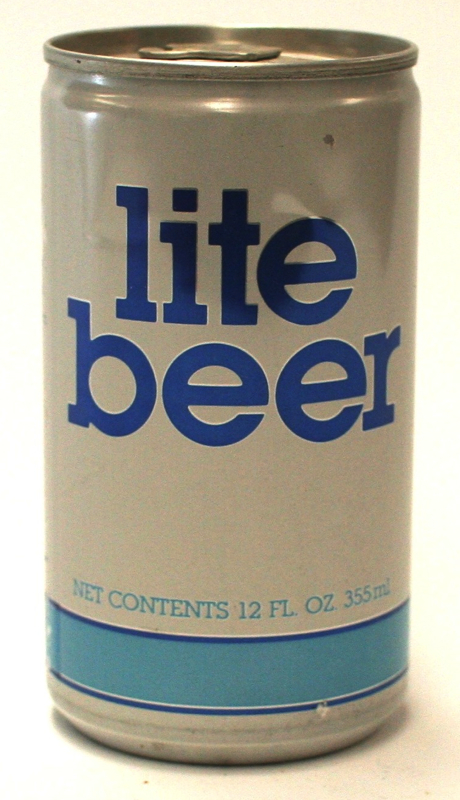
Light beer was the brainchild of one man, who thought people would want diet beer. He was wrong, though he did come up with the process of how to make a low-calorie diet beer. Here’s the story, from an earlier post of mine:

The first low-calorie beer was created by Joe Owades, who, it must be said, had some very strong opinions about beer. He once told me that all ale yeast was dead and inferior to lager yeast. Around 1967, he created Gablinger’s diet beer, the first light beer, while working for Rheingold. It flopped. Big time. Not everybody agrees on what happened next. Some accounts credit Owades with sharing his recipe for light beer with Meister Brau of Chicago while others claim that the Peter Hand Brewing Company (which marketed Meister Brau) came up with it independently on their own. However it happened, Meister Brau Lite proved somewhat more successful than Gablinger’s, primarily due to its superior marketing. Miller Brewing later acquired Meister Brau, and in 1975 debuted Miller Lite, complete with the distinctive, trademark-able spelling.

But it took marketing the new low-calorie beer in a new way so that it removed the “diet” stigma to make it work. They had to trick people into drinking it. Miller’s famously successful “tastes great, less filling” campaign was the primary reason for the category’s success. But it was hardly overnight. It took fifteen years — from 1975 to 1990 — for Miller Lite to reach 10% of the market. Over that time, the other big brewers (loathe to miss out on any market share) introduced their own versions, such as Coors Light and Bud Light, so that whole segment of low-calorie beer was nearly 30% of the beer market by 1990.

Today, seven of the top ten big brands are light beers. Despite its recent dip in sales, it remains a $50 billion segment of the business and still hovers close to half of all beer sold in the United States. That fact, I find to be incredibly sad, frankly. What a great triumph of marketing over common sense and actual taste.

Which is why I hardly think anyone needs to be rushing to its defense. People are willingly drinking it in frighteningly high numbers. I can only assume they’re the same people who buy Wonder Bread, Kraft cheese, TV dinners and every other popular product, even when everybody knows better, healthier, tastier alternatives are available.

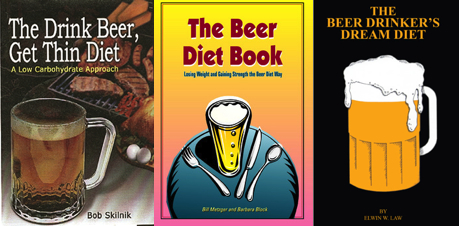
Owades supposedly saw the focus group data indicating that people were giving up beer to save calories. Remember, this was the 1950s. Of course, it seems to me the smarter decision would have been to persuade people that beer is not as fattening as they thought. That this is true means it probably would have been a much easier sell. The idea that beer is so fattening is something of a myth, just like the beer belly. It seems to me that if the beer companies at that time had thrown their millions of ad dollars into that message, things might be a lot better today. But they chose the harder path, one we’re all still paying for. Instead of changing the message, they went with “the customer is always right” approach and created a beer to satisfy the consumer’s misconceptions and incorrect assumptions. In other words, when the customer was wrong, they just went with it. When it tanked, instead of cutting their losses, they instead spent millions persuading customers something that wasn’t true; that beer was fattening, but drinking this “magic diet beer” would fix that. The first thing they learned was not to call it “diet beer.” It’s what pharmaceutical companies have learned how to do so well. They first come up with the drug, then create the condition it will cure, even if it didn’t exist before. Anybody remember “restless leg syndrome” before the drug that treats it came on the market?

Lipinski goes on to detail the technology and the steps in the process that big breweries take to create low-calorie diet beer. And even he admits it was a tough sell at the beginning, and how a barrage of advertising was necessary to make it succeed. So tell me again why I have to respect something that had to be sold to the American people through advertising and marketing and which would probably not exist had that advertising failed? If those ads had not worked, low-calorie diet beer could have just as easily ended up on the scrap heap with dry beer, ice beer or tequila-flavored beer.

Peter Kraemer, a VP at ABI, seems to believe part of the problem is with definitions. He claims that “‘light beer’ has lost all meaning over the years” and he “considers [regular Budweiser and Bud Light] both light beers.” In that, he may be on to something. Regular Bud and Bud Light were once judged at GABF as separate categories, but today are sub-categories under the umbrella “American-Style Lager, Light Lager or Premium Lager,” a category I judged a first round of this year. Indeed, even the technical differences in the four sub-categories are slight. I suspect that they may have been more different at one time, but as Anheuser-Busch finally revealed in a 2006 Wall Street Journal article, Budweiser Admits Flavor “Drifted” Over the Years. So regular Bud has been slowly “creeping” closer to Bud Light over the years. But the fact is they taste pretty similar, have not much difference in terms of calories and are separated only in the way they’re marketed. They remind me of the choice between 87 regular octane gasoline and 91 premium octane. I’m told they’re not the same gasoline but damned if it makes any difference to my car, and I’ve long suspected that it’s like an old Dave Berg cartoon I saw in Mad magazine where all the gas actually comes out of one big tank below the pumps, and really is all the same.

And why not, the driving force in these changes is being able to use less ingredients, making the profits higher. It’s not rocket science. Use less malt and hops, and it will cost less to produce the beer, all other costs being equal. Over a small batch or two, it’s probably not that much, but in vats the size of Montana, it makes a big difference to the bottom line. And that’s plenty of incentive to spend the ad dollars to convince people that the flavor you’re not tasting is what you really want, because it’s better for you, won’t fill you up and, besides, it still tastes great. Trust us.

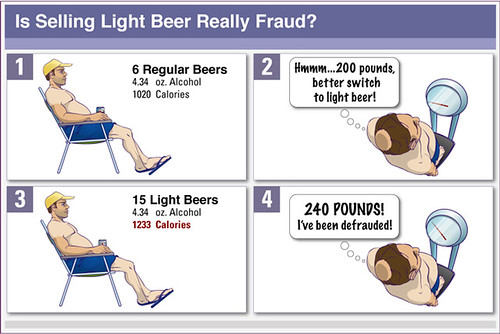
The other reason, or incentive, that the big brewers have for light beer is that having convinced people that they have less calories, people feel that they can actually drink more of them. And that’s what they end up doing. So by promoting them as healthier, diet beer, people end up actually drinking more calories. As The Litigation Consulting Report explains, in order to get the same buzz, that is the same amount of alcohol (which is also lower in most light beers), you’d have to drink 15 light beers to get the same alcohol that’s in six regular beers. According to them, this is known as the “compensation” effect and “is an issue in some product liability cases.”

Selling-Light-Beer

But the diet aspects of beer already work for all beer, no reason to even sacrifice the flavor between the two. But since they’re admittedly both the same, you may as well avoid both regular and the diet versions in favor of something with actual flavor. That’s one of the biggest reasons I hate low-calorie diet beer: there’s simply no reason for it to exist. For most beers, have two instead of three and you’ll be ahead of the game. Drink smarter, drink better.

I realize I’m in the minority here, as every time I write about counting calories, people comment that they do actually watch their caloric intake, but I do not, and never have. I’ve gone over 50 years without counting a single calorie and, while I may not be the world’s healthiest man, I’m not the world’s worst either. And I’ve certainly never regretted choosing to eat or drink whatever I want. I find the slavish obsession to calorie counting absurd, but have come to recognize that many people really do care about them. I’ve written about this issue before, in Calories In Beer: Can We Please Stop?, Calories In Beer: Can We Please Stop, Part 2 and Read This, Not That. Life is undoubtedly about making choices, assessing risks and deciding what’s best for you.

Still, if you love beer, why defend low-calorie diet beer that is in every way as far from actual beer as possible? Everyone acknowledges it has less flavor. It has a few less calories, but stripping calories also strips … wait for it … flavor. But the difference between regular and diet beer seems so slight to me to be almost meaningless, especially when simply drinking one less beer would have roughly the same effect. If Budweiser has 145 calories in a 12 oz. bottle, and Bud Light has 110, drinking three diet beers would save you 105 calories. But have just two Buds, and you’d save 40 calories over three Bud Lights. Better still, choose two Samuel Adams Boston Lagers (160 calories) and you’d still save 10 calories over three Bud Lights or choose two Sierra Nevada Pale Ales (175 calories) and it will cost you only 20 more calories than drinking three Bud Lights would, though you’d still save 85 calories drinking two Sierra Nevada Pale Ales instead of three regular Budweisers. The point is that the caloric savings in diet beers are a sham. The differences are too slight to sacrifice so much flavor and enjoyment.

beer-diets

To sum up, diet beers were created in a laboratory to fill a need that didn’t exist. Making the beer that nobody wanted is incredibly difficult, and much harder than just making normal beer. To be successful, millions of dollars had to be spent on marketing and advertising to convince people to buy the thing that’s harder to make that they didn’t want in the first place. Finally, after nearly 40 years, and at least 20 that they’ve dominated the market, sales are starting to slip as people are choosing beer with more flavor instead. But rather than follow the shifting marketplace, pleas are being made that we should respect the beer nobody wanted that’s harder to make because … well, just because it is so danged hard to make and is a technological marvel deserving our respect.

As Lipinski wittily remarks in his closing sentence, he hopes his efforts at persuading you to respect light beer will “help you see the brew in a new light,” but there’s really nothing new in his arguments. His “scientific reasons” can only command your respect up to a point. I can respect the process, I can respect the technology, I can respect the effort made, but I still can’t respect the results. I honestly don’t understand how anyone can, quite frankly. With no disrespect to the many wonderful brewers who make low-calorie light diet beer, you can do better. You know you can. I have no truck with your skill as brewers or with the technology you wield so impressively. But I want a beer with more flavor. So until diet beer, like so many other diet products, tastes exactly the same as the more flavorful beers I prefer, I can’t give it the respect you insist it deserves.

Filed Under: Beers, Editorial Tagged With: Health & Beer, Light Beer, Mainstream Coverage

Feeding The World

October 31, 2012 By Jay Brooks

food-good
I try to stay away from politics for the most part, because beer lovers come from all walks of life and are from all sides of the political spectrum, too. Beer brings people together, and I find it’s usually best to keep it that way. Regular readers know that I do break that rule from time to time, more often than not when it has something to with beer. So this one’s more of a stretch, except that as I do feel that “beer is agriculture,” and because we all eat food, usually paired with our beer, it’s still within the scope of the Bulletin. If you don’t agree, feel free to just skip this particular rant. Actual beer news will follow.

Here in sunny California, there are a number of contentious propositions on the November election ballot this year, but none, it seems to me, is more combative than Prop. 37, which is about the labeling of GMOs. Although it appears to be an imperfect proposition — aren’t most of them? — the very fact that big agribusinesses and other large mega-corporations are pouring money into the state to defeat it makes me, no compels me, to be supportive of it. I am swayed by the fact that over sixty other nations require GMO labeling. I can see no harm in knowing what’s in my food. I am not persuaded that it will be as costly as the opposition claims. They said the same thing about nutritional labels on food packages, but they’re all still in business today, having endured that “hardship.” I am not persuaded by the number of newspapers against it, because most of the food producers lining up to defeat it also advertise in newspapers. Coincidence? Don’t be so naive. Of course, that could come down to simply lying. I saw yesterday that although television ads against the proposition list the San Francisco Examiner as one of the papers against 37, in fact they have endorsed it.

Even if it passes, it isn’t likely to change peoples’ eating habits any more than warning labels on cigarette cartons stopped smoking. And that’s another argument I can’t abide. Even if true — which it probably is — I tend to err on the side of having more information rather than less, and tend to be suspicious of businesses that actively try to suppress information. Corporations telling me “trust us” or “don’t worry, it’s safe, because we say so” do not exactly inspire the same confidence that transparency does. Especially when the history of corporate malfeasance is so rich with examples of companies placing profits way, way ahead of people.

I suspect it won’t pass. Money does really make a difference in how these propositions fare, and I think most people’s default position is to vote “no” on any of them that are confusing, unclear or contentious. Better to leave things the way they are than change things in an uncertain way. I have certainly felt that way on more than a few occasions. And I suspect that the doubt placed in many voter’s minds by the $34 million barrage of “No on 37” ads will lead many to do just that. I have, however, questioned much of what I’ve seen in the attack ads trying to defeat the proposition, even as for some of it I haven’t known quite what to think. Earlier today, the Yes on 37 campaign posted this video, answering atleast some of those concerns:

I confess my mind’s not made up about GMOs across the board. I certainly don’t think they’re all bad, and there have certainly been instances throughout history where tinkering with nature has been a good thing for us humans. I also know this issue came up a few years ago when Greenpeace attacked ABI for using rice in their beer that may have contained GMOs. While I don’t often side with them, I did think that Greenpeace was out of line there. I should also note that some of the No on 37 ads mention that beer is exempt under the proposition, but that has more to do with the fact that the proposition applied the same standard currently used for labeling all food products, and under current regulations, beer is exempt. So it appears the reason is not conspiratorial.

But can you decide how to vote based on who’s supporting which side of an issue? Maybe. I certainly think there’s a story in who’s on which side. The “Yes on 37 supporters” is a long list that includes (according to the website) 3,643 endorsements that is made up of consumer and public health organizations, food groups (safety, manufacturers, retail), dietary advocacy groups, farmers, farmers markets, co-ops, farming associations, individual farms, medical groups and associations, doctors, political parties, local governments, elected officials, political organizations, natural health businesses, progressive and social justice groups, GMO activists (as you’d expect), labor unions, environmental groups, academics, food writers, chefs and quite a few more.

On the other side of the aisle, No on 37 Donors number around 68 companies, all of which appear to be food or chemical companies. Of the nearly $35 million donated to defeat Prop 37, Monsanto is apparently the leader, with around $7.1 million given to kill it, with Dupont in second place. But the whole lists reads like a who’s who list of ginormous corporations, and includes such well-known players as Bumble Bee Foods, the Campbell Soup Company, Cargill, Clorox Company, Coca-Cola, ConAgra Foods, Dole, Dow, General Mills, Heinz, Hershey, Hormel Foods Corporation, Kraft Food Group, Nestle, Ocean Spray Cranberries, PepsiCo, Sara Lee, Smithfield Foods, the Snack Food Association, Sunny Delight, J.M. Smucker and Unilever. At the bottom of the “No on 37” website, they claim that their efforts are “sponsored by Farmers, Food Producers, and Grocers. Major funding by Monsanto Company, E.I. DuPont de Nemours & Co., Grocery Manufacturers Association” and others. But the only “farmers” there are the giant agribusiness type, while the Yes supporters include what appear to be actual farmers, or, at a minimum, dozens of places with farm-like names.

Is that dispositive? Perhaps not all by itself, but it does, I believe, lead to additional questions about why the majority of the opposition to labeling GMO foods almost entirely have something to do with their creation, manufacture or use. Is their self-interest on the other side? Undoubtedly there is, but for many, if not most, of the supporters, it appears more to be part and parcel with their core beliefs already, not manufactured arguments against transparency.

Whether true or not, it certainly feels somewhat Goliath vs. David-like. I really wish people outside California would leave us alone to vote how we will, instead of pouring money into the state to influence our politics. That always feels intrusive to me, like when the Mormons in Utah spent their millions to defeat the proposition for gay marriage a few years ago. I’ve never understood why foreign nations and their citizens are not allowed to attempt to influence our elections, but people (whether corporate “people” or the regular individual kind) from any state can spend money to influence politics in other states where they don’t live. What’s the difference? I’m certain Monsanto, for example, does business in our state, but they’re a Missouri corporation. Likewise, Dupont is a Delaware corporation. They should stay the fuck out of our politics. That, or move their companies here and start paying state taxes like the rest of us do.

A couple of days ago, someone sent me an article by Frances Moore Lappé and Anna Lappé in the Huffington Post, entitled Seven Things to Tell Your Friends About GMOs. And while I’m no fan of HuffPo — Hey Arianna, how about paying your writers instead of pocketing the millions you make for yourself, you hypocrite — the piece is interesting and brings up a number of good points, at least for a newbie to the issue like myself. Which is, I suspect, the situation most California voters find themselves. We’ve all heard a lot about GMOs, but would be hard-pressed to call ourselves experts on the subject. Since they’re so new, I doubt many people could confidently claim to be experts, but lots of people have their cherished opinions. If you’re a California voter, I’d certainly recommend the Lappé’s 7 Things. At the bottom of the piece, there’s also a link to a video by Food MythBusters: the Real Story About What We Eat which, while not exactly on point for GMOs, is nonetheless interesting and talks more generally about the misinformation spread by the big agribusinesses that are currently spearheading efforts to quash Prop 37.

So hopefully everyone in California will get out and vote this election and will think carefully about this proposition, as well. The rest of the country, and especially the food industry, is closely watching which way this one goes. I personally would love to see it pass, but as I said, I suspect it won’t, and if that’s the case hopefully the architects of it will listen to both the opposition and the honest concerns that many people had with its implementation and fix those aspects of it before re-introducing it again. One final word about it, from a molecular biologist in the San Jose Mercury News, Belinda Martineau: A scientist says yes on Prop 37 to label genetically engineered food, who gives at least one scientist’s perspective on it. For additional reading, see the Ballotpedia entry, discussing both sides of Prop 37 and there’s also the California Voter Guide, which also strives to present both sides fairly.

UPDATE: A good friend of mine tells me that the Lappés’ piece contains numerous mis-statements, so perhaps it should be taken with a grain of salt after all. But here’s another worthy read. Vandana Shiva: Why Monsanto Is Fighting Tooth and Nail Against California’s Prop 37. And SF Weekly’s Anna Roth looked into both sides of the debate over Prop 37 in Three Things I Learned When I Forced Myself to Learn About Proposition 37.

Filed Under: Editorial, Food & Beer, News, Politics & Law Tagged With: California, Food, Video

Beer Bouncing Back

October 29, 2012 By Jay Brooks

bouncingball
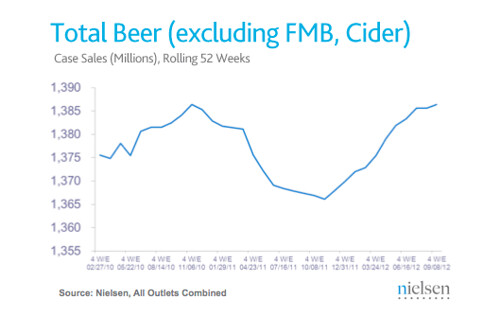
Nielsen, the company that tracks all things trackable, is speculating on their NelsonWire that beer is bouncing back and that this may signal the “beginning of a beer boom.” According to their data, “Beer sales are seeing a surge in growth, up 5 million cases (1.4 percent) in the last 12 weeks through September 1, 2012, in Nielsen-measured retail outlets. The same period last year saw a decline of 1.7 million cases.”

Total-Beer1k-2012

The main reason they cite for this is choice.

With more options on shelves and innovative product offerings, new consumers were attracted to the beer category. Nearly half of the households who were new to malt, or cider-based beverages (beer, flavored malt beverages and cider) in the past six months had bridged over from solely buying wine or spirits last year.

But as they’re focused to a greater extent on the bigger players in the category, they mean choice in a different way than you and I normally understand it. When Nielsen refers to choice, they mean “flavors, formats and packaging,” though in my experience it’s always “packaging options” that seem to get the most attention. But even with the term as common as flavor, it’s used here as more jargon instead of what you’d ordinarily think it means. By “new flavors,” they don’t mean more different styles or kinds of beer on the average beer set shelf. No, they mean line extensions like the two they give as examples: “Bacon Maple and Blue Raspberry Lemonade,” as a part of other already-established brands.

So while this is good news, and we should all welcome a coming “beer boom,” I can’t help but wonder if this “boom” of which they speak — which quite frankly the craft beer side has been seeing for a decade — is not going to favor them as much as the regional breweries and even the smaller craft breweries. That’s what it’s been doing for several years now, and I can’t see any reason to suspect that will change in the coming months or years, no matter how “bright the last quarter of 2012 may be for beer.” Still, a coming “beer boom” sure has a nice ring to it.

Filed Under: Beers, Editorial, News Tagged With: Big Brewers, Business, Mainstream Coverage, Statistics

Higher Alcohol Taxes Reduce Tax Revenue

October 24, 2012 By Jay Brooks

beer-tax
Given that the anti-alcohol folks, and especially my churlish neighbors Alcohol Justice, are continually beating the drum about alcohol taxes being too low, this news is not going to be particularly welcomed with open arms. A British think tank, the Institute of Economic Affairs (IEA), recently took a close look at the effect of higher taxes in alcohol and their report, Drinking in the Shadow Economy, found that the British “Treasury is losing as much as £1.2 billion every year to the illegal alcohol industry.” That, they conclude, is one of the effects of higher taxes on alcohol, because it creates an incentive for people to go outside the law and the safe world of regulated alcohol to make a quick buck. They found that “the illicit alcohol market is also closely associated with high taxes, corruption and poverty. The affordability of alcohol appears to be the key determinant behind the supply and demand for smuggled and counterfeit alcohol.” So place too high taxes on alcohol, and you invite in the wrong element, which we’ve seen in the U.S. before during Prohibition, and which we’re seeing right now with the war on drugs. If that futile policy was reversed, we’d save as much $13.7 billion annually by legalizing, regulating and taxing just marijuana, not to mention we’d remove the criminal element, make it safer and drastically reduce burdens on police, the justice system and prisons.

But back across the pond, the study also notes that the “demand for alcohol is relatively inelastic,” meaning people generally don’t drink less when prices go up, they instead find new ways to address the rising prices. As study after study has concluded, tax hikes are regressive and almost always hit poorer families the hardest, while not eliminating the problem the proponents of such measures claim they will fix.

But here’s that again, said another way:

Our analysis indicates that the affordability of alcohol does not have a strong effect on how much alcohol is consumed. Once unrecorded alcohol is included in the estimates, it can be seen that countries with the least affordable alcohol have the same per capita alcohol consumption rates as those with the most affordable alcohol.

I suspect that’s the case here, too. We know that price hikes cause people living near borders with other states to simply buy their alcohol in the next state over, causing further economic erosion. I don’t know if we have the same issue with counterfeit or illegal beer. Certainly there’s still Moonshine, but beer is probably not profitable enough on its own to warrant illegal breweries flaunting the tax code, not to mention how labor intensive and technology-dependent it is.

Another interesting portion of the report, answering the question “Why Tax Alcohol?”

Temperance and public health campaigners typically dismiss the black market as a problem that can suppressed through rigorous enforcement and tougher sentencing. At worst, they view a growing unofficial market as a price worth paying for a more sober society. This view is rooted in the belief that affordability is the main driver of alcohol consumption and that increasing prices by raising excise duty is therefore the single most effective way of reducing alcohol sales.

Ceteris paribus, economists would expect there to be some truth in this assertion, but there is too much real world evidence to the contrary for it to be taken as an iron rule. For example, alcohol consumption has fallen in most European countries since 1980 despite alcohol becoming significantly more affordable (OECD, 2011: 275).19 In Denmark, Sweden and Finland, the sudden drop in alcohol prices that resulted from EU accession did not bring about the kind of surge in alcohol consumption that the price elasticity models predicted.

A comparison of European countries suggests that affordability has a negligible and statistically insignificant negative effect on recorded alcohol consumption (see Figure 12). Moreover, as Figure 13 shows, when unrecorded alcohol consumption is included in the analysis, affordability does not appear to be a decisive factor in determining alcohol consumption from one country to the next.

Then there’s this long passage addressing some of the philosophy behind taxation which seems to fly in the face of much of the neo-prohibitionists propaganda playbook:

Contrary to temperance rhetoric, high alcohol taxes are not necessarily good for public health because, although excessive alcohol consumption undoubtedly carries risks to health, so too does moonshine. Counterfeit spirits and surrogate alcohol frequently contain dangerous levels of methanol, isopropanol and other chemicals which cause toxic hepatitis, blindness and death. These are the unintended consequences one associates with prohibition, albeit at a less intense level than was seen in America in the 1920s.

It should not be surprising that excessive taxation encourages the same illicit activity as prohibition since the difference is only one of degrees. As John Stuart Mill noted in 1859: ‘To tax stimulants for the sole purpose of making them more difficult to be obtained is a measure differing only in degree from their entire prohibition, and would be justifiable only if that were justifiable. Every increase of cost is a prohibition to those whose means do not come up to the augmented price’ (Mill, 1974: 170-171).

But in a less frequently quoted passage, Mill appears to approve of taxing alcohol to the apex of what we now call the Laffer Curve. Appreciating that governments need to raise funds and that these politicians must decide ‘what commodities the consumers can best spare’, Mill argues that taxation of stimulants ‘up to the point which produces the largest amount of revenue (supposing that the State needs all the revenue which it yields) is not only admissible, but to be approved of’ (Mill, 1974: 171).

This message tends to resonate more powerfully with politicians than Mill’s more libertarian pronouncements. Drinkers generally prefer low alcohol prices. Temperance campaigners nearly always demand higher prices. The politician, however, usually seeks to maximise tax revenues and will only react to the shadow economy when it becomes a serious threat to state finances. Nordlund and Österberg summarise the politician’s dilemma as follows:

‘Domestic economic actors can, of course, support the rules and regulations imposed by the state for controlling unrecorded alcohol consumption, but for these actors a better solution in combating unrecorded alcohol consumption would be the lowering of alcohol excise taxes… In most cases the state is not willing to follow this policy, as lower alcohol excise taxes in most cases mean lower levels of alcohol-related tax incomes. However, if the state is no longer able to control the amount of unrecorded alcohol consumption by different kinds of legal administrative restrictions the only remaining way to counteract, for instance, huge increases in travellers’ border trade with alcoholic beverages or an expansive illegal alcohol market is to lower the price difference between unrecorded and recorded alcohol by decreasing excise taxes on alcoholic beverages.’ (Nordlund, 2000: S559)

It scarcely matters to the politician whether unrecorded alcohol comes from legal or illegal sources. In either case, the treasury loses out on revenue. In Britain, HMRC estimates that the alcohol tax gap could be as much as £1.2 billion per annum, plus the costs of enforcement, and that this is largely because ‘duty rates on alcohol are far higher in the UK than in mainland Europe’ (National Audit Office, 2012: 2, 10). This is the price the state must pay for excessive taxation, but the politician is also aware that these high alcohol taxes raise £9 billion a year (Collis, 2010: 3). Being in possession of these facts he may conclude that reducing the illicit alcohol supply through tax cuts will probably reduce net alcohol tax revenues.

We argue that such a focus on maximising tax revenues is short-sighted and carries significant risks. Failing to deal with alcohol’s shadow economy threatens not only the public finances, but also public health and public order. Unrecorded alcohol has, as Nordlund and Österberg note, ‘the potential to lead to political, social and economic problems’ (Nordlund, 2000: S562). In addition to the health hazards presented by unregulated spirits, alcohol fraud in the UK is, according to the HMRC, ‘perpetrated by organised criminal gangs smuggling alcohol into the UK in large commercial quantities’ (HMRC, 2012: 8). Alcohol smuggling and counterfeiting is linked to other illegal activities, including drug smuggling, prostitution, violence, money-laundering and — in a few instances — terrorism.

Incidentally, you can download a pdf of the entire report here, and at the IEA website.

In the press release, the IEA concludes:

“The government’s focus on maximising tax revenues is short-sighted and dangerous. Aside from losing money by encouraging consumers to find cheaper illicit alternatives, public health and public order are also being put at risk by high prices. Policy-makers ought to take the threat of illicit alcohol production seriously when considering alcohol pricing in the future.”

“There is a clear relationship between the affordability of alcohol and the size of the black market. Politicians might view the illicit trade as a price worth paying for lower rates of alcohol consumption, but this research shows that the amount of drink consumed in high tax countries is exactly the same as in low tax countries.”

“Minimum alcohol pricing might seem like a quick fix to tackle problem drinking, but it is likely to cause many more problems by pushing people towards the black market in alcohol.”

While a fairly emphatic statement against higher taxes on alcohol, I assume that many will still wonder how applicable it is to the United States economy and society. Honestly, I’m sure there are differences, but the overall concept seems sound, at least to me. We can haggle over some of the details, but the idea that higher taxes isn’t always the answer just has the ring of truth to it.

Filed Under: Beers, Editorial, News, Politics & Law Tagged With: Anti-Alcohol, Business, Prohibitionists, Statistics, Taxes, UK

My BFF Beer

September 28, 2012 By Jay Brooks

bff

Canada’s Random House Publishing runs an interesting website called Hazlitt, where, presumably, they feature their own authors on a variety of topics. The one that caught my attention was by Linda Besner, and it’s an essay about My Best Friend, beer.

She begins by claiming that mankind has been “thinking and talking about beer since 4000 B.C.” She’s only off by as much 5,500 years, since brewing is believed to have begun with the “advent of agriculture in the Neolithic Period of the Stone Age about 11,500 years ago.” I don’t want to dwell on that, because we haven’t even gotten to the meat of it, but it did make me initially skeptical.

The story concerns a study that examined beer commercials from both the U.S. and the Ukraine, described as a “cross-cultural study of beer’s metaphors.” Again, I’m quibbling a bit, because the researchers looked at a total of 37 ads from both nations, not exactly a large number, but the author credits them with having “seen a lot of beer commercials.” I think the average consumer might see nearly that many during the average football game, or certainly over the course of a Sunday watching sports in general. But okay, let’s let them make their point. What did they find?

“While the personification of beer is consistent from Ukrainian to U.S. commercials, it seems to me that the kind of person beer is in Ukraine is different from the kind of person beer is in the States.”

In the Ukrainian commercials, the study notes, “people do not become friends by sharing beer; rather beer drinking occurs among individuals who are already established as friends, which entails a close and trusting relationship.” The people drinking beer together are described as druh, which Dr. Lantolf translates as being like the English concept of “best friend,” rather than tovarysch, which translates as “comrade” or “acquaintance.”

In the United States, it’s almost the opposite. Apparently, we use the term “friend” rather loosely, calling people we hardly know, or have just met, our friends. In other words, many of our friends are more superficial, at least compared to how Ukrainians see them.

To illustrate, they give the example of a Budweiser commercial currently up on YouTube under the name “Magic Beer.” A young man sits alone at a bar, opening a bottle. He pours it into his glass, but, miraculously, once the glass is full, beer continues to spill forth. Quickly, he pours some of the excess beer into the glasses of the men next to him. In the next shot, the bar is packed with carousers dancing to a live Scottish band as beer continues to gush from the magic bottle. The erstwhile lonely young man dances between his new friends, a beatific look on his face. Then he drops the bottle. It smashes on the floor, and the flow of beer trickles to nothing amid ghastly silence. The outraged people around him glare daggers. Those closest to him turn and walk away.

Frankly, I hate these ads. They’re not just superficial, they’re utterly ridiculous. Saying they’re depicting how typical Americans act, or view friendship, seems like quite a leap. I think it says more about the advertisers than the consumers, and maybe even a little about the researchers that they think idealized commercials reflect real life.

Even if I accept the premise, that that may be how some people see their “friends,” I’ve never considered such people my friends. Fair-weather friends, perhaps, but that’s a rather derogatory expression. Is it possible I’m not typical? No, I don’t think so, because I’m pretty sure most of the people I know well feel roughly the same way.

I love beer. I make my living writing about it, reviewing, analyzing it, along with the people and companies who make, sell and market it. I have admittedly made friends, to varying degrees, with actual people who work in the industry. But I’d never mistake the beer itself as my friend. It’s an inanimate object, after all. I may love beer, but in the same way I love potato chips or frites. It’s not the same as another person. Doesn’t everyone know the difference?

beer-friend

Not according to the study, apparently. To wit:

It seems that not only do Americans see beer as a person, they see beer as a person other people like better than them. In this scenario, beer is the cool friend you bring to the party who makes you popular by association. As soon as your cool friend leaves, no one wants to hang out with you anymore. It’s doubtful, Dr. Lantolf says, that the producers of “Magic Beer” and other commercials are consciously depicting shallow friendships: “I think that what they were showing is how Americans typically behave.: Dr. Bobrova is originally from the Ukraine, and she says, “I didn’t expect that American commercials would show this superficial concept of American friendships. I have many friends in the U.S. and we spend time together and I share everything with them as with Ukrainian friends. But commercials show a little bit of a different picture. But then,” she adds, “I’m not a beer person.”

Should I be insulted by that? I’m really not sure. I don’t believe that’s “how Americans typically behave.” Sure, there are certainly superficial people in the world, and I’d be willing to accept that a lot of them live here in the States, but I don’t think it’s something most people aspire too. I don’t think Americans view superficiality as a positive attribute. So when the researchers say they think “Americans see beer as a person,” it’s the people in the commercials who may “see beer as a person,” but they’re not real. They’re actors. It’s not the same thing. The advertisers are projecting an image onto the characters to sell us something. It’s not necessarily a reflection of real people, or real life. Am I off base here?

I know many Canadians quietly don’t think too much of their neighbors, and there are certainly times when I agree with them, at least about how we sometimes behave and view the world. But this one I just don’t quite understand. The author of the piece, Linda Besner, is a poet from Quebec who recently published her first collection, The Id Kid. And they may be fine poems, “sassy and sumptuous,” as her publisher describes them, but I can’t help but think she doesn’t know human nature as well as she might think. But the researchers have even more to answer for, since they’re from the University of Pennsylvania, the same school where Patrick McGovern, author of Uncorking the Past, does his research and teaches.

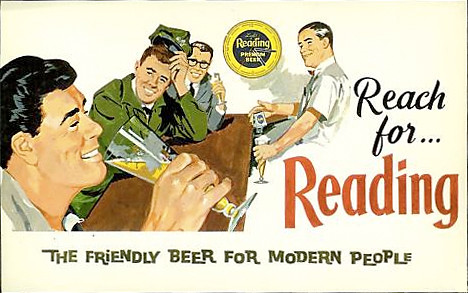
In the end, however effective advertising can be, I tend to think most people know the difference between it and real life. My old hometown beer — Reading Premium Beer — used to advertise with the wonderful slogan: “The Friendly Beer for Modern People.” I love that phrase, but it’s utterly meaningless. I don’t think beer can be friendly, any more than my cat actually likes me when I rub her belly. Oh, sure, it looks likes she’s smiling, but I know she really thinks of me as the hired help. But actual personification, or anthropomorphisation in the case of my feline companions, of beer is ultimately just as futile. It’s just the advertisers trying to project — maybe that needs a new word: advermorphisation — human characteristics onto inanimate objects. Beer will never be my BFF. The people I drink beer with? Those are my people, my true BFFs.

reading-reach-postcard

Filed Under: Beers, Editorial, Just For Fun Tagged With: Advertising, Canada, Science, Ukraine, United States

Beer Drinking Speed Influenced by Glass Shape

September 12, 2012 By Jay Brooks

beer-glass-tulip
With binge drinking front and center of many public policy concerns, the UK’s University of Bristol decided to examine whether it was because of the glass people were drinking out of. The School of Experimental Psychology set out to “explore the influence of glass shape on the rate of consumption of alcoholic and non-alcoholic beverages.” Their results, Glass Shape Influences Consumption Rate for Alcoholic Beverages, were published recently in PLOS ONE, a peer reviewed, open access journal.

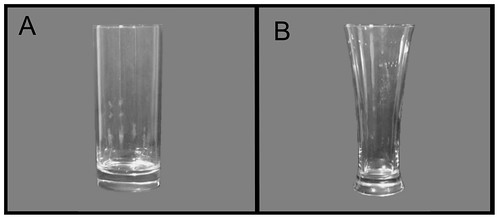
Study participants were given one of the two types of glasses below.

Figure 1

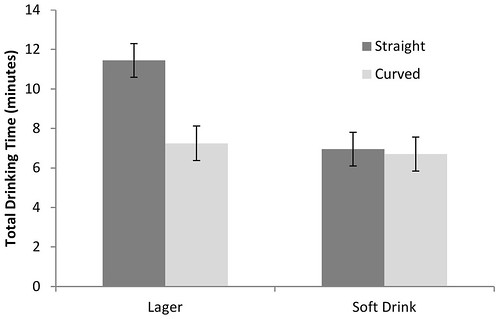
According to the summary by Health Today, “People took about almost twice as long to finish when drinking alcohol from the straight-sided glass, compared with the curved glass. There was no difference in drinking rates from the glasses when the drink was nonalcoholic.” The Bristol scientists conducting the study speculated that “people may swill their alcohol faster from curved glasses because it is more difficult to accurately judge the halfway point of these glasses,” adding that “drinkers may be less able to gauge how much they have consumed.”

They continued:

“People often talk of ‘pacing themselves’ when drinking alcohol as a means of controlling levels of drunkenness, and I think the important point to take from our research is that the ability to pace effectively may be compromised when drinking from certain types of glasses,” said study researcher Angela Attwood of the University of Bristol’s School of Experimental Psychology in the United Kingdom.

While there is a difference, is there a correlation? The researchers seem to think so, though their methodology is unique and it’s the first time, as far as they know, that such a study has been conducted.

Figure 2

Here’s their nutshell conclusion.

Participants were 60% slower to consume an alcoholic beverage from a straight glass compared to a curved glass. This effect was only observed for a full glass and not a half-full glass, and was not observed for a non-alcoholic beverage. Participants also misjudged the half-way point of a curved glass to a greater degree than that of a straight glass, and there was a trend towards a positive association between the degree of error and total drinking time.

But unfortunately they begin with the false premise that “alcohol consumption is associated with increased mortality and morbidity.” Numerous studies have shown that people who drink alcohol in moderation are likely to live longer than either abstainers or binge drinkers (however that’s defined). And at least one study has shown that even binge drinkers will likely live longer than teetotalers. And while there are some persons genetically more susceptible to certain diseases if they drink too much, many other diseases have positive correlations with moderate drinking, that is alcohol use may lower the risk of people contracting those diseases. So public policy really should be aimed at educating the citizenry that it’s in their best interest to drink alcohol responsibly and in moderation. At a minimum, both sides of the story of alcohol should be part of the public discussion instead of the often one-sided version we have today that takes all of the negatives as givens and has no time for any positive findings to balance perspectives.

After more proselytizing and propaganda in their introduction it seems clear which side of the debate they come down on, which I think tends to influence the study itself. They’re looking for a way to reduce drinking — not that that’s a bad goal in and of itself — but while the results seem interesting, the fact is that they set out not to “explore the influence of glass shape on the rate of consumption of alcoholic and non-alcoholic beverages,” as they initially stated, but instead to effect public policy for their somewhat anti-alcohol agenda. It’s not hard to tease that out of how they characterize what they’re doing. For example, when they explain the rise of “branded drinking glasses in the United Kingdom,” they also include statements like “[w]hile alcohol advertising is still permitted in the United Kingdom” (as if they’d prefer it was not or suggesting it one day may not be) and state that glassware with a brewery’s logo on it constitutes a “currently unregulated, marketing channel,” it becomes nakedly obvious that they disagree with the world the way it is.

Happily, unlike many such studies, the entire journal article is online, so you can judge for yourself. I tend to be somewhat paranoid about these affairs, and am usually skeptical about such efforts.

Figure 1

Another issue I have is the glasses themselves. The first is meant, I presume, to be an average pint glass, but it doesn’t look quite like the familiar shaker pint glass. It more resembles the stange, though shorter, but it has the straight walls and does not curve out and taper slightly into a wider mouth like most pint glasses. The second glass is a common type of pilsner glass and more appropriate to the beer they used in the study. But that first glass I’ve rarely seen used in a pub or bar, at least on these shores. Isn’t it just as likely they overlooked the obvious: that participants drank faster because the beer tasted better in a more appropriate glass? They certainly never addressed using a more proper glass and seemed to overlook that aspect entirely, as if it didn’t matter one iota. Considering how careful they appeared to be with so many other aspects of the study, the choice of glasses seems almost comically devoid of reason.

The beer was apparently a 4% a.b.v. lager from Brasserie Saint-Omer, a French brewery. Why an English university didn’t see fit to include a British beer in the study is not disclosed, and to my mind makes little sense. Clearly, the researchers need to get out to the pub themselves a little more often.

But from this preliminary, somewhat flawed first attempt, the authors make the leap that their findings could inform public policy and use them to alter “policy decisions regarding structural changes to the drinking environment which may reduce drinking rates and correspondingly impact on resulting alcohol-related harms.” Whoa, cool your jets there. That’s quite a leap, with almost no apparent understanding of the importance of glassware to beer, even as they admit their “study cannot fully resolve the mechanism which underlies the effects we observed.”

Even if you’re not a hardcore beer geek who insists on just the right glass for a beer, I think we can all agree that a plastic cup is not as good as glass and that some glassware simply works better with certain drinks, in the worlds of beer, wine and spirits. Imagine the hue and cry if they’d suggested people would sip their champagne much more slowly if one used a martini glass or coffee mug for their next wedding toast. I just can’t abide the notion that glassware choice should be dictated by a public policy trying to slow the pace of drinking across the board, using a bludgeon for a problem I’m not even sure actually exists. I tend to be a slow drinker already, so I may not be the target demographic, but I’d still be swept up in its net if my glassware choice was arbitrarily dictated by politicians and so-called health officials. No matter how well-intentioned, they would undoubtedly remove certain glassware from circulation, limiting the types a bar or pub could use in serving their beer. That, I believe, would be bad for all of us. You want that pilsner in a pilsner glass? Forget it, you’ll get the pint glass and like it. Otherwise, you can’t be trusted to drink slowly enough. There are already enough bad bars using a single glass to serve everything they stock, it seems like this could only make things worse.

Filed Under: Beers, Editorial, Just For Fun, News, Politics & Law Tagged With: Glassware, Science

College Drinkers Are Happier & Cooler

August 21, 2012 By Jay Brooks

humor
This has just got to cheese off Alcohol Justice and the other neo-prohibitionist wingnuts, but Time magazine is reporting the results of a recent study that found the unpleasant truth that students who binge drink in college are actually happier and enjoy higher status among their peers. In Why College Binge Drinkers Are Happier, Have High Status, they began with a bang:

College binge drinkers say they’re happier with their social lives than those who don’t indulge — but it’s probably the boost in social status, not the booze itself that lifts their mood, according to new research presented at the annual meeting of the American Sociological Association.

“Binge drinking is a symbolic proxy for high status in college,” said study co-author Carolyn Hsu, an associate professor of sociology at Colgate University in a statement, noting that it’s what the wealthy, powerful and happy students on campus do.

The study found that rich white frat boys reported having the greatest social satisfaction at school and were considered the big men on campus by others. They were not only happier than students in low-status groups — women, minorities and people who were less financially well-off — but also more likely to binge drink. “Binge drinking then becomes associated with high status and the ‘cool’ students on campus,” said Hsu.

Low-status students in turn reported being happier if they binged than if they didn’t. Indeed, alcohol seemed to be the great social equalizer, bringing members of low-status groups to happiness levels similar to those of greater social power if they binged. “Students in all groups consistently liked college more when they participated in the campus’ binge drinking culture,” Hsu said.

The results are still preliminary, but it’s still notable for at least trying to better understand why binge drinking persists, despite endless efforts to curb it. Though to be fair, most of those efforts are misguided bludgeons like “just say no” and other ideas doomed to fail by neo-prohibitionist groups.

Other interesting tidbits included the fact that “the most stressed and highly anxious students were the least likely to binge, suggesting that the negative emotions that often drive alcoholism are not influencing many of these bingers.” And in a related study, it was found that College Men Who Post About Alcohol Have More Facebook Friends. In a way, it’s not surprising, as social status is pretty important at that age, possibly more important than at any other time. College students, often on their own for the first time in their young lives, trying to find themselves and become their own adults, have the added burden of having virtually no education regarding alcohol and having to obtain it through illegal means thanks to the anti-alcohol efforts of the past several decades. So when the study concludes “that the social advantages of binge drinking do not mitigate its negative consequences on health and academic performance,” I can only say, well, duh.

But it’s the final paragraph that contains the most important wisdom, totally lost on neo-prohibitionists and especially people who do not drink.

Surprisingly little research is conducted on the positive effects sought by drug users and what they actually achieve via their drug consumption; the assumption is that alcohol and other drugs are always bad and their users are irrational. But until more studies like this are conducted, prevention programs are unlikely to improve. We can’t prevent what we don’t understand.

Just say know.

Filed Under: Editorial, News, Politics & Law Tagged With: Science, Statistics

Why Is This News? Beer Beats Wine!

August 20, 2012 By Jay Brooks

beer-vs-wine
I never quite understand why this is even considered news at all? The L.A. Times is reporting that “Beer beats out wine as Americans’ booze of choice.” Their source for this so-called news is a new Gallup Poll entitled Majority in U.S. Drink Alcohol, Averaging Four Drinks a Week. But that’s not exactly news insofar as it’s been that way since the dawn of time, or thereabouts. The gallup poll is just a survey, of course, and prone to people’s prejudices and perceptions. So when they report that “Beer edges out wine by 39% to 35% as drinkers’ beverage of choice,” it’s hard not to laugh, and even harder to take it seriously. This is what people tell pollsters, and it’s pretty divorced from reality.

If you want a truer, more accurate picture of peoples’ tastes, look at what they buy. The World Health Organization, at their website, gives the following data, collected in 2005 (though it rarely changes by much):

Alcohol Consumption By Type:

  • Beer: 53%
  • Wine: 16%
  • Spirits: 31%

And the Ginley USDC 2010 reports that for 2009, the volume of alcohol sold in the U.S. — 3.3 billion cases — is divided as follows, giving beer an 85 share:

Alcohol Sales By Volume:

  • Beer: 85%
  • Wine: 6%
  • Spirits: 9%

And by retail dollars — a total $1.89 billion — beer still has a commanding lead:

Alcohol Sales By Dollars:

  • Beer: 52%
  • Wine: 14%
  • Spirits: 34%

It doesn’t really matter what people tell the voice on the other end of the phone when Gallup calls asking for peoples’ preferences, this is what they really drink. And while it does fluctuate over time, it’s been roughly like this as long as anybody can remember. Trying to turn it into something newsworthy takes a certain amount of opportunistic forgetfulness, ignorance and a willingness to ignore history.

And while somewhat petty, this also struck me in a way I couldn’t ignore, like someone slapped me. The author of the L.A. Times piece, Tiffany Hsu, refers to men as floozies, when she reports. “Men tend to be the biggest floozies, downing 6.2 drinks a week on average compared with 2.2 drinks for women.” Now I assume she owns a dictionary, and I was pretty sure what the definition of a floozy was. So after checking at least six dictionaries to confirm my suspicions — like it or not — a floozy is always described as a woman. It’s an old, archaic word you rarely hear these days, but it doesn’t mean someone who drinks too much, as she appears to believe.

There’s also other findings in the Gallup Poll results, part of their annual Consumption Habits poll, and some are interesting, if not altogether showing anything particularly novel or new. But toward the end of Gallup’s press release, they make this obnoxious statement in the conclusion, which they title “The Bottom Line.”

With drinking comes overdrinking, and despite possible reluctance by some respondents to admit problems, one in five drinkers — representing 14% of all U.S. adults — say they sometimes drink too much.

Okay, first of all, WTF! “With drinking comes overdrinking?” No it doesn’t. It’s hardly a fait accompli. Even by their own numbers, that’s twisted logic. 86% of the people polled say they don’t drink too much so one clearly does not follow from the other, now does it? And how about this for twisting; “one in five” is 20%, not even close to 14%. You can’t even say that’s rounding, it’s simply inflating the numbers. So much for even the illusion of accuracy.

And just the idea that one alcoholic beverage has “beat” the other is annoying, too. I may prefer beer, but as a cross-drinker — like most people, frankly — I don’t feel that they’re competing in an us vs. them kind of way. It seems only news outlets hungry for headlines pit the two against one another. The first sentence of the article is “Score one for beer.” What was the contest?

There are plenty of positive stories from the world of beer that mainstream media could be covering. As Garrett Oliver recently wrote in Food & Wine magazine, one of the Crimes Against Beer is its continuing lack of media coverage. Oliver writes. “The public is yearning for more knowledge about beer, and nobody’s giving it to them. Even though craft beer is more popular than wine in the US, every major newspaper has a wine column, and almost nobody has a beer column. What’s wrong with this picture?”

What’s wrong, indeed.

UPDATE: An interesting side discussion came out of my linking Garrett Oliver’s piece, Crimes Against Beer, in which he casually mentions that “craft beer is more popular than wine in the US.” I confess that when I first read that, I thought it couldn’t be correct, but since it wasn’t relevant to the broader point I was trying to make in this post, I didn’t dwell on it. Alan, from A Good Beer Blog, however, did, and used it as a launching point for his own post, Is All That Made Up Stuff A Problem With The Dialogue?. He also did a little digging this morning to get at the actual numbers, and between the two of us, here’s what we found. Alan looked at statistics gathered by the Brewers Association and the Wine Institute. He found that in 2011, there were 347 million cases of wine and 11,468,152 barrels of craft beer sold in the U.S. From that he concluded that craft beer volume is roughly one-third of wine. Being lazier than Alan, I looked at retail dollars from the same sources and saw that there was an “estimated $8.7 billion” in craft beer sales and $32.5 billion in U.S. wine sales. That works out to craft beer selling about 26.8% — just over one-quarter — of wine sales. So no matter how you slice it, craft beer sales are nowhere near that of wine sold in America. That number could be slightly higher, as my one quibble with this is that the Brewers Association definition of what it means to be a craft beer is fine for their purposes (which is membership-based) but is not practical in the real world where what makes a beer crafty is, to my mind at least, how it’s made and how it tastes. I do, for example, consider Blue Moon a craft beer. And that would change the numbers to some degree, but I suspect not enough to alter the fact that wine still outsells craft beer, at least for now.

Filed Under: Beers, Editorial, News, Politics & Law Tagged With: Mainstream Coverage, Poll, Statistics

“Craft Beer” Added To Webster’s Dictionary

August 14, 2012 By Jay Brooks

webster
The interwebs are all abuzz with the news this morning that the term “craft beer” has been added to the Merriam-Webster Dictionary. I know very few people who are happy with the term already, so this is probably not going to help. The definition they chose doesn’t seem to quite work. I know they were trying to generalize a term that itself has struggled to be defined, and there are already many differences of opinion about what the term means, so it was no easy task. Even so, it seems like a fail. It will apparently be in the next print edition of the dictionary, but has already been added online. Here’s the entry:

craft beer noun

Definition of CRAFT BEER

: a specialty beer produced in limited quantities : MICROBREW

First Known Use of CRAFT BEER

1986

That definition suffers from the vagueness of what it means to be “a specialty beer” — which itself needs to be defined — and that it includes only beers that are brewed “in limited quantities.” As opposed to those beers in unlimited quantities? Does that mean year-round beers cannot be considered “craft beer?” Probably not, but my point is this is a pretty inelegant attempt at defining craft beer. It’s simple, at least, but hanging what it means to be a craft beer on it being “special” and “in limited quantities” is not exactly doing anybody any favors.

But other dictionaries have also tackled “craft beer” with mostly the same uninspired results. Here’s a few others.

American Heritage Dictionary: A distinctively flavored beer that is brewed and distributed regionally. Also called craft brew, microbrew.

Dictionary.com: an all-malt or nearly all-malt specialty beer usually brewed in a small, regional brewery.

Oxford English Dictionary: a beer with a distinctive flavour, produced and distributed in a particular region.

Stan had a post a couple of years ago about Craft beer: The 1986 definition that explores its origins. A lot of terms have come and gone, picked up and fallen out of favor, and there’s a twitter discussion swirling about what the next term will be, with Ray Daniels suggesting “Artisan Brewer” as the “next big thing.” Here are a few that have been, and continue to be, used to describe beer that’s not “good old macrobrew made in vats the size of Rhode Island” (however we define that, too), and at least one suggested this morning just in jest:

  • Artisan Beer
  • Authentic Beer
  • Boutique Brewer
  • Cool Brewer
  • Cottage Brewery
  • Craft Beer
  • Craft Brew
  • Flavor Beer
  • Hand-Crafted Beer
  • Handmade Beer
  • Microbrewery
  • Nanobrewery
  • Picobrewery
  • Real Beer
  • Regional Brewery
  • Small Batch Beer
  • Small Brewer
  • Specialty Beer
  • True Beer

Did I miss any? Are there any you think should be added for consideration? What do you think we should call this stuff we all love? Maybe just call it “beer” and be done with it?

Filed Under: Editorial, Just For Fun, News, Politics & Law Tagged With: Words

« Previous Page
Next Page »

Find Something

Northern California Breweries

Please consider purchasing my latest book, California Breweries North, available from Amazon, or ask for it at your local bookstore.

Recent Comments

  • Ernie Dewing on Historic Beer Birthday: Charles William Bergner 
  • Steve 'Pudgy' De Rose on Historic Beer Birthday: Jacob Schmidt
  • Jay Brooks on Beer Birthday: Bill Owens
  • Steve 'Pudgy' De Rose on Beer Birthday: Charles Finkel
  • Steve 'Pudgy' De Rose on Beer Birthday: Bill Owens

Recent Posts

  • Beer In Ads #5204: Oh Brother! Griesedieck Bros. Genuine Premium Bock Beer Is Here! February 15, 2026
  • Historic Beer Birthday: Emil Resch February 15, 2026
  • Historic Beer Birthday: Philip Zang February 15, 2026
  • Beer In Ads #5203: Robert Portner’s Bock Beer February 15, 2026
  • Historic Beer Birthday: August Schell February 15, 2026

BBB Archives

Feedback

Head Quarter
This site is hosted and maintained by H25Q.dev. Any questions or comments for the webmaster can be directed here.