Brookston Beer Bulletin

Jay R. Brooks on Beer

  • Home
  • About
  • Editorial
  • Birthdays
  • Art & Beer

Socialize

  • Dribbble
  • Email
  • Facebook
  • Flickr
  • GitHub
  • Instagram
  • LinkedIn
  • Pinterest
  • RSS
  • Twitter
  • YouTube

Powered by Genesis

Alcohol Fees Vs. Taxes: The Sinclair Decision

June 25, 2010 By Jay Brooks

sinclair
Warning: This post is primarily about arcane legal distinctions and standards that will (or should) be applied to what’s going on in San Francisco. If that’s not your pint of plain, you may want to ignore this post. Yesterday I dipped my toe in the mash tun that is the city of San Francisco’s proposed “Alcohol Mitigation Fee Ordinance” (AMFO). The reason they’re characterizing it as a “fee” instead of a “tax” has to do with politics. A fee doesn’t require a two-thirds vote like a tax, just a simple majority.

Another odd detail that’s missing is a requirement for this type of fee is that a Nexus Study be done, and the proposed ordinance does indeed make reference to it on Page 3, where they claim it’s on file with the Clerk of the Board of Supervisors but leave a blank space for the file number. The reason it’s left blank is because there is no completed Nexus Study, as required. The proponents of the ordinance claim it will be completed in a week, but then why didn’t they wait until it was done before introducing the fee ordinance? If that’s a requirement, it seems they’ve jumped the gun, and this will give opponents less time to review the Nexus Study, which doesn’t seem at all fair.

There’s also no mention in the language exactly how they will collect from companies who do business in San Francisco but have no offices in the city, and thus are outside the city’s jurisdiction?

The earlier draft version of the AMFO included the language “ethanol ounce.” While nobody was sure how that was being designed, it’s now moot because the final document changed the language at the 11h hour to “ounce of alcohol” which is still rather vague and subject to a variety of interpretations as to how it will be applied. If I had to guess, I’d say that it’s possible that the strong spirits lobby got that change made since it would impact them the most by reducing their proportional taxes while beer would get hit the hardest. Curiously, all of the news reports I’ve seen, such as the one from KTVU Channel 2, a typical example, continues to use the phrase “ounce of ethanol” suggesting the mainstream media is working off of earlier versions or not looking at the source document at all. In either event, it’s not exactly stellar reporting and gives the public who reads that the wrong impression of what the AMFO will actually be doing.
sinclair-pinup

But the biggest hurdle is one that’s been in place since 1997, when the California Supreme Court decided the case of Sinclair Paint Co. v. State Board of Equalization, et al. In that seminal case, the state tried to impose a fee on paint companies for potential harm caused by lead paint. Here’s a summary, from the Pillsbury Tax Page: “The Supreme Court held that case law clearly indicates that the police power is broad enough to include mandatory remedial measures to mitigate the past, present, or future adverse impact of the fee payer’s operations, at least where, as here, the measure requires a causal connection or nexus between the product and its adverse effects.” [my emphasis.] What that means is that a “fee” of this type in order to be constitutional and not need a two-thirds majority like any other tax (in other words to keep its “fee status”) it must be proven to have a direct link to the harm being caused by the product being taxed … uh, excuse me, having a fee imposed on it.

In their conclusion, Pillsbury characterizes these fees as camouflaged taxes.

The potential impact of Sinclair is tremendous since it is completely dependent upon the Legislature’s propensity to camouflage taxes as fees. Virtually every industry can be found to place some type of burden on society and now the Court has only limited the Legislature’s ability to impose fees on those industries within the bounds of its inventiveness. It is difficult, if not impossible, to reconcile Sinclair with the state of the law existing prior thereto.

And for the past thirteen years that’s been the standard and remains the controlling case. That means that the AMFO has to “prove” a direct link from the alcohol and the harm they claim is placing such an onerous burden on city resources. In the first two pages of the AMFO, they cite several studies they believe show such a link. But they’re wrong. For every study cited, I could produce ten that says the opposite, including studies that show that the moderate consumption of alcohol makes a person healthier than abstaining. To me, that suggests that trying to keep people from drinking is reckless endangerment or at least is putting the health of every adult who drinks moderately and responsibly at risk. And some of the studies mentioned aren’t even cited, meaning there’s no way to even confirm they say what the AMFO says they do. To say that their “proof” is shoddy is an understatement.

But, as usual, that doesn’t stop Bruce Lee Livingston, executive director of Marin Institute, from trotting out his favorite bullshit line, modified for the specific occasion. “It’s time for Big Alcohol, including wholesalers, to pay its fair share. A local alcohol charge for harm fee is long overdue.” I’m so tired of having to address this each and every time they give voice to this lie. As I’ve said many, many times, no other product save tobacco pays more taxes than alcohol already. To say that there’s some “fair” amount that alcohol companies should be paying is utter nonsense. There’s no amount high enough that would actually satisfy the Marin Institute, all they want to do in reality is put all alcohol companies out of business, the economy and a majority of people’s wishes be damned.


Filed Under: Beers, Editorial, Politics & Law Tagged With: Law, Prohibitionists

San Francisco Wants To Add Alcohol Fee To Every Drink

June 24, 2010 By Jay Brooks

san-francisco
They tried this last year, unsuccessfully, but the neo-prohibitionists are nothing if not incessant. So it’s now been introduced again. City of San Francisco Supervisor John Avalos has introduced the “Alcohol Mitigation Fee Ordinance” (AMFO) in an effort to impose a “fee” (which is technically different from a “tax” since that would be illegal) on alcohol sold in the city. They can call it a “fee” or anything they like if that makes it legal and presumably keeps their conscious clear, but a tax is defined as “a compulsory contribution to state revenue, levied by the government on personal income and business profits or added to the cost of some goods, services, and transactions.” [Oxford Dictionary of English.] If it walks and talks like a duck, guess what it is? It’s complete and utter bullshit, not to mince words.

The stated rationale is that the “fee” is meant to cover the so-called harm caused by people who use alcohol by charging a fee to the distributors and retailers who sell it. For support of that idea, they cite studies that are nowhere near impartial. Essentially they just shopped for the studies that said what they wanted, ignored those that contradicted them, and used that to “prove” their case.

If passed, the AMFO would add a fee of $0.076 to every ounce of alcohol sold in San Francisco. So if I understand that correctly, for a 12-oz. bottle of beer that would be an additional 91.2 cents and for a pint another 121.6 cents, or roughly $1.22. And that fee will imposed at the wholesale level, and the distributors will then naturally mark-up the fee, and so will the retailers, meaning in reality the price of a pint will go up at least a dollar and a half, possibly more. The Marin Institute, who’s really behind this fee, is selling this idea as a “nickel-a-drink” because they’ve found that it polls well with consumers who see no problem with an extra nickel. But as is so typical with the Marin Institute, their “nickel-a-drink” propaganda is just another one of their numerous lies.

Earlier versions of the proposed ordinance used the term “ethanol ounce” presumably to equalize the alcohol content in different types of drinks, like spirits and wine which usually have higher alcohol percentages. The latest version appears to have dropped that, meaning that the fee on beer would be proportionally much, much higher than spirits or wine.

Where this whole idea came from is the despicable Marin Institute, an organization as anti-alcohol as one could imagine. They’ve been pushing this “fee” idea and using the rhetoric about “charge for harm,” which may sound good on paper but it’s entirely unfair to ordinary casual drinkers, which constitute the vast majority who drink alcohol. The Marin Institute claims that “Big Alcohol [should be] accountable for the tremendous harm its products cause. Appropriately taxing alcohol in each state and at the federal level will help reduce over-consumption, as well as provide much-needed funds for prevention and health care.” They hardly even say why that should be the case, so sure are they that people will just swallow that idea without thinking about it. But let’s think about it anyway.

Do the products actually cause any harm or do some people abusing the products cause the harm? Obviously, it’s not the alcohol itself, but its misuse that causes any trouble. If those people who abuse alcohol are straining the health and police resources of San Francisco, then the city should charge them. But saying that the alcohol those people abused should foot the bill is prima facie ridiculous. We don’t charge soda companies for all the unhealthy people that result from drinking pop, or red meat, or any other unhealthy foods that make unhealthy people thus placing a greater burden on our health care system. We don’t charge parachute companies or other extreme sports equipment manufacturers for increased use of emergency room facilities that are disproportionally called upon by extreme sports enthusiasts when “accidents” happen. We don’t put a tax on motorcycle purchases even though its more likely that a motorcycle rider will be involved in an accident, and/or that their accident will likely be more serious than if that accident occurred while driving a car, thus placing a greater burden on our healthcare system. I could go on and on. The point is that it’s absurd that alcohol companies should be responsible for any harm that an adult drinking one of their products might cause to himself or someone else. But the neo-prohibitionists keep on making that argument, regardless of how specious it is.

Even assuming their assertion that there is any “harm its products cause,” it’s still not everybody who drinks alcohol. This “fee” punishes everyone who drinks because it raises the price for everybody across the board. That means that the 99% of adults who drink responsibly and don’t place an undue burden on the city’s resources are forced to pay for the 1% that might. And yet the Marin Institute has no problem saying that’s not only fair, but how the world ought to be. According to them, alcohol has to pay for any harm someone who drinks it may cause, but every other product in the world does not. Why? Obviously, it’s not remotely about fairness or even funding healthcare for people who need it. It’s about punishing alcohol manufacturers and consumers who drink it in any way they can think of. They also claim that others states have similar policies in place, as if that makes it right, but then contradict themselves in their press release by stating that if passed, the “San Francisco alcohol mitigation fee will be the nation’s first local ‘charge for alcohol harm’ program, expanding on traditional nuisance and enforcement laws.”

What will this do to San Francisco’s business should it cost 30%+ more for a drink (or at least $1.25 and possibly as much as $2 more per pint) in the city versus the surrounding big cities like Oakland or San Jose? I think they’ll lose convention revenue, not to mention the nighttime and weekend influx from the Bay Area to the city. And tourism could take a hit, too. Not that any of those concerns are remotely part of the Marin Institute’s list of things they care about. How, or why, they cozied up to Supervisor John Avalos remains a mystery. He, at least, should care about what this might do to San Francisco’s economy. And don’t forget this is a test case. If it works and San Francisco does impose this “fee,” you can bet it will be tried in every metropolitan area where the neo-prohibitionists have a “friend” in local government. Alcohol is already the most taxed consumer good on the market today, but the wingnuts at the Marin Institute won’t rest until it’s taxed out of existence entirely. Yesterday, they took one more step closer toward realizing that goal.

marin-institute
Be afraid, be very afraid….

Filed Under: Breweries, Editorial, News, Politics & Law Tagged With: California, Distributors, Prohibitionists, San Francisco

Update On Steve Altimari

June 16, 2010 By Jay Brooks

mountain
I spoke to Steve Altimari, former brewer with Valley Brewing in Stockton, who’s vacationing in his home town near Ithaca, New York, with his family. Naturally, I asked about what went down at the brewery and why he was out of a job. Having known Steve for a number of years, I was well aware that the family-owned company had its share of drama and that they hardly knew what a talented brewer they had in Steve. Here’s what he was able to tell me.

About a month ago, he heard from the owner, Kelly Jacobs, that she wanted to sell the brewery and gave Steve a price if he was interested. So Steve went to work, found partners and investors in short order and made an offer based on his earlier conversation with Jacobs. No dice. The price was now inexplicably higher. They tried again with higher offers, but each time the owners kept raising the price. Then they fired John, their only salesman. Last Thursday, they tried one last offer, which met with the same frustrating negative response. On Friday, the day before Steve was scheduled to take a family vacation, he asked for explanation. He was told they “decided on another offer, and they don’t need you. Thanks, but get out.” In less than two hours he was locked out of the brewery that he helped build for the past fourteen years.

I never expected that the owners were warm and fuzzy people, but that takes ingratitude to a whole new level. None of the family members know the slightest thing about brewing and if not for the Herculean efforts of Steve, no one would have ever heard of their brewery. I realize it’s unfair to place any of the blame on the new owners — whoever they may be — but it’s going to be difficult for anybody to come in and fill his shoes.

On the plus side, the partners and investors are sticking with Steve and the plans now have shifted to acquiring or building a brewery somewhere in the Bay Area. Apparently, the financing is already in place, so we may not be without beer brewed by Steve Altimari for long.

Steve will be hard at it when he returns from vacation next week, and the first order of business is coming up with a new brewery name. I suggested something that’s the opposite of a valley, like a mountain peak, which is why the icon above is of Mt. Everest. Then perhaps Altimari Brewery could work; it means “high water.” Let’s wish him the best of luck. What brewery name suggestions do you have for Steve’s new venture?

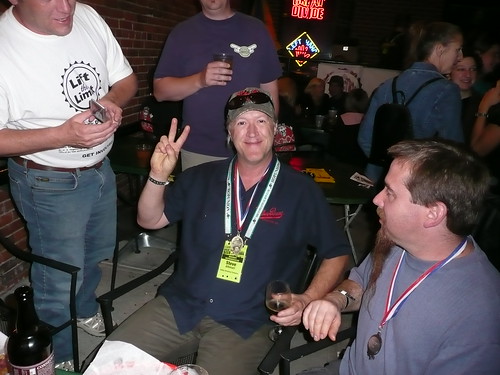
Peace Or 2 Medals: Steve Altimari, from Valley Brewing
A very happy Steve at the Falling Rock Taphouse in Denver, after winning two medals at the 2009 Great American Beer Festival.

Filed Under: Breweries, Editorial, News Tagged With: California, Northern California

Bavaria Beer Marketing Terrorists Strike Again

June 16, 2010 By Jay Brooks

bavaria
You may recall that during the last World Cup in 2006, The Dutch brewery brand Bavaria got themselves in hot wort by stealth marketing their brand during a match where fans wore orange lederhosen with the brewery’s logo on them, an item they sold online at the brewery’s website. I wrote about it then under the title Beer Marketing In Your Underwear? The official beer sponsor, Anheuser-Busch, got their lederhosen in a bunch because they were the “official” beer of the World Cup, ruffling more than a few feathers in Germany with it’s own rich beer history.

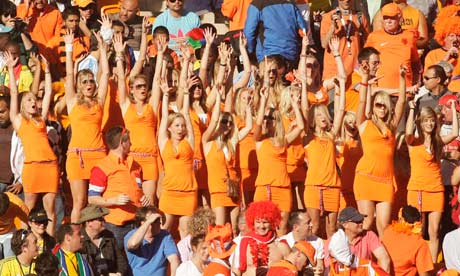
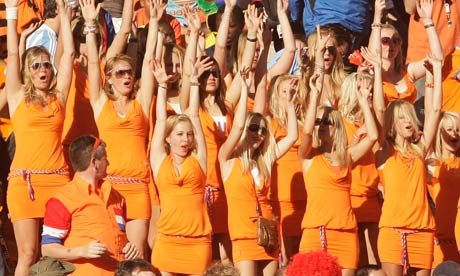
Fast forward four years to the World Cup in South Africa and nobody seems to have learned a damn thing from history, except perhaps the Bavaria Brewery. This year, during the match between the Netherlands and Denmark, 36 women were arrested for wearing plain orange dresses in a block of seats. I’m fairly certain it was indeed stealth marketing on the part of the brewery, but they broke no laws. There was no branding on the dresses and orange is the national color of Holland. Bavaria Beer has an entire Flickr gallery devoted to pictures of women wearing their plain orange dresses.

women-in-orange-dresses

But FIFA stepped in to protect its revenue stream for the millions paid by Anheuser-Busch InBev to be the “official,” and more importantly exclusive, beer of the World Cup. The women were ejected from the game and “arrested under the Contravention of Merchandise Marks Act, which prevents companies benefiting from an event without paying for advertising.” FIFA in a statement said they “view ambush marketing in a very serious light” and called the act of wearing an orange dress an “illicit activity.” The police in South Africa have opened a “criminal investigation,” according to the UK’s newspaper, the Guardian.

But despite the rhetoric, they’re not exactly terrorists. They were all wearing plain orange dresses. Period. Arresting them gave the Bavaria beer brand more publicity than leaving them alone would have. And it does nothing to dispel the image of FIFA and ABIB as thugs who’ll do whatever they like to protect revenue streams above all else, human rights be damned.

As Pete Brown concludes in his own rant over this incident:

Let’s be realistic: even though Bavaria have denied involvement, of course it was a marketing stunt: why else would forty identically dressed women turn up in one block? But it’s a brilliant stunt: once again, Bavaria has had acres of free press coverage, and Fifa and Bud have been made to look really quite sinister and scary.

But that’s because they are. We all know it’s a marketing stunt, but it doesn’t break any rules. The rules prohibit competitive beer branding around the stadium. There was no branding. End of.

As the Bavaria spokesperson says, Fifa don’t have a trade mark on the colour orange. This is an astonishing abuse of human rights — admittedly a trivial one in the context of South Africa’s recent history, but still deeply disturbing, because it’s all about protecting the commercial rights of a beer brand. No brand should have the power to do something like this. If Fifa and Bud are to remain consistent in this policy, we should expect them to eject and detain any England fan with a St George’s cross flag, T-shirt or face paint, because this is a device used extensively in marketing by Bombardier, a competitive beer brand to Budweiser. That would be utterly absurd, outrageous and unacceptable of course. But then so is this.

How A-B InBev think this ugly, bullying behaviour helps enhance Budweiser’s reputation is beyond me.

I know it’s naive to think that any international sporting event should be just about the game, but I continue to hold out hope. But this is one more potent reminder of how the world really works. What Bavaria did may be technically against FIFA’s “policy” (which is very different from a “law”) yet they treated the policy-breakers like terrorists and used police powers essentially to carry out and punish people for breaking the rules of a corporation, reminding me chillingly of the way the military and police have been used to break up strikers. Money and power increasingly call the shots while human beings and small enterprise get trampled. I, for one, am going to start wearing a lot more orange.

women-in-orange-dresses-detail

UPDATE: A few more worthwhile articles about the incident have popped up. These include another Guardian piece, Another triumph for Fifa’s chillingly efficient rights protection team, by Marina Hyde, and Central State Asylum has a nice post from a legal standpoint. But perhaps most hilarious, someone has set up a Facebook page, I’ll buy Bavaria for the match to annoy FIFA.

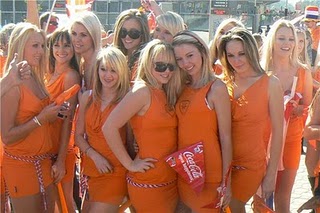
women-in-orange-dresses-vs-japan

UPDATE 6.19: Apparently the gals in orange did show up for the game versus Japan on June 19.

Filed Under: Beers, Breweries, Editorial, News Tagged With: Marketing, Sports, The Netherlands

Session #40: Session Beers

June 4, 2010 By Jay Brooks

session
Our 40th Session is, ironically, about Sessions themselves. Not drinking sessions per se, but Session beers, perhaps the best choice for drinking during a drinking session. Our host, Erik Lars Myers from Top Fermented has chosen a topic near and dear to Lew Bryson’s heart — as well as many other beer lovers — session beers, which he describes as follows.

There are a thousand ways to approach this.

What is your definition of a session beer? Is it, as Dr. Lewis suggested at the Craft Brewers Conference this year, “a pint of British wallop” or is your idea of a session beer a crisp Eastern European lager, a light smoky porter, a dry witbier, or even a dry Flemish sour?

Is it merely enough for a beer to be low alcohol to be considered a session beer, or is there some other ineffable quality that a beer must hold in order to merit the term? And if so, what is that quality? Is it “drinkability”? Or something else?

What about the place of session beer in the craft beer industry? Does session beer risk being washed away in the deluge of extreme beers, special releases, and country-wide collaborations? Or is it the future of the industry, the inevitable palate-saving backlash against a shelf full of Imperial Imperials?

What are some of your favorite session beers? When and where do you drink them? If you’d like, drink one and review it.

session_logo_all_text_200

I tend to think of Session beers loosely as any beer under 5% a.b.v. and which can withstand an evening of leisurely paced drinking without reducing one to belligerence, sloppiness or incoherence. In other words, it’s a beer that allows you to stay lucid and keep up your end of the conversation throughout a drinking session, however long (within reason, of course) as the evening waxes and wanes or the discussion meanders. That’s it for my definition.

Lew Bryson at his wonderful Session Beer Project adds that it must also be flavorful, balanced and priced reasonably. And while I agree that to be a “good” session beer those qualities are desirable, I must respectfully disagree with my learned colleague that it ought to be a requirement. Just as there are bad Imperial Stouts and good Imperial Stouts, I believe there can be bad session beers, too, but either can still be considered a session beer. An expensive low-alcohol beer that’s unbalanced and not too flavorful, to my mind, is still a session beer. It’s just not one I’d drink.

But perhaps that’s just me. What I’m actually more interested in thinking about is the sessions themselves. There just aren’t enough of them. I’m in the middle of reading Kingsley Amis’ book Everyday Drinking. Actually it’s a collection of three short books by Amis that he wrote throughout his career: On Drink (1973), Every Day Drinking (1983), and How’s Your Glass? (1984). In the first, written in the early 1970s, Amis complains mightily about the demise of pub atmosphere brought upon by loud music, among other things. I can’t say why the switch began then in the UK, but for our purposes I’ll take his word for it. What struck about this is that the main reason he disliked this so intensely was not because of the music itself, but its volume. It killed conversation. It killed drinking sessions because people had to shout to be heard and often just gave up trying. He speculates that this may be because when people couldn’t talk, they drank more, which if your livelihood depends on people drinking more then that indeed might provide sufficient incentive for publicans to crank up the music.

Throughout this and the second book, it’s clear to me that Amis valued entertaining and the sharing of ideas, conversation, friendship, etc. that went along with an evening of drinking and eating above all else. His entire philosophy seemed aimed at creating the perfect party atmosphere in which all those things might flourish. In essence, he wanted to dissect and identify the elements to do just that.

And while I have had my share of uplifting drinking sessions in a pub or bar, the noise factor can make them less enjoyable or impossible altogether. Sometimes that’s okay, other times it feels like a missed opportunity. I love music wholeheartedly. I’m a former musician. One of my favorite quotes, by Friedrich Nietzsche, is “without music, life would be a mistake.” But there are times when a little quiet can go a long way, too. Whether turning it down or eliminating it completely, sometimes it’s just more enjoyable to hear your own voice and those of your friends without straining to hear them over the din.

Not all the time, of course. Sometimes listening to a great band is also the stuff of a wonderful evening. But whether there are quiet conversation rooms — the aural equivalent of smoking or non-smoking; “would you like the high-decibel section or would you prefer to be seated in the low-decibel area?” — or even certain designated quiet evenings at a bar, it might go a long way to bring back the fading art of conversation. I’d certainly be more inclined to go to a more quiet bar if my aim was to meet friends and enjoy one another’s company, not just drink in the same vicinity, as sometimes happens when a room is too loud.

Maybe it’s because I’m getting older, or maybe it’s because I just prefer talking too much, but I’d certainly like to see more opportunities to drink and talk, which to me is what a session is all about. If we don’t have the session to go with the session beers, than for me the session beer loses some of its purpose, its raison d’être.

I’ve been thinking about this a lot lately, and my modest plan to change this situation, at least for myself, started two months ago when I finally launched my own regular drinking sessions. I founded what I’m calling the Philopotes Society, and we’re having “meetings” the last Tuesday of every month. A “meeting” consists of an evening of friends getting together at my house, drinking some beer (usually about 30 bottles), eating some food (usually bread, cheese, chocolate and charcuterie) and talking about life, the universe and everything, but especially the beer. We’ve met twice so far and I think it’s been a resounding success. It also helps me clean out my refrigerators and try new samples that are sent to me during the prior month.

Tasting in a group has always been preferable to me than sampling alone for work. I have about 40-odd people — I’m fortunate to have friends who are brewers, chefs, writers, suppliers, retailers, homebrewers and curmudgeons like myself — and if 8-10 show up each month, we have the makings of a pretty cool evening. So far that’s the way it’s working.

The word philopotes is a great word I learned reading Iain Gaitley’s fabulous book, Drink: A Cultural History of Alcohol. Essentially it means “lover of drinking sessions.” And I chose the holy grail as our symbol (actually it’s the grail from Indiana Jones and the Last Crusade, but never mind) because, like the grail, it’s not about actually finding the cup. What’s most important is the search for it. It’s the journey that really matters. The quest for the perfect beer. To me, that’s high adventure. That’s a session. For that, we need more session beers.

philo-banner

Who knows, perhaps one day they’ll be Philopotes Society chapters all over the world. For now, I’m content to have a drinking session I can count on where I know I can enjoy my own session beers. And Lew, you’re welcome anytime.

Filed Under: Beers, Editorial, Related Pleasures, The Session Tagged With: Philopotes Society, Session Beers

UK Wants Pubs To Be Responsible For Patrons

June 2, 2010 By Jay Brooks

pub-sign
According to an article in the UK’s Publican, the National Institute for Health and Clinical Excellence (or, ironically, NICE), which describes itself as “an independent organisation responsible for providing national guidance on promoting good health and preventing and treating ill health,” has made several recommendations for tackling their nation’s alcohol abuse problems.

I’ll skip most of these. Not only have they been floated before, but I and many others have discredited them before. They recommend the old saws; minimum pricing, limiting the number of places in a given area where alcohol may be purchased and a total advertising ban. Most of them are nonsense, but here’s the one that sticks out this time around.

“Protection of the public’s health” should be added to the current licensing objectives.

What that means essentially, is that NICE wants pubs to be legally responsible for individual customers’ behavior as a condition of being licensed by the government to sell alcohol. There are already laws, at least on this side of the pond, where bartenders can’t serve a person who is obviously intoxicated or at least over-intoxicated. I don’t know if the UK has a similar law.

I’ve never liked these kinds of laws, because they’re overly paternalistic. They remove personal responsibility and place it on businesses, and their employees, to determine for someone when they’ve had enough. Now obviously, there are some people for whom their behavior makes this very easy and those people should not be served more alcohol. No bar I know wants to keep serving a belligerent or sloppy drunk. It’s not really good for business for a variety of reasons. These laws also give people an excuse to act irresponsibly, knowing they can always blame someone else, using the law to their advantage and avoiding any responsibility on their own part.

But what about the judgment calls? Only an individual can really determine when he or she has had enough. Yes, I understand that there are people who lose their ability to judge when they drink too much. Those people are usually pretty obvious about it. But this is about the minority abusers. The majority can self determine when to stop. But we keep trying to enact laws that affect everyone, even the people who are mature enough to take care of themselves in most situations. We always end of punishing everyone because of the actions of a few. That’s why paternalism is such a bad idea. The government has no business trying to protect people from themselves. There are plenty of other laws for alcohol abusers to break that don’t effect the responsible drinkers.

Then, of course, there’s the freedom to just get drunk if you want to. I wouldn’t advocate this as a lifestyle, but every now and again it feels good to get rip-roaring drunk. As long as you didn’t drive, made plans on how to get home and aren’t bothering other people, why shouldn’t you be allowed to get and maintain yourself in a drunken state? What business is it of the government to try to make sure that never happens, at least not in public. And yet there are laws against public drunkenness? Why?

And the notion that this is about the “public health” is laughable when it’s aimed only at alcohol. At least beer has many proven health benefits. Soda has no health benefits or nutritional value whatsoever, yet no one’s advocating we cut people off when they’ve had too much soda pop. We still sometimes have soda machines in our schools. The obesity and poor health caused by a diet of soda places a burden on any nation’s health care system, yet where’s the hue and cry over that? Red meat has a lot of protein, but over-indulging in eating it can cause many health problems that similarly tax healthcare. Why are restaurant owners allowed to serve someone as big as steak as they want? Why isn’t there a push for legislation limiting the amount of bacon that can be served at a Sunday brunch? Sounds ridiculous, right? But it’s exactly what NICE is proposing. We only find it funny when it’s not about alcohol. With alcohol, we accept that it has to be regulated in such a fashion.

But that’s just years of anti-alcohol propaganda to the point where most people accept that alcohol is inherently evil. It’s not. It can’t be. Alcohol just is. It takes each individual person to determine their own relationship with it. And most get along with it just fine. The great majority of adults can and do drink responsibly their entire lives. No intervention necessary. And that percentage would be even higher if we were allowed to educate our kids about it, if it didn’t carry such a ridiculous stigma created by people opposed to it and if it wasn’t constantly under attack by such people.

I would never argue that there aren’t people who shouldn’t drink or who are unable to handle themselves around alcohol. There will always be such people, just as there are junkies, over-eaters and addictive personalities of every stripe. We cannot eradicate such people or problems by punishing everyone else who doesn’t abuse alcohol, or whatever else we’re trying to stop from being abused. But time and time again, that’s what well-meaning (I continue to hope) government agencies and organizations continue to propose. It’s a shame for the rest of us that they never, ever, work.

Filed Under: Beers, Editorial, Politics & Law Tagged With: Prohibitionists, Pubs, UK

Outside Lands Music Festival Pairs Rock & Roll … With Wine

June 1, 2010 By Jay Brooks

woodstock
I have nothing against wine, I drink it fairly often and am an unabashed cross drinker. But this is still a little odd, to me. The Outside Lands two-day music festival that will take place in Golden Gate Park in mid-August appears to be wine only. And that’s despite having Heineken as one of the “partners” of the festival. The tagline for Outside Lands 2010 is “Music — Food — Wine — Art,” listed that way even on the Tickets page — they go on sale tomorrow. There are some great bands playing, including a favorite of mine — Gogol Bordello — a band I can’t imagine without beer. To me that seems like an epic fail. Rock & Roll without beer is like … well, I can’t think of an apt metaphor. It’s just wrong.

Filed Under: Beers, Editorial, Events Tagged With: California, Music, San Francisco

I.P.A. Assimilation

May 29, 2010 By Jay Brooks

india
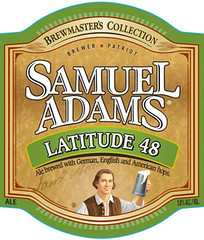
Boston Beer Co. recently announced their new IPA, Latitude 38, previously available only in a variety pack, would be going solo in its own six-pack beginning this fall.

sam-adams-latitude-38

With that decision, nine out of the ten biggest craft breweries will now have an India Pale Ale as a year-round beer. Only the Spoetzl Brewery in Texas doesn’t make one, and they’re primarily a lager brewery, as is Boston Beer given their flagship Samuel Adams Boston Lager. Of the top ten ale breweries, they all have an IPA in their portfolios.

Top Craft Breweries for 2009

  1. Boston Beer Co.: Samuel Adams Latitude 38
  2. Sierra Nevada Brewing: Torpedo Extra IPA
  3. New Belgium Brewing: Ranger India Pale Ale
  4. Spoetzl Brewery: None
  5. Pyramid Breweries: ThunderHead India Pale Ale
  6. Deschutes Brewery: Inversion IPA
  7. Matt Brewing: Saranac India Pale Ale
  8. Magic Hat Brewing: Blind Faith
  9. Boulevard Brewing: Single-Wide I.P.A.
  10. Harpoon Brewery: Harpoon IPA
  11. Alaskan Brewing: Alaskan IPA
  12. Bell’s Brewery: Two Hearted Ale

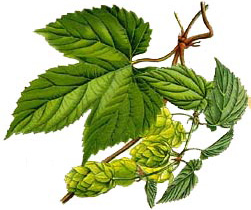
hops

A decade ago or so, hardly anyone had an IPA in their portfolio and fewer still made one all year long. Now almost every brewery feels they need to have one. I’d have to say that’s score one for the hopheads.

Filed Under: Beers, Editorial, Just For Fun, News Tagged With: IPA

Beer Sophistication

May 25, 2010 By Jay Brooks

tripel
Chris Ballard, a beer blogger, has an interesting piece up that he wrote for Blog Critics, Beer is More Sophisticated Than Wine, where he brings together many of the arguments that people have made over the years to showcase beer’s sophistication, especially as compared with wine. I’m not sure it’s necessary to take on wine. That beer is more complex is at this point almost a given. But still, it’s a nice little rant. The only thing I disagree with is his assertion that Plato is an I.P.A. man. Everyone knows Plato preferred whisky. “Plato, they say, could stick it away—Half a crate of whisky every day.”

Filed Under: Beers, Editorial, Just For Fun Tagged With: Guest Posts

Read This, Not That

May 25, 2010 By Jay Brooks

calories
I started to write about this nonsense last year, when the authors of Eat This, Not That declared Sierra Nevada Stout to be the “worst beer” based almost solely on the fact that it’s 210 calories. This year, they’ve declared Sierra Nevada Bigfoot Barleywine Style Ale to be the “worst beer for 2010,” again based almost entirely on the fact that it is 330 calories. Here’s the entire write-up:

Most beers carry fewer than 175 calories, but even your average extra-heady brew rarely eclipses 250. That makes Sierra’s Bigfoot the undisputed beast of the beer jungle. Granted, the alcohol itself provides most of the calories, but it’s the extra heft of carbohydrates that helps stuff nearly 2,000 calories into each six-pack. For comparison, Budweiser has 10.6 grams of carbs, Blue Moon has 13, and Guinness Draught has 10. Let’s hope the appearance of this gut-inducing guzzler in your fridge is as rare as encounters with the fabled beast himself.

But so what? Avery’s The Beast has 480 calories (and Samael’s Ale has 458 and Mephistophele’s has 434). Dogfish Head 120 Minute IPA has 450 (and their Raison d’Extra has 425). Goose Island Bourbon County Stout has 415 calories. Bell’s Expedition Stout has 400 (and their Third Coast Old Ale has 335). Alaskan Barleywine has 373. Rogue’s XS Imperial Stout has 366 calories (and XS Old Crustacean has 346). Sprecher Barleywine has 352 and so does Real Ale’s Sisyphus Barleywine. Fish Poseidon’s Imperial Stout has 338 (and their Leviathan Barleywine has 319). Bristol Old No. 38 Barley Wine has 318. Three Floyds Dreadnaught Imperial IPA has 316. Pike Barleywine has 315 calories. Even McEwan’s Scotch Ale has 295. And the more extreme beers made by Samuel Adams, Utopias has 720 and Triple Bock had 636.

What’s the one thing all of those beers have in common, including Bigfoot? You don’t drink them the same way you do the beers that they compare them to; Budweiser, Blue Moon, Guinness Draught and Leinenkugel’s Fireside Nut Brown Ale. Those are all beers you drink by the six-pack, or at least share by the six-pack. The other beers are all sipping, bottle-sharing beers. Big difference. You can’t really compare them because they’re not made for the same purpose or use. It’s apples and oranges while the Eat This, Not That authors can only see beer as one interchangeable commodity. To them, all beer is the same, only the calories change. They can’t see that some drinks, usually the heavier higher caloric ones, people naturally drink less of. Like heavy foods, you feel full sooner and so don’t eat, or this case drink, more of them.

That the Eat This, Not That folks would have you believe all beers are equal is readily apparent when in their original book from 2008, they recommend that you should drink beers like Carta Blanca and Amstel Light. Their top picks, Michelob Ultra and Beck’s Premier Light, I wouldn’t drink even if they were the only beers on a menu. I’d order water or an alternative alcoholic beverage instead. In the 2009 follow-up, “Supermarket Survival Guide” they continue to recommend almost entirely big, bland beers from national and international companies. Curiously, though Yuengling Light, a recommended beer in 2008, has turned evil a year later and is now on the “Not That” side, because it’s all about calories and carbs. But a close look at the two sides reveals that there’s really very little difference between a recommended beer and the not recommended ones, just like the difference between low-calories light beer and “regular” beer is vanishingly small. That so many people are duped into believing the sacrifice to drink light beer is worth it for their health continues to amaze me and may be one of the greatest lies ever perpetrated my marketing.

But most of the beers on their recommended, as well as their not recommended list, lack one overall, and apparently overlooked, quality: taste. Who cares how many or how few calories or carbs a beer has if it doesn’t taste good, or tastes of nothing, like so many of the beers they’re listing are. And they’re also overlooking the right beer to pair with the right dish, event or occasion. It should be about proportion. I might not recommend Bigfoot as a beer to drink every day of the year. Of course, I wouldn’t suggest any beer for that duty. There’s no such thing as an all-purpose beer. There never should be, despite the mainstream media, marketing “gurus” and even the big breweries attempts to the contrary.

Calorie or carbohydrate-counting may be fine for some people (though I can’t for the life of me come up with a reason why) but applying it to beer is utterly ridiculous and without merit. If following their advice is what passes for healthy living, I’m happy to die sooner having lived a fuller, more enjoyable life. Life’s just too short to drink low-calorie beer.

SierraNevada-Bigfoot
I know what I’m drinking tonight.

Filed Under: Beers, Editorial Tagged With: Health & Beer

« Previous Page
Next Page »

Find Something

Northern California Breweries

Please consider purchasing my latest book, California Breweries North, available from Amazon, or ask for it at your local bookstore.

Recent Comments

  • Bob Paolino on Beer Birthday: Grant Johnston
  • Gambrinus on Historic Beer Birthday: A.J. Houghton
  • Ernie Dewing on Historic Beer Birthday: Charles William Bergner 
  • Steve 'Pudgy' De Rose on Historic Beer Birthday: Jacob Schmidt
  • Jay Brooks on Beer Birthday: Bill Owens

Recent Posts

  • Beer In Ads #5240: Rieker’s Bock Beer Is Now On The Market May 3, 2026
  • Historic Beer Birthday: Herman Adolph Schalk May 3, 2026
  • Beer In Ads #5239: The National Drink May 2, 2026
  • Beer Birthday: Anders Kissmeyer May 2, 2026
  • Beer Birthday: Bruce Paton May 2, 2026

BBB Archives

Feedback

Head Quarter
This site is hosted and maintained by H25Q.dev. Any questions or comments for the webmaster can be directed here.