Brookston Beer Bulletin

Jay R. Brooks on Beer

  • Home
  • About
  • Editorial
  • Birthdays
  • Art & Beer

Socialize

  • Dribbble
  • Email
  • Facebook
  • Flickr
  • GitHub
  • Instagram
  • LinkedIn
  • Pinterest
  • RSS
  • Twitter
  • YouTube

Powered by Genesis

“How Beer Saved The World” To Be Revealed January 30

January 21, 2011 By Jay Brooks

earthday
The documentary that the Discovery Channel was rumored to be working on, How Beer Saved the World, is now scheduled to air on Sunday, January 30 at 8:00 p.m. Pacific time. The trailer is a bit overwrought, but they appear to have some good people being interviewed on camera, such as Charlie Bamforth and Gregg Smith. This should be interesting.

If you want a good laugh, check out the ignorant comments on the YouTube page for this trailer. Their hilarity is only matched by their inanity. It’s certainly amazing how effective anti-alcohol propaganda is as evidenced by some of the nonsense being spouted. It’s also funny, and a little sad, to see the contrast between beer people, who can readily admit that there are some people who abuse alcohol and cause problems for themselves and others, and neo-prohibitionists who cannot bring themselves to concede that alcohol has any positive aspects to it whatsoever.

Filed Under: Beers, Editorial, Events, News Tagged With: Announcements, History, Television, Video

Beer In Ads #293: Blatz, The End Of The Hunt For Good Taste

January 20, 2011 By Jay Brooks

ad-billboard
Thursday’s ad is for Blatz Pilsener Beer from 1944, displaying a hunting motif to go with the cheesy ad copy, “The End of the Hunt For Good Taste.”

Blatz-1944

Filed Under: Art & Beer, Beers Tagged With: Advertising, History

Beerstrology Sign: Aquarius

January 20, 2011 By Jay Brooks

zodiac
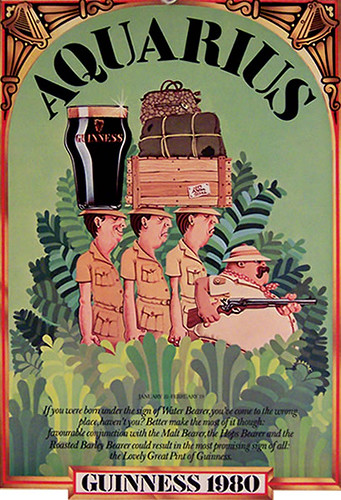
While I don’t put any stock in astrology, in 1980 Guinness put out a calendar with each month representing one of the zodiac signs, and I thought it would be fun to share these throughout the year.

Aquarius, the water-bearer, is from January 20-February 19. To learn more, see:

  • Astrology Online
  • Universal Psychic Guild
  • Wikipedia
  • Zodiac Signs

Guinness-zodiac-01-aquarius

Filed Under: Art & Beer, Just For Fun Tagged With: Beerstrology, Guinness

Beer In Ads #292: Out In The Kitchen …

January 19, 2011 By Jay Brooks

ad-billboard
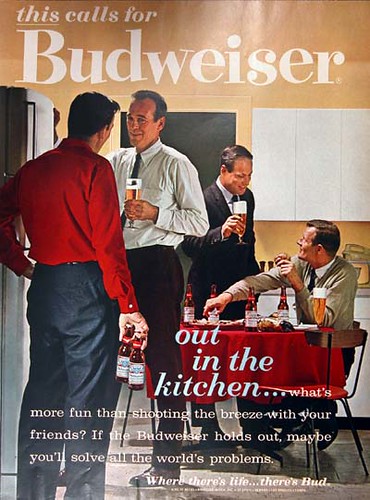
Wednesday’s ad is for Budweiser from 1962, showing the apparently unusual sight of men in the kitchen. Oh, but drinking beer there makes it okay. Maybe it’s just me but I don’t believe this foursome is going to be able to solve all the world’s problems, as the ad copy suggests.

images62budweiser

Filed Under: Art & Beer, Beers Tagged With: Advertising, Budweiser, History

Celtic Beer: 500 B.C.

January 19, 2011 By Jay Brooks

celtic-blue
Science News last week had a fascinating tale from 2,500 years ago, about ancient Celtic breweries in present-day Germany. It was revealed in a new paper by Hans-Peter Stika, entitled Early Iron Age and Late Mediaeval malt finds from Germany—attempts at reconstruction of early Celtic brewing and the taste of Celtic beer, that early Celts built breweries “capable of turning out large quantities of a beer with a dark, smoky, slightly sour taste.”

Published earlier this month in the journal, Archaeological and Anthropological Sciences, here’s the abstract:

In this paper, we discuss specialised ditch structure from the early Iron Age settlement of Eberdingen–Hochdorf (early La Tène Period, fifth–fourth century BC), that contained large numbers of evenly germinated hulled barley grains. This malt appears to be the result of deliberate germination, given the purity of the finds and the associated unusual archaeological structure, which may have been used for germination and/or as a drying kiln for roasting the malt. The Hochdorf malt most probably was produced for the purpose of beer brewing. To learn more about the morphology of malt and the effects of carbonisation on it, experiments on modern barley grains were undertaken. Their results are compared to the ancient Hochdorf malt. Based on the excavated findings and finds as well as theoretical reflections on the early Iron Age brewing process, attempts at reconstructing the possible taste of early Celtic beer are presented. Additionally, a malt find from late mediaeval Berlin in northeast Germany is presented. A mixture of deliberately sprouted hulled barley as well as rye and oat grains, which were not germinated, was found. The three different cereals could have been used for brewing a typical mediaeval/early modern beer since the use of mixed crops for producing beer has been quite common. Because of a lack of further evidence, it remains unclear whether or not the half-timbered house in the late mediaeval town was a trading place and storehouse for malt or the brewery itself, where the malt was processed to make beer.

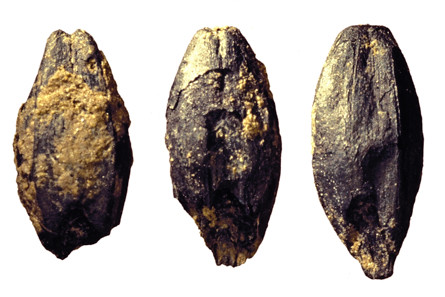
A large store of charred grains of barley were discovered at a site in northeast Germany, near Berlin. The barley was found in ditches, suggesting a “large malt-making enterprise.”
barley-iron-age
He then reconstructed the steps he believes the early Celts would have used to brew their beer.

  1. Dig a ditch, in an oblong shape.
  2. Soak barley in the specially constructed ditches until it sprouts.
  3. Grains were then dried by lighting fires at the ends of the ditches (providing dark color & a smoky taste).
  4. Lactic acid bacteria stimulated by slow drying of soaked grains, a well-known phenomenon, adding sourness to the brew.
  5. Mash up the barley to maximize the sugar content.
  6. Flavor it with henbane — a.k.a. stinking nightshade — which was found at the site. Henbane would also have made the beer more intoxicating. It could possibly have contained other spices such as mugwort or carrot seeds.
  7. Boil the ingredients with the mashed grains, towards the beginning to flavor the beer.
  8. Heated stones may have been placed in liquefied malt during the brewing process (though so far none have been found at the site). Otherwise, it would probably have been heated over a low fire.
  9. Separate out the lumpiest bits of grain.
  10. Fermentation then my have been triggered by using yeast-coated brewing equipment or by adding honey or fruit, both of which would have contained wild yeast.
  11. Let the yeast settle to the bottom.
  12. Cool the beer and drink.

Not all of the steps have been confirmed by the evidence yet, but the search goes on.

Filed Under: Breweries, News Tagged With: Germany, History, Science of Brewing

Red Brick Blonde Goes Down Easy

January 19, 2011 By Jay Brooks

red-brick
I need to tread lightly here, as my own wife is a blonde. Two new television commercials by Atlanta’s Red Brick Brewing play on the stereotype of dumb blondes. Funny or insensitive, I’m staying out of it.

Filed Under: Beers, Breweries, Just For Fun Tagged With: Advertising, History, Humor

Beer In Ads #291: Bud Keeps Cool When The Game Gets Hot

January 18, 2011 By Jay Brooks

ad-billboard
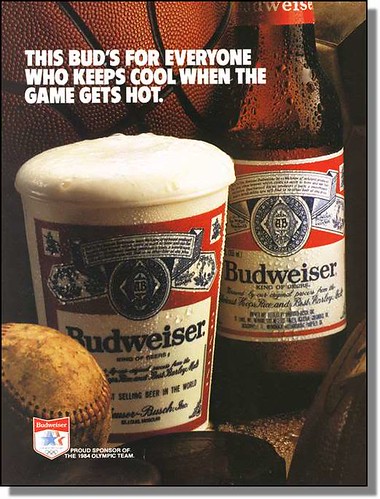
Tuesday’s ad is for Budweiser from 1982, showing sports equipment and announcing Anheuser-Busch as a “proud sponsor of the 1984 Olympic team.” It’s one of the few ads showing beer in a paper cup, which I guess continues the sporting theme.

Bud-1982

Filed Under: Art & Beer, Beers Tagged With: Advertising, Budweiser, History

John Stuart Mill On “Sin Taxes” & Prohibition

January 18, 2011 By Jay Brooks

philosophy
The British philosopher John Stuart Mill was, besides being “particularly ill” on “half a pint of shandy,” a big proponent of the concept of free will, as the song says. In his book On Liberty, he also argues in favor free speech and, 150 years ago, was against minimum alcohol pricing as if it were today, which is why I bring it up.

In today’s UK newspaper, The Telegraph, British writer Brendan O’Neill argues convincingly against minimum pricing on alcohol in a piece entitled ‘Minimum alcohol pricing’ is a Sin Tax designed to punish poor people for the crime of getting hammered.

The British government has been discussing minimum alcohol pricing for a number of years as a way of stopping binge drinking, defined as uselessly there as here. O’Neill sees it rather differently, as “an assault on a certain kind of boozing, the kind indulged by the less well-off who prefer to drink lager or cider and let their hair down rather than quaff chardonnay and discuss Tunisia. The very term “binge drinking” — and bear in mind that, for a man, binge drinking means downing a paltry four pints in a night — is designed to conjure up images of the non-wine-drinking classes, who swig on bottles of beer with no sense of control or decorum; who scoff and down and binge rather than sip. Them, not Us.”

And that brings us back around to John Stuart Mill. I hadn’t seen these quotes before, but they’re brilliant. In On Liberty, he addressed this very issue by calling such price hikes a de facto “sin tax” because, then as now, it’s a regressive tax that punishes the poor for not behaving as some people might want them to.

Here’s what he wrote:

“Every increase of cost is a prohibition, to those whose means do not come up to the augmented price.”

And:

“To tax stimulants for the sole purpose of making them more difficult to be obtained is a measure differing only in degree from their entire prohibition, and would be justifiable only if that were justifiable.”

As O’Neill concludes, that’s simply “prohibition through the backdoor, targeted at those whom the political classes consider to be reckless and self-destructive.” On this side of the pond, it’s all that moralizing plus anti-alcohol groups trying to convince us it’s about safety and “the children” and saying that raising the price will fix all our problems, and the economy to boot. Problem is, it never works. It’s just another attempt at Prohibition. Prohibition Lite, perhaps, but the aims are the same.

Filed Under: Editorial, Just For Fun, News, Politics & Law Tagged With: Philosophy, Prohibitionists, UK

Next Session Opens A Can, Bottle, Cask Or Keg

January 18, 2011 By Jay Brooks

session-the
Our 48th Session will be hosted by Simon Johnson of the Reluctant Scooper. His topic is “Cask, Keg, Can, Bottle?,” or as he describes the question:

The method of beer dispense often raises the hackles of even the most seasoned beer drinker. Some evangilise about living, breathing cask as being the one true way. Others heartily support the pressurised keg. The humble tinny has its fans. Lovers of bottled beer, either conditioned or pasturised, can be equally voiciferous.

Perhaps you think that one method magnifiies a beer’s impact. Perhaps you won’t try a beer if it’s dispensed in a way you don’t agree with. Perhaps you’ve tried one beer that’s been dispensed every which way.

The question is simple but your answer may not be: Cask, Keg, Can, Bottle: Does dispense matter?

So tap a keg, pull a pint, pop a cap or open a can of whoop-ass on the next Session on Friday, February 4.

Filed Under: Beers, The Session Tagged With: Announcements, Bottles, Cans, Kegs, Packaging

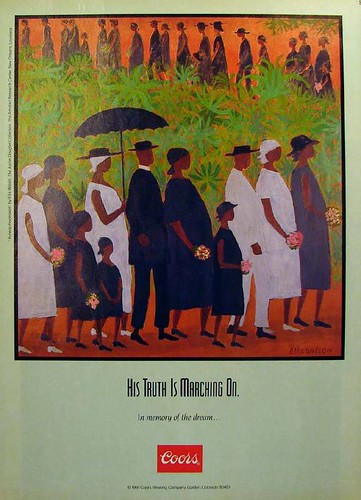
Beer In Ads #290: Coors, His Truth Is Marching On

January 17, 2011 By Jay Brooks

ad-billboard
Monday’s ad is for Coors from around 1990, featuring the painting by artist Ellis Wilson entitled Funeral Procession. It was painted in the 1950s and currently hangs in the Aaron Douglas Collection in the Amistad Research Center at Tulane University, New Orleans, Louisiana.

The painting became well-known in 1985 “thanks to its appearance in the plot of an episode of The Cosby Show in 1985, during the second season of the long-running series. In the program, Mrs. Huxtable acquires the painting—which is ostensibly by her “great-uncle Ellis”—at auction, paying $11,500. At the end of the episode, Dr. Huxtable hung the painting over the living-room mantel, where it would stay for the duration of the series.” Coors used the painting for an ad celebrating Martin Luther King Jr. Day. The ad uses the slogan “His Truth Is Marching On” with a subtitle “In memory of the dream …”

coors-mlk

Here’s the original painting:

Wilson-funeral-procession

Filed Under: Art & Beer, Beers Tagged With: Advertising, Coors, History, Holidays

« Previous Page
Next Page »

Find Something

Northern California Breweries

Please consider purchasing my latest book, California Breweries North, available from Amazon, or ask for it at your local bookstore.

Recent Comments

  • Bob Paolino on Beer Birthday: Grant Johnston
  • Gambrinus on Historic Beer Birthday: A.J. Houghton
  • Ernie Dewing on Historic Beer Birthday: Charles William Bergner 
  • Steve 'Pudgy' De Rose on Historic Beer Birthday: Jacob Schmidt
  • Jay Brooks on Beer Birthday: Bill Owens

Recent Posts

  • Beer In Ads #5257: Dessower Schlossbrauerei Bockbier June 2, 2026
  • Historic Beer Birthday: Thomas Hardy June 2, 2026
  • Beer Birthday: Menno Olivier June 2, 2026
  • Beer Birthday: Tyler Smith June 2, 2026
  • Beer Birthday: Bob Townsend June 2, 2026

BBB Archives

Feedback

Head Quarter
This site is hosted and maintained by H25Q.dev. Any questions or comments for the webmaster can be directed here.