Brookston Beer Bulletin

Jay R. Brooks on Beer

  • Home
  • About
  • Editorial
  • Birthdays
  • Art & Beer

Socialize

  • Dribbble
  • Email
  • Facebook
  • Flickr
  • GitHub
  • Instagram
  • LinkedIn
  • Pinterest
  • RSS
  • Twitter
  • YouTube

Powered by Genesis

Two Possible Buyers Emerge In Bass Sale

June 28, 2010 By Jay Brooks

bass
The UK’s Publican recently included a report from the Scotsman regarding the emergence of the two likeliest candidates to buy Bass from ABI.

A North American brewing giant and small regional UK brewer have emerged as the front-runners to buy beer brand Bass in this country .It is believed brewing major Molson Coors and Well’s & Young’s, based in Bedford in England, are favourites to land Bass as current owner Anheuser-Busch Inbev is understood to be considering a sale to want to focus instead on its premium lager portfolio, which includes Stella Artois, Beck’s and Budweiser. It declined to comment on what it called “market speculation” about a potential sale.

Let’s see how this plays out.

Filed Under: Breweries, News Tagged With: Anheuser-Busch InBev, Bass, Big Brewers, Business, UK

Beer In Art #82: Pabst Art Contests

June 27, 2010 By Jay Brooks

art-beer
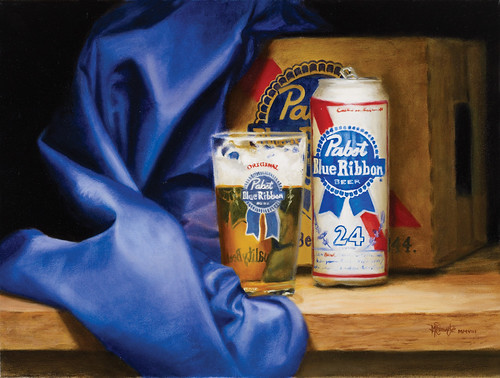
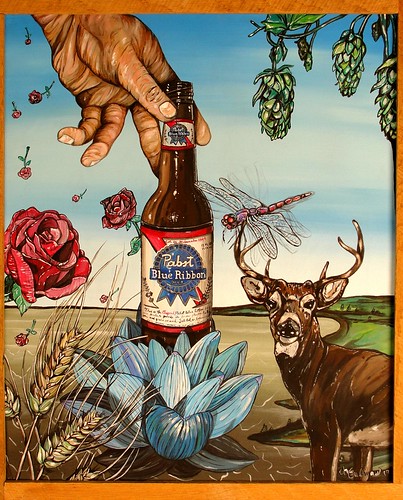
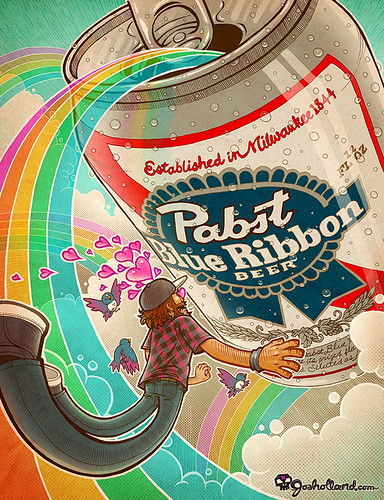
Today’s works of art were all created over the past four years, as a part of an art contest by Pabst Blue Ribbon. Now that Pabst Brewing Co. has recently changed hands, who knows whether the new owners will keep the art contest alive. As far as I can tell, it started in 2007 and has been held each year since, including this year. The PBR Art website has a gallery with 380 works of art that have been submitted. Many of them are quite good, and I’ve picked out some my favorites below.

Mark Cummings
A straightforward still life by Mark Cummings.

Christopher Galiyas
This fun one, an interpretation of Botticelli’s “Birth of Venus” is by Christopher Galiyas.

Josh Holland
This painting by Josh Holland reminds me a bit of a Grateful Dead album cover.

The blog is still acting up and throwing tantrums when I try to embed anything, but I created a slideshow of my favorite 40 Pabst works of art. Just click on the link to be taken to the Flickr slideshow.

Filed Under: Art & Beer, Beers Tagged With: Pabst

Guinness Ad #24: When You’re Tired

June 26, 2010 By Jay Brooks

guinness-toucan
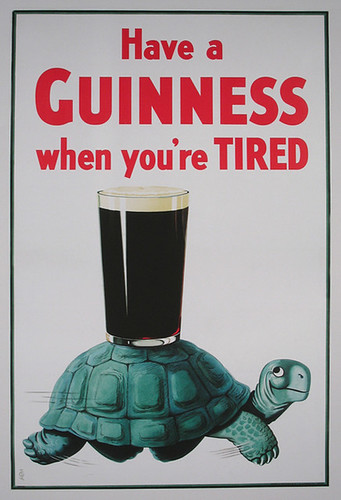
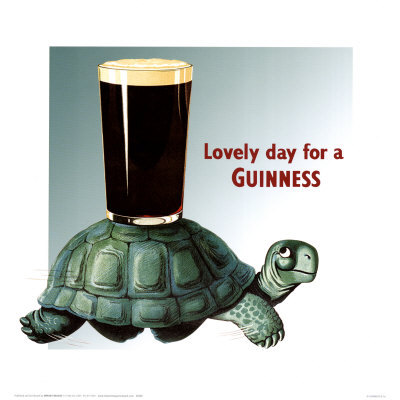
Our 24th Guinness poster by John Gilroy features a slow turtle with the unusual slogan “Have a Guinness When You’re Tired.” Though I suppose the idea is that a Guinness will make a turtle faster.

guinness-turtle-tired

They’ve also used the same image with the more common “Lovely day for a Guinness.”

guinness-turtle-2

Filed Under: Art & Beer, Beers Tagged With: Advertising, Guinness, History

Japanese Paper Beer

June 26, 2010 By Jay Brooks

origami
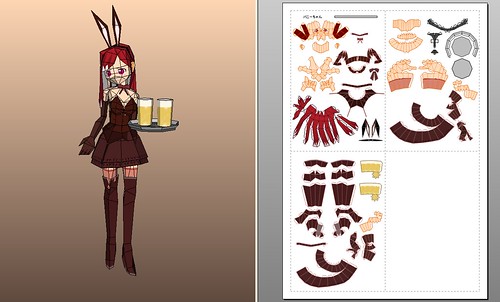
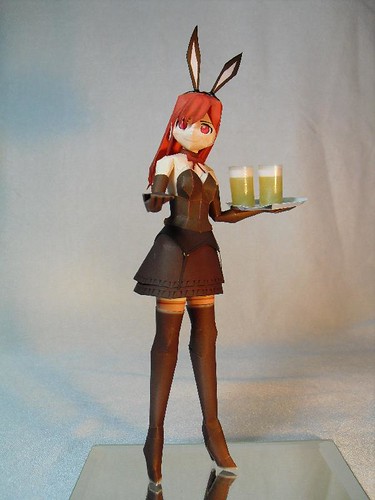
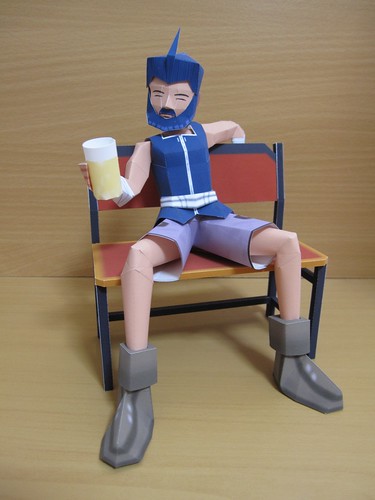
Most people have probably heard of origami, the Japanese art of paper folding. But the Japanese propensity of coming up with unusual hobbies knows no boundaries. One of the tamer examples is the related art of making 3D paper models. Using vector software like Pepakura, 3D models are created in 2D and then sheets are created to cut out and build the paper models. I stumbled on one of these while searching for another image. It’s of a waitress serving beer to a bar patron. The title of it is Bunny Beer Maiden because the waitress is dressed in a bunny costume, a popular Japanese fetish theme. Instructions and more photos are also at Papercraft and also at Paperworks’ And Wind Until, which has even more views of the component parts of the paper models.

rabbgirl-00
First a vector drawing is created on a computer, and then individual pieces like a dress pattern are created that must be carefully cut out for assembly.

rabbgirl-01
After being put together, the server in bunny costume looks like this. See many other angles here.

rabbgirl-03
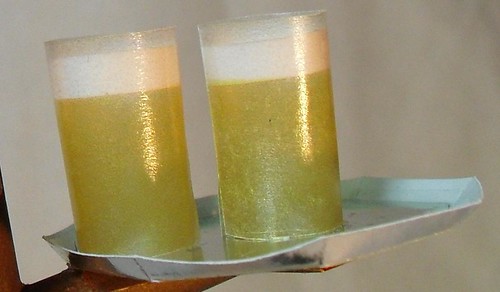
Here’s a close-up of the glasses of beer.

rabbgirl-04
And the customer with his beer. See many other angles here.

rabbgirl-02
And here’s the entire scene with the server, the customer and tables and chairs, all of which are made out of paper.

Filed Under: Art & Beer, Beers, Just For Fun Tagged With: Asia, Japan, Strange But True

Beer In Ads #137: Anheuser-Busch’s Custer’s Last Fight

June 25, 2010 By Jay Brooks

ad-billboard
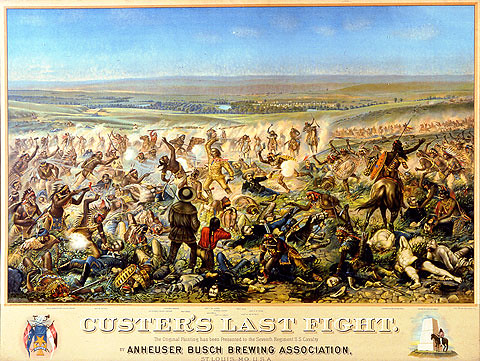
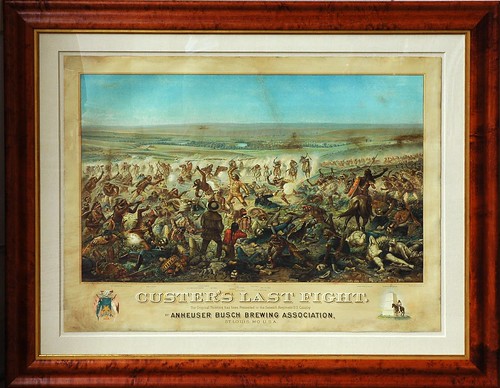
Friday’s ad is the oldest piece of American breweriana known to exist. It was a poster created by Anheuser-Busch, who commissioned the original painting, Custer’s Last Fight, which was painted by Cassilly Adams in 1884. A lithograph was then prepared by F. Otto Becker in 1889. It was distributed as an advertising poster by Anheuser-Busch. It has since become one of the “most famous views of of the Battle of the Little Bighorn, referred by Indians as the Battle of Greasy Grass.”

Today is the anniversary of the beginning of the Battle of Little Bighorn, which has become famous as Custer’s Last Stand. It began on June 25, 1876 and ended the following day.

Cassily_custers-last

According to one history website, Indian Wars — Wyoming Tales and Trails, “it is, however, best charitably described as fanciful. The Indians’ attire is in error; Custer’s hair is in error, he had it closely shorn before leaving Ft. Abraham Lincoln; he is wearing a red scarf; and, perhaps most importantly, the battle is being fought on the wrong side of the river.”

Cassily_custers-last-fight

As possibly the very first piece of breweriana, an original will set you back a pretty penny, at least from $1,699 to $2,250. One of the eBay sellers includes the following information about the lithograph:

Measures approx. 32 ” X 42″across Great colored lithograph depicting the grisly battle between General Custer’s troops and Indian warriors at Little Big Horn. Custer is featured at center waving a saber and dressed in fringed buckskin. The remaining cavalry officers (except for his brother Tom) are dressed in military uniform. Indians are armed with scalping knives, tomahawks, clubs, spears and rifles. Dead of both parties appear in foreground, with several being identified in the bottom margin as Courier from Sitting Bull, Squaw Killing wounded, Rain In the face and the Sioux Warrior who killed Custer. Custer’s medals and banners are in lower left margin. Mounted Indian poses beside a monument in lower right margin. In the small margin directly under the picture it is marked Entered According To Act Of Congress By Adolphus Busch march 30th 1896 In The office of The Librarian Of Congress At Washington, D.C. In the lower center portion it is marked The Original Painting has been Presented to the Seventh Regiment U.S. Cavalry By Anheuser Busch Brewing Association, St. Louis, Mo. U.S.A.

Filed Under: Art & Beer, Beers, Breweries Tagged With: Advertising, Anheuser-Busch, History

Alcohol Fees Vs. Taxes: The Sinclair Decision

June 25, 2010 By Jay Brooks

sinclair
Warning: This post is primarily about arcane legal distinctions and standards that will (or should) be applied to what’s going on in San Francisco. If that’s not your pint of plain, you may want to ignore this post. Yesterday I dipped my toe in the mash tun that is the city of San Francisco’s proposed “Alcohol Mitigation Fee Ordinance” (AMFO). The reason they’re characterizing it as a “fee” instead of a “tax” has to do with politics. A fee doesn’t require a two-thirds vote like a tax, just a simple majority.

Another odd detail that’s missing is a requirement for this type of fee is that a Nexus Study be done, and the proposed ordinance does indeed make reference to it on Page 3, where they claim it’s on file with the Clerk of the Board of Supervisors but leave a blank space for the file number. The reason it’s left blank is because there is no completed Nexus Study, as required. The proponents of the ordinance claim it will be completed in a week, but then why didn’t they wait until it was done before introducing the fee ordinance? If that’s a requirement, it seems they’ve jumped the gun, and this will give opponents less time to review the Nexus Study, which doesn’t seem at all fair.

There’s also no mention in the language exactly how they will collect from companies who do business in San Francisco but have no offices in the city, and thus are outside the city’s jurisdiction?

The earlier draft version of the AMFO included the language “ethanol ounce.” While nobody was sure how that was being designed, it’s now moot because the final document changed the language at the 11h hour to “ounce of alcohol” which is still rather vague and subject to a variety of interpretations as to how it will be applied. If I had to guess, I’d say that it’s possible that the strong spirits lobby got that change made since it would impact them the most by reducing their proportional taxes while beer would get hit the hardest. Curiously, all of the news reports I’ve seen, such as the one from KTVU Channel 2, a typical example, continues to use the phrase “ounce of ethanol” suggesting the mainstream media is working off of earlier versions or not looking at the source document at all. In either event, it’s not exactly stellar reporting and gives the public who reads that the wrong impression of what the AMFO will actually be doing.

sinclair-pinup

But the biggest hurdle is one that’s been in place since 1997, when the California Supreme Court decided the case of Sinclair Paint Co. v. State Board of Equalization, et al. In that seminal case, the state tried to impose a fee on paint companies for potential harm caused by lead paint. Here’s a summary, from the Pillsbury Tax Page: “The Supreme Court held that case law clearly indicates that the police power is broad enough to include mandatory remedial measures to mitigate the past, present, or future adverse impact of the fee payer’s operations, at least where, as here, the measure requires a causal connection or nexus between the product and its adverse effects.” [my emphasis.] What that means is that a “fee” of this type in order to be constitutional and not need a two-thirds majority like any other tax (in other words to keep its “fee status”) it must be proven to have a direct link to the harm being caused by the product being taxed … uh, excuse me, having a fee imposed on it.

In their conclusion, Pillsbury characterizes these fees as camouflaged taxes.

The potential impact of Sinclair is tremendous since it is completely dependent upon the Legislature’s propensity to camouflage taxes as fees. Virtually every industry can be found to place some type of burden on society and now the Court has only limited the Legislature’s ability to impose fees on those industries within the bounds of its inventiveness. It is difficult, if not impossible, to reconcile Sinclair with the state of the law existing prior thereto.

And for the past thirteen years that’s been the standard and remains the controlling case. That means that the AMFO has to “prove” a direct link from the alcohol and the harm they claim is placing such an onerous burden on city resources. In the first two pages of the AMFO, they cite several studies they believe show such a link. But they’re wrong. For every study cited, I could produce ten that says the opposite, including studies that show that the moderate consumption of alcohol makes a person healthier than abstaining. To me, that suggests that trying to keep people from drinking is reckless endangerment or at least is putting the health of every adult who drinks moderately and responsibly at risk. And some of the studies mentioned aren’t even cited, meaning there’s no way to even confirm they say what the AMFO says they do. To say that their “proof” is shoddy is an understatement.

But, as usual, that doesn’t stop Bruce Lee Livingston, executive director of Marin Institute, from trotting out his favorite bullshit line, modified for the specific occasion. “It’s time for Big Alcohol, including wholesalers, to pay its fair share. A local alcohol charge for harm fee is long overdue.” I’m so tired of having to address this each and every time they give voice to this lie. As I’ve said many, many times, no other product save tobacco pays more taxes than alcohol already. To say that there’s some “fair” amount that alcohol companies should be paying is utter nonsense. There’s no amount high enough that would actually satisfy the Marin Institute, all they want to do in reality is put all alcohol companies out of business, the economy and a majority of people’s wishes be damned.

Filed Under: Beers, Editorial, Politics & Law Tagged With: Law, Prohibitionists

Pabst Deal Closes

June 25, 2010 By Jay Brooks

pabst
As of today, the Pabst deal is done. The Kalmanovitz Trust no longer owns Pabst and now C. Dean Metropoulos and his two sons are at the helm.

According to Harry Schuhmacher at Beer Business Daily:

In buying Pabst, Metropoulos is getting a variety of regional brands, some of which he may sell off, according to sources. Pabst owns Schaefer, Carling’s Black Label, Blatz, Colt 45 Malt Liquor, Schmidt, Special Export, Schlitz, Lone Star, Jacob Best, Ballantine, Falstaff, Rainier, Ice Man Malt Liquor, Silver Thunder Malt Liquor and Stroh’s Beer.

Of the portfolio, Pabst Blue Ribbon and to a lesser extent Lone Start are the diamonds in the rough. PBR is currently the fastest growing domestic beer brand of the top brands in IRI scans, up around 20% in the latest four weeks. The brand has been embraced by young adults with an anti-establishment bent, with a love of irony (I decline to say “hipsters” because that’s what everybody says, and I think it’s gone beyond hipsters). Pabst has proven masterful at what I’ve called un-marketing — that is, marketing without seeming to market, relying mainly on word-of-mouth. The recent Clint Eastwood flick Gran Torino didn’t hurt either.

Distributor we’ve talked to are guardedly optimistic about the sale, as Metropoulos clearly has “earned his chops turning around old brands,” as one distrib said in an email. Distribs are also glad that the decades-long uncertainty about the fate of Pabst is finally over. Of course, there is a change in control, which theoretically could put the brewer in play in some states, although I’m not sure that would be a priority at this point for a new owner wanting to minimize disruption. But you never know.

It will certainly be interesting to see what happens next.

Filed Under: Breweries, News Tagged With: Announcements, Business

Beer In Ads #136: Phipps’ Pale Ale

June 24, 2010 By Jay Brooks

ad-billboard
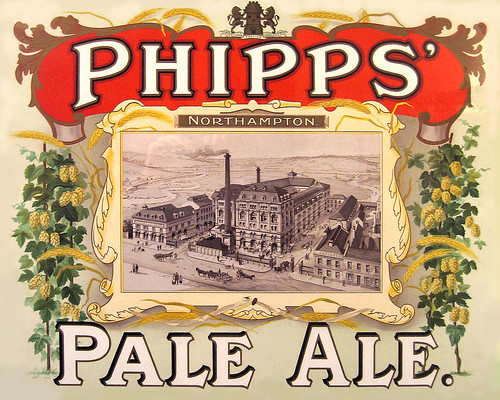
Thursday’s ad is another old one that shows off the brewery with industrial glee. It’s for a British beer, Phipps’ from Northampton. They’re actually still in business under the name Phipps’ NBC (or Northampton Brewing Co.), having been revived in 2004. There’s a nice detailed history online, too. But it’s a beautiful poster, with both the brewery in the center and the surrounding scrolling, especially the hop vines. It’s like a rectangular coat of arms.

Phipps

Filed Under: Art & Beer, Beers Tagged With: Advertising, History, UK

San Francisco Wants To Add Alcohol Fee To Every Drink

June 24, 2010 By Jay Brooks

san-francisco
They tried this last year, unsuccessfully, but the neo-prohibitionists are nothing if not incessant. So it’s now been introduced again. City of San Francisco Supervisor John Avalos has introduced the “Alcohol Mitigation Fee Ordinance” (AMFO) in an effort to impose a “fee” (which is technically different from a “tax” since that would be illegal) on alcohol sold in the city. They can call it a “fee” or anything they like if that makes it legal and presumably keeps their conscious clear, but a tax is defined as “a compulsory contribution to state revenue, levied by the government on personal income and business profits or added to the cost of some goods, services, and transactions.” [Oxford Dictionary of English.] If it walks and talks like a duck, guess what it is? It’s complete and utter bullshit, not to mince words.

The stated rationale is that the “fee” is meant to cover the so-called harm caused by people who use alcohol by charging a fee to the distributors and retailers who sell it. For support of that idea, they cite studies that are nowhere near impartial. Essentially they just shopped for the studies that said what they wanted, ignored those that contradicted them, and used that to “prove” their case.

If passed, the AMFO would add a fee of $0.076 to every ounce of alcohol sold in San Francisco. So if I understand that correctly, for a 12-oz. bottle of beer that would be an additional 91.2 cents and for a pint another 121.6 cents, or roughly $1.22. And that fee will imposed at the wholesale level, and the distributors will then naturally mark-up the fee, and so will the retailers, meaning in reality the price of a pint will go up at least a dollar and a half, possibly more. The Marin Institute, who’s really behind this fee, is selling this idea as a “nickel-a-drink” because they’ve found that it polls well with consumers who see no problem with an extra nickel. But as is so typical with the Marin Institute, their “nickel-a-drink” propaganda is just another one of their numerous lies.

Earlier versions of the proposed ordinance used the term “ethanol ounce” presumably to equalize the alcohol content in different types of drinks, like spirits and wine which usually have higher alcohol percentages. The latest version appears to have dropped that, meaning that the fee on beer would be proportionally much, much higher than spirits or wine.

Where this whole idea came from is the despicable Marin Institute, an organization as anti-alcohol as one could imagine. They’ve been pushing this “fee” idea and using the rhetoric about “charge for harm,” which may sound good on paper but it’s entirely unfair to ordinary casual drinkers, which constitute the vast majority who drink alcohol. The Marin Institute claims that “Big Alcohol [should be] accountable for the tremendous harm its products cause. Appropriately taxing alcohol in each state and at the federal level will help reduce over-consumption, as well as provide much-needed funds for prevention and health care.” They hardly even say why that should be the case, so sure are they that people will just swallow that idea without thinking about it. But let’s think about it anyway.

Do the products actually cause any harm or do some people abusing the products cause the harm? Obviously, it’s not the alcohol itself, but its misuse that causes any trouble. If those people who abuse alcohol are straining the health and police resources of San Francisco, then the city should charge them. But saying that the alcohol those people abused should foot the bill is prima facie ridiculous. We don’t charge soda companies for all the unhealthy people that result from drinking pop, or red meat, or any other unhealthy foods that make unhealthy people thus placing a greater burden on our health care system. We don’t charge parachute companies or other extreme sports equipment manufacturers for increased use of emergency room facilities that are disproportionally called upon by extreme sports enthusiasts when “accidents” happen. We don’t put a tax on motorcycle purchases even though its more likely that a motorcycle rider will be involved in an accident, and/or that their accident will likely be more serious than if that accident occurred while driving a car, thus placing a greater burden on our healthcare system. I could go on and on. The point is that it’s absurd that alcohol companies should be responsible for any harm that an adult drinking one of their products might cause to himself or someone else. But the neo-prohibitionists keep on making that argument, regardless of how specious it is.

Even assuming their assertion that there is any “harm its products cause,” it’s still not everybody who drinks alcohol. This “fee” punishes everyone who drinks because it raises the price for everybody across the board. That means that the 99% of adults who drink responsibly and don’t place an undue burden on the city’s resources are forced to pay for the 1% that might. And yet the Marin Institute has no problem saying that’s not only fair, but how the world ought to be. According to them, alcohol has to pay for any harm someone who drinks it may cause, but every other product in the world does not. Why? Obviously, it’s not remotely about fairness or even funding healthcare for people who need it. It’s about punishing alcohol manufacturers and consumers who drink it in any way they can think of. They also claim that others states have similar policies in place, as if that makes it right, but then contradict themselves in their press release by stating that if passed, the “San Francisco alcohol mitigation fee will be the nation’s first local ‘charge for alcohol harm’ program, expanding on traditional nuisance and enforcement laws.”

What will this do to San Francisco’s business should it cost 30%+ more for a drink (or at least $1.25 and possibly as much as $2 more per pint) in the city versus the surrounding big cities like Oakland or San Jose? I think they’ll lose convention revenue, not to mention the nighttime and weekend influx from the Bay Area to the city. And tourism could take a hit, too. Not that any of those concerns are remotely part of the Marin Institute’s list of things they care about. How, or why, they cozied up to Supervisor John Avalos remains a mystery. He, at least, should care about what this might do to San Francisco’s economy. And don’t forget this is a test case. If it works and San Francisco does impose this “fee,” you can bet it will be tried in every metropolitan area where the neo-prohibitionists have a “friend” in local government. Alcohol is already the most taxed consumer good on the market today, but the wingnuts at the Marin Institute won’t rest until it’s taxed out of existence entirely. Yesterday, they took one more step closer toward realizing that goal.

marin-institute
Be afraid, be very afraid….

Filed Under: Breweries, Editorial, News, Politics & Law Tagged With: California, Distributors, Prohibitionists, San Francisco

Inflatable Beer Mug Coolers

June 24, 2010 By Jay Brooks

ice-cooler
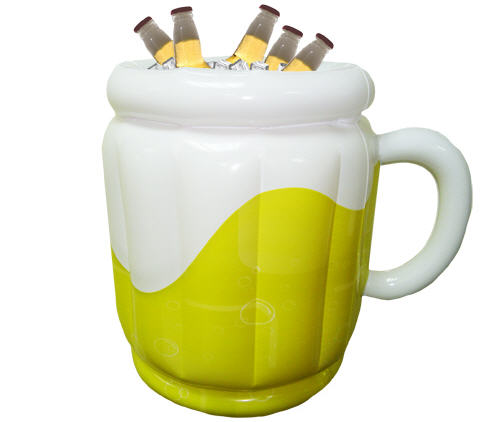
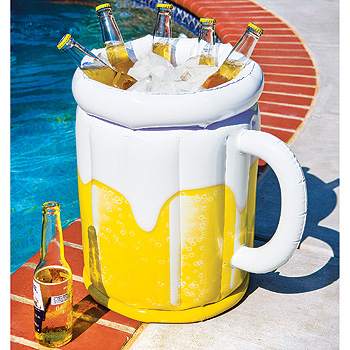
I don’t exactly know why this called to me, but for some reason it did. I’ve seen inflatable beer coolers before, but these seemed kind of cool to me. I guess I like the idea of putting the bottles or cans in a beer mug to cool them down. Like most people who take drinking seriously, I have a number of beer coolers of different sizes, shapes and materials. I also have three big keg tubs, too. But those you have to carry back from the beach or park or wherever remote location you’re hauling them to. With an inflatable one, you don’t have nearly as much to drag back home, which seems like a definitive advantage.

Anyway, the one I like best is from Europe, specifically Switzerland, and there’s one pretty similar available from England.

inflatable-mug-tub

I couldn’t find that one available in the U.S., but a different — though somewhat the same — inflatable mug cooler is available from eCrater and through Amazon.

inflatable-mug-tub-2

Filed Under: Just For Fun, Related Pleasures Tagged With: Beer Accesories, Business, For Sale, Strange But True

« Previous Page
Next Page »

Find Something

Northern California Breweries

Please consider purchasing my latest book, California Breweries North, available from Amazon, or ask for it at your local bookstore.

Recent Comments

  • Bob Paolino on Beer Birthday: Grant Johnston
  • Gambrinus on Historic Beer Birthday: A.J. Houghton
  • Ernie Dewing on Historic Beer Birthday: Charles William Bergner 
  • Steve 'Pudgy' De Rose on Historic Beer Birthday: Jacob Schmidt
  • Jay Brooks on Beer Birthday: Bill Owens

Recent Posts

  • Beer In Ads #5224: Harvard Bock Beer April 16, 2026
  • Historic Beer Birthday: William H. Biner April 16, 2026
  • Historic Beer Birthday: Alan Eames April 16, 2026
  • Historic Beer Birthday: Mathias Leinenkugel April 16, 2026
  • Historic Beer Birthday: Emil Schandein April 16, 2026

BBB Archives

Feedback

Head Quarter
This site is hosted and maintained by H25Q.dev. Any questions or comments for the webmaster can be directed here.