Brookston Beer Bulletin

Jay R. Brooks on Beer

  • Home
  • About
  • Editorial
  • Birthdays
  • Art & Beer

Socialize

  • Dribbble
  • Email
  • Facebook
  • Flickr
  • GitHub
  • Instagram
  • LinkedIn
  • Pinterest
  • RSS
  • Twitter
  • YouTube

Powered by Genesis

Oregon Brewer Cuisinternship Winner Announced

October 5, 2009 By Jay Brooks

oregon-bounty
Oregon Bounty, who is the sponsor of the Cuisinternship contest to find interns for seven uniquely Oregonian artisan and craft pursuits, has begun announcing the winners, one each day.

The Brewmaster Cuisinternship winner was announced this morning. From the many entries, the finalists were whittled down to seven. From those seven, I chose three finalists. The winner was then chosen by Jamie Emmerson, brewmaster at Full Sail Brewing in Mt. Hood, where he’ll spend his beer-filled week.

The beer intern winner was Kevin Kozlen of Bloomington, Illinois. Here’s his video entry. Here’s what Kevin should experience:

Along the shores of the mighty Columbia River Gorge, Kevin will get a week-long lesson from some of the country’s craft brewing pioneers. From the hop farm to the mash tun to the microscope, he’ll feel, smell and taste beer from beginning to end. If he can tear yourself away from the tasting table, he’ll be able to explore the charming town of Hood River, unofficial U.S. capitol of windsurfing, beer drinking and hanging out.

Congratulation, Kevin. Have a great time.

Filed Under: Just For Fun, News Tagged With: Awards, Oregon

Palestine’s Only Brewery

October 5, 2009 By Jay Brooks

palestine
Palestine’s only brewery, Taybeh Brewery is located in the West Bank town of Ramallah, about 20 miles from Jerusalem. It was started by Nadim Khoury, who became a homebrewer when he lived for a time in Boston, Mass. The British newspaper the Guardian just published an interesting article, Brewed in the West Bank, Drunk in Japan, about Taybeh Brewery and their recent trials and tribulations.

Taybeh

Being a great cynic and skeptic, it’s nice to see a story of hope — er, hops — in the Middle East. Who knows, maybe a homebrewer can bring a resolution to the Israeli/Palestinian stalemate. Peace in our time? Khoury’s comments from the end of the Guardian article are so optimistic it’s hard not to believe beer capable of anything.

“People don’t believe that we have a product like Taybeh beer brewed in Palestine,” he says. “On the news they see only violence, bombing and uprisings. Now we are trying to change this and to show the world we can live in peace with our neighbours. We are human beings. We have a right to enjoy life. Enough is enough with the fighting.”

Amen, brother. Make beer, not war.

Filed Under: Breweries, Politics & Law Tagged With: Middle East

Framing Beer Announced For Next Session

October 4, 2009 By Jay Brooks

session-the
Andrew Couch at I’ll Have a Beer has agreed to host our 33rd Session and he’s announced his topic for it. And for those of us who are numbers geeks, it has nothing to do with Rolling Rock.
r-33-rolling-rock
Instead he begins with this wonderfully enigmatic tale:

My sister once told me a story she had heard about a sculpture exhibit: on the winter day it opened, the artist placed a coat rack next to the door. Predictably, the patrons hung their coats on it. Each day the artist moved the rack a bit closer to the rest of the exhibit, until the day came when the visitors chose not to use the “piece of art” for their coats. That day the artist placed a sign on the coat rack that stated simply, “Art begins here.”

Framing is a concept often associated with politics, but which in reality can be applied to virtually anything. Couch goes on to explain what he’s looking for, discussing the philosophy of framing beer and how to apply it to next month’s Session.

Imagine persuasively describing craft beer to someone who has until now entirely missed out, maybe in a sales situation. Perhaps it’s a brown ale and you can can describe the caramel and toast flavors, or it’s a pale ale and you have fruit or herbs from the hops. You might start having to defend yourself if it’s an IPA and those hops taste earthy, resiny, or particularly bitter. You’ll definitely meet some resistance if your favorite is an imperial anything, brimming with intensity and a sharp kick, or if you’d like to convince a person of the credibility of a sour beer or anything for which you must use the word ‘funky’. Each of these descriptions is inevitably an attempt to ‘frame’ the beer, putting the consumer in the proper state of mind to drink it.

For better or worse, in everyday situations beer comes with a label. This label very really ‘frames’ the beer inside. The fact that the beer comes commercially-produced signals the presence of investment (if not skill). A style name or tasting notes indicates the general characteristics to expect. If you know the brewery the beer is framed with your past experiences. Even the label art will affect your expectations for the beer.

What role does this framing play in beer tasting, especially for ‘professional evaluators’? Relate an amusing or optimistic anecdote about introducing someone to strange beer. Comment on the role a label plays in framing a beer or share a label-approval related story. I have not done much blind tasting, and I would be intrigued to hear about this ‘frameless’ evaluation of beer.

And drink a beer. Ideally drink something that you don’t think you will like. Try to pick out what it is about that brew that other people enjoy (make sure to properly frame the beer!).

Extra credit will be given for specific mention of the Post article prompting this topic, or for use of the phrase “priming the pump”.

Get framing. See you in November.

beer-framed

Filed Under: Beers, News, The Session Tagged With: Announcements, Blogging

Weekend Reading

October 4, 2009 By Jay Brooks

reading-books
In my on-going efforts to stay caught up, here is some worthwhile reading I’ll suggest taking a look at. These are various random beer articles that have come to my attention over the last few weeks. Enjoy.

  1. Craft Beer In A Can? A Gutsy Move Is Paying Off from NPR
  2. Oh Dear, It’s Beer, Beer, Beer, Beer by Joanne Weintraub, on the Milwaukee-Wisconsin Journal Sentinel Online
  3. That’s a ‘Binge Belly,’ Not a Beer Belly on WebMD Health News
  4. Category Builders vs. Category Killers on the Branding Strategy Insider
  5. Why Every Cold Beer Costs You More by Michael Brush on MSN Money
  6. Celebrate the History of Statistics: Drink a Guinness by Andrew Leonard on Salon’s How the World Works, which is also discussed at the Economist’s View

Filed Under: Beers, Breweries, Just For Fun Tagged With: Economics, Mainstream Coverage

Beer In Art #46: Christopher Nevinson’s The Hop Fields

October 4, 2009 By Jay Brooks

art-beer
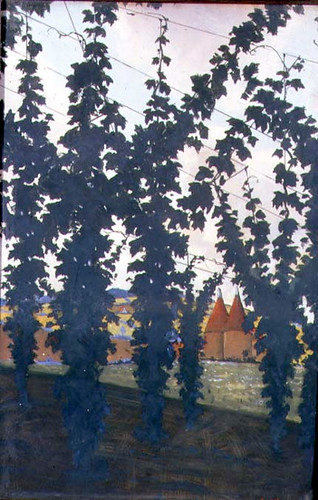
Today’s artist is a British Futurist named Christopher Richard Wynne Nevinson. While many of his paintings and illustrations appear to tackle more contemporary themes like urban life and World War I, he did paint some more idyllic landscapes like The Hop Fields.

Nevinson_hop-fields

In fact, his most striking images are almost all the war paintings, showing the unpleasantness of modern warfare. That seems somewhat ironic, as the Futurist movement he is associated with was about making a break with the old and changing the future, more of a political and societal movement rather than one concerned with paintings styles. But I suppose despite World War I being the first modern war, war itself is one of mankind’s oldest instincts revealing its horrors is in keeping with Futurist ideals.

It’s unclear when Nevinson painted The Hop Fields during his career, or where exactly it was done. But it certainly seems right at home during the Arts & Crafts movement that ended around 1910. The hops themselves seem a little thin, but I like that you can see the round buildings in the distance through the vines. You can even buy a print of the The Hop Fields at Bridgeman Art On Demand.

Nevinson’s biography from Wikipedia:

Christopher Richard Wynne Nevinson (13 August 1889 – 7 October 1946) was an English painter. He is often referred to by his initials C. R. W. Nevinson. He was the son of the famous war correspondent and journalist Henry Nevinson and the suffrage campaigner Margaret Nevinson. Educated at Uppingham School, which he hated, Nevinson went on to study at the St John’s Wood School of Art. Inspired by seeing the work of Augustus John, he decided to attend the Slade School of Art, part of University College London. There his contemporaries included Mark Gertler, Stanley Spencer, Paul Nash and Dora Carrington. Gertler was, for a time, his closest friend and influence, but they subsequently fell out when both men fell in love with Carrington.

On leaving the Slade, Nevinson befriended Marinetti, the leader of the Italian Futurists, and the radical English writer and artist Percy Wyndham Lewis. However, Nevinson fell out with Lewis and other ‘rebel’ artists when he attached their names to the Futurist movement. Lewis went on to found the Vorticists, from which Nevinson was excluded (though he is said to have coined the title for the Vorticists’ famous magazine, Blast).

At the outbreak of World War I, Nevinson joined the Friends’ Ambulance Brigade with his father, and was deeply disturbed by his work tending wounded French soldiers. For a brief period he served as a volunteer ambulance driver, before ill health forced his return to England. He used these experiences as the subject matter for a series of powerful paintings which used Futurist techniques to great effect. Subsequently appointed an official war artist, his later paintings lacked the same powerful effect. A large collection of his work can be found in the Imperial War Museum in London.

Shortly after the end of the war, Nevinson traveled to New York, where he painted a number of powerful images of the city. However, his boasting, and exaggerated claims of his war experiences, together with his depressive and temperamental personality, made him many enemies, in both the USA and England. Roger Fry of the Bloomsbury Group was a particularly virulent critic.

Nevinson was credited with holding the first cocktail party in England in 1924 by Alec Waugh

The first cocktail party in England? How cool is that?

There’s also biographies of Nevinson at Modern British Artists and also at Encyclopedia.com.

You can also see additional pieces by Nevinson at ArtCyclopedia, Artnet, Bridgeman, at the Tate Collection, and the The World Images Kiosk at UC Berkeley.

Filed Under: Art & Beer Tagged With: England, Hops

Firestone Walker Beer Dinner: The 2nd Last At Cathedral Hill

October 3, 2009 By Jay Brooks

beer-chef
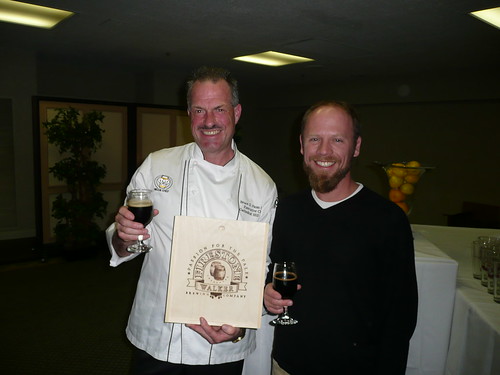
Last night was the second to last beer dinner that will take place at the Cathedral Hill Hotel in San Francisco. The hotel is scheduled to be torn down on Halloween to make way for a new hospital. The Beer Chef, Bruce Paton, put on four wonderful courses paired with the beers of Firestone Walker Brewing in Paso Robles, California. Brewer Matt Brynildson was on hand to talk about his beers.

Bruce & Matt Brynildson
The Beer Chef, Bruce Paton, with Firestone Walker brewer Matt Brynildson.

Below is a slideshow of the beer dinner. After clicking on the arrow in the center to start the slideshow, you can also click on the button on the bottom right with the four arrows pointing outward on it, to see the photos in glorious full screen. Once in full screen slideshow mode, click on “Show Info” to identify who and what’s in the photos.

The final beer dinner at the Cathedral Hill Hotel will take place on October 23. Keep an eye on the Beer Chef website for details.

Filed Under: Beers, Events, Food & Beer Tagged With: Beer Dinner, California, Northern California, San Francisco

Session #32: Drink East, Young Man

October 2, 2009 By Jay Brooks

east
Session #32 heads east this month, courtesy of Girl Likes Beer, whose personal goal to sample a beer from every country with their own brewery. She’s had quite a few west of her native Poland, but the east is still largely unexplored. So she’s invited us to go east with her. She explains:

I would like you to pick your favorite beer made east from your hometown but east enough that it is already in a different country. It can be from the closest country or from the furthest. Explain why do you like this beer. What is the coolest stereotype associated with the country the beer comes from (of course, according to you)? And one more thing. If you do a video or picture of the beer (not obligatory of course) try to include the flag of the country.

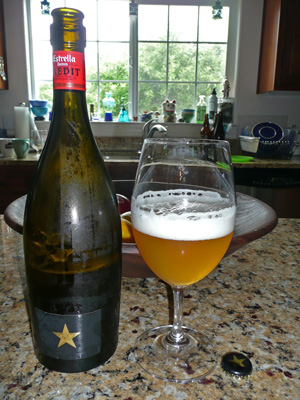
Where I live in Marin County, California is roughly along the 38th Parallel. Following the line of 38 degrees of latitude east, the next countries one encounters, not including a few Atlantic islands, are Portugal and Spain. As I don’t necessarily have a favorite from those nations readily at hand, I’ll go instead for most recently tried. The most recent Spanish beer I’ve tried, is INEDIT, created by Grupo Damm in Barcelona, Spain. Below is my review of it that was published on one of my other blogs, Bottoms Up.

session_logo_all_text_200

Apparently when Ferran Adrià does something new, the food world pays attention. He’s considered one of the world’s great chefs and cooks at el Bulli, his restaurant in Girona, which is in the Catalonia region of Spain. In 2004, he was listed in Time magazine as one of the 100 most influential people in the world. So he’s no doubt a superstar in the restaurant biz.

spain

Adrià recently lent his expertise to beer-making and worked with Spanish brewery Grupo Damm in Barcelona to help create INEDIT, a beer specifically designed as a food beer. Damm is best known for their flagship Estrella Damm, a decent, if unexceptional, example of a European lager, somewhat similar to Heineken or Stella Artois. So if you were going to pair up with a brewery to make a food beer, whatever that even means, there might be better choices, breweries that already understand the balancing of flavors between beer and food, for example.

Cooking, it should be pointed out, does not automatically make one an expert on beer any more than it makes a brewer an expert chef. The press release claims that designing the beer took 1 1/2 years and “400 trial iterations between the master brewers of Estrella Damm,” Adrià, his retaurant partner Juli Soler, and two of the sommeliers from el Bulli. If you know anything about brewing and how long the average batch takes, if might cause you to wonder how it was possible to brew 400 batches in such a short period of time.

At the Damm website, the reason given for why they wanted to make this beer is explained.

Inedit is the first beer specifically created to accompany food. It is born from the conviction that a beer that could be paired with the utmost respect to the best cuisine was necessary. That is its aim and its virtue, and that is what makes Inedit different, special and unique.

A fine sentiment, except that most craft beer along with many of the fine beers brewed in Belgium, Germany, England and others have already been brewed with food in mind. It’s just part and parcel of any good artisanal beer that its very design, its particular ingredients, and the process by which it was brewed all assures it will be an excellent compliment or contrast with just the right food. Many chefs who have been working with beer for years, such as our own Bruce Paton, the beer chef, already know this to be true and have made a living out of discovering those perfect pairings.

But the press releases really trips over itself:

Developed for gastronomy, INEDIT is an alternative to wine for pairing with all dishes — from informal to more exquisite, sophisticated types of food. INEDIT is a unique coupage of barley malt and wheat with spices which provide an intense and complex aroma. It aims to complement food once thought to be a challenge in terms of culinary pairings, including salads, vinegar-based sauces, bitter notes such as asparagus and artichokes, fatty and oily fish, and citrus.

With its delicate carbonation, INEDIT adapts to acidic, sweet and sour flavors. Its appearance is slightly cloudy, and INEDIT has a yeasty sensation with sweet spices, causing a creamy and fresh texture, delicate carbonic long aftertaste, and pleasant memory. The rich and highly adaptable bouquet offers a unique personality with a smooth, yet complex taste.

Unlike most beers, INEDIT is bottled in a 750 ml black wine bottle and is intended for sharing. INEDIT is to be served in a white wine glass, filled halfway and chilled in a cooler.

All well and good, except that how is it possible every beer aficionado knows something, something they take for granted even, that Adrià and his crew do not; which is that beer is, and has always been, a wonderful match with challenging foods.

The very idea of there being an all-purpose beer “for pairing with all dishes” suggests they don’t really understand beer’s complexities at all. No chef worth his salt would ever suggest there’s one wine that might go with any dish, but beer has for so long suffered in the shadows, and many chefs, sadly, think that beer is just one thing: the mass-produced adjunct swill that people guzzle at sporting events.

That they’ve missed the boat is again made obvious by the statement that “[u]nlike most beers, INEDIT is bottled in a 750 ml black wine bottle and is intended for sharing.” There are many, many beers that are bottled in a 750 ml size, not to mention the 22 oz. bomber, which has been around for decades. Both are, and always have been, for sharing.

Then there’s the serving suggestions, that it “be served in a white wine glass, filled halfway and chilled in a cooler.” I’m okay with the white wine glass — sort of — but Belgians and others have specifying particular glassware for their beer for a century or longer. I feel confident that there’s a beer glass that could work, too. But chilling it in a cooler? I don’t even understand that. Is that done with white wine? Is the wine put in the glass and then both are placed in a cooler to chill? Or do they mean that the glass should be chilled in a cooler first, a milder version of a frosted glass? Either way it’s a bad idea, something you should never do to your beer. It probably wouldn’t hurt it the way a frosted glass has the potential to harm beer, but it’s a road we shouldn’t even start traveling down.

But let’s forget all the hype and just talk about the beer itself. After all, that’s really what’s most important. Not surprisingly, Inedit does not live up to the hype. How could it? It’s not that it’s bad, it’s really not, but it’s hardly exceptional in a field in which there are literally countless examples of better beers to pair with food, perhaps hundreds of them being brewed right now just in the Bay Area. Try Arne Johnson’s Point Reyes Porter (from Marin Brewing) with a fine Mexican mole, for example. Absolute heaven. Or Vinnie Cilurzo’s Salvation (from Russian River Brewing) with the Chili Chocolate Mousse featured by Bruce Paton yesterday in his Food & Beer piece. Another slice of heaven. But let’s get back to Inedit.

Inedit’s nose is surprisingly subtle with few spices coming through. As it warms, some of them do start to appear, though still they remain underneath. The sweetness is what comes through on the nose. It’s slightly cloudy like a witbier, though apparently it’s a blend of a lager (most likely something similar to Estrella Damm) and, they claim, a German-style weissbier. There’s no hint of cloves or banana in the nose, suggesting instead that a weissbier yeast has not been used. It has been brewed with orange peel, coriander and licorice. Orange peel and coriander are common ingredients in a Belgian-style wit or white beer, though not a Bavarian-style weissbier. It is unfiltered and is 4.5% a.b.v.

inedit

The mouthfeel is a little thin though the flavors do exhibit some creaminess. Again it’s sweet flavors that dominate the palate, with what spices that do come through being very subtle and remaining in the background throughout. The lager blend seems to contribute a nice clean character, and the finish is quick and similarly clean, dropping off almost immediately. It’s not a bad beer, though there’s no real synergy to the blend, as if it can’t make up its mind what it wants to be. It could work fine with a light salad or some other light fare, but I don’t think it would stand up to heavier flavors very well. At around $9.99, it’s not a bad deal, just don’t expect to be wowed.

I noticed a curious thing though about how this beer’s been received in the two weeks since it was first opened to great fanfare at chef Dan Barber’s Blue Hill at Stone Barns. Barber’s another big time chef, and this year he was picked by Time magazine as one of the 100 most influential people, and it was none other than Ferran Adrià who wrote about Barber for Time. People who’ve reviewed this beer seem to be split down the middle along some telling lines. Beer reviewers seem to consider it, as I do, as average at best. But many food writers, presumably because anything Adrià does is newsworthy, wrote uncritically about it, accepting what was in the press release and passing it along verbatim without question. I’ll let you decide what conclusions to draw from that.

In the New York Times, food writer Florence Fabricant gushes that it “behaves like a wine,” which personally I take as an insult, though I know she doesn’t mean it that way. I suspect Fabricant and other food and wine writers will continue to not quite know what to make of this beer, simply because they don’t seem to really understand it. Fabricant continues by saying later in the short review that Inedit “undergoes a second fermentation in the bottle, like Champagne.” Except that its secondary fermentation, in the beer world, is called bottle conditioning, and is a common practice that’s at least as old as the similar method in champagne-making. There was no need to resort to wine in trying to describe what was going on in the beer.

When she interviewed Adrià last week about the beer she got this gem. “The idea was to make a beer to drink with food, from a wineglass.” The problem, as I see it, with statements like that and Fabricant’s suggestion that the beer is “behaving” like a wine is that, simply put, it isn’t, it can’t, and we shouldn’t even want it to: it’s beer. The only thing about it that makes it appear in any way wine-like is their lack of experience with beer and their apparent refusal to learn anything about it, preferring to fall back on laughingly uneducated wine comparisons. Beer is already the equal of wine in terms of complexity and sophistication, and has been for some time. Sure, there are simple beers, the most popular ones made by the big breweries, for example. But there are also box wines, table wines and Blue Nun, too. That chefs and food writers have no trouble distinguishing between fine wine and the more pedestrian varieties should prepare them to view beer in the same way, yet so few do. Don’t get me wrong, I love wine, too. But it’s just made from one thing: grapes. Beer is made from four primary ingredients (barley, hops, water and yeast). Add to that other grains (like wheat or rye) and other fruit, herbs and spices, then take it and age in a barrel. There are virtually endless combinations of these ingredients and processes that all but guarantee that the complexity that can be realized by a great beer far exceeds most, if not all, wine. These great, complex, sophisticated beers are fantastic with food, and have been for a long time. Pick up Garret Oliver’s “The Brewmaster’s Table,” Stephen Beaumont’s “beer bistro cookbook” or Lucy Saunders’ “Beer & Food, Pairing & Cooking with Craft Beer” at your local bookstore. These authors, and many others, have been writing about the pleasures of beer and food for years and years. It’s frustrating that beer has to continue to claw and fight for the respect it deserves.

Things are starting to change — slowly — and some chefs are beginning to discover that beer often pairs better with many different dishes; heavy meat dishes, cheese, and other spicy foods, to name a few. A majority of culinary schools do teach their students about wine but still ignore beer entirely. To me, that says a lot about the root of the problem. Despite decades of effort by hundreds and hundreds of small breweries to elevate the quality and status of craft beer, many still refuse to afford it the respect it’s due. That’s a shame really. They’re missing out on a lot of pleasure.

Inedit, unfortunately, will not prove to be the answer. The name, Inedit, means “novel, new or original” in French. Too bad it’s not really any of those things.

Filed Under: Beers, The Session Tagged With: Europe, Spain

If Beer Is The Kettle, CASA Is The Pot

October 2, 2009 By Jay Brooks

casa
The National Center on Addiction and Substance Abuse (CASA) at Columbia University, is nothing so grandly academic as its name suggests, but one of a growing number of anti-alcohol groups infecting America with its agenda. Today, its Chairman and Founder Joseph A. Califano, Jr., accused the Brewers Association and the Beer Institute of Chutzpah (which he misspelled “chutzpa”) and two specific members of the House of Representatives of hypocrisy. Talk about the pot calling the kettle black!

On his Chairman’s Corner blog today, he rails against the BEER Act, which Congress introduced back in mid-February. H.R. 836, or as its more commonly known, the Brewers Excise and Economic Relief Act of 2009, seeks to roll back the federal excise tax on beer that was doubled in 1991. The bill also would provide additional tax relief for small brewers. Most people, especially those who oppose alcohol, make the assumption that excise taxes are proper to punish the sin of drinking.

He gives his “First Annual Chutzpa (sic) Award” to the Brewers Association and the Beer Institute for H.R. 836, claiming they’re arrogant and he even has the balls to suggest them of bribery! First of all, he’s seriously delusional if he thinks small brewers have piles of cash for lobbyists.

The fact that a trade organization might work for favorable treatment by Congress for its industry or for a reform of the laws that regulate them, appears to be a novel concept to Califano. Isn’t that what every trade organization does? Did I miss a meeting? It’s okay for every other lobby, but not beer? And we’re arrogant for being happy when something goes our way?

He’s upset because for some reason he believes that the alcohol industry is responsible for the minority of people who abuse it. And, as usual, he throws around the nonsensical statistics of how much societal costs alcohol is apparently on the hook for, even though that’s not true of virtually any other industry.

As I’ve noted in Sin Tax Tyrannies, U.S. Senate Told To Raise Beer Taxes, Stupid Is As Stupid Does, The Lie That Won’t Go Away, and who knows how many others at this point, the notion of taxing only alcohol and tobacco should be deeply disturbing to any rational human being. Those two products are the only ones in our country that have excise taxes imposed on them, taxes no other companies have to pay.

People like Califano and his ilk see no apparent contradiction in tobacco and alcohol having to pay for their presumed sins but every other product that’s bad for us in quantity doesn’t have to. Soda companies don’t pay for the medical costs of the obesity epidemic. Meat companies don’t pay for higher heart risks from the over consumption of beef. Too much of almost anything can be bad for you, but we don’t say there shouldn’t be prescription drugs on the off chance that some people might abuse them.

Califano goes on to give his so-called “First Annual Hypocrisy Award” to the sponsors of H.R. 836, calling them hypocrites because for reasons passing understanding he seems to believe that being pro-alcohol and also for health care reform is contradictory. It appears to come back to the idea that alcohol has to pay for any health consequences that someone who drinks might encounter, yet no other industry has to do likewise. The Patriot Act specifically gave an exemption to pharmaceutical companies for any harm caused by them, but beer better pay its bill, by gum.

To me, that’s a far more hypocritical position to take, especially when his arguments are laced with the usual faulty statistics and, naturally, the “it’s for the children” gambit that has become de rigueur for anti-alcohol groups to invoke. Cutting the beer tax, Califano insists will mean more underage drinking, despite the fact that underage drinking is still illegal. The fact that people under 21 still manage to buy alcohol is somehow the beer industry’s fault; not law enforcement, not retail, not the ridiculousness of the law itself. But raising the tax (and thus the price) so it’s too expensive for kids punishes every adult who can legally buy alcohol, too. That’s not a problem if you want another prohibition, of course, but for the rest of society that seems patently unfair and even cruel.

Most intelligent legislators I should think are more concerned about getting our economy on firmer footing — something that H.R. 836 easily accomplishes — than following the misguided advice of the lunatic fringe that CASA represents. If I had my own made-up award for hypocrisy, Califano, CASA, and the rest of the Neo-Prohibitionist groups, would certainly be worthy recipients.

Filed Under: Editorial, Politics & Law Tagged With: Prohibitionists, Statistics

Serenity In Beer & Ale

October 2, 2009 By Jay Brooks

ubif
During World War 2, the brewing industry trade organization known as the United Brewers Industrial Foundation, which was formed by the USBA in 1937, worked with the U.S. Government to create a series of ads to build morale and on their own to highlight the positive aspects of beer. Out of these grew the more familiar “Beer Belongs” series and the “Home Life in America” series of ads that the United States Brewers Foundation created and ran from 1945 to 1956. You can read my article about these later ads in the current issue of All About Beer magazine. But I recently came upon the ad below that ran in Life magazine’s August 4, 1941 issue, at page 29. I just love the language of the text, which I reprinted below, because it’s hard to read with the ad displayed so small. (Though you can click on it or here to see a larger view.)

In a hurrying, scurrying world


there’s serenity in beer and ale

 
Telephones jangling … radios blaring … auto horns honking … airplanes roaring. In big city or small town, peace is hard to find … and precious.

YES! It’s a busy, dizzy world in which we live! And every man and woman in it needs now and then to get away from it all. Needs to sit down quietly and shut out the din and noise for a peaceful hour or so.

In your needed hours of relaxation, beer can play a pleasant part. For this delicious brew does more than delight your taste. Its mellow, kindly nature helps to unsnarl tangled nerves, helps to refresh a weary body, helps to restore a faltering spirit.

Made from nature’s choicest grains and flavored with plump, ripe, fragrant hops, beer is a mild, wholesome brew. In fact, from earliest times, men have called beer and ale the “beverages of moderation.” Make them part of your own plan of balanced, tolerant, temperate living.

UBIF

Isn’t that just beautiful. It brings a tear to your eye. Beer is certainly part of my own balanced, tolerant, temperate living. It’s funny how the pressures of life in 1941 seem almost exactly the same as those of 2009, isn’t it? I need a vacation. Good thing I’m taking one in less than two weeks.

Filed Under: Art & Beer, Breweries, Editorial, Just For Fun Tagged With: Advertising

Beer Raped Your Daughter and Gave Her Gonorrhea … Again

October 1, 2009 By Jay Brooks

reason
Thanks to Anat Baron for tweeting this my way, but it seems that the storm clouds are once again gathering over ridiculous propaganda aimed at beer. Luckily, Reason Magazine — a periodical I’ve written for — is on the case in a piece entitled Beer Raped Your Daughter and Gave Her Gonorrhea. Again.

It concerns a Washington Post editorial where two doctors argue out of — one hopes — a sense of fealty to their Hippocratic oath that more expensive beer means lower consumption, less problems, less issues, less greenhouse gas emissions, less poverty, less .. well, you get the idea — the world will be a magically better place if only there were more taxes on beer. Of course, we’ve been down this argumentative road before and their statistics, like others before them, don’t add up. They never do, but that doesn’t stop them for spouting off and making this shit up, because they seem to be taking the approach of a lie repeated often enough becomes a fact over time. As a member of The Angry Arm of the Alcohol Lobby, I say bullshit.

Here’s their nut job argument in a nutshell:

One way to reduce the harmful effects of heavy drinking is to make drinking more expensive: the more a drink costs, the less people drink. This is true of young people, pregnant women and even heavy drinkers. Research indicates that a 10 percent increase in current alcohol excise taxes — that is a penny for a beer — would result in less drinking, especially among underage drinkers, reducing rape, robbery, domestic violence and liver disease. A tax increase of 3 cents per beer would cut youth gonorrhea by 9 percent.

So more expensive beer means less rape, less STDs, less domestic violence and all manner of other horrors. Because that’s the way it’s worked as cigarette prices have kept going up, right? Here’s how Reason looked at this argument:

I’m going to pull out that last line one more time in case you, like me, sometime skim over blockquotes too quickly:

A tax increase of 3 cents per beer would cut youth gonorrhea by 9 percent.

Look at the lovely young lady at right [an old Budweiser print ad of a couple fishing]. If only a three cent tax on that Budweiser could have saved her from the heartbreak of VD.

Messrs. (Drs.?) Sederer and Goplerud have taken the fine art of vaguely claiming that “studies show…” to a new level. Obviously, the argument here is that lots of beer makes people more likely to rape, pillage, etc. and that pricier beer means less consumption. A quick Google reveals that they’re pulling from 2000 study that looked at beer taxes and gonorrhea rates in various states. Reason, of course, tore this study a new one back when first made the rounds. Key passage:

[David Murray of the Statistical Assessment Service, a non-profit think tank in D.C.] does yeoman’s work pointing out the junk reasoning at the root of so much junk science. This one was a high, hanging curve for Murray, who said the CDC’s thinking was on the level of “the sun goes down because we turn on the street lights.”

The really interesting thing is that the CDC, in effect, agrees with that criticism. It buries its assent, however, in an editorial note that says the findings “do not prove a causal relation between higher taxes and declining STD [sexually transmitted disease] rates.”

To get a sense of how bad their math is, just look at their assertion that a 10% increase means only one penny more in excise taxes. That would mean that the taxes now would be 10 cents for that to be true. Are they? Not even close. There’s a federal excise tax on beer, and then a state one, too, and the amount varies widely from state to state, making that line ridiculous on its face.

And they trot out this old saw:

It has been 18 years since federal taxes on alcohol have changed. If all spirit taxes had increased at the consumer price index and been taxed like liquor, federal taxes on a shot of spirits would have increased by 10 cents, a beer by 21 cents, and a glass of wine by 24 cents. Making that adjustment now would raise $101 billion over 10 years, without state tax increases. Equalizing the tax among beer, wine and spirits, without inflation, would raise $60 billion over 10 years.

Don’t you believe it. I’ve examined this argument thoroughly before in Here We Go Again: Beer & Taxes and Why Alcohol Doesn’t Get A Pass, among others, and it’s nothing but vicious propaganda. And propaganda made even worse by virtue of it coming from medical doctors, who people tend to believe have their best interests at heart. They don’t, of course, doctors have their own interests at heart, like everyone else. Just look at how they attacked the idea of health care reform, beginning all the way back in 1948 when a P.R. firm hired by the AMA actually coined the term “socialized medicine” to scare people into making sure we wouldn’t have universal health care in this country. That’s how much they care about you and me.

If you track these things, like I tend to, you’ll notice that the attacks on alcohol have been getting more frequent, more virulent and more mainstream. You don’t think that could have anything to do with pharmaceutical ads proliferating while alcohol ads are highly regulated and restricted? Nah, must be a coincidence. Now where does your daughter hang out? I want to buy her a beer.

Filed Under: Editorial, News, Politics & Law Tagged With: Mainstream Coverage, Prohibitionists, Statistics

« Previous Page
Next Page »

Find Something

Northern California Breweries

Please consider purchasing my latest book, California Breweries North, available from Amazon, or ask for it at your local bookstore.

Recent Comments

  • Bob Paolino on Beer Birthday: Grant Johnston
  • Gambrinus on Historic Beer Birthday: A.J. Houghton
  • Ernie Dewing on Historic Beer Birthday: Charles William Bergner 
  • Steve 'Pudgy' De Rose on Historic Beer Birthday: Jacob Schmidt
  • Jay Brooks on Beer Birthday: Bill Owens

Recent Posts

  • Beer In Ads #5215: Another Load Of “Milwaukee’s Choicest” April 10, 2026
  • Beer Birthday: Alexandre Bazzo April 10, 2026
  • Beer In Ads #5214: Poth’s Bock Beer April 10, 2026
  • Historic Beer Birthday: Rudolf Brand April 10, 2026
  • Beer In Ads #5213: Bock Beer Cascade Quality April 9, 2026

BBB Archives

Feedback

Head Quarter
This site is hosted and maintained by H25Q.dev. Any questions or comments for the webmaster can be directed here.