Brookston Beer Bulletin

Jay R. Brooks on Beer

  • Home
  • About
  • Editorial
  • Birthdays
  • Art & Beer

Socialize

  • Dribbble
  • Email
  • Facebook
  • Flickr
  • GitHub
  • Instagram
  • LinkedIn
  • Pinterest
  • RSS
  • Twitter
  • YouTube

Powered by Genesis

Beer In Art #47: UC Berkeley’s Historical Beer Exhibition

October 12, 2009 By Jay Brooks

art-beer
This past Saturday, October 10, the Heart Museum at UC Berkeley held a special beer fair and symposium for their latest exhibit, 99 Bottles of Beer: Global Brewing Traditions 2500 BC – Present.
99-bottles

I’m fascinated by the history of beer and especially the notion that beer just might possibly be responsible for civilization itself. The Berkeley exhibit was also the subject of one of my recent newspaper columns. I was able to meet with the curator, Ira Jacknis, and preview the collection as he spoke about the exhibition.

The artistry of many of the pieces is obvious, but instead of choosing just one or two, here is the entire collection and a summary of the Beer Fair and Symposium that kicked off the beer exhibition, which will be on display at the Hearst Museum at UC Berkeley for at least one year. Stop by and see it in person when you have a chance.
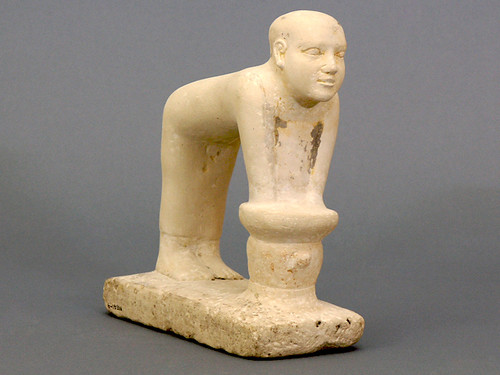
Cat. No. 6-19811
The oldest piece in the collection was from the Old Kingdom in Egypt from the 5-6 Dynasty (2465-2150 BCE). It’s the figurine of a servant woman “straining mash for beer” in painted limestone.
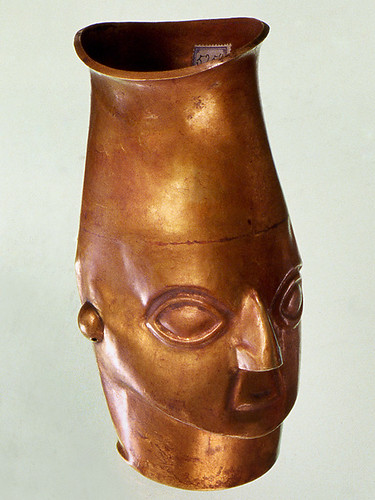
Cat. No. 4-5255
A corn beer tumbler in gold from the Ica Valley of Peru. It dates from the Late Intermediate Period (1000-1476). According to the museum, “Incans graduated their drinking vessels, according to material. The lowest-ranked used gourd bowls, the better-off had finer ceramic and wooden cups, while gold and silver cups were reserved for the elite. The cups were often used in pairs, especially the ornate ones of the emperor.”
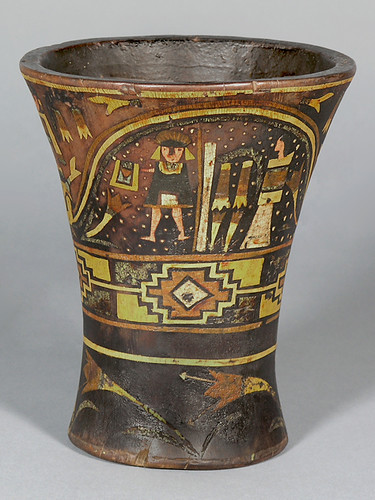
Cat. No. 16-14917
Another corn beer cup from Peru, this one made of polychromed lacquered wood. It was found in Cuzco and is believed to be from the late 16th-17th century. “Like the ancient Incan cups, these wooden cups were made and used in matched pairs. While the shape was conservative, the decoration was innovative, the figures and flowers showing a Spanish influenced. Apparently, they ceased being made after the 1820s. The beer was sprinkled or poured on the ground as a divine offering.”
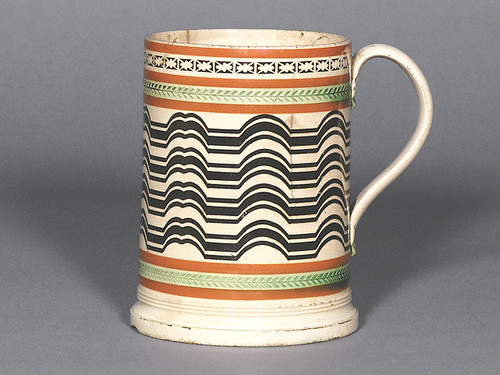
Cat. No. 7-6408
An English mug from the early 1800s, probably from the first quarter of the 19th century. It’s made of lead-glazed pearlware and was found in Staffordshire.”

Below is a slideshow of the day’s events, the collection itself (including press shots) and some photos from my preview of the collection. This Flickr gallery is best viewed in full screen. To view it that way, after clicking on the arrow in the center to start the slideshow, click on the button on the bottom right with the four arrows pointing outward on it, to see the photos in glorious full screen. Once in full screen slideshow mode, click on “Show Info” to identify each photo.

Filed Under: Art & Beer, Events Tagged With: Bay Area, California, History, Northern California, Photo Gallery

Craft Beer Pioneer Greg Noonan Passes Away

October 12, 2009 By Jay Brooks

vermont-pub
Greg Noonan, the craft beer pioneer who founded the Vermont Pub & Brewery in 1988 passed away October 11. He died in his sleep Sunday night. He was only 58 years old. His brewery was one of the first on the east coast, New England and, naturally, Burlington, Vermont. He’s not as well known for his contributions to the industry as he probably should be.

There’s a nice obituary by Guillermo Woolfolk, who’s the Birmingham Craft Beer Examiner.

He will be missed. Raise a toast to his memory.

vermont-pub

Filed Under: Breweries, News Tagged With: Eastern States, New England, Vermont

Final Beer Dinner At Cathedral Hill Coming October 23

October 9, 2009 By Jay Brooks

beer-chef
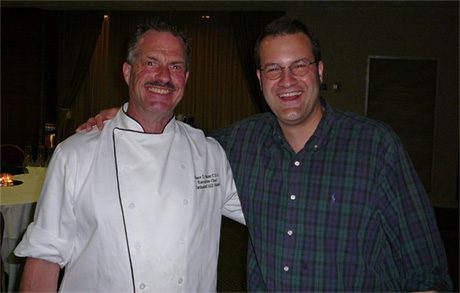
The final beer dinner to be held at the Cathedral Hill Hotel in San Francisco is scheduled for Friday, October 23. For the past eight years, the Beer Chef, Bruce Paton, has done over 60 beer dinners featuring beers from around the corner and across the world. But what you probably didn’t know is that many of the recent dinners have been done on borrowed time. A medical corporation owns the land that the hotel is situated on, and for many years has been planning on building a new hospital there. It’s been postponed several times already and the hotel’s been able to keep renting rooms and doing beer dinners. But that’s finally coming to a close as a date is now set and the Cathedral Hill Hotel will be closing. A week after the dinner, on Halloween, October 31, the hotel will be torn down.

The final beer dinner will feature the beers of Allagash Brewing and brewer/owner Rob Tod will be on hand to talk about his beers. It will be a four-course dinner, and well worth the $100 price of admission. It will begin with a reception at 6:30 p.m. Call 415.674.3406 for reservations before it’s sold out. Don’t delay, it will likely sell out quickly. I’ll see you there.

The Menu:

Reception: 6:30 PM

Beer Chef’s Hors D’Oeuvre
Beer: Allagash White

Dinner: 7:30 PM

First Course

Cannelloni of Dungeness Crab Legs with Citrus Lobster Sauce
Beer: Fluxus

Second Course:

Hobbs Applewood Bacon Fat Poached Duck Breast with Artichoke Fingerling Potato Hash
Beer: Hugh Malone

Third Course:

The Best of the Barnyard with Yam Crème Brule and Bloomsdale Spinach with Duck Ham
Beer: Odyssey

Fourth Course:

Sweet Trick or Treat
Beer: Vagabond

allagash-bdin-09
Bruce Paton, the Beer Chef, with Rob Tod, from Allgash, at an earlier beer dinner.

10.23
Dinner with the Brewmaster: Allagash
Cathedral Hill Hotel, 1101 Van Ness Avenue, San Francisco, California
415.674.3406 [ website ]

Filed Under: Breweries, Events, Food & Beer Tagged With: Announcements, California, Northern California, San Francisco

New Study Reveals RWJF Behind Neo-Prohibitionist Movement

October 9, 2009 By Jay Brooks

rwjf
Dan Mindus at the Center for Consumer Freedom recently published a report entitled Behind the Neo-Prohibition Campaign detailing just how deep the tentacles of the Robert Wood Johnson Foundation (RWJF) go in funding neo-prohibitionist groups and campaigns. As someone who pays attention to the interconnectedness of the neo-prohibitionst organizations, I was still floored by what Mindus uncovered. I often take some flack for crying conspiracy concerning these organizations but I feel a certain vindication at just how big a role RWJF actually plays in leading the charge against alcohol.

Here’s an excerpt from the report:

America’s anti-alcohol movement is composed of dozens of overlapping community groups, research institutions, and advocacy organizations, but they are brought together and given direction by one entity: the Robert Wood Johnson Foundation (RWJF). Based in Princeton, New Jersey, the RWJF has spent more than $265 million between 1997 and 2002 to tax, vilify, and restrict access to alcoholic beverages. Nearly every study disparaging alcohol in the mass media, every legislative push to limit marketing or increase taxes, and every supposedly “grassroots” anti-alcohol movement was conceived and coordinated at the RWJF’s headquarters. Thanks to this one foundation, the U.S. anti-alcohol movement speaks with one voice.

For the RWJF, it is an article of faith that diminishing per capita consumption across the board can contain the social consequences of alcohol abuse. Therefore, it has engaged in a long-term war to reduce overall drinking by all Americans. The RWJF relentlessly audits its own programs, checking to see if each dollar spent is having the maximum impact on reducing per capita consumption. Over the past 10 years, this blueprint has been refined. Increased taxes, omnipresent roadblocks, and a near total elimination of alcohol marketing are just a few of the tactics the RWJF now employs in its so-called “environmental” approach.

The environmental approach seeks to shift blame from the alcohol abuser to society in general (and to alcohol providers in particular). So the RWJF has turned providers into public enemy number one, burdening them with restrictions and taxes to make their business as difficult and complex as possible. The environmental approach’s message to typical consumers, meanwhile, is that drinking is abnormal and unacceptable. The RWJF seeks to marginalize drinking by driving it underground, away from mainstream culture and public places.

The RWJF funds programs that focus on every conceivable target, at every level from local community groups to state and federal legislation. Every demographic group is targeted: women, children, the middle class, business managers, Hispanics, Blacks, Whites, Native Americans. Every legal means is used: taxation, regulation, litigation. Every PR tactic: grassroots advocacy, paid advertising, press warfare. Every conceivable location: college campuses, sporting events, restaurants, cultural activities, inner cities, residential neighborhoods, and even bars.

The RWJF scored a major victory in 2000 with a federal .08 BAC mandate, and can claim credit for restrictions on alcohol in localities all over the country. But its $265 million has accomplished much more: it has put in place all the elements required for more sweeping change. This includes a vast network of local community organizations, centers for technical support, a compliant press, and a growing body of academic literature critical of even moderate alcohol consumption. The next highly publicized study or angry local movement may now reach the “tipping point” where the RWJF-funded anti-alcohol agenda snowballs into the kind of orchestrated frenzy the tobacco industry knows well.

You can read the entire report in a pdf, and if you care about keeping alcohol legal in the U.S., I’d highly encourage you to do so. The report, Behind the Neo-Prohibition Campaign, is only 28 pages and includes a list of the organizations and people to watch out for.

Here’s another excerpt, listing the main points in the RWJF’s plan of attack:

The Anti-Alcohol Movement’s Game Plan

The RWJF-funded anti-alcohol movement seeks to convince the public of the following propositions:

  • The social consequences of alcohol consumption are immense, and require drastic action.
  • The vast majority of Americans either abuse alcohol or don’t drink it. The former shouldn’t have access to alcohol, and the latter won’t care if you take it away.
  • Responsible drinking is an oxymoron.
  • Drinking is not normal, it is not acceptable, and it should be isolated from mainstream culture.
  • Adult drinking encourages kids to engage in reckless behavior.
  • The alcohol industry “targets” children, abusers, and minorities with “deceptive” advertising.
  • Alcohol advertising leads inexorably to abuse.
  • Convenient, inexpensive alcohol leads inevitably to its abuse.
  • There is no such thing as responsible drinking and driving.

The more the public hears these messages, the more they will tolerate the legislation and regulation of the “environmental approach.” Billboards have been taken down, hours of service have been slashed, roadblocks have been thrown up, legal BAC levels have come down, taxes have been raised, ads in restaurants have been eliminated. It’s only the beginning.

Be afraid. Be very afraid. These folks are committed fanatics. They cannot be reasoned with. They will not bow to logic. They cannot be appeased. They have no qualms about bending the truth or outright fabrication. They will do absolutely anything to advance their misguided cause. They hate me and you, too, if you think drinking beer is okay.

Filed Under: Editorial, News, Politics & Law Tagged With: Prohibitionists

Pollan’s Rules To Eat By

October 9, 2009 By Jay Brooks

apple
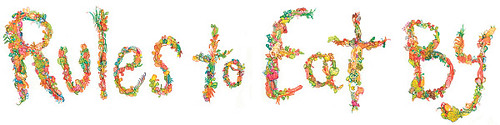
Michael Pollan, author of The Omnivore’s Dilemma, also a frequent contributor to the New York Times, in March asked for reader’s food rules. Over 2,600 people (2,681 as of this morning) posted a comment with their own food rules. On Tuesday, Pollan published a piece in the Times’ The Food Issue section of their magazine called Rules To Eat By where he discussed food rules philosophically and more practically. He’s still asking for your food rules, if you want to contribute. Some will be used in his forthcoming book, Food Rules: An Eater’s Manual.

rules-to-eat-by
Today, Pollan posted his 20 favorites from the thousands contributed. (Actually, the post is dated Oct. 11, so presumably it will be printed in this Sunday’s New York Times Magazine but was posted online early. Also, thanks to Lisa Morrison, the Beer Goddess, for tweeting this my way.) Here are a few of my favorites from his list:

  • Don’t yuck someone’s yum.
  • Never eat something that is pretending to be something else.
  • If you are not hungry enough to eat an apple, then you are not hungry.
  • Avoid snack foods with the “oh” sound in their name: Doritos, Cheetos, Fritos, Tostitos, Hostess Ho Hos, etc.

Filed Under: Food & Beer, Just For Fun, Related Pleasures Tagged With: Food, Lists

Beer In Ads #1: Beer Belongs

October 8, 2009 By Jay Brooks

ad-billboard
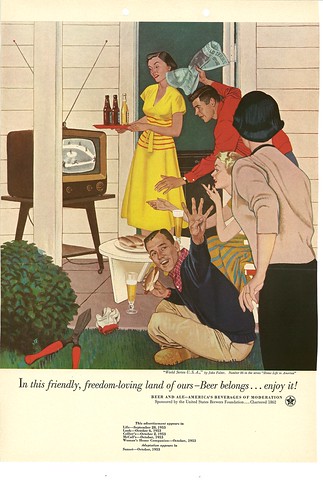
For nearly a year now, every Sunday I’ve been exploring the intersection of the world of art with beer in my Beer In Art series. In searching for more art to showcase, I keep coming upon wondrous examples of advertising illustration. So far, I’ve been reluctant to use them because there’s plenty of fine art involving beer to keep my Sunday’s busy for quite some time. So instead, I figured I’d start featuring advertising art with beer as a separate series. Every Thursday I’ll highlight a beer ad, usually one from the past, that has some impressive artwork associated with it.

To begin, there can be no better choice than the Beer Belongs series that the United States Brewers Foundation (USBF) did from 1945-1956. The bulk of the series, known as the Home Life in America series, ran from 1946-1956 and included 120 numbered ads. In addition, there were several more unnumbered ads that both preceded the Home Life series and were run after its conclusion. They were so popular, even Mad Magazine did a spoof of the ads. You’ve probably seen them at flea markets and antique shows. I have several of them framed in my hallway. About a year ago, I became curious about how many ads were produced and tried to learn about their history. Unfortunately, there wasn’t much out there and after trolling auction sites and the internet for a good six months, off and on, I put together a complete list of all the ads. I collected graphic versions of all the ads with the help of the Beer Institute and got a taste of their origins and history by reading the minutes of meetings by the USBF and looking at old trade publications and books that mention the ad campaign.

That led to an article about this popular ad campaign in this month’s All About Beer magazine (the November 2009 issue, beginning at page 44). Obviously, All About Beer couldn’t run all of the ads, so I’ve put them into a Flickr gallery so you can view all 120 of them, possibly for the very first time anywhere. That’s at the bottom of this post. You can also see the rest of them (the ones that came before and after, along with the spoofs) at my Beer Belongs … Enjoy It! page. There, you can also read some more about the ads and find out a little bit more of their history, though I’d also encourage you to pick up the article in this month’s All About Beer, too, to get the full picture.

bb-header

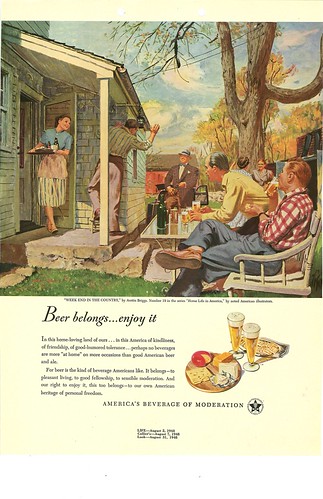
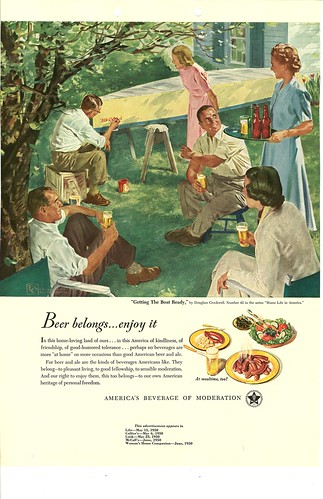
Here are three representative examples from the Home Life in America series:

019. Week End In the Country by Austin Briggs, 1948
#19 in the Home Life in America series. Week End in the Country, by Austin Briggs, 1948.

042. Getting the Boat Ready by Douglass Crockwell, 1950
#42 in the Home Life in America series. Getting the Boat Ready, by Douglass Crockwell, 1950

086. World Series U.S.A. by John Falter, 1953
#86 in the Home Life in America series. World Series U.S.A., by John Falter, 1953.

You can see all 120 of the Home Life in America series in the gallery below. This Flickr gallery is best viewed in full screen. To view it that way, after clicking on the arrow in the center to start the slideshow, click on the button on the bottom right with the four arrows pointing outward on it, to see the photos in glorious full screen. Once in full screen slideshow mode, click on “Show Info” to identify each ad’s title, artist and the year it ran.

Filed Under: Art & Beer, Beers, Just For Fun Tagged With: Advertising, History

InBev To Sell Busch Theme Parks

October 7, 2009 By Jay Brooks

busch-gardens
Anheuser-Busch InBev announced today that they’re selling their ten theme parks to the Blackstone Group for $2.7 billion, including $2.3 billion in cash. Essentially Blackstone will get ABI’s “wholly owned subsidiary, Busch Entertainment Corporation (BEC), the second largest entertainment park operator in the United States with approximately 25 million annual visitors. BEC operates 10 entertainment parks throughout the United States including three SeaWorld parks in Orlando, Florida, San Antonio, Texas, and San Diego, California, two Busch Gardens parks in Tampa, Florida and Williamsburg, Virginia, and other family entertainment attractions in Orlando, Florida, Tampa, Florida, Williamsburg, Virginia, and Langhorne, Pennsylvania.”

Blackstone is a private equity firm that currently owns Universal Studios Orlando and Madame Tussauds wax museums, so this is a business model they’re already familiar with. Obviously, this will help InBev pay down the $52 billion they paid for Anheuser-Busch last year and that’s the underlying reason for the sale.

Filed Under: News, Related Pleasures Tagged With: Anheuser-Busch InBev, Business

Not Drinking Leads To Depression

October 6, 2009 By Jay Brooks

pink-elephant
It will be interesting to see how the neo-prohibitionists spin this one. An article in Time magazine, entitled Why Nondrinkers May Be More Depressed, by John Cloud, details the findings of a recent study that suggests “those who never drink are at significantly higher risk for not only depression but also anxiety disorders, compared with those who consume alcohol regularly.”

That study, Anxiety and Depression Among Abstainers and Low-Level Alcohol Consumers, was published in the journal Addiction. According to the press release from the journal:

Abstaining from alcohol consumption is associated with an increased risk of depression according to a new study published in Addiction journal.

It has long been recognised that excessive alcohol consumption can lead to poor physical and mental health. However, there has been mounting evidence that low levels of alcohol consumption may also be associated with poor mental health possibly due to abstainers having other health problems or being reformed heavy drinkers.

The study utilized data from the Nord-Trøndelag Health Study (HUNT Study) based in Norway. This provided information on the drinking habits and mental health of over 38,000 individuals. Using this data the authors were able to show that those individuals who reported drinking no alcohol over a two week period were more likely than moderate drinkers to report symptoms of depression. Those individuals who additionally labeled themselves as “abstainers” were at the highest risk of depression. Other factors, such as age, physical health problems and number of close friends could explain some, but not all of this increased risk. The authors also had access to reported levels of alcohol consumption 11 years prior to the main survey. This showed that fourteen percent of current abstainers had previously been heavy drinkers, but this did not explain all of the increased risk of depression amongst abstainers.

The authors conclude that in societies where some use of alcohol is the norm, abstinence may be associated with being socially marginalized or particular personality traits that may also be associated with mental illness.

Though the authors of the study stop short of encouraging abstainers to start drinking, the Time magazine concludes with what any rational person reading this might think, which is “just say yes.”

The most powerful explanation seems to be that abstainers have fewer close friends than drinkers, even though they tend to participate more often in organized social activities. Abstainers seem to have a harder time making strong friendship bonds, perhaps because they don’t have alcohol to lubricate their social interactions. After all, it’s easier to reveal your worst fears and greatest hopes to a potential friend after a Negroni or two.

So does this mean we should all have a cocktail? Maybe, but Skogen says he doesn’t believe his study should encourage abstainers to become drinkers. Rather, he says doctors might want to investigate why abstaining patients don’t drink and explain that in societies where alcohol use is common, not drinking may lead them to feel left out. Sometimes, you should just say yes.

In addition to this study concerning mental health, several studies over the past decade or more have also concluded that the moderate consumption of alcohol leads to better physical health than for people who abstain from it. Better physical health and now better mental health, all from simply having a drink or two regularly. To me, that’s the pink elephant in the room.

pink-elephant

The anti-alcohol groups seem so hell bent on their all or nothing approach, seeing any alcohol as bad and no alcohol as all good, when the reality is hardly that simple. As these studies suggest, the common ground should be a more reasonable approach that leads to more drinking in moderation, removing the conditions that lead to over-consumption through education, strengthening infrastructure for public transportation so people can go out for a drink without fear, and recognizing that drinking alcohol does have many positive attributes when consumed responsibly. I realize that seems like a Herculean task at this moment in time, but that’s the only way I can see moving past the entrenched positions of both sides.

Obviously, I’m on one side of the aisle and I honestly believe that no one involved with the alcohol industry thinks that over-consumption or any extremes in drinking are a good thing. Both camps seem to agree on that. But the people against alcohol seem incapable of giving up any ground to concede that for most people moderate drinking may not be the evil they believe or that it doesn’t necessarily have to lead to greater problems. That very unwillingness, I believe, is actually exacerbating the problems that some people do experience with drinking too heavily because their focus is on the wrong problem and paints all drinkers will the same broad brush. As science continues to confirm that alcohol has been, and still is, a part of a healthy lifestyle, that position will become harder and harder to defend.

Remember the definition of an abstainer by Ambrose Bierce, in his Devil’s Dictionary:

Abstainer: n. a weak person who yields to the temptation of denying himself a pleasure.

Filed Under: Editorial, News, Politics & Law Tagged With: Mainstream Coverage, Prohibitionists, Statistics

Top 5 Beer Cities & America’s Best Beers

October 6, 2009 By Jay Brooks

mens-journal
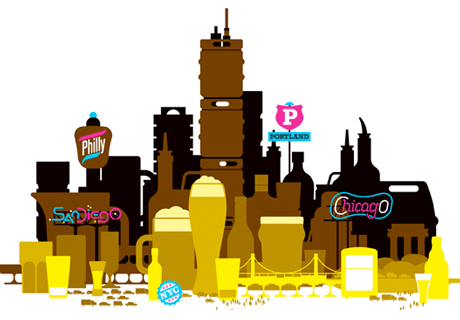
Men’s Journal yesterday released their annual lists of beer, both America’s Best Beers and The Top Five Beer Towns in the U.S.. Let’s look at the top five cities first.

  1. San Diego
  2. New York City
  3. Portland
  4. Philadelphia
  5. Chicago

It’s nice to see San Diego get some much-deserved love. While I think New York has improved in it’s beer scene over the last few years, I still have a hard time seeing it as being superior to Portland or Philly. Of course, Men’s Journal, like many periodicals, is published in New York and it’s been my experience (I lived there for several years once upon a time) that New Yorkers have an over-developed sense of their central position in the world. Naturally, I would have liked to see San Francisco on the list, but really it’s the Bay Area in total that’s most deserving, not that just the city’s scene isn’t good, too.
top-5-beer-cities
As for the beers they highlight this year, it’s a pretty good list, I’m happy to say. I especially love their introduction, where they reveal what many of us in the beer world have been saying for a few years now: “American craft brews now dominate” around the world. Finishing with “[n]ow there’s no reason to travel farther than your nearest specialty grocery store for a perfect beer.” If only the grocery chains would catch up and stock a wider range of good beer.

The list is divided into five broad categories; ales, lagers, dark beers, Belgian-style and cutting edge. Authors Christian DeBenedetti and Seth Fletcher then chose three beers of each kind to come up their top 25. As subjective at these lists can be, I have to say Men’s Journal is getting better at picking their top beers. While there are plenty of other beers I might have put on such a list — as any two people would undoubtedly choose different beers — I can’t really quibble with any of the beers they picked, save one or two, but not even enough to mention. I’ll have to do my own list one of these days.

Filed Under: Beers, Editorial, Just For Fun, News, Reviews Tagged With: Lists, Mainstream Coverage, Statistics

Mad Money Man Jim Cramer Declares Beer Wars Over

October 6, 2009 By Jay Brooks

white
Jim Cramer, the knucklehead financial dramatist who hosts the Mad Money program on MSNBC, tackles the beer wars between the major brewers, and trips over himself all over the place. You’d think no one would would watch his show or take his advice after Jon Stewart exposed him so completely earlier this year, but apparently he’s as popular as ever. That’s surprising to me given that his track record is about as good as the average weatherman. The financial markets being complex and interconnected systems, his simple-minded advice seems doomed to failure for that reason alone, but he still promises on his website that you can “Make Money With Money Manager Jim Cramer.” Caveat emptor, I guess. Maybe it’s just me, but I don’t really like having my advice yelled at me while waving cheap props in my face.
mad_money
Like most financial analysts I’ve seen talk about the brewing industry lately, Cramer has no real sense of what’s going on or the history involved with why the industry is where it is today. And so they seem to attack in a vacuum, with no understanding of it at all. You can check out his screed here about the end of the beer wars.

He details how the beer world until recently was dominated by eight companies: Bud (Anheuser-Busch) Coors, Corona (Grupo Modelo), Dos Equis (FEMSA / Cervecería Cuauhtémoc Moctezuma), Heineken, Miller, Molson and Pabst. But now that InBev bought A-B and Coors and Miller merged their operation in the U.S., “suddenly” — to use Cramer’s surprising words — “we have a near oligopoly?” First of all, these eight are not the full picture. He’s ignored Kirin, Carlsberg, Asahi, and Diageo; all in the top 10 largest beer companies globally. That’s not to mention Radeberger, Tsingtao, Foster’s and others just below the Top 10.

Then there’s the “suddenly” that Cramer keep and his gang of idiots keep feigning. Brewery consolidation has been going on literally since Prohibition ended, 75 years ago. From roughly 1,000 breweries re-opening in the years after alcohol became legal again to 1984, when there were only 44 left, and the top six accounted for 92% of beer sold, mergers & acquisitions have been on-going. This is hardly a new situation. And that’s just the U.S. The same thing has been happening around the world, both locally and in global markets. We’ve been referring to the “Big 3” — A-B, Coors & Miller — for decades. Now that there are two it’s a problem? “Suddenly?” Please …. give me a break.

Recently, ABI announced they would raise prices this fall, and MillerCoors followed suit … like they’ve always done, again for years and years. But Cramer and others reacted as if this is the first time such a thing has happened. It’s not. The major beer companies, both domestic and import, have been following one another’s lead (usually A-B) for as long as I can remember, and undoubtedly longer.

The New York Times has a similar rant in, of all things, their “breaking Views” section called Rising Beer Prices Hint at Oligopoly. I find it funny that something going on without change for decades could be considered a “breaking view,” but I guess that’s what happens when you ignore history.

Anheuser-Busch InBev — purveyor of the president’s preferred brew, Bud Light — and MillerCoors, a joint venture between SABMiller and Molson Coors, are raising prices at the same time, during a recession and while beer demand is slumping. With 80 percent of the market between them, the move almost begs for an antitrust review. [my emphasis.]

Hello, is anybody home? They’ve been raising prices “at the same time” forever. It means nothing. These are not “hints,” but simply business as usual. What the hell is wrong with these people?

Cramer goes on to rave that because they’re both raising prices that somehow that signals an end to the competition between them. He states that they’ve been “going from competitors absolutely killing each other to a slap happy international beer oligopoly.” He’s more daft than I previously thought, and that’s saying a lot.

He keeps calling Labatt, “Labott,” and incorrectly identifies it with InBev. It is owned by InBev outside the U.S., but domestically it’s owned by North American Breweries. His audience is primarily American, so that makes no sense. Cramer’s advice about buying MolsonCoors stock I can’t say I understand completely and he throws around quite a few numbers that don’t seem to either support his conclusions or even appear rational. He’s mildly clever when he says “Give Beer A Chance” with a peace symbol made of beer cans, but I’d prefer he did his homework instead and knew what the hell he was talking about. What a maroon.

The beer wars, of course, are hardly over.

Filed Under: Breweries, Editorial Tagged With: Economics, Mainstream Coverage

« Previous Page
Next Page »

Find Something

Northern California Breweries

Please consider purchasing my latest book, California Breweries North, available from Amazon, or ask for it at your local bookstore.

Recent Comments

  • Bob Paolino on Beer Birthday: Grant Johnston
  • Gambrinus on Historic Beer Birthday: A.J. Houghton
  • Ernie Dewing on Historic Beer Birthday: Charles William Bergner 
  • Steve 'Pudgy' De Rose on Historic Beer Birthday: Jacob Schmidt
  • Jay Brooks on Beer Birthday: Bill Owens

Recent Posts

  • Beer In Ads #5215: Another Load Of “Milwaukee’s Choicest” April 10, 2026
  • Beer Birthday: Alexandre Bazzo April 10, 2026
  • Beer In Ads #5214: Poth’s Bock Beer April 10, 2026
  • Historic Beer Birthday: Rudolf Brand April 10, 2026
  • Beer In Ads #5213: Bock Beer Cascade Quality April 9, 2026

BBB Archives

Feedback

Head Quarter
This site is hosted and maintained by H25Q.dev. Any questions or comments for the webmaster can be directed here.