Brookston Beer Bulletin

Jay R. Brooks on Beer

  • Home
  • About
  • Editorial
  • Birthdays
  • Art & Beer

Socialize

  • Dribbble
  • Email
  • Facebook
  • Flickr
  • GitHub
  • Instagram
  • LinkedIn
  • Pinterest
  • RSS
  • Twitter
  • YouTube

Powered by Genesis

Beer Birthday: Dann Paquette

August 16, 2025 By Jay Brooks

st-mars

Today is the 57th birthday of Dann Paquette, who along with his wife Martha Holley-Paquette, founded the Pretty Things Beer and Ale Project. It was a fairly unique idea. They didn’t own a brewery but they didn’t contract brew either. They rented the brewery and Dann did all the work brewing the beer. Certainly other contract beers were similar, but I liked that Pretty Things makes such a point of the distinction that it’s essentially beyond reproach. Oh, and did I mention he made some of the best beers I’ve tasted? Unfortunately, they recently decided to wind up the business and stop brewing while they decide what the next chapter of their lives will be. From the several philosophical discussions I’ve had with Dann, I consider him a kindred spirit. Their newest project is in Sheffield, England, and is called The Brewery of St. Mars of the Desert. Join me in wishing Dann a very happy birthday.

pretty-things-2
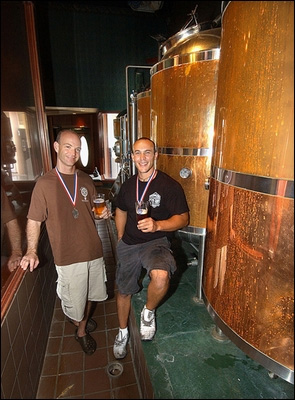
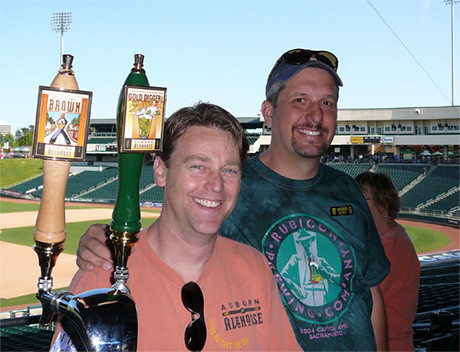
Dann with Andy Couch and Todd Alström showing off Pretty Things’ Baby Tree at the Hungry Mother, in Boston.
Paquette-2
Dann doing his Snidely Whiplash impersonation.
Paquette-3
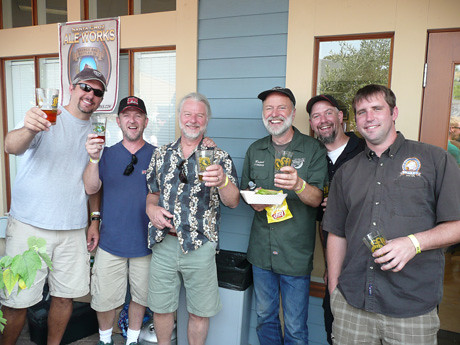
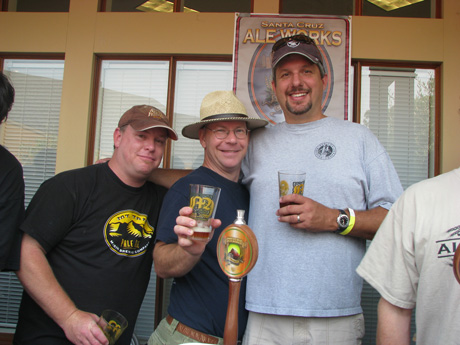
Tomme Arthur, Will Meyers, Dann, Patrick Rue and Rob Tod.
Paquette-1
Dann with his business partner and wife Martha at (I think) Beer Advocate’s Craft Beer Festival.

Note: Last three photos purloined from both Dann and Martha’s Facebook pages.

Filed Under: Birthdays Tagged With: Boston, Massachusetts

Historic Beer Birthday: Emile A.H. Seipgens

August 16, 2025 By Jay Brooks

netherlands
Today is the birthday of Emile Anton Hubert Seipgens (August 16, 1837-June 25, 1896). Seipgens was born in Roermond, the Netherlands. He was the son of a brewer, and after school and some failed jobs, joined his father at the brewery in 1856. By 1859, he was running the brewery along with his brother. But apparently he wasn’t happy there, and in 1874 decided to pursue his dream of becoming a writer. Throughout his life, he wrote poetry, novels, plays and much more.

Seipgens

Here’s a translated biography of his literary career, from Literary Zutphen:

Emile (Anton Hubert) Seipgens, born August 16, 1837 in Roermond, from 1876 until 1883 teacher of German at the Rijks HBS in Zutphen. He founded a literary reading companion for his disciples and was a member of the “Circle of scientific maintenance. He lived Nieuwstad A128-2. Seipgens was an outspoken Limburg author. His work – theater, novels and novellas village – is invariably located in Limburg, and sometimes – his songs – even written in Limburg dialect. Some of his best known and most read titles he wrote in his Zutphense period: The chaplain Bardelo (1880), from Limburg. Novellas and Sketches (1881). In this period made ​​Seipgens, who was first trained to be a priest, then was brewer, then teacher, to eventually become a writer, definitively separated from the Catholic Church. He started on the assembly line to write stories, which he published in magazines such as The Guide , Netherlands and Elsevier . One of those stories, Rooien Hannes , had worked to folk drama and staged by the Netherlands Tooneel great success. Later titles are: In and around the small town (1887), along Maas and Trench (1890), The Killer Star (1892), Jean, ‘t Stumpke, Hawioe-Ho (1893), The Zûpers of Bliënbèèk (1894) and A wild Rosary (1894). In 1892 Seipgens secretary of the Society of Dutch Literature in Leiden, and in that place he died 1896. Posthumously published yet his novel on June 25, Daniel (1897) and the beam A Immortellenkrans (1897). Seipgens, which is one of the earliest naturalists of the Netherlands became completely into oblivion, until the late 70s of the last century actually was a small revival. Which among other things led to reprint the novel The chaplain Bardelo and stories in and around the small town , and to the publication of his biography, written by Peter Nissen: Emile Anton Hubert Seipgens (1837-1896). Of brewer’s son to literary (1987), and the placing of a memorial stone at Seipgens birthplace. But this revival was short-lived. If Emile Seipgens remembered voortleeft, it will have to be on the legend of the rovershoofdman Johann Bückler based ‘operabouffe’ Schinderhannes (1864), which to this day in Roermond is staged!

Seipgens1

And here’s another account from “The Humour of Holland,” published in 1894.

Seipgens-bio

Seipgens2

Filed Under: Birthdays Tagged With: History, Literature, The Netherlands

Beer Birthday: John Pinkerton

August 16, 2025 By Jay Brooks

moon-river
Today is also the 56th birthday of John Pinkerton, founder and brewmaster of Moon River Brewing in Savannah, Georgia. He also brews some terrific beers and is great fun to drink a beer or three with. In addition, he helped to found the Georgia Craft Brewers Guild and is its current president. Join me in wishing John a very happy birthday.

At All About Beer’s “World Beer Festival” in Durham, North Carolina in 2008.
John getting showered with hops at the “Me So Hoppy Lupulin Slam” at the Falling Rock during GABF in 2005.

Filed Under: Birthdays Tagged With: Georgia, Southern States

Charles Bukowski On Drinking

August 16, 2025 By Jay Brooks

Today’s is the birthday of Henry Charles Bukowski (August 16, 1920 – March 9, 1994).

He “was a German-American poet, novelist, and short story writer. His writing was influenced by the social, cultural, and economic ambience of his adopted home city of Los Angeles. Bukowski’s work addresses the ordinary lives of poor Americans, the act of writing, alcohol, relationships with women, and the drudgery of work. The FBI kept a file on him as a result of his column Notes of a Dirty Old Man in the LA underground newspaper Open City.

Bukowski published extensively in small literary magazines and with small presses beginning in the early 1940s and continuing on through the early 1990s. He wrote thousands of poems, hundreds of short stories and six novels, eventually publishing over sixty books during the course of his career. Some of these works include his Poems Written Before Jumping Out of an 8 Story Window, published by his friend and fellow poet Charles Potts, and better-known works such as Burning in Water, Drowning in Flame. These poems and stories were later republished by John Martin’s Black Sparrow Press (now HarperCollins/Ecco Press) as collected volumes of his work. As noted by one reviewer, “Bukowski continued to be, thanks to his antics and deliberate clownish performances, the king of the underground and the epitome of the littles in the ensuing decades, stressing his loyalty to those small press editors who had first championed his work and consolidating his presence in new ventures such as the New York Quarterly, Chiron Review, or Slipstream.”

In 1986, Time called Bukowski a “laureate of American lowlife”. Regarding his enduring popular appeal, Adam Kirsch of The New Yorker wrote, “the secret of Bukowski’s appeal … [is that] he combines the confessional poet’s promise of intimacy with the larger-than-life aplomb of a pulp-fiction hero.”

During his lifetime, Bukowski received little attention from academic critics in the United States, but was better received in Europe, particularly the UK, and especially Germany, where he was born. Since his death in March 1994, Bukowski has been the subject of a number of critical articles and books about both his life and writings.

He wrote about his drinking quite a bit in poems, short stories and in legend. Below is one of his more memorable quotes:

But that’s just the tip of the iceberg, so to speak. Drinking was a favorite topic of Bukowski and his writings on the subject were collected into a single volume entitled “Charles Bukowski On Drinking” in 2019. Here’s a few gems from that volume:

From “Charles Bukowski Answers 10 Easy Questions”

“Question: What would you say is the best brand of American beer on the market today?

Bukowski: Well, that’s a bit difficult. Miller’s is the easiest on my system but each new batch of Miller’s seems to taste a bit worse. Something is going on there that I don’t like. I seem to be gradually going over to Schlitz. And I prefer beer in the bottle. Beer in the can definitely gives off a metallic taste. Cans are for the convenience of storekeepers and breweries. Whenever I see a man drinking out of a can I think, “now there is a damn fool.” Also, bottled beer should be in a brown bottle. Miller again errs in putting the stuff into a white bottle. Beer should be protected both from metal and from light.

Of course, if you have the money, it’s best to go up the scale and get the more expensive beers, imported or better-made American. Instead of a dollar 35 you have to go a dollar 75 or 2 and quarter and up. The taste is immediately noticeable. And you can drink more with less hangover. Most ordinary American beer is almost poison, especially the stuff that comes out of the spigots at racetracks. This beer actually stinks, I mean, to the nose. If you must buy a beer at the racetrack it is best to let it sit for 5 minutes before drinking it. There is something about the oxygen getting in there that removes some of the stink. The stuff is simply green.
Beer was much better before World War 2. It had tang and was filled with sharp little bubbles. It’s wash now, strictly flat. You just do the best you can with it.

Beer is better to write with and talk with than whiskey. You can go longer and make more sense. Of course, much depends upon the talker and the writer. But beer is fattening, plenty, and it lessens the sex drive, I mean, both the day you are drinking it and the day after. Heavy drinking and heavy loving seldom go hand in hand after the age of 35. I’d say a good chilled wine is the best way out and it should be drank slowly after a meal, with just perhaps a small glass before eating.

Heavy drinking is a substitute for companionship and it’s a substitute for suicide. It’s a secondary way of life. I dislike drunks but I do suppose I take a little drink now and then myself. Amen.”

brewed and filled by … (1964)

“everything
in my beercan hand
is sad,
the dirt is even
sad
under my fingernails,
and this hand
is like the hand of a
machine
and yet
it is not—
it curves itself completely
(an effort containing magic)
around the
beercan
in a movement the same as
roots
pounding a gladiola
up into the sun of air,
and the beer
goes into me.”

beerbottle (1974)

“a very miraculous thing just happened:
my beerbottle flipped over backwards
and landed on its bottom on the floor,
and I have set it upon the table to foam down,
but the photos were not so lucky today
and there is a small slit along the leather
of my left shoe, but it’s all very simple:
we cannot acquire too much: there are laws
we know nothing of, all manner of nudges
set us to burning or freezing; what sets
the blackbird in the cat’s mouth
is not for us to say, or why some men
are jailed like pet squirrels
while others nuzzle in enormous breasts
through endless nights—this is the
task and the terror, and we are not
taught why. still, it’s lucky the bottle
landed straightside up, and although
I have one of wine and one of whiskey,
this forsooths, somehow, a good night,
and perhaps tomorrow my nose will be longer:
new shoes, less rain, more poems.”

The Bukowski Tapes (1985)

“I think a man can keep on drinking for centuries, he’ll never die; especially wine and beer . . . I like drunkards, because drunkards, they come out of it, and they’re sick and they spring back, they spring back and forth . . . If you gotta be anything, be an alcoholic. If I hadn’t been a drunkard, I probably would have committed suicide long ago. You know, working the factories, the eight hour job. The slums. The streets. You work a god damn lousy job. You come home at night, you’re tired. What are you gonna do, go to a movie? Turn on your radio in a three dollar a week room? Or are you gonna rest up and wait for the job the next day, for $1.75 an hour? Hell, no! You’re gonna get a bottle of whiskey and drink it. And go down to a bar and maybe get in a fist fight. And meet some bitch, something’s going on. Then you go to work the next day, and do your simple little things, right? . . . Alcohol gives you the release of the dream without the deadness of drugs. You can come back down. You have your hangover to face. That’s the tough part. You get over it, you do your job. You come back. You drink again. I’m all for alcohol. It’s the thing.”

beer (1976)

“I don’t know how many bottles of beer
I have drunk while waiting for things
to get better.
I don’t know how much wine and whiskey
and beer
mostly beer
I have drunk after
splits with women—
waiting
for the phone to ring
waiting for the sound of footsteps,
and the phone never rings
until much later
and the footsteps never arrive
until much later
when my stomach is coming up
out of my mouth
they arrive as fresh as spring flowers:
‘what the hell have you done to yourself?
it will be 3 days before you can fuck me!’

the female is durable
she lives seven and one half years longer
than a man, and she drinks very little beer
because she knows it’s bad for the
figure.

while we are going mad
they are out
dancing and laughing
with horny cowboys.

well, there’s beer
sacks and sacks of empty beer bottles
and when you pick them up
the bottles fall through the wet bottom
of the paper sacks
rolling
clanking
spilling grey wet ash
and stale beer,
or the sacks fall over at 4 A.M.
in the morning
making the only sound in your life.

beer
rivers and seas of beer
beer beer beer
the radio singing love
songs
as the phone remains silent
and the walls stand
straight up and down
the beer is all there is.”

Filed Under: Art & Beer, Birthdays, Just For Fun, Related Pleasures Tagged With: Literature, Poetry

Historic Beer Birthday: Johan Kjeldahl

August 16, 2025 By Jay Brooks

carlsberg-crown
Today is the birthday of Johan Gustav Christoffer Thorsager Kjeldahl (August 16, 1849-July 18, 1900) He was a Danish chemist who developed a method for determining the amount of nitrogen in certain organic compounds using a laboratory technique which was named the Kjeldahl method after him.

Kjeldahl worked in Copenhagen at the Carlsberg Laboratory, associated with Carlsberg Brewery, where he was head of the Chemistry department from 1876 to 1900.

He was given the job to determine the amount of protein in the grain used in the malt industry. Less protein meant more beer. Kjeldahl found the answer was in developing a technique to determine nitrogen with accuracy but existing methods in analytical chemistry related to proteins and biochemistry at the time were far from accurate.

Haslund_Johan_Kjeld
A painting by Otto Haslund of Johan Kjeldahl.

His discovery became known as the Kjeldahl Method

Kjeldahl's_distillation

The method consists of heating a substance with sulphuric acid, which decomposes the organic substance by oxidation to liberate the reduced nitrogen as ammonium sulphate. In this step potassium sulphate is added to increase the boiling point of the medium (from 337 °C to 373 °C) . Chemical decomposition of the sample is complete when the initially very dark-coloured medium has become clear and colourless.

The solution is then distilled with a small quantity of sodium hydroxide, which converts the ammonium salt to ammonia. The amount of ammonia present, and thus the amount of nitrogen present in the sample, is determined by back titration. The end of the condenser is dipped into a solution of boric acid. The ammonia reacts with the acid and the remainder of the acid is then titrated with a sodium carbonate solution by way of a methyl orange pH indicator.

In practice, this analysis is largely automated; specific catalysts accelerate the decomposition. Originally, the catalyst of choice was mercuric oxide. However, while it was very effective, health concerns resulted in it being replaced by cupric sulfate. Cupric sulfate was not as efficient as mercuric oxide, and yielded lower protein results. It was soon supplemented with titanium dioxide, which is currently the approved catalyst in all of the methods of analysis for protein in the Official Methods and Recommended Practices of AOAC International.

And Velp Scientifica also has an explanation of his method, which is still in use today.

Kjeldahl (center) in his laboratory.

Filed Under: Birthdays, Just For Fun, Related Pleasures Tagged With: Carlsberg, Denmark, History, Science, Science of Brewing

Beer In Ads #5054: Alpine Bock Beer Festival

August 15, 2025 By Jay Brooks

Last year I decided to concentrate on Bock ads. Bock, of course, may have originated in Germany, in the town of Einbeck. Because many 19th century American breweries were founded by German immigrants, they offered a bock at certain times of the year, be it Spring, Easter, Lent, Christmas, or what have you. In a sense they were some of the first seasonal beers. “The style was later adopted in Bavaria by Munich brewers in the 17th century. Due to their Bavarian accent, citizens of Munich pronounced ‘Einbeck’ as ‘ein Bock’ (a billy goat), and thus the beer became known as ‘Bock.’ A goat often appears on bottle labels.” And presumably because they were special releases, many breweries went all out promoting them with beautiful artwork on posters and other advertising.

Friday’s ad is not for a specific Bock Beer, but for an upcoming Bock Beer Festival at the Alpine Village Beer Garden, and was published on August 15, 1969. This one is for the Alpine Village in Torrance, California, which was originally founded in 1968. They had Bavarian Dances every weekend, but the Bock Beer Festival took place on august 17. Unfortunately, it closed during Covid, but has recently been designated as culturally significant and saved from demolition. This ad for the event ran in The Daily Breeze, of Hermosa Beach, California.

Filed Under: Art & Beer, Beers, Events, Just For Fun Tagged With: Advertising, Bock, California, History

Historic Beer Birthday: Charles D. Goepper

August 15, 2025 By Jay Brooks

Today is the birthday of Charles D. Goepper (August 15, 1860-June 7, 1909). In 18990, he was elected Secretary of the Phoenix Brewery of Louisville, Kentucky. The brewery was founded in 1859 as the Philip Zang Brewery, but became known as the Phoenix Brewery just two years later, in 1861, but closed in 1916 due to prohibition.

Here is Goepper’s obituary from the American Brewers’ Review:

And this obituary is from the Louisville Courier Journal:

And this obituary is from the same day in Louisville Courier Journal, but is slightly different, possibly from different editions, like the morning and evening papers?:

Filed Under: Birthdays, Breweries, Just For Fun Tagged With: Kentucky

Historic Beer Birthday: Adam Eulberg

August 15, 2025 By Jay Brooks

eulberg-bros

Today is the birthday of Adam Eulberg (August 15, 1835-May 20, 1901). He was born in Nassau, Germany but moved to Portage, Wisconsin with his family when he was 19, in 1854. In 1884 he and his brother Peter bought the City Brewery, which had been founded in 1852 by Carl Haertel. His brother Peter passed away suddenly shortly thereafter and Adam carried on the business alone, at least until his two sons were old enough to join him. Adam and Peter renamed the brewery Eulberg Bros. Brewery, but Adam’s family changed it to the Eulberg Brewing Co. in 1907. They survived prohibition making soda, and resumed beer production after repeal, but the Eulbergs sold the business in 1944. It closed for good in 1958.

Adam-Eulberg

This is Eulberg’s obituary from the American Brewers’ Review:

Adam-Eulberg-obit
Eulberg-brewery-1880
The Eulberg Brewery before he bought it, in 1880.

This short history of the brewery is from the Wisconsin Historical Society:

Milwaukee dominated Wisconsin’s early brewing industry, but successful breweries were found in communities throughout the state. In 1852, German immigrant Carl Haertel began producing beer in Portage, Wisconsin. In 1884, brothers Adam and Peter Eulberg, also originally from Germany, acquired the Haertel Brewery. The Eulberg Brewing Company remained in the family until 1944 and shut its doors permanently in 1958.

Eulberg-crown-select

And here’s another history of the brewery building itself, which is still standing in downtown Portage, Wisconsin.

Eulberg-building
Eulberg-picnic-beer

As far as I can tell, he’s not related to Caspar Eulberg, who was born in roughly the same area of Germany, and started a brewery in Galena, Illinois called C. Eulberg & Sons.

Eulberg-old-portage
Eulberg-can

Filed Under: Birthdays, Breweries, Just For Fun Tagged With: Germany, Wisconsin

Historic Beer Birthday: Christian Benjamin Feigenspan

August 15, 2025 By Jay Brooks

feigenspan
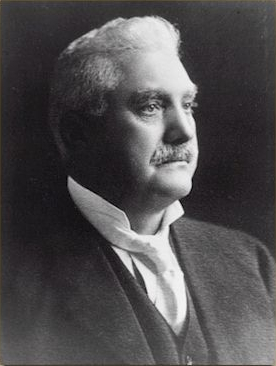
Today is the birthday of Christian Benjamin Feigenspan (August 15, 1844-April 10, 1899). He was born in Thuringia, Germany but moved his family to New Jersey and founded the C. Feigenspan Brewing Company of Newark in 1875, though at least one source says 1868. When he died in 1899, his son Christian William Feigenspan took over management of the brewery, which remained in business through prohibition, but was bought by Ballantine in 1943.

Christian-Benjamin-Feigenspan

There’s surprisingly little biographical information about Christian Benjamin Feigenspan, but here’s some history of his brewery:

In 1875 the Christian Feigenspan Brewing Company was founded at 49 Charlton St., at the former Laible brewery where he had previously been a superintendent. He would also marry Rachel Laible.

In 1878, he reportedly built a brewery on Belmont Street, and as late as 1886 a facility at 54 Belmont would be listed as the “Feigenspan Bottling Establishment”.

In 1880, Christian Feiganspan took over the Charles Kolb lager beer brewery (founded 1866) on Freeman Street. (Altho’, an 1873 map of Newark shows the property owned by a “Lenz Geyer Company”. There was a “Geyer” who was another Newark brewer who owned an “Enterprise Brewery” on Orange St.)

An 1884 fire would, reportedly, burn the brewery to the ground for a loss of $300,000.

By 1909, the firm would be advertising that “…Feigenspan Breweries are the largest producers of Ale in the United States!” (click on barrel above for text of ad) in an apparent dig at their much larger next door neighbor, P. Ballantine & Sons. Ballantine’s Lager Beer sales having by then accounted for 3/4 of their total production.

Possibly because of WWI era restrictions on the allowable alcohol level of beer (set at a mere 2.75%), Feigenspan entered into Prohibition with 4,000 barrels of aging ale in its cellar. In 1927, the ale would make the news as they tried to sell it. One story in July had it going to Heinz in Pittsburgh to be made into malt vinegar, but follow up articles say that in early November the ale was simply dumped into the sewer “…and thence into the Passaic River”.

Sadly, it would not be the first beer dumped by Feigenspan, which had one of the first four licenses to brew “medicinal beer” at the start of Prohibition. “Medicinal beer” was soon outlawed by the “Anti-Beer” law, and the brewery had to dump 600 cases of “real beer” (4.5% alcohol) in March of 1922.

Feigenspan-bock-1900

Christian-Feigenspan-Breweries-Tip-Trays-3-6-inches-Christian-Feigenspan-Inc--Pre-Prohibition

Filed Under: Birthdays, Breweries, Just For Fun Tagged With: Germany, History, New Jersey

Beer In Ads #5053: Stiegl Golden Bock Beer

August 14, 2025 By Jay Brooks

Last year I decided to concentrate on Bock ads. Bock, of course, may have originated in Germany, in the town of Einbeck. Because many 19th century American breweries were founded by German immigrants, they offered a bock at certain times of the year, be it Spring, Easter, Lent, Christmas, or what have you. In a sense they were some of the first seasonal beers. “The style was later adopted in Bavaria by Munich brewers in the 17th century. Due to their Bavarian accent, citizens of Munich pronounced ‘Einbeck’ as ‘ein Bock’ (a billy goat), and thus the beer became known as ‘Bock.’ A goat often appears on bottle labels.” And presumably because they were special releases, many breweries went all out promoting them with beautiful artwork on posters and other advertising.

Thursday’s ad is for Stiegl Golden Bock Beer, which was published on August 14, 1982. This one is for the Stiegl Brauerei of Salzburg, Austria, which was originally founded in 1492. This ad for the imported beer ran in The Chicago Tribune, of Chicago, Illinois.

Filed Under: Art & Beer, Beers, Breweries, Just For Fun Tagged With: Advertising, Austria, Bock, Chicago, History, Illinois

« Previous Page
Next Page »

Find Something

Northern California Breweries

Please consider purchasing my latest book, California Breweries North, available from Amazon, or ask for it at your local bookstore.

Recent Comments

  • Ernie Dewing on Historic Beer Birthday: Charles William Bergner 
  • Steve 'Pudgy' De Rose on Historic Beer Birthday: Jacob Schmidt
  • Jay Brooks on Beer Birthday: Bill Owens
  • Steve 'Pudgy' De Rose on Beer Birthday: Charles Finkel
  • Steve 'Pudgy' De Rose on Beer Birthday: Bill Owens

Recent Posts

  • Beer In Ads #5185: It’s Bock Time January 28, 2026
  • Historic Cider Birthday: H.P. Bulmer January 28, 2026
  • Beer Birthday: Shane McNamara January 28, 2026
  • Historic Beer Birthday: John Goetz January 28, 2026
  • Beer Birthday: Jean-Marie Rock January 28, 2026

BBB Archives

Feedback

Head Quarter
This site is hosted and maintained by H25Q.dev. Any questions or comments for the webmaster can be directed here.