Brookston Beer Bulletin

Jay R. Brooks on Beer

  • Home
  • About
  • Editorial
  • Birthdays
  • Art & Beer

Socialize

  • Dribbble
  • Email
  • Facebook
  • Flickr
  • GitHub
  • Instagram
  • LinkedIn
  • Pinterest
  • RSS
  • Twitter
  • YouTube

Powered by Genesis

Heineken To Acquire 50% Stake In Lagunitas

September 8, 2015 By Jay Brooks

lagunitas-circle heineken-white
Well this was certainly unexpected. I knew that ABI had met with Lagunitas founder Tony Magee but had been rebuffed. But today, Lagunitas Brewing announced that Heineken was acquiring a 50% stake in the Petaluma brewery. Apparently “Lagunitas will continue to be led by Tony Magee … and the company will continue to operate as an independent entity.” The deal is structured as a joint venture and is with the global Heineken rather than Heineken USA.

Here’s the Heineken press release and as it was posted on Lagunitas:

Heineken N.V. today has announced the acquisition of a 50% shareholding in the Lagunitas Brewing Company, the fifth largest craft brewer in the United States by volume. Lagunitas owns a stable of award-winning brands, including Lagunitas IPA. Lagunitas IPA is the largest India Pale Ale brand in the United States and has become a benchmark for the category. The transaction will provide HEINEKEN with the opportunity to build a strong foothold in the dynamic craft brewing category on a global scale, whilst it provides Lagunitas with a global opportunity to present its beers to new consumers in a category that is showing exciting international growth opportunities.

Founded in California in 1993, Lagunitas is estimated to sell c. 1 million hectolitres of beer in 2015 from its two world-class breweries in Petaluma, California, and Chicago, Illinois. A third brewery is currently under construction in Azusa, California. The brewer has a strong track record of growth, with 2012 – 2014 revenue CAGR at 58%. Its other leading brands include A Little Sumpin’ Sumpin’, Daytime, Pils, Sucks, Hop Stoopid and Maximus. Lagunitas has a nationwide presence in the United States and the brewer has expanded into a number of other markets including the UK, Canada, Sweden and Japan, offering strong potential for continued growth outside the United States.

In the United States, craft beer continues to outperform the overall beer market, and now represents 11% of total volumes. Within the craft segment, IPA is the fastest growing category.

Lagunitas will continue to be led by Tony Magee, its founder and Executive Chairman, alongside the existing management team and the company will continue to operate as an independent entity.

The transaction is subject to customary closing conditions and is expected to complete in the 4th quarter of 2015. Financial terms are not disclosed.
lagunitas-logo

For more background, and offering a more personal insight, Tony Magee posted his thoughts about the deal on his Tumblr:

The Future will not be like the Past

Furthur….

So….. this morning you may have heard the exciting news that we announced a powerful joint venture with Heineken to export the exciting vibe of American craft beer globally. If you did, then you know the reason for my previous ten blog entries. What you might not know is how the thinking came about that brought us to this opportunity or how it is that this new relationship will work. If you’re interested, dear reader, please read on.

Our time in Craft Brewing didn’t begin on Craft’s first day, that day came thirty years before we started. Initially in SanFrancisco on 8th Street and then 20 years later around California and the Pacific Northwest. However, from the first day the world of Craft resembled the river in the proverb by the Greek philosopher Heraclitus which says that ‘You can never step in the same river twice; It won’t be the same river and you won’t be the same person’.

The nature of Craft has been on a never-ending curve towards something that it never imagined for itself. In total in the U.S.A. Craft Beer still represents only 9% of all the beer enjoyed. That’s less than one-in-ten. Yet, in places like San Francisco and the Pacific Northwest it approaches and even exceeds 50% of the world of beer. This past February, for one week, our IPA 12-packs were the #1 beer package in the whole of the Bay Area. Number 2 was a big brewer’s 30-packs and #3 was another big brewer’s 24-pack. That kind of thing was not even dreamt about just 5 years earlier. I believe that the West Coast scene is a forecast for the rest of the country and even the rest of the world. It’ll take time, but it is entirely possible. So it is that we have worked hard and grown with that opportunity and we have been driven by a spirit of adventure.

A blog post here a few episodes back was called ‘On Finishing a Poem’ and in it I thought through the nature of the terminal point of a creative adventure. How do you know when you have put the right amount of the right stuff into a thing? Well, you only know when you know, and sometimes it takes a baseball bat to the forehead to notice. For me it was the ill-fated trade-mark dispute back in April. After the dust settled, which took a while, I looked at Lagunitas and realized that we had already infused it with a lot of the right stuff and that it didn’t need to be endlessly recreated for it to have a good time interacting with beer-lovers across the country. By that time we were already looking towards Lagunitas#3 in Azusa with a view towards another brewery after that. We already had ideas of new flavors and we had ideas about new ways to make more connections with more people. The domestic future was a living thing in our minds. In other words, we were already working out an exciting path of worthy challenges within the 50 states, but there is the whole world to think about too…

About the same time we launched Lagunitas in Ireland and I met people there who were big fans of U.S. Craft flavors, some of whom were themselves newly minted brewers, and I realized that the whole damn world of humans may well want to enjoy these same flavors. When I got back home I thought long and hard about how to aim at that truth, how can we get there, to the whole world? I thought about going it alone and working our way through the weeds to that future reality. But I thought also about all of the ‘deals’ going on inside of Craft these days. Private Equity money, Budweiser and now Miller/Coors buying our peers. Family Offices investing. People with big money from the get-go coming in alongside all of the rest of us inspired amateurs.

Here’s my thinking on things, if it matters. I’ve watched for the last few years as some good brewers have made their own decisions about their own futures and the futures of their people and brands. I’ve watched and felt strongly that it was a problematic thing. I’ve watched and tried to learn what it was that was happening. Craft Brewing, the thing itself and the environment it lives in, is freakin’ complicated enough. The entrance of giant piles of Private Equity money and Mega Brewers is disturbing. Not because any of you here will be corrupted by it all, but because the distribution and retail tiers and the merely-craft-aware peeps out there can be corrupted. Beer is an old biz in the US and it used to be very orderly. Craft disrupted that and now the old order wants to find a way back to the past. It won’t work, but it’s going to try.

Amid all of this uncertainty, and being 55 years old going on 80, I had to think long and hard about how to steer our ship into these new waters. There are basically five categories of options that range from indifference all the way to going head-first over the transom and selling the business to someone else to steer the ship instead.

I wrote about the five structural creatures that constitute the zoology of ‘Optionality’ in another blog post and that post ended with the question, ‘is there a sixth way?’. Our new Joint Venture with Heineken is that ’sixth way’. It represents a mutual respect society, a meeting of equals, a partnership of peers. The graduation of American Craft Brewing along with the people who brew it onto the world stage.

Selling one’s business entirely is one thing. This is not that. Selling a stake to a PE fund that will need to re-sell it in a few years is another thing. This is not that. ESOPs are cool but they do not pave a road to bigger opportunities for the people and the brand. This is not that either. What we have created in this relationship is a wide staircase to the sky for all of our people and for our brand as well as for the home-grown vibe of American Craft brewing.

Some might say I’ve changed my mind. Well, I have. But the world around us has changed too and if learning leads to new insight, that’s the best kind of change imaginable. The hard part is discovering truly positive change within the possible avenues forward.

I have also thought about all of the inspired new breweries coming to the scene and that the landscape may well become uncomfortable someday soon. I worried that Craft was beginning to compete with other Craft, a thing that hadn’t happened in the past when everyone looked to the far horizon for opportunities. But that’s not a terrible thing, it’s just nature doing its Darwinian thing. And there is the reality that I’m not really even middle-aged anymore unless I expect to live to be 110, which I don’t. I thought about how all of the people who have made their bets alongside mine would do if I wasn’t here. Maybe everything would be fine, and maybe not. Some of them are my age while others are just beginning their very own working lives right now with Lagunitas.

If I was going to do anything at all it would have to provide big opportunities for those same people and not just be safe-harbor for me and my shareholder partners. It would have to provide something that we could not readily build for ourselves. Historically, the history of breweries shows them to be two or three-generation endeavors, but I only have one of those for myself. I think that a lot of Craft Brewery owners might well be thinking the same thing. After all, no one gets out of here alive. I thought long and hard about how I wanted to spend the next ten of the dwindling count of years remaining on the clock and I decided that I did not want to spend it worrying about what would happen in the fifty states alone. I decided that I wanted to build a ‘sky-hook’. I wanted to see if anyone else saw what I saw in the rest of the global market for great tasting beer.

There’s a pertinent Friedrich Nietzsche parable about a ‘madman’ who comes into a town square holding a lighted lantern declaring to the town that he has important news. He tells his story and the people laugh and berate him in disbelief, throwing stones to drive him off. Finally he gives up saying, ‘I have come too soon’’. He drops the lantern, the light goes out, and he departs.

I wondered if my idea of globalization for American Craft too had also come soon. I thought about who might see what I saw and if the time was right to reach out to that other brewer. I thought about who that other brewer might be and the list was very short. The list of truly global beer brands is a short one. It certainly would not include the ‘bankers’ who own the great Anheuser-Busch now, nor would it be the South Africans who control the other two large brewers in the US who are themselves essentially ‘bankers’. The global brewing scene is a very consolidated one. Consolidation has been the modus operandi for the last 40 years, so there really are very few global brewers, and at that maybe only one actually global beer brand! In my mind only one Brewer stood out as truly global, family-owned and still brewers first; Heineken. We talked with a few others but there was really only one relationship that seemed acceptable.

When we, the Madman in the Parable, came into the square with our lantern, holding up the light of our ideas, we was stunned to see that that one particular brewer understood what we were talking about. They welcomed a dialogue about these crazy ideas of order. They saw what we saw- a global beer business in a state of change, and they wanted to work together to explore this brave new world. We had indeed NOT come too soon.

In them we met a global brewer who uses no adjuncts in their flagship beer; malt only. We met a brewer that is still controlled by its founder’s great-granddaughter. We met a brewer whose CEO/Chairman understood the details of the brewing process. We met people who thoroughly understood the revolutionary aspects of what beer-lovers have wrought in the America. We met people who laughed easily along with us at our own history and our predilections. After all, they are from Amsterdam, if you get my drift. More to the point, we met a company that saw and understood that we could only work together if we could continue as we are, steering our own ship here and abroad, being ourselves and exporting exactly that to communities all over the world, beginning with Mexico…! They wanted what it is that we wanted.

What grew from these conversations was an opportunity like none other to-date: An open door to a planet filled with beer-lovers and a conduit to meet them in our own way. One beer writer commented to me that he was struggling with the ‘having our cake and eating it too’ quality of this relationship, but that’s exactly what we have achieved. It’s come about because we lucked out and found a space where our desires were in sync with the other’s needs. We wanted what they wanted.

Things that are born grow, and mature and become. That process of becoming is endless and all of craft rolled together is itself a thing becoming. It is not one thing, rather whatever you see of it today represents only one point on a curve. Breweries that were born decades ago are at one locus on that curve, ones that were born a few months ago are at a different point on that curve, but all are becoming, endlessly.

So it is for Lagunitas, and this new adventure represents no more or less of an inflection point on that curve than did moving the brewery to Petaluma in 1994, or switching our flagship from Pale Ale to IPA in 1995, or borrowing $52 million to build Chicago or promoting the talented Jeremy Marshall to full Brewmaster status in 2013.

This is not the end of anything at all at Lagunitas, except maybe it is the end of the beginning, meaning that we are now standing at the threshold of an historic opportunity to export the excitement and vibe of American-born Craft Brewing and meet beer-lovers all over the Planet Earth, our true homeland. This could one day even be seen as a crucial victory for American Craft Brewing.

By the way, in the official press release I say that we’ll be available from Mongolia to the far-flung ‘Isles of Langerhans’. Those lovely sounding islets are actually some tiny structures inside your pancreas and I stole that from the Firesign Theater. Everything comes from somewhere, and Lagunitas comes from the U.S.of A. ….available everywhere soon! Cheers, to the ongoing victory of American Craft brewing….!
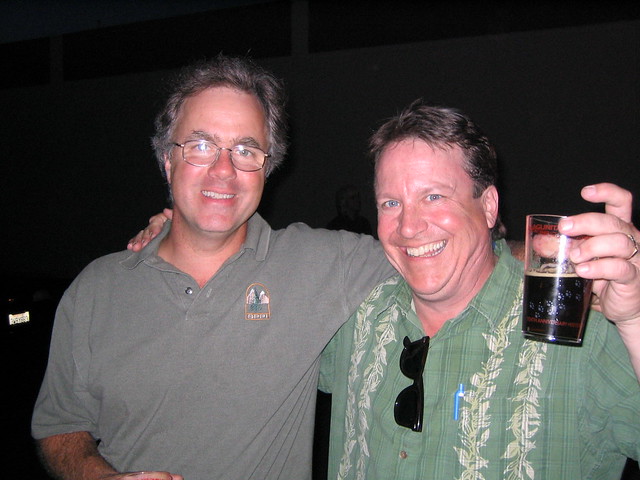
108_0881
Tony Magee and longtime honcho Ron Lindenbusch at the brewery’s 10th anniversary party in 2004.

Filed Under: Breweries, News Tagged With: Announcements, Heineken, Press Release, The Netherlands

Beer In Ads #1671: Bringing Out The Finest Flavor

September 7, 2015 By Jay Brooks


Monday’s ad is for Schlitz, from 1947. Showing an illustration of a backyard barbecue, two couples are having a fine day. One of the women has brought out a tray with enough glasses and bottles of Schlitz for everyone. And boy do the other three look happy, just staring at her with smiling blank looks on their faces. The other couple look like they could be the same person. But the text is great. After a story about it takes just the right amount of seasoning to make the steak taste perfect, they suggest that “it takes a gift of genius to lure shy flavors from their hiding places,” before bringing it back to Schlitz.

Schlitz-1947-bbq

Filed Under: Art & Beer, Beers Tagged With: Advertising, History, Schlitz

No Beer, No Work

September 7, 2015 By Jay Brooks

no-beer-no-work
Today, of course, is Labor Day in the U.S. and Canada, celebrated each year on the first Monday in September since 1894, at least federally. Most countries, more than 80, celebrate something similar on May 1, and a few others on different days. In the Bahamas, for example, it’s the first Friday in June and in New Zealand, it’s celebrated the fourth Monday in October, while in Australia it’s different for every territory there. But the genesis is the same, to “honor the American labor movement and the contributions that workers have made to the strength, prosperity, and well-being of their country.”

According to Wikipedia, “Labor Day was promoted by the Central Labor Union and the Knights of Labor, who organized the first parade in New York City. After the Haymarket Massacre in Chicago on May 4, 1886, U.S. President Grover Cleveland feared that commemorating Labor Day on May 1 could become an opportunity to commemorate the affair. Therefore, in 1887, the United States holiday was established in September to support the Labor Day that the Knights favored.” And you can read more about it at the Department of Labor.

Unlike today, when labor movements, and particularly unions, are demonized in the press and by the right-wing political machine, most people supported labor in some fashion for the very simply reason that a majority of people were part of the labor force. Today, thanks to effective propaganda, many people vote against their own interests. But that was not yet the case when Prohibition took effect in 1920. So many people in the labor force who were very unhappy about not being able to drink a beer after eight hours of back-breaking work started agitating for a repeal of prohibition, in some cases right from the start, since it became abundantly clear very quickly that a working life without the reward of a cold beer was going to suck.

Even before the 18th Amendment was to take effect on January 17, 1920, a previous measure passed by Congress, the Wartime Prohibition Act banned “the sale of alcoholic beverages having an alcohol content of greater than 2.75%” beginning on June 30, 1919.” The measure supposedly was “intended to save grain for the war effort,” but it actually “was passed after the armistice ending World War I was signed on November 11, 1918.” Since July 1st was the first day after alcohol was banned under the Wartime Prohibition Act, that day became known as the “Thirsty-First.”

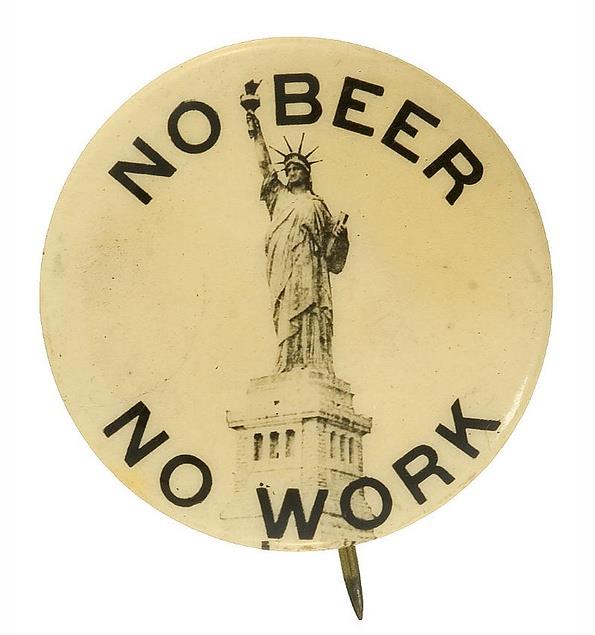
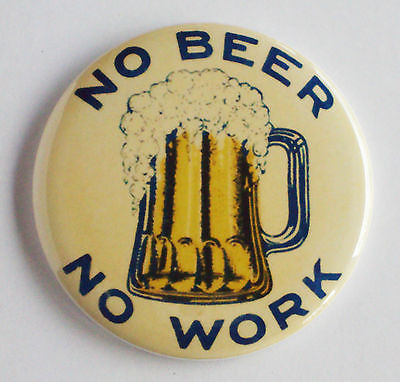
So labor organizations in New York City began making plans to oppose and protest Prohibition, creating pins bearing their slogan “No Beer, No Work.”

no-beer-no-work-pin

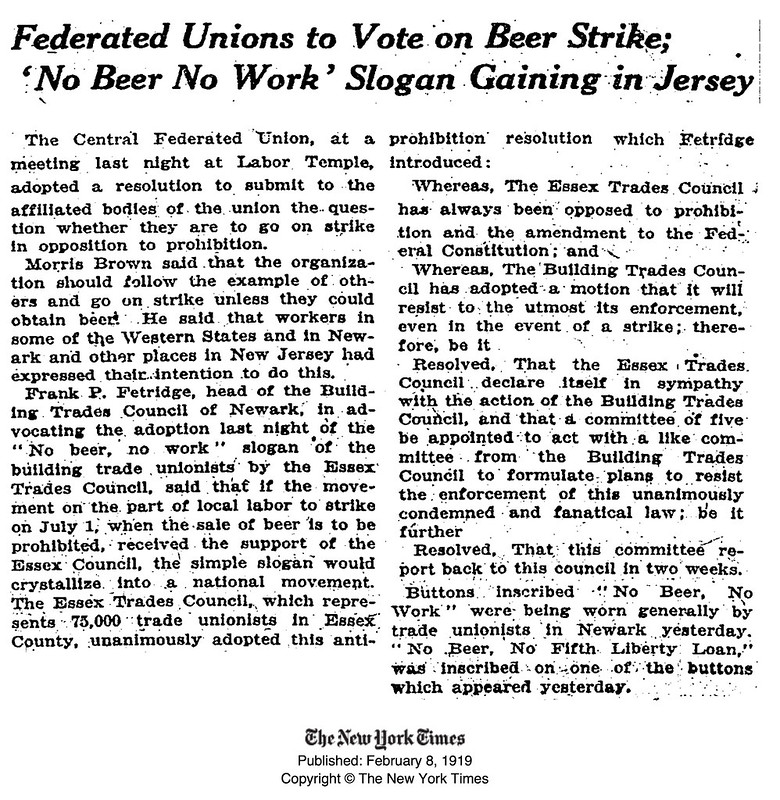
In addition, they planned a walk-out for July 1 of 1919, which was reported in the New York Times on February 8, 1919.

nyt-feb8-1919

The next day, February 9, 1919, the story was picked up in Chicago and ran on the front page of The Evening World.

NoBeerNoWork-1919-Chicago

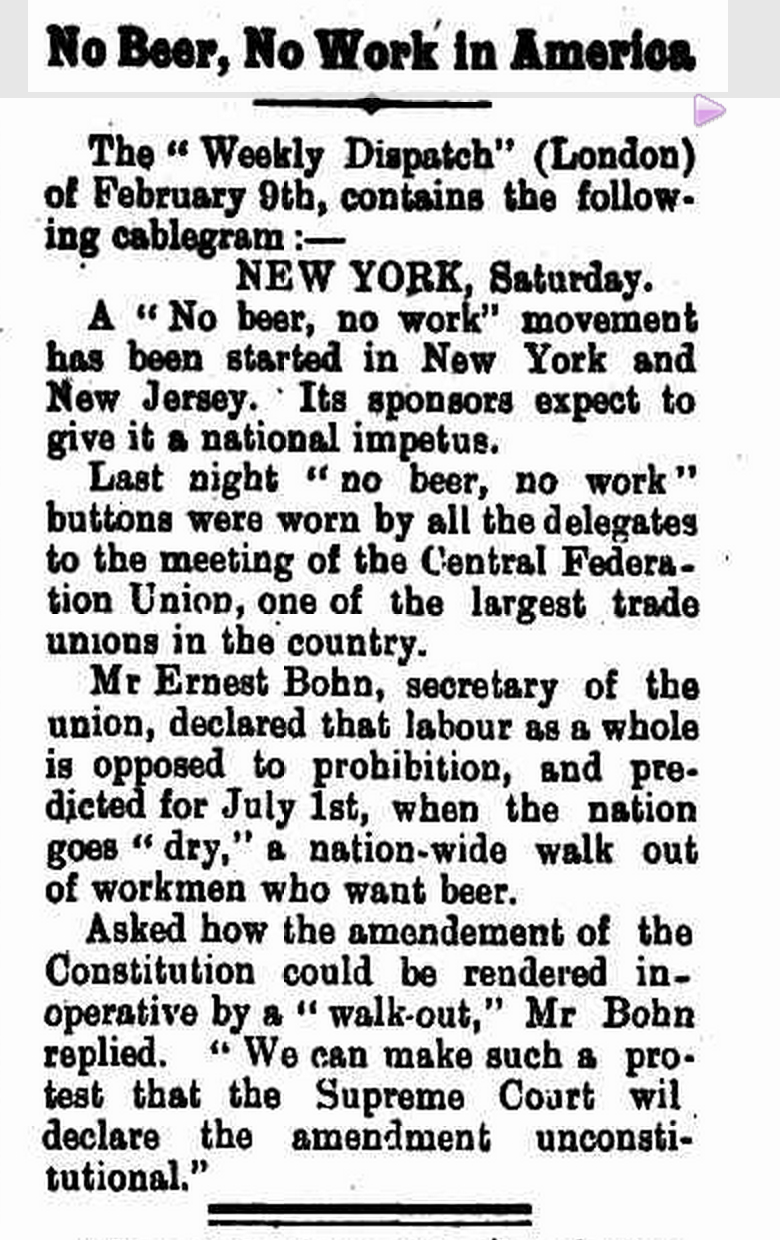
The news even made it as far as Australia’s Northern Territory Times and Gazette of Darwin, which ran the story on April 19, 1919 (reporting on events of February 8th and 9th):

NoBeerNoWork-1919-Australia

A “No beer, no work” movement has been started in New York and New Jersey. Its sponsors expect to give it a national impetus. Last night “no beer, no work” buttons were worn by all the delegates to the meeting of the Central Federation Union, one of the largest trade unions in the country. Mr. Ernest Bohn, secretary of the union, declared that labour as a whole is opposed to prohibition, and predicted for July 1st, when the nation goes “dry,” a nation-wide walk out of workmen who want beer. Asked how the amendment of the Constitution could be rendered inoperative by a ” walk-out,” Mr Bohn replied. “We can make such a protest that the Supreme Court wilt declare the amendment unconstitutional.”

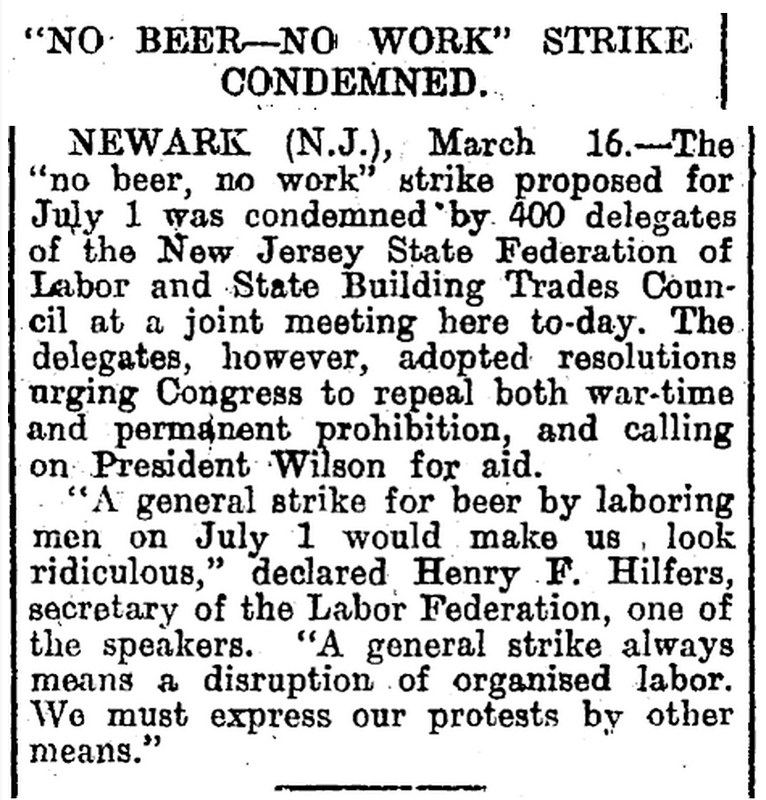
But not everyone in labor agreed, as evidenced by this article in New Jersey’s Poverty Bay Herald on May 3, 1919, where 400 union delegates in the Garden State came out against the strike, although they agreed that Prohibition was a bad idea.

NoBeerNoWork-1919-NJ

But there’s not much more about these efforts in New York that I could find. I did find this paragraph, by a Columbia history student, who in his junior year received a research grant, the Edwin Robbins Prize, and used it to do his senior thesis:

“New York Organized Labor and Prohibition Resistance: The ‘No Beer, No Work’ Movement of 1919.” A forgotten moment in labor history, it was a fascinating intersection of culture, gender, and class, examining the untidy boundary between “economic” and “social” life. Some local trade-unionists co-opted a catchy slogan, “No Beer, No Work,” with the intent of fomenting a national general strike, attempting to save the saloon, galvanize class consciousness, and lead workers into a labor party. The strike more than failed; it never occurred.

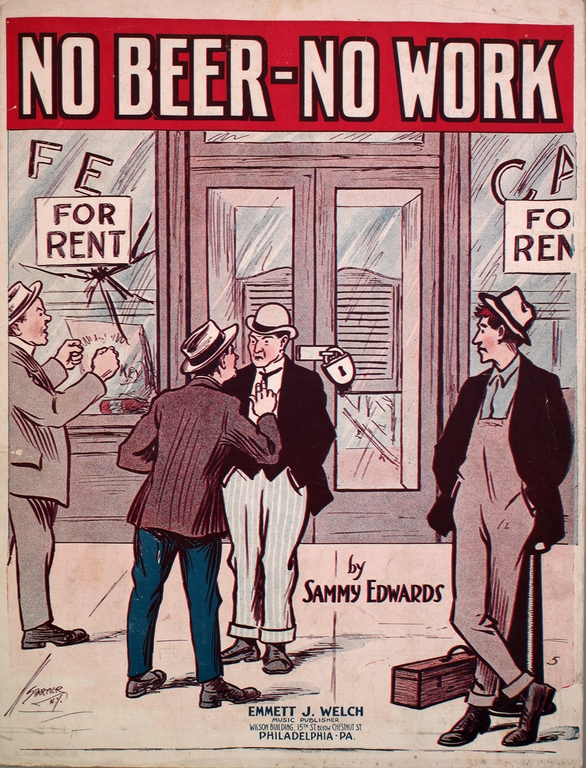
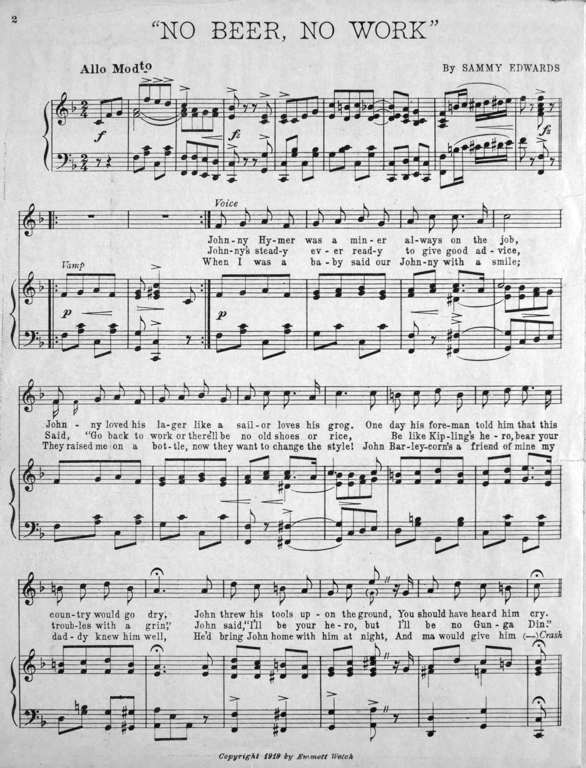
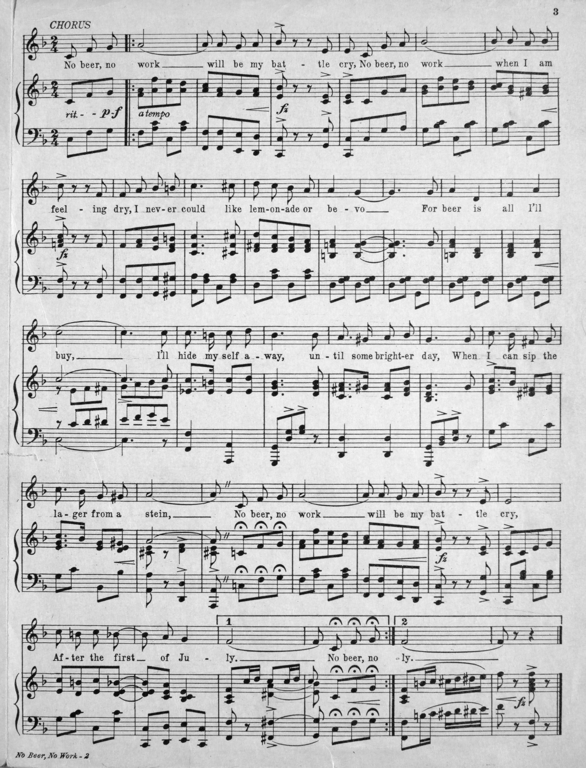
Perhaps more curiously, and what started this, is I discovered that more than one person took the great slogan “No Beer, No Work,” and wrote a song about it, using it as the title. The first I found was written in 1919, by Sammy Edwards.

nbnw-0
nbnw-1
nbnw-2

And here are the lyrics to NO BEER, NO WORK, by Sammy Edwards, 1919:

1. Johnny Hymer was a miner, always on the job.
Johnny loved his lager like a sailor loves his grog.
One day, his foreman told him that this country would go dry.
John threw his tools upon the ground. You should have heard him cry:

CHORUS: “No beer, no work” will be my battle cry.
“No beer, no work” when I am feeling dry.
I never could like lemonade or bevo, for beer is all I’ll buy.
I’ll hide my self away
Until some brighter day
When I can sip the lager from a stein.
“No beer, no work” will be my battle cry
After the first of July.

2. Johnny’s steady, ever ready to give good advice,
Said, “Go back to work or there’ll be no old shoes or rice.
Be like Kipling’s hero. Bear your troubles with a grin.”
John said, “I’ll be your hero, but I’ll be no Gunga Din.”

3. “When I was a baby,” said our Johnny with a smile,
“They raised me on a bottle. Now they want to change the style.
John Barleycorn’s a friend of mine. My daddy knew him well.
He’d bring John home with him at night and ma would give him —.

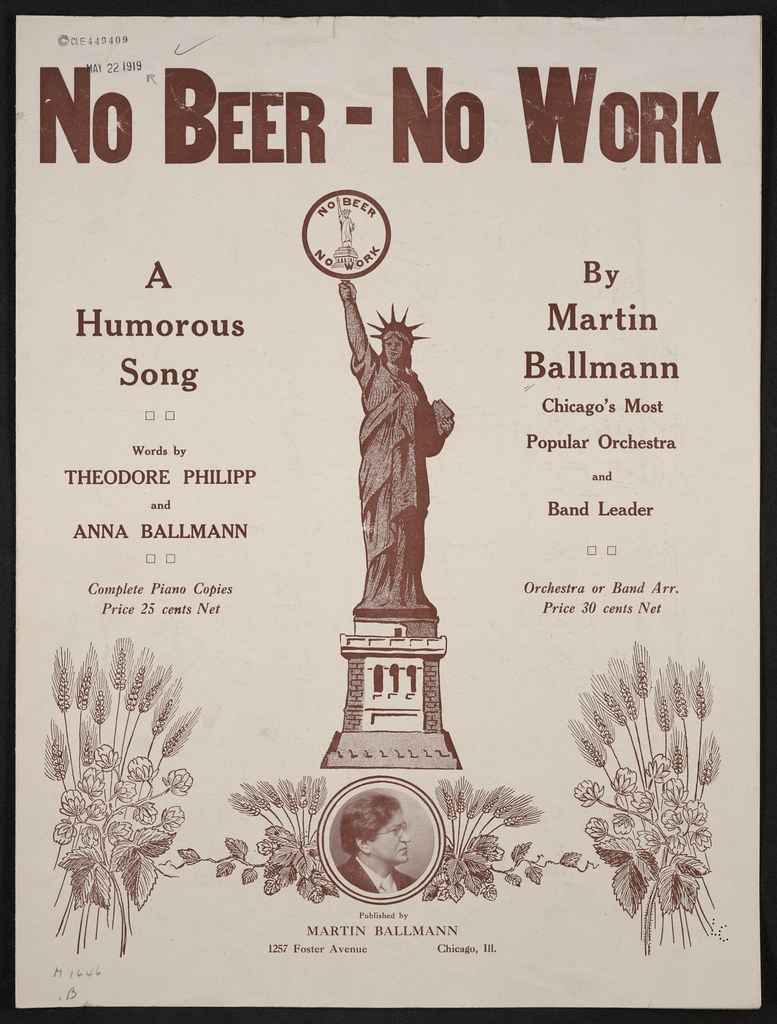
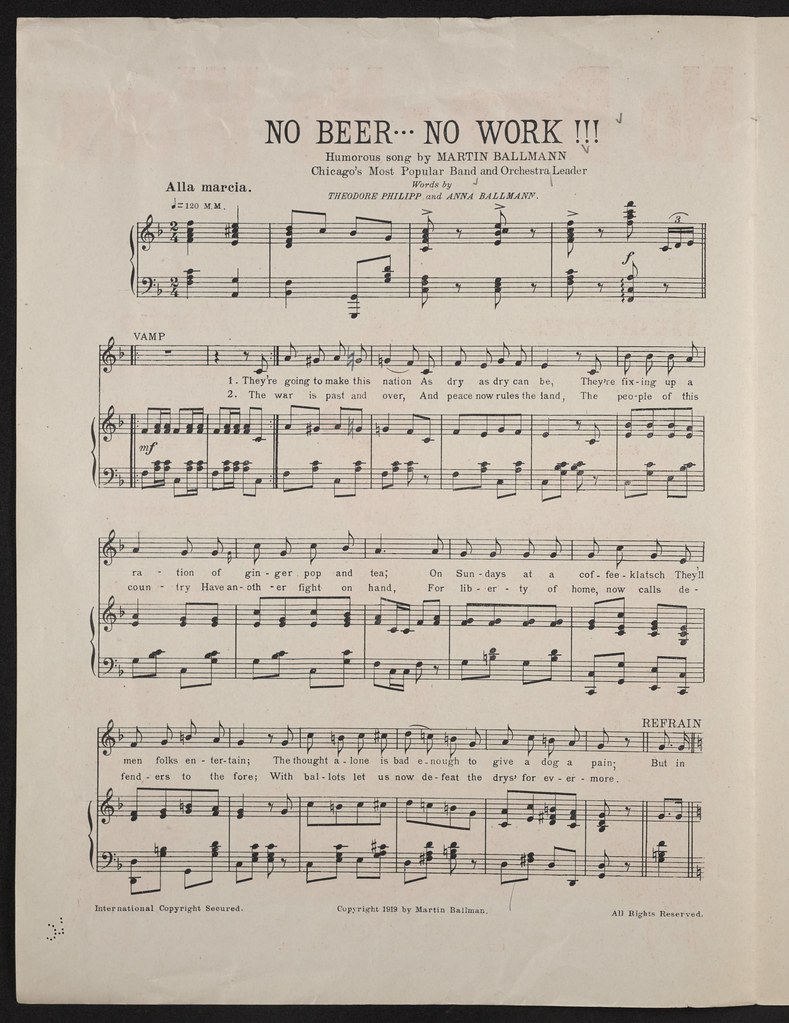
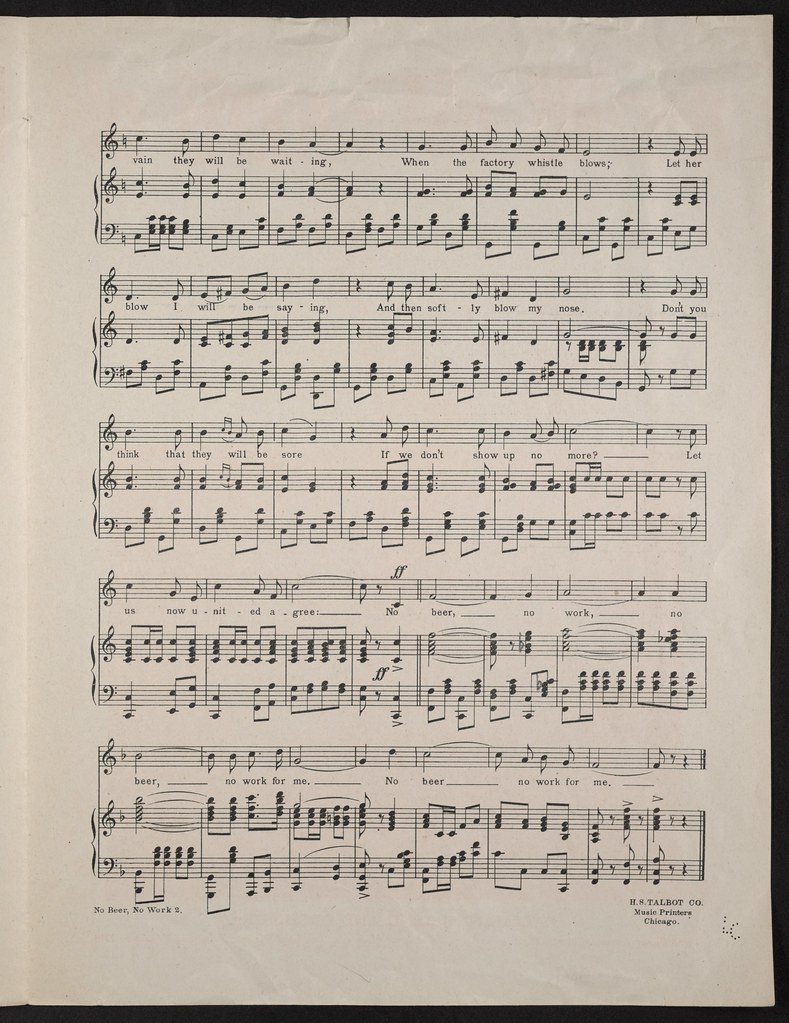
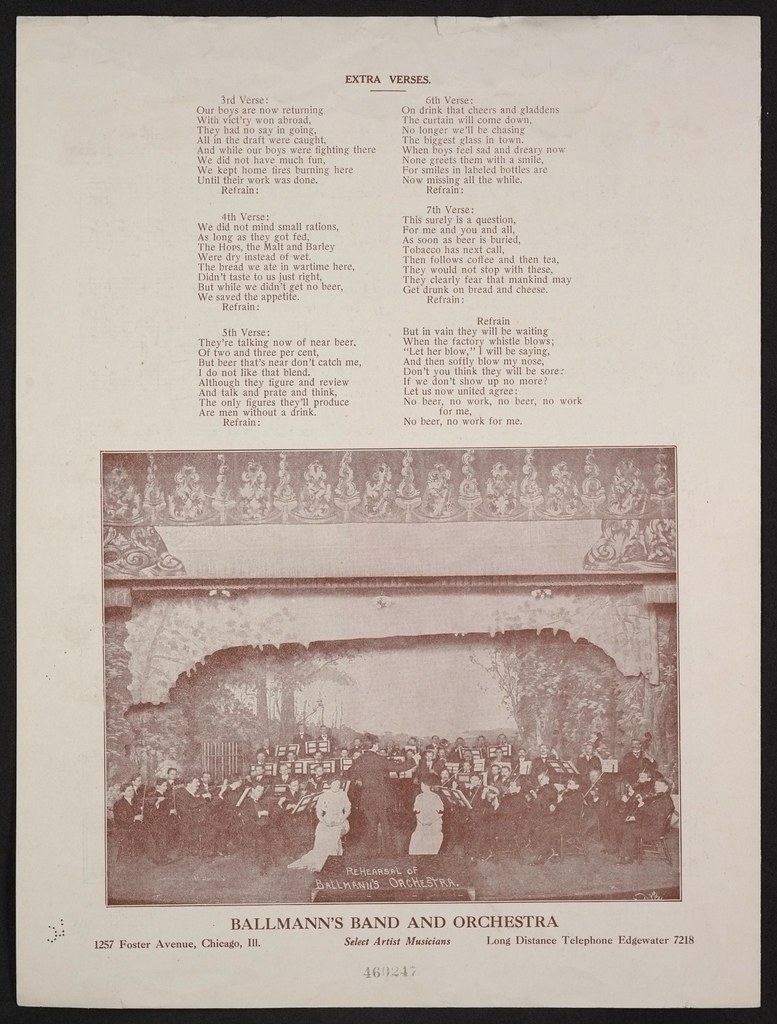
Then the very same year, another song was published by Martin Ballmann, with lyrics by Anna Ballmann and Theodore Philipp, also with the title “No Beer, No Work.” Ballman’s version was published in Chicago, and is completely different than Edwards’, apart from the title, of course.

nb-nw-0
nb-nw-1
nb-nw-2
nb-nw-3

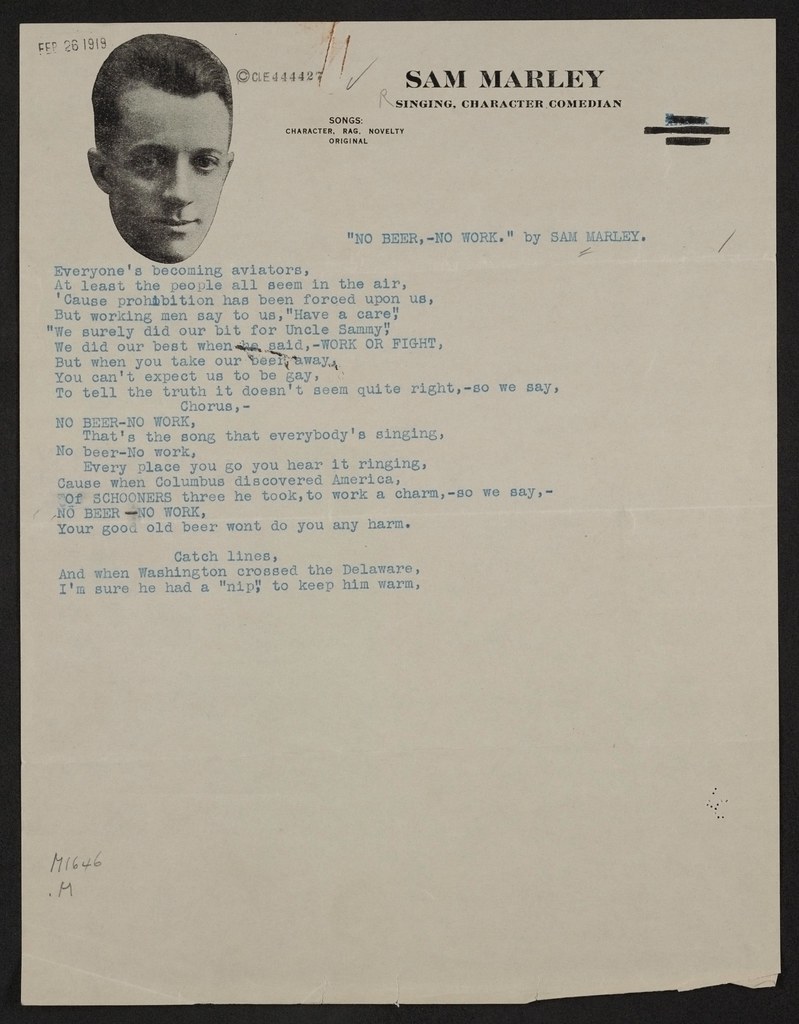
And lastly, music-wise at least, again in early 1919 (February 26 the paper is stamped), “singing character comedian” Sam Marley created original novelty lyrics for a song he called … wait for it … “No Beer, No Work.” His typed lyrics can be found in the collection of the Library of Congress.

no-beer-lyrics

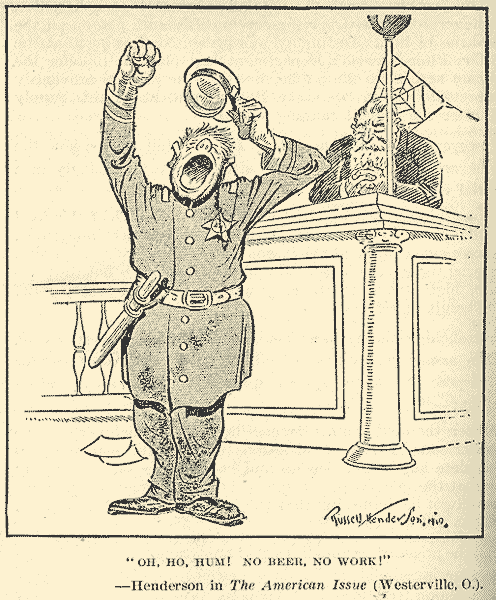
Here’s a political cartoon originally from “The American Issue” of Westerville, Ohio, published August 19, 1919, drawn by an artist named Henderson.

No_Beer

And finally, American author and poet Ellis Parker Butler, wrote a poem in 1919 also using labor’s slogan as the title, which was published in the magazine “Snappy Stories.” Butler’s poem was a parody of Henry Wadsworth Longfellow’s Excelsior.

No Beer, No Work

The shades of night was fallin’ slow
As through New York a guy did go
And nail on ev’ry barroom door
A card that this here motter bore:
‘No beer, no work.’

His brow was sad, his mouth was dry;
It was the first day of July,
And where, all parched and scorched it hung,
These words was stenciled on his tongue:
‘No beer, no work.’

‘Oh, stay,’ the maiden said, ‘and sup
This malted milk from this here cup.’
A shudder passed through that there guy,
But with a moan he made reply:
‘No beer, no work.’

At break of day, as through the town
The milkman put milk bottles down,
Onto one stoop a sort of snore
Was heard, and then was heard no more—
‘No beer, no work.’

The poor old guy plumb dead was found
And planted in the buryin’ ground,
Still graspin’ in his hand of ice
Them placards with this sad device:
‘No beer, no work.’

no-beer-no-work-mug-pin

To which I can only add. Happy Labor Day!

Filed Under: Editorial, Just For Fun, Politics & Law, Related Pleasures Tagged With: History, Holidays, Music, Poetry, Prohibition

Patent No. 5242694A: Process For Brewing Low Carbohydrate Near Beer

September 7, 2015 By Jay Brooks

patent-logo
Today in 1993, US Patent 5242694 A was issued, an invention of Hans Reuther, assigned to the G. Heileman Brewing Company, Inc., for his “Process For Brewing Low Carbohydrate Near Beer.” Here’s the Abstract:

A low carbohydrate near beer is produced by a brewing process utilizing brewing materials including 100% brewer’s malt with not more than a prescribed amount of dextrin malt and not more than a prescribed amount of caramel malt. The mashing, boiling and fermentation stages are controlled so that carbohydrate and calorie levels are achieved in a near beer having excellent taste and brightness.

US5242694-1

Filed Under: Beers, Breweries, Just For Fun, Politics & Law, Related Pleasures Tagged With: History, Law, Non-Alcoholic, Patent, Science of Brewing

Patent No. 2328948A: Seal For Kegs

September 7, 2015 By Jay Brooks

patent-logo
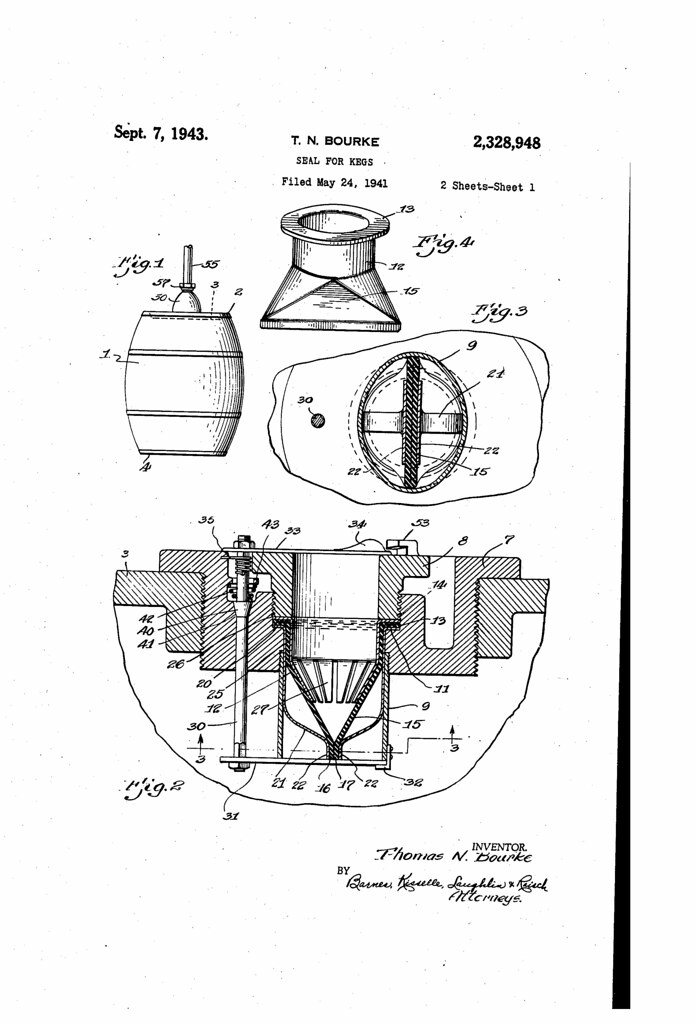
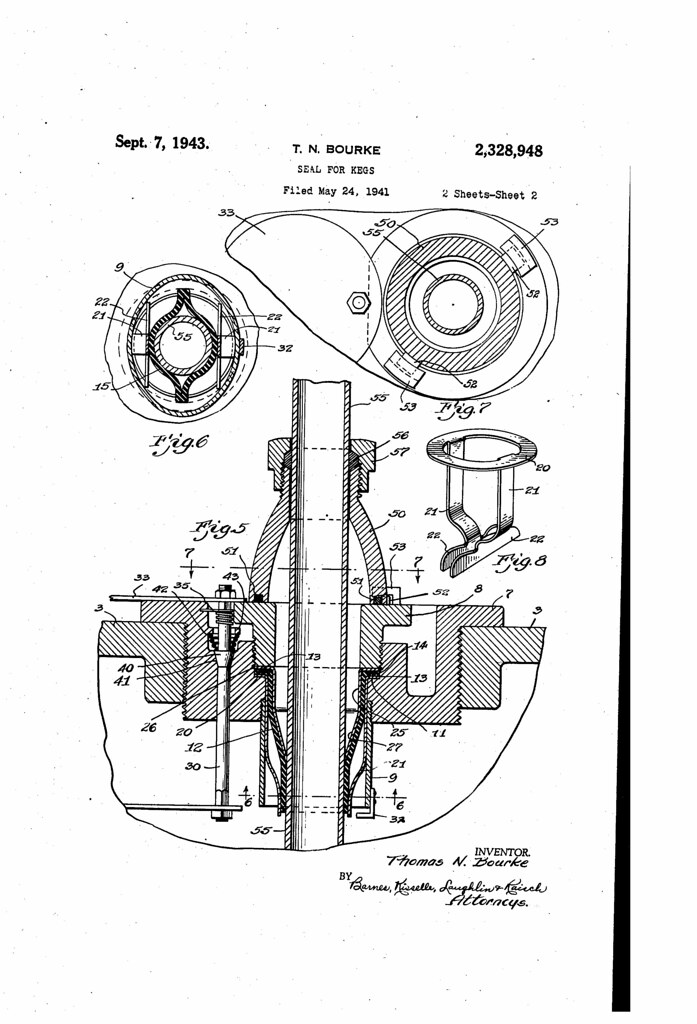
Today in 1943, US Patent 2328948 A was issued, an invention of Thomas N. Bourke, for his “Seal For Kegs.” There’s no Abstract, although in the description it includes this simple summary. “This invention relates to a seal for kegs.” That’s about all I can make out, the OCR did one of the worst jobs of any I’ve tried to read. Take a look for yourself.
Untitled
Untitled

Filed Under: Beers, Just For Fun, Politics & Law, Related Pleasures Tagged With: History, Kegs, Law, Patent

Beer In Ads #1670: So Light! So Right!

September 6, 2015 By Jay Brooks


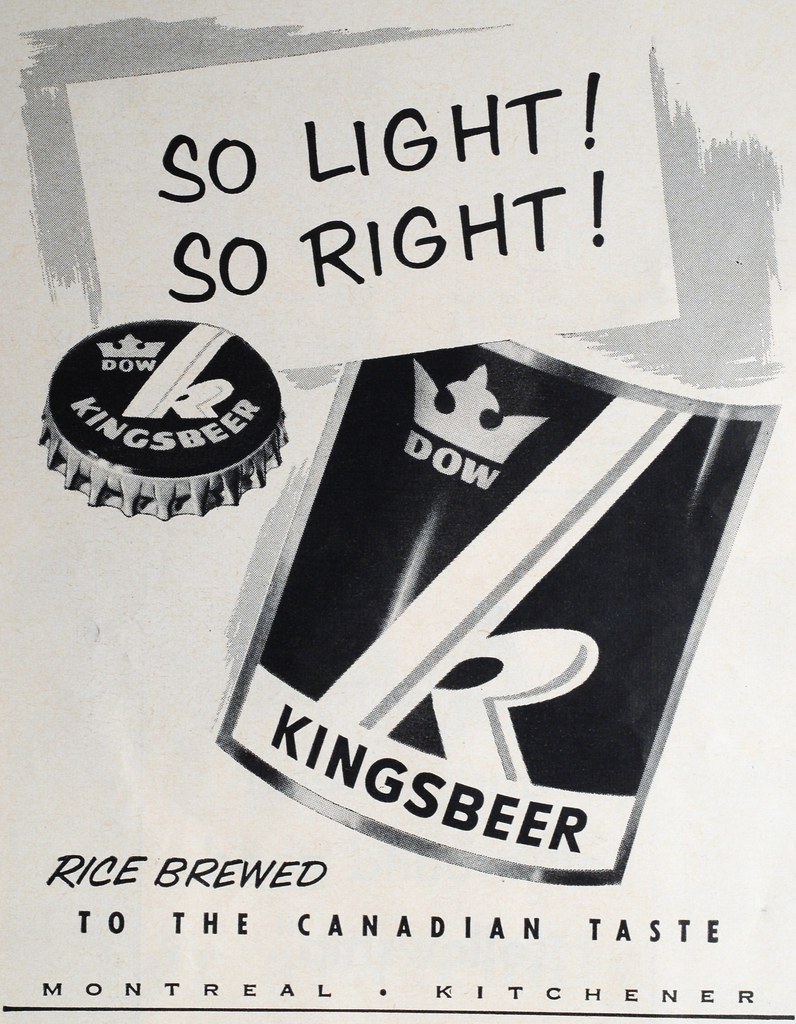
Sunday’s ad is for Kingsbeer Lager, from 1955. The brand was produced by Dow Breweries of Quebec, Canada. A simple ad, but “So Light! So Right!” is a pretty funny tagline. But it’s nothing compared to the other ad copy. “Rice brewed to the Canadian taste.” Ah, the Canadian taste.

Kingsbeer-1955

Filed Under: Art & Beer, Beers Tagged With: Advertising, Canada, History

Patent No. 3271162A: Process For Segregating Lupulin From Dried Hops

September 6, 2015 By Jay Brooks

patent-logo
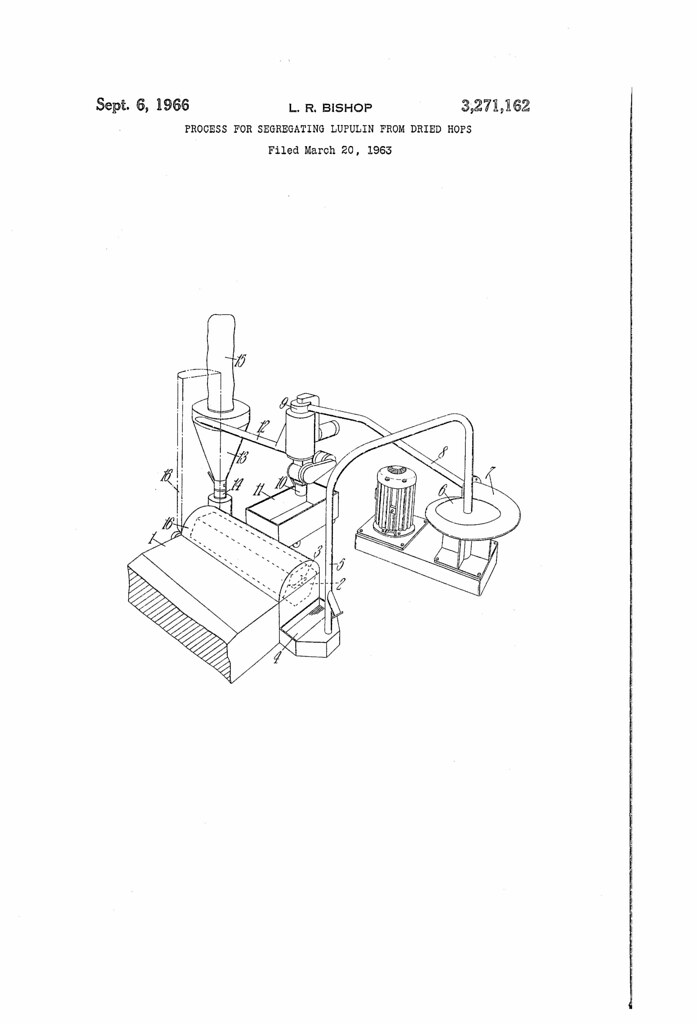
Today in 1966, US Patent 3271162 A was issued, an invention of Laurence R. Bishop, assigned to Watney Combe Reid & Company Ltd., for his “Process For Segregating Lupulin From Dried Hops.” There’s no Abstract, although in the description it includes this summary:

It is a principal object of the invention to enable a relatively concentrated form of lupulin to be separated from the dried hops. This concentrated material can then either be used as such, for boiling with wort or for adding to the brewed beer, or it can be subjected to extraction processes for the isolation of the respective active ingredients which can then be stored, with or without stabilization, until they are required for use. By isolating the lupulin in a relatively concentrated form, its storage under conditions which will preclude or minimize spoilage becomes very much easier and less expensive, while at the same time the large storage space hitherto required is freed for other purposes.

Untitled

Filed Under: Beers, Just For Fun, Politics & Law, Related Pleasures Tagged With: History, Hops, Law, Patent

Beer In Ads #1669: Blue Man Bartender

September 5, 2015 By Jay Brooks


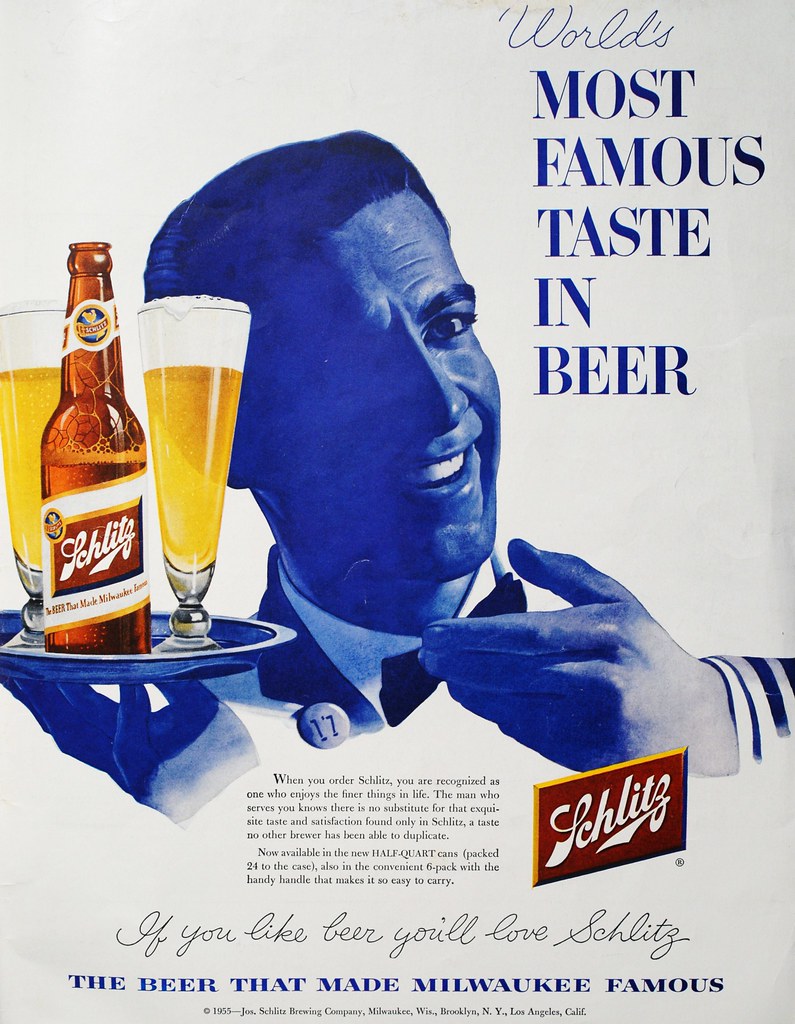
Saturday’s ad is for Schlitz, from 1955. And you thought the blue man group was a new phenomenon, but they were around and serving Schlitz — a.k.a. the World’s Most Famous Taste in Beer — way back in the Fifties. Honestly, I don’t quite understand why the guy is blue. But he does have another one of those magic bottles. It’s only half empty but it managed to completely fill two pilsner glasses.

Schlitz-1955-blue-man

Filed Under: Art & Beer, Beers Tagged With: Advertising, History, Schlitz

Patent No. 6112932A: Beverage Can With Flow Enhancing Sidewall Structure

September 5, 2015 By Jay Brooks

patent-logo
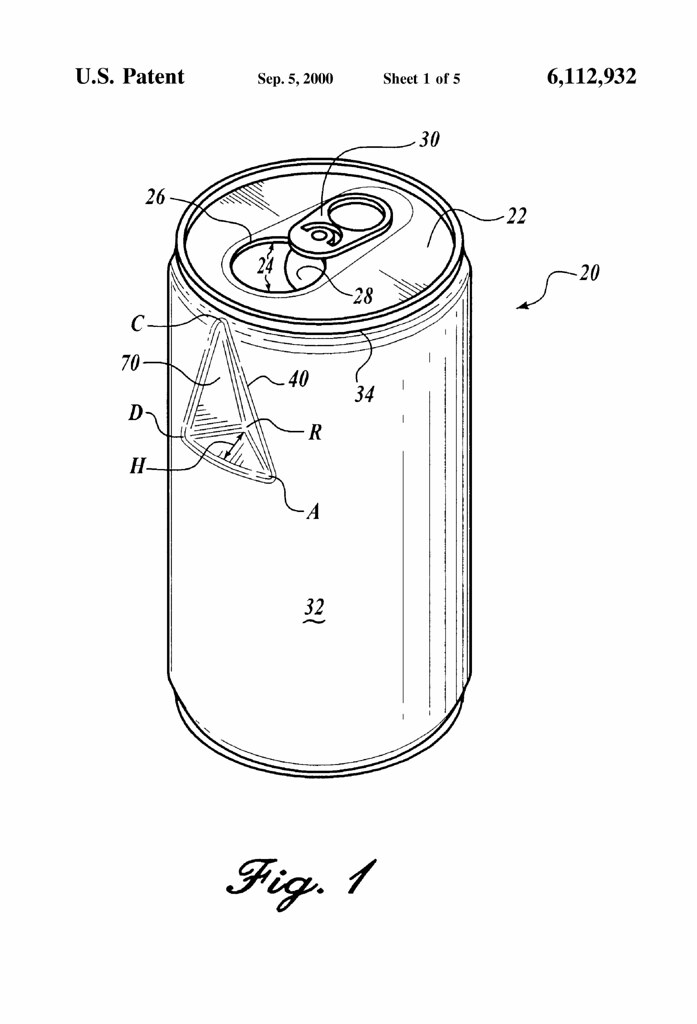
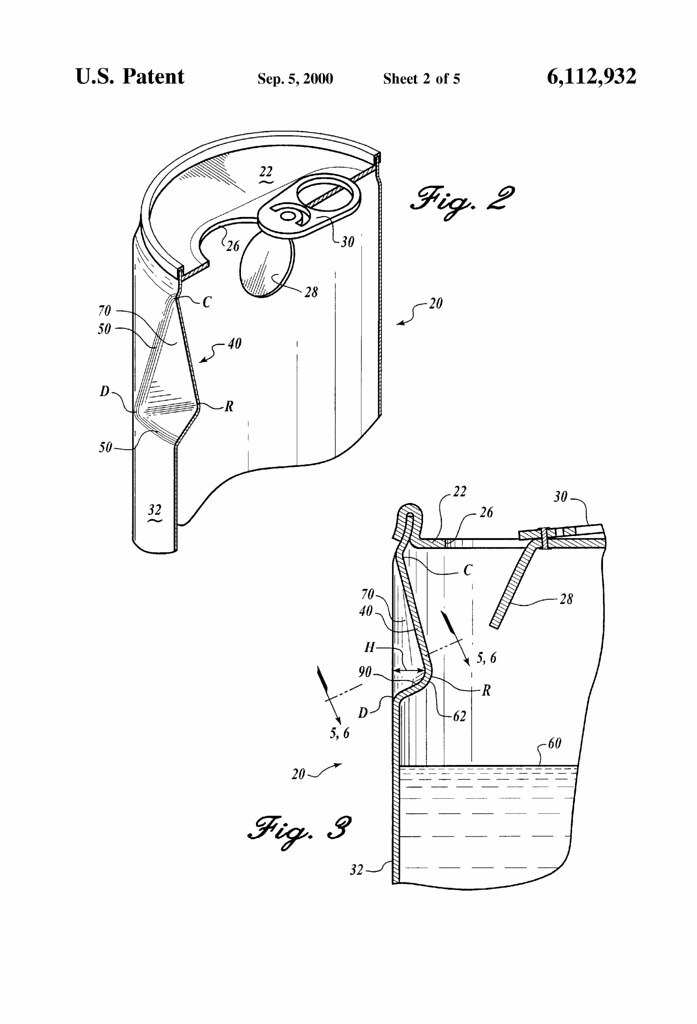
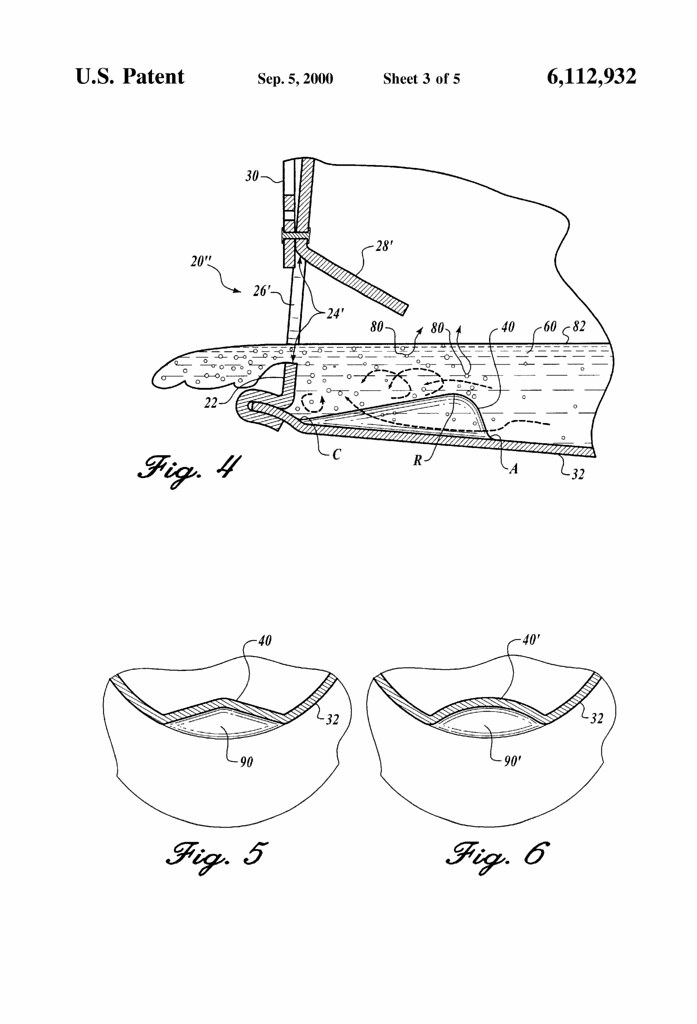
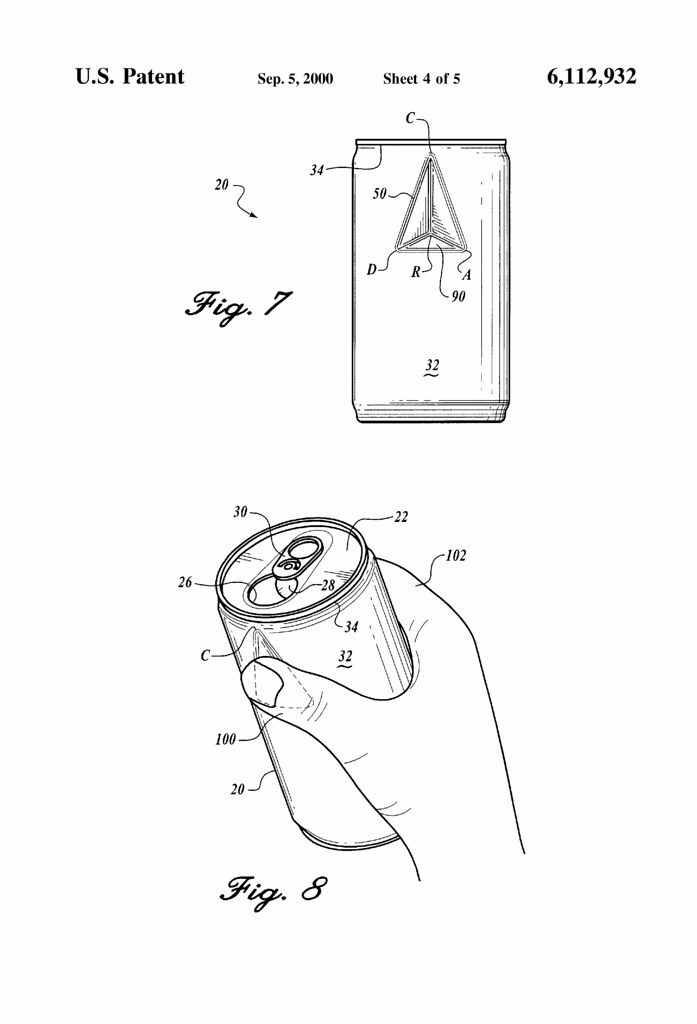
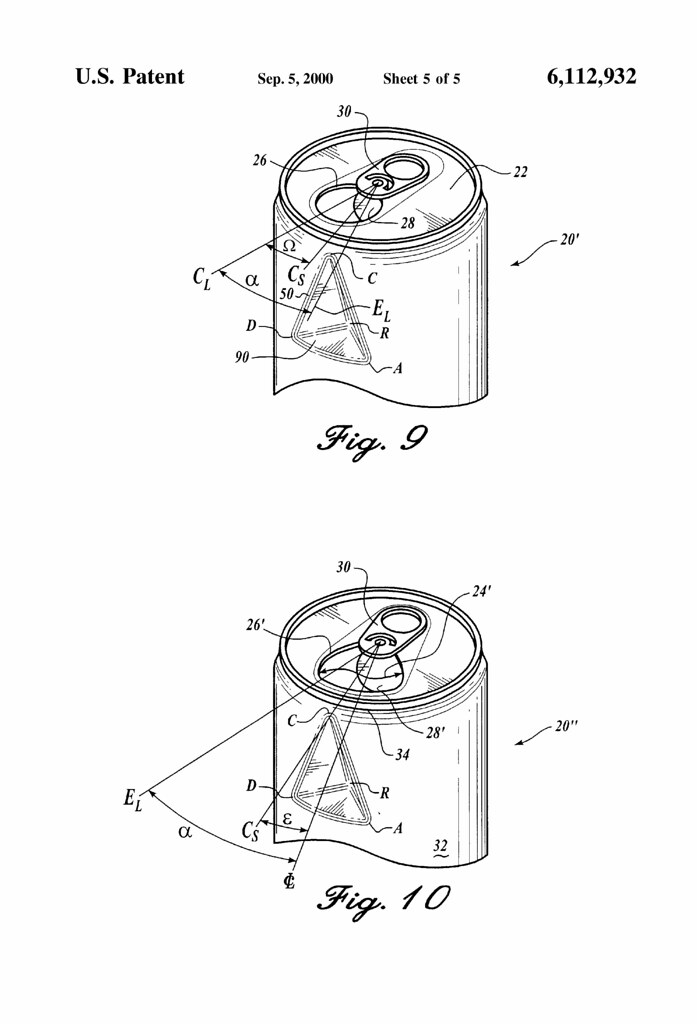
Today in 2000, US Patent 6112932 A was issued, an invention of Ronald E. Holdren, for his “Beverage Can With Flow Enhancing Sidewall Structure.” Here’s the Abstract:

A beverage container with flow enhancing sidewall structure. The container is preferably provided in thin-walled aluminum for containment of carbonated or other beverages such as beer or carbonated soda. The container has a liquid outlet, and adjacent the liquid outlet, but in the substantially cylindrical sidewalls, a generally nose-shaped inwardly indented liquid flow enhancing structure is provided. The flow enhancing structure is provided with a generally reducing cross-sectional area when progressively examined in transverse cross-sectional area toward the liquid outlet end of the cylindrical sidewall. The generally nose-shaped structure may be offset from the centerline of the liquid outlet to further enhance liquid outflow. Although in a preferred embodiment the nose-shaped structure is substantially pyramidal in shape, the structure may alternately be provided as a section of an oblique circular cone, or other flow enhancing shape. Use of such a structure enables a user to locate the container outlet by use of tactile sense alone, such as by use of a thumb. Also, because the flow enhancing structure is inwardly indented, the beverage can is rollable for easy handling during manufacture and distribution.

Untitled
Untitled
Untitled
Untitled
Untitled

Filed Under: Beers, Just For Fun, Politics & Law, Related Pleasures Tagged With: Cans, History, Law, Packaging, Patent

Prohibitionists Calling Most Of The World “Idiotic”

September 5, 2015 By Jay Brooks

dunce
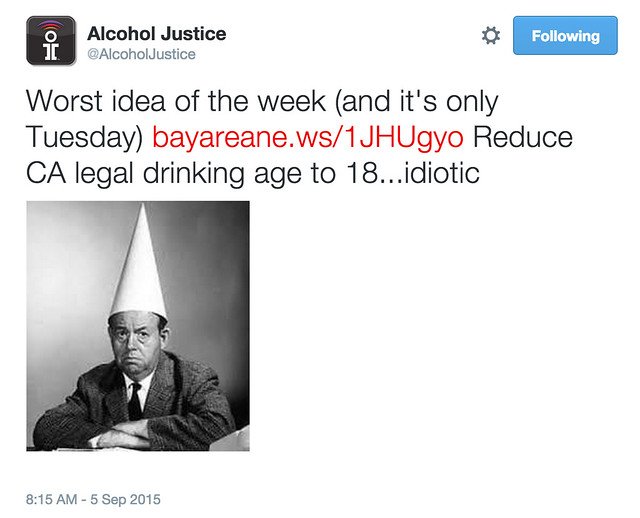
Here’s yet another example of prohibitionists’ zeal run amuck. It’s one thing to disagree with opinions you don’t like, but quite another to call them “idiotic,” especially when the idea being called “idiotic” is the standard in a majority of countries worldwide. Here’s a Tweet from the chuckleheads at Alcohol Justice this morning, where they essentially insult most of the world.

aj-tweet-9-5

Setting aside the fact that today, September 5, is a Saturday and not a Tuesday, and they couldn’t be bothered to change the text to match reality (tell me again who’s the idiot here?), let’s see what this is all about.

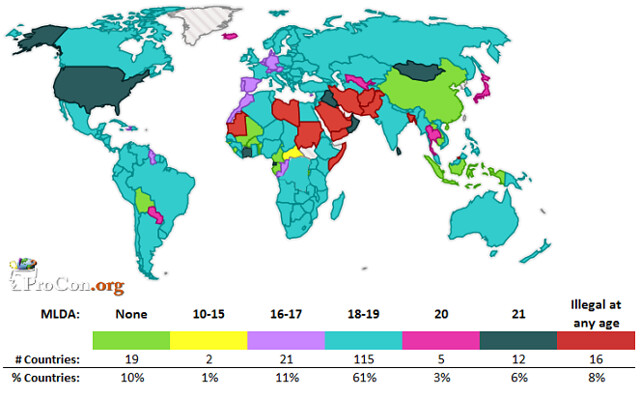
What got AJ into an insulting mood was a California man’s proposal to return the minimum legal drinking age in our state to its pre-1984 level, which was reported in Proposed measure would drop drinking age to 18. And of course, Alcohol Justice disagrees with that, in part because they’re against absolutely anything that shows alcohol in a positive light or opens its availability. And disagreeing is fine, of course. Calling something they disagree with “idiotic” is childish, at best, and at worst is insulting to every other nation of the world in which the minimum drinking age is 18 or below. And that accounts for 83% of the world’s countries. Or 86% for under 21. Only 6%, or 12 countries, have 21 as their drinking age, putting us in such company as Iraq, Mongolia, Oman, and Sri Lanka. In a further 16 nations (with some exceptions for non-muslims), around 8%, it’s illegal to drink alcohol no matter what age you are. So if AJ thinks it’s idiotic for California (and America) to let its otherwise legal adults drink at age 18, by extension they think most of the rest of the world is idiotic, too. Way to keep it professional.

Minimum Legal Drinking Age (MLDA) in 190 Countries

new-worldwide-map-drinking-age-with-key

But the Legal Drinking Age for most persons is well below 21, and has been, as it had been for the United States before 1984, for a very long time, for most of human history in fact. According to Alcohol Problems and Solutions, “the average (mean) minimum legal drinking age around the globe is 15.9. The majority of countries have set the drinking age at 18. In fifty countries the minimum age is lower than 18 and in 12 countries it is higher than 18” (which has changed slightly since that was written, but the analysis is still relevant). ProCon has more current figures on the Minimum Legal Drinking Age (MLDA) in 190 Countries.

But even calling something that most of the world does “the worst idea,” especially when it’s been the norm for most of history, seems typical for prohibitionists who are already convinced they know better and have never been shy about telling you how you should be living your life and what you’re doing wrong (psst – it’s drinking and enjoying yourself). But it also feels fairly condescending and downright rude, and using the stock photo of a dour man wearing a dunce cap tells us how they really feel about the people who don’t think the same way as they do. I guess we’re all idiots.

Filed Under: Beers, Editorial, Politics & Law, Related Pleasures Tagged With: International, Law, Prohibitionists

« Previous Page
Next Page »

Find Something

Northern California Breweries

Please consider purchasing my latest book, California Breweries North, available from Amazon, or ask for it at your local bookstore.

Recent Comments

  • Bob Paolino on Beer Birthday: Grant Johnston
  • Gambrinus on Historic Beer Birthday: A.J. Houghton
  • Ernie Dewing on Historic Beer Birthday: Charles William Bergner 
  • Steve 'Pudgy' De Rose on Historic Beer Birthday: Jacob Schmidt
  • Jay Brooks on Beer Birthday: Bill Owens

Recent Posts

  • Beer In Ads #5228: All Together For Newark April 21, 2026
  • Beer Birthday: Steve Parkes April 21, 2026
  • Beer In Ads #5227: It’s Here! Bock Beer By Bosch April 20, 2026
  • Beer Birthday: Drew Beechum April 20, 2026
  • Beer Birthday: Des De Moor April 20, 2026

BBB Archives

Feedback

Head Quarter
This site is hosted and maintained by H25Q.dev. Any questions or comments for the webmaster can be directed here.