Brookston Beer Bulletin

Jay R. Brooks on Beer

  • Home
  • About
  • Editorial
  • Birthdays
  • Art & Beer

Socialize

  • Dribbble
  • Email
  • Facebook
  • Flickr
  • GitHub
  • Instagram
  • LinkedIn
  • Pinterest
  • RSS
  • Twitter
  • YouTube

Powered by Genesis

Patent No. 5645190A: Aluminum Beverage Can

July 8, 2015 By Jay Brooks

patent-logo
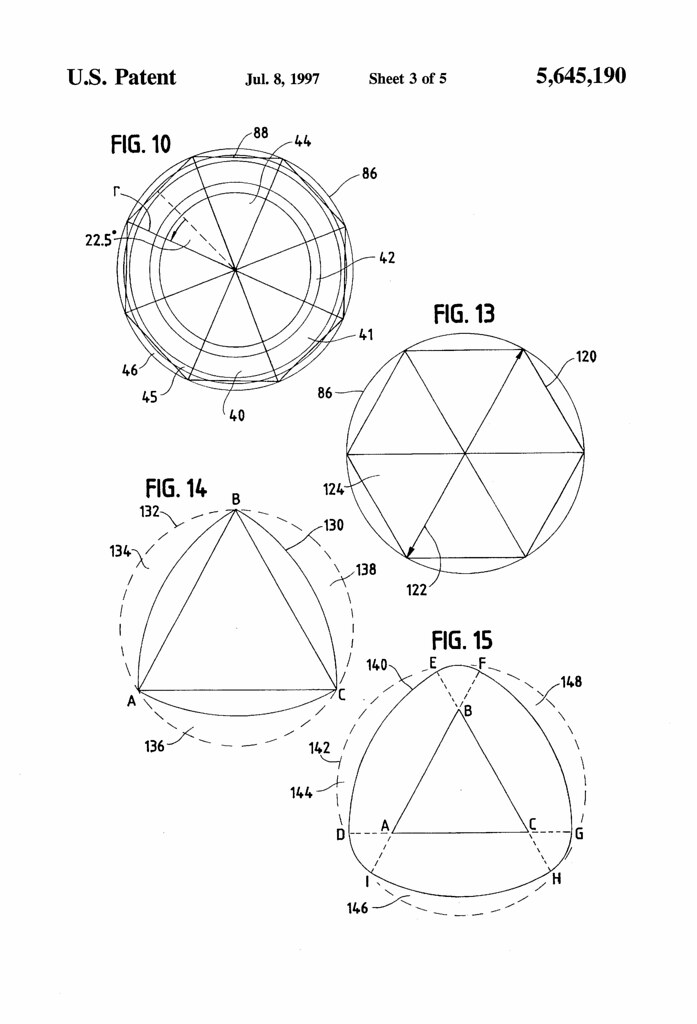
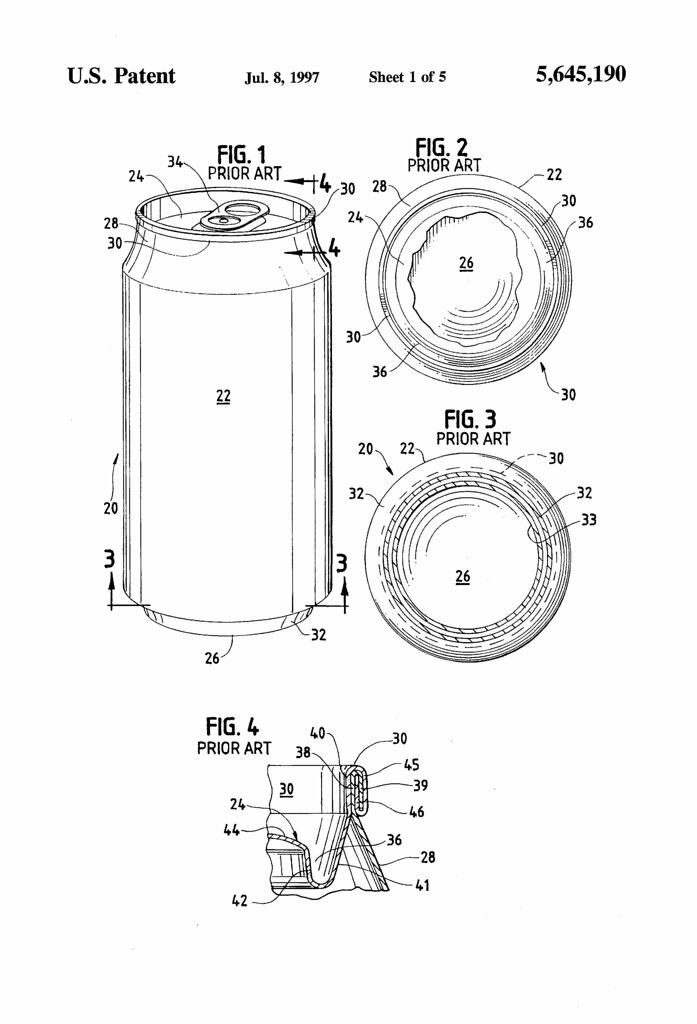
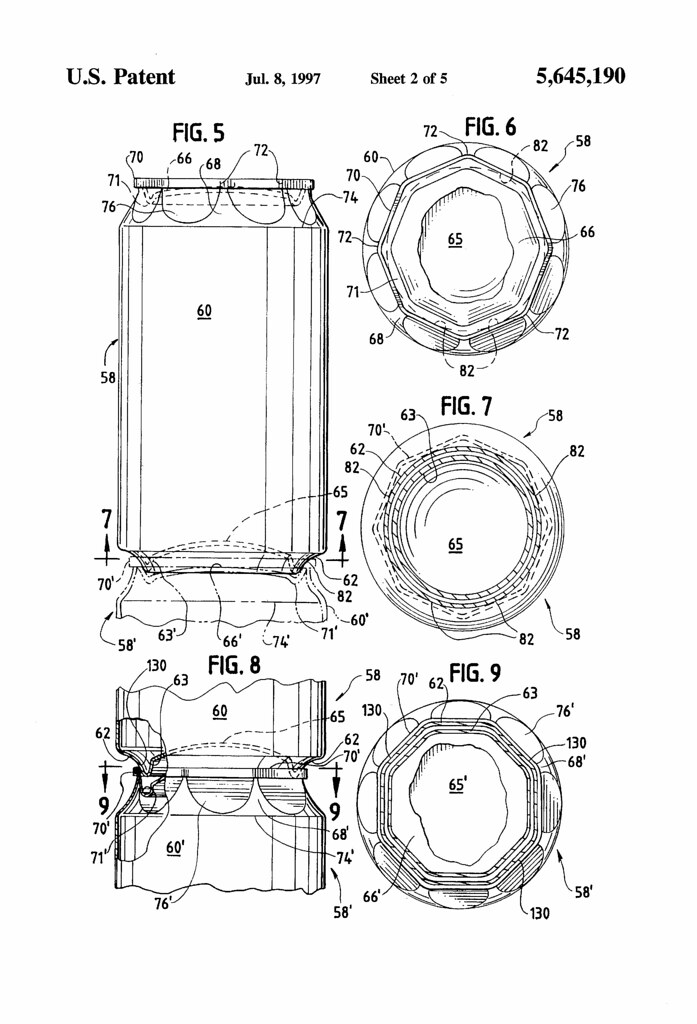
Today in 1997, US Patent 5645190 A was issued, an invention of Norton Robert Goldberg, for his “Aluminum Beverage Can.” Here’s the Abstract:

An aluminum beverage can the top wall of which, and preferably the bottom wall as well, are substantially in the form of (1) a regular polygon of at least four sides, (2) a Reuleaux triangle, (3) an extended Reuleaux triangle, (4) a symmetrical curve of constant width derived from a regular polygon having an odd number of sides at least five in number, or (5) an extended symmetrical curve of constant width derived in the same way.
Untitled

Filed Under: Beers, Just For Fun, Politics & Law, Related Pleasures Tagged With: Cans, History, Law, Patent

Patent No. 3454018A: Apparatus For Processing Beer Kegs

July 8, 2015 By Jay Brooks

patent-logo
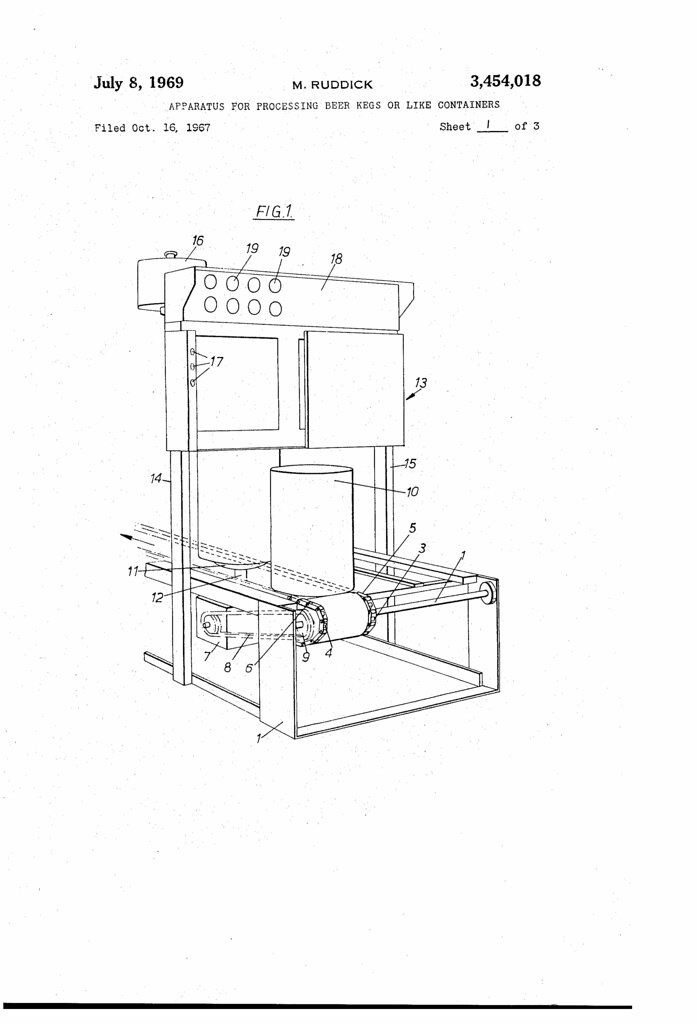
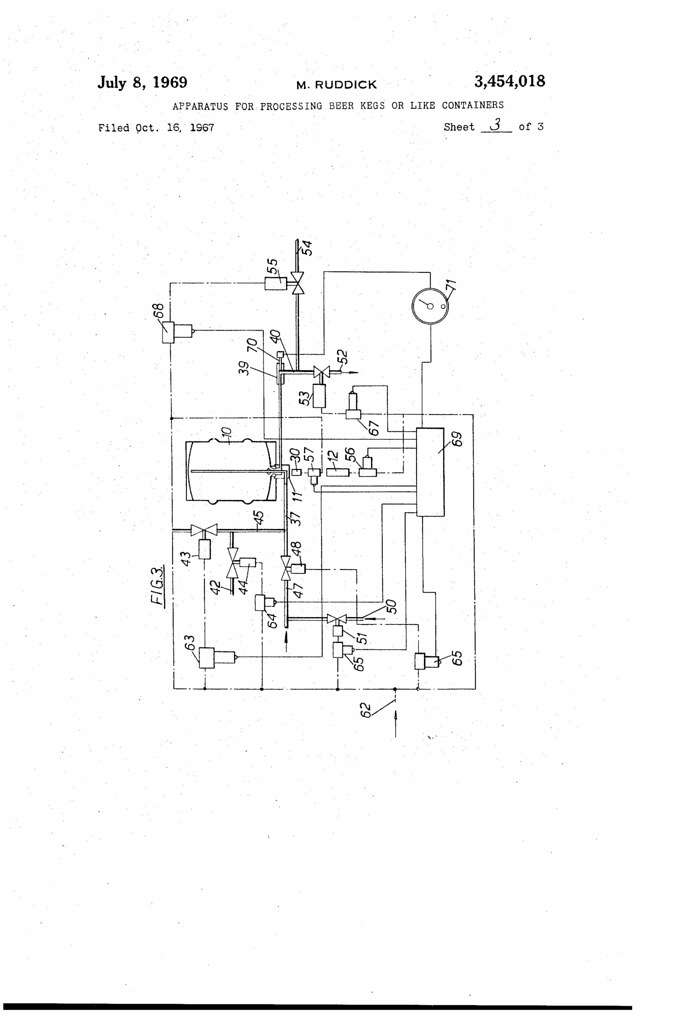
Today in 1969, US Patent 3454018 A was issued, an invention of Maurice Ruddick, for his “Apparatus For Processing Beer Kegs.” There’s no Abstract, although in the description it includes this summary:

Apparatus for automatically washing beer kegs or like containers comprises a head which is applied to the bung hole or other opening of the container with the container inverted, pipes connected to the head for the supply of washing water and detergent for washing the container and steam for lblowing the water and detergent out of the container after washing and a drainage pipe through which the discharged water and subsequently the steam ows from the container. The supply of water, detergent and steam is controlled by pneumatically operated valves in the pipes and the supply of air to control these valves is controlled by solenoid valves operated by an electrical sequence controller. The drainage pipe has an electrical temperature sensitive device electrically connected to the sequence controller which prevents the sequence controller from operating said Valves to cause further washing water or detergent to be supplied tothe container until all previous liquid has been blown out by the steam and there is a flow of steam through the drainage pipe over the temperature sensitive device.

Untitled

Filed Under: Beers, Breweries, Just For Fun, Politics & Law, Related Pleasures Tagged With: Brewing Equipment, History, Kegs, Law, Patent

Patent No. 3454199A: Keg Tapping Structure

July 8, 2015 By Jay Brooks

patent-logo
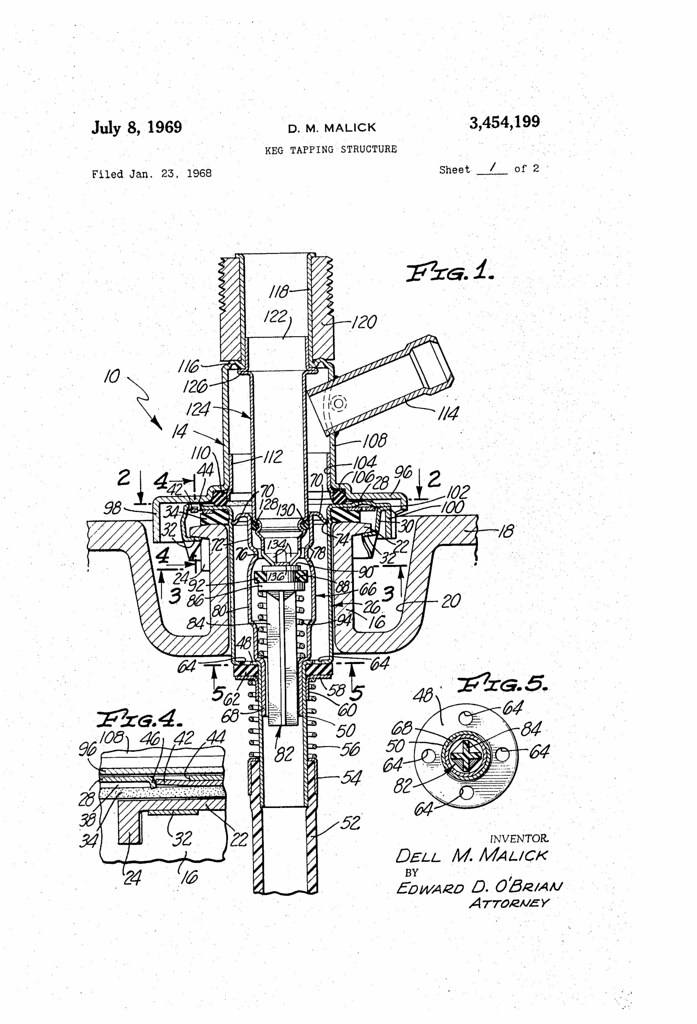
Today in 1969, US Patent 3454199 A was issued, an invention of Dell M. Malick, for his “Keg Tapping Structure.” There’s no Abstract, although in the description it includes this summary:

A complete tapping structure is disclosed. This tapping structure consists of a keg unit or keg valve and a tapping unit which is adapted to be coupled to the keg unit so that the contents of the keg may be exhausted. The keg unit is adapted to be held upon a conventional keg neck structure by cam means so as to be secured against undesired rotation by ratchet means. The tavern unit is adapted to be coupled to the keg unit by being located upon it and twisted. The tavern unit may be removed from the keg unit by being twisted without causing the keg unit to be uncoupled from the keg neck.

Untitled

Filed Under: Beers, Just For Fun, Politics & Law, Related Pleasures Tagged With: History, Kegs, Law, Patent

AB-InBev Buys Pioneering Brazilian Brewery

July 8, 2015 By Jay Brooks

colorado-brazil
Cervejaria Colorado was one of Brazil’s first small breweries when it opened in 1995. I met founder Marcello Carneiro in Argentina when I was there for beer judging in 2011. He’s one of the most fun-loving people I’ve ever met and I’ve since seen him in Brazil and also stateside a few times. He announced earlier today on Facebook that AmBev would be acquiring his brewery. Here’s the Google translation of the announcement:

Dear friends of the bear, we are very happy to formalize you that now the Colorado it becomes part of the group Ambev, along the breweries beer! In 1995, our founder, Marcelo Carneiro, started his journey in the country and put the breweries Colorado on the international market, solidifying a company that today bill around $18 million per year. 20 years ago we work with dignity and fight for the cause brewery, we gain strength and tread a path of large awards, authenticity and it will now be even better! We will continue to develop Brazilian genuinely revenue, our DNA. The Union of the brands will make it possible to increase the capacity of distribution of Colorado and, of course, to our dear Marcelo to devote even more to research of ingredients. Our commitment to the lovers of good beer is still strong and the dream that unites the two pubs is the recovery of the Brazilian beer, with ingredients Brazilians and produced for consumers from north to south of the country. Unite is to make this dream a reality, the dream of the Brazilian school of beer! A toast and hug from bear.

AmBev, you may recall, is the Companhia de Bebidas das Américas, a Brazilian brewing company, and the largest in Latin America and 5th worldwide. It was established by a merger of Brahma and Antarctica in 1999. After more business dealings, mergers and acquisitions, today is owned by Anheuser-Busch InBev. AmBev makes Antarctica, Brahma, Bohemia, and Skol, and in addition has a controlling interest in the popular Argentine brand Quilmes.

AmBev also released a statement, which I’ve used Google Translate to make more understandable as my Portuguese is worthless:

COLORADO NOW IS THE TIME OF THE BREWERY BOHEMIA

Breweries unite the passion for beer and the search for innovation

The dream of creating a Brazilian school of beer, based on the valuation of culture and national ingredients, joined our Brewery Bohemia Brewery and Colorado. The mark of São Paulo is now part of our team, bringing their tradition, quality, passion and daring.

“I am very excited about the opportunity to achieve my dream with Cervejaria Bohemia. When I founded the Colorado 20 years ago, always wanted to give a national touch to recipes and create a Brazilian school of beer, as there is the German and Belgian. I know that together we will make it happen, “says Marcelo Cerneiro, founder of Colorado.

Wakswaser Daniel, director of marketing for Cervejaria Bohemia, also celebrates the partnership: “It’s a time of celebration for the Brazilian culture. Our union allows further spread the knowledge brewing across the country. Consumers will have more choices, varied beers, unusual income and undisputed quality. ”

The Colorado follows with manufacturing in Ribeirão Preto, São Paulo. All labels will be maintained and the union with Bohemia Brewery will bring innovation to the portfolio. With the alliance, the distribution of power increases, enabling the brand to bring more beer enthusiasts throughout Brazil.

So it appears that the acquisition will merge Colorado with AmBev’s premium division headed by Cervejaria Bohemia, just as Wäls did in February, when AmBev bought them, as well. Also, in May, they acquired the Bogotá Beer Co., which is/was Colombia’s largest craft brewer.” So it appears there’s some long term plan for Latin America, just as we’re seeing here in the United States, too.

Marcelo’s also announced what his role will be going forward. “My job is international consultant, for a minimum of five years. My task will be to open new roads for Colorado, talk to business partners, represent the brand that I fought for 20 years. My fight has always been and will continue to facilitate the consolidation of a typically Brazilian brewing school, and it will never be abandoned.”

P1040880
Bia Amorim, me and Marcello after a beer dinner in São Paulo in 2011.

Filed Under: Breweries, News Tagged With: Anheuser-Busch InBev, Brazil, Business

Beer In Ads #1609: Where The Smart World Sets The Pace

July 7, 2015 By Jay Brooks


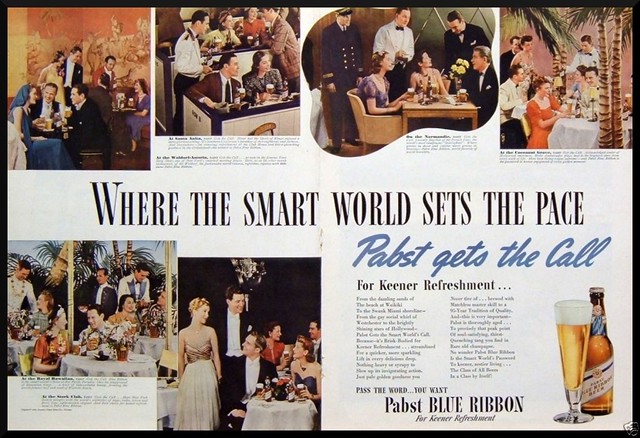
Tuesday’s ad is another one for Pabst, this one from 1939. The ads shows six fancy settings where the rich and famous enjoy their beer. This also looks as if the individual photos were used in individual ads at one time, and this one just used them all together. I love the tagline that used a couple of times here: “For Keener Refreshment ….” That’s certainly what I want in my beer, for it to be more keen than the other beer.

Pabst-1939-keener

Filed Under: Art & Beer, Beers Tagged With: Advertising, History, Pabst

Patent No. EP0668347B1: Pan For Boiling Wort During Beer Production

July 7, 2015 By Jay Brooks

patent-logo
Today in 1999, US Patent EP 0668347 B1 was issued, an invention of Martin Widhopf, assigned to Anton Steinecker Entwicklungs GmbH, for his “Pan For Boiling Wort During Beer Production.” There’s no Abstract, although in the description it includes this summary:

A wort kettle for boiling wort for brewing, comprising a vapor escape pipe and a vapor compressor, wherein vapor can escape to the outside via said vapor escape pipe during heating of said wort kettle and can be diverted by means of a shut-off device via said vapor compressor during boiling, characterized in that said shut-off device is formed by a surge tank which is arranged in the flow direction of said vapor in said vapor escape pipe after a branch towards said vapor compressor.


Filed Under: Beers, Breweries, Just For Fun, Politics & Law, Related Pleasures Tagged With: Brewing Equipment, History, Law, Patent, Science of Brewing, Wort

Why Greasy Food Tastes So Good When You’re Hungover

July 7, 2015 By Jay Brooks

hangover
There’s nothing quite so tasty the next morning after a session of drinking that wakes you up with a pounding headache as greasy food. For me, greasy food is perfect for any meal, but it’s especially fitting after a night of overindulgence. I’ve often wondered why that is, or if it was anything more than the grease sopping up the leftover alcohol coursing through my veins. According to a short article in Popular Science a few years back that I just stumbled on entitled FYI: Why Do We Crave Greasy Food When We’re Hung Over?, the answer is, at least in part, because “we’re really just going back to our caveman roots.”

“All mammals gravitate to eating the most energy-dense foods,” David Levitsky, professor of human ecology and nutritional sciences at Cornell University, says. “Fat is the most energy-dense food available.” It’s just that sober, you won’t usually give in to those cravings. But after a night of boozy indulgence, you lose such learned inhibitions as disciplined eating, Levitsky says.

Or it might be galanin, a “brain chemical.”

William Gruchow, a professor at the University of North Carolina at Greensboro, has studied and written about galanin and its effects on various neurotransmitters. “Galanin increases appetite for fats, and consumption of fat causes more galanin to be produced,” Gruchow said. “Alcohol intake also results in increased galanin production.”

The thinking goes:

By consuming large quantities of high-fat foods and alcohol, you increase your triglycerides possibly stimulating galanin production. That, in turn, makes you crave that calorific Denny’s breakfast you’d never touch otherwise. “The bottom line here is that alcohol intake increases one’s appetite for fat, and fat intake does the same. This is a double whammy for drinkers who eat fatty foods while drinking,” Gruchow says.

And here I just thought it tasted good.

greasy-foods

Filed Under: Beers, Just For Fun, Related Pleasures Tagged With: Archeology, Hangovers, History, Science

Patent No. 4277505A: Process For The Malting Of Grain

July 7, 2015 By Jay Brooks

patent-logo
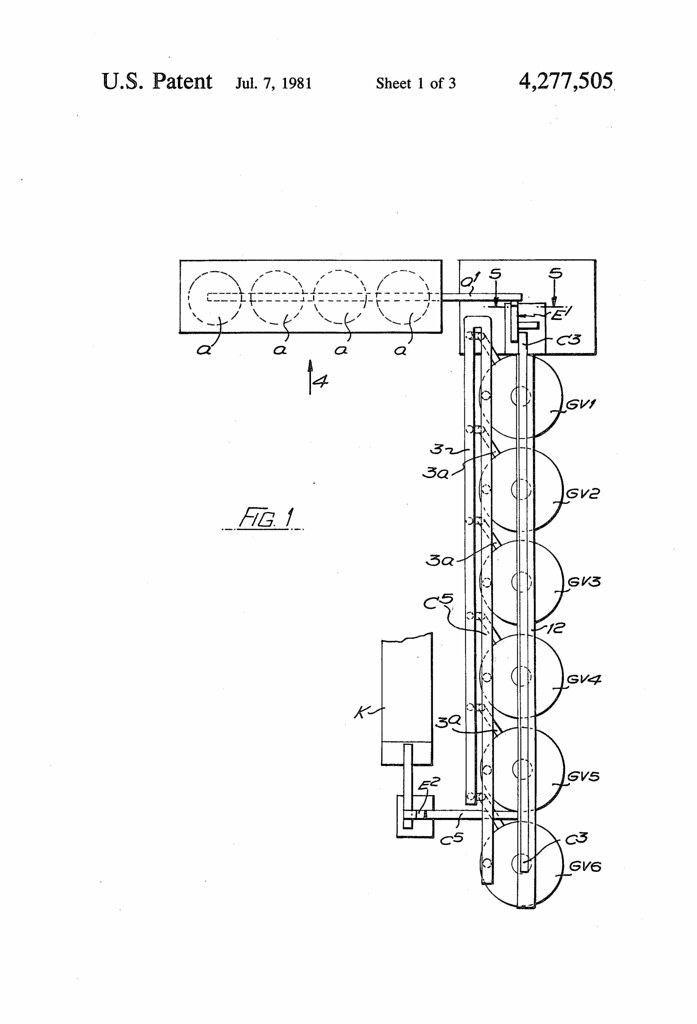
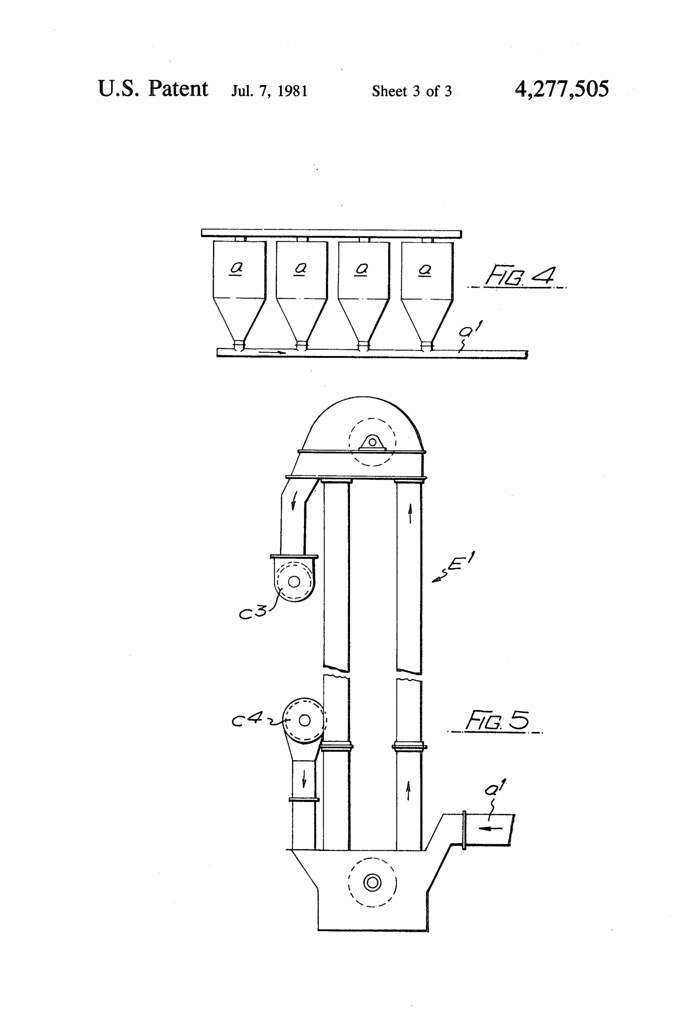
Today in 1981, US Patent 4277505 A was issued, an invention of Simon B. Simpson, for his “Process for the Malting of Grain.” Here’s the Abstract:

Germination of cereal grain in malting is carried out by passing steeped grain to and through a series of six closed spaced discrete vessels in succession. The grain is maintained in each vessel for about a day and in each vessel is subjected to an upward flow of humidified at temperated air. The grain is turned either in a vessel or through transference to the next vessel. Transference from one vessel to the other is carried out by discharging the grain from each vessel along a lower conveyor to an elevator which raises the grain to an upper conveyor that discharges the grain down into the next vessel. Grain leaves the last vessel of the series as green malt and then passes to a malt kiln where it is dried to a desired moisture level.

Untitled

Filed Under: Beers, Just For Fun, Politics & Law, Related Pleasures Tagged With: barley, Brewing Equipment, History, Law, Malt, Patent

Jeremy Warren Leaving Knee Deep

July 7, 2015 By Jay Brooks

knee-deep
Knee Deep Brewing Co. founder Jeremy Warren announced earlier today via Facebook that effective August 3 he’ll be leaving the brewery he started five years ago. Here’s what he’s saying so far:

The past 5 years has been a great ride with Knee Deep Brewing. From my half bbl home brew in my garage to 11,000 bbl in an 18,000 sq. ft. warehouse! I want to thank each and every one of you for your support and encouragement.

Your constant kind words and criticism keeps us Brewers on our toes in making the best beer possible.

With that said, it is with a bittersweet feeling that I’m announcing my separation from Knee Deep Brewing effective August 3rd.

Don’t freak out! I will be announcing my new project soon!

I will not disappoint!!

So it sounds like he’s already cooked another project and will leave Knee Deep intact, which is great. Join me in wishing him well on his next adventure.

UPDATE: The Sacramento Beer published a follow-up yesterday about Jeremy’s resignation that includes speculation that he’ll be opening his own brewery, which naturally is what we’re all thinking. But co-founder Jerry Moore, who’s also apparently the majority owner of Knee Deep, states “he was not surprised by Warren’s decision and he insisted that Knee Deep will not skip a beat.” He then adds this:

“Knee Deep owns those recipes and I own Knee Deep,” said Moore, noting that Warren has been a minority owner. “Knee Deep will continue to make all of the beers we’ve been making. We have four full-time brewers who have been making these beers.”

I don’t want to read too much into that statement, especially since I don’t know Jerry Moore, but it’s hard not to see it as inferring an issue or issues that led to Warren’s departure.

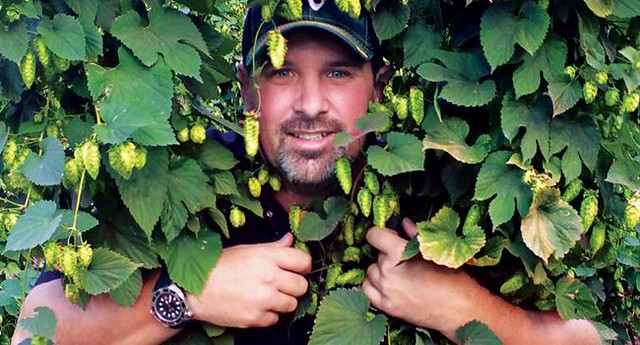
jeremy-warren
Jeremy Warren from a recent article in Sacramento Magazine.

Filed Under: Breweries, News Tagged With: Announcements, Bay Area, Business, California

Patent No. 2893870A: Hopping Of Beer

July 7, 2015 By Jay Brooks

patent-logo
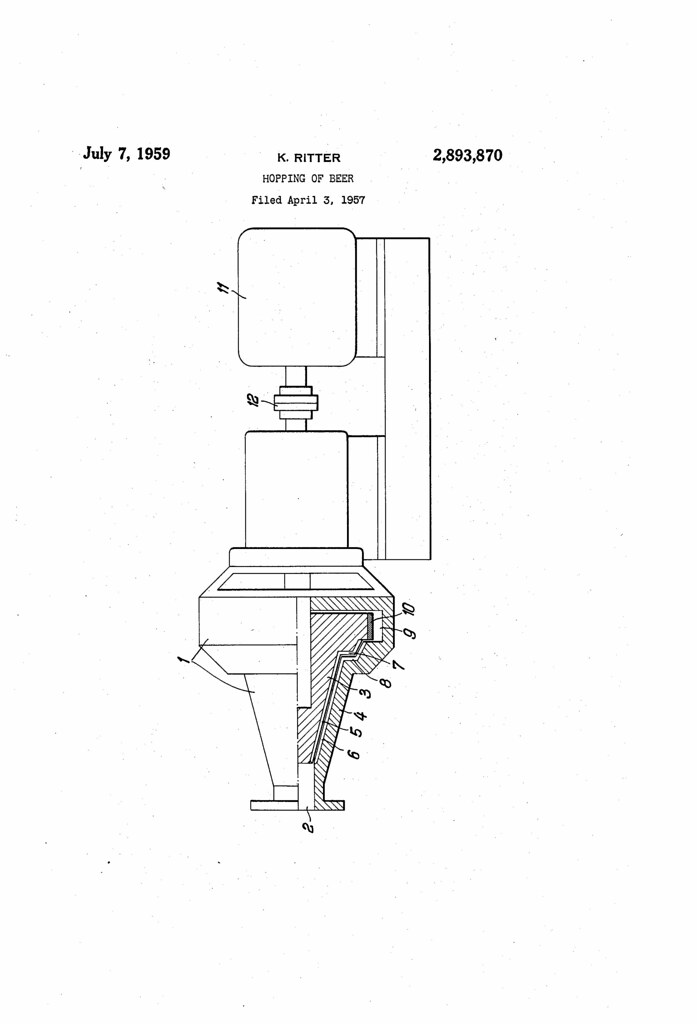
Today in 1959, US Patent 2893870 A was issued, an invention of Kurt Ritter, for his “Hopping of Beer.” There’s no Abstract, although in the description it includes this summary:

The invention relates to improvements in beer brewing and more particularly to an improved method of hopping beer.

The brewing of beer comprises generally the following steps: Ground malt is mashed with water, and the obtained malt solution (first wort) is freed from the malt residues (spent grains). Subsequently, the wort is boiled with addition of the required amount of hops and then separated from the spent hops and fermented with yeast. The hops are generally added as such or in coarsely disintegrated state to the Wort.

Said procedure has the drawback that, on boiling, only about one-third to one-fourth of the bitter principle (resins), contained in the hops, passes into the wort; in addition, a certain amount of the resins, e.g. about 3 to 7 percent, is lost in further processing (fermentation and storage) by precipitation.

So far, attempts to eliminate said drawbacks have not met with satisfactory results. Recently, it has been proposed to extract the resins by subjecting the hops in water or aqueous solutions to ultrasonic irradiation and to introduce the thus obtained resin extract into the boiling wort instead of hopping with natural hops. Said method, however, must be carried out with expensive and delicate devices, the operation of which requires high energy cost, and which are therefore uneconomical for commercial purposes. The preparation of such resin extracts by means of ultrasonic irradiation takes considerable time, for instance 1 to 2 hours and more. During this prolonged treatment, undesired side reactions may take place which may affect the brewing process, for instance with respect to the uniformly fine and pleasant taste of the produced beer.

It is a principal object of the invention to provide a simple, reliable, and economic hopping procedure.

It is another object of the invention to provide a method by which the required amount of hops is considerably reduced and nonetheless a beer of uniform excellent quality and taste is produced.

Untitled

Filed Under: Beers, Breweries, Just For Fun, Politics & Law, Related Pleasures Tagged With: Brewing Equipment, History, Hops, Law, Patent

« Previous Page
Next Page »

Find Something

Northern California Breweries

Please consider purchasing my latest book, California Breweries North, available from Amazon, or ask for it at your local bookstore.

Recent Comments

  • Bob Paolino on Beer Birthday: Grant Johnston
  • Gambrinus on Historic Beer Birthday: A.J. Houghton
  • Ernie Dewing on Historic Beer Birthday: Charles William Bergner 
  • Steve 'Pudgy' De Rose on Historic Beer Birthday: Jacob Schmidt
  • Jay Brooks on Beer Birthday: Bill Owens

Recent Posts

  • Beer In Ads #5227: It’s Here! Bock Beer By Bosch April 20, 2026
  • Beer Birthday: Drew Beechum April 20, 2026
  • Beer Birthday: Des De Moor April 20, 2026
  • Beer Birthday: Brenden Dobel April 20, 2026
  • Historic Beer Birthday: Henry Becker April 19, 2026

BBB Archives

Feedback

Head Quarter
This site is hosted and maintained by H25Q.dev. Any questions or comments for the webmaster can be directed here.