Today’s beer video is a tour of the Blue Point Brewing Co. in Patchogue, New York by The Brewery Show. Given the announcement today that ABI is buying the brewery, I thought readers might be interested in seeing the brewery and learning more about it. It’s from season 2 of The Brewery Show and runs about twelve minutes.
Anheuser-Busch To Buy Blue Point Brewing

Anheuser-Busch announced today that they would be acquiring Long Island craft brewery Blue Point Brewing for an unspecified amount. The deal is expected to close in the next quarter, and like its other recent acquisitions, the brewery will remain at its original location in Patchogue, New York.
From the press release
Anheuser-Busch today announced it has agreed to purchase Blue Point Brewing Co., one of the nation’s top craft brewers with more than 40 beers and sales concentrated along the East Coast, in a move that will bring additional resources to Blue Point’s operations, allowing it to meet growing consumer demand for its award‑winning brands. Terms of the agreement were not disclosed.
Blue Point, known for its creativity, was founded by Mark Burford and Peter Cotter 15 years ago in Patchogue, N.Y., where the brewery will continue to operate. Anheuser-Busch also plans to invest in the brewery to grow its operational capabilities and enhance the consumer experience over the next few years.
“We are deeply grateful to our family of loyal employees and customers. Our success was made possible by the hard work of good people and good beer in Patchogue,” said Peter Cotter, who will continue to be instrumental in the success of the brands along with co-founder Mark Burford. “Together, our talented brewing team and Anheuser-Busch will have the resources to create new and exciting beers and share our portfolio with even more beer lovers,” said Mark Burford.
In 2013, Blue Point sold approximately 60,000 barrels, with 50 percent of the volume from its flagship brand, Toasted Lager. It also sells Hoptical Illusion, Blueberry Ale and seasonal brands among others.
“As we welcome Blue Point into the Anheuser-Busch family of brands, we look forward to working with Mark and Peter to accelerate the growth of the Blue Point portfolio and expand to new markets, while preserving the heritage and innovation of the brands,” said Luiz Edmond, CEO of Anheuser-Busch. “With Anheuser-Busch’s strong beer credentials, we share a commitment to offering high-quality beers that excite consumers. Blue Point brands have a strong following and even more potential.”
The St. Louis Post-Dispatch also some additional information on the deal and its background.
And in case you’re unfamiliar with Blue Point, here’s an overview, also from the press release.
Blue Point Brewing Company is Long Island’s oldest and most award-winning brewery. Founded in 1998 by Mark Burford and Pete Cotter, Blue Point Brewery is headquartered in Patchogue, New York, and is currently the 34th largest craft brewery in the U.S. Blue Point Brewing Company is independently owned and operated and its beers are available in 15 states of distribution including New York, New Jersey, Massachusetts, Connecticut, Pennsylvania, Rhode Island, New Hampshire, Vermont, Maryland, Delaware, Virginia, North Carolina, Georgia, Florida, and Michigan. Blue Point’s portfolio of more than 40 craft beers includes Hoptical Illusion, ESB, RastafaRye Ale, Sour Cherry Imperial Stout, Toxic Sludge, White IPA, No Apologies Double IPA, and its flagship Toasted Lager, which won the World Beer Cup in 2006.
Beer In Ads #1092: Home … And All That It Means

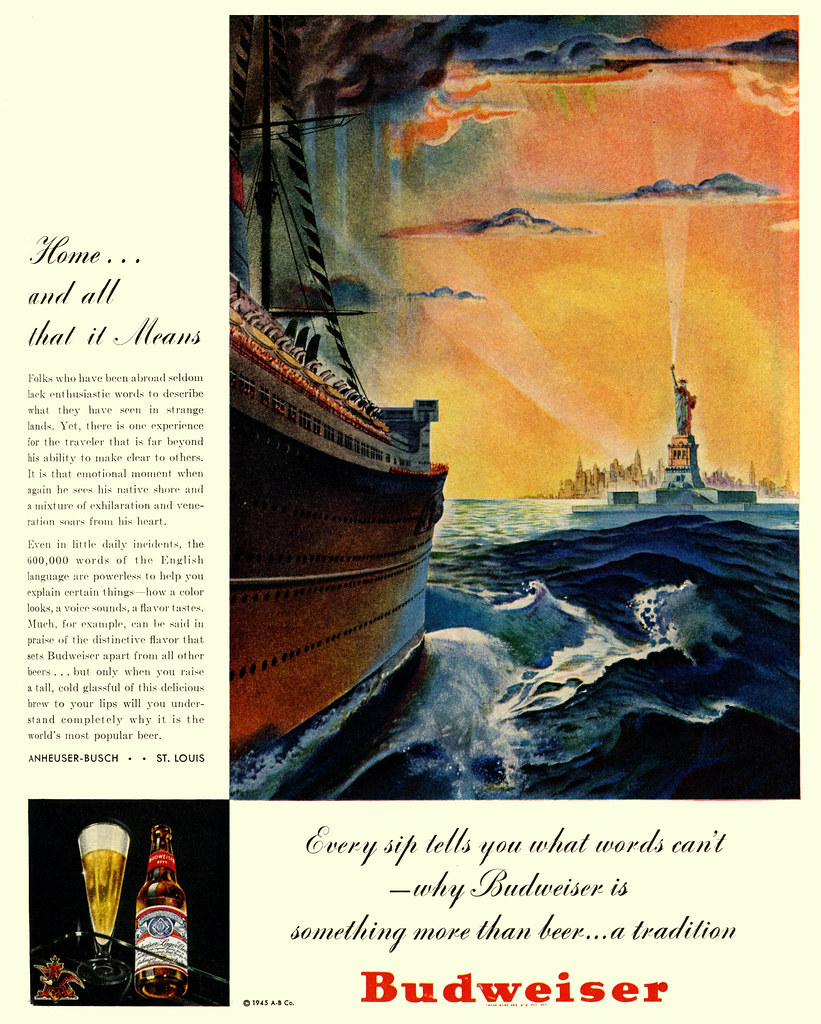
Tuesday’s ad is for Budweiser, from 1945, the final year of World War 2. Showing a returning ship coming into New York harbor as it’s bringing the troops “Home … and all that it Means.”
America’s Addiction Treatment Goal: Perpetual, Lifelong Abstinence

On Sunday, in the morning before the Super Bowl was scheduled to be played, the tragic news broke that actor Philip Seymour Hoffman had been found dead, with a needle stuck in his arm, the victim of an apparent heroin overdose. The following day, on the Psychology Today website, frequent contributor Stanton Peele posted Another One: Why So Many Celebrities Die Following Rehab. Detailing Hoffman’s history, apparently he’d given up drugs and alcohol when he was 22 years old, and had been successfully abstaining for 23 years, when he reportedly “fell off the wagon.” He’d also sought help and had been in rehab over the past six months. Peele wonders why he, and so many other celebrities, overdose and die “after recently having been in treatment? After all, many people have lived long lives while using opiates.”
Interestingly, he says that this is not uncommon and cites our attitudes toward addiction and its “cure” as contributing factors. “What is dysfunctional is our temperance attitudes towards substances, their use, and their misuse. Our attitudes towards drugs are more lethal than the substances themselves,” he writes. While Hoffman was reportedly using heroin, the way we treat addiction for drugs or alcohol is exactly the same, and for purposes of AA and other rehab and treatment facilities, alcohol is considered just another drug on the panoply of addictive substances.
Peele has identified five reasons that he believes “these deaths occur so often following rehab.” Tellingly, he also believes they “stem from one basic fact of American rehab: the one and only goal of treatment is perpetual, lifelong abstinence. No treatment time is devoted to the essential truth that most rehab grads will use again, and to prepare them for this possibility.” This has long been my belief about what’s wrong with AA and other abstinence-based “cures” that don’t cure anything. They merely suppress a person’s impulses without addressing the underlying causes or finding a way to actually cure anyone, which should mean learning how to drink in moderation without returning to bingeing or over-indulging. Peele also believes that “all of these failures to prevent post-rehab deaths are due to the kind of unrealistic, perfectionist, just-say-no approach America takes to drugs, alcohol, and addiction.”
But here’s an overview of the five reasons he believes people leaving rehab so often get into trouble, sometimes fatally:
1. Combining different drugs and alcohol. Rehab grads are not made aware that the worst usage pattern is to combine alcohol and other drugs, particularly depressants. What is usually mistakenly called “overdose” is in fact the result of such lethal combinations, which depress the nervous system and cause the person’s breathing to fail.
2. Lower tolerance. If rehab grads haven’t been using for some time (which is likely the case when they are fresh out of the rehab facility), their tolerance for their drug of choice has diminished. Rehab residents should be schooled in the basic facts of tolerance and alerted that, if they use, they should lower their accustomed dosage.
3. In for a dime, in for a dollar. Twelve-step programs teach people that any level of use of any drug or alcohol is the equivalent of a full bore relapse, so that addicts and alcoholics give up all efforts at self-restraint once they have consumed any amount of a substance. As a result, they often experience a complete relapse after a slip. The opposite approach is to train addicts in relapse prevention, which teaches methods for “getting off the runaway train” at any point, from exposure to a substance, to initial use, to excessive use — for all of which there are remedies or “off ramps.”
4. Failure to have safeguards in place. Since the only permissible stance post rehab is to vow never to use a substance again, graduates are not “allowed” (or alerted) to take safety precautions.
5. Failure to have available an overdose kit. If you are going to use narcotics, you should have readily accessible an overdose kit, the main ingredient of which is naloxone (brand name, Narcan), a narcotic antagonist. In many states, overdose kits are not even used by emergency workers.
Those seem right, at least to my way of thinking. This is, for me, more evidence that America as a society has an unhealthy relationship with drinking. We seem unable to be reasonable in our approach to so many aspects of alcohol consumption and its consequences. And prohibitionist groups fan the flames of our dysfunction and make unwitting accomplices of the health and medical communities because keeping the status quo also keeps the money flowing to them and rehab centers, treatment facilities, etc. It seems that anyone who challenges the twelves steps or abstinence only approaches is immediately shot down. I can’t help but think that any system should be able to stand up to criticism and scrutiny in order to constantly improve it, but it certainly feels like the idea of powerlessness and abstinence are treated as sacrosanct dogma. And that means we’ll always be a nation of addicts who can never change.
Are addiction treatment providers the new snake oil salesmen? Just takes some pills and never touch another drop for the rest of your life and you’ll be fine. Trust us.
Beer In Film #35: Beirut to Brooklyn
Today’s beer video is short film of Brooklyn Brewery co-founder Steve Hindy explaining the reasons he left his job as a journalist to make beer. STeve also recently published his second beer book, The Craft Beer Revolution, this one on the history of craft beer from an insider’s perspective. The film was created by Transient Pictures for the brewery’s 25th anniversary.
Beirut to Brooklyn: The Origins of Brooklyn Brewery from Transient Pictures on Vimeo.
See The Elephant: Anchor IPA

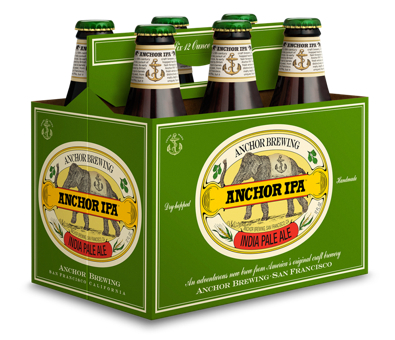
Anchor Brewing will soon be releasing their newest beer, and it should surprise no one seeing the trends in hoppy beers that the new release is Anchor IPA.
While Anchor Liberty is brewed with just Cascade hops, the new Anchor IPA is brewed with six different hops, including Apollo, Bravo and Cascade for bittering, and the five used in dry-hopping are Apollo, Cascade, an experimental hop still know as 431, Nelson Sauvin and Citra. I’ve been invited to an event at the brewery tomorrow night and I suspect we’ll get a chance to try the new 6.5% a.b.v. beer then. For now, they’ve released a video explaining some aspects of the new beer and it’s historical tie-in. Apparently during the gold rush, the phrase “seeing the elephant” was a “hopeful but risky pursuit of happiness,” something every prospector would have been familiar with. So it’s certainly an interesting way to work elephants into the beer’s lore, but I’ll let Anchor take up the story here.
I have now received the press release:
“When we started thinking about Anchor IPA, we wanted to create a beer we would be proud to serve in our Taproom,” said Mark Carpenter, Brewmaster at Anchor Brewing. “Right now a lot of IPAs are so hop forward that your palate can only enjoy one because of the high bitterness. Our IPA will have a strong hop flavor so you know you’re drinking an IPA. But, the combination of malts we’re using are strong enough to hold up to the bitterness, allowing you to enjoy more than one. The unique selections of both traditional and modern hops we are using provide the backbone and flavor, plus an experimental hop adds to its pleasant fruity & floral aroma, the first thing you notice as you sip the beer.”
The California Gold Rush lured thousands west to “see the elephant,” a 19th-century metaphor for the hopeful but risky pursuit of happiness, adventure, and fortune. As early as 1849, India Pale Ale—prepared by British brewers for export to India by adding dry hops to barrels of hoppy ale—was also heading west, from England around the Horn to San Francisco. Thirsty ’49ers savored imported IPAs, but it wasn’t until 1975 that Anchor, America’s original craft brewery, pioneered the revival of dry-hopped handmade ales with the introduction of Anchor’s Liberty Ale®, the first modern American IPA brewed after Prohibition. Now, that tradition fast-forwards to an adventurous new brew: Anchor IPA™. Made with 2-row barley malt and fresh whole-cone hops, its bright amber color, distinctively complex aroma, spiky bitterness, malty depth, and clean finish unite to create a uniquely flavorful, memorable, and timeless IPA.
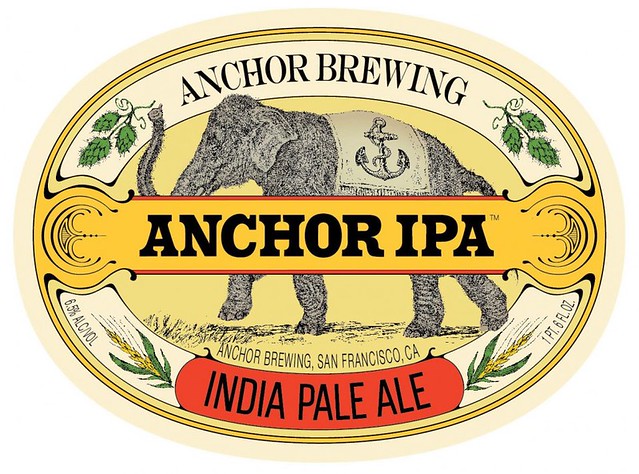
The elephant you see on Anchor IPA™ was hand-drawn by Anchor label artist, James Stitt. The expression to “see the elephant” originates from a tale that predates the California Gold Rush.
There once lived a farmer who had heard of elephants but had never seen one. He longed for the day when he might catch a glimpse of this rare, exotic creature. When the circus came to town, he loaded his wagon with fresh produce and headed to the market. On the way, just as he’d hoped, he came across the circus parade, nobly led by an enormous elephant. The farmer was ecstatic, but his horses were terrified. They reared and bucked, overturning his wagon and scattering its precious contents in the road. “I don’t give a hoot,” exclaimed the farmer. “I have seen the elephant!”
The elephant became the universal symbol of the Gold Rush, as evidenced by the journals, letters, and sketchbooks of the forty-niners. Whether or not they struck it rich in the diggings, those plucky pioneers would forever treasure their California adventure as the defining moment of their lives.
Beer In Ads #1091: Norman Rockwell’s Man With A Beer & Sandwich
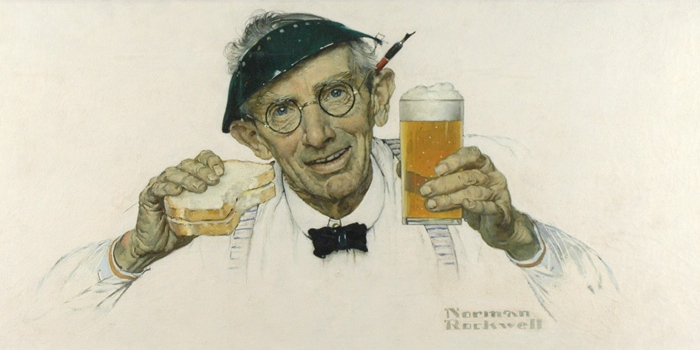
Monday’s ad is by famed artist and illustrator Norman Rockwell, who was born today, February 3, in 1894. Rockwell was most famous for his magazine covers for the Saturday Evening Post and Boys’ Life, the official Boy Scouts’ publication. But he also did some commercial illustration, including this painting of a “Man with Sandwich and Glass of Beer,” for an unspecified beer ad, which was created between 1947 and 1950. I don’t think it was ever used, as I’ve been unable to turn up the illustration in any actual advertisement.
Beer In Film #34: Refreshingest Hamm’s
Today’s beer video is an animated commercial for Hamm’s featuring the Hamm’s bear along with Bambi-like forest creatures. But most impressing; look how clear the color of the beer os it, you can see through it. It must have an SRM of zero.
History’s First Photo Of People Drinking Beer

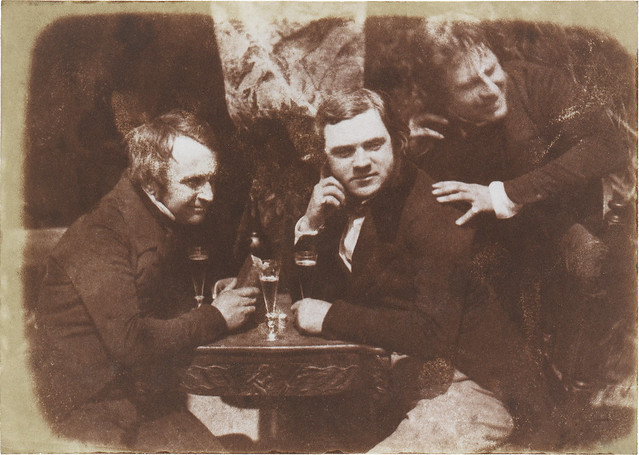
Twitter lit up last night with tweets of an old photograph taken in 1844. It was Boak & Bailey who I saw tweet it, so h/t to them, although it appears to have been bouncing around the interwebs since at least July of 2012. Although neither the Metropolitan Museum of Art, where one of the originals is located, the National Portrait Gallery, where there’s another, or on Wikipedia, confirms or denies it, many sources posting it have indicated that it’s the first photograph taken depicting people drinking beer, in this case Edinburgh Ale. According to the museum, the photographers were David Octavius Hill and Robert Adamson. The people in the photo are identified as James Ballantine, Dr. George Bell, and D.O. Hill. It was printed on salted paper from a paper negative. I like the idea that it is the first photographic record of people enjoying a beer, but I’d prefer to see more proof. It seems likely, of course, since according to one account it was taken just six years after the very first photograph of a human. But I suppose until someone shows me one that’s earlier, I’m going to take their word for it.

This is the photograph from the Metropolitan Museum of Art:
Whereas the photo that’s at the National Portrait Gallery is more grey than brown, and is identified as an Calotype print.
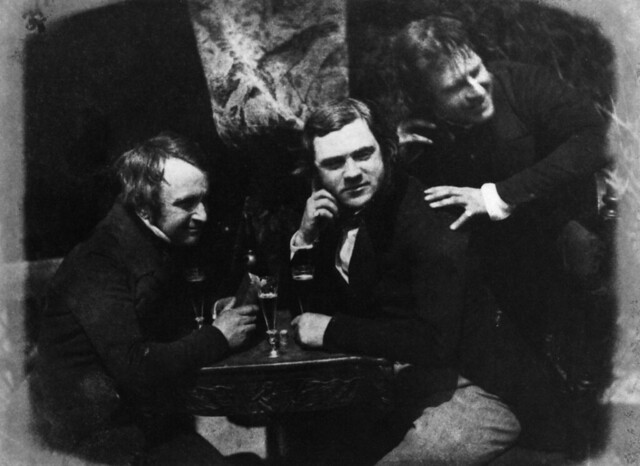
It also includes the following caption.
The skills involved in producing calotypes were not only of a technical nature. Hill’s sociability, humour and his capacity to gauge the sitters’ characters all played a crucial part in his photography. He is shown here on the right, apparently sharing a drink and a joke with James Ballantine and Dr George Bell. Bell, in the middle, was one of the commissioners of the Poor Law of 1845, which reformed poor relief in Scotland. Ballantine was a writer and stained-glass artist, and the son of an Edinburgh brewer. On the table are three glasses of ale. According to a contemporary account, Edinburgh ale was “a potent fluid, which almost glued the lips of the drinker together”.
“Glued the lips of the drinker together,” that’s one of the oddest descriptions of how a beer tastes I’ve ever read. It makes me want to try an Edinburgh Ale. I’ve get to working on that time machine.
Beer In Ads #1090: The Colt 45 Super Bowl
Sunday’s ad — kind of a Super Bowl ad — is for Colt 45, from 1968, when in Super Bowl II my Green Bay Packers defeated the Oakland Raiders 33-14. It’s a funny idea, and if the beer they poured into the crystal bowl had been a better-tasting beer it might truly have been a super bowl.