Brookston Beer Bulletin

Jay R. Brooks on Beer

  • Home
  • About
  • Editorial
  • Birthdays
  • Art & Beer

Socialize

  • Dribbble
  • Email
  • Facebook
  • Flickr
  • GitHub
  • Instagram
  • LinkedIn
  • Pinterest
  • RSS
  • Twitter
  • YouTube

Powered by Genesis

Some Girls For Strong Beer Month

February 2, 2014 By Jay Brooks

21st magnolia-new
It’s February, and that means it’s time for the 12th annual Strong Beer Month, once again with six new extreme beers each at 21st Amendment and Magnolia throughout the month. Try them all, and you get to keep the commemorative logo glass. Just collect all 12 punches in your Strong Beer Month ticket before the beer’s all gone. You can read all about it at both Magnolia and 21st Amendment websites.

This year’s theme is the 1978 album “Some Girls” by the Rolling Stones. “The players on the album from left to right on the album (green row) are: Ben Spencer (Magnolia Head Brewer), Shaun O’Sullivan (21A owner), Zambo (21 Head Brewer), Dave McLean (Magnolia owner) and Nico Freccia (21A owner). There is also an Easter egg in the album, see if you can find Motor Kiesling, a good friend of both the 21A and Magnolia.”
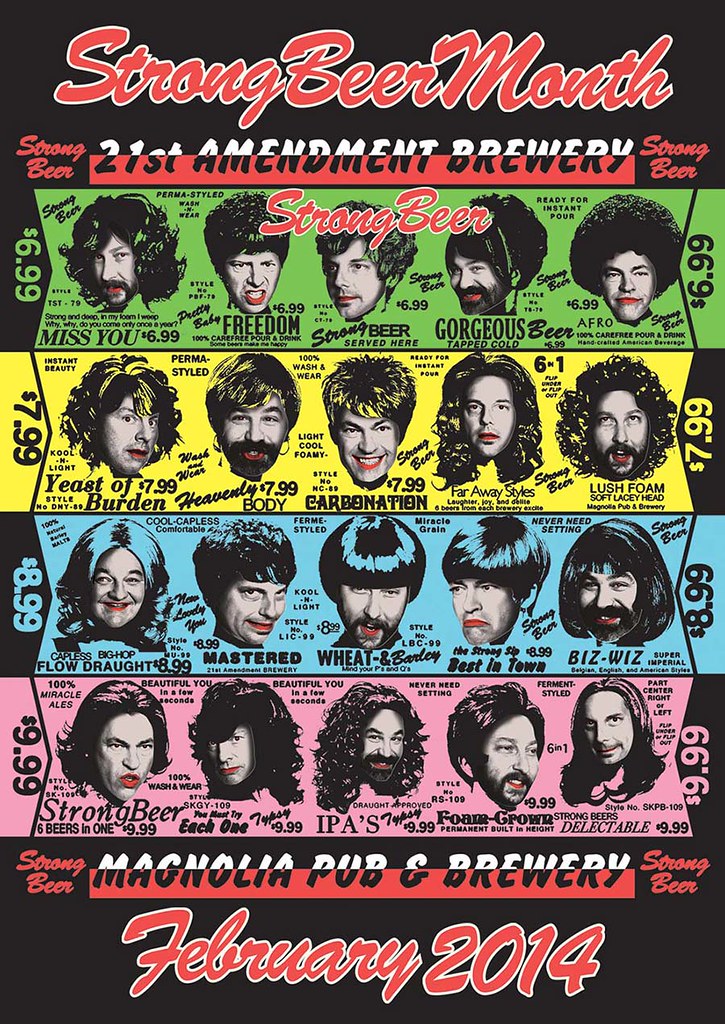
strongbeermonth2014-image1

Here’s the beer for this year:

Side One: Magnolia:

  1. Rye Rye Rocco Rye Brown Ale: 8.1% abv
  2. Let It Rauch German-influenced Smoked Beer: 8.1% abv
  3. Promised Land Imperial IPA: 11.2% abv
  4. Smokestack Lightning Imperial Stout: 9.7% abv
  5. Quadlibet For Tenderfeet Belgian Abbey-style Quadrupel: 8% abv
  6. Old Thunderpussy Barleywine: 10.6% abv

Side Two: 21st Amendment:

  1. Framboise Forte d’Or Belgian-style Raspberry Golden Ale: 10.2% abv
  2. Dub Step Imperial I.P.A.: 10.2% abv
  3. Beast of Burden American-Belgo Imperial IPA: 9.9% abv
  4. Red Titan Giant Red Ale: 12.8%
  5. Bike Lane Hopper Imperial Black IPA: 9.6% abv
  6. Hendrick’s Imperial Stout: 9.3% abv

And here’s the back cover, too, with more details about each beer:
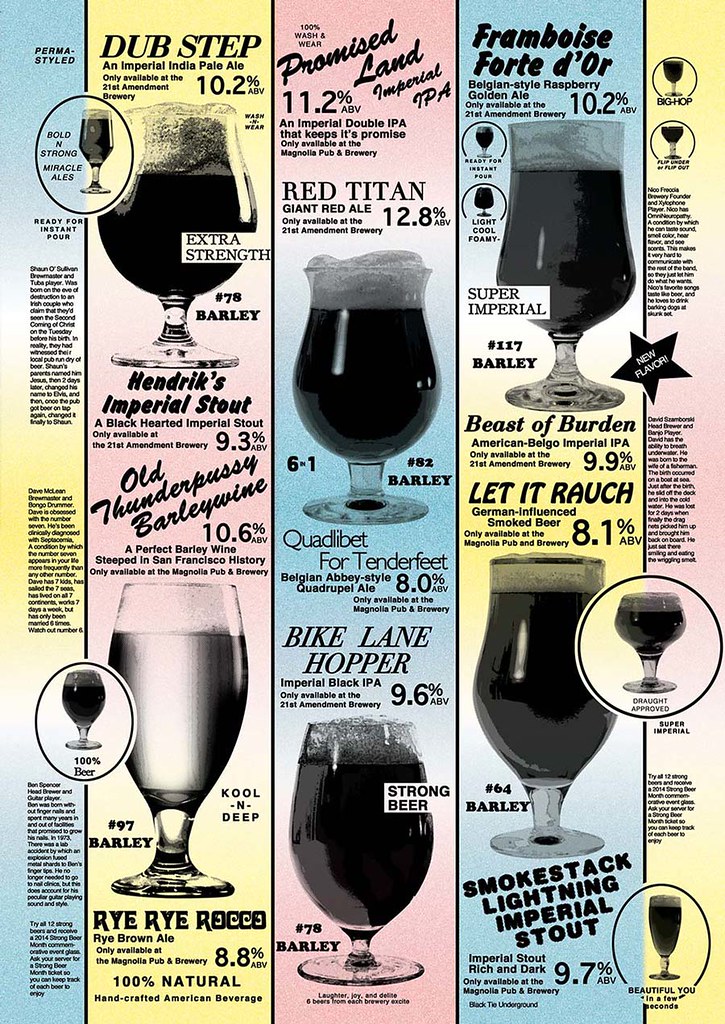
strongbeermonth2014-image3

This year for the first time, they also created a third poster, this one showing the Strong Beer Month gang pal’ing around with all of their celebrity friends. Must be nice to be a brewer.
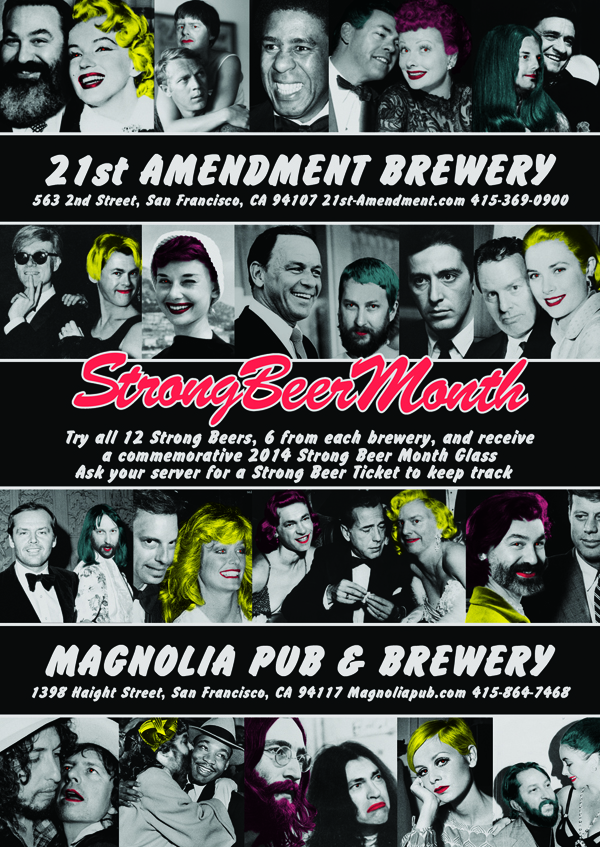
strongbeermonth2014-image2

Filed Under: Beers, Breweries, Events, Just For Fun, News Tagged With: Announcements, California, Music, San Francisco

Beer In Film #33: Newcastle’s Not-Super Bowl Spots

February 2, 2014 By Jay Brooks

brookston-film
Today’s beer video is twofer in honor of the big game that’s being played later today. It’s a pair of non-ad ads created by Newcastle Brown Ale that were never meant to be aired during the way-too-expensive football game. They’re part of a series of non-ads under the umbrella title if we made it that poke fun at the bombast of the game and all of the hype surrounding it. The first one is Anna Kendrick: Behind the Scenes of the Mega Huge Game Day Ad Newcastle Almost Made.

The second one, The Mega Huge Football Game Ad Newcastle Could’ve Made, is a storyboard for an ad that was clearly too expensive not only for Newcastle but possibly for anyone to make, even for an event so mythically big as the Super Bowl.

The whole series is actually pretty funny. Take a look at some of the others at if we made it.

Filed Under: Beers, Breweries, Editorial, Just For Fun, Related Pleasures Tagged With: Advertising, England, Humor, Video

The Brewhog Saw His Shadow, 6 More Weeks Of Winter Beers

February 2, 2014 By Jay Brooks

groundhog-day
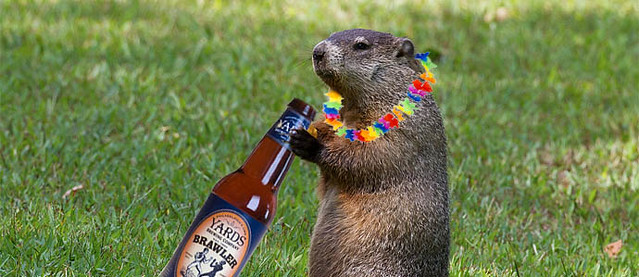
Over in Gobbler’s Knob, in Punxsutawney, Pennsylvania, Phil the Groundhog — a.k.a. Brewhog — raised up his head this morning and looked around, and this year saw his shadow everywhere he looked. You know what that means. It’s six more weeks of drinking winter beers this year. Or something about a late spring, I can’t keep it straight. You can see a video of Punxsutawney Phil here. And there’s more information about Groundhog Day at the Punxsutawney Groundhog Club.

groundhog-day-yards

Filed Under: Just For Fun, News Tagged With: Holidays, Pennsylvania

Beer In Ads #1089: When You’re Out Of Schlitz, Punt.

February 1, 2014 By Jay Brooks


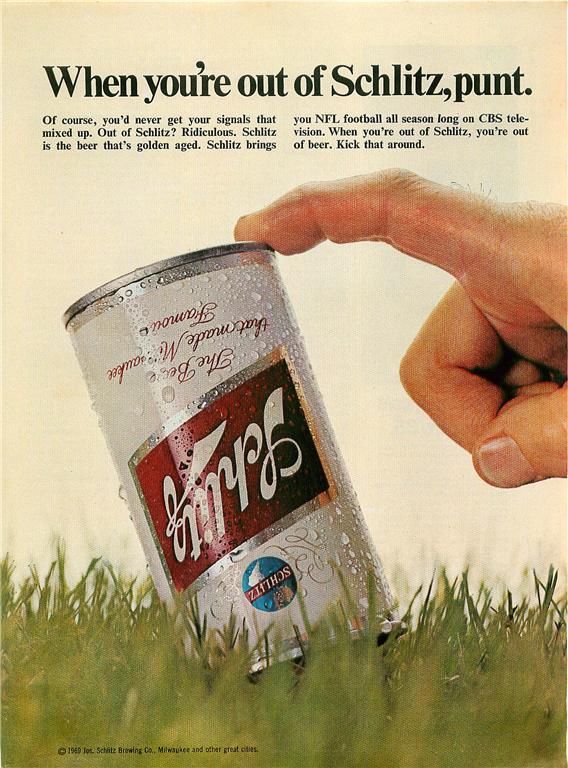
Saturday’s ad, to get your ready for tomorrow’s Super Bowl, is for Schlitz, from 1969. It’s a funny one. Showing an upside down can of Schlitz held up by a finger, ready for the kick … wait a minute. What’s wrong with this picture? How did this get published? Figure it out yet? Somebody at the ad agency must have known something about football, or maybe not. Check the headline again. “When You’re Out Of Schlitz, Punt.” Whoops. Hilarious.

Schlitz-1969-punt

Filed Under: Art & Beer, Beers Tagged With: Advertising, Football, History, Humor, Schlitz, Sports

Beer In Film #32: The Chemistry Of Beer With Grant Wood

February 1, 2014 By Jay Brooks

brookston-film
Today’s beer video is all about the Chemistry of Beer and features Grant Wood, when he still brewmaster for Samuel Adams, at their Boston brewery. Grant recently left to open his own brewery, which is in Texas. His Revolver Brewery is also making some really terrific beers. The video is part of the Byte Science Science series, and provides a great overview of the chemical processes involved in brewing beer.

Filed Under: Breweries, Just For Fun Tagged With: Boston, Education, Samuel Adams, Science of Brewing, Video

As You Watch The Big Game Sunday, Ignore This

February 1, 2014 By Jay Brooks

pinocchio
Never one to pass up an opportunity to proselytize, Alcohol Justice’s annual Superb Owl press release, Big Alcohol’s Big Game Plan is another excellent example of hypocrisy in action. What does Big Alcohol’s “game plan” consist of? Why patent lies, of course, that is completely obvious lies. We’re always lying, apparently, whereas the Watchdog Sheriff of Alcohol always tells the truth.

Our main lie, this time, is that the alcohol industry maintains “that there is no evidence that exposure to alcohol ads encourages underage consumption or harmful over-consumption among adults.” Of course, there is an annual report that has for years shown that advertising is the least influential factor for underage drinking, and has been dropping since they started doing the survey in 1991. According to GfK Roper Youth Report Examines Influences on Youth Decisions about Drinking, advertising accounts for 1% of youth drinking influence. So while I don’t think anyone is arguing advertising has no influence over anything, it’s very small, and kids see ads for things adults buy all the time for the simple reason that they’re in the world. I saw beer ads as a kid. I also saw cigarette ads, and yet I’ve never smoked them.

As for adults, alcohol is legal, advertising is legal, if people over-consume it that’s their business. Why can’t people use the occasion of one of the biggest sporting events of the year to relax and celebrate, sharing a few beers with friends and family? As long as they’re not doing something illegal or obnoxious, that should be nobody’s business. This is certainly a topic for debate, the amount of influence, etc. but as I’ve written before, as long as AJ keeps calling everyone in the alcohol industry a liar, any meaningful dialogue seems fairly inconceivable, but then I don’t think they have any interest in actually having a discussion or finding any workable solutions. They just want to bash the industry and collect donations because they think we account for all the evil in the world.

But the most interesting part of this particular propaganda piece is the section entitled “As You Watch The Big Game Sunday, Think About This.” Here’s the first thing they want us to think about:

Driven by Big Alcohol advertising, branding, sponsorship and celebrity endorsements, America consumes an estimated 325 million gallons of beer on the day of the big game, so alcohol-related harm is inevitable.

325 million gallons? There are approximately 314 million people in the U.S. That means every man, woman and child drinks 1.035 gallons of beer, or about 11 12-oz. bottles of beer in four hours, a figure that represents 5% of total annual beer production. Does that sound even remotely reasonable? That figure fooled me last year when a website listed it and I re-posted it. But I later took a closer look at it and discovered that it came from — shock — Alcohol Justice, who as far as I could tell just made it up. Because as I wrote in Hoodwinked By Propaganda, that number just doesn’t add up. A more reliable figure is around 50 million cases of beer are purchased for the Sunday of the game, probably not all on that day, but in the week leading up to it. That’s around 112.5 million gallons, or roughly one-third of AJ’s number. Talk about inflation. And that’s purchased, not all of that beer is consumed that one day, either.

And “inevitable?” “Alcohol-related harm is inevitable?” Remember that the amount AJ insists is consumed is wrong, a patent lie. But regardless of the amount, whenever people drink it’s not inevitable that harm will follow. It’s not even likely. I’ve consumed my fare share of beer during, well, every single Super Bowl since around 1980. Guess how many times I’ve experienced the supposedly inevitable alcohol-related harm? That would be a grand total of zero times. Will some people act stupidly and make fools of themselves? Of course they will. But that has more to do with the law of large numbers than alcohol. But if 1,000 people drink and one person does something stupid, does that invalidate the other 999? Apparently in AJ’s mind it does, they seem to find anything short of perfection unacceptable. But I’d like to know what other human pursuit is held to such a standard. Certainly gun-related accidents account for some of the annual death toll in America. But I don’t see anyone rushing to ban all guns until we achieve perfection in gun safety. It’s absurd to think that accidents or stupidly won’t happen, if for no other reason than we’re imperfect, fallible humans. But it’s even more absurd to think that any attempts to stop all of them, usually by punishing the majority of people who are blameless and have done nothing wrong, can ever be 100% effective, or frankly even marginally effective.

“It is estimated that about 20 to 30 million kids will tune in to watch [the Super Bowl] on TV and online. As usual, they will be saturated once again with seductive beer ads.”

Saturated? Saturated is defined as “completely filled with something.” Anheuser-Busch InBev is running five spots during the game, for a grand total of four minutes. According to AdAge’s list of Super Bowl advertisers, MillerCoors won’t have any ads in this year’s broadcast. The Super Bowl is scheduled to be aired over four hours, or 240 minutes. Kids, if they’re even paying attention, will see at most four minutes of beer advertisements in four hours. That’s 1.66% of the game’s broadcast time. So the beer industry is a bunch of liars, but 4 minutes out of 4 hours is saturation. That’s what passes for truthfulness?

Two of smartest [sic], most popular TV personalities in the country also believe that there’s something wrong with mixing alcohol and sports. Jon Stewart on “The Daily Show” recently skewered booze-swilling pot critics http://bit.ly/1c0evqa and questioned excessive beer ads on TV sports. While Steven Colbert on “The Colbert Report” commented on lucrative NFL sponsorships and Peyton Manning’s recent “shout-out” for Bud Light http://bit.ly/1dBo0kz “What’s weighing on my mind is how soon I can get a Bud Light in my mouth after this win. That’s priority number 1,” stated Manning.

You do understand that those are comedy shows? They’re not hard news. I love both Jon Stewart and Stephen Colbert’s shows, but they mine the news for comedy gold, and make fun of it wherever they find it. They’re really good at it, so good in fact that you thought they were seriously taking your side and promoting your position? Wow, how sad.

Alcohol ads, sponsorships, and celebrity endorsements associated with sports are disturbing not just because they are designed to lure young people to take that first drink but because as Kerry O’Brien said “…they also
cleverly create a culture where kids perceive alcohol consumption as a normal everyday part of life.

Designed to lure young people to take that first drink? Really? Can you honestly believe that celebrity endorsements only sway kids, that adults are immune to them and not their main target? Alcohol advertising is aimed squarely at adults, the people legally allowed to purchase and consume it. That’s who they’re designed to “lure.” You do understand that the purpose of advertising is to produce a result, like when you run ads endlessly begging for donations. It would be completely bad economics to target persons who are prohibited from buying the advertised products and, in most cases, have little or no money to buy them.

Alcohol consumption as a normal everyday part of life? There’s nothing clever about that, alcohol consumption is perfectly legal, and apart from those surreally ineffective thirteen years last century, it always has been. It is a normal part of everyday life. AJ may not like that fact, but that changes nothing. It’s not clever, creative advertising that give people that perception that “alcohol consumption [is] a normal everyday part of life,” it’s reality.

What I continue to find incredibly insulting about AJ’s propaganda is their insistence that they’re the honest ones and we’re all a bunch of liars. And yet they take huge liberties with the truth constantly. But what’s also annoying is the idea that adults can’t do anything adult if there are children present. Seeing a beer ad during a football game with adults present, to explain the context, etc., is exactly how they should see them. AJ seems worried that 20 to 30 million kids will watch the Super Bowl, but I have to question that figure, too. The most Americans who watched the Super Bowl was 111.3 million people for the 2011 contest, with 111 million the year before. Even at 20 million, that would mean about 18% of viewers were children, or almost 1 in 5. At 30 million, it would be 27%, just over one-quarter of viewers. Nielsen puts the percentage of kids at 16% or around 18 million.

But does the number really matter that much? These kids will undoubtedly be with their families. I doubt many, or any, of them will be watching the Super Bowl by themselves. You’d think that any event that brings families together would be something to celebrate: families spending time together is good thing, isn’t it? But apparently that’s not how AJ sees it. So I have to ask: what would AJ prefer? Should the kids be sent away? Should society set up day camps all over the country where kids can be sent to so they can be shielded from seeing those four minutes worth of beer ads during the game? Separated from their families for an adults-only game? Maybe they think that having kids means you no longer should be permitted to enjoy adult pursuits. Being a parent means giving up every aspect of your own life for your kids, the two worlds can never meet. That seems reasonable, doesn’t it?

Or would they prefer we just do away with all sporting events entirely, instead having us all stay home and play Chutes and Ladders or Candyland until our kids go off to college or are on their own, no longer living at home. At that point, and that point only, will it be safe once more to turn on the TV set and watch a football game. Seriously, what exactly would satisfy Alcohol Justice? What is their goal here? What would a reasonable outcome that satisfies their fanaticism look like? We know they want all alcohol advertising removed from sports. But adults can, and do, enjoy a beer while watching sports. It’s still legal, despite the prohibitionists efforts to limit it as much as possible. And while kids do watch sports, it’s adults who constitute the vast majority of its audience. Is it really reasonable to ban something perfectly legal for a majority of the population because kids can see it. The strategy is that by saying that the alcohol is causing harm, it should be banned the same way we banned tobacco ads and smoking in most public places. But smoke was uncontrollable and could do actual harm. Alcohol doesn’t do any harm, it’s action neutral. People abusing it might, but that’s entirely different. Unless you’re blinded by ideology, you get that some people can abuse alcohol but most people don’t. The outcome is up to the individual, so that’s the variable; it’s not the alcohol that’s doing any harm, no more so than too much red meat can effect your heart or too much sugar can rot your teeth.

We can’t, and shouldn’t, create two separate worlds where one is adults only, a place where we can’t take the kids … ever, and a separate kid’s world where kids are forever sheltered from the adult world until that magic day when they turn eighteen and we throw them into the deep end to fend for themselves, completely unprepared. Actually, we’ll need three worlds. We’ll need an extra, separate adult world that still is void of alcohol, since adults ages 18-20 aren’t allowed to drink yet. Because nothing less will satisfy Alcohol Justice. It doesn’t matter that it’s utterly unrealistic.

So watch the Super Bowl tomorrow, if you want. Ignore all of this. Have a good time, with your wife/husband and kids, if you have any, along with any other family and friends you wish. Enjoy a beer or two, or more. You’re an adult, do what the hell you want.

drink-beer-and-watch-football

UPDATE: OMG Facts tweeted during the Super Bowl that the average American drinks 4 beers over the course of the day of the game. That figure works out to be 117,750,000 gallons, just over one-third (36%) of the 325 million figure that Alcohol Justice is spreading in their propaganda. Seeming more and more like a patent lie to me all the time.

Filed Under: Breweries, Editorial, Politics & Law Tagged With: Anti-Alcohol, Football, Prohibitionists, Sports

Beer In Ads #1088: Nice Shot Group

January 31, 2014 By Jay Brooks


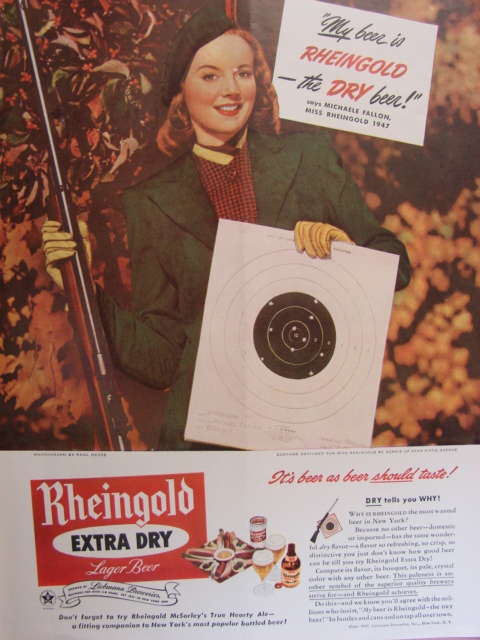
Friday’s ad is for Rheingold Beer, from 1947, featuring Miss Rheingold from that year, Michaelle Fallon. It appears she’s a pretty crack shot with a rifle.

Rheingold-1947-3

Filed Under: Art & Beer, Beers Tagged With: Advertising, History

Beer In Film #31: Brewery Cantillon

January 31, 2014 By Jay Brooks

brookston-film
Today’s beer video is in honor of today being the feast day of St. Veronus, who’s the patron saint of Lembeek and Belgian brewers. It’s a tour of Brewery Cantillon, shot in 2009 by the staff of The Beer In Me. It’s a short, almost ten-minute walk around the brewery museum in Brussels.

Filed Under: Breweries, Just For Fun Tagged With: Belgium, Travel, Video

Why Some Drunks Fight

January 31, 2014 By Jay Brooks

cockfight
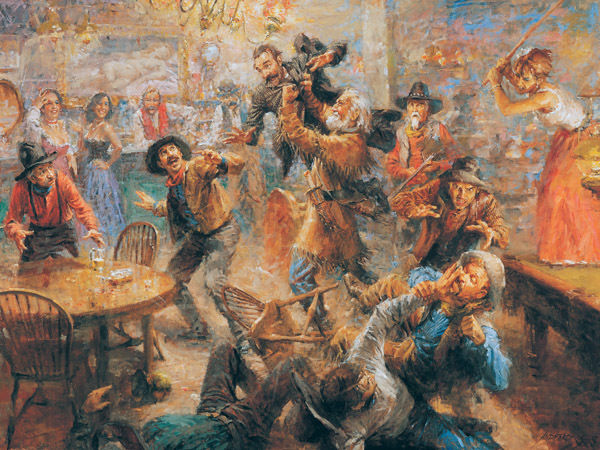
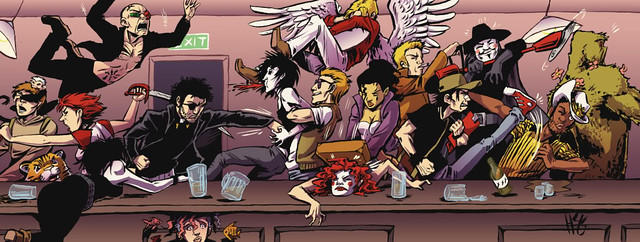
You’ve undoubtedly seen a belligerent drunk at some point in your life. Perhaps you’ve even been one. There are some people who seemingly turn angry when they drink. Some of them get into fights, maybe start one in a bar, the classic mythical bar fight where chairs start flying and everybody joins in because everyone who drinks is looking for a fight, right? Watch almost any western movie to see this in action. It’s so taken for granted, it’s a cliche. I’m sure bar fights occur, but honestly I’ve never seen a full on fight like you see in the movies. And I’ve been to more bars in my lifetime than the average person, I’d warrant. There are apparently people who become angry after a few too many drinks. And some of them probably do start a fight. There are certainly people like this, and I’ve always thought of them simply as “bad drunks.”

Thomas-after-the-poker-game

My stepfather was one. He turned mean on a bender, and he was violent and very, very scary, especially to a young sheltered suburban punk like me, ages 5 to 15 or so. But I quickly figured out all on my own that it wasn’t the alcohol that made him so belligerent. He was already that way, thanks to his own trials and tribulations growing up. Not to mention he was raised in a place/culture/family/time when/where not only weren’t men supposed to show their feelings, they weren’t supposed to actually have any. That’s not an excuse, just a fact. He walked around seething, all bottled up, and used alcohol to release his demons. It seemed to help him, of course, but it was devastating to anyone around him, especially me and my mother, who was too co-dependent to do anything about it. But the next morning, the relief he’d felt was all too brief, and the pressure would start building again to its next inevitable violent conclusion; a day, a week or even a month later.

You’d think after such unpleasant experiences that I might have sworn off alcohol entirely. But as I said, I knew it wasn’t the alcohol that made him that way. It was people and society who were convinced and believed that alcohol made him angry that allowed him to continue to be a nasty drunk, and not have to take any responsibility for his actions. It was just the alcohol, they’d say. Prohibitionists today continue this lie, and it’s one of things I so hate about them, by claiming it’s the alcohol that causes harm. But it’s not. And every time they spout that meme I wonder how many more kids are made to suffer by spouses and family and a community who listen to them, and do honestly believe that were it not for the drinking, Dad would be fine, a model citizen.

But look around you. Not everybody who drinks turns angry. In fact, most don’t. That’s how I know it’s not the alcohol. Because I can get rip-roaring drunk, and never become angry. Believe me I’ve tried, but it never happens. I get more talkative, if that’s possible, and more philosophical and sleepy. And most people I know react similarly, at least insofar as they don’t start a bar fight every time they take a drink. That’s also my biggest problem with AA and similar programs that preach that people are powerless, in effect not responsible. They often claim otherwise, but turning the superhero credo on its head; with great powerless comes a great ability to shirk responsibility for one’s actions. And so it’s the alcohol that ends up with the blame, not the person who abused it. Why society allows that is apparently complicated and is something I frankly don’t completely understand.

A German study published late last year in Deutsches Ärzteblatt International, entitled Alcohol-Related Aggression — Social and Neurobiological Factors sought to examine “Alcohol-related aggression and violence” and begins by noting that “nearly one in three violent acts in Germany was committed under the influence of alcohol (31.8%).” But that also means that over two-thirds of violent acts are committed by people who were not drinking or drunk. Maybe there are other factors we should be looking at as to why people are violent? And it also doesn’t answer the question of how many violent acts were prevented because someone had a drink after a tough day and that relaxed and calmed them.

Curiously, when reported on here in the U.S., the reference to this being a German statistic was removed, making it a much broader, universal statement. For example, the Robert Wood Johnson Foundation Center for Health Policy at the University of New Mexico, Science Daily and Medical News Today (MNT) all begin their coverage with the same sentence. “One-third of all acts of violence are perpetrated under the influence of alcohol.” So first of all, it was actually less than one-third and secondly, that statistic was confined to Germany. Not exactly an auspicious beginning for there to be two errors in the very first sentence. The MNT headline itself is misleading, stating that “Social and neurobiological factors linked to alcohol-related aggression,” while the study didn’t confirm a link so much as examine the “causes of alcohol-related aggression.” But by using that headline, it changes the tone of how you read the entire article.

Emily-Smith-vertigo-bar-fight

But that just seems like prohibitionist interests bending it to their purposes, because the study itself is interesting, and worth a read. The whole article is online, and there’s also a pdf you can download. It’s not so much a scientific study but a survey, or review, of all of the previous studies and literature about alcohol-induced aggression. In the abstract, they describe their process as follows.

In this review, based on a selective search for pertinent literature in PubMed, we analyze and summarize information from original articles, reviews, and book chapters about alcohol and aggression and discuss the neurobiological basis of aggressive behavior.

What they found was that “[o]nly a minority of persons who drink alcohol become aggressive,” which is what we all know. There appears to be evidence that “neurobiological factors” can account for the aggression, but that possibly more importantly, so can “personal expectations of the effects of alcohol, on prior experience of violent conflicts, and on the environmental conditions of early childhood, especially social exclusion and discrimination.”

They cite the World Health Organization and several other studies, and meta-studies, that indicate how many crimes, many of them violent, are committed by drunk people. But for many, if not most, of these, they specifically cite “acute alcohol intoxication” which is not the same thing as having a few beers, drinking responsibly in moderation. In addition, it’s also worse for people with “chronic alcohol consumption and alcohol dependence” issues. So again, this is a subset of all drinkers. But most American prohibitionist groups lump everybody who drinks together into one group, insisting all drinking is bad and leads to all sorts of trouble and mischief, taking a simplistic approach that treats all drinkers the same. But the Germans found things aren’t so simple.

Both clinical observations and scientific data have shown that the manifestation of alcohol-related aggression is by no means uniform. Rather, it is becoming clear that individual differences play a key role. In addition, more recent models are moving away from single-factor causes and towards multifactorial sets of conditions.

So what are the various factors that contribute to someone drinking and turning violent? They identify four.

  • Executive functions such as the control and inhibition of ongoing behavior
  • Information processing
  • Attentional control
  • Individual differences in expectation of the effect of alcohol consumption (e.g. “Alcohol makes me aggressive.”)

They also add to that list, Social learning, described as “experiences with friends or relatives who exhibit aggressive behavior under the influence of alcohol, [and] play a key role in the onset of alcohol-related aggression.”

But looking through the entire survey, what seems clear is that it’s the “expectations of effect” that has the most influence. And that brings us back to everyday experience. People believe that they can act differently under the influence of alcohol, and so they do. Society also expects that people will act differently under the influence of alcohol and so they don’t impose social penalties or ostracize that behavior. In many cases, it’s not just tolerated and excused but forgiven, and therefore enabled. By letting drunks essentially get away with bad behavior, it leads to a society that creates incentives for acting badly. That’s why I hate bad drunks so much. They ruin it for the rest of us. Bad drunks are what prohibitionists believe we all become when we have a beer, any amount of beer, despite the massive evidence to the contrary.

Other “individual factors” they identified “with an increased probability of alcohol-induced aggression” include:

  • Sex (men have a higher risk of reacting aggressively following acute alcohol consumption)
  • Personality traits such as sensation-seeking
  • High underlying irritability
  • Lack of empathy

They add. “Maladaptive reasons for drinking, such as drinking as a coping mechanism, and the assumption that aggression is an acceptable form of social interaction, also play a major role.”

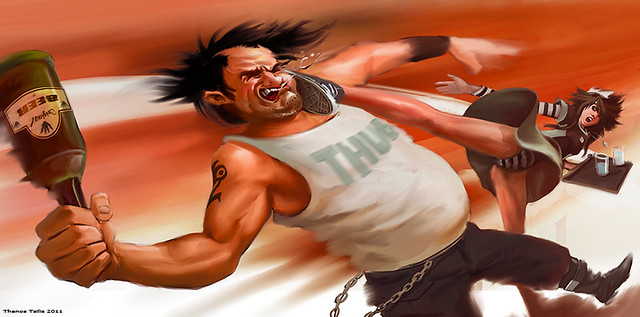
So essentially, they’re saying it’s personality-driven, which has been my experience, as well. If you have a propensity to act aggressively toward women, alcohol will give you the excuse to act that out. If you’re seeking sensational experiences, alcohol will give you the excuse to act that out. If you’re already irritable or angry, alcohol will give you the excuse to act more violently and aggressive. If you already lack empathy, alcohol will give you the excuse to care about other people even less than you normally do. And as long as that’s “an acceptable form of social interaction,” then people will continue to do so because they can use getting drunk as an excuse to be a douchebag.

bar_fight_by_thanostsilis

In the conclusion they sum this up. “Individuals who find it difficult to inhibit their behavior and delay gratification and who have problems enduring unpleasant feelings seem to become aggressive more frequently after consuming alcohol.” And this happens even more often to people who are “alcohol-dependent” but curiously is “not associated with alcohol dependence, including chronic alcohol dependence, per se.” I can’t help but think that’s because in such cases being drunk is used as the excuse to act badly, knowing that society — friends, family, etc. — will let them get away with it because they too have the expectation that the alcohol is causing them to behave badly, and that they shouldn’t, or can’t, be held responsible for their actions.

As this article makes clear, while there are genetic and neurobiological factors that in some people can lead to abusing alcohol, the majority of the problem stems from social conventions. Because the neurobiological causes can be identified, dealt with and treated. The social structures that allow people to use getting drunk as an excuse for bad behavior is a lot harder to change, because it’s so well-rooted in how our society functions. And it doesn’t help that addiction organizations and medical groups that treat this problem also enable this behavior by accepting it as dogma. And it doesn’t help that prohibitionist groups believe it, too, insisting that it’s the alcohol that’s causing the harm, not the individuals using, or abusing, it. By targeting the product that some people are abusing, instead of those people, they’re essentially allowing and even making the conditions more attractive to anyone using alcohol to continue using that as their excuse. After all, they must think, “I can’t be responsible for acting like an asshole, I was drunk. The booze made me do it, I couldn’t help myself.” And that, I think, is why some drunks fight. Because we as a society let them.

We don’t need tougher laws, or more police, or roadside checkpoints, or more prohibitionist propaganda. If everybody with a friend or family member who’s a bad drunk stopped letting them get away with it, this problem would be substantially reduced, whittled down to the people physically unable to control themselves. And we could then get those people the help they need. I say don’t tolerate bad drunks, let them know you don’t accept alcohol as an excuse for their bad behavior. They’ll either stop, or they’ll figure out they really do have a health problem that needs addressing. Social pressure and the threat of ostracization are usually a much more effective method of changing behaviors.

Drinking should be about the enjoyment of life, and responsible, moderate consumption should enhance what’s good in our lives already. Whether it’s improving a meal, conversation with friends at a pub, or celebrating a holiday or personal achievement, beer can heighten and complement those experiences, from the ordinary to the very special. That’s the goal of beer with flavor, that people drink less, but better. Who could fight with that?

Filed Under: Beers, Editorial, Politics & Law Tagged With: Germany, Prohibitionists, Propaganda, Science, Statistics

Beer In Ads #1087: The Day We Got Out Of The Soda Pop Business

January 30, 2014 By Jay Brooks


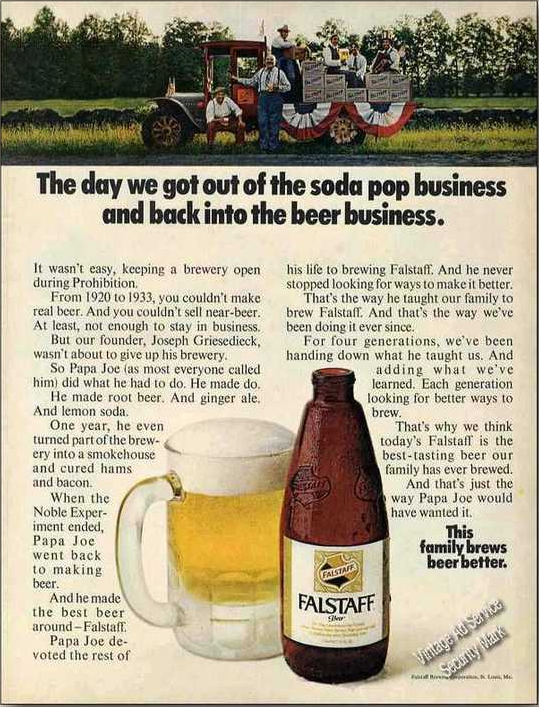
Thursday’s ad is for Falstaff, from 1969. The curious ad tells the charming down home old-timey story of how Falstaff’s “Papa Joe” kept the family business alive during Prohibition by making soda pop. The tale is called “The day we got out of the soda pop business and back into the beer business.”

Falstaff-1969

Filed Under: Art & Beer, Beers Tagged With: Advertising, History

« Previous Page
Next Page »

Find Something

Northern California Breweries

Please consider purchasing my latest book, California Breweries North, available from Amazon, or ask for it at your local bookstore.

Recent Comments

  • Bob Paolino on Beer Birthday: Grant Johnston
  • Gambrinus on Historic Beer Birthday: A.J. Houghton
  • Ernie Dewing on Historic Beer Birthday: Charles William Bergner 
  • Steve 'Pudgy' De Rose on Historic Beer Birthday: Jacob Schmidt
  • Jay Brooks on Beer Birthday: Bill Owens

Recent Posts

  • Beer In Ads #5225: Fabled Ambrosia Of The Ancients April 17, 2026
  • Historic Beer Birthday: William O. Poth April 17, 2026
  • Beer In Ads #5224: Harvard Bock Beer April 16, 2026
  • Historic Beer Birthday: William H. Biner April 16, 2026
  • Historic Beer Birthday: Alan Eames April 16, 2026

BBB Archives

Feedback

Head Quarter
This site is hosted and maintained by H25Q.dev. Any questions or comments for the webmaster can be directed here.