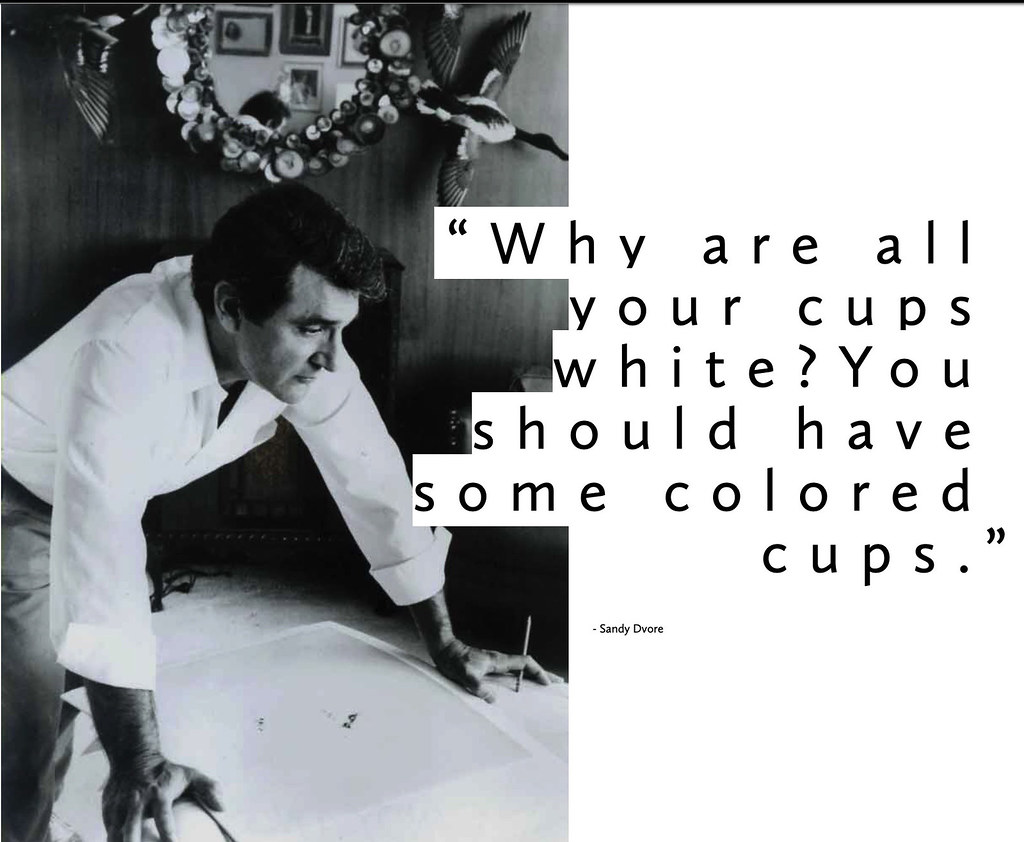
Today is the birthday of Sandy Dvore (August 28, 1934-November 20, 2020). He was a prolific American artist, graphic designer, and title designer. This short biography from his Wikipedia page gives the highlights:
Around 1962, he met Hollywood publicist Guy McElwaine playing baseball, who represented Natalie Wood, Warren Beatty, Judy Garland and Tony Bennett and needed ads created. Through this connection, Dvore became well known for designing back cover art for Sammy Davis Jr. in Variety. Dvore then illustrated an ad for Judy Garland for Judy at Carnegie Hall which caught the attention of American theatrical agent and film producer Freddie Fields. The pair worked together for 13 years on numerous projects. Dvore would go on to illustrate hundreds of ads for stars like Frank Sinatra, Liza Minnelli, Natalie Wood, David Bowie, Mick Jagger, and Steve McQueen. His minimal but vibrant illustrated trade ads held the coveted back pages of The Hollywood Reporter and Variety for years.
Sandy Dvore is best known for his work in designing television title sequences, such as the walking partridges in The Partridge Family, and the brush-stroke logo and paintings from the long-running soap opera The Young and the Restless. His film title credits include the 1976 film Lipstick and the 1972 Blaxploitation thriller Blacula. He also designed the opening credits for selected seasons of the nighttime soap opera Knots Landing.
Dvore’s work in graphic design won him an Emmy Award in 1987 for Carol, Carl, Whoopi and Robin.
But as memorable as that work is, that’s not why I’m sharing his birthday here, as you might expect. He also worked on a more beer-related project. Robert Leo Hulseman, whose father founded the Solo Cup Company. In the 1970s, Hulseman hired Dvore to design a new plastic cup for the company. Here’s the story, from the now-defunct design blog Design-Ago:
One rainy day in early 1970’s Los Angeles…
Leo Hulesman, founder of the Solo cup company, stopped by the studio of Hollywood designer Sandy Dvore.
“I heard you’re the best commercial artist around.” Said Hulesman.
This was true. Dvore was the hottest designer in Hollywood. His work appeared everywhere from billboards to trade ads and most famously, every week in the Hollywood Reporter and Variety publications. At the time, these were the most important pieces of the Hollywood community. EVERYONE looked to these weekly magazines to see what their peers were doing.
Hulesman was looking for a design for his new venture, children’s records that would be a promotional giveaway on the Solo cup box. You see, Dora Hall, a singer who was also Mrs. Hulesman, had given up her career in Ziegfield Follies to raise their children. This was a chance for her to get back to performing again and do something her children could enjoy.
“I’m doing very well now” said Dvore. “I’ve got some major projects and I really don’t want to do small piece work. It would take up a lot of time.”
“What if I give you a retainer?” Said Hulesman.
“He was sharp”, Dvore thought.
At the time Dvore was doing big name television projects, The Partidge Family and The Waltons.
“I could send you a chunk of money…” “What kind of number are we talking?” Asked Hulseman.
“$17,500” stated Dvore.
“Why don’t we just make it a flat $25,000.” Replied Hulesman.
They shook hands and Hulesman smiled. He enjoyed the banter as he, like Dvore, was a self made man from Chicago.
“He liked that I could handle myself.” Dvore remembered. “We became friends and I enjoyed knowing him.”
Hulesman enjoyed sharing the success he had. He would pay for entire television specials for his wife Dora so she could have an opportunity perform.
When it’s time to change.
“The Solo company at the time had an old serif logo right out of a type book.” Dvore remembers.
Dvore looked at the two O’s in the SOLO logo and the idea came to him, simple as that. He hadn’t been asked to create a new logo either. He just thought,
“as a artist, we can do better.”
Hulesman had his feet propped up on Dvore’s desk when he showed him what he had come up with.
“We should change your logo, this should be the logo for your company.” Dvore slid the concept to Hulesman.
The negative space in the SOLO, O’s replaced with cups, along with a new san-serif type.
Hulesman looked at it and replied, “send it to the company.”
And, one short phone call later, it became the logo you still see everywhere today.
Sometimes, but not often, it IS that easy.
A relationship of trust formed between Dvore and Hulesman. Which is why Dvore felt comfortable proposing new ideas.
“Why are all your cups white? You should have some colored cups.”
With this idea Dvore took the colors from his recent Partridge Family art and applied the same blue, yellow and red to the cups.
And in another short phone call to the factory, the Solo cup company started producing color cups.
“I even used the same color numbers from the Partridge Family logo.” Recalls Dvore.
And so, once again, a simple yet smart idea, a phone call, and the rest is history, the red Solo cup was born.
Whoever would have thought a cup would be so famous?
It has inspired songs, drinking games, tattoo’s, merchandise and created plenty of hazy memories.
Why red became the go-to, and a cultural icon is anyone’s guess.
“It’s become the most well known and most seen thing I have ever done.” Dvore states today.
Every day, millions of people get their morning cup of coffee and before they take a sip there it is, the Solo cup logo.
Every night, people attend a party or have a game of beer pong and there it is again, the red Solo cup.
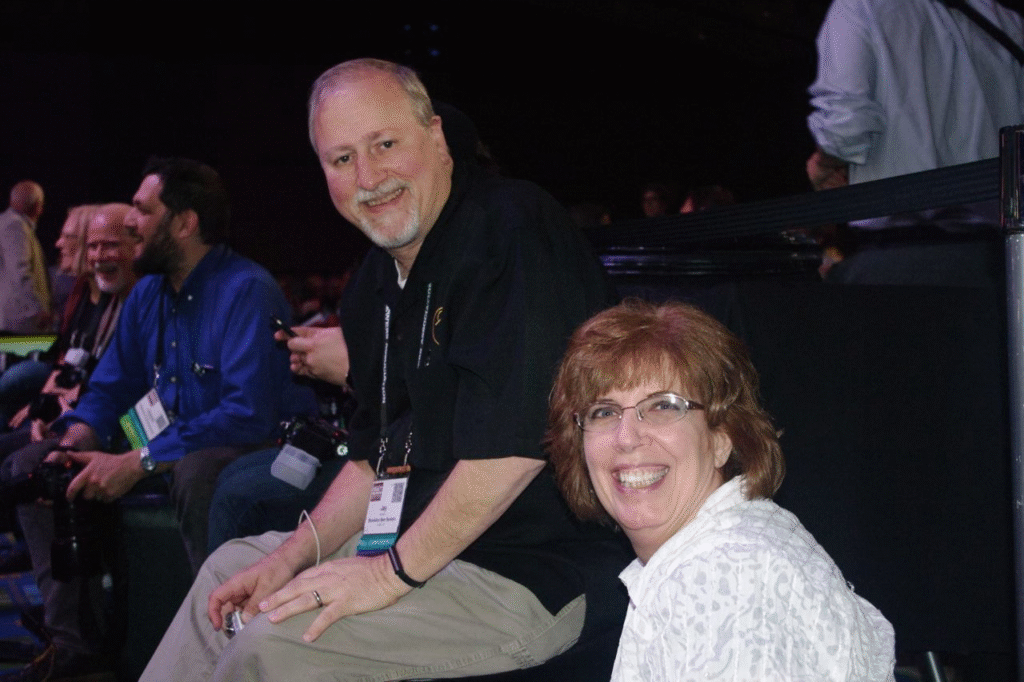
Today is Carolyn Smagalski’s birthday. Carolyn’s a beer writer from Pennsylvania — not sure what it is about Pennsylvania and beer writing — who writes for BellaOnline. Her nickname is the Beer Fox and she does a terrific job spreading the gospel of great beer. Join me in wishing Carolyn a very happy birthday.
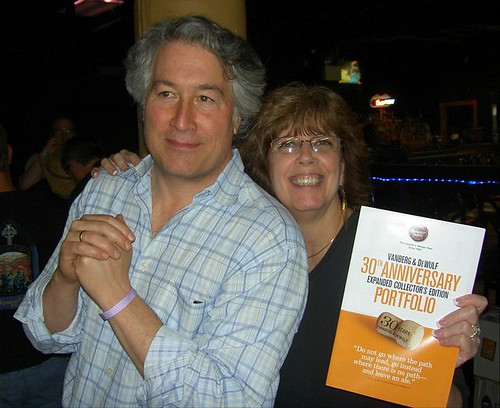
Carolyn with Michael Jackson at GABF in 2006.
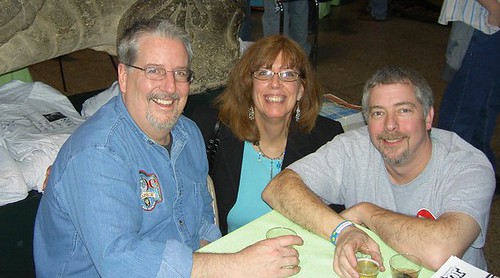
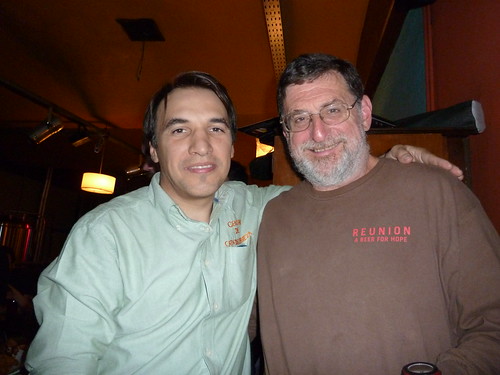
Don Russell, Carolyn and Curt Decker, from Nodding Head.
Don Feinberg with Carolyn.
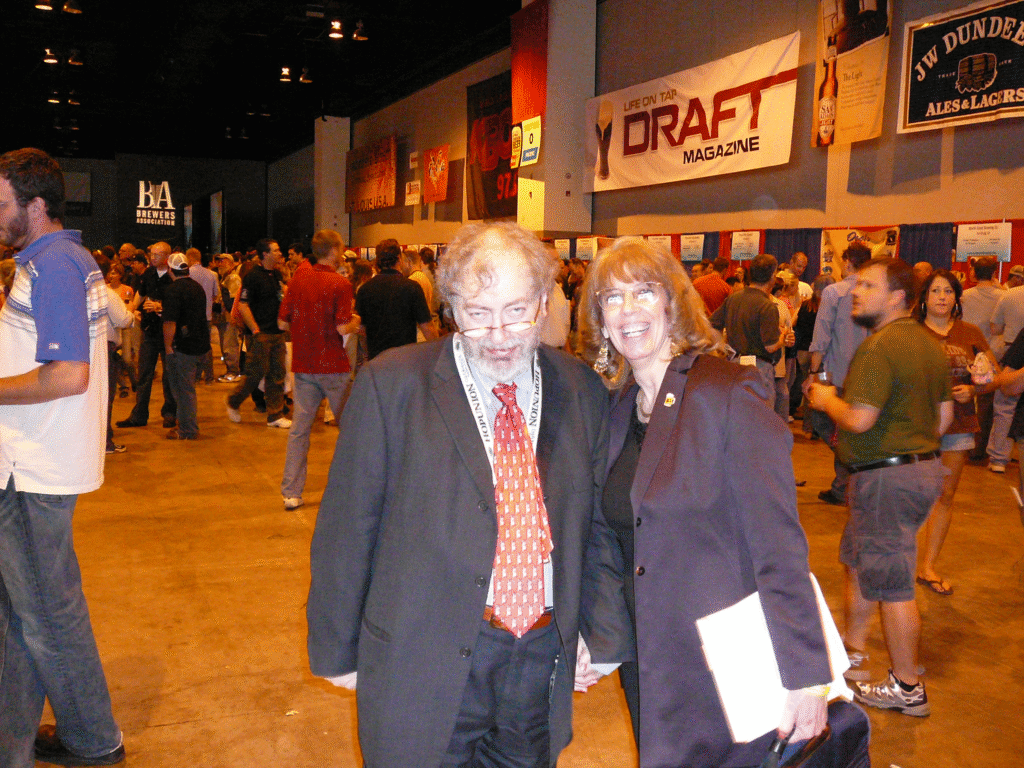
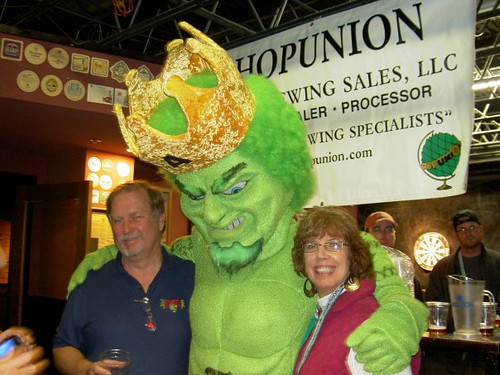
Ralph Olson, from HopUnion, the Alpha King and Carolyn.
NOTE: Previous three photos purloined from Facebook.
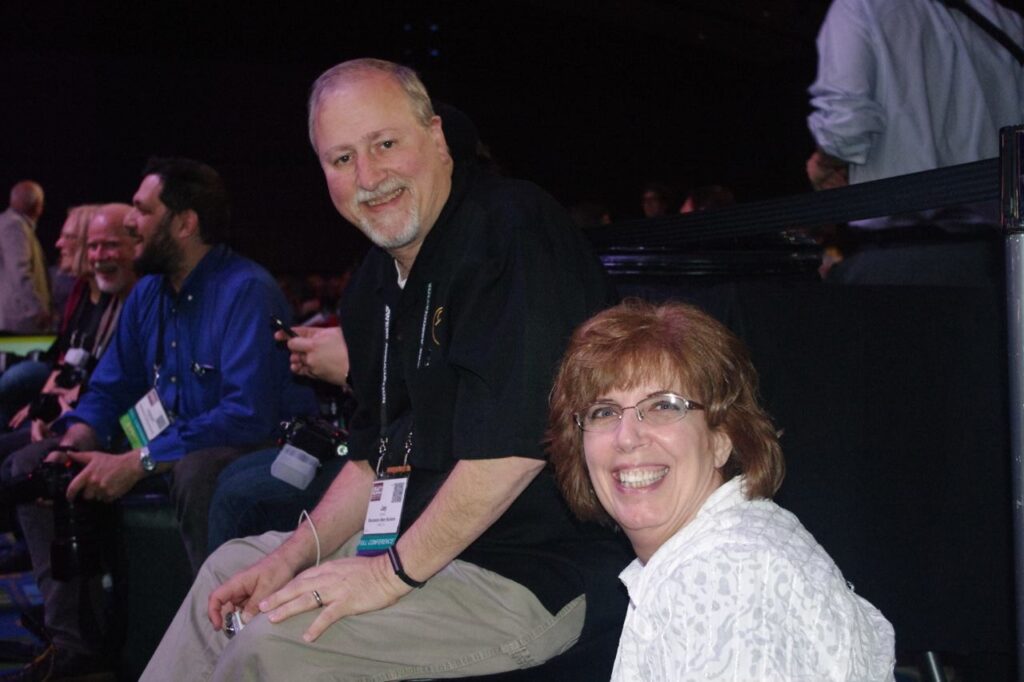
Me and Carolyn at GABF in 2006. [photo by Bryan Kolesar]
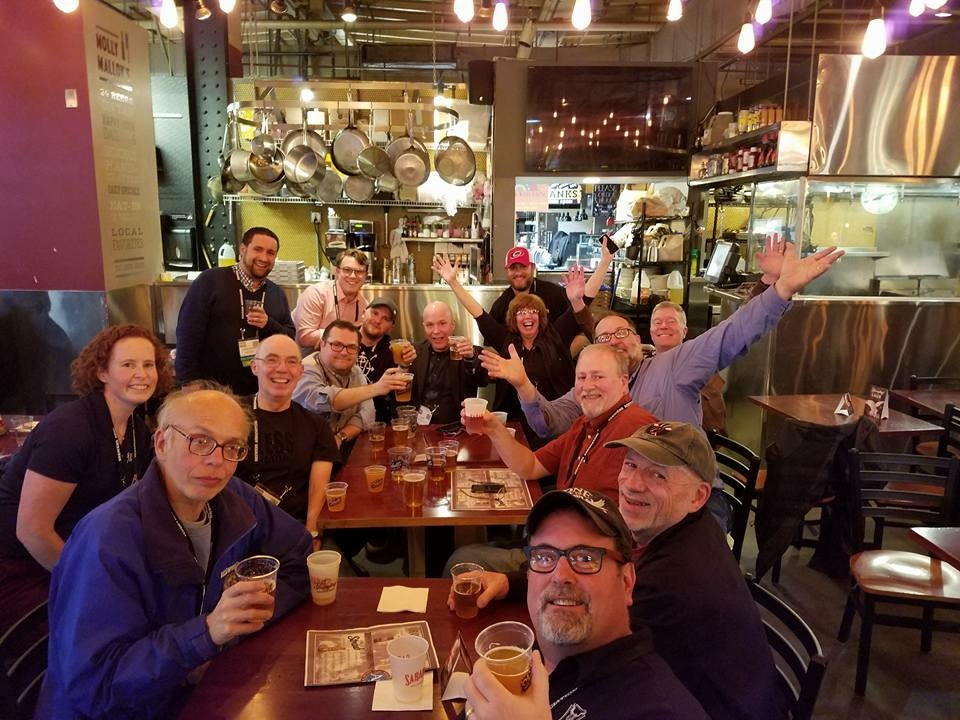
A big group of brewers and beer writers in Philadelphia during CBC.
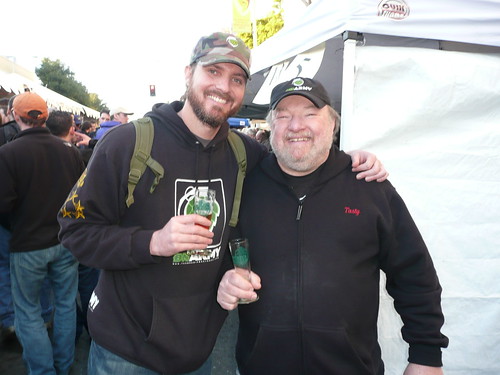
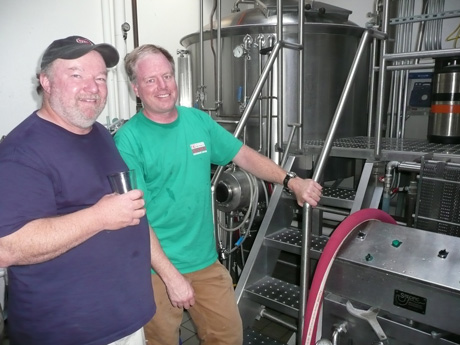
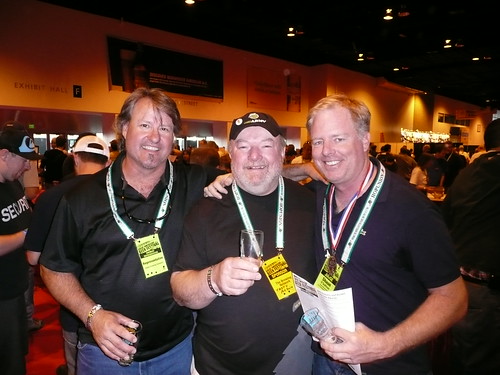
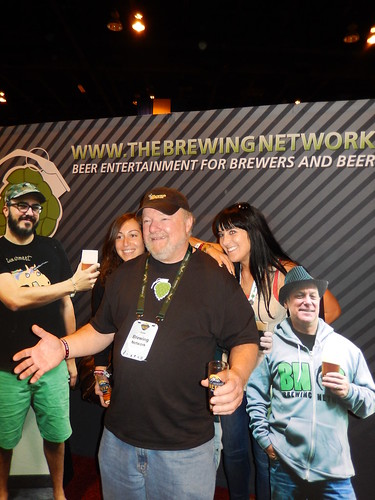
Today would have been the birthday of Mike “Tasty” McDole, homebrewer extraordinaire, and one time co-host of “The Jamil Show,” or “Can You Brew It?” and also was a regular on the “Sunday Show” on The Brewing Network. Tasty would never refer to himself that way, and on Twitter he claimed to be simply a “homebrewer and a craft beer enthusiast.” But most of us who knew him would, as he also admits, “make [him] out to be much more.” And that is correct, I believe, as Tasty was one of the best. He’s a former Longshot winner, has given talks at the National Homebrew Convention and has won countless awards and had collaborated with numerous commercial breweries on beers. Unfortunately, he passed away a couple of years ago after battling cancer. Join me in raising a toast to Tasty’s memory.
With Justin Crossley at the Bistro Double IPA Festival in 2010.
With Shaun O’Sullivan at 21st Amendment in 2009.
Vic Krajl, from The Bistro, Mike & Shaun O’Sullivan, from 21st Amendment at GABF in 2009.
Tasty at GABF in Denver in 2014.
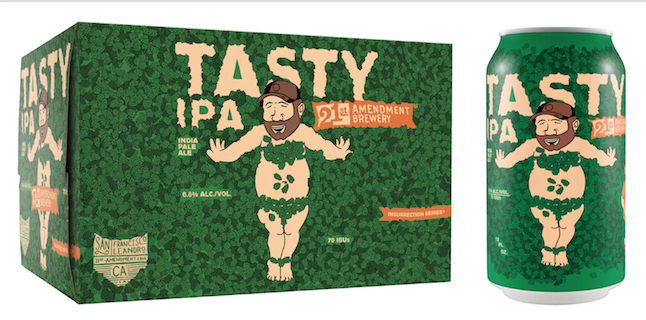
And a couple of years ago, 21st Amendment Brewery released Tasty IPA in collaboration with Mike.
Last year I decided to concentrate on Bock ads. Bock, of course, may have originated in Germany, in the town of Einbeck. Because many 19th century American breweries were founded by German immigrants, they offered a bock at certain times of the year, be it Spring, Easter, Lent, Christmas, or what have you. In a sense they were some of the first seasonal beers. “The style was later adopted in Bavaria by Munich brewers in the 17th century. Due to their Bavarian accent, citizens of Munich pronounced ‘Einbeck’ as ‘ein Bock’ (a billy goat), and thus the beer became known as ‘Bock.’ A goat often appears on bottle labels.” And presumably because they were special releases, many breweries went all out promoting them with beautiful artwork on posters and other advertising.
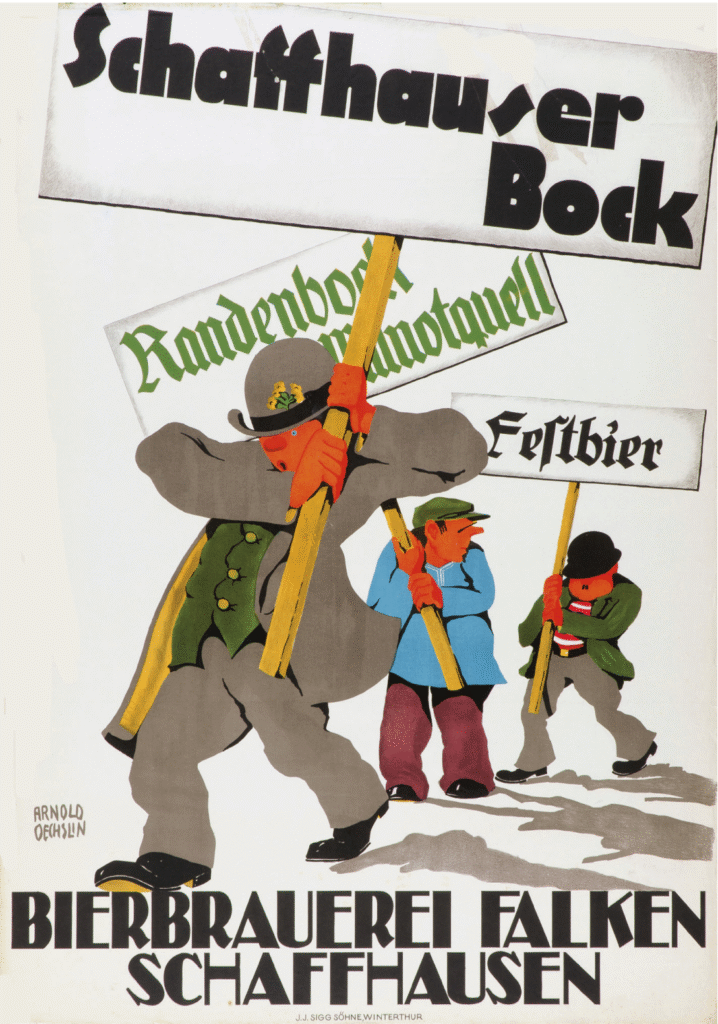
Wednesday’s poster is for Falken Schaffhauser’s Bock, and was published in 1934. This one was made for the Bierbrauerei Falken Schaffhausen, or Falcon Brewery, of Schaffhausen, Switzerland. The brewery was founded in 1799, and is still in business today, and is “considered the only independent brewery in the Schaffhausen region,” and is Switzerland’s 5th largest brewery. This one is for their Schaffhauser Bock and shows a group of protestors carrying signs, though in the end they’re just beer signs. It was created by Swiss artist Arnold Oechslin.
Today is Fred Bowman’s 80th birthday. Fred co-founded the Portland Brewing Co., which was bought several years ago by Pyramid Breweries, which in turn was bought by Magic Hat and then again by North American Breweries. Fred continues to be very active in the craft beer community, and has been supportive of the movement since the beginning. A couple of years ago, he dropped by and stayed with us during his drive ’round the country in a van, visiting old friends and family. Join me in wishing Fred a happy birthday.
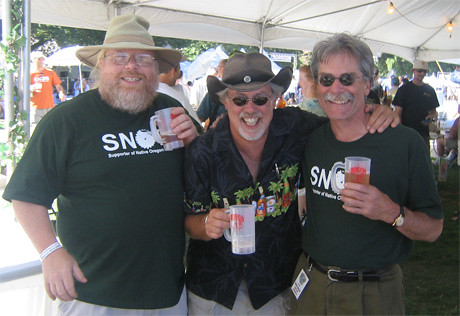
By the Celebrator booth at OBF, from left, John Harris (former head brewer at Full Sail Brewing), Tom Dalldorf, and Fred.
Dick Cantwell, co-owner of Elysian Brewing Co. in Seattle, with Fred at an after party at the Falling Rock during GABF.
With Lisa Morrison a couple of years ago in Portland for FredFest.
Frank Commanday, Art Larrance, Fred, and Bert Grant after brewing Portland Brewing’s 1st batch in January 1986.
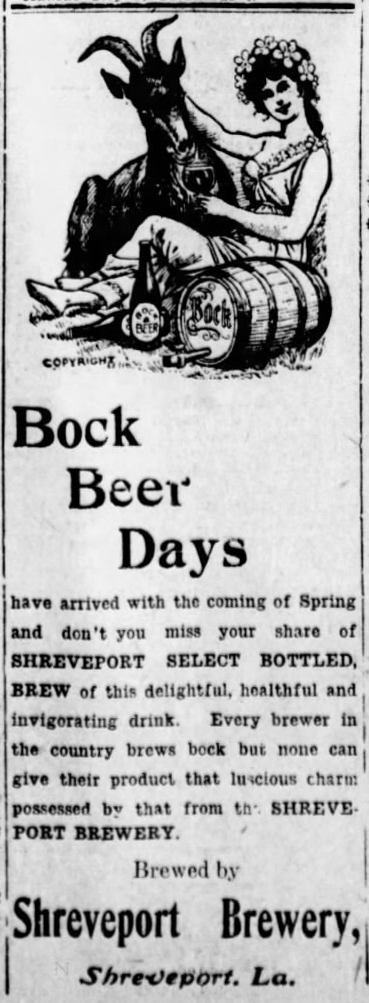
Last year I decided to concentrate on Bock ads. Bock, of course, may have originated in Germany, in the town of Einbeck. Because many 19th century American breweries were founded by German immigrants, they offered a bock at certain times of the year, be it Spring, Easter, Lent, Christmas, or what have you. In a sense they were some of the first seasonal beers. “The style was later adopted in Bavaria by Munich brewers in the 17th century. Due to their Bavarian accent, citizens of Munich pronounced ‘Einbeck’ as ‘ein Bock’ (a billy goat), and thus the beer became known as ‘Bock.’ A goat often appears on bottle labels.” And presumably because they were special releases, many breweries went all out promoting them with beautiful artwork on posters and other advertising.
Tuesday’s ad is for Shreveport Bock Beer, which was published on August 26, 1904. This one was for, I think, the Shreveport Brewery of Shreveport, Louisiana, which was originally founded in 1902, but only appears to have been in business until 1906. This ad ran in The Shreveport Times, also of Shreveport, Louisiana.
Today is Pete Reid’s 62nd birthday. Pete was the publisher of Modern Brewery Age. I first met Pete a number of years ago at a Craft Brewers Conference but finally got to know him much better during a trip to Bavaria a few years back, where the two of us took a side trip to Salzburg to visit the original Austrian Trumer Brauerei. I think he may be retired or at least shut down MBA, as the domain name is no longer active, plus I haven’t seen him at beer events lately, either. Still, join me in wishing Pete a very happy birthday.
At the Zotler Brauerei in Germany.
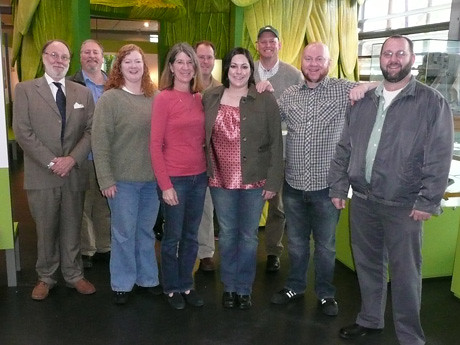
At the Bavarian Hop Museum, that’s Pete in the back row in the baseball cap.
Pete, me and Chris Rice, then from All About Beer magazine, during a trip to Belgium a few years ago.
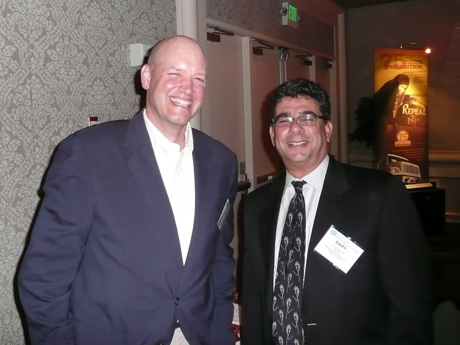
Peter Reid, with Gary Ettelman, of Ettelman & Hochheiser at the NBWA convention in 2008.
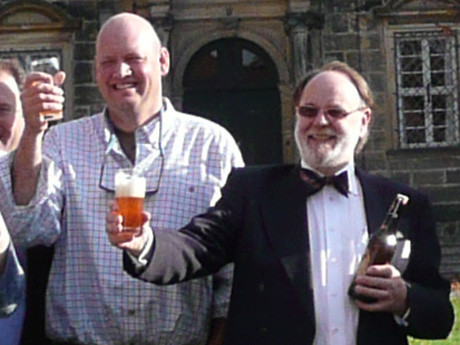
Toasting with Horst Dornbusch at the Bamberg Brewing Museum.
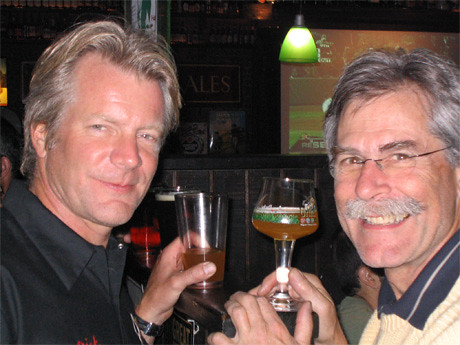
Today is my good friend Pete Slosberg’s 75th birthday . Pete is, of course, best known for Pete’s Wicked Ales. After that he toyed with the idea of making barbecue but decided instead to make some incredible chocolates and had a small company, Cocoa Pete’s. A few years ago, I traveled to South America with Pete (where we took to calling him “El Pete“), where we both spoke and judged beer at a beer conference/competition in Argentina, the South Beer Cup, and then flew to Brazil to attend a pair of beer dinners Stephen Beaumont was hosting and for a while he was working on Mavericks, a newish line of canned session beers, along with Half Moon Bay Brewing, but is now doing some occasional consulting and doing a lot of traveling with his wife Amy looking for the next adventure … or sour beer. Join me wishing Pete a very happy birthday!
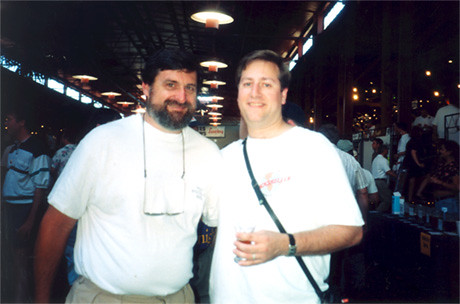
This was taken the first time I met Pete, over twenty-five years ago at the KQED Beer and Food Festival in San Francisco, when I was more or less still a civilian. It was after I’d written my first book on beer, but before I started working as the beer buyer for BevMo.
Pete with his wife Amy and Shaun O’Sullivan, from 21st Amendment, at one of Sean Paxton’s beer dinners during SF Beer Week several years ago.
Working the bottling line at Russian River Brewing, with a bottle of Consecration.
Matt Bonney, from Brouwer’s, Stephen Beaumont, Sean Paxton, Pete and Rick Sellers, then from Odonata at the Bistro Double IPA Festival.
Pete with his wife Amy and Celebrator publisher Tom Dalldorf at one of Bruce Paton’s beer dinners at the Cathedral Hill Hotel in February 2006.
Martin Boan, who organized and ran the South Beer Cup, with Pete in Buenos Aires.
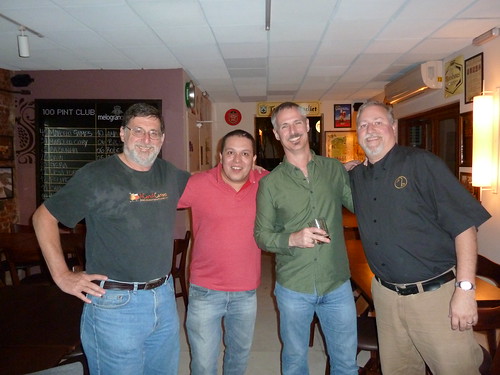
Pete, with Edu Passarelli (owner of Melograno), Stephen Beaumont and me after a beer dinner at Edu’s place in Sao Paulo.
Last year I decided to concentrate on Bock ads. Bock, of course, may have originated in Germany, in the town of Einbeck. Because many 19th century American breweries were founded by German immigrants, they offered a bock at certain times of the year, be it Spring, Easter, Lent, Christmas, or what have you. In a sense they were some of the first seasonal beers. “The style was later adopted in Bavaria by Munich brewers in the 17th century. Due to their Bavarian accent, citizens of Munich pronounced ‘Einbeck’ as ‘ein Bock’ (a billy goat), and thus the beer became known as ‘Bock.’ A goat often appears on bottle labels.” And presumably because they were special releases, many breweries went all out promoting them with beautiful artwork on posters and other advertising.
Monday’s ad is for Atlas Bock Beer, which was published on August 25, 1933. This one was for, I think, the Atlas Brewing Co. (or Atlas Beverage Co.) of Chicago, Illinois, which was originally founded in 1891 as the Bohemian Brewing Co. of Chicago, but was renamed Atlas in 1896. This ad ran in The Daily Argus Leader, of Sioux Falls, North Dakota. I love that the name of the restaurant was “The Eat Shoppe.”
Today is the birthday of Hans Adolf Krebs (August 25, 1900-November 22, 1981). He was a German-born British physician and biochemist. He was the pioneer scientist in study of cellular respiration, a biochemical pathway in cells for production of energy. He is best known for his discoveries of two important chemical reactions in the body, namely the urea cycle and the citric acid cycle. The latter, the key sequence of metabolic reactions that produces energy in cells, often eponymously known as the “Krebs cycle,” earned him a Nobel Prize in Physiology or Medicine in 1953. And it’s the Krebs cycle that is his relation to brewing, as it’s also known as the respiratory phase, the second aerobic state of the fermentation process immediately following the lag period.
Here’s a description of the Krebs cycle from Life Fermented:
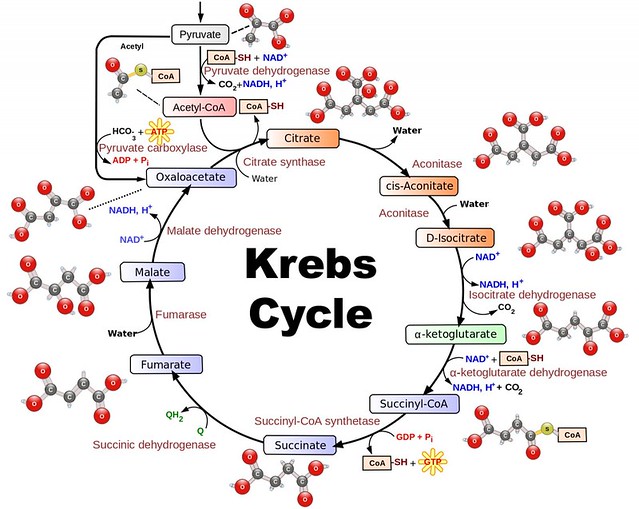
The Krebs cycle, also known as the tricarboxylic acid (TCA) cycle or the citric acid cycle, is a circular and repeating set of reactions which requires oxygen. In beer making, this would occur in the first stage of fermentation when the yeast is pitched into a well aerated wort, and carries on until all oxygen is used up.
Pyruvate (are you tired of this word yet?) is first converted to acetyl-CoA (pronounced “Co-A”) in the following reaction:
pyruvate + 2 NAD+ + CoA-SH → acetyl-CoA + CO2 + NADH, with the help of the pyruvate dehydrogenase (PDH) complex. Note that this is the first time CO2 is produced, and yet more NADH is generated.
This acetyl-CoA then enters into a cycle of reactions which nets two molecules of CO2, one GTP (guanosine triphosphate, another unit of energy equivalent to ATP), three NADH, and one FADH2 (flavin adenine dinucleotide, which functions similarly to NADH). After the cycle completes, another acetyl-CoA molecule enters and the cycle repeats itself.
But wait, this just made more NADH, and we need to regenerate NAD+ so glycolysis can continue. Both the NADH and FADH2 now donate their electrons to a process called the electron transport chain/ oxidative phosphorylation. The result is a return of NAD to the NAD+ state, and a large amount of ATP cellular energy.
Because the Krebs cycle is so efficient at producing ATP energy units, this is the yeast’s preferred pathway. But, you’ll notice a rather conspicuous absence: ethanol. This is only formed in the absence of oxygen.
Here’s a biography of Krebs, from the Nobel Prize website:
Sir Hans Adolf Krebs was born at Hildesheim, Germany, on August 25th, 1900. He is the son of Georg Krebs, M.D., an ear, nose, and throat surgeon of that city, and his wife Alma, née Davidson.
Krebs was educated at the Gymnasium Andreanum at Hildesheim and between the years 1918 and 1923 he studied medicine at the Universities of Göttingen, Freiburg-im-Breisgau, and Berlin. After one year at the Third Medical Clinic of the University of Berlin he took, in 1925, his M.D. degree at the University of Hamburg and then spent one year studying chemistry at Berlin. In 1926 he was appointed Assistant to Professor Otto Warburg at the Kaiser Wilhelm Institute for Biology at Berlin-Dahlem, where he remained until 1930.
In I930, he returned to hospital work, first at the Municipal Hospital at Altona under Professor L. Lichtwitz and later at the Medical Clinic of the University of Freiburg-im-Breisgau under Professor S. J. Thannhauser.
In June 1933, the National Socialist Government terminated his appointment and he went, at the invitation of Sir Frederick Gowland Hopkins, to the School of Biochemistry, Cambridge, where he held a Rockefeller Studentship until 1934, when he was appointed Demonstrator of Biochemistry in the University of Cambridge.
In 1935, he was appointed Lecturer in Pharmacology at the University of Sheffield, and in 1938 Lecturer-in-Charge of the Department of Biochemistry then newly founded there.
In 1945 this appointment was raised to that of Professor, and of Director of a Medical Research Council’s research unit established in his Department. In 1954 he was appointed Whitley Professor of Biochemistry in the University of Oxford and the Medical Research Council’s Unit for Research in Cell Metabolism was transferred to Oxford.
Professor Krebs’ researches have been mainly concerned with various aspects of intermediary metabolism. Among the subjects he has studied are the synthesis of urea in the mammalian liver, the synthesis of uric acid and purine bases in birds, the intermediary stages of the oxidation of foodstuffs, the mechanism of the active transport of electrolytes and the relations between cell respiration and the generation of adenosine polyphosphates.
Among his many publications is the remarkable survey of energy transformations in living matter, published in 1957, in collaboration with H. L. Kornberg, which discusses the complex chemical processes which provide living organisms with high-energy phosphate by way of what is known as the Krebs or citric acid cycle.
Krebs was elected a Fellow of the Royal Society of London in 1947. In 1954 the Royal Medal of the Royal Society, and in 1958 the Gold Medal of the Netherlands Society for Physics, Medical Science and Surgery were conferred upon him. He was knighted in 1958. He holds honorary degrees of the Universities of Chicago, Freiburg-im-Breisgau, Paris, Glasgow, London, Sheffield, Leicester, Berlin (Humboldt University), and Jerusalem.
He married Margaret Cicely Fieldhouse, of Wickersley, Yorkshire, in 1938. They have two sons, Paul and John, and one daughter, Helen.
And in the Microbe Wiki, on a page entitled “Saccharomyces cerevisiae use and function in alcohol production,” under a section called “Fermentation of alchohol,” the Krebs cycle is placed in its portion in the fermentation process:
Saccharomyces cerevisiae is able to perform both aerobic and anaerobic respiration. The process begins with the yeast breaking down the different forms of sugar in the wort. The types of sugars typically found in wort are the monosaccharides glucose and fructose. These sugars contain a single hexose, which is composed of 6 carbon atoms in the molecular formula C6H12O6. Disaccharides are formed when two monosaccharides join together. Typical disaccharides in the wort are galactose, sucrose, and maltose. The third type of fermentable sugar in the wort is a trisaccharide. This trisaccharide is formed when three monosccharides join together. Maltotriose is the trisaccharide commonly found in the wort and is composed of three glucose molecules. The wort does contain other sugars such as dextrins but it is not fermentable by yeast10. These dextrins contain four monosaccarides joined together. In order for the yeast to use the disaccharides and trisaccharides they first must be broken down to monosaccharides. The yeast does this by using different enzymes both inside and outside the cell. The enzyme invertase is used to break down sucrose into glucose and fructose. The invertase catalyzes the hydrolysis of the sucrose by breaking the O-C (fructose bond). The other enzyme used is maltase, which breaks down maltose and maltotriose into glucose inside the cell. The enzyme does this by catalyzing the hydrolysis of the sugars by breaking the glycosidic bond holding the glucose molecules together.
Once the sugars are broken down into monosaccharides the yeast can use them. The primary step is called glycolysis. In this process the glucose is converted to pyruvate using different enzymes in a series of chemical modifications. The electrons from glucose end up being transferred to energy carrying molecules like NAD+ to form NADH. ATP is also formed when phosphates are transferred from high-energy intermediates of glycolysis to ADP. In the presence of oxygen aerobic respiration can occur. This occurs in the mitochondria of the yeast. The energy of the pyruvate is extracted when it goes through metabolic processes like the Krebs cycle. The products of this type of metabolism are ATP, H2O, and CO2. However if there is no oxygen present and an abundance of sugars, as in the wort, the yeast undergo alcoholic fermentation. This type of metabolism yields much smaller amounts of energy when compared to aerobic respiration. However, because of the large supply of sugars from the different grains the wort is a very good environment for fermentative growth. The alcoholic fermentation begins with the two pyruvate acquired from glycolysis. These two pyruvate are decarboxylated by pyruvate decarboxylase to form two acetaldehydes and CO2. The CO2 is the gas that is observed during fermentation as bubbles that float to the top of the wort creating the kräusen or beer head, the foam that is very characteristic of a freshly poured beer. Pyruvate decarboxylase is a homotetramer meaning it contains four identical subunits. This also means that is has four active sites. The active sites are where the pyruvate reacts with the cofactors thiamine pyrophosphate (TPP) and magnesium to remove the carbon dioxide9. The final step to form alcohol is the addition of a hydrogen ion to the aldehyde to form ethanol. This hydrogen ion is from the NADH made during glycolysis and converts back to NAD+. The ethanol is originally believed to serve as an antibiotic against other microbes. This form of defense ensures that bacteria do not grow in the wort, thus ruining the beer with off flavors. However recently with the boom of craft beer different bacteria have been purposefully added to create what is known as sour beer. The sour taste comes from the waste products of the bacteria.
To learn more about the Krebs cycle check out this video from the University of Oklahoma’s Chemistry of Beer – Unit 7 – Chemical Concepts: Krebs Cycle: