
I ran into Dan Gordon, from Gordon Biersch, at CBC yesterday and he told me about a new beer they’ve created, Hoppotamus Maximus, a hoppy and oh-so-rare beer that few people — unfortunately — will ever get a chance to sample. He’s teamed with Justin Crossly of The Brewing Network to tell the story of how he created the beer. It’s a pretty funny spoof of the hype surrounding hard-to-find beers, and the humor is as dry as I expect the beer would be.
Fritz Maytag & Ken Grossman Give Keynote At CBC 2011


Earlier today the 2011 Craft Brewers Conference began with the morning program, which ended with a keynote address by Fritz Maytag and Ken Grossman. It was more of a casual talk or reminiscence, with Maytag and Grossman talking about their early days, with both the challenges and joys of those times when their were trying to get their respective breweries off the ground. They sat opposite one another on comfy chairs and talked for just over 30 minutes finishing with a toast using the collaboration imperial stout they did together last year, Fritz & Ken’s Ale.
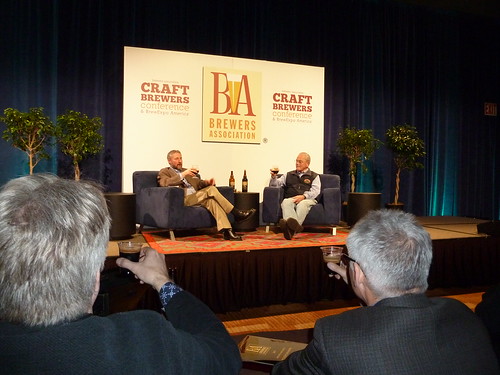
It was a highly entertaining talk and even quite funny in places. I’d forgotten my Flip camera, but I did manage to record the audio of the talk. The keynote is introduced by Tom McCormick, executive director of the California Small Brewers Association, and then it’s Ken and Fritz for thirty plus minutes. Enjoy.
Archie Comics Tapped To Teach Kids About Underage Drinking

The neo-prohibitionist organization MADD today sent out a press release announcing that they’ve partnered with Archie Comics “to raise awareness about underage drinking.” The new issue of Double Digest #217 hits the comic book stores tomorrow, and features an 8-page story entitled The Madd Cowboy of Riverdale High. Below are a few sample pages.
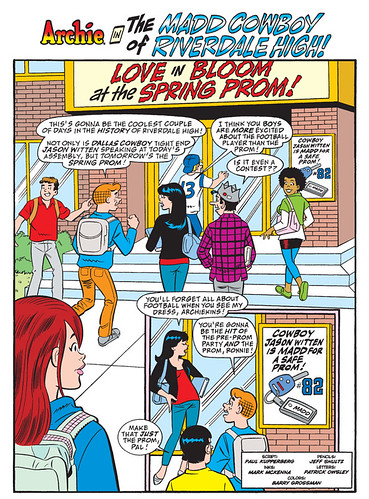
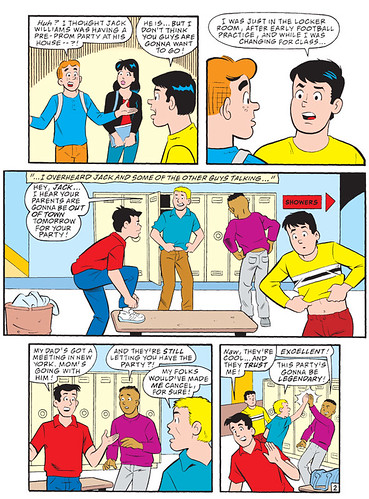
The “Cowboy” part of the title is for Dallas Cowboy tight end Jason Witten, who appears as himself to speak to Archie and his classmates in an assembly. He’s specifically promoting MADD and their Power 21, which will take place April 21 and is touted as a “national event that seeks to have parents talking to their children about underage drinking.”
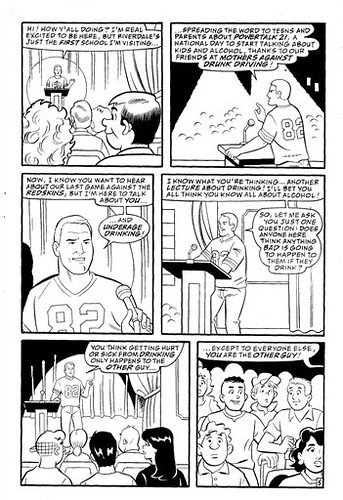
Believe it or not, I’m not entirely against this latest effort by MADD, although I don’t believe the goal should be to completely eliminate underage drinking — an impossibility, in my experience — but should instead focus on figuring out an effective way to allow parents to educate their kids about drinking alcohol as they grow from teens to young adults. In my opinion, that would go a long way toward encouraging responsible behavior and reducing drunk driving and binge drinking. Though to be honest, by the time that message might have been relevant to me as a child, I was done reading Archie Comics. I’m not sure what their main demographic is, but my guess would be pre-teens, around 8-11 or 12.
Craft Beer Grows 11% In Volume

The Brewers Association just announced the statistics of craft beer sales in 2010, and the news is great. Craft beer saw volume growth of 11% over 2009, and in terms of dollars the increase was 12%, equating to roughly an additional one million barrels, or 14 million cases.
From the press release:
“Beer lovers increased their appreciation for American craft brewers and their beers in 2010,” said Paul Gatza, director, Brewers Association. “Craft brewers’ stories resonate with Americans who are choosing small, independent companies making delicious beers in more than 100 different styles.”
The Association also reported a growth in the number of U.S. breweries, with eight percent more breweries than the previous year. In 2010, there were 1,759 operating breweries. Craft brewers produced 9,951,956 barrels, up from an adjusted3 8,934,446 barrels in 2009.
“Prohibition caused a dramatic decline in the number of breweries in the United States, but the number of breweries is now at an all-time high,” added Gatza. “With well over 100 new brewery openings in 2010, plus 618 breweries in planning stages, all signs point to continued growth for the industry.”
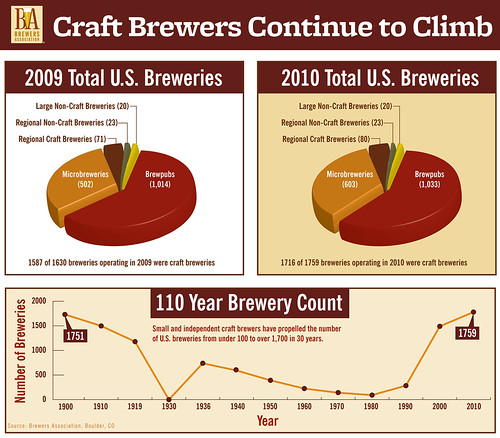
In 2010, craft brewers represented 4.9 percent of volume and 7.6 percent of retail dollars of the total U.S. beer category. The Brewers Association estimates the actual dollar sales figure from craft brewers in 2010 was $7.6 billion, up from $7 billion in 2009.
Overall, the U.S. beer industry represented an estimated retail dollar value of $101 billion. U.S. beer sales were down approximately one percent, or 2 million barrels, in 2010 compared to being down 2.2 percent in 2009. Total beer industry barrels dropped to 203.6 million, down from 205.7 million barrels in 2009. Imports were up five percent in 2010, compared to being down 9.8 percent in 2009. (Note: the Brewers Association does not count flavored malt beverages as beer.)
Gatza added, “We also found that three percent of craft brewer barrels, by volume, are distributed in cans, confirming a growing trend.”
It’s always great to have confirmed what we see in the street, that most, if not all, craft brewers are doing well. Another great year of craft beer growth. Congratulations to everybody.
Beerstrology Sign: Aries

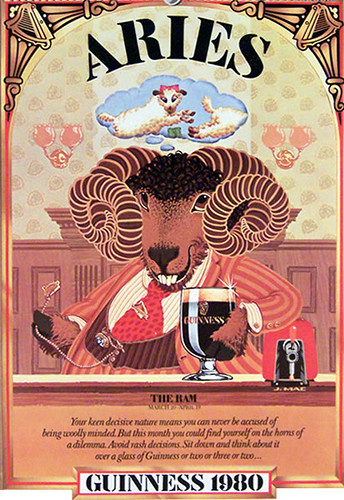
While I don’t put any stock in astrology, in 1980 Guinness put out a calendar with each month representing one of the zodiac signs, and I thought it would be fun to share these throughout the year.
Aries, the water-bearer, is from March 21-April 19. To learn more, see:
- Astrology Online
- Universal Psychic Guild
- Wikipedia
- Zodiac Signs
Beer In Art #119: Pablo Picasso’s Glass and Bottle of Bass

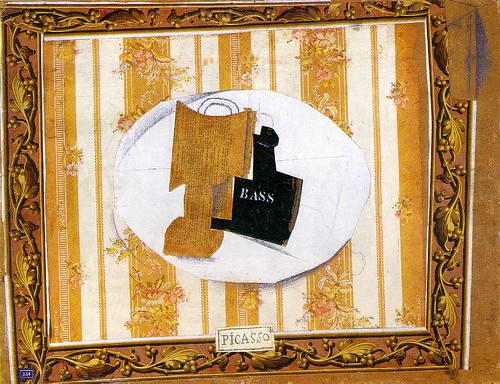
This week’s work of art is by Pablo Picsasso, created using pasted paper and charcoal on cardboard in the Spring of 1914. It’s title is Glass and Bottle of Bass. Though it certainly doesn’t look like any bottle of Bass Ale I’ve ever seen.

There’s a biography of Picasso at Wikipedia and also Biography.com. You can also see more of Picasso’s art at Olga’s Gallery, ArtArchive and the ArtCyclopedia. Then there’s Picasso.com and his “official” website.
Beer Making Is Marvel Of Industrial Chemistry

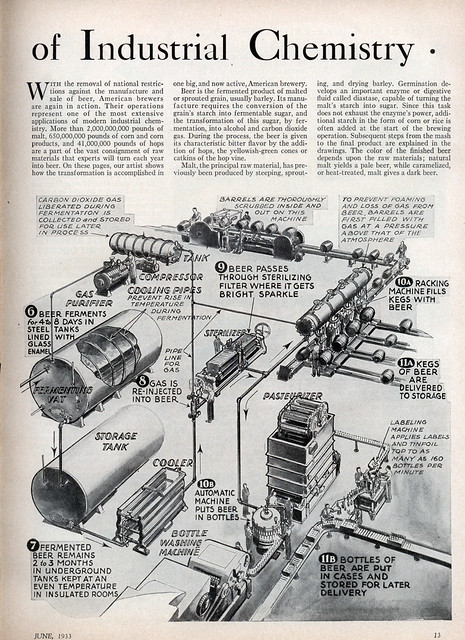
In June of 1933, just as Prohibition was in its death throes, that month’s issue of Popular Science magazine ran a two-page spread entitled Beer Making Is Marvel Of Industrial Chemistry, illustrated by Benjamin Goodwin Seielstad. It’s great fun to see it all laid out the way it’s done here. It seems like they were laying the groundwork for the return of brewing in America.
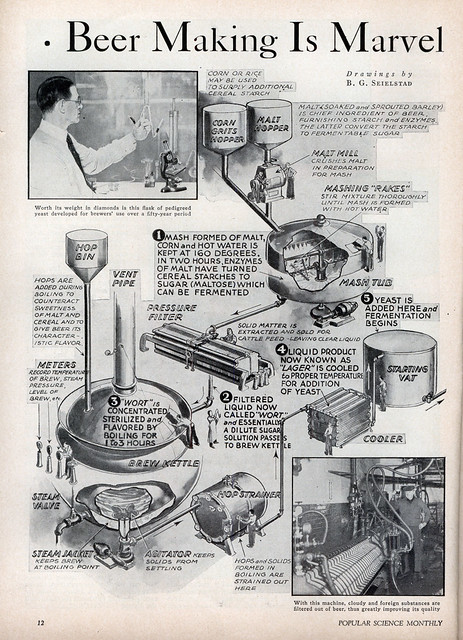
There’s not a great deal of text accompanying the chart, but here it is in its entirety, from page two of the beer making chart:
With the removal of national restrictions against the manufacture and sale of beer, American brewers are again in action. Their operations represent one of the most extensive applications of modern industrial chemistry. More than 2,000,000,000 pounds of malt, 650,000,000 pounds of corn and corn products, and 41,000,000 pounds of hops are a part of the vast consignment of raw materials that experts will turn each year into beer. On these pages, our artist shows how the transformation is accomplished in one big, and now active, American brewery.
Beer is the fermented product of malted or sprouted grain, usually barley. Its manufacture requires the conversion of the grain’s starch into fermentable sugar, and the transformation of this sugar, by fermentation, into alcohol and carbon dioxide gas. During the process, the beer is given its characteristic bitter flavor by the addition of hops, the yellowish-green cones or catkins of the hop vine.
Malt, the principal raw material, has previously been produced by steeping, sprouting, and drying barley. Germination develops an important enzyme or digestive fluid called diastase, capable of turning the malt’s starch into sugar. Since this task does not exhaust the enzyme’s power, additional starch in the form of corn or rice is often added at the start of the brewing operation. Subsequent steps from the mash to the final product are explained in the drawings. The color of the finished beer depends upon the raw materials; natural malt yields a pale beer, while caramelized, or heat-treated, malt gives a dark beer.
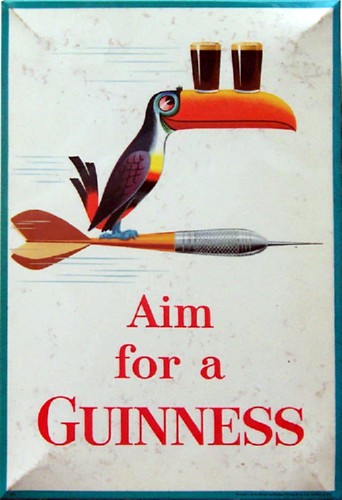
Guinness Ad #60: Aim For A Guinness

Our 60th Guinness ad shows the iconic toucan riding a dart on its way to the dartboard, all the while holding two pints of Guinness on its beak. The slogan isn’t one of the regular ones, but is specific to the ad itself: “Aim For A Guinness.”
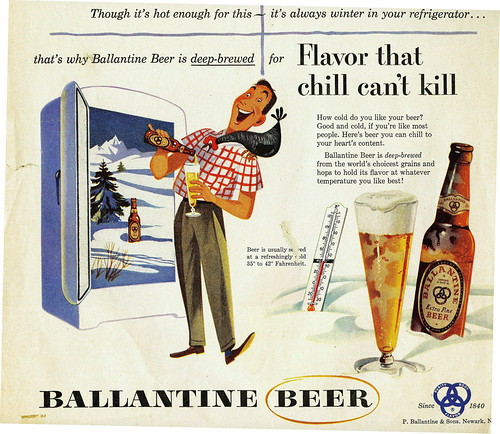
Beer In Ads #334: Ballantine Beer Is Deep-Brewed

Friday’s ad is another Ballantine ad from, I’m guessing here, the late 50s or early 60s. I love the suggestion that Ballantine is “deep-brewed,” whatever that might mean. And I can’t help but wonder: what the hell is that rooster doing on his shoulder as he pours his beer?
Beer In Ads #333: Ballantine Green
Thursday’s ad is from 1949, a Ballantine ad that’s all green, in honor of St. Patrick’s Day. My initial thought is that it was printed in a magazine that wasn’t full color but instead used spot color, in this case black and green. But it works pretty well. And I love the slogan: “A flavor you will find in no other beverage.”
