Brookston Beer Bulletin

Jay R. Brooks on Beer

  • Home
  • About
  • Editorial
  • Birthdays
  • Art & Beer

Socialize

  • Dribbble
  • Email
  • Facebook
  • Flickr
  • GitHub
  • Instagram
  • LinkedIn
  • Pinterest
  • RSS
  • Twitter
  • YouTube

Powered by Genesis

Beer In Ads #1: Beer Belongs

October 8, 2009 By Jay Brooks

ad-billboard
For nearly a year now, every Sunday I’ve been exploring the intersection of the world of art with beer in my Beer In Art series. In searching for more art to showcase, I keep coming upon wondrous examples of advertising illustration. So far, I’ve been reluctant to use them because there’s plenty of fine art involving beer to keep my Sunday’s busy for quite some time. So instead, I figured I’d start featuring advertising art with beer as a separate series. Every Thursday I’ll highlight a beer ad, usually one from the past, that has some impressive artwork associated with it.

To begin, there can be no better choice than the Beer Belongs series that the United States Brewers Foundation (USBF) did from 1945-1956. The bulk of the series, known as the Home Life in America series, ran from 1946-1956 and included 120 numbered ads. In addition, there were several more unnumbered ads that both preceded the Home Life series and were run after its conclusion. They were so popular, even Mad Magazine did a spoof of the ads. You’ve probably seen them at flea markets and antique shows. I have several of them framed in my hallway. About a year ago, I became curious about how many ads were produced and tried to learn about their history. Unfortunately, there wasn’t much out there and after trolling auction sites and the internet for a good six months, off and on, I put together a complete list of all the ads. I collected graphic versions of all the ads with the help of the Beer Institute and got a taste of their origins and history by reading the minutes of meetings by the USBF and looking at old trade publications and books that mention the ad campaign.

That led to an article about this popular ad campaign in this month’s All About Beer magazine (the November 2009 issue, beginning at page 44). Obviously, All About Beer couldn’t run all of the ads, so I’ve put them into a Flickr gallery so you can view all 120 of them, possibly for the very first time anywhere. That’s at the bottom of this post. You can also see the rest of them (the ones that came before and after, along with the spoofs) at my Beer Belongs … Enjoy It! page. There, you can also read some more about the ads and find out a little bit more of their history, though I’d also encourage you to pick up the article in this month’s All About Beer, too, to get the full picture.

bb-header

Here are three representative examples from the Home Life in America series:
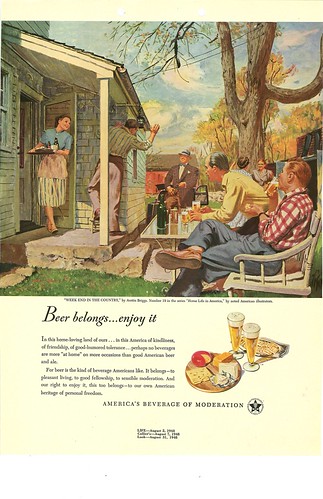
019. Week End In the Country by Austin Briggs, 1948
#19 in the Home Life in America series. Week End in the Country, by Austin Briggs, 1948.
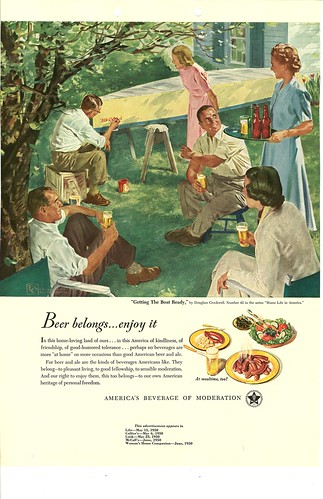
042. Getting the Boat Ready by Douglass Crockwell, 1950
#42 in the Home Life in America series. Getting the Boat Ready, by Douglass Crockwell, 1950
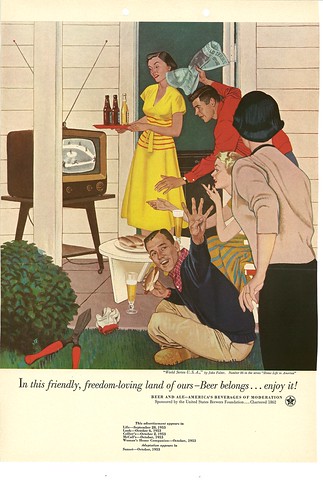
086. World Series U.S.A. by John Falter, 1953
#86 in the Home Life in America series. World Series U.S.A., by John Falter, 1953.

You can see all 120 of the Home Life in America series in the gallery below. This Flickr gallery is best viewed in full screen. To view it that way, after clicking on the arrow in the center to start the slideshow, click on the button on the bottom right with the four arrows pointing outward on it, to see the photos in glorious full screen. Once in full screen slideshow mode, click on “Show Info” to identify each ad’s title, artist and the year it ran.


Filed Under: Art & Beer, Beers, Just For Fun Tagged With: Advertising, History

Serenity In Beer & Ale

October 2, 2009 By Jay Brooks

ubif
During World War 2, the brewing industry trade organization known as the United Brewers Industrial Foundation, which was formed by the USBA in 1937, worked with the U.S. Government to create a series of ads to build morale and on their own to highlight the positive aspects of beer. Out of these grew the more familiar “Beer Belongs” series and the “Home Life in America” series of ads that the United States Brewers Foundation created and ran from 1945 to 1956. You can read my article about these later ads in the current issue of All About Beer magazine. But I recently came upon the ad below that ran in Life magazine’s August 4, 1941 issue, at page 29. I just love the language of the text, which I reprinted below, because it’s hard to read with the ad displayed so small. (Though you can click on it or here to see a larger view.)

In a hurrying, scurrying world


there’s serenity in beer and ale

 
Telephones jangling … radios blaring … auto horns honking … airplanes roaring. In big city or small town, peace is hard to find … and precious.

YES! It’s a busy, dizzy world in which we live! And every man and woman in it needs now and then to get away from it all. Needs to sit down quietly and shut out the din and noise for a peaceful hour or so.

In your needed hours of relaxation, beer can play a pleasant part. For this delicious brew does more than delight your taste. Its mellow, kindly nature helps to unsnarl tangled nerves, helps to refresh a weary body, helps to restore a faltering spirit.

Made from nature’s choicest grains and flavored with plump, ripe, fragrant hops, beer is a mild, wholesome brew. In fact, from earliest times, men have called beer and ale the “beverages of moderation.” Make them part of your own plan of balanced, tolerant, temperate living.

UBIF

Isn’t that just beautiful. It brings a tear to your eye. Beer is certainly part of my own balanced, tolerant, temperate living. It’s funny how the pressures of life in 1941 seem almost exactly the same as those of 2009, isn’t it? I need a vacation. Good thing I’m taking one in less than two weeks.

Filed Under: Art & Beer, Breweries, Editorial, Just For Fun Tagged With: Advertising

Time and Money and Beer

September 20, 2009 By Jay Brooks

Clock
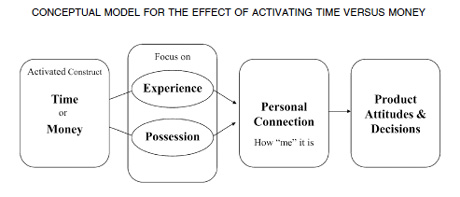
Forbes had an interesting article Friday entitled Time Vs. Money: Which Rules Buying Decisions?. The article is based on a recent academic paper published in the Journal of Consumer Research by Cassie Mogilner, a professor of marketing at Wharton, and Jennifer Aaker, a professor of marketing at Stanford University’s Graduate School of Business. That paper, entitled The Time vs. Money Effect: Shifting Product Attitudes and Decisions through Personal Connection [pdf], examines people’s associations with both time and money and how they relate to decisions about what products to buy. It’s a fairly common element in advertising. According to the study, “a content analysis of ads in four magazines targeting a wide range of consumers (Money, New Yorker, Cosmopolitan, and Rolling Stone) revealed that, out of 300 advertisements, nearly half of the ads (48%) integrated the concepts of time and/or money into their messages.”

time-money-model

Irrespective of whether feelings of personal connection stem from experiences gained using the product or from the mere possession of the product, we hypothesize that increasing one’s feelings that the product is “me” will lead to more favorable product attitudes and increased choice. Indeed, decades of research in psychology have given credence to the assumption that individuals are motivated to (and do) view themselves favorably. Consequently, people tend to have positive automatic associations with respect to themselves—which can influence their feelings about almost anything that is associated with them. For example, people like the letters that appear in their own names more than those that do not, and they are nicer to strangers who share their birthday than they are to other strangers.

One example the authors use is about beer (which is how I came to notice it). From the Forbes article:

“One thing that was surprising,” [Mogilner] says, “was to see how consumers’ attitudes and behaviors toward products and brands can be shifted by something as subtle and as pervasive as mere mentions of time or money. “The concept of time, for example, evokes a personal connection with a product in terms of the experience the consumer gains while using it, she says. To illustrate her point, [she] cites a well-known phrase in beer marketing—”It’s Miller Time.” The ads are still remembered by many consumers from the 1980s because consumers associated the beer with the routine, end-of-day transition from work to leisure.

As for the different emotions that money and social status-related campaigns can conjure, Mogilner points to advertisements for Stella Artois, a premium beer from Belgium. One of the product’s ads shows a man struggling to earn money—whether by chasing pigs, hauling sticks or herding goats—so he can buy his grandmother a pair of beautiful, expensive red shoes. But, alas, just as he’s about to present her with the gift, he spies a pint of Stella and makes a shoes-for-beer trade with the waitress. The commercial is funny, but it also captures the company’s “Perfection has its price” tagline, Mogilner says.

Both Miller and Stella are trying to sell beer. But using the concept of either time or money invites consumers to connect with a product—in this case, beer—in different ways. Of the two, the researchers found that a “Miller Time” connection typically leads to more favorable consumer attitudes and purchasing decisions because people tend to identify more closely with products they have experienced. “If you can dial up one’s thinking about time spent experiencing the product relative to thinking about the money spent to own the product, then you tend to get … beneficial effects,” Mogilner says.

But the “Perfection has its price” crowd is also important, Mogilner adds, even though there are fewer examples of consumers connecting to a product primarily because of its acquisition price. “There are cases where thinking about money can actually be a good thing for particular types of consumers, and particular types of products.”

time-or-money

This is not the first time the psychology surrounding time and money has been studied. Not surprisingly, it adds to the chorus that time beats money in the rochambeau of life. As the article explains, “[r]esearchers have found that because time is less fungible—or less easily replaced—than money, losing time tends to be a more painful event for people, particularly when they think about how they are not able to make up for it. Another difference is that people feel less accountable for how they spend their time because it can be more difficult to measure than monetary outlays. These two characteristics—fungibility and ambiguity—are important differentiators in how consumers think about time and money.”

From prior research, they posit that it “seems highly likely that people will also like products more that are more closely connected to the self than products that are not. Evidence from consumer research offers support for this prediction, showing that consumers report more favorable attitudes toward products that reflect their personal identities.” But then they take their hypothesis in a different direction for conventional wisdom, arguing ” that when these feelings of personal connection stem from experiences gained using the product, activating time (vs. money) should lead to more favorable product attitudes and decisions. In contrast, when feelings of personal connection stem more from product possession,” this does not occur, or least not as strongly.

To me, that’s the important revelation in this new study; that a third consideration is equally important: “the extent to which each concept is linked to consumers’ personal experiences, identity and emotions.” To advertisers, they specifically “propose that activating the construct of time while consumers evaluate a product will lead them to focus on their experiences using the product, which generally will heighten their personal connection to that product—their feeling that the product reflects the self.” So between time and money, the clear winner according to the results of their work is time. “By simply directing people’s attention to time, rather than money, you can actually make people make happier decisions.” But the true insight, I think, is linking that to the experience.

Many of us who write about beer, myself included, have waxed philosophically, even poetically, about how drinking beer is a community affair, that it’s best as a shared experience. Indeed, countless ads for beer are set in social situations and in fact I can’t think of one that features solitary drinking — not counting George Thorogood. Although I often drink alone for professional reasons, in most instances it’s considered a societal taboo, carrying very negative associations. While I don’t think it’s necessarily indicative of “problem” drinking or anything so sinister, it’s certainly not desirable.

So while I think their study is applicable universally, it seems more relatable to beer than many other products, because I think drinking beer is such an experiential beverage. I imagine I’m not alone in having all my best drinking memories ones with friends. It’s probably not a stretch to say that’s universal, too. So the idea that time and the emotional experience of spending it with friends seems almost obvious, but it’s still interesting that it’s borne out by this, and other, studies. For me personally, it may not be Miller Time, but it is “beer time.” Who wants to join me?

If you have the time (yes, pun intended) and inclination, the five studies they conducted (and the whole paper) is worth reading. It’s a little dry and steeped in academic jargon, but interesting nonetheless. (It’s also only 15 pages, and three of those are references.)

Filed Under: Editorial, Politics & Law Tagged With: Advertising, Marketing, Statistics

Back Door Advertising

September 10, 2009 By Jay Brooks

bud-lime-can
Several people sent me a link to ABIB‘s latest ad campaign for Bud Light Lime in a can. You can watch the online commercial below.

I’m not quite sure what to make of it. I’m generally a fan of the double entendre and the wit it often employs, but this Bud Light Lime ad seems less witty and more coarse, low-brow and unsophisticated. Klassy with a “K.” And I say that not because of its naked and unsubtle allusions to sex or because — gasp — children might see it. I’m not personally offended in any way. But regardless of what I think about Bud Light Lime, it hardly shows beer in a positive light. It may be the least respectful ad since Miller’s infamous mud wrestling ad or Bud’s recently flatulent horse.

Created by the ad agency DDB Chicago, so far the reaction has been mixed, yet both sides seem to prove my point that this is not the way to portray beer if we want anyone to take it seriously. (And before anyone chimes in with “but it’s just Bud Light,” like all advertising it accumulates to the overall perception of beer by society at large, so I believe it does matter.) On one hand, Advertising Age says In Juvenile Bud Light Lime Spot, This Butt’s for You, finding it too tasteless to be effective. They conclude:

Crude ads are, of course, nothing new in the category that brought the world the “Swedish Bikini Team,” but they’ve been a bit scarce since Miller Brewing Co.’s bottom-scraping use of bikini-clad mudwrestlers in a 2003 “tastes great, less filling” brawl.

That ad sparked wide recriminations about how lowest-common-denominator advertising turns the product into a commodity indistinguishable by any measure other than whose proprietor has lower standards. For a while after, advertisers toned it down, taking a back seat to fast-food chains and even domain registrars when it came to over-the-top ads.

But perhaps our long national nightmare of relatively tasteful beer ads is coming to an end at last.

But BrandFreak’s Kenneth Hein felt that it is the best thing Bud Light’s done in a while,” completely disagreeing with Advertising Age.

The problem with Bud Light and beer advertising in general is that brands are afraid to have fun. Sure, thinly veiled anal-sex jokes appeal to “the lowest common denominator,” but who cares? We’re talking about beer. A-B and its agencies need to have a couple and loosen up even more, because its recent run of ads have been a buzzkill.

But here’s where he proves my point. He likes the ad precisely because it’s tasteless as he writes “who cares? We’re talking about beer.” And that’s the rub. It perpetuates the perception that beer is just beer, nothing more. And that’s the belief a vast majority of people hold, which I think is almost entirely the fault of of ads like this one. Only the breweries that can afford to advertise on television nationally get their message to consumers. And for decades, that message has appealed to a lowest-common denominator ethos that’s painted beer as an interchangeable commodity. Only the brand is important, because for most of those beer companies, what’s inside is virtually the same. So you sell other ideas, and end up with a populace that perceives all beer as being the same. And that overall perception is hardly flattering. So most people tend to believe that beer is all the same; it’s just that swill that frat boys drink at tailgate parties or while binge-drinking their way through college.

And I hardly think this ad will change that. What do you think about it?

Filed Under: Beers, Editorial Tagged With: Advertising, Cans, Packaging, Video

A Marketeer’s Take On Bud Light

August 19, 2009 By Jay Brooks

bud-light
Thanks to Anat Baron from Beer Wars, who tweeted this. Laura Ries, one half of the father-daughter Ries & Ries marketing consultants, who together wrote The 22 Immutable Laws of Branding and four other books.

She wrote a piece on her far-too-cleverly named Ries’ Pieces blog about the Bud Light brand. It’s interesting to read the take of someone who knows marketing but not the beer industry’s peculiarities.

Filed Under: Beers, Editorial Tagged With: Advertising, Anheuser-Busch InBev, Light Beer, Marketing

North Korea’s First Beer Commercial

July 11, 2009 By Jay Brooks

korea_north
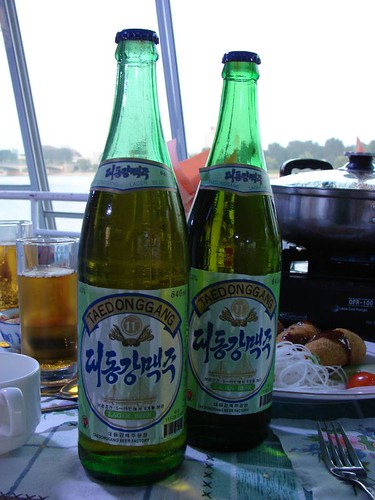
Taedonggang is a brand of beer from North Korea. It’s brewed by the state-owned Taedonggang Brewing Company based in Pyongyang, and is named for the nearby Taedong River. The North Koreans bought an English brewery, Usher’s Brewery in Trowbridge (part of Wiltshire), in 2002 and shipped it back to Asia. They produce 4 brands of beer, of which Taedonggang Beer is the flagship.

In a somewhat surprising move for a fiercely communist country, the state-owned Korean Central Television aired their first ever commercial, and it was a beer ad for Taedonggang beer.

A BBC article describes the ad:

Young women in traditional Korean dress are shown serving trays of beer to men in Western suits.

Billed as the “Pride of Pyongyang”, the advert promises drinkers that the beer will help ease stress.

“It represents the new look of Pyongyang,” the two-and-a-half minute advert says. “It will be a familiar part of our lives.”

I don’t know Korean, but according to a CBS report, “the commercial said the beer relieves stress and improves health and longevity” and went on to assure “viewers of the beer’s quality and nutritional value, saying it was made of rice and contained protein and vitamin B2.”

To see the strange, at times surreal, commercial, click on the image below.


Taedonggang beer, originally uploaded by Rikke Søvsø Nielsen.

Filed Under: Beers, News, Politics & Law Tagged With: Advertising, North Korea, Video

« Previous Page

Find Something

Northern California Breweries

Please consider purchasing my latest book, California Breweries North, available from Amazon, or ask for it at your local bookstore.

Recent Comments

  • Bob Paolino on Beer Birthday: Grant Johnston
  • Gambrinus on Historic Beer Birthday: A.J. Houghton
  • Ernie Dewing on Historic Beer Birthday: Charles William Bergner 
  • Steve 'Pudgy' De Rose on Historic Beer Birthday: Jacob Schmidt
  • Jay Brooks on Beer Birthday: Bill Owens

Recent Posts

  • Beer In Ads #5314: Bok Bier Bavaria August 7, 2026
  • Historic Beer Birthday: Henry J. Schreihart August 7, 2026
  • Beer Birthday: Tara Nurin August 7, 2026
  • Historic Beer Birthday: John Allen Young August 7, 2026
  • Historic Birthday: Henry C. Ramos August 7, 2026

BBB Archives

Feedback

Head Quarter
This site is hosted and maintained by H25Q.dev. Any questions or comments for the webmaster can be directed here.