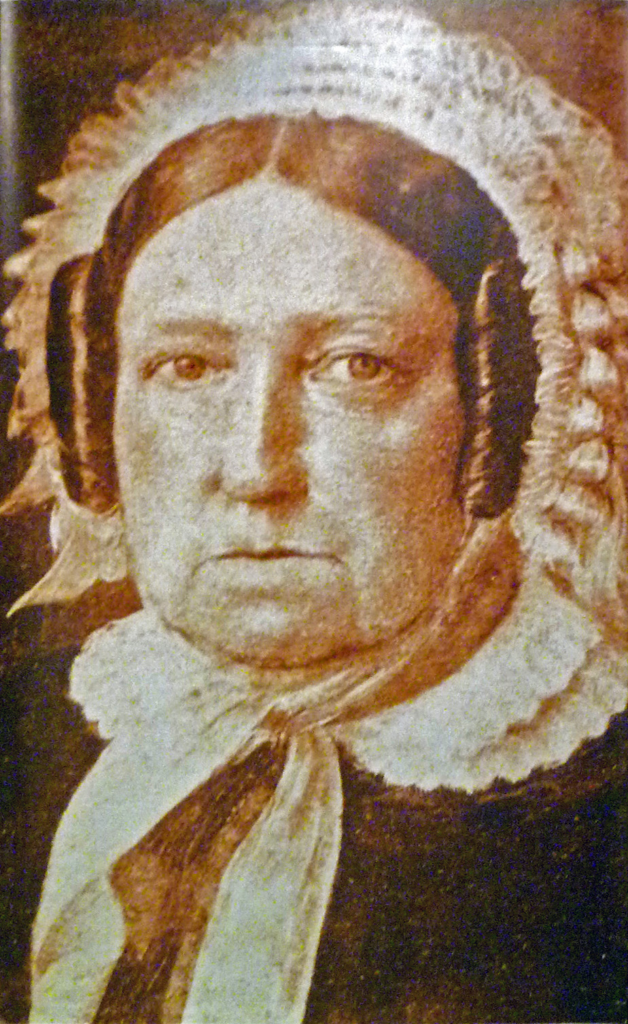
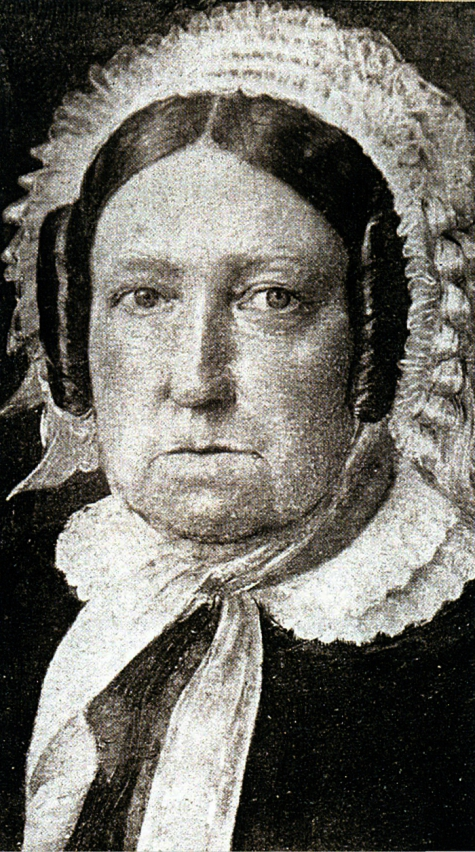
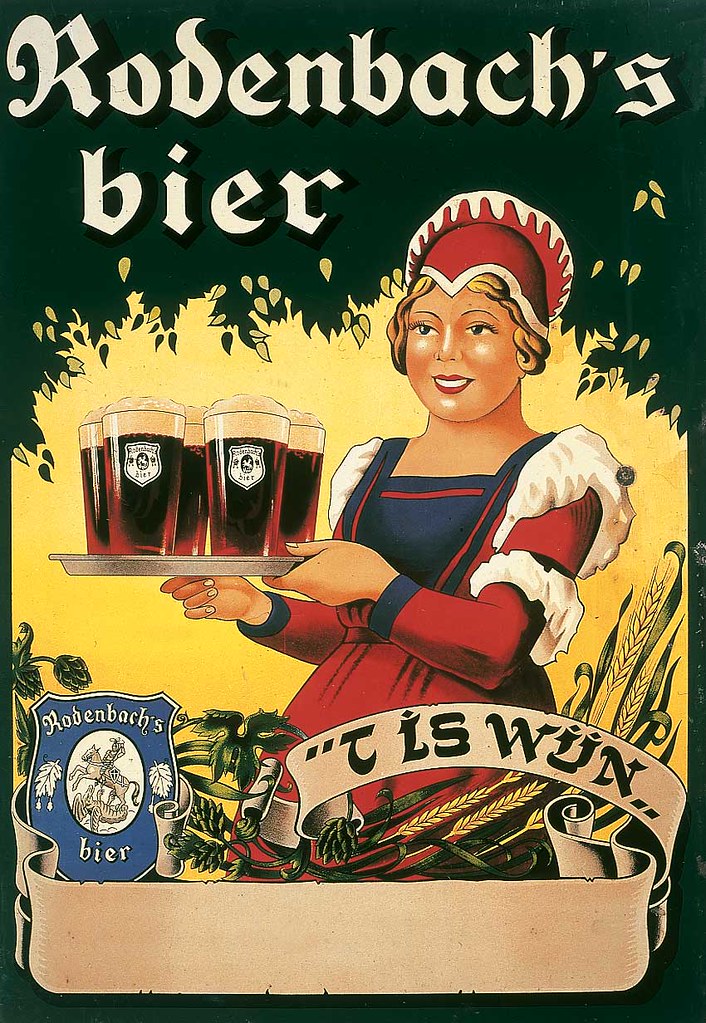
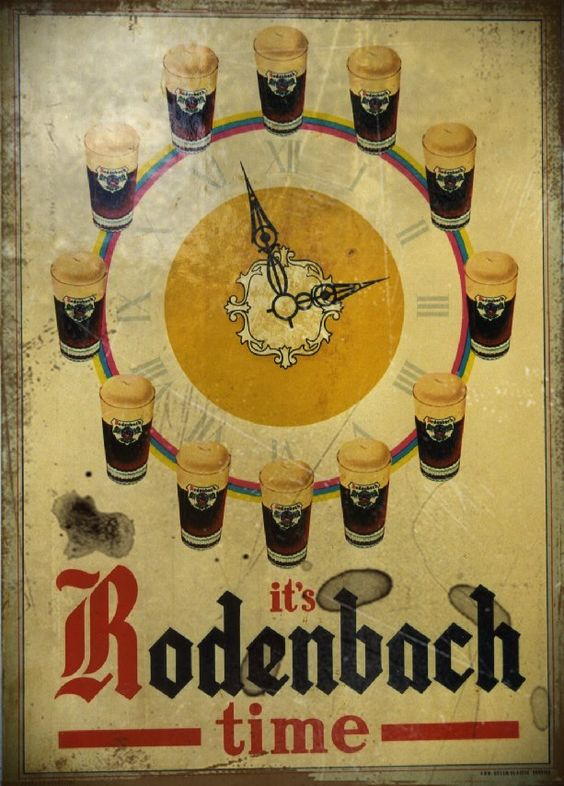
Today is the birthday of Regina Wauters (March 1, 1795-January 24, 1874). She was married to Pedro Rodenbach and the two of them bought out other family members to become sole owners of what would become known as Brouwerij Rodenbach in Rosalre, Belgium.
Born in Mechelen, Regina Wauters was the daughter of a rich local brewer. She married Pedro Rodenbach in 1818 and moved to Roeselare in West Flanders, Belgium, where his family had a distillery.
In 1821 Pedro took along with his brothers and sister a brewery. The brothers agreed to a partnership for fifteen years. At the end of this period, Pedro and Regina bought the brewery from the others and Regina ran the business while Pedro served in the military during the Belgian revolution.
Rodenbach bought the distillery from his family in 1835. He died in Brussels in 1848. His family sold the distillery to Regina Wauters, Her distillery remained for a long time the only significant distillery in Roeselare. Regina extended it immediately after she bought it. Later she asked her eldest son, Raymond, to work in the distillery. Raymond Rodenbach would continue to run the distillery until c.1895. The distillery was later sold to Honoré Talpe who transformed it into a chicory factory.
Regina invested her money not only in the distillery of the Rodenbachs but also in their brewery. In 1836 the family Rodenbach sold the brewery in Roeselare with numerous other properties. Pedro Rodenbach would buy most of it with the money of Regina. Pedro had to sign legal documents to recognize her as sole proprietor of the brewery and any other property that he had bought from his family.
Regina immediately began to expand the brewery. Although she succeeded in building one of the largest distilleries in the region, she would fail to create the largest brewery in the city. She suffered from the fierce competition with Anna Gesquiere, who also ran a brewery in Roeselare.
In 1860 her son Edward Rodenbach came to work in the brewery and it was during his directorship that the brewery expanded outside Roeselare. In 1864 Regina sold him, at the age of 69, her brewery, her house and workshops, along with eleven bars she had bought. Regina Wauters would retire to live on her private means until her death in 1874.
And this is her entry from her Dutch Wikipedia page, translated by Google Translate:
Regina Wauters was a rich brewer’s daughter from Mechelen. She married Pedro Rodenbach in 1818 and moved to Roeselare. The family had a distillery in the Spanjestraat. In 1820, Pedro and his brothers and sisters took over a brewery in the street. In 1835 the family Rodenbach decided to sell the distillery that was still managed in community to Pedro. Pedro Rodenbach was also a soldier and since the Belgian revolutionhe could hardly be seen in Roeselare. He would die in Brussels in 1848. The family then sold the distillery to Regina Wauters, who acted by her husband’s proxy. However, it was Regina who provided the necessary money. She had the necessary documents drawn up, her husband acknowledging that she was the sole owner of the distillery and all other real estate. The distillery would for a long time be the only noteworthy distillery in Roeselare. She employed a lot of people. Regina would expand it immediately after the sale. Later she involved her eldest son, Raymond, in the case. Raymond Rodenbach would continue to run the distillery until about 1895. The distillery was later sold to Honoré Talpe who made it a chicory factory.
Regina Wauters did not only invest her money in the family distillery of the Rodenbachs. In 1836 the Rodenbach family, mainly represented by Alexander Rodenbach , sold her brewery in the Spanjestraat with many other properties. Pedro Rodenbach would buy the majority of that. However, he did this again with Regina’s money. Pedro also had to acknowledge once again in deeds that the brewery and all other properties he had bought from the family were now her property.
Regina Wauters immediately started the expansion of the brewery. She might have one of the largest distilleries in the region; she would not succeed in creating the largest brewery in the city. Before that she had too much competition from Anna Gesquiere, the widow Cauwe, who had a brewery on the Polenplein. There was a strong competition between the two ladies in the 1830s and 1840s. In this way they both strove to introduce the steam engine in Roeselare as soon as possible. Regina Wauters was known for the vigorous management of both her affairs. Her policy was particularly forward-looking. But she was also hardened in the small parts of the business world. For example, she was repeatedly suspected of circumventing the city tax on alcohol. She also had a lock placed on the Mandelbeek without a license,
Since 1848 she moved her sons Emiel and Florent to the brewery, but remained so in the background that they quickly noticed it. In 1860 her second son Eduard Rodenbach entered the brewery. He used to be a lineman manufacturer, but he was certain of being insecure during a flax crisis and decided to concentrate successfully on the beer industry. In 1864 Regina Wauters, now 69, her brewery, home and workshops, together with the eleven cafes she had bought, would sell to her son. From then on, Regina Wauters would retire until her death in 1874.
In 2004 a street in a Roeselaar industrial zone was named after her, the Regina Wautersweg.
And this is the history currently on the brewery website:
The Rodenbachs moved from Andernach am Rhein to Roeselare in West Flanders. The Rodenbach line boasted numerous military men, poets, writers, brewers and entrepreneurs, as well as pragmatic revolutionaries and politicians.
Pedro Rodenbach took part in Napoleon’s Russian campaign and was instrumental in the Belgian revolution in 1830, which led to an independent Belgium. Three Rodenbachs were members of the constitutional congress when Belgium was founded. Constantijn Rodenbach was the author of the “Brabançonne”, the Belgian national anthem.
In 1836, Pedro Rodenbach, together with his entrepreneurial wife Regina Wauters, founded the brewery. However, it is Eugène Rodenbach whom RODENBACH has to thank for its unique quality and masterful character. Not only did he study the vinification of beer, but also optimised the maturation process in oak casks, or “foeders” (maturation casks). The world-renowned cask halls with their 294 oak casks, some of which are 150 years old, are protected as part of the industrial heritage of the Flemish Community.
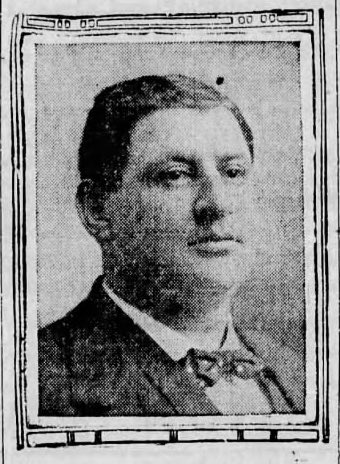
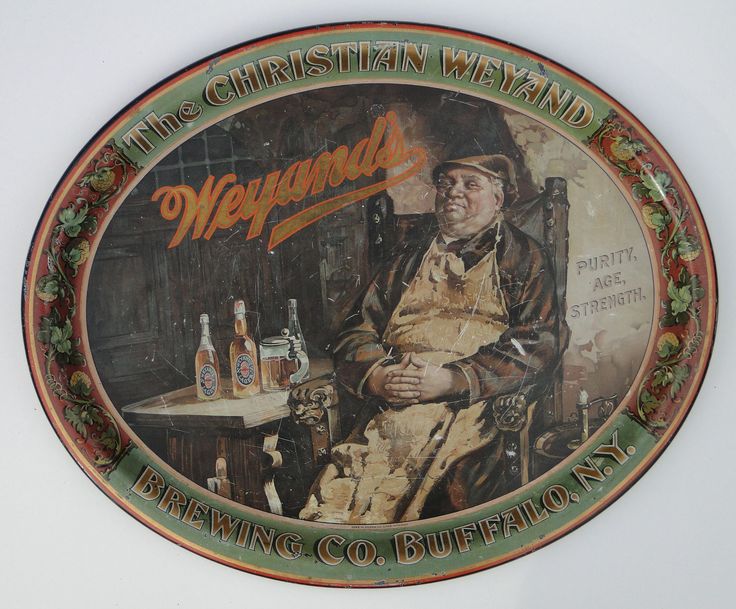
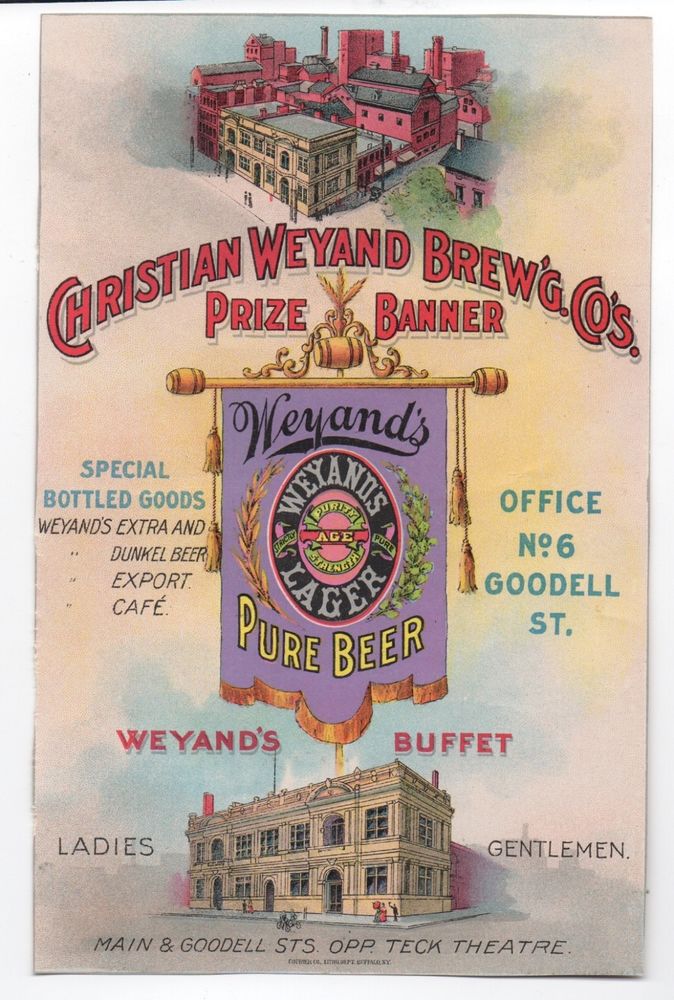
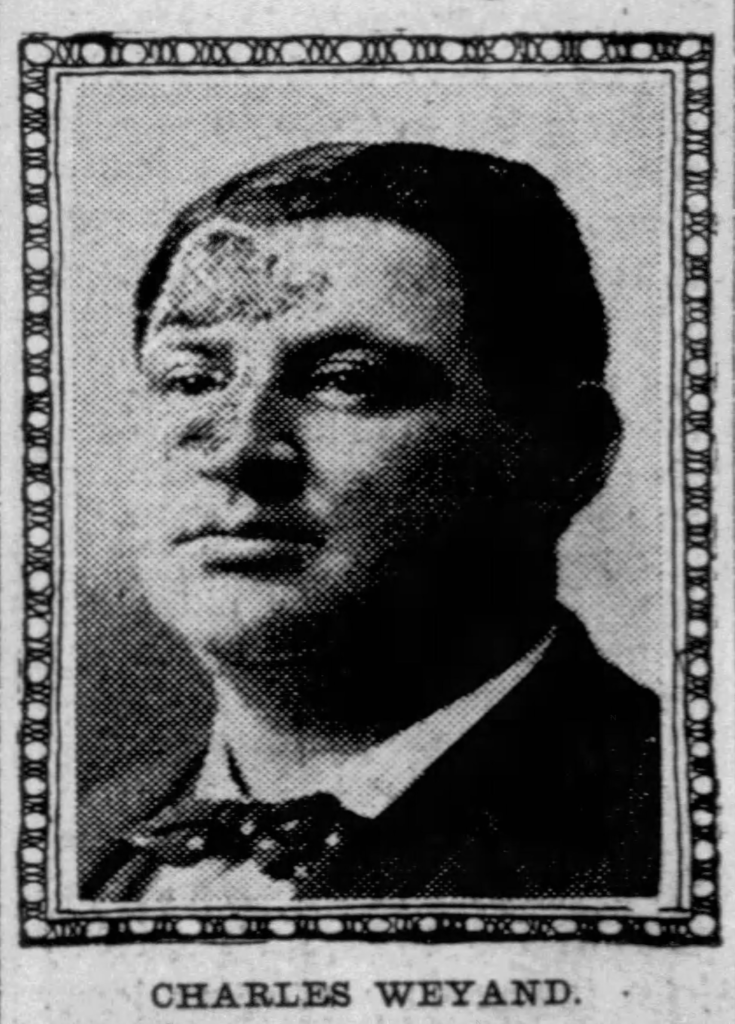
Today is the birthday of Charles Weyand (March 1, 1869-April 28, 1905). He was born in upstate New York, and was the son of Christian Weyand, who co-founded what would become the Christian Weyand Brewing Co. in Buffalo, New York. There’s not too much information about Charles, I suspect because he died fairly young and worked as the secretary and treasurer for his family’s business. His brother, John Weyand, became the president of the brewery after his father died, and it remained in business until closed by prohibition in 1920.
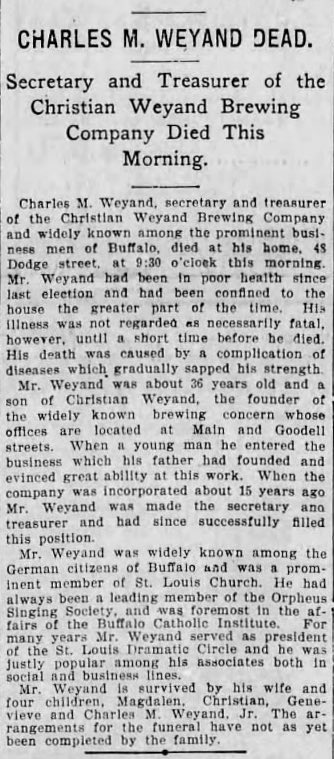
This is his obituary, from the Buffalo News, April 28, 1905:
This biography of Weyand is from “Our County and its people, A descriptive work on Erie County, New York,” edited by Truman C. White, 1898:
Weyand, Charles M., Buffalo, secretary and treasurer of the Christian Weyand Brewing Company, is a son of Christian and Magdelen (Meyer) Weyand, and was born in Buffalo, March 1, 1869. In order to thoroughly equip himself for the business of life he intended to pursue, after passing through the Canisius College he entered the Bryant & Stratton Business College, where he obtained a thorough business education. He immediately entered business with his father and in 1890, when the concern was made a stock company, he was elected secretary and treasurer, which responsible position he now holds. He was married in October, 1891, to Bohumila Louise Andele of Buffalo, and they have one daughter. Mr. Weyand is a member of the Buffalo Orpheus and the St. Louis Dramatic Circle.
Two years ago I decided to concentrate on Bock ads for awhile. Bock, of course, may have originated in Germany, in the town of Einbeck. Because many 19th century American breweries were founded by German immigrants, they offered a bock at certain times of the year, be it Spring, Easter, Lent, Christmas, or what have you. In a sense they were some of the first seasonal beers. “The style was later adopted in Bavaria by Munich brewers in the 17th century. Due to their Bavarian accent, citizens of Munich pronounced ‘Einbeck’ as ‘ein Bock’ (a billy goat), and thus the beer became known as ‘Bock.’ A goat often appears on bottle labels.” And presumably because they were special releases, many breweries went all out promoting them with beautiful artwork on posters and other advertising. With Spring approaching, there are so many great examples that I’m going to post two a day for a few months.
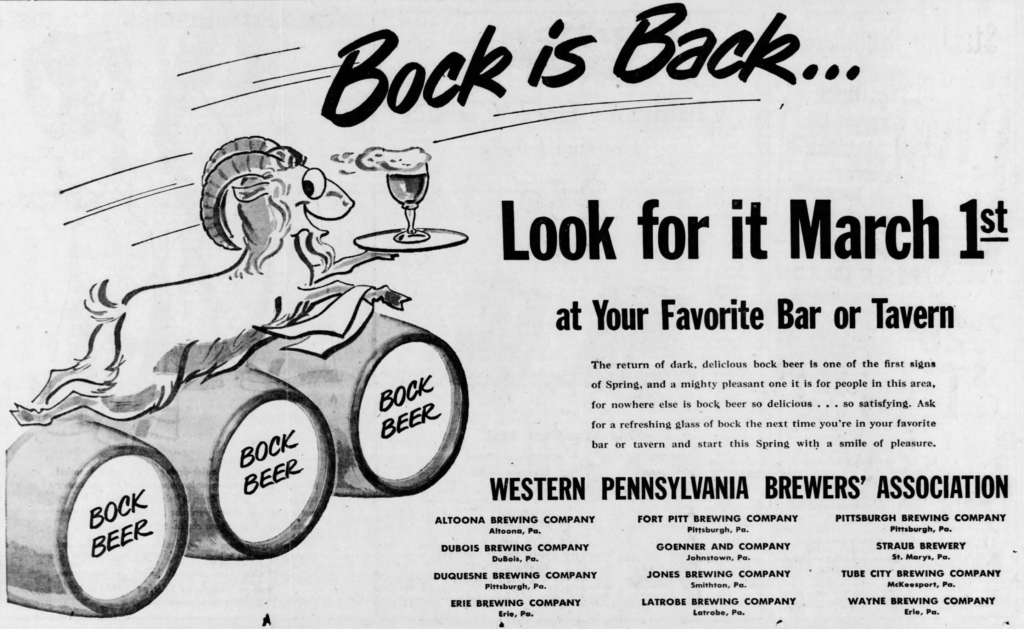
Saturday’s second ad is for not for a specific Bock Beer, but for every Bock made by the member breweries of the Western Pennsylvania Brewers’ Association. The ad was published on February 28, 1951. This one was for the Western Pennsylvania Brewers’ Association which was founded in 1902 by at least a dozen different breweries. This ad ran in The Pittsburgh Press, of Pittsburgh, Pennsylvania.
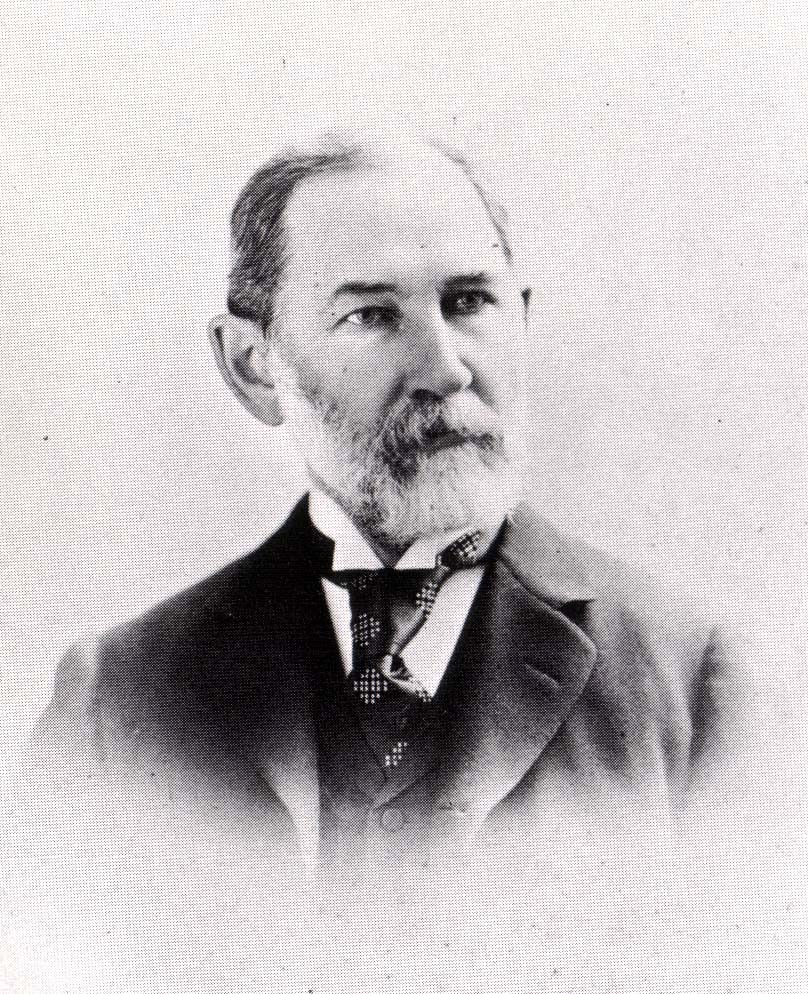
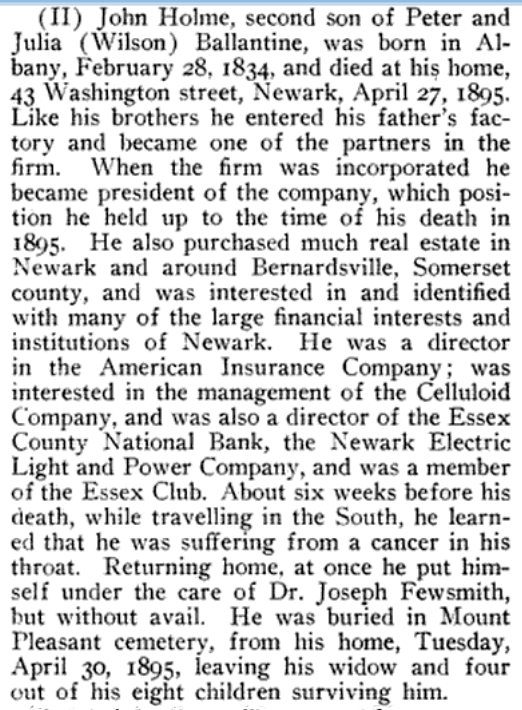
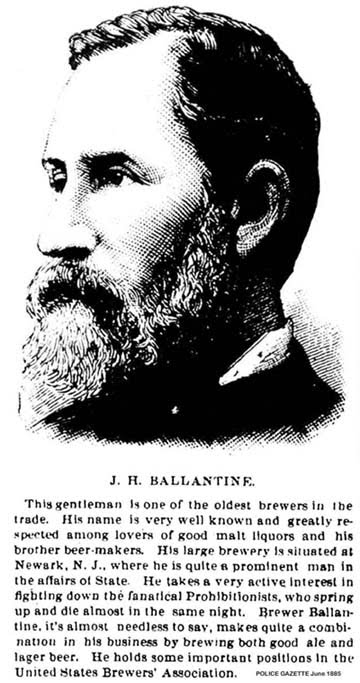
Today is the birthday of John Holme Ballantine (February 28, 1834-April 27, 1895). He was the second of three sons of Peter Ballantine, who founded P. Ballantine & Sons. In 1857, he brought on his three sons as partners. John Holme served as president of the family brewery from 1883 until his death in 1895.
This is John Holme’s obituary from the Genealogical and Memorial History of the State of New Jersey:
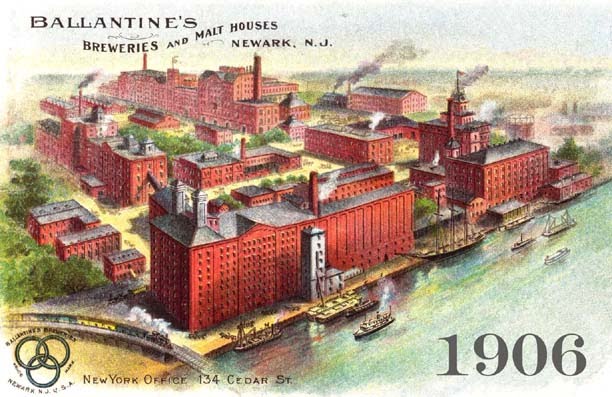
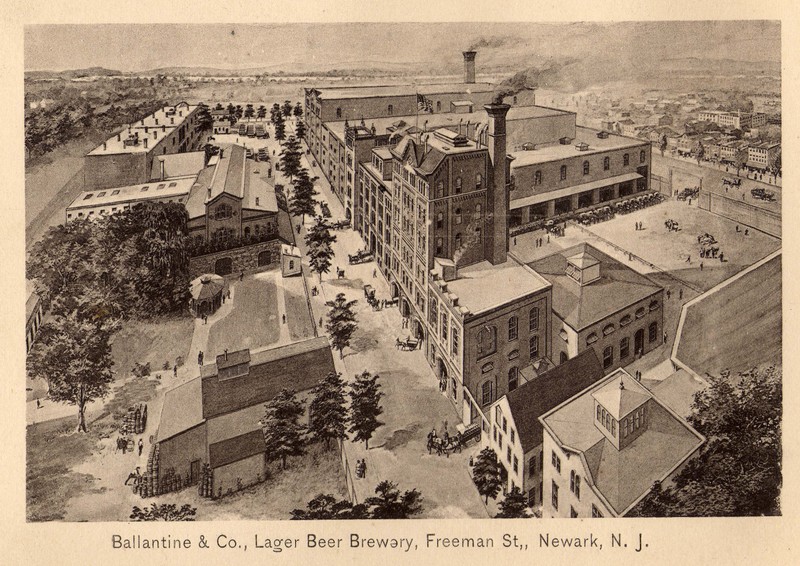
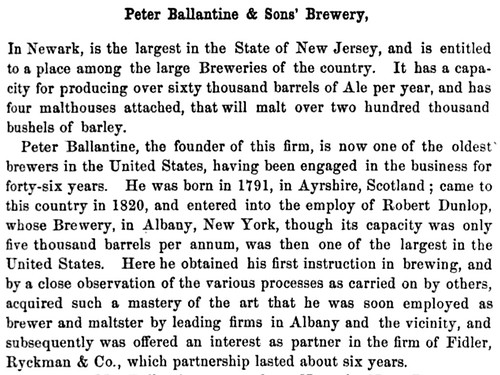
And here’s a history of the Ballantine brewery from “A History of American Manufactures from 1608 to 1860,” by John Leander Bishop, Edwin Troxell Freedley, Edward Young, published in 1868:
Two years ago I decided to concentrate on Bock ads for awhile. Bock, of course, may have originated in Germany, in the town of Einbeck. Because many 19th century American breweries were founded by German immigrants, they offered a bock at certain times of the year, be it Spring, Easter, Lent, Christmas, or what have you. In a sense they were some of the first seasonal beers. “The style was later adopted in Bavaria by Munich brewers in the 17th century. Due to their Bavarian accent, citizens of Munich pronounced ‘Einbeck’ as ‘ein Bock’ (a billy goat), and thus the beer became known as ‘Bock.’ A goat often appears on bottle labels.” And presumably because they were special releases, many breweries went all out promoting them with beautiful artwork on posters and other advertising. With Spring approaching, there are so many great examples that I’m going to post two a day for a few months.
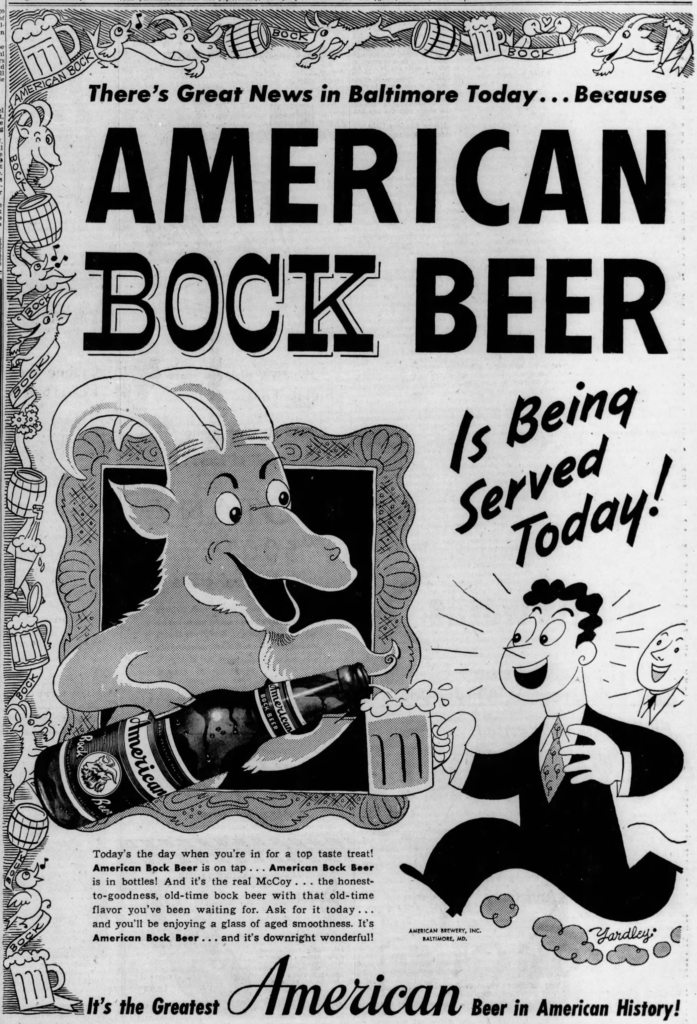
Saturday’s first ad is for American Bock Beer, which was published on February 28, 1951. This one was for the American Brewery Inc. of Baltimore, Maryland and was founded in 1863 by Joseph F. Wiessner. This ad ran in The Evening Sun, of Baltimore, Maryland.
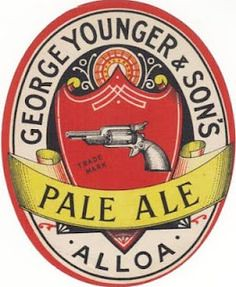
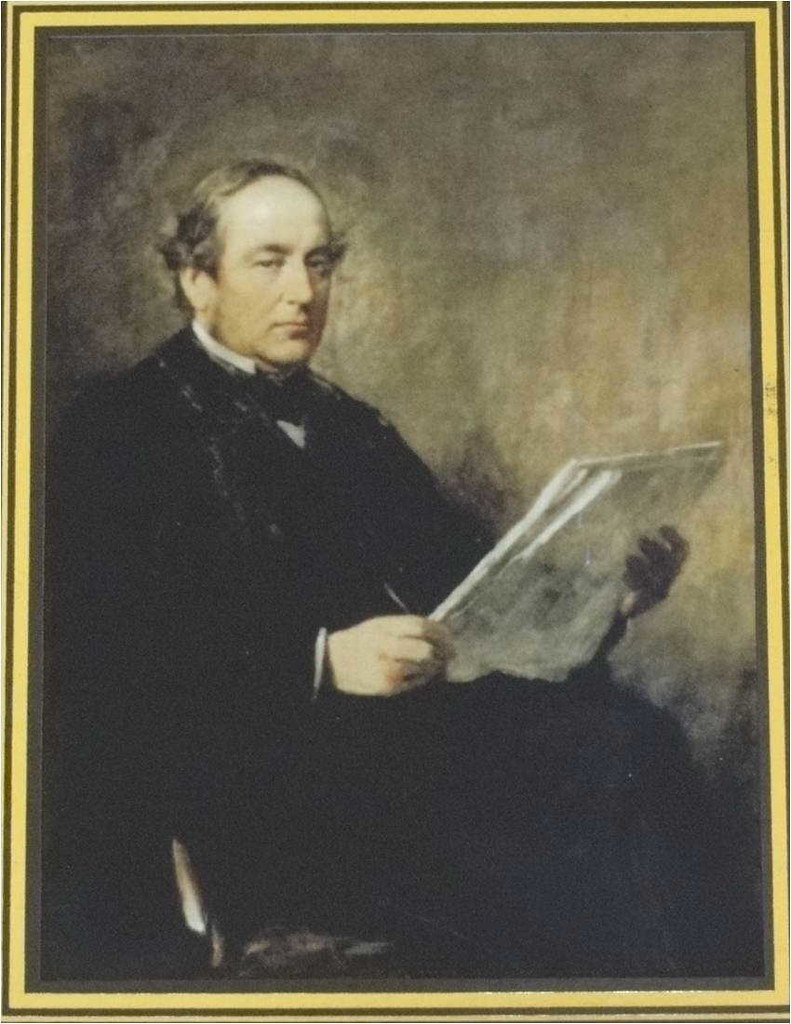
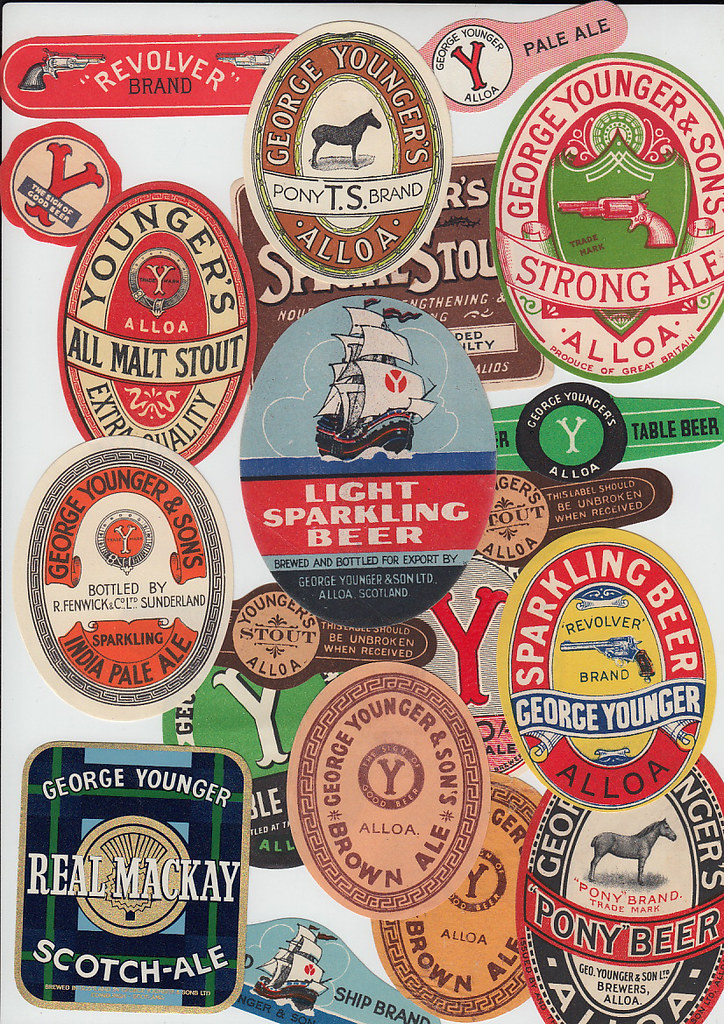
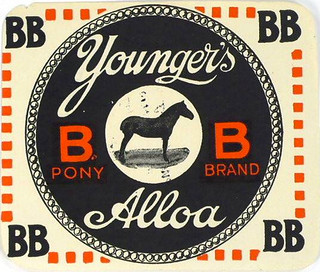
Today is the birthday of James Younger (February 28, 1818-August 5, 1868). He was born in Alloa, Clackmannanshire, Scotland, and was the son of George Younger, and the grandson of George Younger, who founded the brewery that would become George Younger and Son in 1764. He was also a first cousin of Robert Younger (1850-1887) and the ancestor of the Younger family of York, North Yorkshire. Presumably because he wasn’t the first, but one of several in the very early days of the brewery, there’s very little information about him I could find.
He married Janet McEwan, daughter of John McEwan, in November 1850.
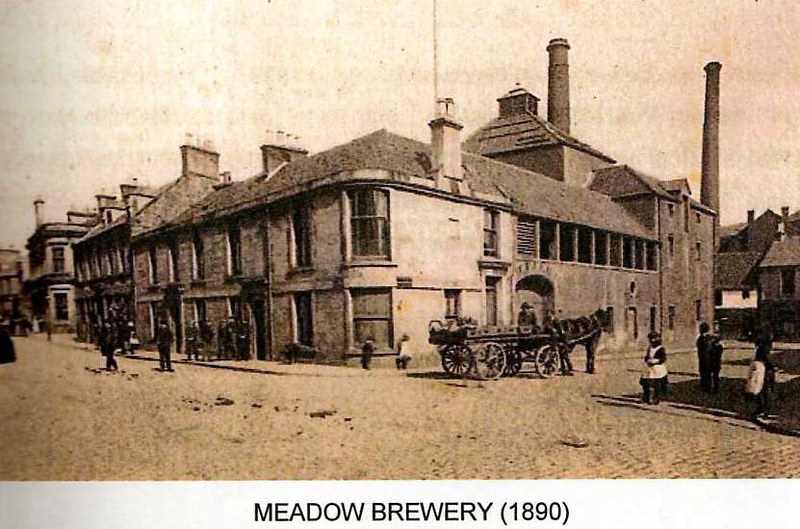
Here’s the Meadow Brewery around 1890, just before it became known as George Younger & Sons.
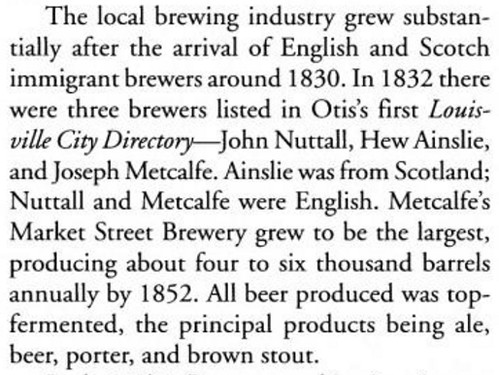
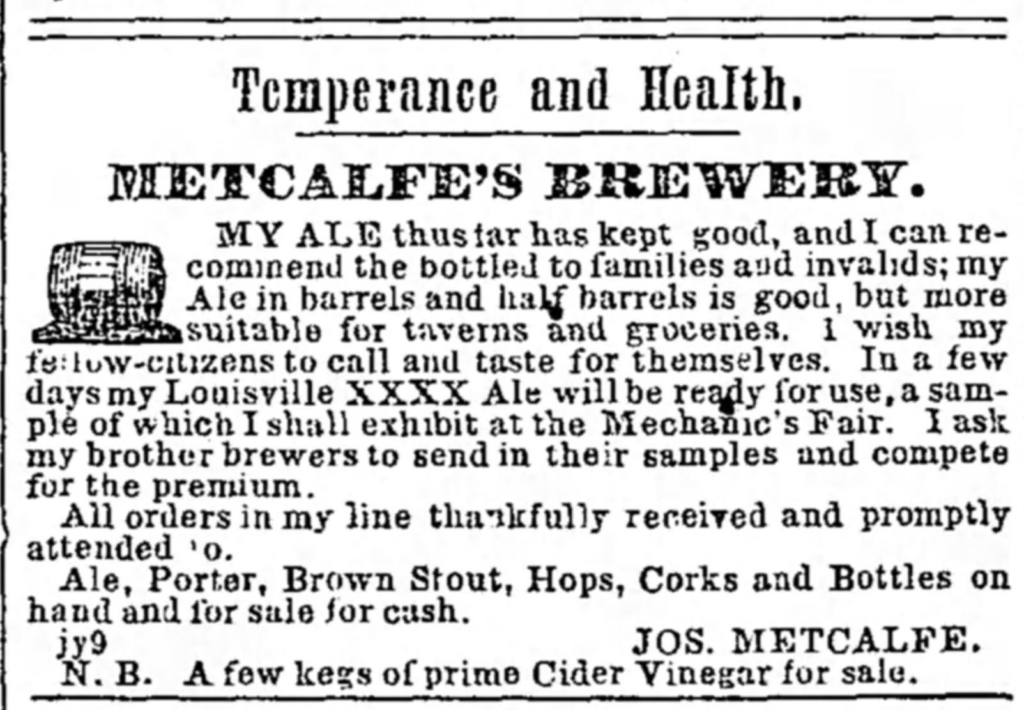
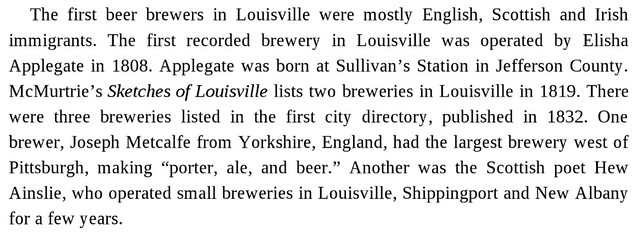
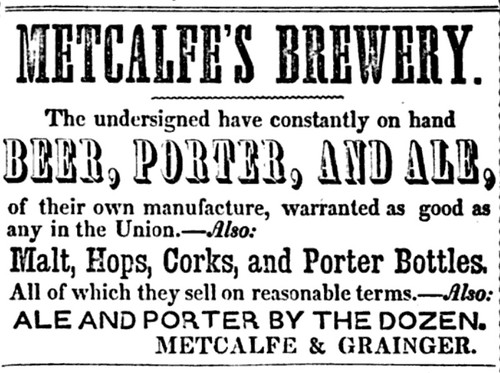
Today is the birthday of Joseph Metcalfe (February 28, 1832-September 26, 1858). He was born in Yorkshire, England, but came to the U.S. with his family as an infant, settling in Louisville when he was still a child. He was a brewer who owned breweries in both Louisville, Kentucky and New Albany, Indiana, which is just across the Ohio River from Louisville. He was often referred to as Colonel Metcalfe, and he was a veteran of the Mexican War as well as the Civil War.
He’s mentioned, curiously, in Germans in Louisville, in the prehistory of the town, from a German perspective.
And again similarly in an Encyclopedia of Louisville:
Here’s the story from IndianaBeer.com:
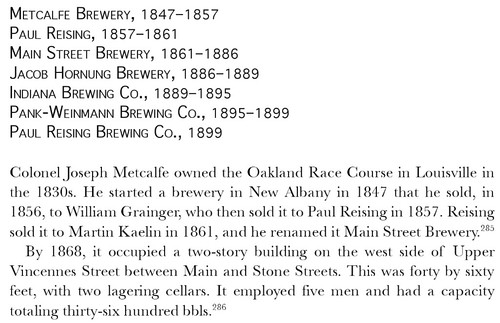
Colonel Joseph Metcalfe started a brewery in New Albany in 1847 which he sold to William Grainger in 1856 who sold it to Paul Reising in 1857. Reising sold it to Martin Kaelin in 1861 who renamed it Main Street Brewery. This was a two-story building of 40×60 feet with two lagering cellars. It employed five men who made 3,600 bbls by 1868.
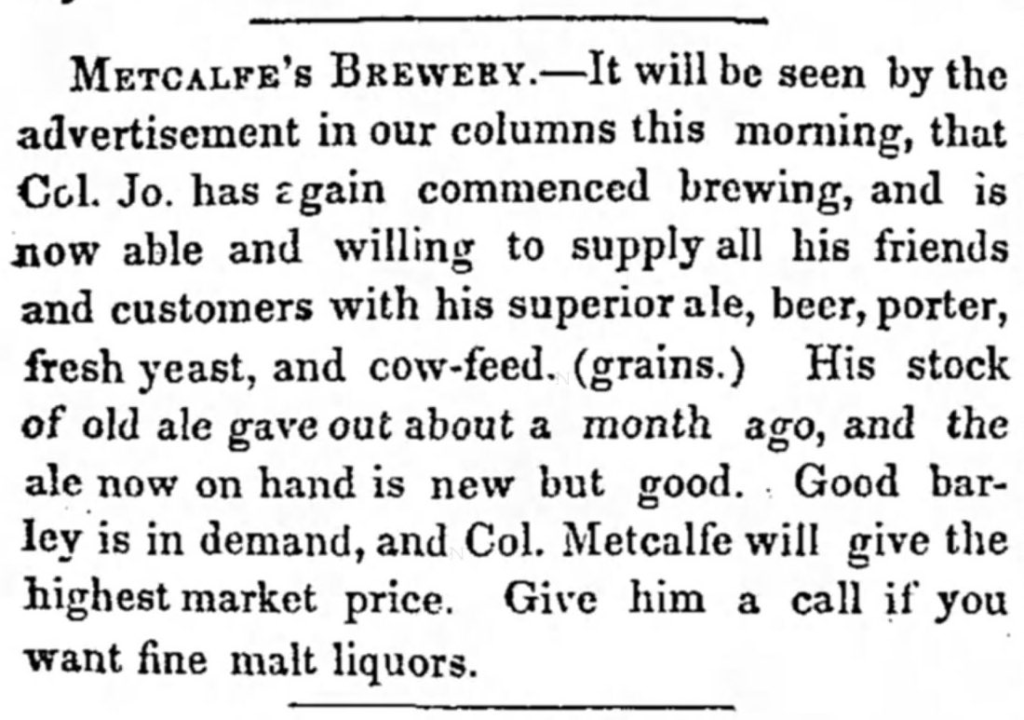
This little item ran in Louisville Courier on September 11, 1855:
And this is how he’s mentioned in Hoosier Beer: Tapping Into Indiana Brewing History:
Tavern Trove has a slightly different timeline for the brewery, as do a number of sources.
Joseph Metcalfe Brewery 1847-1857
William Grainger 1857-aft 1857
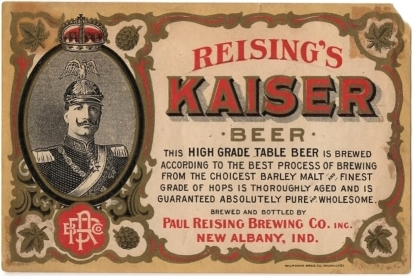
Paul Reising Aft. 1857-1861
Martin Kaelin, Main Street Brewery 1861-1882
Louis Schmidt, Main Street Brewery 1882-1883
Hornung and Atkins, Main Street Brewery 1883-1886
Jacob Hornung, Main Street Brewery 1886-1889
Indiana Brewing Co. 1889-1895
Pank-Weinmann Brewing Company. 1895-1899
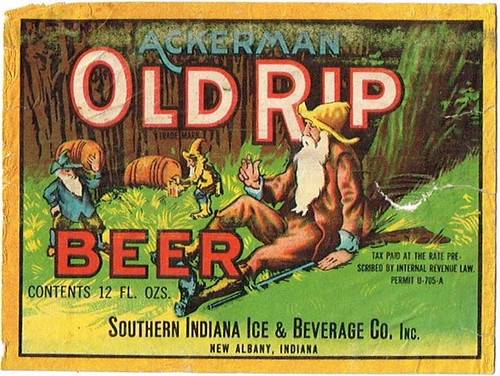
Merged with the Southern Indiana Ice and Beverage Co. of New Albany, Indiana in 1899
This is Metcalfe’s brewery shortly after he had sold it to Paul Reising.
The brewery crew when it was the Paul Riesing Brewery.
Two years ago I decided to concentrate on Bock ads for awhile. Bock, of course, may have originated in Germany, in the town of Einbeck. Because many 19th century American breweries were founded by German immigrants, they offered a bock at certain times of the year, be it Spring, Easter, Lent, Christmas, or what have you. In a sense they were some of the first seasonal beers. “The style was later adopted in Bavaria by Munich brewers in the 17th century. Due to their Bavarian accent, citizens of Munich pronounced ‘Einbeck’ as ‘ein Bock’ (a billy goat), and thus the beer became known as ‘Bock.’ A goat often appears on bottle labels.” And presumably because they were special releases, many breweries went all out promoting them with beautiful artwork on posters and other advertising. With Spring approaching, there are so many great examples that I’m going to post two a day for a few months.
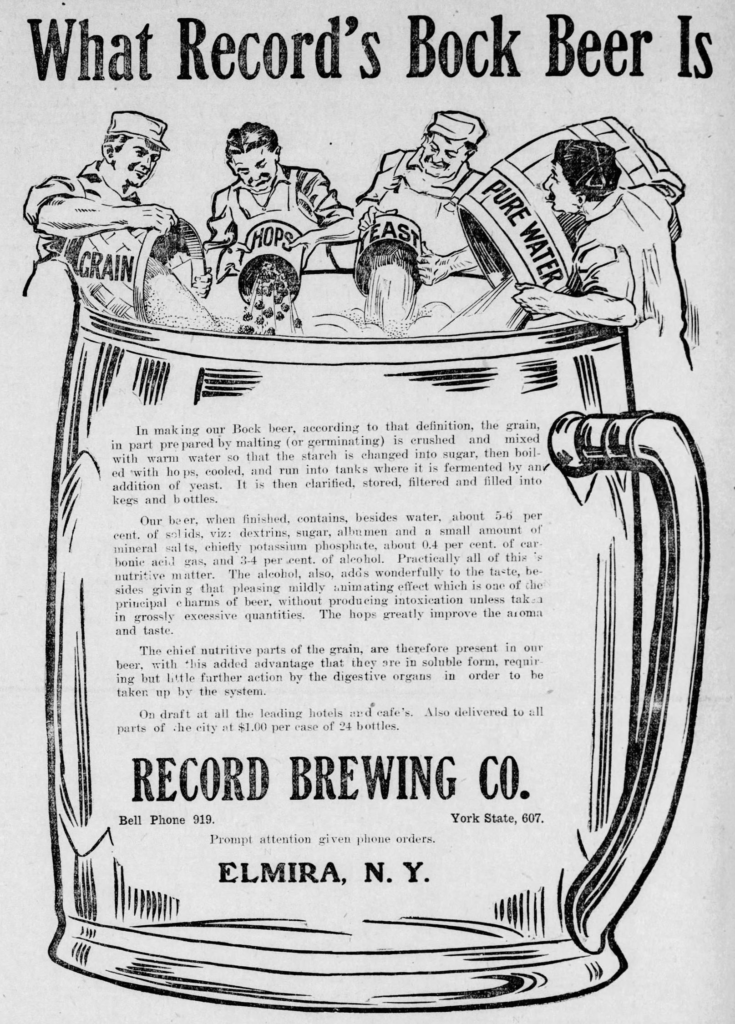
Friday’s second ad is for Bushkill Bock Beer, which was published on February 27, 1912. This one was for Record Brewing Co. of Elmira, New York and was founded in 1902. This ad ran in The Elmira Star Gazette, of Elmira, New York.
Today is the birthday of Albert Braun (February 27, 1863-February 27, 1895). He was born in Dusseldorf, Germany, and emigrated to the U.S. when he was 25, in 1888. He worked at several breweries, including Anheuser-Busch in St. Louis, before settling in Seattle in 1889. The following year he opened the Albert Braun Brewing Association. It was in business only un 1893, when it merged with several other local breweries to become part of the Seattle Brewing and Malting Company.
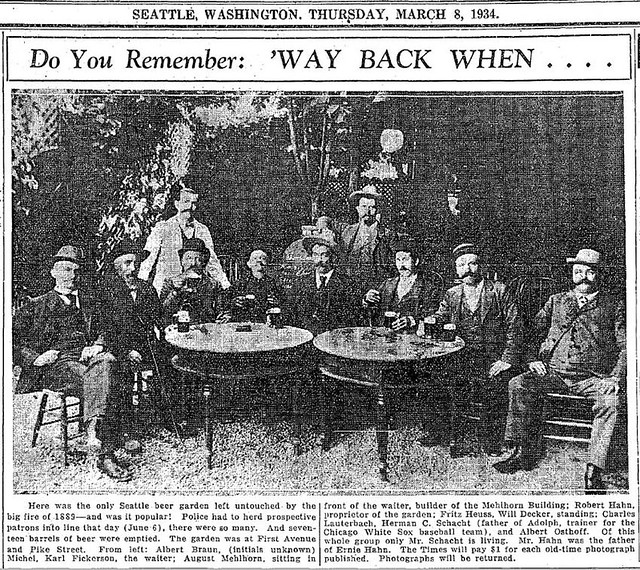
The only photograph I could find of Braun is in the group shot, which in ran in a nostalgia piece in the newspaper, in 1934. Braun is apparently seated at the far left.
This biography is from “An Illustrated History of the State of Washington, by Rev. H.K. Hines, published in 1893:
ALBERT BRAUN, vice-president of the Seattle Brewing and Malting Company was born at Dusseldorf, on the Rhine, Germany, in February, 1863. He was educated in the schools of Germany and then traveled quite extensively through the European countries. His business career began under the direction of his father, who was an extensive manufacturer of preserved fruits, vegetables, meats and fancy canned goods, and was continued in the same industry, in partnership with his brother at Mainz, on the Rhine.
In 1888 Mr. Braun sold his interest and came to the United States and, upon the advice of Adolphus Busch, president of the Anheuser- Busch Association, of St. Louis, Missouri, he entered the brewery of Peter Doelger, of New York, and learned the practical workings of the business, completing his instruction in the details at the Anheuser-Busch brewery in St. Louis.
In 1889 Mr. Braun made a trip through the Northwest, and, after a short visit in Seattle, he was so favorably impressed with the people and location of the city that he decided upon the city as a location for future settlement. He then returned to St. Louis and continued his studies of the brewery business up to March 1, 1890, when he again visited Seattle and at once engaged in the organization of the Albert Braun Brewing Association, which was incorporated with a capital of $250,000, he being duly elected president and general manager. The brewery was erected six miles south of Seattle, very complete in all its appointments, with a capacity of 70,000 barrels per year, the Product finding a ready market in Washington, region, Idaho and British Columbia. Continuing up to 1893, the Albert Braun Brewing Association was consolidated with the Bay View Brewing Company and the Claussen-Sweeney Brewing Company, and incorporated as the Seattle Brewing and Malting Company, with capital stock of $1,000,000. The affairs of the new association were conducted by the managers of the old breweries, the official corps being: Andrew Hemrich, President; Albert Braun, Vice-President; Edward F. Sweeney, Secretary; and Fred Kirschner, Treasurer.
The company expects to develop brewing and malting into one of the leading interests of the city of Seattle, and as their product has competed successfully with the best Eastern brands there is little doubt of an auspicious future.
Mr. Braun is also interested in various other enterprises of the city and he has perfect faith and confidence in the future of Seattle and the Sound districts.
According to Brewing in Seattle, by Kurt Stream, Braun was named Vice-President of Seattle Brewing and Malting. Here’s how it went down:
The Seattle Times also has a story about what happened to Braun’s brewery:
ALBERT BRAUN arrived from Iowa soon after Seattle’s Great Fire of 1889. Within a year and a half, the young German immigrant, with financial help from local and Midwestern investors, built a brewery about 2 miles south of Georgetown.
The serpentine Duwamish River is hidden behind the brewery. Directly across the river, on its west side and also hidden, was the neighboring community of South Park. Braun’s name is emblazoned on the brewery’s east facade, and so it was best read from the ridge of Beacon Hill and from the trains on the railway tracks below.
The brewing began here December 1890, and the brewery’s primary brands, Braun’s Beer, Columbia Beer and Standard Beer, reached their markets in March 1891. The 1893 Sanborn fire insurance map for Seattle includes a footprint of the plant that is faithful to this undated photograph. The map’s legend notes that the buildings were “substantial, painted in and outside” with “electric lights and lanterns” and that a “watchman lives on the premises.” It also reveals, surprisingly, that the brewery was “not in operation” since July of that year. What happened?
The economic panic of 1893 closed many businesses and inspired a few partnerships, too. Braun’s principal shareholders partnered his plant with two other big beer producers, the Claussen Sweeney and Bay Views breweries, to form the Seattle Brewing and Malting Co. Braun’s landmark was then designated “Albert Braun’s Branch.”
Of the three partnering breweries, this was the most remote, and it was largely for that reason, it seems, that it was soon closed. The upset Braun soon resigned; sold most of his interest in the partnership; and relocated to Rock Island, Ill. There, he started work on a new brewery and fell in love, but with tragic results: Early in 1895, Braun committed suicide, reportedly “over a love affair.”
For six years after its closing, the tidy Braun brewery beside the Duwamish River stood like a museum to brewing, but without tours. Practically all the machinery was intact, from its kettles to its ice plant, until the early morning of Sept. 30, 1899. On that day, The Seattle Times reported, “the nighthawks who were just making their way home and the milkmen, butchers and other early risers were certain that the City of Tacoma was surely being burned down.” They were mistaken. It was Braun’s brewery that was reduced to smoldering embers. The plant’s watchman had failed that night to engage the sprinkler system connected to the tank at the top of the five-story brewery.
There is at least a hint that the brewery grounds were put to good use following the fire. The Times, on Aug. 11, 1900, reported that the teachers of the South Park Methodist Episcopalian Sunday school took their classes “out for a holiday on the banks of the beautiful Duwamish River, (and for) a pleasant ride over the river to the Albert Braun picnic grounds.”
Gary Flynn filled in the gaps about what happened to Flynn after 1893, on his page on Braun at his website Brewery Gems:
Albert Braun took his own life, with a gun shot to the heart, on February 27, 1895, at the young age of 32. While still holding a significant number of Seattle Brewing & Malting Co. shares, he was not considered well-to-do in the matter of ready cash. Additionally, Braun had left Seattle for Illinois, after millionair brewer, Otto Huber, indicated that he was interested in partnering with Braun in the purchase of the LaSalle Brewing Co. For what ever reason Huber went back on his promise, leaving Braun with no immediate prospects and in a state of despair.
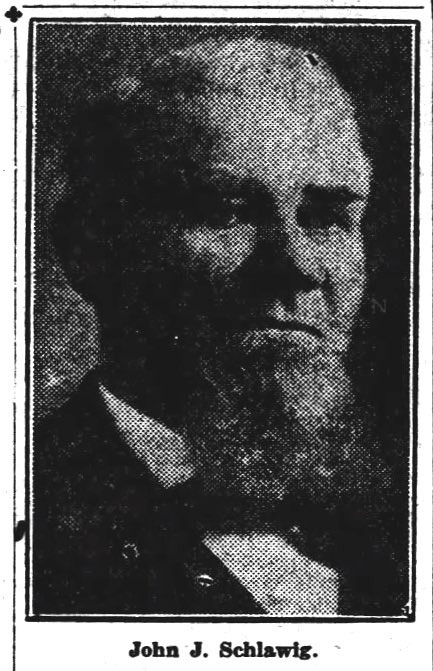
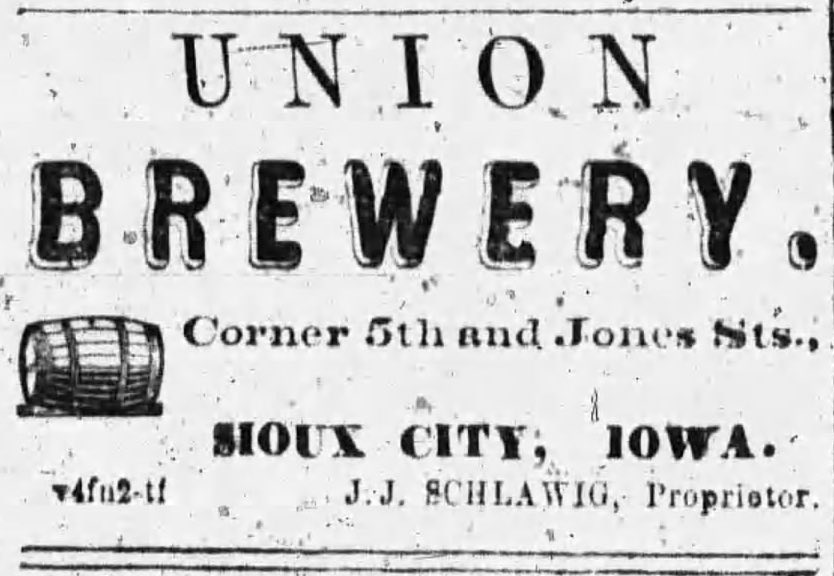
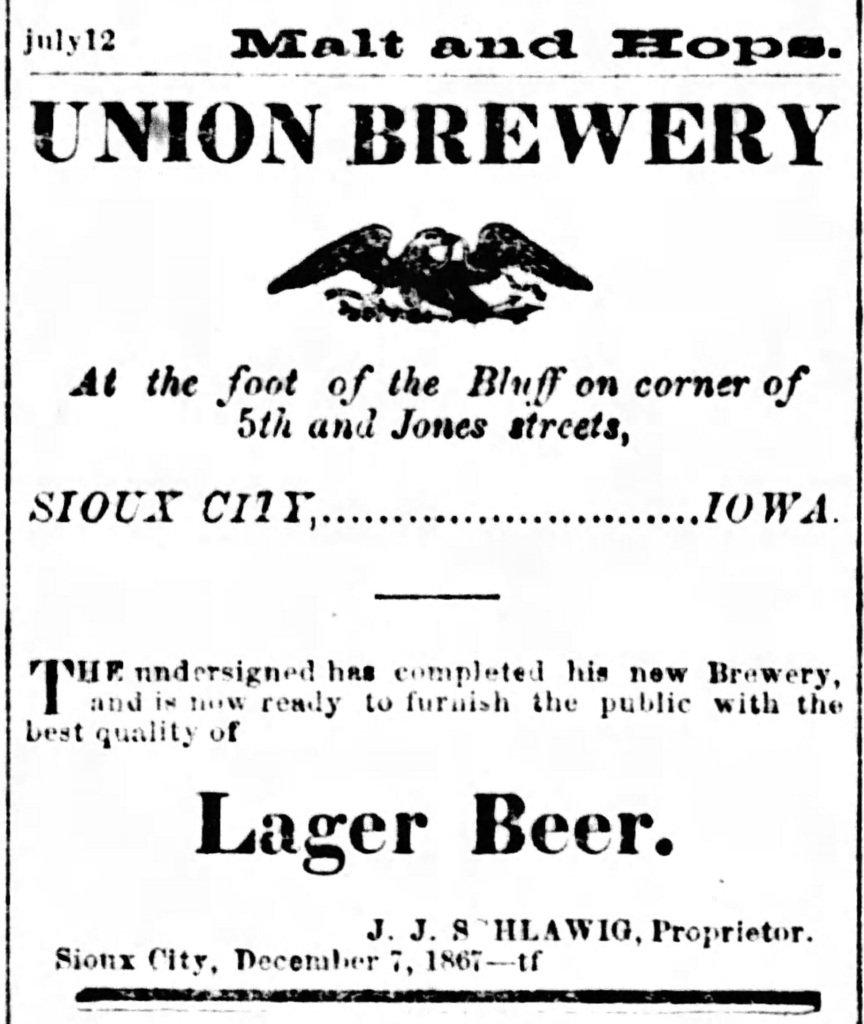
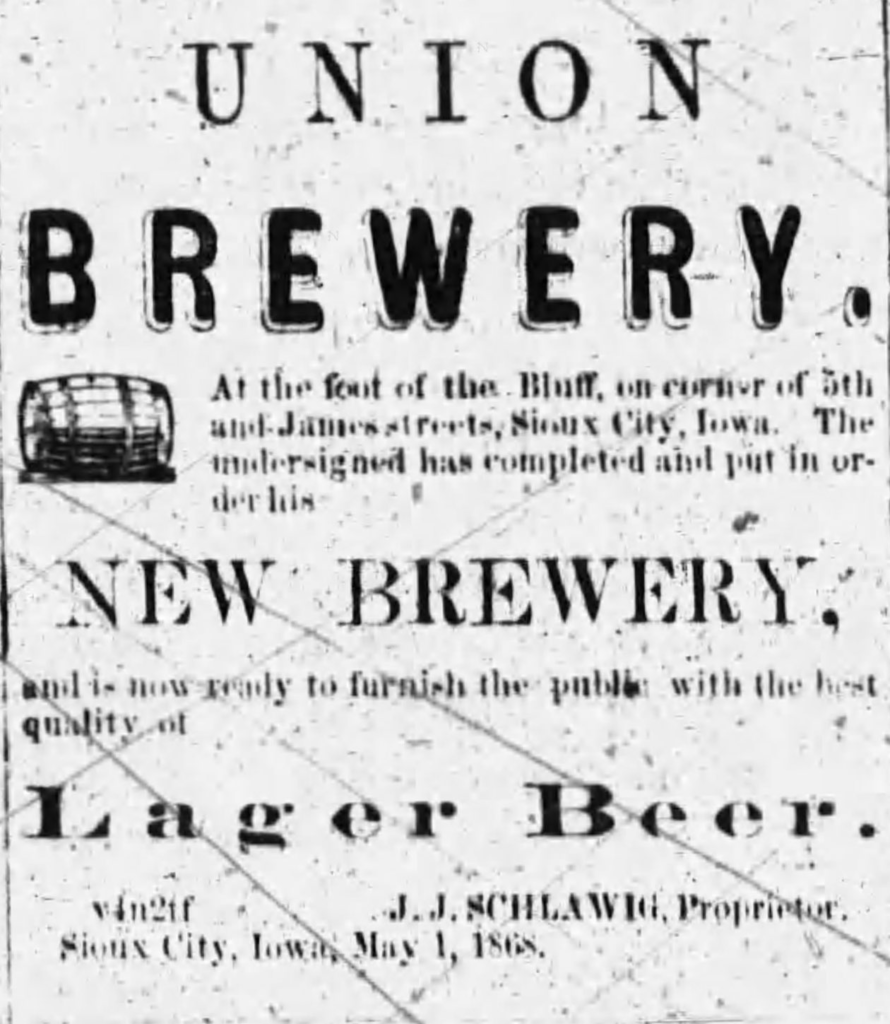
Today is the birthday of John Jacob Schlawig (February 27, 1831-October 11, 1919). He was born in Thusis, Graubünden, Switzerland but was a pioneer of Sioux City, Iowa, believed to be its longest resident at the time of his death in 1919. He married Ursula Haag on 20 September 1853, in Thusis, Graubünden, Switzerland and the couple moved to Iowa in 1857, settling in Sioux City. In 1867, he opened a brewery, the John Schlawig Union Brewery, which was only open until 1876. That same year, gold an silver were discovered in the Dakota Territories, and leaving his family in Iowa, became a miner off and on there for a number years. He also took his brewing equipment and established the J.J. Schlawig Brewery (a.k.a. as J.J.S. Brewery) in Deadwood, South Dakota, though it only lasted one year, closing in 1877.
Here’s a biography of Schlawig from The Sioux City Tribune from October 11, 1919:
J. J. Schlawig Dies, Aged 88 Years; Had Lived in Sioux City Since 1857. Pioneer Believed to Hold Record For Longest Residence Here. Taken By Death Before New Home Was Completed. Family Homestead Recently Sold.
John J. Schlawig, who is believed to have lived longer in Sioux City and to have witnessed more of its growth than any other man, died at 9 a.m. today at the home of his daughter, Mrs. C. A. Patch, 2324 Douglas street, from the infirmities of old age. Mr. Schlawig was born in Thusis, Switzerland. There he married Miss Ursula Haag, 67 years ago. His wife died here one month before the celebration of their golden wedding. He is survived by three daughters, one son, two grandsons and one granddaughter. Dr. J. J. Schlawig, a son, died here 17 years ago. The other son is Dr. William M. Schlawig, of Monument, Col., who has been in the city for the last week. The daughters are Miss Anna Schlawig, who has made the home for her father since the death of the mother; Mrs. R. E. Conniff, and Mrs. Patch at whose home he died. John B. and Arthur C. Patch and Miss Anna Marie Conniff are the grandchildren. He came to Sioux City 62 years ago. He was a wagon and carriage maker and manufactured the first wagon and the first carriage ever made in the city. In 1861 Mr. Schlawig enlisted in Company I of the Seventh Iowa cavalry, a civil war unit of which only two or three men survive. He served as bugler of the regiment and as bodyguard of General Sully. He participated in the White Stone battle.
This is from a “History of Woodbury and Plymouth Counties,” published in 1890:
John Jacob Schlawig, Sioux City. In the picturesque city of Thuses, Canton of Graubunden, Switzerland, February 27, 1831, there was born to one of the oldest families in that historic country an only son, the subject of this sketch, John Jacob Schlawig. His ancestry was prominently identified with the political history of Switzerland, and took an active part in the defense of their land against the invasion of other powers; and a grandfather fell in the gallant defense made against the French army in the battle of Richenan. His early education was acquired among his native hills, where he learned to love the freedom of his Fatherland, and despise the serfdom and oppression of neighboring monarchies. At the age of eighteen he removed to Chur, where he learned the trade of a carriage-maker. There he met and wedded, September 20, 1853, Miss Ursula Haag, the daughter of an old citizen of that city. For some years thereafter he followed his trade, but all the while longing for the greater possibilities offered in America to industry and integrity. In 1857 the dream of his youth was realized when he embarked for this country, taking with him his young wife and two children. On reaching America he pushed westward, believing that that region promised better opportunities to willing hearts and ready hands. He first stopped in Dubuque for a few months, then crossed the state overland by team to Sioux City. On this trip the second daughter, a child of two years, sickened and died, which well nigh discouraged him and his young wife, but they journeyed on, reaching Sioux City, then a frontier village, September 19, 1857. He immediately set to work to procure for himself and family a home. He erected a crude shop and worked at his trade, making and repairing wagons, and built the first wagon made in Sioux City. At the outbreak of the Civil war he offered himself as a volunteer in the defense of his adopted country, and served from 1861 to 1864 in the Seventh Iowa cavalry, Company I. He was with Gen. Sully in his famous expedition against the hostile Sioux, and took part in the battle of White Stone Hill and other engagements. At the close of hostilities he received his honorable discharge, and re-engaged in the wagonmaker’s trade in this city.
In 1875 he was one of the pioneers of the Black Hills, S. D., country, where he prospected extensively, and located several silver mines at Galena, which he afterward consolidated into the Washington Gold and Silver Mining company, of which company he is the principal owner and president. He also owns the Sula mine, at Lead City, S. D. His mining property is well located, and among the best and richest mines in that wonderfully productive mineral region. In the summer of 1890 he platted what is known as Sunny Side addition to Lead City, and a large part of which he still owns. His family consists of two sons and three daughters. The oldest son, John J., is a rising young physician, while the younger, William, is now in college, preparing himself for the practice of dentistry. Two daughters, Anna and Marie, are still at home, the other, Christina, is the wife of Dr. R. E. Conniff, of this city. Mr. Schlawig has always had abundant faith in the future of Sioux City, and has seen it grow from a frontier village to a city of nearly 40,000. He, with other old settlers, endured many of the privations of the early history of Sioux City. His industry and abiding faith in the future of the city have been rewarded by material prosperity, and we find him in his old age surrounded by the comforts of life, and with a competence that jjlaces him above want and secures for him that ease that his industry deserves. Mr. Schlawig is still a man in robust health, of a jovial, kindly disposition that makes and keeps friends, and is respected and esteemed by all that know him.
And this account is from Tavern Trove’s page for Schlawig:
John Jacob Schlawig was born in Thusis, Graubünden, Switzerland where he was trained as a wagon maker. In 1855 he emigrated to America with his wife Ursula (née Haag) and their two daughters. They reached their intended destination of Dubuque, Iowa that summer, but after only a few months they relocated to Sioux City.
In 1855 Sioux City was a hamlet situated on the banks of Perry Creek, far from the noise and nuisance of the lawless frontier town of Dubuque. The Schlawigs made Sioux City their home and John opened a wagon shop on Water Street. He participated in the local guard that defended the area from Sioux warriors who considered the land the property of the Sioux.
In 1861 John Jacob answered the patriotic call of his adopted country and enlisted in the Union Army. The U.S. generals sent him not south but west, to continue the battle with the Native Americans. After his service he returned to Sioux City and opened a brewery next to his home on 6th and Nebraska Street.
For a nearly a decade Schlawig was content in his brewery on the creek. He had three daughters and two sons at home. He took on Joseph Rechner as a foreman and they opened up The William Tell Beer Hall. By all accounts business was good.
Then in 1875 Iowa’s ever-changing Temperance laws caused business strife. The city sued Schlawig for breaking liquor and gambling ordinances. Then his former foreman and another employee sued him for back wages. All three verdicts came down against the brewer and like that, the tidy brewing empire Schlawig built was finished. Schlawig mortgaged the brewery property in February and offered it for sale in November.
In 1876 news came from the west that gold and silver was there for the taking in the Dakota Territory. Schlawig decided to check it out. At age 45 Schlawig filed a miners claim on Bear Butte and rushed back to Iowa in order to pack up his brewery equipment and relocate to the town of Deadwood. He arrived in April of 1876, and, while he retained his residence in Sioux City, over the next decade he spent less and less time there, and more time in the boom town nearly 500 miles away.
By July of 1876 Schlawig was mining by day and brewing at night and both enterprises were earning money. But within the year he will have abandoned the brewery in favor of his silver mine. In February of 1877, when he returned to Iowa he talked only of silver. In June of that year the Sioux City Journal reportedthat Schlawig’s brewery in Deadwood was sitting idle.
Up in the hills Schlawig had hit a vein of silver so rich that soon his brewery debts would soon be a small matter. The Washington Lode, as it was called, was one of the most valuable veins of silver in the Black Hills, and Schlawig had claim to a good bit of it. It ended up making him a very wealthy man.
With the help of Schlawig’s money Sioux City prospered and his old house on 6th and Nebraska Street grew old with him. By 1919 it was considered an eyesore in the business district, and also very valuable property. In April of 1919, 88 year old Schlawig was finally persuaded to move out of the home he built in the 1860s. By that October, he was dead.
John Jacob Schlawig died on October 11th 1919 at age 88 years.
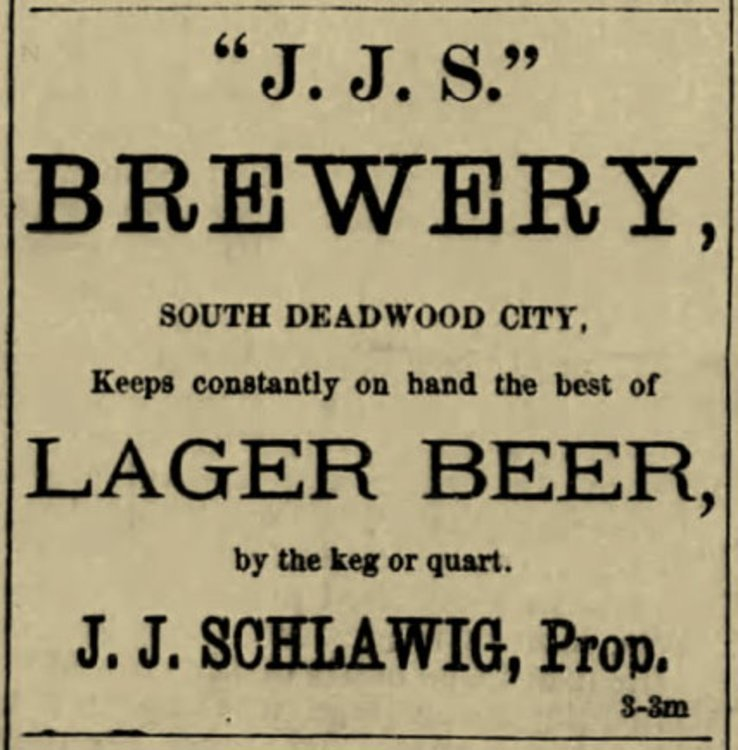
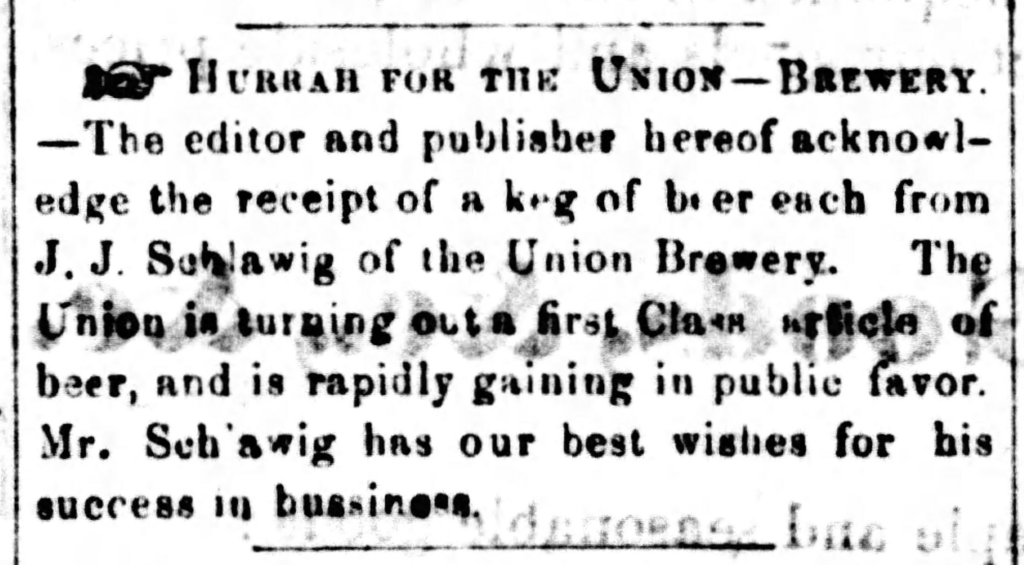
And this was published shortly after the brewery opened: