Brookston Beer Bulletin

Jay R. Brooks on Beer

  • Home
  • About
  • Editorial
  • Birthdays
  • Art & Beer

Socialize

  • Dribbble
  • Email
  • Facebook
  • Flickr
  • GitHub
  • Instagram
  • LinkedIn
  • Pinterest
  • RSS
  • Twitter
  • YouTube

Powered by Genesis

Beer In Ads #5195: It’s The Time Of Year For Pearl Bock Beer

February 7, 2026 By Jay Brooks

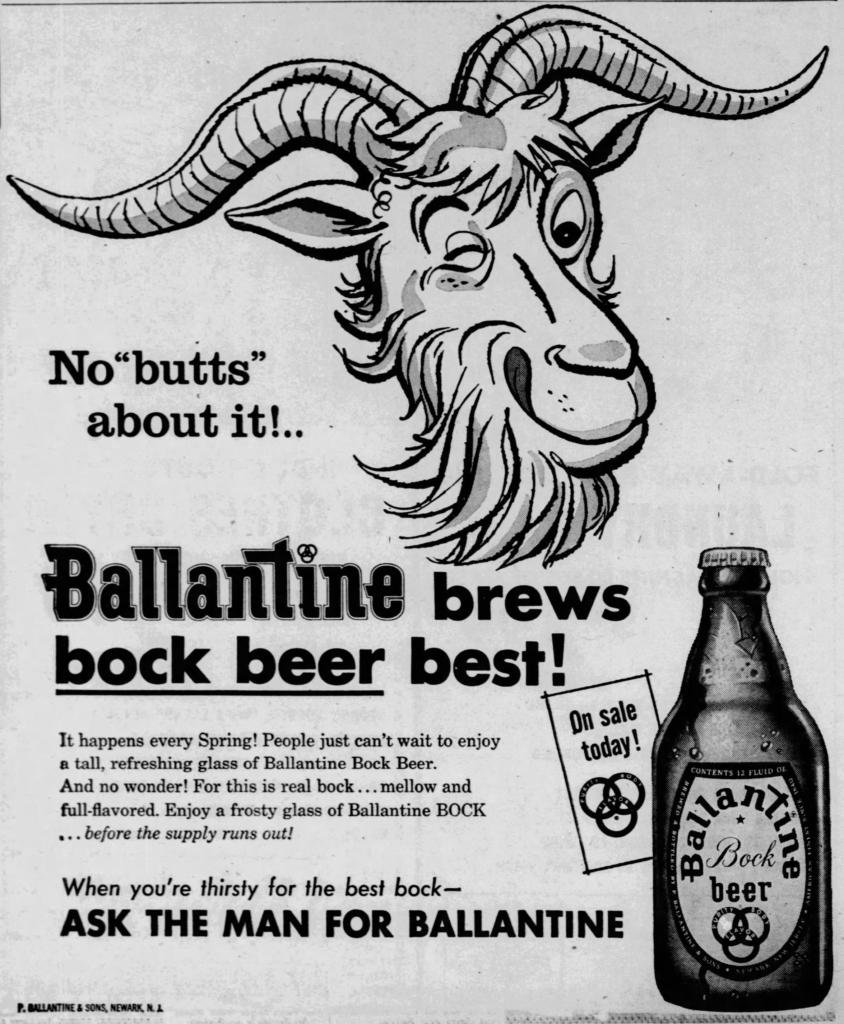
Two years ago I decided to concentrate on Bock ads for awhile. Bock, of course, may have originated in Germany, in the town of Einbeck. Because many 19th century American breweries were founded by German immigrants, they offered a bock at certain times of the year, be it Spring, Easter, Lent, Christmas, or what have you. In a sense they were some of the first seasonal beers. “The style was later adopted in Bavaria by Munich brewers in the 17th century. Due to their Bavarian accent, citizens of Munich pronounced ‘Einbeck’ as ‘ein Bock’ (a billy goat), and thus the beer became known as ‘Bock.’ A goat often appears on bottle labels.” And presumably because they were special releases, many breweries went all out promoting them with beautiful artwork on posters and other advertising.

Saturday’s ad is for Pearl Bock Beer, which was published on February 7, 1964.  This one was for Pearl Brewing Co., of San Antonio, Texas and was founded in 1883. This ad ran in The San Antonio Express, also of San Antonio, Texas.

Filed Under: Art & Beer, Beers, Breweries, Just For Fun Tagged With: Advertising, Bock, History, Texas

Historic Beer Birthday: Morton Coutts

February 7, 2026 By Jay Brooks

db-breweries
Today is the birthday of Morton W. Coutts (February 7, 1904-June 25, 2004) who was a “New Zealand inventor who revolutionized the science of brewing beer,” and “is best known for the continuous fermentation method.”

Here’s a basic biography from the DB Breweries website:

Morton Coutts (1904-2004) was the inheritor of a rich brewing tradition dating back to the 19th century. Like his father, W. Joseph Coutts and grandfather, Joseph Friedrich Kühtze, Morton Coutts was more an innovator and scientific brewer than a businessman. He was foundation head brewer of Dominion Breweries Ltd under (Sir) Henry Kelliher and became a director of the company after his father’s death in 1946. He and Kelliher formed a formidable team-Coutts, the boffin-like heir to a rich brewing heritage, obsessed with quality control and production innovation, and Kelliher, a confident, entrepreneurial businessman, able to hold his own with politicians and competitors.

continuous-fermentation

Morton Coutts’ most important contribution was the development in the 1950s of the system of continuous fermentation, patented in 1956, to give greater beer consistency and product control. The continuous fermentation process was so named because it allows a continuous flow of ingredients in the brewing, eliminating variables to produce the ideal beer continuously. The system achieved this by scrapping open vats-the weak link in the old system-and replacing them with enclosed sealed tanks. Continuous fermentation allows the brew to flow from tank to tank, fermenting under pressure, and never coming into contact with the atmosphere, even when bottled. Coutts’ research showed that his process could produce consistent, more palatable beer with a longer shelf life than under batch brewing. A London newspaper described it as a “brewer’s dream and yours too”. Coutts patented the process, and subsequently the patent rights were sold worldwide as other brewers recognised the inherent benefits of continuous processes. Although many attempted to implement the technology, most failed due to their inability to apply the rigorous hygiene techniques developed and applied by Coutts. Eventually, in 1983, Coutts’ contribution to the industry was honoured in New Zealand.

And DB Breweries also has a timeline with key events in the brewery’s history, including dates from Coutts’ life.

Waitemata-Brewery
The Waitemata Brewery in 1933, after it became part of DB Breweries.

As for his most influential invention, continuous fermentation, here are some resources, one from New Zealand’s Science Trust Roadshow with Morton Coutts — Continuous Fermentation System. And after I visited New Zealand, I wrote a sidebar on it for an article I did for All About Beer, and also later when a German university announced something very similar a few years ago in Everything Old Is New Again: Non-Stop Fermentation.

continuous-fermentation

MortonCouttsNZBeerinnovatorchangedglobalprocesses
Coutts later in life.
Also, here’s the story of him creating DB Export The Untold Story, featuring this fun video.

Filed Under: Birthdays, Breweries, Just For Fun Tagged With: History, New Zealand, Science of Brewing, Video

Beer In Ads #5194: Ring In Spring With Pearl Bock Beer

February 6, 2026 By Jay Brooks

Two years ago I decided to concentrate on Bock ads for awhile. Bock, of course, may have originated in Germany, in the town of Einbeck. Because many 19th century American breweries were founded by German immigrants, they offered a bock at certain times of the year, be it Spring, Easter, Lent, Christmas, or what have you. In a sense they were some of the first seasonal beers. “The style was later adopted in Bavaria by Munich brewers in the 17th century. Due to their Bavarian accent, citizens of Munich pronounced ‘Einbeck’ as ‘ein Bock’ (a billy goat), and thus the beer became known as ‘Bock.’ A goat often appears on bottle labels.” And presumably because they were special releases, many breweries went all out promoting them with beautiful artwork on posters and other advertising.

Friday’s ad is for Pearl Bock Beer, which was published on February 6, 1962.  This one was for Pearl Brewing Co., of San Antonio, Texas and was founded in 1883. This ad ran in The El Paso Herald-Post, of El Paso, Texas.

Filed Under: Art & Beer, Beers, Breweries, Just For Fun Tagged With: Advertising, Bock, History, Texas

Historic Beer Birthday: Henry Miller

February 6, 2026 By Jay Brooks

duquesne

Today is the birthday of Henry Miller (February 6, 1857-August 19, 1902). He was born in Pennsylvania, and was originally a furniture salesman. But later in life he co-founded the Duquesne Brewing Company in 1899, serving as its first president. They were one of the first breweries to pasteurize their bottled beer, the original Duquesne Lager and Silver Top, which quickly began outselling local and out-of-state competitors, and turning the business it into a large regional brewer. But in 1905, they merged with 16 breweries in the area to create the Independent Brewing Co. of Pittsburgh. They survived prohibition and by 1940 were the nation’s eighth-largest brewery, but closed for good in 1972.

Duquesne-Brewery

There wasn’t much information, or even a picture, I could find of Miller. But here is a short obituary of him from the American Brewers Review:

Henry-Miller-obit
Duquesne-Pilsener
Duquesne-Pittsburgh_Post_Gazette_Mon__Dec_2__1935_
Duquesne-Pilsener-2

Filed Under: Birthdays, Breweries, Just For Fun Tagged With: History, Pennsylvania

Beer In Ads #5193: Washington’s Favorite! Senate Bock Is Back

February 5, 2026 By Jay Brooks

Two years ago I decided to concentrate on Bock ads for awhile. Bock, of course, may have originated in Germany, in the town of Einbeck. Because many 19th century American breweries were founded by German immigrants, they offered a bock at certain times of the year, be it Spring, Easter, Lent, Christmas, or what have you. In a sense they were some of the first seasonal beers. “The style was later adopted in Bavaria by Munich brewers in the 17th century. Due to their Bavarian accent, citizens of Munich pronounced ‘Einbeck’ as ‘ein Bock’ (a billy goat), and thus the beer became known as ‘Bock.’ A goat often appears on bottle labels.” And presumably because they were special releases, many breweries went all out promoting them with beautiful artwork on posters and other advertising.

Thursday’s ad is for Pabst Bock Beer, which was published on February 5, 1940.  This one was for Christian Heurich Brewing Co., of Washington, D.C. and was founded in 1872. This ad ran in The Evening Star, also of Washington, D.C.

Filed Under: Art & Beer, Beers, Breweries, Just For Fun Tagged With: Advertising, Bock, D.C., History, Washinton D.C.

Historic Beer Birthday: John L. Hoerber Jr.

February 5, 2026 By Jay Brooks

hoerber
Today is the birthday of John L. Hoerber Jr. (February 5, 1848-April 1, 1927). His father, John L. Hoerber, founded the John L. Hoerber Brewery in 1858 of Chicago, Illinois, located at 186 Griswold Street. There was very little information I could find about him or his son, not even a photo. But their brewery appears to have taken on a partner in 1864, and was renamed the Hoerber & Gastreich Brewery, but just one year later was hte John L. Hoerber Brewery again. But in 1865 it was sold. As far as I can tell, another John L. Hoerber Brewery was opened in 1864, located at 216/224 West 12th Street, but appears to also have been sold in 1882. Then in 1882, yet another brewery was opened at 646/662 Hinman & 22nd Streets, though it 1885 it changed its name again from brewery to the John L. Hoerber Brewing Co., which is stayed until prohibition. After prohibition, it reopened as The Hoerber Brewing Co., and remained in business until 1941, when it closed for good.

hoerber-draught
There’s some information about junior in “The Book of Chicagoans: A Biographical Dictionary of Leading Living Men of the City of Chicago,” published in 1911:

John-Hoerber-Jr-bio
Hoerbers-Beer-Labels-Hoerber-Brewing-Company
Chicago historian and beer writer Bob Skilnik had an article in the Chicago Tribune that mentioned the Hoerber Brewery in 1997:

A population increase from a few hundred in 1833 to more than 100,000 in 1860 opened the market and made success possible for scores of brewers. In 1857, the city council ordered the grades of all existing properties to be raised to a height that would ensure proper drainage. John Hoerber used this opportunity to raise his combination saloon, store and boardinghouse and install a small brewery underneath, pumping fresh beer to his customers. By doing so, Hoerber beat the now-defunct Siebens on West Ontario by about 150 years for the title of Chicago’s first brew pub.

Cream-of-Malt-Premium-Beer-Labels-Hoerber-Brewing-Company
Hoerber-Beer-Labels-Hoerber-Brewing-Company

Filed Under: Birthdays, Just For Fun Tagged With: History, Illinois

Historic Beer Birthday: Henry C. Moffat

February 5, 2026 By Jay Brooks

Today is the birthday of Henry C. Moffat (February 5, 1844-December 30, 1920). He was son of James Moffat, who along with his father John founded one of the earliest breweries in Buffalo, New York in 1833. It was later called the James Moffat Brewery, and after that the Moffat & Service Brewery. After his father died, Henry took over the brewery, renaming it the Henry C. Moffat Brewery in 1890, which was closed by Prohibition in 1920. It briefly reopened after repeal, in 1934, as Moffat’s Ale Brewery, but closed for good the same year.

moffats-brewery-truck

There’s surpringly little information I could find about Henry himself, not even a photograph. This account of his brewery is from “100 Years of Brewing,” published in 1903:

moffats-drawing

According to John & Dave’s Buffalo Brewing History, John Moffat, along with his son James, acquired what was Buffalo’s second brewery and named it the Moffat Brewery.

Kane, Peacock and Relay brewery was short lived however and a 1909 article in the Buffalo Evening Times indicates John Moffat and his son James purchased the brewing operation around 1833. Also, the 1836 Buffalo City Directory lists Moffat as a brewer at that location. The 1839 Directory lists James Moffat & Co. as a “Brewery, Soap and Candle Factory”. The Moffat Brewery continued in operation until son James died and it was sold to Arthur Fox and became the Fox and Williams Brewery. In 1876 it was sold back to the Moffat family and continued in operation at the same location until the advent of Prohibition forced their closure in 1920. After Prohibition the Phoenix Brewery continued brewing “Moffats Pale Ale” through an agreement with the Moffat family.

And “History of the City of Buffalo and Erie County, Volume 2,” published in 1884, has this to say about Buffalo’s earliest brewers, including Moffat:

buffalo-brewers

moffats-brewery

Filed Under: Birthdays, Breweries, Just For Fun Tagged With: History, New York

Beer In Ads #5192: Pabst 1915 Bock Beer

February 4, 2026 By Jay Brooks

Two years ago I decided to concentrate on Bock ads for awhile. Bock, of course, may have originated in Germany, in the town of Einbeck. Because many 19th century American breweries were founded by German immigrants, they offered a bock at certain times of the year, be it Spring, Easter, Lent, Christmas, or what have you. In a sense they were some of the first seasonal beers. “The style was later adopted in Bavaria by Munich brewers in the 17th century. Due to their Bavarian accent, citizens of Munich pronounced ‘Einbeck’ as ‘ein Bock’ (a billy goat), and thus the beer became known as ‘Bock.’ A goat often appears on bottle labels.” And presumably because they were special releases, many breweries went all out promoting them with beautiful artwork on posters and other advertising.

Wednesday’s ad is for Pabst Bock Beer, which was published on February 4, 1915.  This one was for Pabst Brewing Co., of Milwaukee, Wisconsin and was founded in 1844. This ad ran in The Oshkosh Northwestern, of Oshkosh, Wisconsin.

Filed Under: Art & Beer, Beers, Breweries, Just For Fun Tagged With: Advertising, Bock, History, Pabst, Wisconsin

Historic Beer Birthday: Peter P. Straub Jr.

February 4, 2026 By Jay Brooks

straub
Today is the birthday of Peter P. Straub Jr. (February 4, 1893-October 29, 1972). He was the son of Peter Straub, who founded the Straub Brewery in St. Mary’s, Pennsylvania in 1872. The brewery is still owned and operated today by the Straub family.

Peter P. Straub Jr. in the early 1900s.

Peter Jr. was president of the brewery after his brother Andrew.

straub-family-1904
The Straub Family in 1904. Peter Jr. is in the second row, the first person from the left.

Early on, Peter introduced his sons to the world of brewing. Straub used wooden kegs for his beer. He always placed a red band around his barrels to ensure that people would know they were drinking his beer and so that he would get them back. As a lasting trademark tribute to Peter, the brewery continues to place a bright red band around each of its barrels. Red has become a trademark color for the brewery.

Jacob-Francis-and-Peter-P-Straub
Peter (on the right) with his brothers Jacob and Francis.

Following Peter’s death on December 17, 1913, his sons assumed control of the brewery, renaming it the Peter Straub Sons Brewery. During this time, the brewery produced Straub Beer as well as other beer, such as the pilsner-style Straub Fine Beer and Straub Bock Beer. In 1920, the Straub Brothers Brewery purchased one half of the St. Marys Beverage Company, also called the St. Marys Brewery, where St. Marys Beer was produced. During Prohibition, which lasted from January 29, 1920, until December 5, 1933, the brewery produced nonalcoholic near-beer. On July 19, 1940 they purchased the remaining common stock and outstanding bonds of the St. Marys Beverage Company.

straub-brewery-1895-closeup
The Benzinger Spring Brewery in 1895.

Filed Under: Birthdays, Breweries, Just For Fun Tagged With: History, Pennsylvania

Historic Beer Birthday: Louis Camille Maillard

February 4, 2026 By Jay Brooks

Today is the birthday of French physician and chemist Louis Camille Maillard (February 4, 1878-May 12, 1936) who was the Doogie Howser of his era, joining the faculty of the University of Nancy when he was only sixteen. He rose to prominence thanks to his work on kidney disorders and later taught medicine at the prestigious University of Paris.

But his biggest contribution, especially to brewing, was an accidental discovery he made in 1912, which today we call the Maillard Reaction, or Browning Reaction.

Here’s the basic description, from Wikipedia:

The Maillard Reaction a chemical reaction between amino acids and reducing sugars that gives browned food its desirable flavor. Seared steaks, pan-fried dumplings, biscuits (widely known in North America as cookies), breads, toasted marshmallows, and many other foods undergo this reaction. It is named after French chemist Louis-Camille Maillard, who first described it in 1912 while attempting to reproduce biological protein synthesis.

The reaction is a form of non-enzymatic browning which typically proceeds rapidly from around 140 to 165 °C (284 to 329 °F). At higher temperatures, caramelization and subsequently pyrolysis become more pronounced.

The reactive carbonyl group of the sugar reacts with the nucleophilic amino group of the amino acid, and forms a complex mixture of poorly characterized molecules responsible for a range of odors and flavors. This process is accelerated in an alkaline environment (e.g., lye applied to darken pretzels), as the amino groups (RNH3+) are deprotonated and, hence, have an increased nucleophilicity. The type of the amino acid determines the resulting flavor. This reaction is the basis of the flavoring industry. At high temperatures, a potential carcinogen called acrylamide can be formed.

In the process, hundreds of different flavor compounds are created. These compounds, in turn, break down to form yet more new flavor compounds, and so on. Each type of food has a very distinctive set of flavor compounds that are formed during the Maillard reaction. It is these same compounds that flavor scientists have used over the years to make reaction flavors.

It was, and is, for food science and understanding how heat and cooking create flavors. If you want to dive deeper, the Warwick Medical School has an article on the Historical Development of the reaction, and NPR’s Food for Thought on the centenary of Malliard’s discovery posted 100 Years Ago, Maillard Taught Us Why Our Food Tastes Better Cooked.

But it was also very important to brewing, too, especially when it comes to malting and roasting malt to get different flavors and colors in the beer. For example, here’s UC Davis professor Charlie Bamforth writing about the Malliard Reaction in his book Grape vs. Grain.

Not surprisingly, John Mallett, in his book Malt: A Practical Guide from Field to Brewhouse, mentions Malliard’s contributions to brewing science.

Mallet-malliard-1
Mallet-malliard-2

The chemistry website Compound Interest has a good explanation with their post, Food Chemistry – The Maillard Reaction.

Food-Chemistry-Maillard-Reaction
And finally, Popular Science’s BeerSci series discusses the Maillard Reaction in How Beer Gets Its Color.

Filed Under: Birthdays, Just For Fun, Related Pleasures Tagged With: History, Malt, Science of Brewing

« Previous Page
Next Page »

Find Something

Northern California Breweries

Please consider purchasing my latest book, California Breweries North, available from Amazon, or ask for it at your local bookstore.

Recent Comments

  • Bob Paolino on Beer Birthday: Grant Johnston
  • Gambrinus on Historic Beer Birthday: A.J. Houghton
  • Ernie Dewing on Historic Beer Birthday: Charles William Bergner 
  • Steve 'Pudgy' De Rose on Historic Beer Birthday: Jacob Schmidt
  • Jay Brooks on Beer Birthday: Bill Owens

Recent Posts

  • Beer Birthday: Dave Suurballe August 6, 2026
  • Historic Beer Birthday: Timothy Taylor August 6, 2026
  • Beer In Ads #5312: Bock Chasse Royale August 5, 2026
  • Historic Beer Birthday: Jacob Ruppert, Jr. August 5, 2026
  • Beer Birthday: Ben McFarland August 5, 2026

BBB Archives

Feedback

Head Quarter
This site is hosted and maintained by H25Q.dev. Any questions or comments for the webmaster can be directed here.