Brookston Beer Bulletin

Jay R. Brooks on Beer

  • Home
  • About
  • Editorial
  • Birthdays
  • Art & Beer

Socialize

  • Dribbble
  • Email
  • Facebook
  • Flickr
  • GitHub
  • Instagram
  • LinkedIn
  • Pinterest
  • RSS
  • Twitter
  • YouTube

Powered by Genesis

Historic Beer Birthday: Daniel Jung

February 11, 2026 By Jay Brooks

jung-red-heart
Today is the birthday of Daniel Jung (February 11, 1822-December 2, 1877). A member of one of several Jung families in brewing, Daniel was born in Rheinland-Pfalz, Germany, but settled in the Cincinnati area of Ohio, where he founded a brewery that eventually would bear his name.

Daniel-Jung-portrait

When it was first opened in 1857, along with partner Peter Weyand, it was called the Western Brewery (some sources say 1854). In 1879, they added a third investor, and it became the Weyand, Jung & Heilman Brewery. It 1885, with Jung apparently sole owner, it is renamed the Jung Brewing Co., which it remained until 1908, when it went back to being the Western Brewery, before closing due to prohibition in 1919.

Jung-letterhead

But I’ve been unable to find much about Jung personally, about his life. The only obituary I uncovered was in German, and was a scan, meaning I couldn’t just copy it into Google Translate. I know he came to New York from Germany in his early 20s, but returned home for a number of years, before returning via New Orleans and making his way to Cincinnati, where he stayed for the rest of his life.

I do really love their branding, though. They marketed their beers under the name “Red Brand Beer,” with a bright red heart. So many labels of this time period are dull and similar, while this one really seems to stand out. I’d love to see more of their labels and artwork, but unfortunately there doesn’t seem to be much out there lurking on the interwebs. Even their slogan is pretty awesome. “Creates & Sustains Life.”

Jung-tray

Here’s yet another account of his brewery history.

In 1857, Peter Weyand and Daniel Jung established the Western Brewery on Freeman and Bank Streets in Cincinnati, Ohio. In 1879, Weyand and Jung partnered with Max Hellman and operated the brewery until 1885. In 1885, following the deaths of Peter Weyand and Daniel Jung, the brewery was renamed the Jung Brewing Company. The Jung Brewing Company operated from 1885 to 1890. In 1890, the brewery was sold and merged with Cincinnati Breweries Company.

A label from their Old Lager.

Filed Under: Birthdays, Breweries, Just For Fun Tagged With: History, Ohio

Beer In Ads #5198: Back Again! Wiedemann’s Genuine Bock Beer

February 10, 2026 By Jay Brooks

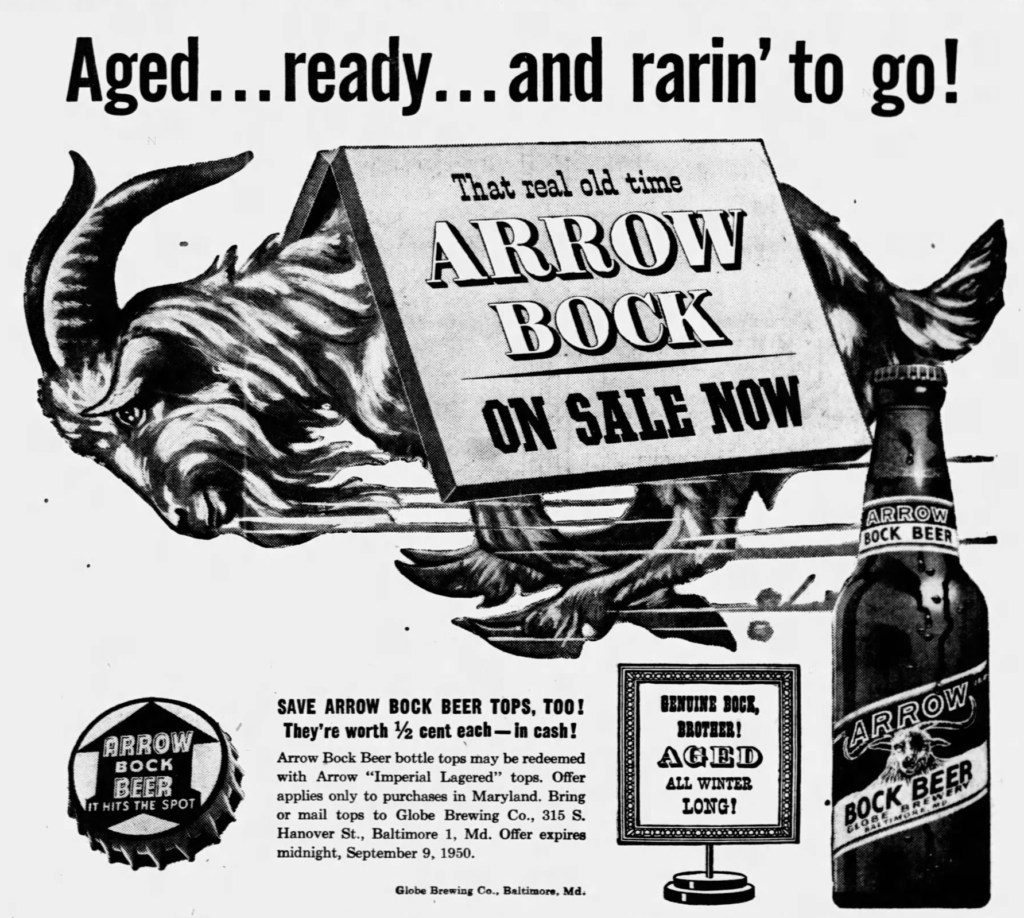
Two years ago I decided to concentrate on Bock ads for awhile. Bock, of course, may have originated in Germany, in the town of Einbeck. Because many 19th century American breweries were founded by German immigrants, they offered a bock at certain times of the year, be it Spring, Easter, Lent, Christmas, or what have you. In a sense they were some of the first seasonal beers. “The style was later adopted in Bavaria by Munich brewers in the 17th century. Due to their Bavarian accent, citizens of Munich pronounced ‘Einbeck’ as ‘ein Bock’ (a billy goat), and thus the beer became known as ‘Bock.’ A goat often appears on bottle labels.” And presumably because they were special releases, many breweries went all out promoting them with beautiful artwork on posters and other advertising.

Tuesday’s ad is for Wiedemann’s Genuine Bock Beer, which was published on February 10, 1953.  This one was for Geo. Wiedemann Brewing Co., of Newport, Kentucky and was founded by John Butcher in 1860, though Wiedemann become involved fairly early, at least by 1870. This ad ran in The Cincinnati Post, of Cincinnati, Ohio. I love that they mention at the bottom that “It’s Registered, Too!”

Filed Under: Art & Beer, Beers, Breweries, Just For Fun Tagged With: Advertising, Bock, History, Ohio

Historic Beer Birthday: Jacob Hammel

February 10, 2026 By Jay Brooks

illinois-bc

Today is the birthday of Jacob Hammel (February 10, 1827-July 9, 1901). He was born in Rheinfalz, Germany, and emigrated to the U.S. in 1849, when he was 22. He initially settled in Ohio, but moved to Lebanon, Illinois where he started the Illinois Brewing Co. For health reasons, his son William moved to Sirocco, New Mexico, and his brother Gustav joined him and they founded Hammel Bros. & Co. But their father Jacob joined them when he was older, around 1888, and they renamed it the Illinois Brewing Co.

This obituary is from the American Brewers Journal five years after his death in 1901, in their “Five Years Ago” page in the 1906 edition.

Jacob-Hammel=Amer-Brewers-obit

This description of Hammel and his breweries’ histories

According to an oral history interview of Clarence Hammel by Helen Sickles, his grandfather Jakob Hammel emigrated from Bavaria ca. 1848 in company with (Eberhard) Anheuser and briefly considered forming a partnership with him in St. Louis, Missouri. The two men were evading conscription into the army before the War of 1849. They separated, and Anheuser established E. Anheuser & Co. (later Anheuser-Busch) in 1860 in St. Louis, Missouri, while Hammel set up the Illinois Brewing Co. (also called Illinois Brewery Co.) ca. 1870 in Lebanon, Illinois. Jakob’s son, William Hammel, was born in 1857 and migrated as a young adult to Socorro in 1882. Like many other newcomers he traveled west on a doctor’s recommendation to find a cleaner and healthier environment. He set up a warehouse and imported beer from Illinois until 1886 when he bought property from Pedro Montoya and started a brewery housed in adobe buildings. In 1904 the Illinois Brewery Co. moved into a new stone building which is now known as the Hammel Museum. The product was a lager beer with the label, Export, later changed to Select. The brewmaster was Francis Eppele.

In 1919 the Volstead Act (18th Amendment) put an end to the brewing operation, and the company continued for almost half a century as an ice house and bottling plant. The company had a very early franchise for Pepsi-Cola to which it added Orange Crush, Dr. Pepper, and Grapette. The growing number of home electric refrigerators eventually reduced the demand for ice to an unprofitable level and the business closed in 1969. Ownership was transferred to the Socorro County Historical Society.

Hammel-Brewery-1902-04
The New Mexico brewery around 1902-04.

And this is from “100 Years of Brewing.”

Illinois-Brewing-100yrs
beer___ice_edited
Illinois-Brewing-Socorro-NM-Tray
Illinois-Export-Beer

Filed Under: Birthdays, Breweries, Just For Fun Tagged With: Germany, History, Illinois, New Mexico

Historic Beer Birthday: John Kauffman

February 10, 2026 By Jay Brooks

Today is the birthday of John Kauffman (February 10, 1839-January 15, 1886). Kauffman was born in Lorraine, France. He was part of the group that bought the Franklin Brewery in Cincinnati, Ohio in 1856. By 1859, it was called the John Kaufman & Co. Brewery, and it became the fourth largest brewery in Cincinnati. Eventually, he remained as the sole owner, and in 1882 renamed it the John Kauffman Brewing Co. It was closed by prohibition, and never reopened, although it was used as the Husman Potato Chip factory, so at least it was put to good use.

There’s an entry for the John Kauffman Brewery in the “History of Cincinnati and Hamilton County, Ohio,” published in 1894:

John-Kauffman-photo

Cincinnati Brewing History has this account of the brewery’s history, taken from Cincinnati Breweries, by Robert J. Wimberg, from 1989:

“In 1856 John Kauffman, George F. Eichenlaub, and Rudolf Rheinbold purchased the Franklin Brewery on Lebanon Road near the Deer Creek from Kauffman’s aunt. Her husband, John Kauffman, estabished the brewery in 1844. He died in 1845. In 1859 under the name Kauffman and Company, they began to build a new brewery on Vine Street and soon left the Deer Creek location. The first structure on Vine was completed in 1860.

In 1871 the Kauffman Brewery was the city’s fourth largest with sales amounting to $30,930. It was located on both the west and east sides of Vine north of Liberty and south of Green Street.

In 1860 Kauffman also bought the Schneider grist mill on Walnut Street near Hamilton Road (McMicken Avenue), but leased it out before long to another company.

In its first year on Vine Street, the brewery produced only about 1000 barrels. By 1877 the number grew to 50,000 barrels of beer. Kauffman’s beer was sold in Nashville, Montgomery, Atlanta, Charleston, Savannah, and New Orleans.

In 1865 Eichenlaub retired from the business and he was followed by Rheinbold in 1877. John Kauffman then took over the leadership by himself. After his oldest son Johnn studied brewing in Augsburg, Germany, he went to work at the family brewery. Emil Schmidt, Kauffman’s son-in-law, was superintendent by 1877.

In 1882 the brewery was incorporated as the John Kauffman Brewing Company with a paid-in capital stock of $700,000. In 1888 the brewery building at 1622 Vine was enlarged. Note it is occupied by the Schuerman Company today. The office and family residence was at 1625-27 Vine, which was razed and replaced about 75 years ago.

John Kauffman died in 1892 and his wife Marianne Eichenlaub Kauffman took over. She was president of the corporation; Emil Schmidt, vice-president; and treasurer; Charles Rheinbold, secretary; Charles J. Kauffman, superintendent; and John R. Kauffman, brewmaster. By 1894 the brewery produced 70,000 barrels of beer. The malt house had a capacity of 150,000 bushels of barley and the brewery plant covered five acres of ground.

By 1913 John R. Kauffman was president of the company. The brewery produced ‘Gilt Edge’, ‘Columbia’ and ‘Old Lager’ beers. It closed in 1919 when Prohibition became law and never reopened.”

John-Kauffman-Brewery-poster

The brewery is also mentioned briefly in a History of the Brewery District for Cincinnati:

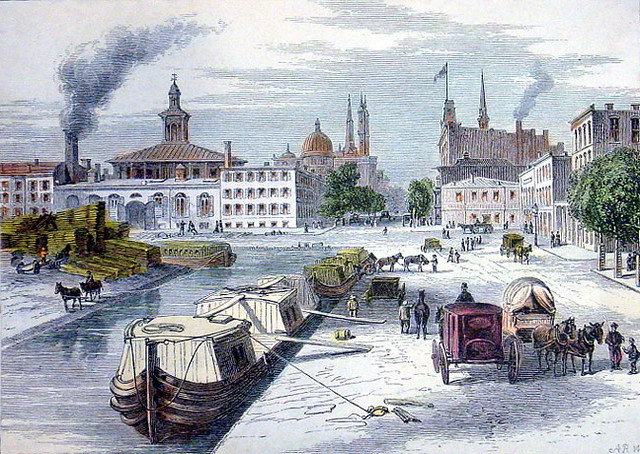
Industry continued to be an important factor in Over-the-Rhine’s development. The canal area was still the location of many diversified industries, including lumberyards, foundries, pork packers, tanneries, and glycerin works. The brewing industry tended to concentrate along McMicken Avenue and the Miami and Erie canal (what is now the Brewery District). By 1866 the Jackson Brewery, J. G. John & Sons Brewery, Christian Moerlein Brewing Company, and John Kauffman Brewing Company dominated the industrial use of the area. In close association on the west side of the canal were the John Hauck and Windisch-Mulhauser Brewing Companies. Between 1875 and 1900 seventeen breweries were located in Over-the-Rhine and West End.

Kauffman-brewery-letterhead

John_Kauffman_Brewing_Company_beer_label

Filed Under: Birthdays, Breweries, Just For Fun Tagged With: France, History, Ohio

Beer In Ads #5197: It’s Here! Rahr’s Bock Beer

February 9, 2026 By Jay Brooks

Two years ago I decided to concentrate on Bock ads for awhile. Bock, of course, may have originated in Germany, in the town of Einbeck. Because many 19th century American breweries were founded by German immigrants, they offered a bock at certain times of the year, be it Spring, Easter, Lent, Christmas, or what have you. In a sense they were some of the first seasonal beers. “The style was later adopted in Bavaria by Munich brewers in the 17th century. Due to their Bavarian accent, citizens of Munich pronounced ‘Einbeck’ as ‘ein Bock’ (a billy goat), and thus the beer became known as ‘Bock.’ A goat often appears on bottle labels.” And presumably because they were special releases, many breweries went all out promoting them with beautiful artwork on posters and other advertising.

Monday’s ad is for Rahr’s Bock Beer, which was published on February 9, 1957.  This one was for Rahr Green Bay Brewing Corp., of Green Bay, Wisconsin and was founded by Henry Rahr in 1864. This ad ran in The Green Bay Press Gazette, of Green Bay, Wisconsin.

Filed Under: Art & Beer, Beers, Breweries, Just For Fun Tagged With: Advertising, Bock, History, Wisconsin

Historic Beer Birthday: David C. Kuntz

February 9, 2026 By Jay Brooks

kuntz
Today is the birthday of David C. Kuntz (February 9, 1877-October 22, 1915). He was born in Waterloo, Ontario, in Canada, and was the grandson of David Kuntz, who established the first brewery in Ontario. He was also the son of Louis Kuntz, David’s son. After the first David Kuntz died, his son Louis Kuntz took over, renaming the the business Louis Kuntz’s Park Brewery, and David C. succeeded his father. Shortly after his passing, in 1930, Canadian Breweries Limited, which had originally been “named Brewing Corporation of Ontario,” was created “by merging The Brading Breweries Limited, an Ottawa company Taylor had inherited from his grandfather, Capital Brewing of Ottawa, and Kuntz Brewery of Waterloo, Ontario.” In 1977 Carling Brewery was purchased by Labatt Breweries of London, but the Waterloo plant was closed by 1993 and all the buildings on the site had been demolished.

This is his obituary, from the Brewers Journal in 1915:

Kuntz-employees-1910s
Kuntz brewery works around 1910.

Here’s a brief mention of David C. Kuntz from Flash from the Past: What remains of the Kuntz Brewery legacy?

Louis Kuntz died, aged 39, following an appendectomy in 1891. His children were still young so brother-in-law Frank Bauer, also a brewer, took over. Then David Kuntz died in 1892. Bauer’s own 1895 passing began an almost unbelievable sequence of deaths in the brewery’s management. However, business success continued and in 1910 David Kuntz Jr., Louis’ son, took over. He also died young, 38, in 1915 so his two brothers, Herbert and William stepped in.

Kuntz-Brewery-postcard-lg

Filed Under: Birthdays, Breweries Tagged With: Canada, History, Ontario

Historic Beer Birthday: Joe Allen

February 9, 2026 By Jay Brooks

anchor-new
Today is the birthday of Joe Allen (February 9, 1888-April 24, 1976). Allen’s parents were Irish and came to America, settling in Minnesota, in 1883. At some point, Joe made his way to San Francisco and was working as a brewer at the Anchor Brewery when it reopened after the end of prohibition in 1933 at 1610 Harrison Street. Unfortunately, less than a year later, in February of 1934, the brewery burned to the ground. Owner Joe Kraus then partnered with his brewmaster, Joe Allen, and they re-built the brewery in an old brick building at 398 Kansas Street, by 1st Street.

Joe-Allen-1-29-52

Here, I’ll let Anchor Brewery’s website take up the story from The Era of Mass Production.

Kraus and Allen valiantly and lovingly kept Anchor afloat until Kraus’s death in 1952. By late 1959, America’s—even San Francisco’s—new-found “taste” for mass-produced, heavily marketed lighter beers had taken its toll on Anchor’s already declining sales. In July of that year, at the age of 71, Joe Allen shut Anchor down for what would, thankfully, be a brief period.

Joe-Allen-6-26-59

Again, Anchor Brewing picks up the story, Surviving Another Challenge from 1960.

Lawrence Steese bought and re-opened Anchor in 1960 at yet another nearby location, retaining Joe Allen to carry Anchor’s craft brewing tradition forward. But one of Anchor’s oldest accounts, the Crystal Palace Market had already closed its doors. And Steese had an increasingly difficult time convincing loyal Bay Area establishments to continue serving Anchor Steam. By 1965, Steese—like Allen six years before—was ready to shut Anchor down.

The next year, 1961, the brewery moved to 541 8th Street, where it remained until 1977. Of course, in 1965, another owner invested in the brewery, eventually buying out the remaining partners. That, you probably already know, was Fritz Maytag. There’s not much I could find on Allen’s life before and after he worked at, and then owned, the Anchor Brewery, not even the year of his death. If anyone has any more information, please leave a comment below or contact me directly.

Filed Under: Birthdays, Just For Fun Tagged With: Anchor Brewery, California, History, San Francisco

Beer In Ads #5196: Happy Days Are Here Again

February 8, 2026 By Jay Brooks

Two years ago I decided to concentrate on Bock ads for awhile. Bock, of course, may have originated in Germany, in the town of Einbeck. Because many 19th century American breweries were founded by German immigrants, they offered a bock at certain times of the year, be it Spring, Easter, Lent, Christmas, or what have you. In a sense they were some of the first seasonal beers. “The style was later adopted in Bavaria by Munich brewers in the 17th century. Due to their Bavarian accent, citizens of Munich pronounced ‘Einbeck’ as ‘ein Bock’ (a billy goat), and thus the beer became known as ‘Bock.’ A goat often appears on bottle labels.” And presumably because they were special releases, many breweries went all out promoting them with beautiful artwork on posters and other advertising.

Sunday’s ad is for Dawson’s Bock Beer, which was published on February 8, 1940.  This one was for Dawson’s Brewery, of New Bedford, Massachusetts and was founded in 1899. This ad ran in The Boston Globe, of Boston, Massachusetts.

Filed Under: Art & Beer, Beers, Breweries, Just For Fun Tagged With: Advertising, Bock, History, Massachusetts

Historic Beer Birthday: Charles Tascher

February 8, 2026 By Jay Brooks

Today is the birthday of Charles Tascher (February 8, 1832-June 5, 1890). He was born in Stark, Ohio, but moved with his family to be raised in Indiana, where he married Elizabeth Soice in 1854. A few years later, Tascher then moved his family to Colorado, settling in Denver. Initially, along with a business partner, Frederick Zadek Salomon, he started a successful mercantile business. From that success, and the addition of Tascher’s brother-in-law, Charles Endlich, the trio founded Denver’s first brewery, Rocky Mountain Brewery, in 1859.

As Endlich’s involvement with the brewery grew and his brother-in-law became sole proprietor, Tascher withdrew from the brewery, moved to Central City, and became a miner (which was the reason he moved West). He passed away at age 58 in 1890.

As for the brewery, Philip Zang bought into it around 1868 and eventually took it over, renaming it the Philip Zang Brewery in 1870, though they continued to use the Rocky Mountain name in the trade. They closed during prohibition, of course, but only lasted one year afterwards before closing for good in 1934.

Filed Under: Birthdays, Breweries, Just For Fun Tagged With: Colorado, History

Historic Beer Birthday: Lüder Rutenberg

February 8, 2026 By Jay Brooks

becks-white
Today is the birthday of Lüder Rutenberg (February 8, 1816-June 14, 1890) who was born in Bremen, Germany. He was an architect, a builder and one of the co-founders of Beck’s Brewery, formally known as Brauerei Beck & Co. “The brewery was formed under the name Kaiserbrauerei Beck & May o.H.G. in 1873 by Lüder Rutenberg, Heinrich Beck and Thomas May. In 1875, Thomas May left the brewery which then became known as Kaiserbrauerei Beck & Co.”

Here’s a short biography of Lüder Rutenberg, translated from his German Wikipedia page:

Rutenberg — son of the builder Diedrich Christian Rutenberg — learned after visiting the Remberti and the grammar school with his father. He studied from 1836 to 1840 in Berlin physics, chemistry and technology. From 1841 he was an employee at his father.

In 1847 he became an independent architect. Its operation was one of the largest construction companies in Bremen. Lüder Rutenberg was especially during the expansion of the Bremen suburbs as a builder for the typical residential streets with one- or two-story terraced houses successfully. Men of his profession erected at that time for its own account and sold whole streets of houses or flats profitably. 1849 by the Bremen Senate a request Rod Berg refused to be allowed to build in Bremen similarly large tenement houses such as in Hamburg or Berlin. Had been such application is approved, this greatly affect the appearance of many neighborhoods Bremen would have had.

1853 rose Rutenberg in the brewery business and acquired with his sister and his brother-in as a partner, the Runge brewery, which he in St. Pauli Brewery renamed and goal for until 1870 the largest brewery in Bremen. Later he bought along with the master brewer Heinrich Beck several smaller breweries and participated in 1873 in the construction of a brewery in the New Town, the then Kaiser brewery was later large brewery Beck & Co.

kaiser-brauerei-becks

Filed Under: Birthdays, Just For Fun Tagged With: Germany, History

« Previous Page
Next Page »

Find Something

Northern California Breweries

Please consider purchasing my latest book, California Breweries North, available from Amazon, or ask for it at your local bookstore.

Recent Comments

  • Bob Paolino on Beer Birthday: Grant Johnston
  • Gambrinus on Historic Beer Birthday: A.J. Houghton
  • Ernie Dewing on Historic Beer Birthday: Charles William Bergner 
  • Steve 'Pudgy' De Rose on Historic Beer Birthday: Jacob Schmidt
  • Jay Brooks on Beer Birthday: Bill Owens

Recent Posts

  • Beer Birthday: Dave Suurballe August 6, 2026
  • Historic Beer Birthday: Timothy Taylor August 6, 2026
  • Beer In Ads #5312: Bock Chasse Royale August 5, 2026
  • Historic Beer Birthday: Jacob Ruppert, Jr. August 5, 2026
  • Beer Birthday: Ben McFarland August 5, 2026

BBB Archives

Feedback

Head Quarter
This site is hosted and maintained by H25Q.dev. Any questions or comments for the webmaster can be directed here.