Brookston Beer Bulletin

Jay R. Brooks on Beer

  • Home
  • About
  • Editorial
  • Birthdays
  • Art & Beer

Socialize

  • Dribbble
  • Email
  • Facebook
  • Flickr
  • GitHub
  • Instagram
  • LinkedIn
  • Pinterest
  • RSS
  • Twitter
  • YouTube

Powered by Genesis

Historic Beer Birthday: Charles Liebmann

March 13, 2025 By Jay Brooks

S-Liebmann
Today is the birthday of Charles Joseph Liebmann (March 13, 1877-September 15, 1957). He was born in New York. He was the son of Henry Liebmann. His grandfather owned the Castle Schmiedelfeld, in Baden-Wuerttemberg, Germany, but when his father was young, the family moved to Ludwigsburg and operated the Zum Stern Inn there, which also included a brewery. For political reasons, some of the family moved to America around 1850 to build a home, and the rest followed in 1854. Initially Henry Liebmann ran the old Maasche Brewery, but later built a new brewery in Bushwick. Originally, it was called the Samuel Liebmann Brewery, but when his sons joined the brewery, it was called the S. Liebmann’s Sons Brewery. When Charles’ grandfather died in 1872, his sons took over the family brewery, and Charles’ father Henry became brewmaster. After prohibition ended, the brothers’ six sons, including Charles, re-opened the brewery as the simpler Liebmann Breweries, but in 1964 they changed the name again to Rheingold Breweries, after their most popular beer. The brewery closed in 1976.
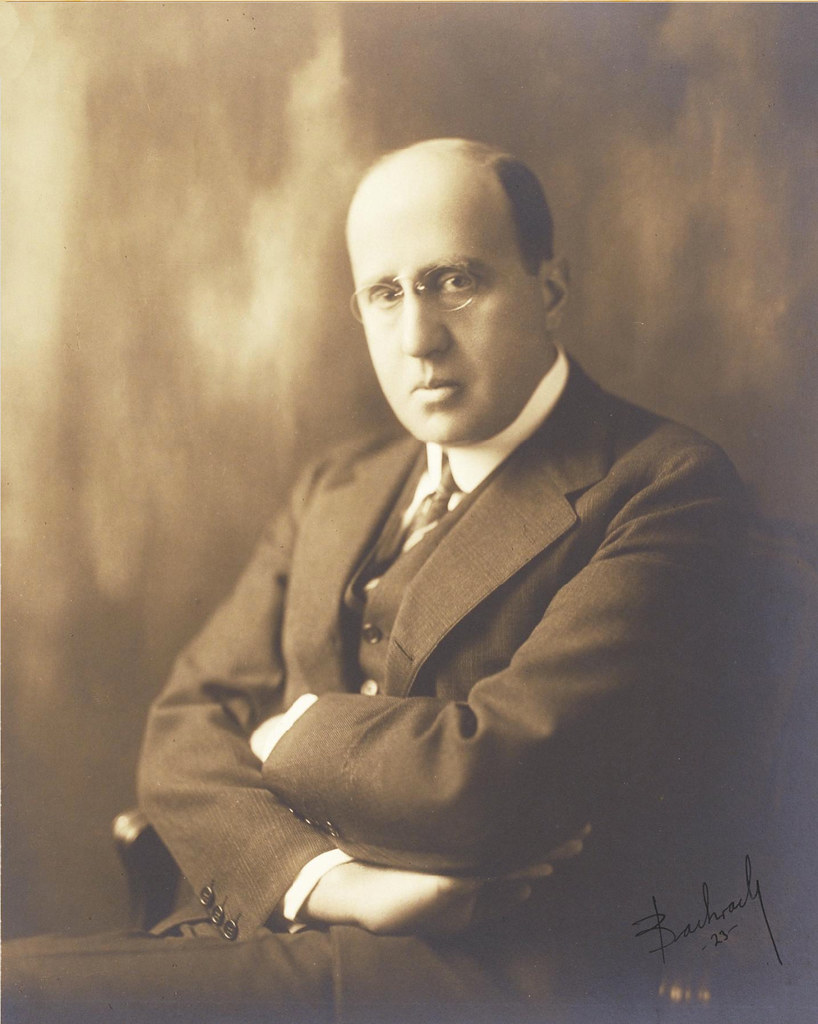
charles-Liebmann

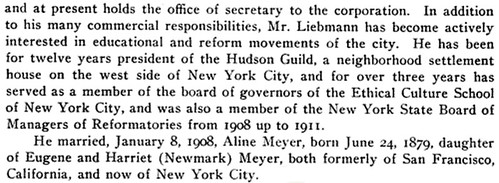
This is from Schlegel’s German-American Families in the United States:
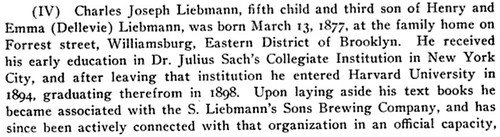
charles-j-liebmann-bio-1
charles-j-liebmann-bio-2

This is from “The Originators of Rheingold Beer: From Ludwigsburg to Brooklyn – A Dynasty of German-Jewish Brewers,” by Rolf Hofmann, originally published in Aufbau, June 21, 2001:

New Yorkers over the age of fifty will remember the brand name Rheingold Beer and the company’s brilliant publicity stunt in which a bevy of attractive young women competed annually for the privilege of being elected that year’s Miss Rheingold and appearing in ads on billboards and in the subways throughout the New York area.

The beer’s evocative name with its allusion to Germany’s great river, was the culmination of a German-Jewish family enterprise that had its beginnings in 1840 in the town of Ludwigsburg, north of Stuttgart, in what was then the Kingdom of Württemberg. One Samuel Liebmann, a member of a prominent Jewish family in the region, settled there and bought the inn and brewery “Zum Stern.” A liberal and staunch supporter of Republican ideals, Liebmann encouraged other like-minded citizens, including some soldiers from the garrison, to meet in his hospitable surroundings. The ideas fomented there contributed to the local revolution of 1848. It brought the opprobrium of the King down upon Liebmann’s enterprise, and “Zum Stern” was declared off limits to the soldiers. Soon thereafter, in 1850, Samuel Liebmann emigrated to the U.S.

The family settled in Brooklyn and Samuel, together with his three sons, Joseph, Henry, and Charles, opened a brewery once again at the corner of Forest and Bremen Streets. With the responsibilities divided among the family – Henry became the brewing expert, Charles. the engineer and architect, Joseph, finance manager – the company was already flourishing by the time of Samuel’s death in 1872. Success also led to a concern for the company’s Brooklyn surroundings, and the Liebmanns became involved in local welfare – focusing on housing and drainage systems.

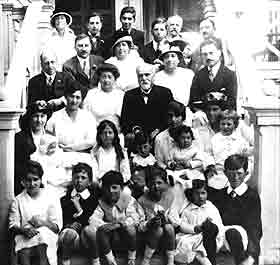
Each of the three brothers had two sons, and when the older Liebmanns retired in 1903, the six members of the third generation took over. Other members of the family also contributed to the gradual expansion of the company. In 1895 Sadie Liebmann (Joseph’s daughter), married Samuel Simon Steiner, a trader in high quality hop, an essential ingredient for good beer. Steiner’s father had begun merchandising hop in Laupheim in 1845 and still today, S.S. Steiner, with its headquarters in New York, is one of the leading hop merchants. Under these fortuitous family circumstances, beer production grew constantly. In the early years, the brewery had produced 1000 barrels per year, by 1914 its output stood at 700,000 barrels.

hofmann-rheingold1
The Liebmann family.

Unfortunately, political developments in the U.S. between 1914 and 1933 were extremely disadvantageous for the Liebmann brewery. The resentment against Germany and anything German during World War I led to an informal boycott of German beers. Following close upon the lean wartime years, was the implementation of Prohibition in 1920 forbidding the manufacturing and trading of alcohol. The Liebmann enterprise managed to survive by producing lemonade and a product they called “Near Beer.”

With the reinstatement of legal alcohol production under President Roosevelt in 1933, opportunities for the brewery opened up, abetted by the anti-Semitic policies of Hitler’s Germany. The pressures on Jewish businessmen there, brought Dr. Hermann Schülein, general manager of the world-renowned LšwenbrŠu brewery, to America. Schulein’s father, Joseph, had acquired two of Munich’s leading breweries at the end of the nineteenth century–Union and Münchner Kindl–and his son had managed the 1920 merger with Löwenbrau. Arriving in New York with this experience behind him, Hermann Schülein became one of the top managers of the Liebmann brewery and was instrumental in its spectacular growth after World War II.

Working with Philip Liebmann (great-grandson of Samuel), Schülein developed a dry lager beer with a European character to be marketed under the brand name “Rheingold.” According to company legend, the name was created in 1883 at a brewery dinner following a performance at the Metropolitan Opera. When the conductor took up his glass, he was so taken with the shade of the beer, that he declared it to be the color of “Rheingold.” For New Yorkers, however, the name Rheingold did not bring to mind the Nibelungen fables, but the pretty young ladies who participated in Schülein’s most brilliant marketing strategy – the selection of each year’s Miss Rheingold by the beer-drinking public of greater New York

At the height of the campaign’s success in the 1950’s and 60’s, the Liebmann Brewery had an output of beer ten times that of Löwenbrau at the same time in Munich.

For thirty years, Rheingold Beer reigned supreme in the New York area, but by 1976, as a local brewery, it could no longer compete with nationwide companies such as Anheuser & Busch, Miller, and Schlitz, and its doors were closed. Only recently, using the same brewmaster, Rheingold is once again being sold in the tri-state area.
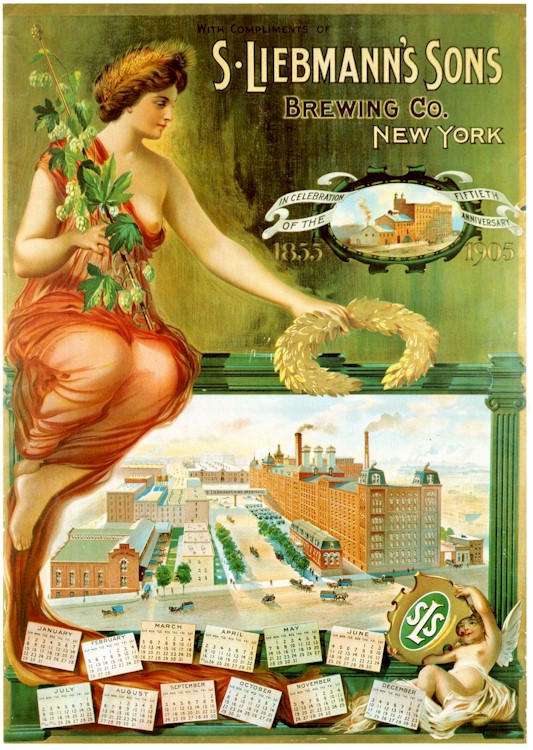
S-Liebmanns-Brewing-poster

Here’s an “Origin of Liebmann Brewery” posted by a relative on Ancestry.com:

On May 12 1833 (Sulzbach-Laufen Archive) Samuel and his older brother Heinrich bought a castle/inn Schmiedelfeld, Sulzbach-Laufen, Schwaebisch Hall District that dated from 1739. They renovated the place and created a prosperous farm/estate and in 1837 began a brewery in the cellar. In 1840, he moved to Ludwigsburg, near Stuttgart and purchased the gasthaus [guest house or inn] “Zum Stern” on Seestrasse 9 (later Zum Rebstock) which included a brewery. (source: Translation extract from Dr. Joacim Hahn’s book, History of the Jewish Community of Ludwigsburg)

After supporting a movement to oust King William I of Wurttemberg, and sensing the wavering tolerance of Jewish businessmen, Samuel sent his eldest son Joseph to the US in 1854 to scout out a location to establish a brewery.

Samuel retired in 1868 and turned the family business over to his sons Joseph, Charles, and Henry under the name S. Liebmann’s Sons Brewery.
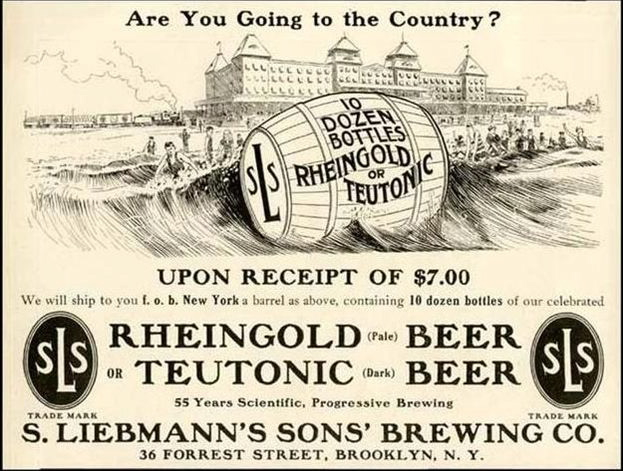
liebmanns-rheingold

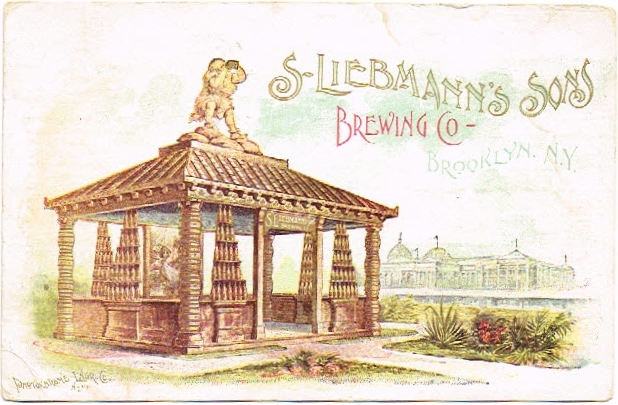
S-Liebmanns-Sons-Cards-Trade-Cards-S-Liebmanns-Sons-Brewing-Company_17585-1

Filed Under: Birthdays, Just For Fun Tagged With: History, New York

Historic Beer Birthday: William Lindsay Everard

March 13, 2025 By Jay Brooks

everards
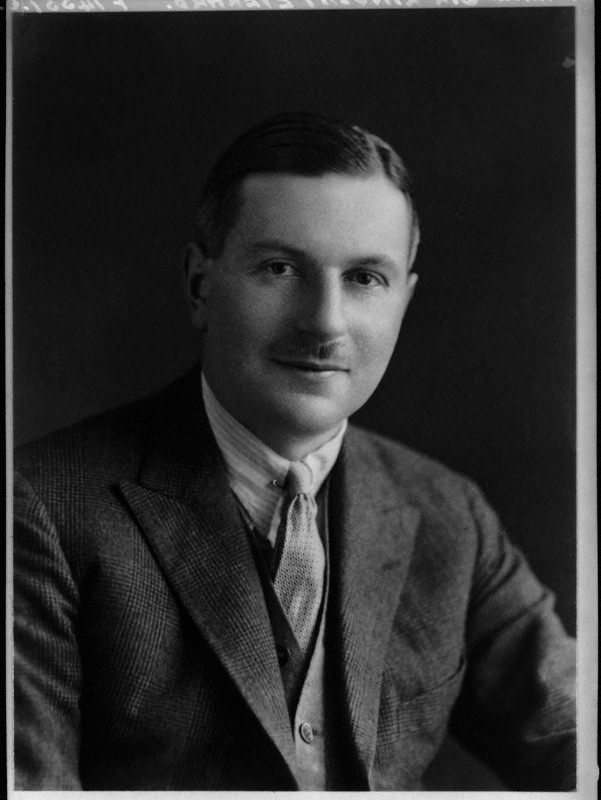
Today is the birthday of William Lindsay Everard (March 13, 1891-March 11, 1949). Known as Lindsay, or Sir Lindsay, William Lindsay Everard was the grandson of William Everard, who in 1849, along with Thomas Hull founded the Everard Brewery in Leicester, England. He took over the family brewery in 1925 and ran it for 25 years. He was also a politician (as a member of parliament), philanthropist and a founder and supporter of the Ratcliffe Aerodrome. Sir Lindsay was a pioneer aviator, knighted for his crucial efforts in World War II with the Air Transport Auxiliary.

NPG x100364; Sir (William) Lindsay Everard1951 photo of Sir (William) Lindsay Everard by Elliott & Fry, from the National Portrait Gallery.
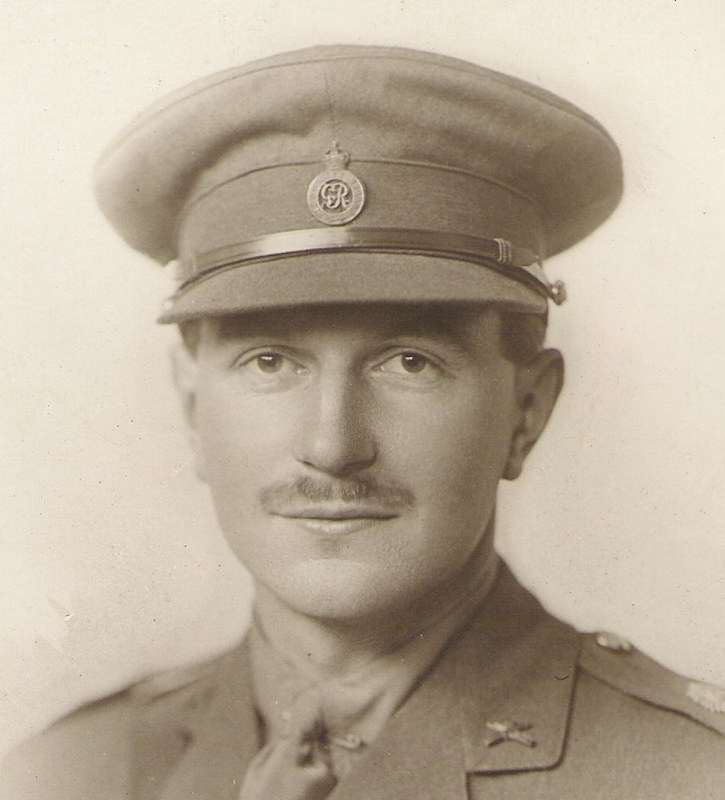
Here’s Sir Lindsay’s story from the Everard Brewery website:
William Lindsay Everard was 34 years old when his father died and control of the company was passed to him. During World War 1 he served in the Leicestershire Yeomanry from 1914 to 1917, rising to be adjutant. He saw active service in France with the 1st Life Guards until the end of hostilities in 1919.

William Lindsay married Cornelia Ione Kathleen Armstrong on the 28th of September 1917. They had two children, Bettyne Ione in 1919 and Patrick Anthony William Beresford in 1922. The family moved into Ratcliffe Hall, Leicestershire the same year and after the war, Sir Lindsay followed the family tradition and was active in local public life.

He became a J.P in 1923, Deputy Lieutenant of the County in 1924 and High Sheriff in 1924. He followed his grandfather’s long service in local politics and came as no surprise when he took to national politics and to Westminster. In 1924 he stood as the Conservative Party candidate for the Melton constituency in the General Election. Using Ratcliffe Hall as his headquarters, he campaigned using the slogan, “If you work hard for Everard, he’ll work hard for you.” Stanley Baldwin’s Conservatives won with an overall majority of more than 200 seats, one of whom was Melton’s new Member of Parliament, Lindsay Everard.

He took his seat in Westminster for the first time in November 1924 and served his constituency for over twenty years. In 1939 he received a knighthood from King George VI for his services to commerce and aviation.

Sir Lindsay had a lifelong interest in aviation, gaining his private pilot’s license in the 1920s. He became president of the Royal Aero Club, the County Flying Club, and the Leicester Aero Club.

sir_lindsay_everard_lg

While he was running the brewery, his interest was actually elsewhere; on aviation. He legacy is considered first and foremost as a pioneer of British aviation.

Wartime aviation has changed the course of history and Sir Lindsay Everard is an important contributor to its development. In 1930, Sir Lindsay opened Ratcliffe Aerodrome on 45 acres (180,000 m2) near his estate and Ratcliffe College. He had become President of the Leicester Aeroclub in 1928, purchasing the club a de Havilland Gipsy Moth in 1929. Named “The Quorn”, the club used Carts Field at Desford. A large air show brought 30,000 spectators to the site. Sir Lindsay purchased a de Havilland Puss Moth that he named “The Leicestershire”, and sold in July 1932. He also favoured the Percival Gull Four P.1.B Mk. IIa

Ratcliffe Aerodrome opened with a ‘Grand Air Pageant’ on 6 September 1930. Famed aviator Amy Johnson made an unexpected trip from London to participate with Sir Sefton Brancker, Director of Civil Aviation. Some 5000 spectators were treated to a show with 100 planes and staged bombings of Chinese pirates. There was one crash, but no one was killed. Ratcliffe Aerodrome was one of the finest in civil aviation with a comfortable clubhouse and an outdoor pool. The hangars were first class and the many air shows and displays had the atmosphere of a garden party.

Sir Lindsay was not a pilot himself, but hired personal pilots to travel throughout the world and participate in air racing events. He owned a de Havilland Dragon, an 8-seat aircraft, with which they won the Oasis Trophy in Cairo. With pilot Lt. Com. Phillips he won the Grosvenor Cup air race. Among his personal pilots were Winifred Spooner, a celebrated woman aviator, and Albert Codling, Sir Lindsay’s Chief Inspector responsible for the maintenance of all his aircraft. Sir Lindsay was supportive of every aspect of aviation, including gliders. He was the first president of the Model Aero Club. His airmail postage stamp collection was sold by H.R. Harmer of London on 19 and 20 October 1953 in 530 lots.

The County Flying Club was formed at Ratcliffe and in 1938 moved to a field at Rearsby on land owned by Sir Lindsay. Another member of the County Flying Club, Alexander Lance Wykes, was the managing director of Crowthers Limited, a Thurmaston company, that manufactured textile machinery. In 1938, Wykes negotiated a license agreement with American manufacturer Taylorcraft to build a light aeroplane in England. It was designated the Taylorcraft “Plus C” model and the first one built was brought by road to Sir Lindsay’s Aerodrome where it made its maiden flight on 3 May 1939. This aircraft became an important part of the war effort in World War II and a production order of 100 aircraft designated the Taylorcraft-Auster Mk 1 was placed in 1942. The Auster continued to be an important and popular plane long after the war.

With the onset of World War II, civil flying was suspended on 31 August 1939. Ratcliffe Aerodrome had a central location that made it an important field for the ATA, a network of civilian pilots that ferried new aircraft from the factories and those that needed repair. Ratcliffe Aerodrome was ferry pool no. 6 of the original 14 started in 1942. The Aerodrome grew larger during the war, adding new facilities. Some 50,000 ferry flights passed through this ideal staging ground.
When the ATA was disbanded, the event was commemorated by an air show on 6 October 1945 that included Geoffrey de Havilland. Sir Lindsay was knighted during the war for services to aviation and commerce. The Leicester Aeroclub reformed in 1947 and drew a crowd of 10,000 for an event in 1949. Sir Lindsay died that year and his estate was sold to non-flyers. Ratcliffe Aerodrome closed on 25 March 1950. It fell into disrepair with some of the buildings being used as barns for the surrounding farms.

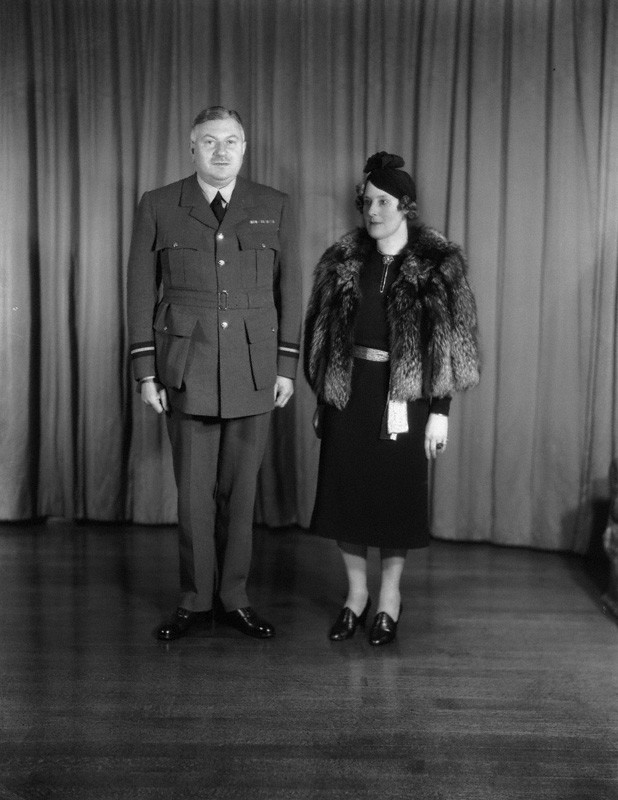
NPG x124405; Sir (William) Lindsay Everard; Cornelia Ione Kathleen (nÈe Beresford-Armstrong), Lady Everard
Sir Lindsay with his wife Cornelia Ione Kathleen, taken in 1939,
and now also in the National Portrait Gallery.

And here’s a short history of the brewery from the beginning until Sir Lindsay took control, from Wikipedia:
The company began as Hull and Everard in 1849 when William Everard, a farmer from Narborough Wood House and brewer Thomas Hull leased the Southgate Street Brewery of Wilmot and Co from the retiring proprietors. Although Hull continued as a maltster, Everard was the driving force behind the business which he managed until his death in 1892.

The business expanded as the company progressively acquired outlets, with over 100 pubs by the late 1880s. In 1875 the company moved to a new state of the art tower brewery designed by Thomas’s nephew architect John Everard. The brewery, on the corner of Southgate st and Castle St extracted very pure water from wells 300 feet deep beneath the premises and steam engines played a significant part in the mechanisation.

After the death of William, control passed to his son Thomas. The historic centre of the UK brewing industry remained some 40 miles away at Burton-upon-Trent, which by the 1890s produced one tenth of Britain’s beer. Everard’s leased the Bridge Brewery on Umplett Green island in 1895 but its 10,000 barrels per year capacity proved insufficient. It was replaced with the newer Trent brewery in Dale St which became available after going into liquidation in 1898. The Southgate brewery remained the distribution centre to the Leicestershire pubs with beer arriving by rail from Burton. The Trent brewery was purchased outright in 1901.(sources differ)[5] It was renamed the Tiger Brewery around 1970. Beer production was seriously affected by World War I, both due to recruitment and the Defence of the Realm Act 1914 which required beer to be diluted, restricted opening times and rationed raw materials. In 1920,(sources differ) Everards bought wine and spirit merchants John Sarsons & Son of Hotel St Leicester, a major supplier to wealthy homes.

Thomas moved his family from Narborough Wood House to Nanpantan Hall. In 1909 he opened a cattle trough in Groby on behalf of the Metropolitan Drinking Fountain and Cattle Trough Association. and in 1921, a year which saw beer production peak at 55,000 barrels, the company acquired the Stamford arms in Groby, the former home of both Thomas’s grandfather, Richard Everard a yeoman tenant farmer of the Grey estate and his great grandfather.

In 1924, the company completed its move away from rail transport to steam powered drays which continued in use until replaced by petrol lorries in 1946.

Thomas died in 1925 and was succeeded by his son William Lindsay Everard who lived in Ratcliffe Hall. The Great Depression saw a penny tax on beer.

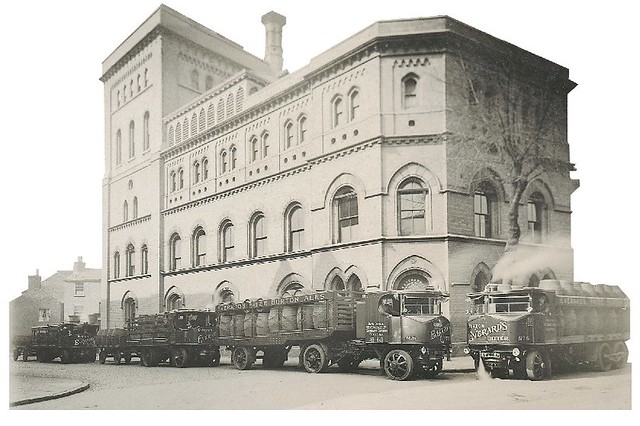
New_Everards_brewery_Southgate_St_Leicester_showing_steam_traction_engines_1875
The then-new Everards brewery on the corner of Southgate Street and Castle Street in Leicester, showing steam traction engines in 1875.

Filed Under: Birthdays, Just For Fun Tagged With: England, Great Britain, History

Historic Beer Birthday: Joseph Priestley

March 13, 2025 By Jay Brooks

oxygen
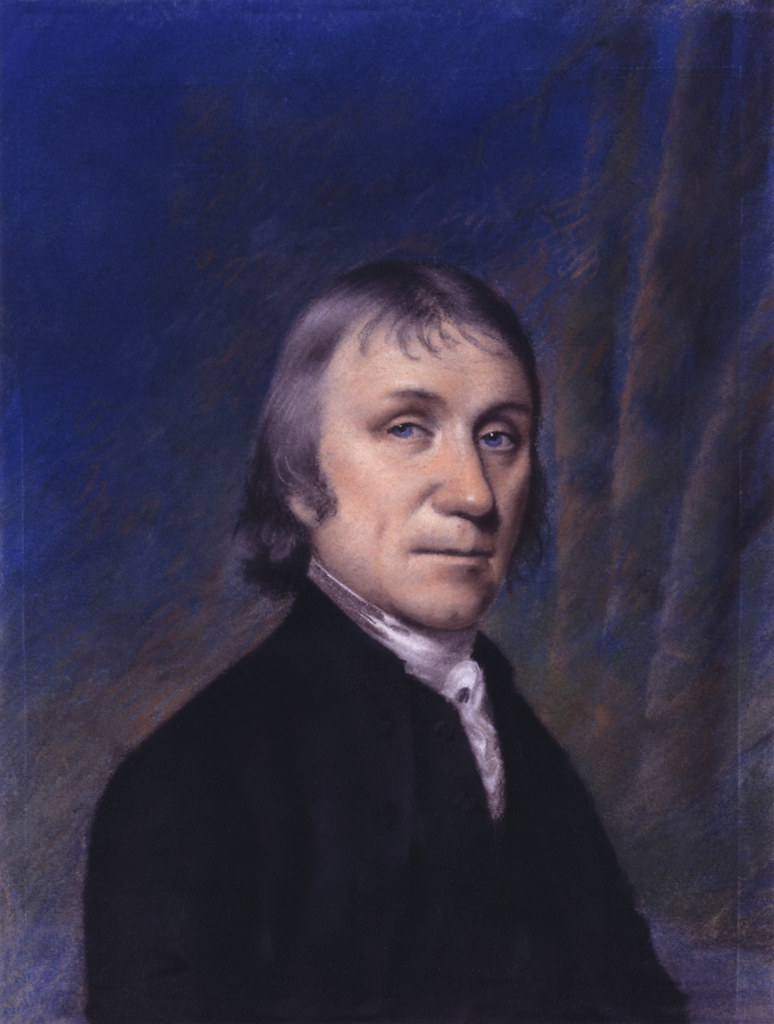
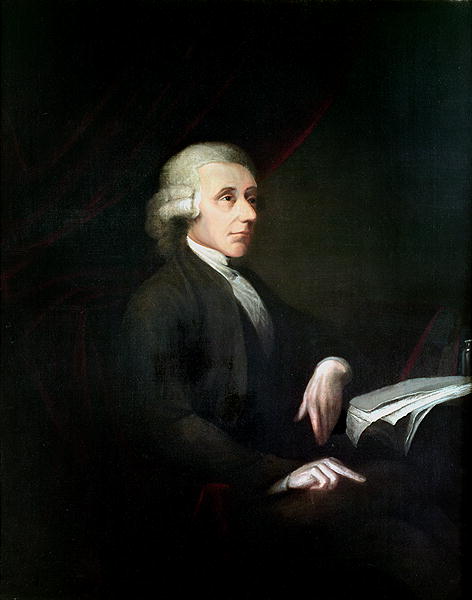
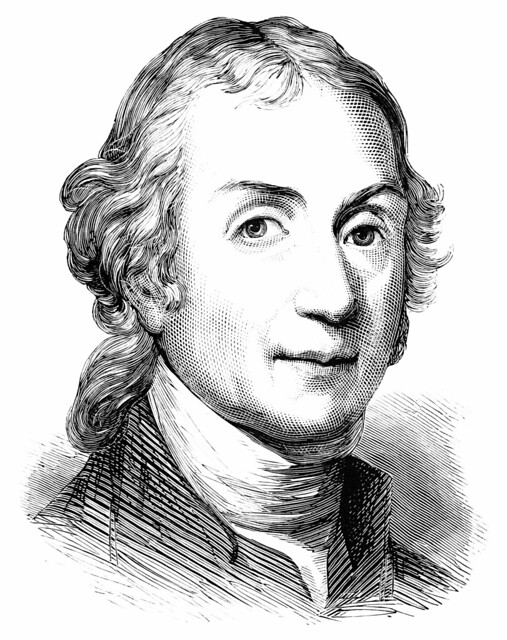
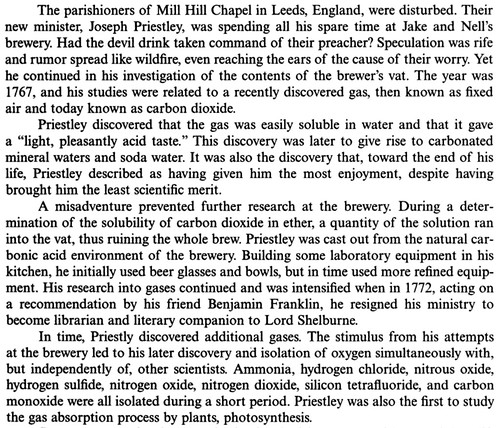
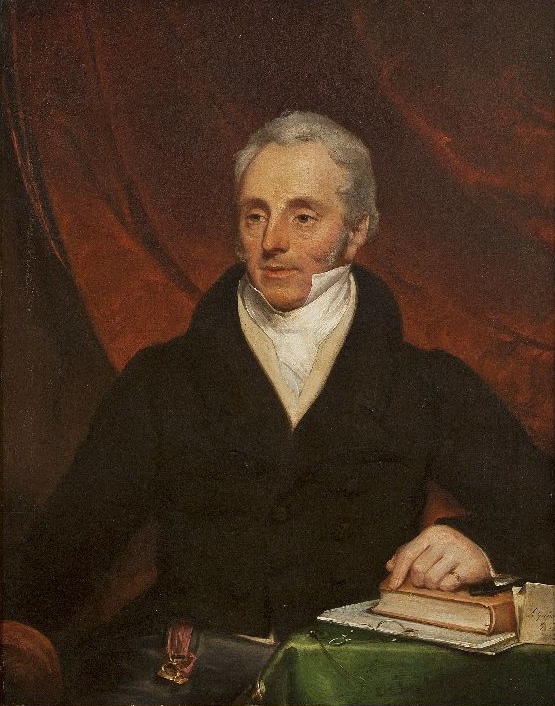
Today is the birthday of English scientist Joseph Priestley (March 13, 1733-February 6, 1804). While he was also a “clergyman, natural philosopher, chemist, educator, and Liberal political theorist,” he’s perhaps best known for discovering oxygen (even though a few others lay claim to that honor). According to Wikipedia, “his early scientific interest was electricity, but he is remembered for his later work in chemistry, especially gases. He investigated the ‘fixed air’ (carbon dioxide) found in a layer above the liquid in beer brewery fermentation vats. Although known by different names at the time, he also discovered sulphur dioxide, ammonia, nitrogen oxides, carbon monoxide and silicon fluoride. Priestley is remembered for his invention of a way of making soda-water (1772), the pneumatic trough, and recognising that green plants in light released oxygen. His political opinions and support of the French Revolution, were unpopular. After his home and laboratory were set afire (1791), he sailed for America, arriving at New York on 4 Jun 1794

Priestley

In the biography of Priestley at the American Chemistry Society has a sidebar about his work with fermentation:

Bubbling Beverages

In 1767, Priestley was offered a ministry in Leeds, Englane, located near a brewery. This abundant and convenient source of “fixed air” — what we now know as carbon dioxide — from fermentation sparked his lifetime investigation into the chemistry of gases. He found a way to produce artificially what occurred naturally in beer and champagne: water containing the effervescence of carbon dioxide. The method earned the Royal Society’s coveted Copley Prize and was the precursor of the modern soft-drink industry.

Even Michael Jackson, in 1994, wrote about Priestley connection to the brewing industry.

“It has been suggested that the Yorkshire square system was developed with the help of Joseph Priestley who, in 1722, delivered a paper to the Royal Society on the absorption of gases in liquids. In addition to being a scientist, and later a political dissident, he was for a time the minister of a Unitarian church in Leeds. During that period he lived next to a brewery on a site that is now Tetley’s.”

ZIN42670

In the New World Encyclopedia, during his time in Leeds, it explains his work on carbonation.

Priestley’s house was next to a brewery, and he became fascinated with the layer of dense gas that hung over the giant vats of fermenting beer. His first experiments showed that the gas would extinguish lighted wood chips. He then noticed that the gas appeared to be heavier than normal air, as it remained in the vats and did not mix with the air in the room. The distinctive gas, which Priestley called “fixed air,” had already been discovered and named “mephitic air” by Joseph Black. It was, in fact, carbon dioxide. Priestley discovered a method of impregnating water with the carbon dioxide by placing a bowl of water above a vat of fermenting beer. The carbon dioxide soon became dissolved in the water to produce soda water, and Priestley found that the impregnated water developed a pleasant acidic taste. In 1773, he published an article on the carbonation of water (soda water), which won him the Royal Society’s Copley Medal and brought much attention to his scientific work.

He began to offer the treated water to friends as a refreshing drink. In 1772, Priestley published a paper entitled Impregnating Water with Fixed Air, in which he described a process of dripping sulfuric acid (or oil of vitriol as Priestley knew it) onto chalk to produce carbon dioxide and forcing the gas to dissolve by agitating a bowl of water in contact with the gas.

Joseph_Priestley

And here’s More About Priestley from the Birmingham Jewellry Quarter, whatever that is:

But his most important work was to be in the field of gases, which he called ‘airs’ (he would later chide James Keir for giving himself airs (oh dear!) by adopting the term ‘gases’ in his Dictionary of Chemistry, saying ‘I cannot help smiling at his new phraseology’). Living, as he did at the time, next to a brewery, he noticed that the gas given off from the fermenting vats drifted to the ground, implying that it was heavier than air. Moreover, he discovered that it extinguished lighted wood chips. He had discovered carbon dioxide, which he called ‘fixed air’. Devising a method of making the gas at home without brewing beer, he discovered that it produced a pleasant tangy taste when dissolved in water. By this invention of carbonated water, he had become the father of fizzy drinks!

PriestleyStamp

But perhaps my favorite retelling comes from the riveting History of Industrial Gases:

priestley-gases

The relevant findings were published in 1772, in Impregnating Water with Fixed Air

20. By this process may fixed air be given to wine, beer, and almost any liquor whatever: and when beer is become flat or dead, it will be revived by this means; but the delicate agreeable flavour, or acidulous taste communicated by the fixed air, and which is manifest in water, will hardly be perceived in wine, or other liquors which have much taste of their own.

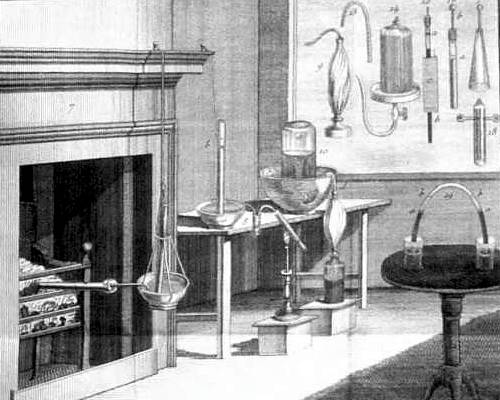
PriestleyJoseph-Lab
Priestley’s apparatus for experimenting with ‘airs.’

Filed Under: Beers, Birthdays, Just For Fun, Politics & Law, Related Pleasures Tagged With: History, Science of Brewing

Beer In Ads #4907: The Bockiest Bock Beer In Town

March 12, 2025 By Jay Brooks

Last year I decided to concentrate on Bock ads. Bock, of course, originated in Germany, in the town of Einbeck. Because many 19th century American breweries were founded by German immigrants, they offered a bock at certain times of the year, be it Spring, Easter, Lent, Christmas, or what have you. In a sense they were some of the first seasonal beers. “The style was later adopted in Bavaria by Munich brewers in the 17th century. Due to their Bavarian accent, citizens of Munich pronounced ‘Einbeck’ as ‘ein Bock’ (a billy goat), and thus the beer became known as ‘Bock.’ A goat often appears on bottle labels.” And presumably because they were special releases, many breweries went all out promoting them with beautiful artwork on posters and other advertising.

Wednesday’s ad is for Bruck’s Bock Beer and was published March 12, 1941. The brewery was the Bruckmann Brewing Co. of Cincinnati, Ohio, which was originally founded in 1856 by brothers Johann and Frederick Bruckmann as the Cumminsville Brewery. After Prohibition they bought out the Ohio Union Brewing Co.and operated it as a second brewing facility until 1949, and both were renamed the Bruckmann Co. after 1919. This ad for Bruck’s Bock Beer is by their Michigan distributor. I love that it’s “The Bockiest Bock Beer in Town.”

Filed Under: Art & Beer, Beers, Breweries, Just For Fun Tagged With: Advertising, Bock, History, Michigan, Ohio

Historic Beer Birthday: Arthur Guinness II

March 12, 2025 By Jay Brooks

guinness-new
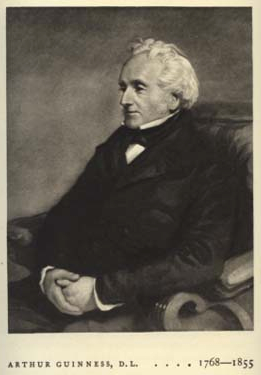
Though his father’s birthdate is uncertain, today is definitely the birthday of Arthur Guinness II (March 12, 1768-June 9, 1855).

Arthur_Guinness_II
Here’s his story, from Wikipedia:

Arthur was the second son of Arthur Guinness and his wife Olivia Whitmore, and was born at their home at Beaumont House (now a part of Beaumont Hospital, Dublin). He attended White’s Academy in Grafton Street, Dublin, (now the site of Bewley’s). Arthur started working for his father at the St James’s Gate brewery from the 1780s. In 1790 his father, then aged 65, commented in a letter that the expansion of his brewery was partly due to his help:

“..one of my sons is grown up to be able to assist me in this Business, or I wd not have attempted it, tho’ prompted by a demand of providing for Ten Children now living out of one & twenty born to us, & more likely yet to come.”

On his marriage to Anne Lee in 1793 the lease of the brewery was assigned to their marriage settlement, proof that he was intended to take over the management of the brewery on his father’s death. At the time his younger brothers Benjamin (d.1826) and William (d.1842) were also working in the brewery.

In 1782 his father had also founded the “Hibernian Mills” beside the River Camac in Kilmainham to mill flour for the expanding city’s population. This was due to the expansion of Irish exports and commerce fostered from 1779 by the Irish Patriot Party, which the Guinnesses supported.

1803-guinness-II

On his father’s death in January 1803, he and his brothers Benjamin and William Lunell created a partnership trading as: “A. B. & W.L. Guinness & Co, brewers and flour millers”. He bought Beaumont House from his elder brother the Revd. Hosea Guinness, who was Rector of St. Werburgh’s Church, Dublin. In 1808 they bought their first steam engine from Boulton and Watt for pumping water.

Sales grew from 360,936 gallons in 1800 to 2,133,504 gallons by 1815. A slump followed, with sales dropping from 66,000 barrels to 27,000 by 1820.

From its rebuilding in 1797–99 the brewery had stopped brewing ale and concentrated on porter. From the 1820s enhanced and stronger varieties of porter known as “Extra Superior Porter” or “Double Stout” were developed in Dublin for the export trade to Britain. By 1837 the young Benjamin Disraeli mentioned that he had: “.. supped at the Carlton.. off oysters, Guinness and broiled bones”.

In the background Arthur’s brewery benefited hugely until the 1830s from the difference between the malt tax levied in Britain and Ireland, easing his higher-value exports to Britain, and so Arthur became more of a supporter of the union as it was in the 1830s, having been a supporter of Grattan’s form of home rule in his youth.

In 1839 Guinness assisted his nephew John in establishing a short-lived brewery in Bristol.

By his death in 1855, St James’s Gate was brewing and selling 78,000 hogsheads annually, equivalent to 4,212,000 gallons. Of these, 42,000 hogsheads were exported, mainly to the British market.

arthur-guinness-ii-photo

Filed Under: Birthdays, Just For Fun Tagged With: Guinness, History, Ireland

Historic Beer Birthday: Arthur Guinness

March 12, 2025 By Jay Brooks

guinness-new
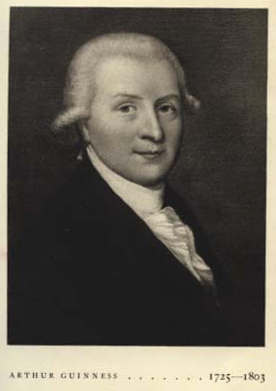
Today might be, though it probably isn’t, the birthday of Arthur Guinness (March 12, 1724-January 23, 1803). But this is as good a day as any, and in some ways better than many others that have been suggested. I’ve been collecting holidays, dates, birthdays, etc. since the late 1970s. I bought a cocktail paperback book and in the back, one of the appendices had four reasons to drink for every day of the year. Intrigued, I bought a thin diary and started writing them down as I came across new ones. When I outgrew that one, I bought a bigger one and hand-copied all of them from one to the other. Thank goodness computers came along so I didn’t have to keep that up. To save space, everything was color-coded and I never noted the original source, primarily because in those early days it was just something goofy I did for myself and I didn’t envision any practical application for such a list. Silly rabbit. Fast forward thirty years and the first website I set up, in 1998, was The Daily Globe, which was to house my collection of dates, among other things. It was then it became apparent that having the original sources would have been useful, but the damage was done. At some point I stumbled on the birthdate of Arthur Guinness, given as a day in September. Several years ago, after the Bulletin started, I ran my daily list as a matter of course on the date I had for Arthur Guinness’ birthdate, and understandably got called out by the Beer Nut for the source of the date. Of course, I had not been keeping them but have always taken the position that it’s better to celebrate the person’s life even if you don’t have the exact right date than ignore them entirely.

Eventually, I got around to trying to find that earlier source, and in the process opened a can of worms. That September date is more than likely wrong, of course, and was simply made up in 1991 by the Guinness company “apparently to end speculation about his birthdate,” as if that would do any good. That’s probably where I got the date, but since I didn’t keep my sources, who knows? In 2009, Guinness decided to declare September 24 “Arthur’s Day” further muddying the waters. The first year was to mark the 250th anniversary of Guinness, but in subsequent years it became a music festival and opportunity to do a worldwide toast to promote the beer. They kept up that farce on the 3rd Thursday in September each year until 2013, but cancelled it in 2014. So clearly September is a dead end.

In 2012, my favorite British beer historian, Martyn Cornell, weighed in on Guinness myths and scandals, including the date of his birth.

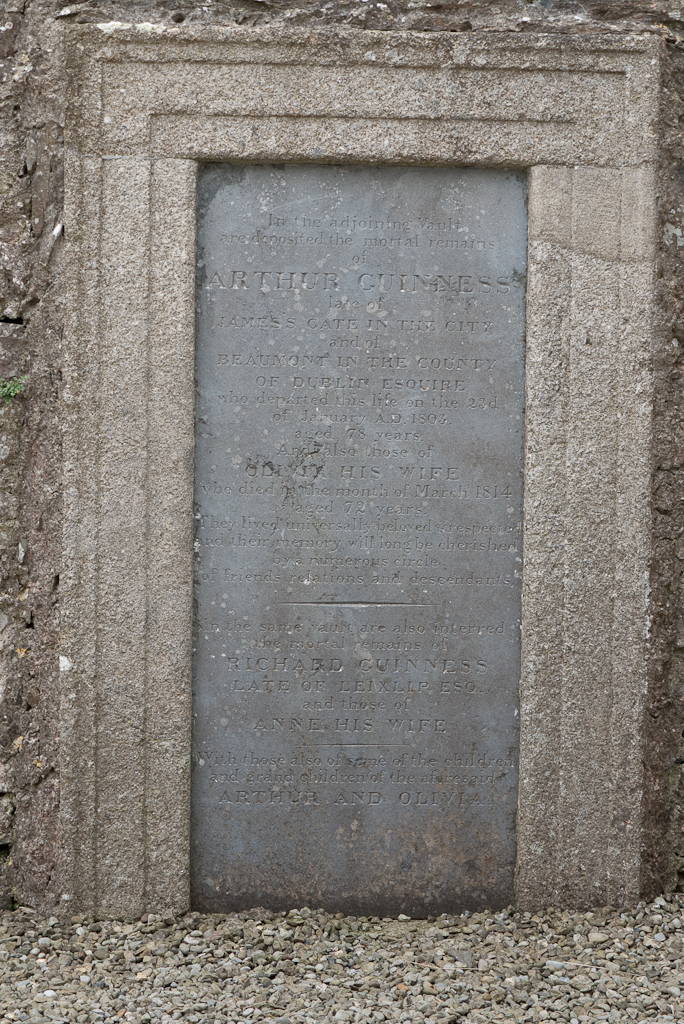
“Arthur Guinness was born in 1725 in Celbridge, County Kildare.” The Dictionary of Irish Biography claims he was born on March 12, 1725. However, that does not match the statement on Arthur Guinness’s grave in Oughterard, Kildare that he died on January 23, 1803 “aged 78 years”, from which it can be inferred that his birthday must have been between January 24, 1724 and January 23, 1725. The most accurate statement, therefore is that his date of birth is unknown, but he was born 1724/5.

Here’s his gravestone:

Guinness-gravestone

So if March 12, 1725 can’t be correct, but it must be “between January 24, 1724 and January 23, 1725,” then maybe it was 1724. So for no better reason than it fits the span of dates, maybe The Dictionary of Irish Biography simply got the year wrong by one. Maybe not, but I like having a date to hang my hat on. So until I find something more compelling, and merely for the purposes of commemoration, I’ll toast Arthur Guinness on March 12.

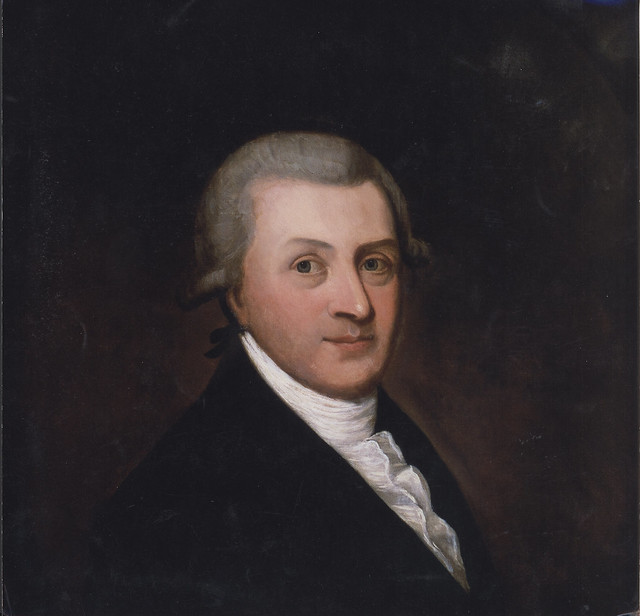
Arthur Guinness, of course, founded the Guinness Brewery in 1759, famously signing a 9,000-year lease for the St. James’ Gate property in Dublin. Shortly afterwards, in 1761, “he married Olivia Whitmore in St. Mary’s Church, Dublin, and they had 21 children, 10 of whom lived to adulthood.”

Arthur_Guinness

The Colson Center, a Christian website, has a short biography:

Arthur Guinness was born to a family of brewers on the estate of Arthur Price, the Protestant Church of Ireland archbishop of Cashel. Arthur’s father Richard was Dr. Price’s brewer, and was known for his particularly fine porter beer. He taught Arthur the craft of brewing.

Arthur must have been a particular favorite of Dr. Price, because on the archbishop’s death in 1752 he bequeathed to Arthur the sum of £100, the equivalent of four years wages. Over the following three years, he perfected his skills as the brewer for an inn owned by his stepmother. In 1755, he struck out his own, purchasing a small brewery in the village of Leixlip. He may have seen brewing beer as a service to the community: this was the era in which gin was devastating poor communities and beer provided a far healthier and less intoxicating alternative.

In 1759, Arthur moved to Dublin. There he found an abandoned brewery at St. James’ Gate, for rent for £100 down and £45 per year. Arthur somehow managed to get the owner to agree to a lease for up to 9,000 years on these terms, and so Arthur opened his new brewery in Dublin.

Arthur was a very dedicated member of the Church of Ireland. In Dublin, he attended a church in which John Wesley preached, and Wesley’s ideas about hard work, the goodness and responsibilities of wealth, and the importance of caring for the poor had a powerful impact on Arthur’s faith.

As a result, Arthur became involved in a variety of social welfare organizations. He was on the board and became governor of Meath hospital and was dedicated to ensuring that it provided care for the poor. He also gave to a number of charities, promoted Gaelic arts to encourage pride in the Irish heritage, and joined the Friendly Brothers of St. Patrick, an organization dedicated to ending the practice of dueling.

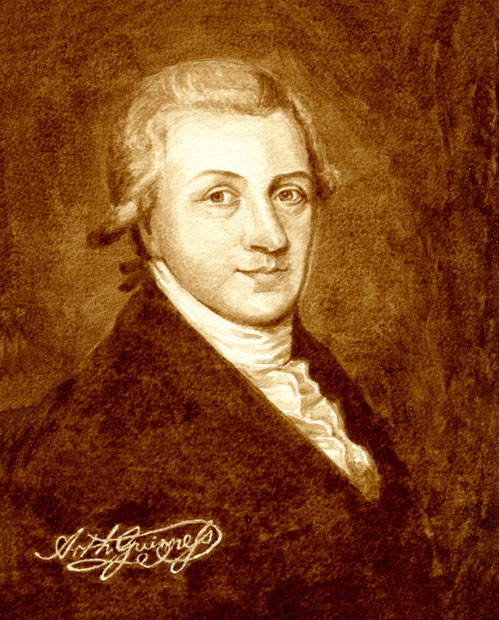
arthur-guinness-photo

He was also a champion of the Sunday School movement in Ireland, which provided basic education to children. For Arthur, this was part of an interest in prison reform: he believed that education combined with Biblical teaching would keep people from falling into a life of crime.

Even though a dedicated Protestant in a community that looked down at Roman Catholics, Guinness advocated for the rights of Catholics and treated them well at his brewery. This may have cost him business, but he believed it was the right thing to do.

Meanwhile, Guinness continued to develop and improve as a brewer. In 1779, he was named official brewer of Dublin Castle. At this point, he was brewing ales as well as a variety of dark porters.

Gradually, though, he decided to specialize in porter; he finally gave up brewing ale in 1799. Porter was very popular in England, and when Arthur and his fellow Irish brewers finally figured out how to produce a good quality black porter (stout), specializing in this kind of beer made sense. Soon Guinness’s porter was in demand not only in Dublin but increasingly in England as well.

Arthur died just a few years later, in 1803. But his story does not end there. Over the next century, Guinness grew to be one of the largest and most respected breweries in the world. That story is a tribute to Arthur’s hard work and insistence on excellence, qualities which he passed on to his children and heirs. But that is only part of the Guinness story. The other part is the amount of good Guinness has done for its employees and their families and for Dublin, all of which is also part of Arthur’s legacy.

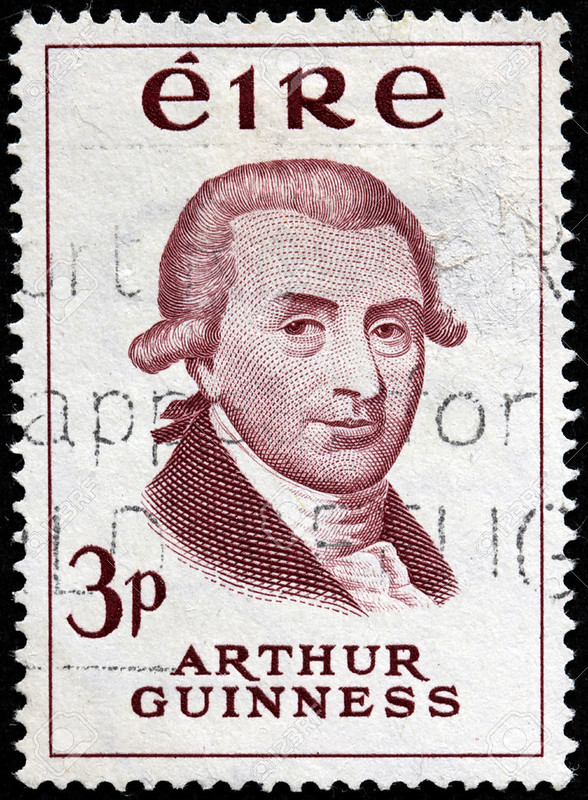
Arthur Guinness Stamp

And here’s another bio:

The Guinness story began in a small Irish village Celbridge, which was the home of Arthur Price, the Church of Ireland Archbishop of Cashel with a sufficient security. Arthur was one of those people who did not want to burden himself with a daily routine, and therefore he had hired Arthur Guinness (1724 or 1725 – January 23, 1803), a manager for all the cases. As time passed a very real friendship ensued between them to the point that Price baptized Arthur’s son Arthur Guinness II, born on March 12, 1768, who helped his father since childhood on the farm of the generous employer.

In his spare time, Arthur Guinness brewed real ale. Dr. Price had a benefit of all necessary equipment at his basement for this. In 1752, Arthur Price died. Such a tragic event, however, marked the beginning of Guinness brewing company’s story. The thing is that Arthur Price left a legacy of 100 pounds to both of them: Arthur Guinness and his son (at the time it was quite a large sum of money).

Guinness story began in a small Irish village Celbridge, which was the home of Arthur Price, the Church of Ireland Archbishop of Cashel with a sufficient security. Arthur was one of those people who did not want to burden himself with a daily routine, and therefore he had hired Arthur Guinness (1724 or 1725 – January 23, 1803), a manager for all the cases. As time passed a very real friendship ensued between them to the point that Price baptized Arthur’s son Arthur Guinness II, born on March 12, 1768, who helped his father since childhood on the farm of the generous employer.

In his spare time, Arthur Guinness brewed real ale. Dr. Price had a benefit of all necessary equipment at his basement for this. In 1752, Arthur Price died. Such a tragic event, however, marked the beginning of Guinness brewing company’s story. The thing is that Arthur Price left a legacy of 100 pounds to both of them: Arthur Guinness and his son (at the time it was quite a large sum of money).

However, all this time, Arthur continued to produce the same ale. Arthur Guinness started producing the dark beer only in 1799. The production of the dark beer with creamy foam originated in 1799 that further made the company one of the symbols of Ireland. Four years later after this momentous event, at age of 78, Arthur Guinness died. As a legacy to their children businessman left 25,000 pounds, which by today’s standards would amount to about 865,000 pounds.

Guinness-painting

Filed Under: Birthdays, Just For Fun Tagged With: Guinness, History, Ireland

Beer In Ads #4906: Braumeister Bock Beer

March 11, 2025 By Jay Brooks

Last year I decided to concentrate on Bock ads. Bock, of course, originated in Germany, in the town of Einbeck. Because many 19th century American breweries were founded by German immigrants, they offered a bock at certain times of the year, be it Spring, Easter, Lent, Christmas, or what have you. In a sense they were some of the first seasonal beers. “The style was later adopted in Bavaria by Munich brewers in the 17th century. Due to their Bavarian accent, citizens of Munich pronounced ‘Einbeck’ as ‘ein Bock’ (a billy goat), and thus the beer became known as ‘Bock.’ A goat often appears on bottle labels.” And presumably because they were special releases, many breweries went all out promoting them with beautiful artwork on posters and other advertising.

Tuesday’s ad is for Braumeister Bock Beer and was published March 11, 1951. The brewery was the Independent Milwaukee Brewery of Milwaukee, Wisconsin, which was founded in 1901 by five partners: Henry N. Bills, William Gutknecht, Charles Evers, Emil Czarnecki, and William Jung. It’s flagship brand was Braumeister. The survived Prohibition and lasted until 1962, when the G. Heileman Brewing Co. of nearby Lacrosse bought the brewery and closed it down the following year. But in 1951, they claimed to have Milwaukee’s most famous brewmaster for brewing Prize Bock Beer.”

Filed Under: Art & Beer, Beers, Breweries, Just For Fun Tagged With: Advertising, Bock, History, Wisconsin

Beer In Ads #4905: The Convert

March 10, 2025 By Jay Brooks

Last year I decided to concentrate on Bock ads. Bock, of course, originated in Germany, in the town of Einbeck. Because many 19th century American breweries were founded by German immigrants, they offered a bock at certain times of the year, be it Spring, Easter, Lent, Christmas, or what have you. In a sense they were some of the first seasonal beers. “The style was later adopted in Bavaria by Munich brewers in the 17th century. Due to their Bavarian accent, citizens of Munich pronounced ‘Einbeck’ as ‘ein Bock’ (a billy goat), and thus the beer became known as ‘Bock.’ A goat often appears on bottle labels.” And presumably because they were special releases, many breweries went all out promoting them with beautiful artwork on posters and other advertising.

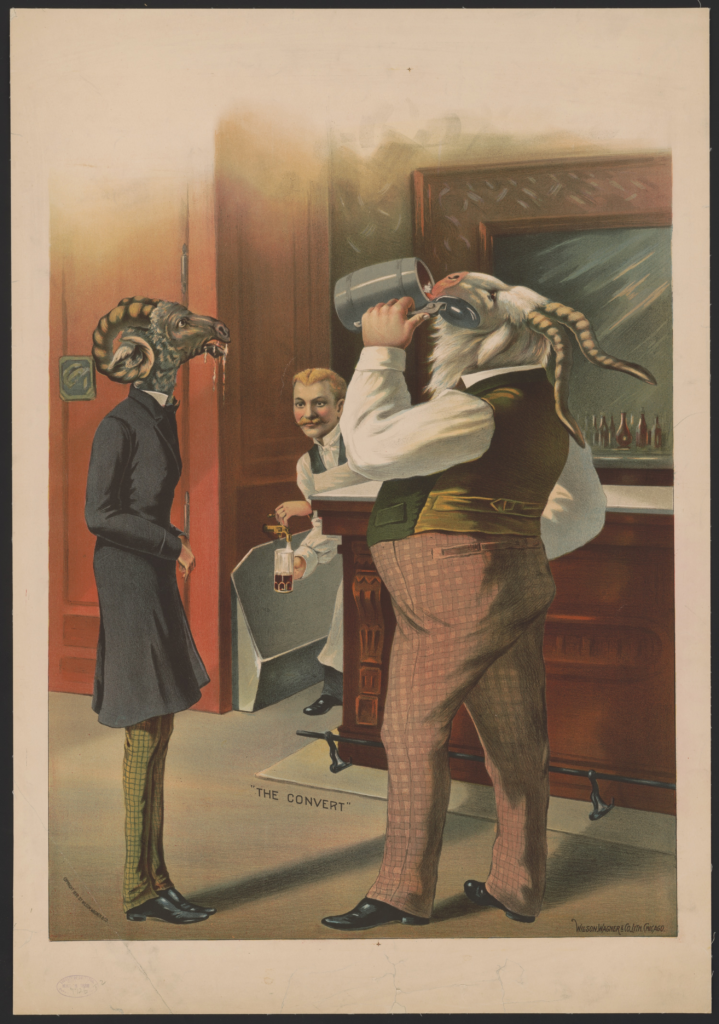
Monday’s ad doesn’t explicitly indicate it’s for Bock Beer, but it seems pretty clear from the imagery that it is. One goat is downing a mug of beer while another looks on and appears to be drooling in anticipation. Behind them is a sinister looking bartender drawing another glass of beer. He looks like he’s up to no good. The chromolithograph was created in 1888 by Wilson, Wagner & Co., Lithographers, of Chicago, Illinois.

Filed Under: Art & Beer, Beers, Just For Fun Tagged With: Advertising, Bock, History

Beer In Ads #4904: It’s Here! The Genuine Bock Beer!

March 9, 2025 By Jay Brooks

Last year I decided to concentrate on Bock ads. Bock, of course, originated in Germany, in the town of Einbeck. Because many 19th century American breweries were founded by German immigrants, they offered a bock at certain times of the year, be it Spring, Easter, Lent, Christmas, or what have you. In a sense they were some of the first seasonal beers. “The style was later adopted in Bavaria by Munich brewers in the 17th century. Due to their Bavarian accent, citizens of Munich pronounced ‘Einbeck’ as ‘ein Bock’ (a billy goat), and thus the beer became known as ‘Bock.’ A goat often appears on bottle labels.” And presumably because they were special releases, many breweries went all out promoting them with beautiful artwork on posters and other advertising.

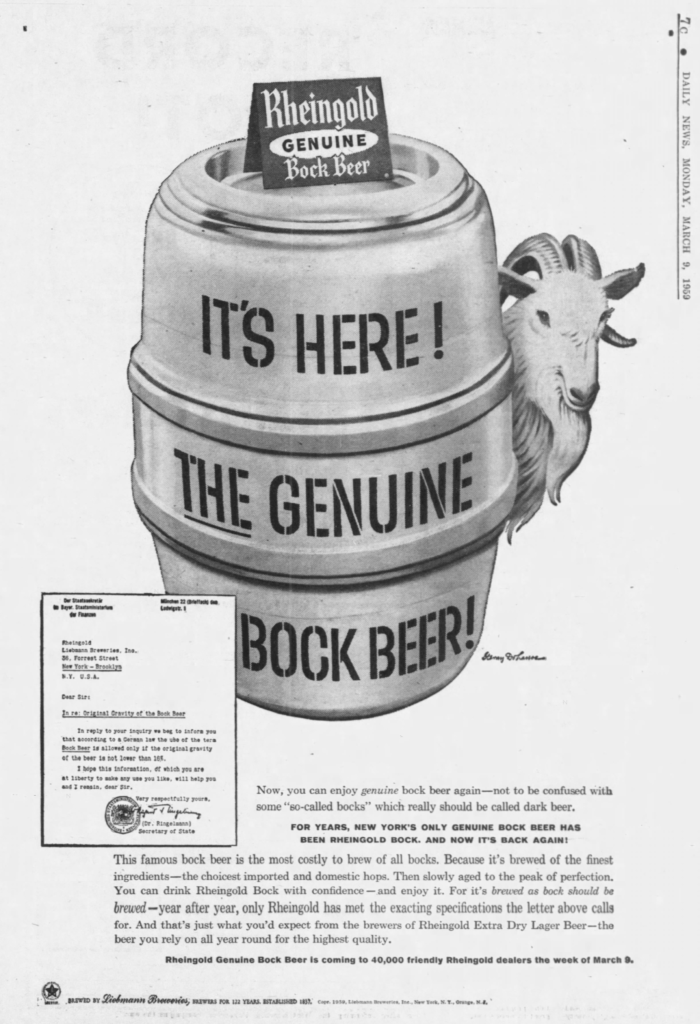
Sunday’s ad if for Rheingold Genuine Bock Beer and was published March 9, 1959. The ad was created for Liebmann Breweries, founded in 1837. The lithograph was created in 1880.  The ad is signed but I’ll be damned if I can read the signature. Best I can make out is something like … well, no, I looked again and I can’t make heads or tales of it. I do love the stenciling on the keg and the goat peeking out from behind it, but especially the letter from Dr. Ringelmann, Secretary of State, about the Original Gravity.

Filed Under: Art & Beer, Beers, Breweries, Just For Fun Tagged With: Advertising, Bock, History, New York, Rheingold

Historic Beer Birthday: William Cobbett

March 9, 2025 By Jay Brooks

Cobbett-cottage-economy
Today is the birthday of William Cobbett (March 9, 1763-June 18, 1835). Wikipedia describes him as:

an English pamphleteer, farmer and journalist, who was born in Farnham, Surrey. He believed that reforming Parliament and abolishing the rotten boroughs would help to end the poverty of farm labourers, and he attacked the borough-mongers, sinecurists and “tax-eaters” relentlessly. He was also against the Corn Laws, a tax on imported grain. Early in his career, he was a loyalist supporter of King and Country: but later he joined and successfully publicised the radical movement, which led to the Reform Bill of 1832, and to his being elected in 1832 as one of the two MPs for the newly enfranchised borough of Oldham. Although he was not a Catholic, he became a fiery advocate of Catholic Emancipation in Britain. Through the seeming contradictions in Cobbett’s life, his opposition to authority stayed constant. He wrote many polemics, on subjects from political reform to religion, but is best known for his book from 1830, Rural Rides, which is still in print today.

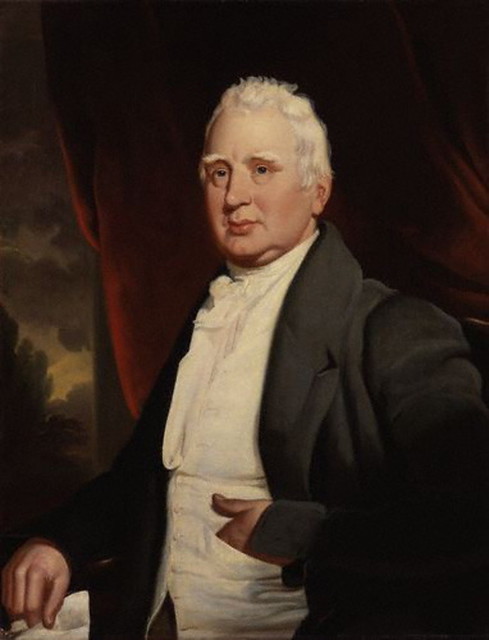
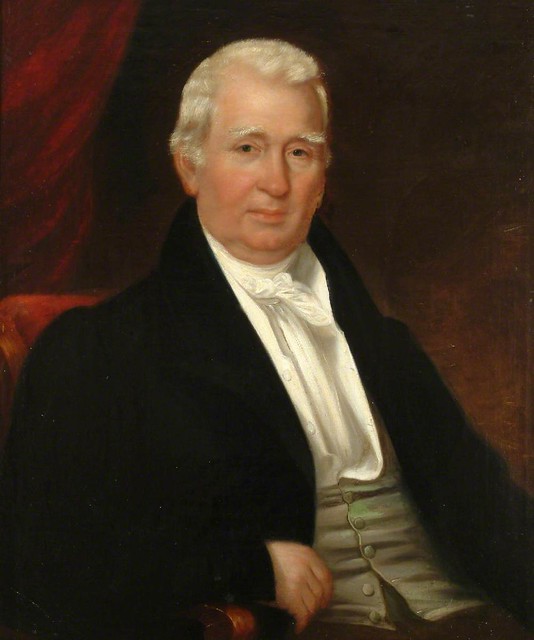
NPG 1549, William Cobbett
An oil painting of William Cobbett, possibly by George Cooke, from
c. 1831, which hangs in the National Portrait Gallery in London.
He was apparently born in a pub, a public house known as the “The Jolly Farmer,” which has since been renamed the “The William Cobbett.” Shortly after his death, friends created a William Cobbett Society, which is still going today. He loved England and all things English, and was especially concerned about turning back the clock to before the industrial revolution modernized Great Britain. Much of his writing was about that conservative view, including Cottage Economy, which was “first published in 1821, [and] which covers many practical instructions such how to bake bread, brew beer, keep livestock and ‘other matters deemed useful in the conducting of the Affairs of a Labourer’s Family’ with the aim of aiding the ‘Labouring Classes’ in having a “good living”. It is considered to be a timeless guide on matters of self-sufficiency.”

Happily Cottage Economy: To Which Is Added The Poor Man’s Friend is in the public domain, and you can read the whole thing at the Gutenberg Project, along with other books and pamphlets by Cobbett. But below are the two chapters on brewing beer.

BREWING BEER.
20. Before I proceed to give any directions about brewing, let me mention some of the inducements to do the thing. In former times, to set about to show to Englishmen that it was good for them to brew beer in their houses would have been as impertinent as gravely to insist, that they ought to endeavour not to lose their breath; for, in those times, (only forty years ago,) to have a house and not to brew was a rare thing indeed. Mr. Ellman, an old man and a large farmer, in Sussex, has recently given in evidence, before a Committee of the House of Commons, this fact; that, forty years ago, there was not a labourer in his parish that did not brew his own beer; and that now there is not one that does it, except by chance the malt be given him. The causes of this change have been the lowering of the wages of labour, compared with the price of provisions, by the means of the paper-money; the enormous tax upon the barley when made into malt; and the increased tax upon hops. These have quite changed the customs of the English people as to their drink. They still drink beer, but, in general, it is of the brewing of common brewers, and in public-houses, of which the common brewers have become the owners, and have thus, by the aid of paper-money, obtained a monopoly in the supplying of the great body of the people with one of those things which, to the hard-working man, is almost a necessary of life.

21. These things will be altered. They must be altered. The nation must be sunk into nothingness, or a new system must be adopted; and the nation will not sink into nothingness. The malt now pays a tax of 4s. 6d.[1] a bushel, and the barley costs only 3s. This brings the bushel of malt to 8s. including the maltster’s charge for malting. If the tax were taken off the malt, malt would be sold, at the present price of barley, for about 3s. 3d. a bushel; because a bushel of barley makes more than a bushel of malt, and the tax, besides its amount, causes great expenses of various sorts to the maltster. The hops pay a tax of 2d.[2] a pound; and a bushel of malt requires, in general, a pound of hops; if these two taxes were taken off, therefore, the consumption of barley and of hops would be exceedingly increased; for double the present quantity would be demanded, and the land is always ready to send it forth.

22. It appears impossible that the landlords should much longer submit to these intolerable burdens on their estates. In short, they must get off the malt tax, or lose those estates. They must do a great deal more, indeed; but that they must do at any rate. The paper-money is fast losing its destructive power; and things are, with regard to the labourers, coming back to what they were forty years ago, and therefore we may prepare for the making of beer in our own houses, and take leave of the poisonous stuff served out to us by common brewers. We may begin immediately; for, even at present prices, home-brewed beer is the cheapest drink that a family can use, except milk, and milk can be applicable only in certain cases.

23. The drink which has come to supply the place of beer has, in general, been tea. It is notorious that tea has no useful strength in it; that it contains nothing nutritious; that it, besides being good for nothing, has badness in it, because it is well known to produce want of sleep in many cases, and in all cases, to shake and weaken the nerves. It is, in fact, a weaker kind of laudanum, which enlivens for the moment and deadens afterwards. At any rate it communicates no strength to the body; it does not, in any degree, assist in affording what labour demands. It is, then, of no use. And, now, as to its cost, compared with that of beer. I shall make my comparison applicable to a year, or three hundred and sixty-five days. I shall suppose the tea to be only five shillings the pound; the sugar only sevenpence; the milk only twopence a quart. The prices are at the very lowest. I shall suppose a tea-pot to cost a shilling, six cups and saucers two shillings and sixpence, and six pewter spoons eighteen-pence. How to estimate the firing I hardly know; but certainly there must be in the course of the year, two hundred fires made that would not be made, were it not for tea drinking. Then comes the great article of all, the time employed in this tea-making affair. It is impossible to make a fire, boil water, make the tea, drink it, wash up the things, sweep up the fire-place, and put all to rights again, in a less space of time, upon an average, than two hours. However, let us allow one hour; and here we have a woman occupied no less than three hundred and sixty-five hours in the year, or thirty whole days, at twelve hours in the day; that is to say, one month out of the twelve in the year, besides the waste of the man’s time in hanging about waiting for the tea! Needs there any thing more to make us cease to wonder at seeing labourers’ children with dirty linen and holes in the heels of their stockings? Observe, too, that the time thus spent is, one half of it, the best time of the day. It is the top of the morning, which, in every calling of life, contains an hour worth two or three hours of the afternoon. By the time that the clattering tea tackle is out of the way, the morning is spoiled; its prime is gone; and any work that is to be done afterwards lags heavily along. If the mother have to go out to work, the tea affair must all first be over. She comes into the field, in summer time, when the sun has gone a third part of his course. She has the heat of the day to encounter, instead of having her work done and being ready to return home at any early hour. Yet early she must go, too: for, there is the fire again to be made, the clattering tea-tackle again to come forward; and even in the longest day she must have candle light, which never ought to be seen in a cottage (except in case of illness) from March to September.

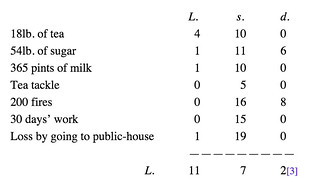
24. Now, then, let us take the bare cost of the use of tea. I suppose a pound of tea to last twenty days; which is not nearly half an ounce every morning and evening. I allow for each mess half a pint of milk. And I allow three pounds of the red dirty sugar to each pound of tea. The account of expenditure would then stand very high; but to these must be added the amount of the tea tackle, one set of which will, upon an average, be demolished every year. To these outgoings must be added the cost of beer at the public-house; for some the man will have, after all, and the woman too, unless they be upon the point of actual starvation. Two pots a week is as little as will serve in this way; and here is a dead loss of ninepence a week, seeing that two pots of beer, full as strong, and a great deal better, can be brewed at home for threepence. The account of the year’s tea drinking will then stand thus:

cottage-economy-1
25. I have here estimated every thing at its very lowest. The entertainment which I have here provided is as poor, as mean, as miserable as any thing short of starvation can set forth; and yet the wretched thing amounts to a good third part of a good and able labourer’s wages! For this money, he and his family may drink good and wholesome beer; in a short time, out of the mere savings from this waste, may drink it out of silver cups and tankards. In a labourer’s family, wholesome beer, that has a little life in it, is all that is wanted in general. Little children, that do not work, should not have beer. Broth, porridge, or something in that way, is the thing for them. However, I shall suppose, in order to make my comparison as little complicated as possible, that he brews nothing but beer as strong as the generality of beer to be had at the public-house, and divested of the poisonous drugs which that beer but too often contains; and I shall further suppose that he uses in his family two quarts of this beer every day from the first of October to the last day of March inclusive: three quarts a day during the months of April and May; four quarts a day during the months of June and September; and five quarts a day during the months of July and August; and if this be not enough, it must be a family of drunkards. Here are 1097 quarts, or 274 gallons. Now, a bushel of malt will make eighteen gallons of better beer than that which is sold at the public-houses. And this is precisely a gallon for the price of a quart. People should bear in mind, that the beer bought at the public-house is loaded with a beer tax, with the tax on the public-house keeper, in the shape of license, with all the taxes and expenses of the brewer, with all the taxes, rent, and other expenses of the publican, and with all the profits of both brewer and publican; so that when a man swallows a pot of beer at a public-house, he has all these expenses to help to defray, besides the mere tax on the malt and on the hops.

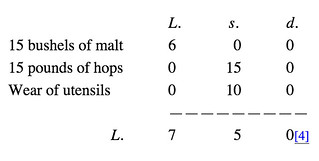
26. Well, then, to brew this ample supply of good beer for a labourer’s family, these 274 gallons, requires fifteen bushels of malt and (for let us do the thing well) fifteen pounds of hops. The malt is now eight shillings a bushel, and very good hops may be bought for less than a shilling a pound. The grains and yeast will amply pay for the labour and fuel employed in the brewing; seeing that there will be pigs to eat the grains, and bread to be baked with the yeast. The account will then stand thus:

cottage-economy-2
27. Here, then, is the sum of four pounds two shillings and twopence saved every year. The utensils for brewing are, a brass kettle, a mashing tub, coolers, (for which washing tubs may serve,) a half hogshead, with one end taken out, for a tun tub, about four nine-gallon casks, and a couple of eighteen-gallon casks. This is an ample supply of utensils, each of which will last, with proper care, a good long lifetime or two, and the whole of which, even if purchased new from the shop, will only exceed by a few shillings, if they exceed at all, the amount of the saving, arising the very first year, from quitting the troublesome and pernicious practice of drinking tea. The saving of each succeeding year would, if you chose it, purchase a silver mug to hold half a pint at least. However, the saving would naturally be applied to purposes more conducive to the well-being and happiness of a family.

28. It is not, however, the mere saving to which I look. This is, indeed, a matter of great importance, whether we look at the amount itself, or at the ultimate consequences of a judicious application of it; for four pounds make a great hole in a man’s wages for the year; and when we consider all the advantages that would arise to a family of children from having these four pounds, now so miserably wasted, laid out upon their backs, in the shape of a decent dress, it is impossible to look at this waste without feelings of sorrow not wholly unmixed with those of a harsher description.

29. But, I look upon the thing in a still more serious light. I view the tea drinking as a destroyer of health, an enfeebler of the frame, an engenderer of effeminacy and laziness, a debaucher of youth, and a maker of misery for old age. In the fifteen bushels of malt there are 570 pounds weight of sweet; that is to say, of nutricious matter, unmixed with any thing injurious to health. In the 730 tea messes of the year there are 54 pounds of sweet in the sugar, and about 30 pounds of matter equal to sugar in the milk. Here are 84 pounds instead of 570, and even the good effect of these 84 pounds is more than over-balanced by the corrosive, gnawing and poisonous powers of the tea.

30. It is impossible for any one to deny the truth of this statement. Put it to the test with a lean hog: give him the fifteen bushels of malt, and he will repay you in ten score of bacon or thereabouts. But give him the 730 tea messes, or rather begin to give them to him, and give him nothing else, and he is dead with hunger, and bequeaths you his skeleton, at the end of about seven days. It is impossible to doubt in such a case. The tea drinking has done a great deal in bringing this nation into the state of misery in which it now is; and the tea drinking, which is carried on by “dribs” and “drabs;” by pence and farthings going out at a time; this miserable practice has been gradually introduced by the growing weight of the taxes on malt and on hops, and by the everlasting penury amongst the labourers, occasioned by the paper-money.

31. We see better prospects however, and therefore let us now rouse ourselves, and shake from us the degrading curse, the effects of which have been much more extensive and infinitely more mischievous than men in general seem to imagine.

32. It must be evident to every one, that the practice of tea drinking must render the frame feeble and unfit to encounter hard labour or severe weather, while, as I have shown, it deducts from the means of replenishing the belly and covering the back. Hence succeeds a softness, an effeminacy, a seeking for the fire-side, a lurking in the bed, and, in short, all the characteristics of idleness, for which, in this case, real want of strength furnishes an apology. The tea drinking fills the public-house, makes the frequenting of it habitual, corrupts boys as soon as they are able to move from home, and does little less for the girls, to whom the gossip of the tea-table is no bad preparatory school for the brothel. At the very least, it teaches them idleness. The everlasting dawdling about with the slops of the tea tackle, gives them a relish for nothing that requires strength and activity. When they go from home, they know how to do nothing that is useful. To brew, to bake, to make butter, to milk, to rear poultry; to do any earthly thing of use they are wholly unqualified. To shut poor young creatures up in manufactories is bad enough; but there, at any rate, they do something that is useful; whereas, the girl that has been brought up merely to boil the tea-kettle, and to assist in the gossip inseparable from the practice, is a mere consumer of food, a pest to her employer, and a curse to her husband, if any man be so unfortunate as to fix his affections upon her.

33. But is it in the power of any man, any good labourer, who has attained the age of fifty, to look back upon the last thirty years of his life, without cursing the day in which tea was introduced into England? Where is there such a man, who cannot trace to this cause a very considerable part of all the mortifications and sufferings of his life? When was he ever too late at his labour; when did he ever meet with a frown, with a turning off, and pauperism on that account, without being able to trace it to the tea-kettle? When reproached with lagging in the morning, the poor wretch tells you that he will make up for it by working during his breakfast time! I have heard this a hundred and a hundred times over. He was up time enough; but the tea-kettle kept him lolling and lounging at home; and now, instead of sitting down to a breakfast upon bread, bacon, and beer, which is to carry him on to the hour of dinner, he has to force his limbs along under the sweat of feebleness, and at dinner time to swallow his dry bread, or slake his half-feverish thirst at the pump or the brook. To the wretched tea-kettle he has to return at night, with legs hardly sufficient to maintain him; and thus he makes his miserable progress towards that death, which he finds ten or fifteen years sooner than he would have found it had he made his wife brew beer instead of making tea. If he now and then gladdens his heart with the drugs of the public house, some quarrel, some accident, some illness, is the probable consequence; to the affray abroad succeeds an affray at home; the mischievous example reaches the children, corrupts them or scatters them, and misery for life is the consequence.

34. I should now proceed to the details of brewing; but these, though they will not occupy a large space, must be put off to the second number. The custom of brewing at home has so long ceased amongst labourers, and, in many cases, amongst tradesmen, that it was necessary for me fully to state my reasons for wishing to see the custom revived. I shall, in my next, clearly explain how the operation is performed; and it will be found to be so easy a thing, that I am not without hope, that many tradesmen, who now spend their evenings at the public house, amidst tobacco smoke and empty noise, may be induced, by the finding of better drink at home, at a quarter part of the price, to perceive that home is by far the pleasantest place wherein to pass their hours of relaxation.

35. My work is intended chiefly for the benefit of cottagers, who must, of course, have some land; for, I purpose to show, that a large part of the food of even a large family may be raised, without any diminution of the labourer’s earnings abroad, from forty rod, or a quarter of an acre, of ground; but at the same time, what I have to say will be applicable to larger establishments, in all the branches of domestic economy: and especially to that of providing a family with beer.

36. The kind of beer, for a labourer’s family, that is to say, the degree of strength, must depend on circumstances; on the numerousness of the family; on the season of the year, and various other things. But, generally speaking, beer half the strength of that mentioned in paragraph 25 will be quite strong enough; for that is, at least, one-third stronger than the farm-house “small beer,” which, however, as long experience has proved, is best suited to the purpose. A judicious labourer would probably always have some ale in his house, and have small beer for the general drink. There is no reason why he should not keep Christmas as well as the farmer; and when he is mowing, reaping, or is at any other hard work, a quart, or three pints, of really good fat ale a-day is by no means too much. However, circumstances vary so much with different labourers, that as to the sort of beer, and the number of brewings, and the times of brewing, no general rule can be laid down.

37. Before I proceed to explain the uses of the several brewing utensils, I must speak of the quality of the materials of which beer is made; that is to say, the malt, hops, and water. Malt varies very much in quality, as, indeed, it must, with the quality of the barley. When good, it is full of flour, and in biting a grain asunder, you find it bite easily, and see the shell thin and filled up well with flour. If it bite hard and steely, the malt is bad. There is pale malt and brown malt; but the difference in the two arises merely from the different degrees of heat employed in the drying. The main thing to attend to is, the quantity of flour. If the barley was bad; thin, or steely, whether from unripeness or blight, or any other cause, it will not malt so well; that is to say, it will not send out its roots in due time; and a part of it will still be barley. Then, the world is wicked enough to think, and even to say, that there are maltsters who, when they send you a bushel of malt, put a little barley amongst it, the malt being taxed and the barley not! Let us hope that this is seldom the case; yet, when we do know that this terrible system of taxation induces the beer-selling gentry to supply their customers with stuff little better than poison, it is not very uncharitable to suppose it possible for some maltsters to yield to the temptations of the devil so far as to play the trick above mentioned. To detect this trick, and to discover what portion of the barley is in an unmalted state, take a handful of the unground malt, and put it into a bowl of cold water. Mix it about with the water a little; that is, let every grain be just wet all over; and whatever part of them sink are not good. If you have your malt ground, there is not, as I know of, any means of detection. Therefore, if your brewing be considerable in amount, grind your own malt, the means of doing which is very easy, and neither expensive nor troublesome, as will appear, when I come to speak of flour. If the barley be well malted, there is still a variety in the quality of the malt; that is to say, a bushel of malt from fine, plump, heavy barley, will be better than the same quantity from thin and light barley. In this case, as in the case of wheat, the weight is the criterion of the quality. Only bear in mind, that as a bushel of wheat, weighing sixty-two pounds, is better worth six shillings, than a bushel weighing fifty-two is worth four shillings, so a bushel of malt weighing forty-five pounds is better worth nine shillings, than a bushel weighing thirty-five is worth six shillings. In malt, therefore, as in every thing else, the word cheap is a deception, unless the quality be taken into view. But, bear in mind, that in the case of unmalted barley, mixed with the malt, the weight can be no rule; for barley is heavier than malt.

William Cobbett (1763-1835)

No. II.BREWING BEER—(continued.)

38. As to using barley in the making of beer, I have given it a full and fair trial twice over, and I would recommend it to neither rich nor poor. The barley produces strength, though nothing like the malt; but the beer is flat, even though you use half malt and half barley; and flat beer lies heavy on the stomach, and of course, besides the bad taste, is unwholesome. To pay 4s. 6d. tax upon every bushel of our own barley, turned into malt, when the barley itself is not worth 3s. a bushel, is a horrid thing; but, as long as the owners of the land shall be so dastardly as to suffer themselves to be thus deprived of the use of their estates to favour the slave-drivers and plunderers of the East and West Indies, we must submit to the thing, incomprehensible to foreigners, and even to ourselves, as the submission may be.

39. With regard to hops, the quality is very various. At times when some sell for 5s. a pound, others sell for sixpence. Provided the purchaser understand the article, the quality is, of course, in proportion to the price. There are two things to be considered in hops: the power of preserving beer, and that of giving it a pleasant flavour. Hops may be strong; and yet not good. They should be bright, have no leaves or bits of branches amongst them. The hop is the husk, or seed-pod, of the hop-vine, as the cone is that of the fir-tree; and the seeds themselves are deposited, like those of the fir, round a little soft stalk, enveloped by the several folds of this pod, or cone. If, in the gathering, leaves of the vine or bits of the branches are mixed with the hops, these not only help to make up the weight, but they give a bad taste to the beer; and indeed, if they abound much, they spoil the beer. Great attention is therefore necessary in this respect. There are, too, numerous sorts of hops, varying in size, form, and quality, quite as much as apples. However, when they are in a state to be used in brewing, the marks of goodness are an absence of brown colour, (for that indicates perished hops;) a colour between green and yellow; a great quantity of the yellow farina; seeds not too large nor too hard; a clammy feel when rubbed between the fingers; and a lively, pleasant smell. As to the age of hops, they retain for twenty years, probably, their power of preserving beer; but not of giving it a pleasant flavour. I have used them at ten years old, and should have no fear of using them at twenty. They lose none of their bitterness; none of their power of preserving beer; but they lose the other quality; and therefore, in the making of fine ale, or beer, new hops are to be preferred. As to the quantity of hops, it is clear, from what has been said, that that must, in some degree depend upon their quality; but, supposing them to be good in quality, a pound of hops to a bushel of malt is about the quantity. A good deal, however, depends upon the length of time that the beer is intended to be kept, and upon the season of the year in which it is brewed. Beer intended to be kept a long while should have the full pound, also beer brewed in warmer weather, though for present use: half the quantity may do under an opposite state of circumstances.

40. The water should be soft by all means. That of brooks, or rivers, is best. That of a pond, fed by a rivulet, or spring, will do very well. Rain-water, if just fallen, may do; but stale rain-water, or stagnant pond-water, makes the beer flat and difficult to keep; and hard water, from wells, is very bad; it does not get the sweetness out of the malt, nor the bitterness out of the hops, like soft water; and the wort of it does not ferment well, which is a certain proof of its unfitness for the purpose.

41. There are two descriptions of persons whom I am desirous to see brewing their own beer; namely, tradesmen, and labourers and journeymen. There must, therefore, be two distinct scales treated of. In the former editions of this work, I spoke of a machine for brewing, and stated the advantages of using it in a family of any considerable consumption of beer; but, while, from my desire to promote private brewing, I strongly recommended the machine, I stated that, “if any of my readers could point out any method by which we should be more likely to restore the practice of private brewing, and especially to the cottage, I should be greatly obliged to them to communicate it to me.” Such communications have been made, and I am very happy to be able, in this new edition of my little work, to avail myself of them. There was, in the Patent Machine, always, an objection on account of the expense; for, even the machine for one bushel of malt cost, at the reduced price, eight pounds; a sum far above the reach of a cottager, and even above that of a small tradesman. Its convenience, especially in towns, where room is so valuable, was an object of great importance; but there were disadvantages attending it which, until after some experience, I did not ascertain. It will be remembered that the method by the brewing machine requires the malt to be put into the cold water, and for the water to make the malt swim, or, at least, to be in such proportion as to prevent the fire beneath from burning the malt. We found that our beer was flat, and that it did not keep. And this arose, I have every reason to believe, from this process. The malt should be put into hot water, and the water, at first, should be but just sufficient in quantity to stir the malt in, and separate it well. Nevertheless, when it is merely to make small beer; beer not wanted to keep; in such cases the brewing machine may be of use; and, as will be seen by-and-by, a moveable boiler (which has nothing to do with the patent) may, in many cases, be of great convenience and utility.

42. The two scales of which I have spoken above, are now to be spoken of; and, that I may explain my meaning the more clearly, I shall suppose, that, for the tradesman’s family, it will be requisite to brew eighteen gallons of ale and thirty-six of small beer, to fill three casks of eighteen gallons each. It will be observed, of course, that, for larger quantities, larger utensils of all sorts will be wanted. I take this quantity as the one to give directions on. The utensils wanted here will be, First, a copper that will contain forty gallons, at least; for, though there be to be but thirty-six gallons of small beer, there must be space for the hops, and for the liquor that goes off in steam. Second, a mashing-tub to contain sixty gallons; for the malt is to be in this along with the water. Third, an underbuck, or shallow tub to go under the mash-tub, for the wort to run into when drawn from the grains. Fourth, a tun-tub, that will contain thirty gallons, to put the ale into to work, the mash-tub, as we shall see, serving as a tun-tub for the small beer. Besides these, a couple of coolers, shallow tubs, which may be the heads of wine buts, or some such things, about a foot deep; or if you have four it may be as well, in order to effect the cooling more quickly.

43. You begin by filling the copper with water, and next by making the water boil. You then put into the mashing-tub water sufficient to stir and separate the malt in. But now let me say more particularly what this mashing-tub is. It is, you know, to contain sixty gallons. It is to be a little broader at top than at bottom, and not quite so deep as it is wide across the bottom. Into the middle of the bottom there is a hole about two inches over, to draw the wort off through. In this hole goes a stick, a foot or two longer than the tub is high. This stick is to be about two inches through, and tapered for about eight inches upwards at the end that goes into the hole, which at last it fills up closely as a cork. Upon the hole, before any thing else be put into the tub, you lay a little bundle of fine birch, (heath or straw may do,) about half the bulk of a birch broom, and well tied at both ends. This being laid over the hole (to keep back the grains as the wort goes out,) you put the tapered end of the stick down through into the hole, and thus cork the hole up. You must then have something of weight sufficient to keep the birch steady at the bottom of the tub, with a hole through it to slip down the stick; otherwise when the stick is raised it will be apt to raise the birch with it, and when you are stirring the mash you would move it from its place. The best thing for this purpose will be a leaden collar for the stick, with the hole in the collar plenty large enough, and it should weigh three or four pounds. The thing they use in some farm-houses is the iron box of a wheel. Any thing will do that will slide down the stick, and lie with weight enough on the birch to keep it from moving. Now, then, you are ready to begin brewing. I allow two bushels of malt for the brewing I have supposed. You must now put into the mashing-tub as much boiling water as will be sufficient to stir the malt in and separate it well. But here occur some of the nicest points of all; namely, the degree of heat that the water is to be at, before you put in the malt. This heat is one hundred and seventy degrees by the thermometer. If you have a thermometer, this is ascertained easily; but, without one, take this rule, by which so much good beer has been made in England for hundreds of years: when you can, by looking down into the tub, see your face clearly in the water, the water is become cool enough; and you must not put the malt in before. Now put in the malt and stir it well in the water. To perform this stirring, which is very necessary, you have a stick, somewhat bigger than a broom-stick, with two or three smaller sticks, eight or ten inches long, put through the lower end of it at about three or four inches asunder, and sticking out on each side of the long stick. These small cross sticks serve to search the malt and separate it well in the stirring or mashing. Thus, then, the malt is in; and in this state it should continue for about a quarter of an hour. In the mean while you will have filled up your copper, and made it boil; and now (at the end of the quarter of an hour) you put in boiling water sufficient to give you your eighteen gallons of ale. But, perhaps, you must have thirty gallons of water in the whole; for the grains will retain at least ten gallons of water; and it is better to have rather too much wort than too little. When your proper quantity of water is in, stir the malt again well. Cover the mashing-tub over with sacks, or something that will answer the same purpose; and there let the mash stand for two hours. When it has stood the two hours, you draw off the wort. And now, mind, the mashing-tub is placed on a couple of stools, or on something, that will enable you to put the underbuck under it, so as to receive the wort as it comes out of the hole before-mentioned. When you have put the underbuck in its place, you let out the wort by pulling up the stick that corks the whole. But, observe, this stick (which goes six or eight inches through the hole) must be raised by degrees, and the wort must be let out slowly, in order to keep back the sediment. So that it is necessary to have something to keep the stick up at the point where you are to raise it, and wish to fix it at for the time. To do this, the simplest, cheapest and best thing in the world is a cleft stick. Take a rod of ash, hazel, birch, or almost any wood; let it be a foot or two longer than your mashing-tub is wide over the top; split it, as if for making hoops; tie it round with a string at each end; lay it across your mashing-tub; pull it open in the middle, and let the upper part of the wort-stick through it, and when you raise that stick, by degrees as before directed, the cleft stick will hold it up at whatever height you please.

44. When you have drawn off the ale-wort, you proceed to put into the mashing tub water for the small beer. But, I shall go on with my directions about the ale till I have got it into the cask and cellar; and shall then return to the small-beer.

45. As you draw off the ale-wort into the underbuck, you must lade it out of that into the tun-tub, for which work, as well as for various other purposes in the brewing, you must have a bowl-dish with a handle to it. The underbuck will not hold the whole of the wort. It is, as before described, a shallow tub, to go under the mashing-tub to draw off the wort into. Out of this underbuck you must lade the ale-wort into the tun-tub; and there it must remain till your copper be emptied and ready to receive it.

46. The copper being empty, you put the wort into it, and put in after the wort, or before it, a pound and a half of good hops, well rubbed and separated as you put them in. You now make the copper boil, and keep it, with the lid off, at a good brisk boil, for a full hour, and if it be an hour and a half it is none the worse.

47. When the boiling is done, put out your fire, and put the liquor into the coolers. But it must be put into the coolers without the hops. Therefore, in order to get the hops out of the liquor, you must have a strainer. The best for your purpose is a small clothes-basket, or any other wicker-basket. You set your coolers in the most convenient place. It may be in-doors or out of doors, as most convenient. You lay a couple of sticks across one of the coolers, and put the basket upon them. Put your liquor, hops and all, into the basket, which will keep back the hops. When you have got liquor enough in one cooler, you go to another with your sticks and basket, till you have got all your liquor out. If you find your liquor deeper in one cooler than the other, you can make an alteration in that respect, till you have the liquor so distributed as to cool equally fast in both, or all, the coolers.

48. The next stage of the liquor is in the tun-tub, where it is set to work. Now, a very great point is, the degree of heat that the liquor is to be at when it is set to working. The proper heat is seventy degrees; so that a thermometer makes this matter sure. In the country they determine the degree of heat by merely putting a finger into the liquor. Seventy degrees is but just warm, a gentle luke-warmth. Nothing like heat. A little experience makes perfectness in such a matter. When at the proper heat, or nearly, (for the liquor will cool a little in being removed,) put it into the tun-tub. And now, before I speak of the act of setting the beer to work, I must describe this tun-tub, which I first mentioned in Paragraph 42. It is to hold thirty gallons, as you have seen; and nothing is better than an old cask of that size, or somewhat larger, with the head taken out, or cut off. But, indeed, any tub of sufficient dimensions, and of about the same depth proportioned to the width as a cask or barrel has, will do for the purpose. Having put the liquor into the tun-tub, you put in the yeast. About half a pint of good yeast is sufficient. This should first be put into a thing of some sort that will hold about a gallon of your liquor; the thing should then be nearly filled with liquor, and with a stick or spoon you should mix the yeast well with the liquor in this bowl, or other thing, and stir in along with the yeast a handful of wheat or rye flour. This mixture is then to be poured out clean into the tun-tub, and the whole mass of the liquor is then to be agitated well by lading up and pouring down again with your bowl-dish, till the yeast be well mixed with the liquor. Some people do the thing in another manner. They mix up the yeast and flour with some liquor (as just mentioned) taken out of the coolers; and then they set the little vessel that contains this mixture down on the bottom of the tun-tub; and, leaving it there, put the liquor out of the coolers into the tun-tub. Being placed at the bottom, and having the liquor poured on it, the mixture is, perhaps, more perfectly effected in this way than in any way. The flour may not be necessary; but, as the country people use it, it is, doubtless, of some use; for their hereditary experience has not been for nothing. When your liquor is thus properly put into the tun-tub and set a working, cover over the top of the tub by laying across it a sack or two, or something that will answer the purpose.

49. We now come to the last stage; the cask or barrel. But I must first speak of the place for the tun-tub to stand in. The place should be such as to avoid too much warmth or cold. The air should, if possible, be at about 55 degrees. Any cool place in summer and any warmish place in winter. If the weather be very cold, some cloths or sacks should be put round the tun-tub while the beer is working. In about six or eight hours, a frothy head will rise upon the liquor; and it will keep rising, more or less slowly, for about forty-eight hours. But, the length of time required for the working depends on various circumstances; so that no precise time can be fixed. The best way is, to take off the froth (which is indeed yeast) at the end of about twenty-four hours, with a common skimmer, and put it into a pan or vessel of some sort; then, in twelve hours’ time, take it off again in the same way; and so on till the liquor has done working, and sends up no more yeast. Then it is beer; and when it is quite cold (for ale or strong beer) put it into the cask by means of a funnel. It must be cold before you do this, or it will be what the country-people call foxed; that is to say, have a rank and disagreeable taste. Now, as to the cask, it must be sound and sweet. I thought, when writing the former edition of this work, that the bell-shaped were the best casks. I am now convinced that that was an error. The bell-shaped, by contracting the width of the top of the beer, as that top descends, in consequence of the draft for use, certainly prevents the head (which always gathers on beer as soon as you begin to draw it off) from breaking and mixing in amongst the beer. This is an advantage in the bell-shape; but then the bell-shape, which places the widest end of the cask uppermost, exposes the cask to the admission of external air much more than the other shape. This danger approaches from the ends of the cask; and, in the bell-shape, you have the broadest end wholly exposed the moment you have drawn out the first gallon of beer, which is not the case with the casks of the common shape. Directions are given, in the case of the bell-casks, to put damp sand on the top to keep out the air. But, it is very difficult to make this effectual; and yet, if you do not keep out the air, your beer will be flat; and when flat, it really is good for nothing but the pigs. It is very difficult to fill the bell-cask, which you will easily see if you consider its shape. It must be placed on the level with the greatest possible truth, or there will be a space left; and to place it with such truth is, perhaps, as difficult a thing as a mason or bricklayer ever had to perform. And yet, if this be not done, there will be an empty space in the cask, though it may, at the same time, run over. With the common casks there are none of these difficulties. A common eye will see when it is well placed; and, at any rate, any little vacant space that may be left is not at an end of the cask, and will, without great carelessness, be so small as to be of no consequence. We now come to the act of putting in the beer. The cask should be placed on a stand with legs about a foot long. The cask, being round, must have a little wedge, or block, on each side to keep it steady. Bricks do very well. Bring your beer down into the cellar in buckets, and pour it in through the funnel, until the cask be full. The cask should lean a little on one side, when you fill it; because the beer will work again here, and send more yeast out of the bung-hole; and, if the cask were not a little on one side, the yeast would flow over both sides of the cask, and would not descend in one stream into a pan, put underneath to receive it. Here the bell-cask is extremely inconvenient; for the yeast works up all over the head, and cannot run off, and makes a very nasty affair. This alone, to say nothing of the other disadvantages, would decide the question against the bell-casks. Something will go off in this working, which may continue for two or three days. When you put the beer in the cask, you should have a gallon or two left, to keep filling up with as the working produces emptiness. At last, when the working is completely over, right the cask. That is to say, block it up to its level. Put in a handful of fresh hops. Fill the cask quite full. Put in the bung, with a bit of coarse linen stuff round it; hammer it down tight; and, if you like, fill a coarse bag with sand, and lay it, well pressed down, over the bung.

50. As to the length of time that you are to keep the beer before you begin to use it, that must, in some measure, depend on taste. Such beer as this ale will keep almost any length of time. As to the mode of tapping, that is as easy almost as drinking. When the cask is empty, great care must be taken to cork it tightly up, so that no air get in; for, if it do, the cask is moulded, and when once moulded, it is spoiled for ever. It is never again fit to be used about beer. Before the cask be used again, the grounds must be poured out, and the cask cleaned by several times scalding; by putting in stones (or a chain,) and rolling and shaking about till it be quite clean. Here again the round casks have the decided advantage; it being almost impossible to make the bell-casks thoroughly clean, without taking the head out, which is both troublesome and expensive; as it cannot be well done by any one but a cooper, who is not always at hand, and who, when he is, must be paid.

51. I have now done with the ale, and it remains for me to speak of the small beer. In Paragraph 47 (which now see) I left you drawing off the ale-wort, and with your copper full of boiling water. Thirty-six gallons of that boiling water are, as soon as you have got your ale-wort out, and have put down your mash-tub stick to close up the hole at the bottom; as soon as you have done this, thirty-six gallons of the boiling water are to go into the mashing-tub; the grains are to be well stirred up, as before; the mashing-tub is to be covered over again, as mentioned in Paragraph 43; and the mash is to stand in that state for an hour, and not two hours, as for the ale-wort.

52. When the small beer mash has stood its hour, draw it off as in Paragraph 47, and put it into the tun-tub as you did the ale-wort.

53. By this time your copper will be empty again, by putting your ale-liquor to cool, as mentioned in Paragraph 47. And you now put the small beer wort into the copper, with the hops that you used before, and with half a pound of fresh hops added to them; and this liquor you boil briskly for an hour.

54. By this time you will have taken the grains and the sediment clean out of the mashing-tub, and taken out the bunch of birch twigs, and made all clean. Now put in the birch twigs again, and put down your stick as before. Lay your two or three sticks across the mashing-tub, put your basket on them, and take your liquor from the copper (putting the fire out first) and pour it into the mashing-tub through the basket. Take the basket away, throw the hops to the dunghill, and leave the small beer liquid to cool in the mashing-tub.

55. Here it is to remain to be set to working as mentioned for the ale, in Paragraph 48; only, in this case, you will want more yeast in proportion; and should have for your thirty-six gallons of small beer, three half pints of good yeast.

56. Proceed, as to all the rest of the business, as with the ale, only, in the case of the small beer, it should be put into the cask, not quite cold, but a little warm; or else it will not work at all in the barrel, which it ought to do. It will not work so strongly or so long as the ale; and may be put in the barrel much sooner; in general the next day after it is brewed.

57. All the utensils should be well cleaned and put away as soon as they are done with; the little things as well as the great things; for it is loss of time to make new ones. And, now, let us see the expense of these utensils. The copper, new, 5l.; the mashing-tub, new, 30s.; the tun-tub, not new, 5s.; the underbuck and three coolers, not new, 20s. The whole cost is 7l. 10s. which is ten shillings less than the one bushel machine. I am now in a farm-house, where the same set of utensils has been used for forty years; and the owner tells me, that, with the same use, they may last for forty years longer. The machine will not, I think, last four years, if in any thing like regular use. It is of sheet-iron, tinned on the inside, and this tin rusts exceedingly, and is not to be kept clean without such rubbing as must soon take off the tin. The great advantage of the machine is, that it can be removed. You can brew without a brew-house.—You can set the boiler up against any fire-place, or any window. You can brew under a cart-shed, and even out of doors. But all this may be done with these utensils, if your copper be moveable. Make the boiler of copper, and not of sheet-iron, and fix it on a stand with a fire-place and stove-pipe; and then you have the whole to brew out of doors with as well as in-doors, which is a very great convenience.

58. Now with regard to the other scale of brewing, little need be said; because, all the principles being the same, the utensils only are to be proportioned to the quantity. If only one sort of beer be to be brewed at a time, all the difference is, that, in order to extract the whole of the goodness of the malt, the mashing ought to be at twice. The two worts are then put together, and then you boil them together with the hops.

59. A Correspondent at Morpeth says, the whole of the utensils used by him are a twenty-gallon pot, a mashing-tub, that also answers for a tun-tub, and a shallow tub for a cooler; and that these are plenty for a person who is any thing of a contriver. This is very true; and these things will cost no more, perhaps, than forty shillings. A nine gallon cask of beer can be brewed very well with such utensils. Indeed, it is what used to be done by almost every labouring man in the kingdom, until the high price of malt and comparatively low price of wages rendered the people too poor and miserable to be able to brew at all. A Correspondent at Bristol has obligingly sent me the model of utensils for brewing on a small scale; but as they consist chiefly of brittle ware, I am of opinion that they would not so well answer the purpose.

60. Indeed, as to the country labourers, all they want is the ability to get the malt. Mr. Ellman, in his evidence before the Agricultural Committee, said, that, when he began farming, forty-five years ago, there was not a labourer’s family in the parish that did not brew their own beer and enjoy it by their own fire-sides; and that, now, not one single family did it, from want of ability to get the malt. It is the tax that prevents their getting the malt; for, the barley is cheap enough. The tax causes a monopoly in the hands of the maltsters, who, when the tax is two and sixpence, make the malt, cost 7s. 6d., though the barley cost but 2s. 6d.; and though the malt, tax and all, ought to cost him about 5s. 6d. If the tax were taken off, this pernicious monopoly would be destroyed.

61. The reader will easily see, that, in proportion to the quantity wanted to be brewed must be the size of the utensils; but, I may observe here, that the above utensils are sufficient for three, or even four, bushels of malt, if stronger beer be wanted.

62. When it is necessary, in case of falling short in the quantity wanted to fill up the ale cask, some may be taken from the small beer. But, upon the whole brewing, there ought to be no falling short; because, if the casks be not filled up, the beer will not be good, and certainly will not keep. Great care should be taken as to the cleansing of the casks. They should be made perfectly sweet; or it is impossible to have good beer.

63. The cellar, for beer to keep any length of time, should be cool. Under a hill is the best place for a cellar; but, at any rate, a cellar of good depth, and dry. At certain times of the year, beer that is kept long will ferment. The vent-pegs must, in such cases, be loosened a little, and afterwards fastened.

64. Small beer may be tapped almost directly. It is a sort of joke that it should see a Sunday; but, that it may do before it be two days old. In short, any beer is better than water; but it should have some strength and some weeks of age at any rate.

65. I cannot conclude this Essay without expressing my pleasure, that a law has been recently passed to authorize the general retail of beer. This really seems necessary to prevent the King’s subjects from being poisoned. The brewers and porter quacks have carried their tricks to such an extent, that there is no safety for those who drink brewer’s beer.

66. The best and most effectual thing is, however, for people to brew their own beer, to enable them and induce them to do which, I have done all that lies in my power. A longer treatise on the subject would have been of no use. These few plain directions will suffice for those who have a disposition to do the thing, and those who have not would remain unmoved by any thing that I could say.

67. There seems to be a great number of things to do in brewing, but the greater part of them require only about a minute each. A brewing, such as I have given the detail of above, may be completed in a day; but, by the word day, I mean to include the morning, beginning at four o’clock.

68. The putting of the beer into barrel is not more than an hour’s work for a servant woman, or a tradesman’s or a farmer’s wife. There is no heavy work, no work too heavy for a woman in any part of the business, otherwise I would not recommend it to be performed by the women, who, though so amiable in themselves, are never quite so amiable as when they are useful; and as to beauty, though men may fall in love with girls at play, there is nothing to make them stand to their love like seeing them at work. In conclusion of these remarks on beer brewing, I once more express my most anxious desire to see abolished for ever the accursed tax on malt, which, I verily believe, has done more harm to the people of England than was ever done to any people by plague, pestilence, famine, and civil war.

69. In Paragraph 76, in Paragraph 108, and perhaps in another place or two (of the last edition,) I spoke of the machine for brewing. The work being stereotyped, it would have been troublesome to alter those paragraphs; but, of course, the public, in reading them, will bear in mind what has been now said relative to the machine. The inventor of that machine deserves great praise for his efforts to promote private brewing; and, as I said before, in certain confined situations, and where the beer is to be merely small beer, and for immediate use, and where time and room are of such importance as to make the cost of the machine comparatively of trifling consideration, the machine may possibly be found to be an useful utensil.

70. Having stated the inducements to the brewing of beer, and given the plainest directions that I was able to give for the doing of the thing, I shall, next, proceed to the subject of bread. But this subject is too large and of too much moment to be treated with brevity, and must, therefore, be put off till my next Number. I cannot, in the mean while, dismiss the subject of brewing beer without once more adverting to its many advantages, as set forth in the foregoing Number of this work.

71. The following instructions for the making of porter, will clearly show what sort of stuff is sold at public-houses in London; and we may pretty fairly suppose that the public-house beer in the country is not superior to it in quality, “A quarter of malt, with these ingredients, will make five barrels of good porter. Take one quarter of high-coloured malt, eight pounds of hops, nine pounds of treacle, eight pounds of colour, eight pounds of sliced liquorice-root, two drams of salt of tartar, two ounces of Spanish-liquorice, and half an ounce of capsicum.” The author says, that he merely gives the ingredients, as used by many persons.

72. This extract is taken from a book on brewing, recently published in London. What a curious composition! What a mess of drugs! But, if the brewers openly avow this, what have we to expect from the secret practices of them, and the retailers of the article! When we know, that beer-doctor and brewers’-druggist are professions, practised as openly as those of bug-man and rat-killer, are we simple enough to suppose that the above-named are the only drugs that people swallow in those potions, which they call pots of beer? Indeed, we know the contrary; for scarcely a week passes without witnessing the detection of some greedy wretch, who has used, in making or in doctoring his beer, drugs, forbidden by the law. And, it is not many weeks since one of these was convicted, in the Court of Excise, for using potent and dangerous drugs, by the means of which, and a suitable quantity of water, he made two buts of beer into three. Upon this occasion, it appeared that no less than ninety of these worthies were in the habit of pursuing the same practices. The drugs are not unpleasant to the taste; they sting the palate: they give a present relish: they communicate a momentary exhilaration: but, they give no force to the body, which, on the contrary, they enfeeble, and, in many instances, with time, destroy; producing diseases from which the drinker would otherwise have been free to the end of his days.

73. But, look again at the receipt for making porter. Here are eight bushels of malt to 180 gallons of beer; that is to say, twenty-fire gallons from the bushel. Now the malt is eight shillings a bushel, and eight pounds of the very best hops will cost but a shilling a pound. The malt and hops, then, for the 180 gallons, cost but seventy-two shillings; that is to say, only a little more than fourpence three farthings a gallon, for stuff which is now retailed for sixteen pence a gallon! If this be not an abomination, I should be glad to know what is. Even if the treacle, colour, and the drugs, be included, the cost is not fivepence a gallon; and yet, not content with this enormous extortion, there are wretches who resort to the use of other and pernicious drugs, in order to increase their gains!

74. To provide against this dreadful evil there is, and there can be, no law; for, it is created by the law. The law it is that imposes the enormous tax on the malt and hops; the law it is that imposes the license tax, and places the power of granting the license at the discretion of persons appointed by the government; the law it is that checks, in this way, the private brewing, and that prevents free and fair competition in the selling of beer, and as long as the law does these, it will in vain endeavour to prevent the people from being destroyed by slow poison.

75. Innumerable are the benefits that would arise from a repeal of the taxes on malt and on hops. Tippling-houses might then be shut up with justice and propriety. The labourer, the artisan, the tradesman, the landlord, all would instantly feel the benefit. But the landlord more, perhaps, in this case, than any other member of the community. The four or five pounds a year which the day-labourer now drizzles away in tea-messes, he would divide with the farmer, if he had untaxed beer. His wages would fall, and fall to his advantage too. The fall of wages would be not less than 40l. upon a hundred acres. Thus 40l. would go, in the end, a fourth, perhaps to the farmer, and three-fourths to the landlord. This is the kind of work to reduce poor-rates, and to restore husbandry to prosperity. Undertaken this work must be, and performed too; but whether we shall see this until the estates have passed away from the present race of landlords, is a question which must be referred to time.

76. Surely we may hope, that, when the American farmers shall see this little Essay, they will begin seriously to think of leaving off the use of the liver-burning and palsy-producing spirits. Their climate, indeed, is something: extremely hot in one part of the year, and extremely cold in the other part of it. Nevertheless, they may have, and do have, very good beer if they will. Negligence is the greatest impediment in their way. I like the Americans very much; and that, if there were no other, would be a reason for my not hiding their faults.

cobbetts-anniv-ale
Curiously, and hilariously, apparently Cobbett hated tea, and thought it evil, while beer was virtuous. Someone at Quite Software, went to the trouble of collecting the relevant passages from the Cottage Economy, and shared what he’s titled The Evils of Tea (and the Virtues of Beer). Here’s the highlights, though you can read through the entire sections on Quite.

  • Section 23: tea has come to supply the place of beer; tea is a weaker kind of laudanum (opium); huge cost of tea; waste of time and of the best part of the day.
  • Section 25: beer much cheaper than tea; suitable for all but the smallest children; up to five quarts a day enough for all but drunkards.
  • Section 29: tea destroys health and causes effeminacy; tea has little of the nutritional value of beer.
  • Section 30: undeniable proof: tea kills pigs.
  • Section 32: tea leads men to idleness; and women to the brothel.

Given how synonymous tea is with British culture and identity, it’s fun to see that it wasn’t always the case. But in Cobbett’s lifetime, it was still a relatively new phenomenon, and apparently he really didn’t like change very much.

Filed Under: Birthdays, Just For Fun Tagged With: England, Great Britain, History

« Previous Page
Next Page »

Find Something

Northern California Breweries

Please consider purchasing my latest book, California Breweries North, available from Amazon, or ask for it at your local bookstore.

Recent Comments

  • Bob Paolino on Beer Birthday: Grant Johnston
  • Gambrinus on Historic Beer Birthday: A.J. Houghton
  • Ernie Dewing on Historic Beer Birthday: Charles William Bergner 
  • Steve 'Pudgy' De Rose on Historic Beer Birthday: Jacob Schmidt
  • Jay Brooks on Beer Birthday: Bill Owens

Recent Posts

  • Beer In Ads #5138: The Event Of The Year: Jax Bock Beer March 2, 2026
  • Historic Beer Birthday: Anthony Durkin March 1, 2026
  • Historic Beer Birthday: Adam Sander March 1, 2026
  • Beer In Ads #5138: Flower City Bock Beer March 1, 2026
  • Historic Beer Birthday: Regina Wauters March 1, 2026

BBB Archives

Feedback

Head Quarter
This site is hosted and maintained by H25Q.dev. Any questions or comments for the webmaster can be directed here.