Brookston Beer Bulletin

Jay R. Brooks on Beer

  • Home
  • About
  • Editorial
  • Birthdays
  • Art & Beer

Socialize

  • Dribbble
  • Email
  • Facebook
  • Flickr
  • GitHub
  • Instagram
  • LinkedIn
  • Pinterest
  • RSS
  • Twitter
  • YouTube

Powered by Genesis

Beer In Ads #352: Louis Pasteur Works In Whitbread’s Laboratory

April 20, 2011 By Jay Brooks

ad-billboard
Wednesday’s ad is for Whitbread, from 1937, and the ad shows an illustration of Louis Pasteur working on his fermentation studies in a laboratory at Whitbread Brewing in 1871, nine years after he completed his first test of pasteurization, which took place today in 1862.
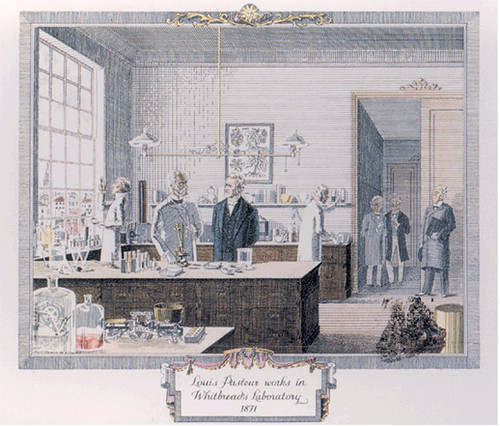
whitbread-pasteur-1937cal

Filed Under: Art & Beer, Beers Tagged With: Advertising, History, Science of Brewing

Brewbot: An Automated Homebrewing Machine

April 5, 2011 By Jay Brooks

robot
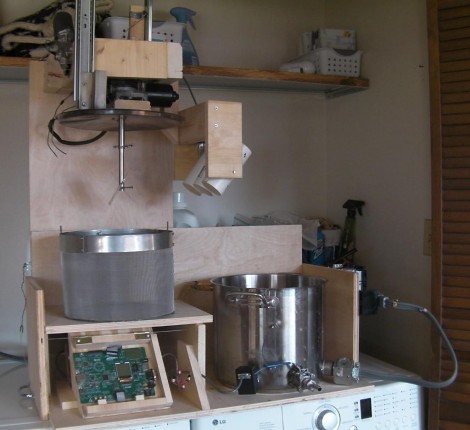
This is an odd one, if not without a certain interest just for the effort involved and how it works. For a design contest, The RX MCU Design Contest, sponsored by Renesas, an Australian designer, Matt Prattau (a.k.a. Zizzle), created the Brewbot, an automated homebrewing system that does all the work.

Here’s his introduction, from the contest submission:

Home brewing beer can be a rewarding mix of art and science. It allows the brewer to explore the thousands of possibilities available using the dozens of varieties of hops, malt, yeast and other interesting ingredients. The process can be time consuming and results can vary due to many factors, including precision, technique and consistency used by the brewer in the process.

Imagine an appliance in your kitchen that could take the time and labor out of the brewing process and brew a consistent batch of beer each time thus allowing the user to focus on the ingredients and recipe.

I always thought that the actual work of homebrewing was part of the fun, not something to be avoided, but still, you have to admire the way he did it. Here’s what it looks like. The submission page also includes links to schematics and other information about the design. He’s also set up a blog where he tracks his progress entitled Brewbot Mk2

automated-beer-brewery

Hack A Day blogged about the Brewbot, and had this to say:

You can see the development board there just to the left of the brew kettle. It’s network connected with a web interface that allows you to take recipes from Brewtarget and import them directly to the system. All you need to do is make sure that you load up the grain basket and boil addition modules to match your recipe. The bot takes it from there, filling the kettle, preheating that water, lowering the grains and maintaining temperature for the mash, and completing the boil with additions from the servo-controlled PVC pipe pods. Experienced brewers will notice a few steps missing, like the sparge, and a quick way to cool the finished wort. But this does take a huge part of the drudgery out of our hands. If only it had a clean-in-place system … then we’d really be happy!

But to get a real feel for it, check out the video where the designer walks you though the steps of how it works.

Filed Under: Breweries, Just For Fun Tagged With: Homebrewing, Science, Science of Brewing

Jean Van Roy Talks Cantillon

March 27, 2011 By Jay Brooks

cantillon
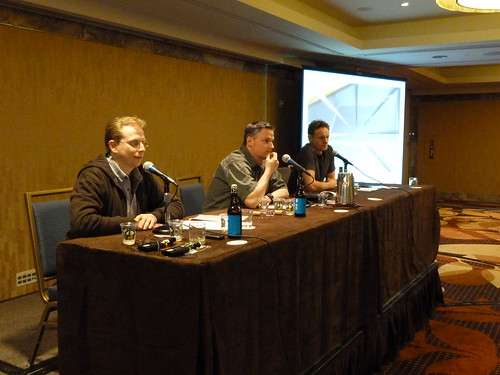
One of the most fun seminars at this year’s Craft Brewers Conference last week was the Barrel-Aged Sour Beers from Two Belgian’s Perspectives on Friday. It was moderated by Vinnie Cilurzo from Russian River Brewing and featured two lambic brewers, Yvan de Baets, owner of Brasserie de la Senne, and Jean Van Roy, owner of Brasserie Cantillon. I missed part of Yvan’s talk, but caught all of Jean’s. I first met Jean Van Roy at Cantillon several years ago, shortly before he took over the brewery from his father, Jean Pierre, and when Yvan was still working there, too. Jean gives a great overview of Cantillon’s brewing process. Enjoy.

P1030623
Yvan de Baets, Vinnie Cilurzo and Jean Van Roy.

Cantillon by Brookston

Filed Under: Beers, Breweries, Events Tagged With: Belgium, Science of Brewing

Beer Making Is Marvel Of Industrial Chemistry

March 20, 2011 By Jay Brooks

copper-kettle
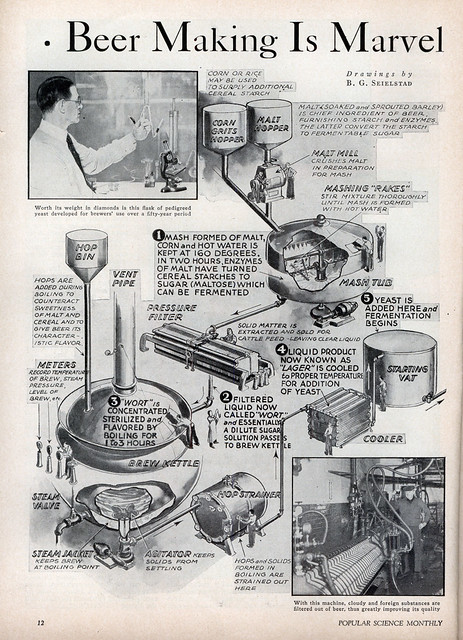
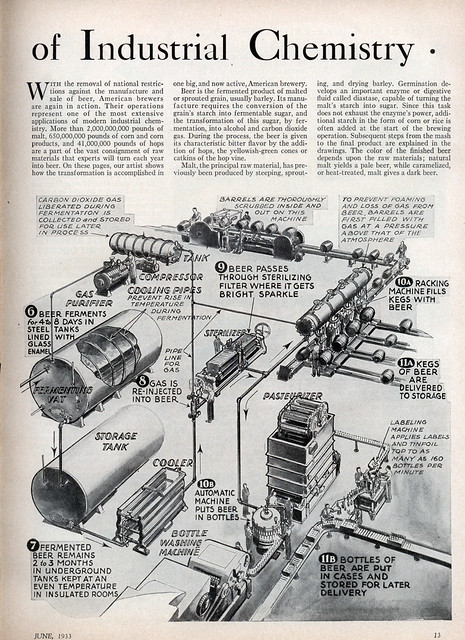
In June of 1933, just as Prohibition was in its death throes, that month’s issue of Popular Science magazine ran a two-page spread entitled Beer Making Is Marvel Of Industrial Chemistry, illustrated by Benjamin Goodwin Seielstad. It’s great fun to see it all laid out the way it’s done here. It seems like they were laying the groundwork for the return of brewing in America.

beer_making_1

There’s not a great deal of text accompanying the chart, but here it is in its entirety, from page two of the beer making chart:

With the removal of national restrictions against the manufacture and sale of beer, American brewers are again in action. Their operations represent one of the most extensive applications of modern industrial chemistry. More than 2,000,000,000 pounds of malt, 650,000,000 pounds of corn and corn products, and 41,000,000 pounds of hops are a part of the vast consignment of raw materials that experts will turn each year into beer. On these pages, our artist shows how the transformation is accomplished in one big, and now active, American brewery.

Beer is the fermented product of malted or sprouted grain, usually barley. Its manufacture requires the conversion of the grain’s starch into fermentable sugar, and the transformation of this sugar, by fermentation, into alcohol and carbon dioxide gas. During the process, the beer is given its characteristic bitter flavor by the addition of hops, the yellowish-green cones or catkins of the hop vine.

Malt, the principal raw material, has previously been produced by steeping, sprouting, and drying barley. Germination develops an important enzyme or digestive fluid called diastase, capable of turning the malt’s starch into sugar. Since this task does not exhaust the enzyme’s power, additional starch in the form of corn or rice is often added at the start of the brewing operation. Subsequent steps from the mash to the final product are explained in the drawings. The color of the finished beer depends upon the raw materials; natural malt yields a pale beer, while caramelized, or heat-treated, malt gives a dark beer.

beer_making_2

Filed Under: Breweries, Just For Fun Tagged With: History, Science of Brewing

The Chemistry Of Beer

March 14, 2011 By Jay Brooks

ACS
I got an interesting press release this morning from the American Chemistry Society (ACS) touting the Chemistry of Beer, as they put it, “just in time for Saint Patrick’s Day. Today they “released a new video, The Chemistry of Beer, which focuses on the science involved in producing the world’s third most popular beverage (after water and tea).”

From the press release:

Shot in high-definition format, the video features Sam Adams Senior Brewing Manager Grant Wood, who holds a degree in Food Science & Technology from Texas A&M University. It explains the process of turning barley, hops, water and yeast into a lager or ale. Among the insights:

  1. Yeast is the most important ingredient because it determines if the brew is ale or lager.
  2. Water is crucial, too, and it must be free of organic substances and “off” flavors.
  3. Key flavor compounds are packed into those little flower clusters called hops, which add flavor and a pleasant bitterness to the beer.

Produced by the ACS Office of Public Affairs, the video includes plenty of “did-you-know” fodder for those St. Patrick’s Day conversations over a pint. Did you know, for instance, that the fermentation process in which yeast produce alcohol also produces almost 600 flavor compounds? The Chemistry of Beer ends with a message that all drinkers should take to heart, St. Patrick’s Day and every day: Drink responsibly!

The whole video was shot at Boston Beer’s pilot brewery in their Jamaica Plain location in Boston. Grant, who you probably know if you’ve visited the brewery or have been in the industry for any length of time, gives a polished tour and explanation of the brewing process. It’s probably nothing you haven’t seen before, but it’s relatively comprehensive and does a good job of explaining brewing in a nutshell, with an emphasis on the chemistry, of course.

Filed Under: Breweries, Just For Fun, News, Politics & Law Tagged With: Science of Brewing, Video

The Impact Of Texture On Taste Perception

March 8, 2011 By Jay Brooks

sense-taste
On Food Navigator, there was an interesting short interview with Matthew Patrick, VP of R&D for TIC Gums where he suggests that “food and beverage product developers spend a shockingly low amount of time examining how texture may impact a finished product.” In beer, of course, texture is more often referred to as “mouthfeel.” And while when judging beer, mouthfeel is a consideration it’s usually not the primary one. Honestly, I’m really not sure how often brewers tinker with their recipes specifically to get a particular mouthfeel though it’s clear that many beers have great ones and many otherwise solid beers suffer for having a less than pleasant or ideally suited mouthfeel.

He’s talking primarily about texture in food and non-alcoholic beverages, though he singles out what he refers to as “low-viscosity beverages” like “tea” as products who didn’t give much thought to their texture. Beer’s viscosity has quite a range, from thin pilsners and golden ales to thick, rich oatmeal and imperial stouts so I can’t say where beer falls in TIC Gums’ viscosity scale. But there’s no doubt that mouthfeel is at least one of the many factors that add up to a beer’s overall taste profile. What a brewer can, or should, do about it seems like a worthy discussion to have.

The impact of texture on taste perception

There’s also a summary of the interview from the Food Navigator website:

Speaking to FoodNavigator-USA at the Research Chefs Association conference and expo in Atlanta, Patrick explained that texture can have wide-ranging influence on consumer perception of a food or beverage product.

For example, texture can influence the way saltiness or sugariness is perceived, meaning that different textures can make a product seem more or less sweet or salty even if the level of sugar or salt remains the same. That effect is something that product developers need to be particularly aware of, as many are cutting sugar or salt in products in response to demand for healthier foods and drinks.

Patrick added that low-viscosity beverages, such as teas, represent one area in which there is particular potential for enhancing consumer experience of a product through subtle textural differences.

Filed Under: Beers, Food & Beer, Related Pleasures Tagged With: Interview, Science of Brewing, Tasting

Celtic Beer: 500 B.C.

January 19, 2011 By Jay Brooks

celtic-blue
Science News last week had a fascinating tale from 2,500 years ago, about ancient Celtic breweries in present-day Germany. It was revealed in a new paper by Hans-Peter Stika, entitled Early Iron Age and Late Mediaeval malt finds from Germany—attempts at reconstruction of early Celtic brewing and the taste of Celtic beer, that early Celts built breweries “capable of turning out large quantities of a beer with a dark, smoky, slightly sour taste.”

Published earlier this month in the journal, Archaeological and Anthropological Sciences, here’s the abstract:

In this paper, we discuss specialised ditch structure from the early Iron Age settlement of Eberdingen–Hochdorf (early La Tène Period, fifth–fourth century BC), that contained large numbers of evenly germinated hulled barley grains. This malt appears to be the result of deliberate germination, given the purity of the finds and the associated unusual archaeological structure, which may have been used for germination and/or as a drying kiln for roasting the malt. The Hochdorf malt most probably was produced for the purpose of beer brewing. To learn more about the morphology of malt and the effects of carbonisation on it, experiments on modern barley grains were undertaken. Their results are compared to the ancient Hochdorf malt. Based on the excavated findings and finds as well as theoretical reflections on the early Iron Age brewing process, attempts at reconstructing the possible taste of early Celtic beer are presented. Additionally, a malt find from late mediaeval Berlin in northeast Germany is presented. A mixture of deliberately sprouted hulled barley as well as rye and oat grains, which were not germinated, was found. The three different cereals could have been used for brewing a typical mediaeval/early modern beer since the use of mixed crops for producing beer has been quite common. Because of a lack of further evidence, it remains unclear whether or not the half-timbered house in the late mediaeval town was a trading place and storehouse for malt or the brewery itself, where the malt was processed to make beer.

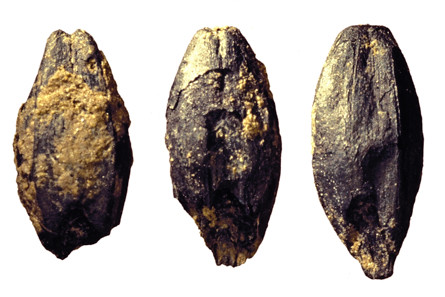
A large store of charred grains of barley were discovered at a site in northeast Germany, near Berlin. The barley was found in ditches, suggesting a “large malt-making enterprise.”
barley-iron-age
He then reconstructed the steps he believes the early Celts would have used to brew their beer.

  1. Dig a ditch, in an oblong shape.
  2. Soak barley in the specially constructed ditches until it sprouts.
  3. Grains were then dried by lighting fires at the ends of the ditches (providing dark color & a smoky taste).
  4. Lactic acid bacteria stimulated by slow drying of soaked grains, a well-known phenomenon, adding sourness to the brew.
  5. Mash up the barley to maximize the sugar content.
  6. Flavor it with henbane — a.k.a. stinking nightshade — which was found at the site. Henbane would also have made the beer more intoxicating. It could possibly have contained other spices such as mugwort or carrot seeds.
  7. Boil the ingredients with the mashed grains, towards the beginning to flavor the beer.
  8. Heated stones may have been placed in liquefied malt during the brewing process (though so far none have been found at the site). Otherwise, it would probably have been heated over a low fire.
  9. Separate out the lumpiest bits of grain.
  10. Fermentation then my have been triggered by using yeast-coated brewing equipment or by adding honey or fruit, both of which would have contained wild yeast.
  11. Let the yeast settle to the bottom.
  12. Cool the beer and drink.

Not all of the steps have been confirmed by the evidence yet, but the search goes on.

Filed Under: Breweries, News Tagged With: Germany, History, Science of Brewing

Searching For Science In A Glass Of Beer

December 4, 2010 By Jay Brooks

science
NPR’s Science Friday had an interview this week with Charlie Bamforth, talking about beer and his new book, “Beer Is Proof God Loves Us: Reaching for the Soul of Beer and Brewing.” Bamforth, of course, is the Anheuser-Busch Endowed Professor of Brewing Science at the University of California at Davis. In the segment, entitled Searching For Science In A Glass of Beer, Charlie takes questions and discusses the brewing process more generally. There’s also a transcript of the talk on their website. [And a hat tip to Rick Sellers for letting me know about the show.] Enjoy.

Filed Under: Beers, Just For Fun Tagged With: Interview, Science of Brewing

NOSB Unanimously Votes That Organic Beer Should Include 100% Organic Hops

October 28, 2010 By Jay Brooks

usda-organic
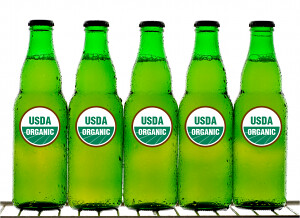
I just heard that the National Organic Standards Board (NOSB) earlier today voted unanimously “to require organic beer to include 100% organic hops beginning January 1, 2013.” If you haven’t been following this, under current USDA guidelines, a beer can be labeled “organic” if 95% of its ingredients are organic. Since less than 5% of beer consists of hops, that means almost any beer using organic malt may be called an organic beer. If a brewery uses 100% organic ingredients, they may label that beer “100% organic,” but all but the most savvy consumers are unaware of the difference. And it’s hard to argue that the current standard doesn’t cause confusion. I think most people who see a product labeled “organic” are going to assume that it’s all organic, not just mostly organic. There are actually four ways that beer can be labeled “organic” which includes the two I just mentioned plus “Made with Organic Ingredients” and “Some Organic Ingredients.” You can see the different standards at a post I did several Years ago, What Makes Beer Organic? The last two seem to convey the intended information, and so does saying “100%.” It’s that simple “organic” designation being only 95% that has people concerned — rightly so, I should add — and led the American Organic Hop Grower Association (AOHGA) to petition the USDA to “remove hops from the National List of non-organic ingredients allowed in organic food (section 205.606).” You can view the petition, and an addendum, at the AOGHA website.

Here’s some of the background, from an AOGHA press release:

Hops were first added to the National List by the NOSB in June 2007, when organic hops were primarily produced in Europe and New Zealand. Since then, the U.S. organic hop industry has made significant advances. Progressive, large-scale family farms in the Pacific Northwest and small, local growers across the country are now growing organic hops, even though the hop producers believe the market for them has remained weak due to the current NOSB policy which allows brewers to use less expensive, non-organic hops in their beer labeled organic.

In an attempt to remove hops from the National List, the American Organic Hop Grower Association (AOHGA) submitted a petition to the USDA in December 2009, supported by Sierra Nevada Brewing Company, Anheuser-Busch, Lakefront Brewery, Seven Bridges Cooperative, and Hopunion LLC.

When the USDA denied the petition, BT Loftus Ranches VP Patrick Smith wrote an impassioned essay, National Organic Standards Board to US Organic Hop Industry: “Drop Dead”, that nicely laid out the organic hop farmers’ case. In the middle of October, “thanks to his efforts, and the attendant “response from consumers, organic hop growers, and organic brewers, the NOSB Handling Committee has revised their previous recommendation and is now recommending that hops come off the National List on January 1, 2013.” Good news, to be sure, but it still required the full board of NOSB board vote on the petition again and accept the changed recommendation at a meeting in Madison today, as reported by Patrick Smith in an Organic Hops Update.

organic-beer

The AOHGA website is now updated with the following: “On October 28, 2010, the National Organic Standards Board unanimously voted in favor of the removal of hops from section 205.606 of the National List of Approved and Prohibited Substances, effective January 1, 2013.”

Filed Under: Beers, Breweries, News Tagged With: Hops, Organic, Science of Brewing

SABMiller Proposes Floating Brewery

October 12, 2010 By Jay Brooks

ship-cargo
SABMiller put out a press release today with their prediction for the future of breweries, “given a range of different scenarios determined by the cost and availability of water and energy.” Below is the text fro the release.

Working with innovation consultancy, Innovia Technology, SABMiller envisioned four plausible business environments, based on the different uncertainties facing the brewing industry over the next 30 years. These scenarios informed thinking around how the ‘Brewery of the Future’ might look under different circumstances, with some surprising results.

The most extreme scenario, ‘Marginal Survival’ envisaged a market with limited access to water and high energy costs. This scenario – where people would migrate from areas of water shortage or turbulent weather -provoked the most unorthodox response. One of the proposed solutions was a smaller, mobile brewery which would move from place to place on the back of a ship.

floating-brewery

Rob Wilkinson, Director of Innovia, said: “The descriptions are intended as food for thought rather than as blueprints for building new facilities. However, the example of the brewery on a ship is entirely feasible. It would allow for rapid entry to new markets, especially where no infrastructure is in place, it would provide flexibility in positioning and length of stay and allow SABMiller to move with water sources, with people, with crops, or even away from severe weather, natural disasters or political instability.”

Maurice Egan, SABMiller’s group head of manufacturing said: “Whilst this research has produced some imaginative solutions, the business case behind the thinking is very serious. We need to ensure that, given the rapid pace of technological developments, the impacts of climate change and growing wealth in developing economies, SABMiller has the capability to define, design and deploy our future breweries and supply chains.”

In another scenario ‘Energy Deprived’, where energy prices and the cost of transport are high but water plentiful and cheap, the brewery is closely integrated with the community, sharing facilities and resources. For example, local farmers might use the brewery mills for processing crops, while the brewery would use their agricultural waste to create bio-fuel as an energy source; the kilns used for malting barley might also be shared with local businesses as a facility for drying paper pulp. The resulting brewery would be a sustainable building looking not unlike the Eden Project in Cornwall where hot processes are timetabled for the day and cold processes during the cooler night in order to optimize resource use.

The other two scenarios envisaged were:

‘Water Scarce’, where energy costs are low due to large scale investment in alternatives to fossil fuels, but water is in short supply exacerbated by population increases coupled with climate change. In this case, the brewery would be highly optimised for low water use, using less than 2 litre of water to produce 1 litre of beer compared to SABMiller’s current average of 4.5 litres; this would be achieved in part by implementing a continuous brewing system and in part by advanced water treatment technologies.

‘Plentiful Supply’ describes a world self-sufficient in both water and energy, which benefits from low transport costs, abundant rainfall and robust water infrastructure. In this cornucopia sustainability and environmental stewardship remain key drivers. For example, the brewery would use natural processes to upgrade waste or extract valuable chemicals from it so as to reduce environmental impact. Power would be derived from renewable sources such as solar panels, rainwater would be collected and as much water as possible recycled.

Filed Under: Breweries, News Tagged With: Announcements, Science of Brewing

« Previous Page
Next Page »

Find Something

Northern California Breweries

Please consider purchasing my latest book, California Breweries North, available from Amazon, or ask for it at your local bookstore.

Recent Comments

  • Bob Paolino on Beer Birthday: Grant Johnston
  • Gambrinus on Historic Beer Birthday: A.J. Houghton
  • Ernie Dewing on Historic Beer Birthday: Charles William Bergner 
  • Steve 'Pudgy' De Rose on Historic Beer Birthday: Jacob Schmidt
  • Jay Brooks on Beer Birthday: Bill Owens

Recent Posts

  • Historic Beer Birthday: Gottlieb Brekle February 23, 2026
  • Beer Birthday: J.J. Phair February 23, 2026
  • Beer In Ads #5126: Start Looking For Bock February 23, 2026
  • Historic Beer Birthday: Johann Baier February 23, 2026
  • Beer In Ads #5125: Bowler Brothers’ Bock February 22, 2026

BBB Archives

Feedback

Head Quarter
This site is hosted and maintained by H25Q.dev. Any questions or comments for the webmaster can be directed here.