Brookston Beer Bulletin

Jay R. Brooks on Beer

  • Home
  • About
  • Editorial
  • Birthdays
  • Art & Beer

Socialize

  • Dribbble
  • Email
  • Facebook
  • Flickr
  • GitHub
  • Instagram
  • LinkedIn
  • Pinterest
  • RSS
  • Twitter
  • YouTube

Powered by Genesis

Beer In Art #147: Jan Vermeer’s The Procuress

November 6, 2011 By Jay Brooks

art-beer
This week’s works of art is an early work by the renowned Dutch painter Jan Vermeer, though technically Johannes Vermeer. In fact, the Swiss Berger Foundation claims it’s Vermeer’s very first known painting, though others disagree. It’s most often known as The Procuress, though occasionally it’s called The Go-Between. Painted in 1656, today the painting hangs in the Staatliche Kunstsammlungen, which is in Dresden, Germany. I saw the original when I visited the nearby Radeberg Brauerei a number of years ago, as we stayed in downtown Dresden.

JohannesVermeer_-_procurous

In “Vermeer: The Complete Works,” author Arthur K. Wheelock, Jr, describes the painting:

Few of Vermeer’s paintings are as provocative as this fascinating scene of mercenary love, which, in its subject, as well as in its momentary gestures and expressions, seems to differ from his earlier biblical and mythological scenes. Here, behind a balustrade covered by a richly decorated rug, a procuress looks approvingly at a soldier, who offers a young woman a coin while fondling her breast. Holding a glass of wine in one hand, she willingly accepts his proposition with her other.

Wikipedia has its own page for the painting. And Essential Vermeer also has analysis of the painting from additional sources. They also have a very cool interactive Procuress where you hold your mouse over different parts of the painting to get detailed information about that area. For our purposes, here’s what they have to say about the beer in the picture:

Vermeer-procuress-ex07

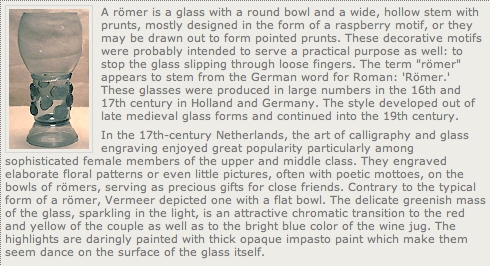
And here’s the information about the Römer glass referred to above:

Vermeer-procuress-ex06

You can read Vermeer’s biography at Wikipedia and at ArTable. There are also endless resources at Essential Vermeer. To see the rest of Vermeer’s paintings, the Essential Vermeer has a complete collection or check out the Web Museum, the Web Gallery of Art or the Artchive.

Filed Under: Art & Beer, Beers Tagged With: History, The Netherlands

Beer In Art #146: Judith Leyster’s Merry Drinkers

October 30, 2011 By Jay Brooks

art-beer
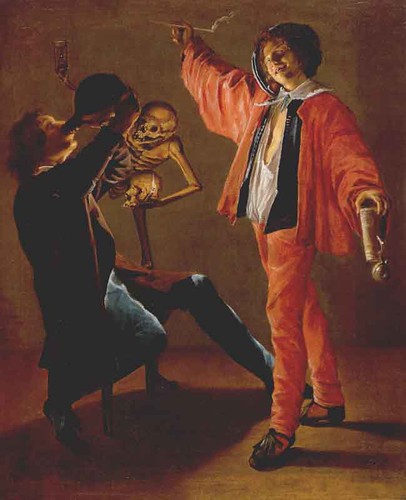
As tomorrow is Halloween, this week’s works of art involves the supernatural as well as beer. It’s from around 1639 and was painted by Judith Leyster, one of three significant Dutch Golden Age female artists. It’s known by various titles, The Last Drop, the Gay Cavalier and the Merry Drinkers. Whatever you call it, the original is at the Philadelphia Museum of Art.

Leyster_Greedy_drinkers

The museum describes the painting:

The costume that the standing figure wears over his clothes suggests that the setting is vastenavond, the night before the beginning of Lent, when people frequently went on binges in order to prepare themselves for fasting and abstinence. This painting speculates on the consequences of such overindulgence. In their dissipated state, the gay cavalier and his companion ignore the menacing presence of the skeleton, which bears an ominous hourglass in one bony hand and a skull in the other.

But another art critic had this to say:

This candle-lit cabaret scene depicts beer drinkers engaged in a drinking competition of sorts. The use of shadow and contrasts in light is pronounced and is reminiscent of Caravaggio. Although the scene is a merry one, Death, symbolized by the skeleton, is present to encourage their excesses, marking them for an all too obvious fate. The setting is magnificently constructed and the lively treatment owes much to Frans Hals. The allegory is striking in the contrast it depicts between the carefree frolickings of the figures and the tragedy awaiting them.

So it seems not everyone agrees about what’s going on in the painting, but it seemed appropriate for Halloween because of the skeleton and the spectre of death it represents.

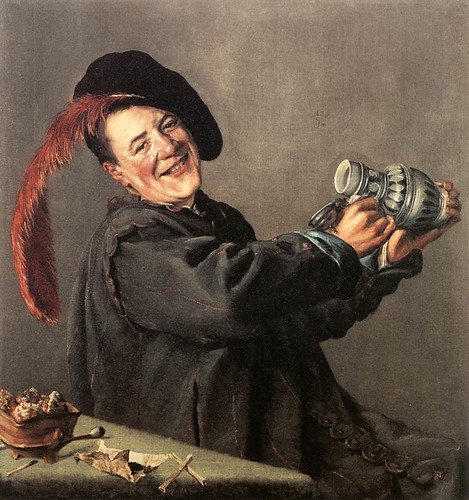
Leyster painted a number of portraits and genre paintings, and at least one more with beer. Below is The Merry Drinker, from 1630.

Judith_Leyster_Jolly_Toper

Unfortunately, she stopped painting after she married. Of course, it was the 17th century. You can read her biography at Wikipedia and at the National Museum
of Women in the Arts. And you can see more of her paintings at ArtCyclopedia, Olga’s Gallery, the Web Gallery of Art and the WikiMedia Gallery.

Filed Under: Art & Beer, Beers Tagged With: History, The Netherlands

Beer In Art #130: Jacob Jardeans’ The Satyr And The Peasants

June 5, 2011 By Jay Brooks

art-beer
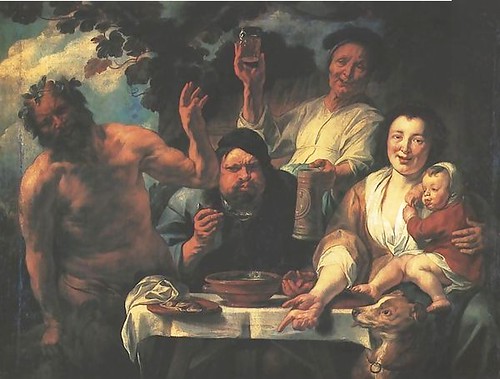
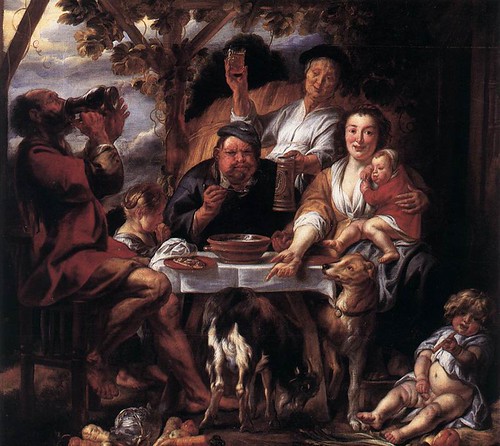
This week’s work of art is by a Dutch Artist, Jacob Jardeans, who was better known in his own time than he is today. Unlike his contemporaries, Rubens and Van Dyck, Jardaens never left Antwerp or found the success that they did. But in his hometown, he was one of the most popular artists. He painted a lot of allegories and mythological pictures, such as The Satyr and the Peasants, seen below, which was created around 1640.

Jordaens-satyr-and-peasants-2

The portrait includes a peasant and his family, along with a satyr and a servant is bring beer. The satyr’s face is odd, almost seems to mocking his hosts. But it’s the peasant’s face, bursting with food, that has the really strange expression. He looks like he was caught mid-bite in a snapshot.

Curiously, Jardaens also painted a very similar scene, the main difference being the canvas is a bit wider to accommodate more area, and two more children, though the satyr has been replaced by another man (another peasant?) who’s draining his own mug of beer. The second painting is known as “Eating Man” but I don’t know if it was painted before or after the other one.

Jordaens-satyr-and-peasants

You can read Jardaens biography at Wikipedia or at the Jacob Jardaens official website. And you can see more of his work at Olga’s Gallery, at the official website gallery and the Web Gallery. And there are links to even more paintings at ArtCyclopedia.

Filed Under: Art & Beer, Beers Tagged With: Mythology, The Netherlands

Beer In Art #125: Pieter de Hooch’s Woman Drinking In A Courtyard

May 1, 2011 By Jay Brooks

art-beer
This week’s work of art is by the Dutch artist Pieter de Hooch who was active during the time period known as the Dutch Golden Age in the 17th century. The painting, completed between 1658-1660, is entitled Un homme fumant et une femme buvant dans une cour a Delft (which is translated as Man Smoking and Woman Drinking in a Courtyard in Delft). The original painting is in the Mauritshuis in the Hague.

pieter-de-hooch-courtyard

The woman looks positively modern, almost like she’s savoring the aroma of the beer before taking her first sip.

You can see more of Pieter de Hooch’s work at the Artchive, the Artcyclopedia, Olga’s Gallery and the Web Gallery of Art.

Filed Under: Art & Beer, Beers Tagged With: The Netherlands

Beer In Ads #357: Grolsch Tulips

April 27, 2011 By Jay Brooks

ad-billboard
Wednesday’s ad is a relatively new ad, from 1983. It’s for the Dutch beer Grolsch, showing six-packs growing out of the national flower of the Netherlands: tulips. Clearly, I’m buying the wrong bulbs.

Grolsch-1983

Filed Under: Art & Beer, Beers Tagged With: Advertising, History, The Netherlands

Beer In Art #121: Jan Jansz van de Velde’s Still Lifes

April 3, 2011 By Jay Brooks

art-beer
This week’s works of art are by Jan Jansz van de Velde, a Dutch painter from that nation’s golden age. He painted still lifes of everyday objects from the time, and at least two of those included beer. The first was completed in 1649, and is entitled Still Life with a Mug of Beer.

Jan-Janz-Van-DeVelde_Still-life-with-a-mug-of-beer_1649

And the second is Still Life with Tall Glass of Beer, painted in 1647.

Jan_van_de_Velde-Still_life_with_tall_beer_glass_1647

Filed Under: Art & Beer, Beers Tagged With: The Netherlands

Beer In Art #102: More Vincent Van Gogh’s Wheat Fields

November 14, 2010 By Jay Brooks

art-beer
Last week’s artworks were all paintings of wheat fields by Vincent Van Gogh for the most recent Session on wheat beers. Since wheat fields were a favorite subject for Van Gogh — throughout his life he painted at least 40 artworks that included a wheat field — I couldn’t help but feature several more again this week.

Wheat field, painted in 1889.

Van_Gogh-wheat_field-1889

Green Wheat Field, also painted in 1889.

Van_Gogh-green_wheat_field-1889

Wheat Field with Reaper, from 1888.

Van_Gogh-wheat_field_w_reaper-1888

Sheaves of What in a Field, from 1885.

Van_Gogh-Sheaves-of-Wheat-in-a-Field_1885

Sunset Wheat Fields Near Arles, from 1888.

Van-Gogh_Sunset-Wheat-Fields-Near-Arles_1888

Wheat Field Behind Saint Paul Hospital with a Reaper, from 1889.

Van-Gogh_Wheat-Field-Behind-Saint-Paul-Hospital-with-a-Reaper_1889

Wheat Field with Cypresses at the Haute Galline Near Eygalieres, from 1889.

Van-Gogh_Wheat-Field-with-Cypresses-at-the-Haute-Galline-Near-Eygalieres_1889

Sunset Wheat Field with Sheafs, from 1888.

Van-Gogh_Sunset-Wheat-Field-w-Sheafs_1888

For more about Vincent Van Gogh, Wikipedia is a good place to start, though there’s even more at the Vincent Van Gogh Gallery, which has a complete list of his works. There are also tons of links at the ArtCyclopedia and another biography at the Web Museum.

Filed Under: Art & Beer, Beers Tagged With: History, The Netherlands

Beer In Art #101: Vincent Van Gogh’s Wheat Fields

November 7, 2010 By Jay Brooks

art-beer
Today’s artworks are all by one of the world’s most well-known artists, Vincent Van Gogh. Given last Friday’s Session topic — wheat beers — I thought it would be fun to look at some paintings of what fields. Wheat fields were a favorite subject for Van Gogh and throughout his life he painted at least 40 artworks that included a wheat field.

One of his most famous wheat field paintings was Wheatfield with Crows, painted toward the end of Van Gogh’s life, in 1890, the same year he passed away. It was also the subject of an episode of Simon Schama’s Power of Art, a wonderful documentary series on art that I heartily recommend. In addition, it was used in a surreal sequence of a lesser know film by Akira Kurosawa called Dreams. The original is in the Van Gogh Museum in Amsterdam.

Van_Gogh-wheat_field_w_crows-1890

Here’s what the Van Gogh Museum has to say about the painting:

Wheatfield with Crows is one of Van Gogh’s most famous paintings and probably the one most subject to speculation. It was executed in July 1890, in the last weeks of Van Gogh’s life. Many have claimed it was his last work, seeing the dramatic, cloudy sky filled with crows and the cut-off path as obvious portents of his coming end. However, since no letters are known from the period immediately preceding his death, we can only guess what his final work might really have been. Some scholars believe it was the Tree-roots, but we have no proof that this was the case.

Another one painted around the same time was Wheat Field Under Clouded Sky, also painted in 1890.

Van_Gogh-wheat_field_under_clouded_sky-1890

Can Gogh also executed a series of paintings called “The Wheat Field” series. All of the paintings “depict the view Van Gogh had from the window of his bedroom on the top floor of the asylum” at Saint-Rémy-de-Provence from June 1889 to May 1890. Here’s one from that series, Wheat Field, Sunrise, painted in 1890.

Van_Gogh-wheat_field_sunrise-1890

And here’s another one, Wheat Field with Rising Sun, from 1889.

Van_Gogh-wheat_field_w_rising_sun-1889

For more about Vincent Van Gogh, Wikipedia is a good place to start, though there’s even more at the Vincent Van Gogh Gallery, which has a complete list of his works. There are also tons of links at the ArtCyclopedia and another biography at the Web Museum.

Filed Under: Art & Beer, Beers Tagged With: History, The Netherlands

A Brewer Trying To Explain What He Does To His Father

October 18, 2010 By Jay Brooks

art
Here’s an interesting art project from the Netherlands. It’s called How To Explain It To My Parents? It’s a series by artists and directors Lernert & Sander in which five “abstract artists explain to their mom and dad what their work is all about.” In Episode 1 Dutch artist Arno Coenen explains to his father about his latest project: brewing beer.

Coenen is not a commercial brewer, but it’s clear from the video that he’s been home brewing since he was in high school. He contracted two beers from the Brouwerij de Molen for his Eurotrash Brewery project.

2311097422_fc3fdb8805_b

Here’s a description of the exhibition from Coenen’s website:

The Eurotrash Brewery project presented in full effect by an Oktoberfest beertent installation at the museum for contemporary art “het Domein” in Sittard Holland last autumn,during the local beerfest! 2 special brews were made, a beer named “Red Oktoberfestbeer”, brewed with mostly Munchener malt and a big dose of Bambergerrachmalz, fermented with a spicy Belgian yeast at a modest drinkable alcohol percentage. The whole brew (500 liters) was available on draft. Especially for the ladies however a mega strong (16% alcohol!) barley wine fermented with champagne yeast, served in elegant champagne flute, called “Eurotrash Lady.” And the ladies loved it.

Both beers were masterly brewed by Menno Olivier from Hollands best brewery “de Molen” from Bodegraven.

In the beertent a altar-esque installation build up by a bar wit 2 beerpumps refridgerators filled with 75 centiliter bottles of “Eurotrash Lady” 7 HD LCD screens with Eurotrash Brewery commercial videos and animations, e.g. the great music video “stars in a circle” by my friends Alex Kloster and Johannes Malfatti from transformer di roboter.

So that’s the context as Coenen tries to explain to his Dad why what he does is art, in this case why brewing a beer is art. It’s an interesting conversation and you can feel there’s some tension between father and son. It’s in Dutch, of course, but it is subtitled.

How to explain it to my parents – Arno Coenen from Lernert & Sander on Vimeo.

Filed Under: Art & Beer, Just For Fun Tagged With: The Netherlands, Video

New Leader Emerges In Battle of Strongest Beer?

July 29, 2010 By Jay Brooks

t-Koelship-2
For the past couple of years, the battle for the world’s strongest beers has been between the Scottish BrewDog and the German brewery Schorschbräu, with the last volley mere days ago with BrewDog’s controversial 55% The End of History. Seemingly out of nowhere a new contender for the title emerged. The Dutch brewer Brouwerij Het ‘t Koelship announced today they’re releasing a new beer, Start the Future, no doubt a response to BrewDog’s name for their 55% beer. Start the Future is 60% a.b.v.

Here’s ‘t Koelship’s description, as auto-translated by Google:

It presents Reefer Biggest beer in the world now the Scots a 55% beer on the market was the question: what do we do now? He is START THE FUTURE 60% alc. In response to the Scottish reaction; Obilix 45% was a success, but this is even better!

START THE FUTURE is like a beer OBILX product, a heavy alcoholic drink with the ingredients Water, malt, hops and yeast. The beer is then processed into a product, a beer-based beer product. START THE FUTURE is like OBILIX is a product made of 100% beer beer. How? Ask the brewer. You drink our START THE FUTURE and Obilix from a small glass and not from a beer glass.

According to Reuters:

Nijboer’s Almere-based brewery, ‘t Koelschip (The Refrigerated Ship), sells the new beer, which is 120 proof and dubbed “Start the Future,” in a one-third litre bottle for 35 euros ($45) each.

Nijboer told ANP he developed the new brew to keep up with Scottish outfits that were also pushing the boundaries of beer’s alcohol content. His previous record-holder, a beer called Oblix that was 90 proof (45 per cent alcohol by volume), was eclipsed by a Scottish beer that reached 55 per cent.

“It has become a little competition,” Nijboer said. “You should see it as a joke.”

It’s probably not a coincidence that the brewery also operates a distillery, too.

t-Koelship

Below is a bad photo of the bottle, from ‘t Koelship’s website.

t-Koelship-Future

UPDATE: It looks like the Start the Future may have whisky added to it, making it doubtful most people will consider it a beer. (Thanks to Ken W. for the info.) The controversy is unfolding on Rate Beer — and probably elsewhere — where many people are questioning that this is truly a beer.

Even Schorsch from Schorschbräu weighed in:

What Mr. Nijboer is doing is not only trying to fool all others who do a fair contest (at the moment I got 43% Vol) and I will try more, but not for the price of leaving the way of Reinheitsgebot (German purity law). It’s a regional special German law and I do not expect that beer must be produced in that way worldwide…but what Koelschip does is pure customer deception. This is also illegal by national Dutch law.

Filed Under: Beers, News Tagged With: The Netherlands

« Previous Page
Next Page »

Find Something

Northern California Breweries

Please consider purchasing my latest book, California Breweries North, available from Amazon, or ask for it at your local bookstore.

Recent Comments

  • Bob Paolino on Beer Birthday: Grant Johnston
  • Gambrinus on Historic Beer Birthday: A.J. Houghton
  • Ernie Dewing on Historic Beer Birthday: Charles William Bergner 
  • Steve 'Pudgy' De Rose on Historic Beer Birthday: Jacob Schmidt
  • Jay Brooks on Beer Birthday: Bill Owens

Recent Posts

  • Historic Beer Birthday: Francis Straub September 7, 2026
  • Historic Beer Birthday: Henry Fink September 7, 2026
  • Beer Birthday: Alan Sprints September 7, 2026
  • Beer In Ads #5341: Falkenstein Bock-Bier September 6, 2026
  • Historic Beer Birthday: Johann Peter Griess September 6, 2026

BBB Archives

Feedback

Head Quarter
This site is hosted and maintained by H25Q.dev. Any questions or comments for the webmaster can be directed here.