Brookston Beer Bulletin

Jay R. Brooks on Beer

  • Home
  • About
  • Editorial
  • Birthdays
  • Art & Beer

Socialize

  • Dribbble
  • Email
  • Facebook
  • Flickr
  • GitHub
  • Instagram
  • LinkedIn
  • Pinterest
  • RSS
  • Twitter
  • YouTube

Powered by Genesis

Beer In Ads #5157: Bock Thillier

December 31, 2025 By Jay Brooks Leave a Comment

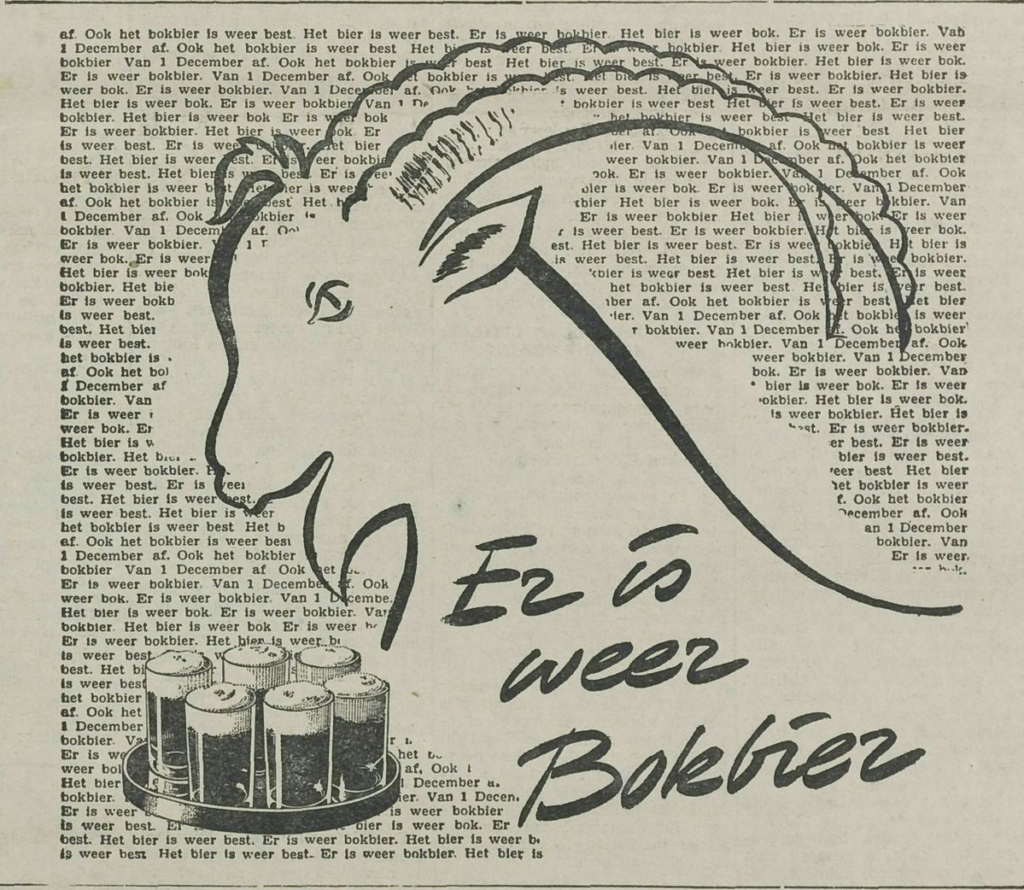
Last year I decided to concentrate on Bock ads for awhile. Bock, of course, may have originated in Germany, in the town of Einbeck. Because many 19th century American breweries were founded by German immigrants, they offered a bock at certain times of the year, be it Spring, Easter, Lent, Christmas, or what have you. In a sense they were some of the first seasonal beers. “The style was later adopted in Bavaria by Munich brewers in the 17th century. Due to their Bavarian accent, citizens of Munich pronounced ‘Einbeck’ as ‘ein Bock’ (a billy goat), and thus the beer became known as ‘Bock.’ A goat often appears on bottle labels.” And presumably because they were special releases, many breweries went all out promoting them with beautiful artwork on posters and other advertising.

Tuesday’s poster is for Bock Thillier, which was created in 1926, exactly one hundred years ago. This poster was for the Brasserie P. Thillier of Fruges, a french commune located in the department of Pas-de-calais in region Hauts-de-france, which is in Northern France, which was originally founded in 1881 by Paul Thillier’s mother, and he took over the brewery and modernized it beginning in 1908. I’m not sure who the artist was who created it, though it was printed by Bachollet Editions.

Filed Under: Art & Beer, Beers, Breweries, Just For Fun Tagged With: Advertising, Bock, France, History

Historic Beer Birthday: John Brown

December 31, 2025 By Jay Brooks Leave a Comment

tring-old
Today is the birthday of John Brown (December 31, 1795–October 23, 1890). He “was a brewer in Tring, Hertfordshire. Born in Okeford Fitzpaine in Dorset, he moved to Tring in 1826. His brewery was in Tring High Street, and he built several public houses in the area, at a period when the coming of the railway was advantageous to the business.”

Former_Tring_Brewery,_Tring_High_Street_-_geograph.org.uk_-_1482019
JOhn-Brown-brewery

Almost entirely what I’ve been able to find out about John Brown’s Tring brewery is from his short Wikipedia page:

In the 1830s, a railway line, of the London and Birmingham Railway, was built, which passed near the town. Since it used shallow gradients, a cutting was created through chalk hills near Tring between 1834 and 1837. The cutting was the largest created at that time, being 4 km long and 12 m deep. It was mostly dug manually. The navvies employed in its construction provided business for breweries in Tring, including that of John Brown.

During the 1830s he built several pubs in the area, which had a distinctive architectural style. In Tring, these included the Britannia (the present Norfolk House) and the King’s Arms. The King’s Arms is away from the town centre: John Brown expected that the town would expand with the coming of the railway, and that the pub would be in a busy area; however, the expansion did not happen as he expected. Another of his buildings is near to the railway station about two miles from Tring; it was built in 1838 under arrangement with the London and Birmingham Railway Company. Its name was originally the Harcourt Arms, after the Harcourt family who owned Pendley Manor; it was renamed, some time between 1845 and 1851, the Royal Hotel.

In 1851 John was a farmer and a wine and spirit merchant, as well as a brewer; in 1881 he was employing nine men at the brewery.

In later years the brewery was run by John’s son John Herbert Brown; he and his brother Frederick William took over when John died in 1890. However, John Herbert died in 1896, and in 1898 Frederick William sold the brewery, with nine freehold public houses, to Locke and Smith of Berkhamsted.

kings-arms-tring

The King’s Arms, which Brown built is still a pub today, though it’s changed hands a number of time since John Brown’s day. Here’s some history of it from the pub’s website:

The King’s Arms was built in the early nineteenth century around 1830, for John Brown’s Tring Brewery (still highly visible but now a High St. stationer’s). When built, the the pub’s land included the top end of Charles St. (which was a dead end) and the pub’s orchard was where the two bungalows ‘Cosy Corner’ and ‘Corners’ now stand.

Brown’s distinctive architectural style was used on a number of other pubs in and around Tring as he expanded his estate. The ‘KA’ as it is known by regulars, has always been a pub, and internally in layout has not changed greatly in the last 180 odd years. Brown built grandly beside what was then the main London to Aylesbury road, catering initially for the army of navvies employed in building the railway, and in the expectation that expansion of the town would follow its completion.

As things turned out, the expected boom failed to materialise and the town centre grew slowly elsewhere, taking the main road along what became Western Road and the High Street. This left the pub rather isolated; later it became surrounded with the houses, shops and workshops that is now known as the ‘Tring Triangle’. At some time during the second half of the 19th century the range of stables and warehousing that bound the garden were built (presumably by the Brewery for general commercial use).

Tring_High_Street,_19th_century
Tring High Street in the 19th century.
This is an excerpt from “Brewers in Hertfordshire” by Allan Whitaker, about the Tring Brewery.

Tring-brewery-history

market_day_lower_high_st_tring__1897
Market Day in the lower High Street in 1897.

In 1992, a new Tring Brewery opened, though it has nothing to do with the original brewery or the family of John Brown.

Filed Under: Birthdays, Breweries, Just For Fun Tagged With: England, Great Britain, History

Historic Beer Birthday: Gottfried Piel

December 31, 2025 By Jay Brooks Leave a Comment

piels
Today is the birthday of Gottfried Piel (December 31, 1852-May 1, 1935) who along with his brothers Michael and Wilhelm Piel founded Piel Bros. Beer in New York, more commonly known as Piels Beer in 1883. Gottfried Piel was more on the business side among his brothers, whereas his older brother Michael was the brewer.

gottfried-piel-1890

Here’s a short biography of Piel from a website highlighting his highly collectible personal corkscrew:

Gottfried Piel was the founder of the Piel Brothers Brewing Company of Brooklyn, New York. Piel left his home in Dusseldorf, Germany in 1882 at the age of 29 to emigrate to the United States. In 1883 he convinced his brothers Michael and Wilhelm to join him in the purchase of the Landzer Brewery.

Piel’s first year beer production was 850 barrels and in ensuing years, Piel Bros. continue to grow rapidly. It became a Brooklyn tradition and, although the brewery closed after some rough years in the 1960s and 1970s, the brand name is still in use. The Piel name was purchased by the Schaefer Brewing Company in 1973.

Gottfried Piel died in 1935 and his corkscrew was left to his daughter Sophia, widow of Pinckney and wife of Peter William Dawson. The corkscrew passed to Peter William Dawson upon the death of Sophia. In 1980 Dawson died and the corkscrew passed to his nephew Jim Lowry. Jim Lowry sold the corkscrew to Don Bull.

piels-brewery-1965

This is a description of Gottfried from Beer of Broadway Fame: The Piel Family and Their Brooklyn Brewery by Alfred W. McCoy:

piel-g-broadway-1

Pielsmalt
And here’s a biography of his brother Michael from the Cyclopedia of American Biography, edited to keep the portions where Gottfried is mentioned:

PIEL, Michael, brewer, b. in Stoffeln, Düsseldorf am Rhein, Germany, 29 March, 1849; d. at Lake Parlin, Me., 12 June, 1915, son of Heinrich Hubert and Gertrud (Gispé) Piel. He was descended from an old Rhenish stock of farmers of singular attachment, whose members successively aimed to expand their patrimony of tillable lands. To the original and extensive Stoffeln Farm his father and uncles added the great Mörsenbroich-Düsseldorf tillages, which now border the residential section of the Lower Rhenish financial capitol. Michael was born in an environment of industry, thrift, and enterprise. His early youth was devoted to the farm at Mörsenbroich-Düsseldorf. At the age of eighteen, he began his military service in the Kaiser Alexander II Regiment of the Imperial Guards at Berlin. The Franco-Prussian War of 1870-71 broke out just as he had completed this duty. As he was not, therefore, subject to the call of the Fatherland, his family sought to hold him back. He promptly volunteered, however, and served throughout the war, participating with his regiment in several engagements, the battle of Gravelotte and the siege of Paris. The impressions on the country boy of his years of service at Berlin, which had already begun to modernize its industries, lingered and served constantly to stimulate his natural gifts of invention. While for several years after the war, true to the family tradition, he worked at Mörsenbroich with his elder brother, he continually sought expression for his native talents. The arduous discipline of farm-labor from sun-up to sun-down, — valuable preparation though it was for the early trials of his later life career — could not check his inventive spirit. Gradually, making the most of his opportunities on the farm, his successes won him away from the family calling. In the creation of new rose-cultures and, particularly, in the perfection of a new and highly productive breed of bees, for both of which, after but two years of experimentation, he was voted the government’s highest awards, he found the encouragement he needed for the growing determination to carve out his own future. It was, however, his invention of a centrifuge for the extraction of honey, awarded special governmental recognition and immediately adopted into general use, that decided him. As the protégé of a machine manufacturer, he visited the industrial centers of the progressive Rhineland and soon chose the ancient German industry of brewing as the one offering the best opportunity for his talent of applying machinery to natural processes. He found a fertile field. The new science of modern refrigeration had just come into practice, and the suggestions which it offered in his chosen field fascinated him. He began his novitiate in the old-style subterranean cellars at the breweries of Dortmund, Westphalia. In 1883, his apprenticeship ended, he welcomed the call of a younger brother, Gottfried, then already established as an export merchant in New York, to found with him in East New York, at its present site, a typically German brewery, to be conceived on modern and scientific principles. The brothers, as a partnership, secured title to a small old-style brewing plant, then in disuse, and found the problem to convert it to newer ideas a fight against tremendous odds. At the outset, Michael was its brewer, superintendent, and engineer, his accumulated experience fitting him admirably for the multiplicity of his duties. In the early days of the converted plant, Michael found that his hours were from four o’clock in the morning till ten at night. At last, in 1888, the ability of his brother as the financial head of the firm and the excellence of his own products assured success and the long struggle was won. The country which had offered him his opportunity for success he gladly and promptly adopted as his own, being admitted to citizenship in 1888. The enterprise prospered and the partnership became a corporation in 1898, with an established business of national reputation.

PielsSign1947

Piels--Beer-Labels-Piel-Bros

Filed Under: Birthdays, Just For Fun Tagged With: Germany, History, New York

Beer Birthday: Mitch Steele

December 31, 2025 By Jay Brooks 9 Comments

Today is the 64th birthday of Mitch Steele, former production manager/head brewer at Stone Brewing. Mitch started out at the tiny San Andreas Brewery in Hollister, California but spent a number of years at one of the much larger Budweiser breweries when he brewed for Anheuser-Busch, before finding a home at Stone. More recently, created something of his own in Atlanta, Georgia, New Realm Brewing, but just announced he was moving into a more advisory role and is looking for new opportunities to pursue. He’s obviously a terrific brewer but is also a great person and a close friend, too. He has been my roomie for GABF judging a couple of years ago and is also the author of IPA: Brewing Techniques, Recipes and the Evolution of India Pale Ale. He’s a big advocate for craft beer and always willing to help out a fellow brewer or homebrewer. Join me in wishing Mitch a very happy birthday.

Mitch with Stone co-founder Steve Wagner at the Craft Brewers Conference in 2007.
Mitch picking up his 3rd Place award on the floor of GABF 2009 for Stone’s Levitation Ale on cask at a special judging at the Great British Beer Festival in 2009 (and which I had the pleasure to judge).
etsy Hensley, Judy Ashworth, Mitch, Brendan Moylan & Bruce Paton at the Celebrator’s 22nd Anniversary Party.
Judy Ashworth, Bill Millar, Mitch and Vic Kralj in front of the Bistro at the IPA Festival in 2007.
george-reisch-mitch-steele
Pete Slosberg, Marty Velas, George Reisch and Mitch at Grillshack Fries and Burgers in Nashville during CBC.
Mitch and 21st Amendment brewer Shaun O’Sullivan practicing their pointing during a collaboration brew in 2008 in San Francisco.
mitch-steele-prom-color
And no birthday post is complete without a blast from the past. Here’s Mitch’s high school prom photo in all its living color glory. It’s from Northgate High School Class of 1980 in Walnut Creek, CA (special thanks to Mitch for updating the old black & white photo with the glorious color one!). Love the powder blue tux.

Filed Under: Birthdays, Just For Fun Tagged With: Anheuser-Busch, California, Georgia, San Diego

Beer In Ads #5156: Straub Bock Beer

December 30, 2025 By Jay Brooks Leave a Comment

Last year I decided to concentrate on Bock ads for awhile. Bock, of course, may have originated in Germany, in the town of Einbeck. Because many 19th century American breweries were founded by German immigrants, they offered a bock at certain times of the year, be it Spring, Easter, Lent, Christmas, or what have you. In a sense they were some of the first seasonal beers. “The style was later adopted in Bavaria by Munich brewers in the 17th century. Due to their Bavarian accent, citizens of Munich pronounced ‘Einbeck’ as ‘ein Bock’ (a billy goat), and thus the beer became known as ‘Bock.’ A goat often appears on bottle labels.” And presumably because they were special releases, many breweries went all out promoting them with beautiful artwork on posters and other advertising.

Tuesday’s poster is for Straub Bock Beer, which was created around 1940. This poster was for the Straub Brewery of St. Mary’s, Pennsylvania, which was originally founded in 1872. I’m not sure who the artist was who created it.

Filed Under: Art & Beer, Beers, Breweries, Just For Fun Tagged With: Advertising, Bock, History, Pennsylvania

Beer Birthday: John Dean

December 30, 2025 By Jay Brooks Leave a Comment

Today is the 59th birthday of John Dean, who co-founded Blind Tiger Brewing in Topeka, Kansas in 1995 and has been its brewmaster for 27 of the 30 years it’s been open. Along with his head brewer Alvaro Canizales, they’ve won a hefty number of awards over the years so I was very aware of the brewery but only got a chance to finally met John this past year at GABF. He was born in Topeka and is the heart and soul of the brewery, and it great hanging out with him and a group of friends behind his booth this year. Join me in wishing John a very happy birthday.

John (in the center) with assorted brewers and beer people behind his booth at GABF in 2025.
John and head brewer Alvaro Canizales in a promotional shot from the brewery’s Facebook page.
John and Avaro with Ashton Lewis from Brew Your Own Magazine at GABF in 2024. [Purloined from Ashton’s Facebook feed; hopefully he won’t mind.]

Filed Under: Birthdays, Breweries, Just For Fun Tagged With: Kansas

Beer In Ads #5155: Bock Beer Festival Parade

December 29, 2025 By Jay Brooks Leave a Comment

Last year I decided to concentrate on Bock ads for awhile. Bock, of course, may have originated in Germany, in the town of Einbeck. Because many 19th century American breweries were founded by German immigrants, they offered a bock at certain times of the year, be it Spring, Easter, Lent, Christmas, or what have you. In a sense they were some of the first seasonal beers. “The style was later adopted in Bavaria by Munich brewers in the 17th century. Due to their Bavarian accent, citizens of Munich pronounced ‘Einbeck’ as ‘ein Bock’ (a billy goat), and thus the beer became known as ‘Bock.’ A goat often appears on bottle labels.” And presumably because they were special releases, many breweries went all out promoting them with beautiful artwork on posters and other advertising.

Monday’s poster is for Bock Beer, which was created probably in the mid-1800s. The title of the oil sketch is “Bockbierfestzug” or “Bock Beer Festival Parade.” The artist was Anton Muttenthaler, who was originally born in Höchstädt an der Donau (Höchstädt on the Danube) in 1820 and died in Leipzig in 1870. The work is in the Munich City Museum.

Filed Under: Art & Beer, Beers, Just For Fun Tagged With: Advertising, Bock, Germany, History

Historic Beer Birthday: August A. Busch, Sr.

December 29, 2025 By Jay Brooks Leave a Comment

a-b
Today is the birthday of August A. Busch, Sr. (December 28, 1865–February 10, 1934). He “was an American brewing magnate who served as the President and CEO of Anheuser-Busch, based in Saint Louis, Missouri, from 1913 to 1934.”

A-Busch-1918
August Busch in 1918.
August Anheuser Busch was born on December 29, 1865 in St. Louis, Missouri. His father, Adolphus Busch, was the German-born founder of Anheuser-Busch. His mother, Lilly Eberhard Anheuser, was the third daughter of brewer Eberhard Anheuser, who owned the Aneuser Brewery.

August_Anheuser_Busch

Here’s a short biography from Find-a-Grave:

Businessman, President of Anheuser-Busch Brewing Company. Born in St Louis, Missouri on December 29, 1865, August was the eldest son of Lilly (Anheuser) and Adolphus Busch. After completing his studies at Lyon Free School in St Louis, Missouri, he attended Morgan Park Military Institute in Chicago, Illinois and the Kemper School of Boonville, Missouri. He then spent several years in Germany and New York City learning brewing techniques and the brewing business. August Busch began his career at Anheuser-Busch by serving as a brewer’s apprentice for three years and then, by successive steps, he advanced within the company learning all facets of the business. August married Alice Ziesemann on May 8, 1890 and they had five children: Adolphus, Marie, Clara, August A, and Alice. After the death of his father, Adolphus Busch, on October 10, 1913, August became president of Anheuser-Busch Brewing Company. He guided the company through three major crises—World War I, Prohibition and the Great Depression. In order to survive the turbulent times, he began to diversify the company’s products. August patented the first diesel engine, which he installed in the brewery to increase production. During World War I, a subsidiary was formed to produce the engine for U S Navy submarines. To support the war effort, the Busch family purchased sufficient war bonds to finance two bombers; each of them was named “Miss Budweiser”. In November 1918, President Woodrow Wilson signed the bill instituting Prohibition in 1920. Unable to brew beer, August diversified the business into related products: malt syrup, for home beer production; a refrigerated car to transport perishables; corn products; baker’s yeast; ice cream and soft drinks. Even though most of these products were discontinued after Prohibition was repealed in 1933, his legacy of diversification is a hallmark of the Anheuser-Busch Companies today. After suffering in extreme pain for over 6 weeks with heart disease, dropsy and gout, August A Busch Sr. took his own life on February 10, 1934 with a self-inflicted bullet to the abdomen. Adolphus Bush III succeeded his father as president of the company.

3-Buschs
August A. Busch (center) and his sons, Adolphus III (left) and August Jr., seal the first case of beer off the Anheuser-Busch bottling plant line in St. Louis on April 7, 1933, when the sale of low-alcohol beers and wines was once again legal. Prohibition didn’t officially end until Dec. 5 of that year.

This focuses on his “Career” on Busch’s Wikipedia page:

Busch became President of Anheuser-Busch in 1913, shortly after his father’s death. Under his leadership, the company survived World War I, Prohibition and the Great Depression by innovating and diversifying. The company delved into the production of corn products, baker’s yeast, ice cream, soft drinks and commercial refrigeration units to stay afloat during Prohibition. After Prohibition ended in 1933, many of these operations were discontinued. August also managed to keep Anheuser-Busch prosperous during anti-German bias of World War I. He built the Bevo Mill, about halfway between his mansion on Gravois Road and the Anheuser-Busch brewery downtown.

August-Busch-with-grandchildren
August A. Busch with two of his grandchildren on his knee.

Filed Under: Birthdays, Breweries, Just For Fun Tagged With: Anheuser-Busch, History, Missouri

Beer Birthday: Kurt Widmer

December 29, 2025 By Jay Brooks 5 Comments

widmer
Today is Kurt Widmer’s 73rd birthday. Kurt is, of course, one of the bros in Widmer Brothers. He and his brother Rob helped found the Oregon Brewers Festival, created the style American Hefeweizen and are one of the few small brewers that have managed to retain their spirit and reputation as they’ve grown much larger. A few years ago, Kurt retired, which hopefully he’s enjoying to the fullest. Join me in wishing Kurt a very happy birthday.

Kurt (at left) and Rob Widmer with their wives at the Oregon Brewers Festival in 2003.
Kurt and Rob after their win for Mid-Size Brewing Company of the Year at GABF in 2002.
Rob and Kurt Widmer accepting the gavel in July 2007 from Jack Joyce and John Maier from Rogue, for 2008 when that next year they hosted OBF.
IMG_4085
Gary Fish, Kurt and beer writer Fred Eckhardt at Don Younger’s memorial (photo by Tom Dalldorf).
early-widmers
Ray, Kurt and Ron Widmer at the start of the brewery.

Filed Under: Birthdays, Just For Fun Tagged With: Oregon, Portland

Historic Beer Birthday: George C. Schemm

December 28, 2025 By Jay Brooks Leave a Comment

john-g-schemm
Today is the birthday of George Christoph Schemm (December 28, 1862-October 20, 1904). He was the son of John G. Schemm, who in 1866 founded what became the J. G. Schemm Brewing Co. in Saginaw, Michigan. George took over his father’s brewery in 1899, incorporating the brewery. Schemm’s wife tried to keep it going after his death, but it closed in 1919 due to prohibition, and was sold to another business who tried reopening it as the Schemm Brewing Co. Inc., but it closed for good in 1938.

Schemm-michigan-football
This is the only photo I could find of Schemm. That’s him in the middle row, seated on the left, as a member of the 1884 University of Michigan Football Team.

This is George Schemm’s obituary from the American Brewers’ Review in 1904:

geroge-c-schemm-bio
Export-Beer-Labels-The-JG-Schemm-Brewing-Co

In this blog post from Pure Saginaw, entitled “Saginaw’s Historic Schemm Brewing Co. ‘Pure and Without Drugs or Poison’,” George’s involment in the brewery is mentioned:

John’s son George C. Schemm also helped with the business and was well educated. He graduated from the University of Michigan with a degree in medicine and was a practicing physician in Saginaw. After the passage of the food and drug act of 1906 requiring truth in labeling, “pure and without drugs or poison” was added to the bottles. It seems kinda funny to read it now, I can’t imagine a beverage manufacturer ever referring to poison on their bottles but the Schemm brewery and family was well respected by the people of Saginaw and known for the high quality of the beer they brewed.

Schemm-brewer-castle

This short account is from “100 Years of Brewing,” published in 1903.

schemm-brewing-100yrs
schemm-brewing-poster
Export-Beer-Labels-Bay-City-Brewing-Co--pre-Prohibition

Schemm-Pilsner-Beer-Labels-Schemm-Brewing-Company

Filed Under: Birthdays, Breweries, Just For Fun Tagged With: History, Michigan

« Previous Page
Next Page »

Find Something

Northern California Breweries

Please consider purchasing my latest book, California Breweries North, available from Amazon, or ask for it at your local bookstore.

Recent Comments

  • Ernie Dewing on Historic Beer Birthday: Charles William Bergner 
  • Steve 'Pudgy' De Rose on Historic Beer Birthday: Jacob Schmidt
  • Jay Brooks on Beer Birthday: Bill Owens
  • Steve 'Pudgy' De Rose on Beer Birthday: Charles Finkel
  • Steve 'Pudgy' De Rose on Beer Birthday: Bill Owens

Recent Posts

  • Beer Birthday: Rafał Kowalczyk January 3, 2026
  • Historic Beer Birthday: Robert F. Ballantine January 3, 2026
  • Beer In Ads #5159: Something Too Good To Keep To Ourselves January 2, 2026
  • Historic Beer Birthday: Peter Schoenhofen January 2, 2026
  • Historic Beer Birthday: James W. Kenney January 2, 2026

BBB Archives

Feedback

Head Quarter
This site is hosted and maintained by H25Q.dev. Any questions or comments for the webmaster can be directed here.