Brookston Beer Bulletin

Jay R. Brooks on Beer

  • Home
  • About
  • Editorial
  • Birthdays
  • Art & Beer

Socialize

  • Dribbble
  • Email
  • Facebook
  • Flickr
  • GitHub
  • Instagram
  • LinkedIn
  • Pinterest
  • RSS
  • Twitter
  • YouTube

Powered by Genesis

Beer Birthday: Jonathan Cutler

October 22, 2025 By Jay Brooks

piece
Today would have been the 53rd birthday of Jonathan Cutler, brewmaster/co-owner of Piece Brewing in Chicago, but unfortunately he passed away in early May three years ago. According to his obituary, “Jonathan graduated from Southern Illinois University where he found his passion for brewing beer.  He subsequently attended the esteemed Siebel Institute in Chicago and started brewing professionally at Goose Island Brewery followed by a position at Sierra Nevada. In 2001 he started as head brewer at Piece Pizza where he went on to win 29 medals at the GABF and World Beer Cup over the course of 19 years. His most recent venture was at Oy Brewing in the Faroe Islands.” In my experience, he was a terrific, fun person, and a great brewer. He even got a shout-out at the Academy Awards a few years ago, when Quentin Tarantino said “Piece Out” during his acceptance speech. Join me in drinking a toast to Jonathan’s memory.

Accepting a medal at GABF in 2002.
Serving beer and pizza at the CBC Reception at the Field Museum.

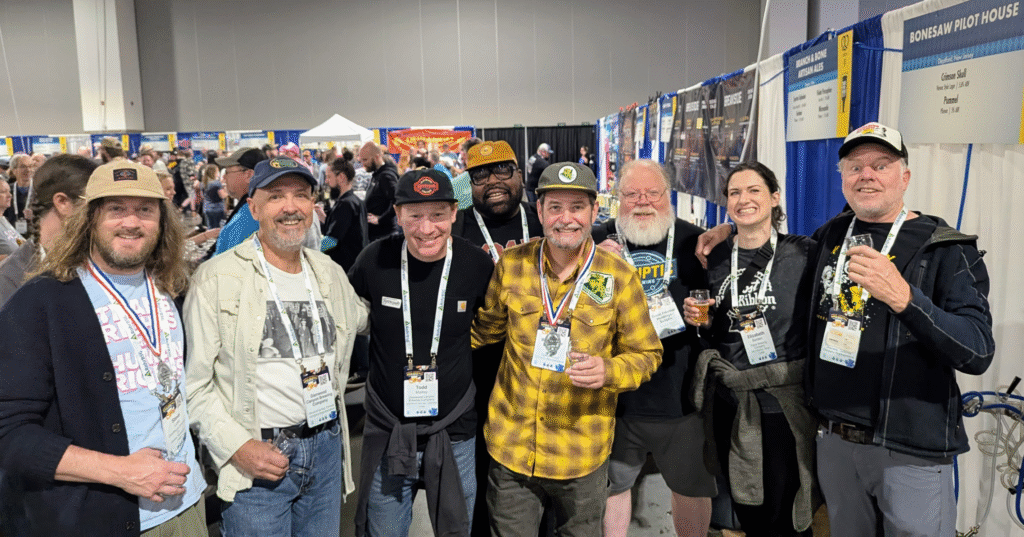
At Stone Brewery during CBC in San Diego in 2008. From left: Peter Schell, Eric Rose (Hollister Brewing), Ian Ward (Brewers Supply Group), Jonathan Cutler (Piece Brewing), Chad Kennedy (Laurelwood Public House) and Fal Allen (now back at Anderson Valley).

Jonathan picking up another GABF award for Piece in 2007.
Jonathan tearing up during Dave Keene and Jennifer Smith’s wedding during GABF several years ago.

Filed Under: Birthdays, Just For Fun Tagged With: Chicago, Illinois

Beer In Ads #5108: Haantje’s Bockbier

October 21, 2025 By Jay Brooks

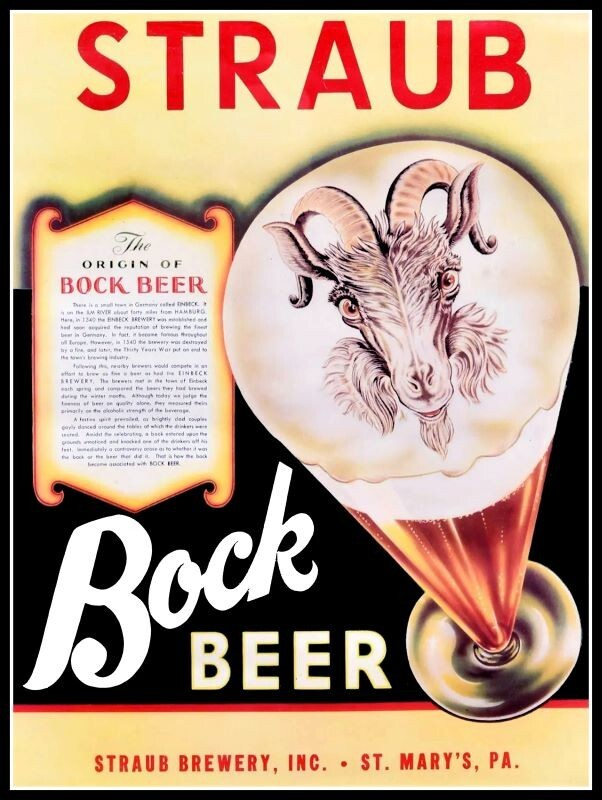
Last year I decided to concentrate on Bock ads for awhile. Bock, of course, may have originated in Germany, in the town of Einbeck. Because many 19th century American breweries were founded by German immigrants, they offered a bock at certain times of the year, be it Spring, Easter, Lent, Christmas, or what have you. In a sense they were some of the first seasonal beers. “The style was later adopted in Bavaria by Munich brewers in the 17th century. Due to their Bavarian accent, citizens of Munich pronounced ‘Einbeck’ as ‘ein Bock’ (a billy goat), and thus the beer became known as ‘Bock.’ A goat often appears on bottle labels.” And presumably because they were special releases, many breweries went all out promoting them with beautiful artwork on posters and other advertising.

Tuesday’s poster is for Haantje’s Bockbier, which was published around 1900. The full title is “Haantje’s Bockbier. Nieuwe Achtergracht – Valckenierstraat Amsterdam,” for which the latter part translates as “New Back Canal – Valckenier Street Amsterdam.” It was made for the Haantje Brewery in Amsterdam, which I believe was founded in 1899. It was created by Dutch illustrator E.G. Schlette.

Filed Under: Art & Beer, Beers, Breweries, Just For Fun Tagged With: Advertising, Bock, History, The Netherlands

Historic Beer Birthday: John D. McKechnie

October 21, 2025 By Jay Brooks

McKechnie
Today is the birthday of John D. McKechnie (October 21, 1849-February 14, 1906). He was the son of Alexander McKechnie, who along with Alexander’s brother James, the Scottish brothers founded the J. & A. McKechnie Brewing Co., d.b.a. the Canandaigua Brewery, in 1843, in Canandaigua, New York. In 1889, after the last brother passed away, John McKechnie became president of the brewery, and it was renamed the simpler McKechnie Brewing Co., but closed for good at the start of Prohibition.

John-D-McKenzie
Here’s the obituary for McKechnie from The Western Brewer:

McKechnie-obit-1
John-D-McKechnie
McKechnie-obit-2
McKechnie-Brewery

And here’s a history of the brewery by Lynn Paulson, the City of Canandaigua Historian, from the Archives of the Ontario County Historical Society:

In 1830, the McKechnie family left Falkirk, Scotland and emigrated to Canada, and from there to Rochester, New York in 1837 where the elder McKechnie with his oldest son set up a brewery business. Two other sons, James and Alexander McKechnie, left Rochester in 1843 and purchased a small brewery in Canandaigua on the site of what is now the Daily Messenger building on Buffalo Street.

The Canandaigua Brewery grew steadily, producing a product that from its earliest days was noted for its excellence. In 1871, the major buildings of the brewery were rebuilt and by 1876, the brewery had become the largest employer in Canandaigua with about 100 workers. The buildings covered over five acres of land and consisted of the brewery and storage block, malt-houses, a cooper shop, woodsheds, a barn for stabling horses, and three ice houses, which had the capacity to store 2000 tons of ice. While the brewery had the capacity of producing 500 barrels of beer each year in its early years, the capacity had grown to 1,000 barrels of beer per week.

The McKechnies became involved in several other enterprises besides their brewery. In 1880 they founded the Canandaigua Lake Steam Navigation Company, which promoted shipping and tourism on Canandaigua Lake. The McKechnie Bank was organized in 1882 and later would become the Ontario Trust Bank. The McKechnies also invested in other businesses including the Canandaigua Gas and Light Company, the local ice houses, and area hops farms. Alexander’s son, John, purchased the Seneca Point Hotel on Canandaigua Lake and managed it until it burned in 1899.

After the death of Alexander McKechnie in 1883, the firm was incorporated as a stock company renamed the McKechnie Brewing Company under the management of James McKechnie. In the production of its ale, the company used only the choicest hops and high-grade malt made from barley grown in Western New York, much of which was grown in Bristol and South Bristol. The hops and barley were brought by steamboat to the Canandaigua City Pier.

With the death of James McKechnie in 1889, the business was managed by John D. McKechnie, the eldest son of Alexander McKechnie. The stock company was renamed the J. & A. McKechnie Brewery Company.

In 1904, the brewery was sold to Schopf Distributors located in Buffalo. The brewery was fully remodeled and concentrated on the production of its celebrated Canandaigua Ale. It had so excellent a reputation that shipments went as far west as Salt Lake City, Utah. The ale is said to have “such an excellent quality that it is widely recommended by physicians as a nourishing and healthful drink for invalids.” The yearly capacity of the brewery had reached 60,000 barrels.

The refurbished brewery had a cooperage where the kegs and barrels necessary for handling the product were manufactured, and a large cold storage warehouse where large quantities of the choice fruit, mostly apples, grown in the vicinity of Canandaigua could be stored. The old-fashioned wooden tanks formerly used to store the ale were discarded and replaced with glass enameled steel tanks that ensured the purity of the ale. Throughout all the processes of manufacture and in all departments of the plant, the strictest cleanliness and attention to sanitary detail were observed.

In 1916, with the advent of Prohibition in New York state, and in 1920, with the implementation of Prohibition nationwide, the J. & A. McKechnie Brewery was forced to close. In addition, the hops farms were hit with several blights in the early 1900s that effectively decimated the industry. For a brief period, the brewery attempted to survive on the production of pickles and vinegar. An attempt was made in 1933 by a Syracuse entrepreneur to reopen the McKechnie Brewery, but it never materialized.

The Canandaigua Cold Storage & Ice Company occupied the buildings of the old brewery until it was sold to the GLF bean processing and dog/pet food manufacturing plant in 1940. On Jan. 1, 1961, the GLF plant burned, leaving a few remaining buildings on the site. Ironically, the McKechnie home on North Main Street where the American Legion had located in 1945 burned in 1960. Any remaining structures of the old McKechnie brewery were removed in 1971 when The Daily Messenger built its new facility on Buffalo Street.

McKechnie-Brewery-building

Filed Under: Birthdays, Breweries, Just For Fun Tagged With: History, New York, Scotland

Historic Beer Birthday: Emil Schmitt

October 21, 2025 By Jay Brooks

john-kauffman
Today is the birthday of Emil (sometimes spelled Emile) Schmitt (October 21, 1851-November 13, 1898). He was born in Lorraine, France, and emigrated to America in 1853 with his family, settling in Cincinnati, Ohio. Having married Maria Elizabeth “Mary” Kauffman, he was the son-in-law of John Kauffman, who was part of the group that bought the Franklin Brewery in Cincinnati, Ohio in 1856. By 1859, it was called the John Kaufman & Co. Brewery, and it became the fourth largest brewery in Cincinnati. Eventually, he remained as the sole owner, and in 1882 renamed it the John Kauffman Brewing Co. Emil Schmitt was the manager of the brewery. When he died in 1886, Emil assumed control of it. It was closed by prohibition, and never reopened, although it was used as the Husman Potato Chip factory, so at least it was put to good use.

Emil-Schmitt
The name confusion is particularly odd, since some accounts, notably his page on Ancestry.com, claims that he was a twin, and that he, Emile, had a twin sister named Emil. But even the illustration accompanying his obituary, shown above, is titled Emil, and you’d be hard-pressed to conclude that’s a woman. There’s also some suggestion that she also died at the same time as her brother Emile. There’s definitely some conflicting reports on this.

Here’s his obituary, from the Cincinnati Enquirer:

Emil-Schmitt-obit
There’s an entry for the John Kauffman Brewery in the “History of Cincinnati and Hamilton County, Ohio,” published in 1894:

john-kauffman-brewery-history
Kauffman-brewery-letterhead

Cincinnati Brewing History has this account of the brewery’s history, taken from Cincinnati Breweries, by Robert J. Wimberg, from 1989:

“In 1856 John Kauffman, George F. Eichenlaub, and Rudolf Rheinbold purchased the Franklin Brewery on Lebanon Road near the Deer Creek from Kauffman’s aunt. Her husband, John Kauffman, estabished the brewery in 1844. He died in 1845. In 1859 under the name Kauffman and Company, they began to build a new brewery on Vine Street and soon left the Deer Creek location. The first structure on Vine was completed in 1860.
In 1871 the Kauffman Brewery was the city’s fourth largest with sales amounting to $30,930. It was located on both the west and east sides of Vine north of Liberty and south of Green Street.

In 1860 Kauffman also bought the Schneider grist mill on Walnut Street near Hamilton Road (McMicken Avenue), but leased it out before long to another company.

In its first year on Vine Street, the brewery produced only about 1000 barrels. By 1877 the number grew to 50,000 barrels of beer. Kauffman’s beer was sold in Nashville, Montgomery, Atlanta, Charleston, Savannah, and New Orleans.

In 1865 Eichenlaub retired from the business and he was followed by Rheinbold in 1877. John Kauffman then took over the leadership by himself. After his oldest son Johnn studied brewing in Augsburg, Germany, he went to work at the family brewery. Emil Schmidt, Kauffman’s son-in-law, was superintendent by 1877.

In 1882 the brewery was incorporated as the John Kauffman Brewing Company with a paid-in capital stock of $700,000. In 1888 the brewery building at 1622 Vine was enlarged. Note it is occupied by the Schuerman Company today. The office and family residence was at 1625-27 Vine, which was razed and replaced about 75 years ago.

John Kauffman died in 1892 and his wife Marianne Eichenlaub Kauffman took over. She was president of the corporation; Emil Schmidt, vice-president; and treasurer; Charles Rheinbold, secretary; Charles J. Kauffman, superintendent; and John R. Kauffman, brewmaster. By 1894 the brewery produced 70,000 barrels of beer. The malt house had a capacity of 150,000 bushels of barley and the brewery plant covered five acres of ground.

By 1913 John R. Kauffman was president of the company. The brewery produced ‘Gilt Edge’, ‘Columbia’ and ‘Old Lager’ beers. It closed in 1919 when Prohibition became law and never reopened.”

John-Kauffman-Brewery-poster

The brewery is also mentioned briefly in a History of the Brewery District for Cincinnati:

Industry continued to be an important factor in Over-the-Rhine’s development. The canal area was still the location of many diversified industries, including lumberyards, foundries, pork packers, tanneries, and glycerin works. The brewing industry tended to concentrate along McMicken Avenue and the Miami and Erie canal (what is now the Brewery District). By 1866 the Jackson Brewery, J. G. John & Sons Brewery, Christian Moerlein Brewing Company, and John Kauffman Brewing Company dominated the industrial use of the area. In close association on the west side of the canal were the John Hauck and Windisch-Mulhauser Brewing Companies. Between 1875 and 1900 seventeen breweries were located in Over-the-Rhine and West End.

John_Kauffman_Brewing_Company_beer_label

Filed Under: Birthdays, Breweries, Just For Fun Tagged With: France, History, Ohio

Beer Birthday: Lucy Saunders

October 21, 2025 By Jay Brooks

beercook
because beer is food: in cooking, at the table, and by the glass …

So begins the website of beer cook Lucy Saunders, whose birthday is today. Lucy has done much to promote both cooking with beer and enjoying food with beer through her books and other writings. She’s a treasure, in more ways than one. Join me in wishing Lucy a very happy birthday Lucy.

beerbistro-04
At the beer bistro in Toronto for Stephen Beaumont and Maggie’s wedding reception.

nbwa08-09
Lucy with Stacy Williams, Brand Manager for Gambrinus, at the Hot Brands reception at the NBWA Convention, when it was in San Francisco a few years ago.

cbc07-36
During CBC in Austin, Texas in 2007, at the Moonshine bar for an event with Lucy for her book, Grilling with Beer. Here, Lucy with three contributors to her book, myself included.

gabf06-wed-04
Lucy with Vinnie Cilurzo at the GABF brewers reception in Denver in 2006.

monks-candinner-6
Shaun O’Sullivan from 21st Amendment, Fergie Carey, co-owner of Monk’s, Lucy Saunders, the beer cook, and Tom Peters, also co-owner of Monk’s at the Canned Beer Dinner many Junes ago.

Filed Under: Birthdays, Food & Beer Tagged With: Midwest, Wisconsin

Historic Beer Birthday: William G. Ruske

October 21, 2025 By Jay Brooks

pittsburgh-brewing
Today is the birthday of William G. Ruske (October 21, 1842-May 2, 1915). Ruske was born in Germany and came to Western Pennsylvania, co-founding the Keystone Brewing Co. 1886, and was its president. In 1899, Keystone became part of a regional trust known as the Pittsburgh Brewing Company, which was formed by the merging together of thirteen Allegheny County breweries. Ruske was initially secretary of the trust, but became president when his predecessor died. The brewery survived prohibition and today is known as the Iron City Brewing Co.

william-ruske

This is his obituary, from the American Brewers’ Review the year he passed away:

ruske-obit-1
ruske-obit-2
ruske-obit-3

Iron_City_Brewery_-_Pittsburgh_-_circa_1919
Pittsburgh brewery around 1919.

And here’s part of another history of Iron City Brewing, from the merger through the end of prohibition, from PA’s Big House:

As the century came to a close, breweries in the Pittsburgh area merged to form the Pittsburgh Brewing Company (PBC). The twelve local breweries included: Wainwright; Phoenix; Keystone; Winter Brothers; Phillip Lauer; John H. Nusser; Eberhardt & Ober; Hippely & Sons; Ober; J. Seiferth Brothers; Straub; and Iron City. In addition to these initial twelve breweries, nine more were included in the merger. Now, Pittsburgh Brewing Company was Pennsylvania’s largest brewery and third largest in the nation with combined assets worth an estimated $11 million. For the next three decades, PBC boasted a brewing capacity of more than one million barrels per year.

The onset of Prohibition in 1920 brought serious strain to breweries across the nation. Pittsburgh Brewing Company, however, was able to survive by using its facilities to produce ice cream, soft drinks, and non-alcoholic “near-beers.” When Prohibition was repealed in 1933, PBC was one of only 725 breweries in the U.S. still operating.

After Prohibition, the Pittsburgh Brewing Company regained market share and produced the same products it had made prior to the act. The president of the company at that time also created a new subsidiary and reinstated the original name: the Iron City Brewing Company (ICBC). ICBC’s products included Iron City Pilsner, Iron City Lager, Tech Beer, and Blue Label Beer. In 1947, the company again expanded and Iron City Brewing Company continued to grow in the market. By the mid-1950’s, ICBC became the best selling beer in Pittsburgh.

Iron-City-Factory-Scene-1901

I really couldn’t find very much information on Ruske, or even his original Keystone Brewery. But one curiosity I came across was this undated tintype. But since tintypes were popular for around twenty years, from the 1860s through the 1870s, I think it’s safe to conclude that’s what this one was created. The two beer bottles on the posts are from the Keystone Brewery and the label apparently reads Cabinet Export Beer.

tintwobrewerskeystone

Filed Under: Birthdays, Just For Fun Tagged With: Germany, History, Pennsylvania

Beer In Ads #5107: “The Winah-h-h!” Star Model Bock Beer

October 20, 2025 By Jay Brooks

Last year I decided to concentrate on Bock ads for awhile. Bock, of course, may have originated in Germany, in the town of Einbeck. Because many 19th century American breweries were founded by German immigrants, they offered a bock at certain times of the year, be it Spring, Easter, Lent, Christmas, or what have you. In a sense they were some of the first seasonal beers. “The style was later adopted in Bavaria by Munich brewers in the 17th century. Due to their Bavarian accent, citizens of Munich pronounced ‘Einbeck’ as ‘ein Bock’ (a billy goat), and thus the beer became known as ‘Bock.’ A goat often appears on bottle labels.” And presumably because they were special releases, many breweries went all out promoting them with beautiful artwork on posters and other advertising.

Monday’s poster is for an Star Model Bock Beer, which was published sometime after 1933, but before 1966. This one was for the Star Union Products Co. of Peru, Illinois, which was originally founded in 1856 as the Fred Kaiser Brewery. By 1877 it was the Union Beer Co. and after 1880, Star Union. The poster is signed with what looks like “Roesler,” but I couldn’t find out any additional information about the artist.

Filed Under: Beers

Beer Birthday: Sean Paxton

October 20, 2025 By Jay Brooks

sean-paxton
Today is the 53rd birthday of Sean Paxton, a.k.a. The Homebrew Chef. Sean is a mad alchemist in the kitchen and puts on some wonderful food and beer spectacles. Plus he’s a terrific homebrewer, an even better human being and a great friend. A few years ago, he spent a great deal of time redoing his website with great new recipes and an amazing interface that allows you to search, scale the recipes, convert measurements and much more. Check it out. He’s been sticking closer to home more recently. Join me in wishing Sean a very happy birthday.

At the Great American Beer Festival in 2008. Bruce Paton, the Beer Chef, Sean and Dave Keene, from the Toronado, in the convention center.
Sean with his daughter Olivia at the Pliny the Elder release several years ago.
Working with nitrogen at the 11-course Belgian Brunch, or Blunch, held at the Toronado.
My wife, Sarah, with Sean after the 10th annual beer dinner at the Northern California Homebrewers Festival held at Lake Francis Resort in Dobbins, California.
With Randy Mosher at the world’s biggest beer dinner at CBC in Chicago.

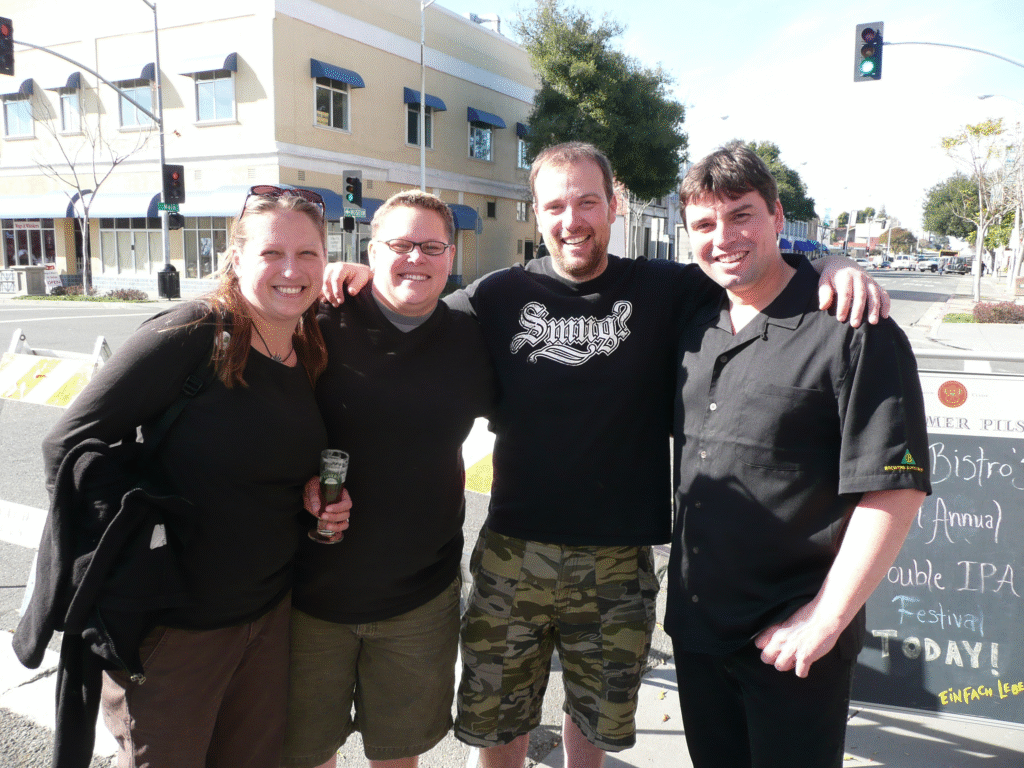
Matt Bonney, Stephen Beaumont, Sean, Pete Slosberg & Rick Sellers at the Bistro for the Double IPA Festival several years back.

Filed Under: Birthdays, Food & Beer, Just For Fun Tagged With: California, Northern California

Historic Beer Birthday: Johann Georg Sohn

October 20, 2025 By Jay Brooks

felsenbrau
Today is the birthday of Johann Georg Sohn (October 20, 1817-October 24, 1876). He was born in Bavaria, but settled in Cincinnati, Ohio. In 1845, he co-founded the Hamilton Brewery, which was later known as the J.G. Sohn & Company Brewery. It was also known as the Clyffside Brewing Co., and used the trade name Feldsbrau. Johann’s sons took over after his death, and it was sold in 1907 and became known as the William G. Sohn Brewing Co. and later the Mohawk Brewing Co. After prohibition, it reopened as the Clyffside Brewing. After World War 2, it was renamed the Red Top Brewing before closing for good in 1958. Unfortunately, I couldn’t find very much biographical information about Sohn, and only a little about his brewery.

Larger memorial image loading...

Here’s a short biography from Find-a-Grave:

Clyffside Brewing Company is a defunct brewery in Cincinnati, located on the site of Hamilton Brewery, founded in 1845 by Johann Sohn and George Klotter as the Hamilton Brewery. By 1853, the company becane known as the Klotter, Sohn and Company. In 1866, Sohn bought out Klotter, and Klotter went on to establish his own brewery on Klotter Street. Sohn renamed the brewery the J.G. Sohn & Company Brewery, and it became the tenth largest of its type in Cincinnati. In November 1900, the company was reorganized as the William S. Sohn Brewing Company when Sohn sold out his interest. In 1907, Sohn was purchased by Mohawk Brewery, and was known for its Zinzinnati Beer.

And here is some more history of the brewery.
Newspaper.  Cincinnati Enquirer (Cincinnati, Ohio).  December 22, 1877 Edition.
cliffyside-brewery

Cincinnati Brewing History has the following to say about the brewery:

George Klotter left the Klotter, Sohn, & Co. Brewery partnership to pursue his own proprietorship, at which point Johann George Sohn brought in Louis Sohngen and Heinrich Schlosser as partners. The new partnership would operate under the name of J.G. Sohn & Co. Brewery. Sohn ran the business until his death in 1876.

After Sohn’s death, leadership of the company was assumed by his sons, J.G. Sohn Jr., William, and J. Edward. J.G. Sohn Jr. died in 1880 and the other two brothers continued to operate the brewery together until 1900, at which time J. Edward left to join the Schaller Brothers Brewery. Shortly thereafter William would rename the brewery as the William S. Sohn Brewery, however he died in 1902. After William’s death his wife, Lena Jung Sohn ran the brewery until 1907, as she was intimately familiar with the industry by way of her father, another Cincinnati brewer.

cliffyside-brewing

Abandoned, the story of a forgotten America, also has a page about the Clyffside Brewing Company

clyffside-brewery

Felsenbrau-Bock-Beer-Labels-Clyffside-Brewing-Company

Felsenbrau2
johan-georg-sohn

Filed Under: Birthdays, Breweries, Just For Fun Tagged With: Germany, History, Ohio

Beer In Ads #5106: Harlequin Bock

October 19, 2025 By Jay Brooks

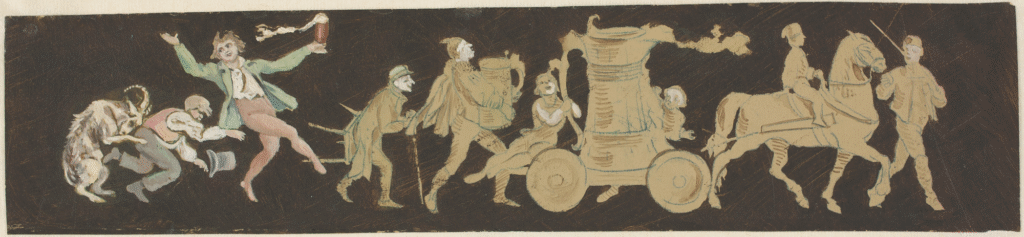
Last year I decided to concentrate on Bock ads for awhile. Bock, of course, may have originated in Germany, in the town of Einbeck. Because many 19th century American breweries were founded by German immigrants, they offered a bock at certain times of the year, be it Spring, Easter, Lent, Christmas, or what have you. In a sense they were some of the first seasonal beers. “The style was later adopted in Bavaria by Munich brewers in the 17th century. Due to their Bavarian accent, citizens of Munich pronounced ‘Einbeck’ as ‘ein Bock’ (a billy goat), and thus the beer became known as ‘Bock.’ A goat often appears on bottle labels.” And presumably because they were special releases, many breweries went all out promoting them with beautiful artwork on posters and other advertising.

Sunday’s poster is for an unknown Bock Beer, which was published in 1890. You might be tempted. to think the person on the swing with the Bock beer goat is a clown, but I think it’s more likely he’s some kind of Harlequin, a character that would have been more familiar in the late 19th century.

Filed Under: Beers

« Previous Page
Next Page »

Find Something

Northern California Breweries

Please consider purchasing my latest book, California Breweries North, available from Amazon, or ask for it at your local bookstore.

Recent Comments

  • Ernie Dewing on Historic Beer Birthday: Charles William Bergner 
  • Steve 'Pudgy' De Rose on Historic Beer Birthday: Jacob Schmidt
  • Jay Brooks on Beer Birthday: Bill Owens
  • Steve 'Pudgy' De Rose on Beer Birthday: Charles Finkel
  • Steve 'Pudgy' De Rose on Beer Birthday: Bill Owens

Recent Posts

  • Beer In Ads #5197: It’s Here! Rahr’s Bock Beer February 9, 2026
  • Historic Beer Birthday: David C. Kuntz February 9, 2026
  • Historic Beer Birthday: Joe Allen February 9, 2026
  • Beer In Ads #5196: Happy Days Are Here Again February 8, 2026
  • Historic Beer Birthday: Andrew MacElhone February 8, 2026

BBB Archives

Feedback

Head Quarter
This site is hosted and maintained by H25Q.dev. Any questions or comments for the webmaster can be directed here.