Brookston Beer Bulletin

Jay R. Brooks on Beer

  • Home
  • About
  • Editorial
  • Birthdays
  • Art & Beer

Socialize

  • Dribbble
  • Email
  • Facebook
  • Flickr
  • GitHub
  • Instagram
  • LinkedIn
  • Pinterest
  • RSS
  • Twitter
  • YouTube

Powered by Genesis

Historic Beer Birthday: Prosper Cocquyt

June 9, 2025 By Jay Brooks

sabena
Today is the birthday of Prosper Cocquyt (June 9, 1900-October 22, 1954). He was born in Astène, Belgium, near Ghent, and is primarily famous for being an aviator.

Prosper-Cocquyt

Prosper Cocquyt was called “the uncrowned king of the airline pilots.” Shortly after learning to fly, in his early twenties, joined Sabena World Airlines in its inception, and opened several routes for them, including to the Belgian Congo. He flew for them for over 25 years, and was even “the favorite pilot of the Belgian royal family and the personal pilot of the kings, Albert I and Leopold III.” Flying Zone has a lengthy biography of Cocquyt, and so does another website.

He was married to Elza Timmermans, and they had two children, a boy and a girl. It’s possible she was part of the Timmermans brewing family, but I’m not sure. But there’s another reason he’s included here.

When World War I broke out, Cocquyt was only fourteen, and he had to abandon going to school and find work. He was hired by a brewery run by a friend of his father as a mechanic. He distinguished himself by his knowledge of mechanics, and so impressed his boss, at sixteen, he was named chief mechanic, and even received a degree in mechanical engineering and electrical engineering at 21, before abandoning working in brewing to begin his career as a pilot. As far as I could tell, he never looked back.

Prosper-DC4

Filed Under: Birthdays, Just For Fun, Related Pleasures Tagged With: Belgium, History

Beer Saints: St. Medard of Noyon

June 8, 2025 By Jay Brooks

Today is the feast day of St. Medard of Noyon, who was also known as St. Medardus (c. 456–545). “He was the Bishop of Noyon. He moved the seat of the diocese from Vermand to Noviomagus Veromanduorum (modern Noyon) in northern France. Medardus was one of the most honored bishops of his time, often depicted laughing, with his mouth wide open, and therefore he was invoked against toothache.” He is also the patron of brewers, as well as vineyards and good harvests. “He is sometimes depicted with a giant eagle hovering over his head to shelter him from rain, while others around him got wet (reputedly this occurred while he was a child.) This led to his association with control over the weather.”

This account is from CatholicSaints.Info:

Born c.470 in Salency, Picardy, France; died c.558. Born of a Frankish noble father and a Gallo-Roman mother, Saint Medard was educated at Saint-Quentin. He is also the brother of Saint Gildard, archbishop of Rouen. At 33, he was ordained to the priesthood and became so successful as a missioner that he was chosen to succeed Bishop Alomer in 530 in the see of Vermandois. Medard may have been consecrated by Saint Remigius of Rheims.

According to an unreliable tradition, Medard moved his see from Saint-Quentin to Noyon after a raid by the Huns, then united it with the diocese of Tournai. Allegedly Noyon and Tournai remained under one bishop for 500 years.

Medard is known to have given the veil to Queen Saint Radegund. He is credited with the institution of the old local custom of Rosiere. Each year where his feast is celebrated, the young girl who has been judged the most exemplary in the district is escorted by 12 boys and 12 girls to the church, where she is crowned with roses and given a gift of money (Benedictines, White).

In art, an eagle shelters Saint Medard from the rain, a reference to the legend that this happened when he was a child (Roeder). This may explain the origins of the superstition that if it rains on his feast day, the next 40 days will be wet; if the weather is good, the next 40 will be fine as well (White). He might also be portrayed with two horses at his feet, leaving footprints on stone, or holding a citadel (Roeder). In Medieval art, Medard may be laughing with his mouth wide open (le ris de Saint Medard), and for this reason he is invoked against toothache (White).

Saint Medard is the patron of brewers, peasants, prisoners (Roeder), corn harvests, and vintage (White). He is invoked on behalf of idiots and lunatics, as well as for fruitfulness, both in child-bearing and in the fields, for rains and vineyards, and against bad weather and toothache (Roeder).

Why exactly he’s a patron of brewers or vineyards or good harvests is not very clear, and I can find no satisfactory answer. The only logical assumption may have to do with association with rain, but that’s admittedly a bit of a stretch.

Central part of a triptych from St. Catherine Chapel by unknown artist (circa 16th century)

There’s also a Brasserie Saint Médard in France that was founded in 2015 that uses the saint in their logo and on their beer bottles.

Filed Under: Beers, Birthdays, Breweries, Related Pleasures Tagged With: beer saints, Religion & Beer

Frieten Birthday: Eddy Cooremans

June 5, 2025 By Jay Brooks

Today is the 77th birthday of Eddy Cooremans, who is a Belgian frites ambassador. I first met Eddy in 2019, when Navefri/Unafri, the Belgian frites shops trade association (which represents Belgium’s 4,500+ frites shops/stands) brought a frites trailer to our lunch during the Brussels Beer Challenge judging. Eddy frequently works as an ambassador for the association, and has flown around the world to make frites in numerous counties during trade delegations and other international events. Eddy started as a locally famous football player in his youth, but after retiring became active in the frites industry, opening a Belgian frites shop in New York City in the 1980s, helped open the Belgian Frites Museum in Brugges, and writing one of the seminal books on Belgian frites, Van Aardappel tot Friet, with André Delcart. Last year, when I was back in Belgium, Eddy invited me to his home outside of Brussels and I spent the day with geeking out on all things frites. He was incredible generous with his time and it’s rare that I can find someone who will happily discuss the minutiae of frites for hours on end, but Eddy is one of those people, truly a kindred spirit. Join me in wishing Eddy a very happy birthday.

A couple of years ago in Eddy’s backyard, where he was teaching me the finer points of frites.
Serving fresh frites for our lunch.
Eddy has perfected the toss.
This was from 2019, the first time I met Eddy.

Filed Under: Birthdays, Food & Beer, Related Pleasures Tagged With: Belgium, Food, Fries, Frites

Historic Beer Birthday: John Gilroy

May 30, 2025 By Jay Brooks

guinness-white
Today is the birthday of John Gilroy (May 30, 1898-April 11, 1985). While not a brewer or even brewery owner, he was nonetheless at least partially responsible for the success of Guinness with his iconic advertising that he created for them beginning in 1928.

John_Gilroy
Here’s his entry from Wikipedia.

“Born in Whitley Bay, Northumberland, England, Gilroy attended Durham University until his studies were interrupted by World War I, during which he served with the Royal Field Artillery. He resumed studying at the Royal College of Art in London, where he remained as a teacher. He taught at Camberwell College of Arts.

In 1925, he gained employment at S.H. Benson’s advertising agency, where he created the iconic advertisement art for Guinness featuring the Zoo Keeper and animals enjoying Guinness. He worked with Dorothy L. Sayers. He was also an accomplished portrait painter, numbering Royalty, Politicians, Actors and many others amongst his sitters. He worked in his large studio at 10 Holland Park, London, the former home and studio of Sir Bernard Partridge. He was a long-standing and much loved member of the Garrick Club, where he was created a Life Member and Chairman of the Works of Art Committee 1970-1975. He was awarded and Honorary MA by Newcastle University in 1975, and was made a Freeman of the City of London in 1981.”

gilroy

The Guinness Collectors Club has a more thorough biography:

John Gilroy (1898-1985) was a superb natural draughtsman and a versatile illustrator and artist who produced advertsising material, portraits, landscapes, murals and greeting cards.

Born on the 30th of May 1898 at Whitley Bay, Newcastle upon Tyne, he was one of a family of eight (five boys and three girls), born to John William Gilroy and his wife Elizabeth. William Gilroy was a marine landscape painter and technical draughtsman and it was obvious from an early age that John junior was going to follow in his footsteps. The young John practised copying cartoons from Punch and took on all kinds of work to pay for drawing materials. From the age of fifteen he was a cartoonist for the Evening Chronicle, Newcastle, commissioned to produce cartoons of well-known entertainers who played the Newcastle theatres.

John attended Sandyford School followed, in 1909, by Heaton Park Road Upper School. At this date his family was living at 25 Kingsley Place. In June 1912, he left Heaton Park and, having attained his drawing certificate, won a scholarship to Armstrong College Art School, Durham University to study under Professor K.G. Hatten.

The First World War interrupted Gilroy’s studies and he served with the Royal Field Artillery in France, Italy and Palestine. In September 1919 he resumed his studies taking a place at the Royal College of Art, London (RCA). During his time there he produced illustrations for the college student magazine and occasionally played in goal for the college football team. In 1920 he attained his Board of Education certificate and the RCA diploma in decorative painting. His work was also rewarded through scholarships and prizes, winning, in 1919, the North Lordbourne prize for composition and, in 1921, the college drawing prize and the British Institute Scholarship for decorative painting. In 1922 Gilroy won an RCA travelling scholarship in mural painting having missed the Prix de Rome by only one vote.

Gilroy graduated from the RCA in July 1923 but stayed on there until 1925 as a teacher. From 1924 to 1926 he also taught drawing from the figure in the evenings at the Camberwell School of Art. In 1924 he married Gwendoline Peri-Short who had been a fellow pupil at the RCA and three years later they had a son, John.

In 1925 Gilroy embarked on his long association with the advertising agency S H Benson Ltd (Benson’s). Although Benson’s was the first advertising agency for whom Gilroy worked as an in-house artist, he had already proven himself in the commercial art sphere. His earliest known piece of commercial art, dating from 1920 when he was still a student, was for a promotional leaflet for the Mangnall-Irving Thrust-Borer commissioned by the Hydraulic Engineering Co.

Gilroy’s early work at Benson’s is reputed to have been on campaigns for Skipper Sardines and Virol. During his time there he also worked on campaigns for Bovril, Macleans and Monk & Glass Custard. His first significant assignment was the Mustard Club campaign for Coleman’s of Norwich, on which he worked with fellow artist William Brearley and copywriters Oswald Greene and Dorothy L Sayers. Between 1926 and 1933 the pens of Gilroy and Brearley brought eccentric characters like Baron de Beef, Signor Spaghetti and Miss Di Gester to life on bill boards and in magazines everywhere.

In 1928 Benson’s won the Guinness advertising account and Gilroy became involved with the product with which his work is most closely associated. Gilroy’s first known Guinness poster was produced in 1930. Working with copywriters like Ronald Barton and Robert Bevan, Gilroy produced more than 100 press advertisements and nearly 50 poster designs for Guinness over 35 years. He is perhaps best remembered for his posters featuring the girder carrier and the wood cutter from the Guinness for Strength campaigns of the early 1930s and for the Guinness animals. The animals, including a lion, toucan, gnu and kangaroo, appeared, with their long-suffering zookeeper, on posters, press advertisements, show cards and waiter trays from the 1930s to the 1960s.

Gilroy continued to produce Guinness advertisements well into the 1960s even though he left Benson’s employment as an in-house artist in the 1940s to continue freelance work.

During the 1920s and succeeding decades commercial art was not Gilroy’s sole occupation; he began to build his reputation as a painterboth of portraits and landscapes. One of his earliest portrait commissions was to paint the future Edward V111 for the Royal Mid-Surrey Golf Club, of which Gilroy was a member and the Prince was patron.

In 1930, while the family was living at The Cottage, Hyde Park Road, Kew Gardens, Gilroy has his first painting, Gwen. exhibited at the Royal Academy. Throughout the 1930s Gilroy’s work continued to be exhibited at the Royal Academy and to appear on advertising boardings, in newspapers and even in the Radio Times. In 1941, with the onset of the blitz, the artist moved to Rasehill, Chorleywood Road, Rickmansworth. His wife and son moved to Cheltenham where, in the same year, he held a one-man exhibition of his work, which then travelled to Sunderland Public Art Gallery.

Throughout the war years, Gilroy’s work continued to be exhibited at the Royal Academy while his commercial art talents were employed by the Ministry of Information in campaigns such as Make-do-and-mend, Keep it under your hat and We want your kitchen waste. He also improved morale by painting murals at various Royal Air Force bases and produced a series of drawings-in-one-line of contemporary political and military figures, called Headlines, which appered in The Star.

By 1945, when his painting Diamond Setting was exhibited at the Royal Academy, the artist’s address was given as 6 Avenue Studios, Sydney Close, SW3. A year laterhe prodced another mural, this time in the bar of the Mrritt Arms Hotel near Greta Bridge on the estate of his close friend Major Morritt. The work at the Morritt Arms began on the 1st February 1946 and was completed within10 days. When Gilroy and his assistant proudly displayed the walls of the bar decorated with Dickensian figures, closer inspection revealed them to be caricatures of local people and staff from the hotel.

In 1949 Esme Jeudwine, a former pupil and portrait subject, introduced Gilroy to the Royle family and another long and successful association began. Gilroy produced five greeting card designs for Royle Publications Ltd (Royles) in that year with another 464 published designs over the next 35 year. In 1966, Gilroy was acting Art Director for Royles.

In 1950 Gilroy married Elizabeth Margaret Bramley (nee Outram Thwaite). The couple lived at 17 Queen’s Gate, Kensington, but moved a year later to 10 Holland Park Road, W14, the former home and studio of Sir Bernard Partridge, whose cartoons Gilroy had copied from Punch as a child. The magnificent studio at Holland Park Road saw the creation of advertising work for T.F. Carrington Van PostingLtd. where Gilroy was Head of the Art Department, and was regularly visited by members of the Royal Family, politicians, actors and many others who came to have theit portraits painted.

In 1957 Gilroy held another one-man exhibition this time at Leighton House Gallery and two years later produced a series of landscapes of McGill University, Montreal, to illustrate a book McGill, The Story of a University, edited by Hugh MacLennan. In 1970 Gilroy held a retrospective exhibition at Upper Grosvenor Galleries and three years later an exhibition of his humorous designs for Royles was held at the London headquarters of Austin Reed Ltd.

In his later years ‘Jack’ Gilroy was a longstanding and much loved member of the Garrick Club where he was Chairman of the Works of Art Committee and where a number of his portraits now hang. In 1975 Gilroy was awarded an honorary MA by Newcastle University and in 1981, now living at 6 Ryecroft Street, Fulham, he was appointed a Freeman of the City of London.

John Gilroy died at Guildford on the 11th April 1985, aged 86, and is buried at Ampney St Peter in Gloucestershire near the home of his son and three grandchildren.

John-Gilroy-photo

He created the zoo animals and other popular characters for Guinness from either 1928 or the early 1930s (accounts differ), but the first one he did appears to be the Guinness for Strength ad featuring a steel girder in 1934. According to some accounts, it was so popular that people even started ordering a ‘girder’ in the pub.

Guinness-1934-girder

The following year, the Toucan debuted, and quickly became one of the most recognizable of the Guinness animals, used in marketing and advertising by Guinness for over 45 years. Here’s the story of its design from History House:

The idea of using a toucan was born in the advertising agency of S.H.Benson in London. Staff included the talented artist John Gilroy was newly employed as the poster artist, and among the copywriting team was Dorothy L Sayers, now famous as a writer, poet and playwright, and best known for her amateur detective stories featuring Lord Peter Wimsey. She had started at the agency in 1922 and worked there while writing books in her spare time.

This team produced some memorable posters for Guinness including several posters in the whimsical “Zoo” series. These included a zoo keeper with a Guinness, a sea lion balancing drink on his nose, an ostrich with the shape of a swallowed glass halfway down its neck, a tortoise with a glass of stout on its back, and a toucan with two Guinness bottles balanced on its beak accompanied by the words.

If he can say as you can
“Guinness is good for you”
How grand to be a Toucan
Just think what Toucan do.

Gilroy remained with the advertising agency until 1960 during which time he designed many other Guinness posters. As to how animals came to be used in an advertising campaign was recalled later by Gilroy. “The Guinness family did not want an advertising campaign that equated with beer. They thought it would be vulgar. They also wanted to stress the brew’s strength and goodness. Somehow it led to animals.”

The toucan returned on several occasions on all types of advertising media and on memorabilia. In 1982 Guinness changed advertising agencies and it was decided that the toucan was no longer an effective advertising motif and it was dropped.

The text from that ad was actually written by Dorothy L. Sayers, who worked for the same advertising agency as Gilroy before she became a famous mystery writer, well-known for such characters as Lord Peter Wimsey, and others.

Guinness-Toucan-1935-Color
Gilroy’s first Toucan ad, from 1935.

And here’s a sample of some more of his work for Guinness.

guinness-collage
And finally, by no means complete, these are other Guinness ads I’ve collected in a Flickr gallery, many of which are by John Gilroy.

Ads: Guinness

Filed Under: Art & Beer, Beers, Birthdays, Breweries, Just For Fun, Related Pleasures Tagged With: Advertising, Guinness, History

Historic Beer Birthday: Eduard Buchner

May 20, 2025 By Jay Brooks

nobel-prize
Today is the birthday of Eduard Buchner (May 20, 1860-August 13, 1917). Buchner was a German chemist and zymologist, and was awarded with Nobel Prize in Chemistry in 1907 for his work on fermentation.

Buchner

This is a short biography from The Famous People:

Born into an educationally distinguished family, Buchner lost his father when he was barely eleven years old. His elder brother, Hans Buchner, helped him to get good education. However, financial crisis forced Eduard to give up his studies for a temporary phase and he spent this period working in preserving and canning factory. Later, he resumed his education under well-known scientists and very soon received his doctorate degree. He then began working on chemical fermentation. However, his experience at the canning factory did not really go waste. Many years later while working with his brother at the Hygiene Institute at Munich he remembered how juices were preserved by adding sugar to it and so to preserve the protein extract from the yeast cells, he added a concentrated doze of sucrose to it. What followed is history. Sugar in the presence of enzymes in the yeast broke into carbon dioxide and alcohol. Later he identified the enzyme as zymase. This chance discovery not only brought him Nobel Prize in Chemistry, but also brought about a revolution in the field of biochemistry.

eduard-buchner

Eduard Buchner is best remembered for his discovery of zymase, an enzyme mixture that promotes cell free fermentation. However, it was a chance discovery. He was then working in his brother’s laboratory in Munich trying to produce yeast cell free extracts, which the latter wanted to use in an application for immunology.

To preserve the protein in the yeast cells, Eduard Buchner added concentrated sucrose to it. Bubbles began to form soon enough. He realized that presence of enzymes in the yeast has broken down sugar into alcohol and carbon dioxide. Later, he identified this enzyme as zymase and showed that it can be extracted from yeast cells. This single discovery laid the foundation of modern biochemistry.

buchner-fermentation

One of the most important aspects of his discovery proving that extracts from yeast cells could elicit fermentation is that it “contradicted a claim by Louis Pasteur that fermentation was an ‘expression of life’ and could occur only in living cells. Pasteur’s claim had put a decades-long brake on progress in fermentation research, according to an introductory speech at Buchner’s Nobel presentation. With Buchner’s results, “hitherto inaccessible territories have now been brought into the field of chemical research, and vast new prospects have been opened up to chemical science.”

In his studies, Buchner gathered liquid from crushed yeast cells. Then he demonstrated that components of the liquid, which he referred to as “zymases,” could independently produce alcohol in the presence of sugar. “Careful investigations have shown that the formation of carbon dioxide is accompanied by that of alcohol, and indeed in just the same proportions as in fermentation with live yeast,” Buchner noted in his Nobel speech.

E._Buchner_WS_1911-12

This is a fuller biography from the Nobel Prize organization:

Eduard Buchner was born in Munich on May 20, 1860, the son of Dr. Ernst Buchner, Professor Extraordinary of Forensic Medicine and physician at the University, and Friederike née Martin.

He was originally destined for a commercial career but, after the early death of his father in 1872, his older brother Hans, ten years his senior, made it possible for him to take a more general education. He matriculated at the Grammar School in his birth-place and after a short period of study at the Munich Polytechnic in the chemical laboratory of E. Erlenmeyer senior, he started work in a preserve and canning factory, with which he later moved to Mombach on Mainz.

The problems of chemistry had greatly attracted him at the Polytechnic and in 1884 he turned afresh to new studies in pure science, mainly in chemistry with Adolf von Baeyer and in botany with Professor C. von Naegeli at the Botanic Institute, Munich.

It was at the latter, where he studied under the special supervision of his brother Hans (who later became well-known as a bacteriologist), that his first publication, Der Einfluss des Sauerstoffs auf Gärungen (The influence of oxygen on fermentations) saw the light in 1885. In the course of his research in organic chemistry he received special assistance and stimulation from T. Curtius and H. von Pechmann, who were assistants in the laboratory in those days.

The Lamont Scholarship awarded by the Philosophical Faculty for three years made it possible for him to continue his studies.

After one term in Erlangen in the laboratory of Otto Fischer, where meanwhile Curtius had been appointed director of the analytical department, he took his doctor’s degree in the University of Munich in 1888. The following year saw his appointment as Assistant Lecturer in the organic laboratory of A. von Baeyer, and in 1891 Lecturer at the University.

By means of a special monetary grant from von Baeyer, it was possible for Buchner to establish a small laboratory for the chemistry of fermentation and to give lectures and perform experiments on chemical fermentations. In 1893 the first experiments were made on the rupture of yeast cells; but because the Board of the Laboratory was of the opinion that “nothing will be achieved by this” – the grinding of the yeast cells had already been described during the past 40 years, which latter statement was confirmed by accurate study of the literature – the studies on the contents of yeast cells were set aside for three years.

In the autumn of 1893 Buchner took over the supervision of the analytical department in T. Curtius’ laboratory in the University of Kiel and established himself there, being granted the title of Professor in 1895.

In 1896 he was called as Professor Extraordinary for Analytical and Pharmaceutical Chemistry in the chemical laboratory of H. von Pechmann at the University of Tübingen.

During the autumn vacation in the same year his researches into the contents of the yeast cell were successfully recommenced in the Hygienic Institute in Munich, where his brother was on the Board of Directors. He was now able to work on a larger scale as the necessary facilities and funds were available.

On January 9, 1897, it was possible to send his first paper, Über alkoholische Gärung ohne Hefezellen (On alcoholic fermentation without yeast cells), to the editors of the Berichte der Deutschen Chemischen Gesellschaft.

In October, 1898, he was appointed to the Chair of General Chemistry in the Agricultural College in Berlin and he also held lectureships on agricultural chemistry and agricultural chemical experiments as well as on the fermentation questions of the sugar industry. In order to obtain adequate assistance for scientific research, and to be able to fully train his assistants himself, he became habilitated at the University of Berlin in 1900.

In 1909 he was transferred to the University of Breslau and from there, in 1911, to Würzburg. The results of Buchner’s discoveries on the alcoholic fermentation of sugar were set forth in the book Die Zymasegärung (Zymosis), 1903, in collaboration with his brother Professor Hans Buchner and Martin Hahn. He was awarded the Nobel Prize in 1907 for his biochemical investigations and his discovery of non-cellular fermentation.

Buchner married Lotte Stahl in 1900. When serving as a major in a field hospital at Folkschani in Roumania, he was wounded on August 3, 1917. Of these wounds received in action at the front, he died on the 13th of the same month.

Chemistry-1907-Buchner

Filed Under: Beers, Birthdays, Just For Fun, Related Pleasures Tagged With: Germany, History, Science, Science of Brewing

Beer Birthday: Homer Simpson

May 12, 2025 By Jay Brooks

duff
Today is the birthday of Homer J. Simpson (May 12, 1956- ). At least that’s the agreed upon date, which comes from episode 16 in Season 4, entitled “Duffless,” which originally aired February 18, 1993. In the episode, Homer loses his driver’s license when he gets a DUI and there’s a scene where his license is voided by a judge. Eagle-eyed fans were able to freeze the frame and see that his date of birth listed on the identification card was May 12, 1956.

homer-can

Here’s one biography of Homer, this one from the IMDb:

Homer (b.May 12, 1956) was raised on a farm by his parents, Mona and Abraham Simpson. In the mid-1960s, while Homer was between nine and twelve years old, Mona went into hiding following a run-in with the law. Homer attended Springfield High School and fell in love with Marge Bouvier in 1974. Marge became pregnant with Bart in 1979, while Homer was working at a miniature golf course. The two were wed in a small wedding chapel across the state line, From there they spent their wedding reception alone at a truck stop, and the remainder of their wedding night at Marge’s parents’ house. After failing to get a job at the Springfield Nuclear Power Plant, Homer left Marge to find a job by which he could support his family. He briefly worked at a taco restaurant called the Gulp n’ Blow, until Marge found him and convinced him to return. As a result, Homer confronted Mr. Burns and secured a job at the Plant. Marge became pregnant with Lisa in 1981, shortly before the new couple bought their first house. In 1985 and 1986, Homer saw brief success as the lead singer and songwriter for the barbershop quartet the Be Sharps, even winning a Grammy. During his time with the group, Homer was frequently absent from home, which put stress on his marriage. After the group broke up due to creative differences, Homer went back to Springfield to continue his old life. Sometime in the late 1980s, Homer and Marge carefully budgeted so Homer could have his dream job as a pin monkey in a bowling alley. Unfortunately for Homer, Marge became pregnant with Maggie shortly after he started his new job, and not being able to support his family, he went back to the Nuclear Plant. He likes martini.
Homer’s age was initially 34, but as the writers aged, they found that he seemed a bit older too, so they changed his age to 38; this is contradicted by The Homer Book which states Homer is currently 36. Homer reunites with his mother.Homer’s personality is one of frequent stupidity, laziness, and explosive anger. He suffers from a short attention span which complements his short-lived passion for hobbies, enterprises and various causes. Homer is prone to emotional outbursts; he is very envious of his neighbors, the Flanders family, and is easily enraged by Bart and strangles him frequently. He shows no compunction about this, and does not attempt to hide his actions from people outside the family, even showing disregard for his son’s well being in other ways, such as leaving Bart alone at a port. While Homer’s thoughtless antics often upset his family, he has also performed acts that reveal him to be a surprisingly caring father and husband: in “Lisa the Beauty Queen”, selling his cherished ride on the Duff blimp and using the money to enter Lisa in a beauty pageant so she could feel better about herself; in “Rosebud”, giving up his chance at wealth to allow Maggie to keep a cherished teddy bear; in “Radio Bart”, spearheading an attempt to dig Bart out after he had fallen down a well, even though Homer generally hates doing physical labor; and in “A Milhouse Divided”, arranging a surprise second wedding with Marge to make up for their lousy first ceremony, even going so far as to hire one of The Doobie Brothers as part of the wedding band and getting a divorce from Marge, essentially making their second wedding a “real” one.

Homer frequently steals things from his neighbor, Ned Flanders, including TV trays, power tools, air conditioners, and at one point, part of his house. Flanders knows about this, but Homer constantly states that he has “borrowed” the stolen items. He has also stolen golf balls from the local driving range, cable television, office supplies (including computers) from work, and beer mugs from Moe’s Tavern. Also, while ‘working the night shift’ with the rest of the employees at a local discount store (which was just them being locked in at night and forced to stay via electrocution chip) he made off with a number of Plasma Screen TVs on a forklift, while at the same time breaking out of the store.

Homer has a vacuous mind, but he is still able to retain a great amount of knowledge about specific subjects. He shows short bursts of astonishing insight, memory, creativity and fluency with many languages. Homer is also extremely confident; no matter how little skill or knowledge he has about anything he tries to do, he has no doubt that he will be successful. However, his brief periods of intelligence are overshadowed by much longer and more consistent periods of ignorance, forgetfulness and stupidity. Homer has a low IQ due to his hereditary “Simpson Gene,” his alcohol problem, exposure to radioactive waste, repetitive cranial trauma, and a crayon lodged in the frontal lobe of his brain. Homer’s intelligence was said to jump fifty points when he had the crayon removed, bringing him to an IQ of 105, slightly above that of an average person, however he had the crayon reinserted, presumably lowering his IQ back to its original 55. The amount of Homer’s brain which still functions is also questionable. At one point in the series, Homer apparently lost 5% of his brain after a coma.

Homer’s attitudes toward women, romance, and sex are occasionally explored. While Homer’s marriage with Marge is occasionally strained, it seems generally happy and faithful. Despite this, Homer usually shows no qualms with gawking at (and drooling over) attractive women. Homer successfully avoided an affair with Mindy Simmons, but has made the occasional remark denoting his attraction to other women (including the gag about coveting his neighbor’s wife), even in front of Marge.

His relationship with his children is not the best, although he loves his children deeply. His relationship with Bart is often shown as a love-hate relationship or friendship. They sometimes appear to get on very well, however, such as on the numerous occasions they jointly commit various petty crimes or “get-rich-quick”-schemes. Homer’s relationship with Lisa is usually quite good although Lisa often tires of her father’s ignorance. His relationship with Maggie is perhaps the best, due to her infant state. However, even though Maggie has saved his life a number of times, he sometimes forgets she even exists (once telling Marge the dog does not count when she told him they had three kids).

moes

So while Homer doesn’t brew beer, he does certainly drink a lot of it. And without him, the world may not have ever heard of Duff Beer. And even though there are a few real world examples of Duff being brewed, I don’t recommend them, at least not the ones I’ve tried. But do drink a toast to Springfield’s favorite beer drinker, Homer Simpsons. Below are a few of the times Homer’s mentioned beer throughout the show’s twenty-plus year run.

“Beer. Now there’s a temporary solution.”

— Homer Simpson, in “Homer’s Odyssey,” Season 1, Episode 3, 1990

homer-shark-infested-waters

“Ah, good ol’ trustworthy beer. My love for you will never die.”

— Homer Simpson, in “Bart Gets Hit by a Car,” Season 2, Episode 10, 1991

woo-hoo-duff

“Mmmm… beer.”

— Homer Simpson, “Lisa’s Pony, Season 3, Episode 8, 1991; “So It’s Come to
This: A Simpsons Clip Show,” Season 4, Episode 18, 1993; and “Whacking
Day, Season 4, Episode 20, 1993”

HomerOcko

“I would kill everyone in this room for a drop of sweet beer.”

— Homer Simpson, in “Duffless,” Season 4, Episode 16, 1993

“Ah beer, my one weakness. My Achilles heel if you will.”

— Homer Simpson, in “So It’s Come to This: A Simpsons Clip Show,” Season 4, Episode 18, 1993

homer-empty-mug

“Alright Brain, you don’t like me, and I don’t like you. But lets just get me through this, and I can get back to killing you with beer.”

— Homer Simpson, in “The Front,” Season 4, Episode 19, 1993

Homer-to-alcohol

“To alcohol! The cause of, and solution to, all of life’s problems.”

— Homer Simpson, in “Homer vs. The Eighteenth Amendment,” Season 8,
Episode 18, 1997

duff-dry-lite

Homer: “Will there be beer?”

Movementarian: “Beer is not allowed.”

Homer: “Homer no function beer well without.”

Movementarian: “Would you rather have beer or complete and utter contentment?”

Homer: “What kind of beer?”

— Homer Simpson, in “The Joy of Sect,” Season 9, Episode 13, 1998

moes-2

“I’m glad I’m back. Because the moment that sweet, sweet beer hit my tongue, I was born again!”

— Homer Simpson, in “The Joy of Sect,” Season 9, Episode 13, 1998

Duff-Beer-Simpsons

“Well, this time I’m drunk on love… and beer.”

— Homer Simpson, in “Natural Born Kissers,” Season 9, Episode 25, 1998

homer-x-files

“Expand my brain, learning juice!”

— Homer Simpson, about to drink a Duff Beer, in “See Homer Run,” Season
17, Episode 6, 2005

Homer-Simpson-and-Moe

Therapist: “And has there been any improvement in Homer’s drinking?”

Marge: “Well, he’s down to two beers in the shower.”

Homer: “They’re pale ales … please.”

— From “Specs and the City,” Season 25, Episode 11, 2014

Filed Under: Birthdays, Just For Fun, Related Pleasures Tagged With: Cartoons, History, Humor

The Cheerupping-Cup

March 19, 2025 By Jay Brooks

Today, like every day, I surveyed a list of writers born this day and try to find an appropriate quote involving beer or drinking for the day. I’ve been doing this for years and have amassed a fairly sizable quantity of quotations. But today I stumbled upon yet another great word that has been lost to time, or in this case never quite seems to have caught on at all, which is a pity.

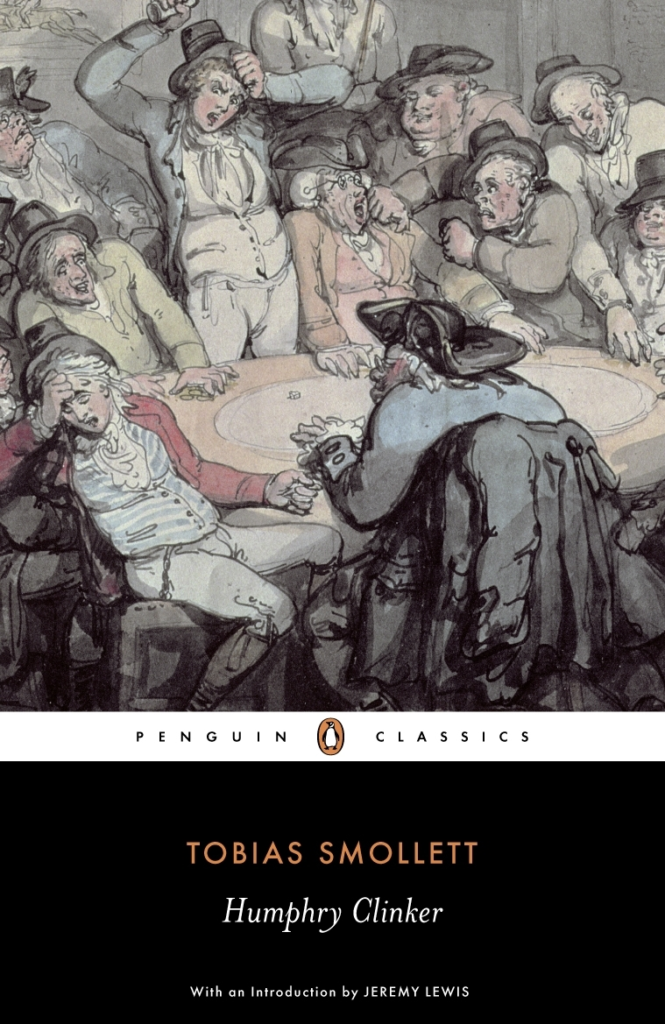
Tobias Smollett was born today in 1721 in “Dalquhurn, now part of Renton in present-day West Dunbartonshire, Scotland.” According to his Wikipedia page, he “was a Scottish writer and surgeon. He was best known for writing picaresque novels such as The Adventures of Roderick Random (1748), The Adventures of Peregrine Pickle (1751) and The Expedition of Humphry Clinker (1771), which influenced later generations of British novelists, including Charles Dickens.”

While searching through his work today, I happened upon a great word in his 1771 novel The Expedition of Humphry Clinker, which is described as “the last of the picaresque novels of Tobias Smollett, published in London on 17 June 1771 (three months before Smollett’s death), and is considered by many to be his best and funniest work. It is an epistolary novel, presented in the form of letters written by six characters: Matthew Bramble, a Welsh Squire; his sister Tabitha; their niece Lydia and nephew Jeremy Melford; Tabitha’s maid Winifred Jenkins; and Lydia’s suitor Wilson.”

In the 59th letter of the novel, of a total of 85, which was written by J. Melford Argylshire and addressed “To Sir Watkin Phillips, Bart. of Jesus college, Oxon” and beginning “Dear Knight,” Smollett invented the word “chearupping-cup” to describe … well, a cup of cheer, with, naturally, alcohol in it. Here’s the paragraph that includes it:

When the Lowlanders want to drink a chearupping-cup, they go to the public house, called the Change-house, and call for a chopine of two-penny, which is a thin, yeasty beverage, made of malt; not quite so strong as the table-beer of England,—This is brought in a pewter stoop, shaped like a skittle, from whence it is emptied into a quaff; that is, a curious cup made of different pieces of wood, such as box and ebony, cut into little staves, joined alternately, and secured with delicate hoops, having two cars or handles—It holds about a gill, is sometimes tipt round the mouth with silver, and has a plate of the same metal at bottom, with the landlord’s cypher engraved.—The Highlanders, on the contrary, despise this liquor, and regale themselves with whisky; a malt spirit, as strong as geneva, which they swallow in great quantities, without any signs of inebriation. They are used to it from the cradle, and find it an excellent preservative against the winter cold, which must be extreme on these mountains—I am told that it is given with great success to infants, as a cordial in the confluent smallpox, when the eruption seems to flag, and the symptoms grow unfavourable—The Highlanders are used to eat much more animal food than falls to the share of their neighbours in the Low-country—They delight in hunting; have plenty of deer and other game, with a great number of sheep, goats, and black-cattle running wild, which they scruple not to kill as vension, without being much at pains to ascertain the property.

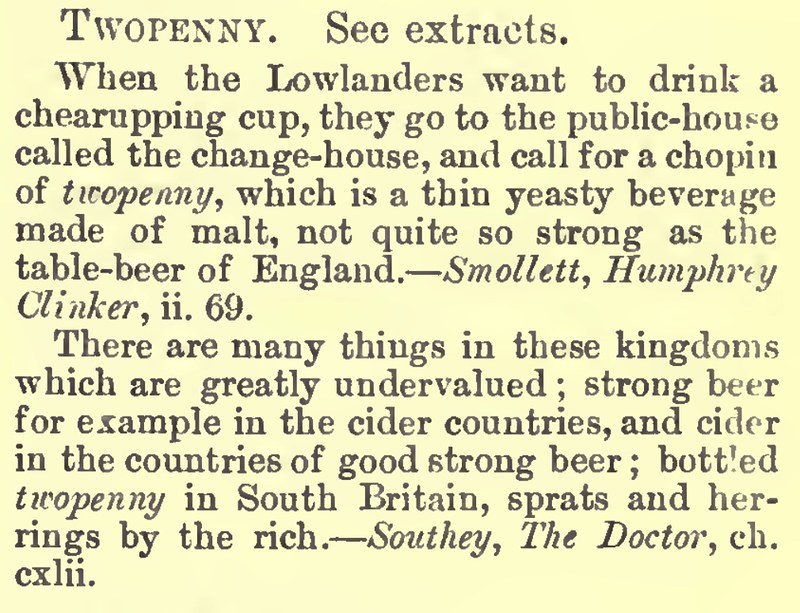
I confirmed with the O.E.D. that this is the sole instance of the word being used (at least that they recorded) and which thy defined as “Of an alcoholic drink: reviving; comforting….” “Chear,” being an archaic form of “cheer,” that never quite caught on as well as cheer, it feels better with the double-ee’s. And indeed later editions spelled it “cheerupping-cup” as listed in “A Supplemental English Glossary,” by T. Lewis O. Davis, and published in 1881, under an entry for “Twopenny.”

From “A Supplemental English Glossary,” by T. Lewis O. Davis.

And in another instance from a news report in the Stamford Mercury, Friday, July 4, 1823, there’s a story using the word.

The language of love, so much talked of by the poets, prevailed against every remonstrance of friends and even the rage and fury of relations. The happy swain had conquest in his cheeks and will love, cherish, honour and obey. Hand in hand the couple blithely proceeded to the adjoining village of Rippingale where the festive board groaned with the weight of the feast and it also being the annual feast day of the parish, the tabor struck up and the village was gay. Rural sports were the order of the day and the merry dance and sparkling glass went round till night was at odds with morning and the groom, having taken sufficient of the cheer-upping cup, the happy couple retired and after throwing the stocking, the jolly swain was left wrapt in the arms of Morpheus to enjoy (what he most needed), nature’s sweet restorer, balmy sleep. [My emphasis.]

But doing some more rabbit-hole digging, I discovered it was used earlier with the more common ‘cheer’ spelling, though still not often and certainly not enough to suggest its use became widespread by any means. The O.E.D. lists as an adjective “cheer-upping” with the same definition, “[o]f an alcoholic drink: reviving; comforting…” with a range of use from 1720-1832. They also list a quotation that predates Smollett, from 1733, so it’s likely he wasn’t the first after all. “They … retired to comfort themselves with a cheer-upping Cup,” which is from “English Malady: or, A Treatise of Nervous Diseases of All Kinds,” by George Cheyne, though he remains one of the few to use it in fiction.

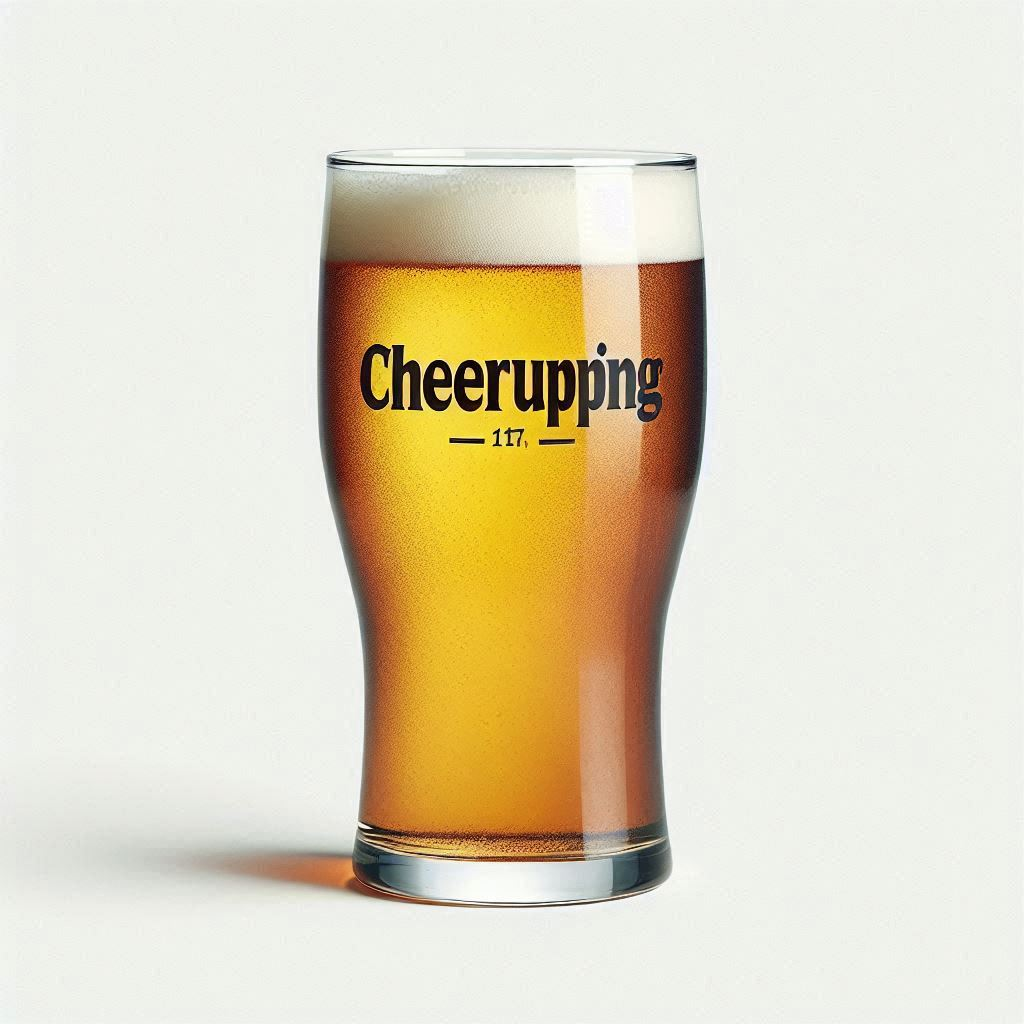
But whoever came up with, I still don’t understand why it fell out of use, because it just rolls pleasantly off the tongue: “cheerupping-cup.” Who wouldn’t want, or often need, a cheerupping-cup? I think I need one now. Who’s with me? Fancy a cheerupping-cup?

Filed Under: Just For Fun, Related Pleasures Tagged With: History, Words

Märzen Madness 2025

March 16, 2025 By Jay Brooks

I may not be biggest fan of academia’s version of indentured servitude, otherwise known as college basketball, but I do still enjoy the games of March Madness every year. The tournament is usually a fun diversion for a few weeks each year, so for the fourteenth straight year, I’ve set up a fantasy game, similar to fantasy football or baseball. It’s a bracket game through Yahoo which I call “Märzen Madness.” It doesn’t look like there’s a limit to the number of people who can play, so sign up and make your picks beginning right now, with the first games taking place on March 18, which only gives you roughly two days to complete your bracket. So don’t delay, sign up right away and fill out your bracket.

To join Märzen Madness and play the Yahoo! Sports Tournament Pick’em game, just follow the link below. You’ll also need a Yahoo ID (which is free if you don’t already have one).

To accept the invitation and play Märzen Madness this year, just follow this invitation link.

Good Luck Everybody!

Filed Under: Just For Fun, Related Pleasures Tagged With: Basketball, Fantasy, Games, Sports

Märzen Madness 2024

March 5, 2024 By Jay Brooks

I may not be biggest fan of academia’s version of indentured servitude, otherwise known as college basketball, but I do still enjoy the games of March Madness every year. The tournament is usually a fun diversion for a few weeks each year, so for the thirteenth straight year, I’ve set up a fantasy game, similar to fantasy football or baseball. It’s a bracket game through Yahoo which I call “Märzen Madness.” It doesn’t look like there’s a limit to the number of people who can play, so sign up and make your picks beginning right now, with the first games taking place on March 17, which only gives you roughly two weeks to complete your bracket. So don’t delay, sign up right away and fill out your bracket.

To join Märzen Madness and play the Yahoo! Sports Tournament Pick’em game, just follow the link below. You’ll also need a Yahoo ID (which is free if you don’t already have one).

To accept the invitation and play Märzen Madness this year, just follow this invitation link.

Good luck everybody!

Filed Under: Just For Fun, Related Pleasures Tagged With: Basketball, Fantasy, Games, Sports

Beer In Ads #4665: Batman, Robin & Miss Rheingold 1962

January 2, 2024 By Jay Brooks

Tuesday’s ad is for “Rheingold Beer,” from 1962. This ad was made for the Rheingold Brewery, which was founded by the Liebmann family in 1883 in New York, New York. At its peak, it sold 35% of all the beer in New York state. In 1963, the family sold the brewery and in was shut down in 1976. In 1940, Philip Liebmann, great-grandson of the founder, Samuel Liebmann, started the “Miss Rheingold” pageant as the centerpiece of its marketing campaign. Beer drinkers voted each year on the young lady who would be featured as Miss Rheingold in advertisements. In the 1940s and 1950s in New York, “the selection of Miss Rheingold was as highly anticipated as the race for the White House.” The winning model was then featured in at least twelve monthly advertisements for the brewery, beginning in 1940 and ending in 1965. Beginning in 1941, the selection of next year’s Miss Rheingold was instituted and became wildly popular in the New York Area and beyond. In 1962, Kathy Kersh won the contest and became Miss Rheingold for that year. She was born Kathleen Kroeger Kersh on December 15, 1942 in Los Angeles, California (though one source claimed it was Hawaii). She attended a theatrical school, studying dance and acting. In 1959, she won the title of Miss Junior Rose Bowl, and became a professional model, and later an actress and singer. After her year as Miss Rheingold 1962, she married actor Vince Edwards, best known as Dr. Ben Casey on the TV show of the same name. But they were married for only four months before divorcing, and her daughter was born shortly thereafter when she became a single mother. Some of her more memorable appearances were on Burke’s Law, My Favorite Martian, The Beverly Hillbillies, The Man from U.N.C.L.E., and a small part in the film “The Americanization of Emily.” In 1967, she signed a record deal with Power Records, and released two singles. After a small role as Cornelia, one of the Joker’s henchmen, on Batman, she married Burt Ward, who played Robin. That marriage last two years, and afterwards she attended business school and embarked on successful a career in commercial real estate. As far as know, she still lives in Sherman Oaks, California. Unlike many of the Miss Rheingolds, Kathy Kersh, went on to have quite a career in entertainment, appearing in both films and television, and continued to sing and do some modeling as she had before 1962. Probably her most remembered appearance was in two episodes of Batman during season 2 in 1966. She played Cornelia, one of the Joker’s henchmen in a two-part story: Episode 21 – “The Impractical Joker” followed by Episode 22 – “The Joker’s Provokers.” Here’s the description of “The Impractical Joker” episode:

The Joker pulls off a string of key-related pranks throughout Gotham City, then with his magic box, proceeds to snatch a priceless jeweled key right under the noses of Batman and Robin. The Dynamic Duo wise up to his ways and thwart him at their next encounter. However, the Joker has more devious plans to do away with them both before his final caper.

And this is for “The Joker’s Provokers” episode:

After a reworking, the Joker’s magic box holds the power to alter time forward and backward. Batman and Robin learn of his plans to pollute the city water supply, and butler Alfred is sent to take over as security guard at the water works. Alfred nabs the box upon the villain’s arrival, freezing him and his cronies in time, but unwittingly commits a dangerous error when he removes the box’s key.

Kathy Kersh wore a very distinctive costume which was a fan favorite. Here’s several stills from the two episodes. And she got quite a lot more out of this appearance on Batman as you’ll soon learn.

Batman, Robin and Cornelia (Kathy Kersh).
Another signed still showing Robin being kidnapped.
Kathy Kersh as Cornelia.
Joker and Cornelia.
Joker and Cornelia agin.
Batman and Robin break into Cornelia’s place.
Cornelia and Joker again.
Kathy Kersh as Cornelia.
Everyone remembers that purple outfit.

During the filming of the two episodes, Kathy Kersh became acquainted with Burt Ward, the actor who played Robin and the pair became a couple, getting married in 1967.

Burt Ward and Kathy Kersh at the wedding in 1967.
This article appeared shortly after the couple married in 1967.
This newspaper item from after the duo married.

Filed Under: Art & Beer, Beers, Just For Fun, Related Pleasures Tagged With: Advertising, History, Rheingold

« Previous Page
Next Page »

Find Something

Northern California Breweries

Please consider purchasing my latest book, California Breweries North, available from Amazon, or ask for it at your local bookstore.

Recent Comments

  • Bob Paolino on Beer Birthday: Grant Johnston
  • Gambrinus on Historic Beer Birthday: A.J. Houghton
  • Ernie Dewing on Historic Beer Birthday: Charles William Bergner 
  • Steve 'Pudgy' De Rose on Historic Beer Birthday: Jacob Schmidt
  • Jay Brooks on Beer Birthday: Bill Owens

Recent Posts

  • Beer In Ads #5240: Rieker’s Bock Beer Is Now On The Market May 3, 2026
  • Historic Beer Birthday: Herman Adolph Schalk May 3, 2026
  • Beer In Ads #5239: The National Drink May 2, 2026
  • Beer Birthday: Anders Kissmeyer May 2, 2026
  • Beer Birthday: Bruce Paton May 2, 2026

BBB Archives

Feedback

Head Quarter
This site is hosted and maintained by H25Q.dev. Any questions or comments for the webmaster can be directed here.