Brookston Beer Bulletin

Jay R. Brooks on Beer

  • Home
  • About
  • Editorial
  • Birthdays
  • Art & Beer

Socialize

  • Dribbble
  • Email
  • Facebook
  • Flickr
  • GitHub
  • Instagram
  • LinkedIn
  • Pinterest
  • RSS
  • Twitter
  • YouTube

Powered by Genesis

Beer Birthday: Andreas Fält

April 13, 2026 By Jay Brooks

Today is the 55th birthday of Andreas Fält, who was the Brand Development Manager at Prime Beer Russia, but more recently became the export manager for Porterhouse Brew Co. I know him, like most people I suspect, from judging together all over the world, as he’s on the international beer judging circuit. Andreas is actually Swedish, but lives in Leeds, England, with his family. He’s a great ambassador for beer, and certainly one of my favorite people in the beer industry. Join me in wishing Andreas a very happy birthday.

Andreas-Falt-1
Me, with Stephen Beaumont, Andreas, and Luc De Raedemaeker. Our last night in Mechelen before judging ended for the 2018 Brussels Beer Challenge, when a healthy percentage of the judges ended up congregated at Den Stillen Genieter, which had a pretty decent beer list though we did our best to liberate as many bottles as we could.
Andreas-Falt-2
Me, Andreas, and Rick Kempen late one night during the Brussels Beer Challenge.
Andreas-Falt-3
My table at the Brussels Beer Challenge a few years ago, with Andreas at the center.
Andreas-Falt-4
Taking a motley crew after dinner to my favorite Brussels frites place, Cafe Georgette, including Andreas (on the left).
With Andreas, Lisa Morrison and Stephen Beaumont in Niagra Falls for the Canada Beer Cup.

Filed Under: Birthdays, Just For Fun Tagged With: Sweden

Beer Birthday: Julie Johnson

April 13, 2026 By Jay Brooks

Today is the birthday of Julie Johnson, who until several years ago was the editor of All About Beer magazine, headquartered in Durham, North Carolina. Julie is without a doubt one of the nicest people in the industry and a pleasure to work with. Plus she likes odd little German trolls almost as much as I do. Hers is pink, mine’s silver. Don’t ask — or do, if you’d like a long, rambling travel story. Join me in wishing Julie a very happy birthday.

P1030505
Julie with Ray Daniels at Lagunitas during the Journalism Retreat before CBC the year it was in San Francisco.
P1030638
Maureen Ogle, Jack McAuliffe and Julie at CBC in San Francisco earlier a few years ago.
julie-and-me
Julie and me at the Rare Beer Tasting at Wynkoop several years back. (photo by Christopher Miller)
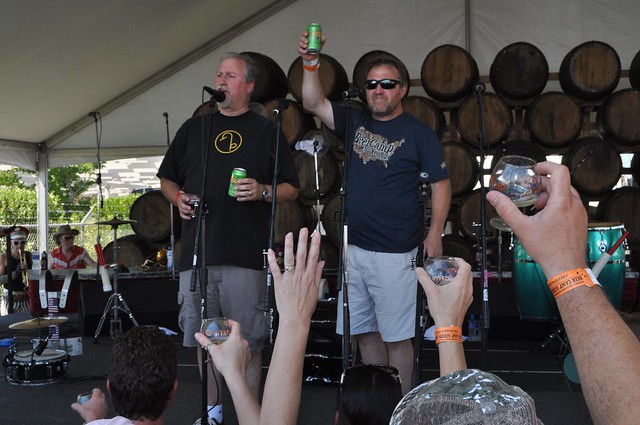
Julie provides guest vocals on Hop This Town at the Falling Rock in Denver, Colorado during GABF week in 2007.

Filed Under: Birthdays, Just For Fun Tagged With: North Carolina, Writing

Historic Beer Birthday: Joseph Bramah

April 13, 2026 By Jay Brooks

Today is the birthday of Joseph Bramah (April 13, 1748-December 9, 1814). Bramah was an English engineer, and inventor, whose most famous invention was the hydraulic press. But he also made improvements and created a practical beer engine, creating his beer pump and engine inventions between 1785 and 1797.

Joseph Bramah: portrait in oils

Another summary of his achievements is quite flattering:

English engineer and inventor whose lock manufacturing shop was the cradle of the British machine-tool industry. Central in early Victorian lockmaking and manufacturing, he influenced almost every mechanical trade of the time. Like Henry Ford, his influence was probably greater for the manufacturing processes he developed, than the product itself. He took out his first patent on a safety lock (1784) and in 1795 he patented his hydraulic press, known as the Bramah press, used for heavy forging. He devised a numerical printing machine for bank notes and was one of the first to suggest the practicability of screw propellers and of hydraulic transmission. He invented milling and planing machines and other machine tools, a beer-engine (1797), and a water-closet.

As for the actual patents, there were two of them. The first was in 1785 and was for what he called a “beer pump.” Then, in 1793 he was granted Patent No. 2196 for his improved version, now referred to as a “beer engine.” It was actually a Dutchman, John Lofting, who had first invented the beer pump in 1688, but Bramah’s were more refined and practical, and more importantly, patented. Curiously, Grace’s Guide to British Industrial History lists the patent dates as 1787 and 1797, so it’s unclear which are the correct dates.

In this engraving, entitled Men of Science Living in 1807-8, Bramah is on the left side, the tenth one in the back from the left. He’s the one with the wide sash across his chest and the star-shaped badge on his jacket. Others include Joseph Banks, Henry Cavendish and James Watt.

Engraving after ‘Men of Science Living in 1807-8’

There’s even a J.D. Wetherspoon’s pub in his home town of Bramley called The Joseph Bramah

Filed Under: Birthdays, Just For Fun, Politics & Law, Related Pleasures Tagged With: Cask, England, Great Britain, History

Historic Beer Birthday: Gambrinus

April 11, 2026 By Jay Brooks

Today is the traditional birthday of Gambrinus, sometimes called King Gambrinus, considered to be a patron saint of beer, brewing and/or Belgian beer. Not an “official” saint, at least not in the catholic church, but a legendary figure. Regardless, join me in drinking a toast to King Gambrinus today.

Here’s the overview at Wikipedia:

Gambrinus is a legendary king of Flanders, and an unofficial patron saint of beer or beer brewing. Gambrinus is variously depicted as a European king, as an English knight of the Middle Ages, or (less commonly) as a plump old man. Gambrinus’ birthday is purported to be April 11.

The origin of the character is most widely believed to be John the Fearless (1371–1419), who some also believe to be the inventor of hopped malt beer. However, other sources report that one of the cup-bearers in the court of Charlemagne (742–814) was also called Gambrinus. In 1543, the German poet Burkart Waldis wrote of Gambrinus, explaining that Gambrinus learned the art of brewing from Isis, the ancient Egyptian goddess of motherhood and fertility.

It is also possible that the original Gambrinus was Duke John I of Brabant (1254-1298), who was called Jan Primus.

Other possible Latin etymologies of the name include cambarus (cellarer) and ganeae birrinus (one who drinks in a tavern). Plzeňský Prazdroj, brewer of the Gambrinus lager, endorses the explanation that the name is a corruption of Jan Primus (John the First), referring to John I, Duke of Brabant. Alternatively, Gambrinus may be a corruption of the name Gambrivius. Although less likely, Gambrinus might also derive from camba, a word from the Celtic language family that refers to a brewer’s pan.

The beer website Froth N Hops has the fullest account of the story of King Gambrinus in one place, though it’s unclear what the source material is. Hopefully, he won’t mind my re-printing it here.

King Gambrinus, known as “the patron saint of beer,” has long been a universal symbol of beer and brewing. Particularly during the late nineteenth century, the image of Gambrinus was used by countless brewers to promote their products and remind consumers of the rich heritage of beer-making. Many breweries were even adorned with life-size statues of the King.

But who was Gambrinus? It is Gambrinus who brought beer to earth, and here is the legend of how this came to pass, and how he came to be King: Gambrinus was a poor apprentice in glass-making, hailing from a little town in the Flandres called Fresne sur l’Escaut. With his wonderful pink cheeks, blonde hair and blonde beard, he was the most beautiful boy in the town and had great romantic success with the town girls.

But Gambrinus had secretly fallen in love with the beautiful daughter of his master, Flandrine. In those times, glass makers were noble from birth, and taught their art only to their sons. Flandrine, as proud as she was pretty, wanted to marry a master glass maker like her father, grandfather, and great grandfather. Gambrinus, as an apprentice, would only prepare the glass for his master, who then skillfully puffed it into decorative sheets.

At last, Gambrinus gathered the courage to reveal his feelings to Flandrine. But Flandrine, offended that such a lowly apprentice sought her affection, refused so strongly that Gambrinus left Fresne, and vowed never to return to glass-working again so that he might forget about Flandrine forever.

So Gambrinus wandered from town to town playing his violin and writing poetry to sing along while he played. Gambrinus, who was very clever and a quick-learner, soon gained a reputation as one of the best violinists in the region. He was constantly called on in towns far and wide to liven up weddings, birthdays, and other parties.

When the people of Fresne heard of the fame Gambrinus had achieved, they could barely believe it. They were so proud of their Gambrinus that they invited him back to Fresne and threw a town-wide celebration in his honor. Gambrinus, flattered by the thought of a celebration in his honor, accepted the towns invitation and returned to Fresne. When he arrived in Fresne and began playing his violin, the delighted townspeople began to sing and dance and cheer.

But soon after Gambrinus had started playing, he noticed Flandrine in the crowd. Overcome by nervousness, Gambrinus began to tremble. He trembled so much and played his violin so horribly that the townspeople began to kick him and shout at him.

The townspeople all blamed Gambrinus for the commotion, since it was his poor playing that upset everyone. Gambrinus soon found himself arrested by the town officials and spent a full month in jail for the trouble he caused in the street and the noisy disturbance he had caused in the night. When Gambrinus was released from jail, he decided the only way he could ever make himself forget about Flandrine was to kill himself. He decided to hang himself, and headed out into the forest to set up a noose and platform. Gambrinus slid the noose over his neck, but just when he was about to step off the platform, he saw before him the devil himself. As is his custom, the devil proposed a deal to Gambrinus: if his power was not strong enough to make Flandrine love Gambrinus, the devil would oblige Gambrinus to forget Flandrine forever. This in exchange for Gambrinus’ soul in 30 years time. Gambrinus accepted the deal, and agreed to the devil’s terms.

As soon as Gambrinus returned to town, he noticed an intense desire to gamble on games. Indeed, the devil meant to turn Gambrinus’ love for Flandrine into a passion for betting. Gambrinus bet on everything he could, not caring whether he won or not. But win he did, and soon Gambrinus found himself the owner of a small fortune. Although gambling had nearly eclipsed any thought of Flandrine, Gambrinus suddenly had an idea. Because he was as rich as a prince, perhaps Flandrine would agree to marry him as a noble. Gambrinus approached Flandrine for the second time and expressed his feelings to her. But Flandrine’s rejection was as swift and as ruthless as the first time: Gambrinus wasn’t a noble; he was born a boy, and would remain a boy for life.

King on a Barrel Gambrinus, returned to the forest to see the devil and ask him what went wrong; after all, Gambrinus still had not forgotten Flandrine, nor had Flandrine been made to fall in love with Gambrinus. Suddenly, before Gambrinus’ eyes appeared a large field with long lines of poles on which green plants began to grow. Soon the poles were covered by these green, perfumed plants. “These,” explained the devil, “are hops.” Just as quickly, two buildings burst forth from the ground. “The first building is a hophouse,” said the devil, “and the second one is a brewery. Come, and I will teach you how to make beer, Flandres’ wine. Beer will help you to forget Flandrine.”
Gambrinus learned how to make beer (not without tasting it every now and again) and found it delicious. Gambrinus soon felt like singing and dancing and playing his violin. But he remembered that the last time he had played violin he had been arrested, and his violin destroyed. Gambrinus asked the devil how he might seek revenge against the townspeople of Fresne who kicked him, sent him to jail, and broke his violin. The devil gave Gambrinus a new instrument that no one could resist, and taught Gambrinus how to play it. The devil explained that this instrument was called the chimes. The devil gave Gambrinus some seeds and the chimes and sent Gambrinus back to Fresne.

Once he arrived home, Gambrinus planted the precious seeds given to him by Belzebuth, and practiced making beer and playing chimes. One morning, Gambrinus set up tables, chairs, barrels, and chimes on the main town square and invited all the townspeople to join him to sample his new drink called beer. The townspeople tasted the beer, which was a brown lager. At first the people complained: “It is too bitter,” “It is too strong.” The people soon began laughing at Gambrinus and his stupid drink. Then Gambrinus began to play the irresistible chimes. The people all began dancing and could not stop. All the dancing made the people thirsty, which encouraged them to drink more beer. After an hour or so, the tired and woozy townspeople pleaded with Gambrinus to stop playing chimes. But Gambrinus kept playing for hours and hours. Gambrinus was satisfied that he had gotten his revenge on those who had wronged him.

But after time the townspeople began to appreciate the beer. They begged Gambrinus to make more and called beer the best drink they ever had. Word of Gambrinus’ drink spread far and wide and crossed over all frontiers. People from other towns soon begged Gambrinus to bring beer to their towns. Everywhere Gambrinus went, he brewed beer and played the chimes. So impressed were the nobles of the region that the Dukes, Counts, and Lords offered Gambrinus the title “King of Flandres.” Gambrinus accepted the position of king, but said he preferred the title “King of the Beer.” From thence on, Gambrinus was known as “The Brewer King.”

When Flandrine realized that Gambrinus would never come to her again, she came to talk to him. Gambrinus, however, more than a little inebriated, couldn’t recognize Flandrine, and just offered her something to drink; indeed, Gambrinus had forgotten about Flandrine.

Gambrinus lived happily with his subjects for many years, until finally the devil returned. “Thirty years have passed since we made our deal,” said the devil. “Now you must follow me.” But when the devil turned around, Gambrinus began playing the chimes, and the devil began to dance. The devil begged Gambrinus to stop playing, but Gambrinus continued, and the devil could not stop dancing. Finally, the devil agreed to break his deal with Gambrinus, releasing Gambrinus from his end of the deal.

King Gambrinus lived happily for another half century playing chimes and making beer. When Gambrinus finally died, his body disappeared, and in its place appeared a barrel of beer. This is why Gambrinus has no tombstone, and why no one knows of the resting place of The Brewer King.

Another website lists some tall tales that have made Gambrinus famous:

  • He received the gift of beer directly from the Egyptian fertility goddess Isis
  • In medieval times he loaned his soul to the devil for 30 years to learn the art and process of brewing
  • He outwitted his opponent in a challenge to lift an impossibly heavy beer cask by first drinking the beer then triumphantly lifted the empty cask
  • During a three-day banquet he drank mug after mug of foamy beer and he was known forever after as the King of Beer

Below is a Symphonion No. 25 GS: “Gambrinus,” a “spectacular original coin-operated disc musical box by ‘Symphonion Musikwerke, Leipzig,’ for 11 3/4 in. discs, 84 teeth in duplex comb (complete), with a wonderful wood-carved figure of the mythical Flemish King “Gambrinus”. 43 1/2 in. high. With 10 discs.”

The German Beer Brewers Museum in Munich owns a portrait from 1526 of King Gambrinus, and it includes the following verse:

Im Leben ward ich Gambrinus gennant,
König zu Flandern und Brabant,
Ich hab aus Gersten Malz gemacht
Und Bierbrauen zuerst erdacht.
Drum können die Brauer mit Wahrheit sagen,
Daß sie einen König zum Meister haben.

Which translates roughly to:

In life I was known as Gambrinus,
King of Flanders and Brabant,
From barley I made malt
And was first at brewing beer.
Thus the brewers can truthfully say,
They have a king as master brewer.

Filed Under: Birthdays, Just For Fun Tagged With: Belgium, Religion & Beer

Historic Beer Birthday: Anton Heeb

April 11, 2026 By Jay Brooks

Today is the birthday of Anton Heeb (April 11, 1811-January 23, 1888). He was born in Hesse-Kassel, Germany, and emigrated to the U.S. in 1835, when he was 24 years old, originally landing in Baltimore, Maryland. Here, Tavern Trove picks up the story:

He lived in that city for a short time then moved to Newark, New Jersey.  By 1838 he had moved to the St. Louis, Missouri, a city that at the time was on the western frontier of America.

In August of 1838 Anton Heeb married Elizabeth Fleischhauer and they had one child before she died a few years later.  Heeb married again to Carolina Knopf in 1845, but she also died just a few days after giving birth to their first child Laurenz in February 1846.  In November of that year Heeb married once again to Katharina Gehrig.  In addition to being a very brave woman she was the daughter of Joseph Anton Gehrig, a brewer who had just arrived in St. Louis from Switzerland.

The elder Gehrig at age 49 had obtained employment at the Washington Brewery in St. Louis and there he met and took under his wing fellow brewer and Swiss emigre 22 year old Matheus Tschirgi.

Gehring was not in America to be in somebody’s employ.  He wanted a brewery of his own.  He saw opportunity in the Territory of Iowa, specifically in the river town of Dubuque.  In the spring of 1846 Gehrig and Tschirgi journeyed 350 miles up the Mississippi to a brand new town that had never before seen a brewery.  But when Gehrig died in August he left a fully functioning brewery in the hands of the apprentice brewer Tschirgi.  Heeb and his betrothed received the terrible news along with a request to come help young Tschirgi in the Dubuque brewery.
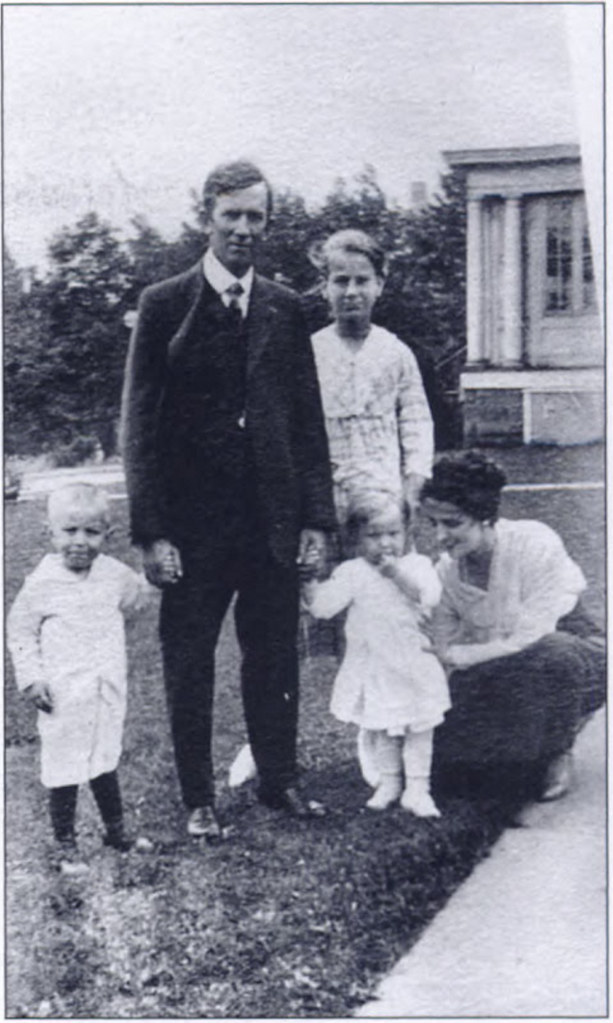
Reports say that Heeb was an experienced brewer and maltster, but the St. Louis City Directory of 1847 lists Anthony Heeb as a brick maker.  Nonetheless Heeb got married, wrapped up business in St. Louis and by the next spring he and his wife had arrived in Dubuque.

Iowa had now become a state and Dubuque was growing quickly.  With Heeb in charge the Dubuque brewery started making money and the Heeb family started growing as well. Ultimately Anton and Katharina had nine children together.

The Heeb brewery grew too.  In addition to being the first brewery in Iowa it maintained its position as the largest brewery in Iowa too.  Tschirgi eventually moved on to found other breweries throughout Iowa.  Heeb stayed put, ultimately guiding the brewery for 41 years until his death at age 76, on the 23rd of January 1888.

In 1892 the Dubuque Brewing and Malting Company was brought into the Iowa brewery syndicate, and over the next four years Iowa anti-saloon laws convinced the brewery to close.

This obituary of Anton Heeb is from the Daily Times on January 24, 1888

Mr. Anton Heeb Dies at His Home on Couler Avenue Yesterday Afternoon.

Biography of the Most Prominent Brewer in the Northwest.

Mr. Anton Heeb died at his home, 2125 Couler avenue, at a quarter after 3 o’clock yesterday afternoon, his bedside being surrounded by his immediate relatives. The cause of death was a complication of diseases of which rheumatism was the most prominent. He had been subject to the latter disease for about twenty-five years, but about a year ago he was attacked by his old complaint in such a manner that he was greatly enfeebled and kept gradually growing weaker until the lamp of life flickered for the last time. He demise had been expected for two weeks by his family, but the public were not aware that his end was so near, and when it became known it occasioned deep regret.

Mr. Heeb was born in Kurhessen, Germany, on the 11th of April, 1811, and accordingly lacked but a few months of being 77 years of age. He emigrated to America and landed in Baltimore, in 1835. He remained in Baltimore a short time, and then moved to Newark, N.J., where he also remained a short time, and then removed to St. Louis, remaining there until 1846, when he came to Dubuque to seek a location for a brewery. Finding this a suitable place, he, in 1847, established one here and conducted it up to about the time he was taken sick, something over a year ago, being in the business forty-one years. His business grew until it became the most extensive in Iowa, if not in that portion of the Northwest, west of the Mississippi, and he was known far and wide. In January , 1846 he was united in marriage to Miss Katharina Gehrig, a distant relative of the Late Joseph Gehrig, of the Jefferson House, also a native of Germany, who was his second wife, his first wife being Miss Carolin Knapp. He leaves two children by the latter, Jacob and Lawrence of LeMars. His surviving children are: Caroline, who is the wife of Mr. Fred Tschudi; Julia, the wife of Mr. Michael Zwack; Bertha, who is Mrs. L.J. Baumhover; Emily, who is in a convent at Redwing, Minn., and whose name in religion is Sister Cassilda; Anna, the wife of Mr. Frank Hellman of Sioux City; Ben and A.F. Heeb. Mr. Louis Heeb, another of his sons, and one of the most excellent young men Dubuque has ever had, died three of four years ago.
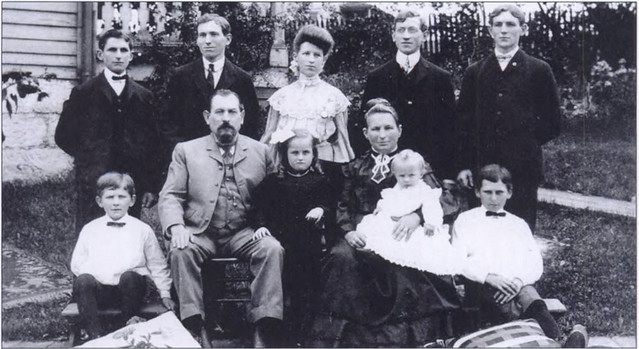
Mr. Heeb was a man of a great deal more than ordinary intelligence, and on several occasions was honored by his fellow citizens with offices of honor and trust. He served his ward as a member of the Council; and was also a member of the Board of Supervisors, in both of which positions he performed his duties in a manner which reflected the highest credit upon himself and his constituents. At the time of his demise he was a member of the Board of Directors of the Dubuque Fire and Marine Insurance Company. Mr. Heeb was the soul of honor, a thorough gentleman, kind-hearted and charitable, and his death will be sincerely regretted by all. He has lain down the burdens of this life with the silvered crown of honored age upon his head, and his memory will be revered in the years to come.

And this account is from Encyclopedia Dubuque:

HEEB, Anton. (Hesse Cassel, Germany Apr. 11,1811–Dubuque, IA, Jan. 23, 1888). Heeb once operated the largest brewery in Iowa. He emigrated to America and landed in Baltimore in September, 1835; in 1836, he went to St. Louis; he came to Dubuque in 1846. The following year, 1847, he came here, located permanently, and established the A. HEEB BREWING COMPANY at Couler and Eagle Point avenues (later Central Avenue and East 22nd Street). In July 1875 records in the United States Revenue Office in Dubuque indicated that Heeb had sold 904 barrels of beer. In 1879 the Dubuque Herald stated that he had purchased $7,000, equivalent to $166,166.67 in 2016, in hops. At the time of his death, the company had an annual production of 15,000 barrels. Heeb’s brewery was among those which formed the DUBUQUE BREWING AND MALTING COMPANY.

Heeb served as a director of the GERMAN TRUST AND SAVINGS BANK and the DUBUQUE FIRE AND MARINE INSURANCE COMPANY. At the time of the building of the Chicago, Dubuque and Minnesota and the Chicago, Clinton and Dubuque railroads, he was involved in construction contracts with Mr. Morgan. He was elected an alderman to the city council and a county supervisor.

And here’s a second obituary of Anton Heeb from the Daily Herald, also on January 24, 1888

DEATH OF A. HEEB

Another of Dubuque’s Prominent Citizens Answers the Last Summons

Yesterday afternoon at a quarter past three, death ended the sufferings of one of Dubuque’s most prominent citizens, Hon. Anton Heeb. For the past twenty five years he had been afflicted with rheumatixm, and for the past year had suffered almost continually with it, though able at times to be up and around. For about two weeks it had been feared hourly that the disease, combined with his advanced age, would result fatally. Yesterday morning he was somewhat brighter than hehad been, and his family were hopeful, but a relapse set in and at the hour stated, he died.

Anton Heeb was born April 11, 1811, at Kurheasen, Germany, and emigrated to this country in 1835, landing at Baltimore. From there he went to New Jersy, and in 1836 went to St. Louis. He came to Dubuque in 1846 and in the following year established the foundation of the great business which bears his name. During the more than forty years in which he has conducted the brewing business it has constantly grown so that it became the largest institution of the kind in the state. He was also known to be most scrupulousin all his business dealings, and has left as a precious heirloom, a most enviable name for honesty and integrity. He did not devote his entire attention to the brewing business, but found time to engage in many public enterprises. At the time of the building of the Chicago, Dubuque and Minnnesota and the Chicago, Clinton and Dubuque railroads, he was largely interested in construction contracts in connections with Mr. Morgan. He was a director of the German Bank, and also of the Dubuque Fire and Marine Insurance Company, and was interested in other institutions of the city. He was an honorary member of the Pius Benevolent Society.

Mr. Heeb was twice married his first wife being Miss Caroline Knapp. In 1846 he was united in marriage to Miss Kathrina Gehrig, a native of Germany and a relative of the late Jos. Gehrig. Besides his wife, he leaves surviving his several children, Jacob and Lawrence of LaMars, Iowa, sons by his former wife, and Caroline (Mrs. Fred Tschudi), Julia (Mrs. Michael Zwack, Bertha (Mrs. L. J. Baumhover), Emily (Sister Cassilda, of Red Wing convent), Ben, Anna (Mrs. Frank Hellman of Sioux City), and A. F. The oldest child by his second wife, Louis, died a few years ago.

Mr. Heeb was a most exemplary citizen and was deeply loved by all the members of his family and respected by all who knew him or had business dealings with him. He was a staunch Catholic, and in his last moments received the sacraments and the consolations of his church.

He was during his lifetime, a staunch Democrat and was elected a county supervisor and twice as a member of the city council. His official record was typical of the man, and he endeavored in every way to serve the public with the most scrupulous honesty and with the utmost regard to the public welfate. Dubuque has lost in his death one of her best and most public spirited citizens, and one who will be sincerely mourned.

The funeral will take place from the family residence, 2125 Couler avenue, Thursday morning at half past 9, to St. Mary’s church, of which Mr. Heeb was during his life, a most faithful and liberal communicant. The interment will be at the German Catholic cemetery.

And these are from an article in 1932 speculating about whether or not the brewery would reopen after prohibition.

Filed Under: Birthdays, Breweries, Just For Fun Tagged With: Germany, History, Iowa

Beer Birthday: Alexandre Bazzo

April 10, 2026 By Jay Brooks

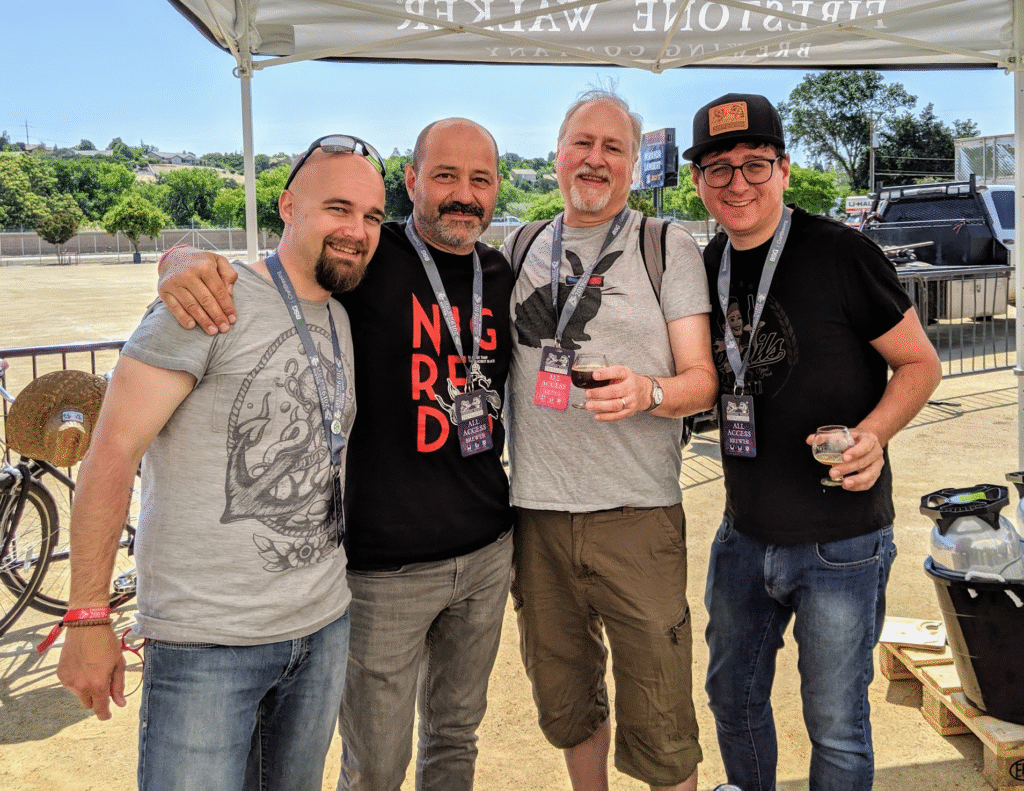
Today is the 50th birthday — The Big 5-O — of Alexandre Bazzo, who is the founder and brewmaster of Micro Cervejaria Bamberg in Brazil. I first met Alexandre in Brazil when I judged in Argentina in 2011, and we made a side trip to Sao Paulo. Given the name of his brewery, you won’t be surprised to learn he makes amazing German-style beers, and has won numerous awards for his efforts. I also saw him again at last year’s Firestone Walker Invitational Beer Festival. Join me in wishing Alexandre a very happy birthday.

IMG_7801
Me, Alexandre, his wife and Steve Shapiro at the 2017 Firestone Walker Invitational Beer Festival.
P1040750
Alexandre with Stephen Beaumont at a beer dinner in Sao Paulo at Melograno in 2011.

Filed Under: Birthdays, Just For Fun Tagged With: Brazil

Historic Beer Birthday: Rudolf Brand

April 10, 2026 By Jay Brooks

Today is the birthday of Rudolf Brand (April 10, 1851-March 25, 1916). He was born in Odenheim, Rheinhessen, Germany. When he was seventeen, in 1868, he emigrated to the U.S., initially to New York, where he worked as a cooper. A few years later he was a foreman at the Busch and Brand brewery in Chicago, Illinois, which was founded by a Michael Brand, who appears to be Rudolf’s uncle. In 1880, he partnered with Ernest (or Ernst) Hummel and founded his own brewery in Chicago, initially known as the Brand (Charles) & Hummel (Ernest) Brewing. A few years after opening, they started trading under the name South Chicago Brewing Co.

The brewery was located at Avenue L and 100th Street. Unfortunately it closed for good in 1922, presumably due to Prohibition.

In May of 1873, he married Clara Sophia Uhlich. The couple had three children two boys and a girl.

He appears to have served as President of the Brewers Association around 1899.

Filed Under: Birthdays, Breweries, Just For Fun Tagged With: Chicago, Germany, History, Illinois

Historic Beer Birthday: Otto Schinkel Jr.

April 9, 2026 By Jay Brooks

Today is the birthday of Otto Schinkel Jr. (April 9, 1869-January 26, 1907). While Anchor Brewing began during the California Gold Rush when Gottlieb Brekle arrived from Germany and began brewing in San Francisco, it didn’t become known as Anchor Brewing until 1896, when “Ernst F. Baruth and his son-in-law, Otto Schinkel, Jr., bought the old brewery on Pacific Avenue and named it Anchor. The brewery burned down in the fires that followed the 1906 earthquake, but was rebuilt at a different location in 1907.” Baruth had passed away the same year as the earthquake, and Schinkel died in an accident in early 1907 when struck by a streetcar in San Francisco.

Surprisingly, there isn’t much biographical information about Schinkel. He was born somewhere in Germany, and married Ida Caroline Baruth on November 26, 1890. She was born in California, sometime in July of 1873. They had three children together, all daughters: Elsie, Alice and Doris.

otto-schinkel

I did discover that he was a president of the Norddeutscher Verein (or North German Association) four times as noted in this portrait from a book celebrating the organization’s 25th anniversary, or Silver Anniversary 1874-1899.

anchor-brewery-early-1900s-lg
The Anchor Brewery in the early 1900s.

Here’s what’s written about him at Find a Grave:

Anchor Beer began during the Gold Rush when Gottlieb Brekle arrived from Germany and began brewing in San Francisco. In 1896, Ernst F. Baruth and his son-in-law, Otto Schinkel, Jr., bought the brewery and named it Anchor. The brewery burned down in the fires that followed the 1906 earthquake, but was rebuilt at a different location in 1907.

“Killed by a Bryant street car just below Twentieth street shortly after noon yesterday as he was attempting to take a seat on the open side of the vehicle. The sudden starting of the car is alleged to have caused him to fall directly in front of the moving vehicle.

“The first wheel crossed his chest and the heavy trucks crushed his skull before Motorman J. N. Swope could stop the car. Motorman, conductor and passengers jumped to the man’s aid. By main strenght they lifted the car. He was already dead, however, and terribly mangled.

“A brother J. H. Schinkel, was standing on the corner, less than fifty feet away, and saw the accident. He ran frantically to the scene and with his own hands dragged the form of his brother from under the car. J. N. Swope, the motorman, was arrested and charged with manslaughter. He was later released on $50 cash bail furnished by the railroad company.

“Otto Schinkel was a prominent German brewer of the city. He was the owner of the Anchor Brewery, located at North Beach before the fire and now being rebuilt at Eighteenth and Hampshire streets. He was a member of the Norddeustcher Verein, Norddeutsche Schutzen Verein, Schleswig-Holstein Society, Golden Gate Aerie of Eagles, Red Men and the Brewers Association. He was thirty-nine years old and had been very prominent in German-American circles for many years. He leaves a widow and two children. A checkbook found in his pocket showed that he had $40,000 on deposit in the Citizens National Bank.”

[Note: Find a Grave lists his birth year as 1849, while every other source I found says 1869.]

Filed Under: Birthdays, Just For Fun Tagged With: California, History, San Francisco

Historic Beer Birthday: Johann Sedlmayr

April 9, 2026 By Jay Brooks

Today is the birthday of Johann Sedlmayr (April 9, 1846-November 24, 1900). Johann was the grandson of Gabriel Sedlmayr and the third son of Gabriel Sedlmayr II. Johann’s father inherited the Spaten Brewery, along with his brother, when his father died, but Gabriel became sole owner after his brother Joseph left to start his own brewery, Franziskaner. Two of Johann’s older brothers died before their father, so when Gabriel II passed away, he and his younger brothers Carl and Anton inherited the family brewery.
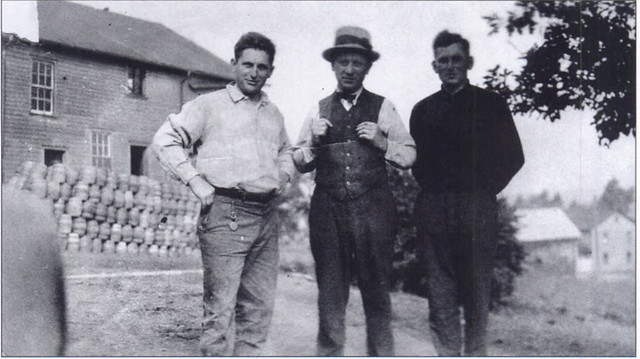
The caption of this photo, from German Wikipedia, translates to “Delivery of the Spade brewery to the sons Johann, Carl and Anton Sedlmayr 1874,” although I can’t say which one is Johann. I don’t know much more about his time running the brewery. “From 1884 to 1890 he was a member of the German Reichstag for the electoral district of Oberbayern 1 Munich I and the Nationalliberal Party.”
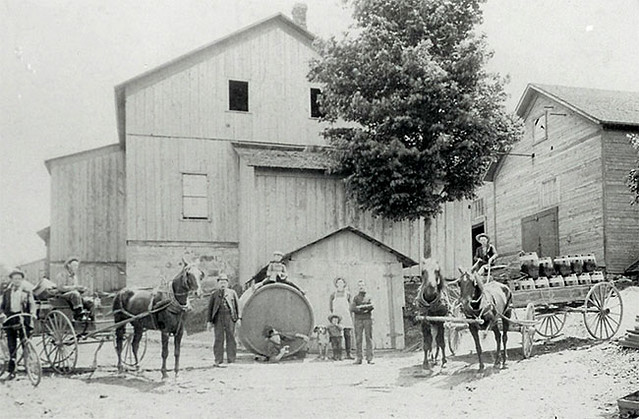
SPATEN-Geschichte

Filed Under: Birthdays, Breweries, Just For Fun Tagged With: Germany, History

Historic Beer Birthday: Ralph Thrale

April 9, 2026 By Jay Brooks

Today is the birthday of Ralph Thrale (1698-April 9, 1758). Thrale’s exact date of birth is not known, but he died today in 1758, so that’s why I’m celebrating his birthday today. He was born in Offley, Hertfordshire, England, the son of Ralph Thrale, a Cottager originally from Sandridge who moved to Offley. His uncle brought him to London around 1711 after his father died (when he was only 13) to work at his Anchor Brewery, in Southwark, in the central part of the city, and eventually he became the Master of The Brewers Company, having bought the brewery after his uncle’s death. He was also a Member of Parliament from 1741-1747 and also High Sheriff for Surrey from 1733-34.
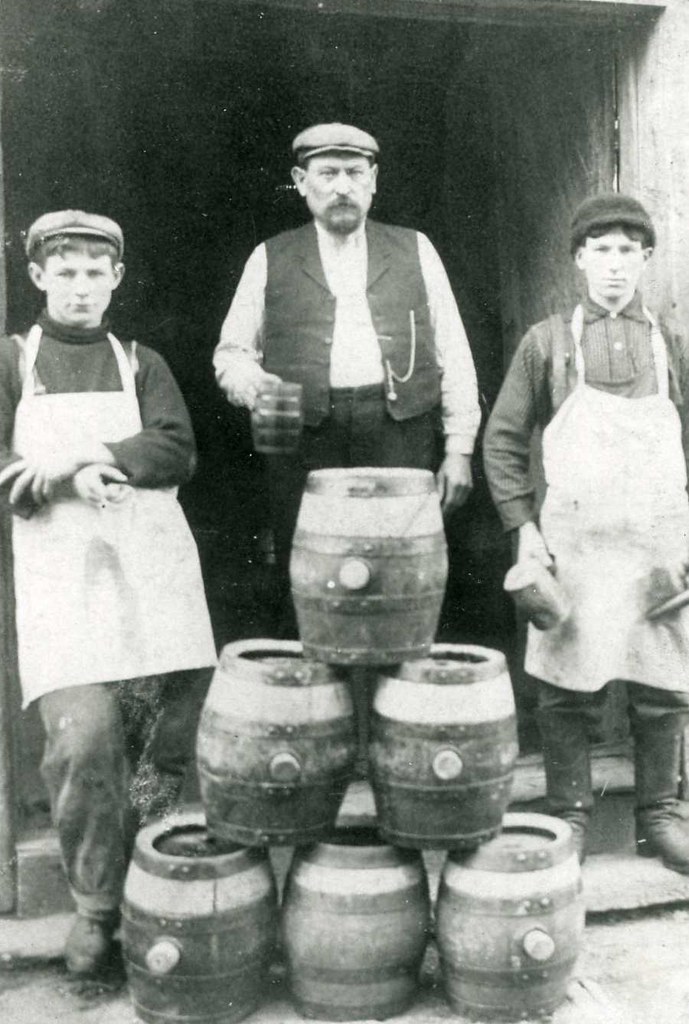
Portrait of Ralph Thrale by Thomas Hudson.

This is his short biography from the History of Parliament:

The son of ‘a hardworking man at Offley’, Thrale was brought to London by his uncle, Edmund Halsey, the owner of the Anchor brewery at Southwark, who ‘said he would make a man of him, and did so but … treated him very roughly’, making him work ‘at six shillings a week for twenty years’. He soon ‘made himself so useful … that the weight of the business fell entirely on him’, and he was expected to succeed to the brewery.1 But he fell out with his uncle by marrying ‘a wench that Halsey wanted to have for his own pleasure’, and was cut off.2On Halsey’s death in 1729, the Anchor brewery was put up for sale. According to Mrs. Piozzi, Thrale’s daughter-in-law,

to find a purchaser for so large a property was a difficult matter, and after some time, it was suggested that it would be advisable to treat with Thrale, a sensible, active, honest man, who had been long employed in the house, and to transfer the whole to him for £30,000, security being taken upon the property. This was accordingly settled. In eleven years Thrale paid the purchase money. He acquired a large fortune. But what was most remarkable was the liberality with which he used his riches.

Returned as an opposition Whig for Southwark, the brewers’ constituency, he voted against the Government on the chairman of the elections committee in 1741 and on the Hanoverians in 1744, was absent from other recorded divisions, did not stand again, and died 8 Apr. 1758.

thrale_brewery_circa_1785
Thrale’s Anchor Brewery around 1785.

This mention of Ralph Thrale’s involvement in the Anchor Brewery is from “A History of Beer and Brewing,” by Ian Spencer Hornsey:

barley-and-perkins-1841

This is the entry for Barclay, Perkins & Co. Ltd, which at one time had been Thrale’s Anchor Brewery, from “The Brewing Industry: A Guide to Historical Records,” edited by Lesley Richmond, Alison Turton, published in 1990:

barclay-perkins-history-1
barclay-perkins-history-2


anchor-brewery-c1820-john-thomas-smith-1766-1833
The Anchor Brewery around 1820.

And finally, the famous English writer Charles Dickens, during the period when he was writing many of his major works, “he was also the publisher, editor, and a major contributor to the journals Household Words (1850–1859) and All the Year Round (1858–1870). In “Volume V, from March 30, 1861 to September 21, 1861,” in a piece entitled “Queen of the Blue Stockings,” from April 20, 1861, Ralph Thrale is mentioned in a history of the Barclay Perkins brewery to give context to his tale:

LondonSE1BarclayPerkinsAnchorPlaque2_SP_Mar10
A marker where Thrale’s brewery once stood in central London.

Filed Under: Birthdays, Just For Fun Tagged With: England, Great Britain, History, London

« Previous Page
Next Page »

Find Something

Northern California Breweries

Please consider purchasing my latest book, California Breweries North, available from Amazon, or ask for it at your local bookstore.

Recent Comments

  • Bob Paolino on Beer Birthday: Grant Johnston
  • Gambrinus on Historic Beer Birthday: A.J. Houghton
  • Ernie Dewing on Historic Beer Birthday: Charles William Bergner 
  • Steve 'Pudgy' De Rose on Historic Beer Birthday: Jacob Schmidt
  • Jay Brooks on Beer Birthday: Bill Owens

Recent Posts

  • Beer Birthday: Tom Riley April 29, 2026
  • Historic Beer Birthday: Matthew Vassar April 29, 2026
  • Beer Birthday: Pat McIlhenney April 29, 2026
  • Beer In Ads #5234: Bock Bier 28 April Bis 1 Mai April 28, 2026
  • Historic Beer Birthday: Louis F. Neuweiler April 28, 2026

BBB Archives

Feedback

Head Quarter
This site is hosted and maintained by H25Q.dev. Any questions or comments for the webmaster can be directed here.