Brookston Beer Bulletin

Jay R. Brooks on Beer

  • Home
  • About
  • Editorial
  • Birthdays
  • Art & Beer

Socialize

  • Dribbble
  • Email
  • Facebook
  • Flickr
  • GitHub
  • Instagram
  • LinkedIn
  • Pinterest
  • RSS
  • Twitter
  • YouTube

Powered by Genesis

Patent No. 129938A: Improvement In Beer Faucets

July 30, 2016 By Jay Brooks

patent-logo
Today in 1872, US Patent 129938 A was issued, an invention of Patrick Francis Donnelly, for his “Improvement in Beer Faucets.” There’s no Abstract, although in the description it includes these claims:

Referring to the drawing, A is a bush or socket-piece, which tapers slightly from the shoulder ato the end. From the shoulder a to the end a fine-threaded screw is cut. This piece accommodates the valve B, which controls the flow of the liquid, and is screwed into the head of the barrel. The valve B rests against a rubber seat, C, being held, when closed, against this seat by the spiral spring b wound round the stem of the valve. D is a plug having several holes through it to permit the liquid to pass through. This plug is screwed into the end of the bush-piece, which projects into the barrel. At the outer end of the bush-piece, which projects outside of the barrel, there is an internal screw cut, and into this the conduit-stem E of the faucet is screwed. F is the operating-rod, which terminates, after passing beyond the conduit stem, in a little wheel, G. This rod F has a double-threaded screw at f, which screws into a corresponding thread cut in the interior of the conduit-stem. H is a packing-box of usual form, supplied, where the rod F passes out of the conduit-stem, to prevent leakage. I is the exit-passage for the liquid.

The operation is as follows: The bushpiece is inserted in the barrel-head, and may remain there until the barrel is worn out. The stem’ part of the faucet is applied when the liquid is to be drawn off, the flow being regulated by screwing the rod F against the valve B.

Instead of the double-threaded screw being supplied on the rod F, this rod may be pushed forward and drawn back by other suitable mechanism not necessary to describe.

US129938-0

Filed Under: Beers, Breweries, Just For Fun, Politics & Law, Related Pleasures Tagged With: Brewing Equipment, History, Law, Patent, Science of Brewing

Patent No. 3394647A: Apparatus For The Production Of Wort

July 30, 2016 By Jay Brooks

patent-logo
Today in 1968, US Patent 3394647 A was issued, an invention of Fritz Reiter, for his “Apparatus For the Production of Wort.” There’s no Abstract, although in the description it includes these claims:

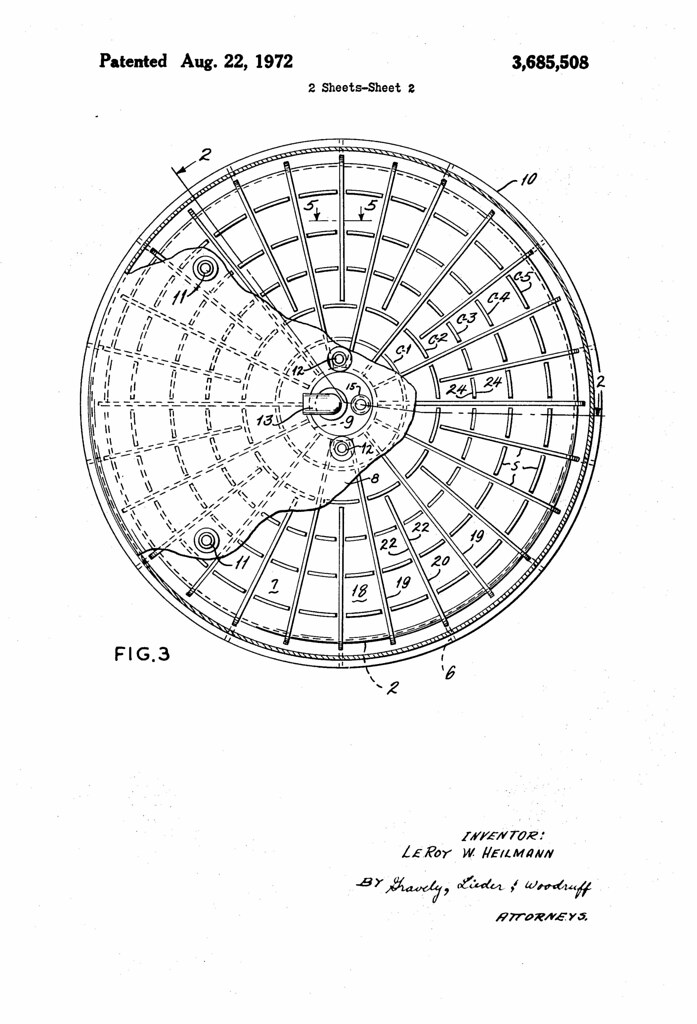
In an apparatus for the production of wort, a filter drum for the separation of the wort from the spent grains comprises suction means to draw the wort into the drum and means cutting the cake of spent grains accumulating on the periphery of the drum, while it is being sparged, into small readily extracted pieces.

US3394647-0
US3394647-1
US3394647-2

US3394647-3 US3394647-4

Filed Under: Beers, Breweries, Just For Fun, Politics & Law, Related Pleasures Tagged With: Brewing Equipment, History, Law, Patent, Science of Brewing, Wort

Patent No. 2009382A: Beer Filter

July 30, 2016 By Jay Brooks

patent-logo
Today in 1935, US Patent 2009382 A was issued, an invention of George Blaufuss, for his beer “Filter.” There’s no Abstract, although in the description it includes these claims:

The object of the present invention is to generally improve and simplify the construction and operation of filters of the character described; to provide a filter in which a filtering medium such as diatomaceous earth, or the like, is used and applied to the surface of a cylinder to form a thick filter cake through which the liquid to be filtered must pass; to provide means for continuously removing impurities collected on the surface of the filter cake and also a portion of the filter cake so as to gradually decrease the thickness of the cake; and further, to provide means for continuously discharging the impurities and material removed from the surface of the filter cake.

US2009382-0
US2009382-1

Filed Under: Beers, Breweries, Just For Fun, Politics & Law, Related Pleasures Tagged With: Brewing Equipment, History, Law, Patent, Science of Brewing

MillerCoors Buys Hop Valley Brewing

July 29, 2016 By Jay Brooks

miller-coors hop-valley
MillerCoors announced today that they’ve acquired a majority interest in Hop Valley Brewing of Springfield and Eugene, Oregon.

Here’s the press release:

Tenth and Blake Beer Company, the craft and import division of MillerCoors, announced today an agreement to obtain a majority interest in Eugene, Ore.-based Hop Valley Brewing Company. Hop Valley is known as a leader in the IPA space, producing a wide variety of acclaimed beers including Alphadelic, its flagship IPA, Citrus Mistress and Alpha Centauri.

“We are very proud of what we have achieved to date, and even more excited about the future for our company and our employees,” said Charles “Chuck” Hare, Hop Valley Brewing Company co-founder. “From the get-go, it has always been about the beer, and we are looking forward to working with Tenth and Blake to get our beers – made right here – to even more consumers.”

Since opening their original brew pub in Springfield, Ore. in 2009, Hop Valley has stayed true to its name producing award-winning IPAs throughout the Pacific Northwest region. The brewer has since added to its production with a 30,000-square-foot brewery and tap room in Eugene, Ore. and currently distributes in Oregon, Washington, California, Idaho and Vermont.

“We’re thrilled to join forces with the Hop Valley team, to add an incredible roster of brands that complement our portfolio perfectly,” said Scott Whitley, president and CEO of Tenth and Blake. “I’m looking forward to working with Chuck and his team to support the continued growth and success of their innovative IPAs and award-winning beers.”

“This is a great opportunity for us and our brewery,” said Trevor Howard, Hop Valley co-founder and brewmaster. “We will continue to craft all of our core brands and innovate with seasonal and small-batch brews like we always have – with the same commitment to quality, taste, and creativity.”

Hop Valley Brewing Company joins other leading crafts in the Tenth and Blake portfolio, including Blue Moon Brewing Company, Jacob Leinenkugel Brewing Company, Saint Archer Brewing Company and, following an expected closing in August 2016, Terrapin Beer Company. For more information on Hop Valley Brewing Company and its portfolio of brands, visit HopValleyBrewing.com.

Hop Valley Brewing Company will operate as a separate business unit of Tenth and Blake. The management team at Hop Valley will continue to lead the business and will retain an ownership interest. The transaction is expected to complete in the third quarter of 2016. The terms of the transaction were not disclosed.

hop-valley-core-portfolio

This is actually the second acquisition this month for Tenth and Blake, MillerCoors’ craft division. Back in 2011, they bought a minority stake in Georgia’s Terrapin Brewing, but last week they acquired a majority stake.

Filed Under: Breweries, News Tagged With: Announcements, Big Brewers, Business, SABMiller

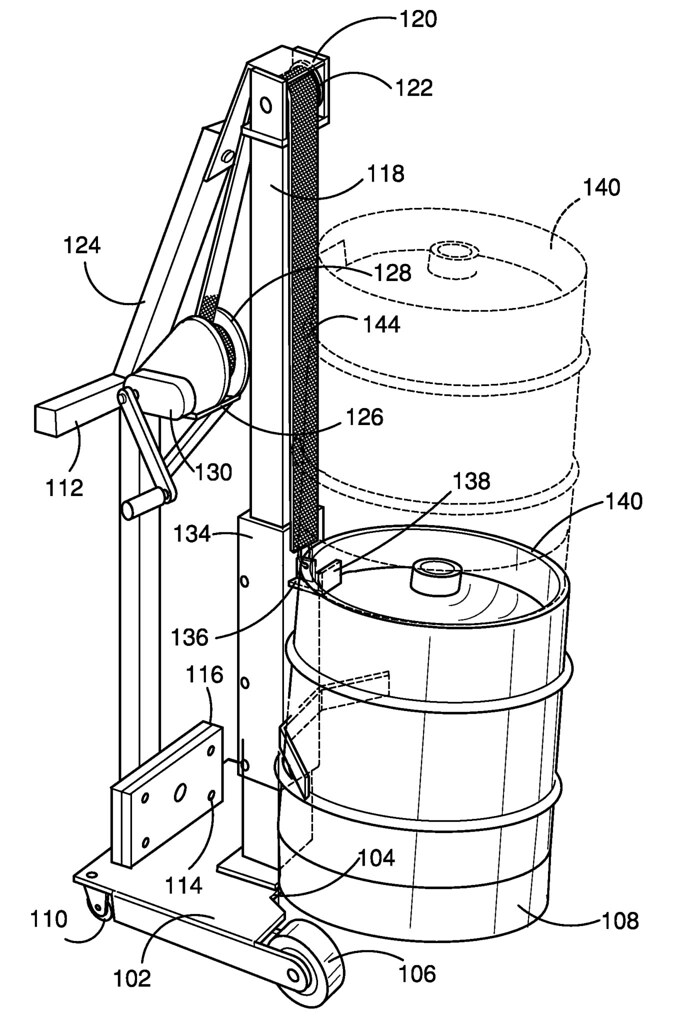
Patent No. 2325309A: Process Of Capping Bottles

July 27, 2016 By Jay Brooks

patent-logo
Today in 1943, US Patent 2325309 A was issued, an invention of Jan De Swart, for his “Process of Capping Bottles.” There’s no Abstract, although in the description it includes these claims:

This invention has to do with sealing caps for bottles and the like, as well as bottle sealing methods.

In its more particular contemplates a hard and substantially non-flexible plastic cap which is so constructed, of a plastic capable of being rendered temporarily pliable and remolded, as to be applied in sealing relationship to a bottle without injury to the cap and which not only is capable of sealing the bottle against substantial pressures but which also compensates for the cold flow characteristics prevalent in most plastics.

I am aware that attempts have been made to produce a successful thermoplastic bottle cap but so far as I am aware, no such cap has been produced which is capable of general use to cap bottles containing fluids such as carbonated beverages, beer or the like. Such prior caps have been incapable of maintaining an effective seal where substantial pressures are generated in the bottle; and have been incapable of withstanding the temperatures incident to pasteurization processes. For instance, pasteurization processes commonly utilize temperatures of the order of 160 produced do not maintain a seal under such conditions. Another shortcoming of prior caps has been the fact that they fail to maintain an effective seal after the plastics of which the caps are made have undergone the normal cold flow.

It is among the aims of my invention to overcome those shortcomings and, generally speaking, I accomplish this by providing a cap preformed of a cold-setting plastic capable of being rendered temporarily pliable and then reformed and re-hardened about the neck of a bottle. An important characteristic of my improved cap resides in the fact that its side Wall presents a peripheral bead of relatively thick cross-section and having a. relatively low setting rate which, after being temporarily softened, is remolded to aspects, my invention the contour of the external marginal bead forming a part of the conventional beer or carbonated beverage bottle. This bead portion undergoes cap into sealing relationship with the neck or more and thermoplastic caps heretofore l the provision of a plastic cap having a construction which provides a double seal.

Another object is the provision of a cap having a guiding formation to guide it onto a bottle during capping.

US2325309-0

Filed Under: Beers, Breweries, Just For Fun, Politics & Law, Related Pleasures Tagged With: Bottles, Brewing Equipment, History, Law, Packaging, Patent

Patent No. 2124959A: Method Of Filling And Closing Cans

July 26, 2016 By Jay Brooks

patent-logo
Today in 1938, US Patent 2124959 A was issued, an invention of William Martin Vogel, for his “Method Of Filling And Closing Cans.” There’s no Abstract, although in the description it includes these claims:

This invention relates to cans and a method of making and filling the same, and has for its object the provision of means whereby a maximum quantity of air may be evacuated from the can prior to the sealing operation.

At the present time beer is being packed in cans and one of the greatest difficulties encountered is that of completely or at least nearly completely evacuating the maximum quantity of air from the can. The failure to uniformly evacuate the air results in lack of uniformity of the contents of the can. In some cases an opened can produces beer of a decidedly fiat appearance and taste; while in other cases, an extremely frothy, aerated fluid emanates. Experiments have shown that this lack of uniformity in canned beer is apparently due to the failure to eliminate or evacuate the greatest possible amount of air from the can during or after the filling operation, and prior to the sealing of the can.

The primary object therefore, of this invention, is to provide a can of such a construction, together with a method of filling and sealing such a can, which will eliminate the maximum quantity of air from the can, thereby completely, or nearly completely, filling the can with the liquid contents only. More particularly, the invention contemplates the provision of a can initially formed with an outwardly distended or dished bottom,

arranged to be reversely curved or distorted under pressure after the can is filled, thereby causing the liquid contents of the can to be bodily shifted toward the top of ‘the can, causing said contents to displace and eject the air out of the can just prior to the sealing of the top of the can.

US2124959-0

Filed Under: Beers, Breweries, Just For Fun, Politics & Law, Related Pleasures Tagged With: Brewing Equipment, Cans, History, Law, Packaging, Patent

Patent No. 3332779A: Neutral Tasting Alcoholic Malt Beverage

July 25, 2016 By Jay Brooks

patent-logo
Today in 1967, US Patent 3332779 A was issued, an invention of Erik Krabbe, Webster Groves, and Cavit Akin, assigned to the Falstaff Brewing Corp., for their “Neutral Tasting Alcoholic Malt Beverage.” There’s no Abstract, although in the description it includes these claims:

The preparation of a neutral tasting alcoholic substrate by yeast fermentation of unboiled, unhopped wort containing fermentable sugar.

This invention relates to alcoholic malt beverage and more particularly to formation of an alcoholic malt beverage or substrate or base. which has a relatively neutral taste. More specifically the invention relates to the formation of a neutral alcoholic substrate from malt and cereal products and thereafter flavoring the neutral substrate with various flavoring substances.

Recently, various proposals have been made to provide flavored alcoholic beverages of various descriptions such as Tom Collins, coffee, mint, cherry, etc. The technique of trying to achieve such flavored alcoholic products by the use of fermented liquor have resulted in a rather. undesired feature of having the undesired normal beer or malt liquor flavor superimposed with a second desired flavor as those heretofore mentioned. So tar one proposal is to ferment the normal beer and then eliminate the flavor of the beer by charcoal filtration. Another technique is to add the flavor agent into boiling wort at which time activated carbon is added to the kettle to remove color from the wort. When sufficient time has been allowed for extracting the flavor, the wort was filtered and then fermented.

In contrast to previous techniques, the present invention briefly contemplates preparing a neutral fermented substrate for an alcoholic malt beverage which does not require the step of attempting to remove the’malt liquor or beer taste. Such an ideal neutral substrate or base alcoholic liquor is achieved by fermenting an extract of 10 to 35 weight percent unboiled, unhopped wort and 90 to 65 weight percent fermentable sugar (cerelose for example), based on the extract being water free. On a volumetric basis, one volume of unboiled, unhopped wort at 10 percent solids is added to three volumes of cerelose solution at 10 percent solids. Four grams of yeast (wet cake) per liter is suitable. The yeast may be the normal brewery yeast which has been washed to prevent carry over of hop bitter substances. The wort and cerelose are fermented preferably at a constant temperature of 13 C. After the fermentation is complete, the fermented extract is cooled to 3 C. and remains at that temperature for two or three days to end fermentation. Thereafter, the fermented extract is centrifuged and/.or filtered to obtain the neutral base which then is ready for carbonation and flavoring. At this stage of processing the flavor of the fermented substrate is substantially neutral with no organoleptic impression of malt liquor.

Falstaff-Beer-Coasters-Placemats-Falstaff-Brewing-Corp-Plant

Filed Under: Beers, Breweries, Just For Fun, Politics & Law, Related Pleasures Tagged With: Falstaff, History, Law, Patent, Science of Brewing

Patent No. 1919665A: Bottle Filling Machine And Method

July 25, 2016 By Jay Brooks

patent-logo
Today in 1933, US Patent 1919665 A was issued, an invention of Frederick W. Muller, for his “Bottle Filling Machine and Method.” There’s no Abstract, although in the description it includes these claims:

This invention relates to bottle filling machines and methods and relates particularly to bottle filling machines of the type wherein a plurality of bottles continuously fed to the machine are automatically and successively filled with a beverage such as beer.

US1919665-0
US1919665-1
US1919665-2
US1919665-3
US1919665-4
US1919665-5

Filed Under: Beers, Breweries, Just For Fun, Politics & Law, Related Pleasures Tagged With: Bottles, Brewing Equipment, History, Law, Packaging, Patent

Patent No. 3679431A: Wort Production

July 25, 2016 By Jay Brooks

patent-logo
Today in 1972, US Patent 3679431 A was issued, an invention of David Henry Clayton and John Karkalas, for their “Wort Production.” There’s no Abstract, although in the description it includes these claims:

This invention is concerned with improvements in or relating to wort production.

– Wort contains in addition to fermentable carbohydrates, soluble nitrogeneous compounds. Barley malt is the traditional raw material for the production of wort since it provides a source of carbohydrates and “nitrogen com pounds and in addition provides the enzymes capable of degrading the carbohydrates and nitrogen compounds to the soluble components of wort.

Malt is manufactured from e.g. barley by the process of malting. This consists of first germinating and then drying barley grain under controlled conditions.

The manufacture of malt is expensive because (1) large capital investments are necessary for the malting machinery, (2) a skilled labour force is required to operate the malting machines, (3) malt can only be made successfully from the higher qualities of barley which are expensive and (4) during the malting process a physical loss in dry matter occurs; this is known as the malting loss.

It is an object of the invention to provide an improved method of producing a wort in which the use of barley malt is reduced or virtually eliminated.

We have found that wort may be produced by treating an aqueous slurry of starch and protein-containing plant material for example unmalted cereal grain e.g. It appears that said hydrodynamic conditions result in the formation of a homogeneous mass very suitable for the action of the starch liquefying enzyme. Examples of starch and protein-containing plant materials other than cereals include roots, fungi material and by-products of processes to which ‘cereals have been subjected.

Examples of suitable materials include tapioca and rice, as well as wheat, barley and maize.

The invention provides a method of producing wort from an aqueous slurry of starch and protein-containing plant material comprising the steps of liquefying starch by treating the slurry with a commercial starch liquefying enzyme subjecting the slurry to hydrodynamic conditions such that a substantial thixotropic reduction of viscosity is produced by shearing forces in the slurry to facilitate the action of the starch liquefying enzyme prior to any substantial reduction of viscosity resulting from the enzymatic liquefaction converting starch to sugar by treatment with a saccharifying enzyme and converting protein to soluble nitrogen-containing compounds by treatment with a proteolytic enzyme.

The invention also provides wort when produced by a method as set out in the last preceding paragraph.

The invention also provides a process for brewing beer including such a method.

The invention also provides beer when produced by such a process.

The invention also provides a process of producing a concentrated wort syrup by concentrating wort produced by such a method.

The invention also provides a concentrated wort syrup when produced by such a process.

US3679431-0

Filed Under: Beers, Breweries, Just For Fun, Politics & Law, Related Pleasures Tagged With: adjuncts, barley, History, Law, Malt, Patent, Science of Brewing, Wort

Patent No. 654369A: Apparatus For Pasteurizing Beer

July 24, 2016 By Jay Brooks

patent-logo
Today in 1900, US Patent 654369 A was issued, an invention of Edward Wagner, assigned to the Model Bottling Machinery Company, for his “Apparatus For Pasteurizing Beer.” There’s no Abstract, although in the description it includes these claims:

This invention relates to an improved apparatus for pasteurizing beer, the’object being to provide a simple, cheap, and convenient apparatus for treating the bottled beer to destroy the yeast molecules and germs contained therein, whereby further fermentation is prevented.

US654369-0

Filed Under: Beers, Breweries, Just For Fun, Politics & Law, Related Pleasures Tagged With: Brewing Equipment, History, Law, Patent, Science of Brewing

« Previous Page
Next Page »

Find Something

Northern California Breweries

Please consider purchasing my latest book, California Breweries North, available from Amazon, or ask for it at your local bookstore.

Recent Comments

  • Bob Paolino on Beer Birthday: Grant Johnston
  • Gambrinus on Historic Beer Birthday: A.J. Houghton
  • Ernie Dewing on Historic Beer Birthday: Charles William Bergner 
  • Steve 'Pudgy' De Rose on Historic Beer Birthday: Jacob Schmidt
  • Jay Brooks on Beer Birthday: Bill Owens

Recent Posts

  • Historic Beer Birthday: Jan Léonardus Moortgat September 13, 2026
  • Beer Birthday: Lorenzo Dabove September 13, 2026
  • Beer Birthday: Dan Gordon September 13, 2026
  • Beer In Ads #5347: It’s Here! September 12, 2026
  • Beer Birthday: Steve Gonzalez September 12, 2026

BBB Archives

Feedback

Head Quarter
This site is hosted and maintained by H25Q.dev. Any questions or comments for the webmaster can be directed here.