Brookston Beer Bulletin

Jay R. Brooks on Beer

  • Home
  • About
  • Editorial
  • Birthdays
  • Art & Beer

Socialize

  • Dribbble
  • Email
  • Facebook
  • Flickr
  • GitHub
  • Instagram
  • LinkedIn
  • Pinterest
  • RSS
  • Twitter
  • YouTube

Powered by Genesis

Beer Saints: St. Brigid

February 1, 2021 By Jay Brooks

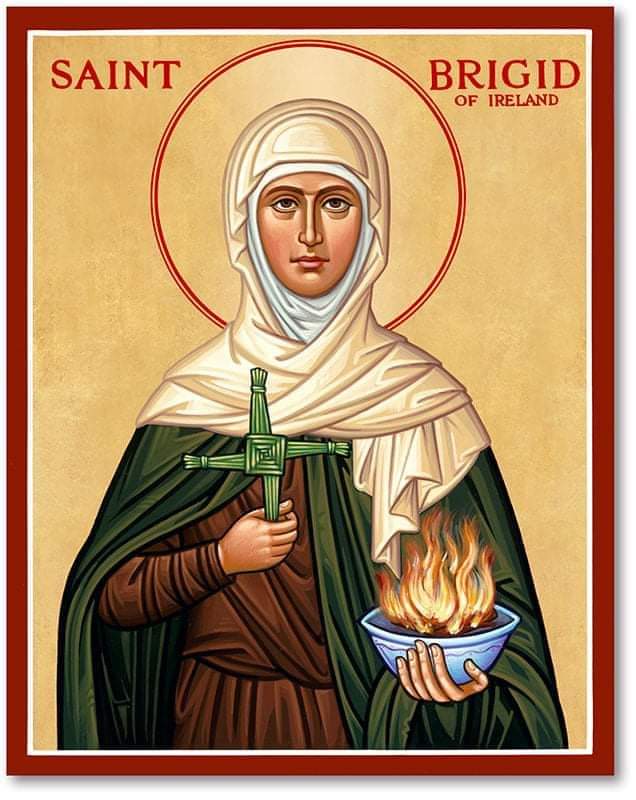
Today is the feast day of St. Brigid (c. 451 CE–525 CE). She is a patron saint of brewers. She was also known as Bride, Bride of the Isles, Bridget of Ireland, Bridget, Brigid of Kildare, Brigit, Ffraid, and Mary of the Gael. She is one of Ireland’s patron saints, along with Patrick and Columba. Irish hagiography makes her an early Irish Christian nun, abbess, and foundress of several monasteries of nuns, including that of Kildare in Ireland, which was famous and was revered. Her feast day is February 1, which was originally a pagan festival called Imbolc, marking the beginning of spring. Her feast day is shared by Dar Lugdach, who tradition says was her student, close companion, and the woman who succeeded her. She also a patron saint of brewers. “Brigid, who had a reputation as an expert dairywoman and brewer, was reputed to turn water into beer.”
Here’s account of her life, from Wikipedia:

Probably the earliest biography, Vita Sanctae Brigitae (Life of St. Brigid), was written by Cogitosus, a 7th century monk of Kildare. A second, Vita Prima Sanctae Brigitae (First Life of St. Brigid), by an unknown author, is sometimes attributed to St. Broccán Clóen (d. 650). The book of uncertain authorship is occasionally argued to be the first written biography of St. Brigid, though most scholars reject this claim.

A Vita sometimes attributed to St. Coelan of Inishcaltra in the early 7th century derives further speculation from the fact that a foreword was added, ostensibly in a subsequent edition, by St. Donatus, also an Irish monk, who became Bishop of Fiesole in 824. In his foreword, Donatus refers to earlier biographies by St. Ultan and St. Ailerán. The manuscript of Vita III, as it has come to be known, was preserved in the Italian monastery of Monte Cassino until its destruction during World War II. As the language used is not that of St. Coelan’s time, philologists remain uncertain of both its authorship and century of origin. Discussion on dates for the annals and the accuracy of dates relating to St. Brigid continues.

Early life

According to tradition, Brigid was born in the year 451 AD in Faughart, just north of Dundalk in County Louth, Ireland. Because of the legendary quality of the earliest accounts of her life, there is debate among many secular scholars and Christians as to the authenticity of her biographies. Three biographies agree that her mother was Brocca, a Christian Pict slave who had been baptized by Saint Patrick. They name her father as Dubhthach, a chieftain of Leinster.

The vitae says that Dubthach’s wife forced him to sell Brigid’s mother to a druid when she became pregnant. Brigid herself was born into slavery. Legends of her early holiness include her vomiting when the druid tried to feed her, due to his impurity; a white cow with red ears appeared to sustain her instead.

As she grew older, Brigid was said to have performed miracles, including healing and feeding the poor. According to one tale, as a child, she once gave away her mother’s entire store of butter. The butter was then replenished in answer to Brigid’s prayers. Around the age of ten, she was returned as a household servant to her father, where her habit of charity led her to donate his belongings to anyone who asked.

In both of the earliest biographies, Dubthach is portrayed as having been so annoyed with Brigid that he took her in a chariot to the King of Leinster to sell her. While Dubthach was talking to the king, Brigid gave away his bejeweled sword to a beggar to barter it for food to feed his family. The king recognized her holiness and convinced Dubthach to grant his daughter freedom.

Religious life

Saint Brigid as depicted in Saint Non’s chapel, St Davids, Wales.
It is said that Brigid was “veiled” or received either by St. Mac Caill, Bishop of Cruachu Brig Ele (Croghan, County Offaly), or by St. Mél of Ardagh at Mág Tulach (the present barony of Fartullagh, County Westmeath), who granted her abbatial powers. It is said that in about 468, she and a Bishop MacCaille followed St. Mél into the Kingdom of Tethbae, which was made up of parts of the modern counties Meath, Westmeath and Longford.

According to tradition, around 480 Brigid founded a monastery at Kildare (Cill Dara: “church of the oak”), on the site of a pagan shrine to the Celtic goddess Brigid, served by a group of young women who tended an eternal flame. The site was under a large oak tree on the ridge of Drum Criadh.

Brigid, with an initial group of seven companions, is credited with organizing communal consecrated religious life for women in Ireland. She founded two monastic institutions, one for men, and the other for women, and invited Conleth (Conláed), a hermit from Old Connell near Newbridge, to help her in Kildare as pastor of them. It has often been said that she gave canonical jurisdiction to Conleth, Bishop of Kildare, but Archbishop Healy says that she simply “selected the person to whom the Church gave this jurisdiction”, and her biographer tells us that she chose Saint Conleth “to govern the church along with herself”. For centuries, Kildare was ruled by a double line of abbot-bishops and of abbesses, the Abbess of Kildare being regarded as superior general of the monasteries in Ireland. Her successors have always been accorded episcopal honour. Brigid’s oratory at Kildare became a centre of religion and learning, and developed into a cathedral city.

Brigid is credited with founding a school of art, including metalwork and illumination, which Conleth oversaw. The Kildare scriptorium made the Book of Kildare, which drew high praise from Gerald of Wales (Giraldus Cambrensis), but disappeared during the Reformation. According to Giraldus, nothing that he ever saw was at all comparable to the book, every page of which was gorgeously illuminated, and the interlaced work and the harmony of the colours left the impression that “all this is the work of angelic, and not human skill”.

According to the Trias Thaumaturga Brigid spent time in Connacht and founded many churches in the Diocese of Elphin. She is said to have visited Longford, Tipperary, Limerick, and South Leinster. Her friendship with Saint Patrick is noted in the following paragraph from the Book of Armagh: “inter sanctum Patricium Brigitanque Hibernesium columpnas amicitia caritatis inerat tanta, ut unum cor consiliumque haberent unum. Christus per illum illamque virtutes multas peregit” (Between St. Patrick and St. Brigid, the pillars of the Irish people, there was so great a friendship of charity that they had but one heart and one mind. Through him and through her Christ performed many great works.)
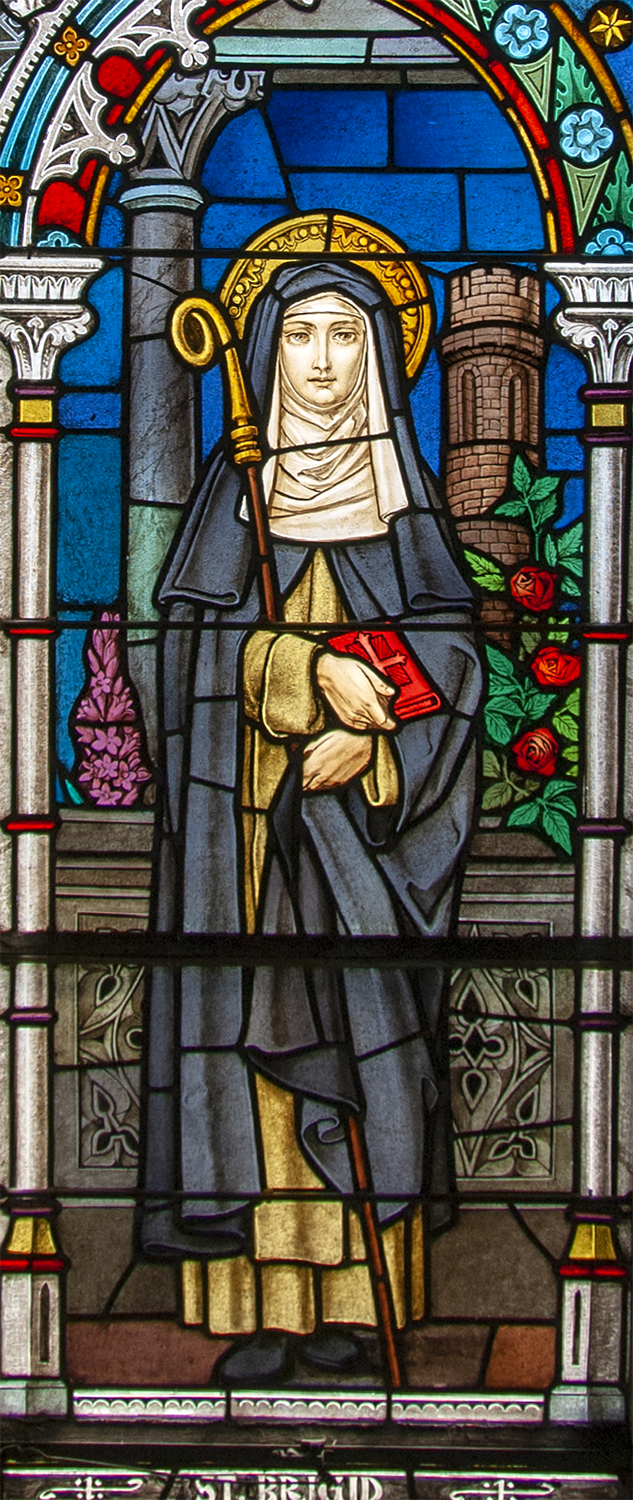
Stained glass window in St. Mary Basilica of Biloxi, Mississippi, created in 1961.

Her exploits appear to have included beer on more than on occasion, as detailed by journalist Jack Beresford in an article for the Irish Post last year.

One of Ireland’s three patron saints alongside St Colmcille and St Patrick, the feast of St Brigid also happens to fall on the Celtic first day of spring, Imbolc.

There are plenty of stories surrounding St Brigid, but few are as famous, fun or fascinating as the tale about how she supposedly turned some ordinary bathwater into beer.

The story goes that one day, while working in a leper colony, she discovered to her horror that they had run out of beer.

It’s important to understand that in those times, centuries ago, beer was consumed on a daily basis as a source of hydration and nourishment.

As opposed to today, of course, when…oh wait, scratch that.

In any case, back in those times many of the water sources close to villages and towns were often polluted to the point where consumption would likely result in illness or, worse still, death.

Alcohol offered an (almost) germ free alternative and was almost as good as any meal of the era.

So, to be faced with a beer drought was nothing short of disastrous.

Not that it mattered all that much to St Brigid.

Channelling a little divine intervention, she answered the prayers of the thirsty lepers under her charge by turning the water they used to bathe into not just any beer, but a genuinely brilliant beer that was enjoyed by one and all.

Her water-based exploits don’t end there either.

Another part of the legend says St Brigid also succeeded in turning dirty bathwater into beer for the clerics visiting the leper colony where she was based.

There’s even a tale of her supplying some eighteen churches with enough beer to last from Holy Thursday through to the end of Easter despite only having one barrel to her name.

Whether fact or fiction, one thing appears undeniable: St Brigid liked beer.

Though perhaps this 10th century poems captures Brigid’s commitment to beer best. It’s entitled “I’d like to give a lake of beer to God.”

I’d like to give a lake of beer to God.
I’d love the heavenly
Host to be tippling there
For all eternity.

I’d love the men of Heaven to live with me,
To dance and sing.
If they wanted, I’d put at their disposal
Vats of suffering.

White cups of love I’d give them
With a heart and a half;
Sweet pitchers of mercy I’d offer
To every man.

I’d make Heaven a cheerful spot
Because the happy heart is true.
I’d make the men contented for their own sake.
I’d like Jesus to love me too.

I’d like the people of heaven to gather
From all the parishes around.
I’d give a special welcome to the women,
The three Marys of great renown.

I’d sit with the men, the women and God
There by the lake of beer.
We’d be drinking good health forever
And every drop would be a prayer.
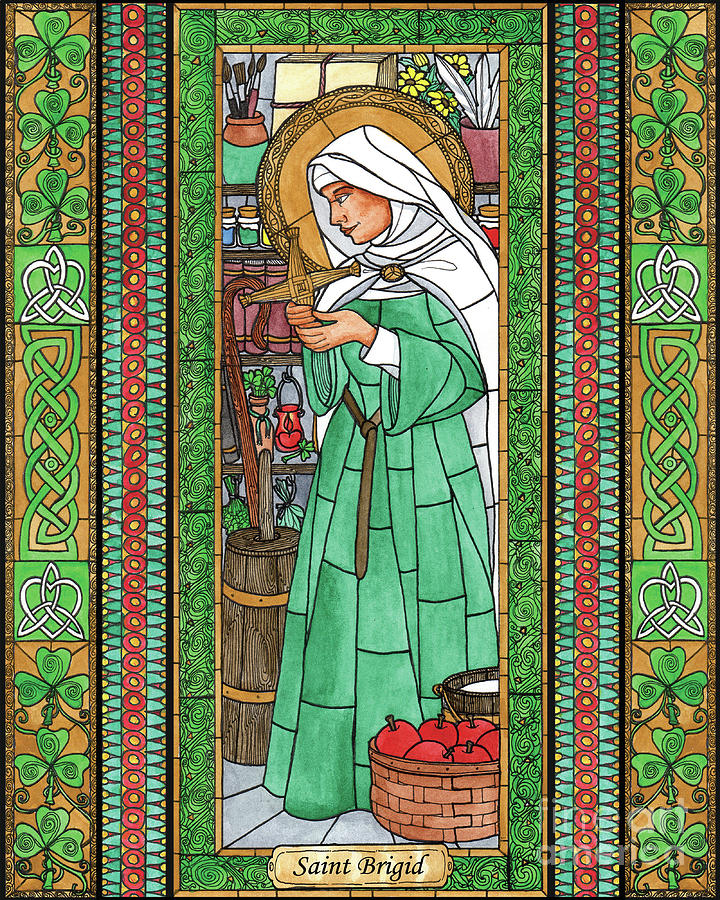
This contemporary painting of the St. Brigid is by artist Brenda Nippert of Pittsburgh, Pennsylvania.

And this is part of an account of Brigid entitled “Wild Irish Women: Saint Brigid – Mary of the Gaels” by Rosemary Rogers for Irish American.

Despite all her accomplishments, her legend grew because of her many miracles, so resonant with Irish mysticism: she taught a fox to dance, tamed a wild boar, hung her damp cloak (that cloak again!) on a sunbeam to dry, obliging the sunbeam to remain all night. In her later years, her powers took on almost Christ-like proportions – she could multiply food, exorcise demons with a casual sign of the cross, and calm storms. Proving she was someone you’d like to have a beer with, Brigid, fond of the brew herself, could produce bottomless barrels and turn both milk and water into ale. Once, while curing lepers, she learned there was nothing to drink and used her own bathwater to stand the entire colony to a pint.
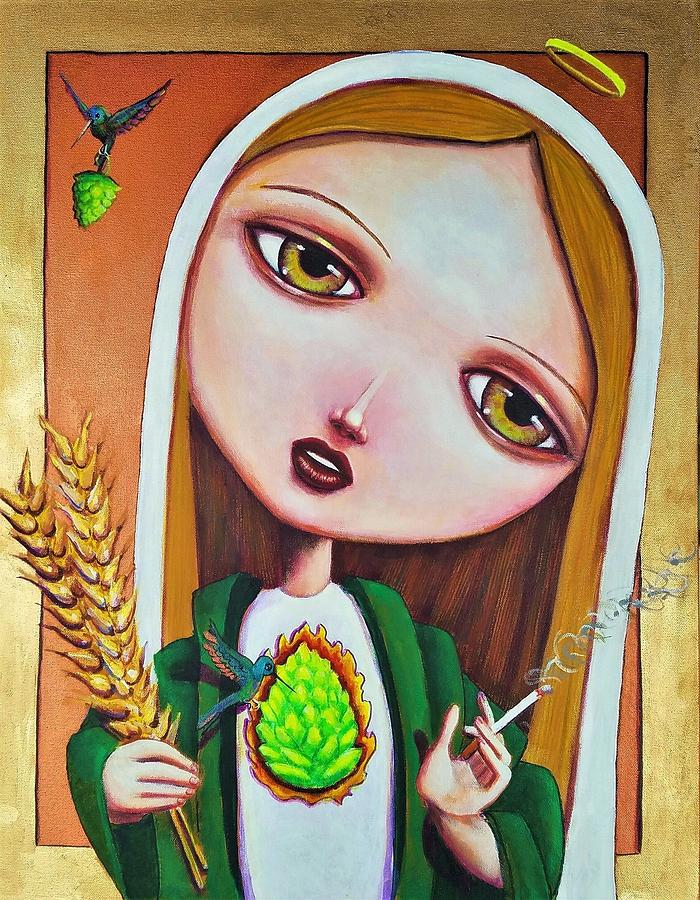
Another contemporary painting entitled “St. Brigid of Ireland” by St. Louis-based artisy Nelson Perez.

Filed Under: Art & Beer, Beers, Just For Fun, Related Pleasures Tagged With: Ireland, Religion & Beer

Beer In Ads #3616: Budweiser In Living Stereo

January 21, 2021 By Jay Brooks

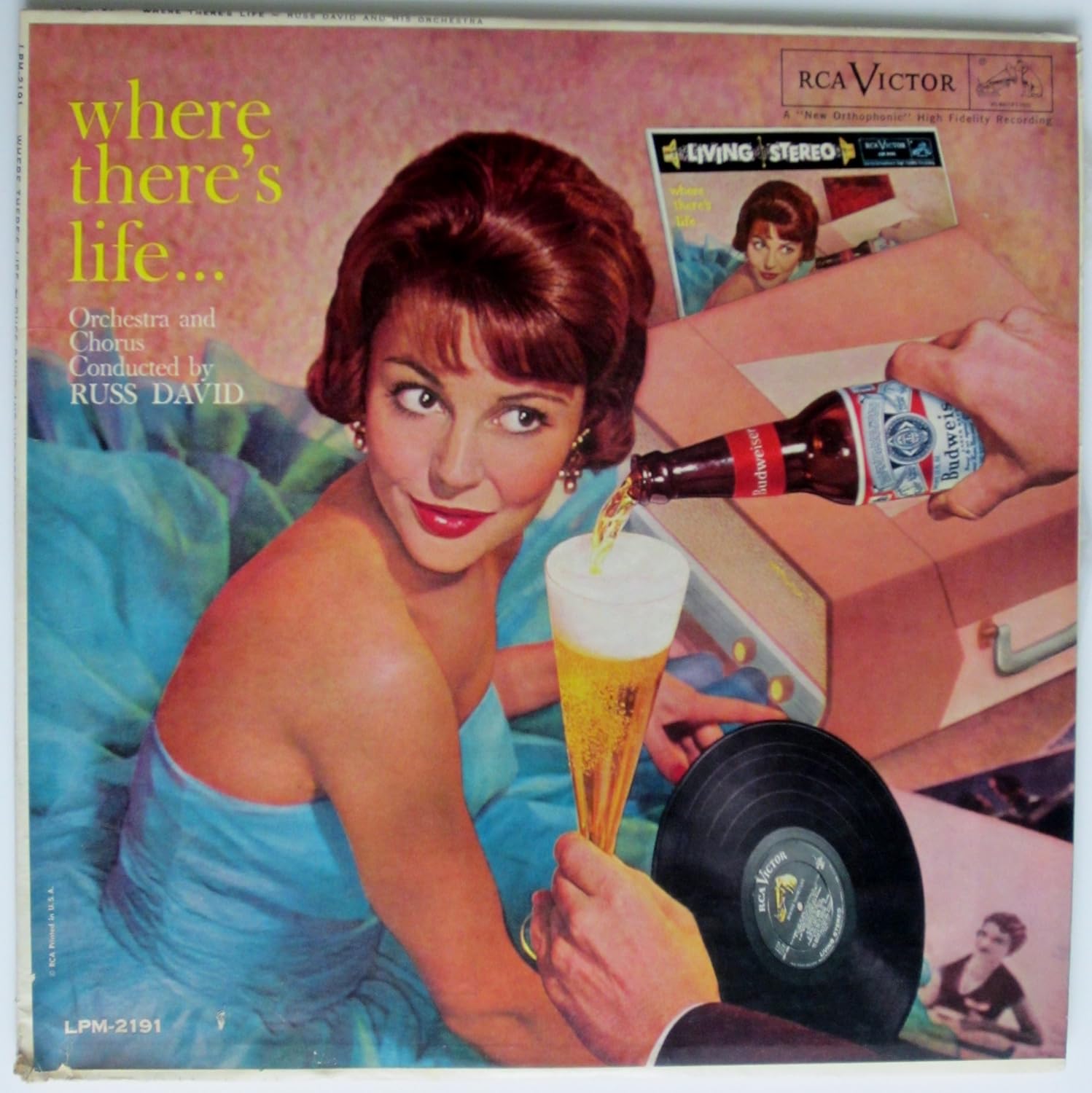
Thursday’s ad is for “Budweiser,” from 1960. This ad was made for Anheuser-Busch, and was part of their series using the tagline. “Where there’s Life … there’s Bud,” which ran from the 1950s into the 1960s, and this one features a woman holding an RCA Victor LP record while a man is pouring her a beer. The text begins: “Special Lyrics.” But look just to the right of her head and you’ll see the cover of an album featuring the same photo from the ad. How meta! But that’s because they made an actual album of Budweiser music. See below for more about that.

LSP-2191 Living Stereo with the Miracle Surface, RCA Victor records. It was released in 1960 in conjunction with the ad. The band was the “Orchestra and Chorus, Conducted by Russ David. He was a pianist and bandleader from St. Louis, Missouri.

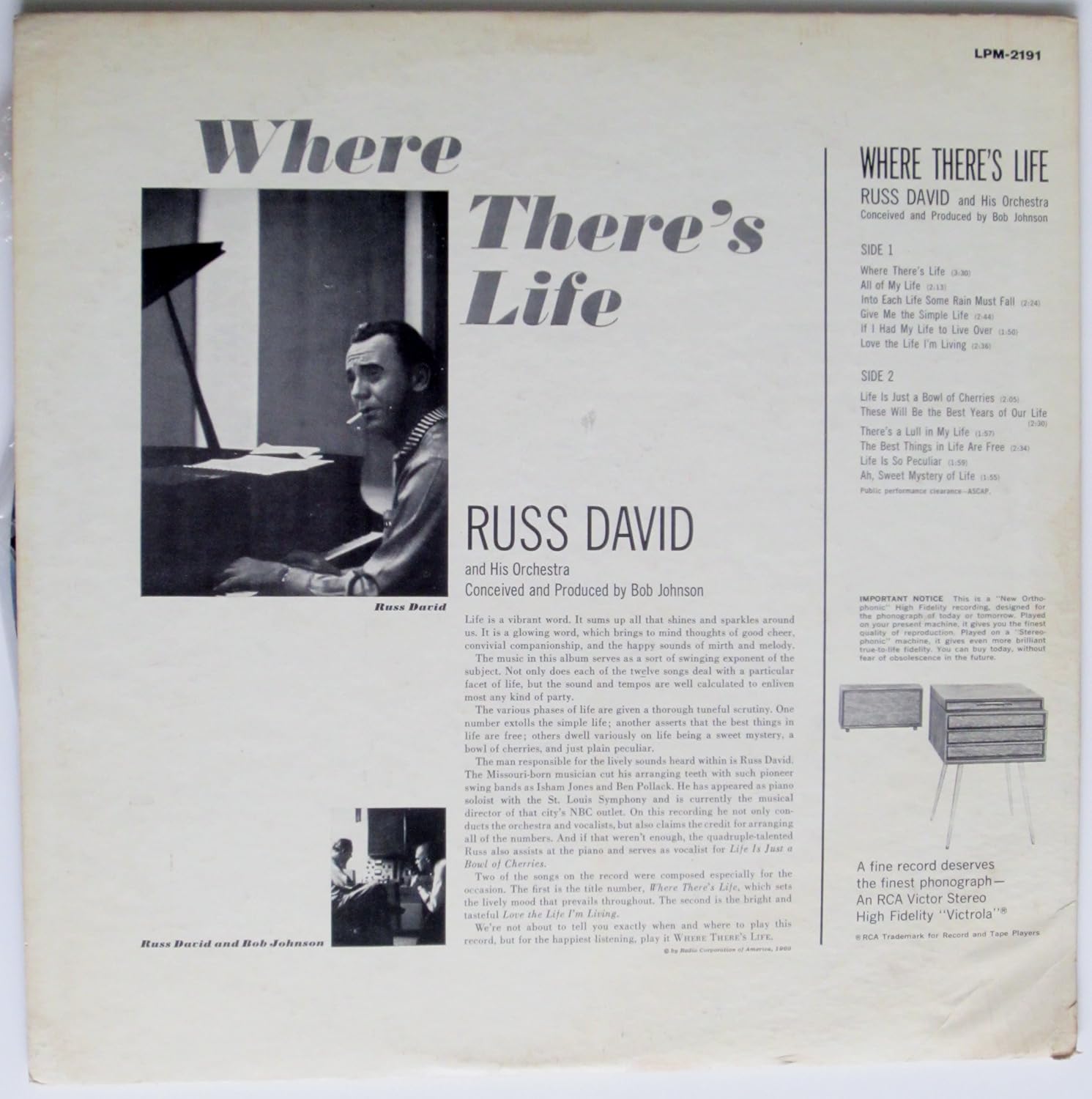
On the back cover: A Sampler of the ’58 sound of Budweiser.

Here’s the track list from the LP:

  1. Where There’s Life
  2. All Of My Life
  3. Into Each Life Some Rain Must Fall
  4. Give Me The Simple Life
  5. If I Had My Life To Live Over
  6. Love The Life I’m Living
  7. Life Is Just A Bowl Of Cherries
  8. These Will Be The Best Years Of Our Life
  9. There’s A Lull In My Life
  10. The Best Things In Life Are Free
  11. Life Is So Peculiar
  12. Ah, Sweet Mystery Of Life

They also apparently produced a Mono version of the album, which you can actually buy on Amazon.

Filed Under: Art & Beer, Beers, Just For Fun Tagged With: Advertising, Anheuser-Busch, Budweiser, History, Music

Historic Beer Birthday: Ludwig Thoma

January 21, 2021 By Jay Brooks

Today is the birthday of Ludwig Thoma (January 21, 1867-August 26, 1921). If his name is not familiar to you, that’s not a surprise. He was a German author, publisher and editor, who gained popularity through his partially exaggerated description of everyday Bavarian life,” but he’s largely unknown outside of his native Germany.

One of his best-known works is Der Münchner im Himmel (or The Municher in Heaven), which in 1962 was made into a short animated cartoon directed by Walter Reiner for BR, the German equivalent of PBS. And it was based on Ludwig Thoma’s story of the same name.

Here’s a description of the story, translated by Google, so you can make sense of the cartoon since it’s in German:

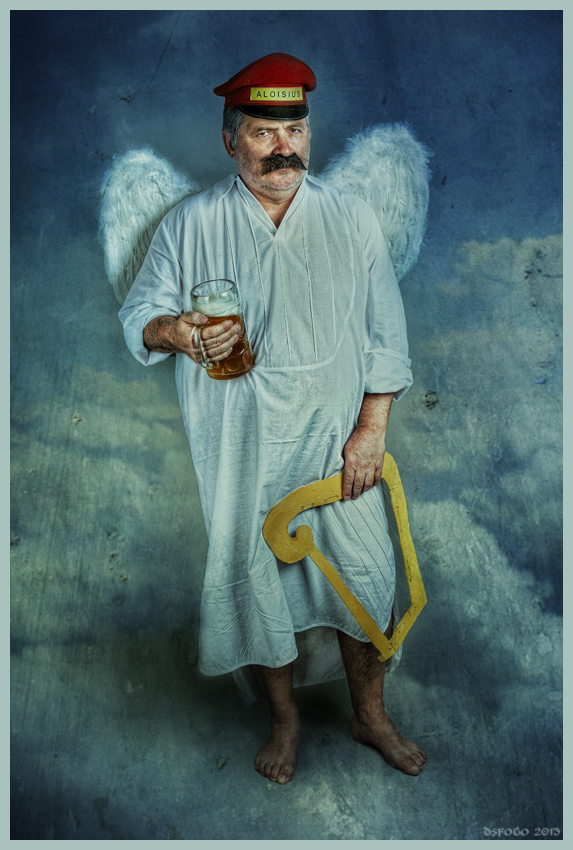
Alois Hingerl, clerk no. 172 from Munich Central Station, goes to heaven. Peter reveals to him the heavenly house rules: “Rejoice and sing Hallelujah”. The “Angel Aloisius” is not particularly impressed by this, especially since he is supposed to get “heavenly manna” instead of the Munich beer. Angry, he sits down on a cloud to rejoice and sing hallelujah. It sounds like the hair of the heavenly ones stand on end. The good Lord has an understanding and instructs Aloisius to convey the divine inspirations to the Bavarian government. He also sends it to Munich with a corresponding letter. When the “Angel Aloisius” steps back on Munich soil, and when he finally – following an old custom – ends up in the Hofbräuhaus again, he forgets the divine mandate and the Bavarian State Government with a “Maß” and another Maß …

This account of the original story is from the German Wikipedia page about Der Münchner im Himmel, translated by Google:

The short story is about Alois Hingerl, clerk number 172 at Munich Central Station . This one does a job with such a hurry that he from the blow falls taken to the ground and dies. Two angels drag him laboriously to heaven , where he is given his otherworldly name “Angel Aloisius” by Peter , a harp and a cloud on which, according to the “heavenly house rules”, he is to rejoice and sing Hosanna according to a fixed schedule . When he asked when he would finally get something to drink, Peter replied to Aloisius with the words: “You will get your manna.”

In view of the prospect of manna instead of the beer he loves, Aloisius suspects something bad, at the same time there will be fights with a heavenly red shandy angel, his hated competition on earth. Frustrated, he begins to rejoice on his cloud. When a “spiritualized angel” flying past answers his request for “am Schmaizla” (a pinch of snuff ) with an incomprehensible, lisped “Hosanna!”, His anger rises, whereupon Aloisius begins to rant and curse, which also changes in his way rejoicing is reflected. Through his scolding, cursing and loud rejoicing (“ Ha-ha-lä-lä-lu-u-uh – – Himmi Lord God – Erdäpfi – Saggerament – – lu – uuu – iah!“) God becomes aware of him. After a brief appraisal of the delinquent and consultation with Peter, he comes after the words “Aha! A Munich resident! ”To the conclusion that Aloisius is of no use for heaven. That is why he has a different task: He is supposed to convey divine advice to the Bavarian government (in the original from Thoma the Bavarian State Minister of the Interior for Church and School Affairs Anton von Wehner ); as a result, the Munich resident comes to Munich a few times a week and the dear soul has its peace.

Alois is very happy about this assignment, takes divine advice and flies away. As usual, he first goes to the Hofbräuhaus with his message , where he orders one beer after the other, then forgets his order and sits there to this day. Meanwhile, the Bavarian government (or the Bavarian Minister of Education) is still waiting for divine advice (or divine inspiration).

Below are some images of Aloisius from various sources. As far as I can tell, he remains a well-known literary figure throughout Germany.

Inside the Hofbrauhaus Oktoberfest tent.
I can’t tell if this is a photograph or painting.

Filed Under: Beers, Birthdays, Just For Fun, Related Pleasures Tagged With: Animation, Cartoons, Germany, History, Literature

The Kidnapping of Schmidt Brewery Son Edward Bremer

January 17, 2021 By Jay Brooks

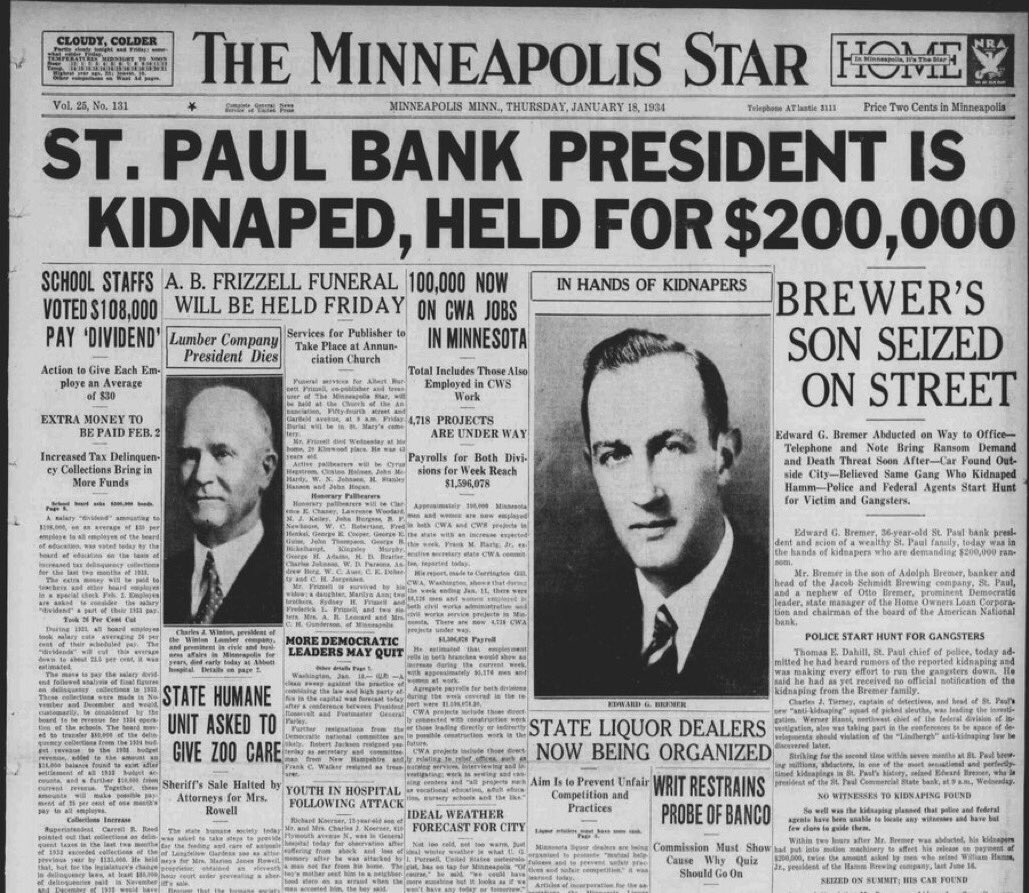
Today is the anniversary of a pretty unsavory incident that was at least tangentially related to prohibition and brewing. On January 17, 1934, the Barker–Karpis gang kidnapped Edward Brewer off of the streets of St. Paul, Minnesota. At the time, he was the wealthy president of Commercial State Bank. But perhaps more importantly, he was also the son of Adolf Bremer, who owned the Schmidt Brewery, having married the daughter of Jacob Schmidt.

Kidnap victim Edward Bremer.

That’s thought to be important because the gang appeared to be targeting brewery owners because of their perceived disrespecting of criminal elements after prohibition was repealed. Many breweries that survived did so by working with bootleggers on the down low, which of course in many cases were part of criminal organizations. But when prohibition was repealed, they distanced themselves from those gangs once alcohol was no longer illegal. The previous year, for example, the Barker-Karpis gang successfully kidnapped William Hamm of Hamm’s Brewery, releasing him June 19, 1933, having been paid $100,000 in ransom.

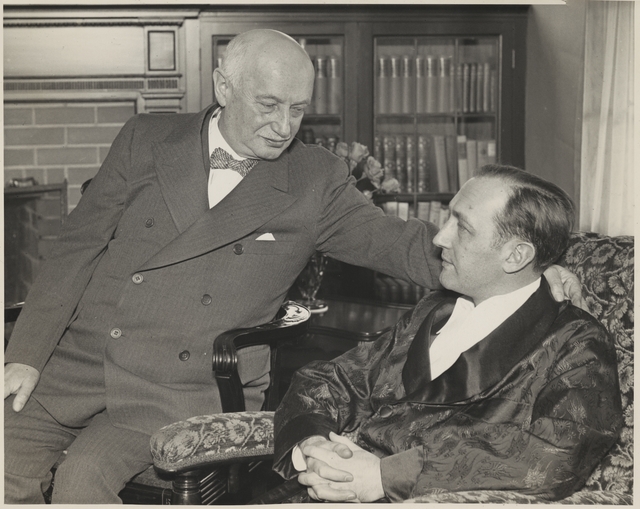
Adolf Bremer with his son Edward.

Because of that history, “it is thought that Bremer was not chosen simply because of his wealth, but also because of a personal vendetta.” They planned the kidnapping for four months. The kidnappers asked for $200,000 this time, double what they’d asked for from the Hamm Brewery family, probably emboldened by their success with that kidnapping.

Naturally, it was front page news, appearing in both the St. Paul Dispatch and the Minneapolis Star.

According to Wikipedia’s account, here’s how it went down:

[Edward Bremer] was on his way to work, having just dropped his daughter off at school when he was approached by two men, one of whom was Arthur “Doc” Barker. Barker repeatedly punched and pistol-whipped him, forcing him into the back of Bremer’s car and placing blindfolding goggles over his eyes. After having some difficulty starting the vehicle, the kidnappers forced the bleeding Bremer to show them the starter button, then drove off, later switching to another car. The blood-stained vehicle was later recovered, leading to fears that Bremer had been killed.

Scene of the Bremer kidnapping, Lexington and Goodrich, St. Paul, MN, 1934

Bremer was held captive in Bensenville, Illinois. He was kept in a small room and was told that his family would be killed if he said anything to the police. He was also told to provide the names of people who could act as intermediaries. Messages demanding $200,000 were left with the Bremers’ trusted business associate and former chauffeur Walter Magee. Through Tom Brown, the gang learned that Magee had informed the police, despite the gang’s demand that he should keep quiet. They threatened to kill him and Bremer. Adolph Bremer, the victim’s father, refused to pay up unless the kidnappers provided proof of life. Edward was forced to write another note pleading to be returned to his wife and children. When Adolph also tried to reduce the ransom money, Fred Barker became enraged and suggested they should kill Edward. His brother Arthur and Karpis overruled him. In the end the ransom was paid by dropping off a bag full of cash, which was collected by George Zieger. Edward was driven to a deserted road by Ziegler and released on February 7, left on the empty road with a small amount of cash. He had to make his own way back home.

The New York Times even covered it.

After Bremer was returned, public outcry led to the FBI intensifying their efforts at bringing the criminals to justice. While not a household name to us today, “these kidnappings brought too much negative publicity, due to the recent Urschel and Lindbergh Kidnappings, and the fact that the father of the Bremer Jr. was a personal friend of President Roosevelt, who mentioned the kidnappings in a fireside chat. On November 27, 1934, Lester “Baby Face Nelson” Gillis, at that time the Public Enemy No. 1, was mortally wounded in a gun battle with the FBI and died later that night. The next day, Alvin Karpis was declared Public Enemy No. 1, which brought the full force of the FBI down on the Barker-Karpis Gang.”

The other well-known aspect of the criminals was the mother of some of the Barker brothers was apparently controlling the gang’s actions and was known as “Ma” Barker.

This account is from KSTP, the ABC affiliate in Minneapolis.

On Jan. 17, 1934, the Minnesota Historical Society says Edward was driving to work when he stopped at the corner of Lexington Parkway and Goodrich Avenue. The gang ended up blocking Edward’s path with one vehicle, and another vehicle pulled up behind him. The kidnappers then opened Edward’s door and pushed him to the ground when he was struggling. They forced Edward to sign ransom notes, and within two hours, Edward’s family friend, Walter W. Magee, received ransom instructions.

The instructions indicated a request of $200,000 in $5 and $10 bills. Magee was to print, “We are ready Alice,” in the Minneapolis Tribune’s personal ads. More ransom notes were delivered to people close to Edward, but people suspected him to be dead due to the amount of blood left in his car. Therefore, his father, Adolph, demanded a note in his son’s handwriting before he would pay. The next day a bank cashier received the requested note, according to Minnesota Historical Society.

The Minneapolis Tribune reported on Feb. 6, 1934, Magee had received the final instructions from the kidnappers to trade the ransom money for Edward. Magee was to transfer the ransom into a car with a Shell Oil sticker in St. Paul and then to trail a bus to Rochester. Afterward, Magee was to turn down a gravel road and drive until he saw five headlight flashes. Once he saw the flashes, he placed the money beside the road and drove off.

After 21 days of captivity, Edward Bremer was released.

The gang members scattered across the country to escape the FBI after authorities were able to lift fingerprints from a gas can that the Barker-Karpis gang used to refuel their car between Chicago and Minneapolis. The FBI had also recorded the serial numbers on the ransom bills.

Almost a year later, on Jan. 16, 1935, Barker and his mother were killed in a shootout with FBI officers, and Karpis remained on the run until the FBI arrested him on May 1, 1936.

Karpis was sentenced to life and served 26 years in Alcatraz.

And this one is from the BBC:

After Bremer dropped his daughter off at the Summit School in St. Paul, he was ambushed and thrown in a car. He was held for 10 days, until his family paid a $200,000 ransom.

Part of this ransom money was used to bribe police who were on the take, according to Paul Maccabee, author of “John Dillinger Slept Here: A Crooks’ Tour of Crime and Corruption in St. Paul, 1920-1936.”

“Prohibition meant bribes in order to ship liquor — to cops, judges, U.S. senators,” Maccabee told MPR News’ Cathy Wurzer. “When Prohibition was repealed and liquor was legal, they switched from bootlegging to kidnapping. The same corrupt cops that had looked the other way during the bootlegging era were also involved with kidnappings and other more nefarious deeds.”

Bremer helped federal investigators find his captors. He memorized every detail about his surroundings.

“When the FBI investigated the case, he was able to identify the specific wallpaper in the home where he was kept,” Maccabee said. “That enabled the FBI to break the case and arrest the Barker-Karpis gang.”

The gang was led by two brothers, Doc and Freddy Barker, who Maccabee describes as “psychopaths,” and Alvin “Creepy” Karpis, who was one of the most infamous gangsters of the period.

Alvin Karpis going into court in St. Paul.

And this, also from Wikipedia, covers the arrests, deaths and the aftermath of the kidnapping.

The FBI had recorded the serial numbers of all the cash used to pay the ransom. They launched an intensive investigation, declaring Alvin Karpis, presumed leader of the gang, to be “Public Enemy No. 1”. Bremer, completely traumatized and worried about the safety of his wife and children, refused to cooperate with the FBI. When they threatened to reveal what they believed about his links to organized crime, he admitted what he knew about the kidnappers, and his suspicions about their connection to Sawyer.

The gang knew that they needed to launder the money, but the intensity of the FBI pressure meant that most of their criminal contacts refused to participate. Ziegler was gunned down in a drive-by killing by unknown assailants in March. Sawyer claimed that he had arranged for the money to be laundered in Cuba. The gang withdrew to Cuba, but Karpis became concerned that the money had not been laundered and that the FBI would soon find them there. They moved to Lake Weir, Florida. Doc left for Chicago, hoping to organize a new criminal project. He was soon recognized and arrested on January 8, 1935 along with minor gang member Byron Bolton. Doc wouldn’t talk, but Bolton told the FBI everything he knew in exchange for a light sentence. Eight days later, Doc’s brother Fred Barker and mother Kate “Ma” Barker were killed in a shootout with the FBI at Lake Weir. Volney Davis was also captured, and Sawyer was tracked down and captured in Mississippi.

Alvin Karpis, who was co-leader of the gang along with Fred Barker, was arrested by the FBI in May, 1936. Karpis pleaded guilty to kidnapping and Doc Barker was convicted after a trial. Both men were sent to Alcatraz. Karpis became the Rock’s longest serving inmate, eventually being paroled in 1969 after decades in prison. Barker was shot while trying to escape from Alcatraz in 1939. Sawyer received a life sentence in 1936. He was released from prison in 1955 due to ill health and died shortly after.

The kidnapping had a significant effect on campaigns against police corruption. During the investigation it became clear to FBI agents that information was being leaked to the kidnappers. Tom Brown was strongly suspected to be the source of the leaks and forced out of the team investigating the case. Brown was implicated as a conspirator in the kidnapping after an investigation by the FBI and a hearing before the city Civil Service Board. Brown was fired from the police force, but the federal government declined further prosecution. The death and arrests of all the important Barker-Karpis gang-members greatly enhanced the reputation of the FBI.

Filed Under: Breweries, Events, Just For Fun, Politics & Law Tagged With: History, Minnesota

Brussels Beer Challenge Winners 2020

November 28, 2020 By Jay Brooks

Yesterday, the winners of the 9th annual Brussels Beer Challenge were announced. Exactly 1,546 beers from 36 countries were judged in 8 broad styles (Pale Ale, Dark Ale, Red Ale, Pils, Stout/Porter, White, Flavoured Beers, and Specialty Beers) and then further subdivided into 80 smaller categories (lambic, abbey, chocolate beers, etc.). In a normal year, I would have been there for the judging, but with Covid restrictions, the EU was not permitting Americans to fly to Europe. I had hoped to post this yesterday, but it took me this long to go through and reformat the winners into a list. Congratulations to all the winners!

Belgium won the most medals, with the United States coming in second. Here are the top medal winners, by country.

Medals Won by Country:

  1. Belgium = 79
  2. United States = 31
  3. Italy = 30
  4. Netherlands = 23
  5. Brazil = 16
  6. France = 13
  7. Canada = 10
  8. TIE: China = 9 / Germany = 9
  9. Ireland = 6
  10. TIE: South Korea = 3 / Taiwan = 3

The 2020 Brussels Beer Challenge Winners

Category 1 — Dark Ale: Abbey / Trappist Style Dubbel

  • Gold: Viven Classic Bruin (Belgium) Owned by Brouwerij Viven
  • Silver: Ter Dolen Donker (Belgium) Brewed by Brouwerij Ter Dolen
  • Bronze: Deduction (United States) Brewed by Taxman Brewing Company
  • Bronze: Duits & Lauret Biere de Garde Brune (Netherlands) Brewed by Brouwerij Duits & Lauret

Category 2 — Dark Ale: Brown Ale

  • Gold: Dark Coffee Break (Brazil) Brewed by Wäls Ambev
  • Silver: Joup (Belgium) Brewed by Brasserie Grain d’Orge
  • Bronze: Rur’ale Brune (France) Brewed by Brasserie Robiche

Category 3 — Dark Ale: Dark/Black IPA

  • Gold: Black Bucket (Ireland) Brewed by Kinnegar Brewing
  • Silver: Colorado Black Indica (Brazil) Brewed by Cervejaria Colorado
  • Bronze: Obaa Three (Belgium) Owned by Obaa Sprl

Category 4 — Dark Ale: Oud Bruin (Flanders Brown Ale)

  • Gold: No award.
  • Silver: Queue de Charrue vieille brune (Belgium) Brewed by Brasserie Vanuxeem
  • Bronze: Liefmans Goudenband (Belgium) Brewed by Duvel Moortgat

Category 5 — Dark Ale: Strong Dark Ale

  • Gold: Qualified (United States) Brewed by Taxman Brewing Company
  • Silver: De Poes Bruin (Belgium) Brewed by Brouwerij De Poes BVBA
  • Silver: St.Bernardus Abt 12 (Belgium) Brewed by St.Bernardus Brouwerij
  • Bronze: Gladium Symphony (Italy) Brewed by Birrificio Artigianale della Presila di Verrino Anselmo & C. Sas

Category 6 — Flavoured Beer: Chocolate

  • Gold: Endless Love (South Korea) Brewed by Artmonster Brewery
  • Silver: Peanut Butter Hazelnut Caramel Chocolate Cake Stout (United States) Brewed by Hoppin’ Frog Brewing Co
  • Bronze: Bodebrown – Iron Maiden Trooper Brasil IPA (Brazil) Brewed by Cervejaria Bodebrown Ltda

Category 7 — Flavoured Beer: Coffee

  • Gold: Dadgum Coffee IPA (United States) Brewed by Rahr & Sons Brewing Co.
  • Silver: Goodieson Coffee Stout (Australia) Brewed by Goodieson Brewery
  • Bronze: Kaffee (Canada) Brewed by Microbrasserie La Souche
  • Bronze: Panda Nero (Ireland) Brewed by Brú Brewery

Category 8 — Flavoured Beer: Field Beer

  • Gold: No Award
  • Silver: Colorado Double Brown Coconut (Brazil) Brewed by Cervejaria Colorado
  • Bronze: La Diablesse (Belgium) Brewed by Brasserie du Renard

Category 9 — Flavoured Beer: Fruit Beer

  • Gold: Daobrew Free-fall Litchi Gose (China) Brewed by Chengdu Fengshou Craft Beer Company, Ltd
  • Silver: Cranbic (United States) Brewed by New Glarus Brewing Company
  • Bronze: Markens Grøde – Farmer´s Reserve (Norway) Brewed by Lindheim Ølkompani

Category 10 — Flavoured Beer: Herb & Spice

  • Gold: Rumpy (United States) Brewed by Rahr & Sons Brewing Co.
  • Silver: SpontanBasil (Belgium) Brewed by Lindemans Brewery
  • Bronze: GingerGueuze (Belgium) Brewed by Lindemans Brewery
  • Bronze: Straf Gouden Boelsbier (Belgium) Owned by Bieren Boels

Category 11 — Flavoured Beer: Honey Beer

  • Gold: Bee Bock (Italy) Brewed by Ibeer
  • Silver: Piersech Honey Saison (Italy) Brewed by Birrificio Gardena SRL
  • Bronze: Bière de Miel (Belgium) Brewed by Brasserie Dupont
  • Bronze: Wallabierke (Belgium) Owned by Wallabieke

Category 12 — Flavoured Beer: Old Style Fruit-Lambic

  • Gold: Kriek Mariage Parfait (Belgium) Brewed by Brouwerij Boon
  • Silver: Oude Kriek Oud Beersel (Belgium) Brewed by Oud Beersel BVBA
  • Silver: Oude Riesling Tilquin à l’ancienne (Belgium) Brewed by Gueuzerie Tilquin S.A.
  • Bronze: Kriek (Belgium) Brewed by Hof ten Dormaal
  • Bronze: Schaarbeekse Oude Kriek Oud Beersel (Belgium) Brewed by Oud Beersel BVBA

Category 13 — Flavoured Beer: Russian Imperial Stout Barrel Or Oaked Aged

  • Gold: Huge Arker (United States) Brewed by Anderson Valley Brewing
  • Silver: Tiki Tiki (United States) Brewed by Veza Sur Brewing Company
  • Bronze: Parabola (United States) Brewed by Firestone

Category 14 — Flavoured Beer: Smoked Beer

  • Gold: Friend or Foe? (Poland) Owned by Browar Rockmill Sp. Z O.O.
  • Silver: Buckskin Rauchbier (Taiwan) Brewed by Buckskin, King Car Group
  • Bronze: Duits & Lauret Houtgerijpte Rook Dubbelbock (Netherlands) Brewed by Brouwerij Duits & Lauret
  • Bronze: Rauch Marzen (South Korea) Brewed by Goose Island Brewhouse Seoul

Category 15 — Flavoured Beer: Sweet/Milk Stout

  • Gold: No award.
  • Silver: No award.
  • Bronze: Film G Milk Stout (China) Brewed by 18 Brewery

Category 16 — Flavoured Beer: Wood/Barrel Aged (Less Than 10% ABV)

  • Gold: Dama Wood Selection Imperial Brown Porter (Brazil) Brewed by Renato Bazzo
  • Silver: Rust – Farmer’s Reseve (Norway) Brewed by Lindheim Ølkompani
  • Bronze: Podere La Berta – Vècc Barrel Aged (Italy) Brewed by Felsina S.p.a.

Category 17 — Flavoured Beer: Wood/Barrel Aged Higher Than 10% ABV)

  • Gold: Bush de Nuits (Belgium) Brewed by Brasserie Dubuisson
  • Gold: Peak Triple Rum Barrel Aged (Belgium) Brewed by Belgium Peak Beer S.A
  • Silver: La Curita Imperial (United States) Brewed by Veza Sur Brewing Company
  • Bronze: Grande Réserve Fermentée en Barriques – Edition Armagnac (Belgium) Brewed by Bières de Chimay

Category 18 — Lager: American-Style Pilsner

  • Gold: No award.
  • Silver: Dama Pilsen (Brazil) Brewed by Renato Bazzo
    Bronze: Firestone Lager (United States) Brewed by Firestone Walker

Category 19 — Lager: Bohemian-Style Pilsner

Gold: Pils (Italy) Brewed by Qubeer
Silver: Mama’s Little Yella Pils (United States) Brewed by Oskar Blues Brewery
Bronze: Kingpin Pils (Poland) Owned by Browar Kingpin Sp. z.o.o.

Category 20 — Lager: Dark/Dunkel (Including Schwarzbier)

  • Gold: Marilune Moonroe (France) Brewed by Brasserie de la Pleine Lune
  • Silver: Eastside Dark (United States) Brewed by Lakefront Brewery
  • Bronze: Slow Chill Dunkel Lager (United States) Brewed by Oskar Blues Brewery

Category 21 — Lager: German-Style Dunkel Bock/Doppelbock

  • Gold: Brand Dubbelbock (Netherlands) Brewed by Heineken
  • Silver: Weyermann® Bamberger Hofbräu® Exquisator (Germany) Brewed by Constantin Förtner
  • Bronze: Dubec (Italy) Brewed by Birrificio Via Priula di San Pellegrino

Category 22 — Lager: German-Style Helles- / MaiBock / Doppelbock

  • Gold: Maestra Doble Lúpulo (Spain) Brewed by Mahou San Miguel
  • Silver: Alfa Krachtig Dort (Netherlands) Brewed by Meens Bierbrouwerij B.V. NL
  • Bronze: Buckskin Heller Bock (Taiwan) Brewed by Buckskin, King Car Group

Category 23 — Lager: German-Style Märzen

  • Gold: Pietra (France) Brewed by Brasserie Pietra
    Silver: Ketterer Edel (Germany) Brewed by Familienbrauerei M. Ketterer GmbH & Co. KG
  • Bronze: No award.

Category 24 — Lager: German-Style Pilsner

  • Gold: Pagoda Hill Pilsner (China) Owned by Blue Marlin Brewing Co.
  • Silver: Pils2 (Italy) Brewed by Birrificio Otus Srl
  • Bronze: AntiKorpo Brewing – Grommet (Italy) Brewed by Birrificio Cittavecchia Soc. Agr. a r.l.
  • Bronze: Ketterer Zwickel-pils (Germany) Brewed by Familienbrauerei M. Ketterer GmbH & Co. KG

Category 25 — Lager: Helles

  • Gold: Waldhaus Hell (Germany) Brewed by Privatbrauerei Waldhaus Joh. Schmid GmbH
  • Silver: B5 (Italy) Brewed by Birrificio Otus Srl
  • Bronze: Bayreuther Hell (Germany) Brewed by Bayreuther Bierbrauerei AG

Category 26 — Lager: Hoppy Lager

  • Gold: Dama American Lager (Brazil) Brewed by Renato Bazzo
  • Silver: American Jasper (Italy) Brewed by Soc.Coop. La Piazza
  • Bronze: American Magut (Italy) Brewed by Birrificio Lambrate
  • Bronze: Pils 13 – White label (Belgium) Owned by The Ministry of Belgian Beer

Category 27 — Lager: International Style Pilsner

  • Gold: Colorado Ribeirão Lager (Brazil) Brewed by Cervejaria Colorado
  • Silver: Alfa Edel Pils (Netherlands) Brewed by Meens Bierbrouwerij B.V. NL
  • Bronze: Estrella Damm (Spain) Brewed by S.A.Damm
  • Bronze: Primus (Belgium) Brewed by Brouwerij Haacht

Category 28 — Lager: Light Lager

  • Gold: DL (Ireland) Brewed by Kinnegar Brewing
  • Silver: Brahma Duplo Malte (Brazil) Brewed by Cervejaria Ambev
  • Bronze: Bohemia Puro Malte (Brazil) Brewed by Cervejaria Ambev
  • Bronze: Brahma Chopp (Brazil) Brewed by Cervejaria Ambev

Category 29 — Lager: Vienna Lager

  • Gold: Vienna Festbier (United States) Brewed by Quarter Celtic Brewpub
    Silver: No award.
  • Bronze: Gangnam Style (South Korea) Brewed by Artmonster Brewery

Category 30 — Pale&Amber Ale: (Belgian Style) Tripel

  • Gold: Paix Dieu (Belgium) Brewed by Brasserie Caulier SPRL
    Gold: Tripel LeFort (Belgium) Brewed by Brouwerij Omer Vander Ghinste
    Silver: Kompel L’or Noir (Belgium) Owned by Brouwerij Kompel
    Silver: Tongerlo Tripel (Belgium) Brewed by Brouwerij Haacht
  • Bronze: No award.

Category 31 — Pale&Amber Ale: Abbey / Trappist Style Blond

  • Gold: Ter Dolen Blond (Belgium) Brewed by Brouwerij Ter Dolen
  • Silver: Lamme Goedzak (Belgium) Brewed by Scheldebrouwerij BVBA
  • Bronze: Herkenrode Cister (Belgium) Brewed by Brouwerij Cornelissen
  • Bronze: Malheur 8 (Belgium) Brewed by Brouwerij Malheur

Category 32 — Pale&Amber Ale: Amber

  • Gold: La Bonne Aventure (Canada) Brewed by Microbrasserie Pit Caribou
  • Silver: La Rousse du Mont Blanc (France) Brewed by Brasserie du Mont Blanc
  • Bronze: Donna di Cuori (Italy) Brewed by Ibeer

Category 33 — Pale&Amber Ale: American IPA (Higher Than 6.5 ABV)

  • Gold: Born and Raised (United States) Brewed by No-Li Brewhouse
  • Gold: California West Coast IPA (Italy) Brewed by Mastri Birrai Umbri Società Agricola
  • Silver: Revision IPA (United States) Brewed by Revision Brewing Company
  • Bronze: Missile (United States) Brewed by Champion Brewing Company

Category 34 — Pale&Amber Ale: American IPA (Less Than 6.5 ABV)

  • Gold: Bird of Prey (Netherlands) Brewed by Uiltje Brewing Company
  • Silver: So Hoppy! (Belgium) Brewed by Dum’s Brew
  • Bronze: Jopen Hop Zij Met Ons (Netherlands) Brewed by Jopen BV
  • Bronze: La Conquereor (Canada) Brewed by Microbrasserie Pit Caribou

Category 35 — Pale&Amber Ale: American Pale Ale

  • Gold: Dikke Lul 3 Bier (Netherlands) Brewed by Uiltje Brewing
  • Silver: Aero (Italy) Brewed by Birrificio della Granda
  • Silver: Day Job Pale Ale (United States) Brewed by Three Weavers Brewing, Co.
  • Bronze: Tiny Gangsta (China) Owned by Crafters Brewing Co.

Category 36 — Pale&Amber Ale: Belgian Style IPA

  • Gold: No award.
  • Silver: Lumunus (Netherlands) Brewed by Stadsbrouwerij 013
    Bronze: Jack’s Precious IPA (Belgium) Brewed by Brouwerij The Musketeers
    Bronze: Viven Master IPA (Belgium) Owned by Brouwerij Viven

Category 37 — Pale&Amber Ale: Best Bitter

  • Gold: Roger Bitter (Italy) Brewed by Birra 100Venti
  • Silver: La Galipette (Belgium) Brewed by Brasserie Le Fou du Roi – E.L.T sprl
  • Bronze: Aubel Pure (Belgium) Brewed by Brasserie Grain d’Orge

Category 38 — Pale&Amber Ale: Bières De Garde Ambrée

  • Gold: No award.
  • Silver: Gare de Roubaix (Italy) Brewed by Birrificio Mezzavia
    Bronze: PAPITOU (Belgium) Owned by MV²O – LPDLT BV.
    Bronze: St Idesbald Rousse (Belgium) Brewed by Brouwerij L. Huyghe

Category 39 — Pale&Amber Ale: Bitter

  • Gold: Doom Bar (United Kingdom) Owned by Sharps Brewery
  • Silver: Bertinchamps Légère (Belgium) Brewed by Brasserie de Bertinchamps
  • Bronze: Santé Maris Otter (Belgium) Owned by Sante Beer

Category 40 — Pale&Amber Ale: Double Saison

  • Gold: Moinette Blonde (Belgium) Brewed by Brasserie Dupont
  • Silver: Tank 7 (United States) Brewed by Boulevard Brewing Company
  • Bronze: Saison Dupont Dry Hop (Belgium) Brewed by Brasserie Dupont
(Photo by Bart Van der Perre)

Category 41 — Pale&Amber Ale: English IPA

  • Gold: SUPER 8 IPA (Belgium) Brewed by Brouwerij Haacht
  • Silver: NONNE IPA (France) Brewed by Les Brasseurs Savoyards
  • Bronze: Ninkasi French IPA (France) Brewed by Ninkasi Fabriques

Category 42 — Pale&Amber Ale: Golden Ale

  • Gold: No award.
  • Silver: Wilderen Goud (Belgium) Brewed by Brouwerij & Distilleerderij Wilderen
    Bronze: St-Feuillien Five (Belgium) Brewed by Brasserie St-Feuillien
    Bronze: Troubadour Blond (Belgium) Brewed by Brouwerij The Musketeers

Category 43 — Pale&Amber Ale: Imperial IPA

  • Gold: Thumper (Ireland) Brewed by Kinnegar Brewing
  • Silver: Azz (Italy) Brewed by Birra Gaia SrL
  • Bronze: Jopen Heavy Cross (Netherlands) Brewed by Jopen BV

Category 44 — Pale&Amber Ale: Kölsch

  • Gold: La Blonde du Pêcheur (Canada) Brewed by Microbrasserie Pit Caribou
  • Silver: No award.
  • Bronze: No award.

Category 45 — Pale&Amber Ale: Light Bitter Blond/Golden Ale

  • Gold: Ename Pater (Belgium) Brewed by Brouwerij Roman
  • Silver: Fientje (Belgium) Owned by Huisbrouwerij Fienneke- Ellen Winters
  • Bronze: 8 File (Italy) Brewed by La Collina Trattoria & Birrificio Artigianale
  • Bronze: Super Sanglier (Belgium) Brewed by Brasserie Minne

Category 46 — Pale&Amber Ale: Modern Saison

  • Gold: Funky Brett (Belgium) Brewed by Brasserie Lefebvre
  • Silver: Blue Butterfly (United States) Brewed by Deschutes Brewery
  • Bronze: 28 Saison (Belgium) Brewed by Brasserie 28

Category 47 — Pale&Amber Ale: New England IPA

  • Gold: Loup des Saules (Canada) Brewed by Microbrasserie La Souche
  • Silver: Disco Ninja (United States) Brewed by Revision Brewing
  • Bronze: Juice Punch V10 (Netherlands) Brewed by Brouwerij Frontaal
  • Bronze: Master Gao Birdland (China) Brewed by Master Gao Brewing Co. of Nanjing

Category 48 — Pale&Amber Ale: Pacific IPA

  • Gold: Crikey IPA (United States) Brewed by Reuben’s Brews
  • Silver: The Pupil (United States) Brewed by Societe Brewing Company
  • Bronze: No award.

Category 49 — Pale&Amber Ale: Session IPA

  • Gold: Jackie Dunn (Canada) Brewed by Microbrasserie La Souche
  • Silver: La Cristal IPA (France) Brewed by Brasserie du Mont Blanc
  • Bronze: Canaia (Italy) Brewed by Birrificio Bradipongo S.r.l.
  • Bronze: Perroquet IPA (Canada) Brewed by Microbrasserie Le Trou du diable

Category 50 — Pale&Amber Ale: Strong Amber

  • Gold: No award.
  • Silver: Pauwel Kwak (Belgium) Brewed by n.v. Brouwerij Bosteels Brasserie s.a.
    Bronze: Millican Extra (Italy) Brewed by Birrificio Mezzopasso

Category 51 — Pale&Amber Ale: Strong Blonde

  • Gold: Hapkin (Belgium) Brewed by Brouwerij Alken-Maes
  • Silver: Duvel Tripel Hop Citra (Belgium) Brewed by Duvel Moortgat
  • Bronze: Bon Secours Blonde (Belgium) Brewed by Brasserie Caulier

Category 52 — Pale&Amber Ale: Strong/Extra Special Bitter

  • Gold: Gatsby (Italy) Brewed by Birrificio La Villana – Centoundici srl
  • Silver: Royal Bitter (Italy) Brewed by Birrificio Legnone
  • Bronze: El Dorado (Italy) Brewed by Ibeer

Category 53 — Pale&Amber Ale: Traditional Saison

  • Gold: Saison Dupont Bio (Belgium) Brewed by Brasserie Dupont
  • Silver: Saison Dupont (Belgium) Brewed by Brasserie Dupont
  • Bronze: Biolégère (Belgium) Brewed by Brasserie Dupont

Category 54 — Red Ale: American Red Ale

  • Gold: No award.
  • Silver: No award.
  • Bronze: Apache (Italy) Brewed by Birra 100Venti
    Bronze: Scarlet Pimpernel (Ireland) Brewed by Killarney Brewing Company

Category 55 — Red Ale: Irish Red Ale

  • Gold: No award.
  • Silver: Brú Red Ale (Ireland) Brewed by Brú Brewery
  • Bronze: No award.

Category 56 — Red Ale: Oud Rood (Flanders Red Ale)

  • Gold: No award.
    Silver: Tsai’s Flanders Red Ale (Taiwan) Brewed by Tsai’s Actual Brewing Co., Ltd.
  • Bronze: No award.

Category 57 — Speciality Beer: Alcohol-Free

  • Gold: Ramon (Belgium) Brewed by Brouwerij Roman
  • Silver: Amstel 0.0 (Netherlands) Brewed by Heineken
  • Bronze: Affligem 0.0% (Belgium) Brewed by Brouwerij Alken-Maes

Category 58 — Speciality Beer: Barley Wine

  • Gold: Barley Wine Brune 2017 (France) Brewed by Cap d’Ona
  • Silver: Base Bohemia Reserva (Brazil) Brewed by Cervejaria Bohemia
  • Bronze: Troost Barleywine (Netherlands) Brewed by Brouwerij Troost

Category 59 — Speciality Beer: Brut Beer

  • Gold: No award.
  • Silver: Kessbier Belgian Mango Brut (Brazil) Brewed by Kessbier Cervejaria
    Bronze: Asparagus (Netherlands) Owned by Brouwerij Hommeles

Category 60 — Speciality Beer: Gluten Free

  • Gold: Brunehaut Triple (Belgium) Brewed by Brasserie de Brunehaut
  • Silver: Biosfera (Italy) Brewed by Il Mastio ssa
  • Bronze: Blonde Bio Sans Gluten (France) Brewed by Cap d’Ona
  • Bronze: Grisette Blonde Bio gluten free (Belgium) Brewed by Brasserie St-Feuillien

Category 61 — Speciality Beer: Low-Alcohol

  • Gold: BIIR – Lots off cry(o)hops almost no alcohol (Belgium) Owned by Biir Noble Brew Trading
  • Silver: Bakalár nealko za studena Chmelený (Czech Republic) Brewed by Tradicní Pivovar v Rakovníku, a.s.
  • Bronze: Maisel & Friends Alkoholfrei (Germany) Brewed by Brauerei Gebr. Maisel

Category 62 — Speciality Beer: Old Style Gueuze-Lambic

  • Gold: Oude Geuze Oud Beersel (Belgium) Brewed by Oud Beersel BVBA
  • Silver: Oude Geuze Vandervelden (Belgium) Brewed by Oud Beersel BVBA
  • Silver: Oude Gueuze Cuvée René (Belgium) Brewed by Lindemans Brewery
  • Bronze: Feral One (United States) Brewed by Firestone Walker

Category 63 — Speciality Beer: Other Sour Ale

  • Gold: Kriek Whiskey BA (Belgium) Brewed by Hof ten Dormaal
  • Silver: Praia do Meio (Brazil) Owned by Cervejaria Cozalinda
  • Bronze: Flower Power (Belgium) Brewed by Brouwerij Angerik
  • Bronze: Summer Sour (United States) Brewed by New Glarus Brewing

Category 64 — Speciality Beer: Speciality Beer (Higher Than 7 ABV)

  • Gold: Apfelstrudel Doppelbock (Netherlands) Brewed by Uiltje Brewing Company
  • Silver: Tiramisù Imperial Stout (Italy) Brewed by Birrificio Lambrate
  • Bronze: Beer Van Brugge Single Malt Whiskey Infused (Belgium) Brewed by Beer Van Brugge
  • Bronze: Dama Oatmeal Golden Coffee Ale (Brazil) Brewed by Renato Bazzo

Category 65 — Speciality Beer: Speciality Beer (Less Than 7 ABV)

  • Gold: Gelders Graan Geluk (Netherlands) Owned by GraanGeluk
  • Silver: La Trappe Puur (Netherlands) Brewed by Bierbrouwerij de Koningshoeven B.V.
  • Silver: Timmermans Lambicus Faro (Belgium) Brewed by Timmermans NV
  • Bronze: The Harlot (United States) Brewed by Societe Brewing Company

Category 66 — Speciality Beer: Speciality Beer: Italian Style Grape Ale

  • Gold: L’Equilibrista (Italy) Brewed by Birra del Borgo Srl
  • Silver: Bienne (Belgium) Owned by Aligenti BV
  • Bronze: Fèlsina Birrificio – White IGA (Italy) Brewed by Felsina S.p.a.

Category 67 — Speciality Beer: Winter Ales

  • Gold: Pietra Brassin d’Hiver (France) Brewed by Brasserie Pietra
  • Silver: Gouden Carolus Christmas (Belgium) Brewed by Brouwerij Het Anker
  • Bronze: Evil Santa (United States) Brewed by The Virginia Beer Co.

Category 68 — Stout/ Porter: American Stout

  • Gold: No award.
  • Silver: No award.
  • Bronze: All Black (Netherlands) Owned by Stanislaus Brewskovitch BV

Category 69 — Stout/ Porter: Baltic Porter

  • Gold: Teodorico (Italy) Brewed by Birra Mastino
  • Silver: No award.
  • Bronze: No award.

Category 70 — Stout/ Porter: Dry Stout

  • Gold: Le Sang d’Encre (Canada) Brewed by Microbrasserie Le Trou du diable
  • Silver: Cheerday Stout (China) Brewed by Hangzhou Cheerday Brewery Co., Ltd.
  • Bronze: Mac Lomas Stout (United States) Brewed by Quarter Celtic Brewpub

Category 71 — Stout/ Porter: Oatmeal Stout

  • Gold: Panty (Netherlands) Brewed by Oedipus Brewing
  • Silver: No award.
  • Bronze: No award.

Category 72 — Stout/ Porter: Porter

  • Gold: La Gaspésienne #13 (Canada) Brewed by Microbrasserie Pit Caribou
    Silver: La Machurée (France) Brewed by SAS Brasserie Stéphanoise
  • Bronze: No award.

Category 73 — Stout/ Porter: Russian Imperial Stout

  • Gold: Dangerous (Italy) Brewed by Birrificio della Granda
  • Gold: Wrecking Ball (United States) Brewed by No-Li Brewhouse
  • Silver: B.O.R.I.S. The Crusher Oatmeal Imperial Stout (United States) Brewed by Hoppin’ Frog Brewing Co
  • Silver: Kollusion (Belgium) Brewed by Brouwerij Maenhout
  • Bronze: No award.

Category 74 — Stout/ Porter: Stout Export

  • Gold: No award.
  • Silver: van Vollenhoven Extra Stout (Netherlands) Brewed by Brouwerij Poesiat & Kater
    Bronze: Dama Stout (Brazil) Brewed by Renato Bazzo

Category 75 — Wheat: Dubbel Wit/Imperial White

  • Gold: Bogaerden Dubbel Tarwe Tripel (Belgium) Brewed by Brouwerij Sako
  • Gold: Jopen Witte Kerst (Netherlands)Brewed by Jopen BV
  • Bronze: Grosse Bertha (Belgium) Owned by Brussels Beer Project

Category 76 — Wheat: Dunkel Weizen(Doppel)Bock

  • Gold: No award.
  • Silver: TAP6 Aventinus (Germany) Brewed by Schneider Weisse G. Schneider & Sohn GmbH
    Bronze: Weizenbock (Netherlands) Brewed by Davo Bieren Bv

Category 77 — Wheat: Gose

  • Gold: La Gose IPA du Barachois (Canada) Brewed by Microbrasserie Pit Caribou
    Silver: No award.
  • Bronze: No award.

Category 78 — Wheat: Weizen

  • Gold: TAP7 Original (Germany) Brewed by Schneider Weisse G. Schneider & Sohn GmbH
  • Silver: Primátor Weizen (Czech Republic) Brewed by Primátor A.s.
  • Bronze: Beluga Beer (China) Brewed by Hunan Beluga Beer Co. , Ltd
  • Bronze: Ketterer Ur-Weisse hell (Germany) Brewed by Familienbrauerei M. Ketterer GmbH & Co. KG

Category 79 — Wheat: White IPA/Hoppy Weizen

  • Gold: Blitz (Netherlands) Owned by Brouwerij Bliksem
  • Silver: No award.
    Bronze: Daobrew CDC Chengmsterdam White IPA (China) Brewed by Chengdu Fengshou Craft Beer Company, Ltd
    Bronze: Pearl of the Orient (China) Brewed by 18 Brewery

Category 80 — Wheat: Witbier

  • Gold: Hoegaarden White (Belgium) Brewed by Hoegaarden AB-Inbev
  • Silver: Blanche de Namur (Belgium) Brewed by Brasserie du Bocq
  • Bronze: Affligem Belgisch Wit (Belgium) Brewed by Brouwerij Alken-Maes
  • Bronze: La Blanche du Mont Blanc (France) Brewed by Brasserie du Mont Blanc
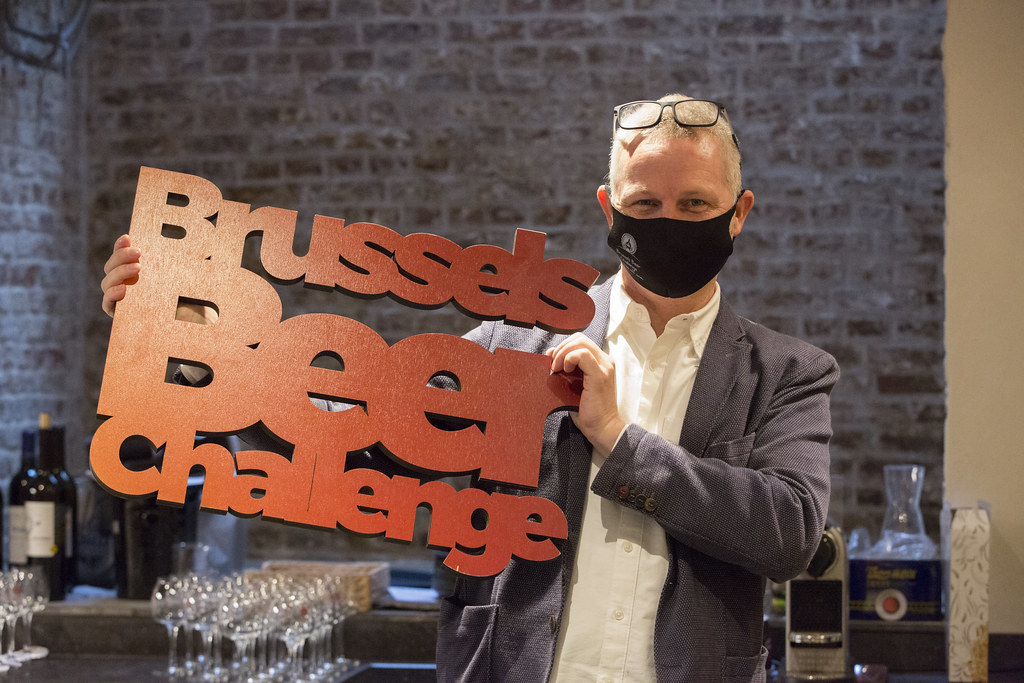
Tasting Director Luc De Raedemaeker (photo by Bart Van der Perre)

Filed Under: Beers, Breweries, Events, Just For Fun, News Tagged With: Awards, Belgium, International

The Battle of Gravensteen Castle

November 16, 2020 By Jay Brooks

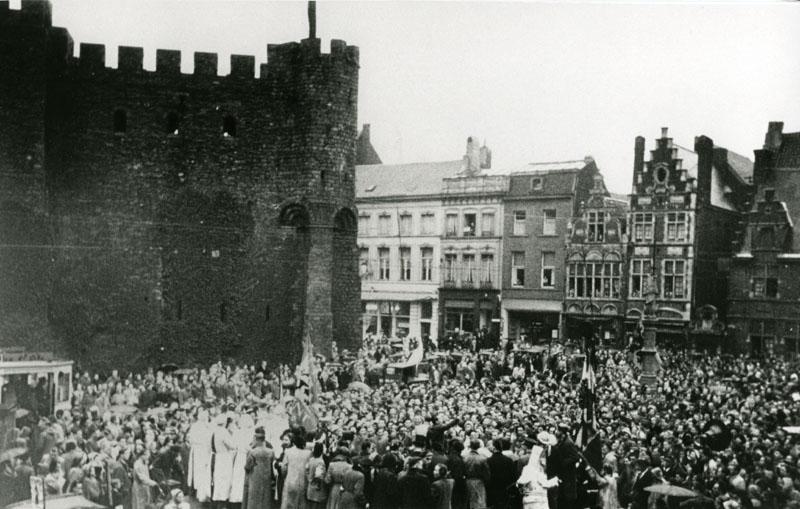
One of the more majestic castles in Belgium is The Gravensteen (which in Dutch means the “Castle of the Counts”). It is a medieval castle built in 1180 and located in Ghent, East Flanders in Belgium. It was only occupied by anyone other than the owners one time, on November 16, 1949, when 138 students from the University of Ghent took over the castle to protest an increase in the price of beer.

Onlookers filled the streets outside the castle in downtown Ghent.

Here is a description of the day’s events from the University of Ghent website, as translated by Google:

On November 16, 1949, 138 students (including one girl) entrenched themselves in the Gravensteen in Ghent. The battlements are adorned with playful student slogans, while the police and fire brigade are treated to overripe fruit and smoke bombs. The student-like violence can only be contained with the greatest difficulty by the police. The student joke is front-page news in the international press. 

Firemen turned their hoses on the students.

In addition to protesting the new beer tax which caused the price to go up, the students also wanted to abolish the use of white helmets by the police. This helmet was replaced by a blue kepi so that the police officers would be less distinguishable from postmen, among others. I don’t know why that was important to the students, but apparently, it was.

Eventually, the police and fire brigade managed to charge the students, but despite this, the students still essentially won the day. Public opinion was on the side of the students and no students were prosecuted and they essentially got what they asked for. To this day, each year it’s commemorated with a parade and a cantus song; and is considered, by the city of Ghent at least, the greatest student prank in its history.

A caricature of the day’s events from shortly after it took place.

The song they sing every year is entitled, of course, “The Battle of the Gravensteen,” and is based on a poem by Flemish teacher and folk poet Eugeen De Ridder. Belgian composer and organist Armand Preud’homme wrote the music for it. Below are the lyrics:

1. In Ghent, the old city,
there was the Gravensteen
For centuries as forgotten,
Abandoned and alone.
Until suddenly student times,
Lust for fun and laughter,
With trickery to renovate the castle,
Without a blow or a blow.

Sprayers of Flanders!
Ghent roars with pleasure:
“‘t Gravenkasteel occupied by students!”
They’re in it! who gets z’er out.
They fear neither club nor water nor spray!
Besiegers if you want to attack.
Watch out, watch out, watch out, watch out!
Ulenspiegel, Ulenspiegel leads them!

2. ‘t Pandoerheir, sealike, Rolls
ladders by the wall,
And takes with water lances,
The ruin under fire.
But apples like grenades,
Explode on the ground,
And the slimey scraps sow, crushing,
Confusion all around.

3. The Student’s Guild, doggedly
Covered with dust and ashes,
Faded its last apple,
His last sod of grass.
Then their battle was over …
But, through the centuries,
Vlaadren’s laughter will commemorate,
The Battle of ‘t Gravensteen!

The Gravensteen Castle today.

Filed Under: Beers, Events, Just For Fun Tagged With: Belgium, History, Politics

NFL Football: Pick The Winners At Brookston Fantasy Games 2020: Pandemic Edition

September 9, 2020 By Jay Brooks

This is the fourteenth year for the Brookston Fantasy Football Games. We’ve had a lot of fun over the last thirteen, so if you love football and beer, consider joining us this year, whether you’ve played in past seasons or are a newcomer. The NFL season begins tomorrow, Thursday, September 10, so you’ve got just a few hours to sign up. And this year is the Pandemic Edition, which just means with so little else to do, everybody should sign up this year. Why not join us?

I’ve again set up two free Yahoo fantasy football games, one a simple pick ’em game and the other a survival pool. Up to 50 people can play each game (that’s Yahoo’s limit, not mine), so if you’re a regular Bulletin reader feel free to sign up for one or even both. It’s free to play, all you need is a Yahoo ID, which is also free. Below is a description of each game and the details on how to join each league and play.

Pro Football Pick’em

In this Pick’em game, just pick the winner for every game each week, with no spread, and let’s see who gets the most correct throughout the season. All that’s at stake is bragging rights, but it’s still great fun.

Also, like the last few years, we’ll be able to keep picking all through the playoffs, so the game will continue through to the Super Bowl, which is pretty cool.

In order to join the group, just go to Pro Football Pick’em, click the “Sign Up” button and look for a link or bottom that reads “Join Group.” From there, follow the path to join an existing private group and when prompted, enter the following information…

Group ID#: 33460 (Brookston Football Picks)
Password: brookston

Survival Football

If picking all sixteen football games every week seems like too much, then Survival Football is for you. In Survival Football, you only have to pick one game each week. The only catch is you can’t pick the same team to win more than once all season. And you better be sure about each game you pick because if you’re wrong, you’re out for the season. Actually a few years ago they added a new feature and I changed the game so to be kicked out you have to be wrong twice. In that way more people stand a better chance of lasting longer into the season. So get one wrong, and you’re still okay, get a second wrong, now you’re gone for the season. Last man standing wins.

Again, like the last few years, we can keep picking all through the playoffs, assuming our luck holds. So the game could even continue through to the Super Bowl.

This year it’s even easier to join, with a new streamlined sign-up process. Just click on this direct link and follow the instructions from there.

With 50 players allowed in each game, there’s plenty of room, so don’t be shy. Sign up for one or both games. In past seasons, I’ve posted the standings on the home page, but wasn’t able to figure out a way to do that recently. Hopefully, I’ll figure out something this year. Anyway, why not join us? Go head to head again me and my team, the Brookston Brew Jays.

Filed Under: Events, Just For Fun, Related Pleasures Tagged With: Announcements, Fantasy, Football, Games, Sports

Bavarian Beer Riots

May 1, 2020 By Jay Brooks

Beginning May 1, 1844, and lasting until May 5, the Beer Riots in Bavaria took place after King Ludwig I of Bavaria decreed a tax on beer. It was due to the rising cost of ingredients and raised the price of a beer by the equivalent of a penny.

Several thousand angry citizens stormed the breweries on the evening of May 1st. The authorities replied with repression, the decree of the Munich police director of May 4, 1844 states:

“The mines in the inns are not tolerated at all from 6 a.m. to 11 a.m. and in the afternoons only as long as no excesses are committed. In the event of excesses, the inns are cleared by the armed forces and the guests are exposed to the danger of being arrested. ”

The police director had not, however, counted on the local Army soldiers’ thirst for beer. These refused to act against the insurgents, and King Ludwig I had to reduce the beer price back to the old price. Order was only restored after the King decreed a 10% reduction in the price of beer. Ludwig I only remained King for 4 more years, when he abdicated following the Revolutions of 1848, and his son, Maximilian II, took his place.

Friedrich Engels, who is most famous for having developed Marxist theory along with Karl Marx, wrote a short article for The Northern Star newspaper a few weeks after the incident.

The Bavarian Beer is the most celebrated of all kinds of this drink brewed in Germany, and, of course, the Bavarians are much addicted to its consumption in rather large quantities. The government laid a new duty of about 100s. ad valorem on beer, and in consequence of this an outbreak occurred, which lasted for more than four days. The working men assembled in large masses, paraded through the streets, assailed the public houses, smashing the windows, breaking the furniture, and destroying everything in their reach, in order to take revenge for the enhanced price of their favourite drink. The military was called in, but a regiment of horse-guards, when commanded to mount on horseback, refused to do so. The police, being, as everywhere, obnoxious to the people, were severely beaten and ill-treated by the rioters, and every station formerly occupied by police-officers had to be occupied by soldiers, who, being upon good terms with the people, were considered less hostile and showed an evident reluctance to interfere. They only did interfere when the palace of the King was attacked, and then merely took up such a position as was sufficient to keep the rioters back. On the second evening (the 2nd of May) the King, in whose family a marriage had just been celebrated, and who for this reason had many illustrious visitors at his court, visited the theatre; but when, after the first act, a crowd assembled before the theatre and threatened to attack it, every one left the house to see what the matter was, and His Majesty, with his illustrious visitors, was obliged to follow them, or else he would have been left alone in his place. The French papers assert that the King on this occasion ordered the military stationed before the theatre to fire upon the people, and that the soldiers refused. The German papers do not mention this, as may be expected from their being published under censorship; but as the French papers are sometimes rather ill-informed about foreign matters, we cannot vouch for the truth of their assertion. From all this, however, it appears that the Poet King (Ludwig, King of Bavaria, is the author of three volumes of unreadable Poems, of a Traveller’s Guide to one of his public buildings &c. &c.) has been in a very awkward position during these outbreaks. In Munich, a town full of soldiers and police, the seat of a royal court, a riot lasts four days, notwithstanding all the array of the military, – and at last the rioters force their object. The King restored tranquillity by an ordinance, reducing the price of the quart of beer from ten kreutzers (3¼ denarius) to nine kreutzers (3d). If the people once know they can frighten the government out of their taxing system, they will soon learn that it will be as easy to frighten them as far as regards more serious matters.

Filed Under: Beers, Just For Fun, Politics & Law, Related Pleasures Tagged With: Bavaria, Germany, History, Politics

Brewhog Determines An Early Spring Bock For 2020

February 2, 2020 By Jay Brooks

groundhog-day

Over in Gobbler’s Knob, in Punxsutawney, Pennsylvania, Phil the Groundhog — a.k.a. the Brewhog — raised up his head this morning and looked around, and this year did not see his shadow. You know what that means? It means an early spring, and earlier spring bock for us. You can see a video of Punxsutawney Phil here. And there’s more information about Groundhog Day from the Punxsutawney Groundhog Club.

groundhog-field-beer

Here’s a new report of this year’s prediction in Punxsutawney.

And here’s a report on it from Time:

Pennsylvania’s most famous groundhog on Sunday declared: “Spring will be early, it’s a certainty.”

At sunrise on Groundhog Day, members of Punxsutawney Phil’s top hat-wearing inner circle revealed the cuddly oracle’s prediction — his 134th, according to the Pennsylvania Tourism Office.

Awoken by the crowd’s chants of “Phil!” the groundhog was hoisted in the air for the assembly to hail before making his decision. He then grasped the glove of a handler as a member of his inner circle announced that spring would come early this year.

The annual event has its origin in a German legend that says if a furry rodent casts a shadow on Feb. 2, winter continues. If not, spring comes early.

punxsutawney-philser

And if you don’t have time to watch all of the deliciously wonderful Groundhog Day film today, here it is in a slightly shorter version just over three minutes.

Filed Under: Just For Fun, News, Related Pleasures

Beer Birthday: The Beer Can

January 24, 2020 By Jay Brooks

beer-generic-can
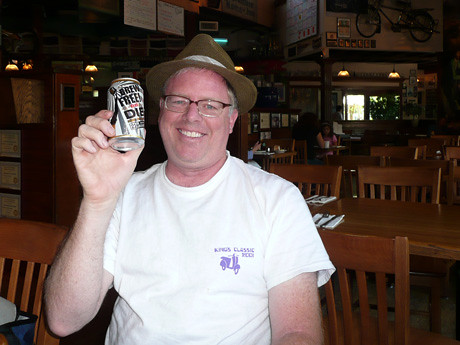
Today is “Beer Can Appreciation Day,” because on this day 85 years ago — January 24, 1935 — the humble beer can was sold for the very first time. So join me in wishing the beer can a happy birthday.

Below is an article I wrote about beer cans alnost 15 years ago telling the story of their history.

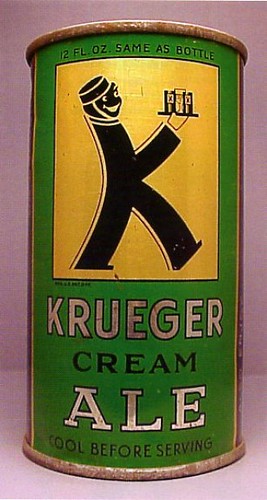
The beer can debuted in 1935, when an otherwise obscure brewery from New Jersey — Gottfried Krueger Brewing Co. — test-marketed them in Virginia, as far from their home market as possible. Breweries may have been initially reluctant, but the public loved cans — they were an overnight sensation. By the end of that first year, Schlitz (then one of America’s biggest brewers) had their beer in cans and every other brewery quickly followed suit.

krueger-can

The beer can was invented by American Can, who patented “Vinylite,” a plastic lining for cans marketed under the brand name “Keglined.” Over the years, the technology continued to improve, from tin to all-aluminum, from cone tops to flat tops, from clumsy openers to pull tops, yet one seemingly intractable problem remained: metal turbity. That’s the technical term for metal leeching into the beer, and consumers increasingly complained about the tainted metallic flavor in canned beer.

krueger-can-back

But then craft beer became popular, and with it better beer evangelists preached that canned beer could never be good. And that remained conventional wisdom for decades, made virtually dogma. During that same time, however, research by the can companies solved the metal turbidity problem. Using an organic polymer — really a water-based epoxy acrylic — that was sprayed inside each can during manufacturing, it could now honestly be said that the beer never touched the metal.

Unfortunately, the only beer in cans was not the type that most beer geeks would willingly quaff. The other great hurdle to getting craft beer in a can was the cost. You could buy a cheap, used bottling line but canning lines were quite massive and very expensive. And the people who made cans were used to selling them to big breweries, and so the minimum run for a can was something on the order of a full railroad car, too many and too expensive for even the biggest microbreweries.

But then the bottom fell out of microbrewing, and by the late-1990s equipment suppliers were also feeling the pinch. Hoping to survive the economic downturn, Canada’s Cask Brewing Systems created an affordable solution. They designed a small manual canning line that was cheaper than the average bottling line and persuaded Ball Corporation (a leading can manufacturer) to significantly reduce their minimum orders. All they had to do was convince someone to try canning their beer.

And so Cask started appearing at trade shows and repeatedly sending literature to breweries. When Dale Katechis, of Oskar Blues, in Lyons, Colorado, first read the pitch, he “just laughed and laughed,” thinking there’s “no way this can be done.” But the more he looked into it, the less he laughed. A few months later — in 2002 — Dale’s Pale Ale was released, the first craft beer to be hand-canned. By 2005, Oskar Blues was the biggest brewpub in the U.S. and Dale’s was declared by the New York Times to be the best pale ale in America.

The Oskar Blues team became evangelists for canned beer with the slogan “the canned-beer apocalypse.” Other small breweries noticed Dale’s success and he was only too happy to show them the light. Today, there are nearly forty [in 2006] craft brewers hand-canning their beer.

There are almost as many kinds of beer in cans as there are styles these days, too, from extreme, strong offerings like Surly’s Furious (a 100-IBU Imperial IPA) and Old Chubb (a Scotch Ale) to more unusual beers like Maui Brewing’s CoCoNut Porter and 21st Amendment’s Hell or High Watermelon to lighter lagers like Sly Fox’s Pikeland Pils and Steamwoks Steam Engine Lager. And now that New Belgium Brewing, one of the largest American craft brewers, is canning their popular Fat Tire Amber Ale, expect to see many more beers in cans in the future.

The biggest challenge is unmaking the dogmatic perception of beer in cans as an evil. It’s a persistent prejudice, but is slowly beginning to change as the advantages to canned beer become more widely known. They keep out all UV light, avoiding the skunky taste of clear and green glass. Cans have lower oxygen levels, meaning longer shelf life. They won’t break; they chill faster and can be taken more places, especially where glass is prohibited. And they’re more environmentally friendly, using less packaging plus more of the can is recyclable, with more used in manufacturing recycled cans. Cans are also lighter, resulting in lower transportation costs and fewer fossil fuels needed.

But in the end, the only thing that matters is how the beer tastes. Side-by-side can vs. draft taste tests reveal that it is virtually impossible to tell the difference. That, coupled with the real advantages of the packaging, means that craft beer in cans is where the future of craft beer is heading.

shaun-cans
Shaun O’Sullivan, co-owner of 21st Amendment, showing off one of his early can designs. 21A was the third brewery in California to can their beer.

When I originally wrote that article, around two dozen small breweries were canning their beer, and when I first posted this in 2011 that number had quadrupled, with over 100 small brewers canning their beer. In 2015, the Canned Beer Database lists 480 breweries offering their beer in cans. It’s great to see good beer in cans become more and more common, and we should continue to see more canned beer from craft brewers in the future. Why not pick up some today and see for yourself how good it now is from a can, especially as we celebrate “Beer Can Appreciation Day.”

krueger-cream-ale-flat

Filed Under: Beers, Breweries, Events, Just For Fun Tagged With: Cans, History

« Previous Page
Next Page »

Find Something

Northern California Breweries

Please consider purchasing my latest book, California Breweries North, available from Amazon, or ask for it at your local bookstore.

Recent Comments

  • Bob Paolino on Beer Birthday: Grant Johnston
  • Gambrinus on Historic Beer Birthday: A.J. Houghton
  • Ernie Dewing on Historic Beer Birthday: Charles William Bergner 
  • Steve 'Pudgy' De Rose on Historic Beer Birthday: Jacob Schmidt
  • Jay Brooks on Beer Birthday: Bill Owens

Recent Posts

  • Beer In Ads #5389: Point & Brunswick Bock Beer November 10, 2026
  • Historic Beer Birthday: Edward Cecil Guinness November 10, 2026
  • Historic Beer Birthday: Jacob Betz November 10, 2026
  • Beer In Ads #5388: Bock Beer Vats In The Brewers Hall November 9, 2026
  • Historic Beer Birthday: Peter Barbey November 9, 2026

BBB Archives

Feedback

Head Quarter
This site is hosted and maintained by H25Q.dev. Any questions or comments for the webmaster can be directed here.