Brookston Beer Bulletin

Jay R. Brooks on Beer

  • Home
  • About
  • Editorial
  • Birthdays
  • Art & Beer

Socialize

  • Dribbble
  • Email
  • Facebook
  • Flickr
  • GitHub
  • Instagram
  • LinkedIn
  • Pinterest
  • RSS
  • Twitter
  • YouTube

Powered by Genesis

My Home County Healthiest In State Despite Higher Than Average Binge Drinking

April 3, 2012 By Jay Brooks

health
My family and I live just north of San Francisco, in Marin County. We moved here a number of years ago to be closer to my wife’s family, who live in Sonoma County. When she was working in San Francisco, Marin was in the middle of work and family, so it made sense. There’s a lot of good things to recommend here, though it is a very expensive place to live, and in fact a few years ago I saw that it was the third-most expensive county for real estate in the United States.

Our local newspaper, the Marin Independent Journal (or I.J.) — which in the interest of full disclosure is part of the Bay Area Newsgroup, the group I write my newspaper column for — had an interesting headline today about the health of Marin’s residents. In Marin County ranked healthiest county in state for third year in a row, despite residents’ love of alcohol, the author reports on a new study recently released by the neo-prohibitionist Robert Wood Johnson Foundation, along with the University of Wisconsin Population Health Institute. This is the third year of the survey, which ranks the health of America’s counties. For the third straight year Marin County was declared the most healthy California county. For an equal number of years, Marin also has the dubious distinction of a higher than average level of binge drinking.

The percentage of Marin residents who told the pollsters they had engaged in binge drinking within the past 30 days — 24 percent — exceeded the state average of 17 percent and the national benchmark of 8 percent. The survey defines binge drinking as consuming more than four alcoholic beverages on a single occasion, if you’re a women, and five drinks if you’re a man.

But maybe that’s the case because there’s little or no correlation between the two, or at least not the correlation that the neo-prohibitionists who funded the study would prefer. They assume, for primarily political and philosophical reasons, that binge drinking is unhealthy. But what if it’s not? What if it has more to do with the way it’s now defined, which again has more to do with politics than reality. The way “binge drinking” is defined has greatly narrowed over the past few decades which is at least one reason why anti-alcohol groups keep insisting that binge-drinking is such a growing societal problem. But at the same time, several recent studies and meta-studies have revealed that people who drink moderately tend to live longer than those who abstain, an inconvenient fact that is rarely mentioned by neo-prohibitionist groups because it doesn’t fit with their agenda. But even worse, from their point of view, some of these same studies have concluded that even people who binge drink tend to be healthier and live longer than the total abstainers. So perhaps binge drinking and health are more closely associated than we think, just not in the way that neo-prohibitionists would prefer. The least healthy county for which there’s data, Del Norte, has a lower rate of binge drinking (10%) than the healthiest.

But as even the Robert Wood Johnson Foundation makes clear in the own press release about the survey, “healthier counties are no more likely than unhealthy counties to have lower rates of excessive drinking.”

Here’s the top counties in states, followed by the county’s “excessive drinking” percentage, followed by their state’s average, with the “national benchmark” being 8%:

  1. Alabama (Shelby): 13%/12%
  2. Alaska (Southeast Fairbanks): 13%/19%
  3. Arizona (Santa Cruz): 18%/19%
  4. Arkansas (Benton): 12%/12%
  5. California (Marin): 24%/17%
  6. Colorado (Pitkin): 30%/18%
  7. Connecticut (Tolland): 17%/18%
  8. Delaware (New Castle): 21%/19%
  9. Florida (St. Johns): 21%/16%
  10. Georgia (Fayette): 18%/14%
  11. Hawaii (Honolulu): 18%/19%
  12. Idaho (Blaine): 23%/15%
  13. Illinois (Kendall): 23%/19%
  14. Indiana (Hamilton): 17%/16%
  15. Iowa (Winneshiek): 19%/20%
  16. Kansas (Riley): 22%/15%
  17. Kentucky (Oldham): 16%/11%
  18. Louisiana (St. Tammany): 19%/15%
  19. Maine (Sagadahoc): 17%/17%
  20. Maryland (Howard): 14%/15%
  21. Massachusetts (Dukes): 29%/19%
  22. Michigan (Leelanau): 20%/18%
  23. Minnesota (Steele): 18%/19%
  24. Mississippi (DeSoto): 10%/11%
  25. Missouri (St. Charles): 24%/17%
  26. Montana (Gallatin): 22%/19%
  27. Nebraska (Cedar): 23%/19%
  28. Nevada (Douglas): 20%/19%
  29. New Hampshire (Merrimack): 16%/18%
  30. New Jersey (Hunterdon): 18%/16%
  31. New Mexico (Los Alamos): 11%/13%
  32. New York (Putnam): 21%/17%
  33. North Carolina (Wake): 15%/13%
  34. North Dakota (Griggs): 19%/22%
  35. Ohio (Delaware): 20%/17%
  36. Oklahoma (Cleveland): 16%/14%
  37. Oregon (Benton): 15%/16%
  38. Pennsylvania (Union): 16%/18%
  39. Rhode Island (Bristol): 17%/19%
  40. South Carolina (Beaufort): 20%/14%
  41. South Dakota (Brookings): 20%/19%
  42. Tennessee (Williamson): 15%/9%
  43. Texas (Collin): 13%/16%
  44. Utah (Morgan): 9%/9%
  45. Vermont (Chittenden): 20%/19%
  46. Virginia (Fairfax): 20%/16%
  47. Washington (San Juan): 21%/17%
  48. West Virginia (Pendelton): 12%/10%
  49. Wisconsin (St. Croix): 31%/24%
  50. Wyoming (Teton): 22%/17%

In every single case, for the healthiest county in every one of the 50 states, their “excessive drinking” percentage is above the national benchmark, and in many cases well above it. 38 of the 50 states’ healthiest counties are at least twice the national benchmark and six are within a point, or more, of tripling it. Every state’s binge drinking average is well above the national average, which seems strange. And in 35 of the states, the healthiest county also has a binge drinking percentage that’s the same or higher than the state average, too. But the obvious takeaway is what you’d expect given total mortality studies, which is that there’s an inverse correlation between binge drinking and health. The counties with the healthiest residents also have higher numbers of binge drinkers. That much is obvious and is supported by the data, despite the story being spun being very different, even the opposite of what conclusions can be drawn from the numbers. Not that they’re making it easy to see. I had to look at each state and then each county’s records to make a chart of this somewhat damning data.

Of course, part of this is how meaningless our definition of binge drinking has become. Including people who drink five or more drinks in a single setting once a month or even once a year distorts the real issues of problem drinkers. It inflates the numbers, which is good if your agenda is to make false accusations about how bad alcohol is for society but terrible if you really want to adress those problems.

Here in California, the five healthiest counties are:

  1. Marin
  2. Santa Clara
  3. San Benito
  4. Placer
  5. San Mateo

Every single one of the ten healthiest counties in California have an excessive drinking rate above national benchmark, too.

Larry Meredith, director of the Marin County Department of Health and Human Services, is quoted in the IJ’s article, saying. “Our strategy must continue — to eliminate health disparities, and conditions that undermine a long and happy life.” Except that he keeps insisting that binge drinking, as defined by the study, “continues to be an issue,” despite the fact that the same study’s numbers seem to indicate the opposite. In the healthiest counties across the nation, binge drinking, as they define it, is higher in every instance.

Real binge drinkers, the more undefinable people who simply keep drinking and rarely ever stop, are not really captured by this type of survey, because they’re lumped together with responsible people who on occasion drink a little more than usual, whether in celebration of something or to drown their sorrows. As long as we keep drawing more and more people into the category of “binge drinkers,” we dilute the real problem. When that mistake is obvious even by a study conducted by an anti-alcohol organization, and then those results all but ignored, it exposes the propaganda and dishonesty of their agenda.

It’s almost funny to see Marin County’s own anti-alcohol organization, Alcohol Justice (who until last year were the Marin Institue) try to distance themselves from this. Their public affairs director, Michael Scippa, says AJ “shouldn’t be faulted for not being more effective in reducing Marin County’s alcohol consumption.” He lists a number of excuses, such as “availability and Marin being a mostly affluent community” and that “[they’re] constantly battling an industry that has enormous resources.” But what is he apologizing for? That Marin County has the state’s healthiest people living in it, despite ignoring his group’s propaganda? Maybe it’s not the people, but the propaganda that’s wrong? Because people all over the country are ignoring his advice and are all the healthier for it.

Filed Under: Editorial, Just For Fun, Politics & Law Tagged With: Anti-Alcohol, California, Health & Beer, Northern California, Prohibitionists, Statistics, United States

Anatomy Of A Propaganda Piece

March 21, 2012 By Jay Brooks

anatomy-of-murder
With Alcohol Justice promoting it, I just knew there had to be more to the CNN story Movies May Increase Binge Drinking in Teens. The article is based on a study published in the journal Pediatrics with the more benign title Alcohol Consumption in Movies and Adolescent Binge Drinking in 6 European Countries. But either way, Hollywood is, of course, the bogeyman. The study “surveyed 16,500 students ages 10 to 19 from Germany, Iceland, Italy, the Netherlands, Poland and Scotland.”

The students were asked how often they drank five alcoholic beverages during one sitting [interesting a European study has adopted the ridiculous U.S. definition of “binge drinking”], and about the types of movies they watched. Participants were given a list of 50 movies to choose from, which included many top box-office hits from the U.S. The number of drinking scenes was tallied for each movie.

I don’t have the resources to pay to see the whole study, so I don’t know what films are on the list, but the first thing I have to wonder is how many of those films are age-appropriate for 10-year olds? Many Hollywood blockbusters would be at least “PG-13” (so no 10-12 year olds allowed) or “R” (no 10-17 year olds allowed). Are there many movies with “drinking scenes” that are “G” or that every parent would find appropriate for their 10 through 19 year old child? There’s also no breakdown of how many kids were 10, 15, 19, etc., but I have to believe there’s a vast difference between the effect of watching a film on a ten-year old and a young adult, age 18 or 19. The researchers apparently also considered other so-called “risk factors,” and somehow accounted for each “teen’s levels of rebelliousness or sensation-seeking, peer drinking levels, family drinking patterns, affluence and gender.” That’s a lot of data on 16,500 kids, and almost none of it could be considered the “hard facts” type.

The overall results were that “27% of the sample had consumed >5 drinks on at least 1 occasion in their life.” So roughly 1 out of 4 of the “kids” had consumed 5 drinks at least once, and possibly ONLY once, in their life. And of those 16,500, some of the “kids” were legally allowed to drink 5 beers if they wanted to. In Germany, Italy and the Netherlands, the minimum age for drinking is 16. In Poland and Scotland it’s 18 (though once source I have says it’s 16 in Poland). In Iceland it’s 20. So for at least half the countries where the kids were surveyed, they were permitted to drink at least beer 4 out of the 10 ages of “kids” in the study.

For five-sixths of the countries, at least some of the ages of children surveyed were likewise legally allowed to drink alcohol. Like the age breakdowns, there’s no information available (at least to me) about how many of those surveyed were from which country. Given all the supposed control factors they accounted for, the legal age at which people in the surveyed countries are permitted to drink alcohol seems nakedly absent and, at least to my way of thinking, a rather important omission.

And one last comment about their methodology, such as it was. To determine each film’s — I don’t know, “quotient,” “unworthiness” or whatever — “the number of drinking scenes was tallied for each movie” by the researchers. But is the sheer number of times there’s a scene of people drinking in any way relevant? Is there no context to each scene? Are there not positive and negative ways to portray drinking alcohol? I already know the answer to that one, as obviously the researchers are convinced that ANY depiction of people drinking alcohol they consider wrong, but of course a second’s thought will reveal that to be patently nonsense. Just counting how often people are seen drinking alcohol in a film really tells you nothing about how influential it will be, or indeed, if it registers anything at all. Shown being consumed responsibly, it could just as easily be a positive influence.

Personally, I’m much more concerned about my kids seeing casual violence in films than drinking. But there, as well as in America, research continues to claim that there’s a direct “link between drinking in movies and adolescent alcohol consumption habits.” This latest study’s conclusion likewise claims that the “link between alcohol use in movies and adolescent binge drinking was robust and seems relatively unaffected by cultural contexts.”

But in the last paragraphs — well after most people probably stopped reading — was what I’d been thinking as I read this, that “even though the European study shows a strong association between what is seen on the movie screen and binge drinking, it cannot show cause and effect.” Like Otto Preminger’s Anatomy of a Murder, not everything is as it seems.

And despite the tone of the story up until that point having been confidently certain, as expressed in the headline’s more movies, more binging (or better mo movies, mo binging), it may not be as certain as they would have you believe. Here’s the smoking gun.

It may be that binge drinking teens seek out movies that have alcohol scenes, or it could be that seeing scenes of alcohol use in movies makes them more likely to binge drink. More research is needed to confirm these findings.

I continue to be troubled by the wide range of ages surveyed, because in my experience those are the ages when people change more in a shorter period of time than at any other time in their entire life. The conclusion suggests that to combat this scourge, parents should “go to the movies with [their kids] and discuss what you’re seeing. What you say matters more than what one TV show or one movie says.” In other words, be a parent. So is this a problem of parenting or the movies? Should movies be stripped of adult content because kids might watch them? That does seem to be a common strategy by neo-prohibitionist groups, especially with regard to advertising.

In the end, this seems like yet another study riddled with more questions than answers. But, as is typical, those questions — if the media raises them at all — are buried at the end of the article, well after the average person has given up reading and has moved on to something else. What we’re left with is a “survey” (and we all now how teenagers always tell the truth about what they’re doing) of kids in six varied nations (with different minimum drinking ages) who are of widely different ages (from a childlike ten to a young adult 19) who appear to binge drink more (or at least once) if they see Hollywood blockbuster movies (or it may be teens who drink prefer those movies). Tell me again how exactly that’s news?

Filed Under: Beers, Editorial, Politics & Law Tagged With: Anti-Alcohol, Europe, Film, Mainstream Coverage, Prohibitionists, Propaganda, Statistics

Creativity & Beer

March 21, 2012 By Jay Brooks

lightbulb
One of the unspoken benefits of beer is that it’s a very useful relaxation tool. After a hard, stressful day of work, a tasty beer is just the thing to calm one’s nerves. It would be nearly impossible to quantify, but I have to wonder how much better off many people are because of the relaxation afforded them through the simple act of drinking a beer. How many didn’t do something that they might later regret had they remained tense, stressed and on edge. It’s worth considering, especially as the neo-prohibitionists increasingly insist that beer has no health benefits. But the mental health benefits that most of us get from a calming glass of beer can’t be ignored.

But there’s apparently one more mental health benefit to a beer, as reported recently in the Wall Street Journal (and thanks to Jeff B. for sending me the link). The essay, by Jonah Lehrer, is How To Be Creative, and the teaser subtitle give a nutshell account of what’s to come. “The image of the ‘creative type’ is a myth. Jonah Lehrer on why anyone can innovate—and why a hot shower, a cold beer or a trip to your colleague’s desk might be the key to your next big idea.” The fascinating story is about where creativity and innovation come from, something science has only very recently even tried to explain. The essay discusses several theories and gives examples of different ways that creativity is sparked and influenced. One of those, of course, is through drinking a glass of beer.

Interestingly, Mr. Beeman and his colleagues have found that certain factors make people much more likely to have an insight, better able to detect the answers generated by the aSTG [superior anterior temporal gyrus]. For instance, exposing subjects to a short, humorous video—the scientists use a clip of Robin Williams doing stand-up—boosts the average success rate by about 20%.

Alcohol also works. Earlier this year, researchers at the University of Illinois at Chicago compared performance on insight puzzles between sober and intoxicated students. The scientists gave the subjects a battery of word problems known as remote associates, in which people have to find one additional word that goes with a triad of words. Here’s a sample problem:

Pine Crab Sauce

In this case, the answer is “apple.” (The compound words are pineapple, crab apple and apple sauce.) Drunk students solved nearly 30% more of these word problems than their sober peers.

What explains the creative benefits of relaxation and booze? The answer involves the surprising advantage of not paying attention. Although we live in an age that worships focus — we are always forcing ourselves to concentrate, chugging caffeine — this approach can inhibit the imagination. We might be focused, but we’re probably focused on the wrong answer.

And this is why relaxation helps: It isn’t until we’re soothed in the shower or distracted by the stand-up comic that we’re able to turn the spotlight of attention inward, eavesdropping on all those random associations unfolding in the far reaches of the brain’s right hemisphere. When we need an insight, those associations are often the source of the answer.

So if you’re having trouble with your latest creative project, stuck somewhere with no solution in sight? Relax, don’t worry, have a beer. That may prove to be just the thing to free your mind and in the process unlock the creativity necessary to solve your problem. Liquid gold indeed.

Filed Under: Beers, Editorial, Politics & Law, Related Pleasures Tagged With: Science

Now Made With Craft Beer

March 19, 2012 By Jay Brooks

food-placesetting-blue
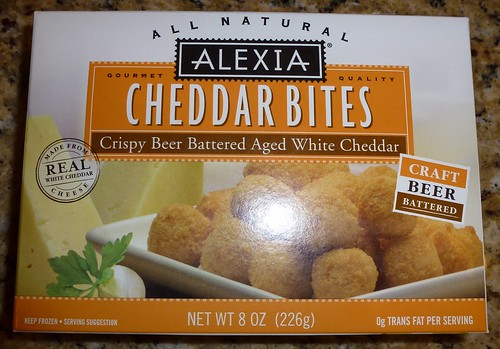
So I’m walking through the grocery store the other day; and I’m hungry, which is never a good combination. I’m perusing the frozen food section, when something catches my eye. It’s Cheddar Bites, or more specifically “Crispy Beer Battered Aged White Cheddar” by Alexia. Now it’s not that they’re beer-battered — which I’m pleased about — but it’s nothing new. That’s not what caught my attention. On the box is a small tri-colored square, at an angle, to the right of the main label, declaring that these cheddar bites aren’t made with just any old beer, but are “Craft Beer Battered!” Woo Hoo! We’ve come a long way, baby, when that becomes a selling point. It made me laugh a bit, and naturally there’s no information about what craft beer was used for the batter. The company’s in Washington, so that’s a clue, I suppose.

Still, I find it interesting that a food company thought it was enough of a selling point to include it as a separate element on the packaging. That certainly suggests that they believed it would appeal to a certain type of consumer, and specifically one for whom the fact that the beer was “craft beer” had some meaning. That’s an interesting development. And it worked, I suppose, since I bought them. The family verdict was mixed. My wife thought they were just “meh,” whereas I liked them just fine; though in fairness my tastes run toward anything that’s not too good for me and can be considered comfort food.

Has anyone else seen similar labeling on packaged foods? It’s the first time I’ve noticed it, but I’m curious if this is happening enough to be considered the beginning of a trend.

cheddar-bites

Filed Under: Beers, Editorial, Food & Beer, Just For Fun Tagged With: Comfort Food, Food, Humor

Oh, The Horror: Children Recognize Beer Brands

March 19, 2012 By Jay Brooks

beer-kids
Another classic propaganda study was just released in Britain, using the all-too-common meme of “think of the children” as the wedge to attack alcohol advertising. Ever since Prohibition ended miserably here in the U.S., anti-alcohol groups turned their attention to other methods of crippling alcohol, and attacking advertising has been a favorite strategy. It’s quite common in the UK, too, as similar groups there have no doubt witnessed its effectiveness on our side of the pond. This one is being reported by the Daily Mirror as More Children Familiar with Alcohol Brands Than Snacks, which is no doubt exactly the alarm that the anti-alcohol organization behind it was hoping to raise. The so-called “study” the Mirror is reporting on was conducted for Alcohol Concern, a “national charity on alcohol misuse” which certainly sounds like one of our American organizations that cover themselves in the cloak of health and concern for the children.

So let’s look at the study. 400 children, ages 10 and 11 (the same age as my son Porter), were shown brand names and images. Of those, 79% correctly recognized Carlsberg as a beer, or at least as alcohol. The same percentage also correctly identified Smirnoff as alcohol whereas only 74% recognized Ben & Jerry’s Ice Cream (which must have greatly chagrined Ben & Jerry’s ad agency). Oh, the horror! From there, of course, the leap is made that tighter controls need to be placed on the advertising of alcoholic beverages lest the kiddies remain able to know what’s alcohol and what’s not. Because if children know which brands are alcohol, then obviously they will drink them. If then can identify them, then obviously they’re being targeted and all ads therefore “encourage immoderate consumption.” Alcohol Concern asserts that alcohol advertising must be “not attractive to children,” as if adults and children like completely different things.

Okay, a couple of things. First, being able to identify which brands are alcoholic drinks and which are not does not mean the recognition came from advertising. That almost 4 out of 5 kids could identify Carlsberg, one of the best-selling beers in the UK, is just as likely due to its popularity, being in those kids’ homes, sitting in the refrigerator, and seeing their parents drinking it. Or seeing it when they’re at the local football game, with family and family friends drinking it while watching the game; or at a picnic; or they may see it walking the supermarket aisles as their parents shop. There are many places where kids can see alcohol brands, including many positive experiences, that do not have to do with advertising. Kids do not have tunnel vision and only retain what they see in ads on television. Yet Mark Leyshon, from Alcohol Concern, insists their “study” does “provide more evidence that alcohol marketing messages are getting through to young people well before they are legally able to buy alcohol.” I’d say that’s true only if you ignore reality.

On some level, isn’t it good news that kids know the difference between alcohol and soda? And guess which one they prefer? Think about it. Do kids like bitter tastes like beer or sugary sweet flavors like soft drinks? Study after study I’ve seen, and not just ones by neo-prohibitionists, always show young people prefer sweet tastes over bitter ones. I know my kids do. Don’t yours? So it’s in their interest — and yours and society’s if the anti-alcohol nutjobs are to be believed — if they don’t accidentally reach for a bottle of Carlsberg thinking the green bottle contains Sprite or 7Up? Knowledge should be a good thing, but apparently Alcohol Concern thinks it would be better if our children were completely ignorant.

Second, the study itself seems overly simplistic at best. The kids were shown “the brand names and logos of common alcohol products, as well as images from TV alcohol advertisements,” along with “brand images, logos and TV adverts for popular non-alcoholic products such as soft drinks and breakfast cereals.” Then it was multiple choice. The kids could choose for each image they were shown between three choices: “food,” “soft drink” or “alcoholic drink.” I can’t speak for their ten and eleven year olds, but I’m fairly certain my own son (who’s 10-1/2) could do a pretty good job of just guessing between those three choices. Most successful brand images work because the association with the products are natural or complimentary, not inscrutable and hard to figure out.

But even so, would it have been better for children’s health if they could more easily identify the “soft drinks” or “sugary snacks,” which ultimately are at least as bad for their health as alcohol? I know that kids under 18 in civilized places (or 21 in places less so) should not be drinking alcohol, and I accept that children should not have unrestricted access to it. But the fact remains that, all things being equal, the excess sugar and other chemicals in soft drinks and many, many processed foods are terrible for everybody, children included. Yet Alcohol Concern — and indeed most anti-alcohol groups — seem to have no difficulty with the many unhealthy products in the world and are single-mindedly convinced that it’s alcohol alone that it is the cause of society’s woes.

For me personally, as a parent, I find this concern completely absurd, unfounded and misguided. My kids could name more alcohol brands than the average ten and seven-year old, because it’s “daddy’s work.” Their hearts sink every time a package arrives on our doorsep and it’s not a new book or toy, but instead is beer. Our house is full of beer. It’s lining the hallway, in boxes in the foyer, sitting around the dining room, the kitchen, the garage, and stuffed into four refrigerators. But my kids have no interest in it whatsoever. Zip, zero, nada. They know it’s “for adults.” And that’s partly why I’m convinced these sorts of attacks on alcohol advertising using children as a shield are not about the kids in the least. They never are. I’m glad my kids know the difference between what they’re allowed to drink and what they’re not. Don’t all parents teach their kids what they can drink? In our home, it’s simple, really. No soda, no beer and no alcohol. They know, and that knowledge is powerful and effective. Just say know.

Filed Under: Beers, Editorial, Politics & Law Tagged With: Anti-Alcohol, Prohibitionists, Propaganda, Statistics, UK

Drowning One’s Sorrows May Be Genetic

March 16, 2012 By Jay Brooks

fruitfly
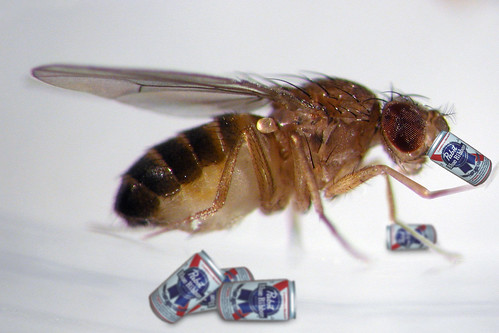
The March issue of Science, touted as “the world’s leading journal of original scientific research, global news and commentary, included an article entitled Sexual Deprivation Increases Ethanol Intake in Drosophila. Which may not mean much, until you realize that in plain English it’s essentially “fruit flies who’ve had their sexual advances rejected drink more alcohol.” Here’s the abstract:

The brain’s reward systems reinforce behaviors required for species survival, including sex, food consumption, and social interaction. Drugs of abuse co-opt these neural pathways, which can lead to addiction. Here, we used Drosophila melanogaster to investigate the relationship between natural and drug rewards. In males, mating increased, whereas sexual deprivation reduced, neuropeptide F (NPF) levels. Activation or inhibition of the NPF system in turn reduced or enhanced ethanol preference. These results thus link sexual experience, NPF system activity, and ethanol consumption. Artificial activation of NPF neurons was in itself rewarding and precluded the ability of ethanol to act as a reward. We propose that activity of the NPF–NPF receptor axis represents the state of the fly reward system and modifies behavior accordingly.

Science Magazine’s News Blog featured the article in more layman’s terms as Sexually Rejected Flies Turn to Booze, and described the results as follows.

Offer a male fruit fly a choice between food soaked in alcohol and its nonalcoholic equivalent, and his decision will depend on whether he’s mated recently or been rejected by a female. Flies that have been given the cold shoulder are more likely to go for the booze, researchers have found. It’s the first discovery, in fruit flies, of a social interaction that influences future behavior.

Apparently that’s not the outcome the scientists expected.

The researchers expected all of the flies to prefer alcohol, but that’s not what they found. “You see that the mated males actually have an aversion to the alcohol-containing food,” Shohat-Ophir says. “And the rejected males have a high preference to that food with alcohol.” On average, the rejected males drank four times more alcohol than the mated ones, her team reports.

In the New York Times’ coverage — Learning From the Spurned and Tipsy Fruit Fly — they make the leap to human addiction, which I find a little troubling. “Fruit flies apparently self-medicate just like many humans do, drowning their sorrows or frustrations for some of the same reasons.” Which is okay, so far, but then they quote an alcohol addiction researcher who was not involved in the study, Dr. Markus Heilig, who believes the study “also supported new approaches to treating alcohol dependence,” including the investigation of “several compounds aimed at blunting alcohol urges.” And earlier in the Times’ reporting, they state that the study “suggests that some elements of the brain’s reward system have changed very little during evolution, and these include some of the mechanisms that support addiction.”

But that presupposes that the urge to drink alcohol is always bad, something that people should never do, and that it necessarily leads to addiction. And that, of course, it not the least bit true. Once upon a time, it meant the difference between living long enough to procreate and dying without issue. When it was safer to drink than the water, those humans with a greater tolerance for alcohol survived while those that couldn’t did not. If you’re reading this right now, it’s likely you can thank your ancient ancestors’ ability to handle their drink.

Even today, people who drink moderately tend to outlive those who never drink alcohol. Even those that drink heavily still tend to outlive those who never drink alcohol. It’s just that small fraction of the population that cannot handle alcohol and can be considered alcoholics, whether genetic or social or simply weak-willed. And for their failings, the world is cursed with neo-prohibitionists hell bent on the idea if even one person can’t handle alcohol, then dagnabbit no one should be able to enjoy it.

But so much of this type of research seems to play into their hands, making the assumption — very, very wrong in my opinion — that alcohol is bad for people, and bad for society, and that drinking alcohol always leads to alcoholism. It’s usually the starting premise. But it’s a false premise, because the majority of people who drink alcohol do so responsibly and in moderation and do not fall prey to alcoholism after their first (or tenth, or 100th or 1000th) sip.

And like the rejected fruit fly, sometimes a beer is just the thing to help get over a bitter rejection, or just a long, tough day at work. The calming effect of a beer after work or with dinner is part of a healthy lifestyle for many, many people. For a majority of people, there’s nothing wrong with that, and it does not signal the onset of addiction or any sort of problem whatsoever. And that’s my takeaway from the fruit fly, too. Sometimes you just need a beer to drown your sorrows.

drunk-fruitfly

Filed Under: Editorial, Just For Fun, News, Related Pleasures Tagged With: Nature, Science

The Great Beeramid Of Calories & Carbs

March 14, 2012 By Jay Brooks

food-pyramid
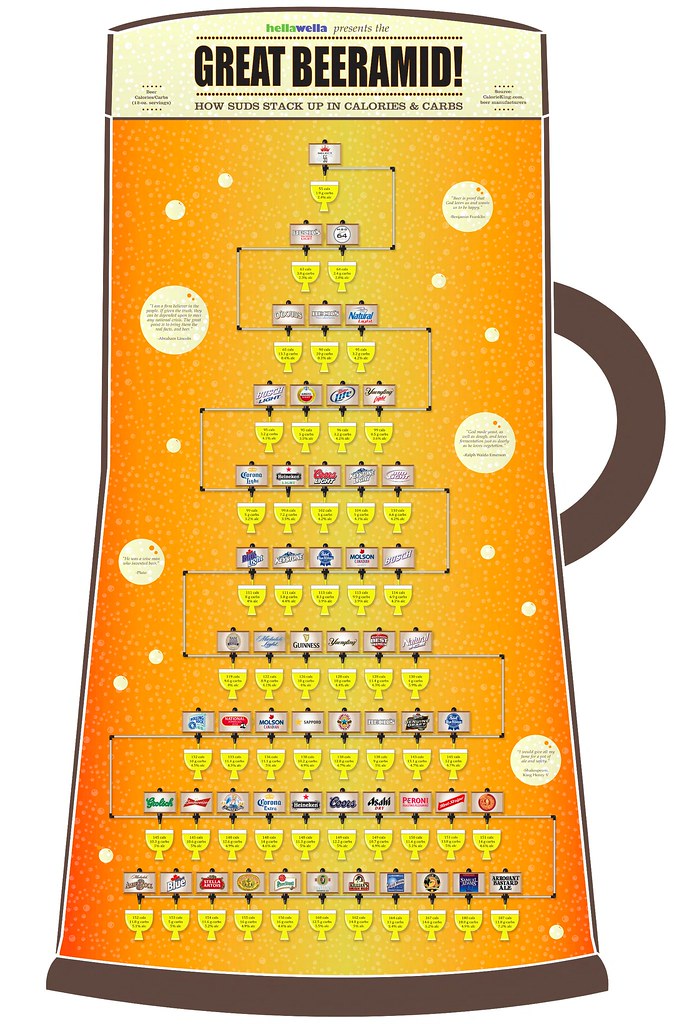
Here’s an interesting infographic, though for most craft beer drinkers it won’t be of much use. It’s a pyramid — or beeramid — showing many of the most popular mainstream beers with their calories and carbohydrates shown, ranking them with the lowest in both at the top of the beeramid and the beers with the most calories and carbs as the foundation on the bottom.

beeramid
It’s hard to read at this size, but you can see it full size at HellaWella.

It was created by HellaWella, a health-oriented website. And while I realize they mean well, I’ve never been convinced that calories or carbohydrates should ever be part of the decision-making process for choosing a beer. I realize other people feel differently, but watching the caloric content necessarily means sacrificing flavor so you can drink more. I say drink less, but better.

They believe that with their chart “you can figure out ahead of time how to keep the calories and/or carbohydrates to a minimum.” But by that criteria, Budweiser’s Select 55 is the best choice. The Top 10 include two non-alcoholic beers (which frankly shouldn’t even be here) and the other eight are low-calorie light beers, not one of which would I voluntarily drink or ever order at a bar or restaurant. But that’s the problem with these health suggestions. When you stick to the numbers, health means giving up what makes beer a great choice in the first place: flavor. If I have to give up beer that tastes of anything to be healthy, to my way of thinking there’s just no point. Except that beer is already healthy (even though the anti-alcohol folks have seen to it breweries aren’t aloud to say so) and since moderation is already the best course to take, why anyone would ever choose a beer with the lowest calories is beyond me.

So I’m a sucker for infographics, and this one is very well done, but in the end its flaw is in the intention, which is to steer people to the blandest possible beers imaginable, supposedly in the interest of health. That’s a mistake, I believe, and not part of a healthy lifestyle. Health also includes mental, as well as physical, health. If drinking responsibly and moderately means (according to the most recent dietary guidelines) having no more than 4 beers in a singe day (3 for a woman) and no more than 14 in a week (7 for women) then you should make them count. Choose the most flavorful, best-tasting beer you can. The difference in calories or carbs just isn’t worth the sacrifice. Skip the piece of cake and go for the better beer. To me, that’s a healthy choice.

Filed Under: Beers, Editorial, Just For Fun Tagged With: Health & Beer, Statistics

Martha Stewart Declares Beer “The New Thing”

March 7, 2012 By Jay Brooks

martha-stewart
I should confess right up front that I’ve never been a big fan of Martha Stewart. I’m not really sure why, but her advice and how she presents it has always bugged me for some reason. I guess for me, it always comes across as trying to be for everyone, the common people, but can really only be followed by people with a lot of free time and money. Even my wife disagrees with me on this one, so I have to conclude it’s just a weird personal prejudice I have about her.

So Stewart was on the Today show this morning in a segment entitled “Bottoms Up! Martha throws a beer party.” And yes, I know it’s great whenever craft beer gets attention from the mainstream media, but the curmudgeon in me just can’t let it pass uncritically. Here’s how it went down.

Matt Lauer begins the segment by saying that “forget the college keg, beer has grown up. Now it’s all about pairing some cold brew with great snacks.” So those are the two choices of what beer can be, “college keg” or “grown-up?” I know it was just an off-hand remark, but sheesh. And being “grown-up” means pairing it with snacks? It just seems like they could do so much better if they really cared about it.

So in comes Martha Stewart, beer savvy housekeeping diva, and declares “a beer tasting party is like the new thing.” That statement reminds me of the actor or musician who finally has a big hit after toiling in his or her craft for thirty years and is suddenly hailed as an overnight success. For millions of people, beer tasting has been a pretty big deal for quite some time now, but now that it’s reached Martha’s notice it’s “the new thing.”

But before she goes too crazy, Lauer reigns her in, suggesting that she “keep it casual, it doesn’t have to be fancy.” Naturally, you should keep it casual, because it would be absurd to suggest otherwise. Stewart, who usually seems at ease in front of the camera, looked unsure of herself talking about the beer, and even appeared to skirt any questions about it.

After showing off the chalkboard oilcloth table cloth where people can use chalk so they “can write their impressions of the beer” right on the table, Lauer asks her what beers are on the table, and guesses, “light, dark and amber.” Stewart replies “yes,” explaining that it’s because “each have a very specific kind of quality.”

When they moved over to the food, she perked up and appeared much more comfortable and at ease. Her demeanor seemed far more confident, since she was now in her element. But the weird thing is, the food seemed much more fancy, with onion jam made with balsamic vinegar and maple syrup and cocktail meatballs with three kinds of meat. That’s not “keeping it casual” to me. So in keeping things “casual” because it’s beer, the food doesn’t stay casual? That seems weird to me. Beer can’t be fancy, but food almost has to be.

In the four and a half minute piece, no more than a minute was about the beer, and in the end, they never got any more specific about the beers than “light, dark and amber,” and that much only because Matt Lauer asked. No mention of what styles. No mention of what brands, though Greg Koch tweeted that he’d been told the dark beer was Stone Smoked Porter. Maybe they didn’t need to talk about specific brands, but to not even discuss what kinds of beers they were tasting seemed odd, especially since the whole point was supposedly to tell people how to throw “a beer party.” They never adressed how or why any of the food paired with the beer, apart from an offhand remark Martha made that the parsnip chips paired with the dark beer’s “smokey flavors.” In the end, it was really all about the food, and really very little, if anything, was communicated about the beer. Which, if you think about it, is pretty pathetic if, as they’re claiming, “a beer tasting party is like the new thing.” Like, for sure. And I guess it must be; after all I saw Martha Stewart say so on national TV.

Visit msnbc.com for breaking news, world news, and news about the economy

Filed Under: Beers, Editorial, Food & Beer, News Tagged With: Food, Mainstream Coverage, Video

Rare Beer Hysteria Gone Awry

March 6, 2012 By Jay Brooks

pliny-the-younger
I assume many people already saw this, and the brouhaha seems to have died down, if not gone away. But the issue remains, lingering like a wound that won’t heal. The specific incident in question began a few days ago when a restaurant in Sacramento, Kupros Bistro, got a keg of Russian River’s highly sought after Pliny the Younger (PtY), and announced on Facebook (now taken down) that they would be offering it to the public for a whopping $45 for a 12 oz. pour, though to be fair that price also included “a burger, and a buck off any other tap beer for the remainder of the event,” as reported by RanSACkedmedia.com, whose byline is “True-life stories of Modern life in California’s Capitol City.” Many people complained, not surprisingly, and Russian River Brewing was inundated with e-mails, some of which even blamed them.

What many people don’t realize — and really why should they? — is that the laws are very specific about how beer is distributed and sold. It’s a highly regulated product. Most people just buy the beer they want, without a moment’s thought about how the system works, how the pricing is set, or what the law says about it. In California, by law, everybody is supposed to pay the same price for the same beer. Whenever prices change, a “posting” must be filed in advance with the California ABC in Sacramento, and it’s done on a county by county basis, meaning a separate “posting” must be done for every county where the beer’s price is raised or lowered. I’ve been to the ABC offices. When I visited, there was a shelf for each county, with the postings heaped chronologically on each one, usually in folders, which I think may have been for each month. I think I heard they’ve finally started to digitize the information but as recently as the late 1990s they were still all analog and the only way to review them was to go to the office and start opening folders. The point is that, despite the occasional shenanigans, the price that every bar pays for a keg in a given county is the same. Neither the brewery or the distributor can start charging more in order to gouge a customer or make more money as a beer becomes more scarce, not without changing the price for everybody by posting the new price.

It’s the retailer, the business that sells the beer directly to the customer, that has more flexibility in their pricing. They can, in theory, charge whatever price they believe they can get for what they’re selling, whatever they believe the market will bear. The manufacturer (in this case the brewer) usually recommends a price point — you often hear it expressed in other industries as the MSRP or “Manufacturer’s Suggested Retail Price,” but they’re usually not bound to take the suggestions. At Christmas there’s usually a hot toy item that becomes artificially scarce and it will cost you a lot more to get the latest Wii game, Tickle-Me-Elmo or Cabbage Patch Doll. Most people just accept that it’s part of living in a capitalist society.

But beer is usually handled somewhat differently, in part because it’s so highly regulated, and in part because until recently there haven’t been many beers that could command an excessively high price. We’re in somewhat uncharted waters. It’s only been maybe the last ten or so years that we’ve seen a proliferation of cult beers — Three Floyds Dark Lord, Portsmouth’s Kate the Great, The Bruery’s Black Tuesday and, of course, Pliny the Younger. So here’s what happened with the PtY flap in Sacramento. Vinnie Cilurzo, Russian River’s brewmaster and co-owner, contacted his distributor in Sacramento, DBI Beverage, and asked them to pay Kupros a visit. Again, ranSACkedmedia.com followed up on the story, reprinting an e-mail from one of Russian River Brewing’s fans who received a reply from someone at the brewery. I feel a little funny re-printing what was obviously intended to be a private e-mail, but since it’s already been posted there, it’s already out in the public.

Thanks for the email, but, please do not jump to conclusions here, it is Kupros that is the bad guy here. DBI Sacramento is already on this as I have received a couple emails before yours, they are heading to the account right not (or they may already be there) telling them that DBI and Russian River are very upset and DBI is dealing with.

We sell beer at a posted price (ABC law) to our Sacramento distributor, DBI Beverage. That means every keg we sold them was the same price. Then, DBI legally has to post their keg price with the ABC, this means they sell a keg of PTY to all accounts for the same price. With that said, it is the account Kupros that is ripping people off, not DBI and not Russian River.

Anyway, I really appreciate you emailing us, and please know that we are pissed off beyond belief and I can say for sure that Kupros will never get RRBC beer again.

That was on March 1, the next day, the event was cancelled, and in an effort to repair their reputation, Kupros announced the following on their Facebook page:

For some of our customers who feel taken advantage of: we wanted to make clear what we were offering you: Kupros was offering something special for those who wanted to make a special night out of enjoying their pint of Russian River Brewing Company Pliny. We were offing a pint WITH YOUR choice of 4 different burgers, happy hour all day and a raffle for free another pint of Pliny at the end of it. It was NOT $45 for a pint. It was NOT $45 for a burger and a small glass. It was a package deal that was mis-communicated on Facebook. For those who called in to confirm and purchase tickets, we thank you! We also thank our loyal patrons who understand that Kupros is not about capitalizing on others, but rather — about community and the special feeling we all get when we can make a night out feel amazing by enjoy a rare taste of beer! In the end, we are sorry for the inconvenience of the lack of clear communication!

Now I don’t know anyone from Kupros, and I certainly don’t mean to keep the wound open, but that sounds like damage control, pure and simple. Let’s say the beer should have been priced at $5 for a 12 oz. glass, is the rest of that “package deal” worth $40? Removing the beer, for $40 you would get a burger (and not just any burger, but you even got to choose from among four different kinds of burgers), happy hour pricing all day long, and the chance to win another glass of Pliny the Younger. That’s the package. And in the story, it’s revealed that the burger that’s part of the package is normally priced at $14, so that would mean your raffle ticket for the second glass of PtY and the right to buy additional draft beer at happy hour prices would cost you $26. As RanSACked also notes, “no mention of the raffle prize for one lucky patron to get a second glass of Pliny the Younger” was made in prior announcements of the event.

Apparently, most people weren’t buying that explanation either, and on March 2, Kupros posted the following on their Facebook page:

“Sorry Sacramento! We made a mistake. Due to the confusion, we will have Pliny the younger on tap for $1 (6 oz. pour) on a first come first serve basis this Sun. (3-4-12) Doors will open to the public at 6 pm. So that more people can try this exclusive beer, there will be a limit of one serving per customer. See you here!”

I think RanSACked said it best, keeping up with their coverage of the local story, when they expressed what I imagine most people thought of that:

“Due to the confusion”? Or was it due to the overwhelming internet backlash? Do you feel this mea culpa is adequate? Are you willing to move on from this SNAFU and patronize the bistro for a chance to taste the ultra-rare Pliny the Younger?

And lending credence to the damage control theory, one commenter noted that Kupros had deleted his sarcastic comment from their Facebook page.

I assume, and hope, this is an isolated incidence. But it is indicative of what can happen when the market changes and there is an unbalanced supply and demand situation. Overall, I think it’s great that breweries make small, special batches of beer. It keeps their creative juices flowing and provides something fun, interesting and hopefully tasty for craft beer’s biggest fans. It’s usually great press and even creates fun events for people to attend. And who doesn’t want to try an ultra-rare, hard-to-get, or one-of-a-kind beer?

While there are people who complain that it’s gone too far, the beer’s are rarely worth all the attention paid them, or that the effort to get one is just too much, I feel confident that almost every one of those same people would happily accept trying the beer if it was handed to them. They just don’t want to make the effort. And that’s fine, nobody’s making them. What I guess I don’t understand is why so many people feel compelled to insult the brewery for creating an exciting beer that many other people are willing to take the time and effort to acquire and to insult the people who are willing to make more of an effort than they are? It usually comes across as sour hops to me.

But as more and more beer lovers are finding craft beer every day, this is a problem that’s only going to continue to grow. When popular breweries make a small batch of beer, chances are there are more people willing to buy some of it than there is beer to go around. Whenever I get a chance to try one of the “cult” or rare beers, I feel fortunate and lucky to have had the opportunity to try that beer, but there are plenty of such beers I’ve never tried and perhaps never will. And for me, that’s just fine. There’s plenty of great beer out there, and I’m not going to waste my time fretting over what I didn’t drink. If someone else gets to try a beer I didn’t, I say “good for them,” and hope they’ll please tell me how it was and what it tasted like.

But it seems to me that many people feel that they’re somehow entitled to that rare beer, and if they don’t get it, then it’s just not fair. People who missed the lottery for some of these beers seem to feel they’ve been cheated somehow. People in other parts of the country seem to think it’s unfair that locals have the advantage. When a beer sells out before they’ve had a chance to try it, they take it personally, as if the brewery ran out of it on purpose just to ruin their day. I’ve even heard people complain to beer festival organizers that because they didn’t get to drink one of 100 or more beers available at an event, that they should be entitled to get their money back, as if a beer festival ticket guarantees a taste of every beer served there. This attitude seems to cause all manner of bad behavior.

If I’ve learned anything in my half-century on planet beer, it’s that people are funny creatures. They definitely want what they can’t get, and so there will always be a market to satisfy such demands, which is why we’re seeing a grey market emerging for cult beers. I saw a tweet recently that someone was filling two water bottles with Kate the Great and was looking to sell or trade one of them. I toured Three Floyds after CBC in Chicago a few years ago and discovered that a few days before someone from a tour group had stolen two bottles of that year’s Dark Lord and put one of them up for sale on eBay.

Many rare bottles now show up on eBay, and eBay seems to look the other way even though it’s supposed to be against their own policy to allow alcohol sales. They get around it by just selling the “collectible” bottle. Uh, huh. I even understand that an industry representative contacted them to try and put a stop to such beer sales and was rudely told they’d have to sue eBay to stop it. In many conversations I’ve had with brewers, they hate seeing their beers sold like that on eBay. But as long as there are people willing to pay high prices for rare beer, people’s greed will keep such a market alive. I’d love to believe we’ve moved past the “greed is good” days of the 1980s, but sadly there’s no evidence I can point to that doesn’t make me think as a society we’re even more controlled by money than ever. And so in order to have such rare, cult beers we’re going to have to suffer the consequences that such scarcity brings.

The good news is, of course, that what that also means is that the demand for such beer suggests all manner of wonderful things to come for craft beer’s future. If we all just learn to play together a little nicer, and not be so consumed by the desire for money, I think I’d drink a little easier. I’d hate to see rare beer become like coin or stamp collecting where it’s all about what it’s worth, and not its intrinsic beauty. Where I grew up in Pennsylvania, there was a big weekly flea market — Renninger’s — where people would come to on the weekends from all over the northeast. As a teenager, I remember feeling disgusted watching some yuppie from New York talking to a book seller about the leather binding of an old book while the seller tried to tell him the story its pages contained. The yuppie could not have cared less about the story; all he cared about was the value and the condition of the binding and how it would look in his house.

Beer is made to be enjoyed. It’s not meant to languish in a cellar. Yes, some beers can, and should, be aged for a period of time, but in the end their purpose is to be opened and, ideally, shared with friends. That’s true whether or not they’re rare or common. I believe that rare and “cult” beers are ultimately good for the beer industry, but only as long as they’re kept in perspective and it’s the beer inside them that’s most important. When it becomes about money, and greed, and grey markets, and eBay, and crime then we’ve lost what made them worthwhile and created the demand for them in the first place. When that happens, then I’ll really need a drink. I just may not be able to afford one.

Filed Under: Beers, Breweries, Editorial, Politics & Law Tagged With: California, Northern California, Sacramento

Session #61: What Makes Local Beer Better?

March 2, 2012 By Jay Brooks

locavore-text
Our 61st Session is hosted by Matt Robinson — a.k.a. The Hoosier Beer Geek — and he’s asking us to consider the question What Makes Local Beer Better? Here’s how he puts it:

The topic I’ve been thinking about is local beer. The term is being used by just about every craft brewer in the country. What does it really mean though? Is it more of a marketing term or is there substance behind the moniker? This month I want to think about what makes local beer better? I’m not just talking about the beer itself, although it’s the focal point, but what makes local beer better? My connection to local beer is far from thinking that my beer is actually “local.” Maybe you don’t agree with me, and you can write about that. Bonus points for writing about your favorite local beer and the settings around it being local to you.

session_logo_all_text_200

I’ve been thinking about this one a bit lately, too, mostly in terms of what most people aren’t talking bout, which is that for many, possibly most, climates the two most common agricultural ingredients of beer cannot be grown and what that means for their ultimate status as local products.

I’ll ignore the question about whether local beer is better, because as far as I’m concerned, that’s not as interesting to me personally. Bad beer can be made halfway around the world as easily as next door, and vice versa. To my way of thinking, good beer is the result of a skilled brewer, using good ingredients, regardless of where they happen to be brewing.

local-beers-logo

There used to a phrase you’d hear as the craft beer movement was gathering steam in its early days: “Think Globally, Drink Locally.” A play on words of “Think Globally, Act Locally,” a phrase that was coined in the late 1960s or 70s (no one’s quite sure); it originally related to town planning and the environment.

But it’s no surprise that early craft brewing placed an emphasis on drinking local, since for most of beer’s history it was only a local product. Beer didn’t used to travel very well, or very far. That’s why at its peak in the 1870s, there were over 4,000 breweries in the United States alone. Every town had at least one brewery to slake the thirst of its residents. When you went to the next town, you drank their beer. When you went to the nearest big city, you could drink perhaps dozens of different beers from their local breweries.

locavore-badge

The First Locavores

In fact, I think craft breweries presaged the newer locavore movements taking place in most communities over the last few years. When the word “locavore” was chosen as Oxford’s 2007 “word of the year,” it was only two years old, having been coined right here in the Bay Area by a group of four women in San Francisco. The original idea was to restrict your diet to food grown or produced within a 100-mile radius. But it also emphasizes that local ingredients are fresher, more nutritious, taste better and are ultimately better for the environment, too. And that message certainly seems to spreading. Are there many towns today that don’t have a farmer’s market?

That’s also the same idea that early craft breweries were trying to get across. Fresh beer tastes better. So the closer to the source one is, the fresher the beer is likely to be, not to mention the economic advantages. By buying local, there’s the added benefit of keeping the money circulating in your local economy and not sending it to a corporate headquarters hundreds of miles away.

Many early microbreweries recognized that advantage from the beginning, and worked tirelessly to be good local citizens, and most I know of are still very active in their local communities, raising money for good causes, donating kegs for worthy events, giving their spent grain to local farmers to feed their livestock and partnering with other local businesses for the benefit of the places where they both live and work.

What Makes a Beer Local?

In 2012, it’s immensely satisfying that no one in America has to travel very far to find local beer. Several years ago, the Brewers Association crunched the numbers and determined that more than half of all Americans lived within 10 miles of a brewery. Since then, hundreds of breweries have opened (with literally hundreds more in various stages of planning) so that factoid is only getting closer. I wouldn’t be surprised to learn it’s more like 75% live within 10 miles of a brewery now.

But as terrific as that is, there is an elephant sitting at the bar, wondering what it means to be a local beer. What exactly makes a beer local? The obvious answer, of course, is that it’s brewed right here. Brewpubs, which brew where they serve, are the most local you can get, from that point of view. And breweries that only deliver their beer in a local area likewise would have to be considered local.

But as many people are beginning to point out, some of the ingredients that go into beer come from all over the world. Beer is an agricultural product, and its two most well known ingredients — barley and hops — do not grow well everywhere. They need the right climate to flourish. Hops grow best in Washington and Oregon, and also in parts of England, Germany, the Czech Republic and even New Zealand. One of pilsner’s signature ingredients is Saaz (or Zatec) hops, which grow best in the area around the Czech Republic. You can grow them other places, but they take on different characteristics when you do that. Beer brewed with the same hop variety grown in different places will often taste slightly different.

And barley does grow in a lot of places, but most it for brewing comes from Europe, the Ukraine, Russia, Canada and Australia. If you want specialty malts, they’re mostly likely available only from where they’re created. Even if you grow your own barley, you have to go through the malting process, which is typically done by a maltster. And there’s not a malthouse in many places, either.

The point is, there are a lot of places where it’s simply not possible to get all the ingredients to brew beer locally, and that raises the specter about whether a beer brewed locally, but with ingredients flown in from around the world, still can be considered a local beer.

Because beer is mostly water, the majority of your bottle will always be almost entirely local, both by weight and by volume. The malt and hops and yeast constitute a very small portion of the finished beer. But as more and more people are taking seriously eating and drinking locally, it’s hard to ignore that arguably beer’s most important ingredients may not come from down the street.

Not that some breweries aren’t trying to address this. Thirsty Bear, in San Francisco, a little while back created a beer using all locally sourced ingredients, which they called Locavore Pale Ale. Likewise, the relatively new Almanac Beer Co. is creating all of their beers with mostly local ingredients, and working toward making that all. And Sierra Nevada releases annually their Estate Brewer’s Harvest Ale, which they make using both malt and hops grown on their own property in and around Chico.

In California, we are fortunate enough to have the right climate where both hops and barley can grow, even though the majority of it is grown elsewhere. But in many other states that traditionally haven’t grown these crops, brewers and farmers are trying to do just that, with an eye toward making their beers even more local.

But in some locations, there isn’t anything that can be done. Alaska isn’t going to start growing hops and barley anytime soon, but I’d have a hard time considering a beer brewed there not being a local beer. Regardless of whether or not 100% of the ingredients are local, it does still have local character. The water, the air, the industry, the people brewing it and selling it, the economy: those are all very local.

For me that’s enough. In the end, I personally don’t think it diminishes beer’s ability to be seen as local. While I believe this is a debate worth having, undoubtedly there will always be some purists who won’t be able to budge from a position that if all the ingredients aren’t local, then it can’t be considered local. If they choose not to drink those beers for that reason alone, that’s a shame. Because with beer, the most important thing is how good it tastes. If it’s all local, that’s just a bonus. Or as friend of mine once quipped, “If I can drink it, it’s local.”

buylocal

Filed Under: Beers, Breweries, Editorial, Just For Fun, The Session Tagged With: California, local

« Previous Page
Next Page »

Find Something

Northern California Breweries

Please consider purchasing my latest book, California Breweries North, available from Amazon, or ask for it at your local bookstore.

Recent Comments

  • Ernie Dewing on Historic Beer Birthday: Charles William Bergner 
  • Steve 'Pudgy' De Rose on Historic Beer Birthday: Jacob Schmidt
  • Jay Brooks on Beer Birthday: Bill Owens
  • Steve 'Pudgy' De Rose on Beer Birthday: Charles Finkel
  • Steve 'Pudgy' De Rose on Beer Birthday: Bill Owens

Recent Posts

  • Beer In Ads #5204: Oh Brother! Griesedieck Bros. Genuine Premium Bock Beer Is Here! February 15, 2026
  • Historic Beer Birthday: Emil Resch February 15, 2026
  • Historic Beer Birthday: Philip Zang February 15, 2026
  • Beer In Ads #5203: Robert Portner’s Bock Beer February 15, 2026
  • Historic Beer Birthday: August Schell February 15, 2026

BBB Archives

Feedback

Head Quarter
This site is hosted and maintained by H25Q.dev. Any questions or comments for the webmaster can be directed here.