Brookston Beer Bulletin

Jay R. Brooks on Beer

  • Home
  • About
  • Editorial
  • Birthdays
  • Art & Beer

Socialize

  • Dribbble
  • Email
  • Facebook
  • Flickr
  • GitHub
  • Instagram
  • LinkedIn
  • Pinterest
  • RSS
  • Twitter
  • YouTube

Powered by Genesis

Stop A Mate Driving Drunk: Legend

October 27, 2011 By Jay Brooks

new_zealand
Monday, I posted some PSA’s aiming to prevent drunk driving in rural Australia — Prevent Mate Morphosis. They used something we’re not used to seeing here in the U.S.: humor. Now here’s another great PSA, this time from New Zealand, that uses a sense of humor to get its message across without pandering or using propaganda. You might have to watch it twice to pick up the idiomatic patois but I love how straight forward it is and how they don’t make such a big deal out of everything. The friend is worried about his mate, is afraid of saying something and appearing uncool, and decides it’s worth it. His friend agrees, problem solved. Everybody’s safe. Beautiful. Bloody legend, indeed.

The Inspiration Room also has some commentary on the thinking behind the ad, which was created by the New Zealand Transportation Agency and launched last Sunday.


Filed Under: Beers, Editorial, Politics & Law Tagged With: Anti-Alcohol, New Zealand, Prohibitionists, Video

Jester King Sues Texas Over Antiquated Beer Regulations

October 25, 2011 By Jay Brooks

jester-king
The Jester King Craft Brewery in Austin, Texas, is my new hero, but then I’m a fan of their Don Quixote kind of crazy. The windmill they’re currently tilting at is the Texas Alcoholic Beverage Commission (TABC).

Like most states, and the Federal government, most of the laws regarding alcohol were written in the months following the passage of the 21st Amendment, which ended Prohibition. Unfortunately, most laws and especially regulations, are rarely updated or amended. And while that may be fine for most laws, after 78 years the beer landscape in America is vastly different than it was when the regulations were implemented. Then, the different kinds of beer being made were significantly more modest than today. A lot of the laws that currently govern how beer is defined, sold, distributed and labeled are incredibly antiquated.

I didn’t know specifically how bad it was in Texas, but I was certainly aware of the federal regs and several other states that have similar inconsistencies between their regulations and reality. Essentially, these laws make it mandatory that brewers lie about what their beer is and/or force them to omit information that consumers would undoubtedly find useful. So Jester King, and two other unnamed co-plaintiffs, is suing the TABC in federal court.

don-quixote
Below is their press release explaining what they’re trying to do:

Jester King Craft brewery, maker of artisan farmhouse ales in the beautiful Texas Hill Country on the outskirts of Austin, has filed suit against the Texas Alcoholic Beverage Commission (TABC). On Wednesday, attorneys representing Jester King Craft Brewery and two other co-plaintiffs filed a motion for summary judgment in federal court asking that the case be decided in our favor.

We have sued the TABC because we believe that its Code violates our rights under the 1st and 14th Amendments to the Constitution of the United States. Under the Code, we are not allowed to tell the beer drinking public where our beer is sold. We are also not permitted to use accurate terms to describe our beers. We are often forced to choose either to label them inaccurately or not to make beers that we would like to brew. Under the bizarre, antiquated naming system mandated by the TABC Code, we have to call everything we brew over 4% alcohol by weight (ABW) “Ale” or “Malt Liquor” and everything we brew at or below 4% ABW “beer.” This results in nonsensical and somewhat comical situations where we have to call pale ale at or below 4% ABW “pale beer” and lager that is over 4% ABW “ale.” The State has arrogantly and autocratically cast aside centuries of rich brewing tradition by taking it upon itself to redefine terms that reference flavor and production method as a simple shorthand for alcoholic strength.

At the same time, the State prohibits breweries from using other terms that accurately reference alcoholic strength like “strong” or “low alcohol.” That means you will not be seeing any Belgian or American Strong Ale in Texas. Further, the State restricts the contexts in which we can communicate the actual alcohol content of our beers. We are not allowed to put the alcoholic content on anything the State considers advertising, which includes our website and social media. We are simply seeking to exercise free and truthful speech about the beer we make and strongly believe that the State has no interest in keeping you from knowing the type of beer we make, how strong it is, or where it’s sold.

Our claim under the Equal Protection Clause of the 14th Amendment, maintains that breweries, like wineries, should be able to sell their products directly to the public. Right now in Texas, we cannot sell our beer at our brewery. We can only sell beer through a retailer or distributor. When people visit Jester King and ask to buy our beer, we have to tell them, “Sorry, it’s illegal.” Brewpubs are faced with an equal and opposite restriction. They can sell beer on-site, but cannot sell beer through a retailer or distributor. Texas wineries on the other hand are allowed to sell on-site and through retailers and distributors. We are suing because the State has no rational interest in maintaining special restrictions aimed at limiting the sale of beer.

Finally, the lawsuit challenges the State’s requirement that every foreign brewery wishing to sell beer in Texas obtain its own separate license. Foreign wineries and distilleries are not burdened by this requirement. They may simply sell their products in Texas through an importer that has one license for all the wine and spirits it brings into our state. The result is that small, artisan beer makers often have their beer kept out of Texas by unduly burdensome fees.

When we started Jester King, part of our plan was to help other small, artisan brewers, from both the United States and abroad, sell their products in Texas. This is something that we remain interested in doing at some point, which is where our material interest in this part of the case comes into play. Our much larger interest, however, is in allowing Texas beer drinkers to have access to the beers that helped shape our desire to build an authentic farmhouse brewery in the Texas Hill Country and that have had a direct influence on the type of beers that we have set out to brew. Many of these beers are from small overseas breweries whose products are currently being sold elsewhere in the U.S., but not in Texas because of exorbitant licensing fees. We would like to have the ability to purchase these beers in our local market and would like for all Texas beer drinkers to be able to do the same.

We have chosen to pursue these matters in federal court after witnessing the lack of progress that has resulted from previous attempts to address the inequities of the TABC Code legislatively. During the last legislative session, there were bills aimed at giving breweries and brewpubs similar rights to Texas wineries, but these bills never even made it out of committee.

We cannot say how likely we are to succeed in this lawsuit. The State has only to show a rational basis for restricting our freedom and the freedom of beer drinkers in this matter. However, as long as there is a TABC Code in Texas that discriminates against and puts undue burdens on breweries both home and abroad, we will continue to do everything in our power to fight for a more just and free system for us and for beer drinkers in our state.

As they say, their quest is a difficult one and the likelihood of success somewhat unlikely, sad to say. But the effort of bringing attention to these problems may increase awareness of them, both in Texas and elsewhere, and long term might start down the long road to changing them and bring them in line with reality. It may be a long quest, but hopefully it’s not an impossible dream.

don-quixote

Good luck, Jester King. This kind of thing should be happening in every state.

Filed Under: Breweries, Editorial, Events, News, Politics & Law Tagged With: Law, State Agencies, Texas

Prevent Mate Morphosis

October 24, 2011 By Jay Brooks

w-anchor
While searching for more information about yesterday’s featured artist for my Beer In Art series, I discovered a second artist named Ben Sanders, this one working as an illustrator in Australia. Perhaps more importantly, he’s actually worked on a campaign to reduce drunk driving down under. The campaign, sponsored by the Motor Accident Commission, was designed to try and reduce drunk driving in the rural areas of southern Australia. Called Prevent Mate Morphosis, it employs a device you’d never see used by our own government and especially not by the neo-prohibitionists: irreverent humor.

Motor_Accident_Commission_(MAC)_Knob_ibelieveinadv

Here’s how they describe the campaign:

Just like on the footy field, mateship is the glue that unites regional communities.

Mates look out for mates — it’s a big part of the Aussie culture. And they’d never intentionally do anything that would cause us harm. It’s just that sometimes, our mates can turn into blokes who, let’s just say, make bad decisions. Especially on the roads.

In this advertising campaign we’ve come up with a new name for this change in a mate’s behaviour. We’re calling it “Matemorphosis” — when your mate gets behind the wheel and morphs into a knob.

Motor_Accident_Commission_(MAC)_Wanker_ibelieveinadv

They continue by saying it’s “For Country People, By Country People:”

This is the first road safety campaign that’s specifically made for country South Australians, by country South Australians. The TV ads don’t use actors, but real people from different regions across SA and were filmed at Callington Football Club oval.

The campaign acknowledges that too many deaths occur on our roads because country roads are different to anywhere else. We all know we can’t change where we drive, but we can change how we drive. And the campaign makes the point that it’s up to all of us to make country roads safer.

Motor_Accident_Commission_(MAC)_Twhat_ibelieveinadv

But they sure seem like they’d get your attention far more effectively because they stop and make you think. Then they make you laugh, which in my mind would make them more memorable, as well.

mac0484_regional-toilet-posters3

Obviously, not all the idioms would translate to American English, but surely we could come up with equally effective and equally funny ones. Not that the folks in MADD and their ilk would, or even could, embrace any strategy that might involve humor. They’d undoubtedly complain that you can’t make light of so serious a problem. But if it furthers their supposed goal of reducing drunk driving, it really shouldn’t matter how the message is communicated, so long as it’s effective. Frankly, I’ve always believed you’d get a lot further being reasonable and human than constantly hammering the same serious propaganda.

mac0484_regional-toilet-posters5.2

And below is one of the billboards in action. I’d much rather see this on the road than a frying pan with an egg in it telling me that’s my brain or a needle sticking out of a bottle of beer equating it to heroin. Such heavy-handed imagery doesn’t work because it doesn’t ring true. It looks like propaganda because it is propaganda. Maybe a little humor would be better? It’s making me laugh … and pay attention.

Motor_Accident_Commission_(MAC)_Cock_ibelieveinadv

Filed Under: Art & Beer, Beers, Editorial, Just For Fun, Politics & Law Tagged With: Australia, Humor, Prohibitionists

Propaganda Masquerading As A Report

October 5, 2011 By Jay Brooks

alcohol-justice
When is a report not a report? When it’s created as propaganda by an organization with the sole purpose of advancing its anti-alcohol agenda. In fact, just calling such propaganda a “report” seems dishonest in and of itself. Witness today’s press release from the self-appointed sheriff of Alcohol Alley, the newly renamed Alcohol Justice (f.k.a. the Marin Institute) entitled “Drunk With Power: Industry Kills Alcohol Mitigation Fees in California in 2010.” Talk about a loaded title. To my mind, a “report” should at least pretend to be an impartial, unbiased examination of a set of data. But as the title suggests, those of us in the alcohol industry are all “drunks,” abusing power and indiscriminately “killing.” That’s how we’re portrayed, as pure evil. Yeah, that describes me and just about everybody I know in the beer world. I hate kids and dogs, and just love pulling the wings off of flies, just for the fun of it.

The press release explains that the “report” examines the political lobbying by alcohol companies and money spent by them. Now I’m not a big fan generally of the corporate influence of our current political system, but it’s not illegal. The reason Alcohol Justice (AJ) is able to compile the lobbying money spent is because it has to be disclosed at all levels. It is, in plainer terms, legal and transparent. Nobody’s done anything wrong. They claim it “details the ever-present dominance of the alcohol industry and its lobbyists on California policymakers in 2010.” But dominance over whom? Over what? It’s not as if alcohol companies are the only people or organizations spending money on lobbying. Every company and/or industry does so. Their corporate charters all but demand that they engage in lobbying. Like it or not, it’s a part of doing business in California and the United States.

The majority of the AJ “report” includes a long list of money received by California politicians from alcohol lobbyists or as political contributions. And they’re drawing the conclusion that they therefore must have been bought off. But their “report” proves no direct correlation between receiving money and how a politician votes on legislation having to do with alcohol regulation. In fact, some of their data seems to contradict that idea.

Just looking at money received from one sector ignores any money they may also have received from any other, possibly even competing, industry or interest. And it doesn’t take into account what portion of the total money any politician received comes from alcohol and/or who else gave them contributions.

Maybe I’m jaded, but even the amounts themselves seem small, especially as a percentage of the total they received. Total lobbying expenditure by all alcohol companies is $1.3 million, according to AJ. One figure I found said that there was $552.6 million spent on lobbying in California in 2008. So that means the alcohol portion, even if they spent that much three years ago, is only 0.23% of all lobbying dollars spent. Hardly the “drunk with power” that AJ churlishly decries. That hardly demonstrates a “dominance of the alcohol industry and its lobbyists,” as they characterize it. More like a drop in the pint glass that is California politics.

The executive summary of the “report” claims that alcohol companies spent $5 million on both lobbying, campaign contributions and other political spending in 2010. Given how big our economy is, that also seems like a vanishingly small amount, especially when it is claimed that it bought so much. According to Follow the Money, California campaign contributions totaled $716,750,583 for 2010. AJ claims that of that $5 million figure, $1,572,939 was spent on candidate contributions. That means that a mere 0.22% of campaign contributions come from alcohol companies. Again, that hardly indicates the undue influences that AJ claims in their “report.”

To me, it’s just as likely that many, if not most, of the politicians don’t view the alcohol companies as pure evil, the way Alcohol Justice does. They probably see them as job creators, having a positive impact on a depressed economy and providing some enjoyment to their customers, quite necessary when so many people are out of work and their spirits so low. Not everybody who drinks abuses it, in fact most people don’t.

The politicians are most likely just people like you and me who like a drink once in a while. They’re part of the majority of people who drink moderately and responsibly, and therefore they can see the legislation for what it is: the work of fanatics who see compromise as a weakness, view all alcohol as bad, believe moderation is not the answer, and for whom only total prohibition is the only result that will satisfy them. And so they vote against it, like they should; like any reasonable person would. The majority of their constituents don’t agree with the radical ideas of neo-prohibitionists. Like most reasonable people, these politicians and the people they represent, don’t see alcohol as inherently bad; the only negative is the abuse of it by a small minority that is rarely addressed by legislation claiming to be for that purpose.

The “mitigation fees” they claim were killed by lobbying are not even a true metric. The idea that the companies that make and sell alcohol should have to pay for the damage caused by its abuse by a minority of individuals is not exactly a time worn idea. NRA lobbyists are not working to insure that gun makers don’t have to pay to mitigate the “harm” done by people shooting one another with their guns. Likewise, the red meat industry isn’t working to insure that cattle ranchers and meat packing plant owners don’t have to pay to mitigate the “harm” done by people who eat too much steak and hamburgers. Those are, quite properly, matters of personal responsibility. But according to the AJ, there is no personal responsibility for the actions of people who abuse alcohol. In that case, it’s always the fault of the people who make and sell it.

The “report” also claims that “only $10,000 was reported being spent by the industry in San Francisco to defeat Supervisor John Avalos’ Charge for Harm fee” (emphasis added), which made me laugh. Avalos may have introduced it, but it was really a Marin Institute (now AJ) initiative from start to finish. But they mention that because they think more money was spent, and wasn’t disclosed. Talk about being a sore loser.

The report also singles out a couple of politicians for their association with the alcohol industry. For example, they detail how former San Francisco mayor Gavin Newsom is, in their words, “firmly entrenched in the alcohol industry.” And that is offered as the only proof that he is somehow beholden to the interests of alcohol companies. It’s incredibly insulting to suggest that someone in politics is incapable of being impartial if they also derive some of their income from the alcohol trade. It could simply be, as Newsom himself suggested, that he saw through the “charge for harm” fiasco and viewed it for what is was — a bad idea that unfairly punished the majority of law-abiding responsible citizens — as so many others did.

The “report” begins, and ends, with the conclusion that “[t]he alcohol industry continued its ever-present dominance at all levels of California politics in 2010.” But the numbers they cite in their self-fulfilling “report” are meaningless in the vacuum of their reasoning without placing them in the larger context of the much more complicated state of politics in California. $5 million sounds like a lot of money until you actually think about how little that is compared to everything else that the state is facing. The alcohol industry in California isn’t drunk with power in California. Hell, it isn’t even tipsy.

In the same year that the alcohol industry spent $3,683,148 (the AJ’s $5 million figure minus lobbying), California agriculture spent $9,658,149, the computer industry spent $30,749,507, the energy industry spent $72,667,630, finance, insurance and real estate interests spent $64,002,966, the health care industry spent $18,759,752 and labor unions spent $76,563,954. Those industries spent 2.6, 8, 20, 17, 5 and 21 times the alcohol industry, respectively. Geez, just general business interests (not part of a specific industry) spent $29,912,733, over 8 times what the alcohol industry spent. Maybe it’s not the alcohol industry after all that’s drunk with power.

Filed Under: Editorial, Politics & Law Tagged With: Prohibitionists, Statistics

Beer Week Explosion

October 3, 2011 By Jay Brooks

week
Out at GABF last week, I heard about a few beer weeks that were new to me. As I’ve been tracking them for some time now, that surprised me. When I first put together a list a couple of years ago, there were a couple dozen. By the time I wrote the entry for beer weeks in the Oxford Companion to Beer, there were around forty. Before I left for GABF, my list included around 55. After hearing about those new ones, I decided to do some more digging and my list now includes 78 beer weeks around the world. Of those, six seem to have been held once or aren’t continuing and three more are “unofficial,” but have all the elements of a beer week (CBC Week, OBF Week and GABF Week). That still leaves 69 ongoing beer weeks, plus I also found eight more that have been announced, have Twitter feeds or Facebook pages but have not set a precise date yet. So that takes the total back up to 77 beer weeks. Of those 77, 68 are in the U.S. and 9 are outside America; in Canada, Australia, Germany and the UK. Fold back in the 3 “unofficial” ones and we’re at 79, meaning it will take over one and a half years to go to every beer week. Now that’s a lot of beer weeks. If you want to see my list of beer weeks, click here.

beer-weeks

Filed Under: Beers, Editorial, Just For Fun Tagged With: Beer Weeks, Statistics

Global Be(er) Responsible Day

September 23, 2011 By Jay Brooks

global-beer-responsible-day
Today, Anheuser-Busch InBev is promoting a new holiday focusing on safe and responsible drinking behavior and especially using designated drivers. They’re calling the effort “Global Be(er) Responsible Day.” From the press release:

More than 1,500 Anheuser-Busch employees across the United States won’t be at their desks on Friday, Sept. 23. Instead, they’ll be out visiting bars, restaurants and grocery stores to promote the use of designated drivers.

It’s all part of Global Be(er) Responsible Day, an annual effort organized by Anheuser-Busch and its sister companies around the world.

“For three decades, Budweiser has been leading the way in the promotion of designated drivers,” said Kathy Casso, vice president of Corporate Social Responsibility for Anheuser-Busch. “Our programming to encourage responsible drinking takes place all year long, but on Global Be(er) Responsible Day our employees are making an extra push to spread the message in partnership with wholesalers, retailers and many other partners.”

TAKE THE PLEDGE

Casso and Finger encourage adults to show their friends they care by visiting Budweiser’s Facebook page, clicking on the “Bud DD” tab and pledging their support of designated drivers. Where legal, consumers who take the pledge may be eligible to win a prize from Budweiser.

“The vast majority of adults enjoy our beers responsibly and we have made progress in reducing drunk driving,” Casso said. “So let’s all work together so we can keep moving in the right direction. By visiting Budweiser’s Facebook page and signing up to be a designated driver, you can show you support the important role that designated drivers play in enjoying the great times.”

DESIGNATED DRIVER FACTS

In conjunction with Global Be(er) Responsible Day, new research from GfK Custom Research North America was released showing promising news in the area of designated driver use and awareness, including that 64% of American adults — or 141 million people 21+ — have been a designated driver or have been driven home by one.

The 2011 Designated Driver poll also showed that 86 percent of respondents think that promoting the use of designated drivers is an excellent or good way to help reduce drunk driving. The full survey results are available at alcoholstats.com.

LIFE-SAVING RESEARCH

On Thursday Anheuser-Busch will host in St. Louis a meeting of a working group of the Traffic Injury Research Foundation, an independent group of law enforcement experts, at its corporate headquarters. The group recently released a report, Effective Strategies to Reduce Drunk Driving, and will be in St. Louis to continue their research as they search for proven strategies to reduce drunk driving on American roadways.

A lot of progress has been achieved in reducing drunk driving, according to the group’s 2010 report, but experts agree there’s still more work to be done.

TIRF’s ground-breaking research on the nation’s DWI system has been supported by Anheuser-Busch for more than 20 years.

global-beer-responsible-day

Now sure it’s P.R. designed to show ABI in a positive light, but that doesn’t make it automatically bad. It’s still a good effort and deserves to be acknowledged. In fact, ABI is composed of people who do care is people die driving drunk. ABI is comprised of fathers, mothers, sons, daughters, aunt, uncles, etc.; people like you and me. I may not always agree with ABI’s business practices or like a lot of their products, but I’ve known many good people, past and present, who work for A-B, and now ABI. They’re not the monsters that Alcohol Justice (nee the Marin Institute, before they re-branded themselves the new moral sheriff in town) and the other anti-alcohol groups make them out to be.

But you can hear the deafening silence of Alcohol Justice, and the others, applauding ABI’s effort. You’d think the self-styled alcohol “industry watchdog” would be able to praise, as well as criticize. You’d think that’s what an observer would, and should, be able to do. But naturally, their website is completely silent, preferring to communicate only what alcohol companies do wrong, which is everything. I’m convinced they can’t even conceive of ever portraying any alcohol company being praiseworthy for anything. As long as I’ve been watching the watchdogs, they’ve never once said anything positive about any alcohol company.

But the message of driving responsibly and using designated drivers is a good one, and efforts to raise awareness of the issue should be applauded, regardless of where they come from. So I, for one, say good job ABI, for promoting Global Be(er) Responsible Day.

Filed Under: Breweries, Editorial, Politics & Law Tagged With: Prohibitionists

Slate’s Anti-Alcohol Hatchet Job

August 29, 2011 By Jay Brooks

Slate
I used to think of Slate’s online magazine as cutting edge stuff, but lately their coverage, at least of things I know something about, shows them to be staunchly conservative. Given that they’re owned by the Washington Post, I guess I shouldn’t be too surprised.

Today an article by William Saletan on the web titlebar is known by the more balanced title “MADD vs. Rick Berman’s American Beverage Institute: Who’s Right About Drunken Driving?” but on the webpage itself by the much less so “Mad at MADD: Alcohol merchants say you shouldn’t donate to Mothers Against Drunk Driving. Really?” (I’m hardly perfect, but I still can’t help but point out it’s not usually referred to as “drunken driving,” but “drunk driving.”)

The article itself is all smoke and mirrors, and starts out by trying to sound reasonable, before veering way off the rails of reasonableness, much like MADD itself, who the author wastes no time in defending. What got apparent MADD-shill William Saletan’s hackles raised was that someone had the temerity to suggest that the neo-prohibitionist organization was not ready for sainthood. Specifically, the American Beverage Institute released a press release pointing out that “Mothers Against Drunk Driving Receives Another ‘D’ from Charity Rating Guide.” The fact that their press release is true seems not to matter, nor is the fact that this is not the first year that MADD’s rating as a charity has been called into question. Saletan accuses the release of “shouting,” as if a press release could shout without turning on the ALL CAPS. Hey Bill, LISTEN UP; that’s how you shout in print.

But his real beef is that he seems to believe that the ABI shouldn’t be allowed to criticize MADD since they’re a trade organization that represents the interests of alcohol producers, therefore anything they have to say on the subject is suspect. It’s an argument that has some merit, but only if it works both ways. MADD has been twisting facts for decades, but when they do it it’s in the service of a higher purpose, therefore it’s allowed, one has to guess.

Then Saletan goes on to accuse the ABI of having its own agenda, that of weakening drunken-driving regulations and claims that essentially ABI wants people to drive drunk, and they probably hate dogs and children, too. I’m exaggerating — only slightly — but the point is that he takes the position that everything ABI does is evil and everything MADD does is benign and well-intentioned. The irony, of course, is that nothing could be further from the truth.

Saletan argues that “ABI has fought MADD on nearly every alcohol-related issue” and that “ABI doesn’t argue for moderation,” despite the fact that the top of their home page includes the phrase “Drink Responsibly, Drive Responsibly.” His dripping sarcasm would be easier to take without such hypocrisy. He doesn’t seem to acknowledge that there might even be a reason why the ABI might oppose an organization like MADD, whose very being is to undermine every aspect of the alcohol industry. MADD, and other neo-prohibitionist organizations, have been attacking the alcohol industry virtually non-stop since prohibition ended yet Saletan doesn’t seem to believe that the ABI even has the right to defend themselves.

The fact that he refers to the ABI as using “extremism” is almost laughable, especially given his own attempt to smear ABI president Rick Berman by using examples of non-alcohol lobbying and companies. He suggests that while he doesn’t “know enough about MADD’s finances to tell you whether MADD is the best investment of your charitable dollars,” he “can say this: Any organization Berman has vilified is probably worth giving money to.” Saletan ends by stating that “if they’re [other non-profits] pissing off Rick Berman, they must be doing something right.” Well, at least that’s not extremism. Nothing personal there. Just some nice, balanced reporting like any good mainstream news outlet. Present the facts and let the reader decide. Uh-huh.

Saletan conveniently ignores that even MADD found Candy Lightner left the organization she founded several years ago because of their growing extremism.

MADD also ranks poorly with another charitable giving guide. Charity Navigator gives MADD an overall rating of 1 of 4 stars, the lowest level rating reserved only for a charity that “fails to meet industry standards.”

These dismal ratings reveal a shift in MADD’s mission. In the words of its own founder Candy Lightner: MADD “has become far more neo-prohibitionist than I had ever wanted or envisioned … I didn’t start MADD to deal with alcohol. I started MADD to deal with the issue of drunk driving.”

No surprises there. Saletan’s screed is typical. He ignores what doesn’t fit his personal world view and rails against everything else. He also states that “ABI is waging PR wars” against MADD and others, while MADD’s own warlike propaganda campaign is not even acknowledged.

Curiously, ABI is pretty much the only alcohol trade group I know of that consistently fights back against MADD and the other anti-alcohol groups. Most try to get along as best they can, a fool’s errand IMHO. It didn’t work for Neville Chamberlain, and I don’t believe appeasement will work in this case, either. So, naturally, ABI has to be vilified. How dare they defend their livelihoods? How dare they defend themselves when attacked? We in the alcohol industry are pure evil, or so it seems every time I read one of these hatchet jobs. But somebody has to shout back. Somebody has to remind these people that the majority of alcohol drinkers do so responsibly and in moderation. Somebody has to point out that there are, in fact, at least two sides to every story. Too bad Slate decided only one side needed to be told.

Filed Under: Editorial, Politics & Law Tagged With: Mainstream Coverage, Prohibitionists, Websites

Did Lager Yeast Come From Patagonia?

August 25, 2011 By Jay Brooks

yeast-cell
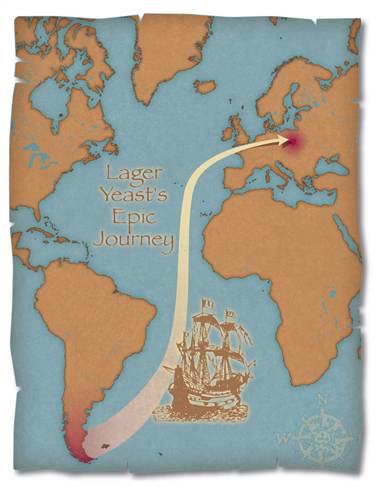
You probably saw this little item, it’s been all over the interwebs over the last few days, about a group of eight scientists positing that a newly discovered yeast strain, dubbed Saccharomyces eubayanus, may have hitched a ride from Patagonia, in South America, to Europe where it got busy with local yeasts there — notably Saccharomyces cerevisiae — to form the yeast we know today as lager yeast, or Saccharomyces pastorianus (a.k.a. Saccharomyces carlsbergensis).

The academic paper, to be published in the August edition of the journal Proceedings of the National Academy of Sciences of the United States of America (or PNAS), goes by the rather dry title, Microbe domestication and the identification of the wild genetic stock of lager-brewing yeast. The Abstract summarizes the paper:

Domestication of plants and animals promoted humanity’s transition from nomadic to sedentary lifestyles, demographic expansion, and the emergence of civilizations. In contrast to the well-documented successes of crop and livestock breeding, processes of microbe domestication remain obscure, despite the importance of microbes to the production of food, beverages, and biofuels. Lager-beer, first brewed in the 15th century, employs an allotetraploid hybrid yeast, Saccharomyces pastorianus (syn. Saccharomyces carlsbergensis), a domesticated species created by the fusion of a Saccharomyces cerevisiae ale-yeast with an unknown cryotolerant Saccharomyces species. We report the isolation of that species and designate it Saccharomyces eubayanus sp. nov. because of its resemblance to Saccharomyces bayanus (a complex hybrid of S. eubayanus, Saccharomyces uvarum, and S. cerevisiae found only in the brewing environment). Individuals from populations of S. eubayanus and its sister species, S. uvarum, exist in apparent sympatry in Nothofagus (Southern beech) forests in Patagonia, but are isolated genetically through intrinsic postzygotic barriers, and ecologically through host-preference. The draft genome sequence of S. eubayanus is 99.5% identical to the non-S. cerevisiae portion of the S. pastorianus genome sequence and suggests specific changes in sugar and sulfite metabolism that were crucial for domestication in the lager-brewing environment. This study shows that combining microbial ecology with comparative genomics facilitates the discovery and preservation of wild genetic stocks of domesticated microbes to trace their history, identify genetic changes, and suggest paths to further industrial improvement.

Mainstream media, picking up the story, has sensationalized it, looking for the human angle. For example the L.A. Times compared the discovery to finding the evolutionary missing link, titling their piece Scientists find lager beer’s missing link — in Patagonia. Essentially, they detail the scientists’ five-year quest to answer the question of where lager yeast originated, and how it came to be. The answer, according to the new paper, is a newly found strain of yeast discovered in the forests of Argentina’s Patagonia region. The wild yeast was named Saccharomyces eubayanus, and it was found living on beech trees.

According to the Times’ report:

Their best bet is that centuries ago, S. eubayanus somehow found its way to Europe and hybridized with the domestic yeast used to brew ale, creating an organism that can ferment at the lower temperatures used to make lager.

Geneticists have known since the 1980s that the yeast brewers use to make lager, S. pastorianus, was a hybrid of two yeast species: S. cerevisiae — used to make ales, wine and bread — and some other, unidentified organism.

Then one of the eight, Diego Libkind, a professor at the Institute for Biodiversity and Environment Research in Bariloche, Argentina, discovered sugar-rich galls on southern beech trees in Patagonia. Yeast were drawn to the galls like a moth to a flame, and had been used by native populations to make a fermented beverage. The yeast in the galls was sent to the University of Colorado, who analyzed the genome, finding that it was 99.5% identical to lager yeast. They named the new yeast Saccharomyces eubayanus, presumably because of its similarity to Saccharomyces bayanus, a yeast commonly used to make cider and wine. Said Stanford geneticist Gavin Sherlock, quoted in the L.A. Times: “The DNA evidence is strong.”

yeast-gall-2

Naturally, Sherlock, and many others have been wondering how Saccharomyces eubayanus hitched a ride to Bavaria at a time when there was no known contact between the two parts of the world, separated by an ocean and some 8,000 miles. The article also states that “Lager was invented in the 1400s,” though my memory is that European brewers were using lager yeast well before that, and it was the lagering process was developed in the 1400s, but perhaps I’m not remembering that correctly.

lager-yeast-maps

In an interesting development surrounding this debate, U. Penn biomolecular archeologist, Patrick McGovern (author of Uncorking the Past), weighed in with his thoughts at the MSNBC article about this story, Beer mystery solved! Yeast ID’d. Here’s what McGovern had to say, as summarized by author John Roach:

Assuming the genetics work is correct, he said he is “troubled by how this newly discovered wild yeast strain made it into Bavaria in the 1500s.”

For one, he noted, Germans, and especially Bavarians, were not involved in the European exploration of Patagonia at the time. So, if the yeast somehow hitched a ride back to Europe via trade with the English, Spanish, and Portuguese, how did it get to Bavaria?

“Perhaps, some Patagonian beech was used to make a wine barrel that was then transported to Bavaria and subsequently inoculated a batch of beer there?” he asked. “Seems unlikely.”

He said a more likely scenario is that galls in the oak forests of southern Germany also harbored S. eubayanus, at least until it was out competed by the more ubiquitous S. cerevisiae.

“If true, then the use of European oak in making beer barrels and especially processing vats, which could harbor the yeast, might better explain the Bavarian ‘discovery’ of lager in the 1500s,” he said.

Nevertheless, he added, history and archaeology are full of surprises.

“Nowhere is this more true than of the seemingly miraculous process of fermentation and the key role of alcohol in human culture and life itself on this planet,” he said.

“This article has begun to unravel the complicated heritage and life history of the fermentation yeasts, and will hopefully stimulate more research to see whether the Patagonian hypothesis proves correct.”

Diplomatically put, because as everyone admits, the find in South America may not be the exclusive area where Saccharomyces eubayanus lives, just the first place it’s been found. The human history portion of this story doesn’t seem to quite fit at this point, but it’s certainly a compelling story and it will be interesting to see how it continues to develop.

yeast-gall-1

Filed Under: Beers, Editorial, News Tagged With: Archeology, Argentina, Europe, Germany, History, South America, Yeast

The Remaining Heritage Breweries

July 21, 2011 By Jay Brooks

copper-kettle
Charlie Papazian had an interesting series of posts (See Part 1, Part 2 and Part 3) a few years back that I thought was worth revisiting about what he refers to as “heritage breweries,” a term that he used to describe the few small breweries that not only survived prohibition but are still in business today, over 75 year later. According to his research, when prohibition summarily closed down thriving businesses in 1919, at a stroke 1,179 breweries were out of business, or at least no longer allowed to make their primary product: beer.

Of the ones that reopened thirteen years later, when prohibition was repealed only a handful managed to make it into the present, braving untold challenges, merger-manias, fickle consumers and ever more oppressive attacks by neo-prohibitionists unconvinced of prohibition’s massive failure. Papazian divides the heritage brewers into four types:

  1. Small, Independent and owned by the original family Heritage Brewers.
  2. Small breweries that have survived that are no longer owned by the original family, yet still independent of the large brewing companies.
  3. Breweries that have survived but are no longer owned by the original family, nor independent of a large brewing company.
  4. Small brewery that may remotely be considered a Heritage Brewery, though original family ownership and location is far removed from the current operation.

Of the first type, those still owned by the original family, only four remain.

  1. August Schell Brewing, New Ulm, Minnesota. (Founded in 1860)
  2. Matt Brewing / Saranac Brewery, Utica, New York. (Founded in 1888)
  3. Straub Brewery, St. Mary, Pennsylvania. (Founded in 1831)
  4. Yuengling Brewery, a.k.a. D. G. Yuengling and Son Inc., Pottsville, Pennsylvania. (Founded in 1829)

For the second type, breweries still considered independent but no longer owned by their original founders or their family, there are a mere seven left.

  1. Anchor Brewing, San Francisco, California. (Founded in 1896)
  2. Dundee Ales & Lagers, f.k.a. J.W. Dundee, High Falls Brewing, and Genesee Brewing (prior to 2000), Rochester, New York. (Founded in 1857)
  3. Iron City Brewing, f.k.a. Pittsburgh Brewing, Pittsburgh, Pennsylvania. (Founded in 1861)
  4. Lion Brewery, Wilkes-Barre, Pennsylvania. (Founded in 1905)
  5. Minhas Craft Brewery, Monroe, Wisconsin. (Founded in 1845 as the Blumer Brewery but from 1947 and on it was known as the Joseph Huber Brewing Co. before being bought by the Canadian Mountain Crest Brewing Co. of Calgary, Alberta in 2006)
    Minhas was not listed in Charlie’s original list, and I can only speculate as to why. Despite their parent company, Mountain Crest, having been founded only in 2003, it appears to be very well-funded and seems to do business along the lines of a very big brewer and not a small one. Likewise, Minhas, after taking over Huber five years ago, has operated it like a big, rather than small, beer business.
  6. Spoetzl Brewery (Shiner Beer), Shiner, Texas. (Founded in 1909)
  7. Stevens Point Brewing, Stevens Point, Wisconsin. (Founded in 1857)

Of the third type, breweries “no longer owned by the original family, nor independent of a large brewing company,” only one remains, and I’m not sure if it really does fit in the third group.

  1. Jacob Leinenkugel Brewing, Chippewa Falls, Wisconsin. (Founded in 1867.) Bought by Miller Brewing, now MillerCoors, in 1988.

I say that because it seems to me that while MillerCoors does own the brewery outright, the family, led today by Jake Leinenkugel, does maintain a certain amount of autonomy and makes a lot of their own decisions about the business. I interviewed Jake a number of years ago for an article I wrote for American Brewer magazine, and that was certainly the impression I was left with. It may not be “owned” by the family any longer, but they do seem to control their own destiny, and that has to count for something.

The fourth, and final category, as outlined by Papazian, is one in which the “original family ownership and location is far removed from the current operation.” Of this type, there are only two remaining.

  1. Cold Springs Brewery, (Originally established as the Mississippi Brewing Company, changed to Gluek Brewing Company sold to G. Heileman, then original brewery was demolished and then restablished itself as Cold Springs in 1997, changed back to Gluek and then back again to Cold Springs Brewery again recently), Cold Springs, Minnesota. (Founded in 1857)
  2. Dixie Brewing, New Orleans, Louisiana. The beer is said to be contract brewed at other locations. (Founded in 1907)

Totaled up, there are only thirteen breweries still in existence that were in business 92 years ago, when prohibition began. Twelve, if you discount brands that are contract brewed, such as Dixie is now post-Katrina. Now that’s just small breweries, but the picture’s not much rosier even if you include everybody, big and small.

  1. Anheuser-Busch InBev, St. Louis, Missouri or New York City, or Leuven, Belgium. (Founded in 1852 as Bavarian Brewery, name changed to E. Anheuser & Co. in 1860, incorporated as Anheuser-Busch in 1875)
    Given the takeover by InBev in 2008 and August Busch IV no longer a member of the board, essentially that would place ABI in Type 4.
  2. MillerCoors, Chicago, Illinois.
    Whether to consider them together or separately, that it is the question.

    • Coors Brewing, Golden, Colorado (Founded in 1873)
      Merged with Molson to form MolsonCoors in 2004, merged their U.S. operations with Miller in 2008 to form MillerCoors. Despite all that mergering, Pete Coors is still involved in running at least part of the company his family founded, but it’s a bit of a crapshoot where they’d fit in Papazian’s categories.
    • Miller Brewing, Milwaukee, Wisconsin (Founded in 1855)
      Founder Frederick Miller’s granddaughter, who hated alcohol, sold the company to W.R. Grace in 1966. In 1969, Phillip Morris acquired Miller but sold it to the South African Breweries in 2002 to form SABMiller, and they also merged their U.S. operations with Coors in 2008 to form MillerCoors. That would put them, too, in category 4.
  3. Pabst Brewing, Greenwich, Connecticut or San Antonio, Texas or Milwaukee, Wisconsin. (Founded in 1844)
    The Pabst family sold out back in the 1950s, if I recall correctly, and it was recently bought by Greek billionaire Dean Metropoulos. They haven’t owned an actual brewery in years, contracting all of their many brands of beer so it’s unclear, like Dixie, if they should be included at all. If so, they’re a clear Type 4.

Even pulling everybody, big or small, contract beer company or actual brewery, that’s still only 18 remaining from the original 1,179 left. That’s only 1.5% still in business after 82 years. Back out the big guys, and it’s 1.2%. I’m an inveterate pessimist, so I find that sad. I know that’s business in general, and many of the brewery mergers are the result of the cannibalistic nature of many of the big brewers (and corporate business more generally), but I’m a romantic pessimist, the worst kind. As much as I don’t really like the beers so many of the fallen breweries (and many of the remaining big ones, too) make, I still think we lose some part of our history every time yet another one closes or is bought out.

Filed Under: Breweries, Editorial Tagged With: History, Prohibition

Beer Good For Economic Growth Worldwide

June 27, 2011 By Jay Brooks

sales-chart-up
My wife’s a political news junkie and reads such arcane fare as Foreign Policy, a magazine covering global politics and economics. She forwarded me Chug for Growth , an article detailing how the beer industry is having a positive effect on economies around the world, especially in emerging nations. Here’s how it begins:

The myth of the smug teetotaler is no joke. Many of the most popular theories of economic growth in wealthy countries, dating back to the Protestant work ethic of Max Weber, emphasize the abstemious and sober virtues of the well-to-do. And from the 18th-century Gin Acts in Britain to Prohibition in 1920s America to a certain class of modern-day economists, there’s a long tradition of blaming intemperance for the persistence of poverty.

But in fact, mounting evidence suggests that beer in particular, and the beer industry that surrounds it, may be as good for growth as excess sobriety. In some of the world’s toughest investment climates, beer companies today are building factories, creating jobs, and providing vital public services, all in the pursuit of new customers for a pint. It’s the brewery as economic stimulus: a formula even a frat boy could love.

The article goes on to detail how beer is good for both the big brewers and the local economies where they’re building or acquiring new breweries. They can add “tax revenue, lease payments, numerous local jobs, and increased demand for local agricultural produce.” And it sells even in the most challenged economies, as “even the poorest of the poor will spend money on alcohol.” I could have done without the lecture on alcohol abuse, while of course ignoring the positive health benefits of moderate consumption, but apart from that it makes a strong case for beer not only being recession-proof, but even a recession-beater in some places.

The article concludes with some interesting speculation about economic growth centuries ago, and whether it, too, may have been caused not, as been previously thought, by the Christian work ethic, but by breweries themselves as is happening today.

Indeed, beer may have been a force for growth for a long time. [Researchers] Colen and Swinnen note that beer consumption is higher in Protestant countries. What if the early success of Protestant-dominated economies wasn’t about Weber’s famed work ethic at all, but about the impact of breweries? Of course, it may be just as outlandish to argue that progress is driven by hops and barley as by the fear of eternal damnation — but at least it’s more fun to discuss over a pint.

I’m all for that.

Filed Under: Beers, Breweries, Editorial, News, Politics & Law Tagged With: Economics, International

« Previous Page
Next Page »

Find Something

Northern California Breweries

Please consider purchasing my latest book, California Breweries North, available from Amazon, or ask for it at your local bookstore.

Recent Comments

  • Ernie Dewing on Historic Beer Birthday: Charles William Bergner 
  • Steve 'Pudgy' De Rose on Historic Beer Birthday: Jacob Schmidt
  • Jay Brooks on Beer Birthday: Bill Owens
  • Steve 'Pudgy' De Rose on Beer Birthday: Charles Finkel
  • Steve 'Pudgy' De Rose on Beer Birthday: Bill Owens

Recent Posts

  • Beer In Ads #5204: Oh Brother! Griesedieck Bros. Genuine Premium Bock Beer Is Here! February 15, 2026
  • Historic Beer Birthday: Emil Resch February 15, 2026
  • Historic Beer Birthday: Philip Zang February 15, 2026
  • Beer In Ads #5203: Robert Portner’s Bock Beer February 15, 2026
  • Historic Beer Birthday: August Schell February 15, 2026

BBB Archives

Feedback

Head Quarter
This site is hosted and maintained by H25Q.dev. Any questions or comments for the webmaster can be directed here.