Brookston Beer Bulletin

Jay R. Brooks on Beer

  • Home
  • About
  • Editorial
  • Birthdays
  • Art & Beer

Socialize

  • Dribbble
  • Email
  • Facebook
  • Flickr
  • GitHub
  • Instagram
  • LinkedIn
  • Pinterest
  • RSS
  • Twitter
  • YouTube

Powered by Genesis

MillerCoors Acquires Majority Stake In Saint Archer

September 10, 2015 By Jay Brooks

saint-archer millercoors
Not quite as big news as yesterday, but certainly continuing a trend. This Morning, MillerCoors announced that Saint Archer Brewing of San Diego, California will be joining their craft division, Tenth and Blake, as they acquire a majority interest in the small brewery.

Here’s the press release:

Tenth and Blake, the craft and import division of MillerCoors, announced today an agreement to acquire a majority interest in Saint Archer Brewing Company.

Founded in San Diego in 2013 by a talented group of entrepreneurs, artists, skateboarders and surfers, Saint Archer brews an award-winning range of ales including Blonde Ale, IPA, White Ale and Pale Ale. Saint Archer expects to sell 35,000 barrels of beer in 2015, up more than 100 percent over 2014, making it one of the fastest-growing breweries in California. Tenth and Blake plans to support its continued growth under the ongoing leadership of Josh Landan, Saint Archer co-founder and president.

“We have always wanted to get great beer into more people’s hands,” said Landan. “We were fortunate that brewers big and small were interested in partnering with us, but Tenth and Blake was the clear choice. Tenth and Blake shares our passion for putting great beer first. Joining Tenth and Blake allows us to keep doing what we love right here in San Diego, but now with more resources to innovate and grow. With Tenth and Blake’s help, we hope to one day be a national brand.”

Saint Archer’s management and their team will continue to brew, package, ship, and sell Saint Archer’s outstanding portfolio of high-quality brands. Saint Archer will be run as a separate business unit of Tenth and Blake.

“We’re really excited about our partnership with Saint Archer,” said Scott Whitley, president and CEO of Tenth and Blake. “Saint Archer is consistent with our strategy of building our high-end portfolio while driving topline growth. Josh and his team represent everything we look for in a partner. Saint Archer brews award-winning ales across a variety of styles that are complementary to our current portfolio—including some outstanding IPAs. We’re excited at the prospect of working together to support the continued success of Saint Archer.”

Saint Archer picked up two gold medals at the 2014 San Diego International Beer Festival and a gold medal at the 2014 Great American Beer Festival.

Saint Archer joins other leading crafts in the Tenth and Blake portfolio, including Blue Moon Brewing Company, Jacob Leinenkugel Brewing Company, Crispin Cider Company and a minority equity stake in Terrapin Beer Company.

The transaction is expected to complete in October 2015. The terms of the transaction were not disclosed.

st-archer

Filed Under: Breweries, News, Politics & Law Tagged With: Announcements, Business, California, MillerCoors, Press Release, San Diego

Patent No. 3834429A: Method And Apparatus For Detecting Beverage Bottles Having A Lip Damaged Outwardly Of The Crown Sealing Surface

September 10, 2015 By Jay Brooks

patent-logo
Today in 1974, US Patent 3834429 A was issued, an invention of Arthur F. Schulz, assigned to the Schlitz Brewing Co., for his “Method and Apparatus for Detecting Beverage Bottles Having a Lip Damaged Outwardly of the Crown Sealing Surface.” Here’s the Abstract:

Method and apparatus are disclosed for the detection of beverage bottles having a lip damaged outwardly of the crown sealing surface. Such detection is provided for in conjunction with the bottle filling operation wherein the filling apparatus seals on the bottle lip outwardly of the crown sealing surface and the bottle is then subjected to a counter pressure. If the counter pressure developed in the bottle is less than the pressure imposed on the beverage in the source reservoir, a short fill results. Thus, if the bottle lip is damaged outwardly of the crown sealing surface and in the region of sealing, a lesser counter pressure is developed in the bottle due to leakage past the seal which will result in a detectable short fill and can be rejected from the production line.

Untitled

Filed Under: Beers, Breweries, Just For Fun, Politics & Law, Related Pleasures Tagged With: Bottles, Brewing Equipment, History, Law, Packaging, Patent

Patent No. 3103297A: Combination Can Opener And Drinking Cup

September 10, 2015 By Jay Brooks

patent-logo
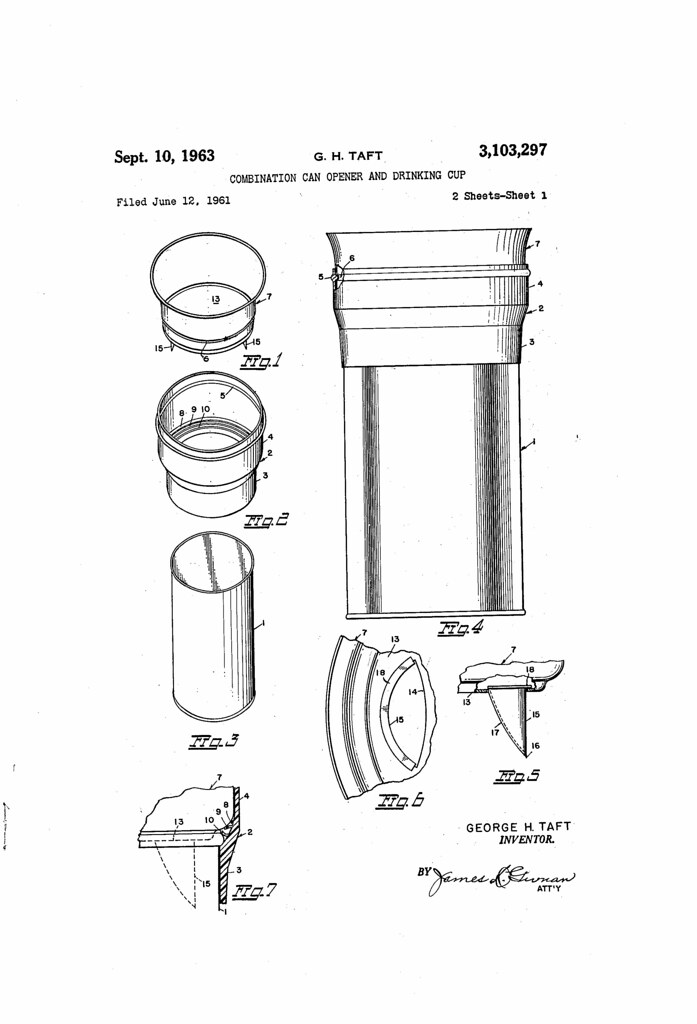
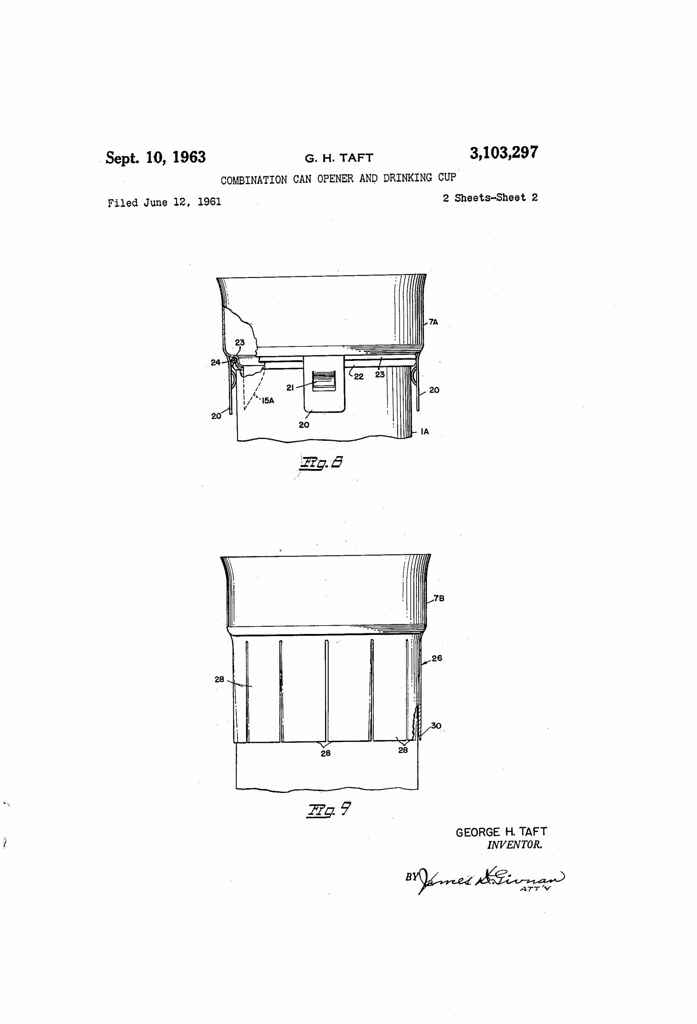
Today in 1963, US Patent 3103297 A was issued, an invention of George H. Taft, for his “Combination Can Opener and Drinking Cup.” There’s no Abstract, although in the description it includes this summary:

This invention relates to a combination can-piercing device and drinking cup.

One of the principal objects of the invention is the provision of :a drinking cup provided with can-piercing instrumentalities depending from its bottom wall, guide means for attaching the cup to the top of a beverage can and sealing means associated with the cup and guide means to prevent leakage between the top of the can and the outside of the cup after the top of the can has been pierced.

Untitled
Untitled

Filed Under: Beers, Just For Fun, Politics & Law, Related Pleasures Tagged With: History, Law, Patent

Patent No. 2806217A: Apparatus For Clarifying Brewer’s Wort

September 10, 2015 By Jay Brooks

patent-logo
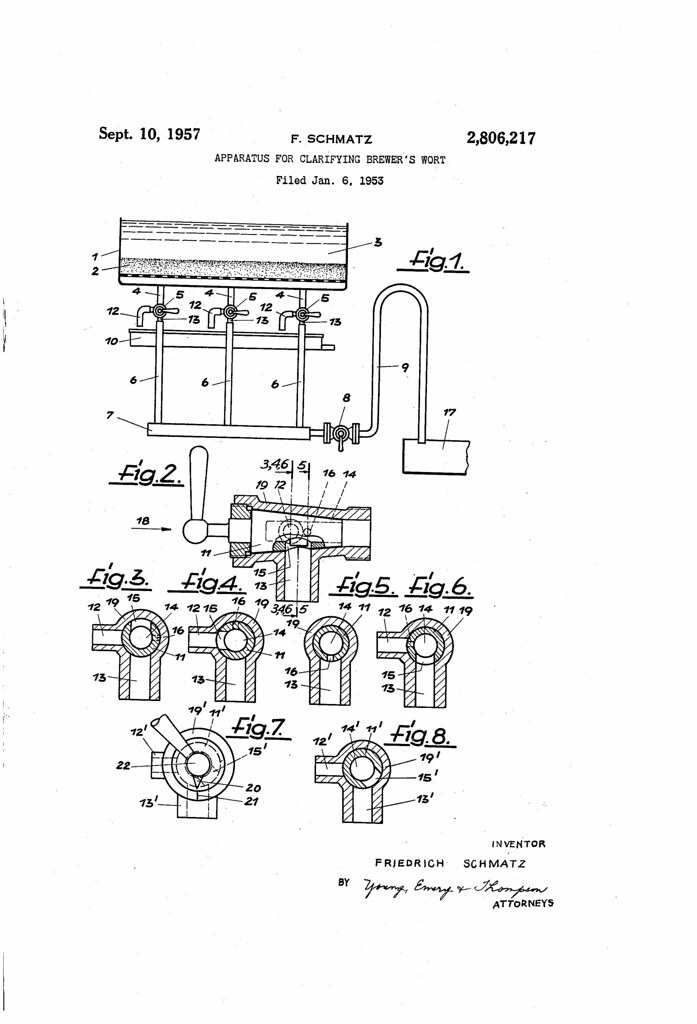
Today in 1957, US Patent 2806217 A was issued, an invention of Friedrich Schmatz, for his “Apparatus For Clarifying Brewer’s Wort.” There’s no Abstract, although in the description it includes this summary:

This invention relates to an apparatus for clarifying brewers wort.

Especially this invention refers to a process for clarifying the wort discharged from a straining vat by means of drain pipes communicating with a standpipe, drain taps being provided in the drain pipes substantially under the straining vat.

It is an object of the invention to eliminate this disadvantage so that the wort will remain substantially clear after changing the taps from the clarifying trough to the drain pipes.

According to the invention the above is brought about in such a way that at the beginning of the draining of clear wort first a communication with a small clear opening is established between the clarifying vat at the communicating system until clear water runs in the drain pipes and the standpipe is displaced by the wort, and only then the clear opening is enlarged to the full clear opening of the drain pipes.

This process may be carried out in such a way that the clarifying tap is not completely adjusted to the drain pipe when adjusting its passage from the clarifying trough to the drain pipe, so that the clear opening of the passage is reduced in this way. In this operation, however, it is difficult to reduce the clear opening to the necessary degree, that is, the opening will be adjusted too small or too wide. If the clear opening is adjusted too wide, the purpose of the process according to the invention will not be attained, and the Wort will become turbid. If the clear opening is adjusted too small, the clear water will be displaced too slowly. Several drain pipes each provided with a tap being usually provided, the clear opening of the passage cannot uniformly be adjusted at will even with the greatest care. If some taps are opened too much and others too little, an undesired turbidness of the wort will occur.

Untitled

Filed Under: Beers, Breweries, Just For Fun, Politics & Law, Related Pleasures Tagged With: Brewing Equipment, History, Law, Patent, Science of Brewing, Wort

Patent No. 5664702A: Foot Operated Beer Keg Pressurizer

September 9, 2015 By Jay Brooks

patent-logo
Today in 1997, US Patent 5664702 A was issued, an invention of Christopher E. Beauchamp, for his “Foot Operated Beer Keg Pressurizer.” Here’s the Abstract:

A foot-operated beer-keg pressurizer has a floor-based foot pump (1) with which air is pumped through a pressure tube (17) from a variably remote beer keg (2) to a keg faucet (9) that is attachable to conventional beer-keg connectors (6). A beer tube (8) extended from the keg faucet in the variably remote beer keg has a beer tap (7) that is preferably a squeeze or push-button type. Foot operation of the floor-based foot pump by a user or by a separate person frees both hands of a user for filling beer-drinking containers.

Untitled

Filed Under: Beers, Just For Fun, Politics & Law, Related Pleasures Tagged With: History, Kegs, Law, Patent

Prohibitionists Picking On Past Their Primers

September 9, 2015 By Jay Brooks

geezer
What is it with Alcohol Justice insulting people recently? A few days ago they called people around the world “idiotic,” and now they’re referring to the elderly as “geezers?” What happened to being an organization holding the alcohol industry to impossibly high standards? Or don’t those apply in the first person, only in the third person? Sadly, that’s probably the answer as whatever they do is championed as correct and everything — and I do mean everything — that alcohol companies and anyone who might choose to drink alcohol are doing is considered wrong.

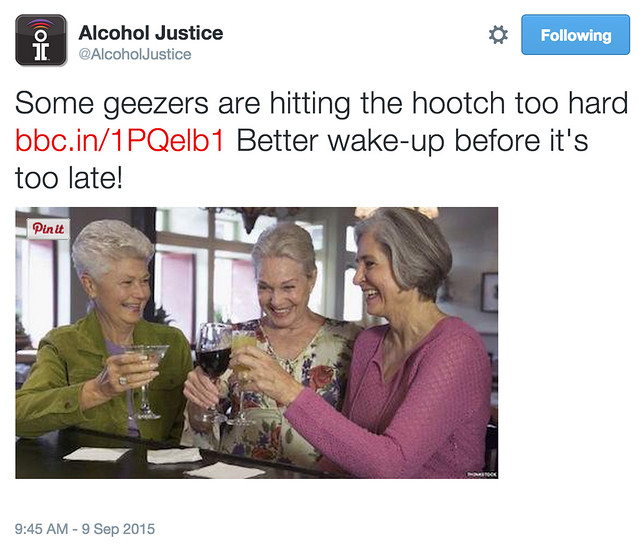
So — sigh — what is it this time? AJ tweeted out the following this morning:

aj-tweet-9-9

“Some geezers are hitting the hootch too hard bbc.in/1PQelb1 Better wake-up before it’s too late!”

The link takes you to an article posted on the BBC‘s health website, with the far more gentle title, Elderly people warned over alcohol consumption. So why exactly is AJ calling the elderly “geezers?” According to Wikipedia, “Geezer is a slang term for a man. In the UK, it can carry the connotation of either age or eccentricity. In the US, the term typically refers to a cranky old man.” In AJ’s tweet, of course, they show three elderly women sipping what looks like wine, champagne and a cocktail, not “hootch,” or even it’s more common spelling “hooch” (oh, AJ how many mistakes can you pack into one tweet?). Yes, hooch can mean any “alcoholic liquor,” but it usually refers to “inferior or illicit whiskey,” not the good stuff. So calling these three women geezers drinking hooch doesn’t really work, does it?

The BBC article itself, naturally, is problematic, as well. The headline is that they found that “one in five people over 65 who drink” (so only 20% and only 20% of the elderly population that are not teetotalers, meaning less than 20%) is drinking their “hooch” at “unsafe levels.”

First of all, those levels they’re talking about in the UK are arbitrary and were simply made up, as was revealed in 2007, twenty years after the guidelines for the UK had been set in stone in 1987. One committee member who’d worked on the guidelines remembered that they were simply “plucked out of the air” and had “no basis in science” whatsoever, which I detailed at the time in Target: Alcohol. So it’s pretty hard to get worked up about elderly people, and a minority of them at that, who are not following capricious, arbitrary guidelines that were simply made up.

But the kicker, for me, is that final admonishment in AJ’s tweet: “Better wake-up before it’s too late!” To which my first through was exactly the same as the nearly 300 commenters to the BBC article. “Or what?” After working my entire lifetime, and finally reaching retirement age, finally able to do the things I want to do, the last thing I want to hear is “go easy, darling, mustn’t have too much to drink” from … well, from anybody. Seriously, unless I’m falling down, incoherently drunk every single day at age 70, it’s nobody’s business but my own and Alcohol Justice and their ilk can go f*@k themselves. I’m going to enjoy my twilight years, if I can, and if I make it that far on my own, I think I can manage without their unwanted intrusion and advice. They don’t care about my health, they care about controlling people and telling them what’s good for them because they know better than you and me. It’s the true national pastime.

But what I’m still unclear about is why they’ve chosen to begin attacking people with insults and epithets, people who’ve done nothing more than live their lives as they see fit, but apparently differently from how AJ believes they should live. That’s certainly not how you win people over to your way of thinking. It just pisses them off.

Filed Under: Beers, Editorial, Politics & Law Tagged With: Prohibitionists, Science, Statistics

Patent No. 4610888A: Beer Foam Enhancing Process And Apparatus

September 9, 2015 By Jay Brooks

patent-logo
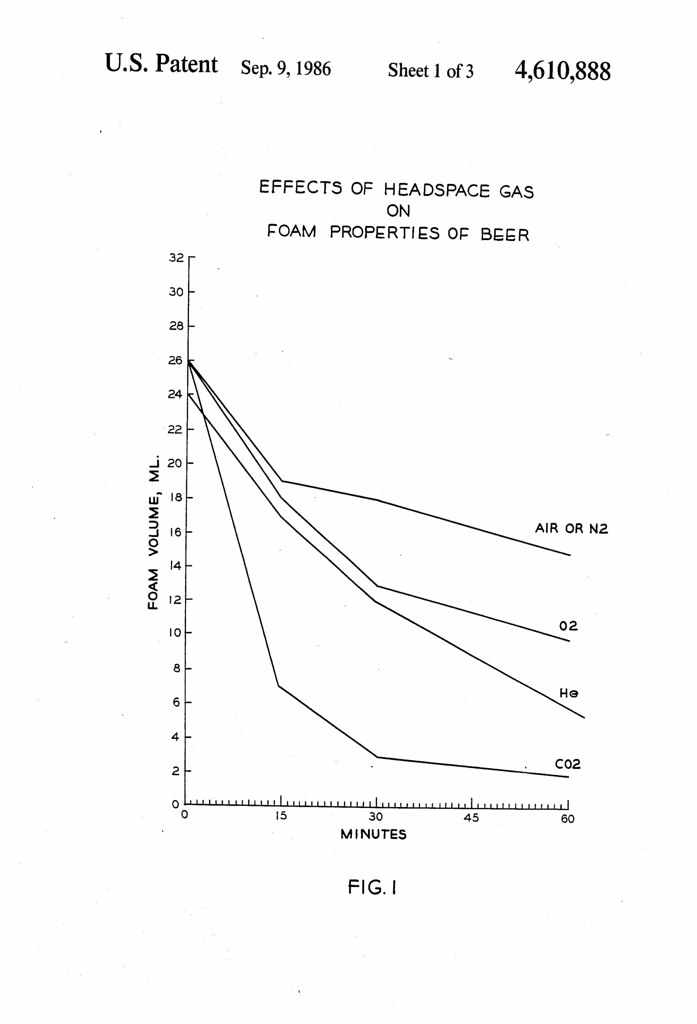
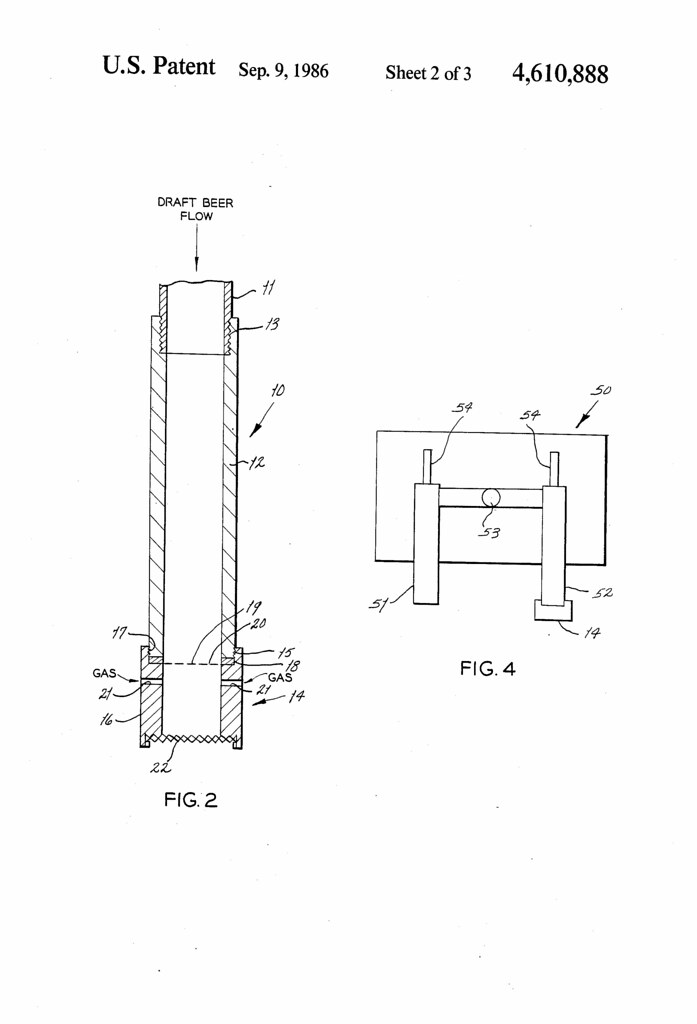
Today in 1986, US Patent 4610888 A was issued, an invention of James Teng and John H. Dokos, assigned to the Anheuser-Busch Companies, Inc., for their “Beer Foam Enhancing Process and Apparatus.” Here’s the Abstract:

A beer foaming process and apparatus in which a smooth stable foam is formed by intimately admixing a nitrogen containing gas, preferably air, by a Venturi effect in a nozzle positioned on the beer tap. The nozzle has a mixing chamber with a perforated plate at its intake end to divide the flow of beer from the keg into smaller streams of higher velocity in the mixing chamber, intake ports in the side walls of the chamber for admitting gas into the chamber, and a screen of 30 to 200 mesh at the discharge end of the nozzle to form the stable foam discharged from the chamber.

Untitled
Untitled
Untitled

Filed Under: Beers, Breweries, Just For Fun, Politics & Law, Related Pleasures Tagged With: Brewing Equipment, History, Law, Patent, Science of Brewing

Patent No. 325979A: Hop-Breaker

September 8, 2015 By Jay Brooks

patent-logo
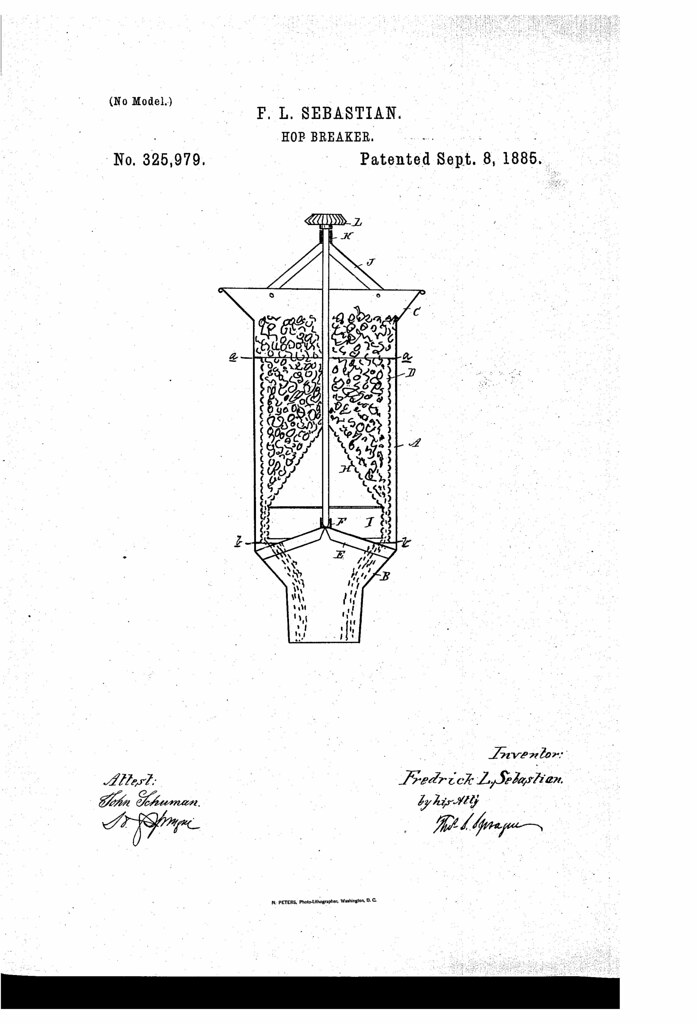
Today in 1885, US Patent 325979 A was issued, an invention of Fredrich Louis Sebastian, for his “Hop-Breaker.” There’s no Abstract, although in the description it includes this summary:

This invention relates to certain new and useful improvements in the construction and operation of a machine for breaking up hops preparatory to their use by the brewer.

The object of the invention is to so prepare the hops that very little time will be necessary to extract the properties of such hops when put into the hot liquor in the process of making beer, and thereby lessening the loss of the aroma in the steam arising from such liquor. By breaking the hops up I do not mean to be understood as grinding them to a powder, as if they were reduced to this condition they would be comparatively worthless to the manufacturer of beer.

Untitled

Filed Under: Beers, Just For Fun, Politics & Law, Related Pleasures Tagged With: History, Hops, Law, Patent

Patent No. 326017A: Beer-Drawing Apparatus

September 8, 2015 By Jay Brooks

patent-logo
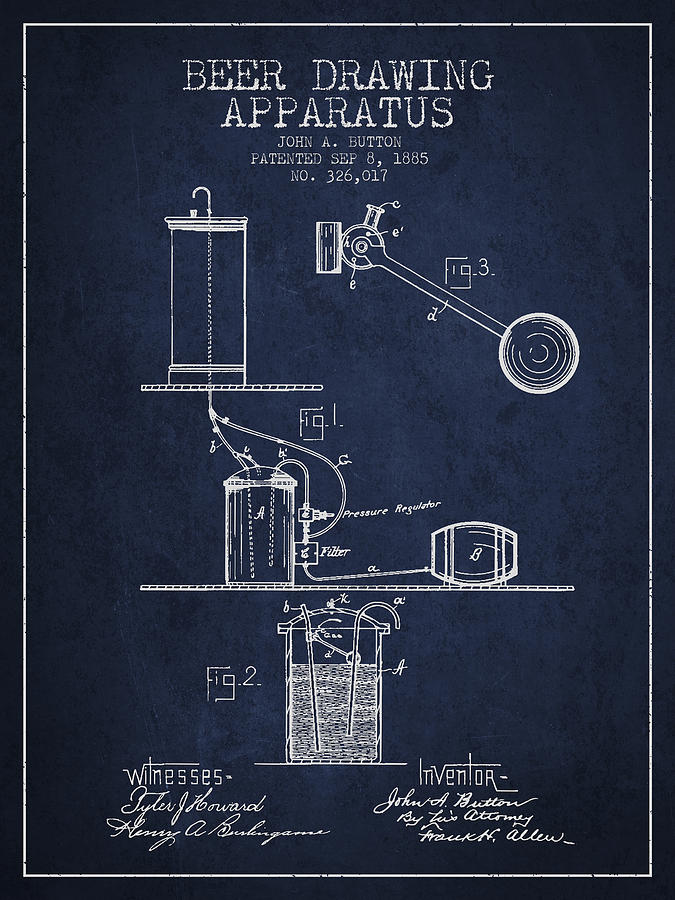
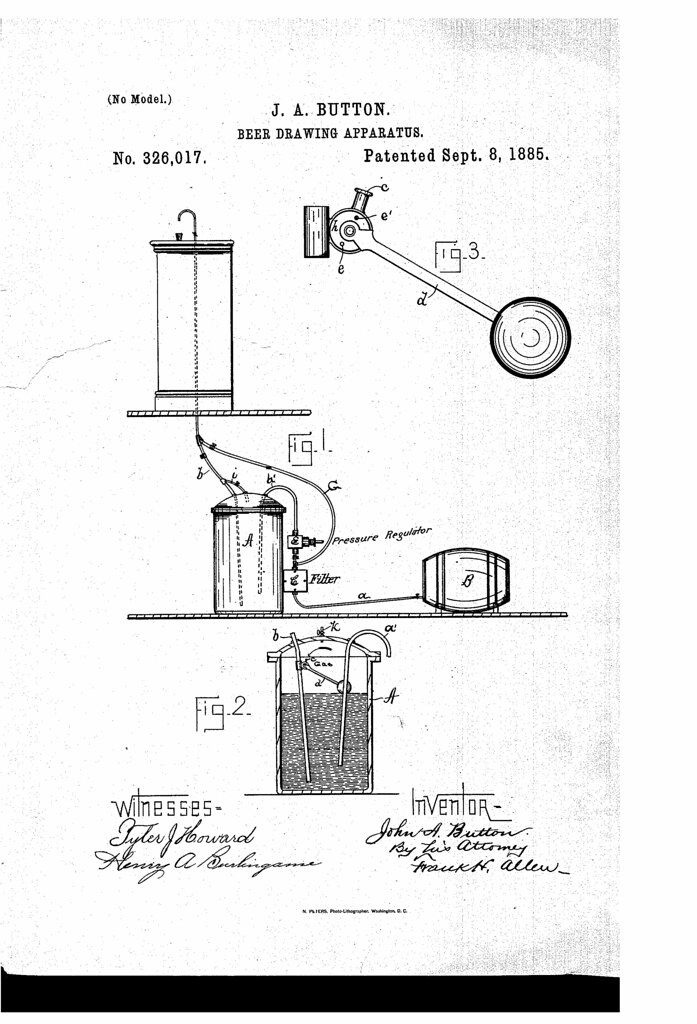
Today in 1885, US Patent 326017 A was issued, an invention of John A. Button, for his “Beer-Drawing Apparatus.” There’s no Abstract, although in the description it includes this summary:

My invention relates to that class of devices by means of which beer or other analogous liquids are drawn direct from the barrel, my object being to so improve-such apparatus that the liquid drawn shall be delivered under a uniform pressure and free from all sediment or impurities. It is also my purpose to so improve the pressure-chamber that the gas which collects therein may be automatically disposed of.

beer-drawing-apparatus-patent-from-1885-navy-blue-aged-pixel

And here’s the original drawing filed with the application:
Untitled

Filed Under: Beers, Just For Fun, Politics & Law, Related Pleasures Tagged With: History, Kegs, Law, Patent

No Beer, No Work

September 7, 2015 By Jay Brooks

no-beer-no-work
Today, of course, is Labor Day in the U.S. and Canada, celebrated each year on the first Monday in September since 1894, at least federally. Most countries, more than 80, celebrate something similar on May 1, and a few others on different days. In the Bahamas, for example, it’s the first Friday in June and in New Zealand, it’s celebrated the fourth Monday in October, while in Australia it’s different for every territory there. But the genesis is the same, to “honor the American labor movement and the contributions that workers have made to the strength, prosperity, and well-being of their country.”

According to Wikipedia, “Labor Day was promoted by the Central Labor Union and the Knights of Labor, who organized the first parade in New York City. After the Haymarket Massacre in Chicago on May 4, 1886, U.S. President Grover Cleveland feared that commemorating Labor Day on May 1 could become an opportunity to commemorate the affair. Therefore, in 1887, the United States holiday was established in September to support the Labor Day that the Knights favored.” And you can read more about it at the Department of Labor.

Unlike today, when labor movements, and particularly unions, are demonized in the press and by the right-wing political machine, most people supported labor in some fashion for the very simply reason that a majority of people were part of the labor force. Today, thanks to effective propaganda, many people vote against their own interests. But that was not yet the case when Prohibition took effect in 1920. So many people in the labor force who were very unhappy about not being able to drink a beer after eight hours of back-breaking work started agitating for a repeal of prohibition, in some cases right from the start, since it became abundantly clear very quickly that a working life without the reward of a cold beer was going to suck.

Even before the 18th Amendment was to take effect on January 17, 1920, a previous measure passed by Congress, the Wartime Prohibition Act banned “the sale of alcoholic beverages having an alcohol content of greater than 2.75%” beginning on June 30, 1919.” The measure supposedly was “intended to save grain for the war effort,” but it actually “was passed after the armistice ending World War I was signed on November 11, 1918.” Since July 1st was the first day after alcohol was banned under the Wartime Prohibition Act, that day became known as the “Thirsty-First.”

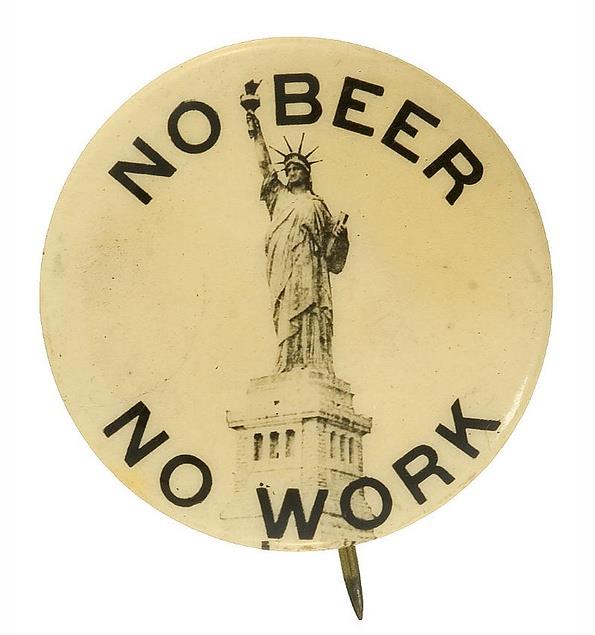
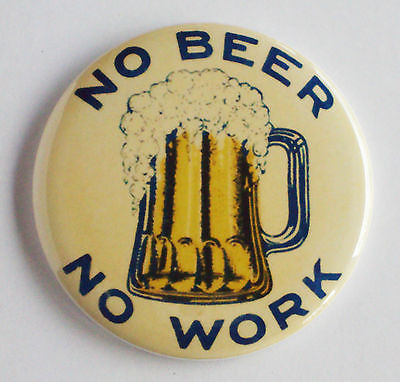
So labor organizations in New York City began making plans to oppose and protest Prohibition, creating pins bearing their slogan “No Beer, No Work.”

no-beer-no-work-pin

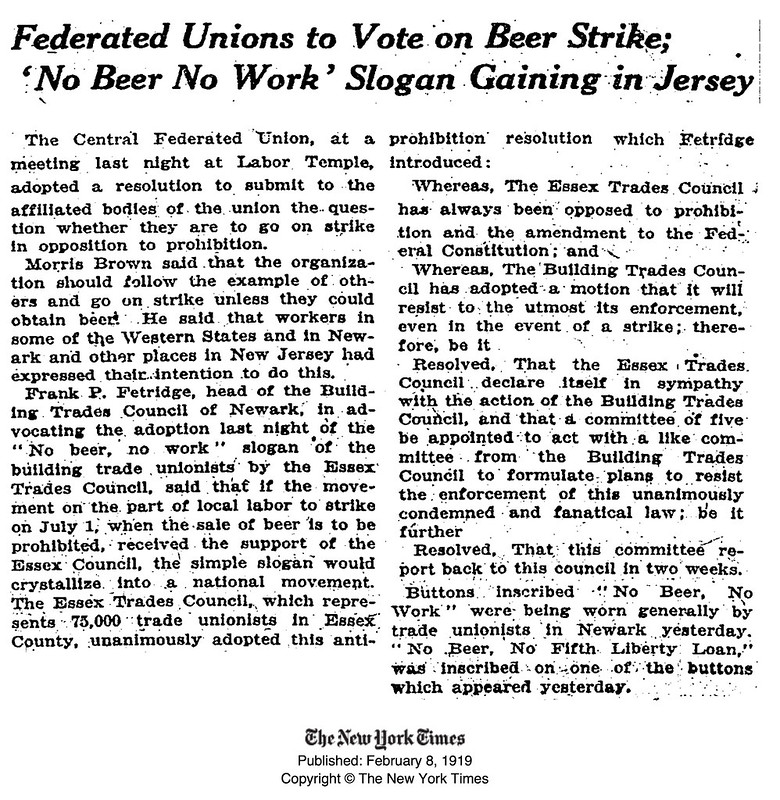
In addition, they planned a walk-out for July 1 of 1919, which was reported in the New York Times on February 8, 1919.

nyt-feb8-1919

The next day, February 9, 1919, the story was picked up in Chicago and ran on the front page of The Evening World.

NoBeerNoWork-1919-Chicago

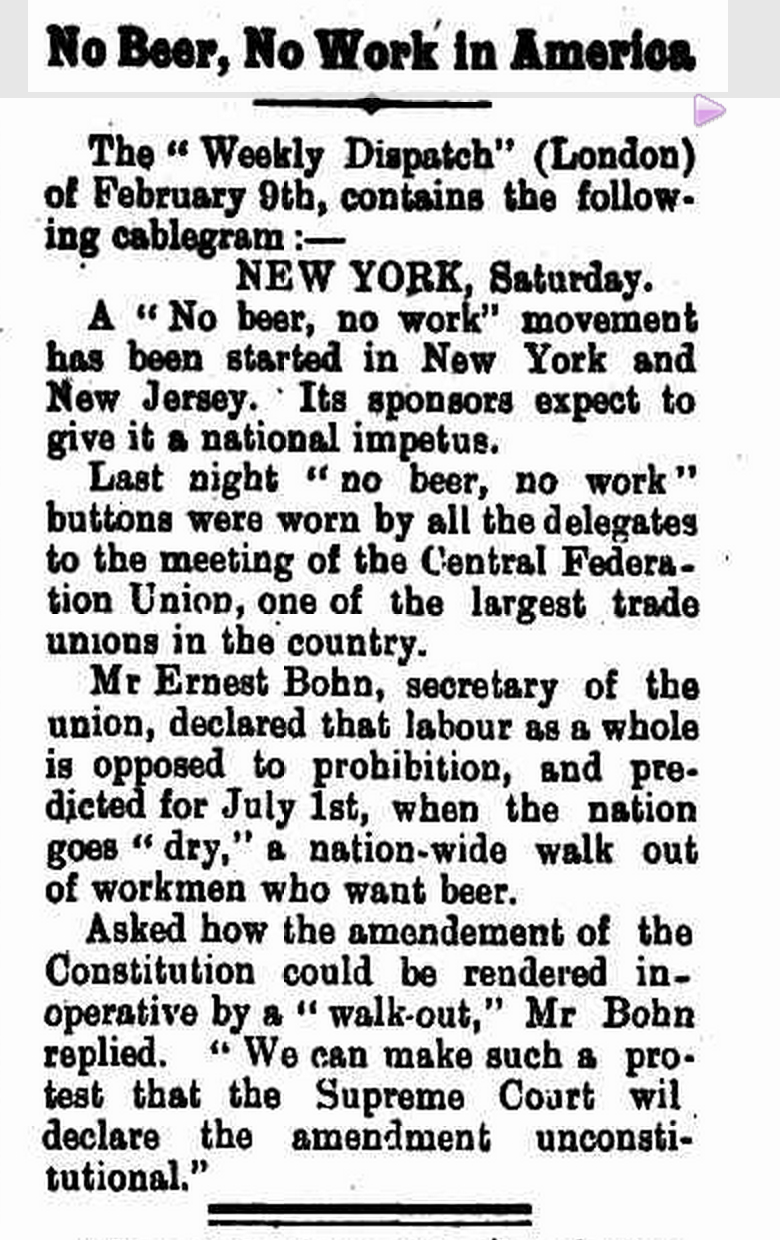
The news even made it as far as Australia’s Northern Territory Times and Gazette of Darwin, which ran the story on April 19, 1919 (reporting on events of February 8th and 9th):

NoBeerNoWork-1919-Australia

A “No beer, no work” movement has been started in New York and New Jersey. Its sponsors expect to give it a national impetus. Last night “no beer, no work” buttons were worn by all the delegates to the meeting of the Central Federation Union, one of the largest trade unions in the country. Mr. Ernest Bohn, secretary of the union, declared that labour as a whole is opposed to prohibition, and predicted for July 1st, when the nation goes “dry,” a nation-wide walk out of workmen who want beer. Asked how the amendment of the Constitution could be rendered inoperative by a ” walk-out,” Mr Bohn replied. “We can make such a protest that the Supreme Court wilt declare the amendment unconstitutional.”

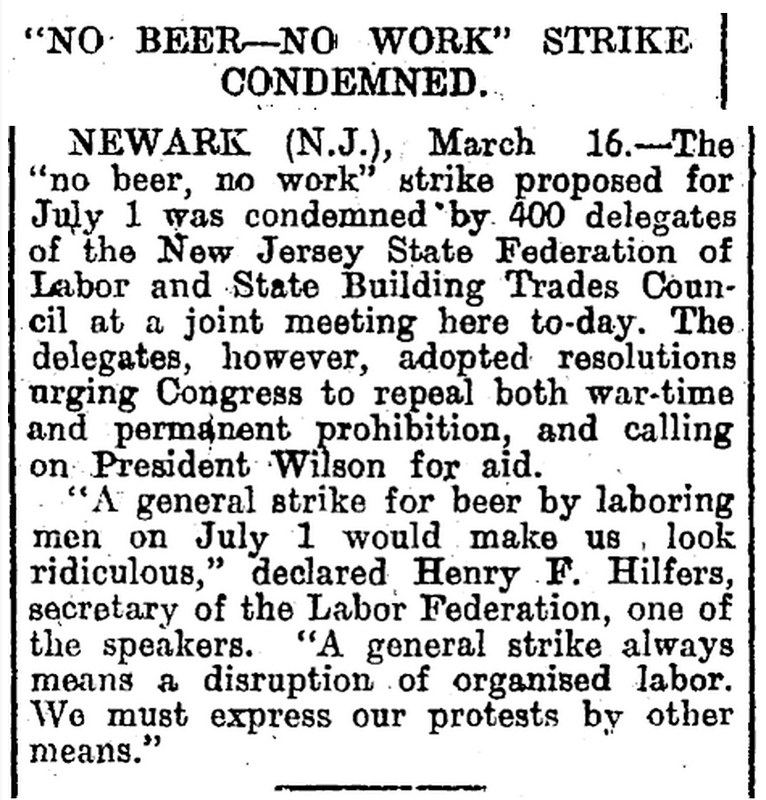
But not everyone in labor agreed, as evidenced by this article in New Jersey’s Poverty Bay Herald on May 3, 1919, where 400 union delegates in the Garden State came out against the strike, although they agreed that Prohibition was a bad idea.

NoBeerNoWork-1919-NJ

But there’s not much more about these efforts in New York that I could find. I did find this paragraph, by a Columbia history student, who in his junior year received a research grant, the Edwin Robbins Prize, and used it to do his senior thesis:

“New York Organized Labor and Prohibition Resistance: The ‘No Beer, No Work’ Movement of 1919.” A forgotten moment in labor history, it was a fascinating intersection of culture, gender, and class, examining the untidy boundary between “economic” and “social” life. Some local trade-unionists co-opted a catchy slogan, “No Beer, No Work,” with the intent of fomenting a national general strike, attempting to save the saloon, galvanize class consciousness, and lead workers into a labor party. The strike more than failed; it never occurred.

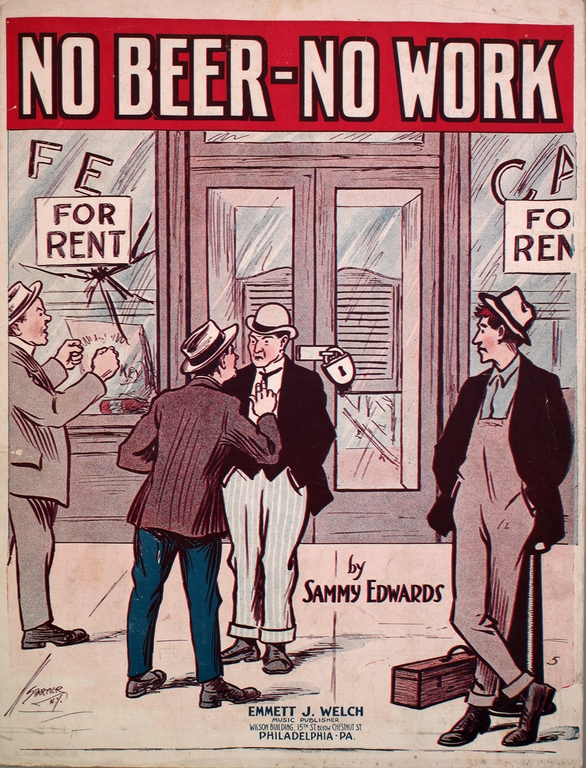
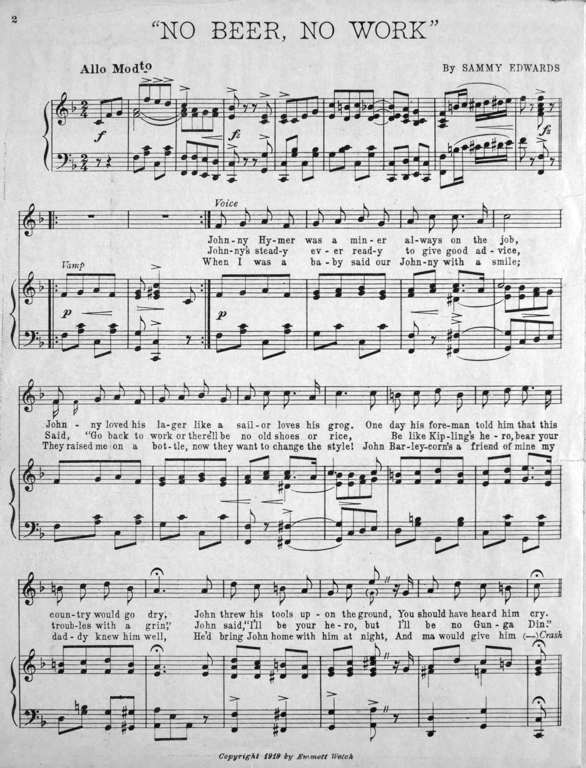
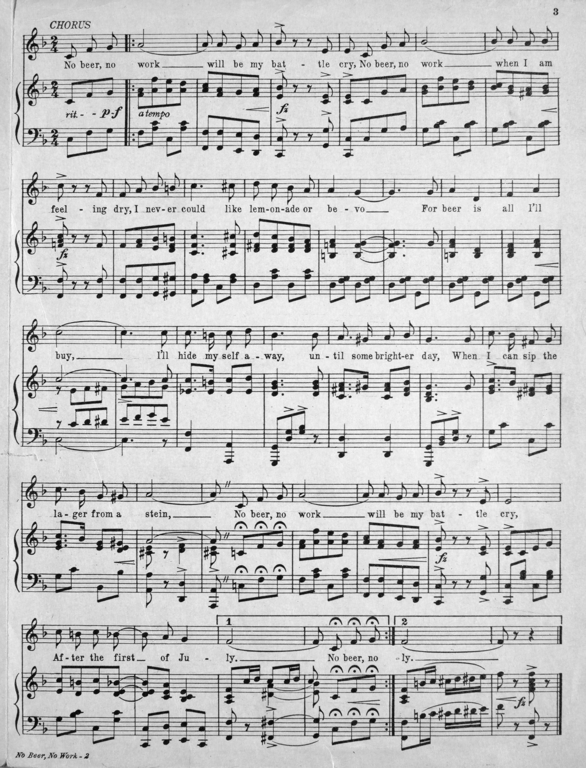
Perhaps more curiously, and what started this, is I discovered that more than one person took the great slogan “No Beer, No Work,” and wrote a song about it, using it as the title. The first I found was written in 1919, by Sammy Edwards.

nbnw-0
nbnw-1
nbnw-2

And here are the lyrics to NO BEER, NO WORK, by Sammy Edwards, 1919:

1. Johnny Hymer was a miner, always on the job.
Johnny loved his lager like a sailor loves his grog.
One day, his foreman told him that this country would go dry.
John threw his tools upon the ground. You should have heard him cry:

CHORUS: “No beer, no work” will be my battle cry.
“No beer, no work” when I am feeling dry.
I never could like lemonade or bevo, for beer is all I’ll buy.
I’ll hide my self away
Until some brighter day
When I can sip the lager from a stein.
“No beer, no work” will be my battle cry
After the first of July.

2. Johnny’s steady, ever ready to give good advice,
Said, “Go back to work or there’ll be no old shoes or rice.
Be like Kipling’s hero. Bear your troubles with a grin.”
John said, “I’ll be your hero, but I’ll be no Gunga Din.”

3. “When I was a baby,” said our Johnny with a smile,
“They raised me on a bottle. Now they want to change the style.
John Barleycorn’s a friend of mine. My daddy knew him well.
He’d bring John home with him at night and ma would give him —.

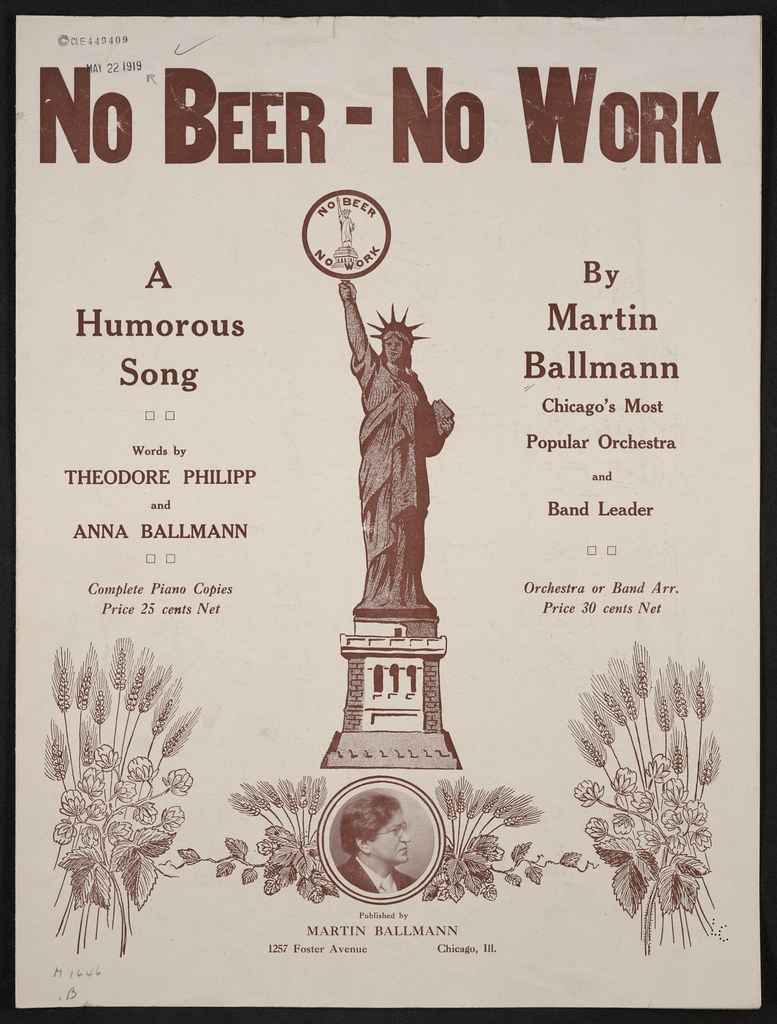
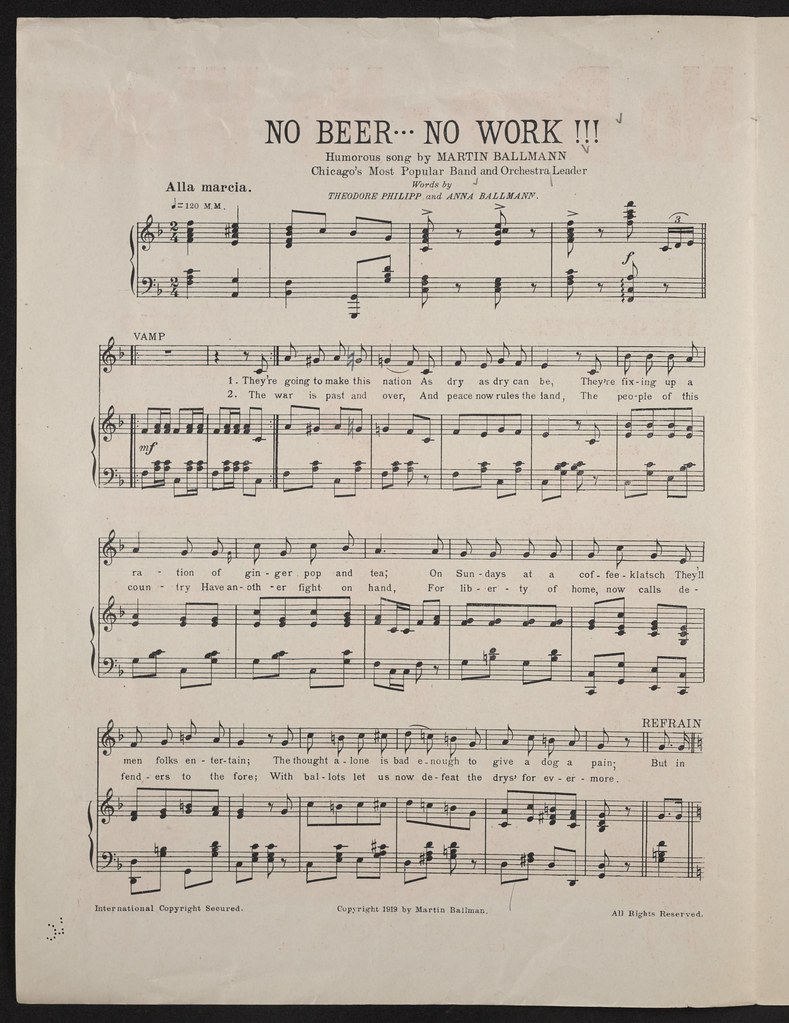
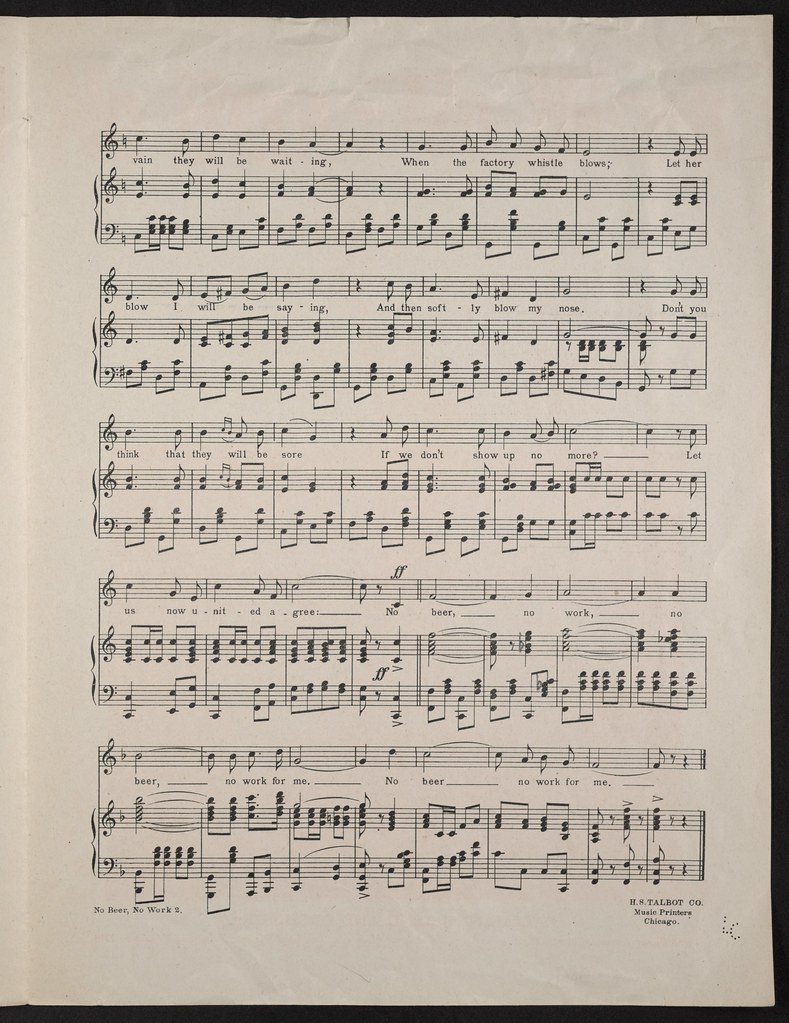
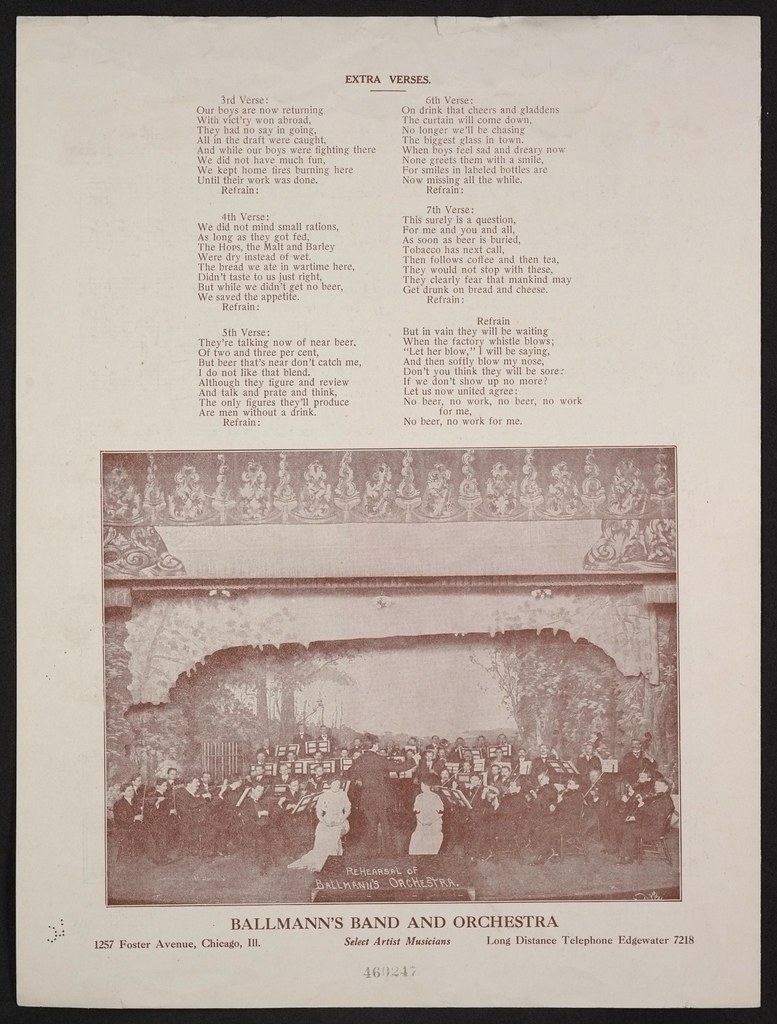
Then the very same year, another song was published by Martin Ballmann, with lyrics by Anna Ballmann and Theodore Philipp, also with the title “No Beer, No Work.” Ballman’s version was published in Chicago, and is completely different than Edwards’, apart from the title, of course.

nb-nw-0
nb-nw-1
nb-nw-2
nb-nw-3

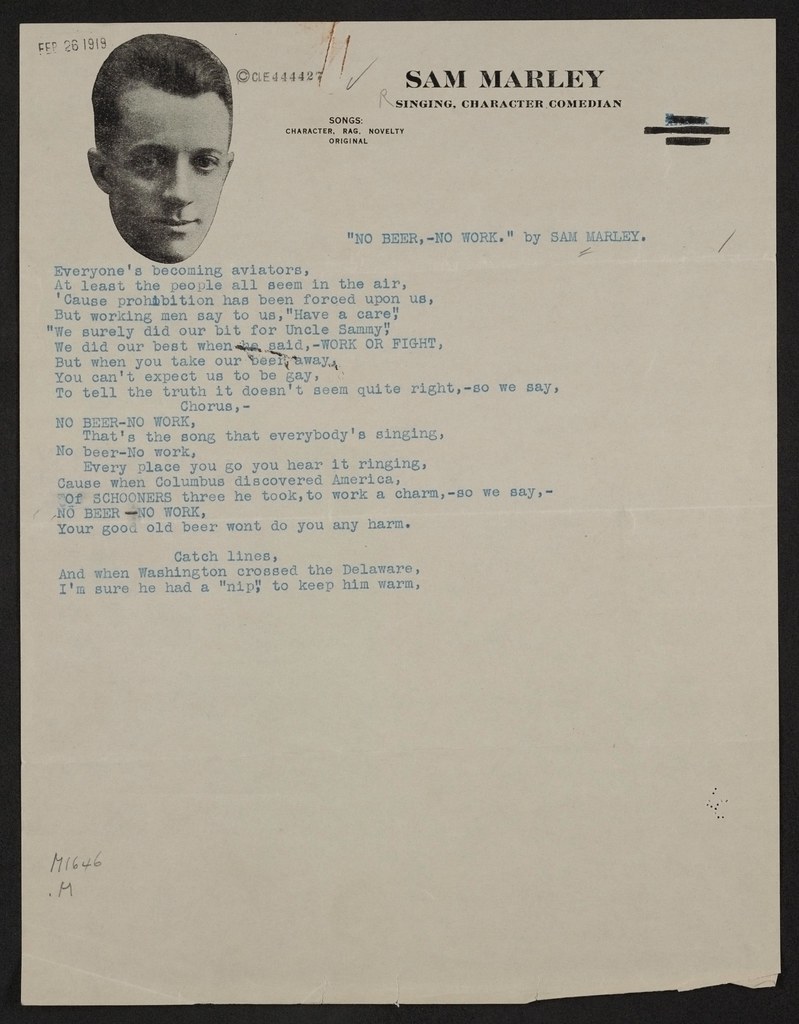
And lastly, music-wise at least, again in early 1919 (February 26 the paper is stamped), “singing character comedian” Sam Marley created original novelty lyrics for a song he called … wait for it … “No Beer, No Work.” His typed lyrics can be found in the collection of the Library of Congress.

no-beer-lyrics

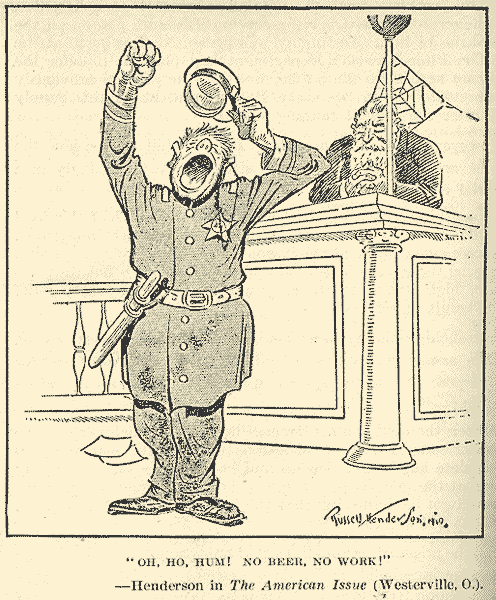
Here’s a political cartoon originally from “The American Issue” of Westerville, Ohio, published August 19, 1919, drawn by an artist named Henderson.

No_Beer

And finally, American author and poet Ellis Parker Butler, wrote a poem in 1919 also using labor’s slogan as the title, which was published in the magazine “Snappy Stories.” Butler’s poem was a parody of Henry Wadsworth Longfellow’s Excelsior.

No Beer, No Work

The shades of night was fallin’ slow
As through New York a guy did go
And nail on ev’ry barroom door
A card that this here motter bore:
‘No beer, no work.’

His brow was sad, his mouth was dry;
It was the first day of July,
And where, all parched and scorched it hung,
These words was stenciled on his tongue:
‘No beer, no work.’

‘Oh, stay,’ the maiden said, ‘and sup
This malted milk from this here cup.’
A shudder passed through that there guy,
But with a moan he made reply:
‘No beer, no work.’

At break of day, as through the town
The milkman put milk bottles down,
Onto one stoop a sort of snore
Was heard, and then was heard no more—
‘No beer, no work.’

The poor old guy plumb dead was found
And planted in the buryin’ ground,
Still graspin’ in his hand of ice
Them placards with this sad device:
‘No beer, no work.’

no-beer-no-work-mug-pin

To which I can only add. Happy Labor Day!

Filed Under: Editorial, Just For Fun, Politics & Law, Related Pleasures Tagged With: History, Holidays, Music, Poetry, Prohibition

« Previous Page
Next Page »

Find Something

Northern California Breweries

Please consider purchasing my latest book, California Breweries North, available from Amazon, or ask for it at your local bookstore.

Recent Comments

  • Bob Paolino on Beer Birthday: Grant Johnston
  • Gambrinus on Historic Beer Birthday: A.J. Houghton
  • Ernie Dewing on Historic Beer Birthday: Charles William Bergner 
  • Steve 'Pudgy' De Rose on Historic Beer Birthday: Jacob Schmidt
  • Jay Brooks on Beer Birthday: Bill Owens

Recent Posts

  • Beer In Ads #5192: Bock Beer, The Kind Made By The “Old Brew Masters” March 29, 2026
  • Historic Beer Birthday: Michael Piel March 29, 2026
  • Beer In Ads #5191: “Gesundheit” Here Today! The Drink Of Springtime! Jax Bock Beer March 28, 2026
  • Historic Beer Birthday: Jaromír Vejvoda March 28, 2026
  • Beer In Ads #5190: Heurich Bock Beer Satisfies A Long Thirst! March 28, 2026

BBB Archives

Feedback

Head Quarter
This site is hosted and maintained by H25Q.dev. Any questions or comments for the webmaster can be directed here.