

Thursday’s ad is another early ad for Ballantine, done by a cartoon artist depicting three well-heeled gentlemen sitting and talking while they enjoy their Ballantine Ale. It uses the tagline “Moving in the Best Circles …”
The Beer Vault

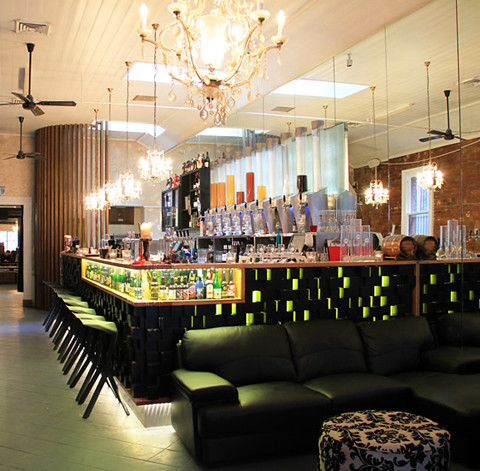
I’m not quite sure what to make of this gadget. It was created by a design firm in Australia, JonesChijoff, working with Edwin Koh and Iqbal Ameer for their Melbourne bar, Biero. It’s called a Beer Vault, and takes bottled beer and transfers it into a draft environment, cooled by glycol and kept under pressure to preserve it using carbon dioxide which they claim maintains its freshness as if it was still in the bottle. It was also designed so the bottle itself can be displayed just below a clear UV-protected tube that stores and dispenses the beer. (Thanks to Andrew M. for sending me the original link.)
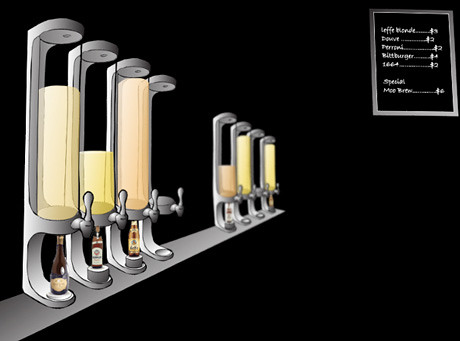
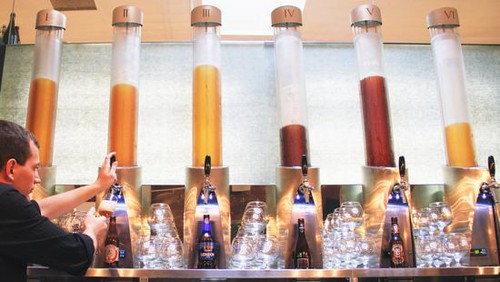
And here’s the finished product, behind the bar at Biero bar.
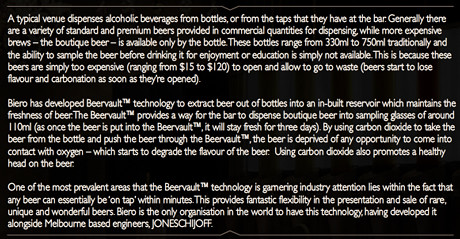
The website at Biero has some additional information.
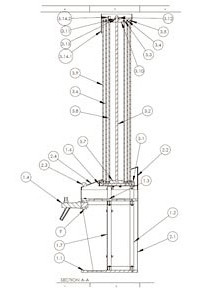
And there’s also a blueprint there, too.
The website anthill, where ideas and business meet, describes the project like this:
Be able to offer premium beer to punters in a way that hasn’t previously been done. Any beer is now available on tap! But not displayed in an industrial tin-can hidden away, but out ‘n’ proud, showcasing the varying hues of amber.
Syphoning the bottled beer into the BeerVaults and keeping it under the same pressure as was in the bottle before the lid was cracked. It is also chilled via a clear volume of liquid glycol surrounding the beer, which reticulates through a chiller. At JONESCHIJOFF we put simplicity above all else, and this was the simplest yet most effective solution.
Apparently it will keep the bottled beer fresh for about three days, meaning more people could theoretically buy a small amount of a rare beer, without having to open and potentially even waste a whole bottle. So maybe it’s a good idea? I guess time will tell.
And here’s a wider shot of the Biero bar.
Craft Beer’s 10 Commandments

Jim, the beer-half of the Beer & Whiskey Brothers blog with his brother Don, has a fun list they created; The Ten Commandments of Craft Beer. They’re not so much “commandments” in the sense that you’re being commanded, but it’s a pretty good list of things you can do to get the most out of enjoying craft beer. What would you add? Is there anything you disagree with?

Most Complete Beer Proteome Found

The American Chemical Society has announced that the most complete beer proteome has been found. The journal article in the ACS publication Journal of proteome Research, The Proteome Content of Your Beer Mug was conducted in Milan, Italy by two area university departments from the Politecnico di Milano and the Universit degli Studi di Milano working together.
According to the press release:
In an advance that may give brewers powerful new ability to engineer the flavor and aroma of beer — the world’s favorite alcoholic beverage — scientists are publishing the most comprehensive deciphering of the beer’s “proteome” ever reported. Their report on the proteome (the set of proteins that make beer “beer”) appears in ACS’ monthly Journal of Proteome Research.
Pier Giorgio Righetti and colleagues from say they were inspired to do the research by a popular Belgian story, Les Maîtres de l’Orge (The Brew Masters), which chronicles the fortunes of a family of brewers over 150 years. They realized that beer ranks behind only water and tea as the world’s most popular beverage, and yet little research had been done to identify the full set of proteins that make up beer. Those proteins, they note, play a key role in the formation, texture, and stability of the foamy “head” that drinkers value so highly. Nevertheless, scientists had identified only a dozen beer proteins, including seven from the barley used to make beer and two from yeast.
They identified 20 barley proteins, 40 proteins from yeast, and two proteins from corn, representing the largest-ever portrait of the beer proteome. “These findings might help brewers in devising fermentation processes in which the release of yeast proteins could be minimized, if such components could alter the flavor of beer, or maximized in case of species improving beer’s aroma,” the report notes.
I’m not sure about those findings, the statement about the “ability to engineer the flavor and aroma of beer” sounds a bit too Frankenstein-like for my tastes. Though to be fair, I don’t remember much about Proteomes from my time taking the short course on brewing at U.C. Davis.
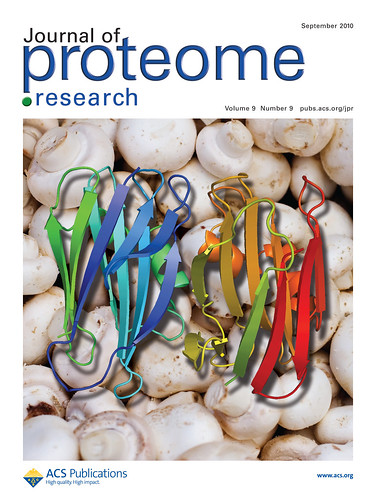
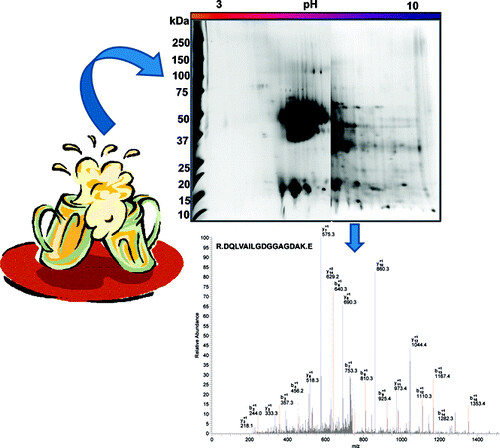
At any rate, the whole article is online. Below is the abstract, see if it makes sense to you:
The beer proteome has been evaluated via prior capture with combinatorial peptide ligand libraries (ProteoMiner as well as a homemade library of reduced polydispersity) at three different pH (4.0, 7.0, and 9.3) values. Via mass spectrometry analysis of the recovered fractions, after elution of the captured populations in 4% boiling SDS, we could categorize such species in 20 different barley protein families and 2 maize proteins, the only ones that had survived the brewing process (the most abundant ones being Z-serpins and lipid transfer proteins). In addition to those, we could identify 40 unique gene products from Saccharomyces cerevisiae, one from S. bayanus and one from S. pastorianus as routinely used in the malting process for lager beer. These latter species must represent trace components, as in previous proteome investigations barely two such yeast proteins could be detected. Our protocol permits handling of very large beer volumes (liters, if needed) in a very simple and user-friendly manner and in a much reduced sample handling time. The knowledge of the residual proteome in beers might help brewers in selecting proper proteinaceous components that might enrich beer flavor and texture.
Interesting ….
Beer In Ads #205: Ballantine Clown
Wednesday’s ad is an early ad for Ballantine, one of the first to use their iconic three-rings of “body,” “purity” and “flavor.” Unfortunately, it also features an ugly, frightening clown — but then I hate clowns.

Beer In Ads #204: Pilse Etzer
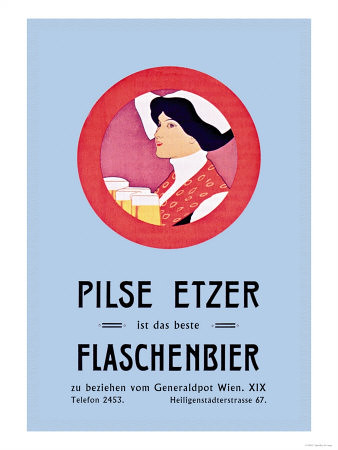
Tuesday’s ad is for a German brewery — I think — Pilse Etzer, so it says, is the best bottled beer. The woman in the red circle, however, looks like Dutch.
Beer In Ads #203: Epidor Moritz
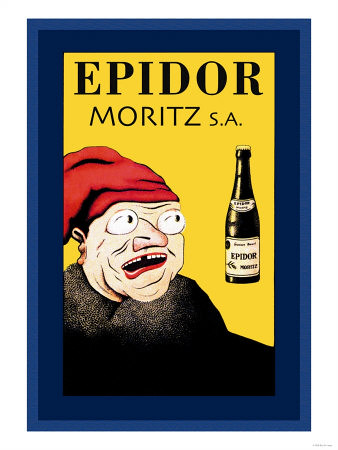
Monday’s ad is for a Spanish brewery, Moritz in Barcelona, which was founded in 1856 and closed in 1978. Remaining family members started up the brand again a few years ago, contracting the brewing. This ad is for Epidor, a strong lager they debuted July 23, 1923. Given the strange face of the man in the ad, I’m not exactly sure who their target audience was or why they thought that would help sell beer. Does it make you want to drink their beer?
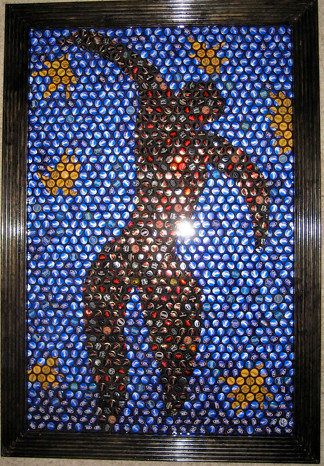
Beer In Art #95: Wesley Alan Harris’ Bottlecap Art

Today’s featured artwork is by an RN from Plano, Texas, who in in his spare time makes incredible works of art using crowns, or bottlecaps, as his medium. The one that I first saw was a bottle cap version of the famous work by Henri Matisse, Icarus. The framed bottlecap Icarus is 2.5 by 4 feet.
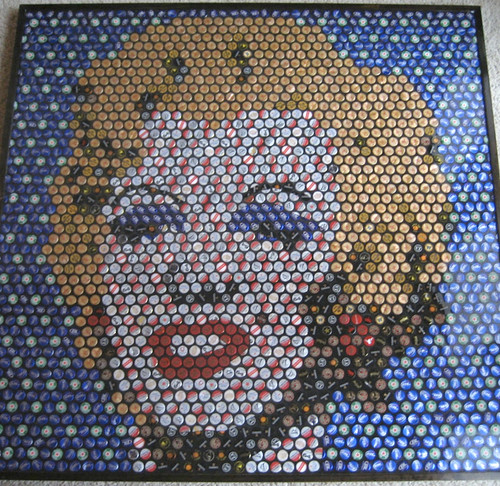
And here’s one of his Warhol-inspired portraits of Marilyn Monroe.
Here’s how he got into making bottlecap art, from his blog:
My work with bottle caps all started as a joke in college, but eventually became a hobby, and moreover a form of art that is quite interesting, stimulating, and rare. It is also keeping in theme with today’s mindset of reusing and recycling trash to make genuine treasures. I have many friends, relatives, coworkers, and favorite drinking/dining establishments who save bottle caps for me.
A friend of mine opened a bar in 2008, and I offered my first piece as decoration in the bare-walled establishment. After receiving copious and favorable feedback about my first piece, I decided to undertake bottle capping more seriously in 2009. I have completed several ‘spec’ pieces, in addition to selling my first piece in August 2009. In March 2010 I had a showing of all of my bottle cap artwork.
Here’s that first one he did, which was started n 2002 but not finished until 2006.
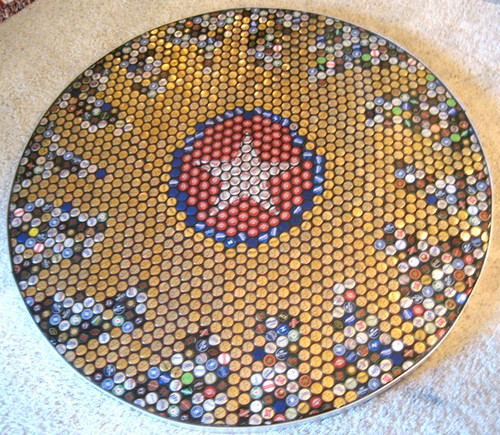
I think this is my favorite of his originals, a mostly blue field with the sun in the corner.

And finally, here’s another Matisse inspired piece, his recreations of Blue Nude, Souvenir of Biskra.


You can see the rest of Harris’ bottlecap works at his portfolio, many of which are for sale.
A Short History of Malt Liquor

California freelance journalist Andrew Rosenblum has an interesting short history of malt liquor marketing on Accidental Blogger entitled What Was Malt Liquor?
Open Up With The 1973 Budweiser Malt Liquor Express

Check out this unintentionally hilarious video made for the Anheuser-Busch sales force and distributors in 1973, created to showcase how they were going to “open up” the market for malt liquor with Budweiser Malt Liquor.