Brookston Beer Bulletin

Jay R. Brooks on Beer

  • Home
  • About
  • Editorial
  • Birthdays
  • Art & Beer

Socialize

  • Dribbble
  • Email
  • Facebook
  • Flickr
  • GitHub
  • Instagram
  • LinkedIn
  • Pinterest
  • RSS
  • Twitter
  • YouTube

Powered by Genesis

Beer In Ads #1647: Everything I Have Is Yours

August 13, 2015 By Jay Brooks


Thursday’s ad is for the American Can Company, from 1938. It’s for their “keglined” cans and includes a curiously feminine beer can (I don’t think I realized that cans could be male or female). But the text is pure gold. “I am a beer can. I have no past — no future. I belong to YOU. I was brand new when i was filled. I’ll never be used again. I am clean. I am safe. I am easy to carry, easy to stack. I protect the delicious flavor of beer and ale because I keep out harmful light.” Genius.

I-am-a-beer-can-1938

Filed Under: Art & Beer, Beers Tagged With: Advertising, Cans, History

Bass Vs. Cooke Brewing Co.

August 13, 2015 By Jay Brooks

tm
It seems many people think that trademark disputes are a new phenomenon, because in the age of social media and the twenty-four news cycle, everything is news, but they’re actually nothing new. Trademark disputes have been going on as long as the very concept of a trademark existed, it’s just that they used to happen mostly out of the glare of the public, and instead quietly wound their way through court documents and appearances before special tribunals created to adjudicate these specific types of disputes.

I, myself, was involved in one as the beer buyer for Beverages & more, when an East coast brewery objected to one of our private label beers. Few people know about it, because even as recently as the late 1990s, when this took place, such disputes were mostly private matters. Personally, I think that’s how it should be, because trademark is a highly technical, arcane subject, which I think is better left to experts in the field. I also think trademark law could use some updating to better reflect the real world we find ourselves in today, but that’s an argument for another day.

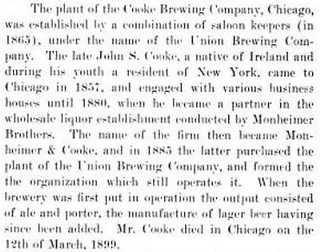
My point here is only that trademark disputes are old hat. A few days ago, I stumbled on one from around 1893, when the makers Bass Ale sued a Chicago brewery — the Cooke Brewing Co. — for trademark infringement. I couldn’t find out very much information about the Cooke brewery, but “One Hundred Years of Brewing” (originally published in 1903, and reprinted in 1974) includes this summary:

Cooke-Brewing-history

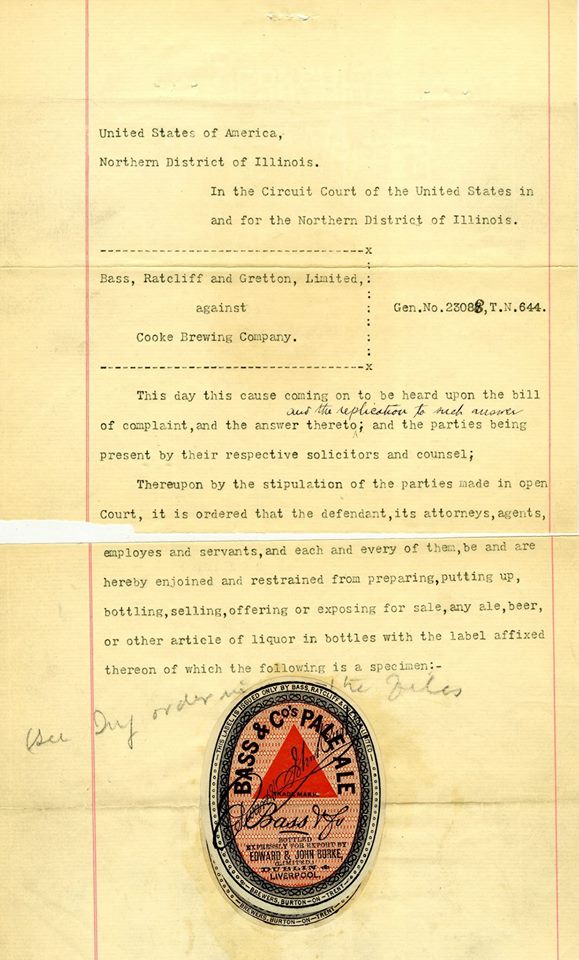
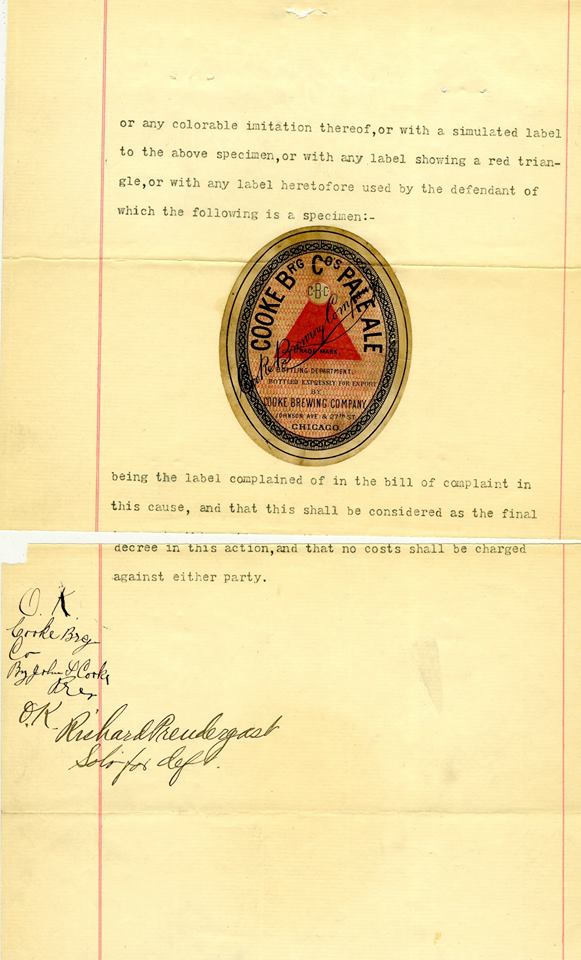
Apparently, in 1893, when the World’s Columbian Exposition (a.k.a. The Chicago World’s Far) took place in Chicago from May to October of that year, “Cooke Brewing Company created a display to advertise its beer. The bottles, however, were labeled with remarkable similarity to those used by Bass.” Not surprisingly, Bass sued for relief in the US Circuit Court Northern District of Illinois. While many trademark disputes are open to debate in which reasonable people may have a difference of opinion, I don’t think this is one of those cases. I think you’d be hard pressed to find anyone not employed by the Cooke Brewing Co. who didn’t believe this was one of the most clear cut examples of trademark infringement in the annals of history.

Online records, as far as I can tell, don’t go back far enough to see how this case started and progressed. The only reason the final ruling is out there, is because someone at the National Archives in Chicago came across this and decided to share it on their website and Facebook page. But take a look below at the two beer labels and see for yourself. It’s hard to believe it got this far, and Bass had to file a lawsuit at all to stop the Chicago brewers. I guess they really thought they could get away with using a red triangle on their label.

Bass-v-Cooke-1 Bass-v-Cooke-2

Filed Under: Beers, Breweries, Editorial, Just For Fun, Politics & Law Tagged With: History, Law, Trademark

Patent No. 3100707A: Addition Of Dry Hectorite To Beer

August 13, 2015 By Jay Brooks

patent-logo
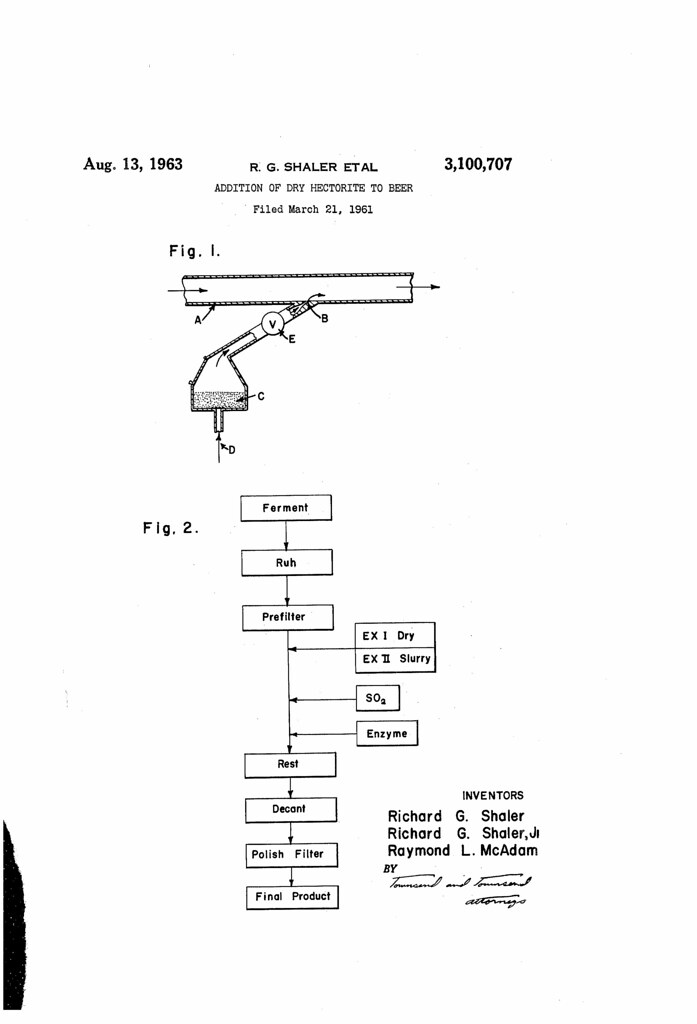
Today in 1961, US Patent 3100707 A was issued, an invention of Raymond L. Mcadam, Richard G. Shaler Jr., and Richard G. Shaler, assigned to the American Tansul Company, for his “Addition of Dry Hectorite to Beer.” There’s no Abstract, although in the description it includes this summary:

This invention relates to an improvement in the process for treating beer or similar beverages such as wines and fruit juices whereby the beverages are improved in clarity, stability, and qualities or brilliance, sparkle, and taste. The invention relates to an improvement in the treatment of beer with a swelling gelling clay, preferably a montmorillonite clay such as hectoritc.

Specifically, the invention relates to a new method of “chill-proofing” beer or other beverages by the use of a dry swelling gelling clay of the montmorillonite group and preferably hectorite. When heretofore the clay has been first placed in an aqueous suspension prior to introduction into the beer, the present invention contemplates direct addition of the clay to the beer in dry pulverant form. The results show a surprising increase in yield of beer and excellent product stability.

Untitled

Filed Under: Beers, Breweries, Just For Fun, Politics & Law, Related Pleasures Tagged With: History, Law, Patent, Science of Brewing

Beer In Ads #1646: Beer Is Good … Because Everything In It Is Good

August 12, 2015 By Jay Brooks


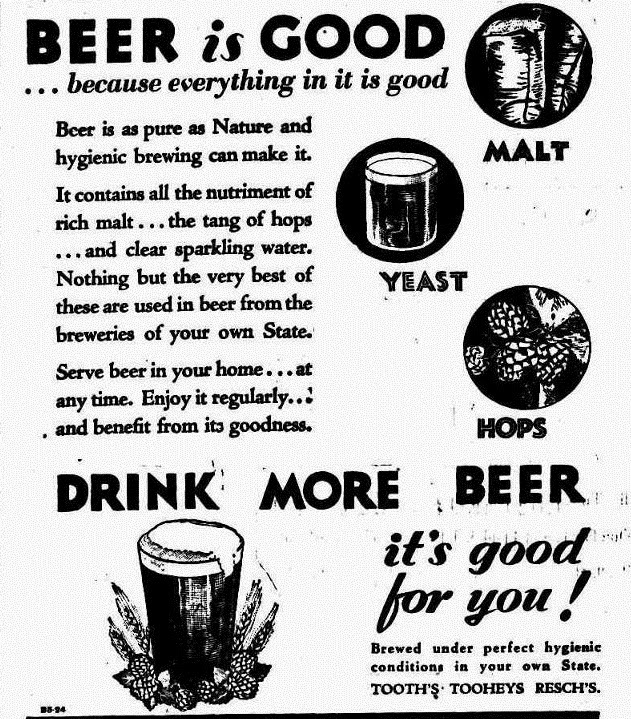
Wednesday’s ad is for Tooheys, from 1932. The Australian ad starts with awesome tagline. “Beer is Good … because everything in it is good.” There’s a number of great bon mots in the text. “Beer is as pure as Nature and hygienic brewing can make it,” is a good one. But I love this ending, too. “Serve beer in your home … at any time. Enjoy it regularly … and benefit from its goodness.” Well, okay.

Tooheys-1932-beer-melbourne

Filed Under: Art & Beer, Beers Tagged With: Advertising, Australia, History

Patent No. 2252235A: Bottle Carrier

August 12, 2015 By Jay Brooks

patent-logo
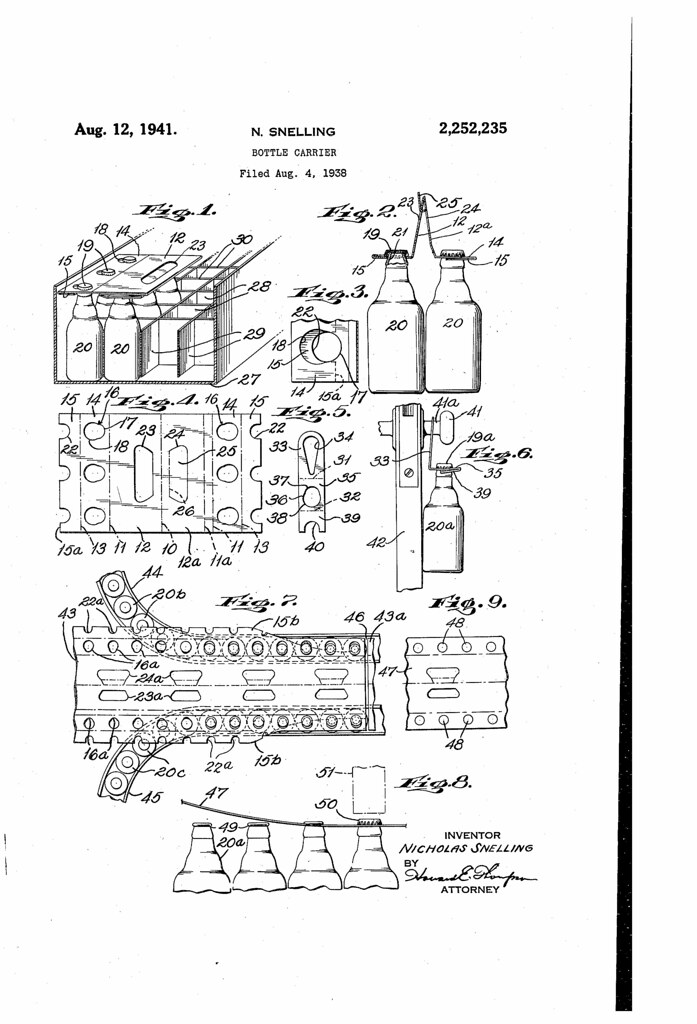
Today in 1941, US Patent 2252235 A was issued, an invention of Nicholas Snelling, assigned to the Zimba Beverage Co. Inc., for his “Bottle Carrier.” There’s no Abstract, although in the description it includes this summary:

This invention relates to devices for carrying Orr-supporting bottles of various kinds and classes, and particularly bottles having removable closure caps; and the object of the invention is to provide a supporting device of the character described made from heavy `paper or light cardboard which is die cut, printed, lithographed, or otherwise characterized, and then folded to form a means for carrying, handling, or assembling bottled goods either individually or collectively so as to facilitate the handling and packaging as well as delivery thereof; a further object being to provide a device of the character described having an apertured portion from which or by means of which the device including the bottle or bottles thereon may be suspended or carried; a further object’ being to provide’a device of the character described wherein a number of bottles may be collectively packed in a carton or shipping case with the carrying lor suspending device attached thereto or to a number of bottles in a compact and collapsed manner and whereby the group of bottles may be simultaneously removed from the carton or shipping casein the removal of the supporting device therefrom thereby simplifying the handling of merchandise of this kind by the merchant and also facilitating the packing and carrying thereof a still further object being to provide an improved method of constructing a device of the character described `so as to adapt the same for use in a’ continuous assemblage upon a multiplicity of bottles moved relatively thereto so as to` expedite the assemblage of the device to groups of bottles, and further to incorporating a device of this character upon bottled goods in the operation of capping or sealing the same; and with these and other objects in view, the invention consists in a device of the class and for the purpose specified which is simple and economical in construction, and which may be produced and used in accordance with the method more fully hereinafter described and claimed.

Untitled

Filed Under: Beers, Breweries, Just For Fun, Politics & Law, Related Pleasures Tagged With: Bottles, History, Law, Patent

Hefe Wheaties

August 12, 2015 By Jay Brooks

Untitled
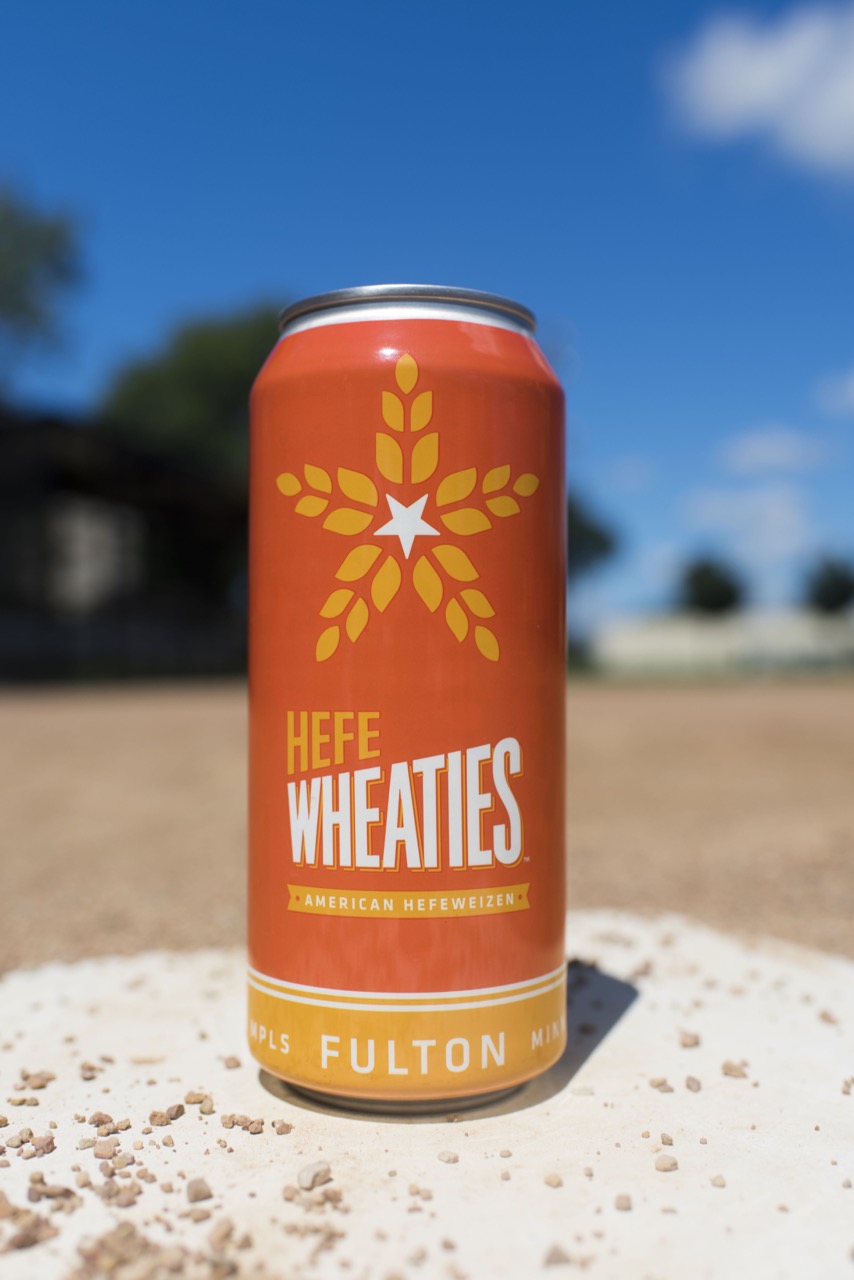
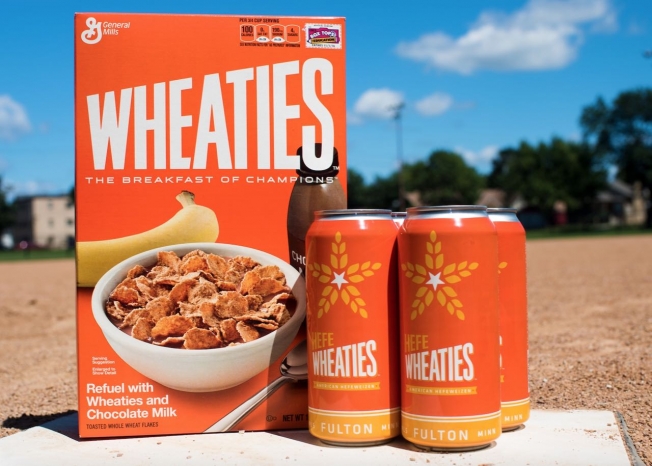
Just when you think things can’t get stranger, the makers of Wheaties — the Breakfast of Champions — General Mills have announced that they’re making a new beer, Hefe Wheaties. Expecting people to do a spit take when reading that, General Mills blog anticipated skepticism in their announcement of the new beer. “Well, you read it correctly. Wheaties has partnered with Fulton, a craft brewery in Minneapolis, to create a limited-edition Hefeweizen beer named HefeWheaties.

HefeWheaties-1

Here’s how General Mills’ describes the collaboration beer on their blog.

Wheaties is not actually in the beer, but there is wheat. And that connection helped both brands try something interesting.

“We were intrigued from the get-go on this idea for many reasons, including that we’re both Minneapolis companies, and that the beer and the cereal both started from the same place in terms of raw ingredients and the same city,” says Ryan Petz, president and co-founder of Fulton.

So what about the name?

“We had been sampling a number of Hefeweizens, so we had been discussing with the Wheaties team what we liked,” says Petz. “Someone on the team said HefeWheaties, and it kind of sprung out from there.”

The Hefeweizen is a south German style of wheat beer, typically brewed with over 50 percent malted wheat, making it a natural fit for Wheaties.

The “Hefe” prefix means, “with yeast.” This German-style beer often has a cloudy appearance because of the high wheat content and has a little bit of hop bitterness.

Typically served in a traditional Weizen glass, HefeWheaties will be the first beer of this style brewed by Fulton. It’s brewed with water, malted wheat, malted barley, hops from Germany, the U.S. and Australia, and a yeast strain specifically developed for fermenting American-style wheat beers.

“This was a true partnership between Wheaties and Fulton,” says David Oehler, marketing manager, Wheaties. “Both teams were passionate about this project and got to work quickly. We enjoyed the chance to collaborate with Fulton throughout the entire process from idea generation to can design.”

The idea for HefeWheaties came up earlier this summer, thanks to some connections between Fulton’s team and employees at General Mills.

Tony Libera, who manages the social media accounts for Wheaties, chatted about the possibility of a beer partnership for the brand with a friend who was a sales representative for Fulton, and the plans were put in motion from there.

The Fulton team also has other close ties to General Mills. Petz worked for us for a few years after business school, as did Fulton’s director of operations. And the wife of another Fulton founder currently works at General Mills.

So where can you find HefeWheaties?

For a limited time, beginning August 26, it will be available in the Twin Cities market in a 16oz. tallboy can. 4-packs will be sold at limited retailers in the area, while quantities last. HefeWheaties will not be available for shipment or purchase outside of Minnesota.

Also, the Fulton taproom in Minneapolis will host several events featuring HefeWheaties, with the first being held on August 26.

“We’ll see how people react to it,” says Petz. “If it’s something everybody loves, we’ll obviously consider doing it again in a bigger and more widely distributed way in the future.”

Hmm. Breakfast beer, anybody?

hefewheaties

Filed Under: Beers, Breweries, Food & Beer, Just For Fun, News Tagged With: Announcements, Collaborations, Food, Minnesota, Press Release

Patent No. 8802421B2: Method Of Propagating And Delivering Yeast

August 12, 2015 By Jay Brooks

patent-logo
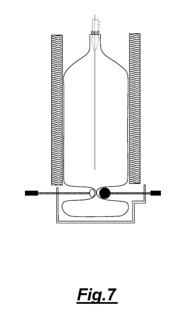
Today in 2014, US Patent 8802421 B2 was issued, an invention of Chris White, assigned to White Labs, for his “Method of Propagating and Delivering Yeast.” Here’s the Abstract:

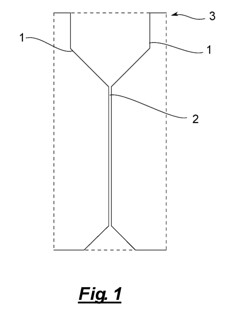
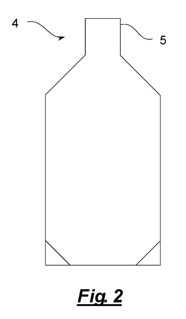
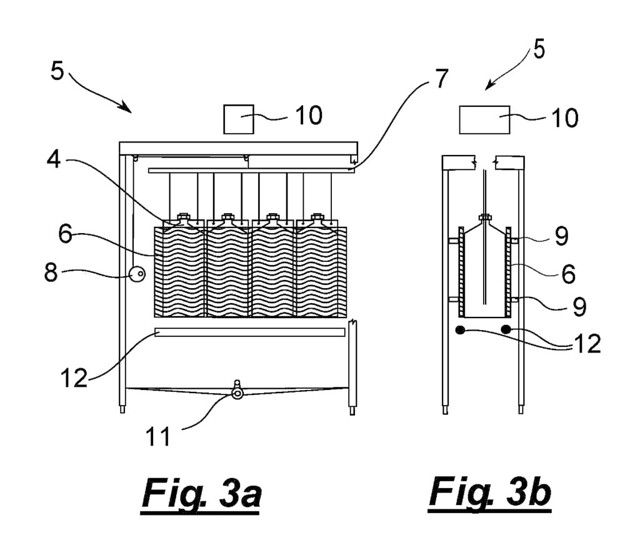
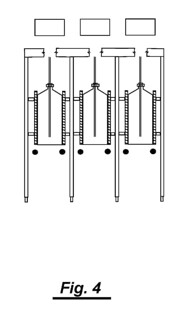
A method of propagating, concentrating and delivering yeast is disclosed. The method comprises the steps of producing and inoculating a bag, propagating yeast within the bag, and concentrating the yeast in a section of the bag that is the removed from the remainder of the bag while not exposing any portion of the yeast therein to an external environment. In order to remove the bag, which contains the most concentrated slurry of yeast, a smaller bag is heat-sealed off of the larger bag, thereby creating a separate bag for the living sediment, which is still the bag in which the sediment was propagated. In a preferred embodiment, the method is specific to the alcoholic beverage industry. The method is also applicable to other industries that grow and transport yeast, bacteria, molds and other microorganisms.

Untitled Untitled

Untitled
Untitled Untitled

Untitled Untitled

When Chris spoke at my SSU Beer Appreciation class last semester, he talked about his new innovation, which was patented today a year ago, and which they’re calling the “FlexCell Process” and marketing it as “Pure Pitch.” It’s a pretty cool idea.

Untitled

And here’s a short video about the “FlexCell Process” from the White Labs website.

Filed Under: Beers, Just For Fun, Politics & Law, Related Pleasures Tagged With: Law, Patent, Yeast

Patent No. 2847309A: Brewing Process

August 12, 2015 By Jay Brooks

patent-logo
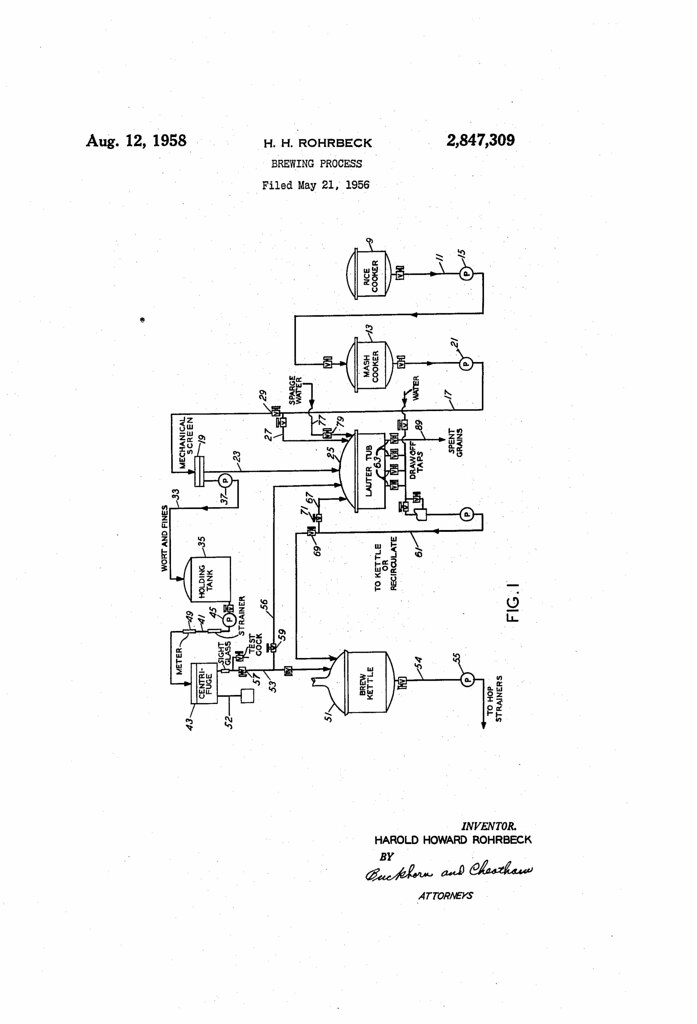
Today in 1958, US Patent 2847309 A was issued, an invention of Harold Howard Rohrbeck, assigned to the Olympia Brewing Company, for his “Brewing Process.” There’s no Abstract, although in the description it includes this summary:

Heretofore, in the conventional brewing process, it has taken considerable time toV filter the wort through the lautering bed provided by the grain in the lauter tub and also to sparge the bed. I believe the reason for this is that the lines, which are microscopic glutinous protein matter, have collected in the interstices of the filtering bed and have restricted and even completely closed them thus slowing down the filtering step.

It is a main object of the present invention to provide a brewing process overcoming the above disadvantage.

A further object of the present invention is to provide a process in which all or part of the fines are removed from the mash prior to the mash entering the lauter tub whereby to speed up the filtering operation.

A further object of the present invention is to provide an apparatus by which the method of the present invention may be carried out.

The process -of the present invention is characterized by the steps of separating the fines from at least a part of the mash prior to the mash being conducted to the lauter tub so that the filter bed is not nearly as congested or restricted by the presence of the fines as heretofore has been the case and thus the filtering action of the bed is much more rapid than heretofore.

Untitled

Filed Under: Beers, Breweries, Just For Fun, Politics & Law, Related Pleasures Tagged With: Brewing Equipment, History, Law, Patent, Science of Brewing

Beer In Ads #1645: Enjoy The Difference!

August 11, 2015 By Jay Brooks


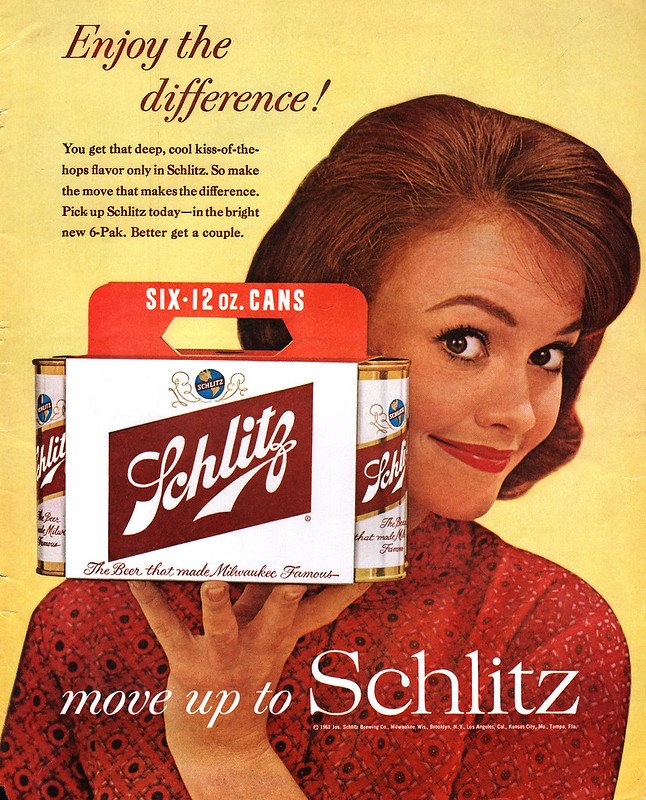
Tuesday’s ad is for Schlitz, from 1961. I love her smile, the expression on her face — it’s so Mary Tyler Moore, especially with the hip material of the dress (or is that a blouse?) she’s wearing. I also love how she’s holding that six-pack, so we know just how light it is, able to be picked up with little effort at the grocery store. Which is probably why toward the end of the ad copy, there’s this suggestion. “Better get a couple.”

schlitz-enjoy-the-difference

Filed Under: Art & Beer, Beers Tagged With: Advertising, History, Schlitz

The Robert Smith India Pale Ale Brewery

August 11, 2015 By Jay Brooks

Untitled
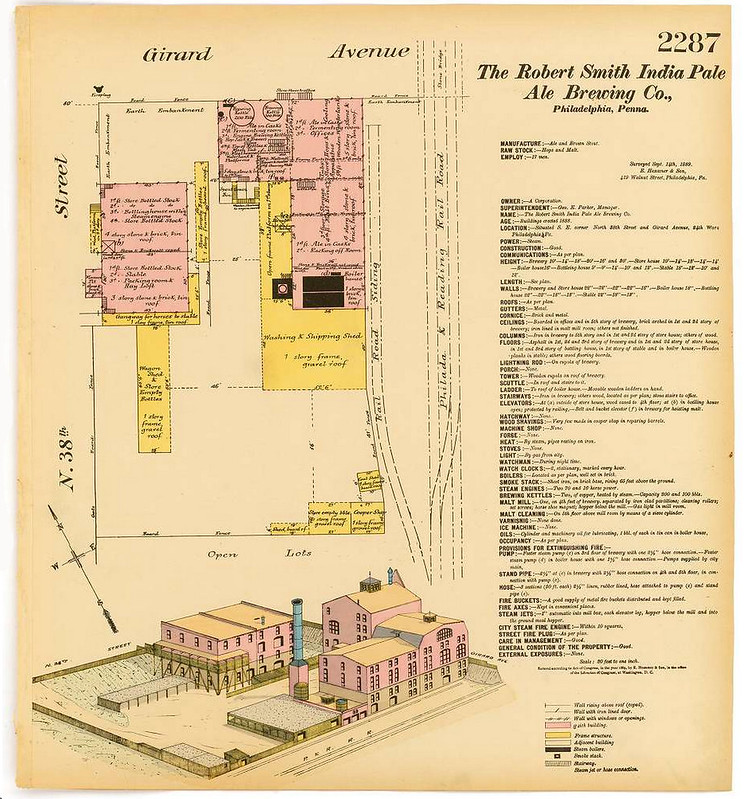
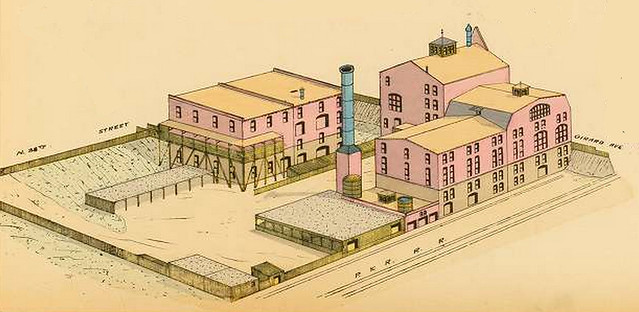
The ad I featured yesterday in my long-running Beer In Ads series was for The Robert Smith Ale Brewing Co. of Philadelphia, Pennsylvania. The brewery was only called by that name from 1896 until it closed when Prohibition began. From 1887 until 1896, the brewery was called The Robert Smith India Pale Ale Brewing Co. While searching for information for the post last night, I happened upon a cool bit of history regarding the brewery from 1889. The Map Collection at the Free Library of Philadelphia includes a survey map of The Robert Smith India Pale Ale Brewing Co. created by Ernest Hexamer and included in the Hexamer General Surveys, Volume 24, published in 1889.

Robert-Smith-IPA-1889

The brewery was located in West Philadelphia, in the 24th Ward, at N. 38th St, Girard Ave and Philadelphia and the Reading Railroad. The survey also includes some interesting tidbits in the text at the right, a laundry list of architectural facts and figures. For example, the brewery was powered by steam, had two copper kettles — a 100 bbl and 200 bbl vessel — and employed 17 people. Below is a blow-up of the brewery illustration, showing the brewery property and grounds.

Robert-Smith-IPA-1889-brewery

Filed Under: Art & Beer, Breweries, Just For Fun Tagged With: History, Pennsylvania, Philadelphia

« Previous Page
Next Page »

Find Something

Northern California Breweries

Please consider purchasing my latest book, California Breweries North, available from Amazon, or ask for it at your local bookstore.

Recent Comments

  • Bob Paolino on Beer Birthday: Grant Johnston
  • Gambrinus on Historic Beer Birthday: A.J. Houghton
  • Ernie Dewing on Historic Beer Birthday: Charles William Bergner 
  • Steve 'Pudgy' De Rose on Historic Beer Birthday: Jacob Schmidt
  • Jay Brooks on Beer Birthday: Bill Owens

Recent Posts

  • Beer In Ads #5240: Rieker’s Bock Beer Is Now On The Market May 3, 2026
  • Historic Beer Birthday: Herman Adolph Schalk May 3, 2026
  • Beer In Ads #5239: The National Drink May 2, 2026
  • Beer Birthday: Anders Kissmeyer May 2, 2026
  • Beer Birthday: Bruce Paton May 2, 2026

BBB Archives

Feedback

Head Quarter
This site is hosted and maintained by H25Q.dev. Any questions or comments for the webmaster can be directed here.