Wednesday’s ad is from the 1930s, and is for Pabst Blue Ribbon, a Thanksgiving wish from the brewery “To Health & Good Cheer.” Since tomorrow is Thanksgiving, that’s my wish, too.
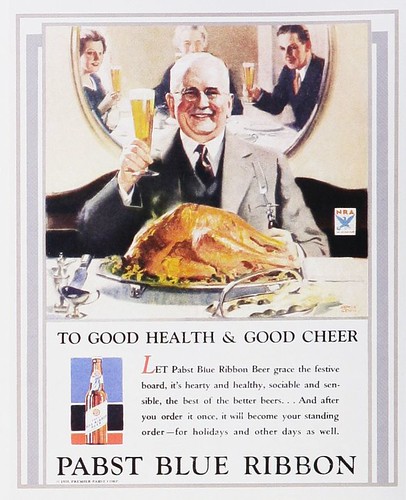

Wednesday’s ad is from the 1930s, and is for Pabst Blue Ribbon, a Thanksgiving wish from the brewery “To Health & Good Cheer.” Since tomorrow is Thanksgiving, that’s my wish, too.
Tuesday’s ad is another by Eugene Oge, a French illustrator who did a number of great beer adverts during his lifetime from 1861-1936. He was a major figure in the Belle Epoque and did many outstanding ads for resorts, food, and all sorts of beverages and brands. This is the third of his I’ve featured, and it’s for a presumably French beer brand, Biere de Chartres.


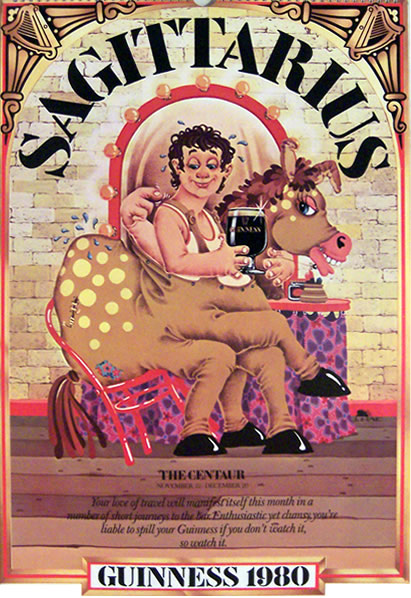
While I don’t put any stock in astrology, in 1980 Guinness put out a calendar with each month representing one of the zodiac signs, and I thought it would be fun to share these throughout the year.
Sagittarius, the archer, is from November 22-December 22. To learn more, see:
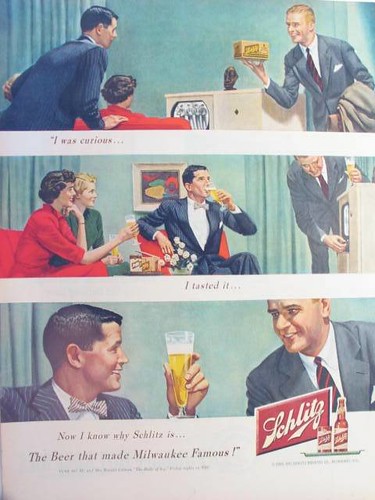
Monday’s ad is for Schlitz, from 1950. It’s yet another of the “I was curious” series. In this installment, a couple gets dressed up to go to another well-dressed couple’s house to watch that new-fangled tee-vee that everyone was talking about. I love how the man holding the six-pack of beer is using just his fingertips.

Today in 1789, North Carolina became the 12th state.
North Carolina
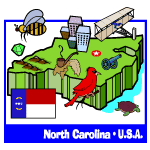
North Carolina Breweries
North Carolina Brewery Guides
Guild: North Carolina Brewers Guild
State Agency: North Carolina Alcoholic Beverage Control Commission

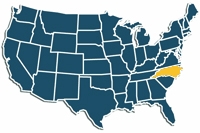

Package Mix:
Beer Taxes:
Economic Impact (2010):
Legal Restrictions:
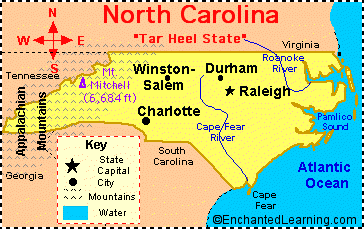
Data complied, in part, from the Beer Institute’s Brewer’s Almanac 2010, Beer Serves America, the Brewers Association, Wikipedia and my World Factbook. If you see I’m missing a brewery link, please be so kind as to drop me a note or simply comment on this post. Thanks.
For the remaining states, see Brewing Links: United States.

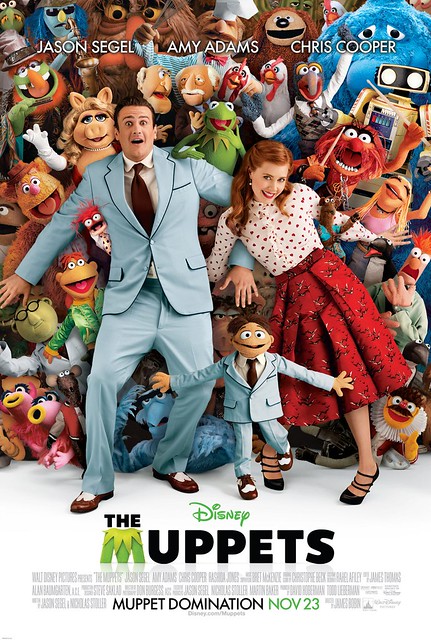
I got a nice tweet from Gerard Walen of Road Trips For Beer, who’s obviously been paying attention enough to know how much of a Muppets fan I am. He had a chance to see an advance screening of the new Muppet film that opens Thanksgiving and he assures me that Porter and I “will love the movie.” Of that, I have little doubt. I’ve turned my whole family into Muppet fans by showing them all of the television shows and movies since they were little. I’ve been a fan since I was a kid, and have never really stopped loving their bad pun, groaner brand of humor ever since. But after seeing the film, Walen took it a step farther in a post: ‘The Muppets’ Movie Makes Me Wonder: What Beer Would They Drink? He’s come up with some pretty funny, inspired choices for the main characters. Makes me even more thirsty to see the movie later this week.

You may recall my skeptical take on the Vodka and Tampon story two weeks ago. Since then, I got an e-mail from a friend with a link to a Tiny Cat Pants post In Which I Debunk the Vodka-Soaked Tampon Myth. Today, I learned from the Missus that Danielle Crittenden, Managing Editor, Blogs, for the Huffington Post Canada was as skeptical as I was. Crittenden’s also the wife of famed conservative David Frum and an author in her own right. She posted her own efforts at reproducing the vodka tampon on the Huffington Post, in an article entitled Bartender, a Dirty Martini With a Tampon!. Like Tiny Cat Pants, it didn’t go well … at all. And it’s part of mounting evidence that the people spreading this story are, for lack of a better term, full of shit. As I suspected, this sounded more like an urban legend, a hoax, a way for media outlets to scare parents. But read Crittenden’s account, it’s pretty funny, and scary, but in a whole different way.

Curious how to properly use a butterfly beer opener? Not to worry, Lagunitas has your back. Watch and learn, grasshopper.

This week’s work of art is by the Dutch illustrator and engraver Jan Luyken. His watercolor painting, The Cooper, was originally done as a study for an engraving he was working on for a larger project, a book entitled “Het Menselyk Bedryf,” or “Book Of Trades.”
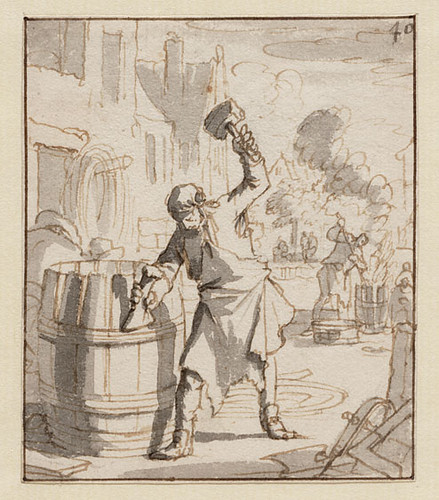
Both the watercolor and the subsequent engraving, which is below, was completed in 1694.
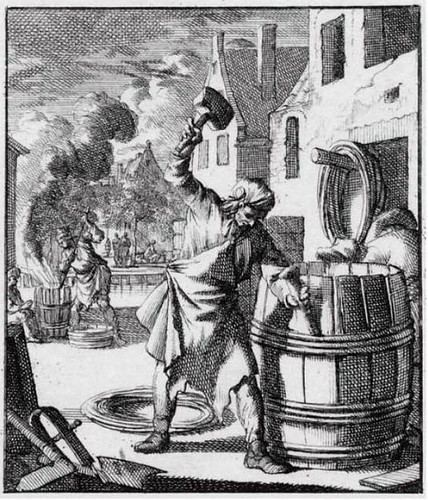
The final engraving was included in The Book of Trades, and looked like this in one edition.

On critic, writing about Luyken’s Cooper, has the following to say:
Luyken’s rapid treatment of the work is accentuated by the use of quick brush strokes in the watercolour highlights. The cooper, who is outside his workshop, is attaching the barrel staves which he has shaped and positioned in the background, his colleague is coating the inside of a barrel with wax.
You can read Luyken’s biography at Wikipedia or at Scroll Publishing. You can also see the rest of the engravings from The Book of Trades and you can see other works at WikiGallery. Also, his biblical set, Martyrs Mirror, from 1685, can be seen at Bethel College’s website.

In September, the British Beer & Pub Association released information regarding pub closures in the UK.
Back in the 1970s more than 90% of all beer consumed in Britain was bought from the “on trade” — pubs and clubs.
According to the British Beer & Pub Association this ratio had fallen to 51% from pubs and 49% from supermarkets at the end of last year. “It will cross over in the near future,” said a spokesman, possibly as soon as this Christmas.
This would be a watershed moment for Britain’s beer industry, a culmination of long-standing change in consumers’ drinking habits as well as confirmation that the recession has caused people to stay at home more.
The figure came as a report from the GMB union highlighted how the high price of beer has caused the destruction of thousands of neighborhood pubs, in turn damaging many working class communities. It said that local pubs, many of which had survived the Blitz and the great depression of the 1930s, were now being destroyed by the recession.
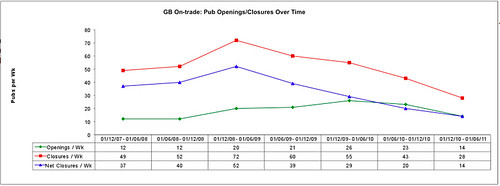
Pub closures hit a record rate of 53 a week at the height of the recession. Last year, 26 a week closed their doors, leaving just 52,500 pubs in Britain, nearly half of the level at its peak before the World War II.
The Beer & Pub Association blamed competition from the supermarkets, which often sell beer as a “loss leader” to drive customers into their stores, and above-inflation increases to beer duty. The GMB blamed large pub companies putting up their prices because they were struggling with too many debts.
Last week, they released a new statement, Sticking to the facts on pub closure numbers, which said, in part:
The BBPA has moved to set the record straight over conflicting analysis in recent days of UK pub closure figures. It is absolutely clear from CGA data, says the BBPA, that free trade pubs have been closing at a much faster rate that tenanted and leased pubs in recent years. The BBPA has published its full analysis of the data on its website, today available from the link below.
From January 2009 to June this year, CGA figures show 3,444 free trade pubs closed, compared with 2,239 tenanted and leased pubs over the same period. As the free trade sector has considerably fewer pubs, their closure rate over the period was almost double that of the tenanted and leased sector, at 16 per cent, as compared with 8 per cent. Taking new openings into account, there was a 9 per cent net reduction in free houses, compared with a 6 per cent reduction in tenanted and leased.
Free trade closures are higher, despite the considerable numbers of pubs being sold into the free trade from the tenanted sector. The reason that there are more free-trade pubs now than there were at the start of 2009 is that companies have sold tenanted/leased pubs to private owners, where this has been deemed appropriate.
“Pub closures are caused by a huge range of issues — the greatest of which we can influence are undoubtedly punitive rates of taxation and the high cost of regulation. And though there is still some way to go to halt the decline, we should all welcome that the latest figures show that the net closure rate has fallen significantly.”
Still, net closures are 14 per week. That’s two a day! But really, it’s 28 pubs closing each week or four a day, which is even more alarming. I’ve been told by Brit friends who know more about this than I do that it’s the bad pubs that are closing, but I have a hard time believing that’s all it is. With that many closing, there must be some good ones, or at least just average ones, that can’t survive as well.
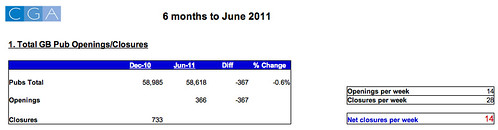
Overall closures are declining since their all-time high (or low) in 2008, as are openings as well, so you can see why there is some reason for optimism. When things are going poorly, you tend to focus on whatever positives you can. Everyone who was involved in craft beer in the mid-1990s will know what I mean. But I’d still be more pleased if the British pub was to regain its footing by opening more pubs than are closing.