Brookston Beer Bulletin

Jay R. Brooks on Beer

  • Home
  • About
  • Editorial
  • Birthdays
  • Art & Beer

Socialize

  • Dribbble
  • Email
  • Facebook
  • Flickr
  • GitHub
  • Instagram
  • LinkedIn
  • Pinterest
  • RSS
  • Twitter
  • YouTube

Powered by Genesis

Beer In Ads #5021: Olympia Bock Beer

July 10, 2025 By Jay Brooks

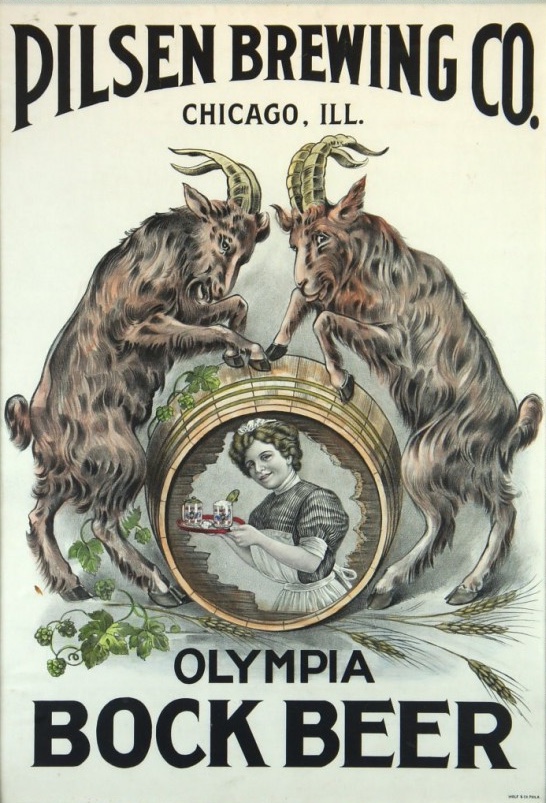
Last year I decided to concentrate on Bock ads. Bock, of course, may have originated in Germany, in the town of Einbeck. Because many 19th century American breweries were founded by German immigrants, they offered a bock at certain times of the year, be it Spring, Easter, Lent, Christmas, or what have you. In a sense they were some of the first seasonal beers. “The style was later adopted in Bavaria by Munich brewers in the 17th century. Due to their Bavarian accent, citizens of Munich pronounced ‘Einbeck’ as ‘ein Bock’ (a billy goat), and thus the beer became known as ‘Bock.’ A goat often appears on bottle labels.” And presumably because they were special releases, many breweries went all out promoting them with beautiful artwork on posters and other advertising.

Thursday’s poster is for Olympia Bock Beer, and was published around the 1910s. This one was for the Pilsen Brewing Co. of Chicago, Illinois, which was originally founded in 1903 by a group of Bohemian tavern owners.

Filed Under: Art & Beer, Beers, Breweries, Just For Fun Tagged With: Advertising, Bock, Chicago, History, Illinois

Historic Beer Birthday: Max Henius

June 16, 2025 By Jay Brooks

Today is the birthday of Max Henius (June 16, 1859–November 15, 1935). He “was a Danish-American biochemist who specialized in the fermentation processes. Max Henius co-founded the American Academy of Brewing in Chicago.”

Here’s his biography, from Wikipedia:

Max Henius was born in Aalborg, Denmark. His parents were Isidor Henius (1820–1901) and Emilie (née Wasserzug) Henius (1839–1913), both Polish Jewish immigrants. His father, who was born in Thorn, West Prussia, now Torun, Poland, emigrated to Denmark in 1837 and continued his work for spirits distillers to improve and standardise production and later – 15 January 1846 – co-founded one distillery, Aalborg priviligerede Sirup- og Sprtitfabrik, that was later, together with several other distilleries, consolidated into De Danske Spritfabrikker in 1881, a Danish distillery which is now – since 2012 – part of the Norwegian Arcus Group, which closed the distillery in Aalborg in 2015, moving production to Norway instead. Isidor Henius also owned a small castle in Aalborg, now called Sohngaardsholm Slot. Since 2005, it has been the site of a gourmet restaurant.

Max Henius was educated at the Aalborg Latin School and went on to study at the Polytechnic Institute in Hanover, Germany He attended the University of Marburg, earning his Ph.D. degree in chemistry during 1881. His father sold the distillery that same year. Max Henius subsequently emigrated from Aalborg to the United States in 1881 at the age of 22, settling in Chicago. His younger brother, Erik S. Henius, (1863- 1926) remained in Denmark where he was Chairman of the Danish Export Association.

Initially he was employed by the Northern Pacific Railway on an assignment to test the waters between Fargo, North Dakota, and Bozeman, Montana. In 1886, he opened a drug store. Subsequently he formed Wahl & Henius, an institute for chemical and mechanical analysis, with his former schoolmate, Robert Wahl (1858-1937). Founded in 1891, the Chicago-based American Brewing Academy (later known as the Wahl-Henius Institute of Fermentology) was one of the premier brewing schools of the pre-prohibition era. This institute was later expanded with a brew master school that operated until 1921.

At the beginning of the twentieth century, Max Henius became interested in Danish-American organizations in Chicago. Funds were being raised by Danish Americans to purchase 200 acres (0.81 km2) of heather-covered hills, located in part of Rold Forest (Danish: Rold Skov), Denmark’s largest forest. In 1912 Max Henius presented the deed to H.M. King Christian X as a permanent memorial from Danish Americans. Rebild National Park (Danish: Rebild Bakker) is today a Danish national park situated near the town of Skørping in Rebild municipality, Region Nordjylland in northern Jutland, Denmark. Every July 4 since 1912, except during the two world wars, large crowds have gathered in the heather-covered hills of Rebild to celebrate American Independence Day. On the slope north of Rebild, where the residence of Max Henius was once located, a bust was placed in his memory.

wahl-and-henius

And here’s Randy Mosher’s entry from the Oxford Companion to Beer of the Wahl-Henius Institute of Fermentology:

Wahl-Henius Institute of Fermentology
is a brewing research laboratory and school in Chicago that operated between 1886 and 1921.

Founded in 1886 by Dr Robert Wahl and Dr Max Henius as the Wahl & Henius, the name was changed to the Scientific Station for Brewing of Chicago and then to the Institute of Fermentology before becoming the Wahl-Henius Institute. Its educational division, the American Brewing Academy, was created in 1891.

The school and laboratory operated successfully until Prohibition, when the near dissolution of the brewing trade forced its closure and sale to the American Institute of Baking, which retains the nucleus of the Wahl-Henius library.

Wahl-Henius would perhaps be mostly forgotten today if it were not for its role as publisher of two important beer texts. The Wahl-Henius Handy Book of Brewing, Malting and the Auxillary Trades, coauthored by Wahl and Henius, is a comprehensive and wide-ranging view into American brewing in 1901. It also contains basic chemical analyses of many contemporary American and European beers, providing an unusually valuable window into the brewing past. J. P. Arnold’s 1911 Origin and History of Beer and Brewing is an exhaustive romp through thousands of years of beer history.

Henius-bust


And this bust of Henius is in the Rebild National Park in Denmark. Henius organized fund-raising and “in 1911, almost 200 acres of the hilly countryside were bought with funds raised by Danish Americans. In 1912, Max Henius presented the deed to the land to his Majesty King Christian X as a permanent memorial to Danish Americans. Later the Danish government added to the land, that now features a beautiful natural park.”

And this is from the Chicago Midwest Rebild Chapter:

As we celebrate the 100th anniversary of the Rebild Society, I find it fascinating to look at the lives of its builders in the context of their times. It is hard to imagine a more dynamic time of porous borders and explosive growth than the late 19th century. Probably the name most closely associated with the founding of the Rebild Society is Max Henius. I had the good fortune to come across a biography of Henius written by his associates shortly after his death, and much of what I have written of Henius is largely based on that biography.

The first Europeans to come to Chicago were Pere Marquette and Louis Joliet in 1673 when they claimed Midwestern North America for Nouvelle France. Marquette and Joliet traveled up the Illinois River and portaged to the Chicago River and down to Lake Michigan. Joliet called for a canal to be built to connect the Illinois and Chicago rivers to stimulate trade and help France establish an economic empire in the New World. It was a prescient recommendation. Such a canal would indeed be built almost 200 years later, and an economic empire was ignited. Chicago would become the transport hub for a new nation, and not for New France.

In 1838, ten years before the canal was built connecting the Great Lakes and Mississippi watersheds, Max Henius’ father immigrated to Denmark from an impoverished Jewish family in Torun, Poland, traveling on foot to Aarhus, where his brother Jacob lived. The journey took six weeks. The elder Henius rose quickly in the distillery business first in Aarhus and then in København. He launched his own his distillery, Spritfabrikken in Aalborg in 1846, with money loaned from partners. In 1854 he returned to Torun to find a bride.

Born in 1859, Max was educated at the Aalborg Latin School and went on to study at the Polytechnic Institute in Hanover before matriculating at the University of Marburg, Germany. 1881 was a pivotal year for Max Henius. His father sold the distillery that Max had hoped to take over, and he had fallen in love with Johanne Heiberg. Both families disapproved of the relationship and Max Henius decided to immigrate to the US and subsequently send for his fiancée to come and marry him. Interestingly, a contemporary who would also become a very famous Danish-American, Jens Jensen, would immigrate to the US three years later partly because his prospective partner also did not meet family approval. A fellow student from Hannover and Warburg, Robert Wahl, told Max of the multiple opportunities available in the US, and later would partner with Henius in a very successful business.

Already in 1870 immigrants made up a larger proportion of the city’s population (48 percent) than any other place in North America. Chicago was quickly rebuilding after its massive destruction by fire in 1871 and Danish immigration was beginning to swell. Max Henius arrived in Chicago in October of 1881. Although he was a well educated and degreed chemist, his first jobs were as a door to door book salesman, errand boy for a pharmacy, and as a coal trimmer. Two years later he was employed by the Northern Pacific Railway to test the waters between Fargo, North Dakota and Bozeman, Montana but returned to Chicago to marry Johanne on June 4, 1883. With his savings he opened a drug store and subsequently formed Wahl & Henius, Analytical and Consulting Chemists with a lab at the back of the store. They established themselves as authorities on yeast culture and brewing.

Chicago was at this time one of the most rapidly growing cities in the world, the Shanghai of the late 19th century. Population growth was meteoric, fueled by decade after decade of immigration. But it was a wide open and divided city and hardly immune to the controversies of its time. May 1, 1886 saw a massive demonstration by workers (well advertised in the immigrant press) in favor of the eight-hour working day. Three days later the conflict culminated in a violent confrontation. The 1886 Haymarket Massacre took place in Chicago when an unknown person threw a dynamite bomb at police as they dispersed a public meeting. Chicago police fired on workers during a general strike for the eight-hour workday, killing several demonstrators and resulting in the deaths of several police officers. International Workers’ Day is the commemoration of the Haymarket Massacre. Ironically this would become a holiday officially celebrated throughout the Soviet bloc in the next century.

Henius did become involved in some of the public issues of this time. In 1892 a typhoid epidemic broke out in Chicago. Sewage was discharged into the Chicago River and subsequently found it way into Lake Michigan where Chicago’s water supply was tapped. Henius examined milk samples that were watered down and publicly spoke out on his findings. The waters of Lake Michigan were mapped bacteriologically so the water cribs were moved farther out in Lake Michigan.

Henius was very active in various Danish immigrant organizations, including the Danish-American Association, formed in Chicago in 1906. The idea for a Danish-American festival to be held in Denmark actually came from Ivar Kirkegaard, a Danish-American poet and editor. The first Danish-American rally was held in 1908 at Krabbesholm Folk High School on Skive Fjord. En route to the Krabbesholm festival, Henius was visiting Aarhus, when he learned of the planning for a national exposition to be held in Aarhus the following summer. He proposed to his fellow association members that they organize a Danish-American meeting for July 4, 1909. They filled an auditorium and persuaded the crown prince, later King Christian X, Georg Brandes and other noted Danes to speak at the event. Three years later Rebild Park was purchased by Danish Americans and set aside as a park, with the understanding that the site would be used to celebrate the 4th of July. Rebild Park was dedicated in 1912, and the first festival in Rebild was held on August 5, 1912.

Later Henius would found and head the Jacob A. Riis League of Patriotic Service to act as a clearing house for patriotic activities for Danish Americans during the First World War. The League grew out of a committee that managed the 3rd Liberty Load drive in Chicago among Danish-Americans. It also had among its objectives the preservation of Danish culture in America. Its influence was used with President Woodrow Wilson to include the question of the Danish border with Germany in the post war peace settlement. Henius would also be instrumental in establishing and supporting the Danes Worldwide Archives in Aalborg, initially housed in his childhood home of Sohngårdsholm.

Immigration has always been a controversial subject and resisted with varying degrees of success throughout history. But looking backwards one can only conclude it has been to our good fortune, and that our societies have been quite enriched and rejuvenated by the dynamism that immigrants have brought to us.

And Gary Gillman also has a nice overview of Henius’ life in a blog post a few years ago, entitled Max Henius, Star of American Brewing Science. And there’s another tribute, entitled Reflections on the Life and Extraordinary Times of Max Henius, by Nicolai Schousboe.

Filed Under: Birthdays, Just For Fun, Related Pleasures Tagged With: Chicago, Denmark, History, Science of Brewing

Historic Beer Birthday: William Ogden

June 15, 2025 By Jay Brooks

chicago-1

Today is the birthday of William B. Ogden (June 15, 1805-August 3, 1877). Ogden’s biggest claim to fame is being the first mayor of the city of Chicago, elected in 1837. But he was also a businessman, and one of the businesses he was involved in was one of Chicago’s first breweries, Lill & Diversey.

William_B_Ogden_by_GPA_Healy,_1855
A portrait of William B. Ogden, painted by G.P.A. Healy in 1855.

Some sources say it was the very first brewery in Chicago, but either way, it was certainly one of the earliest. It was founded by William Lill, who was later joined by partner Michael Diversey

lilldiversies

Here’s the brewery’s story from One Hundred Years of Brewing, published in 1901:

The immense brewing interests of Chicago had their origin in the persons of William Lill and William Haas. In September, 1839, William B. Ogden, who, two years previously, had been elected mayor of the city, established Mr. Lill in business at the corner of Pine street and Chicago avenue, Mr. Haas being the latter’s assistant. The “plant” was installed in a small tenement building and the first year’s brew was about 450 barrels.

After a few years Michael Diversey formed a partnership with Mr. Lill, when Mr. Ogden withdrew his silent interest in the business. Under the management of Lill & Diversey the so-called Chicago Brewery developed into one of the most extensive establishments of the kind in the west, occupying a portion of the original site, but then covering an entire block. For many years “Lill‘s Cream Ale” was one of the most famous brands in the country. Besides being known as good business men, Lill and Diversey were noted for their benevolence and generosity, the latter being a large benefactor to the German Catholic churches of Chicago.

In 1841, Michael Diversey and William Lill bought the first commercial brewery in Chicago (Haas & Sulzer Brewery) and changed the name to the Lill & Diversey Brewery, also known as the Chicago Brewery. The two men saw huge success and by 1861 were producing 45,000 barrels of beer a year and employing over 75 men. Famous for “Lill’s Cream Ale,” by 1866 the brewery had sprawled to over two acres and four stories high. The Water Tower Pumping Station, which still stands today, was put in directly across the street.

Serving two terms as a Chicago Alderman (1844-45; 1856-1868), Michael Diversey also donated a small plot of land where a Catholic church for fellow German immigrants was built. St. Michael’s was the tallest building in Chicago until 1885 when The Old Chicago Board of Trade building was completed. Known as a great city leader and keeping company with the likes of Joseph Sheffield and William Ogden, Michael Diversey was integral in bringing great growth to Chicago.

However, Diversey died in 1869, and Lill continued to run the brewery. Till the Great Fire of 1871 wiped it out and Lill lost everything. The brewery never re-opened and Lill passed away in 1875.

WB-Ogden

Most of Ogden’s biographies don’t even mention his affiliation with the brewery at all. See, for example his Wikipedia page, the WBEZ Chicago blog and the Encyclopedia of Chicago. His business with the brewery was apparently a pretty minor investment for him, and he was much more heavily involved in many other projects and businesses. Most accounts state that Ogden was a silent partner in the brewer. But in Gregg Smith’s “Beer In America: The Early Years—1587-1840,” he claims “that the mayor was very much involved in the business, and not just a silent partner: he wanted to ensure that the brewery’s hops came from New York’s Finger Lakes region.” Which makes some sense; Ogden was born in upstate New York.

william-b-ogden
A photo of Ogden later in life.

Filed Under: Birthdays Tagged With: Chicago, History, Illinois, New York

Beer Birthday: Ray Daniels

June 9, 2025 By Jay Brooks

cicerone-circle
Today is the 67th birthday of Ray Daniels. Ray is the former director of Craft Beer Marketing for the Brewers Association and today runs the Cicerone program, which he founded, to certify beer professionals, similar to sommeliers in the wine industry. He also founded the Real Ale Festival that used to take place annually in Chicago. And he’s one of my favorite people in the beer industry. Join me in wishing Ray a very happy birthday.

P1030505
Julie Johnson, from All About Beer, with Ray at Lagunitas during the Journalism Retreat when CBC was in San Francisco a few years ago.
gabf07-55
On the floor at GABF with Bob Pease, from the Brewers Association, Mark Dorber, publican extraordinaire, and John Mallet, from Bell’s Brewery.
ray-daniels
It’s hard not to love his Cicerone press photo.
huska-1
Ray with his former assistant Sarah Huska at the Cicerone booth at CBC in Chicago several years ago.

Filed Under: Birthdays Tagged With: Chicago, Illinois

Beer In Ads #2044: La Salle Street, Chicago

September 25, 2016 By Jay Brooks


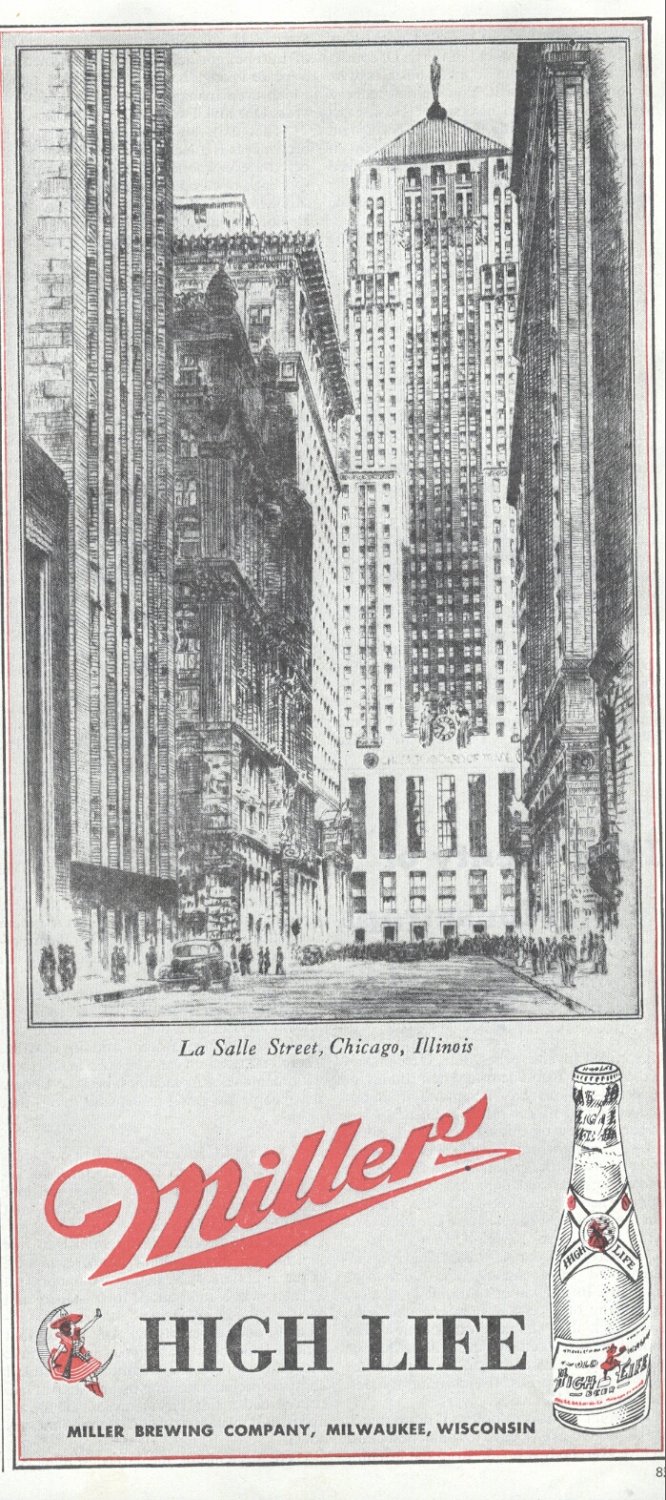
Sunday’s ad is for Miller High Life, from 1945. In this ad, it’s very simple, showing a detailed view of La Salle Street in Chicago, Illinois, with no text apart from the location and then the name of the beer below. I don’t know if this was part of a series showing other locations or if there’s some special significance to this street in 1945. This would have been toward the end of the Second World War, so perhaps that has something to do with, but in the end there are more questions than answers, but it’s still an oddly comforting ad.

Miller-1945-la-salle-street

Filed Under: Beers Tagged With: Advertising, Chicago, History, Miller Brewing

Anheuser-Busch InBev Buys Goose Island Brewpub

February 19, 2016 By Jay Brooks

goose-island-new
The Chicago Tribune reported this morning that Anheuser-Busch InBev, who five years ago bought Goose Island Brewing, the production facility and the brand — but not the brewpubs — has announced the purchase of the original brewpub on Chicago’s Clybourn. Founder “John Hall said AB InBev was unable to buy the brewpub under Illinois law at the time of the first sale, in 2011, but also didn’t have much interest. ‘They didn’t understand the value, which they do now,’ he said.” Neither the price or terms were revealed, but apparently “Goose Island’s Fulton Street brewery will become the parent company of the brewpub on Clybourn, which Hall started in 1988 after a career in the corrugated box industry.” In December, the Wrigleyville brewpub closed, meaning ABI will now owns the entire Goose Island kit and kaboodle.

P1050283

Filed Under: Breweries, News Tagged With: Anheuser-Busch InBev, Business, Chicago

Beer Birthday: Wendy Littlefield

February 17, 2016 By Jay Brooks

vanberg-dewulf-new
Today is Wendy Littlefield’s 60th birthday. Wendy, along with her husband, ran the Belgian export company Vanberg & DeWulf, until quite recently, when the business was sold, although they continued for the next year with the company before starting the next chapter. Their portfolio included such great beer lines as Dupont, Castelain and Dubuisson (Bush). They were also the original founders of Brewery Ommegang. Four years ago was their 30th anniversary of being involved in the beer industry and bringing great beer to America. Plus, they’re great fun to hang out and drink with, especially in Belgium. Join me in wishing Wendy a very happy birthday.

P1050259
Michael Roper, owner of the Hopleaf, Jonathan Surratt, and Wendy, when we had dinner there a couple of years ago.

P1200300
At an Avec beer dinner a few years ago.

DSCN7499
Wendy with husband Don Feinberg in Ghent at a beer dinner with Dilewyns last week.

wendy-3
Don Feinberg, Anne (from New York’s Ginger Man) and Wendy in Belgium.

Feinberg-QE2
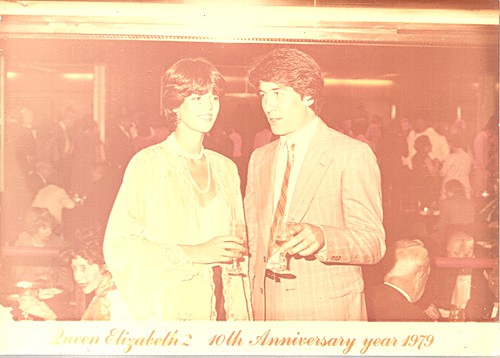
Wendy and Don in 1979.

NOTE: Photos purloined from Vanberg & DeWulf’s website and Facebook.

Filed Under: Birthdays Tagged With: Belgium, Chicago, Illinois, New York

The Lagunitas Loft Couch Goes To Chicago

January 28, 2013 By Jay Brooks

lagunitas-circle
If you’ve ever been to the loft that overlooks the Lagunitas Brewery, you’ve probably seen this orange couch. I’ve sat in it on numerous occasions. As I remember it, it’s a pretty comfy sofa, and you sink right into it.

orange-couch

But I guess I’ll have to travel to Chicago if I want to sit on it again. Check out its journey in this humorous video from Lagunitas.

Filed Under: Breweries, Just For Fun Tagged With: California, Chicago, Humor, Illinois, Northern California, Video

Lagunitas Building New Brewery In Chicago

April 10, 2012 By Jay Brooks

lagunitas-circle
Sheesh, you try and do something other than sit at your computer all day, and all hell breaks loose. At least I have an excuse, sort of. My wife and I just bought another house, which we’re having some work done on before we move in, and that’s been occupying a healthy percentage of my time over the past few weeks, which is also why I haven’t been posting as much, either. But what I missed was a wowzer. Tony Magee, the iconoclastic owner of Lagunitas Brewing, revealed via twitter that’s he’s signed a lease for an old movie soundstage (and former Ryerson Steel Factory) in Chicago, where he’s planning to build another 250-barrel brewhouse by July 2013, with the first brew anticipated in the 4th Quarter.

Adam Nasam, from Beer Pulse, happily, was paying attention and broke the story yesterday, even including a map of the property. Earlier today, Craft Business Daily had an interview with Magee, where he revealed more details about Lagunitas’ plans for the Chicago brewery.

This afternoon, Lagunitas finally sent out a press release about the acquisition and their plane for a Chicago brewery.

The Lagunitas Brewing Company of Petaluma CA is moving forward with the construction of a second brewing facility in the crossroads of the US; Chicago Illinois. Carl Sandburg’s ‘City of Big Shoulders’ will be home to a new ROLEC-built 250 barrel kettle and 200,000 barrels of initial capacity. The brewery will be operating by the 4th quarter of 2013, and will occupy 150,420 square feet on the grounds of the CineSpace Movie Soundstage complex at 15th Street and Rockwell in Chicago’s Douglas Park neighborhood.

According to Lagunitas founder and CEO, Tony Magee, the idea got very real in the last 2 months. A few days spent with a calculator and a couple more visiting sites around the city crystalized the plan. “I was born and raised in Chicago so the siting questions were easy to figure out. But the real driver behind it all was two-fold; first, I realized that there was about 4 ounces of diesel in every 22oz bottle of our beer when enjoyed in Chicago, even more if you’re in NYC. Secondly, the future of Craft Beer is, we believe, local and we sure want to be a part of the future so the decision was easy. One of the best things about craft brewing is being close to the people who are digging it.”

Lagunitas is just finishing up a major expansion of its Petaluma home where it built a new brewhouse that will eventually enable it to brew more than four times what it brewed in 2011. The Petaluma brewery only has fermentation capacity to meet its needs through 2013. By building a second brewery in Chicago, Lagunitas will be adding that needed future capacity closer to where it will be enjoyed. According to Magee, “By the time Lagunitas Chicago is ready to mash in we will move about 140,000 barrels of production there. All the left coast and western states beer will still be brewed in Petaluma and life at the Petaluma brewery will be pretty calm, for a change, for a while…!”.

Awesome news for Lagunitas. That’s the fourth regional brewery this year to announce a second location. I’d say we’re witnessing a definite trend.

Filed Under: Breweries, News Tagged With: California, Chicago, Illinois

Beer Birthday: Sarah Huska

May 26, 2011 By Jay Brooks

cicerone-logo
Today is the 25th birthday — how is that possible? — of Sarah Huska. Sarah is the program administrator for the Cicerone Certification Program that Ray Daniels founded. I got to meet Sarah while I was in Chicago for CBC last year, at the Siebel open house. You can also read much more about Sarah at her featured beer tweeter interview/profile at Drink with the Wench. Join me in wishing Sarah a very happy birthday.

huska-1
Sarah with Ray Daniels at the Cicerone booth at last year’s CBC in Chicago.

huska-4
Sarah with Nico Freccia, from 21st Amendment.

huska-5
Sarah, building a bridge with Nicole Erny, also with the Cicerone program, and Justin Crossley of the Brewing Network trying to cross it.

huska-3
A bottle of New Glarus and AleSmith? That must have been one great evening.

[Note: all photos purloined from Facebook.]

Filed Under: Birthdays Tagged With: Chicago, Illinois

« Previous Page
Next Page »

Find Something

Northern California Breweries

Please consider purchasing my latest book, California Breweries North, available from Amazon, or ask for it at your local bookstore.

Recent Comments

  • Bob Paolino on Beer Birthday: Grant Johnston
  • Gambrinus on Historic Beer Birthday: A.J. Houghton
  • Ernie Dewing on Historic Beer Birthday: Charles William Bergner 
  • Steve 'Pudgy' De Rose on Historic Beer Birthday: Jacob Schmidt
  • Jay Brooks on Beer Birthday: Bill Owens

Recent Posts

  • Historic Beer Birthday: Joseph Theurer May 24, 2026
  • Historic Beer Birthday: James Barkley May 23, 2026
  • Beer Birthday: Tony Forder May 23, 2026
  • Historic Beer Birthday: Henry Wagstaff May 22, 2026
  • Historic Beer Birthday: Jacob Leinenkugel May 22, 2026

BBB Archives

Feedback

Head Quarter
This site is hosted and maintained by H25Q.dev. Any questions or comments for the webmaster can be directed here.