Brookston Beer Bulletin

Jay R. Brooks on Beer

  • Home
  • About
  • Editorial
  • Birthdays
  • Art & Beer

Socialize

  • Dribbble
  • Email
  • Facebook
  • Flickr
  • GitHub
  • Instagram
  • LinkedIn
  • Pinterest
  • RSS
  • Twitter
  • YouTube

Powered by Genesis

Historic Beer Birthday: George Schmitt

June 14, 2018 By Jay Brooks

new_york
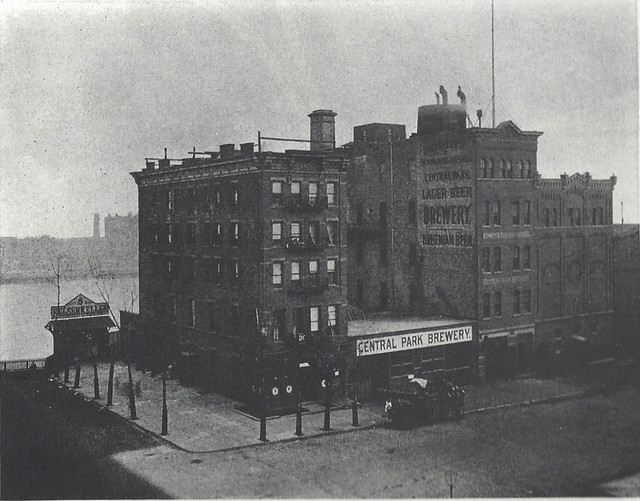
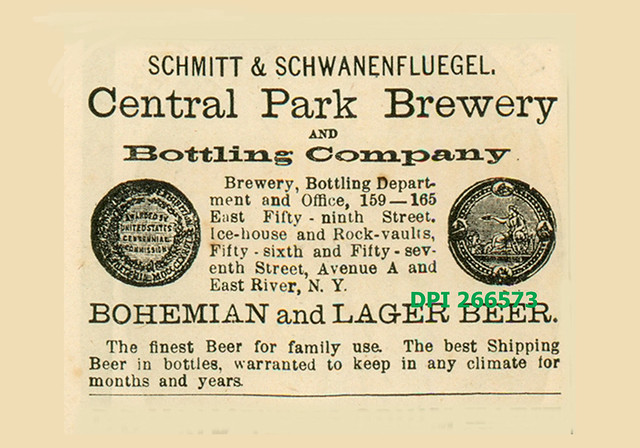
Today is the birthday of George Peter Allen Schmitt (June 14, 1833-May 4, 1897). He was born in Zell-in-der-Pflaz, Bavaria. Originally trained as a carpenter, he came to America when he was 19, in 1852, eventually shifting careers to importing wines. That proved successful enough that he partnered with Henry Elias to open the Central Park Brewery, and after changing partners a few times it became known as the Schmitt & Schwanenfluegel Brewery, which was in New York City, near Central Park at 1065 Avenue A, between 56th & 57th. Schmitt passed away in 1897, and his son, also George Schmitt, kept it going briefly, but he also died the following year, in 1898.

george-schmitt-sr

The brewery was originally known as the Henry Elias Brewery, who founded it near 15th Street & Broadway in 1855. Elias, in 1865, partnered with George Schmitt, and became known as Henry Elias & George Schmitt Brewery, a.k.a. the Central Park Brewery (and was readdressed to 1065 Avenue A, between 56th & 57th). In 1868, Schmitt partnered with Christian Koehne to keep it going and it became the Schmitt & Christian Koehne Brewery. Then in 1885, Koehne left and Louis Von Schwanenfluegel came to the business and it became known as Schmitt & Schwanenfluegel Brewery, which it remained until it closed in 1906. During that time it was also known as Consumers Park Brewing Co. and also Central Park Brewery.

Schmitt-and-Schwanenfluegel-brewery

schmitt-schwan

Extra-Bohemian-Beer-Foam-Scrapers-Schmitt-and-Schwanenfluegel

Filed Under: Birthdays, Just For Fun Tagged With: Germany, History, New York

Order Of Temperance Founded Christmas Day

December 25, 2017 By Jay Brooks

hesse-kassel
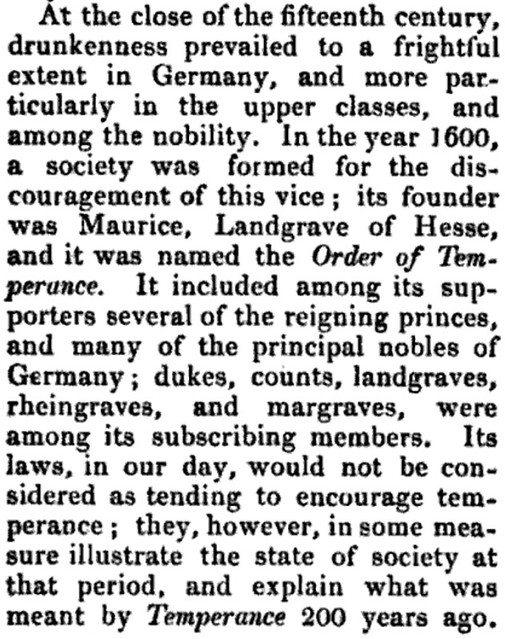
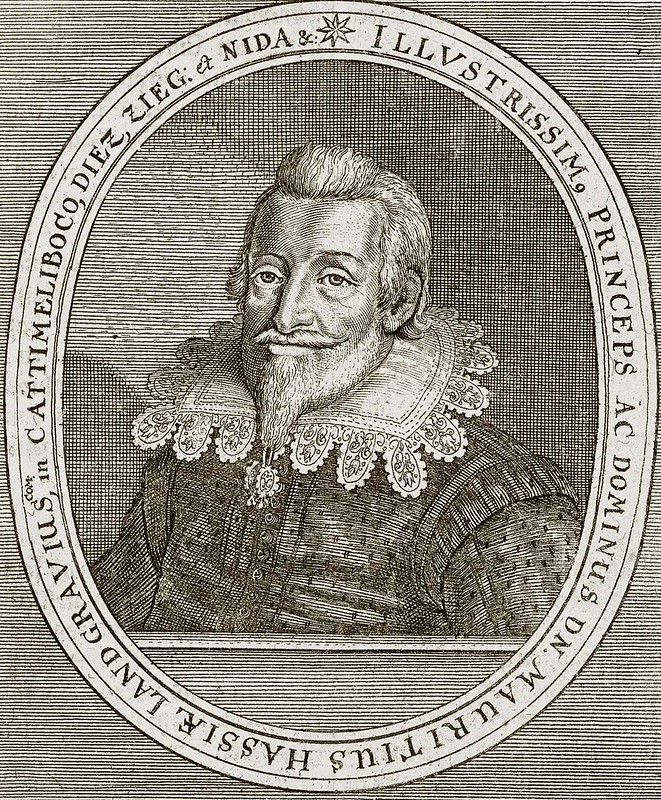
Here’s an interesting, and odd, bit of history. One of the earliest temoperance socities, the Order of Temperance, was founded on Christmas Day, December 25, 1600. It was established by Maurice, Landgrave of Hesse-Kassel. The Landgraviate of Hesse-Kassel, or Hesse-Cassel, was a state in the Holy Roman Empire.

Here’s a short history of the Order, from “The Gentlemen’s Magzine, published in 1836:

order-of-temp

They were trying to put an end to the custom of “pledging healths,” which in that time period meant drinking to the health of everyone and everything; or toasting. So the Order of Temperance had its members pledge “to never become intoxicated.” Which is all well and good, except for one tiny little detail. The order had strict rules on alcoholic consumption and they were allowed no more than seven alcoholic drinks per meal, and only two meals per day; essentially they were restricted to only fourteen glasses or wine or beer per day. That was their idea of temperance. That doesn’t actually sound too bad, now does it? I think most of us could have taken that pledge.

maurice-hesse
Maurice, Landgrave of Hesse-Kassel

Filed Under: Just For Fun, Politics & Law, Related Pleasures Tagged With: Germany, History, Prohibitionists

Jean Verdenal’s Letter To T.S. Eliot

May 11, 2017 By Jay Brooks

reading-book
This will probably only be of interest to the most hardcore literati among you, but if you like poetry, literature or weird history, read on McDuff. According to Wikipedia, Jean Jules Verdenal “(May 11, 1890–May 2, 1915) was a French medical officer who served, and was killed, during the First World War. Verdenal and his life remain cloaked in obscurity; the little we do know comes mainly from interviews with family members and several surviving letters.”

Verdenal was born in Pau, France, the son of Paul Verdenal, a medical doctor. He had a talent for foreign languages. He was athletically inclined. Verdenal as a student was interested in literature and poetry and possessed copies of Stéphane Mallarmé’s Poésies and of Jules Laforgue’s Poésies and Moralités Légendaires. It was perhaps Verdenal’s literary inclinations that led him to become friends with American poet T.S. Eliot, whom he met in 1910 at the Sorbonne. After they parted ways, Verdenal and Eliot corresponded through letters. Verdenal was killed on May 2, 1915, while treating a wounded man on the battlefield. This was just a week into the Gallipoli Campaign and a few days shy of his twenty-fifth birthday.”

ts-eliot

T.S. Eliot, of course, was an American-born poet, who most people know of because his 1939 collection of poems, “Old Possum’s Book of Practical Cats,” was later adapted by Andrew Lloyd Webber into the popular musical, “Cats,” which debuted in 1981. But here’s the basics, again from Wikipedia:

Thomas Stearns Eliot (September 26, 1888–January 4, 1965) was a British essayist, publisher, playwright, literary and social critic, and “one of the twentieth century’s major poets”. He moved from his native United States to England in 1914 at the age of 25, settling, working, and marrying there. He eventually became a British subject in 1927 at the age of 39, renouncing his American citizenship.

Eliot attracted widespread attention for his poem “The Love Song of J. Alfred Prufrock” (1915), which was seen as a masterpiece of the Modernist movement. It was followed by some of the best-known poems in the English language, including The Waste Land (1922), “The Hollow Men” (1925), “Ash Wednesday” (1930), and Four Quartets (1943). He was also known for his seven plays, particularly Murder in the Cathedral (1935) and The Cocktail Party (1949). He was awarded the Nobel Prize in Literature in 1948, “for his outstanding, pioneer contribution to present-day poetry.”

There is also speculation that Verdenal was the inspiration for the character “Phlebas the Phoenician” in Eliot’s long-form poem “The Wasteland,” which he published in 1922. Eliot certainly dedicated some of his works to Verdenal, including “his first volume of poetry, ‘Prufrock and Other Observations,’ which was published two years after Verdenal’s death, in 1917.

Here’s another account of their meeting and friendship:

In 1910 T.S. Eliot, then a graduate student studying philosophy at Harvard University, went to Paris to study a year at the Sorbonne. He took a room at a pension where he met and befriended Jean Verdenal, a French medical student who had another room there.

Eliot returned to Harvard in the autumn of 1911 to continue his work toward a doctorate.

Eliot and Verdenal carried on a correspondence at least through 1912. Seven letters from Verdenal to Eliot (written in French) are archived at Harvard University’s Houghton Library. The Verdenal letters have also been published in The Letters of T.S. Eliot: 1898-1922 (Vol 1). Apparently no copies of Eliot’s letters to Verdenal survive.

So why I bring this is up is the following passage, from a letter that Verdenal wrote to T.S. Eliot in July of 1911.

“My dear friend, I am waiting impatiently to hear that you have found some notepaper in Bavaria, and to receive an example of it covered with your beautiful handwriting, before German beer has dulled your wits. As a matter of fact, it would have some difficulty in doing so, and we see that even few natives of the country escaped its effects; history tells us that the formidable Schopenhauer was a great beer-lover. He also played the clarinet, but perhaps that was just to annoy his neighbours. Such things are quite enough to make us cling to life. The will to live is evil, a source of desires and sufferings, but beer is not to be despised — and so we carry on. O Reason!”

Verdenal has an interesting take on German beer. ANd the clarinet, which I used to play, too.

Phlebas-the-Phoenician

And this is passage from “The Wasteland,” about which some scholars believe Verdenal was the inspiration for Phlebas the Phoenician. You can read more about why at this page about T.S. Eliot and Jean Verdenal.

          IV. Death by Water

Phlebas the Phoenician, a fortnight dead,
Forgot the cry of gulls, and the deep sea swell
And the profit and loss.
                                 A current under sea
Picked his bones in whispers. As he rose and fell
He passed the stages of his age and youth
Entering the whirlpool.
                               Gentile or Jew
O you who turn the wheel and look to windward,
Consider Phlebas, who was once handsome and tall as you.

Filed Under: Beers, Just For Fun, Related Pleasures Tagged With: Germany, History, Literature, Poetry

The Brothers Grimm & Fairy Tale Beer

January 4, 2017 By Jay Brooks

fairytale
Today is the birthday of Jacob Grimm, who along with his brother Wilhelm Grimm, created numerous fairy tales under the name the Brothers Grimm. Their best known stories are classics, tales like “Cinderella,”, “The Frog Prince,” “Hansel and Gretel,” “Rapunzel,” “Rumpelstiltskin,” and “Snow White.” We usually think of these old fairy tales as being strictly for kids, probably because of how Disney and others have sanitized them, but the originals are often genuinely frightening, and their moral and purpose was to scare children, the original “scared straight” stories. In a few lesser-known stories, beer is mentioned and in a few cases is actually an important factor in the tale. Here’s a few of these Grimm’s fairy tales involving beer to read to your kids or just enjoy yourself.

Clever Elsie

Clever-Elsie

There was once a man who had a daughter who was called Clever Elsie. And when she had grown up her father said: ‘We will get her married.’ ‘Yes,’ said the mother, ‘if only someone would come who would have her.’ At length a man came from a distance and wooed her, who was called Hans; but he stipulated that Clever Elsie should be really smart. ‘Oh,’ said the father, ‘she has plenty of good sense’; and the mother said: ‘Oh, she can see the wind coming up the street, and hear the flies coughing.’ ‘Well,’ said Hans, ‘if she is not really smart, I won’t have her.’ When they were sitting at dinner and had eaten, the mother said: ‘Elsie, go into the cellar and fetch some beer.’ Then Clever Elsie took the pitcher from the wall, went into the cellar, and tapped the lid briskly as she went, so that the time might not appear long. When she was below she fetched herself a chair, and set it before the barrel so that she had no need to stoop, and did not hurt her back or do herself any unexpected injury. Then she placed the can before her, and turned the tap, and while the beer was running she would not let her eyes be idle, but looked up at the wall, and after much peering here and there, saw a pick-axe exactly above her, which the masons had accidentally left there.

Then Clever Elsie began to weep and said: ‘If I get Hans, and we have a child, and he grows big, and we send him into the cellar here to draw beer, then the pick-axe will fall on his head and kill him.’ Then she sat and wept and screamed with all the strength of her body, over the misfortune which lay before her. Those upstairs waited for the drink, but Clever Elsie still did not come. Then the woman said to the servant: ‘Just go down into the cellar and see where Elsie is.’ The maid went and found her sitting in front of the barrel, screaming loudly. ‘Elsie why do you weep?’ asked the maid. ‘Ah,’ she answered, ‘have I not reason to weep? If I get Hans, and we have a child, and he grows big, and has to draw beer here, the pick-axe will perhaps fall on his head, and kill him.’ Then said the maid: ‘What a clever Elsie we have!’ and sat down beside her and began loudly to weep over the misfortune. After a while, as the maid did not come back, and those upstairs were thirsty for the beer, the man said to the boy: ‘Just go down into the cellar and see where Elsie and the girl are.’ The boy went down, and there sat Clever Elsie and the girl both weeping together. Then he asked: ‘Why are you weeping?’ ‘Ah,’ said Elsie, ‘have I not reason to weep? If I get Hans, and we have a child, and he grows big, and has to draw beer here, the pick-axe will fall on his head and kill him.’ Then said the boy: ‘What a clever Elsie we have!’ and sat down by her, and likewise began to howl loudly. Upstairs they waited for the boy, but as he still did not return, the man said to the woman: ‘Just go down into the cellar and see where Elsie is!’ The woman went down, and found all three in the midst of their lamentations, and inquired what was the cause; then Elsie told her also that her future child was to be killed by the pick-axe, when it grew big and had to draw beer, and the pick-axe fell down. Then said the mother likewise: ‘What a clever Elsie we have!’ and sat down and wept with them. The man upstairs waited a short time, but as his wife did not come back and his thirst grew ever greater, he said: ‘I must go into the cellar myself and see where Elsie is.’ But when he got into the cellar, and they were all sitting together crying, and he heard the reason, and that Elsie’s child was the cause, and the Elsie might perhaps bring one into the world some day, and that he might be killed by the pick-axe, if he should happen to be sitting beneath it, drawing beer just at the very time when it fell down, he cried: ‘Oh, what a clever Elsie!’ and sat down, and likewise wept with them. The bridegroom stayed upstairs alone for a long time; then as no one would come back he thought: ‘They must be waiting for me below: I too must go there and see what they are about.’ When he got down, the five of them were sitting screaming and lamenting quite piteously, each out-doing the other. ‘What misfortune has happened then?’ asked he. ‘Ah, dear Hans,’ said Elsie, ‘if we marry each other and have a child, and he is big, and we perhaps send him here to draw something to drink, then the pick-axe which has been left up there might dash his brains out if it were to fall down, so have we not reason to weep?’ ‘Come,’ said Hans, ‘more understanding than that is not needed for my household, as you are such a clever Elsie, I will have you,’ and seized her hand, took her upstairs with him, and married her.

After Hans had had her some time, he said: ‘Wife, I am going out to work and earn some money for us; go into the field and cut the corn that we may have some bread.’ ‘Yes, dear Hans, I will do that.’ After Hans had gone away, she cooked herself some good broth and took it into the field with her. When she came to the field she said to herself: ‘What shall I do; shall I cut first, or shall I eat first? Oh, I will eat first.’ Then she drank her cup of broth and when she was fully satisfied, she once more said: ‘What shall I do? Shall I cut first, or shall I sleep first? I will sleep first.’ Then she lay down among the corn and fell asleep. Hans had been at home for a long time, but Elsie did not come; then said he: ‘What a clever Elsie I have; she is so industrious that she does not even come home to eat.’ But when evening came and she still stayed away, Hans went out to see what she had cut, but nothing was cut, and she was lying among the corn asleep. Then Hans hastened home and brought a fowler’s net with little bells and hung it round about her, and she still went on sleeping. Then he ran home, shut the house-door, and sat down in his chair and worked. At length, when it was quite dark, Clever Elsie awoke and when she got up there was a jingling all round about her, and the bells rang at each step which she took. Then she was alarmed, and became uncertain whether she really was Clever Elsie or not, and said: ‘Is it I, or is it not I?’ But she knew not what answer to make to this, and stood for a time in doubt; at length she thought: ‘I will go home and ask if it be I, or if it be not I, they will be sure to know.’ She ran to the door of her own house, but it was shut; then she knocked at the window and cried: ‘Hans, is Elsie within?’ ‘Yes,’ answered Hans, ‘she is within.’ Hereupon she was terrified, and said: ‘Ah, heavens! Then it is not I,’ and went to another door; but when the people heard the jingling of the bells they would not open it, and she could get in nowhere. Then she ran out of the village, and no one has seen her since.

Frederick and Catherine

frederick-and-catherine

There was once a man called Frederick: he had a wife whose name was Catherine, and they had not long been married. One day Frederick said. ‘Kate! I am going to work in the fields; when I come back I shall be hungry so let me have something nice cooked, and a good draught of ale.’ ‘Very well,’ said she, ‘it shall all be ready.’ When dinner-time drew nigh, Catherine took a nice steak, which was all the meat she had, and put it on the fire to fry. The steak soon began to look brown, and to crackle in the pan; and Catherine stood by with a fork and turned it: then she said to herself, ‘The steak is almost ready, I may as well go to the cellar for the ale.’ So she left the pan on the fire and took a large jug and went into the cellar and tapped the ale cask. The beer ran into the jug and Catherine stood looking on. At last it popped into her head, ‘The dog is not shut up—he may be running away with the steak; that’s well thought of.’ So up she ran from the cellar; and sure enough the rascally cur had got the steak in his mouth, and was making off with it.

Away ran Catherine, and away ran the dog across the field: but he ran faster than she, and stuck close to the steak. ‘It’s all gone, and “what can’t be cured must be endured”,’ said Catherine. So she turned round; and as she had run a good way and was tired, she walked home leisurely to cool herself.

Now all this time the ale was running too, for Catherine had not turned the cock; and when the jug was full the liquor ran upon the floor till the cask was empty. When she got to the cellar stairs she saw what had happened. ‘My stars!’ said she, ‘what shall I do to keep Frederick from seeing all this slopping about?’ So she thought a while; and at last remembered that there was a sack of fine meal bought at the last fair, and that if she sprinkled this over the floor it would suck up the ale nicely. ‘What a lucky thing,’ said she, ‘that we kept that meal! we have now a good use for it.’ So away she went for it: but she managed to set it down just upon the great jug full of beer, and upset it; and thus all the ale that had been saved was set swimming on the floor also. ‘Ah! well,’ said she, ‘when one goes another may as well follow.’ Then she strewed the meal all about the cellar, and was quite pleased with her cleverness, and said, ‘How very neat and clean it looks!’

At noon Frederick came home. ‘Now, wife,’ cried he, ‘what have you for dinner?’ ‘O Frederick!’ answered she, ‘I was cooking you a steak; but while I went down to draw the ale, the dog ran away with it; and while I ran after him, the ale ran out; and when I went to dry up the ale with the sack of meal that we got at the fair, I upset the jug: but the cellar is now quite dry, and looks so clean!’ ‘Kate, Kate,’ said he, ‘how could you do all this?’ Why did you leave the steak to fry, and the ale to run, and then spoil all the meal?’ ‘Why, Frederick,’ said she, ‘I did not know I was doing wrong; you should have told me before.’

The husband thought to himself, ‘If my wife manages matters thus, I must look sharp myself.’ Now he had a good deal of gold in the house: so he said to Catherine, ‘What pretty yellow buttons these are! I shall put them into a box and bury them in the garden; but take care that you never go near or meddle with them.’ ‘No, Frederick,’ said she, ‘that I never will.’ As soon as he was gone, there came by some peddlers with earthenware plates and dishes, and they asked her whether she would buy. ‘Oh dear me, I should like to buy very much, but I have no money: if you had any use for yellow buttons, I might deal with you.’ ‘Yellow buttons!’ said they: ‘let us have a look at them.’ ‘Go into the garden and dig where I tell you, and you will find the yellow buttons: I dare not go myself.’ So the rogues went: and when they found what these yellow buttons were, they took them all away, and left her plenty of plates and dishes. Then she set them all about the house for a show: and when Frederick came back, he cried out, ‘Kate, what have you been doing?’ ‘See,’ said she, ‘I have bought all these with your yellow buttons: but I did not touch them myself; the pedlars went themselves and dug them up.’ ‘Wife, wife,’ said Frederick, ‘what a pretty piece of work you have made! those yellow buttons were all my money: how came you to do such a thing?’ ‘Why,’ answered she, ‘I did not know there was any harm in it; you should have told me.’

Catherine stood musing for a while, and at last said to her husband, ‘Hark ye, Frederick, we will soon get the gold back: let us run after the thieves.’ ‘Well, we will try,’ answered he; ‘but take some butter and cheese with you, that we may have something to eat by the way.’ ‘Very well,’ said she; and they set out: and as Frederick walked the fastest, he left his wife some way behind. ‘It does not matter,’ thought she: ‘when we turn back, I shall be so much nearer home than he.’

Presently she came to the top of a hill, down the side of which there was a road so narrow that the cart wheels always chafed the trees on each side as they passed. ‘Ah, see now,’ said she, ‘how they have bruised and wounded those poor trees; they will never get well.’ So she took pity on them, and made use of the butter to grease them all, so that the wheels might not hurt them so much. While she was doing this kind office one of her cheeses fell out of the basket, and rolled down the hill. Catherine looked, but could not see where it had gone; so she said, ‘Well, I suppose the other will go the same way and find you; he has younger legs than I have.’ Then she rolled the other cheese after it; and away it went, nobody knows where, down the hill. But she said she supposed that they knew the road, and would follow her, and she could not stay there all day waiting for them.

At last she overtook Frederick, who desired her to give him something to eat. Then she gave him the dry bread. ‘Where are the butter and cheese?’ said he. ‘Oh!’ answered she, ‘I used the butter to grease those poor trees that the wheels chafed so: and one of the cheeses ran away so I sent the other after it to find it, and I suppose they are both on the road together somewhere.’ ‘What a goose you are to do such silly things!’ said the husband. ‘How can you say so?’ said she; ‘I am sure you never told me not.’

They ate the dry bread together; and Frederick said, ‘Kate, I hope you locked the door safe when you came away.’ ‘No,’ answered she, ‘you did not tell me.’ ‘Then go home, and do it now before we go any farther,’ said Frederick, ‘and bring with you something to eat.’

Catherine did as he told her, and thought to herself by the way, ‘Frederick wants something to eat; but I don’t think he is very fond of butter and cheese: I’ll bring him a bag of fine nuts, and the vinegar, for I have often seen him take some.’

When she reached home, she bolted the back door, but the front door she took off the hinges, and said, ‘Frederick told me to lock the door, but surely it can nowhere be so safe if I take it with me.’ So she took her time by the way; and when she overtook her husband she cried out, ‘There, Frederick, there is the door itself, you may watch it as carefully as you please.’ ‘Alas! alas!’ said he, ‘what a clever wife I have! I sent you to make the house fast, and you take the door away, so that everybody may go in and out as they please—however, as you have brought the door, you shall carry it about with you for your pains.’ ‘Very well,’ answered she, ‘I’ll carry the door; but I’ll not carry the nuts and vinegar bottle also—that would be too much of a load; so if you please, I’ll fasten them to the door.’

Frederick of course made no objection to that plan, and they set off into the wood to look for the thieves; but they could not find them: and when it grew dark, they climbed up into a tree to spend the night there. Scarcely were they up, than who should come by but the very rogues they were looking for. They were in truth great rascals, and belonged to that class of people who find things before they are lost; they were tired; so they sat down and made a fire under the very tree where Frederick and Catherine were. Frederick slipped down on the other side, and picked up some stones. Then he climbed up again, and tried to hit the thieves on the head with them: but they only said, ‘It must be near morning, for the wind shakes the fir-apples down.’

Catherine, who had the door on her shoulder, began to be very tired; but she thought it was the nuts upon it that were so heavy: so she said softly, ‘Frederick, I must let the nuts go.’ ‘No,’ answered he, ‘not now, they will discover us.’ ‘I can’t help that: they must go.’ ‘Well, then, make haste and throw them down, if you will.’ Then away rattled the nuts down among the boughs and one of the thieves cried, ‘Bless me, it is hailing.’

A little while after, Catherine thought the door was still very heavy: so she whispered to Frederick, ‘I must throw the vinegar down.’ ‘Pray don’t,’ answered he, ‘it will discover us.’ ‘I can’t help that,’ said she, ‘go it must.’ So she poured all the vinegar down; and the thieves said, ‘What a heavy dew there is!’

At last it popped into Catherine’s head that it was the door itself that was so heavy all the time: so she whispered, ‘Frederick, I must throw the door down soon.’ But he begged and prayed her not to do so, for he was sure it would betray them. ‘Here goes, however,’ said she: and down went the door with such a clatter upon the thieves, that they cried out ‘Murder!’ and not knowing what was coming, ran away as fast as they could, and left all the gold. So when Frederick and Catherine came down, there they found all their money safe and sound.

The Golden Goose

golden-goose

There was a man who had three sons, the youngest of whom was called Dummling,[*] and was despised, mocked, and sneered at on every occasion.

It happened that the eldest wanted to go into the forest to hew wood, and before he went his mother gave him a beautiful sweet cake and a bottle of wine in order that he might not suffer from hunger or thirst.

When he entered the forest he met a little grey-haired old man who bade him good day, and said: ‘Do give me a piece of cake out of your pocket, and let me have a draught of your wine; I am so hungry and thirsty.’ But the clever son answered: ‘If I give you my cake and wine, I shall have none for myself; be off with you,’ and he left the little man standing and went on.

But when he began to hew down a tree, it was not long before he made a false stroke, and the axe cut him in the arm, so that he had to go home and have it bound up. And this was the little grey man’s doing.

After this the second son went into the forest, and his mother gave him, like the eldest, a cake and a bottle of wine. The little old grey man met him likewise, and asked him for a piece of cake and a drink of wine. But the second son, too, said sensibly enough: ‘What I give you will be taken away from myself; be off!’ and he left the little man standing and went on. His punishment, however, was not delayed; when he had made a few blows at the tree he struck himself in the leg, so that he had to be carried home.

Then Dummling said: ‘Father, do let me go and cut wood.’ The father answered: ‘Your brothers have hurt themselves with it, leave it alone, you do not understand anything about it.’ But Dummling begged so long that at last he said: ‘Just go then, you will get wiser by hurting yourself.’ His mother gave him a cake made with water and baked in the cinders, and with it a bottle of sour beer.

When he came to the forest the little old grey man met him likewise, and greeting him, said: ‘Give me a piece of your cake and a drink out of your bottle; I am so hungry and thirsty.’ Dummling answered: ‘I have only cinder-cake and sour beer; if that pleases you, we will sit down and eat.’ So they sat down, and when Dummling pulled out his cinder-cake, it was a fine sweet cake, and the sour beer had become good wine. So they ate and drank, and after that the little man said: ‘Since you have a good heart, and are willing to divide what you have, I will give you good luck. There stands an old tree, cut it down, and you will find something at the roots.’ Then the little man took leave of him.

Dummling went and cut down the tree, and when it fell there was a goose sitting in the roots with feathers of pure gold. He lifted her up, and taking her with him, went to an inn where he thought he would stay the night. Now the host had three daughters, who saw the goose and were curious to know what such a wonderful bird might be, and would have liked to have one of its golden feathers.

The eldest thought: ‘I shall soon find an opportunity of pulling out a feather,’ and as soon as Dummling had gone out she seized the goose by the wing, but her finger and hand remained sticking fast to it.

The second came soon afterwards, thinking only of how she might get a feather for herself, but she had scarcely touched her sister than she was held fast.

At last the third also came with the like intent, and the others screamed out: ‘Keep away; for goodness’ sake keep away!’ But she did not understand why she was to keep away. ‘The others are there,’ she thought, ‘I may as well be there too,’ and ran to them; but as soon as she had touched her sister, she remained sticking fast to her. So they had to spend the night with the goose.

The next morning Dummling took the goose under his arm and set out, without troubling himself about the three girls who were hanging on to it. They were obliged to run after him continually, now left, now right, wherever his legs took him.

In the middle of the fields the parson met them, and when he saw the procession he said: ‘For shame, you good-for-nothing girls, why are you running across the fields after this young man? Is that seemly?’ At the same time he seized the youngest by the hand in order to pull her away, but as soon as he touched her he likewise stuck fast, and was himself obliged to run behind.

Before long the sexton came by and saw his master, the parson, running behind three girls. He was astonished at this and called out: ‘Hi! your reverence, whither away so quickly? Do not forget that we have a christening today!’ and running after him he took him by the sleeve, but was also held fast to it.

Whilst the five were trotting thus one behind the other, two labourers came with their hoes from the fields; the parson called out to them and begged that they would set him and the sexton free. But they had scarcely touched the sexton when they were held fast, and now there were seven of them running behind Dummling and the goose.
Soon afterwards he came to a city, where a king ruled who had a daughter who was so serious that no one could make her laugh. So he had put forth a decree that whosoever should be able to make her laugh should marry her. When Dummling heard this, he went with his goose and all her train before the king’s daughter, and as soon as she saw the seven people running on and on, one behind the other, she began to laugh quite loudly, and as if she would never stop. Thereupon Dummling asked to have her for his wife; but the king did not like the son-in-law, and made all manner of excuses and said he must first produce a man who could drink a cellarful of wine. Dummling thought of the little grey man, who could certainly help him; so he went into the forest, and in the same place where he had felled the tree, he saw a man sitting, who had a very sorrowful face. Dummling asked him what he was taking to heart so sorely, and he answered: ‘I have such a great thirst and cannot quench it; cold water I cannot stand, a barrel of wine I have just emptied, but that to me is like a drop on a hot stone!’

‘There, I can help you,’ said Dummling, ‘just come with me and you shall be satisfied.’

He led him into the king’s cellar, and the man bent over the huge barrels, and drank and drank till his loins hurt, and before the day was out he had emptied all the barrels. Then Dummling asked once more for his bride, but the king was vexed that such an ugly fellow, whom everyone called Dummling, should take away his daughter, and he made a new condition; he must first find a man who could eat a whole mountain of bread. Dummling did not think long, but went straight into the forest, where in the same place there sat a man who was tying up his body with a strap, and making an awful face, and saying: ‘I have eaten a whole ovenful of rolls, but what good is that when one has such a hunger as I? My stomach remains empty, and I must tie myself up if I am not to die of hunger.’
At this Dummling was glad, and said: ‘Get up and come with me; you shall eat yourself full.’ He led him to the king’s palace where all the flour in the whole Kingdom was collected, and from it he caused a huge mountain of bread to be baked. The man from the forest stood before it, began to eat, and by the end of one day the whole mountain had vanished. Then Dummling for the third time asked for his bride; but the king again sought a way out, and ordered a ship which could sail on land and on water. ‘As soon as you come sailing back in it,’ said he, ‘you shall have my daughter for wife.’

Dummling went straight into the forest, and there sat the little grey man to whom he had given his cake. When he heard what Dummling wanted, he said: ‘Since you have given me to eat and to drink, I will give you the ship; and I do all this because you once were kind to me.’ Then he gave him the ship which could sail on land and water, and when the king saw that, he could no longer prevent him from having his daughter. The wedding was celebrated, and after the king’s death, Dummling inherited his kingdom and lived for a long time contentedly with his wife.

Filed Under: Beers, Just For Fun, Related Pleasures Tagged With: Europe, Germany, History, Literature

Schnitzelbank

October 24, 2016 By Jay Brooks

schnitzelbank
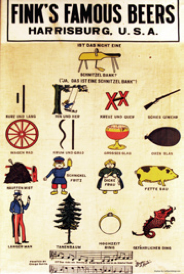
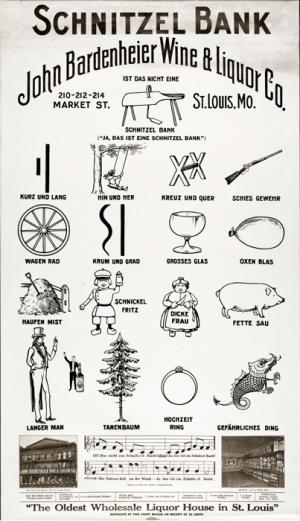
Several weeks ago, while researching the birthday of Pennsylvania brewer Henry Fink, I happened upon the advertising poster below. Intrigued, because I’m fascinated with symbols, I couldn’t make out what they were because the largest image I could find is this one. All I could figure out at the time was that it had something to do with a song.

harrisburgfink

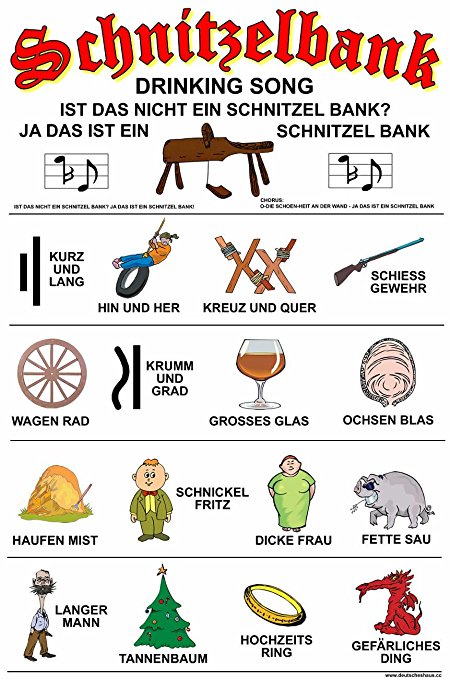
Eventually I gave up, and moved on, because if I’m not careful I’ll keep going off on tangents and down rabbit holes until I’ve gotten myself well and truly lost, not to mention wasted hours of unproductive time. But I kept coming back to it, and eventually, I had to figure out what exactly it was or go crazy. So I started taking a closer look into the poster and figured out that they’re all over the place and it’s a famous German song called the “Schnitzelbank.” And the Fink’s ad poster, or versions of it, is everywhere and has been used by breweries, restaurants and others for years. Which makes sense because, although it’s a “German-language ditty for children and popular among German Americans with an interest in learning or teaching German to their offspring,” it’s also commonly sung by adults for entertainment and nostalgia, and usually while they’re drinking beer.

Schnitzelbank-amazon-poster

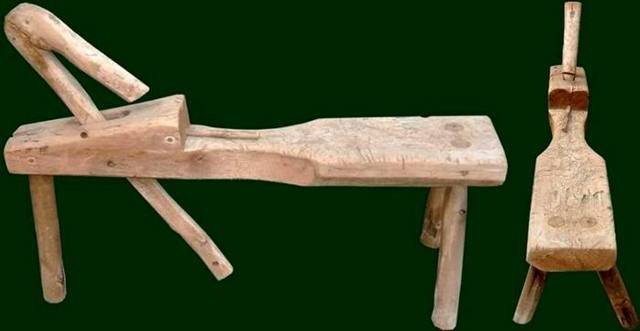
In German, Schnitzelbank apparently “literally means ‘scrap bench’ or ‘chip bench’ (from Schnitzel ‘scraps / clips / cuttings (from carving)’ or the colloquial verb schnitzeln “to make scraps” or “to carve” and Bank “bench”); like the Bank, it is feminine and takes the article “die”. It is a woodworking tool used in Germany prior to the industrial revolution. It was in regular use in colonial New England, and in the Appalachian region until early in the 20th century; it is still in use by specialist artisans today. In America it is known as a shaving horse. It uses the mechanical advantage of a foot-operated lever to securely clamp the object to be carved. The shaving horse is used in combination with the drawknife or spokeshave to cut down green or seasoned wood, to accomplish jobs such as handling an ax; creating wooden rakes, hay forks, walking sticks, etc. The shaving horse was used by various trades, from farmer to basketmaker and wheelwright.”

shaving-horse-old
A traditional shaving horse around 200 years old.

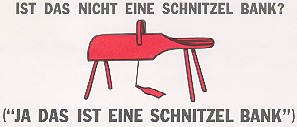
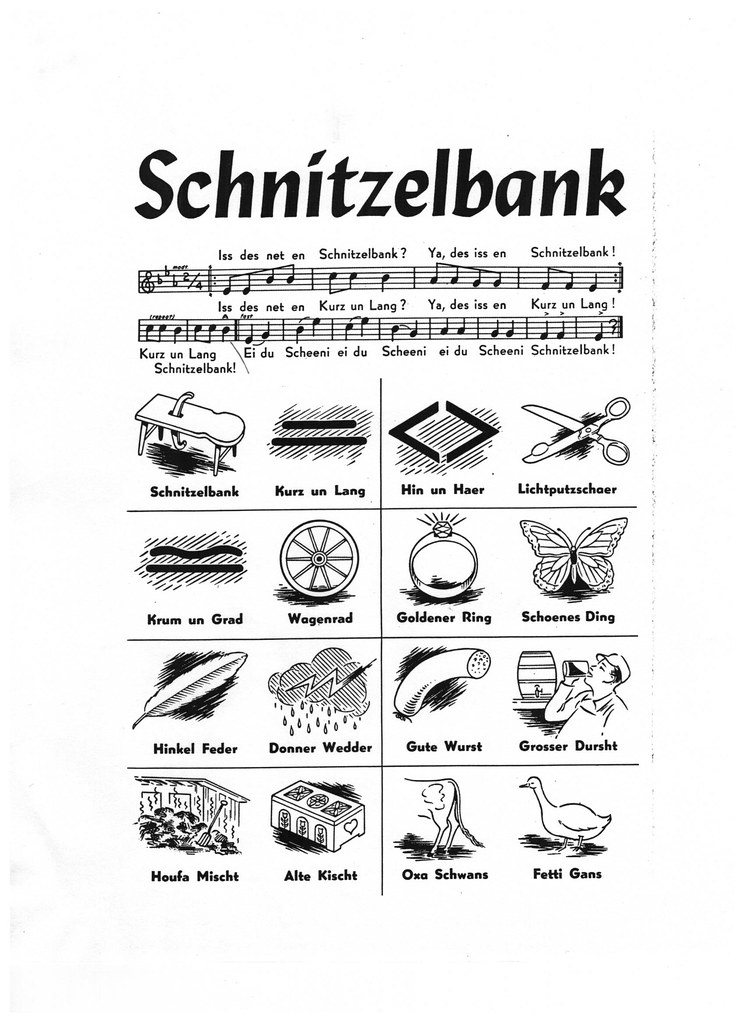
And that’s also why the posters always include a Schnitzelbank, because in addition to it being the title, it’s also how the song begins.

schnitzelbank1

Here’s one description of the Schnitzelbank song:

A Schnitzelbank is also a short rhyming verse or song with humorous content, often but not always sung with instrumental accompaniment. Each verse in a Schnitzelbank introduces a topic and ends with a comedic twist. This meaning of the word is mainly used in Switzerland and southwestern Germany; it is masculine and takes the article “der”. It is a main element of the Fasnacht celebrations in the city of Basel, where it is also written Schnitzelbangg. Schnitzelbänke (pl.) are also sung at weddings and other festivities by the Schitzelbänkler, a single person or small group. Often the Schnitzelbänkler will display posters called Helgen [which is “hello” in German] during some verses that depict the topic but do not give away the joke.

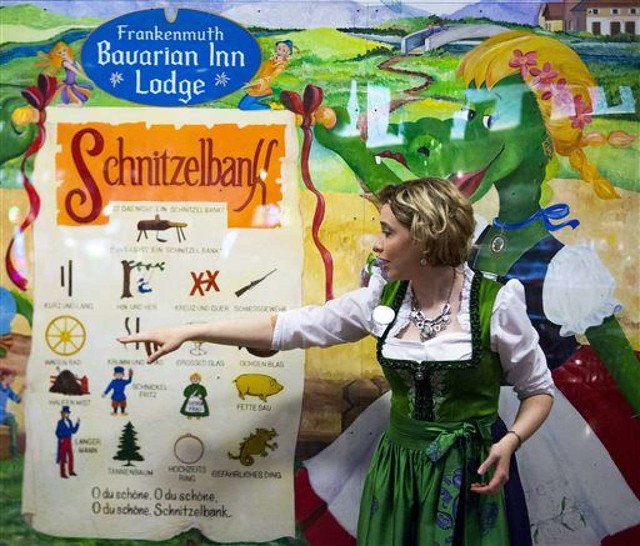
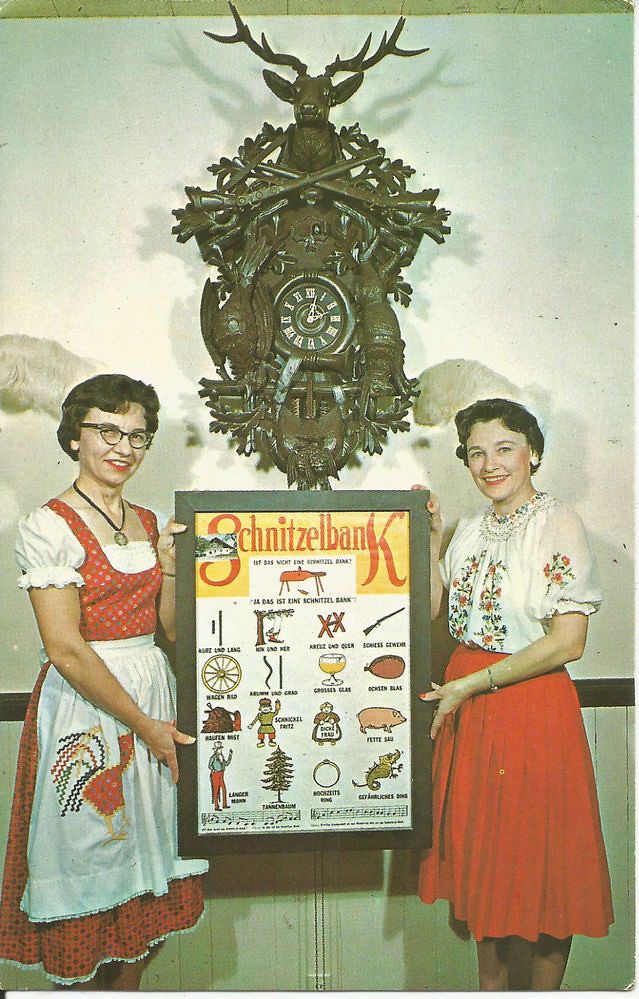
Often the songleader uses the poster to lead people in the song, pointing to the symbols as they come up in the lyrics, as this photo from the Frankenmuth Bavarian Inn Lodge illustrates.

schnitzelbank-frankenmuth

The song uses call and response, with the leader singing one lyric, and the chorus repeating it back as it goes along. So here’s what the traditional version of the song sounds like:

Some Sauerkraut with Your Schnitzelbank? has an interesting reminiscence of a visit to a Fasching Sonntag in the St. Louis area around 1982, and includes his experience taking part in the singing of the Schnitzelbank song.

In the evening, everyone moved upstairs to the parish hall, which was the typical multipurpose gymnasium with a stage at one end. Set up with long tables in parallel rows on both sides, the band in place on the stage, and the large crowd ready for the music to begin, the hall had lost its bland, bare, everyday atmosphere. On the stage, off to one side, was a large easel with a poster on it. I didn’t pay much attention to it, thinking it was for announcements later in the evening. The band started, and the dancing began in the clear space down the middle of the hall, mostly polkas and waltzes, with a few variety numbers like the dreaded Duck Dance, which explained the need for pitchers of beer. Finally, when the crowd was well exercised and well lubricated, someone approached the easel with a pointer in his hand. People started shouting “Schnitzelbank! Schnitzelbank!” The music began, and the person with the pointer called “Ist das nicht ein Schnitzelbank?” and the crowd heartily responded “Ja, das ist ein Schnitzelbank!” Then came a chorus of music, to which everyone sang, “O Die Schoenheit un der Vand, da das ist ein Schnitzelbank.” And so it continued for several verses, the person on stage pointing to another object on the poster with “Ist das nicht ein.…?” and the crowd responding at the top of their voices. I was puzzled at first, but eventually joined in and didn’t think much more about it. I’m pretty sure that only a few people knew all the German words, and that some had memorized it over the years, while the ones in front were close enough to the poster to read the words under the pictures—everyone else just shouted a cheerful approximation of what they thought their neighbor was saying.

Schnitzelbank-1900-missouri

The Schnitzelbank, or Schnitzel Bank, is a song with short verses, meant to be sung the way it was at the Fasching Sonntag, with a leader and group response. It is sung in some areas of Germany for Fasching, Fastnacht, or Karnival, and also during Oktoberfest, and other occasions where there is a happy, celebratory crowd. In America, the posters are displayed at a few German restaurants and some tourist attractions with a German American heritage, such as the Amana Colonies in Iowa and some Pennsylvania Dutch locations. Singing the Schnitzelbank in America dates at least to the turn of the 20th century, which is when the John Bardenheier Wine and Liquor Company printed its version on an advertising poster.

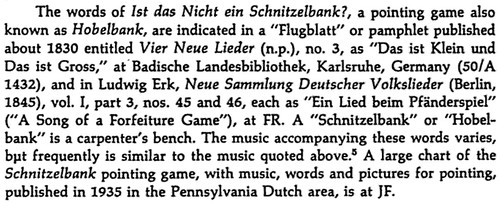
According to “The Book of World-Famous Music: Classical, Popular, and Folk,” first published in 1966, the melody first appeared in 1761 by a French composer and lyrics were written a few years later, n 1765, and it was known as “Ah! Vous Dirai-Je, Maman,” but it became far more well-known as “Twinkle Twinkle, Little Star” and “Baa Baa Black Sheep” in subsequent years. Apparently it first appeared as “Schnitzelbank” in 1830.

schnitzelbank-music

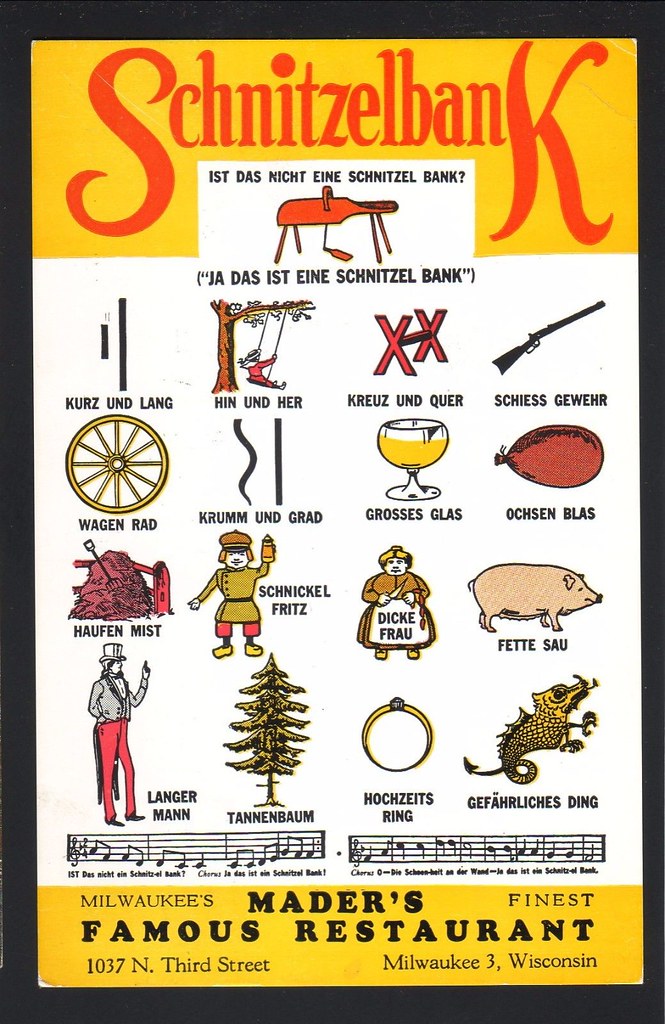
This is the most common version of the poster, and as far as I can tell the symbols have become more or less fixed sometime in the mid-20th century. Perhaps it’s because one company is licensing the imagery to various purposes, or the song has simply evolved to its modern form, made easier by recordings and a growing number of shared experiences.

Schnitzelbank-maders-wisconsin

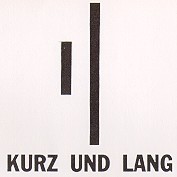
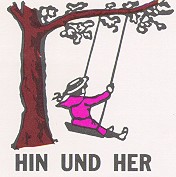
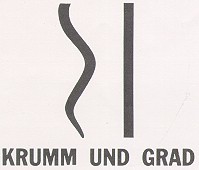
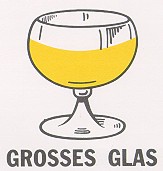
So let’s break down the most common version of the song:

schnitzelbank0

            SymbolTranslation
schnitzelbank1Is this not a Schnitzelbank?

(“Yes this is a Schnitzelbank”)

schnitzelbank17Short and Long
schnitzelbank2Him and Her
schnitzelbank3Criss and Cross
schnitzelbank6Shooting Gun
schnitzelbank18Wagon Wheel
schnitzelbank4Crooked and Straight
schnitzelbank5Big Glass
schnitzelbank7Oxen Bladder
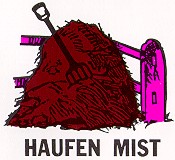
schnitzelbank19Heap of Manure
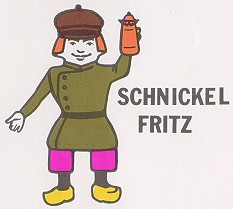
schnitzelbank9Cantankerous Boy
schnitzelbank10Heavy Woman
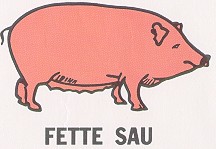
schnitzelbank8Fat Sow
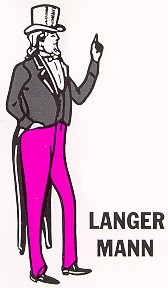
schnitzelbank11Tall Man
schnitzelbank12Fir Tree
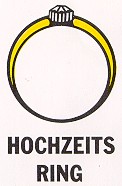
schnitzelbank14Wedding Ring
schnitzelbank15Dangerous Thing

schnitzelbank13

schnitzelbank16

schnitzelbank-frankenmuth-clockFrom Mader’s Famous Restaurant in Milwaukee, Wisconsin.

Here’s another band performing the song. This is the Gootman Sauerkraut Band at the Bravarian Pretzel Factory 2014.

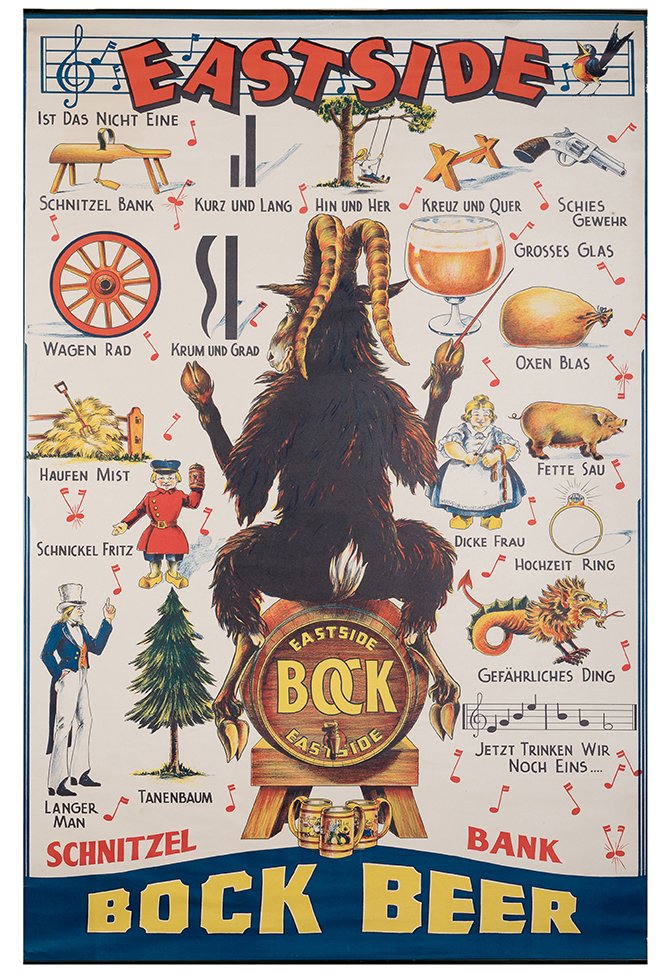
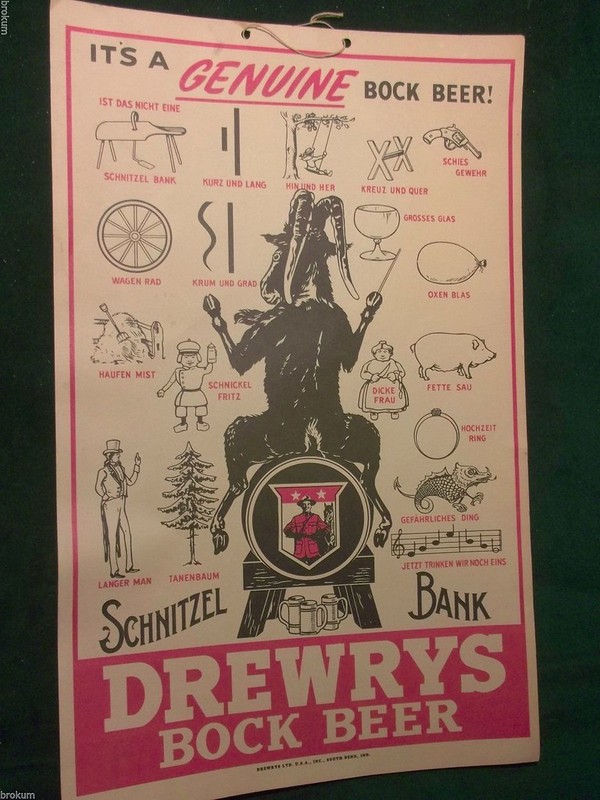
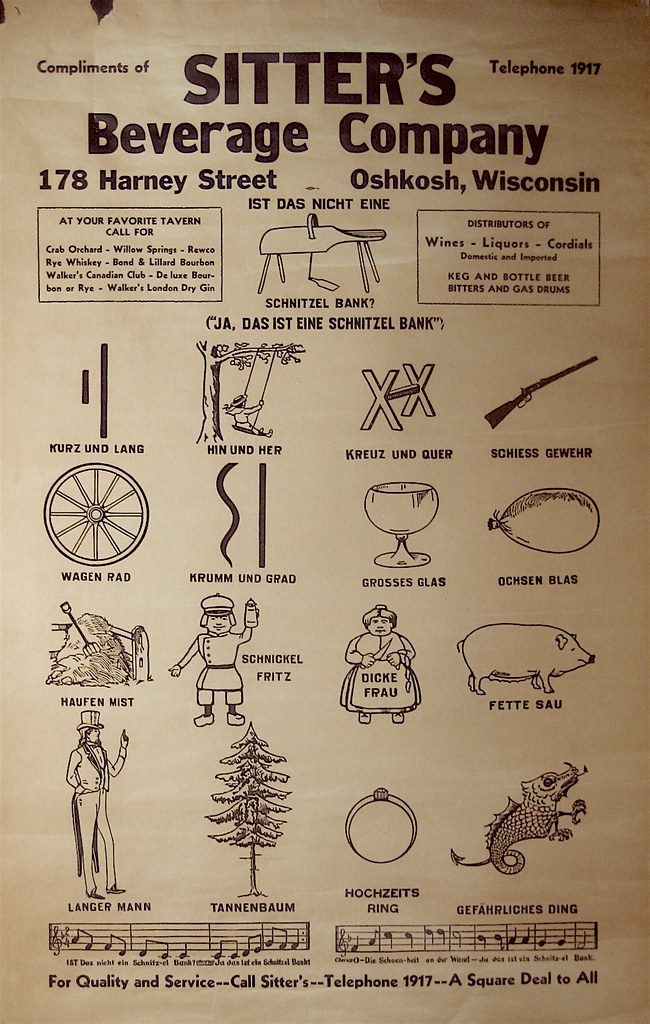
As I mentioned, this all started because a brewery used the Schnitzelbank poster as an advertisement. Apparently that was not unique, and I’ve find a number of others who did likewise. Here’s a few of them:

schnitzelbank-1930s-eastside
The Eastside Brewery of Los Angeles, California, from the 1930s.

schnitzelbank-1940s-drewrys
Drewery’s, the Canadian brewery, from the 1940s.

Huebner-Bock-Schnitzelbank-Lithograph-Signs-Pre-Pro-Huebner-Toledo-Breweries-Co-Huebner-Brewery
The Huebner Brewery of Toldeo, Ohio, from sometime prior to prohibition.

Sitters-Beverage
This one, though not for a specific brewery, was for Sitter’s Beverages, a distributor of beer, wine, liquor and cordials in Oshkosh, Wisconsin. It’s undated, but given that the telephone number is “1917” (yes, just those four numbers) I suspect it’s pre-prohibition. One source puts the date between 1912 and 1919.

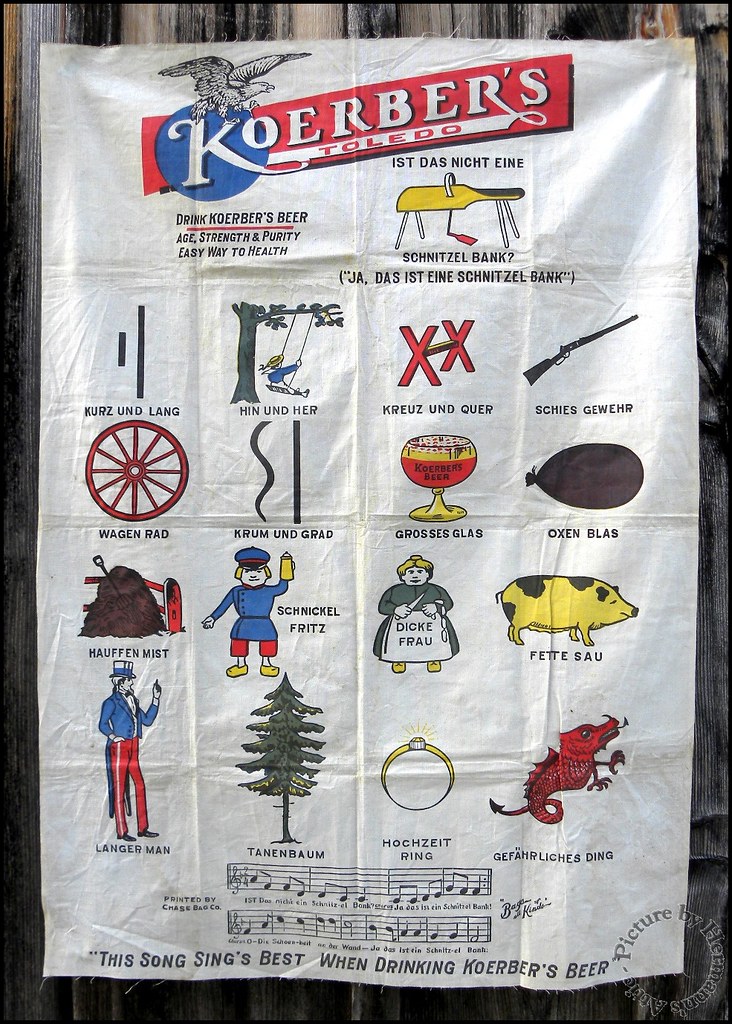
Schnitzelbank-koerbers
A promotional towel, from Koerber’s Brewery, also from Toledo, Ohio.

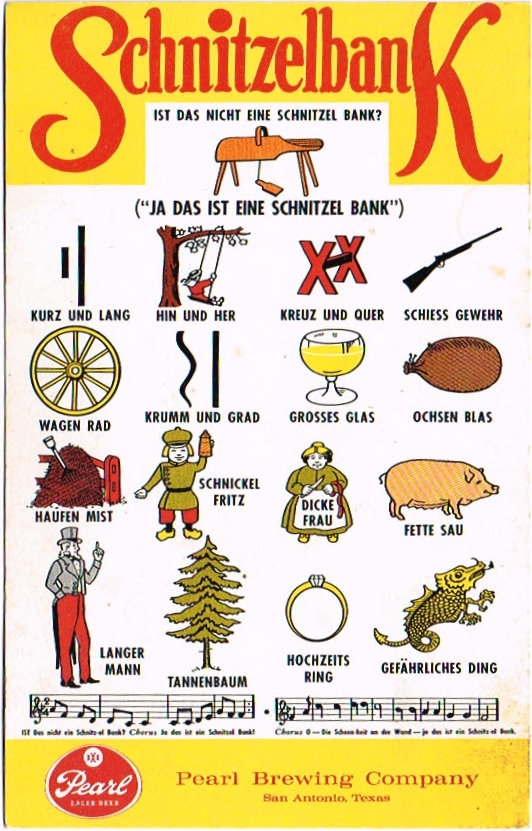
Schnitzelbank-Post-Cards-Pearl-Brewing-Co
The Pearl Brewery of San Antonio, Texas

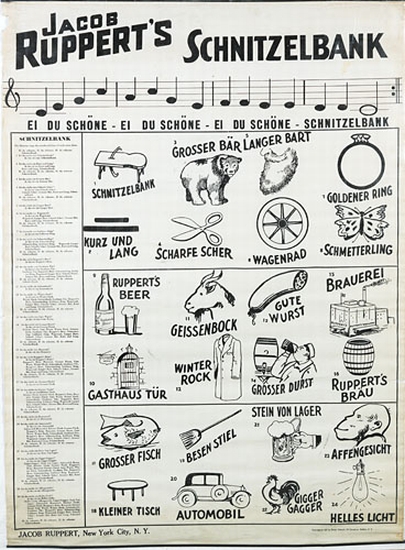
Schnitzelbank-Jacob-Ruppert-1907

Jacob Ruppert’s Brewery of New York City, 1907. Though notice that the almost uniform symbols were changed for Ruppert’s ad, substituting his own beer and brewery, along with other more beer-friendly items into the song list.

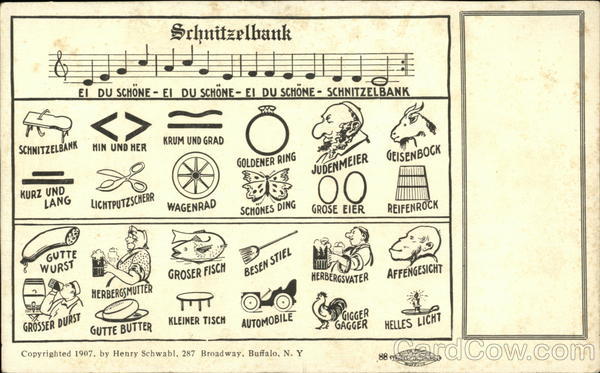
Schnitzelbank-1907-postcard

Although it’s possible that the symbols weren’t quite as settled in the early 20th century, as this postcard, also from 1907, has several that deviate from the standard symbols, including some also in the Ruppert’s poster, but also some that are not in that one.

vintage-yuengling-schnitzelbank-linen

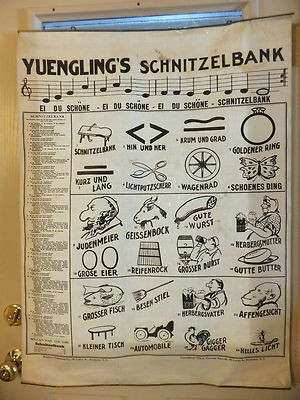
Yuengling Brewery also apparently had their own Schnitzelbank poster, based on the Ruppert’s design. This one is a linen towel being used as a window shade, though it’s too small for me to read the date.

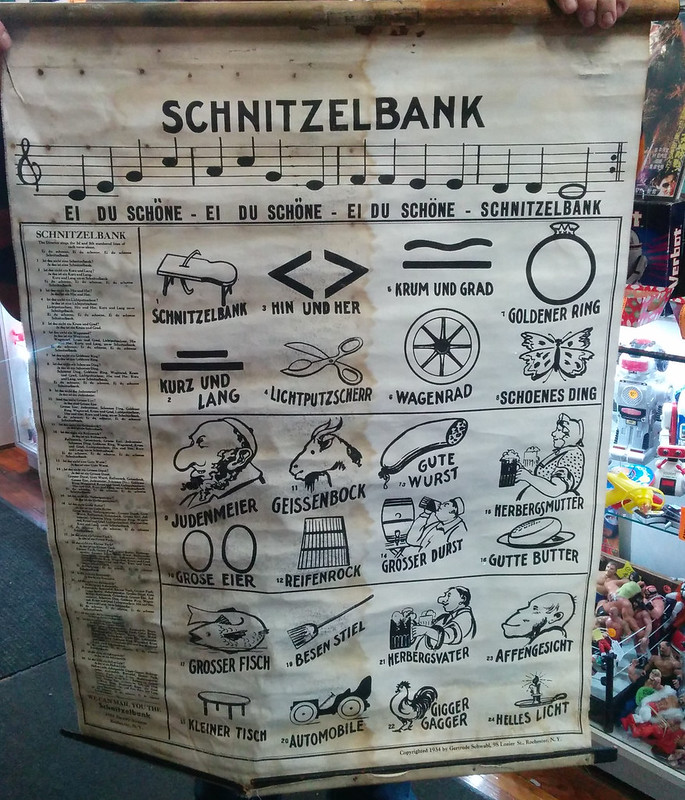
schnitzelbank-1934

Though the Ruppert’s design appears to be copyrighted again in 1934, based on this generic one found by someone in an antique store.

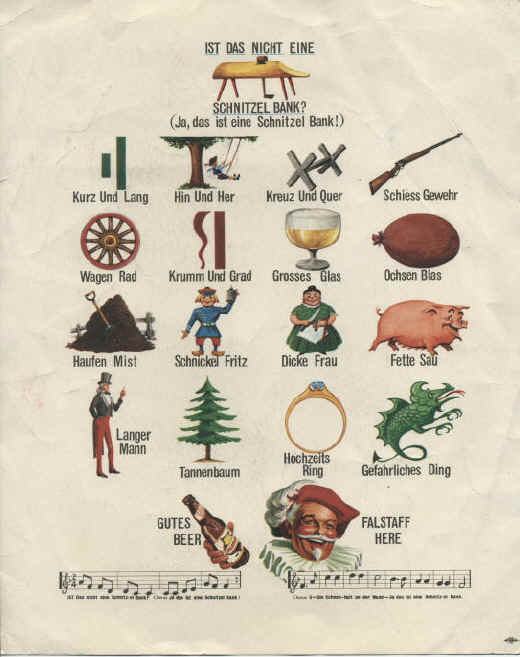
Schnitzelbank-1953-Falstaff

Likewise, this one for Falstaff Beer uses the traditional symbols, but adds two more, one for “Gutes Bier” (good beer) and “Falstaff Here.”

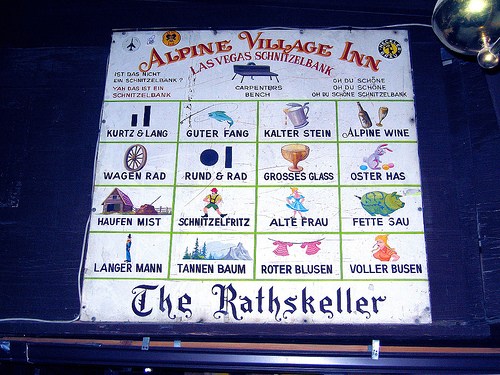
rathskeller-schnitzelbank

This one’s also not from a brewery, but the Alpine Village Inn in Las Vegas, Nevada. This one’s newer, as it opened in 1950, became somewhat famous, but then closed in 1970.

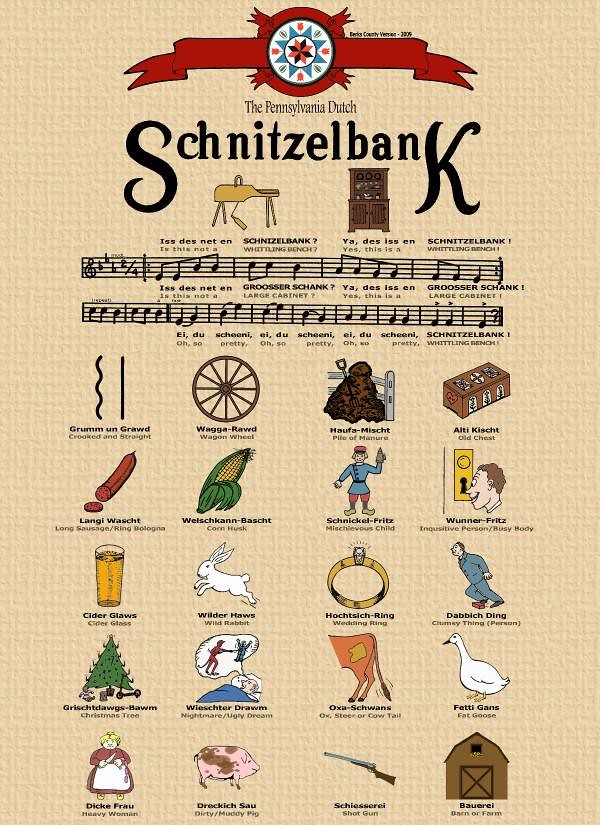
Schnitzelbank-penna-dutch

This one is labeled as being a “Pennsylvania Dutch Schnitzelbank” and has 20 symbols rather than the standard sixteen. And only eight of those are the usual ones. I don’t know how I missed it growing up (I grew up near Pennsylvania Dutch country in Pennsylvania, and in fact my grandparents grew up on Mennonite farms, but were the first generation to leave them).

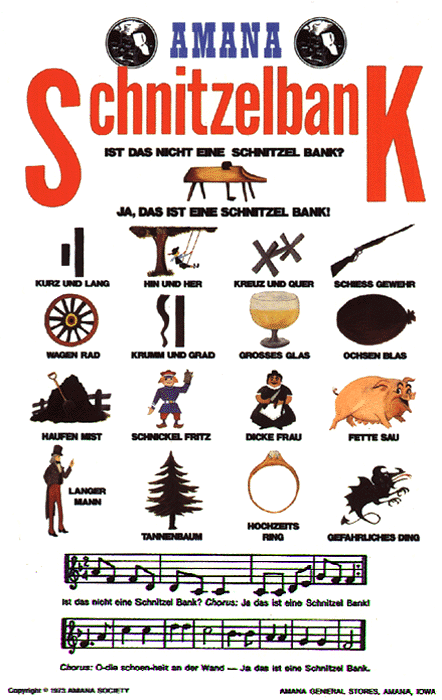
amana-schnitzelbank

Apparently it’s also a big deal in Amana, Iowa, where there’s a gift and toy store called the “Schnitzelbank” and where, in 1973, the Amana Society created this Schnitzelbank poster.

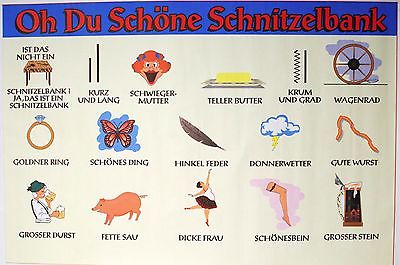
German-Schnitzelbank-Poster

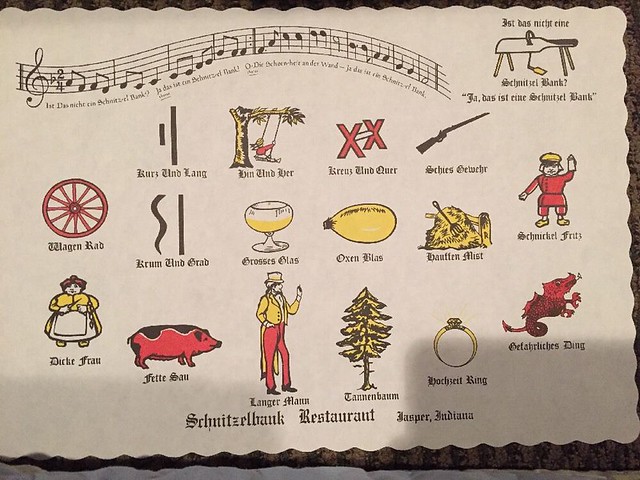
schnitzelbank-placemat
The Schnitzelbank Restaurant in Jasper, Indiana, uses the poster as their placemats.

This random German poster, which translates as “Oh you beautiful Schnitzelbank” has only about half of the standard symbols on it. I’m not sure when this one was created but it’s available on Polka Time as an “Oktoberfest Poster.”

Schnitzelbank-new-paltz-band
Also more modern, the New Paltz Band has their own version of the song using non-standard symbols.

Schnitzelbank-Marv-Herzog

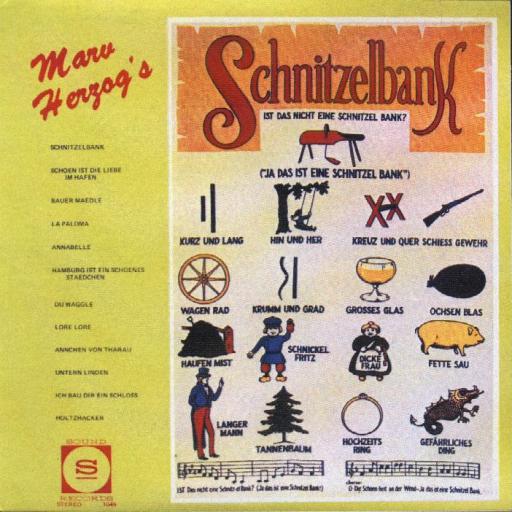
And speaking of music, Marv Herzog used the poster on an album cover. The album, of course, included the Schnitzelbank song.

And lastly, the Animanics did their own version of the Schnitzelbank song in episode 56 entitled “Schnitzelbank,” which aired in 1994. It’s described as “a traditional German song that the Warners learn in German from Prof. Otto von Schnitzelpusskrankengescheitmeyer. The lyrics were adapted by Randy Rogel.”

schnitzelbank-conductor
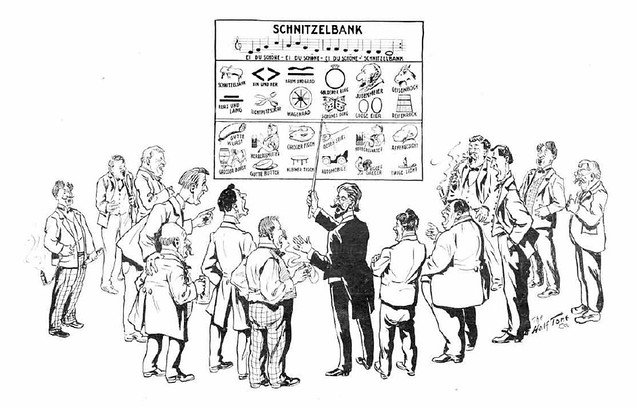
From Henry Sticht’s “Schnitzelbank Two-Step,” 1907.

Filed Under: Beers, Just For Fun, Related Pleasures Tagged With: Germany, Humor, Music, Pennsylvania, Wisconsin

500th Anniversary Of The Reinheitsgebot

April 23, 2016 By Jay Brooks

reinheitsgebot bavaria-coa
It’s hard to believe it’s been 500 years since Bavaria signed what’s considered the first food purity law, the Reinheitsgebot, also known as the Bavarian Beer Purity Law, and later the German Beer Purity Law. That’s because in 1516, when the law was decreed, Germany did not yet exist, and wouldn’t for nearly 300 years, with the formation of the German Confederation in 1815, longer if you go by the German Empire, founded in 1871. Modern Germany consists of sixteen federal states, called Bundesländers, of which Bavaria is one.
reinheits-500
And it was in Bavarian town of Ingolstadt on April 23, 1516, that William IV, Duke of Bavaria wrote and signed the law, along with his younger brother Louis X, Duke of Bavaria. That 1516 law was itself a variation of earlier laws, at least as early as 1447 and another in independent Munich in 1487. When Bavaria reunited, the new Reinheitsgebot applied to the entirety of the Bavarian duchy. It didn’t apply to all of Germany until 1906, and it wasn’t referred to as the Reinheitsgebot until 1918, when it was coined by a member of the Bavarian parliament. But while today most people think of it as all about food purity, that was in reality only a small part of it, and probably not even the most important.

reinheitsgebot

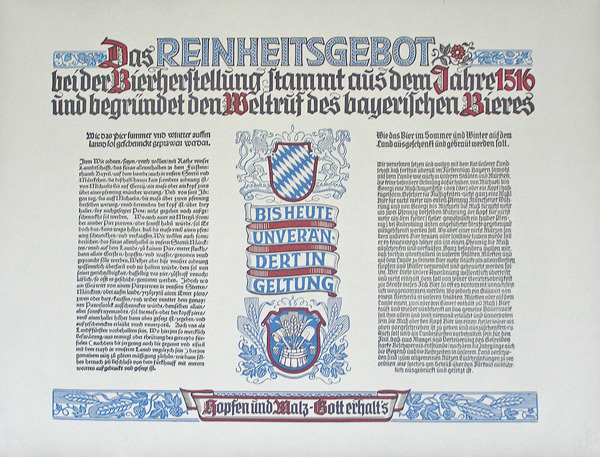
Here’s a translation of the Reinheitsgebot, from a 1993 issue of Zymurgy:

We hereby proclaim and decree, by Authority of our Province, that henceforth in the Duchy of Bavaria, in the country as well as in the cities and marketplaces, the following rules apply to the sale of beer:

From Michaelmas to Georgi [St. George’s Day], the price for one Mass [Bavarian Liter 1,069] or one Kopf [bowl-shaped container for fluids, not quite one Mass], is not to exceed one Pfennig Munich value, and

From Georgi to Michaelmas, the Mass shall not be sold for more than two Pfennig of the same value, the Kopf not more than three Heller [Heller usually one-half Pfennig].

If this not be adhered to, the punishment stated below shall be administered.

Should any person brew, or otherwise have, other beer than March beer, it is not to be sold any higher than one Pfennig per Mass.

Furthermore, we wish to emphasize that in future in all cities, markets and in the country, the only ingredients used for the brewing of beer must be Barley, Hops and Water. Whosoever knowingly disregards or transgresses upon this ordinance, shall be punished by the Court authorities’ confiscating such barrels of beer, without fail.

Should, however, an innkeeper in the country, city or markets buy two or three pails of beer (containing 60 Mass) and sell it again to the common peasantry, he alone shall be permitted to charge one Heller more for the Mass or the Kopf, than mentioned above. Furthermore, should there arise a scarcity and subsequent price increase of the barley (also considering that the times of harvest differ, due to location), WE, the Bavarian Duchy, shall have the right to order curtailments for the good of all concerned.

Notice that the first two decrees have to do with pricing and when beer can be sold. It isn’t until paragraph six, the second last one, that the issue of what ingredients will be allowed comes up. If it had been the most important part, is seems more likely they would have led with it. Even then, it wasn’t about purity, but again commerce. Barley was designated as the only grain so that others, notably wheat and rye, were set aside to be used for baking bread.

Also, a lot of hay has been made about it not mentioning yeast, with the idea that it was because yeast wasn’t discovered until Louis Pasteur in the 19th century. But early brewers did know something about yeast, even if they didn’t have the full scientific understanding that came later. Otherwise, they wouldn’t have been able to make consistent batches of beer. At the end of your brew, you’ll find a layer of billowing foam and other indeterminate matter at the bottom of the fermenter, which the Germans called “Zeug,” which means “stuff.” And early German brewers had a person, called a “hefener,” whose job it was to scoop out the Zeug, which was in effect the leftover yeast, and pitch it in the next batch of beer. So it’s hard to say they didn’t have some understanding of yeast.

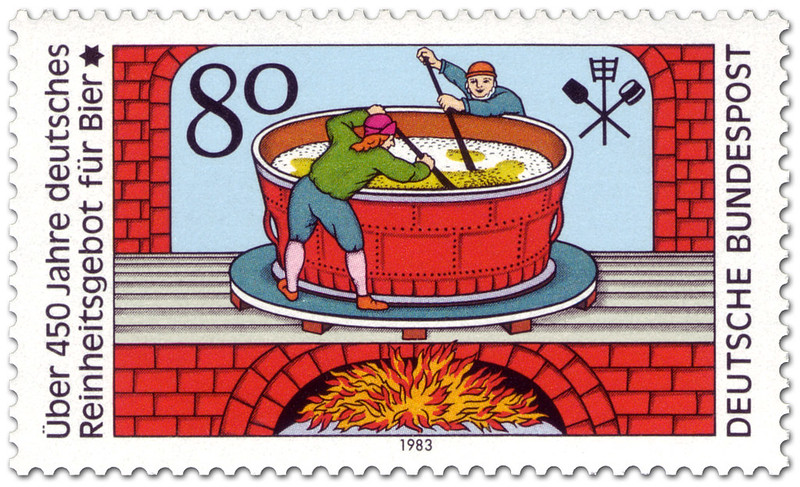
Reinheitsgebot-Bier-stamp
A German postage stamp celebrating the 450th anniversary of the Reinheitsgebot in 1983.
The Germans, of course, have set up a website for the 500th anniversary, and so does the Bayerischer Brauerbund, which is a a Bavarian brewers trade group along with the German Brewers Group. They also created a 50-second film marking the anniversary.
And the media is covering the Reinheitsgebot’s Quincentenary. A few examples include the BBC, Food and Wine, NPR, Spiegel, and Wired. But by far the most thorough examination of the Reinheitsgebot was by Jeff Alworth in All About Beer magazine, Attempting to Understand the Reinheitsgebot.

reinheitsgebot-replica

It’s great that it’s been 500 years, and that German brewers are justly proud of the Reinheitsgebot. It’s clearly helped create the unique German beer scene and their many native styles. But it’s also been used as a shameless marketing tool, been used as an exclusionary tactic, and has even had little-known exceptions to its rules for years, ones that most people are not even aware of, not to mention the use of other items in the brewing process that are also not mentioned by the law, but which because they’re not strictly “ingredients” more modern brewers have interpreted as not being prohibited.

Many people have voiced criticisms against it over the years. One that’s particularly thorough is The German Reinheitsgebot — Why it’s a Load of Old Bollocks. The German magazine Spiegel’s recent coverage is entitled Attacking Beer Purity: The Twilight of Germany’s Reinheitsgebot.

Back in 2001, Fred Eckhardt wrote an entertaining tale for All About Beer entitled The Spy who Saved the Reinheitsgebot, about how a brewer was able to prove Beck’s was using adjuncts and was not in adherence with the German law.

In another recent article in First We Feast, Sam Calagione, of the Dogfish Head Craft Brewery, is quoted with an opinion I suspect many American brewers hold. “I hate the concept of the Reinheitsgebot, but I am essentially happy it exists.”

Reinheitsgebot-Bier-stamp-2016
Deutsche Post’s 2016 commemorative stamp.

Filed Under: Beers, Events, Just For Fun, Politics & Law Tagged With: Bavaria, Germany, History, Law

Beer In Ads #1805: Bock, James Bock

January 29, 2016 By Jay Brooks


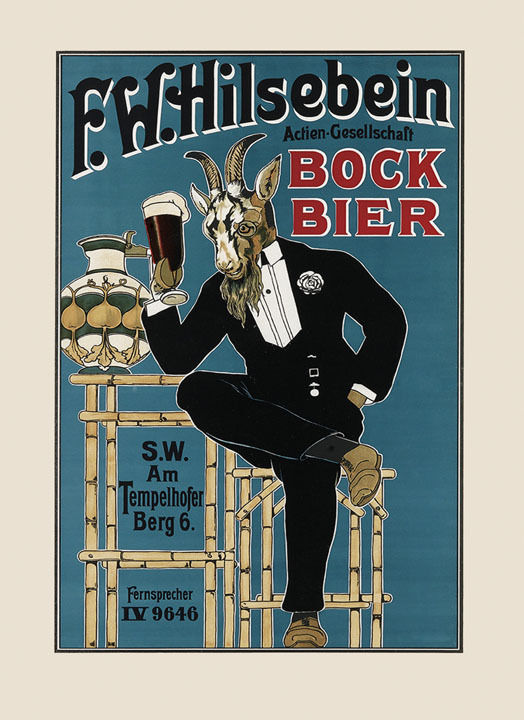
Friday’s ad is for F.W. Hilsebein Bock Beer, from who knows when. This is obviously a more suave and sophisticated bock. It’s from the German brewery, Berliner Bierbrauerei A.G. vorm F.W. Hilsebein. But I keep expecting the goat to look at the camera and say. “Bock, James Bock.”

Hilsebeim-bock

Filed Under: Art & Beer, Beers Tagged With: Advertising, Germany, History

Beer In Ads #1796: Hofer Löwenbräu Bock

January 20, 2016 By Jay Brooks


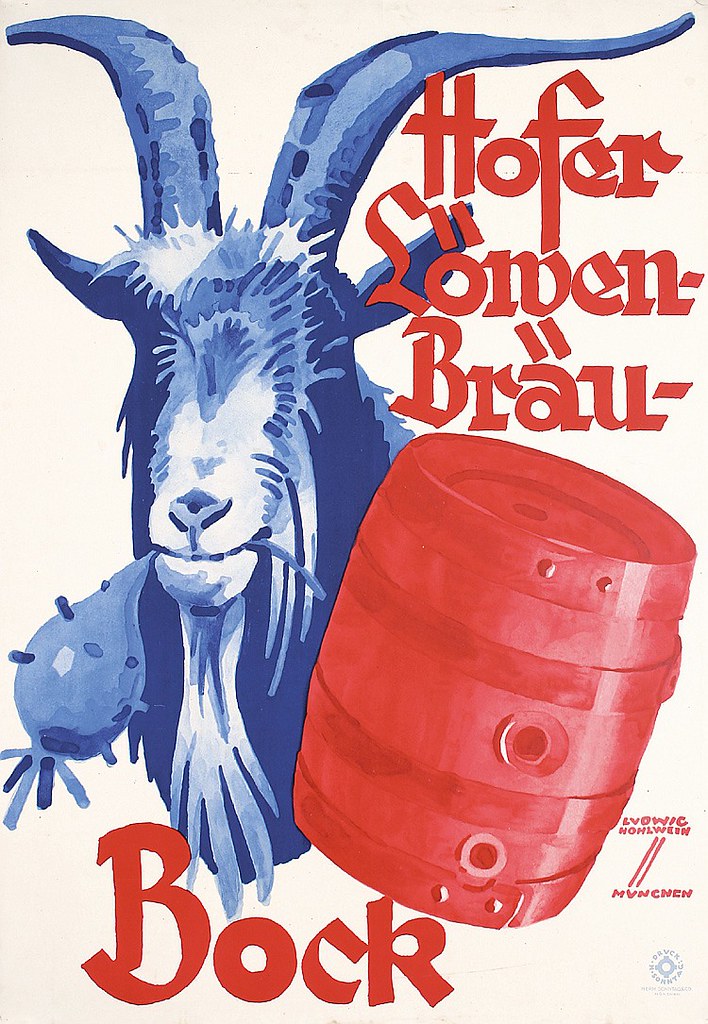
Wednesday’s ad is for Hofer Löwenbräu Bock, from the 1930s. It was created by German poster artist Ludwig Hohlwein using only shades of red and blue.

1930s-ludwig-hohlwein-bock-beer-poster

Filed Under: Art & Beer, Beers Tagged With: Advertising, Germany, History

Patent No. 8349378B2: Brewing Process And Brewery Installations

January 8, 2016 By Jay Brooks

patent-logo
Today in 2013, US Patent 8348086 B2 was issued, an invention of Klaus-Karl Wasmuht and Cornelia Folz, assigned to Krones Ag, for their “Brewing Process and Brewery Installations.” Here’s the Abstract:

A brewing process including taking off a fluid having a starting temperature from a heat store; feeding the fluid to a plurality of heat consumers for releasing heat; and returning to the heat store the fluid which has a final temperature. The brewery installation has a heat store for controlling the flow of the fluid in the installation, and a plurality of heat consumers each of which is connected to the primary circuit for releasing heat. Improved efficiency is achieved in part by the final temperature of the fluid which flows out of the respective heat consumers is measured and the return of the fluid is controlled as a function of the measured final temperature.

US08349378-20130108-D00001
US08349378-20130108-D00002

Filed Under: Beers, Breweries, Just For Fun, Politics & Law, Related Pleasures Tagged With: Brewing Equipment, Germany, Law, Patent, Science of Brewing

Beer In Ads #1779: Bock Lowenbrau Munchen

January 3, 2016 By Jay Brooks


Sunday’s ad is for Löwenbräu Bock, though again I’m not sure when the ad is originally from. The beer from Löwenbräu München is no longer made, and the brewery is currently owned by Anheuser-Busch InBev. But it’s another beautiful ad for Bock, featuring another really cool got. It looks like I’m on a roll this week with Bock ads, just like the goat on the barrel.

German-Bock

Filed Under: Art & Beer, Beers Tagged With: Advertising, Germany, History

« Previous Page
Next Page »

Find Something

Northern California Breweries

Please consider purchasing my latest book, California Breweries North, available from Amazon, or ask for it at your local bookstore.

Recent Comments

  • Ernie Dewing on Historic Beer Birthday: Charles William Bergner 
  • Steve 'Pudgy' De Rose on Historic Beer Birthday: Jacob Schmidt
  • Jay Brooks on Beer Birthday: Bill Owens
  • Steve 'Pudgy' De Rose on Beer Birthday: Charles Finkel
  • Steve 'Pudgy' De Rose on Beer Birthday: Bill Owens

Recent Posts

  • Beer In Ads #5205: Bock Time Is Schmidt’s Time February 16, 2026
  • Historic Beer Birthday: Samuel C. Whitbread February 16, 2026
  • Historic Beer Birthday: Wilhelm Bierbauer February 16, 2026
  • Beer Birthday: Brendan Moylan February 16, 2026
  • Beer In Ads #5204: Oh Brother! Griesedieck Bros. Genuine Premium Bock Beer Is Here! February 15, 2026

BBB Archives

Feedback

Head Quarter
This site is hosted and maintained by H25Q.dev. Any questions or comments for the webmaster can be directed here.