Brookston Beer Bulletin

Jay R. Brooks on Beer

  • Home
  • About
  • Editorial
  • Birthdays
  • Art & Beer

Socialize

  • Dribbble
  • Email
  • Facebook
  • Flickr
  • GitHub
  • Instagram
  • LinkedIn
  • Pinterest
  • RSS
  • Twitter
  • YouTube

Powered by Genesis

Beer In Ads #4941: Poth Bock Beer

April 15, 2025 By Jay Brooks

Last year I decided to concentrate on Bock ads. Bock, of course, may have originated in Germany, in the town of Einbeck. Because many 19th century American breweries were founded by German immigrants, they offered a bock at certain times of the year, be it Spring, Easter, Lent, Christmas, or what have you. In a sense they were some of the first seasonal beers. “The style was later adopted in Bavaria by Munich brewers in the 17th century. Due to their Bavarian accent, citizens of Munich pronounced ‘Einbeck’ as ‘ein Bock’ (a billy goat), and thus the beer became known as ‘Bock.’ A goat often appears on bottle labels.” And presumably because they were special releases, many breweries went all out promoting them with beautiful artwork on posters and other advertising.

Tuesday’s ad is for Poth Bock Beer and was published April 15, 1892. The brewery was the F.A. Poth Brewing Co., of Philadelphia, Pennsylvania, which was originally founded in 1864. This ad ran in the Philadelphia Times, of Philadelphia, Pennsylvania.

Filed Under: Art & Beer, Beers, Breweries, Just For Fun Tagged With: Advertising, Bock, History, Pennsylvania, Philadelphia

Historic Beer Birthday: William Leonard Hoerber

April 15, 2025 By Jay Brooks

hoerber
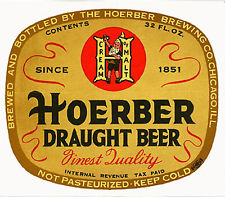
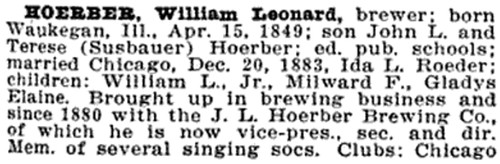
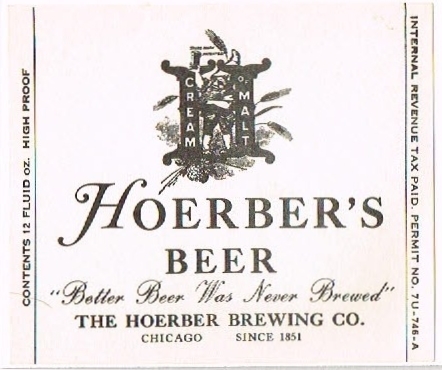
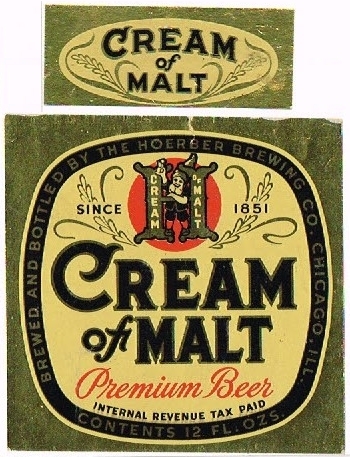
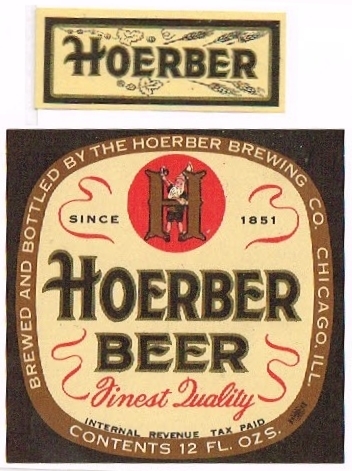
Today is the birthday of William Leonard Hoerber (April 5, 1849-May 7, 1933). He was the son of German-born John L. Hoerber, who founded the John L. Hoerber Brewery in 1858, after emigrating to Chicago, Illinois. William was brought up in the family business and took over the brewery after his father passed away in 1898. After prohibition, it reopened as The Hoerber Brewing Co., and remained in business until 1941, when it closed for good.

hoerber-draught

This short biography is from “The Book of Chicagoans: A Biographical Dictionary of Leading Living Men of the City of Chicago, edited by Albert Nelson Marquis, published in 1911:

william-leonard-hoerber-bio-1
william-leonard-hoerber-bio-2

Hoerbers-Beer-Labels-Hoerber-Brewing-Company

Chicago historian and beer writer Bob Skilnik had an article in the Chicago Tribune that mentioned the Hoerber Brewery in 1997:

A population increase from a few hundred in 1833 to more than 100,000 in 1860 opened the market and made success possible for scores of brewers. In 1857, the city council ordered the grades of all existing properties to be raised to a height that would ensure proper drainage. John Hoerber used this opportunity to raise his combination saloon, store and boardinghouse and install a small brewery underneath, pumping fresh beer to his customers. By doing so, Hoerber beat the now-defunct Siebens on West Ontario by about 150 years for the title of Chicago’s first brew pub.

Cream-of-Malt-Premium-Beer-Labels-Hoerber-Brewing-Company

Hoerber-Beer-Labels-Hoerber-Brewing-Company

Filed Under: Birthdays, Breweries, Just For Fun Tagged With: Chicago, History, Illinois

Historic Beer Birthday: Richard Katzenmayer

April 15, 2025 By Jay Brooks

usba
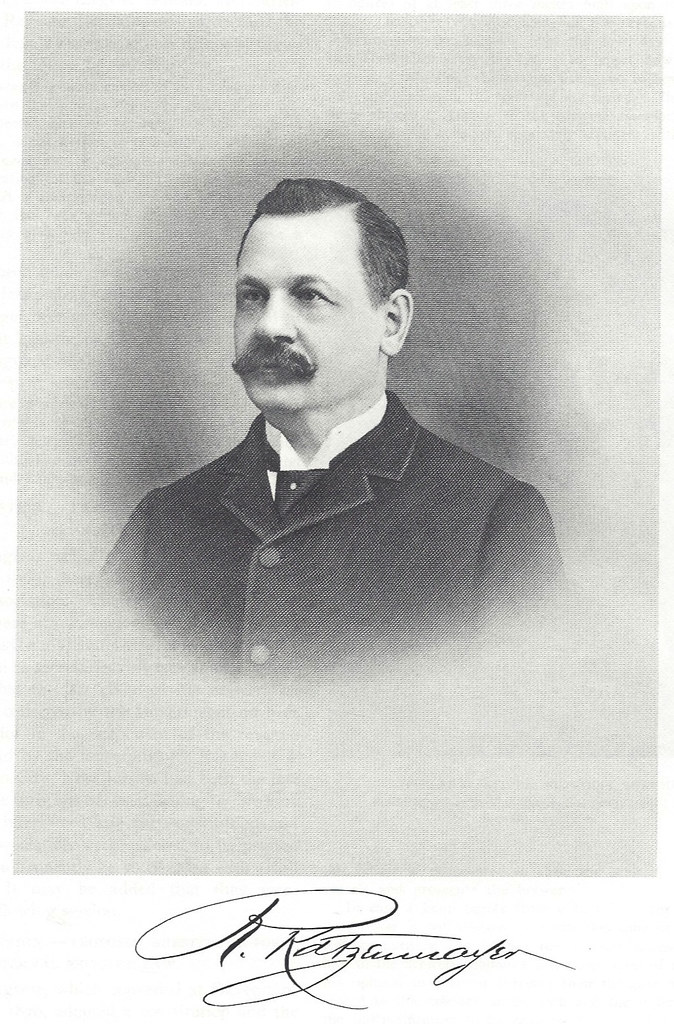
Today is the birthday of Richard Katzenmayer (April 15, 1839-October 3, 1893). He came with his family to America from the Bodensee, the European lake that borders Germany, Austria and Switzerland. They settled in New York City, and his father, John Katzenmayer, was a bookkeeper for a brewery there, A. Schmid & Co. John Katzenmayer was a founding member of the United States Brewers Association in 1862, and was its first secretary, a position he held until his death in 1866. When Richard’s father passed away, he became the secretary of the USBA and continued in that role for over thirty years until his own death. Although not a brewer by trade, he was a fixture of the association in its early days and helped shape the future of the brewing industry in the late 19th century.

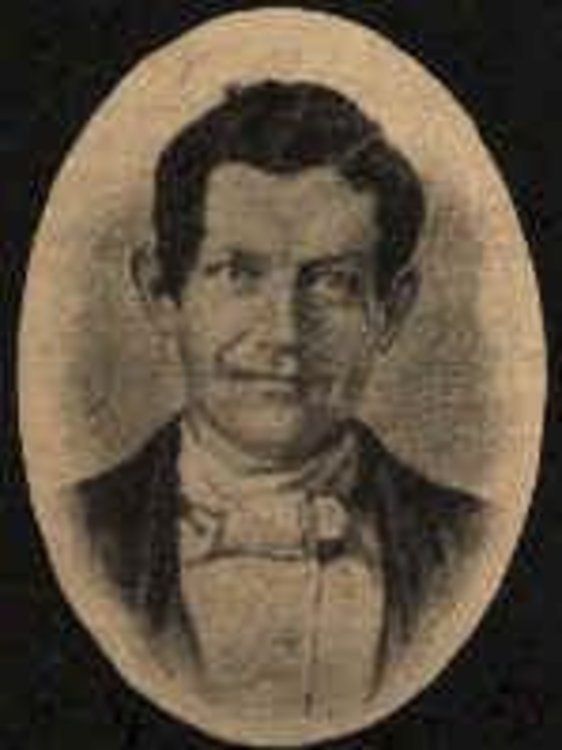
Richard-Katzenmayer

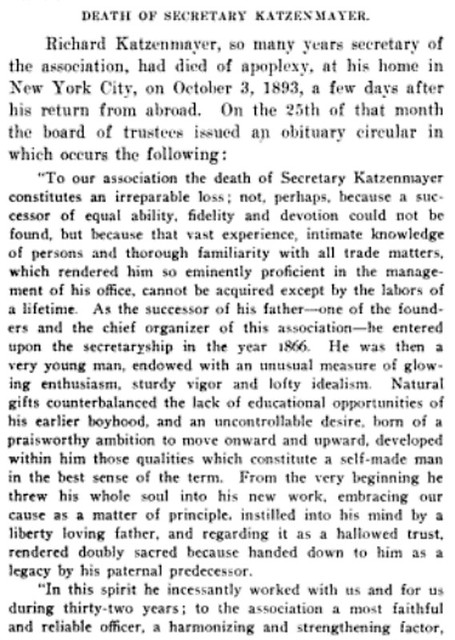
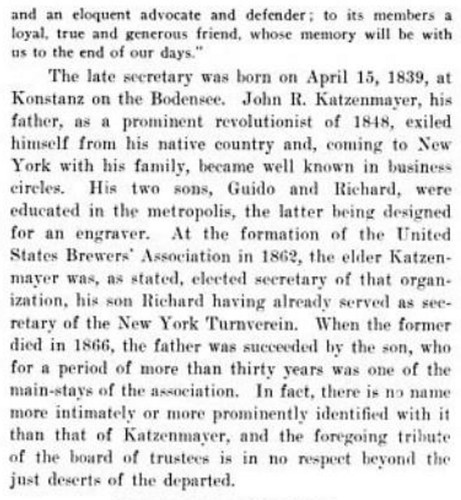
Considering his prominent role in the USBA, surprisingly there isn’t much information I could find about him, apart from this obituary from 100 Years of Brewing:

katzenmayer-100yrs-1
katzenmayer-100yrs-2

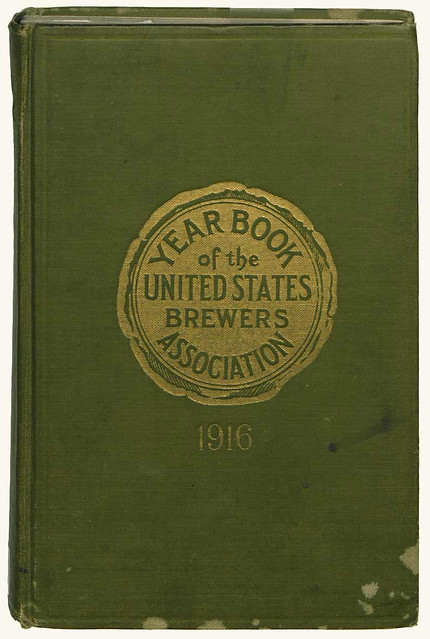
usba-yearbook-1916

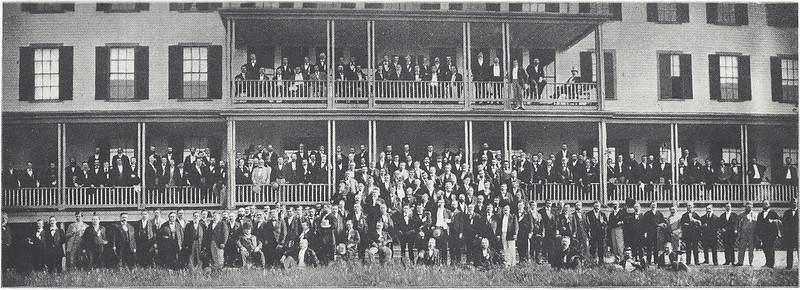
usba-1874
The USBA Convention, held in Boston, in 1874. Katzenmayer is listed as being in the photo, but if you can find him you’ve got better eyes that I do.

Filed Under: Birthdays, Just For Fun Tagged With: Brewers Association, History, New York

Historic Beer Birthday: August Krug

April 15, 2025 By Jay Brooks

schlitz-globe
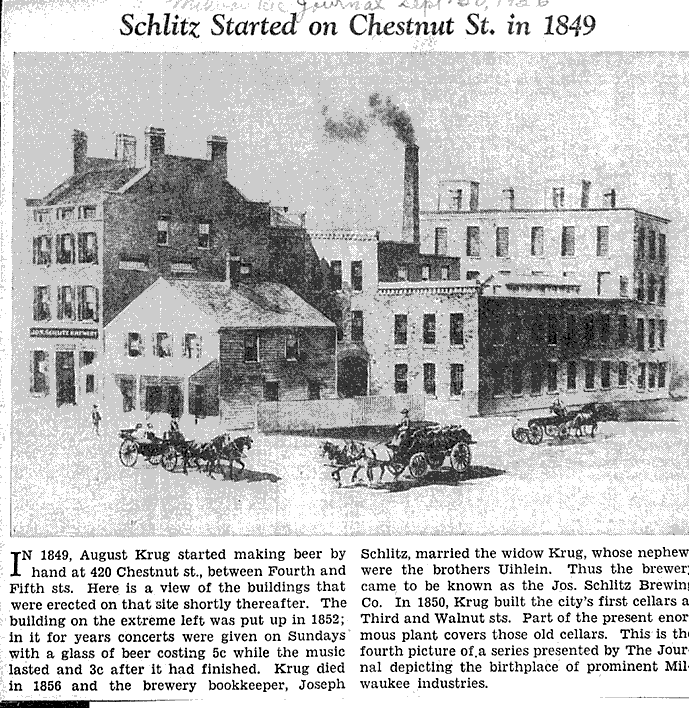
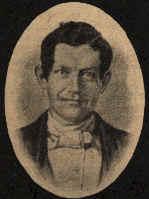
Today is the birthday of August Krug (April 15, 1815-December 30, 1856). Krug was born in Miltenberg, Bavaria, Germany, but when he was 33, in 1848, emigrated to the U.S. and settle in central Wisconsin. He opened a restaurant and the following year, 1849, added a brewery, which was known then as the August Krug Brewery. When he died young, in 1856, his bookkeeper, Joseph Schlitz took over management on behalf of Krug’s widow, Anna Marie. In 1858, Schlitz married Krug’s widow and renamed the brewery after himself.

Here’s a biography of him from Find-a-Grave:

Brewer. His August Krug Brewery was the foundation that became the giant Joseph Schlitz Brewing Co. in Milwaukee, Wisconsin. Born Georg August Krug in Miltenberg, Bavaria, Germany, he came to the USA about 1848, established a restaurant in Kilbourntown (now central Milwaukee), Wisconsin and added a small brewery in 1849 which, limited by lack of refrigeration to brewing in cooler months, produced about 150 barrels the first year. In 1850, his father, Georg Krug, came to visit, surviving a shipwreck on the way. The father managed to save himself, Krug’s eight-year-old nephew August Uihlein and $800 in gold. The gold was used to expand the brewery and hire four people, including Joseph Schlitz as bookkeeper. Krug, who is credited with building Kilawukee’s first underground brewer’s vault tunneled into the hill to provide the consistent cool temperatures essential to brewing and storage, died seven years after his brewery produced its first barrel of beer. The bookkeeper, Schlitz, acquired both his brewery and then his widow after Krug died in 1856. The brewery’s market share increased steadily, and sales doubled when Schlitz entered the Chicago market immediately after the Chicago Fire in 1871. Schlitz was lost at sea in 1875, after which Krug’s four nephews began the Uihlein dynasty that was to run the company during its long history. In the 1960s, Schlitz was the second-largest brewer in the world; during the 1970s it was troubled by indictments for improper marketing, by insufficient advertising and by public resentment over a change in the brewing recipe; finally a 1981 strike lead to the closure of their Milwaukee plant although it was still the USA’s third-largest brewer when purchased by the Stroh Brewery Company of Detroit (now part of Pabst Brewing Co.) in 1982.

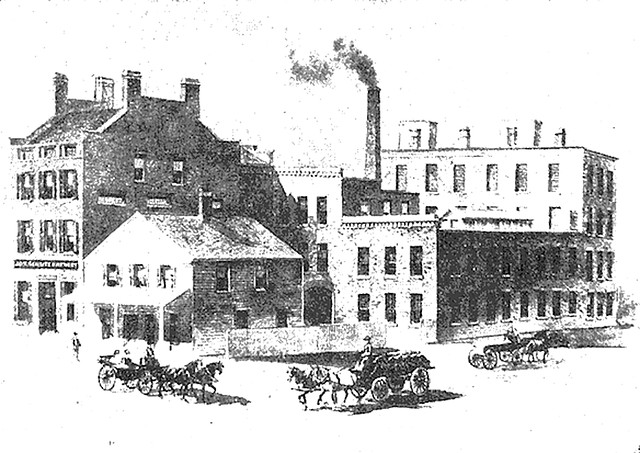
schlitz_first_brewery
The August Krug Brewery, c. 1850s.

This portion of the brewery’s history from Immigrant Entrepreneurship is entitled “Political Revolution, Emigration, and Establishing a Regional Player in Brewing: August Krug and Joseph Schlitz” and is the early section that includes Krug’s contributions:

At the beginning was the German revolution of 1848. Georg August Krug (born April 15, 1815 in Miltenberg, grand duchy of Hesse-Darmstadt; died: December 30, 1856 in Milwaukee, WI) was born the son of Georg Anton Krug (1785–1860) and Anna Marie Ludwig (1784–1864), who owned the brewery “Zum Weißen Löwen,” the predecessor of today’s Faust brewery, in Miltenberg. This was a small and contested town at the River Main, which belonged until 1803 to the Electorate of Mayence (Mainz), became part of the grand duchy of Baden in 1806, was transferred to the grand duchy of Hesse-Darmstadt in 1810, and finally became part of the Kingdom of Bavaria in 1816. Georg August Krug worked in the family business but also became a member of a group of revolutionists surrounding a local doctor and farmer, Jakob Nöthig, who later emigrated to the U.S. after he was accused of being a ringleader (Rädelsführerei) of a local band of political agitators and other offenses against the Bavarian authorities. Krug and his father were among the petitioners in Miltenberg on March 8, 1848 who demanded liberal reforms. On the following day Miltenberg was shaken by protests and turmoil, and Bavarian armed forces reestablished order. Facing official prosecution, the younger Krug became part of the first wave of politically-motivated emigration. He arrived in the United States in May 1848, where he used only his second name and where he was naturalized on December 15, 1854.

In Milwaukee, at that time a preferred destination for the 48ers, August Krug established, probably with his savings, a saloon and restaurant on 4th and Chestnut Streets. Far from Bavaria, he still managed to receive additional support from his family. First, his fiancée Anna Maria Wiesmann Hartig arrived from Miltenberg (Oct. 9, 1819–Jan. 20, 1887) and they eventually married—likely in 1849. She was the daughter of Michael Wiesmann and Christina Schlohr, both from Miltenberg. Her presence allowed an expansion of his business activities. While Anna Maria Krug managed the restaurant, August Krug started a small brewing business at a nearby building at 420 Chestnut Street in 1849. Second, his father Georg Anton Krug arrived in the United States on October 25, 1850, accompanied by his grandson, 8-year-old August Uihlein. Such visits were not without risk: the visitors travelled on the Helena Sloman, the first German steamship on the transatlantic route. It encountered distress at sea on November 28, 1850 and sunk. Nine people were killed, but the vast majority of the crew and the passengers, in total 175 persons, were rescued by the American ship Devonshire. Georg Anton Krug lost a Bavarian beer pump, which went down with the wreckage, but he rescued $800 in gold (or $23,000 in 2010 dollars). This capital was invested into the brewery of his son and used to hire three additional employees, including a bookkeeper named Joseph Schlitz.

August Krug became a respected citizen. In 1850, his real estate property was valued at $1,600 ($46,100 in 2010 dollars). His household consisted of five people: himself and his wife Anna Maria, two brewery workers (both from Bavaria), and a young 18-year-old women, probably a servant. Krug was apparently a respected voice in his neighborhood, as his name was invoked in a newspaper advertisement for a local fireproof tile maker. He could afford to visit Germany in 1855, where he was able to meet with his relatives again.

By the mid-1850s, Krug already saw himself as a competitor for preeminence with other German immigrant brewers in Milwaukee in particular the Best family and Miltenberg-born Valentin Blatz (1826–1894). However, he was injured in an accident late in 1856, when he tumbled down a hatchway, and passed away several days later. The value of the eleven lots of real estate he owned was estimated at $20,050 ($532,000 in 2010 dollars). There were a total of $15,296.76 in claims and demands against the estate, including $276.50 owed to bookkeeper Joseph Schlitz (in 2010 dollars, equivalent to roughly $406,000 and $7,330, respectively).

krugbrewery1936article

august-krug

Filed Under: Birthdays, Breweries, Just For Fun Tagged With: Germany, History, Wisconsin

Historic Beer Birthday: William Cullen

April 15, 2025 By Jay Brooks

refrigeration
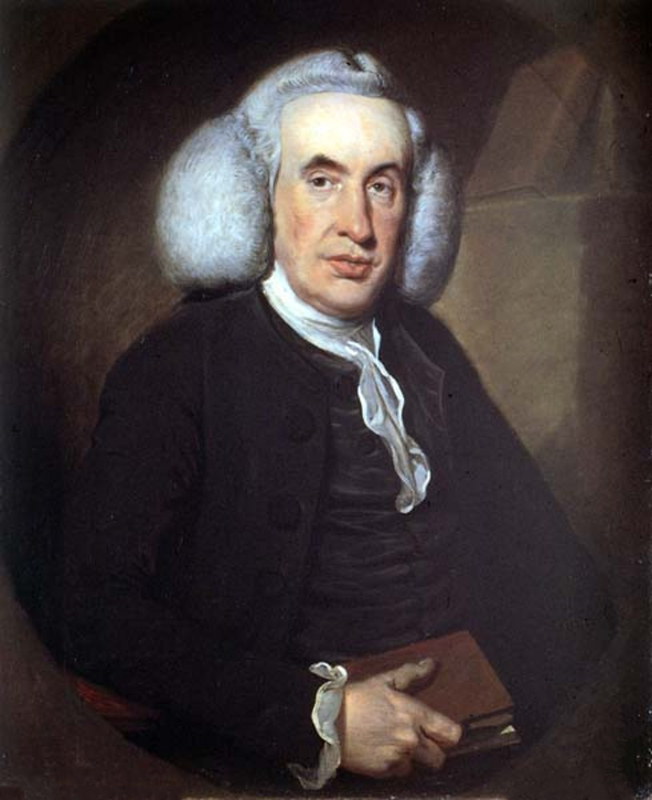
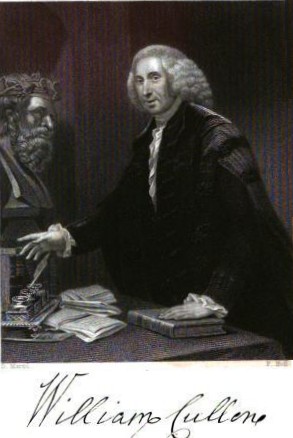
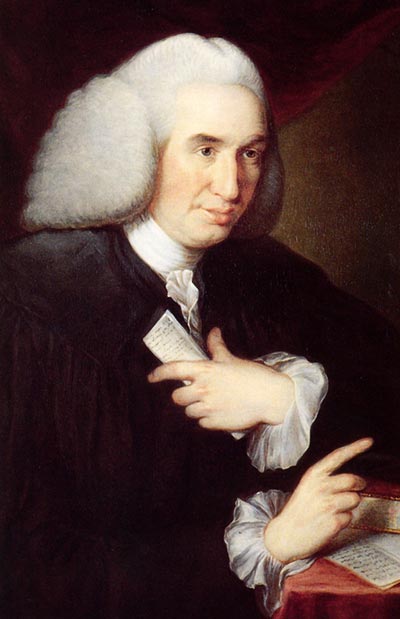
Today is the birthday of William Cullen (April 15, 1710-February 5, 1790). He “was a Scottish physician, chemist and agriculturalist, and one of the most important professors at the Edinburgh Medical School, during its hay-day as the leading center of medical education in the English-speaking world.

Cullen was also a central figure in the Scottish Enlightenment. He was David Hume’s physician and friend, and on intimate terms with Adam Smith, Lord Kames (with whom he discussed theoretical and practical aspects of husbandry), Joseph Black, John Millar, and Adam Ferguson, among others.

He was President of the Royal College of Physicians and Surgeons of Glasgow (1746–47), President of the Royal College of Physicians of Edinburgh (1773–1775) and First Physician to the King in Scotland (1773–1790). He was also, incidentally, one of the prime movers in obtaining a royal charter for the Philosophical Society of Edinburgh, resulting in the formation of the Royal Society of Edinburgh in 1783.”

Cullen extended the subject of chemistry beyond medicine by connecting it to many “arts” including agriculture, bleaching, brewing, mining, and the manufacture of vinegar and alkalies. In brewing, it was the very important need for cooling using artificial refrigeration where William Cullen at the University of Glasgow in 1748 made his impact, making advances crucial to the development of refrigeration for the brewing industry when he began studying the cooling effects of liquids evaporating in a vacuum, the process by which we cool foods today. He even demonstrated artificial refrigeration for the first time in 1748.

William_Cullen

In the Brussels Journal, in a multi-part history of beer, Cullen’s contributions are acknowledged and explained:

The principle of vacuum refrigerators is based on the fact that water in a sealed container can be made to boil if the pressure is reduced (the “boiling point” of 100 degrees Celsius refers to the situation when the external pressure equals one atmosphere; water can be made to boil at lower temperatures on a mountain top). The heat necessary for evaporation is taken from the water itself. Reducing the pressure further lowers the temperature until freezing-point is reached and ice is formed. The Scottish scholar and chemist William Cullen (1710-1790) gave one of the first documented public demonstrations of artificial refrigeration, and the United States inventor Oliver Evans (1755-1819) designed, but did not build, a refrigeration machine which ran on vapor in 1805. I. Hornsey writes in his history of beer and brewing:

“The earliest machine of this type was constructed in 1755, by Dr William Cullen, who produced the vacuum necessary purely by means of a pump. Then, in 1810, Sir John Leslie combined a vessel containing a strong sulphuric acid solution along with the air pump, the acid acting as an absorbent for water vapour in the air. This principle was taken up and elaborated upon by E.C. Carré, who in 1860 invented a machine that used ammonia as the volatile liquid instead of water….The first compression machine was manufactured by John Hague in 1834, from designs by the inventor, Jacob Perkins, who took out the original patents, and recommended that ether was used as the volatile agent. Although Hague’s machine can be regarded as the archetype for all ‘modern’ refrigerators, it never really got past the development stage, and it was left to the Australian, James Harrison, of Geelong, Victoria, to finalise the practicalities and produce a working version, which he did in 1856. By 1859, Harrison’s equipment was being manufactured commercially in New South Wales, and the first of them (which used ether as the refrigerating agent) came to Britain in 1861.”

Cullen_William

Although the first inventor of a practical refrigerator was Oliver Evans in 1805, Cullen invented the process in 1748 which allowed the technology to be further developed. After his public demonstration of the refrigeration effects of evaporative cooling, he described the phenomenon in “Of the Cold Produced by Evaporating Fluids and of Some Other Means of Producing Cold” (Essays and Observations, Physical and Literary, vol. 2 [1756]).

cullen-portrait

Filed Under: Birthdays, Breweries, Just For Fun, Related Pleasures Tagged With: Brewing Equipment, History, Science of Brewing, Scotland

Beer In Ads #4940: Christian Moerlein Bock Beer

April 14, 2025 By Jay Brooks

Last year I decided to concentrate on Bock ads. Bock, of course, may have originated in Germany, in the town of Einbeck. Because many 19th century American breweries were founded by German immigrants, they offered a bock at certain times of the year, be it Spring, Easter, Lent, Christmas, or what have you. In a sense they were some of the first seasonal beers. “The style was later adopted in Bavaria by Munich brewers in the 17th century. Due to their Bavarian accent, citizens of Munich pronounced ‘Einbeck’ as ‘ein Bock’ (a billy goat), and thus the beer became known as ‘Bock.’ A goat often appears on bottle labels.” And presumably because they were special releases, many breweries went all out promoting them with beautiful artwork on posters and other advertising.

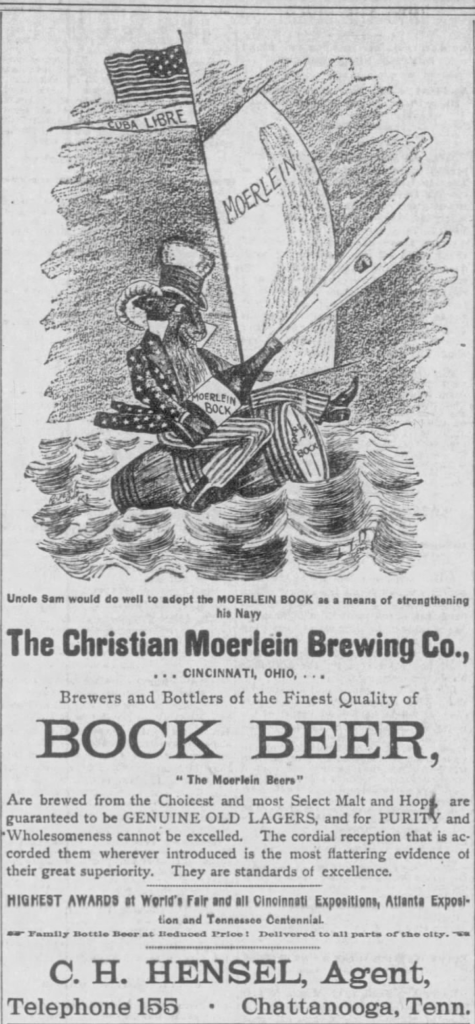
Monday’s ad is for Christian Moerlein Bock Beer and was published April 14, 1898. The brewery was the Christian Moerlein Brewing, of Cincinnati, Ohio, which was originally founded in 1887. This ad ran in the Chattanooga Daily Times, of Chattanooga, Tennessee. The cartoon is pretty hilarious, but especially with the text below it: “Uncle Sam would do well to adopt MOERLEIN BOCK as a means of strengthening his Navy.

Filed Under: Art & Beer, Beers, Breweries, Just For Fun Tagged With: Advertising, Bock, History, Ohio, Tennessee

Historic Beer Birthday: George Schmitt

April 14, 2025 By Jay Brooks

new_york
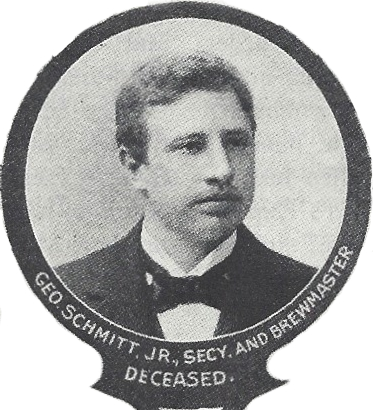
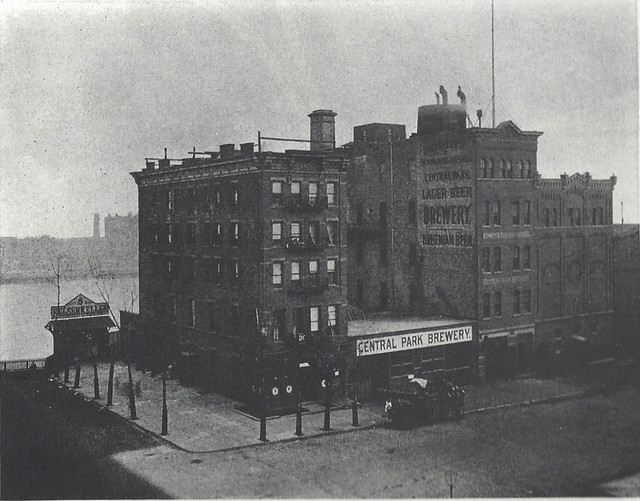
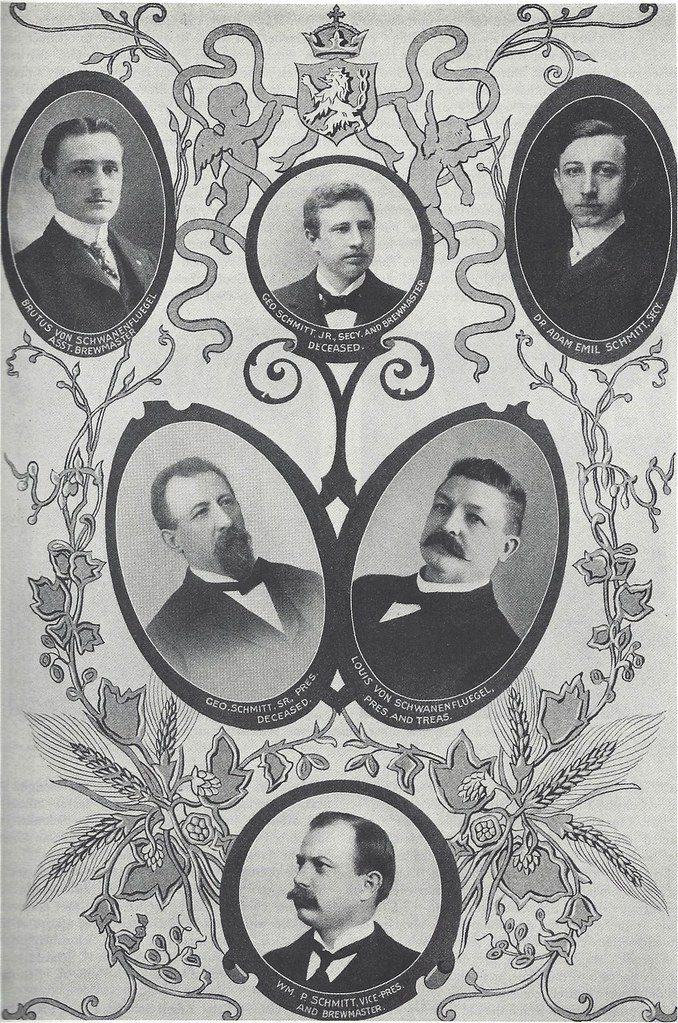
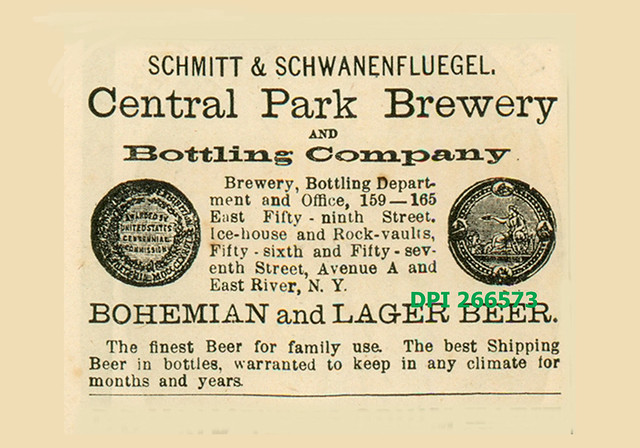
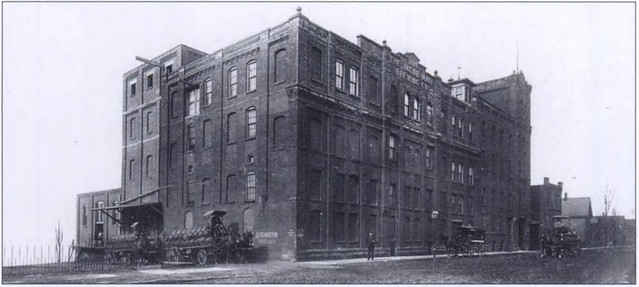
Today is the birthday of George Schmitt (April 14, 1869-July 31, 1898). There’s very little about him that I could find, though I suspect the fact that he died when he was only 29 might have something to do with that. He was trained as a brewer at his father’s brewery, worked at a malt house, and became the manager of Schmitt & Schwanenfluegel Brewery, which was in New York City, near Central Park at 1065 Avenue A, between 56th & 57th.

George-Schmitt-jr

Extra-Bohemian-Beer-Foam-Scrapers-Schmitt-and-Schwanenfluegel

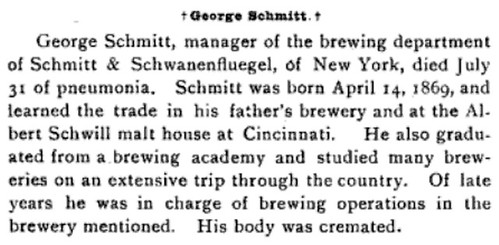
This short obituary was printed in the American Brewers’ Review:

george-schmitt-obit

Schmitt-and-Schwanenfluegel-brewery

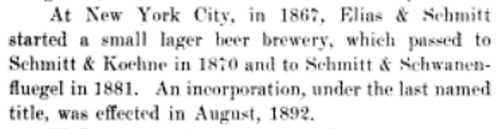
The brewery was originally known as the Henry Elias Brewery, who founded it near 15th Street & Broadway in 1855. Elias, in 1865, partnered with George Schmitt, this George’s father, and became known as Henry Elias & George Schmitt Brewery, a.k.a. the Central Park Brewery (and was readdressed to 1065 Avenue A, between 56th & 57th). In 1868, Schmitt partnered with Christian Koehne to keep it going and it became the Schmitt & Christian Koehne Brewery. Then in 1885, Koehne left and Louis Von Schwanenfluegel came to the business and it became known as Schmitt & Schwanenfluegel Brewery, which it remained until it closed in 1906. During that time it was also known as Consumers Park Brewing Co. and also Central Park Brewery.
Schmitt-and-Schwanenfluegel

According to 100 Years of Brewing, the chronology is slightly different:

schmitt-100yrs

schmitt-schwan

Filed Under: Birthdays, Breweries, Just For Fun Tagged With: History, New York

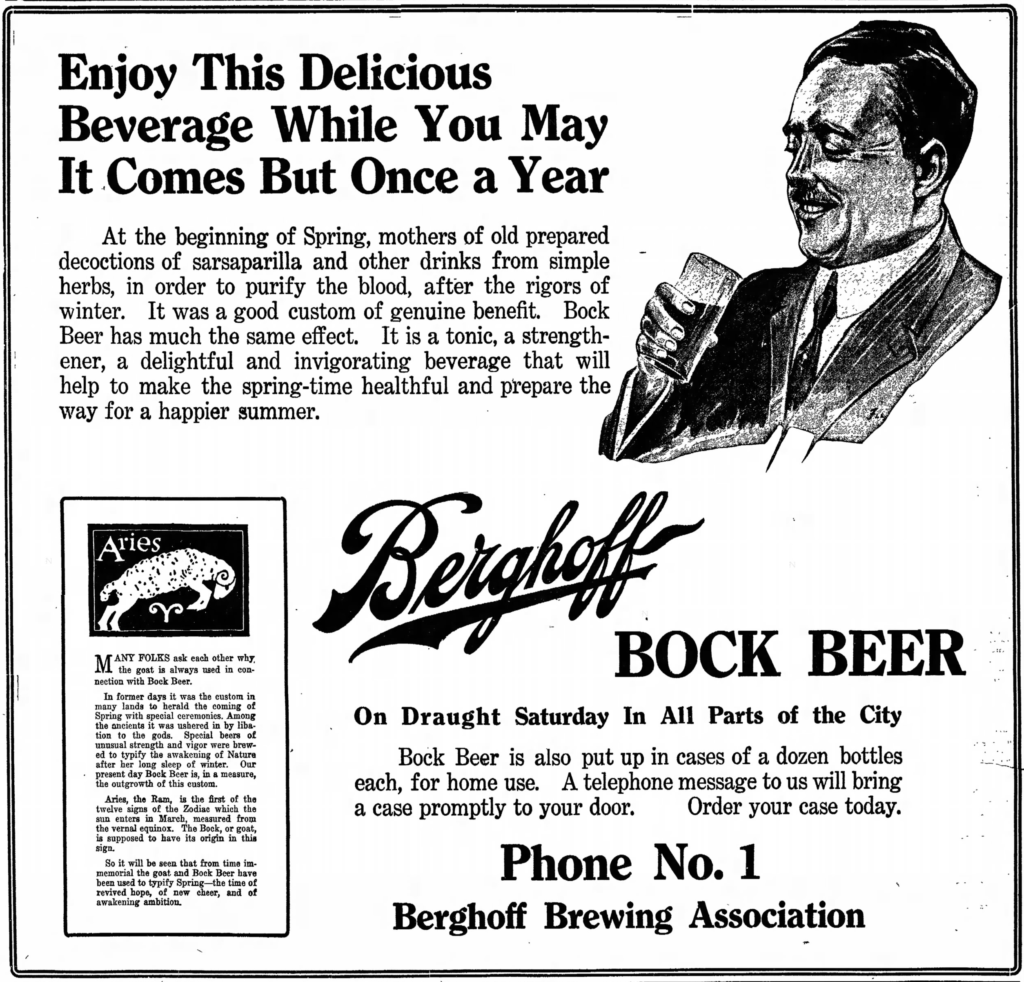
Beer In Ads #4939: Enjoy This Delicious Beverage While You Can

April 13, 2025 By Jay Brooks

Last year I decided to concentrate on Bock ads. Bock, of course, may have originated in Germany, in the town of Einbeck. Because many 19th century American breweries were founded by German immigrants, they offered a bock at certain times of the year, be it Spring, Easter, Lent, Christmas, or what have you. In a sense they were some of the first seasonal beers. “The style was later adopted in Bavaria by Munich brewers in the 17th century. Due to their Bavarian accent, citizens of Munich pronounced ‘Einbeck’ as ‘ein Bock’ (a billy goat), and thus the beer became known as ‘Bock.’ A goat often appears on bottle labels.” And presumably because they were special releases, many breweries went all out promoting them with beautiful artwork on posters and other advertising.

Sunday’s ad is for Berghoff Bock Beer and was published April 13, 1916. The brewery was the Berghoff Brewing Association, of Fort Wayne, Indiana, which was originally founded in 1887. This ad ran in the Fort Wayne News, of, naturally, Fort Wayne, Indiana. It’s hilarious that in 1916 the brewery’s phone number is “1.”

Filed Under: Art & Beer, Beers, Breweries, Just For Fun Tagged With: Advertising, Bock, History

Historic Beer Birthday: George Gund II

April 13, 2025 By Jay Brooks

gunds
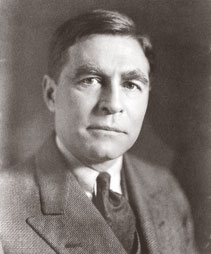
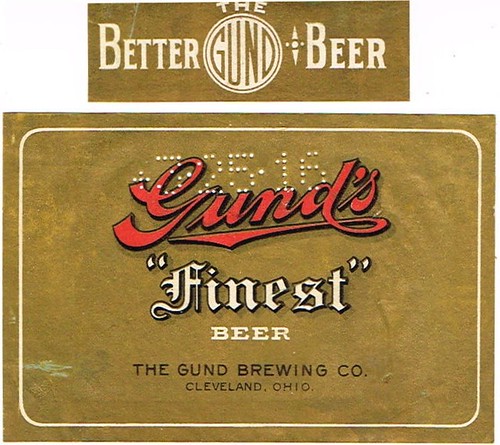
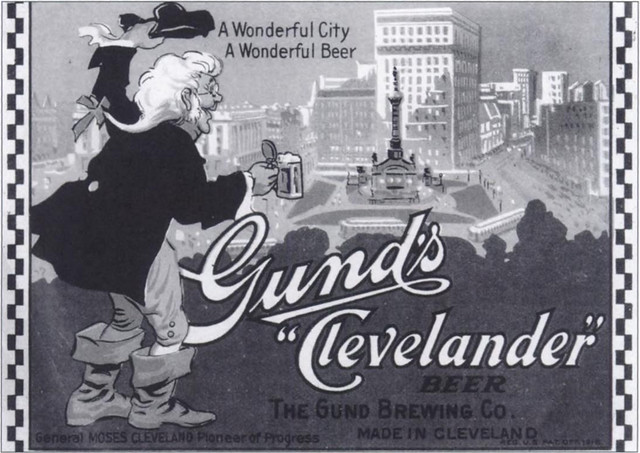
Today is the birthday of George Gund II (April 13, 1888-November 15, 1966). He was the son of George F. Gund and the grandson of John Gund, the founder of John Gund Brewing, of La Crosse, Wisconsin, and the brother of Henry Gund and John Gund Jr., who founded Lexington Brewing, in Lexington, Kentucky. George Frederick Gund founded Gund Brewing Co., of Cleveland, Ohio. Despite the brewing heritage, Gund II “was an American banker, business executive, and real estate investor who lived in Cleveland, Ohio in the early and middle part of the 20th century. Heir to the George Frederick Gund brewing and banking fortune, he was a philanthropist for most of his life. He established The George Gund Foundation in 1952 and endowed it with most of his $600 million fortune at his death.”

george-gund-headshot

Here’s his biography from Wikipedia:

Gund’s grandfather, Johann Gund, was born in 1830 in Brühl am Rhein in the independent country of the Grand Duchy of Baden (now part of Germany). The family emigrated to the United States in 1848 and settled in Illinois, but in 1854 moved to La Crosse, Wisconsin. There his grandfather founded the John Gund Brewery. His father, George Frederick Gund, was born in LaCrosse in 1856 and later managed the Gund Brewery. His father moved to Seattle, Washington, founded the Seattle Brewing and Malting Company, became a director of two banks, and then returned to the Midwest to move his family to Cleveland in 1897. His father bought the Jacob Mall Brewing Company, renamed it the Gund Brewing Company, and made a large fortune investing in banking, mining, and real estate.

George Gund, Jr. (as he was then known) was born to George Frederick and Anna Louise (Metzger) Gund on April 13, 1888. He was a student at the University School of Cleveland from 1897 to 1905. He entered Harvard University, and received his A.B. in 1909. Toward the end of his Harvard education, he simultaneously enrolled in the Harvard Business School, and graduated in the school’s first class in 1909. He moved to Seattle and took a job as a clerk with the Seattle First National Bank, but moved back to Cleveland when his father died in 1916. But when World War I broke out, he enlisted in the United States Army and served in the Military Intelligence Division.

gund-brewery-ohio
The Jacob Mall Brewing Co. when George Gund bought it in 1897.

After the start of prohibition in the United States in 1920, Gund was forced to close his father’s brewery in Cleveland. But during the war, Kaffee HAG, a German corporation, was stripped of its assets in the United States. Among its subsidiaries was Sanka, the company which manufactured decaffeinated coffee. Gund purchased Sanka in 1919, then sold it to Kellogg’s in 1927 for $10 million in stock. Gund also took over management of the Gund Realty Company in Cleveland and invested his money in numerous ventures. During the depths of the Great Depression, he purchased large amounts of stock at very low prices.

Gund studied animal husbandry at Iowa State University from 1922 to 1923. He made many trips to California and Nevada, often staying there for many months at a time, and became interested in a possible political career in Nevada. He purchased a large cattle ranch in Nevada, but on May 23, 1936, he married Jessica Laidlaw Roesler. She was the granddaughter of Henry Bedell Laidlaw, the founder of one of the first investment banking houses in New York City, Laidlaw & Company. Gund purchased a large home in Beachwood, a wealthy suburb of Cleveland, and the couple had six children: George III, Agnes, Gordon, Graham, Geoffrey, and Louise.

In 1937, Gund was elected a director of the Cleveland Trust Company (a savings bank established in 1896), and was named president in 1941. He was made chairman of the board of trustees in 1962. Under Gund’s leadership, by 1967 the bank had more than $2 billion in assets, making it the 18th largest bank in the United States. Gund also served on the board of directors of another 30 national and multinational corporations. But despite the urban nature of his work, Gund never lost his affection for the Old West. He used his income to collect a large number of works of art which depicted the American West, including works by Albert Bierstadt, Frederic Remington, and Charles Marion Russell.

George Gund died of leukemia at the Cleveland Clinic on November 15, 1966. He was interred at Lake View Cemetery in Cleveland.

His foundation also has a nice biography of him.

gunds-clevelander

Gunds--quot-Finest-quot--Beer-Labels-Gund-Brewing-Co

Filed Under: Birthdays, Just For Fun Tagged With: History, Wisconsin

Historic Beer Birthday: Joseph Bramah

April 13, 2025 By Jay Brooks

handpump
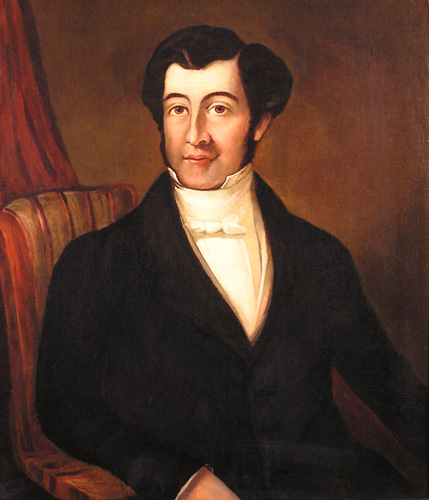
Today is the birthday of Joseph Bramah (April 13, 1748-December 9, 1814). Bramah was an English engineer, and inventor, whose most famous invention was the hydraulic press. But he also made improvements and created a practical beer engine, creating his beer pump and engine inventions between 1785 and 1797.

Joseph Bramah- portrait in oils

Another summary of his achievements is quite flattering:

English engineer and inventor whose lock manufacturing shop was the cradle of the British machine-tool industry. Central in early Victorian lockmaking and manufacturing, he influenced almost every mechanical trade of the time. Like Henry Ford, his influence was probably greater for the manufacturing processes he developed, than the product itself. He took out his first patent on a safety lock (1784) and in 1795 he patented his hydraulic press, known as the Bramah press, used for heavy forging. He devised a numerical printing machine for bank notes and was one of the first to suggest the practicability of screw propellers and of hydraulic transmission. He invented milling and planing machines and other machine tools, a beer-engine (1797), and a water-closet.

As for the actual patents, there were two of them. The first was in 1785 and was for what he called a “beer pump.” Then, in 1793 he was granted Patent No. 2196 for his improved version, now referred to as a “beer engine.” It was actually a Dutchman, John Lofting, who had first invented the beer pump in 1688, but Bramah’s were more refined and practical, and more importantly, patented. Curiously, Grace’s Guide to British Industrial History lists the patent dates as 1787 and 1797, so it’s unclear which are the correct dates.

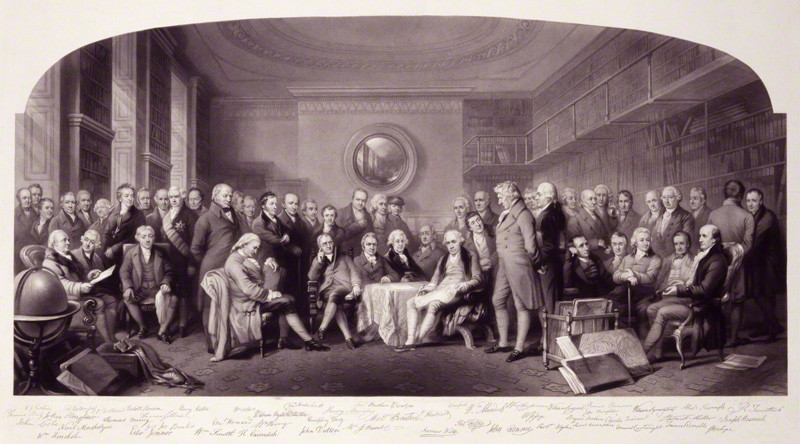
In this engraving, entitled Men of Science Living in 1807-8, Bramah is on the left side, the tenth one in the back from the left. He’s the one with the wide sash across his chest and the star-shaped badge on his jacket. Others include Joseph Banks, Henry Cavendish and James Watt.

NPG 1075a; Engraving after 'Men of Science Living in 1807-8'

There’s even a J.D. Wetherspoon’s pub in his home town of Bramley called The Joseph Bramah

joseph-bramah-pub-3

Filed Under: Birthdays, Just For Fun, Politics & Law, Related Pleasures Tagged With: Cask, England, Great Britain, History

« Previous Page
Next Page »

Find Something

Northern California Breweries

Please consider purchasing my latest book, California Breweries North, available from Amazon, or ask for it at your local bookstore.

Recent Comments

  • Bob Paolino on Beer Birthday: Grant Johnston
  • Gambrinus on Historic Beer Birthday: A.J. Houghton
  • Ernie Dewing on Historic Beer Birthday: Charles William Bergner 
  • Steve 'Pudgy' De Rose on Historic Beer Birthday: Jacob Schmidt
  • Jay Brooks on Beer Birthday: Bill Owens

Recent Posts

  • Beer In Ads #5138: Flower City Bock Beer March 1, 2026
  • Historic Beer Birthday: Regina Wauters March 1, 2026
  • Historic Beer Birthday: Danny Williams March 1, 2026
  • Historic Beer Birthday: Charles Weyand March 1, 2026
  • Beer In Ads #5137: Bock Is Back… Look For It March 1st February 28, 2026

BBB Archives

Feedback

Head Quarter
This site is hosted and maintained by H25Q.dev. Any questions or comments for the webmaster can be directed here.