Brookston Beer Bulletin

Jay R. Brooks on Beer

  • Home
  • About
  • Editorial
  • Birthdays
  • Art & Beer

Socialize

  • Dribbble
  • Email
  • Facebook
  • Flickr
  • GitHub
  • Instagram
  • LinkedIn
  • Pinterest
  • RSS
  • Twitter
  • YouTube

Powered by Genesis

Historic Beer Birthday: George Gund II

April 13, 2025 By Jay Brooks

gunds
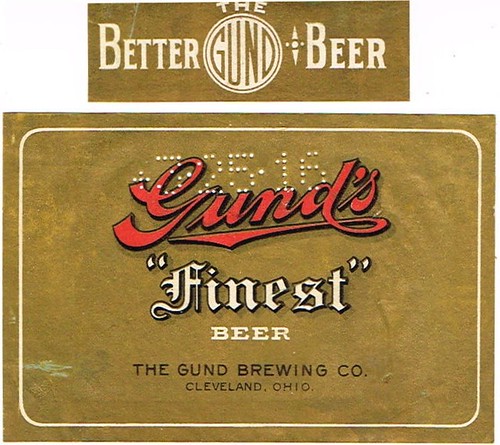
Today is the birthday of George Gund II (April 13, 1888-November 15, 1966). He was the son of George F. Gund and the grandson of John Gund, the founder of John Gund Brewing, of La Crosse, Wisconsin, and the brother of Henry Gund and John Gund Jr., who founded Lexington Brewing, in Lexington, Kentucky. George Frederick Gund founded Gund Brewing Co., of Cleveland, Ohio. Despite the brewing heritage, Gund II “was an American banker, business executive, and real estate investor who lived in Cleveland, Ohio in the early and middle part of the 20th century. Heir to the George Frederick Gund brewing and banking fortune, he was a philanthropist for most of his life. He established The George Gund Foundation in 1952 and endowed it with most of his $600 million fortune at his death.”
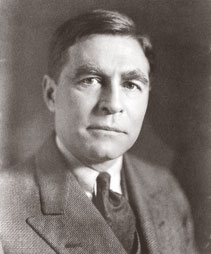
george-gund-headshot

Here’s his biography from Wikipedia:

Gund’s grandfather, Johann Gund, was born in 1830 in Brühl am Rhein in the independent country of the Grand Duchy of Baden (now part of Germany). The family emigrated to the United States in 1848 and settled in Illinois, but in 1854 moved to La Crosse, Wisconsin. There his grandfather founded the John Gund Brewery. His father, George Frederick Gund, was born in LaCrosse in 1856 and later managed the Gund Brewery. His father moved to Seattle, Washington, founded the Seattle Brewing and Malting Company, became a director of two banks, and then returned to the Midwest to move his family to Cleveland in 1897. His father bought the Jacob Mall Brewing Company, renamed it the Gund Brewing Company, and made a large fortune investing in banking, mining, and real estate.

George Gund, Jr. (as he was then known) was born to George Frederick and Anna Louise (Metzger) Gund on April 13, 1888. He was a student at the University School of Cleveland from 1897 to 1905. He entered Harvard University, and received his A.B. in 1909. Toward the end of his Harvard education, he simultaneously enrolled in the Harvard Business School, and graduated in the school’s first class in 1909. He moved to Seattle and took a job as a clerk with the Seattle First National Bank, but moved back to Cleveland when his father died in 1916. But when World War I broke out, he enlisted in the United States Army and served in the Military Intelligence Division.
gund-brewery-ohio
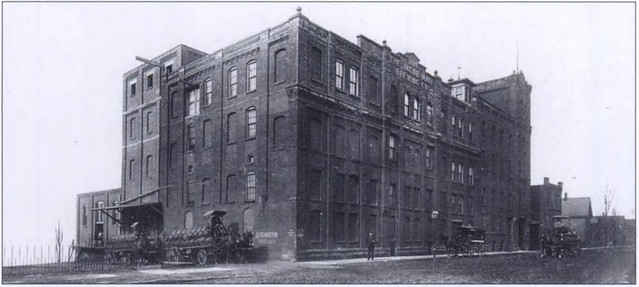
The Jacob Mall Brewing Co. when George Gund bought it in 1897.

After the start of prohibition in the United States in 1920, Gund was forced to close his father’s brewery in Cleveland. But during the war, Kaffee HAG, a German corporation, was stripped of its assets in the United States. Among its subsidiaries was Sanka, the company which manufactured decaffeinated coffee. Gund purchased Sanka in 1919, then sold it to Kellogg’s in 1927 for $10 million in stock. Gund also took over management of the Gund Realty Company in Cleveland and invested his money in numerous ventures. During the depths of the Great Depression, he purchased large amounts of stock at very low prices.

Gund studied animal husbandry at Iowa State University from 1922 to 1923. He made many trips to California and Nevada, often staying there for many months at a time, and became interested in a possible political career in Nevada. He purchased a large cattle ranch in Nevada, but on May 23, 1936, he married Jessica Laidlaw Roesler. She was the granddaughter of Henry Bedell Laidlaw, the founder of one of the first investment banking houses in New York City, Laidlaw & Company. Gund purchased a large home in Beachwood, a wealthy suburb of Cleveland, and the couple had six children: George III, Agnes, Gordon, Graham, Geoffrey, and Louise.

In 1937, Gund was elected a director of the Cleveland Trust Company (a savings bank established in 1896), and was named president in 1941. He was made chairman of the board of trustees in 1962. Under Gund’s leadership, by 1967 the bank had more than $2 billion in assets, making it the 18th largest bank in the United States. Gund also served on the board of directors of another 30 national and multinational corporations. But despite the urban nature of his work, Gund never lost his affection for the Old West. He used his income to collect a large number of works of art which depicted the American West, including works by Albert Bierstadt, Frederic Remington, and Charles Marion Russell.

George Gund died of leukemia at the Cleveland Clinic on November 15, 1966. He was interred at Lake View Cemetery in Cleveland.

His foundation also has a nice biography of him.
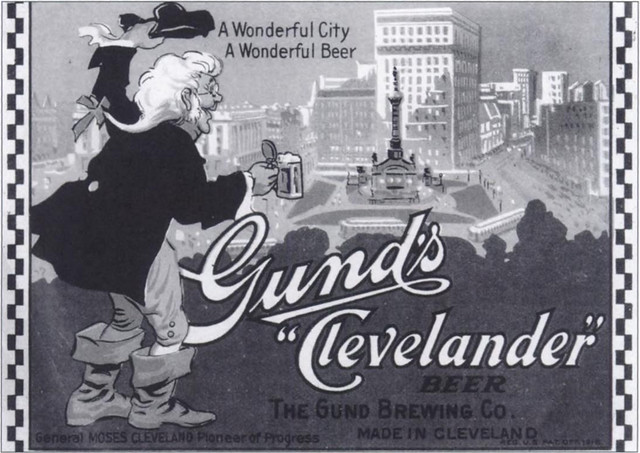
gunds-clevelander

Gunds--quot-Finest-quot--Beer-Labels-Gund-Brewing-Co

Filed Under: Birthdays, Just For Fun Tagged With: History, Wisconsin

Historic Beer Birthday: Joseph Bramah

April 13, 2025 By Jay Brooks

handpump
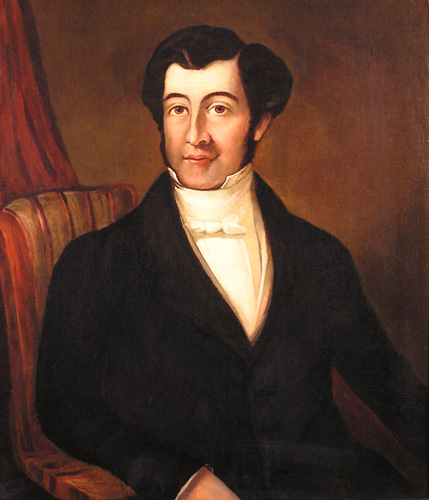
Today is the birthday of Joseph Bramah (April 13, 1748-December 9, 1814). Bramah was an English engineer, and inventor, whose most famous invention was the hydraulic press. But he also made improvements and created a practical beer engine, creating his beer pump and engine inventions between 1785 and 1797.

Joseph Bramah- portrait in oils

Another summary of his achievements is quite flattering:

English engineer and inventor whose lock manufacturing shop was the cradle of the British machine-tool industry. Central in early Victorian lockmaking and manufacturing, he influenced almost every mechanical trade of the time. Like Henry Ford, his influence was probably greater for the manufacturing processes he developed, than the product itself. He took out his first patent on a safety lock (1784) and in 1795 he patented his hydraulic press, known as the Bramah press, used for heavy forging. He devised a numerical printing machine for bank notes and was one of the first to suggest the practicability of screw propellers and of hydraulic transmission. He invented milling and planing machines and other machine tools, a beer-engine (1797), and a water-closet.

As for the actual patents, there were two of them. The first was in 1785 and was for what he called a “beer pump.” Then, in 1793 he was granted Patent No. 2196 for his improved version, now referred to as a “beer engine.” It was actually a Dutchman, John Lofting, who had first invented the beer pump in 1688, but Bramah’s were more refined and practical, and more importantly, patented. Curiously, Grace’s Guide to British Industrial History lists the patent dates as 1787 and 1797, so it’s unclear which are the correct dates.
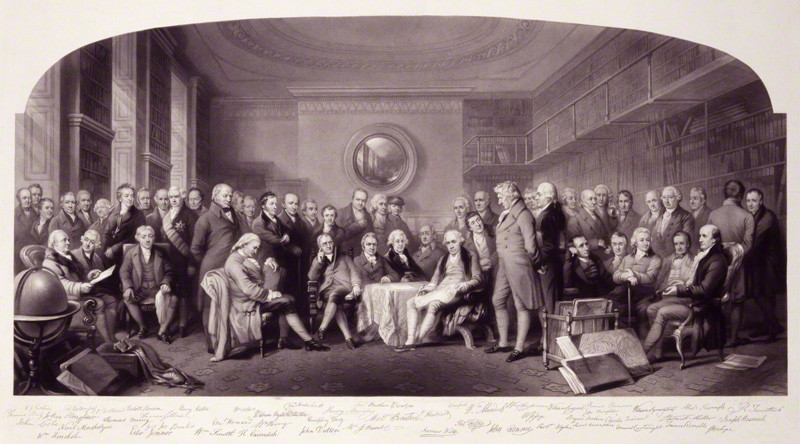
In this engraving, entitled Men of Science Living in 1807-8, Bramah is on the left side, the tenth one in the back from the left. He’s the one with the wide sash across his chest and the star-shaped badge on his jacket. Others include Joseph Banks, Henry Cavendish and James Watt.

NPG 1075a; Engraving after 'Men of Science Living in 1807-8'

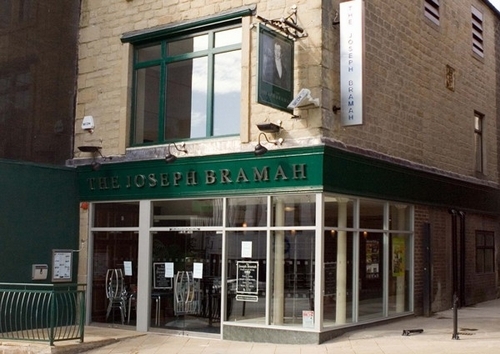
There’s even a J.D. Wetherspoon’s pub in his home town of Bramley called The Joseph Bramah

joseph-bramah-pub-3

Filed Under: Birthdays, Just For Fun, Politics & Law, Related Pleasures Tagged With: Cask, England, Great Britain, History

Beer In Ads #4938: Moerschel’s Bock Beer, The King Of All Beers

April 12, 2025 By Jay Brooks

Last year I decided to concentrate on Bock ads. Bock, of course, may have originated in Germany, in the town of Einbeck. Because many 19th century American breweries were founded by German immigrants, they offered a bock at certain times of the year, be it Spring, Easter, Lent, Christmas, or what have you. In a sense they were some of the first seasonal beers. “The style was later adopted in Bavaria by Munich brewers in the 17th century. Due to their Bavarian accent, citizens of Munich pronounced ‘Einbeck’ as ‘ein Bock’ (a billy goat), and thus the beer became known as ‘Bock.’ A goat often appears on bottle labels.” And presumably because they were special releases, many breweries went all out promoting them with beautiful artwork on posters and other advertising.

Friday’s ad is for Moerschel’s Bock Beer and was published April 12, 1901. The brewery was the Capitol Brewery Co., of Jefferson City, Missouri, which was originally founded in 1845 as the Joe Kessler Brewery. This ad ran in the Republican Review.

Filed Under: Art & Beer, Beers, Breweries, Just For Fun Tagged With: Advertising, Bock, History, Missouri

Beer In Ads #4937: Gambrinus Bock Is Back

April 11, 2025 By Jay Brooks

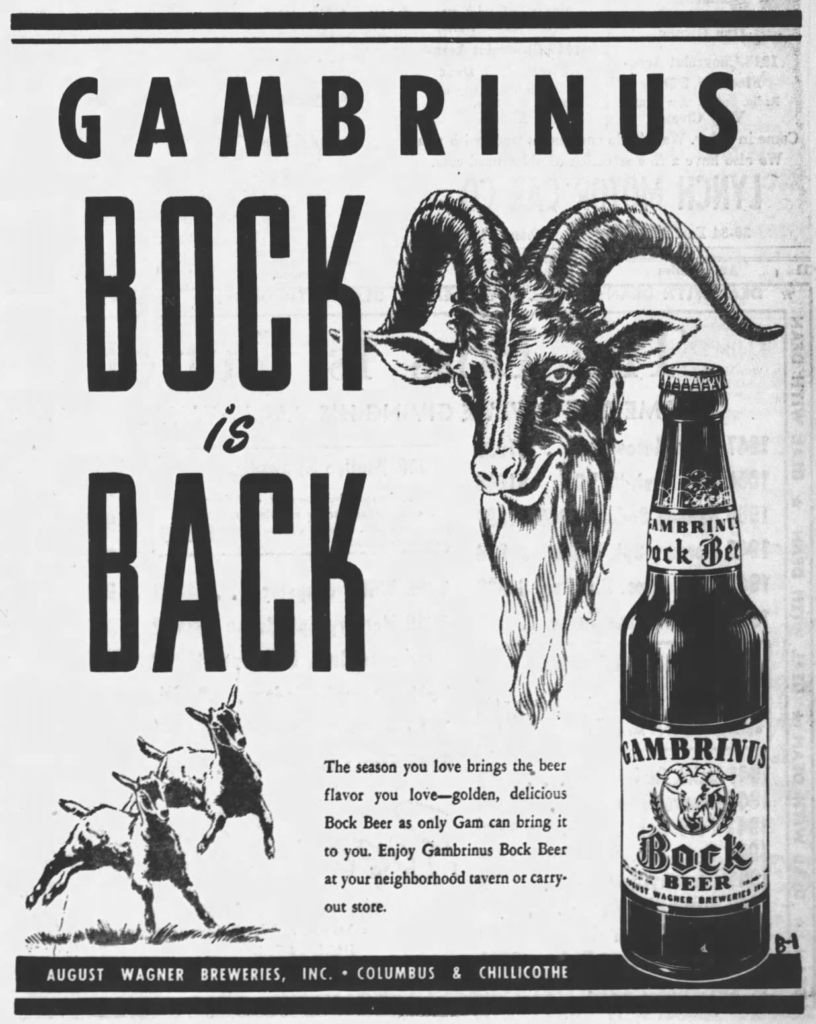
Last year I decided to concentrate on Bock ads. Bock, of course, may have originated in Germany, in the town of Einbeck. Because many 19th century American breweries were founded by German immigrants, they offered a bock at certain times of the year, be it Spring, Easter, Lent, Christmas, or what have you. In a sense they were some of the first seasonal beers. “The style was later adopted in Bavaria by Munich brewers in the 17th century. Due to their Bavarian accent, citizens of Munich pronounced ‘Einbeck’ as ‘ein Bock’ (a billy goat), and thus the beer became known as ‘Bock.’ A goat often appears on bottle labels.” And presumably because they were special releases, many breweries went all out promoting them with beautiful artwork on posters and other advertising.

Thursday’s ad is for Gambrinus Bock Beer and was published in 1951. The brewery was August Wagner Breweries, of Columbus, Ohio, which was originally founded in 1870. This ad ran in the Chillicothe Gazette, Ohio’s oldest newspaper, which was first published in 1793.

Filed Under: Art & Beer, Beers, Breweries, Just For Fun Tagged With: Advertising, Bock, History

Beer In Ads #4936: Rheingold Bock Beer

April 10, 2025 By Jay Brooks

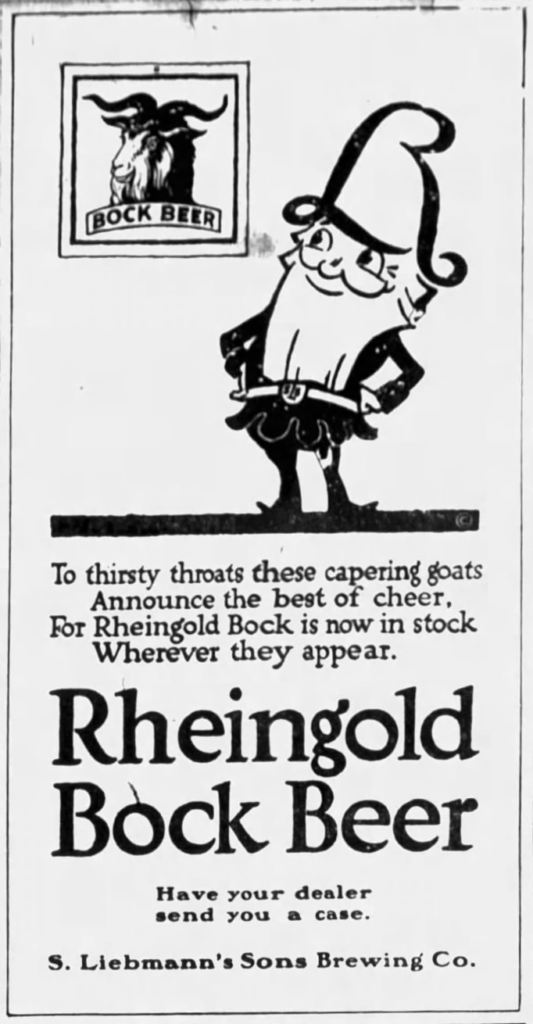
Last year I decided to concentrate on Bock ads. Bock, of course, originated in Germany, in the town of Einbeck. Because many 19th century American breweries were founded by German immigrants, they offered a bock at certain times of the year, be it Spring, Easter, Lent, Christmas, or what have you. In a sense they were some of the first seasonal beers. “The style was later adopted in Bavaria by Munich brewers in the 17th century. Due to their Bavarian accent, citizens of Munich pronounced ‘Einbeck’ as ‘ein Bock’ (a billy goat), and thus the beer became known as ‘Bock.’ A goat often appears on bottle labels.” And presumably because they were special releases, many breweries went all out promoting them with beautiful artwork on posters and other advertising.

Thursday’s ad is for Rheingold Bock Beer and was published April 10, 1916. The brewery was S. Liebmann’s Sons Brewing Co., a.k.a. as the Rheingold Brewery, of New York, New York, which was originally founded in 1870. This ad ran in The Brooklyn Citizen, of Brooklyn, New York. I do love the poem that’s a part of the ad:

To thirsty throats these capering goats
Announce the best of cheer
For Rheingold Bock is now in stock
Wherever they appear.

Filed Under: Art & Beer, Beers, Breweries, Just For Fun Tagged With: Advertising, Bock, History, New York

Beer In Ads #4935: Steinle’s Bock Beer

April 9, 2025 By Jay Brooks

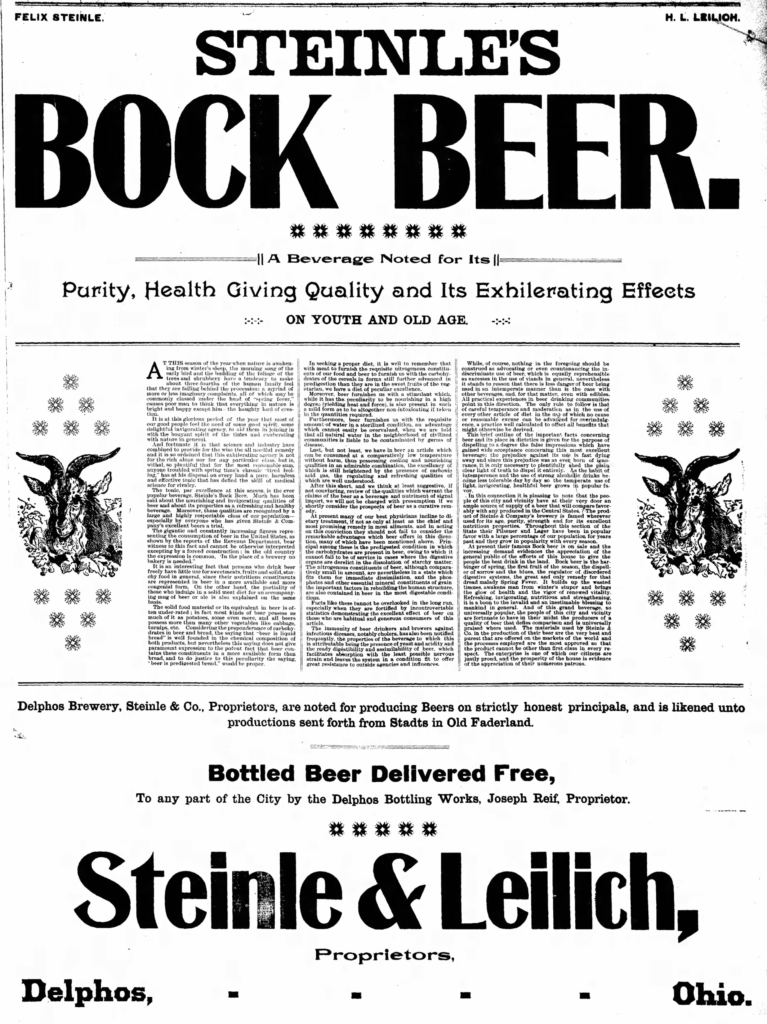
Last year I decided to concentrate on Bock ads. Bock, of course, originated in Germany, in the town of Einbeck. Because many 19th century American breweries were founded by German immigrants, they offered a bock at certain times of the year, be it Spring, Easter, Lent, Christmas, or what have you. In a sense they were some of the first seasonal beers. “The style was later adopted in Bavaria by Munich brewers in the 17th century. Due to their Bavarian accent, citizens of Munich pronounced ‘Einbeck’ as ‘ein Bock’ (a billy goat), and thus the beer became known as ‘Bock.’ A goat often appears on bottle labels.” And presumably because they were special releases, many breweries went all out promoting them with beautiful artwork on posters and other advertising.

Wednesday’s ad is for Steinle’s Bock Beer and was published April 9, 1898. The brewery was the Delphos Brewery, a.k.a. Steinle & Co. of Delphos, Ohio, which was originally founded in 1858. This ad ran in The Daily Herald, of Delphos, Ohio, with the tagline: “Steinle’s Bock Beer.”

Filed Under: Art & Beer, Beers, Breweries, Just For Fun Tagged With: Advertising, Bock, History, Ohio

Historic Beer Birthday: Otto Schinkel Jr.

April 9, 2025 By Jay Brooks

anchor-retro
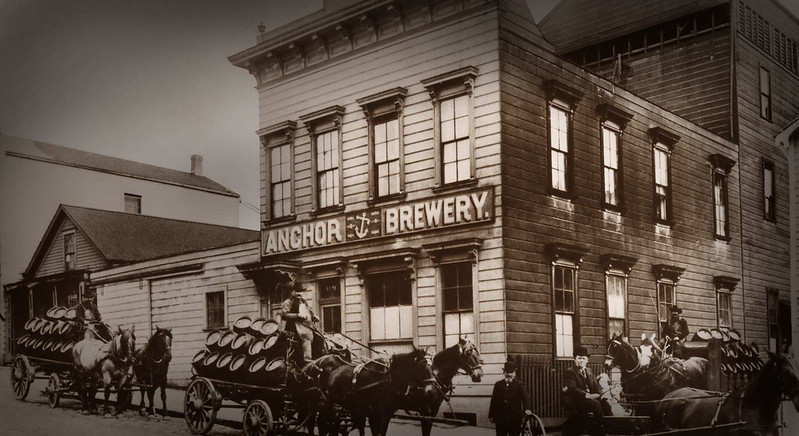
Today is the birthday of Otto Schinkel Jr. (April 9, 1869-January 26, 1907). While Anchor Brewing began during the California Gold Rush when Gottlieb Brekle arrived from Germany and began brewing in San Francisco, it didn’t become known as Anchor Brewing until 1896, when “Ernst F. Baruth and his son-in-law, Otto Schinkel, Jr., bought the old brewery on Pacific Avenue and named it Anchor. The brewery burned down in the fires that followed the 1906 earthquake, but was rebuilt at a different location in 1907.” Baruth had passed away the same year as the earthquake, and Schinkel died in an accident in early 1907 when struck by a streetcar in San Francisco.

Surprisingly, there isn’t much biographical information about Schinkel. He was born somewhere in Germany, and married Ida Caroline Baruth on November 26, 1890. She was born in California, sometime in July of 1873. They had three children together, all daughters: Elsie, Alice and Doris.

otto-schinkel

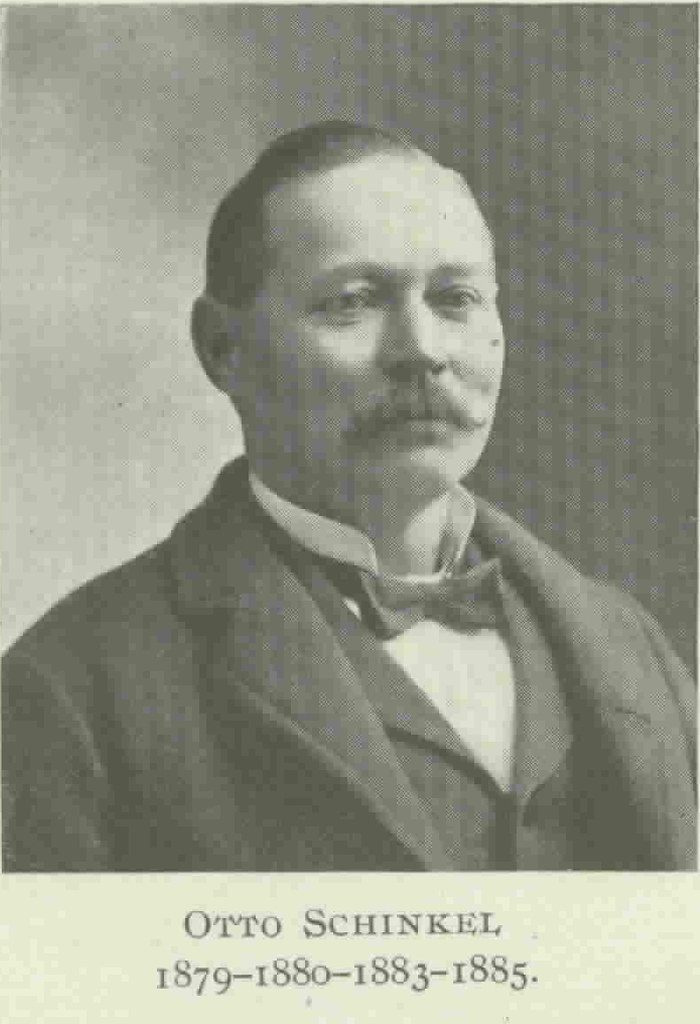
I did discover that he was a president of the Norddeutscher Verein (or North German Association) four times as noted in this portrait from a book celebrating the organization’s 25th anniversary, or Silver Anniversary 1874-1899.

anchor-brewery-early-1900s-lg
The Anchor Brewery in the early 1900s.

Here’s what’s written about him at Find a Grave:

Anchor Beer began during the Gold Rush when Gottlieb Brekle arrived from Germany and began brewing in San Francisco. In 1896, Ernst F. Baruth and his son-in-law, Otto Schinkel, Jr., bought the brewery and named it Anchor. The brewery burned down in the fires that followed the 1906 earthquake, but was rebuilt at a different location in 1907.

“Killed by a Bryant street car just below Twentieth street shortly after noon yesterday as he was attempting to take a seat on the open side of the vehicle. The sudden starting of the car is alleged to have caused him to fall directly in front of the moving vehicle.

“The first wheel crossed his chest and the heavy trucks crushed his skull before Motorman J. N. Swope could stop the car. Motorman, conductor and passengers jumped to the man’s aid. By main strenght they lifted the car. He was already dead, however, and terribly mangled.

“A brother J. H. Schinkel, was standing on the corner, less than fifty feet away, and saw the accident. He ran frantically to the scene and with his own hands dragged the form of his brother from under the car. J. N. Swope, the motorman, was arrested and charged with manslaughter. He was later released on $50 cash bail furnished by the railroad company.

“Otto Schinkel was a prominent German brewer of the city. He was the owner of the Anchor Brewery, located at North Beach before the fire and now being rebuilt at Eighteenth and Hampshire streets. He was a member of the Norddeustcher Verein, Norddeutsche Schutzen Verein, Schleswig-Holstein Society, Golden Gate Aerie of Eagles, Red Men and the Brewers Association. He was thirty-nine years old and had been very prominent in German-American circles for many years. He leaves a widow and two children. A checkbook found in his pocket showed that he had $40,000 on deposit in the Citizens National Bank.”

[Note: Find a Grave lists his birth year as 1849, while every other source I found says 1869.]

Filed Under: Birthdays, Just For Fun Tagged With: California, History, San Francisco

Historic Beer Birthday: Johann Sedlmayr

April 9, 2025 By Jay Brooks

spaten-hops
Today is the birthday of Johann Sedlmayr (April 9, 1846-November 24, 1900). Johann was the grandson of Gabriel Sedlmayr and the third son of Gabriel Sedlmayr II. Johann’s father inherited the Spaten Brewery, along with his brother, when his father died, but Gabriel became sole owner after his brother Joseph left to start his own brewery, Franziskaner. Two of Johann’s older brothers died before their father, so when Gabriel II passed away, he and his younger brothers Carl and Anton inherited the family brewery.

sedlmayr_gabriel_1874
The caption of this photo, from German Wikipedia, translates to “Delivery of the Spade brewery to the sons Johann, Carl and Anton Sedlmayr 1874,” although I can’t say which one is Johann. I don’t know much more about his time running the brewery. “From 1884 to 1890 he was a member of the German Reichstag for the electoral district of Oberbayern 1 Munich I and the Nationalliberal Party.”

SPATEN-Geschichte

Filed Under: Birthdays, Breweries, Just For Fun Tagged With: Germany, History

Historic Beer Birthday: Ralph Thrale

April 9, 2025 By Jay Brooks

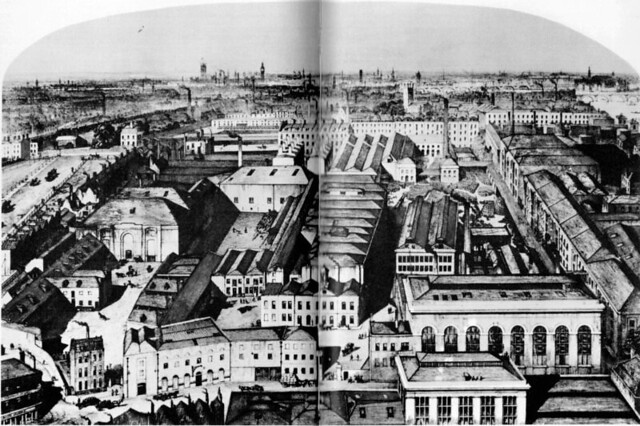
anchor-southwark
Today is the birthday of Ralph Thrale (1698-April 9, 1758). Thrale’s exact date of birth is not known, but he died today in 1758, so that’s why I’m celebrating his birthday today. He was born in Offley, Hertfordshire, England, the son of Ralph Thrale, a Cottager originally from Sandridge who moved to Offley. His uncle brought him to London around 1711 after his father died (when he was only 13) to work at his Anchor Brewery, in Southwark, in the central part of the city, and eventually he became the Master of The Brewers Company, having bought the brewery after his uncle’s death. He was also a Member of Parliament from 1741-1747 and also High Sheriff for Surrey from 1733-34.

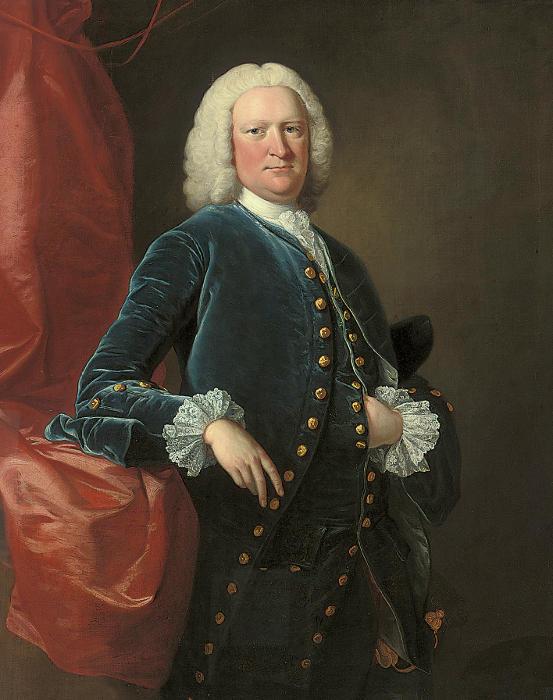
ralph_thrale_1698-1758_by_thomas_hudson
Portrait of Ralph Thrale by Thomas Hudson.

This is his short biography from the History of Parliament:

The son of ‘a hardworking man at Offley’, Thrale was brought to London by his uncle, Edmund Halsey, the owner of the Anchor brewery at Southwark, who ‘said he would make a man of him, and did so but … treated him very roughly’, making him work ‘at six shillings a week for twenty years’. He soon ‘made himself so useful … that the weight of the business fell entirely on him’, and he was expected to succeed to the brewery.1 But he fell out with his uncle by marrying ‘a wench that Halsey wanted to have for his own pleasure’, and was cut off.2On Halsey’s death in 1729, the Anchor brewery was put up for sale. According to Mrs. Piozzi, Thrale’s daughter-in-law,

to find a purchaser for so large a property was a difficult matter, and after some time, it was suggested that it would be advisable to treat with Thrale, a sensible, active, honest man, who had been long employed in the house, and to transfer the whole to him for £30,000, security being taken upon the property. This was accordingly settled. In eleven years Thrale paid the purchase money. He acquired a large fortune. But what was most remarkable was the liberality with which he used his riches.

Returned as an opposition Whig for Southwark, the brewers’ constituency, he voted against the Government on the chairman of the elections committee in 1741 and on the Hanoverians in 1744, was absent from other recorded divisions, did not stand again, and died 8 Apr. 1758.

thrale_brewery_circa_1785
Thrale’s Anchor Brewery around 1785.

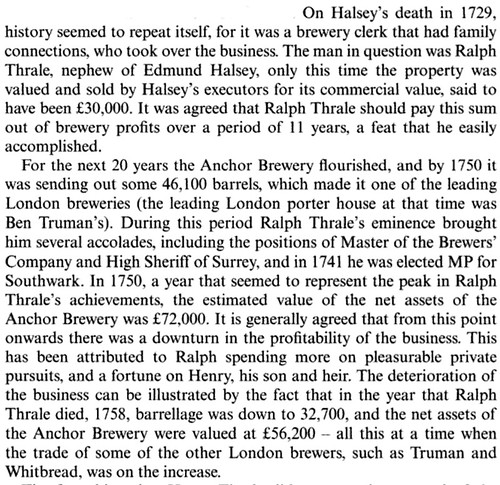
This mention of Ralph Thrale’s involvement in the Anchor Brewery is from “A History of Beer and Brewing,” by Ian Spencer Hornsey:

Hornsey-thrale

barley-and-perkins-1841

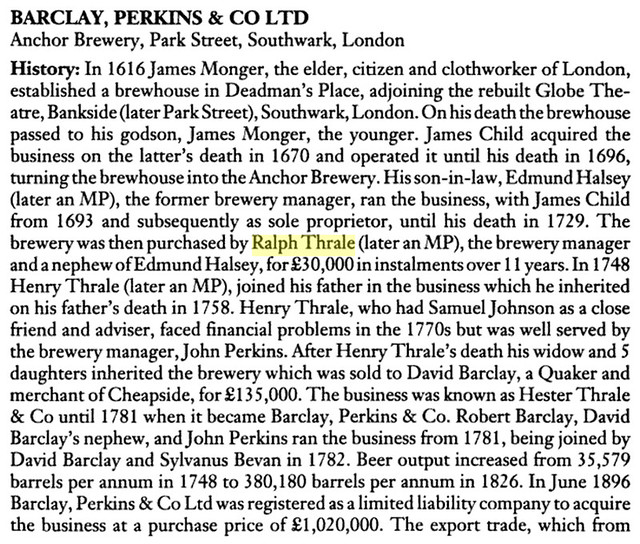
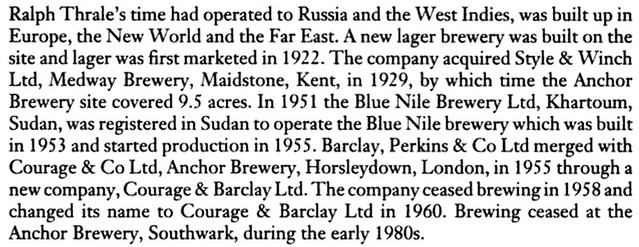
This is the entry for Barclay, Perkins & Co. Ltd, which at one time had been Thrale’s Anchor Brewery, from “The Brewing Industry: A Guide to Historical Records,” edited by Lesley Richmond, Alison Turton, published in 1990:

barclay-perkins-history-1
barclay-perkins-history-2

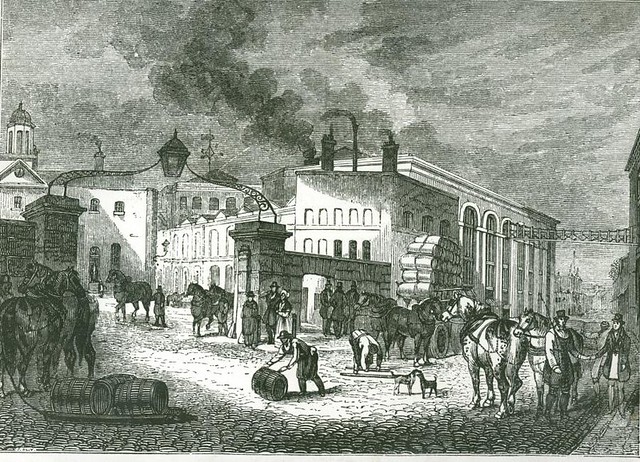
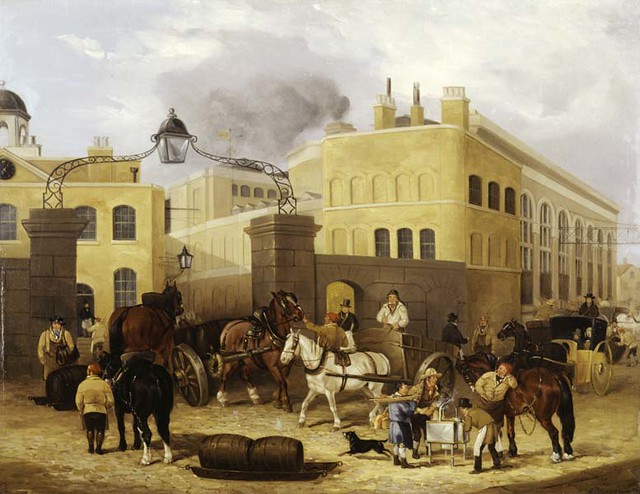
anchor-brewery-c1820-john-thomas-smith-1766-1833
The Anchor Brewery around 1820.

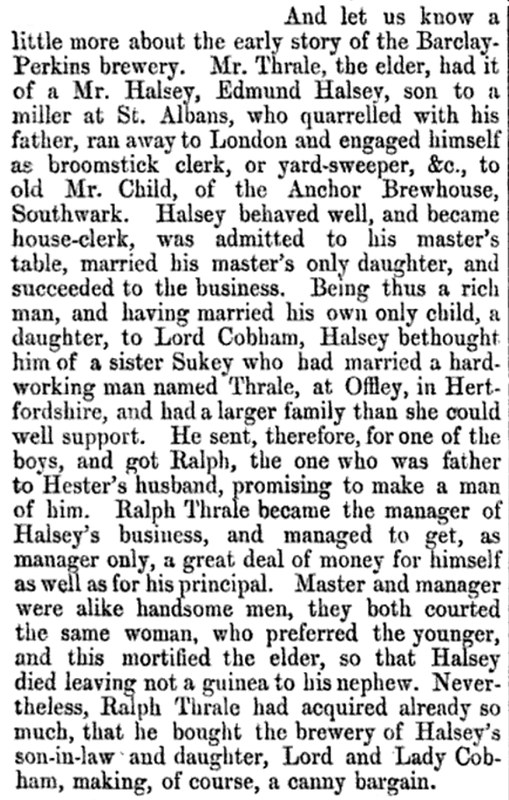
And finally, the famous English writer Charles Dickens, during the period when he was writing many of his major works, “he was also the publisher, editor, and a major contributor to the journals Household Words (1850–1859) and All the Year Round (1858–1870). In “Volume V, from March 30, 1861 to September 21, 1861,” in a piece entitled “Queen of the Blue Stockings,” from April 20, 1861, Ralph Thrale is mentioned in a history of the Barclay Perkins brewery to give context to his tale:

Dickens-Thrale

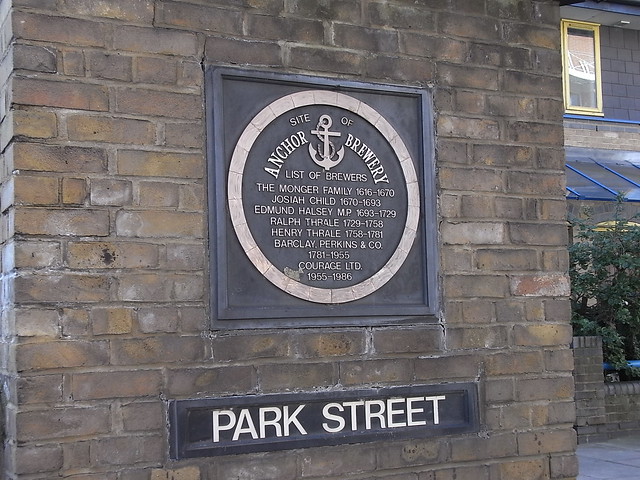
LondonSE1BarclayPerkinsAnchorPlaque2_SP_Mar10
A marker where Thrale’s brewery once stood in central London.

Filed Under: Birthdays, Just For Fun Tagged With: England, Great Britain, History, London

Historic Beer Birthday: Mathias Meller

April 9, 2025 By Jay Brooks

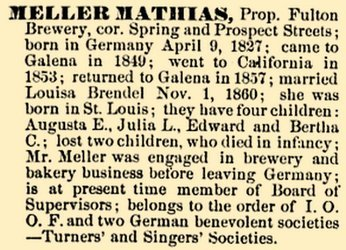
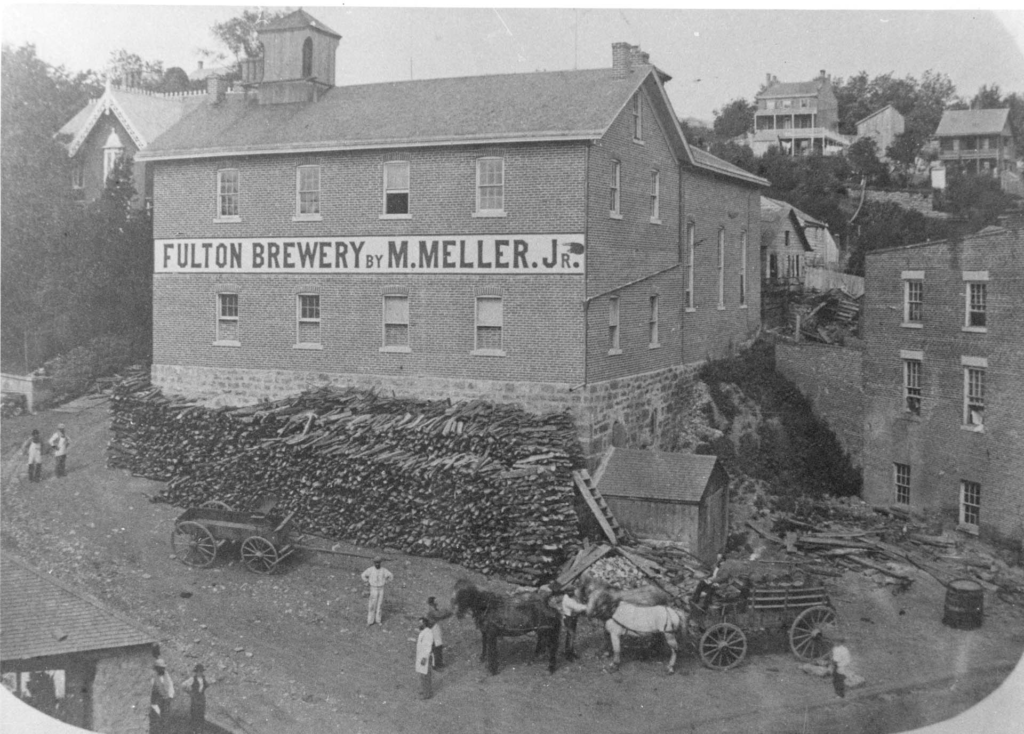
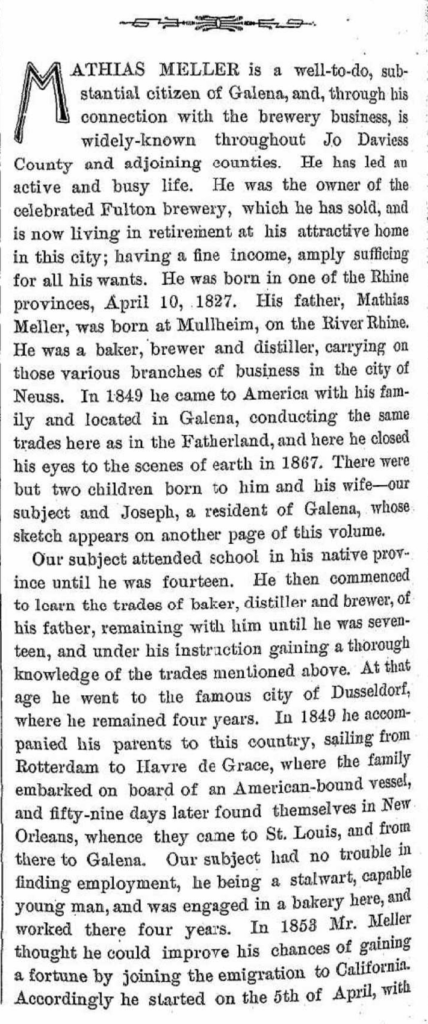
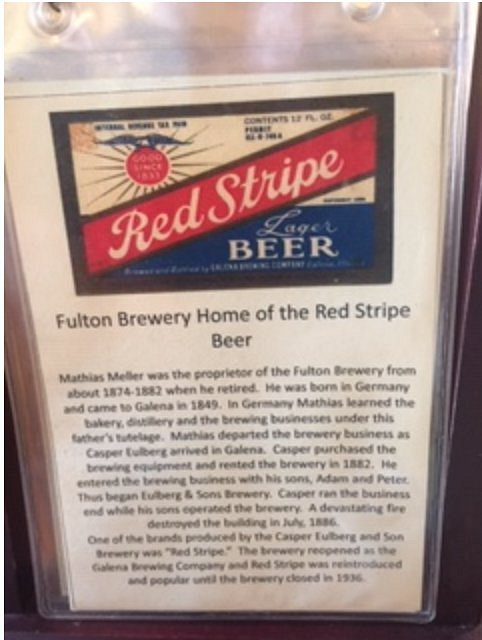
Today is the birthday of Mathias Meller (April 9, 1827-April 1, 1900). He was born in  Neuss, Germany, which is in the North Rhine-Westphalia area, and emigrated to the U.S. when he was 22, in 1849. He eventually settled in Galena, Illinois. In 1860 (or 1874, sources differ), he founded the Math. Meller Brewery (also called the Fulton Brewery), which would become the Casper Eulberg & Sons Brewery, and later, briefly, the Galena Brewing Co. after prohibition, before closing for good in 1936.

Here’s a short biography of Meller:

And this biography appears to be from a book on people from Jo Davis County

Curiously, their most popular beer was called Red Stripe, and had been made since the late 19th century. Apparently, when prohibition closed the brewery, they sold their recipe to British brewers who began production of the now-famous label in Jamaica.

Filed Under: Birthdays, Breweries, Just For Fun Tagged With: Germany, History, Illinois

« Previous Page
Next Page »

Find Something

Northern California Breweries

Please consider purchasing my latest book, California Breweries North, available from Amazon, or ask for it at your local bookstore.

Recent Comments

  • Bob Paolino on Beer Birthday: Grant Johnston
  • Gambrinus on Historic Beer Birthday: A.J. Houghton
  • Ernie Dewing on Historic Beer Birthday: Charles William Bergner 
  • Steve 'Pudgy' De Rose on Historic Beer Birthday: Jacob Schmidt
  • Jay Brooks on Beer Birthday: Bill Owens

Recent Posts

  • Historic Beer Birthday: Anthony Durkin March 1, 2026
  • Historic Beer Birthday: Adam Sander March 1, 2026
  • Beer In Ads #5138: Flower City Bock Beer March 1, 2026
  • Historic Beer Birthday: Regina Wauters March 1, 2026
  • Historic Beer Birthday: Danny Williams March 1, 2026

BBB Archives

Feedback

Head Quarter
This site is hosted and maintained by H25Q.dev. Any questions or comments for the webmaster can be directed here.