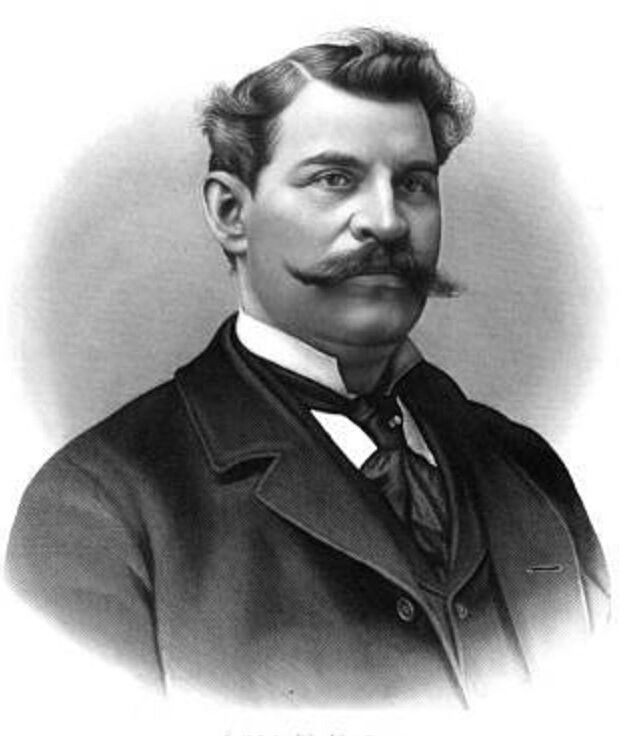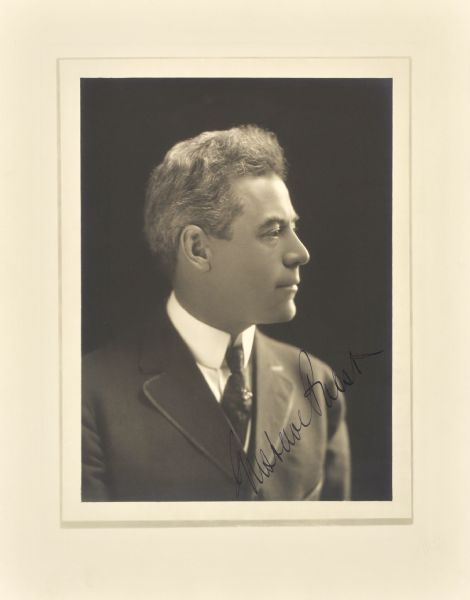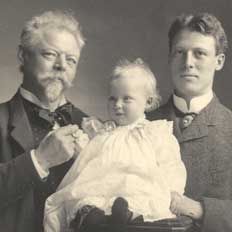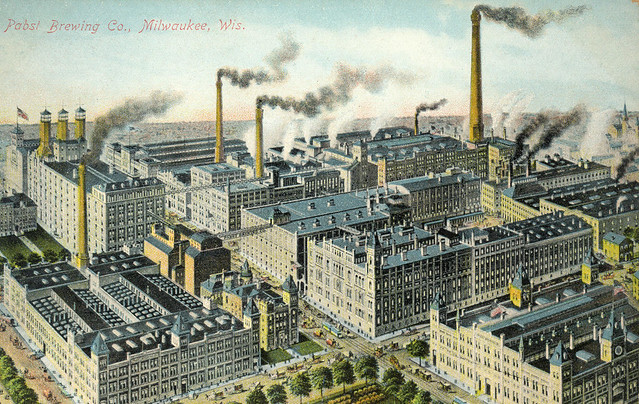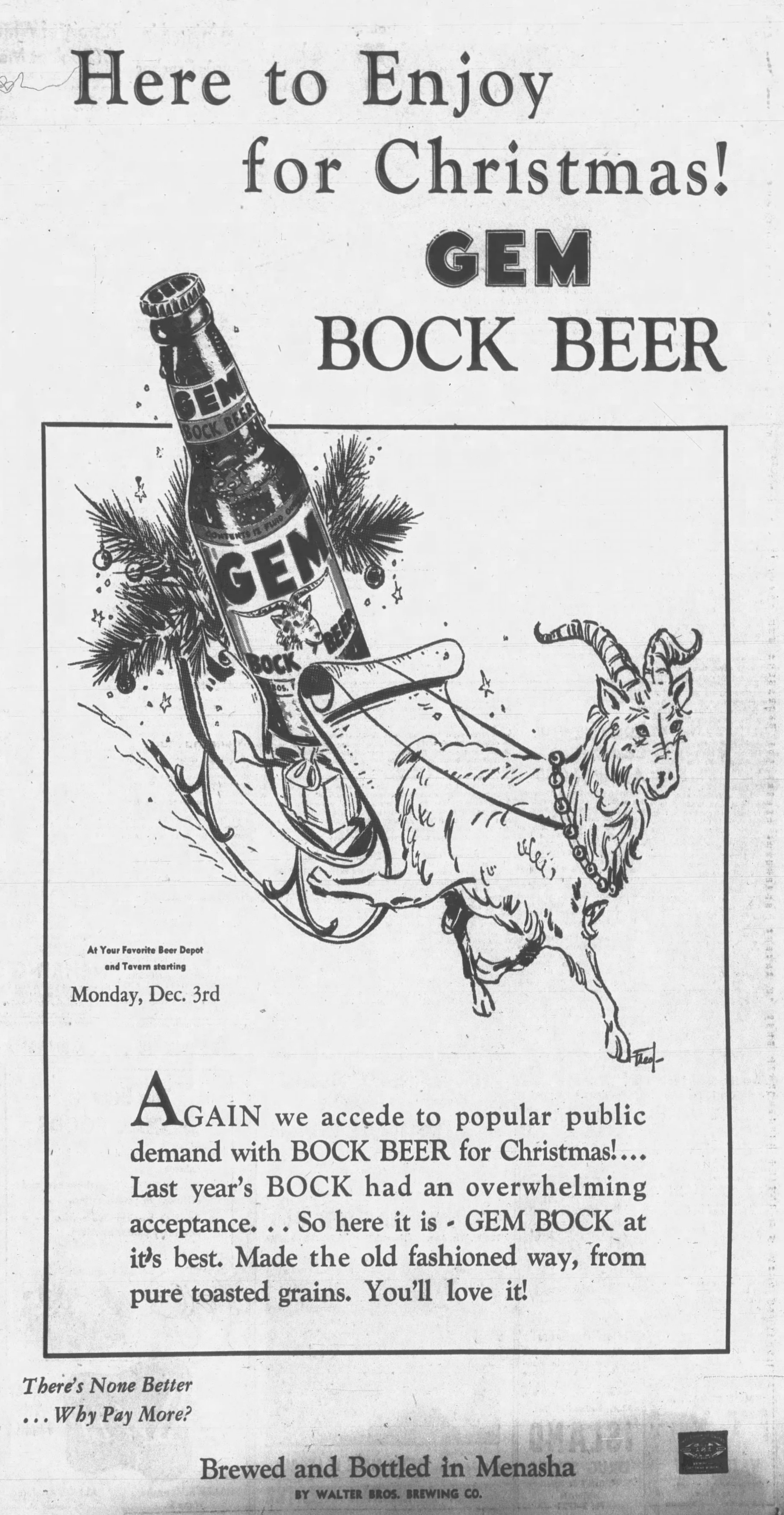
Today is the birthday of Magdalena “Lena” Jung Sohn (June 24, 1857-July 25, 1940). She was born in Cincinnati, Ohio, the sister of Daniel Jung, who founded the Jung Brewery in Cincinnati. She later married brewery owner William Sebastian Sohn. He was the son of Johann Georg Sohn, who co-founded the Hamilton Brewery, which was later known as the J. G. Sohn & Company Brewery. It was also known as the Clyffside Brewing Co., and used the trade name Feldsbrau. After his death in 1902, she took over the brewery and ran it until 1907, which became known as the William G. Sohn Brewing Co. and later the Mohawk Brewing Co. After prohibition, it reopened as the Clyffside Brewing. After World War 2, it was renamed the Red Top Brewing before closing for good in 1958.
She was considered one of the beer barons of Cincinnati and left a legacy
Lena Jung Sohn was one of the most influential figures in the beer industry in the late 1800s and early 1900s, and she wasn’t afraid to show it as president and owner of William S. Sohn Brewing Co. and later as owner and co-director of Mohawk Brewery.
Magdalena, or “Lena,” Jung was born on 24 June 1857 to Magdalena Oeh and blacksmith Philipp Jung. Little Lena’s maternal aunt was Barbara Oeh Moerlein, second wife of Christian Moerlein. Nine of the Moerlein children were Lena’s full first cousins. Her paternal uncle Daniel owned the Jung Brewery. Her sister Katherine married Jacob Born, and her first cousin Magdalena Moerlein married Conrad Born, both Borns of the Born brewing family in Columbus. It seems that Lena was destined for the brewing business.
In 1876, Cincinnati’s most established brewer and mentor to the other brewers John George Sohn died, leaving John Kauffman to be the senior-most brewer in Cincinnati, having been in it for 31 years. Just a week after J.G.’s death, a bullet shot through the Sohns’ parlor window, narrowly missing his widowed wife Barbara and dropping beside her. Was it a person in favor of temperance? A wronged worker? A rival? A jealous family member who wants all her money? Suspiciously, it was just after the reading of the will. Sohn left his estates and house to Barbara, money to his daughters Ida, Carolina, and Mathilda, and the brewery to his sons, J.G., Jr. and William Sebastian.
William Sebastian Sohn and Magdalena “Lena” Jung married in 1877 at a time when the brewing industry was being attacked by the temperance movement, supported by the Gazette, feeding anger and fear against the brewers, amidst rumors that they used poison instead of malt and hops and that the cost per barrel would rise. Lena, already heavily exposed to the brewing industry, would come to learn the industry first-hand through her husband while also keeping house and raising four children – Walter, Alma, Elsie, and Edna.
Aside from Barbara’s near-death experience, during this time, a number of terrible events occurred at the brewery, including an engineer’s gruesome death in the fly wheel and the repeated burning of the Orpheus building. However, the Jungs and Sohns were also among the few worldwide to invest in new washing-machine technology in the late 1880s. They were always looking to innovate their business practice.
William bought out his brother’s interest and took over the business in 1900. J. G., transferring the Sohn & Co property to William S. Sohn Brewing Company in 1900 with William and Lena being co-owners. Lena’s family by blood and marriage was running the Cincinnati brewing industry at this point.
William died on 26 February 1902, leaving the brewery to Lena, and she was voted in as president. Lena was actively using her name as President of the William S. Sohn Brewing Company, after Marianne Kauffman hid hers under initials and women before her staying out of being mentioned at all. Lena didn’t mind the spotlight and enjoyed the labors of the beer baronesses before her. She did her best to take care of her employees and show them they were like their own family. If an employee or their family died, she ensured that the entire brewery pitched in for donations of some sort as well as her family.
In addition to making a happier, more caring place to work, Lena continued the tradition of making the brewery state-of-the art. In 1904, the brewery began constructing a new bottle shop, “modern in every detail and the machinery and equipment of the latest and most improved on the market.” Lena also began selling off what didn’t make the company money. That meant selling off some of the enterprises they owned—like a saloon, grocery, and boarding house. What she couldn’t sell, she rented out instead, becoming an effective landlord. This allowed her to earn income, even after stepping down as president of the brewery in 1907 with George H. Osterfield replacing her. Her son Walter remained as secretary and treasurer. Lena remained as the owner of the brewery and its properties, even during its transfer to new presidents and new names.
Alma, Elsa, and Edna lived with their mother at Marion Ave and Winding Way and later 212 Ludlow Avenue, but they enjoyed trips to Atlantic City. After all, they were women of a more unsavory reputation, being in the brewing industry, so it was a fitting city for vacations. At home, Lena also invested in new (and most definitely loud) technology, installed by Pogue’s. She was an early adopter of Williams Oil-o-Matic Heater, developed by the company because of the oil shortage during WWI. The heater burned used automobile engine oil.
Lena’s oldest daughter Alma married a longtime friend on 29 January 1912, distiller Robert C. Heinzman, who patented many inventions to innovate the distilling industry throughout his life, perfect for a family that was always looking for innovations. Robert moved in with the family and continued living with them, even after Alma’s death from a pulmonary embolism on 29 October 1918, a little over a month after her infant died.
The family deeply grieved over the loss of Alma, and Prohibition brought about even more change the following year. The family had to adjust to life during Prohibition, but they only had to change how they appeared. The Mohawk Brewing Company continued to make near-beer and full beer under Walter’s supervision, until 3 August 1925 when the brewery was raided by federal agents. This forced Walter to step down from an active role in the brewery, and the brewery continued on as an ice house and malt beverage makers.
When Prohibition ended, the owners of Mohawk Brewery didn’t want to re-open. Lena was old, and Robert was retired. Shareholders voted to dissolve the Mohawk Brewery, and co-directors Lena, Robert, and Norbert J. Sprengard dissolved the brewery on 1 June 1936, and sold it to the owners of what would become Clyffside Brewing. This was the end of Lena’s business ventures. Lena, after some vacationing to Atlantic City with her daughters, died at her home on 24 July 1940, at the age of 83. Walter lived until 1962. Edna and Elsa lived in Cincinnati and Atlantic City until their respective deaths in 1979 and 1981.
When the beer baronesses married inside the alcohol industry, they could continue with their children. But when the women in the alcohol industry didn’t marry, there was no one in the family to continue the brewing business. As a brewing woman, you had a limited selection, being an improper lady. That meant you had to marry someone who didn’t care about social status, marry another man in the brewing industry, or not marry at all. Many of the women chose or were forced into that last option. Because Lena’s lineage did not continue with her children, neither did her direct family’s stronghold on the brewing industry, severely exacerbated by Prohibition. The men may have made the industry, but it was the women who kept it going.
Here’s another short biography from Tavern Trove
Magdalena (Lena) Jung Sohn, one of the “Beer Barons of Cincinnati” was born in Cincinnati, Ohio. As the niece of Daniel Jung of the Jung Brewery Lena Jung was already Cincinnati brewery royalty. In 1877 she married Johann Georg ‘J.G.’ Sohn, who was a member of another Cincinnati brewing dynasty. When her husband died in 1902 Magdalena took over the expansive operation and renamed it the Mohawk Brewing Company and ran it successfully until Prohibition shut it down in 1920. Magdalena (Jung) Sohn died on July 24, 1940. She was 83 years of age.
Today is the birthday of Christian Schmidt (June 24, 1833-September 6, 1894). Schmidt was born in Magstadt, Wurtemberg, Germany but moved to Philadelphia as a young man. In 1859, he became a partner with the Robert Coutrennay Brewery but bought him out the following year, renaming the brewery the Christian Schmidt Brewing Company until his sons joined the brewery in 1892, when it became known as C. Schmidt & Sons.
Christian Schmidt, an immigrant from Wurtemberg, Germany, purchased the Robert Courtenay brewery which primarily produced ale at this site in 1860. The acquisition of other breweries, such as Peter Schemm, in addition to the production of lager beer, boosted output to 100,000 barrels by 1892. A marked expansion of the physical plant kept pace with the brewery’s growth.
The last quarter of the nineteenth century was Philadelphia’s shining era for large and small breweries. Bergner and Engel (120,000 barrels), and William Massey and Company (75,000 barrels), were the third largest and eleventh largest breweries respectively in the U. S. in 1877. By 1895, Bergner and Engel with 250,000-300,000 barrels had fallen to 15th place; the largest local brewery. Other major companies were Engels and Wolf, Betz and Bergdoll. Christian Schmidt was succeeded by his son Edward who headed the company from 1895 until 1944. There were 421 employees at Schmidt’s in 1943. It had survived and thrived through new technologies—refrigeration, and political impediments, even Prohibition, which decimated other breweries both locally and nationally. Only 26 breweries operated in Pennsylvania in 1960. Philadelphia lost brands such as Esslinger, Poth, Gretz and Class and Nachod.
Schmidt family ownership ceased in 1976 with the sale of the brewery to William H. Pflaumer. By the late 1970s Schmidt’s was the tenth-largest American brewery. It operated a plant in Cleveland, Ohio which facilitated mid-west regional sales. Valley Forge Brewing Company was acquired in the 1960s, Duquesne Brewing Company (Pittsburgh) in 1972, and label and brewing rights to Reading and Bergheim were purchased in 1976, Rheingold in 1977, Erie Brewing Company, with its Koehler brands in 1978. In 1981, Ortlieb, the only other Philadelphia brewery, was purchased by Pflaumer. Schmidt’s, unable to cope with the marketing muscle of the giant national brewers even though it employed 1,400 and produced three million barrels of beer as recently as 1984, sold its brands to G. Heileman Brewing Company of La Crosse, Wisconsin, in April 1987. Production of the Schmidt’s labels slumped to about $1.6 million barrels in 1986, less than one percent of the total U. S. Market. The demise of Schmidt’s marked the end of the large brewery in Philadelphia.
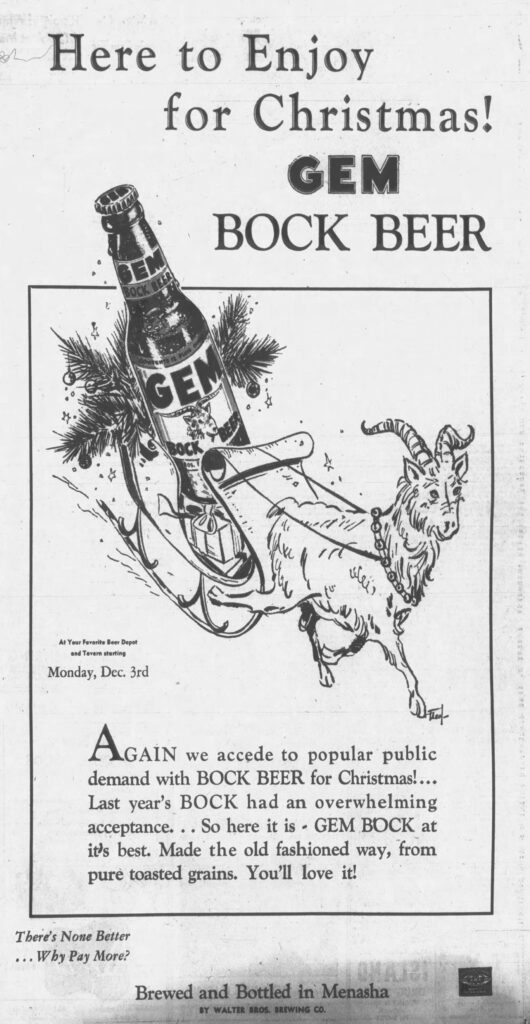
Last year I decided to concentrate on Bock ads. Bock, of course, may have originated in Germany, in the town of Einbeck. Because many 19th century American breweries were founded by German immigrants, they offered a bock at certain times of the year, be it Spring, Easter, Lent, Christmas, or what have you. In a sense they were some of the first seasonal beers. “The style was later adopted in Bavaria by Munich brewers in the 17th century. Due to their Bavarian accent, citizens of Munich pronounced ‘Einbeck’ as ‘ein Bock’ (a billy goat), and thus the beer became known as ‘Bock.’ A goat often appears on bottle labels.” And presumably because they were special releases, many breweries went all out promoting them with beautiful artwork on posters and other advertising.
Monday’s ad is for Lucky Lager Bock Beer. The ad was published on June 23, 1980. This one was for the Lucky Lager Breweries, which was located in Vancouver, Washington, among other places, and was originally launched in 1934. This ad ran in The Spokane Chronicle, of Spokane, Washington. This ad is isn’t all bock. In fact, bock seems more of an afterthought with the text “Ask for Lucky Lager Bock Beer” on the left edge of the ad. It’s really more of a “Sports Calendar” sponsored by Lucky Lager. But I do love the karate fight going on at the bottom between a bottle of Lucky Lager and a man employing “full contact karate.”
Today is the birthday of Joseph Seelinger (June 23, 1863-October 17, 1939). He was born in Erie, Pennsylvania, the son of Joseph F. Seelinger, who owned the Erie City Brewery for a time. Originally founded in 1861 by George Frey, Seelinger bought in 1870, renamed it the Joseph F. Seelinger Brewery in 1872, but closed it for good the same year, and relocated to Norfolk, Virginia and opened the Onyx Saloon.
Joseph Seelinger aged 76, operator of one of Norfolk’s Bygone popular restaurants, and who entertained such prominent personages as President Grover Cleveland, when the latter came to Norfolk on duck hunting trips, died yesterday afternoon at 4:30 at his residence, 318 Mowbray Arch.
Mr. Seelinger came to Norfolk in his early life from Erie Penn. and became widely know throughout the city by the fastidious diners with whom cost was not a factor. In the gay days of Norfolk his place was the center of fashionable gatherings, especially around the holiday seasons.
Mr Seelinger was an active member of Norfolk Lodge No. 38, BPOE. He was the son of F Joseph and Elizabeth Stemmer Seelinger, he is survived by his sons Sherman E and Joseph P Seelinger and two daughters Mrs. C J Aydlette and Mrs C C Dixon.
The family never looked back and found success with the restaurant saloon in Virginia. There’s also an entertaining account of the time Saloon Owner “Joe” Went Gunning with Grover Cleveland. That may be Seelinger in the trade card below, but nobody seems to be able to confirm it.
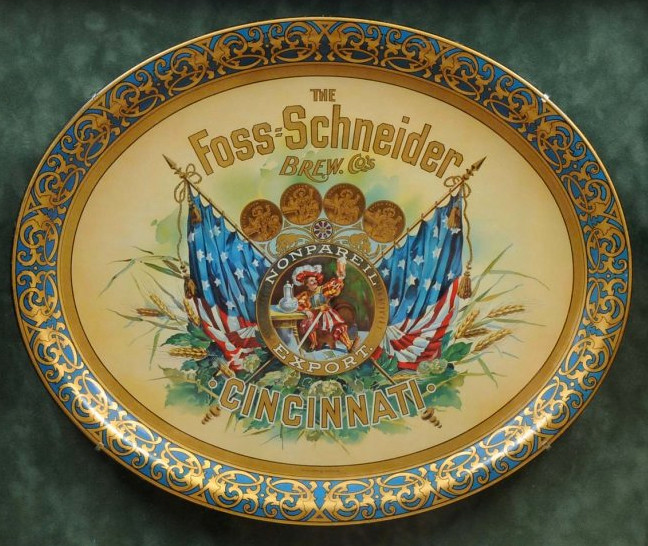
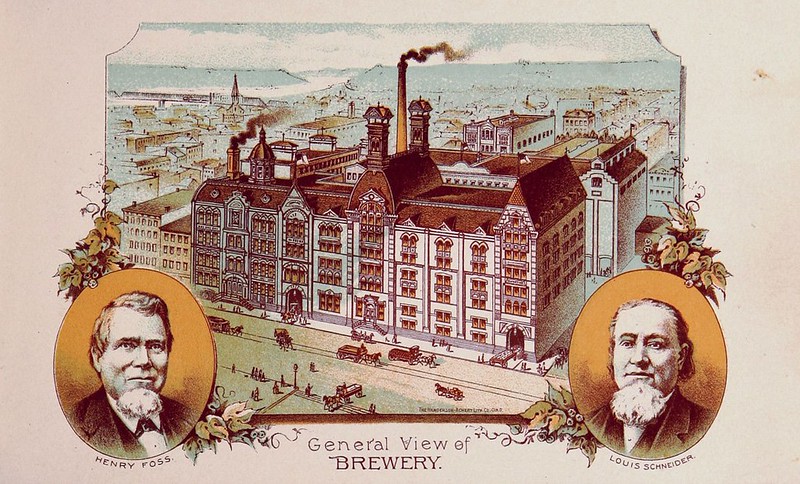
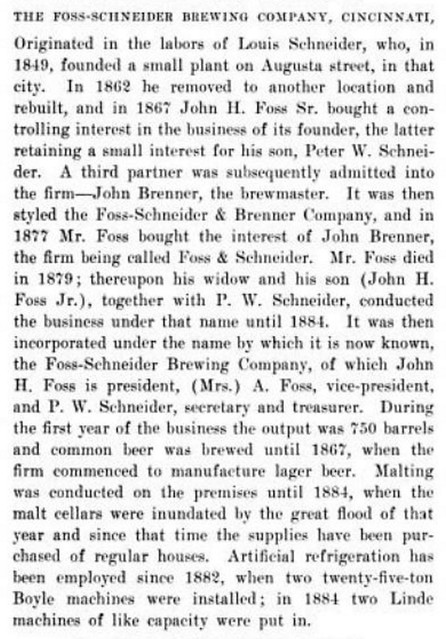
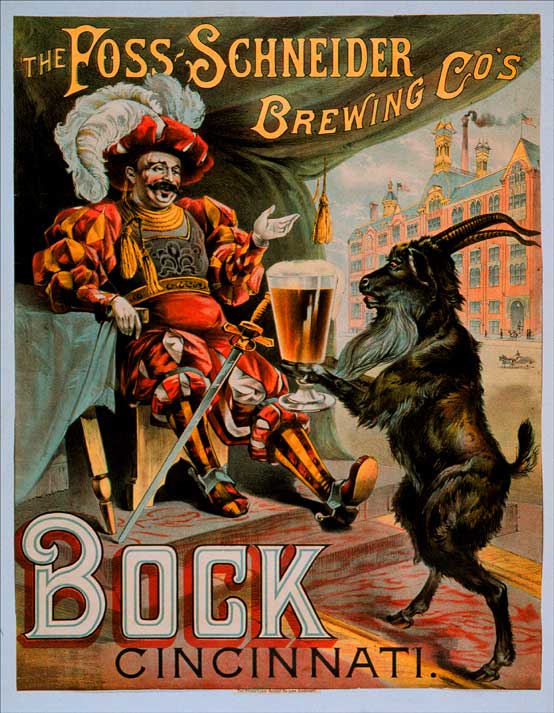
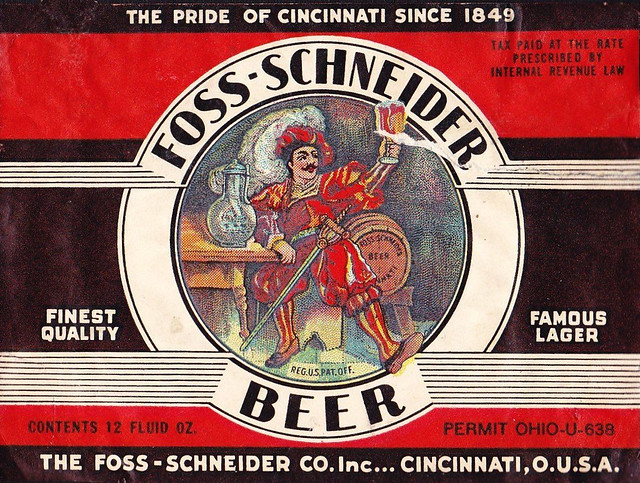
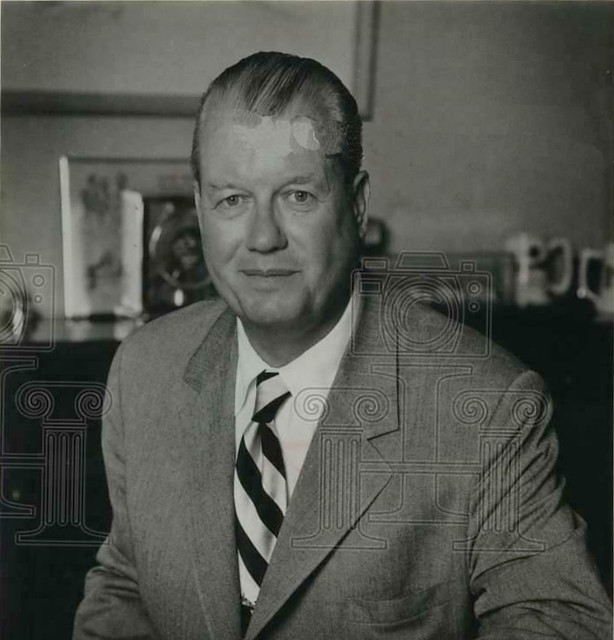
Today is the birthday of Henry Foss, a.k.a. John Henry Foss (June 23, 1817-August 13, 1879). Foss was born in Hanover, Germany but emigrated to Ohio. In 1842, he married Elizabeth Rumpeing, but she passed away in 1854 after twelve years of marriage. He then married Adelaide Foss later the same year, and they had 13 children together. In 1867, he became involved with the Louis Schneider Brewery in Cincinnati, Ohio, becoming a partner and it eventually became known as the Foss-Schneider Brewing Co. It closed during prohibition, but reopened when it was repealed in 1933, though closed for good in 1939.
Here’s a biography of Foss, from the “History of Cincinnati and Hamilton County, Ohio: Their Past and Present Including Early Development, Antiquarian Researches, Their Aboriginal History, Pioneer History, Political Organization, Agricultural, Mining and Manufacturing Interests, A History of the City, Villages and Townships, Religious, Educational, Biographies, and Portraits of Pioneers and Representative Citizens, Etc.,” which was published in 1894.
Henry Foss was born in Germany, June 23, 1817, and died in Cincinnati August 13, 1879. After attending the common schools until he was between thirteen and fourteen years of age he was given to understand that from that time he would be expected to “paddle his own canoe,” so he at once commenced the life of a farm laborer, and, to the credit of his industrious habits, it is said that he followed this kind of work faithfully until he was nearly twenty years old. But at that time he somehow or other began to get dissatisfied with the result of his six years’ hard work, so he thought he would “take stock” to see how much he had made, and calculated how much he would be worth in forty years, if he continued at the same business at the same wages — about twelve or fourteen dollars a year. He had nothing at the start; he had wasted no money; had only kept himself clothed, and still he had nothing to show for all his labor but a few dollars, barely sufficient to take him over the sea to the New World. Yet, nevertheless, he was determined to go with a party that was about to leave the village for America. Leaving home on the tenth day of May 1837, the party, consisting of himself and three others, traveled by wagon to Bremen, where they took passage on the ship “Richmond” bound for Richmond, Va. After paying his passage money he had but five cents left, so that it was no trouble for him to conclude to rely solely upon his efforts in the New World of the West — in fact, there was no choice in the matter. After being at sea for several days they encountered a storm of great severity, during which they lost their mainmast and much of their rigging, and were driven back so far that the distance lost was not regained for fourteen days. Besides the above disasters the cook’s galley, with all the cooking apparatus, was swept clean overboard, so that it was three days after before they had a particle of anything warm to eat or drink. At last, however, after twenty-two days. they landed safely at Richmond, Va., our subject having, we suspect, had enough of “life on the ocean wave” to satisfy him, as he never re-crossed it.
After looking around for a day or two, Mr. Foss went to work on the James River canal, at seventeen dollars per month and board. At this he continued for about seven months, when, having saved something like one hundred dollars, he thought he was rich at once, and would soon buy all the land he wanted. Like thousands of his countrymen he judged that the West was the place for him; so he joined a party of twenty-two possessed of the same idea. Clubbing together, the party procured a large team, and started over the mountains to the Kanawha canal, by which they arrived at Wheeling, where they took steamer for Pittsburgh, and at once proceeded down the river to Cincinnati. On landing here Mr. Foss found things so dull that he determined to proceed to St. Louis. Finding matters much the same there, he began to think he had made a mistake in coming west; but he passed over into Illinois with the expectation of going to work on a turnpike at Belleville. It was so swampy there, however, that almost every one who worked there was seized with fever and ague. In this emergency he returned to St. Louis, and from there again came to Cincinnati, where he was advised by his friends to go to work on the Whitewater canal, at Brookville, some forty miles from the city. He walked this distance with his knapsack on his back, and at once began to work at seventeen dollars per month and board. At the end of three months he went to Cincinnati. and sent fifty dollars home to his parents to help smooth the path of life for them. After working on the canal two months longer he was made foreman of a squad of quarry men; while at this work he conceived the idea of learning the stone-cutting trade, and after instructing another in his duties, he went to the yard to learn the trade. In nine mouths the locks of the canal were completed, at the end of which time Mr. Foss came to the city, and was employed at dressing stone until he saw an opening at the locks of the Licking canal, Kentucky. After working there about six mouths he commenced as a stone mason, and having a good eye for mechanics he soon proved an efficient workman, and thereafter could either cut or lay stone. After continuing in this way two years, during which he had sent $500 home to bring out the whole family, and saved $500 besides, on the arrival of his parents and his brothers and sisters they found that Henrv had rented and furnished a house complete for them to go into.
With the $500 in hand he commenced business for himself on a small scale, which he gradually increased from year to year until he employed from fifty to sixty journeymen, and nearly as many laborers. In 1848-49, in connection with Henry Atlemeier, he built the House of Refuge; and while thus engaged the cholera was raging so fearfully that the funerals moving from the city to the cemetery formed a constant procession. The architect of their job. Henry Walters, and many of their workmen fell victims to the epidemic. In 1851 he built the foundations of the Hamilton and Dayton depot, which consumed some 5,000 perches of stone, and completed the job in about three months. He built the church on the corner of Mound and Barr, and adjoining gymnasium in 1857-58, also the foundations of St. Philomena church on Congress and Butler streets; St. Joseph’s, on Linn; Holy Trinity, on Fifth; likewise that of the large block on the corner of Ninth and Walnut; and the church of the Holy Angels (all of stone), Fulton; and the south wing of Bishop Purcell’s seminary, besides a vast number of dwelling houses. He continued this business until 1856, when he sold off his teams and building apparatus generally, and built a distillery on the Plank road, now Gest street, for himself and his partner, with a capacity of 900 bushels per day. After its completion his partner was somewhat alarmed at their great undertaking, so, to make the matter lighter, sold a quarter interest to two other gentlemen, retaining a quarter himself. After conducting the business together for about three months, hard times came upon them, and Mr. Foss’ original partner again became alarmed for fear all would be lost; but not so Mr. Foss, who at once bought the interest of that gentleman, and continued the business with the owner of the fourth interest. The scale soon turned in their favor, and, after eight years of success, having considerable surplus money, Mr. Foss bought the interest of his partners, and carried on the business alone for about two years, then sold out to Mr. John Pfeffer, concluding that he would work a little in his garden, and take things easy the rest of his life. But to his surprise he did not know what to do with himself, and, after laying off about two months, he came to the conclusion that doing nothing was the hardest work in the world. He then formed a partnership with Adam Heitbrink for the purpose of building the foundation of the city Work House. After this was finished he formed a partnership with William P. Snyder and John Brenner, and went into the manufacture of. lager beer, ‘ the capacity of their works at the commencement being about sixty-five barrels per day. This was in December, 1867; in the spring of 1868 it became necessary to enlarge their works, and their business continued to increase. The further connection of Mr. Foss with the great brewing establishment, now known as the Foss-Schneider Brewing Company, is contained in the personal history of his son and successor, John H. Foss, president of that company, and which is contained in this volume.
Mr. Henry Foss was married in 1842, to Miss Elizabeth Rumpeing, a German lady, who was every way worthy to be his wife. Of this union five children were born, all of whom, together with their mother, have died, the latter in 1854. Mr. Foss was married again, during the same year, to Miss Adelaide TeVeluwe, of Zutfen Lechtenforde, Holland, and by her eight children were born to him, seven of whom—John H., William, Edward, Philomena, Lizzy, Rosey and Bernidena—are still living, as is also Mrs. Foss.
Here’s a short history of the brewery, from “100 Years of Brewing:”
Last year I decided to concentrate on Bock ads. Bock, of course, may have originated in Germany, in the town of Einbeck. Because many 19th century American breweries were founded by German immigrants, they offered a bock at certain times of the year, be it Spring, Easter, Lent, Christmas, or what have you. In a sense they were some of the first seasonal beers. “The style was later adopted in Bavaria by Munich brewers in the 17th century. Due to their Bavarian accent, citizens of Munich pronounced ‘Einbeck’ as ‘ein Bock’ (a billy goat), and thus the beer became known as ‘Bock.’ A goat often appears on bottle labels.” And presumably because they were special releases, many breweries went all out promoting them with beautiful artwork on posters and other advertising.
Sunday’s ad is for Valley Forge Bock Beer. The ad was published in 1954. This one was for the Adam Scheidt Brewing Co., which was located in Norristown, Pennsylvania and was originally founded in 1866. This ad ran in The Evening Star, of Washington, D.C.
Last year I decided to concentrate on Bock ads. Bock, of course, may have originated in Germany, in the town of Einbeck. Because many 19th century American breweries were founded by German immigrants, they offered a bock at certain times of the year, be it Spring, Easter, Lent, Christmas, or what have you. In a sense they were some of the first seasonal beers. “The style was later adopted in Bavaria by Munich brewers in the 17th century. Due to their Bavarian accent, citizens of Munich pronounced ‘Einbeck’ as ‘ein Bock’ (a billy goat), and thus the beer became known as ‘Bock.’ A goat often appears on bottle labels.” And presumably because they were special releases, many breweries went all out promoting them with beautiful artwork on posters and other advertising.
Saturday’s ad is for Old Imperial Bock Beer. The ad was published in 1962. This one was for the Rahr-Green Bay Brewing Co., which was located in Green Bay, Wisconsin and was originally founded in 1853. This ad ran in The Green Bay Press Gazette, of Green Bay, Wisconsin. The text on this one is great. “Cool, Refreshing, Palatable.” Palatable? Not exactly a great descriptor. But even better are the two endorsements, first from Valter: “Ven I say ‘good,’ I mean ‘GOOD!'” followed by Droopy: “‘Ach! You know de answer.”
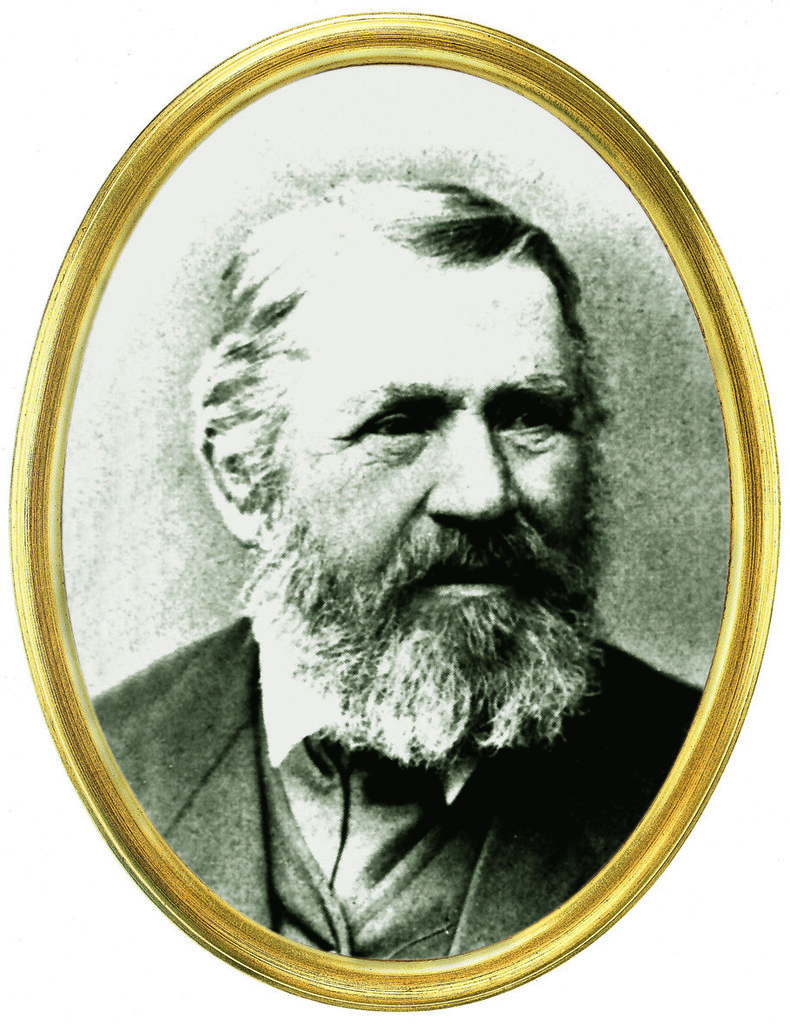
Last year I decided to concentrate on Bock ads. Bock, of course, may have originated in Germany, in the town of Einbeck. Because many 19th century American breweries were founded by German immigrants, they offered a bock at certain times of the year, be it Spring, Easter, Lent, Christmas, or what have you. In a sense they were some of the first seasonal beers. “The style was later adopted in Bavaria by Munich brewers in the 17th century. Due to their Bavarian accent, citizens of Munich pronounced ‘Einbeck’ as ‘ein Bock’ (a billy goat), and thus the beer became known as ‘Bock.’ A goat often appears on bottle labels.” And presumably because they were special releases, many breweries went all out promoting them with beautiful artwork on posters and other advertising.
Friday’s ad is for Jax Bock Beer. The ad was published in 1962. This one was for the Jackson Brewing Co., which was located in New Orleans, Louisiana and was originally founded in 1890. This ad ran in The San Angelo Standard Times, of San Angelo, Texas.
Last year I decided to concentrate on Bock ads. Bock, of course, may have originated in Germany, in the town of Einbeck. Because many 19th century American breweries were founded by German immigrants, they offered a bock at certain times of the year, be it Spring, Easter, Lent, Christmas, or what have you. In a sense they were some of the first seasonal beers. “The style was later adopted in Bavaria by Munich brewers in the 17th century. Due to their Bavarian accent, citizens of Munich pronounced ‘Einbeck’ as ‘ein Bock’ (a billy goat), and thus the beer became known as ‘Bock.’ A goat often appears on bottle labels.” And presumably because they were special releases, many breweries went all out promoting them with beautiful artwork on posters and other advertising.
Thursday’s ad is for Old Reading Bock Beer. The ad was published in 1935. This one was for the Reading Brewing Co., which was located in Reading, Pennsylvania and was originally founded in 1886. This ad ran in The Reading Times, also of Reading, Pennsylvania.
Today is the birthday of Alan MacGregor Cranston (June 19, 1914–December 31, 2000). Cranston was a Democratic senator from California, born in Palo Alto, and served four terms.
US Senator. A member of the Democratic party, he represented the state of California for four terms in the US Senate from January 1969 until January 1993, serving as the Democratic Whip from 1977 until 1991. Born Alan MacGregor Cranston in Palo Alto, California into a wealthy real estate family, he attended local public schools before attending Pomona College in Claremont, California and the Universidad Nacional Autonoma de Mexico in Mexico City, Mexico, and graduated in 1936 from Stanford University in Palo Alto with a degree in journalism. In 1937 he became a correspondent for the International News Service for two years preceding World War II, covering Europe and North Africa. When an abridged English-language translation of Adolf Hitler’s “Mein Kampf” was released, sanitized to exclude some of Hitler’s anti-semitism and militancy, he published a different translation (with annotations) which he believed more accurately reflected the contents of the book. In 1939 Hitler’s publisher sued him for copyright violation in Connecticut and a judge ruled in Hitler’s favor and publication of the book was halted. From 1940 until 1944 he served as chief, foreign language division in the Office of War Information and in 1944 he enlisted in the US Army. In 1945 he wrote the book, “The Killing of the Peace,” a synopsis of the failed bid to get the US to join the League of Nations immediately following World War I. A world government supporter, he attended the 1945 conference that led to the Dublin Declaration, and became president of the World Federalist Association in 1948. In 1949 he successfully pushed for the California legislature to pass the World Federalist California Resolution, calling on Congress to amend the Constitution to allow US participation in a federal world government. From 1949 until 1952 he was the national president of the United World Federalists. In 1952 he co-founded the California Democratic Council and served as its chairman. In 1958 he was elected California’s State Controller as a Democrat and was re-elected in 1962. In 1968 he ran as the Democratic candidate for US Senate and was elected to the first of four six-year terms, defeating Republican challenger Max Rafferty, followed by Republican challenger H.L. “Bill” Richardson in 1974, Republican Paul Gann in 1980, and Republican Congressman Ed Zschau in 1986. During his time in the US Senate, he served on the Banking, Housing, Urban Affairs, Veterans (which he chaired), and Foreign Relations Committees and was strongly opposed to the US involvement in the Vietnam War. He was an unsuccessful candidate for the 1984 Democratic presidential nomination, dropping out of the race after finishing poorly in the Iowa and New Hampshire primaries. In November 1991 he was reprimanded by the US Senate Select Committee on Ethics for “improper conduct” after Lincoln Savings head Charles Keating’s companies contributed $850,000 to voter registration groups closely affiliated with him. Because the Keating affair had damaged his political career, coupled with his diagnosis and treatment of prostate cancer, he decided against running for a 5th US Senate term. His final act as a Senator was to preside over the inauguration of Bill Clinton as President of the US on January 20, 1993. A fitness enthusiast, he was notable for practicing and participating in the sport of track and field as a sprinter in special senior races. An avid lifetime supporter of the global abolishment of nuclear weapons, in his retirement he became a part of the Nuclear Weapon Elimination Initiative of the State of the World Forum and founded the Global Security Institute in 1999, serving as its president. He died of natural causes in Los Altos, California at the age of 86.
Of course, the one thing left out of Cranston’s biography in most accounts is the reason that he’s featured here. On January 4, 1977, Representative William A. Steiger (Republican from Wisconsin’s 6th District) introduced H.R.1337 a transportation bill with the title “A bill to amend the Internal Revenue Code of 1954 with respect to excise tax on certain trucks, buses, tractors, etcetera.”
To that bill, senator Cranston added a crucial amendment which had a profound effect on the landscape of beer today, and its final title was “An Act to amend the Internal Revenue Code of 1954 with respect to excise tax on certain trucks, buses, tractors, et cetera, home production of beer and wine, refunds of the taxes on gasoline and special fuels to aerial applicators, and partial rollovers of lump sum distributions.”
Here’s the text of the beer portion of Amendment 3534, added by Senator Alan Cranston:
(e) BEER FOR PERSONAL OR FAMILY USE. — Subject to regulation prescribed by the Secretary, any adult may, without payment of tax, produce beer for personal or family use and not for sale. The aggregate amount of beer exempt from tax under this subsection with respect to any household shall not exceed —
(1) 200 gallons per calendar year if there are 2 or more adults in such household, or
(2) 100 gallons per calendar year if there is only 1 adult in such household.
For purposes of this subsection, the term ‘adult’ means an individual who has attained 18 years of age, or the minimum age (if any) established by law applicable in the locality in which the household is situated at which beer may be sold to individuals, whichever is greater.
As we all know, President Jimmy Carter signed H.R. 1337 into law on October 14, 1978, paving the way for the our modern brewing industry that includes over 700 breweries in California alone, and over 4,000 nationwide. Thanks Alan.
In 1984, Cranston made a failed bid to run for president. I bet he would have gotten the homebrewing vote.