Brookston Beer Bulletin

Jay R. Brooks on Beer

  • Home
  • About
  • Editorial
  • Birthdays
  • Art & Beer

Socialize

  • Dribbble
  • Email
  • Facebook
  • Flickr
  • GitHub
  • Instagram
  • LinkedIn
  • Pinterest
  • RSS
  • Twitter
  • YouTube

Powered by Genesis

Patent No. 4068005A: Accelerated Fermentation Of Lager Beer

January 10, 2015 By Jay Brooks

patent-logo
Today in 1978, US Patent 4068005 A was issued, an invention assigned to Miller Brewing Company, for the “Accelerated Fermentation of Lager Beer.” Here’s the Abstract:

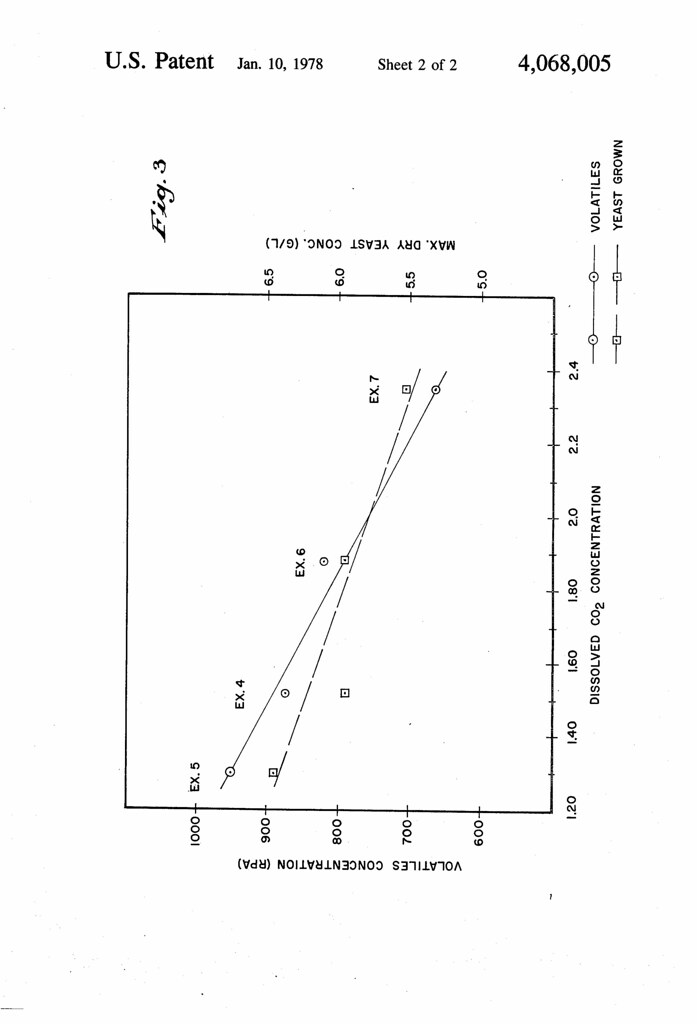
A method of accelerating the fermentation of a lager-type beer comprises conducting the fermentation at an elevated temperature with or without exogenous agitation while maintaining the dissolved carbon dioxide concentration in the fermentation liquor at a level approximating that found in a fermentation liquor during a normal supersaturated lager-type bottom-fermentation. The level of dissolved carbon dioxide is maintained at about 1.5 to about 2.0 cc per cc of beer by use of an overpressure of 2-20 psig of carbon dioxide.

US4068005-1

US4068005-2

Filed Under: Beers, Breweries, Just For Fun, Politics & Law, Related Pleasures Tagged With: lager, Patent, Science of Brewing

Patent No. 20120000367A1: Brewery Facility For Producing And Bottling Beer

January 5, 2015 By Jay Brooks

patent-logo
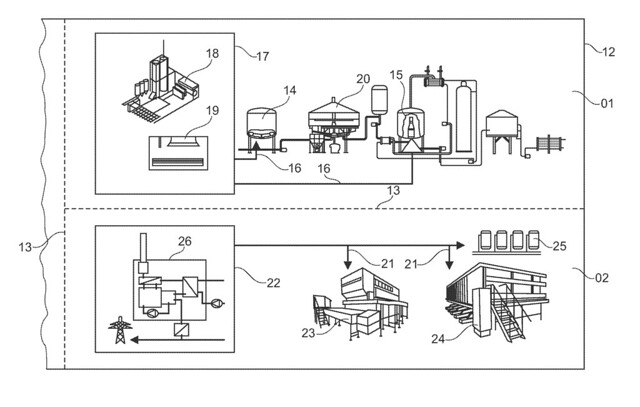
Today in 2012, just three years ago, US Patent 20120000367 A1 was issued, an invention of Rudolf Michel and Ludwig Scheller, for a “Brewery Facility for Producing and Bottling Beer.” Here’s the Abstract:

The invention relates to a brewery plant (12) for producing and bottling beer, comprising a brewhouse facility (01) in which wort is produced from raw materials while employing process energy, and further comprising a bottling facility (02) in which beer produced from the wort is filled into packaging containers, in particular bottles, while employing process energy, wherein in order to supply the brewhouse facility (01) with process energy a first energy supply network (16) is provided, into which process heat having a first temperature level is fed from at least one first energy generation facility (17) and is distributed by a heat transfer means to different energy consumers (14, 15) in the brewhouse facility (01), and wherein in order to supply the bottling facility (02) with process energy a second energy supply network (21) is provided, into which process heat having a second temperature level is fed from at least one second energy generation facility (22) and is distributed by a heat transfer means to different energy consumers (23, 24, 25) in the bottling facility (02), wherein the maximum temperature of the heat transfer means in the first energy supply network is above the maximum temperature of the heat transfer means in the second energy supply network.

US20120000367A1-20120105-D00000

If you love this sort of thing, there’s much more about the specifics at the patent application page.

Filed Under: Breweries, Just For Fun, Related Pleasures Tagged With: Patent, Science of Brewing

Patent No. 1166599A: Mash And Strainer Tank Machine

January 4, 2015 By Jay Brooks

patent-logo
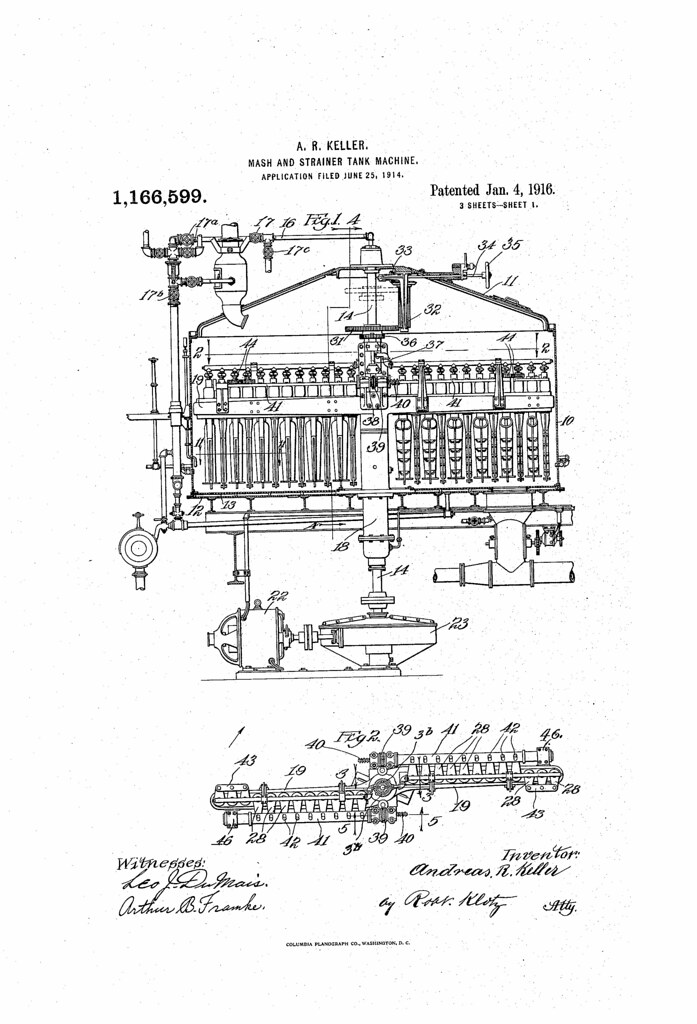
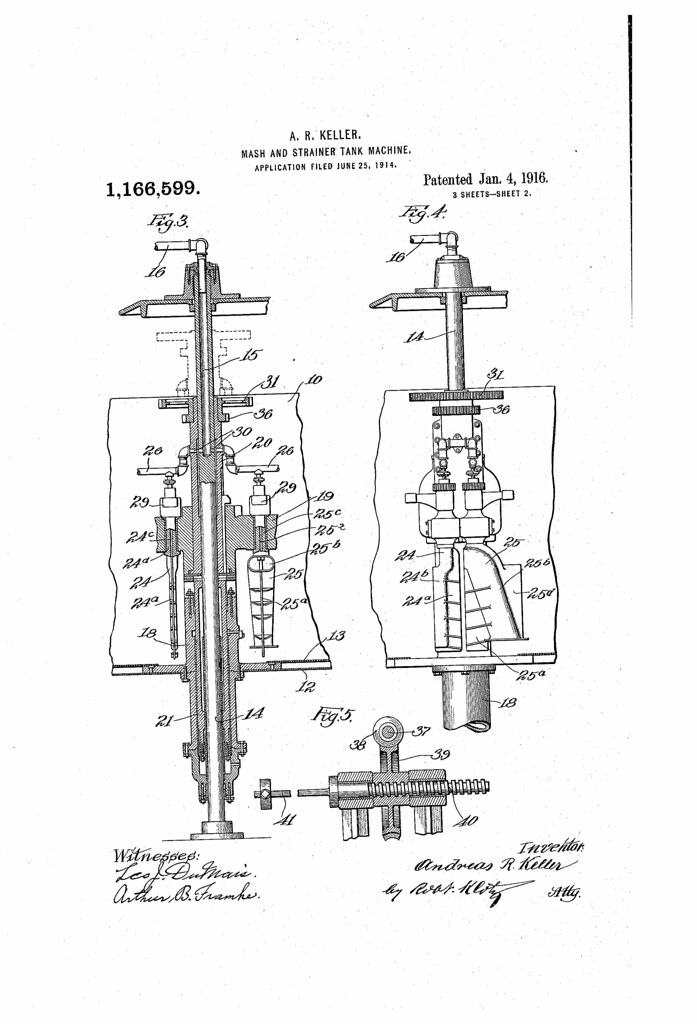
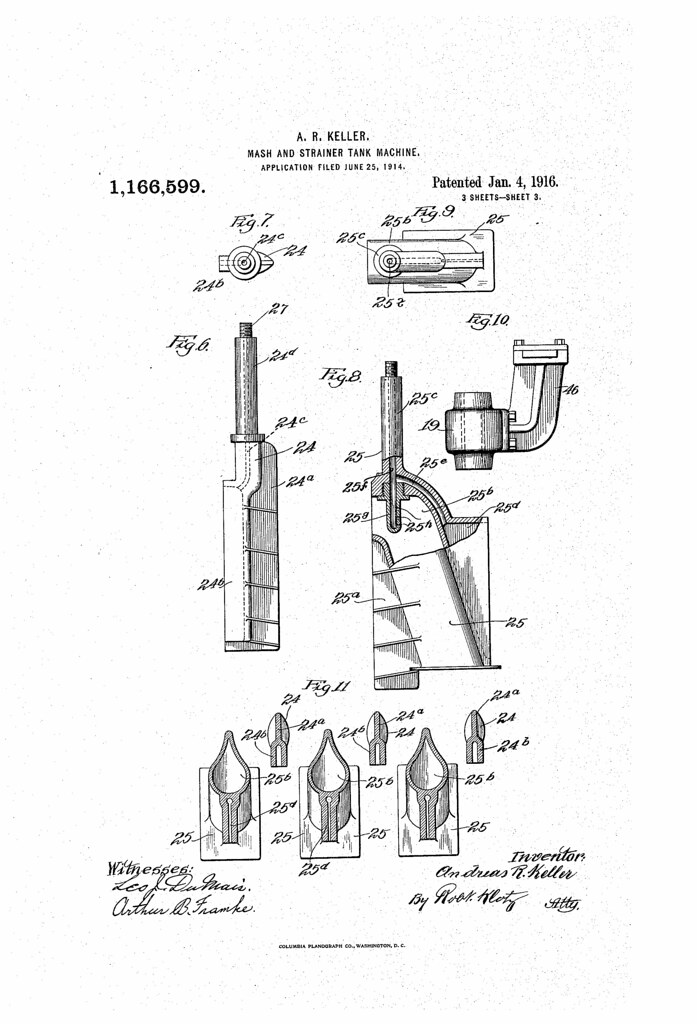
Today in 1916, US Patent 1166599 A was issued, an invention of Andreas R Keller, for a “Mash and Strainer Tank Machine.” There’s no Abstract, but in the description, the overview states the “invention relates to new and useful improvements in mash and .strainer tank machines, and is designed to increase the efficiency of such machines by improving the mixing, percolation, heating or cooking, straining, and drawing-off features, thereby overcoming the predominant and objectionable disadvantages of the machines now in use.”
US1166599-0
US1166599-1
US1166599-2

Filed Under: Breweries, Just For Fun, Politics & Law, Related Pleasures Tagged With: Brewing Equipment, Patent, Science of Brewing

Patent No. 3295988A: Preparation Of Reconstituted Beer

January 3, 2015 By Jay Brooks

patent-logo
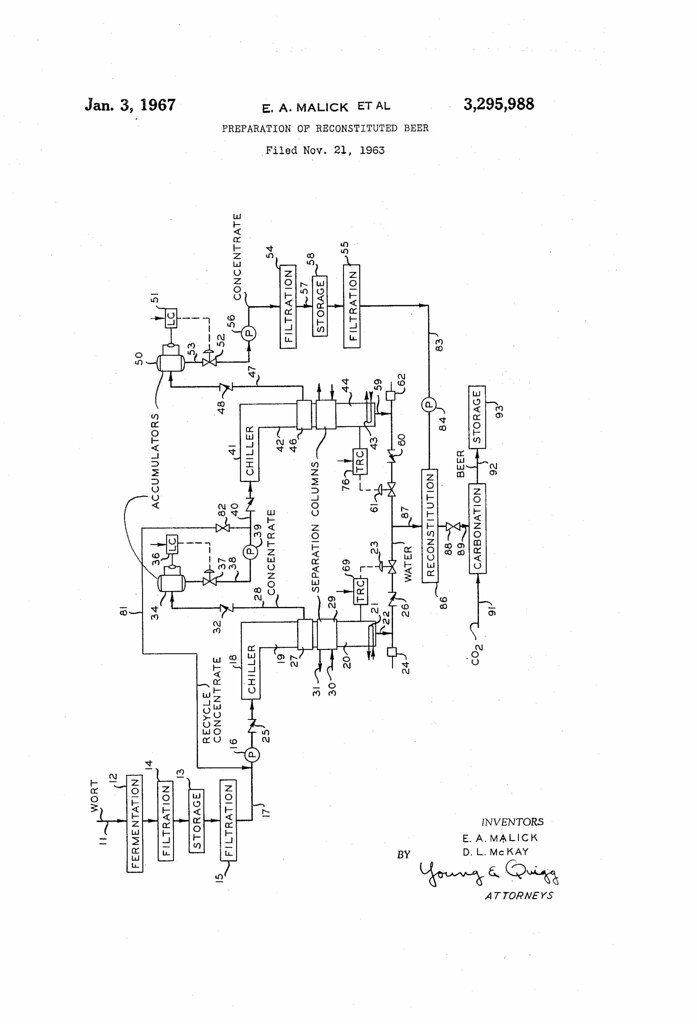
Today in 1967, US Patent 3295988 A was issued, assigned to Phillips Petroleum, for a “Preparation of Reconstituted Beer.” According to the application the invention “relates to a method of concentrating solutions by crystallization. In another aspect it relates to an improved method of using a crystal purification column for the removal of water from beer. In a further aspect it relates to an improved method of concentrating aqueous solutions, e.g., beer, and reconstituting the resulting concentrate.”

US3295988-0

Filed Under: Beers, Breweries, Just For Fun, Related Pleasures Tagged With: Patent, Science of Brewing

Patent No. 2967107A: Continuous Fermentation Process

January 3, 2015 By Jay Brooks

patent-logo
Today in 1961, US Patent 2967107 A was issued to Kenneth H. Geiger and John Compton, assigned to John Labott Ltd, for their “Continuous fermentation process.” According to the application the “invention relates to a novel continuous fermentation process for the production of potable beer.”

Figure 1 is a schematic illustrating a type of fermentation vessel which may be used in carrying out the process of the invention indicating typical fittings and controls.
US2967107-0

Continuous fermentation processes have already been utilized in connection with the production of industrial grade alcohols, and the desirability of continuous fermentation in the production of potable beer has long been recognized in the art. The principal obstacle to the adaptation of existing continuous fermentation methods to the production of potable beer has been the inability of such processes to provide adequate control of flavour. As is well recognized, the control of flavour is of paramount importance insofar as the production of potable beer is concerned.

The present invention provides a continuous fermentation process in which the control of flavour is readily achieved, and in which a number of additional advantages are to be found in addition to those important ones which might normally be expected to fiow from the conversion of what has previously been a batch operation into a continuous one.

Figure 2 is a schematic fiowsheet illustrating apparatus used for carrying out the process of the invention with one yeast propagation vessel and two alcohol producing vessels in the product formation stage.
US2967107-1

According to the present invention, potable beer is produced by the yeast fermentation of a fermentable carbohydrate which is carried out in stages. A first stage is provided in which aerobic conditions favourable to yeast growth are maintained, and a second stage is provided in which anaerobic conditions favourable to carbohydrate attenuation are maintained. Preferably according to the invention, the yeast concentration in the second stage of the process is maintained substantially constant at a concentration which is in excess of the maximum level normally obtainable or commonly used under batch fermentation conditions. This level of yeast concentration is maintained by separating at least a portion of the yeast from the efliuent of the second stage and recycling it through the second stage.

Operating in this manner, the first stage of the process serves primarily as a continuous yeast propagator under predetermined aerobic conditions while the second stage which may be, and preferably is, carried out in a series of separate series connected vessels serves primarily for ICC attenuation of the fermentable carbohydrates to alcohol under predetermined anaerobic conditions. For convenience hereinafter, we refer to the first stage of the process as the yeast propagation stage and the second stage as the product formation stage.

The inherent advantages of the continuous fermentation process described above are manifold, and of substantial practical importance. For instance, the growth rate of yeast and feed rate of fermentable substrate are equillbrated and controlled under steady state conditions in the first stage, so that the extent or rate of metabolism unconnected with yeast cell growth and/or reproduction is not critical. The maintenance of any predetermined high yeast concentration in the second stage is independent of flow rate, while, provided a relatively high concentration of yeast is present in the second stage, the rate of product formation will be for all practical purposes independent of yeast growth and, provided the substrate is satisfactory, almost entirely dependent on total quantity of yeast present and temperature.

Because the process of the invention makes for more efiicient substrate utilization, less is used for yeast production than in normal batch fermentations.

Furthermore, a very rapid fermentation is possible, with a holdup time appreciably less than in other conventional fermentation systems, batch or continuous, without concommitant adverse eifects on the quality of the product.

Figure 3 is a general schematic fiowsheet illustrating the process of the invention as it would be carried out using four separate vessels in the product formation stage.
US2967107-2

Filed Under: Beers, Breweries, Just For Fun, Related Pleasures Tagged With: Patent, Science of Brewing

Skunked Beer: Hide Your Shame

November 18, 2014 By Jay Brooks

skunk-left
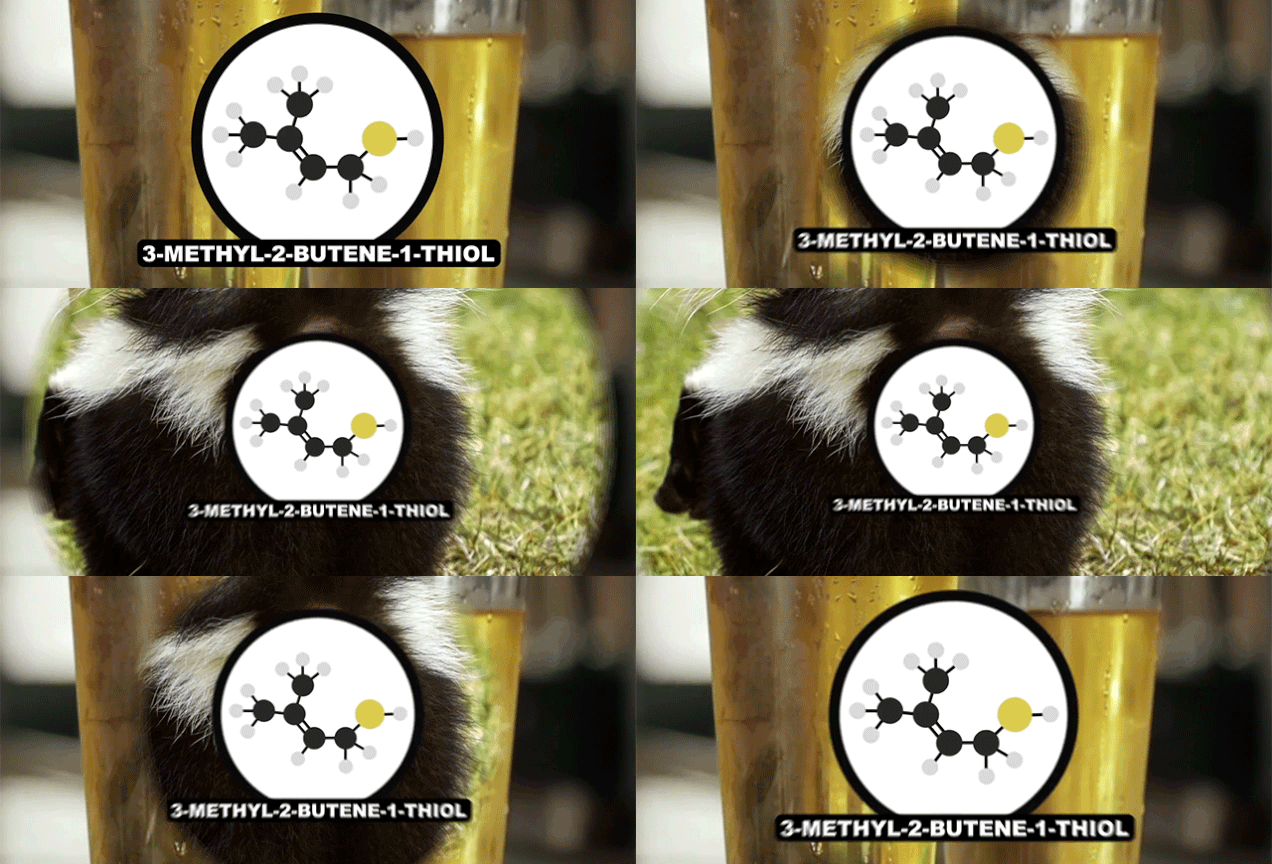
Wired magazine had a short article today giving a basic overview about how beer gets lightstruck, entitled What’s Up With That: My Beer Tastes Like a Skunk’s Bathwater.

lightstruck-chemistry

It’s a fairly basic explanation of the process of a beer becoming lightstruck — often called skunky — written after interviewing Roger Barth, author of the textbook, the Chemistry of Beer. The author even takes a little thinly-veiled swipe at Corona. “This could explain why certain clear-bottled brands suggest you squeeze a lime into their beer to mask the skunk before taking a swig.” But it was the final sentence that had me in stitches. “But if you must, for reasons I will never understand, drink a Heineken, I suggest you get it on tap and hide your shame in a dark corner of the bar.”

skunked

Filed Under: Beers, Just For Fun Tagged With: Humor, Science of Brewing

Brewing: Love & Talent With Peter Bouckaert

November 13, 2014 By Jay Brooks

new-belgium-new
You’re probably familiar with Ted Talks, but there’s also independently organized Ted events, known as TEDx. Recently Peter Bouckaert, the brewmaster at New Belgium Brewing gave one at TEDxCSU, the Fort Collins extension of the talks. In the talk, “[h]e explains his personal journey of challenging limitations to “brew” together a life of creativity,” and the YouTube page describes Peter as having “made a career through utilizing innovation and working outside the box.”

A Belgian native, he is a Biochemistry engineer, with a specialization in Brewing and Fermentation technology from the University of Ghent, Belgium. Before joining New Belgium in 1996, and moving to the US, he worked in the Belgian brewery world in breweries with difficult to pronounce names like Zulte and the world renowned Rodenbach. He was the 2013 winner of the Russell Schehrer award for innovation in Brewing.

It’s only a little longer than fifteen minutes. I only wish it was longer. Enjoy.

Filed Under: Beers, Breweries, Just For Fun, Related Pleasures Tagged With: Science of Brewing, Video

A Love Story: Brewing Yeast & Fruit Flies

October 19, 2014 By Jay Brooks

fly
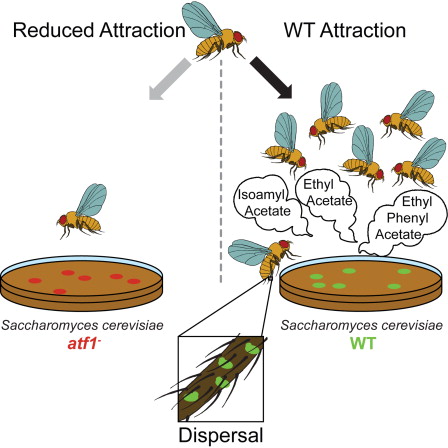
There was an interesting story posted on Popular Science, specifically their BeerSci series. They did a great job of spinning the story as a love story, albeit an unusual one between fruit flies and brewer’s yeast, especially since the original title of the study they’re reporting on was The Fungal Aroma Gene ATF1 Promotes Dispersal of Yeast Cells through Insect Vectors. But it is, and in How Flies Are Responsible For Beer’s Tasty, Fruity Smells, they detail how,”[i]n a series of experiments, biologists from several institutes in Belgium demonstrated that brewer’s yeast makes fruity, floral smells to attract fruit flies. In the wild, yeast might live on rotting fruit and entice flies to come to them there. Yeast and flies’ relationship benefits them both, the biologists found. Previous studies have found that eating yeast helps fruit fly larva develop faster and survive better. This new study found that fruit flies help spread yeast to new environments, like a bee spreading pollen.” In effect, their study demonstrates “the co-evolution of two species.”

Here’s the summary from the original, published in Cell Reports.

Yeast cells produce various volatile metabolites that are key contributors to the pleasing fruity and flowery aroma of fermented beverages. Several of these fruity metabolites, including isoamyl acetate and ethyl acetate, are produced by a dedicated enzyme, the alcohol acetyl transferase Atf1. However, despite much research, the physiological role of acetate ester formation in yeast remains unknown. Using a combination of molecular biology, neurobiology, and behavioral tests, we demonstrate that deletion of ATF1 alters the olfactory response in the antennal lobe of fruit flies that feed on yeast cells. The flies are much less attracted to the mutant yeast cells, and this in turn results in reduced dispersal of the mutant yeast cells by the flies. Together, our results uncover the molecular details of an intriguing aroma-based communication and mutualism between microbes and their insect vectors. Similar mechanisms may exist in other microbes, including microbes on flowering plants and pathogens.

Graphical_Abstract

You can also read the entire study as a pdf, but to get a sense of what it all means, read Francie Diep’s How Flies Are Responsible For Beer’s Tasty, Fruity Smells and keep in mind her warning from the outset. “Sorry, but brewer’s yeast did not evolve for you.” Perhaps not, but at least we can still reap the benefits of the relationship between those fruit flies and the yeast used to create delicious beer.

beersci-logo

Filed Under: Beers, Just For Fun, News, Related Pleasures Tagged With: Science, Science of Brewing, Yeast

Brewers For Clean Water

October 14, 2014 By Jay Brooks

water
There was interesting article a couple of days ago on Newsweek, entitled Craft Beer Brewers Team Up to Improve Water Standard about a group of breweries partnering with the “Natural Resources Defense Council (NRDC), a New York–based environmental group, to support stricter regulations on water pollution.” At least forty breweries are currently signed on as “Brewers for Clean Water,” including Lagunitas and Sierra Nevada Breweries.

According to Newsweek:

The NRDC and the brewers, including the California-based Lagunitas and Sierra Nevada brewing companies, are asking citizens to write to the Environmental Protection Agency (EPA) to finalize a proposed rule that would give federal government more latitude to enforce the Clean Water Act. The agency is currently considering public comments until November 14, before putting the finishing touches on the fine text of the rule, known as the “Waters of the United States.”

The NRDC also created a video about the issue of water.

save-water-drink-beer

Filed Under: Beers, Breweries, News, Related Pleasures Tagged With: Environment, Science of Brewing, Water

How A Modern Brewery Operates

October 7, 2014 By Jay Brooks

brewhouse
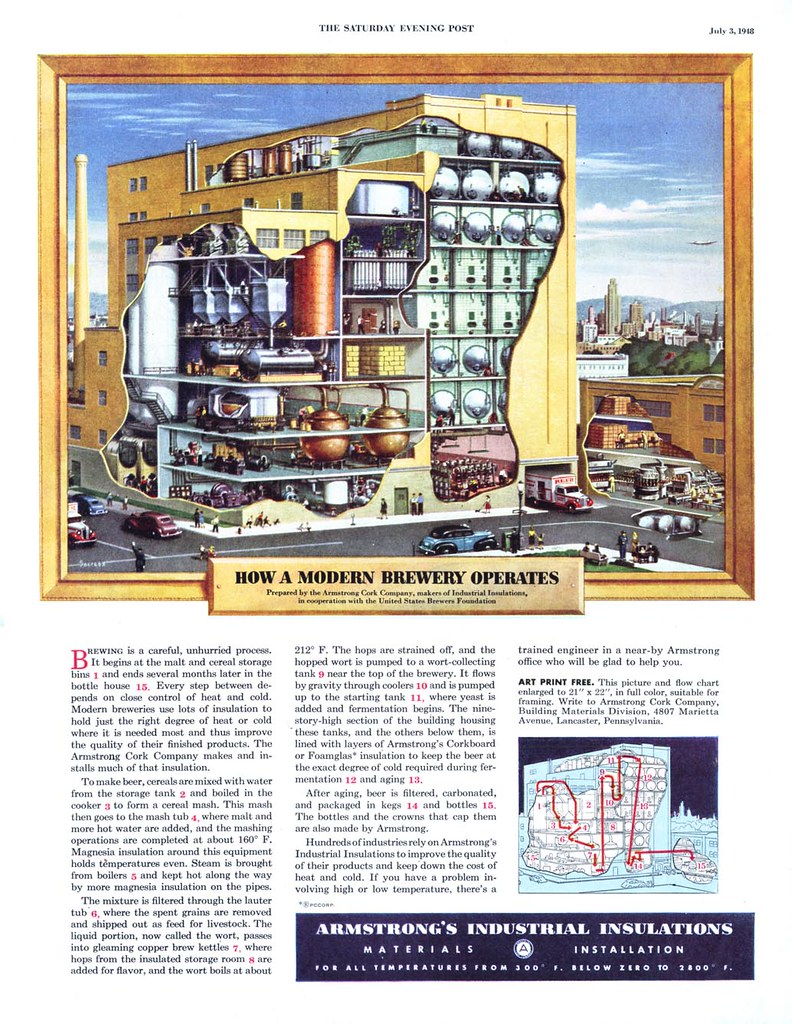
Here’s another fascinating artifact of the 1940s, by a little-known artist, Frank Soltesz. “How a Brewery Operates” was one of around 29 cutaway illustrations he did for a client, Armstrong’s Industrial Insulations (specifically their Armstrong Cork division). The ads were produced between 1947 and 1951, and ran in the Saturday Evening Post, each one designed to show how Armstrong’s products were used in a wide variety of scenarios. Apparently you could even send away for a 21″ by 22″ print, which was, as the ad says, “suitable for framing.” “How a Brewery Operates” ran in the Post on July 3, 1948. It can viewed full size here. You can also see many more of his cutaways at Full Table or Past Print.

How-Modern-Brewery-Operates

Filed Under: Art & Beer, Breweries, Just For Fun Tagged With: History, Science of Brewing

« Previous Page
Next Page »

Find Something

Northern California Breweries

Please consider purchasing my latest book, California Breweries North, available from Amazon, or ask for it at your local bookstore.

Recent Comments

  • Ernie Dewing on Historic Beer Birthday: Charles William Bergner 
  • Steve 'Pudgy' De Rose on Historic Beer Birthday: Jacob Schmidt
  • Jay Brooks on Beer Birthday: Bill Owens
  • Steve 'Pudgy' De Rose on Beer Birthday: Charles Finkel
  • Steve 'Pudgy' De Rose on Beer Birthday: Bill Owens

Recent Posts

  • Beer In Ads #5125: Bowler Brothers’ Bock February 22, 2026
  • Beer Birthday: Fred Bueltmann February 22, 2026
  • Historic Beer Birthday: John Emmerling February 22, 2026
  • Beer In Ads #5124: Möerlbach Bock February 22, 2026
  • Historic Beer Birthday: George M. Biner February 22, 2026

BBB Archives

Feedback

Head Quarter
This site is hosted and maintained by H25Q.dev. Any questions or comments for the webmaster can be directed here.