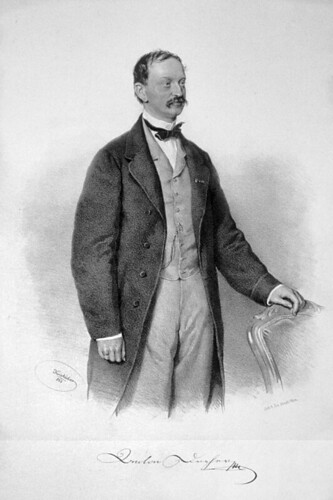
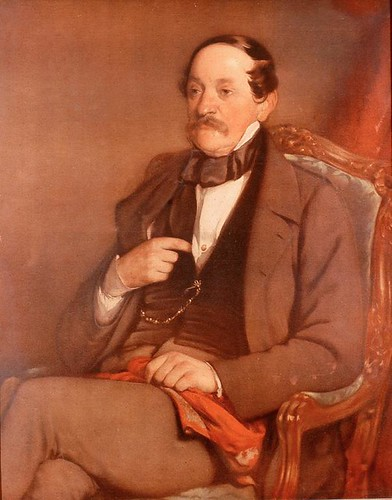
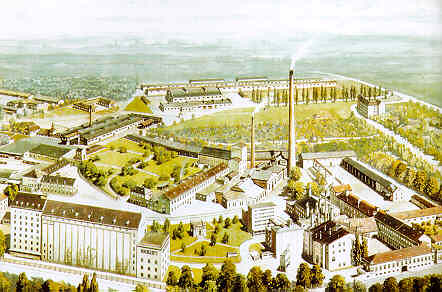
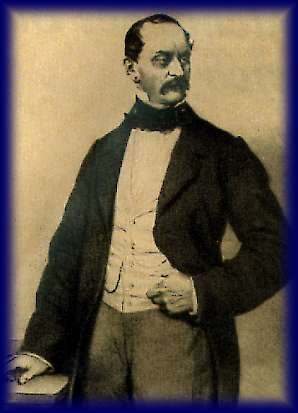
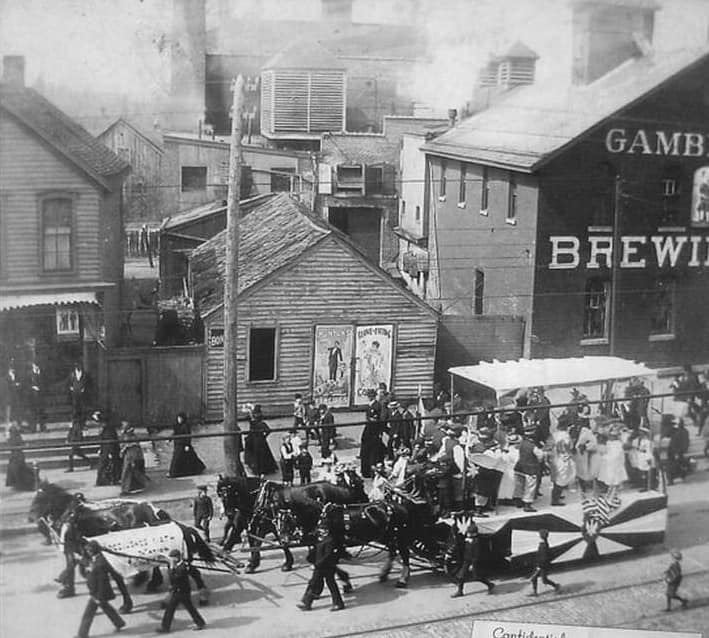
Today is the birthday of Thomas Dawes (April 8, 1785-February 11, 1863). He was born in Ambleside, Cumbria, England, but emigrated to Canada in 1808, eventually settling in Montreal. After working in breweries, he founded the Dawes Brewing around 1811 and it remained in the family until 1952.
This biography of Dawes is from the Musee de Lachine website in Montreal, Quebec’s exhibition on Black Horse Beer entitled “Pour boire il faut vendre” (To get a drink you have to sell):”
Born in Ambleside, England, Thomas Dawes (about 1775-1863) was the eldest of six children. He arrived in Canada in his early thirties, in 1808. In 1811, he settled in the area of Montréal called Côte des Argoulets (today’s Verdun borough), where he found work at a brewery run by Joseph Chapman. The brewing business suited him, it seems, since it became his lifelong career.
Thomas Dawes married Charlotte Weller in 1817, with Joseph Chapman and James Ogilvie as witnesses. The Dawes and Ogilvie families appear to have been friends. The connection was confirmed a few years later when, on April 21, 1826, Thomas Dawes and his associate Archibald Ogilvie bought from Stephen Finchlay a parcel of land southwest of Montréal, near what is now 28th Avenue in Lachine. Banking on his experience, Dawes set out to operate a farm and a brewery on the 4-acre by 30-acre lot.
This account of the brewery and the Dawes family is a Google translation from “Historie du Quebec:”
The name Dawes evokes one of the most famous breweries in Quebec. It was in 1811 that Thomas Dawes founded the Dawes Brewery, which was Lachine’s first industrial enterprise. Dawes is the third brewery on the island of Montreal, after the Molson brewery , founded in 1786, and the Dunn brewery , which appeared in 1809.
The Dawes Brewery is a family business, and no less than four generations of Dawes manage it, before selling the company to Canadian Breweries.
After Thomas Dawes, his sons James P. Dawes and Thomas A. Dawes took over. The third generation is represented by Andrew J. Dawes and James P. Dawes Jr. The fourth, by Norman Dawes, who has run the brewery for decades. But he sold it in 1952.
The Dawes were involved in the development of Lachine. Indeed, Thomas A. Dawes was mayor of Lachine from 1868 to 1869, while Andrew J. Dawes held this position from 1888 to 1893. It was the Dawes who funded the foundation of the Lachine General Hospital and of several churches , the tram network and the installation of the first Lachine telegraph line.
In addition, the Dawes family was among the founders of the Société d’Assurance Automobile du Québec , created in 1904 under the name of the Automobile Club of Canada . Andrew J. Dawes also headed Bell Canada, the Merchant Bank and other large companies. In addition, the Dawes imported and raised black percherons and contributed to the improvement of this horse breed. It will be remembered that it was Percherons who ensured the delivery of the beer and that they thus became the symbol of the Dawes brewery thanks to Black Horse beer .
In 1862, the Dawes built their imposing family home in Lachine (which was not sold until 1940). Around the Dawes area, large fields were devoted to the cultivation of barley and hops.
The decline of the Dawes brewery began in 1909, when sixteen Quebec breweries merged into the National Breweries Ltd. consortium. But the Dawes Brewery survived this ordeal, even if the company felt the effects of American prohibition in the 1920s. In 1939, it became the Dawes Black Horse Brewery, recalling its most famous beer.
In 1944, the Dawes proposed a merger with Molson, but the latter refused for fear of establishing a monopoly. The National Breweries Ltd. consortium was finally sold in 1952. It was bought by Canadian Breweries . The group is renamed Dow Brewery (moreover, the Dow Brewery had already existed for years, it was the designation for the whole consortium). The Dawes Black Horse Brewery disappears, as does the great Dawes dynasty. The Dow has long become one of the most popular brands among Quebecers, but that’s another story.
Today is the birthday of John F. Betz (April 8, 1831-January 16, 1908). He was born in Mohringer, Germany and emigrated with his family when he was an infant. His sister Elizabeth married D.G. Yuengling, and he learned brewing there from an early age. When he was 24, he bought a brewery in New York, but moved to Philadelphia in 1867, and bought what was originally the Robert Hare & J. Warren Porter Brewery when it opened in 1775. It was the William Gaul Brewery, but Betz changed it to the John F. Betz Brewery, though after his son joined the business in 1880, it became known as the John F. Betz & Son Brewery. The brewery survived prohibition, but closed for good in 1939.
John F. Betz came to Philadelphia in 1867 from New York, where he had been brewing for fourteen years. He took a job at the Gaul Brewery until purchasing it in 1880. Prior to Betz’s ownership, only ale and porter were brewed. Betz commenced brewing lager beer as well. John F. Betz became very active in the real estate market in the city. One of his other concerns was a beer garden at Riverside above the Wissahickon Creek on the Schuylkill River. He put in a line of little steamboats to carry his patrons up the river from Fairmount Dam. Betz produced an IPA of 6.5 % a.b.v. and an East India Pale Ale at 7.5% a.b.v. Betz’s half-and-half was a mixture of two-year old ale and stout, and Betz’s Best was a lager that was said to rival Bavarian imports. The Betz brewery reopened after Prohibition and remained in business until 1939.
Brewer. He started as an apprentice in a brewery in 1844, and in 1855 he established his own brewery. John F. Betz then came to Philadelphia in 1867, working at the Gaul Brewery. He bought it in 1880. In that same year he built a state of the art brewery. Gaul had only brewed ale and porter; Betz introduced lager beer. He also invested in Philadelphia real estate. His beer garden at Riverside above the Wissahickon Creek on the Schuylkill River was so popular that steamboats brought patrons up the Schuylkill from Fairmount Dam. His contemporaries claimed that Betz’s Best was a lager that rivaled Bavarian imports. His brewery at Fourth and Callowhill Streets was one of the nation’s largest breweries until it closed during Prohibition. The Betz brewery reopened after Prohibition and remained in business until 1939. Though a Lutheran throughout his life, he was made a Chevalier of the Order of St. Gregory by Pope Leo XIII. His first wife was Sybilla Caroline Betz. He was later married to Anna Helene Berroldinger. Before his death he disposed of his property among his wife, two adult sons, and two minor children to avoid the any conflicts over his will.
This mention of Betz and his brewery in New York is from “Yuengling: A History of America’s Oldest Brewery,” by Mark A. Noon:
D.G. Yuengling’s son David Jr., who would have been Betz’s nephew, worked at the New York brewery, too. In 1884, the name was changed to the Star Brewery, but it closed for good in 1891.
Betz also started a brewery in Jersey City, New Jersey with Henry Lembeck named The Lembeck and Betz Eagle Brewing Company. “The company was incorporated in May 1890. Since 1869, the brewery grew to become the fourth-largest brewery in New Jersey,” but closed due to prohibition.
The Betz brewery in Philadelphia.
This much longer account is from “Philadelphia and Popular Philadelphians,” published in 1891:
The Philadelphia brewery.
I’m not sure if this was a newspaper advertisement or some very favorable coverage, but this was a page from The Times—Philadelphia on May 28, 1893.
Today is the birthday of Leo Van Munching Jr. (April 7, 1926-February 15, 2016). He was born in Rotterdam, The Netherlands, but moved with his family after prohibition. His father, Leo van Munching Sr. started importing Heineken beer under the name “Van Munching & Co., and he and his son built it into a powerhouse imported beer brand. Sales Agents UK has an overview of their business strategy in a short piece entitled Leo Van Munching – The Story of the US Heineken Mogul.
This is his obituary from the San Francisco Chronicle:
Leo Van Munching Jr., whose stewardship of the importing company started by his father made the Dutch-brewed beer Heineken and its low-calorie sibling, Amstel Light, familiar brand names in the United States, died on Sunday at his home in Darien. He was 89.
The cause was heart failure, his son Philip said.
Heineken, which was first brewed in the 19th century, was the first European beer to be shipped to this country after the end of Prohibition. It was Mr. Van Munching’s father, Leo van Munching (the father preferred the lowercase v, the son the uppercase V), who recognized the business opportunity, and persuaded Heineken executives to allow him to represent the brand in the United States.
He arrived from the Netherlands with 50 cases of beer and his young family shortly after the repeal in December 1933 of the 18th amendment to the Constitution that had banned the manufacture and sale of alcoholic beverages. Earlier that year, President Franklin D. Roosevelt had signed the Beer and Wine Revenue Act that legalized (and taxed) beverages containing no more than 3.2 percent alcohol. “I think this would be a good time for beer,” the president declared.
Exports from the Netherlands were curtailed a few years later during World War II, but in 1946, the elder Mr. van Munching established Van Munching and Company as the lone American distributor of Heineken products.
Spurred by the beer’s popularity among American soldiers, who had enjoyed it in Europe, and by an advertising campaign that underscored its cachet as a foreign beer, sales were brisk. In 1951, The New York Times reported that sales of Heineken in the United States totaled more than 4.6 million bottles, an increase of 49 percent from 1950, a period when beer sales as a whole increased by only 1.2 percent.
That was just about the time that the younger Mr. Van Munching went to work for the company, shortly after graduating from college in 1950. He worked closely with his father for a quarter-century, establishing regional offices and, through advertising and marketing, helping to lift American recognition of the Heineken brand.
The Van Munching name grew in prominence as well, largely because of radio ads for Heineken that closed with an announcer saying: “Imported by Van Munching and Company, New York, New York.” By the mid-1970s, Leo Jr. was running day-to-day operations; he was officially named president in 1980.
By then, Heineken had been the best-selling imported beer in America for eight years, and according to Advertising Age, in 1979, it accounted for a whopping 41 percent of all imported beer sales in the country. Under Mr. Van Munching, the family company introduced other brands to the United States (including Grizzly, a Canadian-brewed beer, whose radio ads featured a not terribly well-known comedian named Jerry Seinfeld).
But perhaps more significantly, he increased Heineken product sales: He persuaded Heineken, which had bought the Amstel brewery, then in Amsterdam, in 1968, to begin producing a low-calorie beer for export; it arrived in the United States as Amstel Light in the early 1980s, initially marketed with women as a target.
Beginning in the mid-1970s, he marketed Heineken with television advertising for the first time, focusing on the beer’s distinctive green bottle and a slogan promoting its documented popularity: “America’s No. 1-selling imported beer.”
By the late 1980s, fending off a challenge from Mexican beers that were being marketed to younger drinkers — by then, the decade had minted (and named) a new demographic, yuppies, who gravitated to trendy imports — Heineken changed its advertising direction, which was focused by a tagline: “When you’re done kidding around, Heineken.”
Mr. Van Munching sold his company to Heineken in the early 1990s (he ran it for them until 1993), and when he left, it was still the leading American import. By 1997, however, Heineken had yielded the top spot to Corona Extra. As of 2015, it had yet to reclaim it.
Mr. Van Munching was born in Rotterdam, the Netherlands, on April 7, 1926. His father had been a ship’s steward for the Holland/America cruise line before he began importing beer. His mother was the former Maria Molt.
The family lived in Weehawken, N.J., where Mr. Van Munching attended high school. He joined the Navy, serving in Hawaii at the end of World War II. Afterward, he studied business and management at the University of Maryland on the G.I. Bill of Rights.
In later years, among his many philanthropic donations were gifts totaling $11 million to his alma mater, where Van Munching Hall is the home of the Robert H. Smith School of Business.
And this obituary is from his hometown paper of Darien, Connecticut, the Darien Times:
Leo Van Munching, Jr., who guided Heineken’s decades-long dominance in the US imported beer market, died February 14th after a long illness. The Darien resident was 89.
Born in 1926 in Rotterdam, the Netherlands, Leo and his family immigrated to the United States upon the repeal of Prohibition in 1933. His late father, Leo, Sr., came as a representative of the Heineken brewery and eventually established the independent Van Munching & Company as the sole US importer of Heineken brands.
Leo served as a ‘Seabee’ in the 35th Special Naval Construction Battalion on Oahu, Hawaii from 1944 to 1946. Upon discharge from the Navy, he enrolled in the University of Maryland on the G.I. Bill, earning a degree from the College of Business and Management in 1950.
He then went to work for Van Munching & Company, establishing regional offices in major markets around the country and developing both the brand imagery and the distribution network that led to Heineken’s preeminence in the expanding imported beer segment. He married Margaret (Peggy) Pratt in 1953, and moved his quickly growing family to Chicago and Los Angeles before settling in Connecticut, where he took over as president of Van Munching & Company. He remained in that role until his retirement in 1993.
During his time with Van Munching & Company, no other brand approached Heineken’s position as the largest-selling imported beer. After cajoling the Heineken Brewery to create a low-calorie version of its Amstel brand, Leo guided Amstel Light to the top sales spot in the imported light beer segment.
In recognition of his outstanding contributions and personal dedication to US-Netherlands trade relations, and his promotion of goodwill for the Netherlands in the United States, the Dutch government honored him with The Order of Orange-Nassau in 1982. Six years later, the Netherlands Chamber of Commerce in the US also recognized his role in the expansion of trade between the two countries, presenting him with the George Washington Vanderbilt Award.
Leo’s efforts as a philanthropist – often anonymous – were substantial and far-reaching. Many of his contributions were made out of appreciation for the opportunities he and his family enjoyed in America. He became involved in the restoration of the Statue of Liberty in honor of his mother, Mia, who he said was greatly affected by seeing the statue as an arriving immigrant.
He donated Van Munching Hall, home of the University of Maryland’s Robert H. Smith School of Business, in part to thank the university for its kind treatment of the veterans of World War II. In addition to building the home for the University of Maryland’s business school, Leo was a member of the school’s Dean’s Advisory Council, an honorary trustee of the University of Maryland College Park Foundation Board, and in 2012, was given the Tyser Gottwals Award in honor of his outstanding service to the university.
Leo’s fervent commitment to supporting education led him to a long-standing relationship with Kolbe Cathedral High School in Bridgeport. His support of that school, both as a benefactor and member of the Advisory Board, prompted the Diocese of Bridgeport to honor him with the Order of St. Augustine Medal of Service in 2012. He and Peggy were also strong supporters of the St. Margaret Mary School in the Bronx.
Closer to home, Leo and Peggy established the Van Munching Rehabilitation Unit at Stamford Hospital, which helps people with chronic or disabling illnesses or injuries restore their mobility and independence. The excellent care he received at the New York Hospital/Cornell Medical Center prompted Leo to make a founding donation to the Margaret M. Dyson Vision Research Institute. Leo was also a leadership donor to the construction of the new Darien Library, which opened in 2009. He was an active supporter of several Darien-based charities, and a member of the Wee Burn Country Club.
This plaque hangs at the University of Maryland, Van Munching’s alma mater, which he attended after World War 2.
Today is the birthday of Charles Duff (April 7, 1894–October 15, 1966). He was primarily known as “an Irish author of books on language learning,” although his most famous book was “A Handbook of Hanging,” which also covered “electrocution, decapitations, gassings, innocent men executed and botched executions.” He was an interesting, eclectic person, to say the least, and a couple of years ago Gary Gillman did a nice job summarizing his quirky life in a post entitled “Charles Duff on the Circa-1950s Irish Pub.”
Charles Duff.
But he also wrote a few travel guides, including one called “Ireland and the Irish,” published in 1952. In it, he starts with Irish history and its folklore, in fact spending nearly 100 pages of the 282-page book, before actually suggesting what the reader should see in Ireland.
Duff also had a lot to say about beer in Ireland at the time, and it’s fascinating to see his views over 75 years later. Gillman also analyzes his writing historically and reprints some of his great writing, and you should read that, too, but I’m also sharing my favorite passages from Duff regarding the beer.
In discussing Dublin, Duff attempts to provide an image of the typical modern Dublin pub, and describes a place I’d certainly like to visit.
The atmosphere is cocktailish, the seats are most comfortable, the carpets soft. I did not find the drinks or service any less efficient, nor, I must say in fairness, any more efficient than in the old days when, before Dublin was really awake in the morning, a kindly and sympathetic barman diagnosed your hangover and might prescribe, as he did for me on one occasion, a seidlitz powder, telling me not to drink anything alcoholic before noon, when he recommended a dozen oysters and a bottle or two of stout “to settle the inside and get back the feelings of a Christian.” Today the atmosphere is convivial and friendly, and you will get a good drink there. But when you go out into the street you will not have the feelings we had after a session there. I think the main difference is that in the old days the drinkers in ‘Davy Byrne’s’ had a higher opinion of one another than they have now. And in the old days you sat on any sort of old chair with a pint in front of you on a very plain table and knew that there was no other pub quite like this. It is almost ill- mannered to make the comparison, and perhaps unfair to the present house which, after all, is not responsible for the age in which we live.
Another interesting insight about Dublin, is that you should read some Joyce before your visit.
It is not a bad preparation for a visit to Dublin to read James Joyce’s Dubliners, Portrait of the Artist as a Young Man, and Ulysses—in that order if you have not already read Joyce. On your second visit, or perhaps on some later occasion, you can have a try at Finnegan’s Wake, which a Dublin friend assures me is best read by moonlight as you lean over one of the Liffey bridges, and preferably while in that state of imaginative gestation to which a reasonable consumption of the wine of the country—Guinness’s Stout—is conducive. But you will not need any of this preparation to tell you that Dubliners are not always easy people to understand, and experience of Ireland can lead you to the conclusion that it is more difficult to grasp and analyse the mentality of the Dubliner than of any other kind or class of native. For one thing, Dubliners are a more mixed breed than you will find anywhere in Ireland, because Dublin has been a cosmopoli- tan community longer than any other in Ireland. This ‘town of the ford of the hurdles’ had its original Picts, Celtic Irish, its Norsemen, its Normans and then its English as the principal elements in its ethnic constitution. It has also had a generous sprinkling of the adventurous; and of the adven- turers, military, political and commercial, who invariably find their way to promising territories. In Dublin you will find surnames which come direct or are derived from those of almost every country and race in Europe; one cannot say this of any other Irish city or town.
Duff’s other travel guide was called “England and the English,” in which he followed a similar format as his Irish guidebook. This one was published a few years later, in 1955. Gillman also analyzes Duff’s English writing, too, in a two-part post entitled Charles Duff Eulogises the English Pub – Part I, which primarily provides context and background to the 1950s climate in which Duff was writing. But in Part II he tackles Duff’s take on the Eglish pub.
But I’m more interested in just sharing his stories. Like his previous work, it is filled with interesting anecdotes about like in England, with this one from an experience in World War II involving beer and cider being particularly funny.
By way of final warning, I can tell of an episode I am not likely to forget. There was a shortage of beer in the last years of the Second World War when I was staying at the cottage in Devon. That did not greatly worry local people; they drank their local cider. But very often the American troops stationed in the neighbourhood suffered distress from the lack of alcohol and (I suspect, somewhat to their disgust) were driven back on cider, which they contemptuously regarded as a soft drink 1 Friendly patrons of the pub advised them to ‘take it easy’ until they got used to it. But those hearties just laughed, possibly regarding the civilian adviser as needlessly timid; and they just went ahead. At about the third mug the fun began then the cider started to have effect. Another mug or two and the balloon went up. The usual effects of strong alcohol were felt : in this case of an alcoholic beverage to which those strong, healthy men were quite unaccustomed. We all felt sorry for them, and for their poor heads next day. And as, one by one they rolled off, the locals smiled and called for another mug saying: “Don’t it just show ‘ee !”
My friend would often reminisce and philosophize about cider, telling me that farm-workers used to have little barrels (he later showed me his; it held about a pint and a half) which they took with them to their work, but that the young genera- tion know nothing of this. He thought that modern cider is better and purer than that of his youth. He had known of men who drank themselves to death on cider, but insisted that this is rare; because, he said, cider is one of those rare drinks which carries its own safety-point and, when that point has been reached depending on the drinker’s capacity and head there is no inclination to drink any more. “How very con- venient!” the conservative drinker will say. The illustrious may comment: “How awful! ” There it is.
Duff discusses pubs more generally when covering the “prosperous market-town of Bishop’s Stortford (about thirty miles from London) is on the River Stort, which forms the boundary with Essex.”
It was precisely this easy-going atmosphere which I liked about Bishop’s Stortford. With it goes a great variety of friendly pubs Herts is a good county for beer some of which confront the traveller unexpectedly, and inside are found to be just the sort of typical little country pubs one reads about. You can find a pub almost anywhere in the town. There are the major houses such as the ‘George* and the ‘Chequers’, but I felt attracted by old names such as:
The Feathers
The Falcon
The Anchor
The Swan
The Grapes
The Reindeer
The Boar’s Head
The Half Moon
The Rising Sun
The Castle The Royal Oak
The Bull
The Fox
The Bricklayers’ Arms
most of them with their colourful, interesting signs. The names I have listed do not exhaust the possibilities of Bishop’s Stortford, and merely represent what I recall easily. The little ‘Bricklayers’ Arms’ on the road to Hadham had just received a fresh coat of paint the last time I was there. I thought it looked a very beautiful little pub from outside. Inside I was not disappointed: the beer was delicious, and Mrs. Morgan, the landlady, a great personality whom I am not likely to forget.
I should like to dwell on these pubs, some of which are very old, because of their importance as an institution of considerable import in the social fabric of this country. Hertfordshire, and, indeed, all of this eastern area, can provide examples of more than ordinary interest. At St. Albans there is the ‘Fighting Cocks’, which is said to be the oldest inhabited licensed house in England. Thomas Burke mentions A.D. 795 as the date of its foundation. “The traveller by car who takes the Great North Road the historic highway linking London with Edinburgh will come upon many pub signs which will inevitably attract his attention and often make him stop for a closer scrutiny. A little conversation with landlords and know- ledgeable local people will quickly show that the English public-house (as we usually call it now), with which one may include the terms ‘inn’ and ‘tavern’, embraces a vast social his- tory that can be traced back to Saxon times. For over one thou- sand years the house which provides food and drink for the traveller and wayfarer, and a centre or dub for local people, has been a part of English life. If I have not mentioned the subject until now, it is not because other areas of England are less rich in public-houses than this eastern part, but merely that it falls in more conveniently at this stage. What I say about the pubs here can be paralleled for most parts of England and, as it is, I can deal with it only in the most summary way. Take, for example, the ‘Letchworth Hair at Letchworth, formerly a manor-house and, some may say, too much of an hotel to be considered as a ‘typical’ pub. It is mentioned in Domesday Book. And the ‘Sun’ at Hitchin, which was used by the Parliamentarians during the Civil War (1642-1648), and, in 1745, was the place in which North Hertfordshire men enrolled for the Resistence Movement that was to face the advancing army of the Pretender. Some of these old buildings are architecturally and artistically extremely interesting, externally or internally, and sometimes in both senses. As we move northwards, a slight detour takes us to Buckden and Huntingdon, both in Huntingdonshire. The first town has the ‘Lion’ with a lounge beautifully adorned by some magnificent oak beams; the second town has the ‘George’, with its long frontage and a lovely row of fifteen windows. Stilton, where one of the world’s great cheeses is made, has the ‘Bell’ dating back to the spacious days when men travelled on horseback, more often than not in companies in order to be able to cope with the activities of such gentry as Dick Turpin. Lincolnshire has some noteworthy houses: the ‘George’ at Stamford where, in 1746, William Duke of Cumberland put up after his victory over Bonnie Prince Charlie at Culloden; and the curiously named ‘Ram Jam Inn’, a haunt of Dick Turpin and his men. At Grantham there is another ‘George’, visited by Charles Dickens in 1838 and about which he wrote to his wife, “. . . the most comfortable inn I ever put up in”. In Grantham there is also the ancient ‘Angel and Royal’ with seven hundred years of history behind it and originally a favourite house of the Knights Templars. Kings held their courts there; the present building dates from about the middle of the i4th century. These few dips will indicate the scope of the subject, but I think I have said sufficient to show the reader that the English pub is a very old, very strong institution and in every way worthy of his attention. I have never yet entered a pub, however humble, from which I did not emerge refreshed in mind and body, and I think that a good argument could be put up in favour of the pub as the most characteristic institution of the people of England: of the men, that is, for it is only in comparatively recent years that women are frequenting licensed premises with the approval of the younger generation of men, of course, but often with the strong disapproval of old regulars. To these it is unbecoming to the spirit and atmosphere of their club that lively and frivolous girls the more attractive they are, the worse it is ! often in slacks or even shorts, should lower the serious tone of the establishment with their disconcerting jazzing, crooning and giggling. This little survival of Puritanism is quickly passing and in many places no longer exists. It will soon be gone. The pub will survive by adapting itself to the social environment: as it always has done in the past.
He also stresses that one should never discuss politics or religion in a pub, good advice now as then.
Again it comes back to the desire for political stability, for if there is one thing that the English have learnt by bitter experience, it is that nothing can cause greater disturbances than religion, especially when used for a political end. A man’s religion is his own affair. Hence, in conversation it is never even discussed! The unwritten law of the English pub is: No religion.
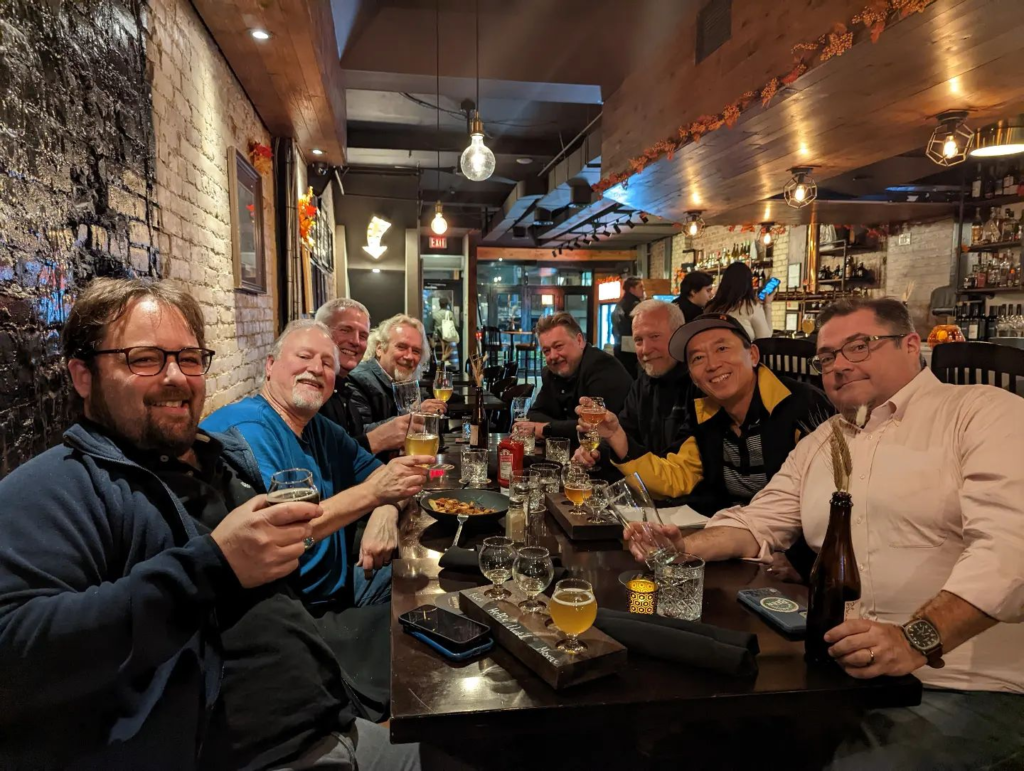
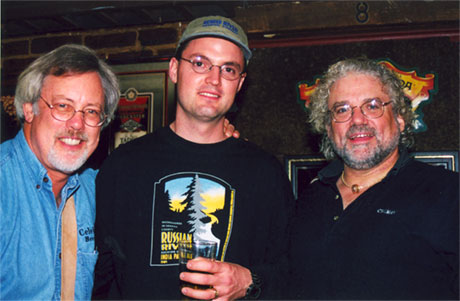
Today is the 65th birthday of Alex Puchner, who’s the Senior Vice President of Brewing Operations, and its first brewmaster, for the BJ’s Restaurant Brewhouse chain. He started with the chain in 1996, a co-founder, when they built their first brewpub. Alex had been homebrewing for a decade before that first brewery. There now have 174 locations in 23 states, although they backed away from their brewpub model and contract most of their beer, but have added lost of guest taps and good bottled imports, including a great selection from Belgium. Alex has been very active over the years in the beer community and the CCBA, and has been great for beer in California, providing many people’s first introduction to craft beer with BJ’s. Join me in wishing Alex a very happy birthday.
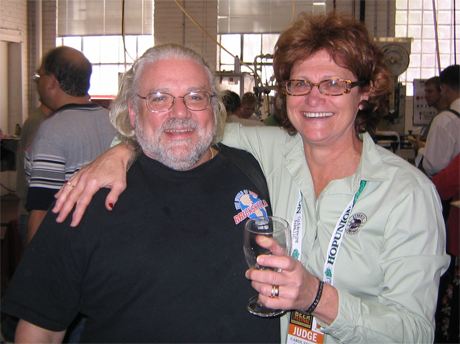
Me and Alex during World Beer Cup judging in Minnesota.
Alex with Greg Hall, formerly with Goose Island, during a visit to San Francisco a few years ago.
Alex in the brewhouse (Note: purloined from Facebook).
Today is the birthday of George Ehret (April 6, 1835-January 21, 1927). He was born in Hofweier, Buden, Germany but followed his father to America, arriving in New York in 1857, age 31. Having been trained as a brewer, he worked for a few years and then founded his own brewery, the George Ehret Brewery, which was also known as the Hell Gate Brewery, in 1866. It stopped producing beer in 1920 due to prohibition and limped along until 1927, when it closed due to his death.
The entry at Find a Grave has just a couple of sentences. “Beer Brewer, he established The Hell Gate Brewery in 1866 in New York City. It became one of the nation’s largest breweries, producing 602,000 barrels in 1900. When he died, his estate was valued at $40,000,000.”
100 Years of Brewing has a much fuller account of Ehret and the Hell Gate Brewery:
George Ehret’s Hell Gate Brewery, New York City.
The Hell Gate Brewery was established by George Ehret in the year 1866; hence, at a time when the annual production of malt liquors [in the U.S.] had increased to 5,115,140 barrels. He had then just attained the age of thirty-one years, the date of his birth being April 6, 1835. Nine years before the establishment of this brewery, Mr. Ehret came to America (1857) to join his father, who had emigrated from Germany in August, 1852.
Mr. Ehret, being a thoroughly practical brewer, strictly devoted to his calling, had not long to serve in the brewery of A. Hupfel before he rose to the foremanship and gained the full confidence and friendship of his employer. When he made known his intention to start a brewery for himself, Mr. Hupfel, a man of generous instincts and philanthropic disposition, at once promised and, at the proper time, gave his support and assistance to the new enterprise.
The site selected by Mr. George Ehret for his brewery was at that time of a decidedly rural character. It was opposite a dangerous passage in the East river, which had been designated “Hell Gate.” From this fact Mr. Ehret decided to name his brewery “The Hell Gate Brewery.”
The building in which he began brewing was erected under his supervision on the lower part of the block, between Ninety-second and Ninety-third streets and Second and Third avenues, and its interior appointments were completed at the beginning of the year 1867. This building is no longer standing. It was succeeded by another in 1871, which formed the nucleus of the establishment that now covers the greater part of an entire block. It is at present almost hidden by the over-towering brewery buildings which have sprung up around it in the course of a quarter century, and a full view of it can only be gained from the quadrangular yard, of which it forms the interior side, the buildings flanking it being the offices and the storehouse, both fronting on Ninety-second street.
Mr. George Ehret, from the very beginning, aimed at the brewing of a beer as nearly like the best quality of Munich lager as the difference between our water and that of the river Isar would admit. How well he succeeded in this may be inferred from the popularity which his beer attained in a few years. As has been said, he began brewing immediately after the completion of his plant. At the beginning of January, 1867, the first brew was stored in the cellars; in March of the same year his wagons, freighted not only with kegs, but also, metaphorically speaking, with all his expectations and anxieties, left his yards for the first time to serve his new customers. Five years after that date he sold 33,512 barrels; seven years later, 74,497 barrels, and in 1874 he produced and sold 101,050 barrels — a quantity which twenty-eight years ago was manufactured by but very few of the largest establishments. This growth was then all the more remarkable, because Mr. Ehret’s operations had suddenly been checked for a considerable time on account of a fire which, on the 19th of September, 1870, destroyed the greater part of his brewery, including books and papers. It is owing to this fact that we are unable to give the quantities of beer brewed during the four years preceding the fire.
The year 1870 may be called the second starting point in the growth of Hell Gate Brewery. In a certain sense the fire was not an unmixed evil, especially in view of the fact that the demand for Ehret beer was fast outgrowing the capacity of the original plant, necessitating a considerable extension of the premises and buildings, and many additions to the machinery and other appointments.
As stated above, the amount of beer produced and sold by the Hell Gate Brewery in the year 1874 amounted to 101,050 barrels; in 1880, the production amounted to 220,096 barrels, an increase in six years of over one hundred per cent. Ten years after, in the year 1890, the production amounted to 412,851 barrels, making another increase of almost one hundred per cent for the decade. In the year 1900, the production was 601,000 barrels, showing an increase of about forty-six per cent. This is a record to be proud of, and one that has seldom been equaled in the history of brewing.
This immense production has been attained without any forced efforts to open new channels outside of the limits of the State of New York; although, naturally enough, whenever a demand was shown to exist in outside markets, Mr. George Ehret endeavored to supply it, and thus established a number of agencies. The home demand always proved so great that the idea of engaging in an extensive export trade beyond the sea could not be entertained, save in conjunction with plans for a further enlargement of the brewery premises and increase in equipment.
On approaching the brewery, one is impressed at the very first glance with the unusually large dimensions of the grounds upon which the buildings are erected. In a smaller city this would not be anything worthy of note, but in New York, and especially in that part of it to which we refer, where scantness of territory and an immense and ever-growing population render necessary the utmost economy in the utilization of space (much to the detriment of architectural beauty), such extended premises as those we speak of can not fail to make an impression. The grounds, extending from within a short distance of Third avenue to Second avenue, and from Ninety-first to Ninety-fourth streets, comprise, inclusive of stables and storage buildings on Second avenue between Ninety-first and Ninety-third streets, seventy-five city lots, or one hundred and eighty-seven thousand five hundred square feet.
The main building, an imposing structure, surmounted by a graceful clock tower, fronts on Ninety-third street, extending southward to a considerable depth; it is flanked on either side by lower wings, which, in point of architecture and symmetrical proportions, harmonize perfectly with the principal facade. Ornamental gables, rising from the cornices of every building, enhance the impression of uniformity which, next to utility, was manifestly one of the prime objects of the architect.
100 Years of Brewing was published in 1903, so the rest of the story can be found in Will Anderson’s Breweries of Brooklyn:
George Ehret, once this nation’s largest brewer, passed away in January of 1927 (leaving an estate valued at $40,000,000!). It was beginning to look as if Prohibition would last forever and the executors of Ehret’s estate debated whether they should sell the mammoth brewery buildings on the upper east side of Manhattan. For years they held off but in April of 1935 Col. Jacob Ruppert, Ehret’s neighbor on Third Avenue and 92nd Street, made an offer that the Ehret family just couldn’t refuse. With the sale to Ruppert, the Ehrets had even more money to add to what they’d inherited earlier — but they had no brewery. This problem was solved very nicely by the cash purchase, in July of 1935, of the Interboro Beverage Co. facilities [in Brooklyn]. Although the location was new, the brewery was still very much under the control of the Ehret family. Louis J. Ehret, George’s son, headed the firm, and he was aided by two of George’s grandchildren, George Ehret Burghardt and William Ehret Ottmann. Richard Barthel, brewmaster at the old Ehret plant in Yorkville, also made the move to Brooklyn. Over $200,000 was spent to thoroughly recondition the plant throughout, and by the summer of 1936 Louis J. Ehret had the plant in full production.
Ehret’s Extra Beer and Ale were brewed in Brooklyn for the next 12 years, until 1948, when the company transferred its operations to Union City, New Jersey. Whether Ehret’s moved because of an irresistible offer from Schlitz [who bought the Brooklyn plant] or because the Union City plant seemed preferable is unknown. In any case, move to New Jersey they did, where they remained in operation but three more years.
Today is the birthday of Caspar Eulberg (April 6, 1826-May 19, 1902). There’s very little information I could find about him. He was born in Kreis Westerburg, Hessen-Nassau, which was then Prussia. He married Franciska Rost, also from Prussia, and together they had ten children, six of whom were boys. At least some of them must have worked at his brewery in Galena, Illinois, because for most of its life it was called Casper Eulberg & Sons Brewery. Originally called Math. Meller Brewery when in opened in 1874, it appears Eulberg acquired it in 1885, changing the name to his own, at least until closed by prohibition in 1920. It tried to open after repeal, under the name Galena Brewing Co., but closed for good in 1936.
Here’s an obituary of Eulbert from the American Brewers’ Review:
On October 11, 1886, the Galena Daily Gazette reported that Casper Eulberg and his two sons had launched the Galena Brewery. Eulberg had purchased the long-operating brewery a year earlier, running it as C. Eulberg & Sons, but after only six months the entire operation burned to the ground. Eulberg rebuilt bigger and better, with modern machinery and a larger capacity. He changed the name to Galena Brewery. Within a few years, his flagship beer, Red Stripe, became one of the most popular beers in northern Illinois, southern Wisconsin and Iowa.
Red Stripe’s reign continued until Prohibition shut down the brewery in 1920. When Prohibition ended in 1933, the Galena Brewery reopened under new ownership and relaunched Red Stripe, based on the Eulberg family’s formula. In 1935, it trademarked the Red Stripe label but went out of business one year later.
Today is the birthday of Julius Hermann “James” Griesenbeck (April 6, 1830-February 28, 1877). He was born in Materborn Gutersloh, Germany, but in 1852, when he was 22, his family took a ship to Galveston, Texas, and emigrated to the United States. Initially, they were in Comal County, but Julius, who begn using the first name ‘James,’ moved to nearby Waco, which had been incorporated in 1856. There he founded the James Griesenbeck Brewery in Waco, Texas, in 1870, but it was not successful, and closed just five years later, in 1875. Two years after that, he left his wife and their twelve children, supposedly to look for work, and rented a room above McPherson’s Saloon in Denison, Texas, where he turned his Navy pistol on himself, committing suicide.
Waco, Texas City Hall.
And this is an account of Griesenbeck’s suicide, from Tavern Trove:
Today is the birthday of Edward W. Voigt (April 5, 1844-May 14, 1920). His father was a brewer who founded a brewery, and also trained his son, and sent him to brewing school. He worke din other breweries and in completely different businesses, but eventually worked with his father and ran the family brewery, the Voigt Brewery, in Detroit, Michigan.
Here’s a thorough biography by Burton (though I confess I don’t know who Burton might be):
EDWARD W. VOIGT was an outstanding figure in connection with the development of Detroit, where for more than fifty-five years he was identified with the city’s business interests. Mr. Voigt was born in Daebeln, Saxony, Germany, April 5, 1844, a son of Carl William and Pauline (Beck) Voigt, the latter of whom died in Germany. The father married again in that country and with his wife and only son, Edward W., sailed from Hamburg for Liverpool, England, the latter part of May, 1854. At the latter port they embarked on the ship Malabar and reached New York on the 1st of August. An epidemic of cholera was then raging in New York and, moreover, the father was not in robust health as a result of conditions which he had experienced during the ocean voyage. It seemed better that they leave New York at once, which they did, and went to College Paint, Long Island. When the father had sufficiently recovered to travel they went west, stopping in Toledo, Chicago and Milwaukee, but remained in those cities only a short time, after which they journeyed an to Madison, Wisconsin. In the latter city Carl William Voigt established a small ale brewery, which was converted into a lager beer brewery in 1857, and this business he conducted until 1863, when he removed to Milwaukee, where he soon afterward purchased the schooner Columbian that plied the lakes between Chicago and Buffalo in the grain trade. In 1864 Carl William Voigt removed to Detroit, retaining his vessel interest until December, 1865, when he disposed of same. It was really his intention at this time to return to Germany, but rumors of the possibility of war between that country and France caused him to defer the trip. In 1866 he established a brewery in Detroit and continued to conduct this until 1871, when he leased the plant to his son, Edward W., and returned to Germany, where he engaged in the milling business until his death in that country in 1889. Edward W. Voigt was about ten years of age when his parents brought him to America. His first schooling was received in his native land and after coming to this country he attended the public schools of Madison, Wisconsin, also a business college and for one term was a student at the University of Wisconsin. He had from boyhood worked in his father’s brewery at different periods and early in life had acquired a practical knowledge of the business. In those days it was impossible to brew lager beer during the summer months owing to the lack of familiarity with the theory of refrigeration, so that during those periods of inactivity Edward W. Voigt was able to attend classes. When the weather became cooler, so that the manufacture of beer could be resumed, he again took his place as a brewer in his father’s plant.
After his father disposed of the brewery at Madison in the fall of 1863, Edward W. Voigt concluded he would go to California and try his fortune in that new country. He went by the Isthmus of Panama but on reaching San Francisco found that work as a brewer was difficult to secure. He could not afford to remain idle indefinitely, so shipped before the mast on the barkentine Monitor, plying between San Francisco and north Pacific coast cities. Wages were law and the work not the most desirable. In writing home to his Vol. II-3 parents he had mentioned the character of his employment and his father replied that if Edward W. Voigt wanted to be a sailor he should come back home, as the father had bought the schooner Columbian. Edward W. Voigt returned east, again by the Isthmus route, and took the position of second mate on his father’s schooner. This was during the latter part of 1864. During the winter of 1864-65 Edward W. Voigt studied navigation in Boston, thus equipping himself to command his father’s schooner, and during the season of 1865 he was captain of the vessel, which was sold in December, 1865.
The following year Edward W. Voigt entered the employ of his father in the brewery which the latter had established in Detroit and continued in that capacity until 1871. At this time his father decided to return to Germany, so that the brewery equipment was disposed of to the son, who rented the plant for a term of four years, later renewing the lease for five more years. This was a downright business transaction and the fact that the father and only child were the principals made no difference whatever in the terms of the deal. The son had practically no capital at all and the father was secured by chattel mortgage on the stock and equipment. This was Edward W. Voigt’s beginning in business for himself and at a time when competition was keen, as there were no less than thirty plants in the ale and lager beer line in Detroit, but he was young, energetic and a hustler. Under his management the business began to grow from the very start and before long he was on the rapid road to success, so that in 1882 he purchased outright the entire interest of his father. The high class product that he turned out soon became one of the most popular in the city and the capacity of his brewery grew from three thousand barrels annually to more than forty-three thousand barrels, which was then a larger production than that of any brewery in the state. Mr. Voigt continued the business as sole owner and under his personal management until 1889, when he sold out to an English syndicate, retaining, however, a substantial interest in the new organization. In 1895 he bought back the business and organized the Voigt Brewery Company, of which he became president, and remained as such until the business was closed out on May 1, 1918, as a result of prohibition. Subsequently the plant passed into the hands of the Voigt Beverage Company, which now owns the plant.
While Mr. Voigt was a most successful brewery operator and one of the most prominent men in that industry in Detroit, his activities in other lines were big and valuable factors in the city’s growth. As his business became profitable and his means began to accumulate, he invested in numerous projects that not only brought personal gain but great public benefit as well. He was one of the founders of the Edison Illuminating Company of Detroit in 1886, in which undertaking he was associated with James Scripps, George Peck, Simon J. Murphy and several others. This company had a capital of one hundred and fifty thousand dollars and for fifteen years Mr. Voigt was its vice president. It proved a profitable project from its inception and led to Mr. Voigt’s further connection with various public utilities. He helped in establishing branches of the Edison Illuminating Company at Grand Rapids, Jackson, Sault Ste. Marie and Petoskey, Michigan. Mr. Voigt was formerly the owner of a tract of about one hundred and fifty acres of land on Woodward avenue four miles from the city’s center that he operated as a farm for a number of years. Then as the city began to expand he developed the property into the Voigt Park subdivision, which was laid out in the ’90s. In connection with that project he donated the present Voigt Park to the city. He laid out Boston and Chicago boulevards, as well as Atkinson, Edison, Longfellow and Calvert avenues and Glynn Court, comprising some of the best residential property in the city. Years ago Mr. Voigt purchased what was then known as Moores Bay, a tract of land of about fourteen acres at the foot of Twenty-fourth street, which was covered by six feet of water. This was filled in to the harbor line after nearly forty years of effort and was transformed into a valuable property. In 1919 the same was condemned by the city for dockage purposes. He was an extensive owner of central property and his city realty included his residence on Second boulevard and Cass Park, which was completed in 1886 and was his home until his death. This fine old mansion was built in the days when every detail of material and construction was most carefully considered and everywhere gives evidence of the thorough manner in which such work was done. Mr. Voigt was also one of the founders of the Port Huron Sulphite & Paper Company, which was organized in 1888 and of which he was the president until his death. In 1898-1900 he built the North Western Electric Railway out Grand River road to Northville, Orchard Lake and Pontiac, which is a great feeder now to Detroit and is controlled by the Detroit United Railway. He was likewise the president of the bridge company that built the large bridge between Grosse Ile and Wyandotte in 1912. This bridge connected his large tract of valuable land with the mainland. He was also the president of the Miles Theatre Company. He readily recognized and utilized business opportunities and as the years passed by developed his interests to extensive proportions.
In April, 1871, Mr. Voigt was married to Miss Bertha Dramburg, of Detroit, and they became the parents of four children: Augusta L. and Pauline M., both living at home; Anna Elsa, who is now Mrs. Otto Reinvaldt, of Detroit, and has three daughters; and one son, William F., who married Miss Caroline Halloran, of Detroit, by whom he has a son, Edward W. (II), and two daughters. William F. Voigt, who is the second of the family, and Otto Reinvaldt, his son in-law, were far a number of years associated with the father in business, largely looking after the Voigt interests. Mrs. Bertha (Dramburg) Voigt died in 1890 and for his second wife Mr. Voigt married in 1892 Miss Marion Randall, of Detroit, who passed away in December, 1911. There were no children by this marriage.
Years ago Henry Ford was in the employ of Mr. Voigt for a period of nine years as chief engineer of the Edison Illuminating Company. After prohibition went into effect the Voigt Brewery Company ceased to operate, but the outside interests of Mr. Voigt were extensive and important and made full claim upon his time and energy. In early manhood Mr. Voigt was a democrat, but the party’s stand upon the subject of free trade made him change his allegiance to the republican party, of which he became a warm supporter. He belonged to the Harmonie Society, to the Elks lodge and to the New Grosse Ile Golf Club. Mr. Voigt was one of the original founders of the Detroit Museum of Art. His success came from his own efforts and for many years he was included among Detroit’s strong, substantial business men. He was an unusually well preserved man for one of his years and took a keen interest in everything that pertained to the civic welfare and advancement of Detroit. His contributions to the development of the city were of a most substantial character, making him one of the foremost business men of Michigan’s metropolis. His death occurred May 14, 1920.
Telling the Stories of Detroit Parks also tells Voigt’s story:
As a landowner, he turned his 150 acre farm off Woodward into Voigt Park Subdivision in the 1890’s. We can thank him for Boston Boulevard, Chicago Boulevard as well as several of the surrounding streets west of Woodward.
Raised in Germany, he traveled to America with his folks Carl William and Pauline in 1854 on the trans-Atlantic ship, the Malabar. The trio crisscrossed the Midwest settling in Madison, Wisconsin where his father started the Capitol Steam Brewery. Edward began his education and attended the University of Wisconsin. He achieved the status of Brew Master at age 17. In 1864, the family brewery was sold to Carl Hausmann, a local WI ale competitor. William Voigt moved to Detroit to start a new brewery; his son Edward went on an adventure to California. The Detroit Voigt Brewery was built on Grand River at High Street [today this is around Grand River and I-75 area). Eventually, its 150 ft. chimney would grace the Detroit skyline.
Edward did an apprenticeship as a sailor and became captain of his father’s schooner – the Columbian; a short-lived adventure running the Great Lakes. Father and son would reunite in Detroit in 1871. Nothing was handed to Edward. He rented the Detroit brewery from his father who moved back to Europe. His energy and work ethic resulted in the ability to purchase the entire brewery operation from Carl in 1882. In 1893, his Rheingold beer earned 4 medals in the Chicago World’s Fair.
In 1889, British investors took great interest in purchasing or leasing American brewing facilities. Brewers such as the Stroh family and Anheuser Busch were vocally opposed to this practice. Edward Voigt negotiated the lease of his brewery for the period of 1890-1897. At the end of the contract, he received his business back but without a clean title. He enacted foreclosure proceedings to clear the title and stood in front of the old Detroit city hall to rebid on his business at auction. His creative business practices increased his fortune. He amassed extensive land holdings and was a principal founder of the Edison Illuminating Company which employed Henry Ford.
Around 1902, Voigt donated a rectangular parcel of land at 2nd and 3rd Avenues, Longfellow and Edison Avenues to the city on the condition it would be converted to a park and named for him.
Edward Voigt died at home on May 14, 1920 of a stroke. In 1922, the Voigt estate sold the brewery to a demolition firm who pulled down the chimney with a chain and a truck. The tumbling brick marked the end of Voigt reign in Detroit and the beginning of prohibition.
He was also very involved in the Grosse Ile Toll Bridge. There’s quite a bit more at Find a Grave, not for him, but for his first wife, Bertha Dramburg Voigt, who believe it or not was the family maid.
Today is also the 59th birthday of Lester Jones. Lester was for a number of years the economist for the Beer Institute, the man who crunched all the numbers, including the great resource Beer Serves America, but a couple of years ago he moved over to do the same job for the National Beer Wholesalers Association (NBWA). As a big fan of the dismal science, I’ve gotten to know Lester well over the years and appreciate all that he does to help promote beer. He’s one of the good guys. Join me in wishing Lester a very happy birthday.
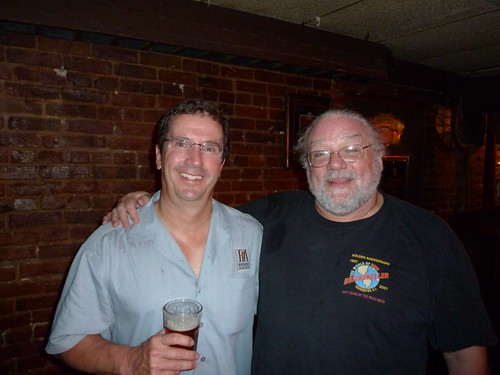
Me and Lester in Minneapolis for CBC a few yers ago.
Lester with George Reisch, from ABI, at GABF in 2009.
Lester with, from left: Daniel Bradford, Patrick Rue, and Tom McCormick at SAVOR in 2010.