Brookston Beer Bulletin

Jay R. Brooks on Beer

  • Home
  • About
  • Editorial
  • Birthdays
  • Art & Beer

Socialize

  • Dribbble
  • Email
  • Facebook
  • Flickr
  • GitHub
  • Instagram
  • LinkedIn
  • Pinterest
  • RSS
  • Twitter
  • YouTube

Powered by Genesis

Patent No. 2124959A: Method Of Filling And Closing Cans

July 26, 2016 By Jay Brooks

patent-logo
Today in 1938, US Patent 2124959 A was issued, an invention of William Martin Vogel, for his “Method Of Filling And Closing Cans.” There’s no Abstract, although in the description it includes these claims:

This invention relates to cans and a method of making and filling the same, and has for its object the provision of means whereby a maximum quantity of air may be evacuated from the can prior to the sealing operation.

At the present time beer is being packed in cans and one of the greatest difficulties encountered is that of completely or at least nearly completely evacuating the maximum quantity of air from the can. The failure to uniformly evacuate the air results in lack of uniformity of the contents of the can. In some cases an opened can produces beer of a decidedly fiat appearance and taste; while in other cases, an extremely frothy, aerated fluid emanates. Experiments have shown that this lack of uniformity in canned beer is apparently due to the failure to eliminate or evacuate the greatest possible amount of air from the can during or after the filling operation, and prior to the sealing of the can.

The primary object therefore, of this invention, is to provide a can of such a construction, together with a method of filling and sealing such a can, which will eliminate the maximum quantity of air from the can, thereby completely, or nearly completely, filling the can with the liquid contents only. More particularly, the invention contemplates the provision of a can initially formed with an outwardly distended or dished bottom,

arranged to be reversely curved or distorted under pressure after the can is filled, thereby causing the liquid contents of the can to be bodily shifted toward the top of ‘the can, causing said contents to displace and eject the air out of the can just prior to the sealing of the top of the can.

US2124959-0

Filed Under: Beers, Breweries, Just For Fun, Politics & Law, Related Pleasures Tagged With: Brewing Equipment, Cans, History, Law, Packaging, Patent

Patent No. 3332779A: Neutral Tasting Alcoholic Malt Beverage

July 25, 2016 By Jay Brooks

patent-logo
Today in 1967, US Patent 3332779 A was issued, an invention of Erik Krabbe, Webster Groves, and Cavit Akin, assigned to the Falstaff Brewing Corp., for their “Neutral Tasting Alcoholic Malt Beverage.” There’s no Abstract, although in the description it includes these claims:

The preparation of a neutral tasting alcoholic substrate by yeast fermentation of unboiled, unhopped wort containing fermentable sugar.

This invention relates to alcoholic malt beverage and more particularly to formation of an alcoholic malt beverage or substrate or base. which has a relatively neutral taste. More specifically the invention relates to the formation of a neutral alcoholic substrate from malt and cereal products and thereafter flavoring the neutral substrate with various flavoring substances.

Recently, various proposals have been made to provide flavored alcoholic beverages of various descriptions such as Tom Collins, coffee, mint, cherry, etc. The technique of trying to achieve such flavored alcoholic products by the use of fermented liquor have resulted in a rather. undesired feature of having the undesired normal beer or malt liquor flavor superimposed with a second desired flavor as those heretofore mentioned. So tar one proposal is to ferment the normal beer and then eliminate the flavor of the beer by charcoal filtration. Another technique is to add the flavor agent into boiling wort at which time activated carbon is added to the kettle to remove color from the wort. When sufficient time has been allowed for extracting the flavor, the wort was filtered and then fermented.

In contrast to previous techniques, the present invention briefly contemplates preparing a neutral fermented substrate for an alcoholic malt beverage which does not require the step of attempting to remove the’malt liquor or beer taste. Such an ideal neutral substrate or base alcoholic liquor is achieved by fermenting an extract of 10 to 35 weight percent unboiled, unhopped wort and 90 to 65 weight percent fermentable sugar (cerelose for example), based on the extract being water free. On a volumetric basis, one volume of unboiled, unhopped wort at 10 percent solids is added to three volumes of cerelose solution at 10 percent solids. Four grams of yeast (wet cake) per liter is suitable. The yeast may be the normal brewery yeast which has been washed to prevent carry over of hop bitter substances. The wort and cerelose are fermented preferably at a constant temperature of 13 C. After the fermentation is complete, the fermented extract is cooled to 3 C. and remains at that temperature for two or three days to end fermentation. Thereafter, the fermented extract is centrifuged and/.or filtered to obtain the neutral base which then is ready for carbonation and flavoring. At this stage of processing the flavor of the fermented substrate is substantially neutral with no organoleptic impression of malt liquor.

Falstaff-Beer-Coasters-Placemats-Falstaff-Brewing-Corp-Plant

Filed Under: Beers, Breweries, Just For Fun, Politics & Law, Related Pleasures Tagged With: Falstaff, History, Law, Patent, Science of Brewing

Patent No. 1919665A: Bottle Filling Machine And Method

July 25, 2016 By Jay Brooks

patent-logo
Today in 1933, US Patent 1919665 A was issued, an invention of Frederick W. Muller, for his “Bottle Filling Machine and Method.” There’s no Abstract, although in the description it includes these claims:

This invention relates to bottle filling machines and methods and relates particularly to bottle filling machines of the type wherein a plurality of bottles continuously fed to the machine are automatically and successively filled with a beverage such as beer.

US1919665-0
US1919665-1
US1919665-2
US1919665-3
US1919665-4
US1919665-5

Filed Under: Beers, Breweries, Just For Fun, Politics & Law, Related Pleasures Tagged With: Bottles, Brewing Equipment, History, Law, Packaging, Patent

Patent No. 3679431A: Wort Production

July 25, 2016 By Jay Brooks

patent-logo
Today in 1972, US Patent 3679431 A was issued, an invention of David Henry Clayton and John Karkalas, for their “Wort Production.” There’s no Abstract, although in the description it includes these claims:

This invention is concerned with improvements in or relating to wort production.

– Wort contains in addition to fermentable carbohydrates, soluble nitrogeneous compounds. Barley malt is the traditional raw material for the production of wort since it provides a source of carbohydrates and “nitrogen com pounds and in addition provides the enzymes capable of degrading the carbohydrates and nitrogen compounds to the soluble components of wort.

Malt is manufactured from e.g. barley by the process of malting. This consists of first germinating and then drying barley grain under controlled conditions.

The manufacture of malt is expensive because (1) large capital investments are necessary for the malting machinery, (2) a skilled labour force is required to operate the malting machines, (3) malt can only be made successfully from the higher qualities of barley which are expensive and (4) during the malting process a physical loss in dry matter occurs; this is known as the malting loss.

It is an object of the invention to provide an improved method of producing a wort in which the use of barley malt is reduced or virtually eliminated.

We have found that wort may be produced by treating an aqueous slurry of starch and protein-containing plant material for example unmalted cereal grain e.g. It appears that said hydrodynamic conditions result in the formation of a homogeneous mass very suitable for the action of the starch liquefying enzyme. Examples of starch and protein-containing plant materials other than cereals include roots, fungi material and by-products of processes to which ‘cereals have been subjected.

Examples of suitable materials include tapioca and rice, as well as wheat, barley and maize.

The invention provides a method of producing wort from an aqueous slurry of starch and protein-containing plant material comprising the steps of liquefying starch by treating the slurry with a commercial starch liquefying enzyme subjecting the slurry to hydrodynamic conditions such that a substantial thixotropic reduction of viscosity is produced by shearing forces in the slurry to facilitate the action of the starch liquefying enzyme prior to any substantial reduction of viscosity resulting from the enzymatic liquefaction converting starch to sugar by treatment with a saccharifying enzyme and converting protein to soluble nitrogen-containing compounds by treatment with a proteolytic enzyme.

The invention also provides wort when produced by a method as set out in the last preceding paragraph.

The invention also provides a process for brewing beer including such a method.

The invention also provides beer when produced by such a process.

The invention also provides a process of producing a concentrated wort syrup by concentrating wort produced by such a method.

The invention also provides a concentrated wort syrup when produced by such a process.

US3679431-0

Filed Under: Beers, Breweries, Just For Fun, Politics & Law, Related Pleasures Tagged With: adjuncts, barley, History, Law, Malt, Patent, Science of Brewing, Wort

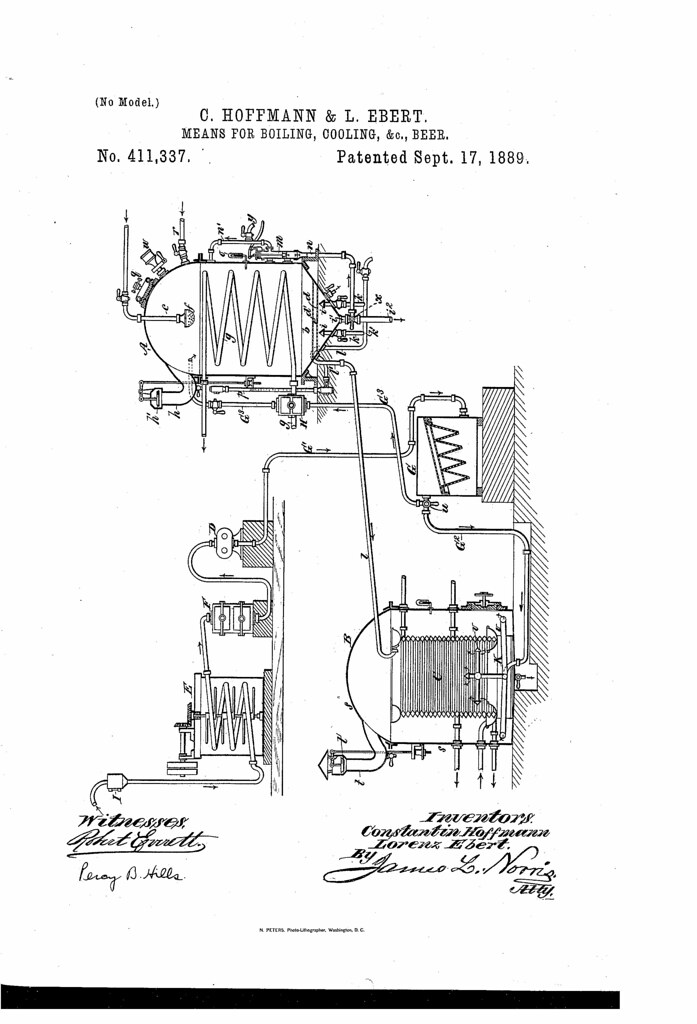
Patent No. 654369A: Apparatus For Pasteurizing Beer

July 24, 2016 By Jay Brooks

patent-logo
Today in 1900, US Patent 654369 A was issued, an invention of Edward Wagner, assigned to the Model Bottling Machinery Company, for his “Apparatus For Pasteurizing Beer.” There’s no Abstract, although in the description it includes these claims:

This invention relates to an improved apparatus for pasteurizing beer, the’object being to provide a simple, cheap, and convenient apparatus for treating the bottled beer to destroy the yeast molecules and germs contained therein, whereby further fermentation is prevented.

US654369-0

Filed Under: Beers, Breweries, Just For Fun, Politics & Law, Related Pleasures Tagged With: Brewing Equipment, History, Law, Patent, Science of Brewing

Patent No. 860936A: Bottle Carrier For Bottling Establishments

July 23, 2016 By Jay Brooks

patent-logo
Today in 1907, US Patent 860936 A was issued, an invention of Max W. Norkewitz, for his “Bottle Carrier For Bottling Establishments.” There’s no Abstract, although in the description it includes these claims:

This invention relates particularly to machinery for bottling establishments and it is’ intended primarily to dispose of the bottles expeditiously from a gang of labeling machines and facilitate the operation of packing them in cases.

My invention is intended for use principally in those bottling establishments where a number of brands of beer or other liquid are bottled and labeled at the same time and its object is to provide means for carrying the bottles away from a gang of labeling machines to the packing tables and without mixing them.

US860936-0
US860936-1

Filed Under: Beers, Breweries, Just For Fun, Politics & Law, Related Pleasures Tagged With: Bottles, Brewing Equipment, History, Law, Patent

Patent No. 3895478A: Roll On Capping Head

July 22, 2016 By Jay Brooks

patent-logo
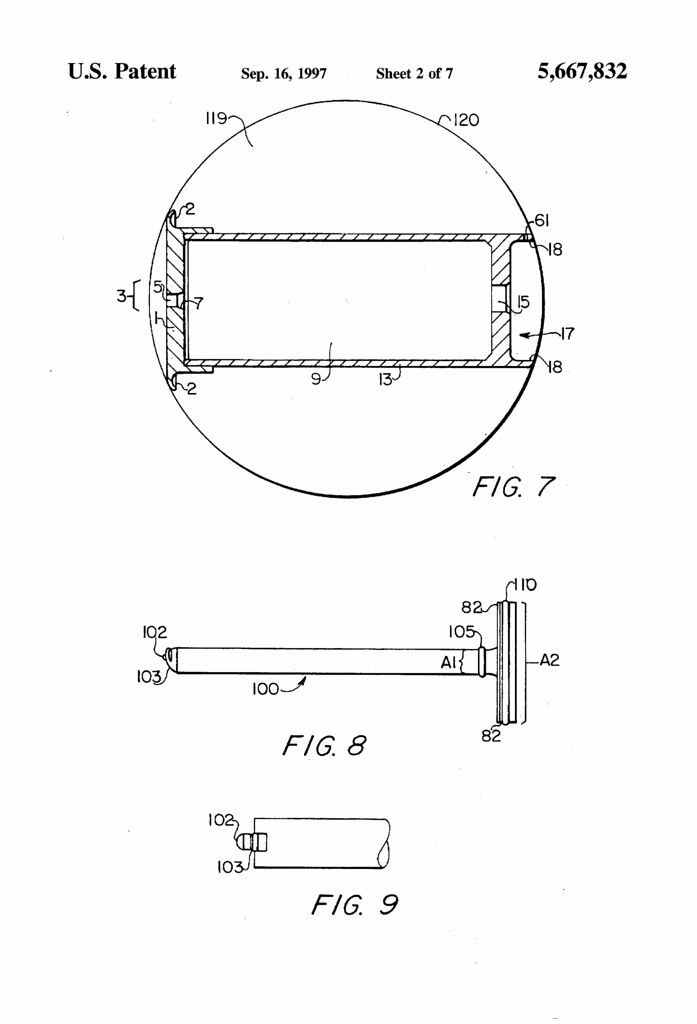
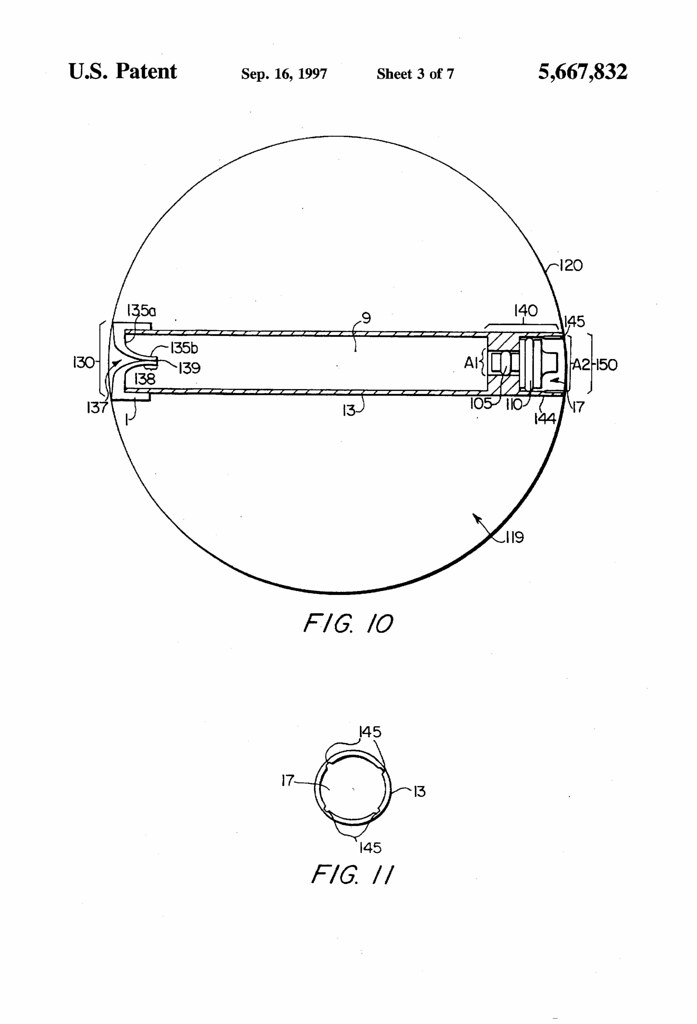
Today in 1975, US Patent 3895478 A was issued, an invention of Kenneth F.M. Friendship, assigned to Continental Can Co., for his “Roll On Capping Head.” Here’s the Abstract:

A roll on type capping head for applying closure cap blanks to the mouths of containers, such as bottles, jars or cans, which is characterized by a non-rotatable inner spindle member supporting a cylindrical outer spindle assembly which is rotatable about the axis of the inner spindle member and which carries cap skirt-engaging rollers adapted to be cammed into engagement with portions of the skirt on the cap blank so as to shape it to the contour of the threads on the container neck and to form a pilfer-proof ring thereon. The head is mounted for vertical reciprocation between operative and inoperative positions and the operation of the head and rollers is effected by a pneumatic spring arrangement with a no-cap no-roll operation feature.

US3895478-1
US3895478-2
US3895478-3

Filed Under: Beers, Breweries, Just For Fun, Politics & Law, Related Pleasures Tagged With: Bottles, Brewing Equipment, History, Law, Packaging, Patent

Ballantine’s Literary Ads: Ernest Hemingway

July 21, 2016 By Jay Brooks

ballantine
Between 1951 and 1953, P. Ballantine and Sons Brewing Company, or simply Ballentine Beer, created a series of ads with at least thirteen different writers. They asked each one “How would you put a glass of Ballantine Ale into words?” Each author wrote a page that included reference to their beer, and in most cases not subtly. One of them was Ernest Hemingway, who wrote several memorable novels, such as the The Sun Also Rises, A Farewell to Arms, For Whom the Bell Tolls and The Old Man and the Sea.

Today is the birthday of Ernest Hemingway (July 17, 1899–July 2, 1961). He “was an American novelist, short story writer, and journalist. His economical and understated style had a strong influence on 20th-century fiction, while his life of adventure and his public image influenced later generations. Hemingway produced most of his work between the mid-1920s and the mid-1950s, and won the Nobel Prize in Literature in 1954. He published seven novels, six short story collections, and two non-fiction works. Additional works, including three novels, four short story collections, and three non-fiction works, were published posthumously. Many of his works are considered classics of American literature.” His Ballantine ad ran in 1952.

Hemingway NYT Ballantines

His piece for Ballantine was done in the form of a letter on fishing, written from Cuba:

Bob Benchley first introduced me to Ballantine Ale. It has been a good companion ever since.

You have to work hard to deserve to drink it. But I would rather have a bottle of Ballantine Ale than any other drink after fighting a really big fish.

We keep it iced in the bait box with chunks of ice packed around it. And you ought to taste it on a hot day when you have worked a big marlin fast because there were sharks after him.

You are tired all the way through. The fish is landed untouched by sharks and you have a bottle of Ballantine cold in your hand and drink it cool, light, and full-bodied, so it tastes good long after you have swallowed it. That’s the test of an ale with me: whether it tastes as good afterwards as when it’s going down. Ballantine does.

ballantine-1952-Hemingway-text

Filed Under: Beers, Breweries, Just For Fun, Related Pleasures Tagged With: Advertising, History, Literature, Sports

Patent No. 564528A: Bottling Machine

July 21, 2016 By Jay Brooks

patent-logo
Today in 1896, US Patent 564528 A was issued, an invention of Ernest Lyle Miller, for his “Bottling Machine.” There’s no Abstract, although in the description it includes these claims:

The object of this invention is to provide a bottling machine which can be readily adapted to various sizes of bottles, and which, moreover, can be made simple and compact in construction and reliable in its operation; and the invention resides in the novel features of construction set forth in the following specification and claims, and illustrated in the annexed drawings

US564528-0
US564528-1

Filed Under: Beers, Breweries, Just For Fun, Politics & Law, Related Pleasures Tagged With: Bottles, Brewing Equipment, History, Law, Patent

Patent No. 607770A: Apparatus For Pasteurizing Beer

July 19, 2016 By Jay Brooks

patent-logo
Today in 1898, US Patent 607770 A was issued, an invention of William J. Ruff, for his “Apparatus For Pasteurizing Beer.” There’s no Abstract, although in the description it includes these claims:

My invention has for its object an improved apparatus to be utilized in pasteurizing beer, whereby the operation is more perfectly carried out and the beer more effectually and uniformly treated and its chemical properties preserved.

US607770-0

Filed Under: Beers, Breweries, Just For Fun, Politics & Law, Related Pleasures Tagged With: Brewing Equipment, History, Law, Patent, Science of Brewing

« Previous Page
Next Page »

Find Something

Northern California Breweries

Please consider purchasing my latest book, California Breweries North, available from Amazon, or ask for it at your local bookstore.

Recent Comments

  • Bob Paolino on Beer Birthday: Grant Johnston
  • Gambrinus on Historic Beer Birthday: A.J. Houghton
  • Ernie Dewing on Historic Beer Birthday: Charles William Bergner 
  • Steve 'Pudgy' De Rose on Historic Beer Birthday: Jacob Schmidt
  • Jay Brooks on Beer Birthday: Bill Owens

Recent Posts

  • Historic Beer Birthday: Ellis Wainwright August 3, 2026
  • Beer Birthday: Steve Donohue August 3, 2026
  • Beer In Ads #5309: Falling Down Heute Bock August 2, 2026
  • Historic Beer Birthday: Armin Louis Neubert August 2, 2026
  • Historic Beer Birthday: Albert Moortgat August 2, 2026

BBB Archives

Feedback

Head Quarter
This site is hosted and maintained by H25Q.dev. Any questions or comments for the webmaster can be directed here.