Brookston Beer Bulletin

Jay R. Brooks on Beer

  • Home
  • About
  • Editorial
  • Birthdays
  • Art & Beer

Socialize

  • Dribbble
  • Email
  • Facebook
  • Flickr
  • GitHub
  • Instagram
  • LinkedIn
  • Pinterest
  • RSS
  • Twitter
  • YouTube

Powered by Genesis

California Reaches 600 Breweries

December 3, 2015 By Jay Brooks

california
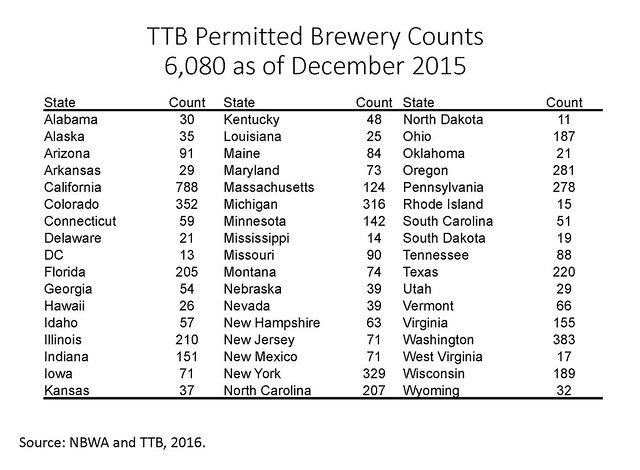
On the heels of yesterday’s news that the number of breweries in America has reached a historic high point, today the California Craft Brewers Association (CCBA) released the news that the number of breweries in the state of California reached 600. The next closest state, Oregon, has less than half of that. Congratulations to all 600!

cal-600

For me the biggest takeaway is how rapid the number of California breweries doubled. Fritz Maytag bought the Anchor Brewery in 1965, but the first new brewery opened over a decade later, in 1978. That was New Albion. It took until 2012, or 34 years, to reach 300 breweries. Three years later, this month in 2015, there are 600. That means half of the breweries in California are less than three years old, which seems remarkable.

Here’s the press release:

The California Craft Brewers Association (CCBA) today announced another milestone in the growth of local brewing, with more than 600 craft breweries in operation across the state. More breweries call California home than any other state in the nation.

“We continue to celebrate the success of craft beer in California,” said Tom McCormick, executive director of the CCBA. “The Golden State is the birthplace of the American craft beer movement and continues to lead the nation with its committed fans and creative brewers. We have seen a remarkable and growing demand for neighborhood-supported craft breweries and handcrafted, locally produced beers. It’s an exciting time to be a craft beer drinker in California and even more exciting to be a craft brewer.”

The 18 percent increase in operating breweries over that past year represents a return to the localization of beer production. In 2014, an average of two breweries opened every week in California.

Industries associated with craft beer also continue to expand, with additional investment in California-grown ingredients. Breweries throughout the state are planting hops and barley and looking to local farms to source ingredients.

“California’s craft beer drinkers are looking to their neighborhood breweries for local, sustainable, hand-grown, hand-produced, hand-crafted beers,” said Jacob Pressey, owner and brewmaster for Humboldt Regeneration Brewery and Farm and CCBA member. “We are the first California brewery since Prohibition to brew a 100 percent house-grown and malted beer, a milestone we’ve been focused on for the past three years. Across the state we see hop growers, grain growers and craft maltsters set the stage for a sustainable, local-focused industry.”

As the number of craft breweries has increased, so has national recognition for creative styles and classic West Coast IPAs brewed in California. In 2015, California breweries received the largest number of awards at the Great American Beer Festival, contributed hundreds of millions of dollars and thousands of jobs to the state’s economy and donated approximately $11,050,000 to support local and statewide charities, including fundraisers for nonprofits and charitable causes.

“California is the growth epicenter of the craft beer industry,” said Brook Taylor, deputy director of the Governor’s Office of Business and Economic Development (GO-Biz). “More than 600 California craft breweries generate $6.5 billion in annual revenue, employ thousands of people and contribute to the state’s nation leading job growth. The craft beer industry is emblematic of California – innovative people, creating innovative products and providing new jobs in a rapidly growing industry.”

Filed Under: Breweries, News Tagged With: California, CCBA, Statistics

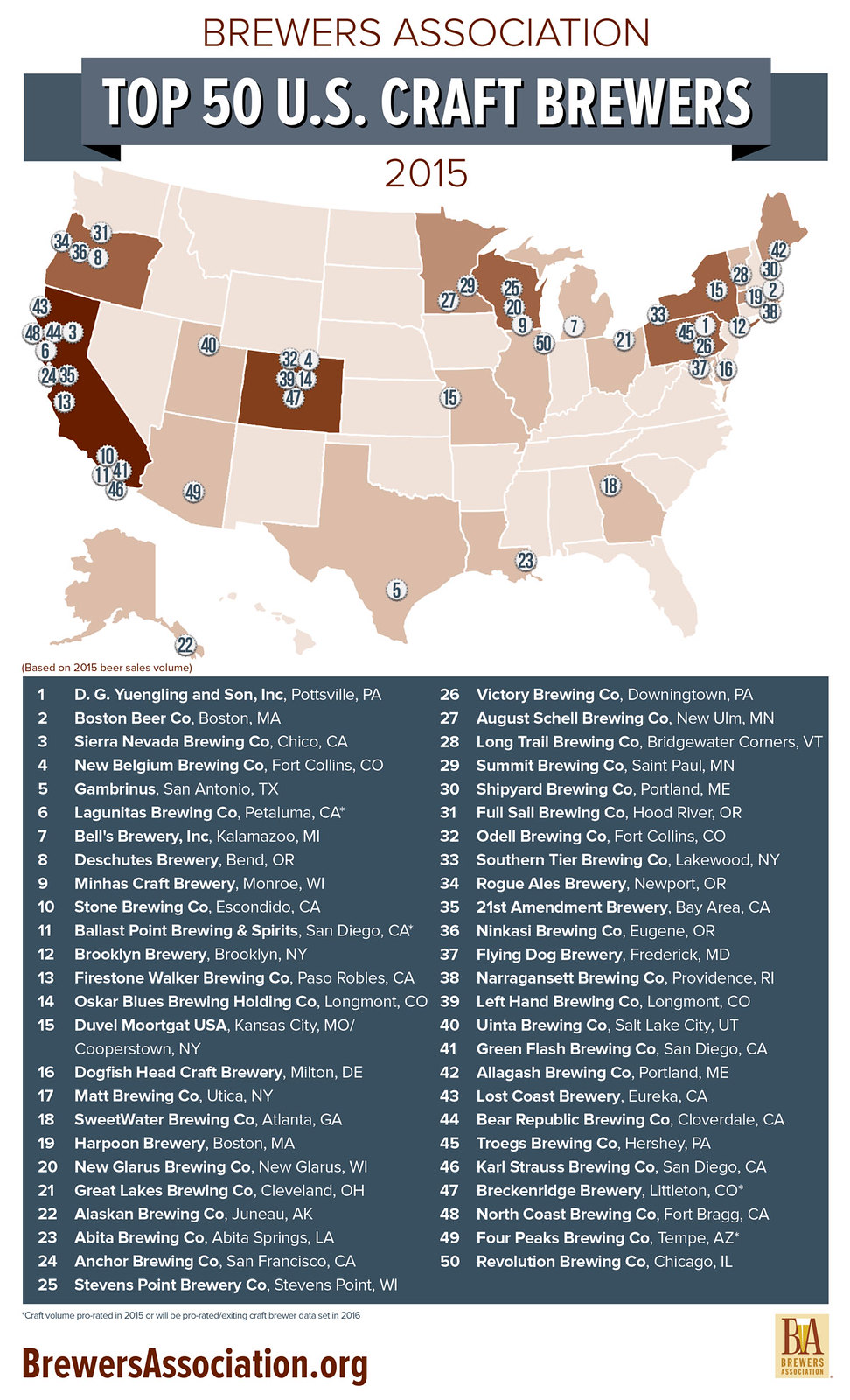
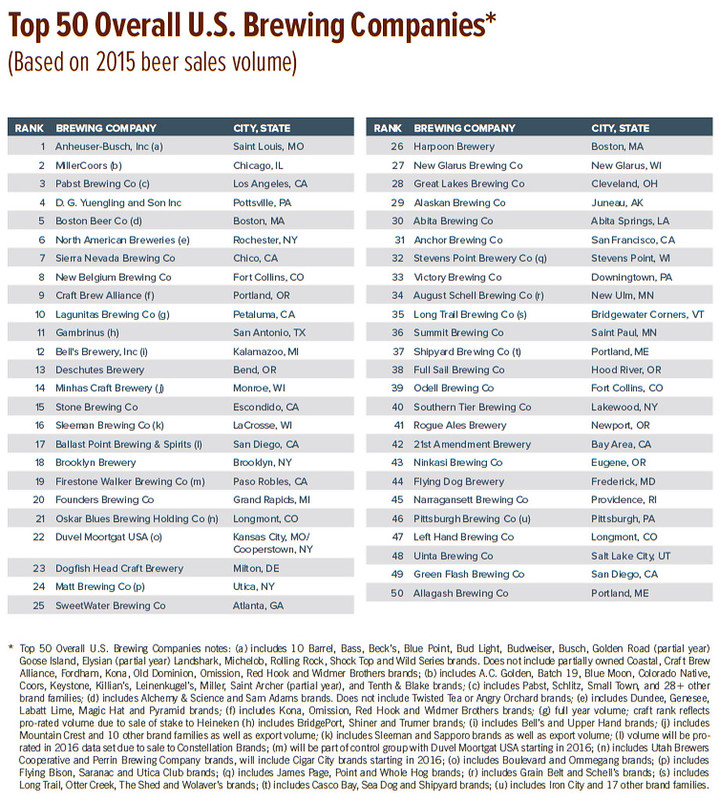
Number Of American Breweries Reaches Historic High

December 2, 2015 By Jay Brooks

ba
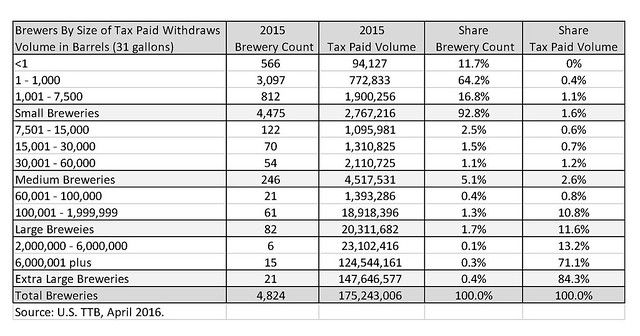
The most breweries open in the United States at any point in our history was 4,131, a milestone reached way back in 1873. Right afterwards, breweries started merging at a furious pace, drastically reducing that number. Then prohibition decimated the industry, closing almost every brewery (except for the few who figured out non-alcoholic products to make). When prohibition ended thirteen years later, fewer than 800 reopened in the year after repeal of the 18th Amendment. But many didn’t last long, and by 1950 the number was down to 407. And the slide continued, with only 230 in 1961 and the nadir of 80 in 1983, with only 51 of them owned by independent companies. For what it’s worth, other accounts say 1978 was the low point. Once the first two California craft breweries got going — Anchor in 1965 and New Albion in 1978 — things moved slowly, it took until 1994 before small brewers made up 1% of the total beer market. In 1996, we returned to pre-prohibition numbers, with 1,000 breweries open. Fifteen years later, in 2011, that number had doubled to 2,000, but in only three more years we’d reached 3,000 breweries. At the end of September, three months ago, we reached 4,000.

Today, the Brewers Association released a new press release:

As of the end of November, there are now 4,144 breweries in the country, topping the historic high of 4,131 breweries in 1873.

I knew it was coming, but it’s still a nice milestone to mark. More breweries are open right now in the U.S. than have ever been open at one time before. That’s pretty cool. Congratulations to all of those breweries.

A few additional tidbits worth noting:

  • Brewery openings now exceed two a day.
  • Fifteen states are now home to more than 100 breweries: California, Washington, Colorado, Oregon, Michigan, New York, Pennsylvania, Illinois, Texas, Ohio, Florida, Virginia, North Carolina, Wisconsin, Indiana.
  • IPA remained the top style sold by independent craft brewers, and continues to grow faster than the overall craft category.

4144-breweries

Filed Under: Breweries, News Tagged With: Brewers Association, Press Release

Patent No. 3544329A: Electrolysis Of Fermented Beverages

December 1, 2015 By Jay Brooks

patent-logo
Today in 1970, US Patent 3544329 A was issued, an invention of Erik Johannes Helm and Richard Stanley Wrey Thorne, for their “Electrolysis of Fermented Beverages.” There’s no Abstract, although in the description it includes this summary:

This invention relates to a method and means for the improvement of the flavour of fermented beverages, such as beers, ciders, and wines, by elimination of hydrogen sulphide produced during fermentation.

Hydrogen sulphide is a normal product of yeast metabolism; during fermentation of beverages such as beer it is produced from cysteine by desulphuration and from inorganic sulphate by reduction, and probably from other precursors as well. It is well known to brewers that beer, and particularly newly fermented beer, for this reason often contains so much hydrogen sulphide as seriously to impair its avour, and especially its aroma. Generally speaking, this circumstance applies both to bottom-fermented beers (pilsner and lager types) and to top-fermented beers (ale and stout types).

This hydrogen sulphide may disappear during the maturation of beer, a process which consists essentially of a slow secondary fermentation, the hydrogen sulphide being swept out of the beer by the slowly evolving carbon dioxide. In practice, however, it is often found that for one reason or another the finished beer still retains a sensible concentration of hydrogen sulphide; particularly in the case of pilsner type beers this residual hydrogen sulphide may be sucient to detract from the delicacy of their llavoun The concentration of hydrogen sulphide in iinished beers may vary from inappreciable traces up to about 0.06 p.p.m. Its presence is already perceptible at a concentration of about 0.005 p.p.m.; at this level it is hardly perceived as such, but rather as modifying the general beer aroma. At 0.005 to 0.02 p.p.m. its odour has been described as yeasty or sulphury, i.e. more or less abnormal and undesirable. At about 0.05 p.p.m. it is recognizable as the characteristic hydrogen sulphide stench. Thus, while very low concentrations of hydrogen sulphide, say, less than 0.005 p.p.m. may not be objectionable in beer, and may even contribute a desirable element to its aroma, higher levels than this are definitely undesirable and perceived as a defect.

Accordingly, a process for the elimination of hydrogen sulphide from beer or its reduction to an imperceptible level, a process which might help to abbreviate the economically expensive secondary fermentation, is much to be desired.

The extremely low solubility product of copper sulphide suggests that a very simple means to this end might be to dose small quantities of, for example copper sulphate into beer so as to precipitate all of its hydrogen sulphide in the form of copper sulphide which would be subsequently removed during the regular beer ltration prior to bottling. However, the fact that beers normally contain traces of copper of the order of 0.1 p.p.m. or more which are as a rule more than equivalent to the amount of hydrogen sulphide to be removed, Without any such removal actually taking place, suggests that the problem is not quite so simple as it may at rst sight appear. It is true that the addition of an excess of copper sulphate to beer, of the order of l p.p.m. of copper, does indeed remove all perceptible hydrogen sulphide from it, but the relatively high concentration of residual copper remaining in the beer constitutes such a technical disadvantage that this procedure could not be seriously advocated for practical use. The drawback attaching to soluble copper in beer is that it rather drastically reduces the stability (shelflife) of the beer: copper accelerates the precipitation of proteinaceous material from the beer, rendering it cloudy and unsaleable. Presumably, the small amount of copper normally present in beer is already complexed to proteinaceous material in the beer so that it is unavailable for precipitating the hydrogen sulphide. Similarly, the excessive amount of copper sulphate which is necessary to eliminate hydrogen sulphide from beer must be attributed to most of the copper immediately being complexed, only a minor amount being available to react with the hydrogen sulphide.

The present invention comprises dosing suitably small quantities of copper into beer by means of electrolytic dissolution. Trials have shown that by this procedure the hydrogen sulphide may be removed from beer without causing any appreciable increase in its copper content.

According to this invention, beer, during the course of its passage to the filter, is passed between two electrodes of electrolytic copper, or between two electrodes one of which, the anode, is ot electrolytic copper. By the application of a suitable electromotive force across the electrodes copper passes into solution into the beer; the concentration of copper so dissolved depends only upon (a) the quantity of electricity passing through the beer (measured by the product of current strength and time), and (b) the velocity of the beer flowing past the electrodes. Copper dissolution is therefore precisely controllable by regulating current strength in relation to beer velocity.

Untitled

Filed Under: Beers, Breweries, Just For Fun, Politics & Law, Related Pleasures Tagged With: Brewing Equipment, History, Law, Patent, Science of Brewing

Patent No. 4361080A: Floor For Lautering Vessels

November 30, 2015 By Jay Brooks

patent-logo
Today in 1982, US Patent 4361080 A was issued, an invention of David K. Smith, Nigel Harlow, and Samuel W. Maxfield, for their “Floor For Lautering Vessels.” Here’s the Abstract:

Disclosed is a real floor for a lauter tun comprising a plurality of elongated linear troughs, each trough extending unobstructed across the bottom of the vessel and each forming a relatively shallow upward opening V-shape. The elements making up the floor are shaped to provide the lauter tun floor with a circular profile.

Untitled
Untitled

Filed Under: Beers, Breweries, Just For Fun, Politics & Law, Related Pleasures Tagged With: Brewing Equipment, History, Law, Patent, Science of Brewing

Patent No. 1162515A: Process For Treating Cement Beer-Fermenting Tanks

November 30, 2015 By Jay Brooks

patent-logo
Today in 1915, US Patent 1162515 A was issued, an invention of Frank W. Rickers, assigned to the Schaefer Brewing Co., for his “Process For Treating Cement Beer-Fermenting Tanks.” There’s no Abstract, although in the description it includes this summary:

The object of the present invention is the production of a beer fermenting tank constructed of hydraulic cement or cement concrete or reinforced cement concrete which shall avoid the disadvantages incident to those previously constructed, and which shall be economical to construct, and which shall be substantially permanent when constructed.

Untitled

Filed Under: Beers, Breweries, Just For Fun, Politics & Law, Related Pleasures Tagged With: Brewing Equipment, History, Law, Patent

Patent No. 6968773B1: Vessel And Wort Processing Method For Producing Beer

November 29, 2015 By Jay Brooks

patent-logo
Today in 2005, US Patent 6968773 B1 was issued, an invention of Kurt Stippler and Klaus-Karl Wasmuht, assigned to Anton Steinecker Maschinenfabrik Gmbh, for their “Vessel and Wort Processing Method for Producing Beer.” Here’s the Abstract:

A vessel and a method for thermally treating wort in beer brewing, wherein a wort guiding screen or cone is placed inside the vessel and a feed pipe ending above the wort guiding screen or cone is used to discharge wort from above onto the wort guiding screen or cone. The wort boiling method has the wort discharged onto an inclined, heated guiding surface from which it flows down and spreads into a sheet and is thereby heated.

Untitled

Untitled

Untitled
Untitled

Filed Under: Beers, Breweries, Just For Fun, Politics & Law, Related Pleasures Tagged With: Brewing Equipment, History, Law, Patent, Science of Brewing, Wort

Patent No. 2771752A: Beer Cooling Apparatus

November 27, 2015 By Jay Brooks

patent-logo
Today in 1956, US Patent 2771752 A was issued, an invention of Edward E. Tennant, assigned to the Schlitz Brewing Co., for his “Beer Cooling Apparatus.” There’s no Abstract, although in the description it includes this summary:

This invention relates to a beverage cooling system and apparatus and particularly has reference to apparatus for cooling or maintaining a carbonated beverage, like beer, in a properly cooled condition while transporting the same a substantial distance from the source or keg to the dispensing tap.

Untitled

Filed Under: Beers, Breweries, Just For Fun, Politics & Law, Related Pleasures Tagged With: Brewing Equipment, History, Law, Patent, Science of Brewing

Patent No. 6321927B2: Beverage Can Seal

November 27, 2015 By Jay Brooks

patent-logo
Today in 2001, US Patent 6321927 B2 was issued, an invention of Michael Cavella, for his “Beverage Can Seal.” Here’s the Abstract:

A seal for use on a container such as a beverage or food storage container and more specifically such as a soft drink, beer, or soup can where the seal prevents contamination of the rim or lip, trough and area adjacent to and surrounding the drinking aperture as well as between the drinking aperture and the nearest rim. The seal covers the inner surface of the rim but does not restrict use of 6-pack rings or the like, nor does the seal interfere with stacking of the cans. The seal further includes a peel tab.

Untitled

Untitled
Untitled

Filed Under: Beers, Breweries, Just For Fun, Politics & Law, Related Pleasures Tagged With: Cans, History, Law, Packaging, Patent

Patent No. 441477A: Bottling-Machine

November 25, 2015 By Jay Brooks

patent-logo
Today in 1890, US Patent 441477 A was issued, an invention of William H. Foye, Jr., and William H. Foye, Sr., for their “Bottling-Machine.” There’s no Abstract, although in the description it includes this summary:

Our invention relates to improvements in bottling-machines used in bottling fermented liquors and other fluids which contain carbonic acid gas or are to be charged with the same.

Our objects are, first, to provide a machine capable of adjustment to any size or shape of bottle; second, to force out the atmospheric air contained in the bottle and fill the same with carbonic-acid gas; third, to fill the bottle with fluid and prevent the same from coming in contact with atmospheric air, if desired, thereby preventing the escape of carbonic-acid gas and preserving the life and aroma of the fluid; fourth, to saturate the fluid with carbonic-acid gas, when required, by pressure and agitation, and, fifth, to cork and secure the same by wiring before removing the bottle from the machine, if desired.

1890-bottling-machine-patent-artwork-vintage-nikki-marie-smith

And here’s the original drawing filed with the application:
Untitled

Filed Under: Beers, Breweries, Just For Fun, Politics & Law, Related Pleasures Tagged With: Bottles, Brewing Equipment, History, Law, Patent

Pretty Beer To Stop Brewing

November 24, 2015 By Jay Brooks

pretty-things
Sad news. Dann and Martha Paquette, co-owners of the Pretty Things Beer and Ale Project posted on their website today their decision to cease the operations of their company. Explaining their decision in For a Beginning, there must be an End, here’s what’s up:

Seven years ago we sold our first glass of beer at The Publick House in Brookline. We didn’t foresee then that our strange project would become such a part of our lives.

It has been a crazy fun time. We’ve dressed up in more costumes than a Bob Hope special. Amazing employees and friends have conspired with us along the way. Bocky, Anya, and John Funke have channeled our project almost better than we have done ourselves. And we found a rag tag group of like-minded creative brewers out there in the world as well.

Brewing our beers has been a great labor and a great joy. But best of all we shared it with so many great beer drinkers. It really feels like we met you all. We’ve stood in shops, bars, restaurants, on stages, in VFW halls. Sometimes you were already fans. Sometimes you spat out our beer. Sometimes you just fancied a chat. We always felt happy to meet you by the end. It was always fun, or funny, or we sold a beer, or learned something. Many of you became friends. We’ve loved drinking beers with you.

We hope our beers brought you joy and brought you closer together. There’s no greater goal for a batch of beer or a project like ours.

After seven years it’s time to draw the curtains and head off to a new adventure. A poorly drawn grain of barley called Jack D’Or made this whole thing possible. He’ll be coming with us.

Besides making great beer, Dann’s thoughtful approach to everything they do has been great to watch, if only from afar. The few times we’ve spent any time together I’ve loved talking philosophically with him and certainly hope his voice won’t be lost as he transitions to whatever adventure awaits him in the next chapter of his journey. And I wish Dann and Martha the best of best wishes going forward.

Pretty Things beer will be available until it runs out, probably sometime in January of next year. If I were you, I’d stock up while you can.

dann-and-martha-the-end
Their parting shot.

Filed Under: Breweries, News Tagged With: Announcements, Business, Massachusetts, Press Release

« Previous Page
Next Page »

Find Something

Northern California Breweries

Please consider purchasing my latest book, California Breweries North, available from Amazon, or ask for it at your local bookstore.

Recent Comments

  • Bob Paolino on Beer Birthday: Grant Johnston
  • Gambrinus on Historic Beer Birthday: A.J. Houghton
  • Ernie Dewing on Historic Beer Birthday: Charles William Bergner 
  • Steve 'Pudgy' De Rose on Historic Beer Birthday: Jacob Schmidt
  • Jay Brooks on Beer Birthday: Bill Owens

Recent Posts

  • Historic Beer Birthday: Oliver Hughes May 20, 2026
  • Historic Beer Birthday: Benjamin, Lord Iveagh May 20, 2026
  • Historic Beer Birthday: Eduard Buchner May 20, 2026
  • Historic Beer Birthday: Louis de Luze Simonds May 20, 2026
  • Historic Beer Birthday: Johann Adam Lemp May 20, 2026

BBB Archives

Feedback

Head Quarter
This site is hosted and maintained by H25Q.dev. Any questions or comments for the webmaster can be directed here.