Brookston Beer Bulletin

Jay R. Brooks on Beer

  • Home
  • About
  • Editorial
  • Birthdays
  • Art & Beer

Socialize

  • Dribbble
  • Email
  • Facebook
  • Flickr
  • GitHub
  • Instagram
  • LinkedIn
  • Pinterest
  • RSS
  • Twitter
  • YouTube

Powered by Genesis

Session #50: How Do They Make Me Buy The Beer?

April 1, 2011 By Jay Brooks

buy-please
Our 50th Session is hosted by Alan McLeod from A Good Beer Blog, and is the second of our third hosting by the three original Session hosts on our fourth anniversary of Beer Blogging Friday. The topic he’s chosen is How Do They Make Me Buy Their Beer?, by which Alan means:

What makes you buy someone’s beer? Elemental. Multi-faceted. Maybe even interesting.

  • Buying beer. I mean takeaway. From the shelf to you glass. What rules are dumb? Who gives the best service? What does good service mean to you? Please avoid “my favorite bar references” however wonderful. I am not talking about taverns as the third space. Unless you really really need to and contextualize it into the moment of transaction at the bar. If you can crystallize that moment of “yes” when the bartender is, in fact, tender go for it.
  • What doesn’t work? What fad or ad turned you off what had previously been turned on about some beer’s appeal? When does a beer jump the shark? When does a beer store fail or soar? When does a brewery lose your pennies or earn your dimes?
  • Go micro rather than macro. You may want to explore when you got tired of “extreme” or “lite” or “Belgian-style” but think about it in terms of your relationship with one brewery rather than some sort of internet wave of slag … like that ever happens.
  • What is the most you paid for a great beer? More importantly – because this is not about being negative – what is the least? I don’t mean a gift. What compels you you to say this is the quality price ratio (“QPR”) that works best for you? When does a beer scream “you would have paid 27% more for me but you didn’t need to!”?
session_logo_all_text_200

As an old curmudgeon who’s been alive and drinking before there was a craft beer industry — at least in practice, if not entirely legally — my earliest memories of the beer available where I lived were the more or less local regional brands. I grew up in medium-sized east coast industrial town — Reading, Pennsylvania — and our local brewery closed my junior year of high school — 1976. Before that, I vividly recall accompanying my stepfather to the beer distributor to pick up beer and soda. He didn’t always choose Reading Premium, but he did gravitate toward the more local and regional brands (in this case, mostly from Philadelphia, eastern Pennsylvania and New York).

The funny thing about that is nobody talked about “buying local” as a concept and the word “locavore” was decades from being coined. But that’s what people did. They patronized local businesses. We bought almost all of our produce from the local farmer’s market, along with some of our meat and other food. It was open every Friday in an indoor setting where each person rented a stall that was the same from week to week, and they were more or less permanent with cash registers, refrigerated cases, etc. But they were the local farmers, butchers, food purveyors, etc. We knew them all by name. They were a part of the community. About every six months or so, my parents bought a side of beef from a butcher, had it cut into numerous packages — ground beef, steak, etc. — and stored it in a deep freezer in our basement. All the meat came from the same cow, it wasn’t from an assembly line meat-packing plant. For bread, we went to the local baker. Milk was delivered to our doorstep twice a week. Charles Chips even made potato chip deliveries, though I preferred Good’s Chips in the Blue Can, which we bought every week at the farmer’s market. Good’s were made by a Mennonite family on their farm in nearby Reinholds. I visited the chip farm once. It was a simple operation, but it worked. The chips themselves were even simpler. The label read: potatoes, fried in lard, salt added. They were the best chips … ever.

And beer was just the same. I remember when I was little, my Mom liked Sunshine beer, another label from the Reading Brewing Co. Then there were the Philly brands: Schmidt’s, Ortlieb’s, etc. Everyone drank Ballantine when visiting my aunt and uncle in New Jersey. There were other regional Pennsylvania and New York brands: Yuengling, Genesee Cream Ale, Schaefer and Fyfe & Drum Extra Lyte Beer (their slogan: less filling … more refreshing). I seem to recall a lot of Carling Black Label in our house, too. I think it was on sale a lot, though I don’t remember where it was brewed back then. The point is I don’t even remember seeing a national brand until I was well into my teens. I first started being aware of Budweiser in junior high, Lite Beer from Miller when they started advertising nationally in the mid-1970s or so, and Coors once I started driving in high school. It became “cool” to get a Coors iron-on t-shirt down the shore at Ocean City or Wildwood, our preferred weekend getaway towns.

header_title

But the greed and consumerism that seemed to mark the 80s also sounded the death knell for local, and even healthy, food in general. High-fructose corn syrup began it meteoric rise around 1975 but really hit its stride in the 1980s. Giant grocery store chains dominated and the locally owned ones disappeared, paving the way for the big national food processors to likewise dominate stores shelves (they were the only ones who could afford the slotting fees that should be illegal, but curiously are not when it comes to food).

Pennsylvania grocery stores couldn’t sell beer (and still can’t) so I don’t have firsthand knowledge of what happened to grocery sets during that time, but I can only assume what happened with food, also happened with beer. At that time, I started moving around for work — Virginia, New York, back to Pennsylvania, North Carolina and then, finally, California in 1985. By the time I arrived in California — thirsty for good beer, sparked by my time in NYC — there was the chain of Liquor Barns that carried a wide selection of both imported beer and the new micros, but grocery stores were still almost exclusively national and international brands, with just a few exceptions. Bars, too, carried a very small number of beers, and very few, if any micros. It slowly got better, but even in 1991, when I visited over 550 bars in four months to write The Bars of Silicon Valley: A Beer Drinker’s Guide to Silicon Valley, very few carried anything beyond the Big 3 and a few imports (usually Heineken, Corona, or if the bar was Irish or British-themed: Guinness).

So what does all this nostalgia have to do with Alan’s topic? How does any of that make me buy a particular beer, or choose one over another? As the Peter Allen song claims, “Everything Old Is New Again,” and so it is with buying locally. What once was taken for granted as not so much buying locally, but simply “buying,” people are again purchasing locally made or grown goods, the only difference is this time it’s on purpose. It’s a decision, based on a growing understanding that doing so is beneficial on several fronts. It’s good for the planet because the closer the food is to the consumer, the shorter distance is as to travel, meaning it uses less fossil fuels, and as a bonus it’s usually fresher, too. It’s also good for the local economy because it creates local jobs, but more importantly the money stays in circulation locally, too. It isn’t shipped back to a corporate headquarters somewhere else, which is just one of the reasons Wal-Mart is so bad for local economies.

The dirty little secret in brewing is that many of the ingredients for making beer come from far afield, and there isn’t much that can be done about that. Barley and hops don’t grow everywhere, and certain types that are necessary for certain kinds of beers can’t be obtained from local sources in many, many places. More and more breweries, both large and small, are trying to make “estate” beers or beers made using only relatively local ingredients. Sierra Nevada is making an estate beer using their own locally grown barley and hops, and the San Francisco brewpub, Thirsty Bear, recently made a beer using all organic ingredients from northern California farmers. But that’s hard to do, especially in certain locations where the agriculture just isn’t available. I applaud such efforts, but it simply isn’t feasible for everybody. Hops is starting to be grown in more locations than the Pacific Northwest, but most efforts will not be able to replace the Willamette or the Yakima Valleys, only supplement the supply, not to mention hop varieties from abroad — England, Germany, the Czech Republic, New Zealand, etc.

So the brewing industry, for the most part, will have to continue to hang its hat on local production, not that that’s necessarily a bad thing, just the reality of how beer is made. But with over 1700 breweries in the U.S. — and 618 in planning — finding locally brewed beer is getting easier and easier. In a sense, we’re returning to a time when it was local and regional breweries that held sway. In the late 19th century, America peaked at just over 4,000 breweries. It was a time when beer didn’t travel or age very well and so every locale needed a brewery. Even many small and mid-sized towns had multiple breweries. Then it was out of necessity, but today an increasing number of people are choosing smaller, local beers over the national brands. It’s happening very slowly — too slowly for my personal tastes — but it is moving in the right direction. The big brands, both foreign and domestic, are flat or down in some cases, while the smaller breweries are for the most part up, and up a lot in many cases. And that’s played out over ten plus years, a sufficiently long enough period of time that I think we can safely call it a trend.

I continue to believe that distribution will be the single most important aspect of continuing that growth and finding, finally, a tipping point, where better local beer becomes the norm. And that’s one worrying counter-trend. The number of distributors continues to shrink, and that will be bad, I think, if a work around can’t be found, especially in states where self-distribution is not legal, where franchise laws are particularly strong, and where it’s difficult for alternative new distribution models to emerge.
beer-shelf-3

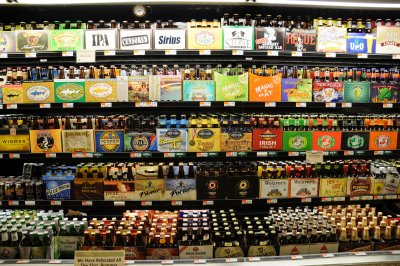
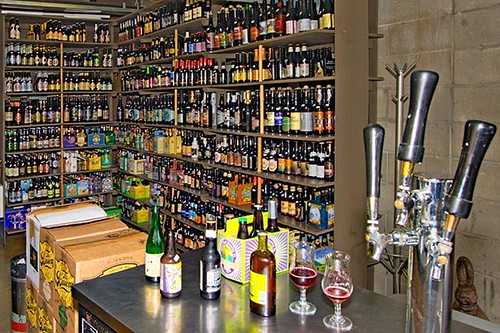
So what causes me to make a particular purchase decision? How Do They Make Me Buy The Beer? Well, firstly, I’m not a typical consumer. If you write a beer blog, chances are you’re not either, even if you believe otherwise. Because you and I will will try almost any new beer. That’s just who we are. Typical consumers, I’d argue, don’t. The only evidence I need for that is the fact most breweries have a flagship beer that accounts for 60%, 70% or even 80% of their total production. Somebody is buying all that beer, if it’s not you and me. Although, the fact that seasonal beer is the fastest growing category in grocery stores does suggest that many people are buying something different along with the flagship beer, too.

But secondly, if I’m not buying beer to sample for work, if I’m just picking up beer to watch a game with friends, or for a party or just to have a good time, I’ll buy something brewed locally. Usually, I know all the beers on a typical grocery or liquor store’s shelves — occupational hazard — so once I get past the novelty of something new, factoring in the weather and/or what I’m eating, the decision comes down to location, location, location.

beer-shelf-5

Filed Under: Beers, Breweries, Editorial, The Session Tagged With: Business, Marketing

The New Albion Brewery Site 30 Years Later

April 1, 2011 By Jay Brooks

new-albion-banner
This has been one amazing week. During yesterday’s unexpected lunch with craft beer pioneer Jack McAuliffe at Russian River Brewery, Jack invited us to have him show us around the old site of the New Albion Brewery in Sonoma, California. Needless to say, we didn’t have to be asked twice and readily accepted Jack’s kind offer.

We met at high Noon at the Swiss Hotel on Sonoma Square. After a quick lunch and a few pints of beer, our convoy of two cars headed out into the industrial park wilds of Sonoma, with Jack and his friend Pat leading the way. After a few minutes driving, we pulled off the road into a warren of tin buildings with scrap metal in organized heaps, including the recognizable midsections of several jet airplanes. We turned around, parking out on the public road, and Jack went in to ask the landlord — still the same man Jack rented the property from in 1976 — for permission to show us around. He came back a few minutes later, waving us in.


Arriving at the old brewery site.

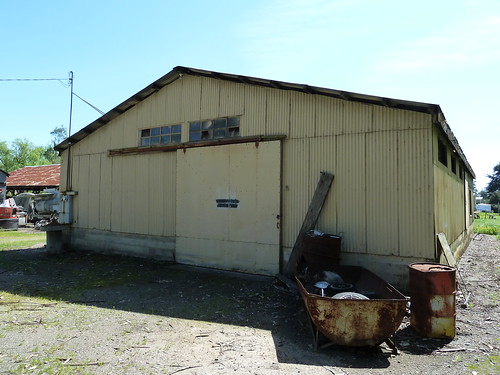
P1030780
This is the building where the New Albion Brewery stood over thirty years ago.

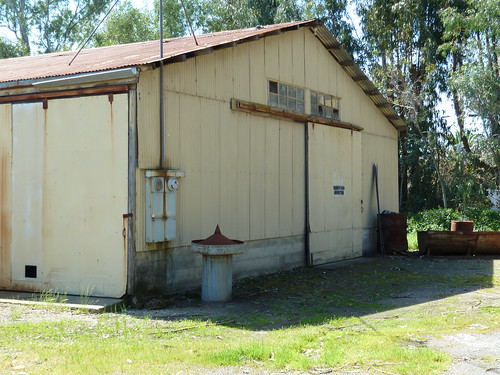
P1030778
Despite its proximity to the entrance, this was not the front of the brewery building, in part because Jack didn’t rent the entire building, just a portion of it.

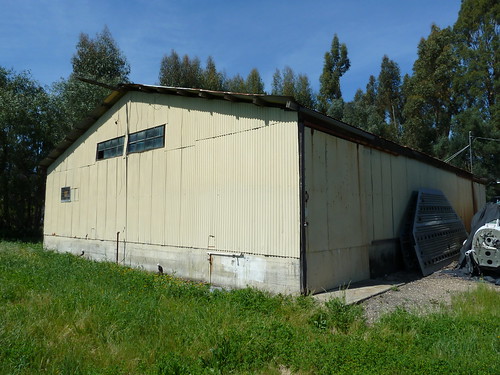
P1030783
This was essentially the front of the brewery building.

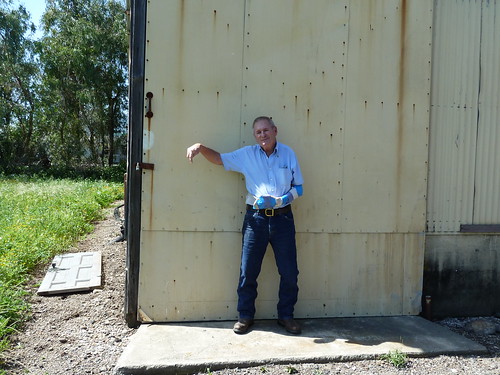
P1030793
Jack indicating that this was the front door to the brewery.

P1030788
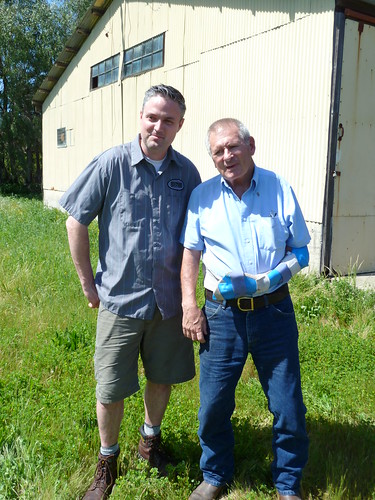
Vinnie Cilurzo, from Russian River Brewery, and Jack McAuliffe in front of the old site of his brewery.


Jack McAuliffe showing us around the old site of his New Albion Brewery.

P1030798
The view of where the brewery building stood from the road.

Jess Kidden has scans from Brewers Digest issues in November 1979 and October 1980 where you can contrast the building today and what it looked like 30+ years ago.

What a wonderful afternoon. Having the opportunity to spend time with the father of the modern microbrewery and have him show us where it all began was just amazing. Seeing the history and hearing Jack reminisce about that time in his life was a once-in-a-lifetime event. Thanks again Jack, and cheers to Vinnie and Natalie for letting me tag along.

Filed Under: Breweries, Just For Fun Tagged With: California, History, Northern California, Video

Jack McAuliffe Visits Russian River

March 30, 2011 By Jay Brooks

new-albion-banner
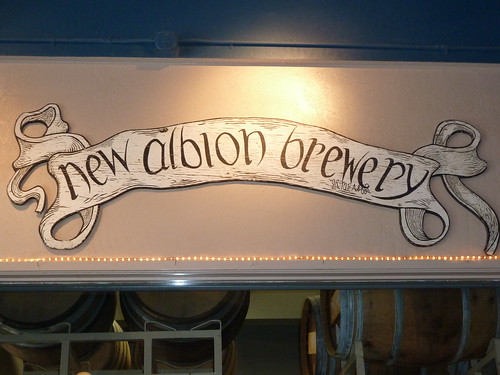
Quite by accident yesterday I had the pleasure of spending a few hours with Jack McAuliffe, founder of New Albion Brewery. I had to meet some new friends from Argentina at Russian River Brewery (more on that later) and when I arrived, I found out that Jack was coming by to have lunch with Russian River owners Vinnie and Natalie Cilurzo. I knew Jack was still in California because at CBC last week, where I met him for the first time (more about that later, too), he’d said as much. And I knew Natalie had invited Jack to come by their brewpub, where the original New Albion sign (that I later learned Jack made himself) hung behind the bar in a prominent place, but I didn’t know any of the details.

P1030765
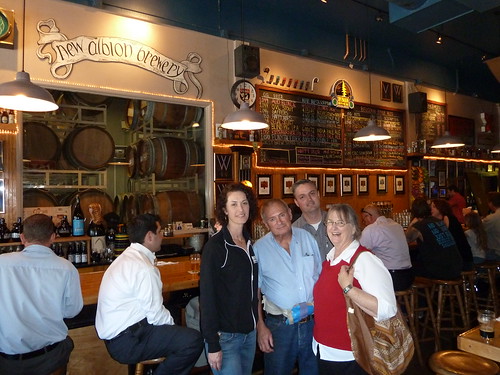
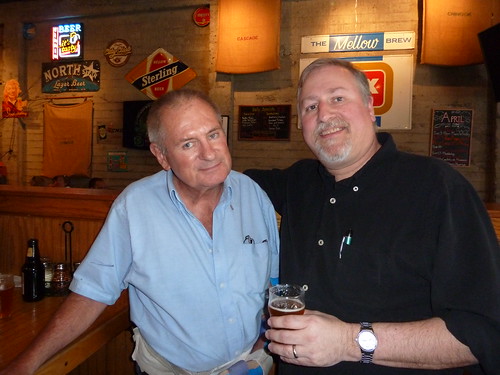
Vinnie and Natalie with Jack McAuliffe and his friend Pat Crisco.

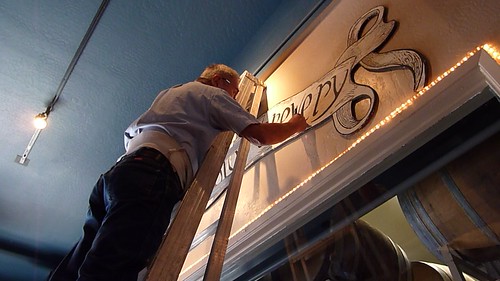
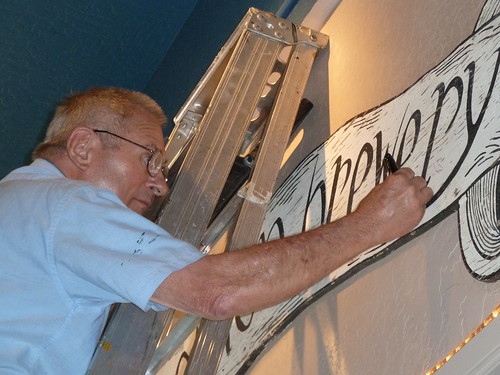
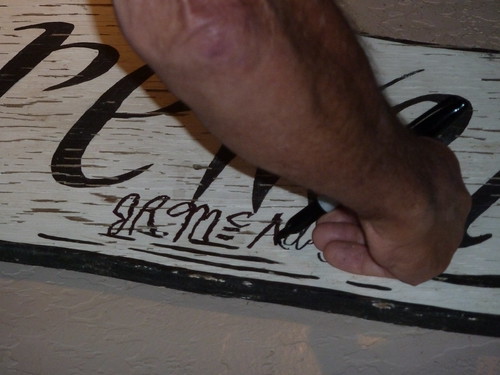
Vinnie and Natalie generously invited me join them for lunch with Jack and a friend of his, Pat, who he was staying with for the week. We sat below the New Albion sign and talked, drank and ate. For an amateur beer historian, it was nothing short of remarkable. Jack told great stories about his early days in brewing — some can be retold, others perhaps not — but all of them colorful and entertaining. I knew as much of New Albion’s story as had been told, but to hear it from the man who lived it was such a treat, plus Jack added many personal details that I’d never known before which was amazing to hear. Anyway, at some point, Jack pointed up at the old sign and asked Vinnie if he’d like him to sign it. I’m not sure we all believed he’d do it, but we got out the ladder and up he climbed, sharpie between his teeth like a beer pirate.

P1030749
Jack up on the ladder signing the New Albion sign.

P1030761
Signing it up close.

P1030756
Signing the sign.

P1030762
The finished old sign, now new again with Jack McAuliffe’s signature.

P1030766
Jack and me at Russian River. What a great afternoon.

UPDATE: During Jack’s visit to Russian River, I met Peter Stetson who does social media for the town of Calistoga, and he also took some photos and captured some video of Jack signing the New Albion sign. Thanks, Peter.

Filed Under: Breweries, Just For Fun, News Tagged With: California, History, Northern California

Moylan’s Releases Orange & Black Congrats Ale! For Giants’ Opener

March 28, 2011 By Jay Brooks

moylans
As the Giants get ready to take on the Athletics in the annual Bay Bridge Series that begins tonight, a local brewery gets set to release a new beer to honor San Francisco’s world series victory last year. Moylan’s, in Novato, California, will release Orange & Black Congrats Ale! on March 31 to coincide with the start of the regular baseball season. The special limited release is an American black ale, 6% a.b.v. and 32 IBUs. It will be available on draft, in growlers from the brewpub and in 22 oz. bottles.

Giants spec '11

From the press release:

In honor of the World Champions at the Cove, Moylan’s has created a smooth, American Black Ale brewed with orange zest. A hearty brew for the bleacher bums, the gardeners of turf and patient fans who have endured 54 years of pine-grabbing torture. This ale is a reflection of the many dedicated hearts and minds needed to brew a quality beer. It is made with Montana-grown pale two-row barley malted by Malteurop, crystal and black malted barley grown and roasted in Bamberg, Germany by Weyermann Specialty Malts. The robust flavors in the Black and Orange beer also include Canadian-grown barley supplied by Gilbertson and Paige and Mt. Hood and Liberty hops grown in the Yakima Valley by Puterbaugh Farms for Hops direct.

All the oranges used in this brew were grown locally in the California sunshine. Moylan’s offers an adult beverage to salute the Bat, the Stick, the Rally throng, the Crab, the Seal, the Golden voices in the box and all of the San Francisco legends that helped them see the dream become reality. The Orange & Black beer will be officially released on the Giants Opening Day on March 31st and will be available for a limited time. Alcohol by Volume 6.0%, total IBUs 36, 1.068 Original Gravity. This beer will be seen on draft at the pub and in select locations throughout the bay area.

This should be the perfect beer to enjoy as the Giants begin their run for back to back world series victories.

Filed Under: Beers, Breweries, Just For Fun, News Tagged With: Announcements, Bay Area, California, new release, Northern California, Sports

Anheuser-Busch InBev Buys Goose Island

March 28, 2011 By Jay Brooks

goose-island
I received a press release this morning that Anheuser-Busch InBev is buying a controlling interest in Goose Island Brewing. ABI will pay $22.5 million for a 58% share of the Chicago brewery and the remaining 42% currently owned by the Craft Brewers Alliance will be sold to ABI for an additional $16.3 million in cash, bringing the total price of the sale to $38.8 million. The Chicago Tribune is reporting that “[a]n additional $1.3 million will be invested to increase production at Goose Island’s Fulton Street brewery” and that the “transaction is expected to close by the end of June.”

From the press release:

Chicago-based Goose Island, one of the nation’s most‑respected and fastest-growing small brewers with sales concentrated throughout the Midwest, today announced it had agreed to be acquired by Anheuser‑Busch, its current distribution partner, in a move that will bring additional capital into Goose Island’s operations to meet growing consumer demand for its brands and deepen its Chicago and Midwest distribution.

Goose Island’s legal name is Fulton Street Brewery LLC (FSB). Anheuser-Busch reached an agreement to purchase the majority (58 percent) equity stake in FSB from its founders and investors, held in Goose Holdings Inc. (GHI), for $22.5 million. Craft Brewers Alliance Inc. (CBA), an independent, publicly traded brewer based in Portland, Ore., that operates Widmer Brothers, Redhook and Kona breweries, owns the remaining 42 percent of FSB and reached an agreement in principle to sell its stake in FSB to Anheuser-Busch for $16.3 million in cash. Anheuser‑Busch holds a minority stake (32.25 percent) in CBA.

Goose Island sold approximately 127,000 barrels of Honkers Ale, 312 Urban Wheat Ale, Matilda and other brands in 2010. To help meet immediate demand, an additional $1.3 million will be invested to increase Goose Island’s Chicago Fulton Street brewery’s production as early as this summer.

“Demand for our beers has grown beyond our capacity to serve our wholesale partners, retailers, and beer lovers,” said Goose Island founder and president John Hall, who will continue as Goose Island chief executive officer. “This partnership between our extraordinary artisanal brewing team and one of the best brewers in the world in Anheuser-Busch will bring resources to brew more beer here in Chicago to reach more beer drinkers, while continuing our development of new beer styles. This agreement helps us achieve our goals with an ideal partner who helped fuel our growth, appreciates our products and supports their success.”

Hall will continue to be responsible for Goose Island beer production and the expansion of Goose Island’s Chicago brewery, where production will continue and its business will still be based.

“The new structure will preserve the qualities that make Goose Island’s beers unique, strictly maintain our recipes and brewing processes,” Hall said. “We had several options, but we decided to go with Anheuser‑Busch because it was the best. The transaction is good for our stakeholders, employees and customers.”

Anheuser-Busch has distributed Goose Island brands since 2006 as part of an agreement with Widmer Brothers Brewing Co. of Portland, Ore., a co-founder of CBA, that provides Goose Island access to the network of independent wholesalers that distribute Anheuser-Busch beers. Anheuser‑Busch also provides logistical support to all Anheuser‑Busch wholesalers distributing Goose Island and CBA beers as part of that agreement.

“These critically acclaimed beers are the hometown pride of Chicagoans,” said Dave Peacock, president of Anheuser-Busch, Inc. “We are very committed to expanding in the high‑end beer segment, and this deal expands our portfolio of brands with high-quality, regional beers. As we share ideas and bring our different strengths and experiences together, we can accelerate the growth of these brands.”

The two Goose Island brew pubs are not part of the deal, but will continue in operation, offering consumers an opportunity to sample Goose Island’s award-winning specialty beers and food selections.
As part of CBA’s agreement to sell its 42 percent block in FSB to Anheuser-Busch, in addition to cash, Anheuser-Busch will provide enhanced retail selling support for CBA brands, will reduce distribution fees payable by CBA to Anheuser‑Busch and will provide CBA additional flexibility with respect to future acquisitions and divestitures.

In a separate press release today, Goose Island announced that Brett Porter will become Brewmaster of the production facility, replacing longtime brewmaster Greg Hall. Porter’s most recent brewing job was with Deschutes and he’s also brewed at Portland Brewing and a couple of UK breweries.

UPDATE: Goose Island founder John Hall has released a short statement about their acquisition by ABI, which they call a Special Announcement.

Filed Under: Breweries, News Tagged With: Anheuser-Busch InBev, Business, Chicago, Illinois

Jean Van Roy Talks Cantillon

March 27, 2011 By Jay Brooks

cantillon
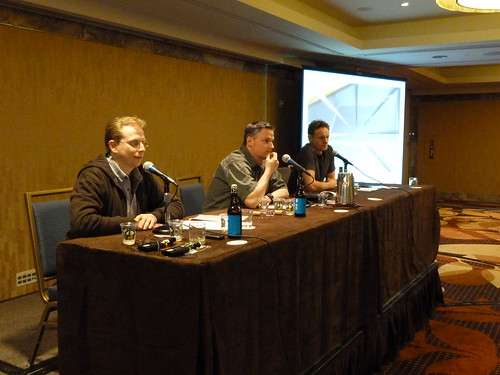
One of the most fun seminars at this year’s Craft Brewers Conference last week was the Barrel-Aged Sour Beers from Two Belgian’s Perspectives on Friday. It was moderated by Vinnie Cilurzo from Russian River Brewing and featured two lambic brewers, Yvan de Baets, owner of Brasserie de la Senne, and Jean Van Roy, owner of Brasserie Cantillon. I missed part of Yvan’s talk, but caught all of Jean’s. I first met Jean Van Roy at Cantillon several years ago, shortly before he took over the brewery from his father, Jean Pierre, and when Yvan was still working there, too. Jean gives a great overview of Cantillon’s brewing process. Enjoy.

P1030623
Yvan de Baets, Vinnie Cilurzo and Jean Van Roy.

Cantillon by Brookston

Filed Under: Beers, Breweries, Events Tagged With: Belgium, Science of Brewing

Gordon Biersch Creates World’s Rarest Beer: Hoppotamus Maximus

March 26, 2011 By Jay Brooks

gordon-biersch
I ran into Dan Gordon, from Gordon Biersch, at CBC yesterday and he told me about a new beer they’ve created, Hoppotamus Maximus, a hoppy and oh-so-rare beer that few people — unfortunately — will ever get a chance to sample. He’s teamed with Justin Crossly of The Brewing Network to tell the story of how he created the beer. It’s a pretty funny spoof of the hype surrounding hard-to-find beers, and the humor is as dry as I expect the beer would be.

Filed Under: Beers, Breweries, Just For Fun Tagged With: Bay Area, California, Humor, Video

Fritz Maytag & Ken Grossman Give Keynote At CBC 2011

March 24, 2011 By Jay Brooks

anchor-steam sierra-nevada
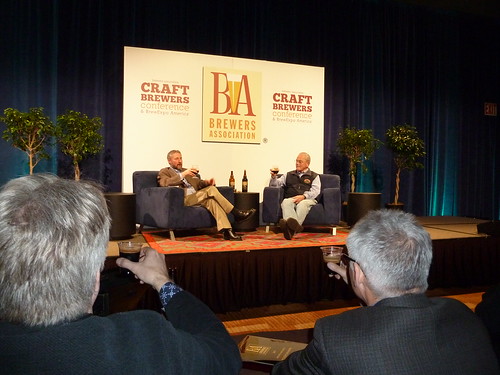
Earlier today the 2011 Craft Brewers Conference began with the morning program, which ended with a keynote address by Fritz Maytag and Ken Grossman. It was more of a casual talk or reminiscence, with Maytag and Grossman talking about their early days, with both the challenges and joys of those times when their were trying to get their respective breweries off the ground. They sat opposite one another on comfy chairs and talked for just over 30 minutes finishing with a toast using the collaboration imperial stout they did together last year, Fritz & Ken’s Ale.

P1030605

It was a highly entertaining talk and even quite funny in places. I’d forgotten my Flip camera, but I did manage to record the audio of the talk. The keynote is introduced by Tom McCormick, executive director of the California Small Brewers Association, and then it’s Ken and Fritz for thirty plus minutes. Enjoy.

Filed Under: Breweries, Events, Just For Fun, News Tagged With: Bay Area, Brewers Association, California, History

Craft Beer Grows 11% In Volume

March 21, 2011 By Jay Brooks

ba
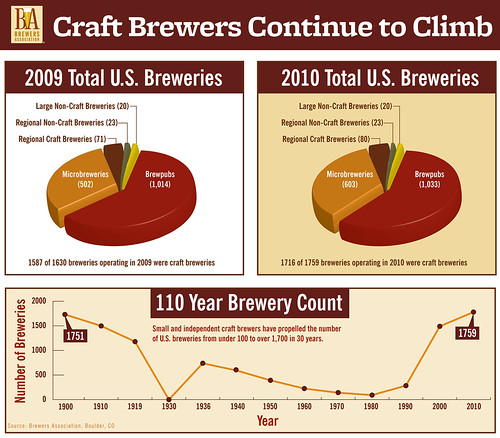
The Brewers Association just announced the statistics of craft beer sales in 2010, and the news is great. Craft beer saw volume growth of 11% over 2009, and in terms of dollars the increase was 12%, equating to roughly an additional one million barrels, or 14 million cases.

From the press release:

“Beer lovers increased their appreciation for American craft brewers and their beers in 2010,” said Paul Gatza, director, Brewers Association. “Craft brewers’ stories resonate with Americans who are choosing small, independent companies making delicious beers in more than 100 different styles.”

The Association also reported a growth in the number of U.S. breweries, with eight percent more breweries than the previous year. In 2010, there were 1,759 operating breweries. Craft brewers produced 9,951,956 barrels, up from an adjusted3 8,934,446 barrels in 2009.

“Prohibition caused a dramatic decline in the number of breweries in the United States, but the number of breweries is now at an all-time high,” added Gatza. “With well over 100 new brewery openings in 2010, plus 618 breweries in planning stages, all signs point to continued growth for the industry.”

Total Breweries

In 2010, craft brewers represented 4.9 percent of volume and 7.6 percent of retail dollars of the total U.S. beer category. The Brewers Association estimates the actual dollar sales figure from craft brewers in 2010 was $7.6 billion, up from $7 billion in 2009.

Overall, the U.S. beer industry represented an estimated retail dollar value of $101 billion. U.S. beer sales were down approximately one percent, or 2 million barrels, in 2010 compared to being down 2.2 percent in 2009. Total beer industry barrels dropped to 203.6 million, down from 205.7 million barrels in 2009. Imports were up five percent in 2010, compared to being down 9.8 percent in 2009. (Note: the Brewers Association does not count flavored malt beverages as beer.)

Gatza added, “We also found that three percent of craft brewer barrels, by volume, are distributed in cans, confirming a growing trend.”

It’s always great to have confirmed what we see in the street, that most, if not all, craft brewers are doing well. Another great year of craft beer growth. Congratulations to everybody.

Filed Under: Breweries, News Tagged With: Brewers Association, Press Release, Statistics

Beer Making Is Marvel Of Industrial Chemistry

March 20, 2011 By Jay Brooks

copper-kettle
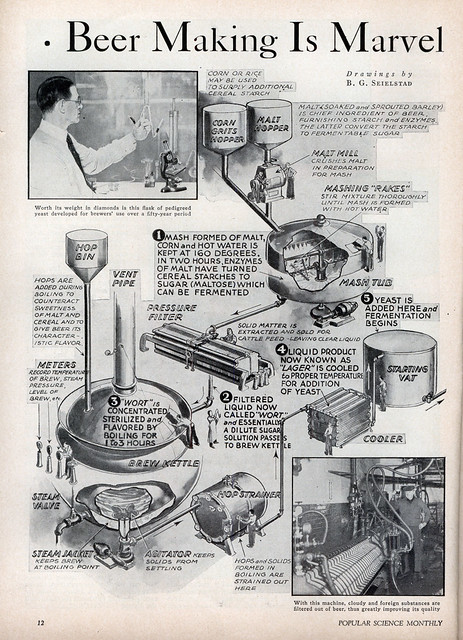
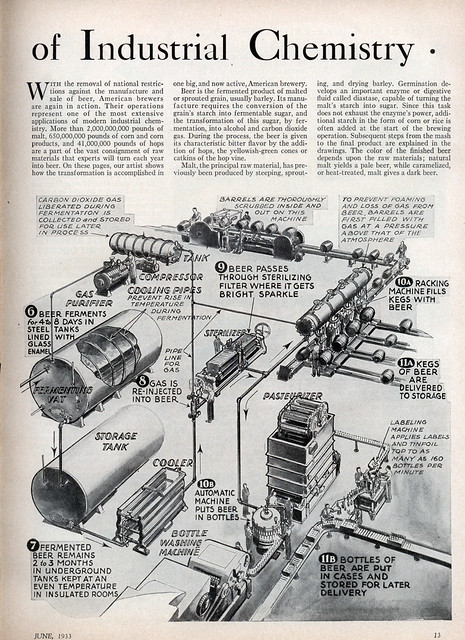
In June of 1933, just as Prohibition was in its death throes, that month’s issue of Popular Science magazine ran a two-page spread entitled Beer Making Is Marvel Of Industrial Chemistry, illustrated by Benjamin Goodwin Seielstad. It’s great fun to see it all laid out the way it’s done here. It seems like they were laying the groundwork for the return of brewing in America.

beer_making_1

There’s not a great deal of text accompanying the chart, but here it is in its entirety, from page two of the beer making chart:

With the removal of national restrictions against the manufacture and sale of beer, American brewers are again in action. Their operations represent one of the most extensive applications of modern industrial chemistry. More than 2,000,000,000 pounds of malt, 650,000,000 pounds of corn and corn products, and 41,000,000 pounds of hops are a part of the vast consignment of raw materials that experts will turn each year into beer. On these pages, our artist shows how the transformation is accomplished in one big, and now active, American brewery.

Beer is the fermented product of malted or sprouted grain, usually barley. Its manufacture requires the conversion of the grain’s starch into fermentable sugar, and the transformation of this sugar, by fermentation, into alcohol and carbon dioxide gas. During the process, the beer is given its characteristic bitter flavor by the addition of hops, the yellowish-green cones or catkins of the hop vine.

Malt, the principal raw material, has previously been produced by steeping, sprouting, and drying barley. Germination develops an important enzyme or digestive fluid called diastase, capable of turning the malt’s starch into sugar. Since this task does not exhaust the enzyme’s power, additional starch in the form of corn or rice is often added at the start of the brewing operation. Subsequent steps from the mash to the final product are explained in the drawings. The color of the finished beer depends upon the raw materials; natural malt yields a pale beer, while caramelized, or heat-treated, malt gives a dark beer.

beer_making_2

Filed Under: Breweries, Just For Fun Tagged With: History, Science of Brewing

« Previous Page
Next Page »

Find Something

Northern California Breweries

Please consider purchasing my latest book, California Breweries North, available from Amazon, or ask for it at your local bookstore.

Recent Comments

  • Bob Paolino on Beer Birthday: Grant Johnston
  • Gambrinus on Historic Beer Birthday: A.J. Houghton
  • Ernie Dewing on Historic Beer Birthday: Charles William Bergner 
  • Steve 'Pudgy' De Rose on Historic Beer Birthday: Jacob Schmidt
  • Jay Brooks on Beer Birthday: Bill Owens

Recent Posts

  • Historic Beer Birthday: Frederick Kirschner May 21, 2026
  • Beer Birthday: Nick Matt May 21, 2026
  • Historic Beer Birthday: Oliver Hughes May 20, 2026
  • Historic Beer Birthday: Benjamin, Lord Iveagh May 20, 2026
  • Historic Beer Birthday: Eduard Buchner May 20, 2026

BBB Archives

Feedback

Head Quarter
This site is hosted and maintained by H25Q.dev. Any questions or comments for the webmaster can be directed here.