Brookston Beer Bulletin

Jay R. Brooks on Beer

  • Home
  • About
  • Editorial
  • Birthdays
  • Art & Beer

Socialize

  • Dribbble
  • Email
  • Facebook
  • Flickr
  • GitHub
  • Instagram
  • LinkedIn
  • Pinterest
  • RSS
  • Twitter
  • YouTube

Powered by Genesis

Session #100: One Hundred Beers You’ve Probably Never Heard Of

June 6, 2015 By Jay Brooks

compass-open
It’s hard to believe we’ve doing this 100 months in a row, but it’s true. For our 100th Session, our host, Reuben Grey — who writes the Tale of the Ale — has decided to send us all on a quest to find the ark of the holy grail filled with lost beer styles, or something like that. Actually, for the June Session, the topic is “Resurrecting Lost Beer Styles,” which he describes below.

There are many [lost or almost lost beer styles] that have started to come back in to fashion in the last 10 years due to the rise of craft beer around the world.

If you have a local beer style that died out and is starting to appear again then please let the world know. Not everyone will so just write about any that you have experienced. Some of the recent style resurrections I have come across in Ireland are Kentucky Common, Grodziskie, Gose and some others. Perhaps it’s a beer you have only come across in homebrew circles and is not even made commercially.

There are no restrictions other than the beer being an obscure style you don’t find in very many places. The format, I leave up to individuals. It could be a historical analysis or just a simple beer review.
session_logo_all_text_200

Not content to follow directions, I recently spent way too much time thinking about beer color and creating several lists as a part of that. So I’m feeling whatever the opposite of listless is. Listical? Listful?

I have a love/hate relationship with beer styles. I think of them as both useless and necessary at the same time. And I’m hopeless when it comes to the instinct to categorize and organize everything, I can’t help but do it. I want to believe it’s simply human nature but I clearly have an advanced case of whatever disease causes people to catalogue, classify and codify the world.

I see beer styles as a dichotomy that will never be resolved. I understand both sides of the divide and think both are correct, and wrong, at least sometimes. The way we think about beer styles is a modern construct. Michael Jackson created the taxonomy that’s still with us (more or less) as a way to write about different beers around the world, and then Fred Eckhardt expanded on it and codified it for homebrewers, sealing its fate as the way we generally talk about beer styles. And I think it worked pretty well … for a while. It’s undoubtedly useful in judging and creating expectations. But I remember fifteen or so years ago Charlie Bamforth, my professor at U.C. Davis for the short course, telling us how beer styles don’t matter at all. And he was right, of course. They don’t. All that matters to a commercial brewery is that people like, and more importantly, buy the beer, no matter what “style” it is.

But where all these different beers came from has to do with geography, climate, agriculture and culture. Place is the single most important factor in having created so many different types of beer. Every local area had its own unique, or a mostly unique variation, of beer that took advantage of what the brewers had on hand, be it the grain, hops or other flavors they could get, what the local water was like, the local customs, and the politics or culture itself. What we call traditional beer styles today are simply the winners, the local or regional styles that survived industrialization and displaced more local styles as breweries grew larger and expanded their reach. Beer, slowly at first, and then much more rapidly, became commodified, became all the same, especially in the U.S., but all over the world to a greater or lesser extent. Popular regional, national and global brands displaced local ones and many of those can now be considered “lost,” if not entirely forgotten.
atlas-beer

A favorite line from Elvis Costello’s 1977 song “I’m Not Angry” is “there’s no such thing as an original sin.” And I think that applies to beer styles, too. Just about everything has been tried before, and we fool ourselves that modern beers are more innovative. That’s not to take away from brewers trying to make distinctive beers, whether by trying to break tradition or finding beers that have become extinct or nearly so and resurrecting them, so to speak, or more often making a modern interpretation. I think these are all good developments. I’m not sure we need another IPA, so I find it much more interesting that brewers are exploring different flavors in an effort to stand out and make their mark in the beer world. So I’m not as interested in opining if they’re styles or not, I just want to taste them.

So for this Session, still feeling listful, I decided instead to do some searching around to simply find how many old, mostly forgotten types of beer I could find. As I said, I came up with the title before I even knew if I could find 100. It took maybe an hour to go past the century mark, and in the end, was no problem at all. And that tells us quite a bit about how much the landscape of beer was changed by industrialization and the consolidation of the industry worldwide. When beer became very much the same, the local, more unique beers were lost. We saw the same thing happen with food, too, which spawned the artisanal movements for better cheese, meats, chocolate, heirloom fruits and vegetables, etc.

Blue metal compass
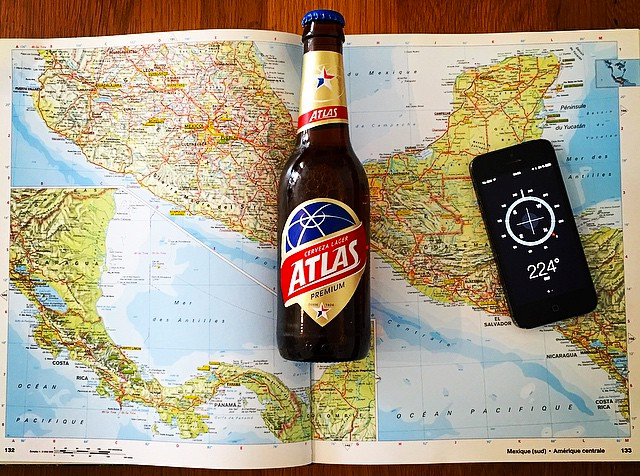
So the list of 100 beers below is not strictly all extinct beers, but also includes beers nearly so, ones that are starting to come back, beers that are only made by a very few breweries and some so ancient we don’t know much about them beyond their names. The beers are from all over the compass. I gathered them from a variety of sources, mostly websites and a few books in my library. When I say you’ve probably never heard of them, chances are you know the names of at least a few of them. You could probably test your beer geek quotient by how many you recognize.

  1. Aarschotse Bruine
  2. Adambier
  3. Black Cork
  4. Black or Spruce Beer
  5. Bremer Bier
  6. Brett-Fermented Stock Ale
  7. Breyhan or Broyhan
  8. Burton Ale
  9. Chicha
  10. Citronenbier (Lemon Beer)
  11. Cock Ale
  12. Coirm
  13. Colne Spring Ale
  14. Cöpenicker Moll
  15. Dampfbier
  16. Danziger Bier
  17. Deutsches Porter
  18. Devonshire White or Devon White Ale
  19. Duckstein
  20. Dutch Black Buckwheat Beer
  21. Ebla
  22. Eilenburger Bier
  23. Einfachbier
  24. Erfurter Bier
  25. Erntebier (Harvest Beer)
  26. Fern Ale
  27. Fränkische Biere
  28. Gale Ale
  29. Garlebischer Garley
  30. Geithayner
  31. Gotlandsdrickå
  32. Grodziski (a.k.a. Grodziskie or Grätzer Bier)
  33. Grout Ale
  34. Hamburger Bier
  35. Heather Ale
  36. Hellesroggen
  37. Hogen Mogen
  38. Hosenmilch
  39. Humming Ale
  40. Jopenbier
  41. Kash or Kás
  42. Kashbir
  43. Kashdu
  44. Kashdùg
  45. Kashgíg or Kashgíg-dùgga
  46. Kash-sur-ra
  47. Kassi
  48. Kennett Ale
  49. Kentucky Common
  50. Keptinus Alus
  51. Kiszlnschtschi
  52. Kodoulu
  53. Kotbüsser Bier
  54. Koyt
  55. Kushkal
  56. Kuurna
  57. Kvass
  58. Leipziger Stadtbier
  59. Lichtenhainer
  60. Light Bitter
  61. Light Mild
  62. Lübecker
  63. Makgeolli
  64. Merseburger
  65. Moskovskaya (Old Moscow Brown Ale)
  66. Mum or Mumme
  67. Münster Beer
  68. Naumburger
  69. Pennsylvania Swankey
  70. Peeterman
  71. Potsdamer Bier
  72. Preusishce Bier
  73. Purl
  74. Rheinländische Bitterbier
  75. Rostocker Bier
  76. Ruppiner Bier
  77. Sahti
  78. Säuerliche Bier
  79. Scotch Ale
  80. Seef
  81. Sloe Beer (Schlehenbier)
  82. Sour Bock
  83. Sour Ofest
  84. Sour Old Ale
  85. Stein Beer
  86. Stingo
  87. Stitch
  88. Strong Pale Mild
  89. Sußbier or Einfachbier
  90. Uitzet or Uytzet
  91. Ulushin
  92. Vatted Old Ale
  93. Vatted Porter
  94. Weizenschalenbier
  95. West Country White Ale
  96. Wettiner
  97. Windsor Ale
  98. Winter Warmer
  99. Wurzner
  100. Zerbster

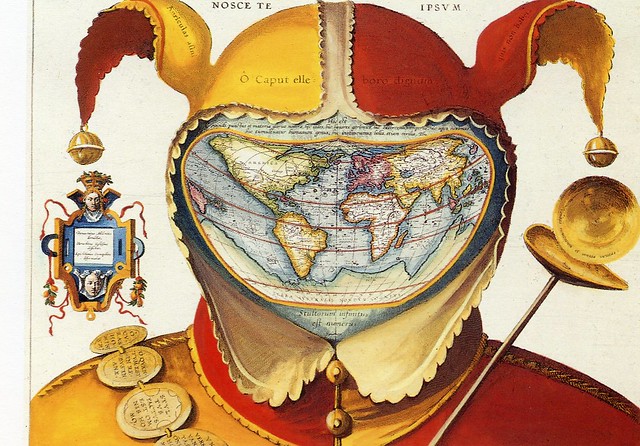
How much fun would it be to try every one of them? Beer, of course, is a global drink and is the third most-consumed liquid (after water and tea) so I suspect the number of lost beers is far greater than this, and probably numbers in the hundreds, or possibly thousands, depending on how you differentiated them. Should we try to catalogue them all? Now that would be a real fool’s errand, but it would be fun to try.
foolscap

Filed Under: Beers, Editorial, Just For Fun, Related Pleasures, The Session Tagged With: Beer Styles, History, International

Patent No. 4837156A: Tilting Lauter Tun

June 6, 2015 By Jay Brooks

patent-logo
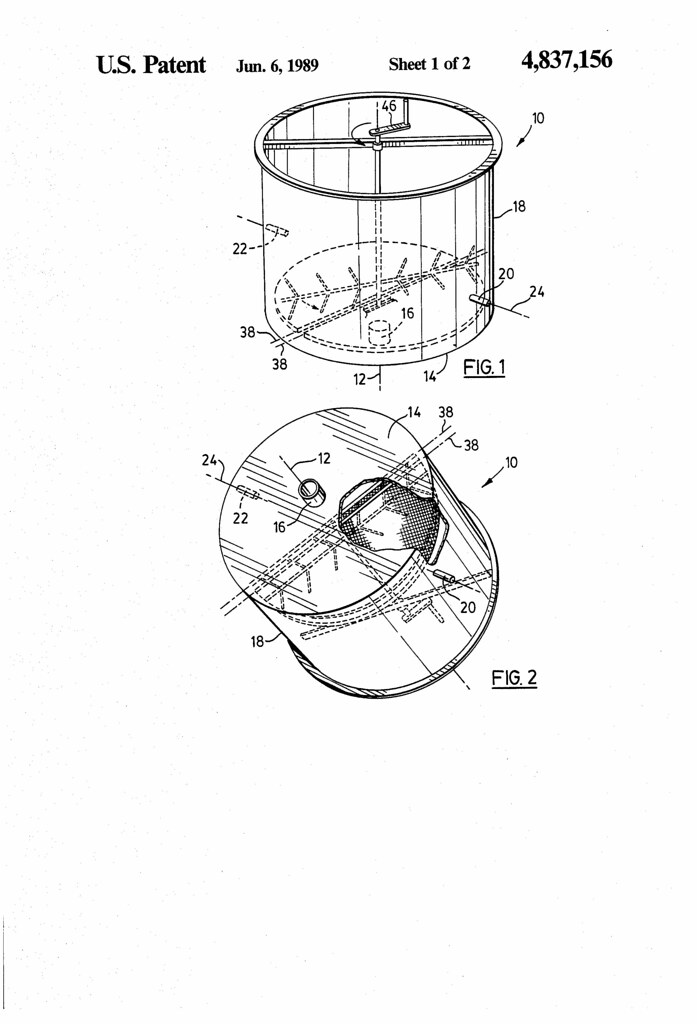
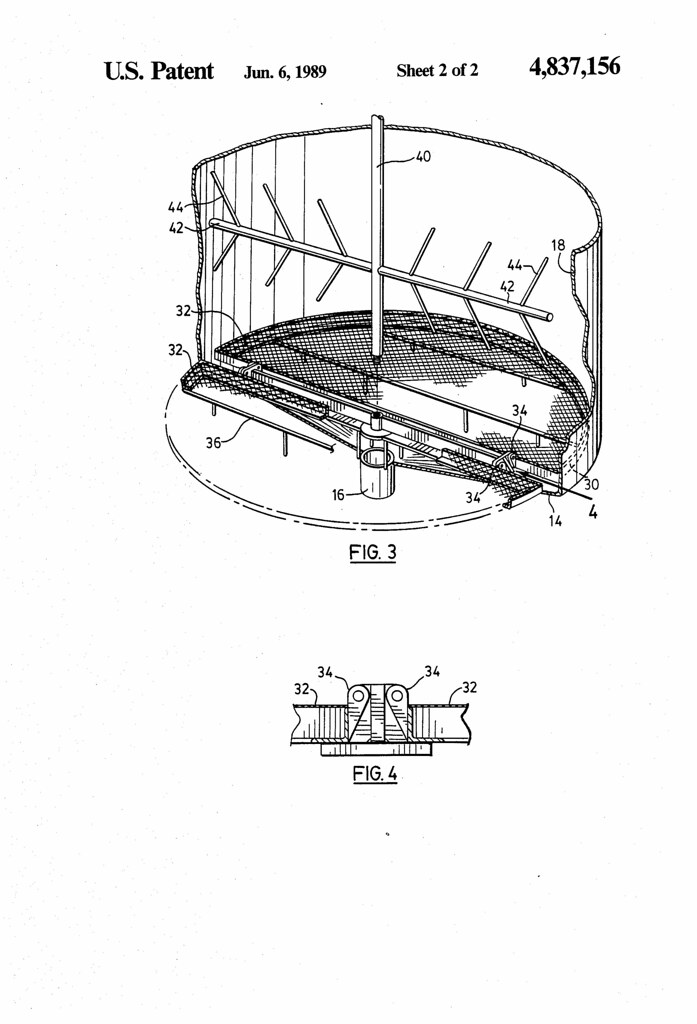
Today in 1989, US Patent 4837156 A was issued, an invention of Leo K. Lampinen, for his “Tilting Lauter Tun.” Here’s the Abstract:

A vessel has a central longitudinal axis, a pair of trunnions defining a tilting axis, and a fixed bottom and a false bottom. The false bottom comprises at least one screen. At least one of the screens is affixed to the vessel by a plurality of hinges so as to allow the screens to freely swing from a first position to a second position as said vessel is tilted about the tilting axis.

Untitled
Untitled

Filed Under: Beers, Breweries, Just For Fun, Politics & Law, Related Pleasures Tagged With: Brewing Equipment, History, Law, Patent, Science of Brewing

Patent No. 3037431A: Carton Feeding, Erecting And Filling Mechanism

June 5, 2015 By Jay Brooks

patent-logo
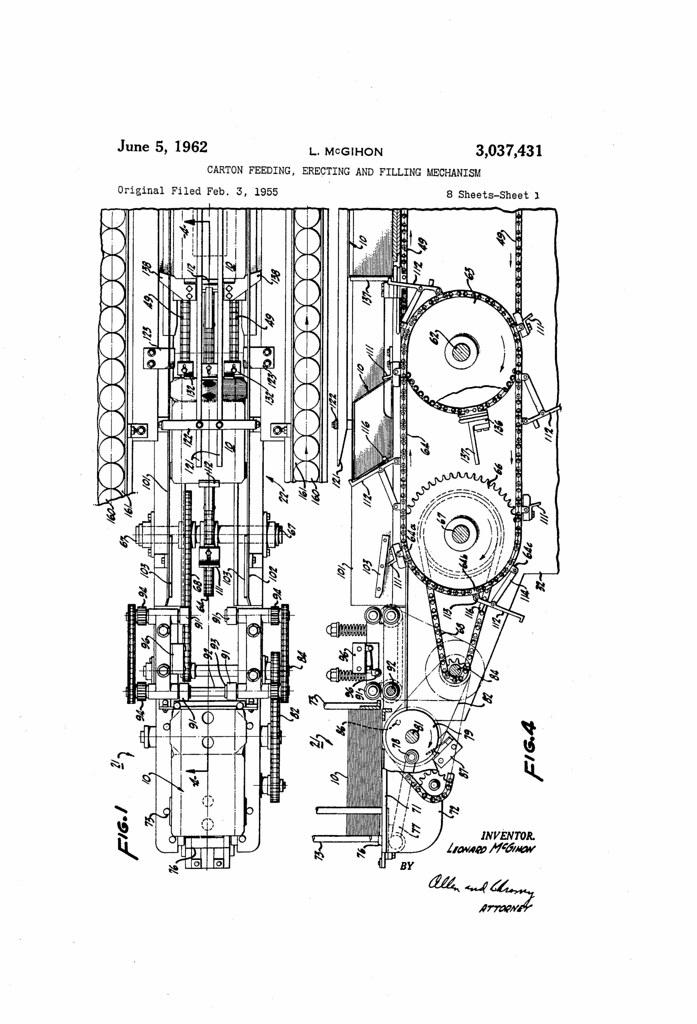
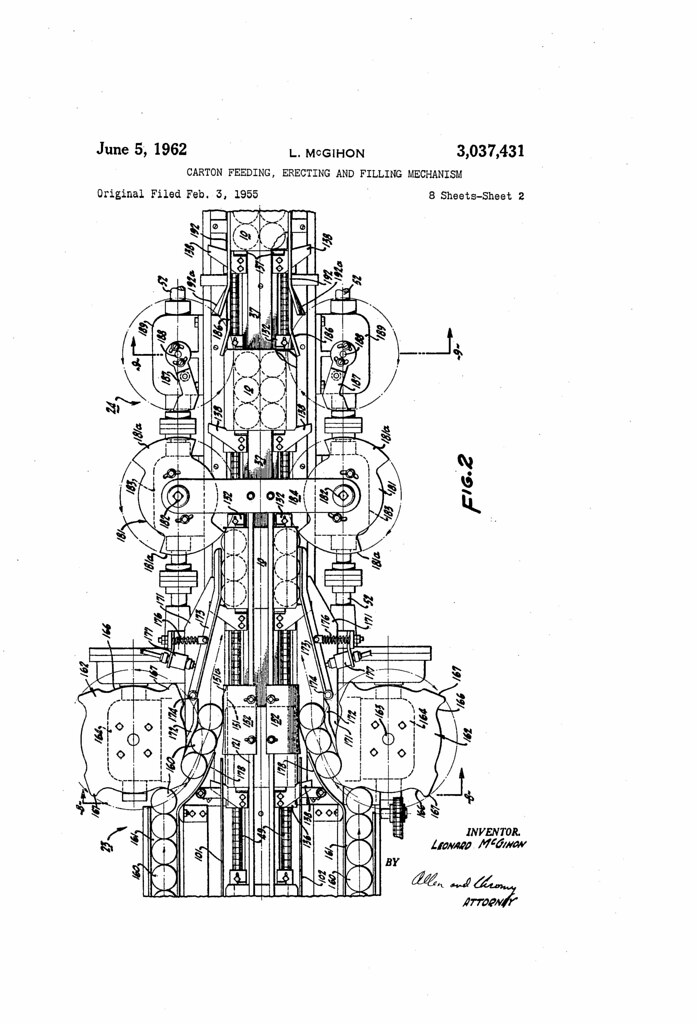
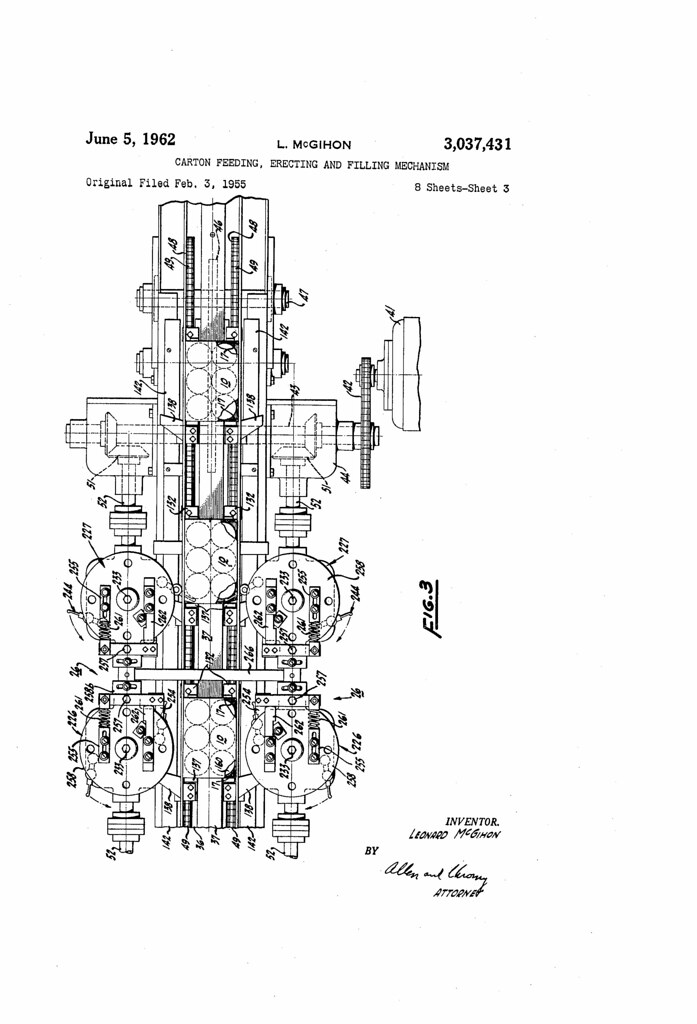
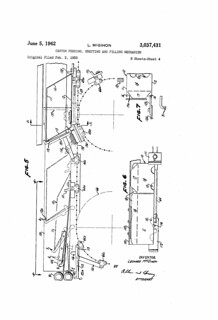
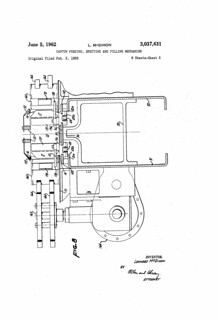
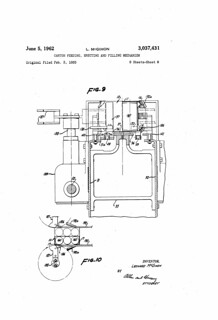
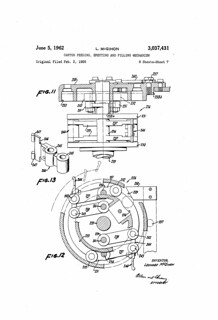
Today in 1962, US Patent 3037431 A was issued, an invention of Leonard McGihon of San Leandro, California, assigned to the King-O-Matic Equipment Corp., for his “Carton Feeding, Erecting And Filling Mechanism” There’s no Abstract, although there’s a paragraph in the description that summarizes it nicely.

The present invention relates to mechanism for taking respective folded cartons, successively from a stack, opening these cartons to a box-like form with open sides, feeding cans or other containers in groups into the carton through the open sides thereof, and then closing the cartons so as to provide a carry-home pack of the containers in the carton. The various operations take place in sequence and continuously to provide a rapid and efficient method of packing containers in cartons, for example beer cans packed in the familiar six-pack cartons as now commonly on the market. More particularly, the instant mechanism is designed to operate on a carton of a character having a closed rectangular shape with partially open sides, the open sides being provided with connected or continuous side flap portions, the respective adjacent side flaps of each corner being connected by a gusset type fold. In this type of carton, the folding of the flaps attached to the end panels of the carton tucks these flaps behind the containers or cans in the carton and effectively holds the carton closed during shipment and handling, but provides for easy opening by the user.

Untitled
Untitled
Untitled

Untitled Untitled

Untitled Untitled

Filed Under: Beers, Breweries, Just For Fun, Politics & Law, Related Pleasures Tagged With: Brewing Equipment, History, Law, Packaging, Patent

Patent No. 5021246A: Step Mashing Process For Producing Low Alcohol Beer

June 4, 2015 By Jay Brooks

patent-logo
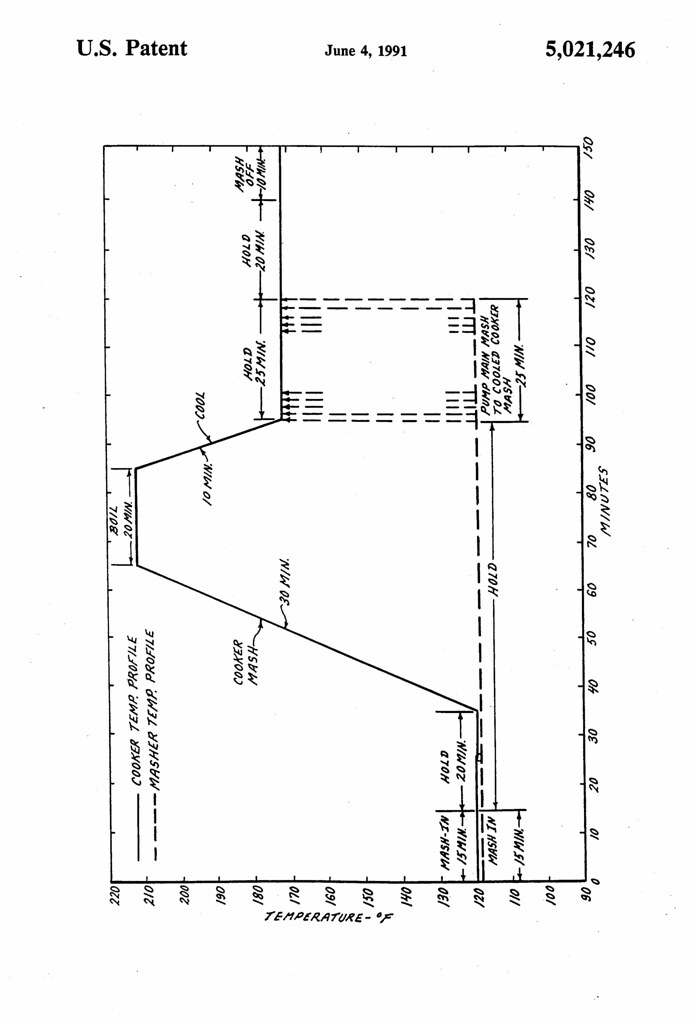
Today in 1991, US Patent 5021246 A was issued, an invention of Roger L. Sieben and Klaus D. Zastrow, assigned to Anheuser-Busch, for their “Step Mashing Process For Producing Low Alcohol Beer.” Here’s the Abstract:

A low alcohol reduced calorie beer is produced by a mashing technique wherein a main mash at a temperature below the activity range for beta-amylase is added incrementally to a brewing liquid at a temperature above the deactivation temperature of beta-amylase and below the deactivation temperature of alpha-amylase at a rate such that the added main mash is substantially instantaneously raised to the temperature of the brewing liquid. This mashing technique limits the conversion of starches by beta-amylase and other enzymes without significant loss of alpha-amylase from overheating to produce a wort having a low real degree of fermentation of from about 40% to about 46%. The main mash has a temperature of about 95° F. to 120° F., and the brewing liquid has a temperature of about 169° F. to 174° F. and can be water or a cooker mash that has been boiled and cooled. Beer can be produced having less than 2% alcohol by weight and less than about 118 calories per 12 ounce serving.

Untitled

Filed Under: Beers, Breweries, Just For Fun, Politics & Law, Related Pleasures Tagged With: Anheuser-Busch, History, Law, Light Beer, Patent, Science of Brewing

Patent No. 2794453A: Filling Heads For Bottling Machine

June 4, 2015 By Jay Brooks

patent-logo
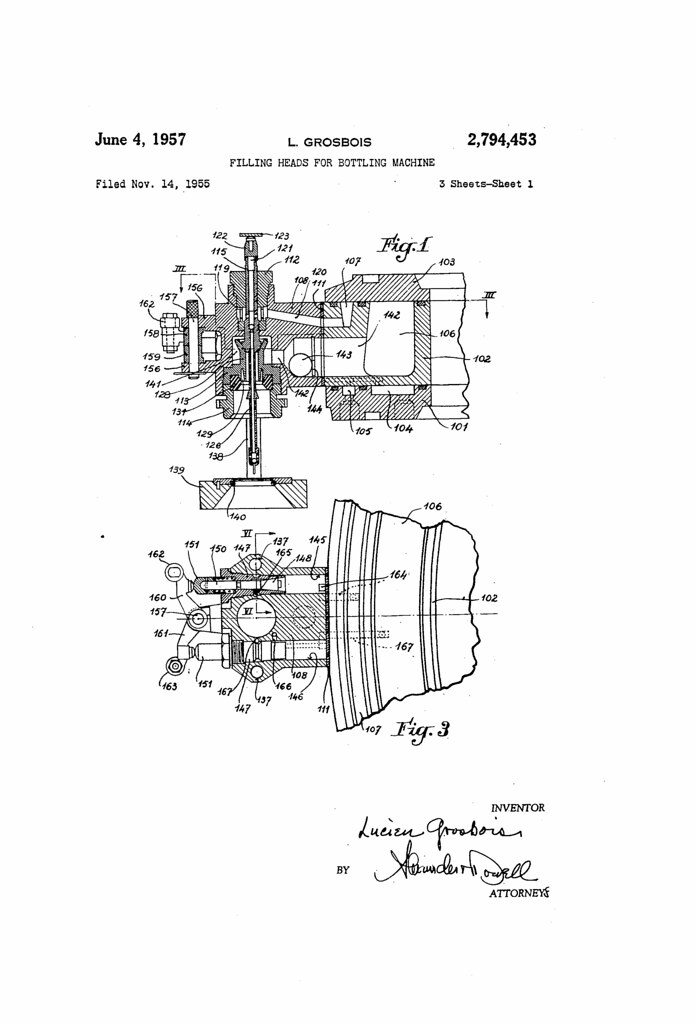
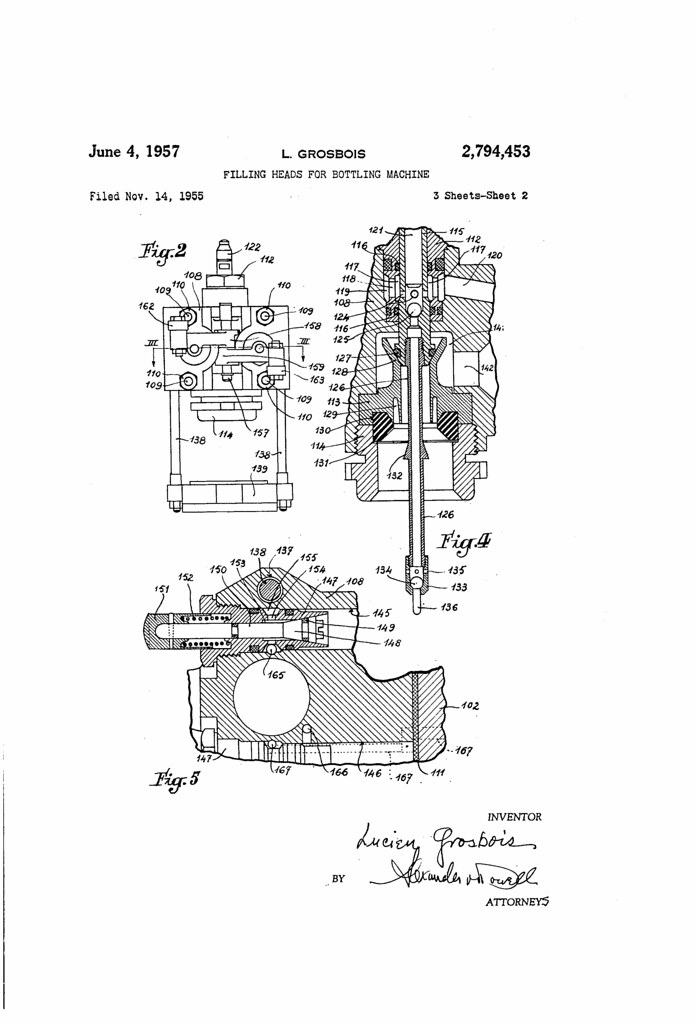
Today in 1957, US Patent 2794453 A was issued, an invention of Lucien Grosbois, for his “Filling Heads For Bottling Machine.” There’s no Abstract, though the description in the application states that the “invention relates to filling heads adapted to be mounted on bottling machines for gaseous liquids under pressure.”
Untitled
Untitled

Filed Under: Beers, Just For Fun, Politics & Law, Related Pleasures Tagged With: Bottles, Brewing Equipment, History, Law, Patent

Patent No. 2203130A: Beer Energizer

June 4, 2015 By Jay Brooks

patent-logo
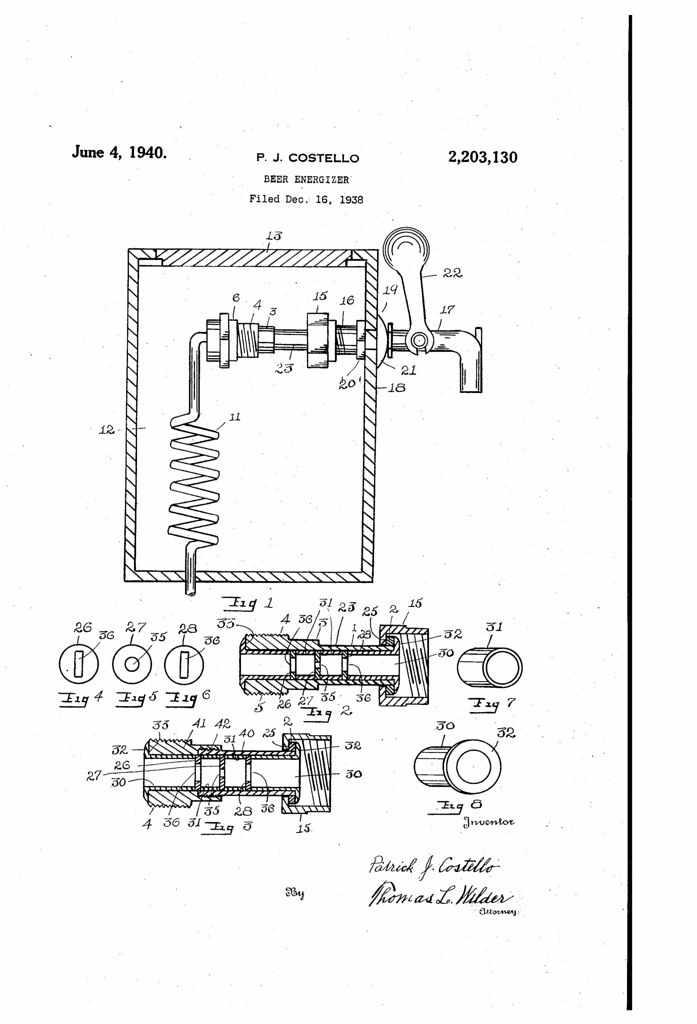
Today in 1940, US Patent 2203130 A was issued, an invention of Patrick J. Costello, for his “Beer Energizer.” There’s no Abstract, though the description in the application states that the “object of my invention is to provide a device for drawing beer in its normal stage without applying extra pressure or force, whereby to create a line creamy foam.” I’m not sure what about that “energizes” the beer, but it’s certainly a catchy name.
Untitled

Filed Under: Beers, Just For Fun, Politics & Law, Related Pleasures Tagged With: History, Law, Patent

10-Cent Beer Night In Cleveland

June 4, 2015 By Jay Brooks

10-cents
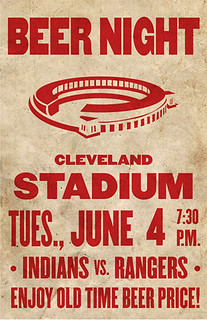
On June 4, 1974, the Cleveland Indians hosted the Texas Rangers with a promotion entitled “10¢ Beer Night” in an effort to boost sagging attendance to Municipal Stadium. 25,134 fans showed up, about twice the number expected. They were allowed to purchase six 10¢ beers (12 oz. cups of 3.2 beer or 4% ABV) at a time, but there was no limit on how many trips to the concession stand one could make. To give that some context, regular beer prices at the time were 65¢, so a dime beer was about 6-and-half times cheaper, a pretty good bargain. Accounts vary on the brand of beer. Some say Stroh’s while other say it was Genesee. By the time the game ended in chaos, around 60,000 beers had been consumed.

beer-night-poster 10centcup

To add fuel to the fire, a little over a week before in Texas, the Rangers had a similar promotion in which there was “a bench-clearing brawl” when the two teams had played “at Arlington Stadium in Texas [which] left some Indians fans harboring a grudge against the Rangers.”

The Indians had been losing most of the game, but managed to tie it up in the 9th inning, at which point I’ll let Wikipedia take over the story.

After the Indians had managed to tie the game, a 19-year-old fan named Terry Yerkic ran onto the field and attempted to steal Texas outfielder Jeff Burroughs’ cap. Confronting the fan, Burroughs tripped. Thinking that Burroughs had been attacked, Texas manager Billy Martin charged onto the field with his players right behind, some wielding bats. A large number of intoxicated fans – some armed with knives, chains, and portions of stadium seats that they had torn apart – surged onto the field, and others hurled bottles from the stands. Hundreds of fans surrounded the outnumbered Rangers.

Realizing that the Rangers’ lives might be in danger, Cleveland manager Ken Aspromonte ordered his players to grab bats and help the Rangers, attacking the team’s own fans in the process. Rioters began throwing steel folding chairs, and Cleveland relief pitcher Tom Hilgendorf was hit in the head by one of them. Hargrove, after subduing one rioter in a fistfight, had to fight another on his way back to the Texas dugout. The two teams retreated off the field through the dugouts in groups, with players protecting each other.

The bases were pulled up and stolen and many rioters threw a vast array of objects including cups, rocks, bottles, batteries from radios, hot dogs, popcorn containers, and folding chairs. As a result, umpire crew chief Nestor Chylak, realizing that order would not be restored in a timely fashion, forfeited the game to Texas. He too was a victim of the rioters, as one struck and cut his head with part of a stadium seat[11] and his hand was cut by a thrown rock. He later called the fans “uncontrollable beasts” and stated that he’d never seen anything like what had happened, “except in a zoo”.

As Joe Tait and Herb Score called the riot live on radio, Score mentioned the security guards’ inability to handle the crowd. He said, “Aw, this is absolute tragedy.” The Cleveland Police Department finally arrived to restore order.

Later, Cleveland general manager Phil Seghi blamed the umpires for losing control of the game. The Sporting News wrote that “Seghi’s perspective might have been different had he been in Chylak’s shoes, in the midst of knife-wielding, bottle-throwing, chair-tossing, fist-swinging drunks.”

The game ended with the Indian forfeiting because order could not be restored so the game could be completed.

Cleveland-10c-beer-1
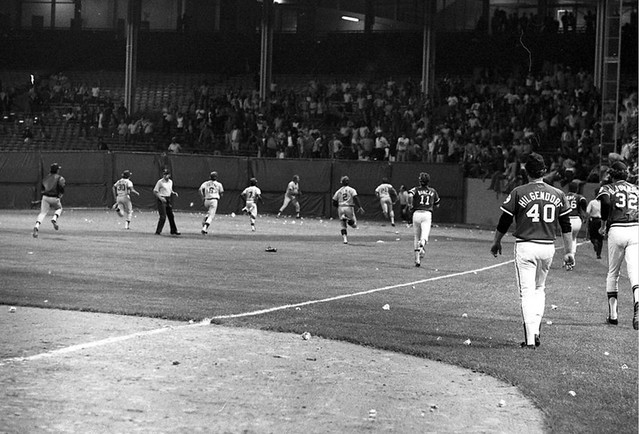
The scene as thinks began to turn ugly in the bottom of the 9th.

Cleveland-10c-beer-2
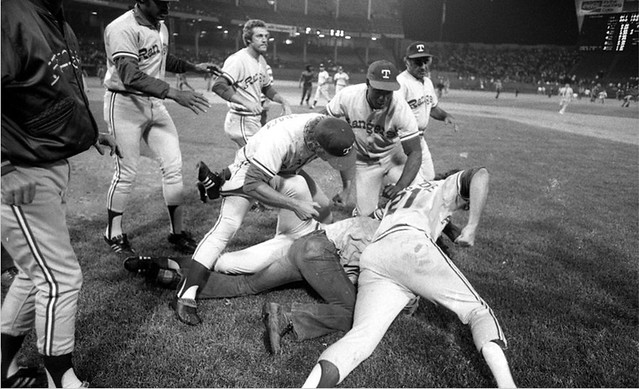
Things went from bad to worse after that. Here’s a run down of the statistics from sportswriter Dan Coughlin, who was there that night and got punched in the face:

  • 25,134 fans
  • 60,000 Genesee beers at 10 cents each
  • 50 cops
  • 19 streakers
  • 7 emergency room injuries
  • 9 arrests
  • 2 bare moons
  • 2 bouncing breasts
  • 1 sportswriter punched in the jaw

You can read all about Dan Coughlin recalls the Indians’ famous Ten-Cent Beer Night and see a gallery of photos at SB★Nation entitled Celebrating 10-Cent Beer Night in photos.

Mental Floss summed it up like this:

Among the more tame incidents was a woman who flashed the crowd from the on-deck circle, a father-son team mooning the players, and fans jumping on the field to meet the outfielders. Then, in the bottom of the ninth, the Indians tied the game, but never got a chance to win. Fans started throwing batteries, golf balls, cups, and rocks onto the field. The drunk-fest involved more streakers, base stealers (literally), and fans who stormed the field and attacked the opposing team. Cleveland players had to wield bats to come to the aid of the Rangers players. Texas was awarded a forfeit.

Not exactly baseball or beer’s finest hour.

And a special thanks to Jason Petros from MoreBeer and The Brewing Network for reminding me it was today.

Filed Under: Beers, Just For Fun, Related Pleasures Tagged With: Baseball, History, Sports

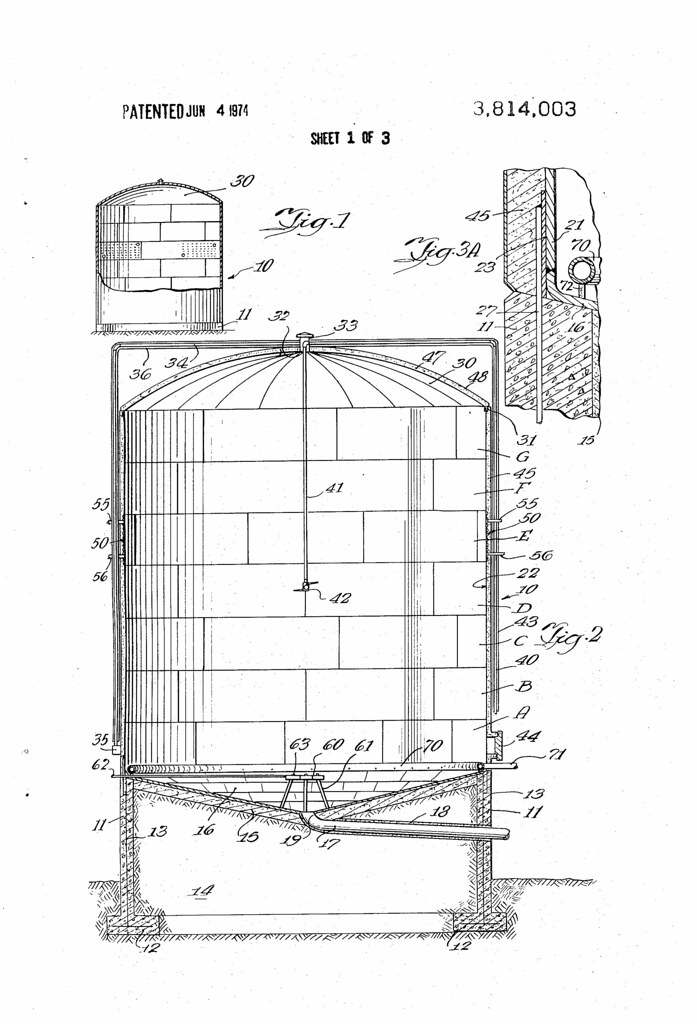
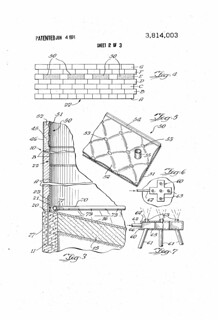
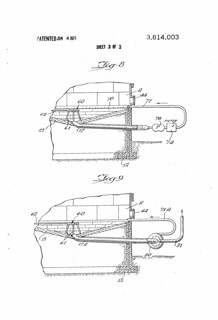
Patent No. 3814003A: Brewing Apparatus

June 4, 2015 By Jay Brooks

patent-logo
Today in 1974, US Patent 3814003 A was issued, an invention of Nickolas Lothar Vacano, assigned to Rainier Companies, for his “Brewing Apparatus.” Here’s the Abstract:

A large size thin-shelled outdoor metal tank, such as for making beer, with a conical metal bottom having a shallow slope of no more than 25 DEG from the horizontal, a conduit communicating with the tank interior at the apex of the conical bottom, a circular cylindrical vertical metal wall joined to the bottom, a metal roof joined to and supported by the vertical wall, insulation exterior of the bottom, wall and roof, a vent opening in the roof, a manifold centrally located in the tank spaced above the bottom and the level of unsuspended solids which may settle therein, said manifold having a plurality of openings through which carbon dioxide gas can exit into liquid in the tank, and a pipe leading from outside the tank to the manifold for supplying carbon dioxide thereto. The tank can have a tubular ring positioned inside the tank adjacent the periphery of the bottom, a pipe communicating with the ring and the exterior of the tank for supplying fluid to the ring, and a plurality of holes in the ring from which fluid under pressure can be ejected along the slope of the bottom to wash solids to the conduit in the bottom for removal.

Untitled

Untitled Untitled

Filed Under: Beers, Breweries, Just For Fun, Politics & Law, Related Pleasures Tagged With: Brewing Equipment, History, Law, Patent, Science of Brewing

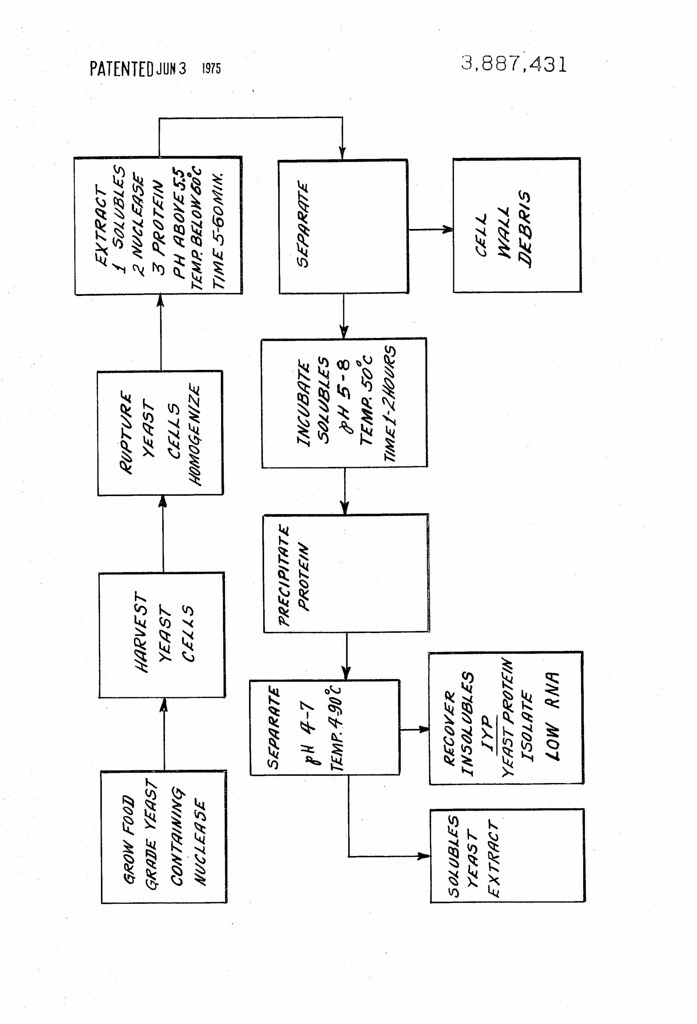
Patent No. 3887431A: Yeast Protein Isolate With Reduced Nucleic Acid Content & Process Of Making Same

June 3, 2015 By Jay Brooks

patent-logo
Today in 1975, US Patent 3887431 A was issued, an invention of Ernest Aleck Robbins, Robert William Sucher Jr., Erich Henry Schuldt, Daniel Robert Sidoti, Robert Dudley Seeley, and Jon Albert Newell, assigned to Anheuser Busch, for their “Yeast Protein Isolate with Reduced Nucleic Acid Content and Process of Making Same.” Here’s the Abstract:

This disclosure relates to a yeast protein isolate (IYP) with less than 9% nucleic acid (RNA) and a Protein Equivalence Ratio (PER) of greater than 1. The yeast protein is made by a process which involves rupturing yeast cells, removing the cell wall residue from an alkaline medium, incubating in such a manner that the endogenous nuclease contained in the solubles portion degrades the nucleic acid present to a soluble form, insolubilizing the protein to separate it from the hydrolyzed nucleic acid, and separating the insoluble protein from the fraction containing soluble nucleic acid.

Untitled

Filed Under: Beers, Breweries, Just For Fun, Politics & Law, Related Pleasures Tagged With: History, Law, Patent, Yeast

The Beer Barrel Polka

June 3, 2015 By Jay Brooks

oktoberfest-band
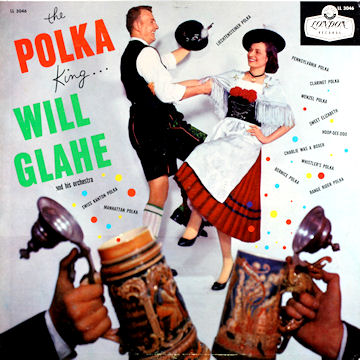
76 years ago today one of the most well-known polkas, and songs about beer, The Beer Barrel Polka, reached #1 on the Billboard Pop Music Chart in 1939. It was actually written in 1927, by Czech composer Jaromír Vejvoda. It was originally an instrumental known as the Modřanská polka (“Polka of Modřany”), but in 1939, German accordionist Will Glahé renamed it “The Beer Barrel Polka” and it was his 1939 version that made it the memorable song that is still played today. After World War II, Glahé was known in America as the “Polka King.” The English lyrics were later written by Lew Brown and Wladimir Timm, both Tin Pan Alley lyricists. The song was subsequently recorded by many other bands and singers. Musicians such as the Andrews Sisters, the Glenn Miller Orchestra, Benny Goodman, Billie Holiday, Liberace, the Marx Brothers, Bobby Vinton and Frankie Yankovic did their own versions, too, making it a mainstay at dances and weddings to this day.

polka-king-will-glahe

I was unaware of this local connection, but according to Wikipedia:

At San Jose Giants home games, a batter from the opposing team is designated the “beer batter.” If the San Jose pitcher strikes out that batter, beer is half price in the beer only lines for the 15 minutes immediately following the strike out. The beer batter promotion is in effect only for the first six innings of the game. The PA system plays Beer Barrel Polka whenever the beer batter comes to the plate and after every strike during the beer batter’s at-bat (through the first six innings). After the sixth inning, the beer batter becomes the apple juice batter and if he strikes out, fans get half-priced Martinelli’s apple juice.

So here is the original version that made it a hit, as performed by Will Glahé:

will_glahe_orchester_1935_auf_wangerooge
Will Glahe and his orchestra in 1935, before the Beer Barrel Polka made him famous.

Filed Under: Just For Fun, Related Pleasures Tagged With: Germany, History, Music, Video

« Previous Page
Next Page »

Find Something

Northern California Breweries

Please consider purchasing my latest book, California Breweries North, available from Amazon, or ask for it at your local bookstore.

Recent Comments

  • Bob Paolino on Beer Birthday: Grant Johnston
  • Gambrinus on Historic Beer Birthday: A.J. Houghton
  • Ernie Dewing on Historic Beer Birthday: Charles William Bergner 
  • Steve 'Pudgy' De Rose on Historic Beer Birthday: Jacob Schmidt
  • Jay Brooks on Beer Birthday: Bill Owens

Recent Posts

  • Beer In Ads #5391: Billy And The Judge November 12, 2026
  • Historic Beer Birthday: Michael Arthur Bass November 12, 2026
  • Historic Beer Birthday: Samuel Liebmann November 12, 2026
  • Historic Beer Birthday: Philip R. Ebling November 12, 2026
  • Historic Beer Birthday: Joseph Coors Sr. November 12, 2026

BBB Archives

Feedback

Head Quarter
This site is hosted and maintained by H25Q.dev. Any questions or comments for the webmaster can be directed here.