Brookston Beer Bulletin

Jay R. Brooks on Beer

  • Home
  • About
  • Editorial
  • Birthdays
  • Art & Beer

Socialize

  • Dribbble
  • Email
  • Facebook
  • Flickr
  • GitHub
  • Instagram
  • LinkedIn
  • Pinterest
  • RSS
  • Twitter
  • YouTube

Powered by Genesis

R.I.P. Don Younger 1941-2011

January 31, 2011 By Jay Brooks

horse-brass
I just heard that Don Younger, owner of the Horse Brass in Portland, passed away last night around 12:30 a.m. He will be greatly missed. The craft beer community has lost one of its earliest and most ardent supporters, and a great friend to so many of us. Here’s to you, Don.

I just spoke to Lisa Morrison, who was up very late, first at the Hospital and then out with friends toasting and celebrating Don Younger’s life. Though nothing definite has been decided, it’s likely there will be a charity wake at some point soon. One story she told me seemed to sum it up best. There was a parade of visitors at the hospital going in, one at a time, to visit Don, and the nurse asked who Don was, to which Lisa replied “he was our Messiah.” Amen.

younger-silva
Don Younger 1941-2011

Below is an interview Tom Dalldorf of the Celebrator Beer News did along with Lisa Morrison for the 30th anniversary of the Horse Brass.

Filed Under: News Tagged With: Oregon, Portland, Pubs

Don Younger In Hospital

January 30, 2011 By Jay Brooks

horse-brass
Don Younger, owner of the Horse Brass in Portland, has been the subject of numerous rumors today throughout the Twitterverse. I wanted to find out what’s really going on so I called a friend in Portland who’s close to the situation, and here’s what I’ve learned.

Don fell last week and broke his shoulder, and was taken to the hospital. Because of numerous medications he’d been on and the health of his lungs, doctors have him on a respirator and are keeping him for observation. The prognosis does not appear favorable and there apparently isn’t much that the doctors can do except watch, and wait, at least for now. Don’s a tough customer, and has as strong a will as anyone I’ve known, so I’m hoping that will see him through this. It looks like we should know more in the next few hours or days.

Please join me in sending your prayers and positive thoughts Don’s way. Drink a toast to Don’s health. I’ll update this as new information becomes available.

UPDATE: John Foyston has more information up at the Oregonian.

younger-porter
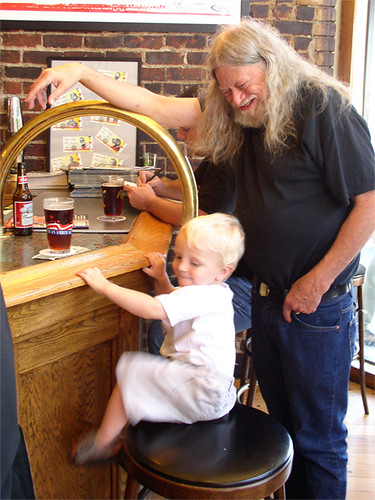
Don with my son Porter when he was a toddler at the Rogue Alehouse in San Francisco.

younger-dalldorf
Don sharing a beer with me and Tom Dalldorf at the Celebrator offices a number of years ago.

Filed Under: News Tagged With: Oregon, Portland, Pubs

Grilling With Beer: Fanning The Flames Of A New Edition

January 30, 2011 By Jay Brooks

lucy-saunders
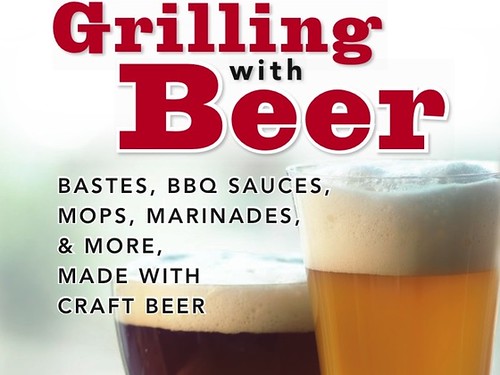
The beer cook, Lucy Saunders, published a great book five years ago called Grilling with Beer. I must confess I’m a little biased, because I contributed a short chapter to it on Oyster BBQ. The book is now out of print, though there’s still great demand for it. So Lucy’s planning on “putting together new chapters and recipes for [her] cookbook, GRILLING WITH BEER: bastes, barbecue sauces, mops, marinades and more made with craft beer.”

She’s using Kickstarter to raise the $28,000 she needs “to pay for the printing for the 224-page color cookbook (using recycled paper and eco-inks). Everyone who funds will be acknowledged on the grillingwithbeer.com website — and larger funders can get even more cookbooks, plus assorted goodies such as tastings and cooking demonstrations. Eventually, the cookbook will be sold (suggested price will be $21.95) where craft beer is sold!”

While you can pledge any amount on Kickstarter, pledge just $25 and get a copy of the book autographed by Lucy, a t-shirt and 5 recipe postcards. Such a deal! Whether you have a copy of the original book or not, here’s a great opportunity to get the new version and help out a very worthwhile project to get Lucy’s book back in print.

Grilling-with-beer

Filed Under: Beers, Food & Beer, News Tagged With: Beer Books, Cooking

“Brew Your Cask Off” Contest

January 28, 2011 By Jay Brooks

all-about-beer
All About Beer magazine, one of the publications I regularly write for, has launched a cool contest, where you could win a trip to the “Brew Your Cask Off” beer festival hosted by Georgia’s SweetWater Brewing in Atlanta, Georgia on March 5, 2011. The festival will include around 80 special one-of-a-kind cask ales created by brewers from around the country, each competing to win the “Best Cask Ale” or be declared the “Biggest Loser.”

You can win a trip for two to the event, courtesy of All About Beer, by telling them — in 300 words or less — what type of cask beer you’d brew. That’s roughly the equivalent of two tweets. Impress them with your beer description and you could win big.

BYCO_title

All the details, along with the form to enter, can be found at the All About Beer’s website. In a nutshell:

Tell us what type of cask you would brew in 300 words or less and you could win a free trip for two (two nights of lodging included) to the Brew Your Cask Off festival. In addition, you and your guest will be celebrity judges helping decide who made the best, and who made the worst cask ale.

Entries will be judged on entertainment value, imagination, artistic abilities, historical accuracies, whatever criteria strikes us at the office when we all sit down to decide the lucky winner of a trip for two to Brew Your Cask Off. You need not be a professional or even an amateur brewer — just someone with a palate for what makes a good cask ale.

Start thinking about your beer, but don’t ponder it too long. All entries must be received by Valentine’s Day, February 14th, and the winner will be announced on February 18.

aab-cask-off

Filed Under: Beers, Breweries, Events, Just For Fun, News Tagged With: Announcements, Beer Festivals, Contest

Walgreens Debuts Private Label Beer

January 27, 2011 By Jay Brooks

walgreens
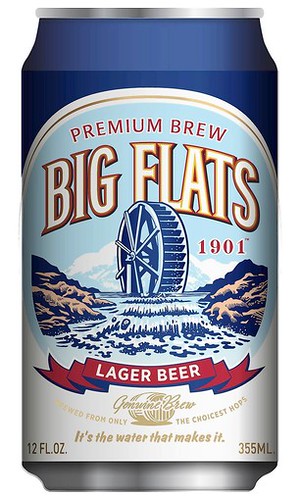
The Chicago Tribune is reporting that the drug store chain Walgreens has rolled out their own private label beer in cans, called Big Flats 1901. Walgreens is carrying the new beers in 60% of its nearly 8,000 locations and the average price is about $2.99 per six-pack or 50 cents a can. Around 15 years ago, Walgreens stopped selling alcohol in all (most?) of its stores, but recently starting stocking it again in less than half of the locations.

It would appear that Genesee Brewing in New York, part of North American Breweries, is the contract brewer making the lager beer. The label refers to the it as “Premium Brew” and includes a generic “Genuine Brew” logo and the tagline “It’s the water that makes it.” Supposedly the name comes from the “flat boats that traveled the” rivers in upstate New York “delivering goods to early settlers.” Curiously, the trademark for the name “Big Flats 1901” is owned by the Winery Exchange, which styles itself as a “full-service, value-added, corporate brand beverage alcohol company that sources beer, wine and spirits from the finest regions worldwide.” They’re also located in the same small Marin County town where I live, Novato, California.

walgreens-beer

Filed Under: Beers, News Tagged With: Business, Cans

ABI To Include Stella Artois In Super Bowl Ads

January 21, 2011 By Jay Brooks

stella-artois
Anheuser-Busch traditionally pulls out all the tops for the Super Bowl, one of the most-watched television events of the year, especially for their core demographic. And that looks to be true for this year’s game, as well. But according to a report from Advertising Age yesterday, they’ll be trying something new this year.

The biggest overall change is that “instead of running nine ads for a total of five minutes, as it did last year, A-B will air five ads that run over three-and-a-half minutes.” The ads themselves will be similar to past efforts. But 2011 will mark the first time they’ve deviated from their core brands of Budweiser and Bud Light. One of their spots, a 60-second ad, will be for the uninspired Belgian lager Stella Artois under the banner of a new campaign, “She is a thing of beauty.”

I’m fairly certain this isn’t the ad they’ll be running, but this one was supposedly directed by Wes Anderson and Sophia Coppola.

Despite the Marin Institute’s incessant complaining about alcohol advertising during the Super Bowl — oh, the horror, why won’t anyone think of the kiddies? — of the 28 planned advertisers, only one is an alcohol producer, Anheuser-Busch InBev. So not only are they misplaced about who watches the Super Bowl, but seeing as a mere 3.5% — exactly one — of the advertisers are alcohol producers it hardly seems worth all the hue and cry they’ve raised. Of the 3-4 hours of the game, just 3-1/2 minutes are taken up by beer ads, representing less than 2% to under 1.5%, depending on how long the game ultimately runs. Even at that, it assumes anyone watching would be glued the set the entire time, a dubious proposition at best, especially applied to children. But the Marin Institute won’t be happy until they’ve “freed the bowl” from even those three and half minutes.

Personally, I’m looking forward to this year’s Super Bowl, especially if my beloved Packers manage to win on Sunday. It’s been more then a decade since I’ve actually cared about who wins the game, it would sure be nice to have someone to root for this year.

Filed Under: Beers, Breweries, Editorial, News Tagged With: Advertising, Anheuser-Busch InBev, Big Brewers, Sports

“How Beer Saved The World” To Be Revealed January 30

January 21, 2011 By Jay Brooks

earthday
The documentary that the Discovery Channel was rumored to be working on, How Beer Saved the World, is now scheduled to air on Sunday, January 30 at 8:00 p.m. Pacific time. The trailer is a bit overwrought, but they appear to have some good people being interviewed on camera, such as Charlie Bamforth and Gregg Smith. This should be interesting.

If you want a good laugh, check out the ignorant comments on the YouTube page for this trailer. Their hilarity is only matched by their inanity. It’s certainly amazing how effective anti-alcohol propaganda is as evidenced by some of the nonsense being spouted. It’s also funny, and a little sad, to see the contrast between beer people, who can readily admit that there are some people who abuse alcohol and cause problems for themselves and others, and neo-prohibitionists who cannot bring themselves to concede that alcohol has any positive aspects to it whatsoever.

Filed Under: Beers, Editorial, Events, News Tagged With: Announcements, History, Television, Video

Celtic Beer: 500 B.C.

January 19, 2011 By Jay Brooks

celtic-blue
Science News last week had a fascinating tale from 2,500 years ago, about ancient Celtic breweries in present-day Germany. It was revealed in a new paper by Hans-Peter Stika, entitled Early Iron Age and Late Mediaeval malt finds from Germany—attempts at reconstruction of early Celtic brewing and the taste of Celtic beer, that early Celts built breweries “capable of turning out large quantities of a beer with a dark, smoky, slightly sour taste.”

Published earlier this month in the journal, Archaeological and Anthropological Sciences, here’s the abstract:

In this paper, we discuss specialised ditch structure from the early Iron Age settlement of Eberdingen–Hochdorf (early La Tène Period, fifth–fourth century BC), that contained large numbers of evenly germinated hulled barley grains. This malt appears to be the result of deliberate germination, given the purity of the finds and the associated unusual archaeological structure, which may have been used for germination and/or as a drying kiln for roasting the malt. The Hochdorf malt most probably was produced for the purpose of beer brewing. To learn more about the morphology of malt and the effects of carbonisation on it, experiments on modern barley grains were undertaken. Their results are compared to the ancient Hochdorf malt. Based on the excavated findings and finds as well as theoretical reflections on the early Iron Age brewing process, attempts at reconstructing the possible taste of early Celtic beer are presented. Additionally, a malt find from late mediaeval Berlin in northeast Germany is presented. A mixture of deliberately sprouted hulled barley as well as rye and oat grains, which were not germinated, was found. The three different cereals could have been used for brewing a typical mediaeval/early modern beer since the use of mixed crops for producing beer has been quite common. Because of a lack of further evidence, it remains unclear whether or not the half-timbered house in the late mediaeval town was a trading place and storehouse for malt or the brewery itself, where the malt was processed to make beer.

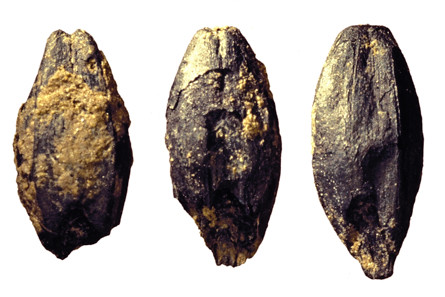
A large store of charred grains of barley were discovered at a site in northeast Germany, near Berlin. The barley was found in ditches, suggesting a “large malt-making enterprise.”
barley-iron-age
He then reconstructed the steps he believes the early Celts would have used to brew their beer.

  1. Dig a ditch, in an oblong shape.
  2. Soak barley in the specially constructed ditches until it sprouts.
  3. Grains were then dried by lighting fires at the ends of the ditches (providing dark color & a smoky taste).
  4. Lactic acid bacteria stimulated by slow drying of soaked grains, a well-known phenomenon, adding sourness to the brew.
  5. Mash up the barley to maximize the sugar content.
  6. Flavor it with henbane — a.k.a. stinking nightshade — which was found at the site. Henbane would also have made the beer more intoxicating. It could possibly have contained other spices such as mugwort or carrot seeds.
  7. Boil the ingredients with the mashed grains, towards the beginning to flavor the beer.
  8. Heated stones may have been placed in liquefied malt during the brewing process (though so far none have been found at the site). Otherwise, it would probably have been heated over a low fire.
  9. Separate out the lumpiest bits of grain.
  10. Fermentation then my have been triggered by using yeast-coated brewing equipment or by adding honey or fruit, both of which would have contained wild yeast.
  11. Let the yeast settle to the bottom.
  12. Cool the beer and drink.

Not all of the steps have been confirmed by the evidence yet, but the search goes on.

Filed Under: Breweries, News Tagged With: Germany, History, Science of Brewing

John Stuart Mill On “Sin Taxes” & Prohibition

January 18, 2011 By Jay Brooks

philosophy
The British philosopher John Stuart Mill was, besides being “particularly ill” on “half a pint of shandy,” a big proponent of the concept of free will, as the song says. In his book On Liberty, he also argues in favor free speech and, 150 years ago, was against minimum alcohol pricing as if it were today, which is why I bring it up.

In today’s UK newspaper, The Telegraph, British writer Brendan O’Neill argues convincingly against minimum pricing on alcohol in a piece entitled ‘Minimum alcohol pricing’ is a Sin Tax designed to punish poor people for the crime of getting hammered.

The British government has been discussing minimum alcohol pricing for a number of years as a way of stopping binge drinking, defined as uselessly there as here. O’Neill sees it rather differently, as “an assault on a certain kind of boozing, the kind indulged by the less well-off who prefer to drink lager or cider and let their hair down rather than quaff chardonnay and discuss Tunisia. The very term “binge drinking” — and bear in mind that, for a man, binge drinking means downing a paltry four pints in a night — is designed to conjure up images of the non-wine-drinking classes, who swig on bottles of beer with no sense of control or decorum; who scoff and down and binge rather than sip. Them, not Us.”

And that brings us back around to John Stuart Mill. I hadn’t seen these quotes before, but they’re brilliant. In On Liberty, he addressed this very issue by calling such price hikes a de facto “sin tax” because, then as now, it’s a regressive tax that punishes the poor for not behaving as some people might want them to.

Here’s what he wrote:

“Every increase of cost is a prohibition, to those whose means do not come up to the augmented price.”

And:

“To tax stimulants for the sole purpose of making them more difficult to be obtained is a measure differing only in degree from their entire prohibition, and would be justifiable only if that were justifiable.”

As O’Neill concludes, that’s simply “prohibition through the backdoor, targeted at those whom the political classes consider to be reckless and self-destructive.” On this side of the pond, it’s all that moralizing plus anti-alcohol groups trying to convince us it’s about safety and “the children” and saying that raising the price will fix all our problems, and the economy to boot. Problem is, it never works. It’s just another attempt at Prohibition. Prohibition Lite, perhaps, but the aims are the same.

Filed Under: Editorial, Just For Fun, News, Politics & Law Tagged With: Philosophy, Prohibitionists, UK

The Results Of Targeting Alcohol?

January 16, 2011 By Jay Brooks

target-alcohol
There’s a debate going right now about whether images and rhetoric that are extreme and potentially violent in nature can be responsible for actions taken by the people who view them. Obviously, the recent tragedy in Tuscon, Arizona is what sparked this debate, but it’s nothing new. Some people who are against people having legal access to abortions have painted the physicians who perform them as evil murderers and other people who have heard that message and internalized it have murdered abortion doctors. It’s happened more than once. If you’ve studied semiotics, you understand that at a minimum symbols and signs have power. Almost everything is a sign, both words and symbols, that is they mean something, often different things to different groups of people depending on how they’re framed or used. Dean Rader, in the San Francisco Chronicle, had an interesting piece applying semiotics to the events prior to, and leading up to, the Tuscon incident and assassination attempt in Palin, Crosshairs, and Semiotics: The Signs of the Times.

I bring this up because anti-alcohol and neo-prohibitionist groups have been painting alcohol as a great sin and inherently evil literally for decades. That includes both harmful propaganda and rhetoric along with graphic symbols, such as the banner used by one group showing a bottle of beer as a syringe, attempting to equate beer with heroin. The result of that, I believe, is that the average person does believe that drinking is a “sin” and that people cannot be trusted not to abuse it so therefore it must be highly regulated, taxed, demonized and marginalized. The other thing that such an incessant parade of propaganda might cause is the incident that occurred near Milwaukee, Wisconsin on Friday afternoon.

According to the Milwaukee Journal Sentinnel, an unidentified 32-year old man with a metal pipe several feet long and two inches in diameter walked up to a beer delivery truck making its rounds at Mid-Town Groceries and ordered him to stop delivering the beer. When the deliveryman continued doing his job, our wingnut began smashing the beer, and spent about thirty minutes destroying roughly $2,000 worth of beer — possibly Milwaukee’s Best. While he took pipe to beer can — and the intrepid deliveryman tried to get him to stop without getting beaned with a big metal pipe — he ranted about the evils of alcohol, and “scolded the deliverymen for bringing what he called ‘poison’ into his neighborhood.”

beer-terrorism

That’s the same tactic Carry Nation employed, smashing up bars — private property — with a hatchet just because she didn’t like what they were doing. It’s something she was celebrated for, but it’s still vandalism and without trying to sound overly dramatic, terrorism. My OED defines terrorism as “the use of violence and intimidation in the pursuit of political aims” and Merriam-Webster calls it “the systematic use of terror especially as a means of coercion.” Whether wielding a hatchet or a lead pipe, it’s using violence to promote your ideas and get your way.

Where did the Milwaukee man get the idea that beer is “poison” and it was acceptable behavior to smash someone else’s property? To me, that’s a great question we’ll probably never know the answer to, because this story’s not quite big enough news that we’ll likely see a follow-up report. Did these ideas infect him through years of neo-prohibitionist propaganda? Through the subtler, but no less effective, way in which so many take it for granted, thanks to our policies and laws, that drinking is “sinful” and that demonizing it only appropriate? With anti-alcohol propaganda so pervasive it seems quite unlikely to me that he came to this notion on his own. I take it for granted that he is indeed a lone wingnut and no neo-prohibitionist group will claim him as one of their own. But it makes you wonder. Rhetoric and symbols are powerful weapons that can influence just about anything, so why not a violent hatred for alcohol and the people who deliver it?

Filed Under: Editorial, Events, News, Politics & Law Tagged With: Prohibitionists

« Previous Page
Next Page »

Find Something

Northern California Breweries

Please consider purchasing my latest book, California Breweries North, available from Amazon, or ask for it at your local bookstore.

Recent Comments

  • Bob Paolino on Beer Birthday: Grant Johnston
  • Gambrinus on Historic Beer Birthday: A.J. Houghton
  • Ernie Dewing on Historic Beer Birthday: Charles William Bergner 
  • Steve 'Pudgy' De Rose on Historic Beer Birthday: Jacob Schmidt
  • Jay Brooks on Beer Birthday: Bill Owens

Recent Posts

  • Beer In Ads #5135: What Record’s Bock Beer Is February 27, 2026
  • Historic Beer Birthday: Albert Braun February 27, 2026
  • Historic Beer Birthday: John J. Schlawig February 27, 2026
  • Beer In Ads #5134: Lord Bushkill On Bushkill Bock February 27, 2026
  • Historic Beer Birthday: William Henry Beadleston February 27, 2026

BBB Archives

Feedback

Head Quarter
This site is hosted and maintained by H25Q.dev. Any questions or comments for the webmaster can be directed here.