Brookston Beer Bulletin

Jay R. Brooks on Beer

  • Home
  • About
  • Editorial
  • Birthdays
  • Art & Beer

Socialize

  • Dribbble
  • Email
  • Facebook
  • Flickr
  • GitHub
  • Instagram
  • LinkedIn
  • Pinterest
  • RSS
  • Twitter
  • YouTube

Powered by Genesis

Give An AlcoHoot

March 1, 2013 By Jay Brooks

alcohoot
This looks promising, although it’s not yet out on the market. A new device that pairs with your smartphone, Alcohoot, will apparently be a police grade breathalyzer. But not only that, it can direct you to the nearest restaurant for a cup of coffee, start a timer until your body should be below a preset BAC, or if all else fails call a friend or a taxi. It can even give your exact position using GPS even if you’re too far gone to know where you are.

I could do without the scary statistics that begin the video below, but I know their goal is to make sales, so it’s understandable, at least. You can safely skip the first 30 seconds and get to the meat of it. Unfortunately, as I mentioned, it’s not on the market just yet, but it may be soon. The suggested price it should be around $95, and may even drop as sales increase, which given everything it does seems like a bargain, especially when compared with the cost of standard low-tech breathalyzers.

PopSci also has a short video of the two founders of the company demonstrating the Alcohoot at an event at the New York Stock exchange recently. If it delivers on its great promise, it may be quite the device. I know I’d like to give it a try. I have an e-mail out to the company to see if I can find out more about it and when they think they’ll begin selling Alcohoot.
alcohoot

Filed Under: Beers, Editorial, News, Politics & Law, Related Pleasures Tagged With: gadgets

Ignoring Economies of Scale

February 26, 2013 By Jay Brooks

economics
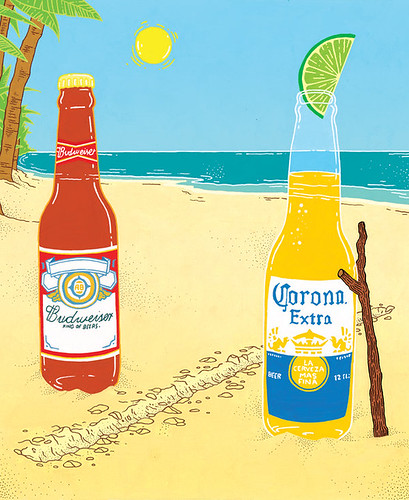
As the news keeps swirling around the possible — I say inevitable — buyout of Grupo Modelo by Anheuser Busch-InBev in a breathless “will they, won’t they” kind of coverage, I’m utterly fascinated by the theater of it all. It’s especially interesting to see the many “business experts” weighing in with no real understanding of the history of the brewing industry or how it all works. These “instant experts” all seem to assume that general economics or business principles apply equally well to every scenario, yet fail to grasp that alcohol has always navigated a different path through the economic world, with extra layers of taxation, legislation and law, its moral or anti-alcohol critics, and has to abide by at least 51 sets of laws (federal laws plus one for each state). I brought this up last month in The Beer Monopoly, but this morning an economics reporter from the New York Times, Adam Davidson, weighed in with his own take on the shenanigans.

In his It’s the Economy column published today, Are We in Danger of a Beer Monopoly?, he gives his own version of reality. In his world, where there are nearly 2,400 American breweries, he at least admits many of them are “tiny,” but goes on to claim that a few “have become large national brands.” National, yes, but “large” is a somewhat relative term. They’re large compared to a tiny nanobrewery or even an average sized brewpub, but the volumes of beer manufactured by ABI and SABMIller are in another class altogether. All 2,398 of the other breweries represent much less than 10% of the total beer produced in the U.S., meaning there’s a fairly wide chasm between the two groups, even if “a handful” of them have been successful. Measured against the domination of the biggest two, even the most successful seem modest by comparison.

But this is an argument that many economists seem to make, and indeed it’s the same argument that ABI always makes when they’re trying to buy another global company. How can there be a monopoly with so much competition? Just walk down the beer set in an average grocery store and, if you know who owns or controls what, you’ll easily see who’s winning the beer wars. The power wielded by ABI and SABMiller is so far above that of any smaller brewer, or even the total of all of the smaller ones, that it really is a true David and Goliath relationship. Sure, the big guys throw a few crumbs to the little guys nipping at their heels, but they don’t feel seriously threatened by them. Lately, they’ve been paying closer attention because they’re losing incremental marketshare, but they’ll respond to any such loss, because it hurts the share price. But saying they’re on equal footing is the economic equivalent of pretending that employees and employers have equal bargaining power, as most economic textbooks continue to insist.

But here’s Davidson’s takeaway from recent events as ABI tries to win approval for buying Grupo Modelo. “So I was surprised to learn that the Justice Department is worried that Anheuser-Busch InBev, the conglomerate that owns Bud, is on the cusp of becoming an abusive monopoly.” That’s almost spit take worthy. “On the cusp?” ABI has been a de facto monopoly with one or two others for decades, all but controlling the marketplace, not that anybody has been particularly concerned in the business world.

Anyone who hasn’t had their head buried deep in the sand for last few decades has to have noticed that we live in a society utterly dominated by business interests. Business power is the only power that matters. Political power takes a back seat to it and the will of the people is something politicians invoke only when they’re trying to get elected. How else can you explain that corporations have all the benefits of being a person, with none of the responsibilities or consequences? How else can money be considered free speech to influence politics? How else can you explain the many businesses deemed too big to fail while the same individuals those corporations ruined are left swinging in the wind, with no life raft for the ordinary flesh and blood person.

Davidson goes on to give a flawed history of the brewery business, and seems to think that mergers are a relatively new phenomenon. Of course, brewery mergers and acquisitions have been going on in brewing since the late 19th century, and stopped only briefly for about thirteen years, during Prohibition. Then he says we’re “still in the very early stages of what appears to be a global version of the scale-based consolidation we’ve seen in the United States over the past century.” I can’t tell if that’s a joke? The global beer world has been dominated by an ever-shrinking group of very large conglomerates for at least the last three or four decades. It’s hardly a new thing. In 2010, the four largest beer companies accounted for over half of all beer worldwide, and according to another source the Top 5 were about half. Heineken, Carlsberg, and a few others are very large companies, indeed, and they, too, have been gobbling up breweries around the world for many, many years.

It’s probably not a coincidence that Davidson has his own S.H.A.M.E. profile. Why the New York Times continues to let him shill for big business, well’s that’s a whole other discussion, but it’s obvious he’s defending the pro-business position. It’s also clear that he’s part of the theater that will ultimately end in the DOJ’s approval of the deal between ABI and Grupo Modelo. Here’s my prediction of what will happen next. As always happens, the two parties will hammer out a compromise that was probably the deal everybody wanted in the first place, but this way both parties look good in the public eye. The DOJ will look like they’re being tough on big business and are protecting the public while ABI will look good because they were able to get the deal done, and their share price will shoot up. Everybody wins. As Shakespeare observed, “all the world’s a stage.” And we’re the audience. I just wish they’d stop pretending we’re all idiots.

bud-corona

Filed Under: Breweries, Editorial, News, Politics & Law Tagged With: Big Brewers, Business, Economics, Mainstream Coverage

A Bud Is A Bud Is A Bud

February 21, 2013 By Jay Brooks

budvar
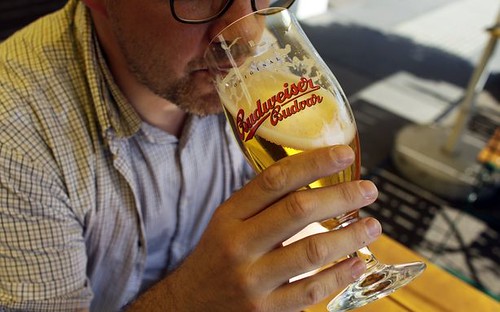
Oh, I hate to pick on the mainstream media as they cover the world of beer, but this is too delicious not to point out. In a story about the proposed buyout of Grupo Modelo by Anheuser-Busch InBev, entitled The Great Beer Monopoly Deal May Be Back On, the Atlantic features the following photo, which I downloaded in case somebody gets wise and replaces it. And a hat tip to Tom Dalldorf for sending me the link. I guess one Bud’s as good as another. Can I assume I don’t have to draw a diagram?

budvar-ab

Filed Under: Beers, Breweries, Editorial, Just For Fun, News Tagged With: Anheuser-Busch InBev, Business, Mainstream Coverage

What Is Addiction?

February 21, 2013 By Jay Brooks

addiction
In my experience, people who don’t like alcohol, and especially hate the people who do enjoy it, often tend to blame the alcohol as being addictive. I’ve always found that odd, since not everybody who takes a drink automatically becomes an alcoholic, unable to stop drinking. In fact, it doesn’t work that way for most people, and certainly nobody I’ve ever met. It should be obvious to everyone that some people have more addictive personalities than others. Whether that’s genetic, learned or some combination of the two is still an open question, but what’s clear is that it effects different people differently. That alone should let alcohol off the hook, but it never does. Many people remain convinced that addiction is confined to the traditional instruments of sin: booze and drugs.

But gambling can be an addiction, can’t it? And there’s certainly food addictions, in part foisted on society by unscrupulous processed food companies who add sugar and salt and fat to everything. But the point is that as the list of accepted addictions grows, it confirms what I’ve believed all along. That addiction has to do with the addictive personality — the person — and not the object of the addiction. There are, of course, substances which have addictive properties. Tobacco springs to mind, but even it doesn’t effect everybody the same way. Over the course of my life, I’ve had the odd cigarette, and even enjoyed the occasional cigar, but have never felt like I *had* to have another one. That may just be because I don’t have an addictive personalty for such things, or it may take more repeated use before it kicks in, though I doubt it. It seems more likely it’s the former. So while I have no doubt that cigarettes are bad for me, I don’t fear they’ll grab hold of me and I’ll be unable to stop smoking.

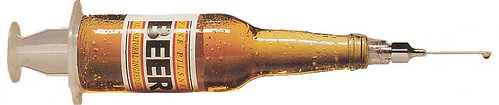
So why is it that the neo-prohibitionists seem so reluctant to include personal responsibility as a factor, if not the factor? It boggles the mind. They seem far more interested in blaming the alcohol companies for trying to “hook” people in with advertising, as if people have no choice but to fall prey and begin binge drinking. Some anti-alcohol groups have gone so far as to portray alcohol in a syringe in an attempt to paint heroin and beer as the same.

beer-syringe-white

With the publication this May of the new DSM-5, the bible of psychiatric disorders and treatment that’s put out by the American Psychiatric Association, “compulsive gambling” will be added to the list of accepted “addictions.” The DSM-5 also replaced the term “dependence” and goes back to using the term “addiction” again instead. Why that’s the case is a fascinating story in and of itself, which you can read an overview of in Blinded by Biochemistry. Oddly enough, compulsive “binge-eating” and “hypersexuality” are both not considered addictions, at least not yet. As Stanton Peele, author of Love and Addiction, writes, “Binge-drinking can bring on addiction, but not binge-eating? How come?”

I’m convinced that’s because of the social acceptability of eating, as contrasted by the demonization of alcohol. Drinking has been treated as a sin and a moral failing by alcohol’s opponents for so long now that the very concept has been absorbed into the culture at large. The DSM-5 is merely reflecting that prejudice in our society.

But as Steele points out in a more recent article, What Is Addiction? Addiction isn’t what it used to be, the New York Times recently identified new trends of addiction, that of being addicted to “junk food” and playing “mindless games.” (How those can be considered “new” is also quite puzzling, frankly.) But as I can’t quite shake the notion that it’s not the substance of the addiction that’s at fault, but the individual’s reaction to it that makes it addictive, Steele offers some confirmation that I’m not off my rocker.

What makes such a thing an addiction? And it is no more the existence and consumption of junk food, repetitive games or other video stimulation, or placing a bet that makes it so; it is the way the individual interprets and reacts to the experience of the thing in the context of his or her life that creates an addiction (think of heroin addiction in Vietnam, soon left behind by most vets on their return home). When a powerful experience is welcomed for its reassurance and as a life solution, when it become preoccupying and detrimental to the consumer, and — finally — when the individual him or herself comes to see and to believe that the experience is addictive — voila!

addiction

But as Steele wrote earlier in Psychology Today magazine:

Addiction is the search for emotional satisfaction — for a sense of security, a sense of being loved, even a sense of control over life. But the gratification is temporary and illusory, and the behavior results instead in greater self-disgust, reduced psychological security, and poorer coping ability. That’s what all addictions have in common.

As he points out, we can never agree on a exhaustive list of all of the stuff one could become addicted to, because it’s not about the object of addiction, but the addictive person’s reaction and relationship to his particular obsession. And that’s where, in his opinion, the new DSM-5 is still taking the wrong approach by “viewing the nature of addiction as a characteristic of specific substances,” because it doesn’t recognize the basic truth that addiction is more complicated than just banning anything that someone might become addicted to. Steele continues.

[T]hink about obsessive-compulsive disorder (OCD): People are not diagnosed based on the specific habit they repeat — be it hand-washing or checking locked doors. They are diagnosed with OCD because of how life-disruptive and compulsive the habit is. Similarly, addictive disorders are about how badly a habit harms a person’s life.

And that is, or should be, the point. How a person reacts to anything, and alcohol in particular, is almost as individual and unique as they are. Most people can drink beer responsibly and without their lives falling into ruin. A few can’t. But can we please stop targeting the beer and use those same resources to get the minority of people who can’t some help?

Filed Under: Beers, Editorial, Politics & Law Tagged With: Health & Beer, Science

More Evidence of the Myth of the Beer Belly

February 12, 2013 By Jay Brooks

binge-barney
I’ve been saying this for years, that the beer belly is a myth and that drinking low-calorie diet light beer is a foolish decision, especially since it’s a sacrifice of too much flavor for too little discernible positives for your health or your waistline. Here’s the nutshell overview, the first paragraph from the UK Telegraph’s coverage — sure to make the head of the average neo-prohibitionist uncontrollably spin with rage — “The ‘beer belly’ is a myth as there is no scientific evidence to suggest that the beverage causes weight gain, a new report has claimed.”

In fact beer, the country’s national drink, has nutritional and wellbeing benefits similar to wine when consumed in moderation, it is claimed.

Nutritionist Dr Kathryn O’Sullivan, who carried out the review of the scientific review, believes that swapping beverages for beer may actually be a sensible way to diet.

Although the industry-sponsored research may seem incredible to some it in fact adds to an emerging body of thought that the beer belly is a myth.

Beer has fewer calories per 100ml than wine, spirits, and even orange juice, it is claimed.

“Unfortunately beer has this image as a high-calorie, high-fat drink,” Dr O’Sullivan told The Times. “It is very unfair.”

The study itself is called “Beer & calories; a scientific review” and I’d love to read the whole thing, but so far it doesn’t appear to be available online.

And an Irish report, “Study: ‘Beer belly’ is a myth” adds the following:

The study does note that if you drink vast amounts of beer (or pretty much anything for that matter) you will gain weight, and Dr O’Sullivan also does not dispute the evidence that drinking too much can lead to an early death.

However, Dr O’Sullivan said that swapping two large glasses of wine a day with two bottles of lager could save 58,240 calories a year (that equates to roughly 106 Big Mac’s a year).

“Beer drinking has become regarded by many as a vice and not a component of a healthy balanced lifestyle. But this is contrary to the latest scientific evidence,” she said.

“Enjoyed in moderation, beer, like wine, can provide many essential vitamins and minerals and moderate consumption may also protect against many conditions such as heart disease, osteoporosis and diabetes.”

This new study also is consistent with an earlier study in Denmark, where Professor Arne Astrup, who’s at the Department of Human Nutrition at The University of Copenhagen, found “that there is no concrete scientific evidence to support the idea of the ‘beer belly.'”

Filed Under: Beers, Editorial, News Tagged With: Science, Statistics

Annie Leibovitz Shoots Stella Artois

January 19, 2013 By Jay Brooks

stella-artois
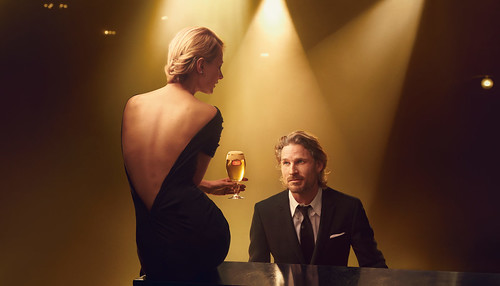
A couple of days ago, Stella Artois sent out a press release that iconic photographer Annie Leibovitz was hired by Anheuser-Busch InBev to shoot photos for their Belgian lager. The photos are being released at the Sundance Film Festival, which started two days ago, apparently amid much hoopla. Which makes sense when you realize that Stella Artois is an “official sponsor” of the independent film festival, listed as a “sustaining sponsor.” They’re in fact the only big alcohol company sponsor, among quite a few corporate sponsors. I don’t know why that seems odd to me, but I guess I thought Sundance was supposed be about independent filmmakers, especially when the site also includes a donations page where they make it sound like your $10 will make a grassroots movement possible. Maybe I’ve become jaded, but the nearly two dozen truly big sponsors plus what looks like it could easily be another hundred more company sponsorships, seems counter to the principal of “independent” and their mission of “discovery and development of independent artists and audiences.”

In both the press release, Stella Artois Unveils New Campaign Shot by Legendary Photographer Annie Leibovitz and the Stella Artois website, they refer to it as a “collaboration” between the beer and photographer. But how is hiring a famous photographer and paying her to work a “collaboration” in any meaningful sense?

Merriam-Webster defines collaborate as “to work jointly with others or together especially in an intellectual endeavor.” That’s what brewers do when they get together to brew a beer, most times at least, but this just seems like a big company paying a lot of money (one presumes Annie Leibovitz doesn’t work cheap) to an expensive big-name photographer to sell a big product. Does that make it art? I honestly don’t know. I think I’m cranky and overworked these days.

Here’s some more press release spin:

It features British Actor, Noah Huntley and Ukrainian model Tanya Ruban and will appear in the printed fashion titles such as GQ, Elle and Vanity Fair, beginning in February 2013.

“Annie Leibovitz’s work marries artistic genius with painstaking craftsmanship to create timeless beauty,” said Emma Fox, Global Marketing Director, Stella Artois. “This concept is a personal one for Stella Artois. Our fans experience the beer in its finished form, but 600 years of brewing expertise helped make this possible. So we wanted to celebrate both the beauty and the craftsmanship that go into its creation”.

So here’s the results, or at least two of them. You can see lots of behind the scenes of the photoshoot itself — why you’d want to, I don’t really understand — in the Stella Artois Studio, what the press release refers to as an “online experience.”

Leibovitz-stella-artois-1

It’s not that they’re bad photographs, but they certainly don’t make me want to drink Stella Artois. Didn’t Jeff Bridges and Michelle Pfeiffer already do this in The Fabulous Baker Boys.

Leibovitz-stella-artois-2

Filed Under: Beers, Editorial, News Tagged With: Advertising, Belgium, Big Brewers, Marketing

Megan Fox For Brahma Beer

January 14, 2013 By Jay Brooks

brahma
Today I saw in the UK Sun that American actor Megan Fox is doing ads for Brahma, the Brazilian Budweiser, an especially accurate association since Brahma is part of Anheuser-Busch InBev. Why do we care? We don’t, but I’m game to look at a couple of ads with Megan Fox in them. Isn’t that why advertisers chose her? Of course, it’s still a tasteless, flavorless beer.

As Mais Gostosas do Carnival (The Hottest Carnival)

brahma-fox-2

Is it just me, or does that beer have his arm around Fox? Is the beer wearing sunglasses because he doesn’t want to be seen with Megan Fox?

Convidando Megan Fox Pra Uma Brahma (Inviting Megan Fox for a Brahma)

brahma-fox-1

And here she is going off to have a picnic. According to the Sun, she’s flying down to Rio to do a commercial and pose for some more ads.

brahma-fox-3

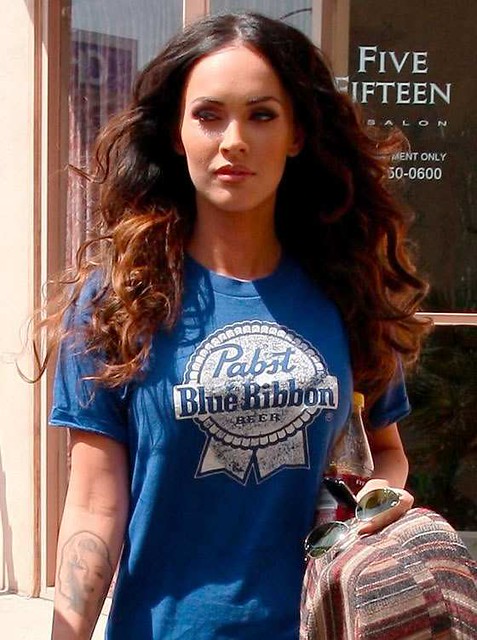
Although humorously enough, a few years ago the hipster appeared more partial to Pabst Blue Ribbon. This was taken by paparazzi in 2009. Ah, sex and beer. What’s not to love. It seems to me, the big brewers follow a variation of the old lawyer’s adage. “When the law is on your side, argue the law. When the facts are on your side, argue the facts. When neither the facts nor the law are on your side, make an ad hominem attack.” In the brewer’s world it’s more along these lines. “When the beer tastes good, promote the beer. When the brewery has personality, promote the brewer. When the beer has neither, promote a celebrity, a cartoon, or both.”

megan-fox-pbr

Filed Under: Beers, Breweries, Editorial, Just For Fun, News Tagged With: Advertising, Anheuser-Busch InBev, Brazil, Humor, Women

Beer In The Pacific Northwest

January 8, 2013 By Jay Brooks

gigantic-brewing
My buddy Ben Love, who last year opened his own brewery in Portland, Gigantic Brewing, just sent me this cool video featuring his “master brewer,” Van Havig, who joined him at Gigantic, after many years at the Rock Bottom in Portland. The short film, entitled Victory, was created by Jerry Makare as a project for the University of Oregon Multi-Media Journalism Program Foundations class (J610) in Fall 2012. Havig makes some great points. Portland is an amazing place to drink beer, and what he’s saying, I think, holds true for a few other pockets of the country, but as far as I know, the market penetration of specialty beer there is second to none. It’s certainly one of my favorite places to enjoy a beer.

Filed Under: Beers, Editorial, Just For Fun Tagged With: Oregon, Portland, Video

The Top Beer Brand Of 2012

January 4, 2013 By Jay Brooks

ace-metrix
I don’t want to wade neck deep into the “craft vs. crafty” debate — I’m not quite finished digesting it all — so I’m trying to not comment too much about this, yet in this instance, I’m going to at least stick my toe into the murky waters of this issue. (Oh, and a hat tip to Evan Benn for tweeting about this.)

Ace Metrix, a company based in nearby Mountain View, has just released their list of the Top Brands and Ads of 2012. Ace Metrix characterizes themselves as “the new standard in television and video analytics.”

They picked the top brand in fifteen different broad categories. The award does not go to the company with the best product, but to the one that had the best advertising last year, that is whoever received the “highest average Ace Score for their body of work in 2012.” This is best illustrated by reviewing some of the other category “winners.” For example, Olive Garden won for restaurants, so that should tell you something.

In the category “Beverages — Alcoholic” the winner was Blue Moon. You can even view the five Blue Moon commercials that got the highest scores. Now, I like Blue Moon. It’s not a bad beer. It may not be my favorite wit, but unlike many other beers made by big companies, I will drink it if my choices are limited. I know its creator, Keith Villa (who also stars in the commercials), and I’ve judged with him at GABF several times. It’s a great entry level beer, and has been phenomenally successful in that regard and also in marketing itself as not being part of Coors, in the same way that Saturn cars did in setting themselves apart from GM.

But that’s the way of the world, at least in our peculiar pro-corporate brand of capitalism. In brewing, I have to say, things are a lot more transparent than in many other industries. There was also a Geekologie chart of Parent Companies and their Subsidiary Brands, but the site’s been more recently hacked, to get an idea of how literally hundreds of brands are owned by just ten corporations. And I’ll bet dollars to doughnuts that most people weren’t aware of more than a few of those relationships, believing many of those brands to be independent or small companies, if they even cared at all.

Maybe it’s because in the world of beer geekdom we pay so much more attention, but most of the stealth brands like Blue Moon are open secrets. They may not talk about who owns the brands, but the information is out there and available if you bother to look. The thing is, most people don’t. If they like it, they drink it, and they buy it. Period.

Where the trouble comes in, I think, is when doing so infringes on another’s business ethos, or whatever. When small specialty breweries first started popping up, the big guys were initially somewhat helpful but as they began eating into their market share, things started to change. Over the years we’ve seen many attempts, with varying degrees of success, to copy or acquire anything that’s successful. In a sense it’s human nature, or certainly business nature. Do you think it’s an accident that after any successful film or television series, similar shows in the same genre proliferate with alarming alacrity?

But back to the Ace Metrix and their top brands of 2012. In their press release, in a section entitled “Brands of the Year Illuminate Many Notable Themes,” there’s this headline: “Craft Beer and Juice Beat Out Big Beer and Soda Brands.” Here’s the relevant bits about beer:

A changing of the guard was not only seen in the technology category, but also in the beverage category in which Blue Moon usurped the top spot from ‘big beer,’ and Ocean Spray ousted Coca-Cola from the winner’s platform. … Blue Moon swept the Alcoholic Beverage Category with an average Ace Score of 538, beating out big beer brands like Budweiser, Bud Light, Miller Lite and Coors Light, all of which failed to even make the Watch List this year, a stark comparison to 2011.

See the problem? How can Blue Moon have usurped anything from “big beer” when it really is a big beer. And that’s why the Brewers Association had to come out with its recent controversial statement, because even professional business analysts don’t realize who owns what, so what chance do consumers have?

I’m going to steer clear of the BA’s statement itself, at least for now, except to say that I thought the excellent rebuttal by August Schell was heart-wrenching and perfectly illustrated the problems of such statements and definitions. Because those characterizations only matter internally, among insiders and the businesses and professionals working in those industries. And while once upon a time those inner workings remained … well, internal … today almost everything is out in the open, on the internet, and often what might better be private insider discussions become full-blown public debates. Sometimes, it’s simply exhausting.

It’s a bit like beer styles themselves. They only really matter in very rarified situations, like competition judging. In the real world, they matter very little. It’s the same with trying to define beer, or craft beer, or whatever we’re calling it now. I completely understand why the BA needs to define craft beer, because their mission is to promote craft beer. You have to know exactly what and who it is you’re promoting in order to do your job. I get that. From private discussions I had a few years ago with people who were involved in crafting the newer definition over about a year’s time, it was apparently a very contentious process and was extremely difficult because with every changed word, someone was excluded or someone you didn’t think belonged remained. It reminds me a little of a famous quip made by a Supreme Court justice in Jacobellis v. Ohio when, in trying to define hardcore pornography and create an obscenity threshold, Justice Potter Stewart wrote that it was difficult to define, but that “I know it when I see it.”

And that’s the problem, because how you define craft beer is, and should be, different things to different people, with varying priorities and concerns. It may be one thing to the BA, but something else entirely for an average consumer and yet again something more stringent to a hardcore beer geek. The thing is, everybody’s both right and wrong on this one, at least as I see it. When you’re talking about personal preference, it’s ultimately just that: personal. Like pornography or even religion, whatever you believe is correct, for you. Whatever you choose to drink is right for you. I may disagree with your choice, but that’s okay. Happily, they come in these little 12, 16 or 22 oz. bottles and cans, or can be poured into single-serving sizes of glassware, so that we can all just drink what we want, definitions be damned.

Filed Under: Beers, Breweries, Editorial, News, Politics & Law Tagged With: Advertising, Big Brewers, Coors, Packaging

Ice Plus Beer

December 25, 2012 By Jay Brooks

kirin
I tend to view the concept of ice plus beer with horror, but apparently in Japan it’s “so cool.” That’s at least the opinion of Kirin, whose uncharacteristically low-tech commercial make the case for its coolness. The verdict? The ad: pretty cool. Ice plus beer: not cool.

Filed Under: Breweries, Editorial, Just For Fun Tagged With: Advertising, Japan, Video

« Previous Page
Next Page »

Find Something

Northern California Breweries

Please consider purchasing my latest book, California Breweries North, available from Amazon, or ask for it at your local bookstore.

Recent Comments

  • Ernie Dewing on Historic Beer Birthday: Charles William Bergner 
  • Steve 'Pudgy' De Rose on Historic Beer Birthday: Jacob Schmidt
  • Jay Brooks on Beer Birthday: Bill Owens
  • Steve 'Pudgy' De Rose on Beer Birthday: Charles Finkel
  • Steve 'Pudgy' De Rose on Beer Birthday: Bill Owens

Recent Posts

  • Beer In Ads #5204: Oh Brother! Griesedieck Bros. Genuine Premium Bock Beer Is Here! February 15, 2026
  • Historic Beer Birthday: Emil Resch February 15, 2026
  • Historic Beer Birthday: Philip Zang February 15, 2026
  • Beer In Ads #5203: Robert Portner’s Bock Beer February 15, 2026
  • Historic Beer Birthday: August Schell February 15, 2026

BBB Archives

Feedback

Head Quarter
This site is hosted and maintained by H25Q.dev. Any questions or comments for the webmaster can be directed here.