Brookston Beer Bulletin

Jay R. Brooks on Beer

  • Home
  • About
  • Editorial
  • Birthdays
  • Art & Beer

Socialize

  • Dribbble
  • Email
  • Facebook
  • Flickr
  • GitHub
  • Instagram
  • LinkedIn
  • Pinterest
  • RSS
  • Twitter
  • YouTube

Powered by Genesis

Beer In Ads #4939: Enjoy This Delicious Beverage While You Can

April 13, 2025 By Jay Brooks

Last year I decided to concentrate on Bock ads. Bock, of course, may have originated in Germany, in the town of Einbeck. Because many 19th century American breweries were founded by German immigrants, they offered a bock at certain times of the year, be it Spring, Easter, Lent, Christmas, or what have you. In a sense they were some of the first seasonal beers. “The style was later adopted in Bavaria by Munich brewers in the 17th century. Due to their Bavarian accent, citizens of Munich pronounced ‘Einbeck’ as ‘ein Bock’ (a billy goat), and thus the beer became known as ‘Bock.’ A goat often appears on bottle labels.” And presumably because they were special releases, many breweries went all out promoting them with beautiful artwork on posters and other advertising.

Sunday’s ad is for Berghoff Bock Beer and was published April 13, 1916. The brewery was the Berghoff Brewing Association, of Fort Wayne, Indiana, which was originally founded in 1887. This ad ran in the Fort Wayne News, of, naturally, Fort Wayne, Indiana. It’s hilarious that in 1916 the brewery’s phone number is “1.”

Filed Under: Art & Beer, Beers, Breweries, Just For Fun Tagged With: Advertising, Bock, History

Beer Birthday: Ray McCoy

April 13, 2025 By Jay Brooks

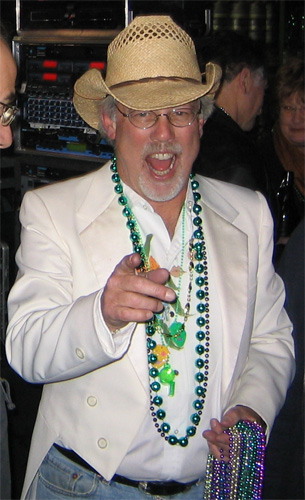
backstage
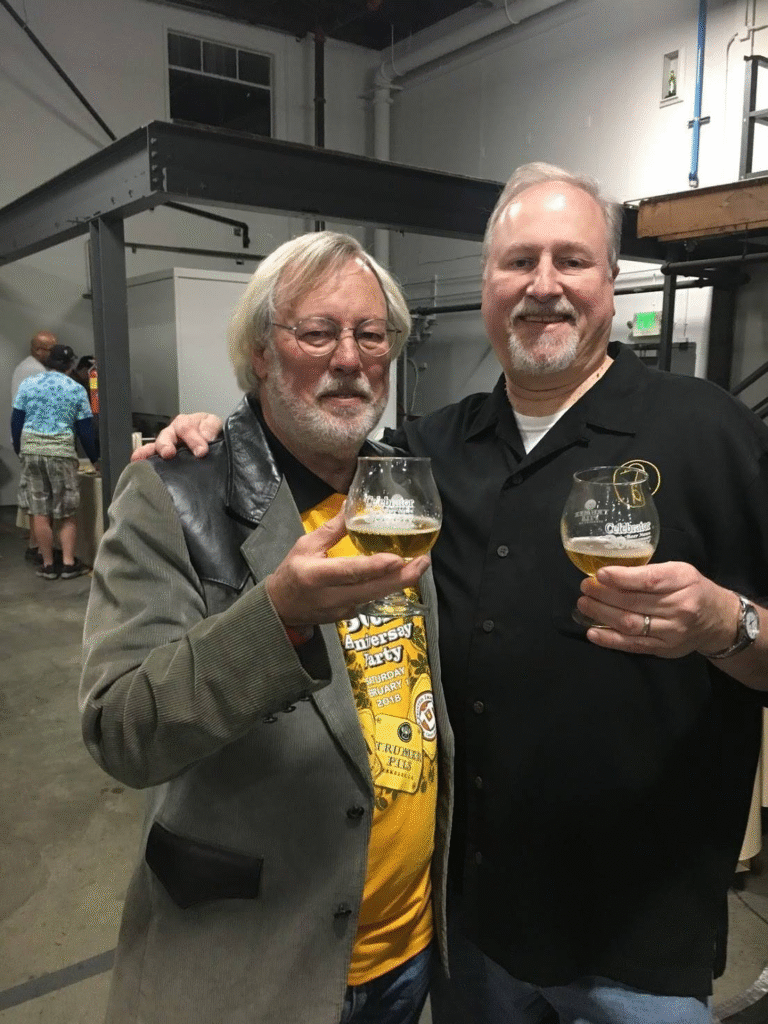
If you’re on the national beer festival circuit, you’ve no doubt seen Ray McCoy, whose birthday is today. In 2003, Ray was crowned “Beer Drinker of the Year” in the contest sponsored by Wynkoop. Ray and his wife, Cornelia Corey (herself a 2001 BDOTY, making them the only couple to have won) travel from their native North Carolina to attend many of the big beer festivals and events around the country, and the parties are always a bit more fun when they’re around. Join me in wishing Ray a very happy birthday.

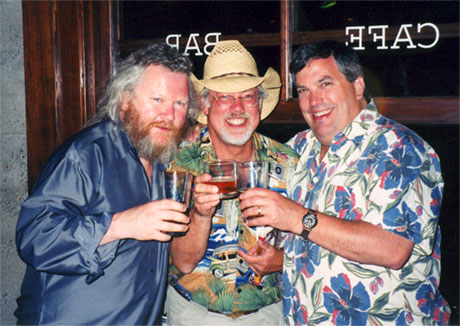
gdivide07-5
At the Great Divide Brewery in Denver, Cornelia and Ray, during GABF week in 2007.

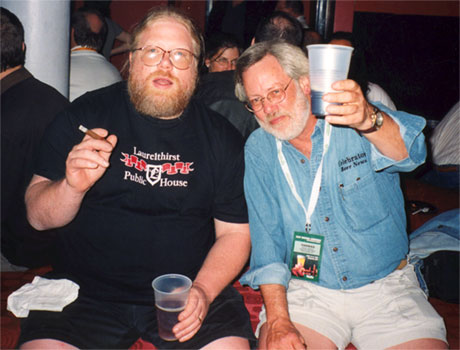
cbn-ann19-27
Cornelia and Ray at the 19th Anniversary Party for the Celebrator Beer News.

No photo description available.

Filed Under: Birthdays, Just For Fun Tagged With: North Carolina

Historic Beer Birthday: George Gund II

April 13, 2025 By Jay Brooks

gunds
Today is the birthday of George Gund II (April 13, 1888-November 15, 1966). He was the son of George F. Gund and the grandson of John Gund, the founder of John Gund Brewing, of La Crosse, Wisconsin, and the brother of Henry Gund and John Gund Jr., who founded Lexington Brewing, in Lexington, Kentucky. George Frederick Gund founded Gund Brewing Co., of Cleveland, Ohio. Despite the brewing heritage, Gund II “was an American banker, business executive, and real estate investor who lived in Cleveland, Ohio in the early and middle part of the 20th century. Heir to the George Frederick Gund brewing and banking fortune, he was a philanthropist for most of his life. He established The George Gund Foundation in 1952 and endowed it with most of his $600 million fortune at his death.”

george-gund-headshot

Here’s his biography from Wikipedia:

Gund’s grandfather, Johann Gund, was born in 1830 in Brühl am Rhein in the independent country of the Grand Duchy of Baden (now part of Germany). The family emigrated to the United States in 1848 and settled in Illinois, but in 1854 moved to La Crosse, Wisconsin. There his grandfather founded the John Gund Brewery. His father, George Frederick Gund, was born in LaCrosse in 1856 and later managed the Gund Brewery. His father moved to Seattle, Washington, founded the Seattle Brewing and Malting Company, became a director of two banks, and then returned to the Midwest to move his family to Cleveland in 1897. His father bought the Jacob Mall Brewing Company, renamed it the Gund Brewing Company, and made a large fortune investing in banking, mining, and real estate.

George Gund, Jr. (as he was then known) was born to George Frederick and Anna Louise (Metzger) Gund on April 13, 1888. He was a student at the University School of Cleveland from 1897 to 1905. He entered Harvard University, and received his A.B. in 1909. Toward the end of his Harvard education, he simultaneously enrolled in the Harvard Business School, and graduated in the school’s first class in 1909. He moved to Seattle and took a job as a clerk with the Seattle First National Bank, but moved back to Cleveland when his father died in 1916. But when World War I broke out, he enlisted in the United States Army and served in the Military Intelligence Division.

gund-brewery-ohio
The Jacob Mall Brewing Co. when George Gund bought it in 1897.

After the start of prohibition in the United States in 1920, Gund was forced to close his father’s brewery in Cleveland. But during the war, Kaffee HAG, a German corporation, was stripped of its assets in the United States. Among its subsidiaries was Sanka, the company which manufactured decaffeinated coffee. Gund purchased Sanka in 1919, then sold it to Kellogg’s in 1927 for $10 million in stock. Gund also took over management of the Gund Realty Company in Cleveland and invested his money in numerous ventures. During the depths of the Great Depression, he purchased large amounts of stock at very low prices.

Gund studied animal husbandry at Iowa State University from 1922 to 1923. He made many trips to California and Nevada, often staying there for many months at a time, and became interested in a possible political career in Nevada. He purchased a large cattle ranch in Nevada, but on May 23, 1936, he married Jessica Laidlaw Roesler. She was the granddaughter of Henry Bedell Laidlaw, the founder of one of the first investment banking houses in New York City, Laidlaw & Company. Gund purchased a large home in Beachwood, a wealthy suburb of Cleveland, and the couple had six children: George III, Agnes, Gordon, Graham, Geoffrey, and Louise.

In 1937, Gund was elected a director of the Cleveland Trust Company (a savings bank established in 1896), and was named president in 1941. He was made chairman of the board of trustees in 1962. Under Gund’s leadership, by 1967 the bank had more than $2 billion in assets, making it the 18th largest bank in the United States. Gund also served on the board of directors of another 30 national and multinational corporations. But despite the urban nature of his work, Gund never lost his affection for the Old West. He used his income to collect a large number of works of art which depicted the American West, including works by Albert Bierstadt, Frederic Remington, and Charles Marion Russell.

George Gund died of leukemia at the Cleveland Clinic on November 15, 1966. He was interred at Lake View Cemetery in Cleveland.

His foundation also has a nice biography of him.

gunds-clevelander

Gunds--quot-Finest-quot--Beer-Labels-Gund-Brewing-Co

Filed Under: Birthdays, Just For Fun Tagged With: History, Wisconsin

Historic Beer Birthday: Albert C. Houghton

April 13, 2025 By Jay Brooks

Today is the birthday of Albert C. Houghton (April 13, 1844-August 11, 1914). He was born in Stamford, Vermont, the eldest of nine children. He also appears to have served as a private in the Massachusetts 16th Infantry, Company C during the Civil War. His father was Andrew Jackson Houghton, who founded the A.J. Houghton & Co. Brewery with John A. Kohl in 1870, in Boston, Massachusetts. Albert took over the brewery and was its president after his father died in 1892. It was also known as the Vienna Brewery at various points of its history, before closing for good in 1918 when Prohibition went into effect.

Here is his biography, from Wikipedia:

Albert Charles Houghton was born April 13, 1844 in Stamford, Vermont to James and Chloe Houghton. He was the youngest son in a family of nine children. Houghton married Cordelia J. Smith, of Stamford, Vermont in 1866. They had four children, all of whom studied in Germany.

Houghton died as a result of injuries five days after a car accident that also killed his daughter Mary and her friend Sybil Cady Hutton. The chauffeur, John Widders, killed himself the next morning.

Houghton was engaged in various business dealings. Before he was 21, he founded the Houghton Chemical Works of Stamford with his brother J.R. Houghton. By 1868, he was doing work in real estate and operating the Parker Mill in North Adams, Massachusetts. Houghton and his family moved to North Adams permanently in 1870.

Houghton owned the North Pownal Manufacturing Company in North Pownal, Vermont. He became president of the Arnold Print Works in 1881. He was president and owner of the A.J. Houghton Brewing Company of Boston, upon the death of founder A.J. Houghton in 1892. In 1877, he bought the Williamstown Manufacturing Company. In 1878 he bought the Eclipse Mill and Beaver Mill, both cotton manufacturing mills. In 1895 he became director of the Boston & Albany Railroad. He was also a trustee of Williams College, and sat on the boards of various banks. Five days prior to his death in 1914, Houghton purchased the Mausert Block.

In 1868, Houghton was a member of the state legislature in Vermont, representing his hometown of Searsburg. When North Adams was incorporated as a city in 1895, Mr. Houghton was nominated by “all parties” and elected its first mayor.

And this account is from Ghost Adventures Wiki:

Albert Charles Houghton, born 1844 in nearby Vermont, made his fortune as president of Arnold Printworks, the largest employer in North Adams. He was elected the town’s first mayor in 1896, and the Houghton Mansion was built for his family.

On August 1st, 1914, Mr. Houghton and his daughter Mary Houghton decided to go to Bennington for a pleasure drive in a brand-new Pierce-Arrow touring car, driven by the family’s longtime chauffeur John Widders and accompanied by a doctor, Mrs. Hutton from New York. About 9:30AM, they came up what is now Oak Hill Road and came across a team of horses parked on the right side of the road. Widders turned the car left around it, but the engine started to race at a shoulder bend and the car toppled down a hillside, rolling over three times until it came to rest in an upright position in a farmer’s field. Mr. Houghton and Widders escaped with minor injuries, but Mrs. Hutton was killed instantly and Mary Houghton died of her injuries at 3:00PM.

Mr. Houghton, heartbroken over the death of his daughter, died in the mansion 10 days after the accident.

So why was Houghton’s biography on a Ghost Adventures website? Well, that’s more fully explained in yet another website article with the provocative title “Photo Tour: Investigate the haunted, historic Houghton Mansion in North Adams, Mass.” There’s also quite a few photos of the Houghton mansion there, too.

On August 1st, 1914 Widders was driving A.C. Houghton, his daughter Mary and a family friend, Sybil Hutton to Vermont. They came upon a road crew on a mountain road, so Widders swerved to the edge of the road to avoid them. The vehicle hit a soft shoulder and rolled down a steep embankment, flipping over 3 times.

Sybil died at the scene and Mary Houghton died enroute to the hospital. Both John Widders and A.C. Houghton suffered minor injuries. The next day, in the early morning hours, John Widders was found dead in the barn behind the mansion. He had committed suicide by shooting himself with a horse pistol, unable to forgive himself for the accident that he felt was his fault. Albert Houghton died just 9 days later, some say of a broken heart.

The tragic accident and subsequent suicide have had a deep and lasting effect on the property at 172 Church Street in North Adams. It is said to this day that the home is still occupied by the spirits of A.C. Houghton and his daughter Mary. Mary is usually seen on the upper-floors of the mansion, while Albert still enjoys the run of the beautiful, historic home. The tragic John Widders is also said to be seen, in the form of shadows throughout the property.

The property was eventually sold to the Masons in 1920. They soon erected a huge Masonic Temple at the rear of the house. The mansion is still in use as a Masonic Temple today and is maintained by the Lafayette Graylock Masonic Lodge A.F. & A.M. and the Naomi Chapter of the Eastern Star — non-profit associations that support many charitable organizations.

Portrait of A.C. Houghton by Paul K. M. Thomas, completed in 1915.

Filed Under: Birthdays, Breweries, Just For Fun Tagged With: Massachusetts, Vermont

Beer Birthday: Andreas Fält

April 13, 2025 By Jay Brooks

sweden

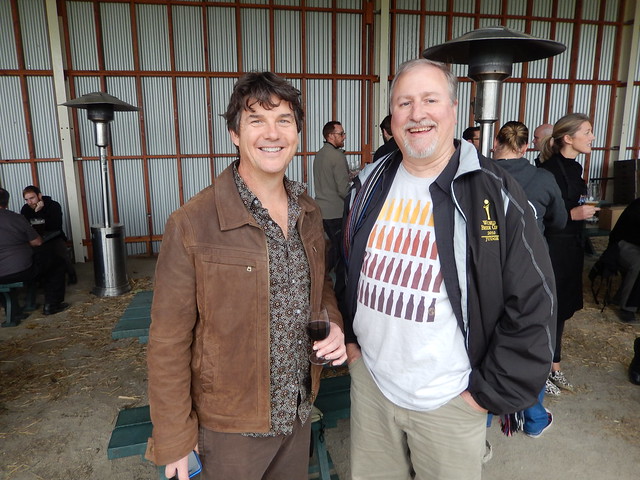
Today is the 54th birthday of Andreas Fält, who was the Brand Development Manager at Prime Beer Russia, but more recently became the export manager for Porterhouse Brew Co. I know him, like most people I suspect, from judging together all over the world, as he’s on the international beer judging circuit. Andreas is actually Swedish, but lives in Leeds, England, with his family. He’s a great ambassador for beer, and certainly one of my favorite people in the beer industry. Join me in wishing Andreas a very happy birthday.
Andreas-Falt-1
Me, with Stephen Beaumont, Andreas, and Luc De Raedemaeker. Our last night in Mechelen before judging ended for the 2018 Brussels Beer Challenge, when a healthy percentage of the judges ended up congregated at Den Stillen Genieter, which had a pretty decent beer list though we did our best to liberate as many bottles as we could.
Andreas-Falt-2
Me, Andreas, and Rick Kempen late one night during the Brussels Beer Challenge.
Andreas-Falt-3
My table at the Brussels Beer Challenge a few years ago, with Andreas at the center.
Andreas-Falt-4
Taking a motley crew after dinner to my favorite Brussels frites place, Cafe Georgette, including Andreas (on the left).
With Andreas, Lisa Morrison and Stephen Beaumont in Niagra Falls for the Canada Beer Cup.

Filed Under: Birthdays, Just For Fun Tagged With: Sweden

Beer Birthday: Julie Johnson

April 13, 2025 By Jay Brooks

all-about-beer
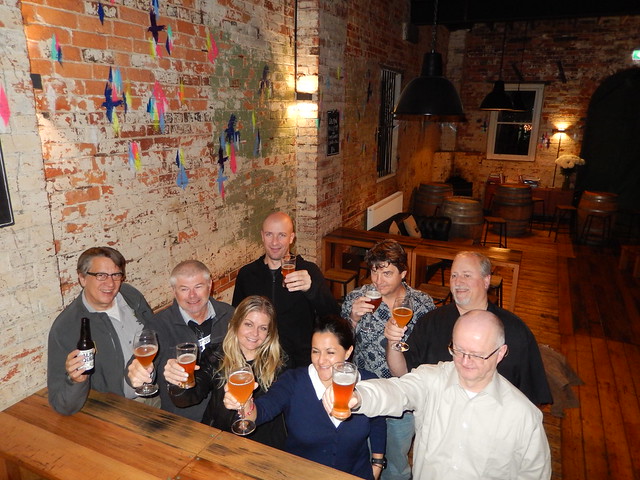
Today is the birthday of Julie Johnson, who until several years ago was the editor of All About Beer magazine, headquartered in Durham, North Carolina. Julie is without a doubt one of the nicest people in the industry and a pleasure to work with. Plus she likes odd little German trolls almost as much as I do. Hers is pink, mine’s silver. Don’t ask — or do, if you’d like a long, rambling travel story. Join me in wishing Julie a very happy birthday.
P1030505
Julie with Ray Daniels at Lagunitas during the Journalism Retreat before CBC the year it was in San Francisco.

P1030638
Maureen Ogle, Jack McAuliffe and Julie at CBC in San Francisco earlier a few years ago.

julie-and-me
Julie and me at the Rare Beer Tasting at Wynkoop several years back. (photo by Christopher Miller)

gabf07-11
Julie provides guest vocals on Hop This Town at the Falling Rock in Denver, Colorado during GABF week in 2007.

Filed Under: Birthdays, Just For Fun Tagged With: North Carolina, Writing

Historic Beer Birthday: Joseph Bramah

April 13, 2025 By Jay Brooks

handpump
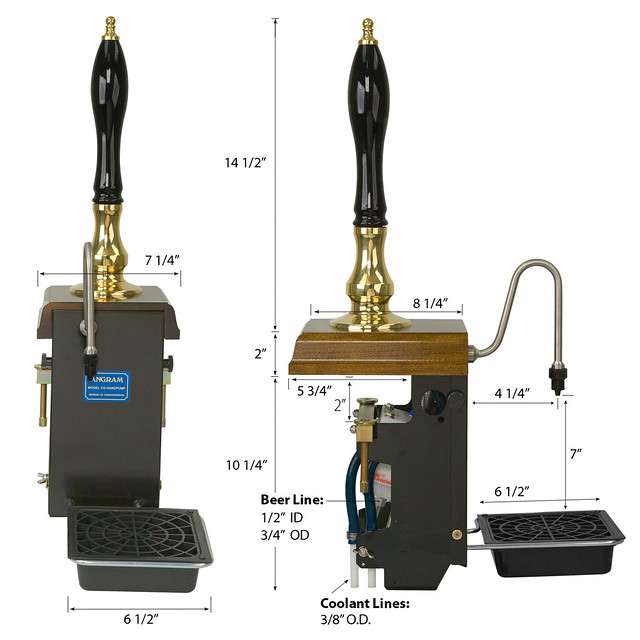
Today is the birthday of Joseph Bramah (April 13, 1748-December 9, 1814). Bramah was an English engineer, and inventor, whose most famous invention was the hydraulic press. But he also made improvements and created a practical beer engine, creating his beer pump and engine inventions between 1785 and 1797.

Joseph Bramah- portrait in oils

Another summary of his achievements is quite flattering:

English engineer and inventor whose lock manufacturing shop was the cradle of the British machine-tool industry. Central in early Victorian lockmaking and manufacturing, he influenced almost every mechanical trade of the time. Like Henry Ford, his influence was probably greater for the manufacturing processes he developed, than the product itself. He took out his first patent on a safety lock (1784) and in 1795 he patented his hydraulic press, known as the Bramah press, used for heavy forging. He devised a numerical printing machine for bank notes and was one of the first to suggest the practicability of screw propellers and of hydraulic transmission. He invented milling and planing machines and other machine tools, a beer-engine (1797), and a water-closet.

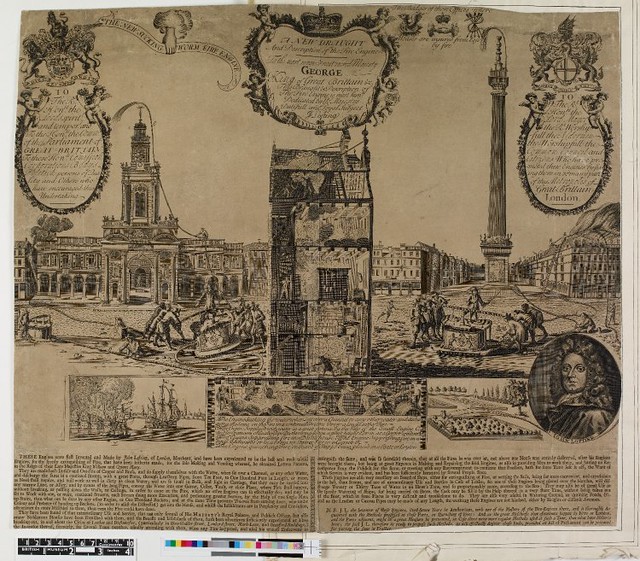
As for the actual patents, there were two of them. The first was in 1785 and was for what he called a “beer pump.” Then, in 1793 he was granted Patent No. 2196 for his improved version, now referred to as a “beer engine.” It was actually a Dutchman, John Lofting, who had first invented the beer pump in 1688, but Bramah’s were more refined and practical, and more importantly, patented. Curiously, Grace’s Guide to British Industrial History lists the patent dates as 1787 and 1797, so it’s unclear which are the correct dates.

In this engraving, entitled Men of Science Living in 1807-8, Bramah is on the left side, the tenth one in the back from the left. He’s the one with the wide sash across his chest and the star-shaped badge on his jacket. Others include Joseph Banks, Henry Cavendish and James Watt.

NPG 1075a; Engraving after 'Men of Science Living in 1807-8'

There’s even a J.D. Wetherspoon’s pub in his home town of Bramley called The Joseph Bramah

joseph-bramah-pub-3

Filed Under: Birthdays, Just For Fun, Politics & Law, Related Pleasures Tagged With: Cask, England, Great Britain, History

Beer In Ads #4938: Moerschel’s Bock Beer, The King Of All Beers

April 12, 2025 By Jay Brooks

Last year I decided to concentrate on Bock ads. Bock, of course, may have originated in Germany, in the town of Einbeck. Because many 19th century American breweries were founded by German immigrants, they offered a bock at certain times of the year, be it Spring, Easter, Lent, Christmas, or what have you. In a sense they were some of the first seasonal beers. “The style was later adopted in Bavaria by Munich brewers in the 17th century. Due to their Bavarian accent, citizens of Munich pronounced ‘Einbeck’ as ‘ein Bock’ (a billy goat), and thus the beer became known as ‘Bock.’ A goat often appears on bottle labels.” And presumably because they were special releases, many breweries went all out promoting them with beautiful artwork on posters and other advertising.

Friday’s ad is for Moerschel’s Bock Beer and was published April 12, 1901. The brewery was the Capitol Brewery Co., of Jefferson City, Missouri, which was originally founded in 1845 as the Joe Kessler Brewery. This ad ran in the Republican Review.

Filed Under: Art & Beer, Beers, Breweries, Just For Fun Tagged With: Advertising, Bock, History, Missouri

Beer In Ads #4937: Gambrinus Bock Is Back

April 11, 2025 By Jay Brooks

Last year I decided to concentrate on Bock ads. Bock, of course, may have originated in Germany, in the town of Einbeck. Because many 19th century American breweries were founded by German immigrants, they offered a bock at certain times of the year, be it Spring, Easter, Lent, Christmas, or what have you. In a sense they were some of the first seasonal beers. “The style was later adopted in Bavaria by Munich brewers in the 17th century. Due to their Bavarian accent, citizens of Munich pronounced ‘Einbeck’ as ‘ein Bock’ (a billy goat), and thus the beer became known as ‘Bock.’ A goat often appears on bottle labels.” And presumably because they were special releases, many breweries went all out promoting them with beautiful artwork on posters and other advertising.

Thursday’s ad is for Gambrinus Bock Beer and was published in 1951. The brewery was August Wagner Breweries, of Columbus, Ohio, which was originally founded in 1870. This ad ran in the Chillicothe Gazette, Ohio’s oldest newspaper, which was first published in 1793.

Filed Under: Art & Beer, Beers, Breweries, Just For Fun Tagged With: Advertising, Bock, History

Historic Beer Birthday: Gambrinus

April 11, 2025 By Jay Brooks

gambrinus
Today is the traditional birthday of Gambrinus, sometimes called King Gambrinus, considered to be a patron saint of beer, brewing and/or Belgian beer. Not an “official” saint, at least not in the catholic church, but a legendary figure. Regardless, join me in drinking a toast to King Gambrinus today.
gambrinus1
Here’s the overview at Wikipedia:

Gambrinus is a legendary king of Flanders, and an unofficial patron saint of beer or beer brewing. Gambrinus is variously depicted as a European king, as an English knight of the Middle Ages, or (less commonly) as a plump old man. Gambrinus’ birthday is purported to be April 11.

The origin of the character is most widely believed to be John the Fearless (1371–1419), who some also believe to be the inventor of hopped malt beer. However, other sources report that one of the cup-bearers in the court of Charlemagne (742–814) was also called Gambrinus. In 1543, the German poet Burkart Waldis wrote of Gambrinus, explaining that Gambrinus learned the art of brewing from Isis, the ancient Egyptian goddess of motherhood and fertility.
It is also possible that the original Gambrinus was Duke John I of Brabant (1254-1298), who was called Jan Primus.
Other possible Latin etymologies of the name include cambarus (cellarer) and ganeae birrinus (one who drinks in a tavern). Plzeňský Prazdroj, brewer of the Gambrinus lager, endorses the explanation that the name is a corruption of Jan Primus (John the First), referring to John I, Duke of Brabant. Alternatively, Gambrinus may be a corruption of the name Gambrivius. Although less likely, Gambrinus might also derive from camba, a word from the Celtic language family that refers to a brewer’s pan.

gambrinus-2
The beer website Froth N Hops has the fullest account of the story of King Gambrinus in one place, though it’s unclear what the source material is. Hopefully, he won’t mind my re-printing it here.

King Gambrinus, known as “the patron saint of beer,” has long been a universal symbol of beer and brewing. Particularly during the late nineteenth century, the image of Gambrinus was used by countless brewers to promote their products and remind consumers of the rich heritage of beer-making. Many breweries were even adorned with life-size statues of the King.

But who was Gambrinus? It is Gambrinus who brought beer to earth, and here is the legend of how this came to pass, and how he came to be King: Gambrinus was a poor apprentice in glass-making, hailing from a little town in the Flandres called Fresne sur l’Escaut. With his wonderful pink cheeks, blonde hair and blonde beard, he was the most beautiful boy in the town and had great romantic success with the town girls.

gambrinus-brewery-export
But Gambrinus had secretly fallen in love with the beautiful daughter of his master, Flandrine. In those times, glass makers were noble from birth, and taught their art only to their sons. Flandrine, as proud as she was pretty, wanted to marry a master glass maker like her father, grandfather, and great grandfather. Gambrinus, as an apprentice, would only prepare the glass for his master, who then skillfully puffed it into decorative sheets.

At last, Gambrinus gathered the courage to reveal his feelings to Flandrine. But Flandrine, offended that such a lowly apprentice sought her affection, refused so strongly that Gambrinus left Fresne, and vowed never to return to glass-working again so that he might forget about Flandrine forever.

wagners-gambrinus-tray
So Gambrinus wandered from town to town playing his violin and writing poetry to sing along while he played. Gambrinus, who was very clever and a quick-learner, soon gained a reputation as one of the best violinists in the region. He was constantly called on in towns far and wide to liven up weddings, birthdays, and other parties.

When the people of Fresne heard of the fame Gambrinus had achieved, they could barely believe it. They were so proud of their Gambrinus that they invited him back to Fresne and threw a town-wide celebration in his honor. Gambrinus, flattered by the thought of a celebration in his honor, accepted the towns invitation and returned to Fresne. When he arrived in Fresne and began playing his violin, the delighted townspeople began to sing and dance and cheer.

But soon after Gambrinus had started playing, he noticed Flandrine in the crowd. Overcome by nervousness, Gambrinus began to tremble. He trembled so much and played his violin so horribly that the townspeople began to kick him and shout at him.

gambrinus-stock
The townspeople all blamed Gambrinus for the commotion, since it was his poor playing that upset everyone. Gambrinus soon found himself arrested by the town officials and spent a full month in jail for the trouble he caused in the street and the noisy disturbance he had caused in the night. When Gambrinus was released from jail, he decided the only way he could ever make himself forget about Flandrine was to kill himself. He decided to hang himself, and headed out into the forest to set up a noose and platform. Gambrinus slid the noose over his neck, but just when he was about to step off the platform, he saw before him the devil himself. As is his custom, the devil proposed a deal to Gambrinus: if his power was not strong enough to make Flandrine love Gambrinus, the devil would oblige Gambrinus to forget Flandrine forever. This in exchange for Gambrinus’ soul in 30 years time. Gambrinus accepted the deal, and agreed to the devil’s terms.

As soon as Gambrinus returned to town, he noticed an intense desire to gamble on games. Indeed, the devil meant to turn Gambrinus’ love for Flandrine into a passion for betting. Gambrinus bet on everything he could, not caring whether he won or not. But win he did, and soon Gambrinus found himself the owner of a small fortune. Although gambling had nearly eclipsed any thought of Flandrine, Gambrinus suddenly had an idea. Because he was as rich as a prince, perhaps Flandrine would agree to marry him as a noble. Gambrinus approached Flandrine for the second time and expressed his feelings to her. But Flandrine’s rejection was as swift and as ruthless as the first time: Gambrinus wasn’t a noble; he was born a boy, and would remain a boy for life.

BEER-TRAY_GAMBRINUS_01
King on a Barrel Gambrinus, returned to the forest to see the devil and ask him what went wrong; after all, Gambrinus still had not forgotten Flandrine, nor had Flandrine been made to fall in love with Gambrinus. Suddenly, before Gambrinus’ eyes appeared a large field with long lines of poles on which green plants began to grow. Soon the poles were covered by these green, perfumed plants. “These,” explained the devil, “are hops.” Just as quickly, two buildings burst forth from the ground. “The first building is a hophouse,” said the devil, “and the second one is a brewery. Come, and I will teach you how to make beer, Flandres’ wine. Beer will help you to forget Flandrine.”

Gambrinus learned how to make beer (not without tasting it every now and again) and found it delicious. Gambrinus soon felt like singing and dancing and playing his violin. But he remembered that the last time he had played violin he had been arrested, and his violin destroyed. Gambrinus asked the devil how he might seek revenge against the townspeople of Fresne who kicked him, sent him to jail, and broke his violin. The devil gave Gambrinus a new instrument that no one could resist, and taught Gambrinus how to play it. The devil explained that this instrument was called the chimes. The devil gave Gambrinus some seeds and the chimes and sent Gambrinus back to Fresne.

cantillon_rose_de_gambrinus-3
Once he arrived home, Gambrinus planted the precious seeds given to him by Belzebuth, and practiced making beer and playing chimes. One morning, Gambrinus set up tables, chairs, barrels, and chimes on the main town square and invited all the townspeople to join him to sample his new drink called beer. The townspeople tasted the beer, which was a brown lager. At first the people complained: “It is too bitter,” “It is too strong.” The people soon began laughing at Gambrinus and his stupid drink. Then Gambrinus began to play the irresistible chimes. The people all began dancing and could not stop. All the dancing made the people thirsty, which encouraged them to drink more beer. After an hour or so, the tired and woozy townspeople pleaded with Gambrinus to stop playing chimes. But Gambrinus kept playing for hours and hours. Gambrinus was satisfied that he had gotten his revenge on those who had wronged him.

But after time the townspeople began to appreciate the beer. They begged Gambrinus to make more and called beer the best drink they ever had. Word of Gambrinus’ drink spread far and wide and crossed over all frontiers. People from other towns soon begged Gambrinus to bring beer to their towns. Everywhere Gambrinus went, he brewed beer and played the chimes. So impressed were the nobles of the region that the Dukes, Counts, and Lords offered Gambrinus the title “King of Flandres.” Gambrinus accepted the position of king, but said he preferred the title “King of the Beer.” From thence on, Gambrinus was known as “The Brewer King.”

Gambrinus-yuengling
When Flandrine realized that Gambrinus would never come to her again, she came to talk to him. Gambrinus, however, more than a little inebriated, couldn’t recognize Flandrine, and just offered her something to drink; indeed, Gambrinus had forgotten about Flandrine.

Gambrinus lived happily with his subjects for many years, until finally the devil returned. “Thirty years have passed since we made our deal,” said the devil. “Now you must follow me.” But when the devil turned around, Gambrinus began playing the chimes, and the devil began to dance. The devil begged Gambrinus to stop playing, but Gambrinus continued, and the devil could not stop dancing. Finally, the devil agreed to break his deal with Gambrinus, releasing Gambrinus from his end of the deal.

King Gambrinus lived happily for another half century playing chimes and making beer. When Gambrinus finally died, his body disappeared, and in its place appeared a barrel of beer. This is why Gambrinus has no tombstone, and why no one knows of the resting place of The Brewer King.

gambrinus-logo
Another website lists some tall tales that have made Gambrinus famous:

  • He received the gift of beer directly from the Egyptian fertility goddess Isis
  • In medieval times he loaned his soul to the devil for 30 years to learn the art and process of brewing
  • He outwitted his opponent in a challenge to lift an impossibly heavy beer cask by first drinking the beer then triumphantly lifted the empty cask
  • During a three-day banquet he drank mug after mug of foamy beer and he was known forever after as the King of Beer

KingGambrinus
Below is a Symphonion No. 25 GS: “Gambrinus,” a “spectacular original coin-operated disc musical box by ‘Symphonion Musikwerke, Leipzig,’ for 11 3/4 in. discs, 84 teeth in duplex comb (complete), with a wonderful wood-carved figure of the mythical Flemish King “Gambrinus”. 43 1/2 in. high. With 10 discs.”

gambrinus-music-box
The German Beer Brewers Museum in Munich owns a portrait from 1526 of King Gambrinus, and it includes the following verse:

Im Leben ward ich Gambrinus gennant,
König zu Flandern und Brabant,
Ich hab aus Gersten Malz gemacht
Und Bierbrauen zuerst erdacht.
Drum können die Brauer mit Wahrheit sagen,
Daß sie einen König zum Meister haben.

Which translates roughly to:

In life I was known as Gambrinus,
King of Flanders and Brabant,
From barley I made malt
And was first at brewing beer.
Thus the brewers can truthfully say,
They have a king as master brewer.

gambrinus-munich

Filed Under: Birthdays, Just For Fun Tagged With: Belgium, Religion & Beer

« Previous Page
Next Page »

Find Something

Northern California Breweries

Please consider purchasing my latest book, California Breweries North, available from Amazon, or ask for it at your local bookstore.

Recent Comments

  • Ernie Dewing on Historic Beer Birthday: Charles William Bergner 
  • Steve 'Pudgy' De Rose on Historic Beer Birthday: Jacob Schmidt
  • Jay Brooks on Beer Birthday: Bill Owens
  • Steve 'Pudgy' De Rose on Beer Birthday: Charles Finkel
  • Steve 'Pudgy' De Rose on Beer Birthday: Bill Owens

Recent Posts

  • Beer Birthday: Chuck Silva February 14, 2026
  • Beer Birthday: Lew Bryson February 14, 2026
  • Beer In Ads #5201: Metzger’s Bock Beer February 13, 2026
  • Historic Beer Birthday: Mary of Burgundy February 13, 2026
  • Historic Beer Birthday: Henry C. Haefner Jr. February 13, 2026

BBB Archives

Feedback

Head Quarter
This site is hosted and maintained by H25Q.dev. Any questions or comments for the webmaster can be directed here.