Brookston Beer Bulletin

Jay R. Brooks on Beer

  • Home
  • About
  • Editorial
  • Birthdays
  • Art & Beer

Socialize

  • Dribbble
  • Email
  • Facebook
  • Flickr
  • GitHub
  • Instagram
  • LinkedIn
  • Pinterest
  • RSS
  • Twitter
  • YouTube

Powered by Genesis

Beer In Ads #5090: Salvator Season In Munich

September 28, 2025 By Jay Brooks

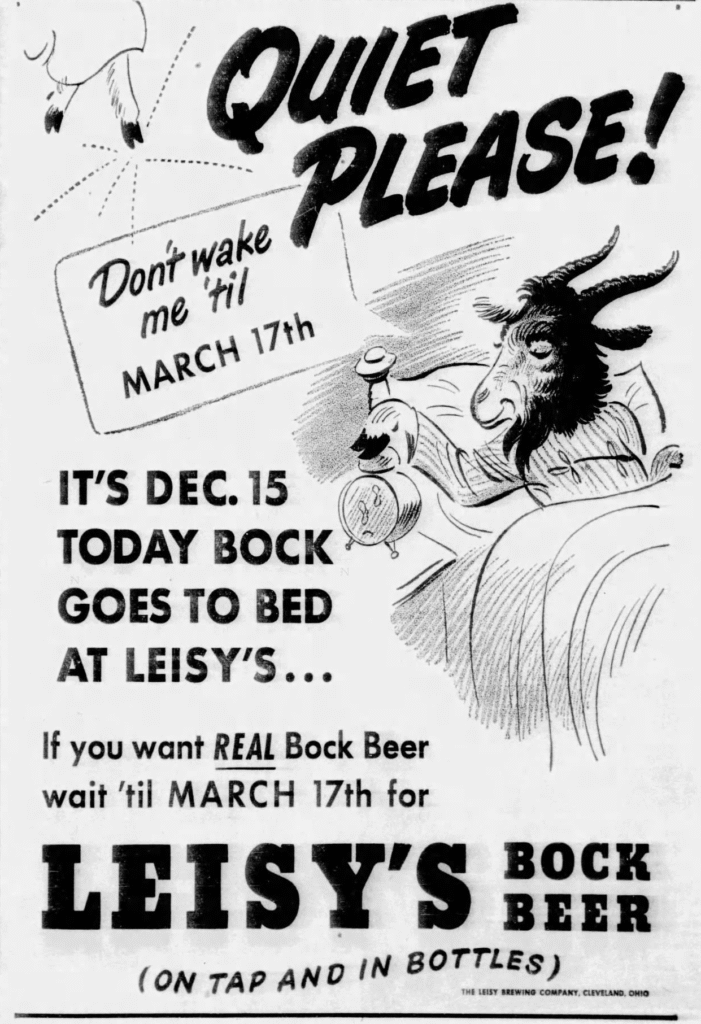
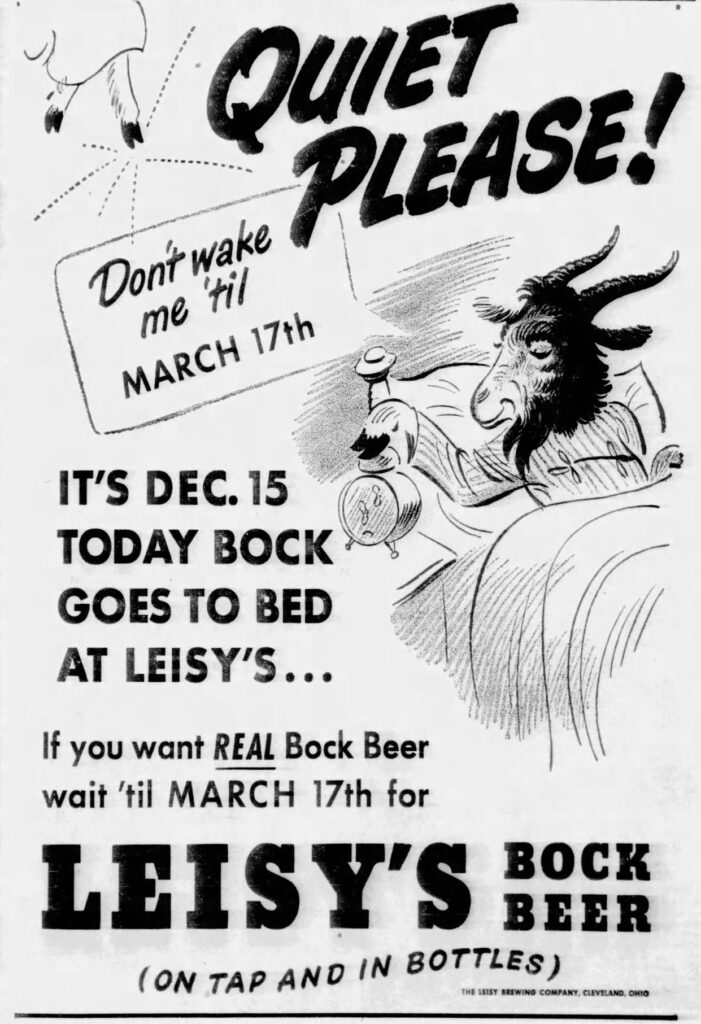
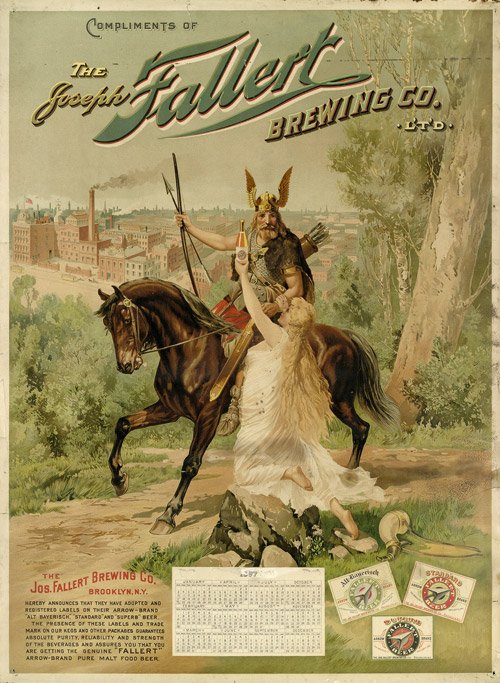
Last year I decided to concentrate on Bock ads. Bock, of course, may have originated in Germany, in the town of Einbeck. Because many 19th century American breweries were founded by German immigrants, they offered a bock at certain times of the year, be it Spring, Easter, Lent, Christmas, or what have you. In a sense they were some of the first seasonal beers. “The style was later adopted in Bavaria by Munich brewers in the 17th century. Due to their Bavarian accent, citizens of Munich pronounced ‘Einbeck’ as ‘ein Bock’ (a billy goat), and thus the beer became known as ‘Bock.’ A goat often appears on bottle labels.” And presumably because they were special releases, many breweries went all out promoting them with beautiful artwork on posters and other advertising.

Sunday’s work is another one for Salvator Doppelbock, which was created in 1861. This one was for the Paulaner Brewery (Paulaner Brauerei München) of Munich, Germany, which was originally founded in 1634. It’s an original drawing is called “Die Salvator-Saison in München” (or “Salvator Season in Munich”) at the Munich City Museum, although they don’t know who the artist was who created this highly detailed drawing.

Filed Under: Art & Beer, Beers, Breweries, Just For Fun Tagged With: Advertising, Bock, Germany, History

Historic Beer Birthday: Frederick Schaefer

September 28, 2025 By Jay Brooks

schaefer
Today is the birthday of Frederick Schaefer (September 28, 1817-May 20, 1897). Frederick is the “F” in F&M Schaefer Brewing Co., founding it with his brother Maximilian in 1842. He was born in Wetzlar, which is part of Hesse, in what today is Germany. He arrived in New York in 1838, a year before his brother joined him in America.

This is his biography from Find a Grave:

Beer Magnate. He emigrated to the United States in 1838, settled in New York City, and was employed by a local beer maker. In 1839 his brother Maximilian also emigrated, carrying with him the recipe for lager, a popular brew in Germany that was then unknown in America. In 1842 the Schaefers bought out their employer and established F & M Schaefer Brewing. Lager proved popular and the Schaefer company became one of the country’s largest beer producers, with Frederick Schaefer remaining active in the company until failing health caused him to retire in the early 1890s. By the early 1900s, its customer base in the Northeastern United States made Schaefer the most popular beer in the country, a position it maintained until ceding it to Budweiser in the 1970s. The Schaefer brand continued to decline, and as of 1999 is owned by Pabst Brewing, a holding company that contracts for the brewing of formerly popular regional brands.
This is what the brewery looked like in 1842, when Frederick and his brother opened the brewery.

schaefer-brewery-1842

Below is part of a chapter on the history of F&M Schaefer Brewing Co., from Will Anderson’s hard-to-find Breweries in Brooklyn.

Longest operating brewery in New York City, last operating brewery in New York City [as of 1976], and America’s oldest lager beer brewing company — these honors, plus many others, all belong to The F. & M. Schaefer Brewing Co.

“F. & M.”, as most breweriana buffs know, stands for Frederick and Maximilian, the brothers who founded Schaefer. Frederick Schaefer, a native of Wetzlar, Prussia, Germany, emigrated to the U.S. in 1838. When he arrived in New York City on October 23rd he was 21 years old and had exactly $1.00 to his name. There is some doubt as to whether or not he had been a practicing brewer in Germany, but there is no doubt that he was soon a practicing brewer in his adopted city. Within two weeks of his landing, Frederick took a job with Sebastian Sommers, who operated a small brewhouse on Broadway, between 18th and 19th Streets. Frederick obviously enjoyed both his job and life in America, and the next year his younger brother, Maximilian, decided to make the arduous trip across the Atlantic also. He arrived in June of 1839 and brought with him a formula for lager, a type of beer popular in Germany but unheard of in the United States. The brothers dreamed, and planned, and saved – and in the late summer of 1842 they were able to buy the small brewery from Sommers. The official, and historic, starting date was September, 1842.

schaefer-brewery-1849
The new brewery they built in 1849.

Sommers’ former facility was a start, but that’s all it was, as it was much too small. New York beer drinkers immediately took a liking to “the different beer” the brothers brewed, and in 1845 Frederick and Maximilian developed a new plant several blocks away, on 7th Avenue, between 16th and 17th Streets (7th Avenue and 17th Street is today, of course, well known as the home of Barney’s, the giant men’s clothing store). This, too, proved to be just a temporary move; the plant was almost immediately inadequate to meet demands and the brothers wisely decided to build yet another new plant, and to locate it in an area where they could expand as needed. Their search took them to what were then the “wilds” of uptown Manhattan. In 1849 the brewery, lock, stock and many barrels, was moved to Fourth Ave. (now Park Avenue) and 51st Street. Here, just north of Grand Central Station, the Schaefers brewed for the next 67 years, ever-expanding their plant. The only problem was that the brothers were not the only ones to locate “uptown.” The area in the 40’s, 50’s and 60’s grew rapidly all during the last half of the 19th century, and especially after the opening of the original Grand Central Terminal in 1871. Frederick and Maximilian had wisely purchased numerous lots between 50th and 52nd Streets, and by the time they passed away (Frederick in 1897 and Maximilian in 1904) the brewery was, literally, sitting atop a small fortune. Maximilian’s son, Rudolph J. Schaefer, fully realized this when he assumed the Presidency of the brewery in 1912. In that same year Rudolph purchased the 50% of the company owned by his uncle Frederick’s heirs. He thus had complete control of the brewery, and one of the first matters he turned to was the suitable location for a new, and presumably everlasting, plant. In 1914, in anticipation of its move, Schaefer sold part of the Park Ave. site to St. Bartholomew’s Church. This sale, for a reputed $1,500,000, forced Rudolph to intensify his search for a new location. Finally, in June of 1915, it was announced that the brewery had decided on a large tract in Brooklyn, directly on the East River and bounded by Kent Avenue and South 9th and 10th Streets. Here, starting in 1915, Rudolph constructed the very best in pre-Prohibition breweries. The move across the river to their ultra-new and modern plant was made in 1916, just four years before the Volstead Act crimped the sails (and sales!) of all United States breweries, new or old alike.

schaefer-brewery-1842-1892

Schaefer-family
Three generations of Schaefers.

Filed Under: Birthdays, Breweries Tagged With: History, Law, Patent

Historic Beer Birthday: Alexander Rodenbach

September 28, 2025 By Jay Brooks

rodenbach-logo
Today is the birthday of Alexander Rodenbach (September 28, 1786-August 17, 1869). He was a co-founder of Brouwerij Rodenbach, along with his brothers. His younger brother Pedro Rodenbach was a military officer and fought in the Battle of Waterloo. When he left the army in 1818, he married a brewer’s daughter, Regina Wauters, who was from Mechelen in Belgium. After Pedro’s father died, he and his brothers, Alexander, Ferdinand and Constantijn, bought a brewery in Roeselare. When their agreed-upon partnership ended after fifteen years, Pedro and Regina bought them out. It was originally called Brasserie et Malterie Saint-Georges. Afterward, Alexander opposed King Willem I and became a member of the National Congress, a position he held for 38 years, and for 25 years was also the mayor of Rumbeke, in Western Belgium. He also went blind as a youngster, when he was eleven, and was an advocate for helping the blind throughout his life.

This is a translation of his French Wikipedia page:

Alexander descends from a family of medieval German knights, the Van Rodenbachs. His father Jean had four sons: Ferdinand (1773-1841), Alexander (1786-1869), Constantin-Francois (? -1846) and Pierre (? -1848). Alexandre was born in Roeselare in 1786. With blindness at the age of 11, he will develop his other senses. He became the pupil of Valentin Haüy, then propagated the system of writing and teaching invented by Haüy.

In 1820, he bought a small brewery in his hometown. This brewery takes the name of Rodenbach and will last until its acquisition in 1998 by Palm Breweries. A beer tribute to the brewery is called Alexander Rodenbach in honor of the founder.

He began his political commitment around 1826 in the Catholic opposition movement against King William, notably by petitions. He earned the nickname “the blind man of Roeselare”. With his brothers Pierre and Constantin, they helped to create the “Catholic movement of the Netherlands”.

In parallel, Alexandre continues his actions with the blind by becoming involved with teaching methods and Catholic schools.

In 1830 Alexander and his brother Constantine entered politics in the Catholic and congressional movement of the Chamber of Deputies. Alexander was re-elected until May 1866.

His brothers also make less careers in politics. Ferdinand was commissioner of the arrondissement of Ypres from 1831 to 1841 (date of his death); Constantine is deputy with Alexander and then becomes ambassador to Athens; Pierre made a career in the army from 1826, when he created a corps of volunteers, up to the rank of captain.

Among his actions as a politician, he participated in the founding of the Institute of Blind and Deaf-mutes in Brussels, he manages the typhus and famine crisis of 1846-1847, he is a member of the commission Agriculture Superior of Belgium.

He died in Rumbeke in 1869. He was the burgomaster of Rumbeke from 1844 until his death in 1869.

rodenbgeschonder

And this is the history currently on the brewery website:

Entrepreneur, statesman, author, people’s representative, burgomaster. Unmarried. Went blind in his youth. Ran the brewery from 1821. Wrote scathing petitions against the policy of William I and in favour of freedom of speech and the press. Was instrumental in the Revolution in Roeselare in 1830 and supported his brothers Constantijn and Pedro in Brussels. Elected as a member of the Constitutional congress. As a parliamentarian, campaigned for the economic development of West Flanders, including railway and canal construction in Roeselare. Enjoyed a reputation in Europe for his books on teaching the blind and the deaf-and-dumb. Was multilingual, wrote poems and books, played the piano, was an art lover and a pragmatic revolutionary.

This biography is from the “National Biography of Belgium, XIX,” published in 1907:

RODENBACH (Alexander), politician, publicist and philanthropist, born in Roeselare, of a family originally from the Grand Duchy of Hesse, September 28, 1786, died at Rumbeke on August 17, 1869.

He was the second son of Jean Rodenbach and the brother of Ferdinand, Constantin Francis and Peter.
Alexander lost sight at the age of eleven, and it was in vain that his father, a notable merchant of Roeselare, submitted him to four operations by the best oculists of the time, including the celebrated Dubois, the surgeon of Napoleon. He was raised in Paris at the Museum of the Blind, founded and directed by Valentin Haüy. Endowed with energy and tenacity in every way, Rodenbach learned to be initiated into those arts which his unhappiness seemed to forbid him: dancing, riding and swimming. He applied himself particularly to developing the acuity of his senses, and Haüy soon counted him among his best pupils. So when King Louis of Holland asked the illustrious protector of the blind in 1807, one of his disciples to propagate his method to the school at Amsterdam, Haüy sent him Rodenbach, so much the better in this task that his knowledge of Dutch made it considerably easier for him to teach. About 1810 he returned to Roeselare, where he devoted himself to the industry and commerce of his parents. In 1828 he published his Letter on the Blind, following that of Diderot, and the following year his “Glance of a blind man on the deaf and dumb”; he later resumed this last subject in “The blind and the deaf-mute” (1853) which had two years after a second edition. a blind man on deaf-mutes “; he later resumed this last subject in “The blind and the deaf-mute” (1853) which had two years after a second edition. a blind man on deaf-mutes “; he later resumed this last subject in “The blind and the deaf-mute” (1853) which had two years after a second edition.

In 1829 Rodenbach proved, against Dewez and Barante, that it was at West Roosebeke , at the foot of the Keyaertsberg , that Philippe Van Artevelde was beaten and killed. Then he published his “Record on phonography or musical telegraphic language,” and some time after his “Historical and Geographical Notices on the City of Roeselare”.

Towards 1826, lthe Catholic opposition had redoubled its attacks against the government of King William, particularly on the laws of education. From the beginning, Alexander and Constantine Rodenbach actively collaborated with the “Catholic of the Netherlands” and contributed to the petitioning movement. “The Blind of Roeselare,” it was the name by which Alexander was designated, made this city a center of petitioning. At the first sound of the revolution, while his brother Pierre was rushing to Brussels to organize a body of volunteers, Alexander kept up the agitation inWest-Flanders. During and on the September days he went with Ferdinand to Lille, where, in concert with Bartholomew Dumortier, he summoned an assembly of the banished (September 27, 1830). While Pierre Rodenbach brought Louis de Potter back to Brussels, Alexander returned to Bruges, where he organized the revolution with Adolphe Bartels. He caused the Dutch garrison to be disbanded by his inflamed proclamation addressed to the non-commissioned officers of the army, and carried to the barracks by canvassers.

On the 4th of November, the inhabitants of Roulers sent him to sit at the National Congress, with Constantine his brother. In the following elections, he was elected deputy and bedroom until May 1866.

At the Congress, Alexander strongly supported the project of expulsion of the Nassau presented by his brother. Both voted for the Duke of Leuchtenberg, and then supported the regent’s hesitant policy. In 1831, while Constantine gave his voice to Leopold of Saxe-Coburg, Alexander refused to vote for this prince “convinced,” said he, “that he has too much honor to accept the crown under the humiliating conditions of the Holy Alliance He. More tenacious than his brother, who approved the eighteen articles, he signed the protest of 29 June 1831 and voted against the violation of the integrity of the territory. We see that Rodenbach displayed great parliamentary activity.

Later, he contributed powerfully to the erection of an Institute of the blind and deaf-mutes in Brussels, where he had his improvements adopted in the system of Haüy. As a protector of the blind and deaf-mutes, he introduced in the discussion of the communal law an amendment which obliges the communal councils to pay annually to the budget of their expenses maintenance and instruction costs for the blind and the deaf-mute indigents.

After the reorganization of the state universities at Liege and Ghent (September 27, 1835), it was Alexander Rodenbach who negotiated the translation of the Catholic university, founded at Mechelen in 1834, at Louvain (December 1, 1835). On December 27, 1841, he lost his brother Ferdinand (b. 3 May 1773), commissioner for ten years in the arrondissement of Ypres; in 1846, Constantine, ambassador at Athens; in 1848, Pierre, retired captain. These bereavements did not destroy his energy. As burgomaster of Rumbeke, he rendered immense services to the whole population of the district during the disastrous years from 1846 to 1847, when famine and typhus decimated Flanders. At bedroom, Alexander supported the abolition of the stamp of the newspapers and demanded the reduction of their port to a penny and that of the letters to ten centimes. At that time he was appointed member of the superior agricultural commission of the kingdom.

In October 1855, The Imperial Institute of the Young Blind in Paris organized a great festival in his honor, and he delivered a discourse full of encouragement to his young companions in misfortune. On August 10, 1861, he represented Belgium at the inauguration of the statue of Haüy, in Paris.

In 1858, a painful incident, which his author might have avoided, came to quarrel with Rodenbach, with one of his old friends, like himself a zealous philanthropist. J. Cappron, director of the Institute of the Deaf and Dumb in Antwerp, had composed a Flemish work, based chiefly on the work of M. de Gérando, “Memoirs on the instruction of the deaf mutes” (Paris, 1827) and had dedicated it to Rodenbach. Abbe C. Carton of Bruges thought he saw a plagiarism, and accused the author of literary insincerity in a strange letter, to which the blind man of Roeselius replied on March 30, 1858. Carton replied bitterly, insinuating that Rodenbach was unaware of these issues. Cappronintervened in the debate and proved that Carton, in his “Crowned Memory of the Academy of Belgium,” had himself borrowed much from de Gerando. The quarrel remained there.
It was also around this time that Rodenbach had a curious interview in Lille with the famous deaf-mute Jean Massieu , director of an institution for the blind in Lille.

Early the great philanthropist, who enjoyed the general esteem of his fellow-citizens, also excited the admiration of the stranger. His tenacity, his energy in misfortune, his vast intelligence had created a European fame, and visitors from all quarters came to solicit an interview with him in his modest village of Rumbeke. In 1835 he had obtained the cross and was appointed, in 1854, an officer of the order of Leopold. In the same year he received the decorations of St. Michael of Bavaria, Danebrog, Wasa, Christ of Portugal and the Rose from Brazil. The following year, Spain appointed him commander of the Order of Charles III., And the Pope created him Knight of St. Gregory the Great. In 1856 he was appointed knight of the Medjidie of Turkey, of Saint-Maurice of Sardinia, of Saint-Georges of Parma, of the Savior of Greece, of Francis I of the Two Sicilies; Napoleon III granted him the cross ofthe Legion of honor.

Alexandre Rodenbach, by his high qualities, was one of the most beautiful Belgium independent. His life will tell all the disinherited of nature what the will can do, even against the most unfortunate of infirmities. His name, inseparable from those of Haüy and Braille, will be honored like that of a benefactor of humanity.
His posthumous work, “Aide-Mémoire de l’aveugle de Roulers”, was published at Merchtem in 1870 by his nephew, Felix Rodenbach, then receiver of the recording at Ixelles (born in Roulers in 1827, living in Bruges), who wrote several books on recording rights.

Rodenbach_Alex

The brewery began brewing a beer named for Alexander in 1986, and have subsequently brought it back from time to time:

RODENBACH Alexander was brewed for the first time in 1986 on the occasion of Alexander Rodenbach’s 200th birthday and is now back by popular demand to the delight of beer lovers here and abroad. Its aftertaste is reminiscent of a Burgundy wine and its freshness makes this beer the perfect aperitif or accompaniment to cheeses or dessert.

Filed Under: Birthdays, Breweries, Just For Fun Tagged With: Belgium, History

Historic Beer Birthday: Gerard Adriaan Heineken

September 28, 2025 By Jay Brooks

Today is the birthday of Gerard Adriaan Heineken (September 28, 1841-March 18, 1893). In 1864, he founded the Heineken brewing dynasty that’s still family-owned today.

This is part of the Wikipedia page for Heineken:

On 15 February 1864, Gerard Adriaan Heineken (1841–1893) convinced his wealthy mother to buy De Hooiberg (The Haystack) brewery in Amsterdam, a popular working-class brand founded in 1592. In 1873 after hiring a Dr. Elion (student of Louis Pasteur) to develop Heineken a yeast for Bavarian bottom fermentation, the HBM (Heineken’s Bierbrouwerij Maatschappij) was established, and the first Heineken brand beer was brewed. In 1875 Heineken won the Medaille D’Or at the International Maritime Exposition in Paris, then began to be shipped there regularly, after which Heineken sales topped 64,000 hectolitres (1.7 million U.S. gallons), making them the biggest beer exporter to France.

Here are some “interesting facts” about the early days of Heineken from the website First Versions:

  • In 1869 Gerard Heineken decided to switch from traditional top fermentation to the Bavarian method of bottom fermentation, a totally different technique that produces a clearer, purer beer, which keeps longer.
  • On January 11, 1873, Heineken’s Bierbrouwerij Maatschappij NV (HBM) was established, and Gerard Heineken was appointed President.
  • A second brewery was opened in Rotterdam in 1874.
  • In 1886 Dr. Hartog Elion, a pupil of the French chemist Louis Pasteur, developed the “A-yeast” in the Heineken laboratory. This yeast is still the key ingredient of Heineken beer.
The Heineken Brewery in 1867.

And this is from the Heineken N.V. Wikipedia page:

The Heineken company was founded in 1864 when the 22-year-old Gerard Adriaan Heineken bought a brewery known as De Hooiberg (the haystack) in Amsterdam. In 1869 Heineken switched to the use of bottom-fermenting yeast. In 1873 the brewery’s name changed to Heineken’s Bierbrouwerij Maatschappij (HBM), and opened a second brewery in Rotterdam in 1874. In 1886 Dr. H. Elion, a pupil of the French chemist Louis Pasteur, developed the “Heineken A-yeast” in the Heineken laboratory. This yeast is still the key ingredient of Heineken beer.

And this longer biography is a Google translation of Oneindig Noord-Holland:

Gerard was born in Amsterdam in 1841 as the son of Cornelis Heineken and Anna Geertruida van der Paauw. He grew up with his brother and two sisters at a time when various contagious diseases were haunting the city. Many fled from run-down and impoverished Amsterdam. Gerard’s half-sister died in 1851 and his brother Adriaan, who was only eight years old, died two months later.

Gerard was a child of his time: he had a great interest in art, the history of the city and new technological developments. In 1863 Gerard had his eye on the somewhat dilapidated De Hooiberg brewery on the Nieuwezijds Achterburgwal in Amsterdam. Gerard’s move to take over the brewery was, to say the least, remarkable. The consumption of beer, still the national folk drink in the 17th century, had only declined. Preference was often given to wine, coffee, cocoa or tea and for the workers, gin and brandy were sufficient, which also had a better shelf life than beer. In addition, the quality of beer had recently deteriorated, so that the brewing industry enjoyed little prestige.

What probably appealed to Gerard was the technical aspect of brewing. It was a time when many new techniques were being developed and with that much progress was possible. In England, partly due to the steam engine, the beer industry had grown to such an extent that it was comparable to the textile industry or mining. In addition, beer was considered a blessing for public health in the Netherlands. If people wanted to move forward and regain their former prosperity, they had to drink the gin and the beer. Beer was therefore an ideal product to invest in if you had money and enough guts.

Gerard had a nose for entrepreneurship and managed to bring the beer back to the man. The switch to the so-called Beijerse or bottom-fermented beer was the first major success. Expansion soon became necessary and three years later the first stone was laid for a new factory on Stadhouderskade.

To keep up, Gerard made sure that the most modern techniques were used in the brewery. He was the first to buy a very expensive ice cream machine, which solved the cooling problems in one fell swoop. Yet the brewery is not only doing well. The international market and Paris in particular remains difficult to conquer. There was strong competition from Germany but also from our own city, where Amsterdam’s Amstel beer provided exciting times. Nevertheless, Gerard always managed to come back as the largest Dutch beer brewery.

While 1893 seemed to be a quiet year, disaster struck on March 18 for Gerard. He collapsed during a meeting, after which he died almost immediately: a heart attack. His son Henry Pierre Heineken (1886-1971) would eventually take over, but lacked business acumen and interest and did more harm than good. Fortunately, his son, the well-known Freddy Heineken (1923-2002), seemed to have inherited more of his grandfather’s talent for trade and leadership. Freddy did everything he could to get the company back into the hands of the Heinekens and would then be able to turn Gerard’s beer brand into a global brand.

Filed Under: Birthdays, Breweries, Just For Fun Tagged With: Heineken, History, The Netherlands

Beer In Ads #5089: Bottled Beer At Its Best

September 27, 2025 By Jay Brooks

Last year I decided to concentrate on Bock ads. Bock, of course, may have originated in Germany, in the town of Einbeck. Because many 19th century American breweries were founded by German immigrants, they offered a bock at certain times of the year, be it Spring, Easter, Lent, Christmas, or what have you. In a sense they were some of the first seasonal beers. “The style was later adopted in Bavaria by Munich brewers in the 17th century. Due to their Bavarian accent, citizens of Munich pronounced ‘Einbeck’ as ‘ein Bock’ (a billy goat), and thus the beer became known as ‘Bock.’ A goat often appears on bottle labels.” And presumably because they were special releases, many breweries went all out promoting them with beautiful artwork on posters and other advertising.

Saturday’s ad is for bottles of Hornung’s White Bock Beer, which was published on September 27, 1935. This one was for the Jacob Hornung Brewing Co. of Philadelphia, Pennsylvania, which was originally founded in 1885. This ad ran in The Trenton Evening Times, from Trenton, New Jersey.

Filed Under: Art & Beer, Beers, Breweries, Just For Fun Tagged With: Advertising, Bock, History, New Jersey, Pennsylvania

Historic Beer Birthday: Carl Adolf Riebeck

September 27, 2025 By Jay Brooks

riebeck

Today is the birthday of Carl Adolf Riebeck (September 27, 1821-January 28, 1883). He was primarily an industrialist and mining entrepreneur from Clausthal, Germany. According to Wikipedia, “Riebeck later became the wealthiest citizen of Halle, operating the Riebecksche brewery, Leipziger Brauhaus zu Reudnitz, in the Saxon Reudnitz,” which today is part of the town of Leipzig. As far as I can tell, the brewery is still around, but there’s some confusion (at least to me) as to what happened to it. One source claims that today it’s owned by the Radeberger Group while another seems to say it’s part of Braugold, but I’ll explore that in more depth below. At any rate, he and his family operated the brewery during his lifetime.

Carl_Adolf_Riebeck

This biography is from a defunct German website profiling German Industrialists, and I used Google Translate to convert it to English:

The largest square in Saxony-Anhalt’s largest city, Halle, is named after Carl Adolf Riebeck.  Why did you choose this name? Carl Adolf Riebeck was born in poor conditions, his ancestors had all been miners. He started casting ore at the age of 10 and soon entered the mine. The village school gave him little, he could hardly write properly right throughout his life.

The poor payroll conditions led him to seek his fortune outside the home area at the age of eighteen. So he came to Zeitz and Weissenfels. Riebeck soon became Steiger and later Bohrmeister. Why he again worked as a riser in a small pit after his return in 1847, which was a social decline, is unclear. In 1847 he married, in the marriage 6 sons and 3 daughters were born. During the Revolution of 1848/49, he served a one-year prison sentence, which he probably got for criminal offenses (tax evasion?) And then went back to central Germany.

There he got a higher position in the “Saxon-Thuringian joint stock company for brown coal utilization,” a state-owned company. He got to know the area very well and received in 1855 the position of a mountain inspector. Another ascent rejected the board. In particular, it was said that a former convict, who could barely write, had no business on the board. Riebeck then concealed a very rich coal discovery and bought the area in 1858 itself. This was the beginning of an unprecedented career.

At that time there were already several companies in the area that produced tar and other distillation products. His own first facilities in Gosserau (Weißenfels district) consisted of devices that had been sorted out by other companies. The bad machines and his low capital meant that his company did not want to get ahead. Only when he managed to borrow 20,000 Taler from a Halle bank, the company could flourish. 
In return, he offered to pay a thaler for every hundred pounds of tar sold. After a few years, Riebeck was able to repay both the loan amount and the interest. One of the foundations for wealth was the law that was then in effect at the Weißenfelser Revier,

Gradually, he bought almost all lignite recycling companies in the area around Halle and Weißenfels. Riebeck realized early on that the high-bituminous coal that he had initially processed would run out and expand his production range. In the 1860s, it increasingly relied on two pillars: the smoldering of bitumen-rich coal and the production of briquettes from bituminous coal. In addition, his company produced tar, which he sold to Bitterfeld for further processing. Increasingly, he had the technique and procedures scientifically justified. The introduction of scientifically supported industry-related research is one of its pioneering achievements.

With his money Riebeck was also a major landowner in the area around Halle, he owned several manors and participated in the still existing brewery in Reudnitz (today part of Leipzig). 

Because he rejected the struggle of social democracy for the improvement of working and living conditions, he introduced social measures far in advance of Bismarck’s social legislation (sickness and disability funds, foundations, etc.). He wanted to show that a social democracy was not needed to achieve improvements, but that it was much easier and without disputes about the patriarchal benevolence of the entrepreneur possible.

In just under 25 years, Riebeck has gone from the propertyless to the richest citizen of Halle, to the largest landowner in the district of Weissenfels and to the Prussian Council of Commerce. He was always a pure practitioner in his activity, who was suspicious of everything that was theoretical and theoretical. This he also remained in view of the successes that resulted from working with chemists of the University of Halle. Riebeck was able to compensate for his lack of school education with the help of handicraft talent and a sense for the technical.

When Riebeck died, he owned 15 coal mines, three mineral oil factories, 31 smolderies, 27 briquette presses and 13 brickworks, as well as a brewery and a handful of manors.

1821_adolf_riebeck_original

This account of his personal life is from his Wikipedia page:

Riebeck was born into a mining family from Clausthal. In 1827, his father, Steiger, a mine surveyor’s assistant, moved with his family to Harzgerode to work in the Lower Harzironstone mines in Anhalt.
In 1847, Riebeck married Maria Renk ( 1825-1873 ). From this marriage 7 children were born, of which three survived to adulthood. Of these 7 children, only two were sons, Emil Riebeck and Paul Riebeck. His daughter Margaret (1864-1904) married General Reinhard Gottlob Georg Heinrich Freiherr von Scheffer-Boyadel, who was knighted in 1890. His daughter Maria married geoscientist Herbert Credner in 1872.
In 1877, Riebeck married his second wife, Emilie Balthasar, producing two children.

Riebeck-schwarzbier

And the same Wikipedia page details his career:

Riebeck eventually left school to begin working in 1835 as a pit boy and later as Lehrhäuer in Harzgerode’s Albertine ironstone mine. At the age of 18, he left the Harz mountains to work in the brown coal mines of Zeitz and Weissenfels. He attended a mining school in Eisleben and qualified to become a mining foreman.

After an accident, Riebeck was sentenced to one year of imprisonment for criminal breach of duty, which he served between 1848 and 1849. After his release, he found a job at Sächsisch-Thüringischen Aktiengesellschaft, that excavated brown coal. In 1856 he was promoted to the post of mining inspector.

He resigned in 1858 after realizing that he would not be considered for a higher position. He bought brown coal mines in the area of Bitterfeld und Weißenfels and soon began mining operations. Riebeck borrowed money to invest in the upgrade of coal technology as well as distillation units for the production of paraffin, mineral oil and tar.

The petroleum factories of Gosserau, Webau, Reußen bei Theißen and Oberröblingen became the foundation of Riebeck’s empire.
Within a few years, Riebeck acquired refining plants and briquette factories in Hall, Schwelereien, Whiterock and Bitterfeld. He developed brown coal mining into a large scale industry within Saxony and Thuringia.

Riebeck later became the wealthiest citizen of Halle, operating the Riebecksche brewery, Leipziger Brauhaus zu Reudnitz, in the Saxon Reudnitz and some manors.

Even before social legislation was created, he provided social security measures for his workers.

Riebeck-Brewery

As for the brewery, it was founded in 1862 and Riebeck bought it out of bankruptcy in 1871, and turned it around. Here’s one account of its history according to the Leipzig Brauhaus in Reudnitz Wikipedia page, which also concludes that today is owned by the Radeberger Group.

The history of the brewery goes back to the year 1862, when 
Adolf Schröder founded the Leipzig beer brewery in Reudnitz in the suburb of Reudnitz, which had not yet been incorporated into Leipzig. As early as 1871, the bankruptcy-ripe enterprise was sold to the industrialist 
Carl Adolf Riebeck and some citizens of Leipzig.

Under the leadership of Riebecks, the development of the brewery began to become the most important in Saxony and the fourth largest in the 
German Reich. In 1887, this was renamed Riebeck & Comp. trading companies converted into a stock corporation. On the threshold of the 20th century, the company owned the most modern brewing equipment in Europe and the largest brewhouse in the world. The company acquired the Altenburger Aktienbrauerei and the brewery Gottlieb Büchner in Erfurt.

The company also acquired the majority of shares in the Kiesel-Haberland brewery in Finsterwalde , the Vereinsbrauerei in Döbeln, the Heßberg brewery in Heßberg , the Pfannenberg brewery in Zerbst, the Partuschke brewery in Torgau and the Kürsten brewery in Arnstadt. 
Furthermore, the Riebeck & Comp. AG at the Aktienbrauerei Neustadt-Magdeburg AG (62.4%), the Vereinsbrauerei AG Greiz (74%), the Reichsquelle brewery AG Mühlhausen(40%), the Bürgerliches Brauhaus AG Saalfeld (66.23%), the Vereinsbrauerei AG Zwickau (58.3%), the Vereinsbrauerei AG Apolda (72%), the Bergbrauerei AG Riesa (74%), the Aktienbrauerei Greußen ( 70%), the brewery Hack AG Meiningen (40%), the brewery Krostitz (74%), the Germania brewery AG Oschersleben , the export beer brewery AG Peter Königsee, the town 
brewery AG Wurzen and the monastery brewery AG Stadtroda. 

Riebeck-marzen

By air strikes more than half of the brewery building was destroyed during the Second World War. In 1946, the nationalization of the company, which henceforth operated as VEB Riebeck brewery, later as VEB Landes-brewery. At the same time, the gradual reconstruction of brewery facilities began. In 1959, the brewery with other breweries, including the former brewery VEB Westquell as former brewery CW Naumann in Plagwitz, together to combine VEB Sachsenbräu. In 1968, the formation of the VEB Getränkekombinat Leipzig, whose parent company was the VEB Sachsenbräu followed.

Riebeck-Brauerei-Gera-8

After the political change in the GDR, the Combine was dissolved. 
The brewery now appeared with the new brand “Reudnitzer.” In 1991, the Dortmund-based beverage company Brau und Brunnen AG took over the company and renamed it to Leipziger Brauhaus Reudnitz GmbH.  For the modernization of the production plants, Brau und Brunnen AG invested about the equivalent of approx. 50 million euros. 

In 1993, a fully automated brewhouse was inaugurated. Due to economic difficulties of the parent company was the Reudnitzer brewery with its 170 jobs in 1997 threatened by the closure. It could be averted by massive citizen protests.

In 2005, the brewery was sold to the Radeberger Group of the Oetker Group. In the same year, a new bottling plant with a capacity of up to 60,000 bottles per hour was installed. With the elimination of the last brewed products Reudnitzer Pilsner and Reudnitzer Ur-Bock 2012 ended the beer brand Reudnitzer. The Leipziger Brauhaus zu Reudnitz GmbH is removed from the trade register. The production facilities are used to produce Sternburg beer.

Riebeck-Brauerei-Erfurt-Marz

However, on the Wikipedia page for Braugold, they tell a different story of the path that the Riebeck brewery took.

In 1920 the [Braugold] brewery acquired Baumann Buchner AG. At the same time the brewery merged with Leipzig Riebeck Brauerei AG, founded by Carl Adolf Riebeck. In 1921 the reorganized brewery produced 2.5 million gallons of beer.

After the end of World War II, the brewery was transferred to public ownership in 1948. With the entry of the trademark Braugold the brewery in 1956 received its current name. In 1967, the production of today’s best-selling beer brewing Pilsner special gold began. 1969 was formed by the merger of nine breweries in the district of Erfurt VEB Kombinat drinks Erfurt. The Braugold brewery was the parent company and seat of the line of the combine.

After the turn and the associated end of the beverages combine the Braugold brewery was first adopted by the Lich private brewery in 1990. In 1996 it was taken over by the successor to the former owner, the Riebeck group, which included at that time the brewery in Eisenach and the Wernesgrüner brewery. On 1 January 2011 took over the beverage group Forest Hoff Braugold Brewery.

In the fall of 2010, production in the Erfurt was halted for all seven types of beer, as the largely run-down brewery building did not allow for economical production. The actual brewing and bottling is now done in a brewery in Braunschweig.

riebeck_maibock
Riebeck-Lager-Riebeck-Bock

Filed Under: Birthdays, Breweries, Just For Fun Tagged With: Germany, History

Historic Beer Birthday: Louis Centlivre

September 27, 2025 By Jay Brooks

old-crown
Today is the birthday of Louis Alphonse Centlivre (September 27, 1857-February 15, 1942). He was born in Dubuque, Iowa, and was the son of C.L. Centlivre, who founded the C.L. Centlivre Brewing Company with his brother, Frank. It was also known as the French Brewery and much later as the Old Crown Brewery.

Louis-Alphonse-Centlivre
The brewery was first known as the French Brewery when it was founded in 1862, but Charles L. Centlivre’s name was associated with it from the very beginning. In 1893, the name was formally changed to the C.L. Centlivre Brewing Co., which it remained until it was shut down in 1918 by the Indiana State Prohibition, two years before it was national. During Prohibition the brewery was called Centlivre Ice & Storage Co. After repeal in 1933, it was rebranded as the Centlivre Brewing Corp., until 1961, when it was changed to the Old Crown Brewing Co. That was still its name when it closed for good in 1973.

FW-Centlivre-Employees
This biography of Louis is from “Men of Progress, Indiana: A Selected List of Biographical Sketches,” edited by William Cumback and Jacob Beckwith Maynard:

Louis-Centlivre-1
Louis-Centlivre-2
FW-Centlivre-Postcard
Louis-Centlivre-3
old-reliable
Louis-Centlivre-4

c-l-centlivre-brewery

This account of Centlivre is from an unnamed printed source at the Allen County Public Library in Fort Wayne, Indiana:

Louis-A-Centlivre

Louis-Centlivre

centlivre-nickel-plate

Filed Under: Birthdays, Breweries, Just For Fun Tagged With: History, Indiana

Historic Beer Birthday: Frank D. Yuengling

September 27, 2025 By Jay Brooks

yuengling-eagle
Today is the birthday of Frank D. Yuengling (September 27, 1876-January 29, 1963). He was the grandson of David G. Yuengling, who founded the Eagle Brewing Co. in 1829, and today it’s “America’s oldest brewery.” The name was changed in 1873 to D. G. Yuengling and Son when David’s son Frederick Yuengling joined the company. Frank D. Yuengling was Frederick’s son, and after his father passed away in 1899, “he took over the running of the brewery, borrowed $500,000, and slowly bought out the other family members, with he and his mother living on $50 a month until the debt was repaid. He ran the company until his death in 1963.”

This biography of Frank Yuengling is from a “History of Schuylkill County, Pennsylvania … including a genealogical and biographical record of many families and persons in the county,” published in 1907:

yuengling-poster

100 Years of Brewing has a short summary of D.G. and the brewery’s early years.

Yuengling-1855
The oldest known photo of the brewery, from 1855.

Filed Under: Birthdays, Breweries, Just For Fun Tagged With: History, Pennsylvania

Historic Beer Birthday: C.L. Centlivre

September 27, 2025 By Jay Brooks

old-crown
Today is the birthday of C.L. Centlivre (September 27, 1827-January 13, 1894). Centlivre was born in France, and settle in Fort Wayne, Indiana, where he founded the C.L. Centlivre Brewing Company with his brother, Frank. It was also known as the French Brewery and much later as the Old Crown Brewery.

The Wikipedia page for the Old Crown Brewing Corporation includes this short biography:

Charles Louis Centlivre was born in Dannemarie, Haut-Rhin, France, September 27, 1827. He was trained as a cooper (profession) and initially came to America in 1847, having settled in New Orleans, Louisiana. After a cholera epidemic he returned to France, returning to America via New York City with his father and two brothers. After living in Massillon, Ohio and working as a cooper in Louisville, Ohio, he founded a brewery in McGregor, Iowa in 1850 and operated it until he came to Fort Wayne, Indiana in 1862 and founded the C. L. Centlivre Brewing Company with his brother, Frank. He died in 1894 at the age of 67.

A statute of Centlivre that used to be on the brewery but now resides above a Fort Wayne restaurant.

The brewery was first known as the French Brewery when it was founded in 1862, but Charles L. Centlivre’s name was associated with it from the very beginning. In 1893, the name was formally changed to the C.L. Centlivre Brewing Co., which it remained until it was shut down in 1918 by the Indiana State Prohibition, two years before it was national. During Prohibition the brewery was called Centlivre Ice & Storage Co. After repeal in 1933, it was rebranded as the Centlivre Brewing Corp., until 1961, when it was changed to the Old Crown Brewing Co.. That was still its name when it closed for good in 1973.

Here’s a biography from “The Pictorial History of Fort Wayne,” published in 1917.

c-l-centlivre-brewery

The website Fort Wayne Beer has a great account of the history of the Centlivre Brewery.

CHARLES LOUIS CENTLIVRE was french, Monsieur Centlivre (His surname has been anglicized to rhyme with “river”) was born in 1827 in Lutran, a small town in the northeast of France about nine miles from the German border and 90 miles south of the 349-year-old Kronenbourg Brewery in Strasbourg. When he was 12, his family father, stepmother, five siblings and a stepbrother-moved to neighboring Valdieu, where he apparently apprenticed as a cooper.

BON…JOUR AMERICA

Charles, along with his sister Celestine and stepbrother Henri Tonkeul sailed from France and arrived in the Port of New Orleans on December 24, 1850. Charles and Henri would soon relocate to Louisville, OH near Canton (now home of the NFL Hall of Fame), where they reportedly met up with other relatives, and where Charles found work as a cooper. In 1854 they were joined by Charles’ father, stepmother and younger siblings. It was here that Centlivre wed Marie Houma ire, a young French woman who spoke no English. The newlyweds had met by accident on a train reroute to Louisville. Marie had boarded the wrong train; she was supposed to be heading to Louisville, Kentucky’ Late in 1854 or early 1855, Charles and Marie moved to McGregor, Iowa, where he purchased some land. McGregor, located on the Mississippi, was becoming a hub where grain from Iowa and Minnesota was transported across the river and sent on to Milwaukee via railroad; by the 1870s it had become the busiest shipping port west of Chicago. A number of family members also moved to Iowa, including Centlivre’s brothers Francois and Denis, sister Celestine and his father Louis. Marie gave birth to their first two children, Amelia and Louis, in Iowa. Charles met Christian Magnus, a German emigrant and brewer, while in Dubuque County, Iowa. Magnus helped Centlivre start a brewery in Twin Springs, Iowa about 1857 and served as its foreman until 1858. Magnus was known to age beer in caves, which may be how Centlivre learned to lager beer. Also while in Twin Springs, Centlivre declared his intent to become a United States citizen. More than a brewer, Charles L. Centlivre was an entrepreneur, and while in Fort Wayne, Indiana, possibly to visit his stepbrother Henri Tonkeul, (Tonkel Road still exists in Fort Wayne), he saw a greater business potential than existed in Iowa. Fort Wayne had a large German population, a total population at the time of about 10,000, rail service connecting Fort Wayne to Chicago and Pittsburgh and three rivers from which to draw water and ice for brewing. In February 1862 he purchased 320 acres in Fort Wayne from Rufus French.

THE FRENCH BREWERY

It was here that Charles, his father, and his brother Frank literally built a primitive Brewhouse with their own hands. Located next to the St. Mary’s river on Lima Plank Road, now known as Spy Run Avenue, the French Brewery opened on September 27, 1862. By 1864 all the Centlivre property in Iowa would be sold. Charles’ brother Denis relocated to southwestern Wisconsin and established the Platteville Brewery in the town of the same name. In Fort Wayne, the French Brewery grew in both size and popularity, and the Centlivre’s continued to purchase land there to expand the brewery and other ventures. A malting plant was installed at the brewery in 1868. In 1869 Louis Centlivre had a deed drawn up that granted his son 80 additional acres of land and all the buildings and stock contained thereon. For nine years the Centlivre family, which numbered as many as nine, lived in a section of the brewery until a family home was built in 1871. With the 1871 Chicago fire and the destruction of many Chicago breweries, Charles saw an opportunity to recruit Peter Nussbaum as Brewmaster at the French Brewery. Nussbaum, who had learned his craft in Luxembourg, accepted the position. Until his arrival, the only products of the French Brewery were French Lager and Excelsior. Nussbaum added XX Brand, Bohemian, Munchener, and Kaiser to the brewery’s menu. Centlivre Special and Nickel Plate replaced the latter two. Nussbaum served as a Brewmaster for the Centlivre brewery for 37 years and worked for three generations of the family. Less than half a mile south of the brewery is Nussbaum Street, where “Herr Nussbaum” lived. Centlivre was continually improving his brewing facilities. He erected a new bottling plant, one of the first in the area, in 1876. Two years later, the brewery received Fort Wayne’s first artificial refrigeration units. The French Brewery produced approximately 500 barrels of beer in its first year of operation. By 1880, popularity and expansion ramped that number up to 20,000 barrels annually. In the late 1870s and early 1880s the Centlivre family turned 28 acres along Spy Run Ave. into Centlivre Park, a place for families to gather and enjoy picnics, sports and music. Rowboats could be rented for $1.00 a day, and, of course, Centlivre Beer was available for a modest price.

The Centlivre’s had a strong interest in boating. Charles’ son Joseph rowed competitively until he developed typhoid after his skiff was swamped during a race in the Detroit River. Joseph died in September 1882; just four years later Marie Centlivre passed after a brief illness. By the mid- 1880s Charles Centlivre was preparing his remaining sons to run the brewery. Charles F. was a delivery clerk and then superintendent of the bottling works; Louis Alphonse worked as the brewery manager. Daughter Amelia’s husband, John Reuss, became the French Brewery’s corporate secretary and treasurer. In spring 1887 construction of the C. L. Centlivre Street Railway Co. began. Two rail cars would replace the old horse-drawn trolleys that took people to Centlivre Park. The line also played a role in the brewery’s business, as it carried beer deliveries to the Nickel Plate Railroad station and saloons downtown. Later that year the family celebrated another milestone. On August 6, Charles Louis Centlivre, now 60 years old, became a naturalized U.S. citizen.

Also, Hoosier Beer has some additional information about the brewery’s history.

centlivre-nickel-plate

Here’s another short account from Field Tripper:

In 1862 a French immigrant, Charles L. Centlivre, established one of Fort Wayne’s most well-known industries on the west bank of the St. Joseph River, just north of where the State Street Bridge crosses the river. Known initially as the “French Brewery,” Centlivre’s enterprise, along with the Berghoff Brewery on the east side of town, made Fort Wayne a leading beer producer in the Midwest by the end of the nineteenth century. Employees of the brewery honored the founder by placing a statue of Charles Centlivre on top of the factory building. The brewery ceased operations in 1974, and the business-related buildings were subsequently razed. The 1888 Queen Anne–style Charles Centlivre residence that appears in this view could still be seen as of 2000 on Spy Run Avenue north of the intersection with State Street. A used car lot, as of 2000, occupied the site where the brewery once stood.

Filed Under: Birthdays, Breweries, Just For Fun Tagged With: France, History, Indiana

Historic Beer Birthday: Conrad Seipp

September 27, 2025 By Jay Brooks

conrad-seipp
Today is the birthday of Conrad Seipp (September 27, 1825-January 28, 1890). Conrad Seipp immigrated to the United States from Hessen, Germany, in the 1840s. After moving to Chicago, he drove a beer wagon for Miller Brothers brewery. Eventually he started his own brewery. By the turn of the century, the Seipp Brewery expanded to become one of the largest in the United States.

Chicagology includes a short history of Conrad Seipp at the page about Chicago Breweries:

Conrad Seipp, the founder of the brewing company of that name, was born in 1825, near Frankfort on-the-Main, Germany, his early trade being that of a carpenter and joiner. In 1849 he came to this country, locating at Rochester, N. Y., but after a brief stay there, during which he followed his trade, removed to Chicago. For the succeeding five years he was proprietor of a hotel, but in 1854 rented a small plant, known as the M. Best Brewery, at the foot of Fourteenth street. In the following year his brewery was destroyed by fire, but in the fall he rebuilt on the site of the present plant of the Conrad Seipp Brewing Company.

The main building, of brick, had a frontage of about fifty feet, the beer cellars being underground, the malt floors on the ground, the living rooms for Mr. Seipp and his three children on the second floor, and the storage rooms for the barley and malt above. In 1858 Mr. Seipp formed a partnership with Frederick Lehmann, the firm of Seipp & Lehmann continuing until the death of the latter in July, 1872.

The surviving partner purchased the interest of the Lehmann heirs and in 1876 incorporated the Conrad Seipp Brewing Company, of which he remained president up to the time of his death, in January, 1890. During this period also Wm. C. Seipp, his son, served as vice-president, and T. J. Lefens as secretary and treasurer. From the founding of the business, in 1854, until its incorporation in 1876, the output increased from 1,000 barrels of lager beer to more than 100,000 barrels. The founder of the company was a man, not only of remarkable strength of character, but of rare domestic and philanthropic virtues. After his death different local charities received bequests from his estate which amounted to more than $100,000.

In April, 1890, a few months after the death of the founder of the business, the Conrad Seipp, the West Side, and the F. J. Dewes’ breweries, with the L. C. Huck and the George Bullen malt houses were amalgamated to form the City of Chicago Brewing and Malting Company. By this time the Conrad Seipp plant had expanded into one of the most extensive establishments in the country, with an annual output of 240,000 barrels of lager beer. It was one of the pioneers in the adoption of artificial refrigeration, the first of its machines being installed in 1881.

seipp-car-ad

After the success of his brewery, Seipp built a large mansion on the south shore of Geneva Lake in Wisconsin, which today is a tourist destination known as the Black Point Estate and Gardens. Their Facebook page includes …

Conrad Seipp’s Story

Conrad Seipp, the youngest of five brothers and sisters arrived alone in America at the age of 24 after fighting in the 1848 German Revolution as a protector of royalty. He was forced to fight against family & friends. Upon conclusion of the Revolution in he arrived in Rochester NY and moved to Lyons Illinois with his new wife Maria. His first job was driving a beer wagon. He soon set his sights on Chicago where he successfully managed a hotel on the corner of Washington & Fifth (Now Wells). In 1851 he staked claim on 80 acres of farmland (now 79th and Jeffery, SE side). In 1854 with the profits from the sale of his hotel he purchased a small brewery from Matthias Best on 14th street. It burned down within the year so he immediately built a new brick brewery at the foot of 27th and Lake Michigan with 50′ frontage, underground cellars, malt floor on ground level and 2nd floor living quarters for his growing family. By the end of the first year he had 6 employees and was producing over 1,000 barrels. In 1858 he formed a partnership with Frederick Lehmann and the name was changed to Seipp & Lehmann. The brewery expanded to 50 employees and began producing over 50,000 barrels annually. His wife Maria died of pneumonia at age 39 in 1866. Understanding the need to have a matriarch he met and married 26 year old Catharina Orb within the year. Disaster again struck in 1872 when Lehmann was killed in a buggy accident but the brewery continued to grow. Producing 103,697 barrels of beer during the period of May 1872-1873, it was now the leading brewery in the United States and Conrad was only 47 years old. He lost the US lead to a Milwaukee brewer but the Chicago Tribune article January 1, 1880 described the Seipp Brewery as the largest in Chicago with a barrelage in 1879 of 108,347. Since 1877 he had to purchase malt and barely from outside sources to keep up with production. (See 1877 Chicago News article attached) Seipp was one of the first to ship beer outside Chicago, his Salvator bottled beer was greatly appreciated in the developing Western states and Territories. According to another Tribune article, “Seipp’s bottled beer was often considered a temperance drink that has done more to reform the mining districts of the West then all the moral agencies that have ever been sent there. It has supplemented the use of stronger drinks.” Conrad’s extraordinary use of advertising helped make him one of the most successful brewers, using match boxes, coasters, trading cards, serving trays, and beer mugs. During the 1880’s a number of horse racing tracks were opening up in the Chicago area. He purchased property near Washington Park Race Track and other real estate surrounding the area tracks allowing him to build company saloons to accommodate thirsty customers attending the races. This period of growth in Chicago’s ran unchecked with sporting houses and brothels cropping up weekly and often protected by ward politicians and police alike. There were numerous Seipp Beer advertisements in “The Sporting House Directory of 1889, a Guide to Chicago Brothels” which just proved that Seipp knew and understood niche markets. In the early part of the 20th century, it was estimated that the annual consumption of beer in the Chicago bordellos was more than seven million bottles of beer and we can only assume many of those bottles were from the Conrad Seipp Brewery!

In 1887 Chicago beer baron Conrad Seipp began construction for Black Point Estate & Gardens as a respite for his family. Owners like Seipp never envisioned their homes could ever be more than that since there were no roads nor access to utilities. The estate could be reached only by boat. The 20-room Queen Anne-style “cottage” was completed in 1888 for $20,000. It included 13 bedrooms and only one bathroom. It sat on nearly eight acres of beautiful grounds that included 620 feet of undisturbed Geneva Lake shoreline. While building Black Point, Seipp was simultaneously erecting a new mansion in Chicago. During this process he moved much of the family’s furniture from the previous Chicago home into Black Point.

Seipp-brewery

A travel website, d-LIFE of @lm!ng, has an article entitled The Four Generations: Seipp Family

Conrad Seipp is a German immigrant who came to the United States in 1849 at the age of 25. He married Maria Teutsch and had three children. Before he became a Beer Baron in Chicago, he was a beer wagon driver for Miller Brothers brewery. Then he became an owner of a small hotel before he bought a small beer factory in 1854. A year after, his brewery was burned down. Conrad didn’t give up and rebuilt his company out of brick with underground cellars, a malt floor and family living quarters. After Maria died in 1866, he married Catherine Orb, and together they have five children.

Business seemed to be progressing which was producing 1000 barrels of beer in its first year. In 1858 he partnered with M. Frederick Lehmann to expand their business. In just ten years they produced 50,000 barrels of beers yearly. Seipp and Lehmann’s brewery grew to become one of the largest in the United States. But Lehmann died in an accident, so Seipp bought his partner’s shares and renamed his business to Conrad Seipp Brewing Company.

Seipp died in 1890, soon after Black Point was completed. His company was sold to British investors who merged with other brewing businesses in Chicago. Seipp family member continued to work at the brewery, but later their production exceeded by its competitors. The company was closed in 1933.

postcard-chicago-conrad-seipp-brewing-company-interior-and-trade-mark-1910s

The Encyclopedia of Chicago has this entry for the Seipp (Conrad) Brewing Co.:

Conrad Seipp, an immigrant from Germany, started making beer in Chicago in 1854, after buying a small brewery from Mathias Best. By 1856, Seipp had six employees, who helped him produce about 1,100 barrels of beer each year. In 1858, Frederick Lehman joined the company, which became Seipp & Lehman. By the end of the 1860s, when Seipp & Lehman was one of Chicago’s leading brewers, about 50 employees made more than 50,000 barrels of beer (worth close to $500,000) per year. After Lehman died in 1872, Seipp organized the Conrad Seipp Brewing Co. Dominating the Chicago beer market by the late 1870s, Seipp was among the largest breweries in the United States, producing over 100,000 barrels a year. After Conrad Seipp died in 1890, the company merged with several smaller Chicago breweries to form the City of Chicago Consolidated Brewing & Malting Co., which was controlled by British investors, although Seipp was allowed to operate with considerable autonomy and under the Seipp name. At the turn of the century, the Seipp brewery was still active; annual output had reached about 250,000 barrels. The widespread establishment of neighborhood liquor stores around 1910 siphoned off sales from Seipp and other city breweries, but Seipp managed to stay afloat by introducing home beer deliveries. Grain and coal shortages during World War I stifled Seipp’s production before the enactment of Prohibition in 1919 dealt a devastating blow to the beer industry as a whole. The company limped along through the Prohibition years by producing low-alcohol “near bear” and distributing soda pop. Many speculated that Seipp also produced bootleg beer for the Torrio-Capone crime organization. Ironically, Seipp operations ceased in 1933, just before Prohibition was lifted. The brewery was destroyed that year to make room for a new hospital.

seipp-brewery-overview

And here’s a curious artifact, a press release from the Conrad Seipp Brewery from May 4, 1879.

Only Lager Beer! Conrad Seipp’s Brewery Ships Genuine Lager Beer Only

Lager beer is the demand of the day! There was a time when the public preferred fresh beer, and brewers conformed to the fashion. There were also other factors involved: The tremendous increase in beer consumption and inadequate storage facilities which prevented an accumulation of what brewers considered an “adequately seasoned supply”. The public eventually became aware that fresh beer was not a particularly healthful beverage and thus public opinion clamored again for genuine Lager Beer.

Among those brewers who always have a large stock of well-seasoned beer on hand and need not substitute a hurried, artificially aged produce, is the Conrad Seipp Brewing Company. There has hardly been a period in the Company’s 2history when such a large supply for summer consumption has been available. According to official figures of the revenue collector, Seipp’s Brewery sold 108,000 barrels of beer between May 1, 1878 and April 30, 1879. Aside from this colossal amount the government report shows that a tremendous quantity was stored in the Brewery’s recently enlarged cellars–41,671 large barrels.

These figures are not mere estimates or exaggerations. They are accurate and are taken from official statements–showing the amount registered by the Revenue Department, and, quite aside from the fact that the Seipp Brewing Company has no intention of cheating the government, a falsification of these reports is not an easy matter, and if the Company claims to have a larger stock in storage than is actually available, then the Brewery would be faced with the problem of paying large additional sums for taxes.

The public can therefore rest assured that the Seipp Brewery had the above-mentioned quantity of beer in stock on May 1, this year, that is: 41,671 full 3barrels, and it is therefore quite evident that this large quantity was not brewed in a day or two; it required almost five months. Obviously, anyone seeing the sign “Seipp’s Beer” displayed by a saloon will be convinced that genuine, healthful Lager Beer is on tap.

That such a large concern as the Conrad Seipp Brewing Company makes special efforts to provide its customers with genuine Lager Beer augurs well and proves that even in this endeavor time-tried products will reassert themselves and make short shrift of “quick production processes”.

Ere long other breweries must emulate the good example–if they have not already done so–and the public can then drink confidently the usual morning, noon, or evening quota without harmful after effects resulting from a hurriedly mixed, artificially fermented concoction; a wholesome, slowly and properly seasoned brew is now available.

seipp-tray

Filed Under: Birthdays, Breweries, Just For Fun Tagged With: Chicago, Germany, History, Illinois

« Previous Page
Next Page »

Find Something

Northern California Breweries

Please consider purchasing my latest book, California Breweries North, available from Amazon, or ask for it at your local bookstore.

Recent Comments

  • Ernie Dewing on Historic Beer Birthday: Charles William Bergner 
  • Steve 'Pudgy' De Rose on Historic Beer Birthday: Jacob Schmidt
  • Jay Brooks on Beer Birthday: Bill Owens
  • Steve 'Pudgy' De Rose on Beer Birthday: Charles Finkel
  • Steve 'Pudgy' De Rose on Beer Birthday: Bill Owens

Recent Posts

  • Historic Beer Birthday: John Goetz January 28, 2026
  • Beer Birthday: Jean-Marie Rock January 28, 2026
  • Beer In Ads #5184: The “B”s Are Here, Bruton Bock Beer January 27, 2026
  • Beer Birthday: Logan Plant January 27, 2026
  • Historic Beer Birthday: William Tunis Ryerson January 27, 2026

BBB Archives

Feedback

Head Quarter
This site is hosted and maintained by H25Q.dev. Any questions or comments for the webmaster can be directed here.