Brookston Beer Bulletin

Jay R. Brooks on Beer

  • Home
  • About
  • Editorial
  • Birthdays
  • Art & Beer

Socialize

  • Dribbble
  • Email
  • Facebook
  • Flickr
  • GitHub
  • Instagram
  • LinkedIn
  • Pinterest
  • RSS
  • Twitter
  • YouTube

Powered by Genesis

Historic Beer Birthday: Arthur Guinness, 1st Baron Ardilaun

November 1, 2025 By Jay Brooks

guinness-new
Today is the birthday of Arthur Guinness, 1st Baron Ardilaun (November 1, 1840–January 20, 1915). He was the great-grandson of Arthur Guinness (1725–1803), and the “eldest son of Benjamin Lee Guinness, 1st Baronet, and elder brother of Edward Guinness, 1st Earl of Iveagh. He was educated at Eton and Trinity College Dublin, and in 1868 succeeded his father as second Baronet.”

Arthur_Ed_Guinness

In 1868 Guinness was elected Conservative Member of Parliament for the City of Dublin, a seat he held for only a year. His election was voided because of his election agent’s unlawful efforts, which the court found were unknown to him. He was re-elected at the next election in 1874.

A supporter of Disraeli’s “one nation” conservatism, his politics were typical of “constructive unionism”, the belief that the union between Ireland and Britain should be more beneficial to the people of Ireland after centuries of difficulties. In 1872 he was a sponsor of the “Irish Exhibition” at Earlsfort Terrace in Dublin, which was arranged to promote Irish trade. Correcting a mistake about the exhibition in the Freeman’s Journal led to a death threat from a religious extremist, which he did not report to the police. In the 1890s he supported the Irish Unionist Alliance.

After withdrawing from the Guinness company in 1876, when he sold his half-share to his brother Edward for £600,000, he was in 1880 raised to the peerage as Baron Ardilaun, of Ashford in the County of Galway. His home there was at Ashford Castle on Lough Corrib, and his title derived from the Gaelic Ard Oileáin, a ‘high island’ on the lake.

Arthur_Edward_Guinness

Owning 33,000 acres recently bought by his father or himself in Counties Galway and Mayo, Ardilaun was placed in a difficult and unusual position during the Land War of the 1880s. Tenant farmers had started a rent strike against absentee landlords who cared little about their estates. In contrast, Ardilaun lived at Ashford for much of the year, and invested heavily in his lands, but was forced to sell land from the 1880s and saw two of his bailiffs killed in what became known as the Lough Mask Murders. His attempt to preserve the landscape at Muckross, Killarney from 1899 for aesthetic reasons was under challenge as soon as 1905. With the Digby family he was a joint owner of the Aran Islands that were compulsorily purchased by the Congested Districts Board in 1916.

Ardilaun was, like many in the Guinness family, a generous philanthropist, devoting himself to a number of public causes, including the restoration of Marsh’s Library in Dublin and the extension of the city’s Coombe Women’s Hospital. In buying and keeping intact the estate around Muckross House in 1899, he assisted the movement to preserve the lake and mountain landscape around Killarney, now a major tourist destination. From 1875 he was a sponsor of the “Dublin Artizan’s Dwellings Company”, which built cottages for poor Dubliners at reasonable rents, and was the forerunner of the Iveagh Trust later set up by his brother Edward.

In his best-known achievement, he also bought, landscaped, and gave to the capital, the central public park of St Stephen’s Green, where his statue commissioned by the city can be seen opposite the Royal College of Surgeons. To do so he sponsored a Private bill that was passed as the Saint Stephen’s Green (Dublin) Act 1877, and after the landscaping it was formally opened to the public on 27 July 1880. It has been maintained since then by the Commissioners of Public Works in Ireland (now the Office of Public Works)

An intermission in Ardilaun’s philanthropy provoked Yeats’s powerful poem “To a Wealthy Man….”

He was also President of the Royal Dublin Society from 1892 to 1913.

Ulysses by James Joyce includes several references to Ardilaun, as Joyce considered him to be a prime Irish example of Victorian conventional respectability. The porter brewed by the “cunning brothers” – he and his brother Lord Iveagh – was: “a crystal cup full of the foamy ebon ale which the noble twin brothers Bungiveagh and Bungardilaun brew ever in their divine alevats, cunning as the sons of deathless Leda. For they garner the succulent berries of the hop and mass and sift and bruise and brew them and they mix therewith sour juices and bring the must to the sacred fire and cease not night or day from their toil, those cunning brothers, lords of the vat.” “Bung” referred to the stopper in a wooden barrel of beer. In the “Nighttown” section, the breasts of a girl who is undressing are “Two ardilauns”, meaning “two high islands”, a play on the Gaelic meaning of the word.
In 1871 Lord Ardilaun married Olivia Hedges-White, daughter of the Earl of Bantry whose family home is Bantry House in County Cork; this was a happy but childless marriage. He died on January 20, 1915 at his home at St Anne’s, Raheny, and was buried at All Saints Church, Raheny, whose construction he had sponsored. Those present at the funeral included representatives of the Royal Dublin Society, of which Lord Ardilaun was president for many years, the Royal Horticultural Society of Ireland, the Irish Unionist Alliance, and the Primrose League. His barony became extinct at his death, but the baronetcy devolved upon his nephew Algernon. On his widow’s death St. Anne’s passed to Algernon’s cousin Rev. Benjamin Plunket former Bishop of Meath, who sold most of the estate to Dublin Corporation in the 1937, keeping Sybil Hill as his residence. The corporation has preserved much of the estate as one of Dublin’s most important public parks, though the house itself burnt down in 1943, with the remaining lands used for housing.

Arthur_Edward_Guinness_Vanity_Fair_1880-05-08
From Vanity Fair, May 8, 1880.

Filed Under: Birthdays, Just For Fun Tagged With: Guinness, History, Ireland

Historic Beer Birthday: Edmund Fitzgerald

November 1, 2025 By Jay Brooks

fitzgerald-brothers
Today is the birthday of Edmund Fitzgerald (November 1, 1847-1911). He was born in Ireland. In 1866, he acquired the Troy, New York brewery that was founded in 1852 which was first known as Lundy & Ingram Brewery, but went through several name changes before it was changed to the Fitzgerald Bros. Brewery when Edmund and his brothers John and Michael joined the business. Michael left the business in 1870, but Edmund and John soldiered on and the family business, although they stopped brewing in 1963, continues to this day in New York. The brewery survived prohibition and continued brewing afterwards until 1963, when the family shut down the brewery and became a Pepsi bottler and distributor, among other products, and for 25 years was a Coors distributor. Today the company is known as Fitzgerald Brothers Beverages, Inc. – Glens Falls Bottler and Beverage Distributor. There isn’t much biographical information about Edmund Fitzgerald.

Fitzgerald-Bros-Brewing-Burgomaster-Troy-Ny

This account of the brewery is from “The City of Troy and Its Vicinity,” by Arthur James Weise, published in 1886:

fitz-bros-1
fitz-bros-2

fitz

This is the history presented on the current company’s website:

Fitzgerald Brothers Beverages, Inc. was founded in 1857 in Troy, New York. It is currently in its 6th generation of ownership.

The Company started out distributing various liqueurs, gins, whiskeys and brandies. A decade later, it began brewing it’s own brand of beer, Fitzgerald Beer and Ale. During the next 150+ years, the Company continued to adapt and change based upon the needs of it’s customers.

In 1961, Fitzgerald Brothers Beverages, Inc. purchased the Pepsi Bottler located on Dix Avenue in Glens Falls and continues to operate out of this location.

In 1986, as Coors Brewing Company expanded east of the Mississippi River for the first time, Fitzgerald Brothers Beverages, Inc. was awarded the distribution rights in the Albany Capital District for all Coors brands, which it serviced for 25 years until 2011.

In 1996 Fitzgerald Brothers Beverages, Inc. acquired two Full-Line Vending businesses to expand its services into Full-Line Vending. After 18 years, in April 2014 Fitzgerald Brothers Beverages, Inc. divested its Full-Line Vending business.

Today, Fitzgerald Brothers Beverages, Inc. continues to provide a full portfolio of beverages to nearly 1,750 customers in Warren, Washington and northern Saratoga counties.

Fitzgeralds-Burgomaster-Beer-Labels-Fitzgerald-Bros-Brewing-Company

And this is the history of the brewery ownership, since it’s a bit complicated:

James Lundy, North River Brewery 1852-1853
Lundy & Ingram Brewery 1853-1855
Lundy & Kennedy Brewery 1855-1857
Lundy, Dunn & Co. Brewery 1857-1859
Dunn & Kennedy Brewery 1859-1866
Fitzgerald Bros. Brewery 1866-1899
Fitzgerald Bros. Brewing Co. 1899-1920
Brewery operations shut down by National Prohibition in 1920
Issued U-Permit No. NY-U-221 allowing the operation of a brewery 1933
Fitzgerald Bros. Brewing Co. 1933-1963

Fitzgerald-Half--Half-Labels-Fitzgerald-Bros-Brewing-Company

Fitzgeralds-Bros-tray

Fitzgeralds-Garryowen-Ale-Labels-Fitzgerald-Bros-Brewing-Company

Fitzgerald-Bros-can

Filed Under: Birthdays, Breweries, Just For Fun Tagged With: History, New York

Historic Beer Birthday: Benjamin Lee Guinness, 1st Baronet

November 1, 2025 By Jay Brooks

guinness-new
Today is the birthday of Benjamin Lee Guinness, 1st Baronet (November 1, 1798–May 19, 1868). He was the grandson of Arthur Guinness (1725–1803), “who had bought the St. James’s Gate Brewery in 1759. He joined his father in the business in his late teens, without attending university, and from 1839 he took sole control within the family. From 1855, when his father died, Guinness had become the richest man in Ireland, having built up a huge export trade and by continually enlarging his brewery.”

1850-ben-guinness

In 1851 he was elected the first Lord Mayor of Dublin under the reformed corporation.

In 1863 he was made an honorary LL.D. (Doctor of Laws) by Trinity College Dublin, and on 15 April 1867 was created a baronet by patent, in addition to which, on 18 May 1867, by royal licence, he had a grant of supporters to his family arms.

Guinness was elected to the House of Commons in 1865 as a Conservative representative for Dublin City, serving until his death. His party’s leader was Lord Derby. Previously he had supported the Liberal Lord Palmerston, but in the 1860s the Liberals proposed higher taxation on drinks such as beer. Before 1865 the Irish Conservative Party did not entirely support British conservative policy, but did so after the Irish Church Act 1869. The government’s most notable reform was the Reform Act 1867 that expanded the franchise.

From 1860 to 1865, he undertook at his own expense, and without hiring an architect, the restoration of the city’s St Patrick’s Cathedral, an enterprise that cost him over £150,000. In 1865 the building was restored to the dean and chapter, and reopened for services on 24 February. The citizens of Dublin and the dean and chapter of St. Patrick’s presented him with addresses on 31 December 1865, expressive of their gratitude for what he had done for the city. The addresses were in two volumes, which were afterwards exhibited at the Paris Exhibition.

In recognition of his generosity, he was made a baronet in 1867. He was one of the ecclesiastical commissioners for Ireland, a governor of Simpson’s Hospital, and vice-chairman of the Dublin Exhibition Palace. He died the following year at his Park Lane London home. At the time of his death he was engaged in the restoration of Archbishop Marsh’s public library, a building which adjoins St. Patrick’s Cathedral, which was finished by his son Arthur.

He showed his practical interest in Irish archæology by carefully preserving the antiquarian remains existing on his large estates around Ashford Castle in County Galway, which he bought in 1855. Nearby Cong Abbey was well-known, and the famous Cross of Cong had been moved to a Dublin museum in 1839.

Benjamin_Guinness_ILN

On 24 February 1837 he married his first cousin Elizabeth Guinness, third daughter of Edward Guinness of Dublin, and they had three sons and a daughter, living at Beaumont House, Beaumont, in north County Dublin. In 1856 he bought what is now Iveagh House at 80 St Stephen’s Green. Ashford Castle was described in William Wilde’s book on Lough Corrib in the 1860s.

He was succeeded in the baronetcy by his eldest son, Arthur, who took over the brewery with his brother, the third son, Edward. His second son Benjamin (1842–1900) married Henrietta, daughter of the 3rd Earl of Howth; they moved to England where he was a Captain in the Royal Horse Guards. His daughter Anne (1839–1889) married William, Lord Plunket in 1863. The present-day Guinness Baronets descend from his second son Benjamin.

He was buried in Mount Jerome Cemetery, Dublin, in the family vault, on 27 May. His personalty was sworn under £1,100,000 on 8 August 1868. A bronze statue of him by John Foley was erected by the Cathedral Chapter in St. Patrick’s churchyard, on the south side of the cathedral, in September 1875, which was restored in 2006.

benjamin-guinness-statue

Filed Under: Birthdays, Breweries, Just For Fun Tagged With: Guinness, History, Ireland

Historic Beer Birthday: Petrus Van Roy

November 1, 2025 By Jay Brooks

Today is the birthday of Petrus Van Roy (November 1, 1830-December 27, 1908). He was born in Denderbelle, a small village in the province of East Flanders, Belgium, and in 1866 he founded the Brouwerij Van Roy on his farm. It was later known as the Brouwerij Het Anker Wieze.

Petrus Van Roy and his family.

After Petrus dies, the brewery “was continued from 1907 by his son Raymond, who later became mayor in Wieze and died in 1951. Raymond had further expanded the brewery, but during World War I all the necessary copper was stolen.

During the Second World War, the beer was contract brewed and in 1952, Petrus’ grandsons Jan and Willy Van Roy launched the Wieze Pils.

From 1956 to 1986, the Van Roy Brewery organized the Wieze Oktoberfeesten, a sixteen-day party based on the German model.

The Van Roy Brewery, which once employed 370 employees, went bankrupt for the first time in 1994. A new company was founded and the brewery continued under the name Wieze Het Anker and employed 50 employees. Nevertheless, production fell from 120,000 hectoliters to 30,000 hectoliters. This was partly due to the loss of a number of contracts with supermarkets. In 1997, the brewery was declared bankrupt again.

In 1999, the developer Matexi Group bought the buildings and land. In 2001 the buildings were demolished. In 2008 it was decided to divide the vacant land into 58 building lots, after the site had been converted into a residential zone.

Now there is a new Brouwerij Wieze located in Wieze which has taken over the old logo as well as the registered trademarks for the Benelux, which appears to have been started by members of the Van Roy family.

Filed Under: Birthdays, Breweries, Just For Fun Tagged With: Belgium, History

Historic Beer Birthday: Ferdinand Rodenbach

November 1, 2025 By Jay Brooks

rodenbach-logo
Today is the birthday of Ferdinand Rodenbach (November 1, 1714-November, 17 1783). He was a military surgeon and a co-founder of Brouwerij Rodenbach, along with his brothers. His younger brother Pedro Rodenbach was a military officer and fought in the Battle of Waterloo. When he left the army in 1818, he married a brewer’s daughter, Regina Wauters, who was from Mechelen in Belgium. After Pedro’s father died, he and his brothers, Alexander, Ferdinand and Constantijn, bought a brewery in Roeselare, which is where Ferdinand had settled after being held as a prisoner of war in France. When their agreed-upon partnership ended after fifteen years, Pedro and Regina bought them out. It was originally called Brasserie et Malterie Saint-Georges, but later became known as Brouwerij Rodenbach.

This is from the website for the City of Roeselare:

Ferdinand Rodenbach, born in Andernach 1714, is the first Rodenbach to settle in Roeselare. In the mid-eighteenth century he was a warrior in the Austrian army that came to fight Louis XV in our regions. After the war, Ferdinand Rodenbach married Johanna Vandenbossche van Wacken in Lille in 1748 and came to Roeselare in June 1749. On the following July 17, he was “gheadmitt by the Collegium Medicum of Ipre” and settled in Roeselare as master surgeons. He writes several works on medicine in German. In 1762 he bought a house “van suyden d’Iperstraete” and lived there. In 1773 he became burgess of Roeselare. Ten years later, in 1783, Ferdinand Rodenbach died there. Ferdinand and Johanna’s marriage produces eight children, five of whom,three daughters and two sons, growing big.

Present at the reveling of the statue of Albrecht Rodenbach in Roeselaere. Formerly Hugo Verriest, Ferdinand Rodenbach and his children, René de Clercq, Prof. Gustaf Verriest and others.

rodenbgeschonder

And this is the history currently on the brewery website:

Ferdinand RODENBACH was a soldier, civilian physician and burgher. He was married to Johanna VANDENBOSSCHE and they had 4 children. The RODENBACH family coat of arms indicates its noble origins, originating from Odenwald in HESSEN. The RODENBACHs of Roeselare originate from the town of ANDERNACH AM RHEIN. After being a French prisoner of war in Lille, Ferdinand left the Austrian army at the age of 35 and settled in Roeselare. He is known to have published several medical volumes in German.

Filed Under: Birthdays, Just For Fun Tagged With: Belgium, History

Beer In Ads #5112: Big Halloween Party Tonight At The Owl Cabaret

October 31, 2025 By Jay Brooks

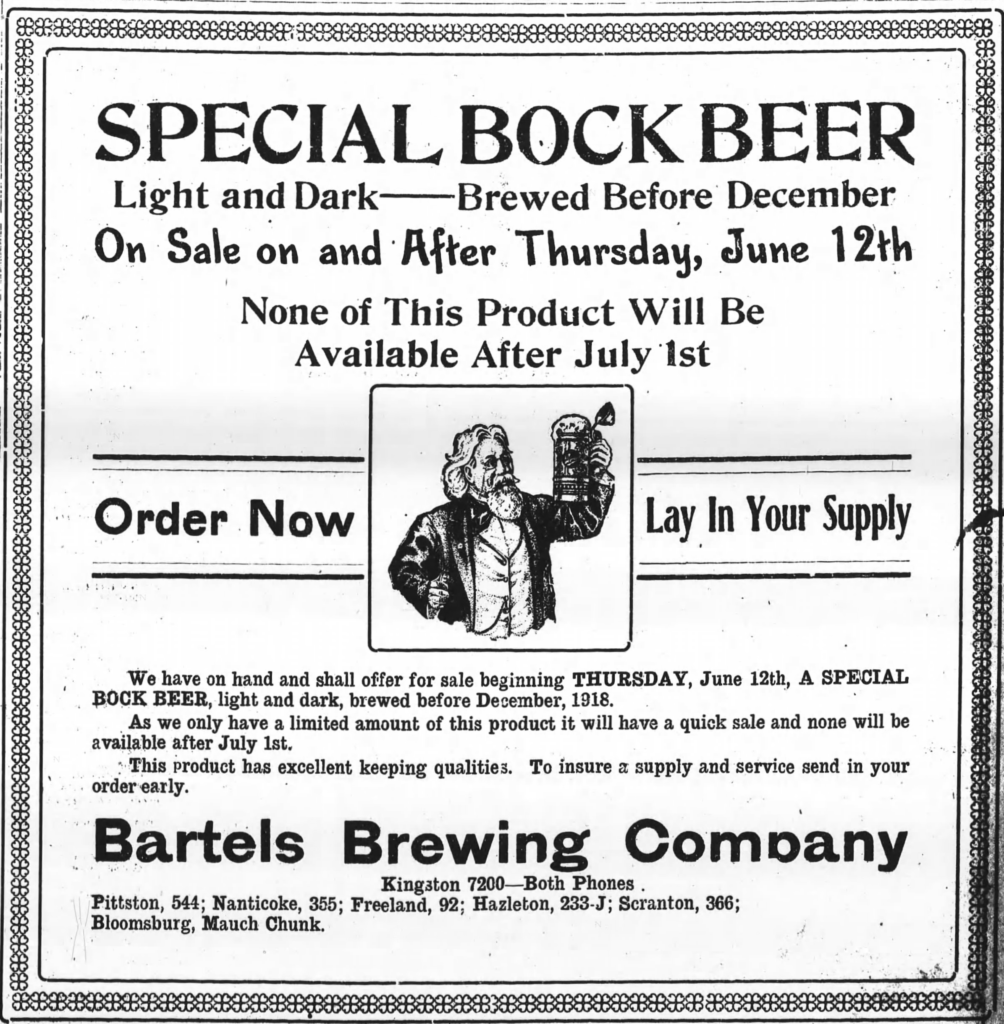
Last year I decided to concentrate on Bock ads for awhile. Bock, of course, may have originated in Germany, in the town of Einbeck. Because many 19th century American breweries were founded by German immigrants, they offered a bock at certain times of the year, be it Spring, Easter, Lent, Christmas, or what have you. In a sense they were some of the first seasonal beers. “The style was later adopted in Bavaria by Munich brewers in the 17th century. Due to their Bavarian accent, citizens of Munich pronounced ‘Einbeck’ as ‘ein Bock’ (a billy goat), and thus the beer became known as ‘Bock.’ A goat often appears on bottle labels.” And presumably because they were special releases, many breweries went all out promoting them with beautiful artwork on posters and other advertising.

Friday’s ad is for a Halloween Party taking place tonight rather than a specific Bock Beer, which was published on October 31, 1933. So presumably this would have been the first Halloween after prohibition was repealed, and they are advertising a Bock Beer Glass for 5-cents This one was for the Owl Cabaret at the A.B.W. Club in Mexicali, Mexico. This ad ran in The Imperial Valley Press, from El Centro, California.

Filed Under: Art & Beer, Beers, Just For Fun Tagged With: Advertising, Bock, California, Halloween, History

Historic Beer Birthday: Andrew Hemrich

October 31, 2025 By Jay Brooks

hemrich
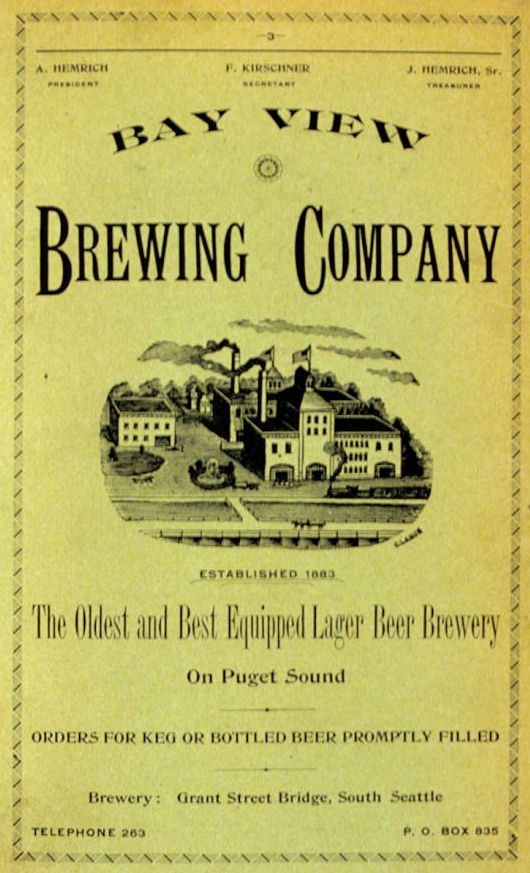
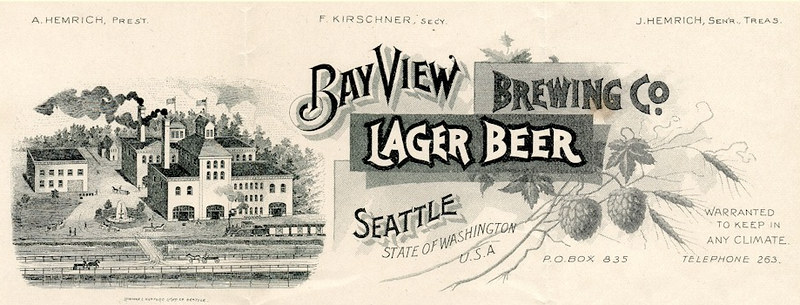
Today is the birthday of Andrew Henrich (October 31, 1856-May 2, 1910). He was born in Wisconsin, and was the first of his brothers to move to the Seattle, Washington area, but his brothers Alvin, Julius and Louis soon joined him. He bought the Bay View Brewery in Seattle, and later his brother Alvin bought the North Pacific Brewery (also known as the old Slorah brewery), and renamed it the Alvin Hemrich Brewing Co. in 1897. Two of his brothers soon joined him in the enterprise, and it was renamed again, this time to Hemrich Brothers Brewing Company. They did well enough that he began buying out other area breweries. When prohibition closed the brewery, they were ready, having retooled their plants for near-beer and also having divested into some other businesses.

andrew-hemrich
This biography of Andrew is from “An Illustrated History of the State of Washington,” by Rev. H. K. Hines, published in 1893, as found on Gary Flynn’s Brewery Gems‘ page on Andrew Hemrich:

Andrew Hemrich received an elementary education at Alma, which was continued in the practical duties of life, as at the age of ten years, he began work in his father’s brewery, and three years later was sent to La Crosse, as an apprentice to learn the brewing business. This was followed by two years in breweries in Milwaukee, one year at Denver, Colorado, and one year at Eureka, Nevada. In 1876, with two companions, all well mounted, he made a trip of 1,700 miles through the Yankee Fork mining district of Idaho, but the claims being all covered and the country being in constant danger from the attacks of hostile tribes of Indians, the party continued to Butte, Montana, then but a small mining settlement. In 1877 at Glendale, thirty-five miles from Butte, Mr. Hemrich partnered with Frank Gilig in starting a small brewery, selling their product at $21 per barrel. This he continued for eighteen months, then sold out and engaged in mining, in which a short experience exhausted his accumulated savings. He then gave up mining and going to Bozeman resumed his trade as foreman of a small brewery and there remained until February, 1883, when he came to Seattle and forming a co-partnership with John Kopp started a small steam beer brewery with an annual capacity of 2,500 barrels. This was the nucleus of the present Bay View brewery.

In 1884 Mr. Kopp sold out his interest to the father of our subject, John Hemrich, and in 1885, the latter’s brother-in-law; Fred Kirschner, entered the firm, then known as Hemrich & Co. With the growing demand the capacity of the brewery was increased from time to time up to 1887, when the brewery was rebuilt and with improved machinery the firm engaged in the manufacture of lager beer, with a capacity of 80,000 barrels per year. The product was sold throughout the Northwest. In April, 1891, the business was incorporated as the Bay View Brewing Company, with a capital stock of $300,000, and so continued up to the spring of 1893, when the company consolidated with the Albert Braun Brewing Company, and the Claussen-Sweeney Brewing Company, under the incorporate name of Seattle Brewing & Malting Company, with a capital stock of $1,000,000, Mr. Hemrich continuing as president. In 1892 our subject was one of the organizers and incorporators of the Victoria Brewing & Ice Company, of which he is vice-president. He has also extensive mining interests in the Cascade mountains, twenty miles east of Snoqualmie Falls. The claims cover 6,000 x 600 feet on one ledge, and 4,500 x 600 feet on a parallel ledge, gold-bearing, running from $5 to $105 per ton. Mr. Hemrich is also president of the Eureka Coal Company, and owns valuable improved and unimproved property in the city of Seattle.

He was married in Seattle, in 1885, to Miss Amelia Hucke, of Essen, Germany. They have four children: John, Alvin, Ernest and Katherine.

andrew-hemrich-cartoon

And this account of Andrew is from “A Volume of Memoirs and Genealogy of Representative Citizens of the City of Seattle and County of King, Washington,” published in 1903:

With a deep and abiding interest in the city of Seattle, in its progress and improvement, Andrew Hemrich has done much for its advancement, laboring earnestly along lines that have contributed to its material upbuilding. He is therefore known as one of its valued citizens. He is furthermore prominent in business affairs and a recognized leader in the ranks of the Republican party, on whose ticket he was elected to the office of state senator in 1898, so that he is now serving.

Mr. Hemrich was born in Alma, Wisconsin, October 31, 1856, and is a son of John and Catherine (Koeppel) Hemrich, both of whom were natives of Germany, the father having been born in Baden, while the mother’s birth occurred in Bavaria. In youth they came to American and the father traveled across the country in a covered wagon from Rochester, New York, to Iowa, stopping for a while at Mount Vernon, Indiana, thus making his way to Keokuk, Iowa, where he engaged in the brewing business. He followed that pursuit until 1852, when he loaded his brewery appliances and fixtures upon a barge which was towed to Alma, Wisconsin. There he again established a brewery, which he successfully conducted for thirty years. In 1884 he came to Seattle, where his son Andrew had previously located, and joined him in the organization and incorporation of the Bay View Brewing Company, which was conducted under the firm name until 1893, when it became the Bay View branch of the Seattle Brewing and Malting Company. About 1891 John Hemrich retired from active business life, enjoying a well-merited rest until called to his final home in 1897. His wife still survives him and resides at the old home in Bay View. He was a very active and energetic business man, reliable in all his trade transactions and his industry and capable management brought to him splendid success. In politics he was a Democrat and during the war of the rebellion served as sheriff of Buffalo county, Wisconsin. To him and his wife were born ten children: Edwin, who died at the age of six years; George, who passed away at the age of eighteen; Louise, who became the wife of John Lick, and died at the age of twenty-four; Matilda, who married John Lick, and died at the age of twenty-nine years; Andrew, whose name introduces this review; John, who is living retired; Emma, the widow of Frederick Kirschner; William, who is connected with the Bay View Brewery; Alvin and Louis, who are members of the firm of Hemrich Brothers.

During his boyhood days Andrew Hemrich pursued his education in the common schools, which he attended until fourteen years of age. He then left home and went to the wild mining regions of the west, spending about ten or twelve years on the prairies of Colorado, Nevada, Idaho and Montana. He was there engaged in mining and was also connected with brewing interests, establishing a brewery at Glendale, Montana, which he conducted for several years. He then sold his plant there and accepted a position as manager superintendent of the Bozeman Brewing Company of Bozeman, Montana. He occupied that position for two years and upon resigning he came to Seattle in accordance with plans perfected to establish a brewery business in company with John Kopp.

Mr. Hemrich arrived in this city February 18, 1883, and has since been one of its residents, active in its business affairs and a recognized leader in political circles. The same year he established a business at Bay View under the firm name of Kopp & Hemrich, which business was conducted for two years, at the end of which time he was joined by his father, John Hemrich, and his brother-in-law, Frederick Kirschner, in the organization and incorporation of the Bay View Brewing Company, which was conducted under that style until 1893. The business was then merged into the Seattle Brewing and Malting Company, whose trade has grown from a modest beginning to mammoth proportions, and it is now the largest establishment of the kind on the coast. In addition to the plant at Bay View, there has been a colossal new brick structure erected at Georgetown. It required three years in its construction and has just been completed. It now has a capacity of three hundred thousand barrels per year. The brand “Rainier” is as famous on the coast as the Pabst and Schlitz brews are in the middle and eastern section of the country. Mr. Hemrich was chosen president on the organization of the new company and still serves in that capacity. He has excellent business ability and executive force, his plans are readily and substantially formed and he is determined in their execution and carries forth to a successful conclusion whatever he commences, brooking no obstacles that can be overcome by persistent, honorable and earnest effort.

Mr. Hemrich has long been deeply interested in important measures for the improvement and upbuilding of Seattle. He was one of the organizers and is vice-president of the Seattle and Lake Washington Water-way Company, and many other interests of importance owe their successful existence to his wise counsel and active co-operation. No movement or measure calculated to prove of benefit to the city solicits his aid in vain, for he had ever been a generous contributor to every interest for the general good. In political affairs, too, he is well known, and has labored earnestly and effectively for the improvement and growth of the Republican party, of which he has long been a stalwart and earnest supporter. He was elected in 1898 on that ticket to the office of state senator and is still occupying this position. He has given due consideration to all matters which have come up for action and has left the impress of his individuality upon the legislation enacted during his term.

In November, 1884, Mr. Hemrich was united in marriage to Miss Maria Hucke, a native of Germany, and to them have been born five children: John, Alvin, Ernest, Katie G. and Charles. The family have a fine residence at Bay View, which was erected by Mr. Hemrich in 1892. He has been and is distinctively a man of affairs and one who has wielded wide influence. A strong mentality, an invincible courage and a most determined individuality have so entered into his makeup as to render him a natural leader of men and director of things.

Hemrichs-Select-Beer-Labels-Hemrich-Brew

Hemrich-tray

Filed Under: Birthdays, Just For Fun Tagged With: History, Washington, Wisconsin

Historic Beer Birthday: Jean Baptiste Bechaud

October 31, 2025 By Jay Brooks

Today is the birthday of Jean Baptiste Bechaud (October 31, 1848-April 20, 1922). He was born in Franfhein, Lower Bavaria on the Rhine, in Germany, but moved to the U.S. with his parents at the age of six, settling in Fond du Lac, Wisconsin. At some point, he anglicized his name to John Bates, but seems to have used the two interchangeably depending on the setting. In 1871, along with two of his brothers, Adoph and Frank, founded the A.G. Bechaud Brewery, which was also known as the A.G. Bechaud & Bros. Brewery and later, beginning in 1875, traded under the Empire Brewery name, before returning to Bechaud Brewery when it reopened after prohibition ended, before closing for good in 1941.

This is Bechaud’s obituary in the Fond du Lac Daily Reporter, on Thursday April 20, 1922:

JOHN B. BECHAUD DIES, AGED 75. Well Known Businessman of City Succumbs to Long Illness. LEAVES SIX CHILDREN. John Bates Bechaud, aged 75 years, prominent in Fond du Lac business circles for many years, died at 2:50 o’clock this afternoon after an illness of a year, which had been acute for the past two months. He had been a resident of Fond du Lac for 53 years. Funeral arrangements have not yet been made. Mr. Bechaud was born in Germany Oct. 31, 1846, his parents immigrating to America in 1851. The father, John P. Bechaud, conducted a hotel in Fond du Lac for four years after the family arrived in America, later removing to a farm. The son remained with the father until 1871, when he joined with his brothers, Adolph and Frank H. Bechaud, in the organization of the Bechaud Brewing company. Serving as a private in the Sixth Michigan Cavalry from the date of his enlistment in 1864 until the close of the Civil war, Mr. Bechaud served with another Michigan cavalry regiment in the West until his discharge in 1866. He was affiliated with the Elks, Eagles and Masonic order. The surviving relatives are the widow, Mrs. Mary Bechaud, and three sons and three daughters, Mrs. M.H. Nelson, Mrs. M.H. Boudry, Mrs. P.L. Kolb, and Rudolph and Louis Bechaud, Fond du Lac, and Armand Bechaud, Chicago.

Jean Baptiste with his wife, Mary Ann Kraemer Bechaud.

And here’s another obituary from the Fond du Lac Daily Commonwealth, also on Thursday, April 20, 1922:

J.B. BECHAUD IS DEAD, WAS FAILING FOR LONG PERIOD. End Comes at Residence Near 3 O’clock. WAS A CIVIL WAR VETERAN. John B. Bechaud, one of Fond du Lac’s prominent citizens and businessmen, died at 3 o’clock this afternoon at the residence 108 South Union street. He had been in failing health for some time. Mr. Bechaud was born Oct. 31, 1846 in Germany, and came to this country in 1851. Mr. Bechaud on acquiring his majority followed agricultural pursuits until 1871 when he became associated with his brothers, F.H., and Adolph, in the brewing business. He served as vice president of the Bechaud Brewing Co. He was a member of the Masons, Elks, Eagles and National Union. He served as a member of the city common council and the school board.

This history of the Bechaud Brewery is from Oshkosh Beer’s post “An Illustrated History of the Brewing Industry in Fond du Lac.”

In 1871, Fond du Lac’s most successful brewery was opened at 515 Main Street by the brothers Frank, John and Capt. A.G. Bechaud. Formed during the presidency of Ulysses S. Grant, their brewing company also set the standard for longevity among Fond du Lac beer makers, surviving until 1941, when Franklin Delano Roosevelt began his third term in office.

The Bechaud brothers, all born in Bavaria, started brewing at their Main Street location but they also bought lakeshore property on Lake Winnebago just northwest of the city limits, where they envisioned locating their permanent brewing empire. However, the beachfront brew-house was not to be. Instead, in 1873, the Bechauds opened their new large brewery on Eleventh Street, just west of Hickory Street.

The Bechauds also maintained a Main Street address. Their “sample room” gave people a chance to enjoy the freshest beer the company had to offer. The most popular brand produced by Bechaud, “Empire” was bottled and sold in various cities. Their other beers included “Műnchner” and “Pilsener.” In all, the company sold an average of 15,000 barrels of their beers annually.

Filed Under: Birthdays, Breweries, Just For Fun Tagged With: Germany, Wisconsin

Historic Beer Birthday: George Weisbrod

October 31, 2025 By Jay Brooks

weisbrod-hess
Today is the birthday of George Weisbrod (October 31, 1851-January 1, 1912). Weisbrod was born in Germany, and that’s about all I could find out about the man who co-founded, along with Christian Hess, the George Weisbrod & Christian Hess Brewery, usually shortened to just the Weisbrd & Hess Brewery, and also known as the Oriental Brewery.

george-weisbrod-cartoon

Both Weisbrod and Hess were German immigrants, and originally their intention was simply to make enough beer to supply their Philadelphia saloon on Germantown Avenue. Some sources say they began as early as 1880, but most put the founding at 1882. The brewery was going strong until closed by prohibition. They managed to reopen in 1933, but closed for good in 1938.

weisbrod-hess-1905
A brewery poster from 1905.
In 1994, Yards Brewing renovated the old Weisbrod & Hess Brewery, but after the partners split, it became the Philadelphia Brewing Co., while Yards under the direction of Tom Kehoe moved to another location.

phillybeerwk08-47
In the Philadelphia Brewing Co. tasting room upstairs, an old photo of the employees of the original brewery on the premises, Weisbrod & Hess Oriental Brewing Company.
Both Philadelphia Weekly and Hidden City Philadelphia have stories about the brewery and efforts to re-open it.

weisbrod-hess-1892
The brewery two years closing, in 1940.

The brewery was designed by famed local architect Adam C. Wagner, and this is an illustration of his design for the brewery from 1892.

W&H-1892

OrientalBreweryPhila1899
An ad from 1899.

Factory-Scene-1912-calendar-Signs-Pre-Pro-Weisbrod-Hess-Brewing-Co
And a calendar from 1912.

Filed Under: Birthdays, Breweries Tagged With: Germany, History, Pennsylvania, Philadelphia

Historic Beer Birthday: Frederick Hinckel Sr.

October 29, 2025 By Jay Brooks

hinckel
Today is the birthday of Frederick Hinckel Sr. (October 29, 1832-October 29, 1881). He was born in Prussia (Germany) and along with Johann Andreas Schinnerer founded the Cataract Brewery (a.k.a. the F. Hinckel & A. Schinnerer) in 1852. “Its premises occupied half a city block, bounded by Swan Street, Myrtle and Park Avenues.” Twelve years later, in 1864, Hinckel owned the brewery outright, and changed its name to the Hickel Brewery, which remained its name until closing in 1920 (or 1922) due to prohibition.

fred-hinkle-sr

hinckel-brewery-letterhead

Here’s a biography of Hinckel from a “Bi-centennial History of Albany,” published in 1886:

fred-hinkel-sr-bio-1
hinckel-brewery-wagon
A Hinckel Brewery beer wagon.

Henkel-Brewery-1880-malthouse
Although the brewery closed in 1920 because of prohibition, and never reopened afterwards, the build was preserved and today is an apartment complex.

hinckel-ceramic-bottle

Filed Under: Birthdays, Breweries, Just For Fun Tagged With: History, New York

« Previous Page
Next Page »

Find Something

Northern California Breweries

Please consider purchasing my latest book, California Breweries North, available from Amazon, or ask for it at your local bookstore.

Recent Comments

  • Bob Paolino on Beer Birthday: Grant Johnston
  • Gambrinus on Historic Beer Birthday: A.J. Houghton
  • Ernie Dewing on Historic Beer Birthday: Charles William Bergner 
  • Steve 'Pudgy' De Rose on Historic Beer Birthday: Jacob Schmidt
  • Jay Brooks on Beer Birthday: Bill Owens

Recent Posts

  • Historic Beer Birthday: Jim Patton February 24, 2026
  • Historic Beer Birthday: August Meiresonne February 24, 2026
  • Historic Beer Birthday: Frederick Gettelman February 24, 2026
  • Beer In Ads #5128: Dr. Seuss For E and B Bock Beer February 24, 2026
  • Historic Beer Birthday: Georg Schneider II February 24, 2026

BBB Archives

Feedback

Head Quarter
This site is hosted and maintained by H25Q.dev. Any questions or comments for the webmaster can be directed here.