Brookston Beer Bulletin

Jay R. Brooks on Beer

  • Home
  • About
  • Editorial
  • Birthdays
  • Art & Beer

Socialize

  • Dribbble
  • Email
  • Facebook
  • Flickr
  • GitHub
  • Instagram
  • LinkedIn
  • Pinterest
  • RSS
  • Twitter
  • YouTube

Powered by Genesis

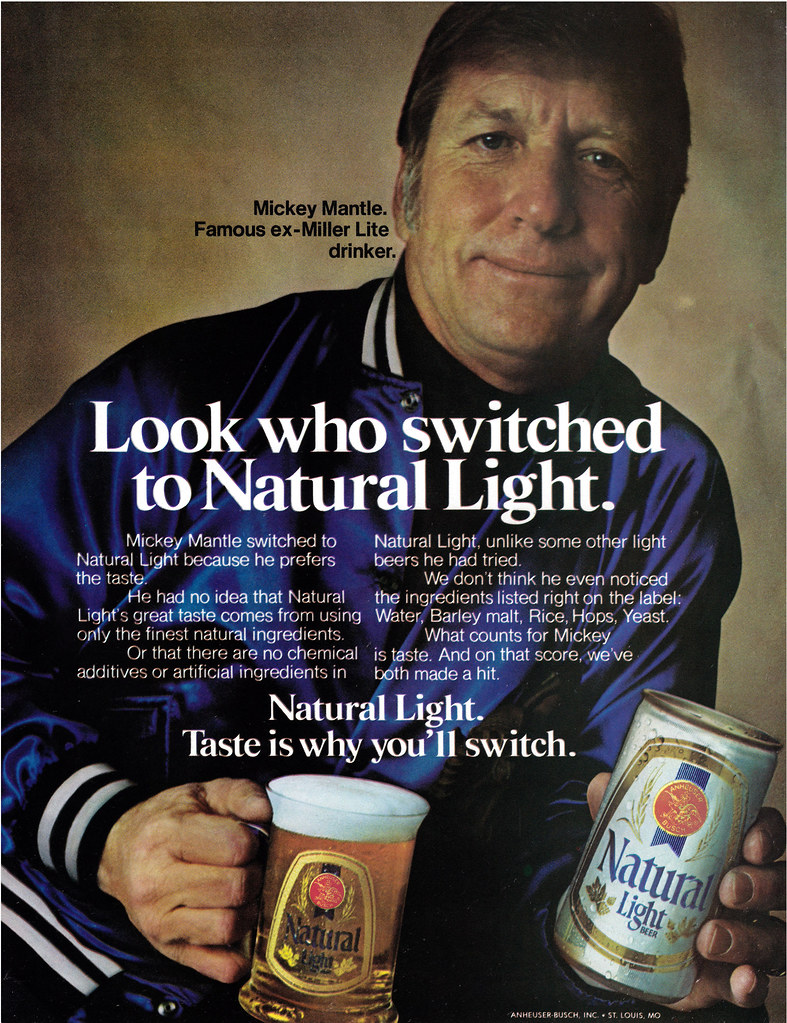
Beer In Ads #1714: Look Who Switched To Natural Light

October 20, 2015 By Jay Brooks


Tuesday’s ad is for Natural Light, from 1980. Today is the birthday of baseball legend Mickey Mantle. In the mid-1970s, Mantle did some commercials, along with fellow Yankees teammate Whitey Ford, for Miller Lite. So when he did this ad for rival Natural Light, they played up his being a switch hitter “who switched to Natural Light.”
Natural-Light-1980-Mickey-Mantle

Filed Under: Art & Beer, Beers Tagged With: Advertising, Anheuser-Busch, Baseball, History, Light Beer

Patent No. 5823222A: Sanitary Sampling Device

October 20, 2015 By Jay Brooks

patent-logo
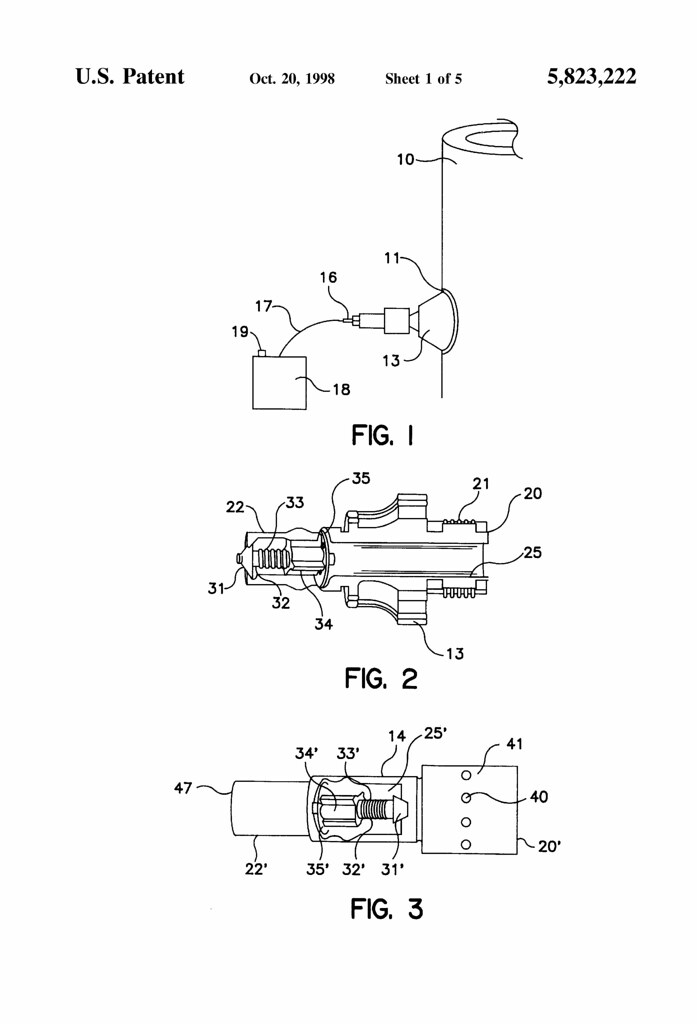
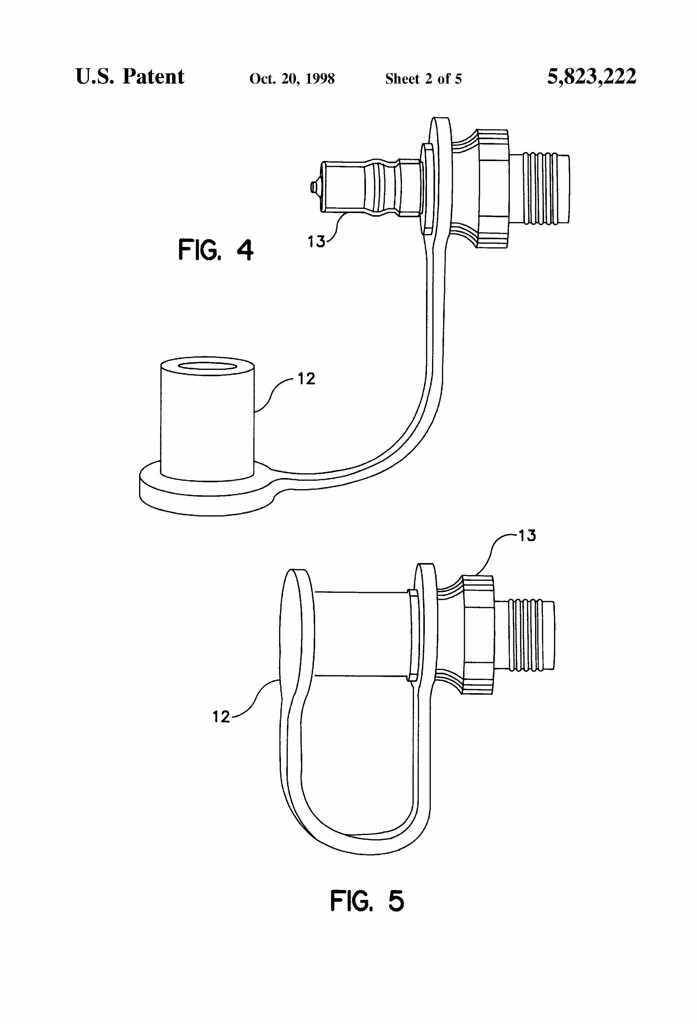
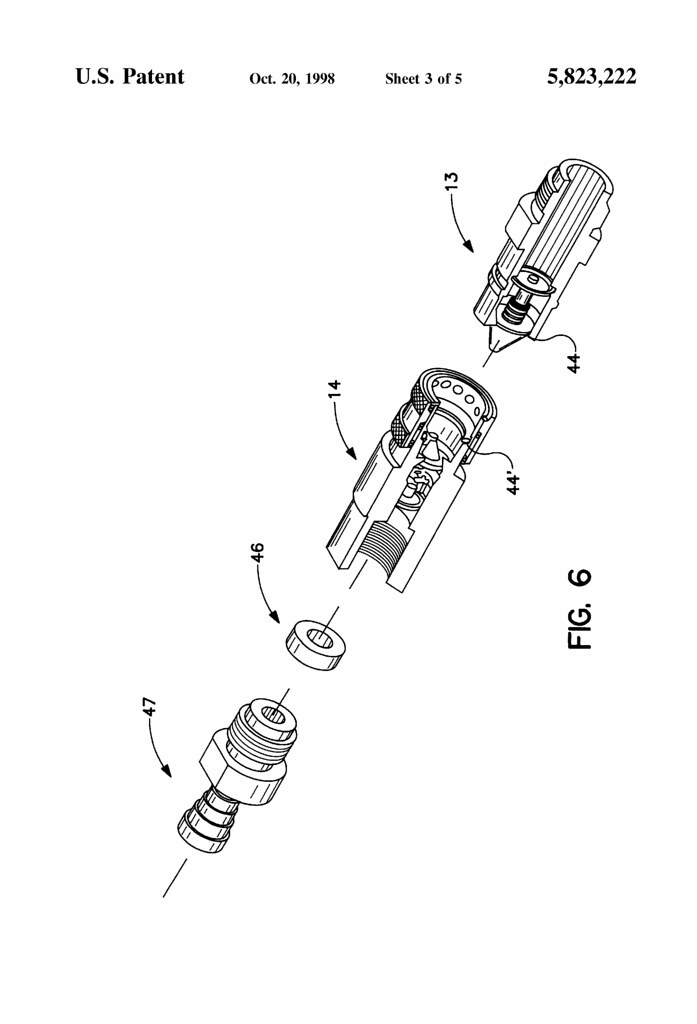
Today in 1998, US Patent 5823222 A was issued, an invention of James Edward Minshull and Robert G. Lawrence, assigned to Labatt Brewing Company Limited, for their “Sanitary Sampling Device and Method for Using Same.” Here’s the Abstract:

A sanitary coupling device and a method for its use are described. The sanitary coupling device taps a vessel, such as a brewery tank, without exposing the fluid to the atmosphere. The device can include a coupler that prevents the collected fluid from exposure to the atmosphere. The method for tapping a vessel can include engaging a nipple with a coupler. Then, collecting a sample and disengaging the coupler from the nipple is performed. The invention is desirable for a brewery tank sampling with a clean-in-place connection system.

Untitled
Untitled
Untitled

Filed Under: Beers, Breweries, Just For Fun, Politics & Law, Related Pleasures Tagged With: History, Law, Patent

Patent No. 5156283A: Wooden Stein With Responsive Emblem

October 20, 2015 By Jay Brooks

patent-logo
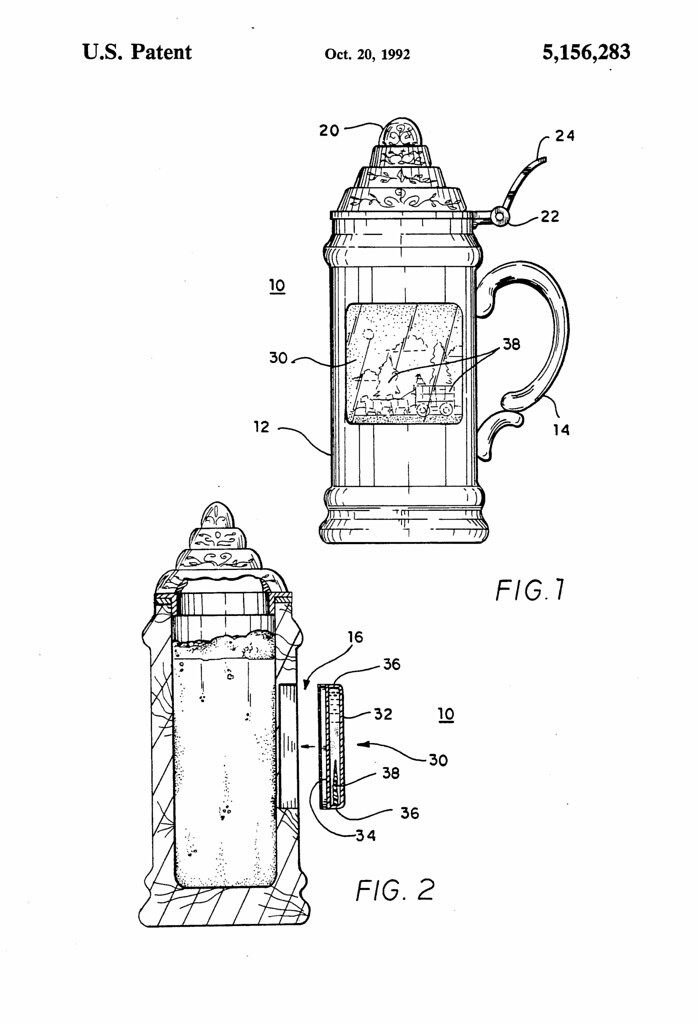
Today in 1992, US Patent 5156283 A was issued, an invention of Susan R. Sampson, for her “Wooden Stein With Responsive Emblem.” Here’s the Abstract:

A beer stein is made of wood, which imparts no disagreeable flavor to the beer, and creates a faint pleasant aroma. The stein has an insert on its front surface which contains some active display reactive to the environment, such as a thermochromic emblem or a swirling snowflake scene.

Untitled

Filed Under: Beers, Just For Fun, Politics & Law, Related Pleasures Tagged With: Glassware, History, Law, Patent

Patent No. 2909044A: Spout Cooling Apparatus

October 20, 2015 By Jay Brooks

patent-logo
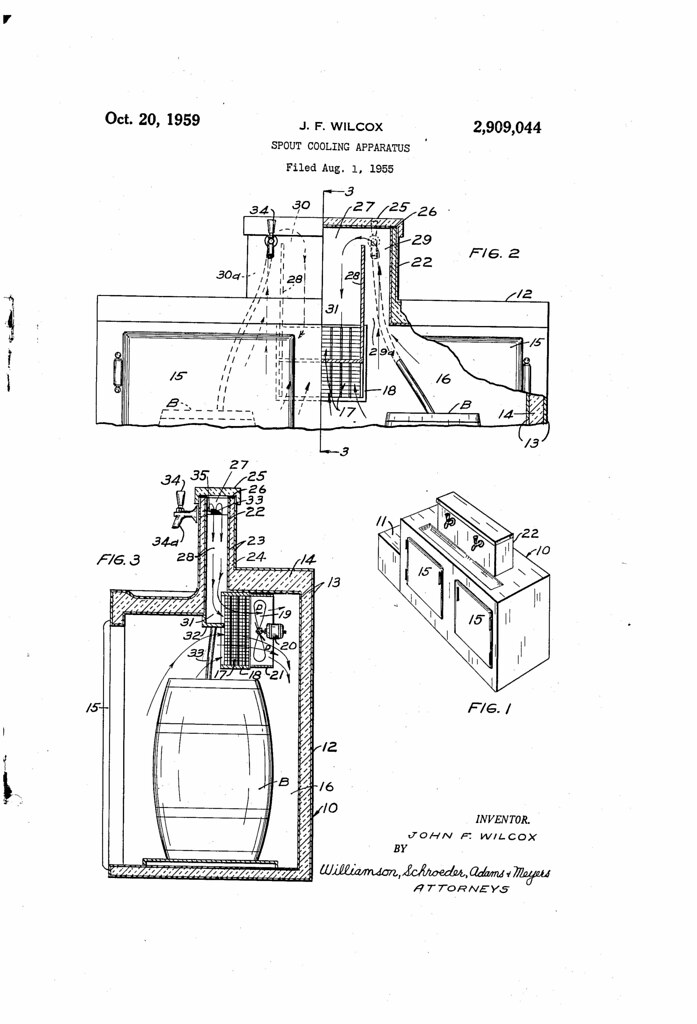
Today in 1959, US Patent 2909044 A was issued, an invention of John F. Wilcox, assigned to Superior Products Mfg Company, for his “Spout Cooling Apparatus.” There’s no Abstract, although in the description it includes this summary:

This invention relates to liquid coolers and dispensers and more specifically relates to apparatus for cooling liquid dispensing spouts or faucets.

This one’s interesting and worth the long read. It’s essentially adjunct brewing, but incorporating soybeans in the process, too. The fact that Archer Daniels Midland owns the rights to the patent is also a bit curious.
Untitled

Filed Under: Beers, Just For Fun, Politics & Law, Related Pleasures Tagged With: History, Kegs, Law, Patent

Beer In Ads #1713: There’s Room To Grow In Canada Unlimited

October 19, 2015 By Jay Brooks


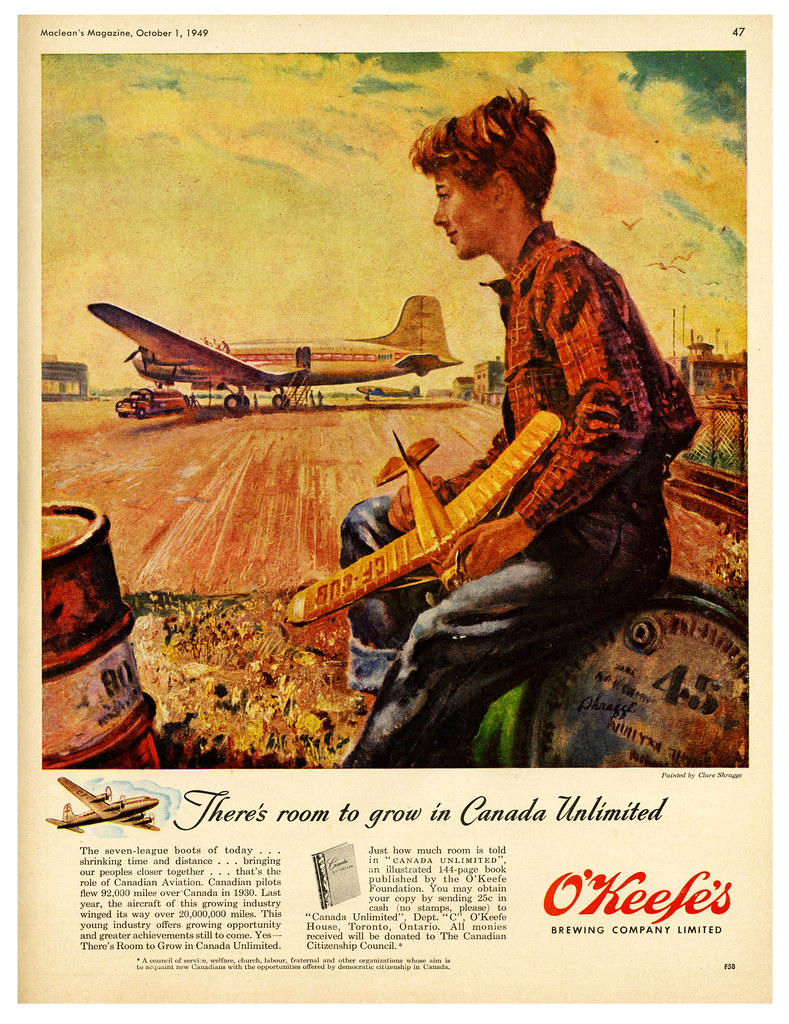
Monday’s ad is for O’Keefe’s, from 1949. The ad copy begins: “The seven-league boots of today …,” which I confess made no sense to me. Apparently seven-league boots “are an element in European folklore. The boots allow the person wearing them to take strides of seven leagues per step, resulting in great speed. The boots are often presented by a magical character to the protagonist to aid in the completion of a significant task.” In this case, it’s uniting Canada, by “shrinking time and distance … bringing our peoples closer together … that’s the role of Canadian aviation.” The Rockwell-like illustration was created by a Clare Shragge. It’s an emotionally charged painting, brimming with optimism … and beer.

Okeefes-1949-airplanes

Filed Under: Art & Beer, Beers Tagged With: Advertising, Bottles, History

Patent No. 4355047A: Method Of Preparing A Low Calorie Beer

October 19, 2015 By Jay Brooks

patent-logo
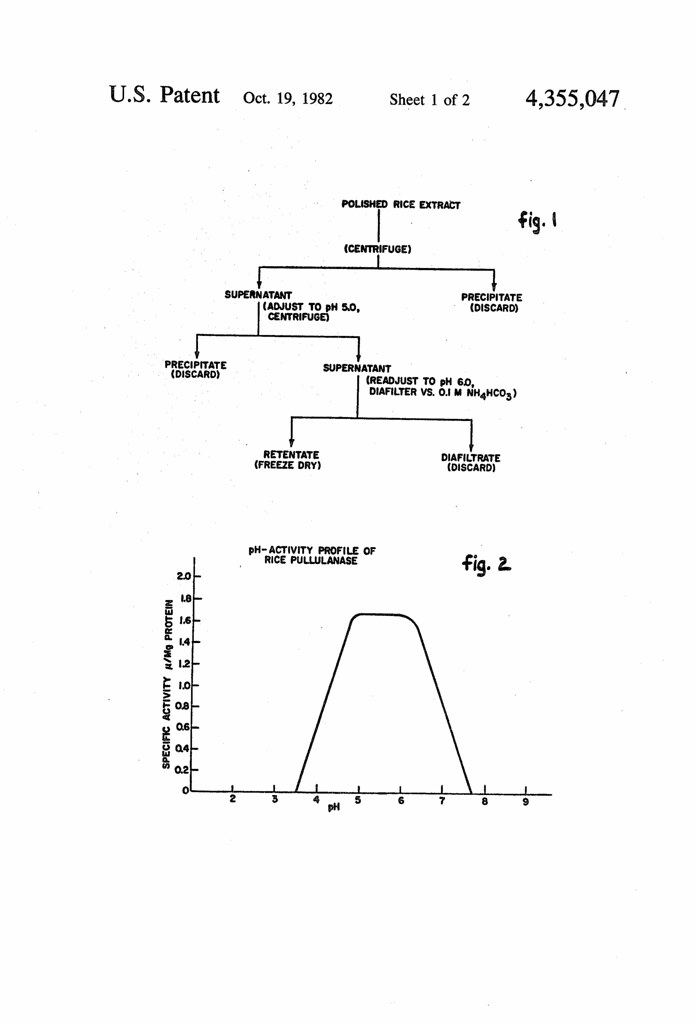
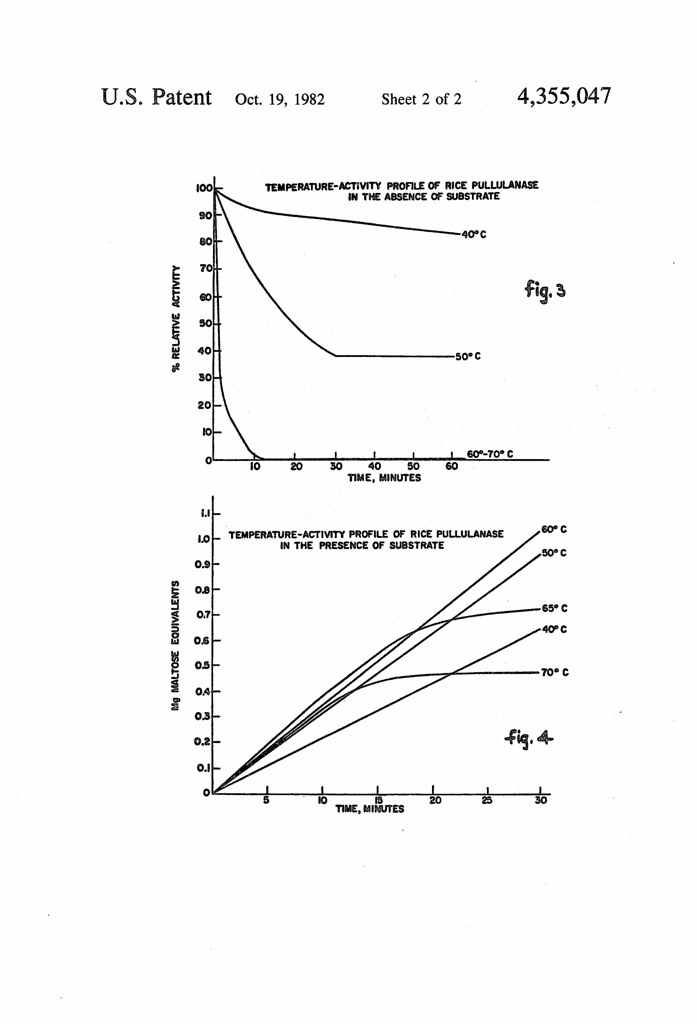
Today in 1982, US Patent 4355047 A was issued, an invention of William F. Line, Vinod K. Chaudhary, Etzer Chicoye, and Robert J. Mizerak, assigned to Miller Brewing Company, for his “Method of Preparing a Low Calorie Beer.” Here’s the Abstract:

Low calorie beer is prepared by introducing into the brewing process a debranching enzyme (pullulanase) obtained from rice, a traditional brewing material. The debranching enzyme reduces the real extract of the beer by cleaving alpha 1,6 linkages of unfermentable limit dextrins to form alpha 1,4 dextrins which can be converted by alpha 1,4 carbohydrates to sugars that can be fermented by brewer’s yeast. The enzyme may be introduced into the brewing process by adding rice or the enzyme extracted from rice to the mash or to the wort before or during fermentation. The debranching enzyme may be obtained from polished dry milled rice by extraction with an aqueous buffer solution. When malted rice is used as the enzyme source a particularly useful mixture of the debranching enzyme and alpha 1,4 carbohydrates is obtained.

Untitled
Untitled

Filed Under: Beers, Breweries, Just For Fun, Politics & Law, Related Pleasures Tagged With: History, Law, Light Beer, Patent, Science of Brewing

Patent No. 2692199A: Method Of Making Beer (With Soybeans)

October 19, 2015 By Jay Brooks

patent-logo
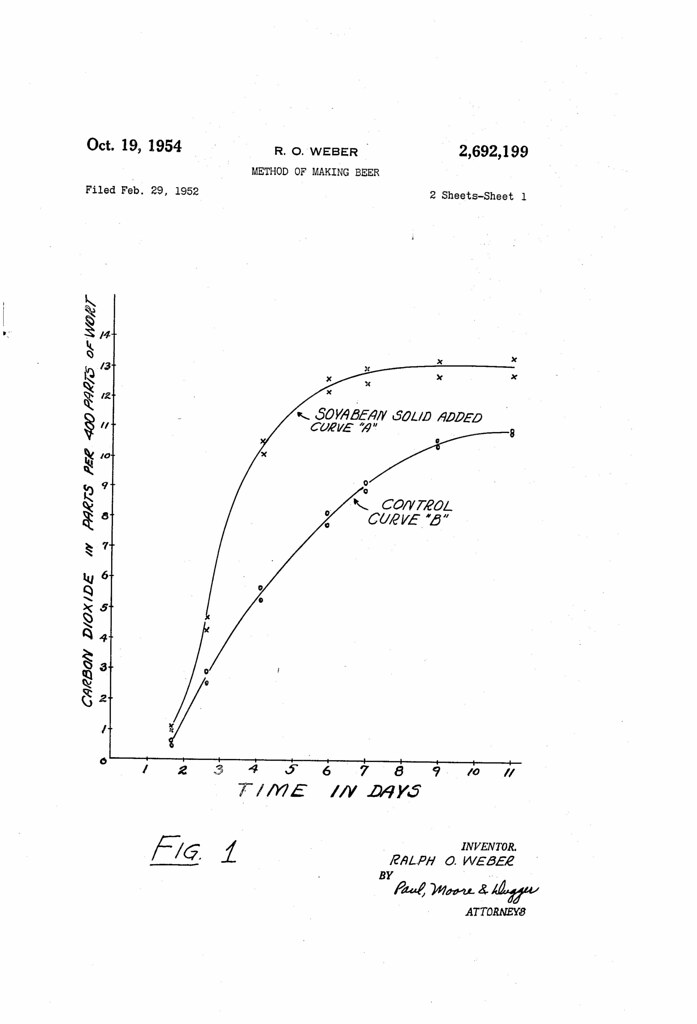
Today in 1954, US Patent 2692199 A was issued, an invention of Ralph O. Weber, assigned to Archer Daniels Midland Co., for his “Method Of Making Beer.” There’s no Abstract, although in the description it includes this summary:

This invention relates to processes of making beer, and more particularly to improvements wherein there is utilized the solid materials of soybeans from which the oil has been removed.

This one’s interesting and worth the long read. It’s essentially adjunct brewing, but incorporating soybeans in the process, too. The fact that Archer Daniels Midland owns the rights to the patent is also a bit curious.
Untitled
Untitled

Filed Under: Beers, Breweries, Just For Fun, Politics & Law, Related Pleasures Tagged With: History, Law, Patent, Science of Brewing

The Comforts Of Life

October 19, 2015 By Jay Brooks

art
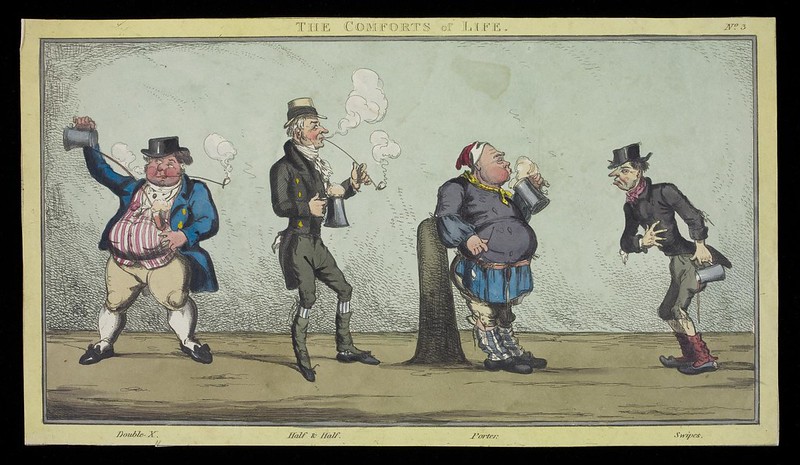
Here’s an interesting piece of history I came across this morning. It’s a hand-colored etching created around 1826, possibly by Henry Heath. This one is plate 3 from a set of 4, all of which apparently relate to alcohol and its effects. It’s believed to have been published by William Cole of 10 Newgate Street in London. An original of the print is in the collection of the Victoria & Albert Museum. It’s certainly an interesting caricature of life in the early 19th century.

comforts

According to the text at the bottom of the print, each of the gentlemen are drinking the following. Double-X / Half & Half / Porter / Swipes (Which appears to be beer that is weak, thin, watery or even spoiled).

Filed Under: Art & Beer, Just For Fun, Related Pleasures Tagged With: England, Great Britain, History

Patent No. 3212854A: Estimate Of Hop Bitter Substance In Beer

October 19, 2015 By Jay Brooks

patent-logo
Today in 1965, US Patent 3212854 A was issued, an invention of Mohd Akhtar and Max William Betts, for their “Estimate of Hop Bitter Substance in Beer.” There’s no Abstract, although in the description it includes this summary:

This invention relates to the extraction of substances which impart the distinctive bitter taste to beer and to their estimation.

In this specification by hop bitter substances we mean all isohumulones, and humulones as well as humulinic and isohurnulinic acids as well as any other substances which may contribute to the bitter taste of been In this specification by the term beer (except where otherwise stated) we mean hopped wort or beer or any other liquid used in a brewing process whose hop bitter content is required to be known. We also intend the term beer to include any beer in the complete range from light beers such as lagers to heavy beers such as stouts.

The percentage of hop bitter substances in hops varies sufficiently to affect the bitterness of a beer, but until recently no satisfactory chemical method for estimating hop bitter substances was known. Therefore, to keep the bitterness of a beer produced constant, experts had to taste it during the brewing process and advise on what additions were needed. This not only made the product dependent on human judgment but also necessitated brewing beer in batches.

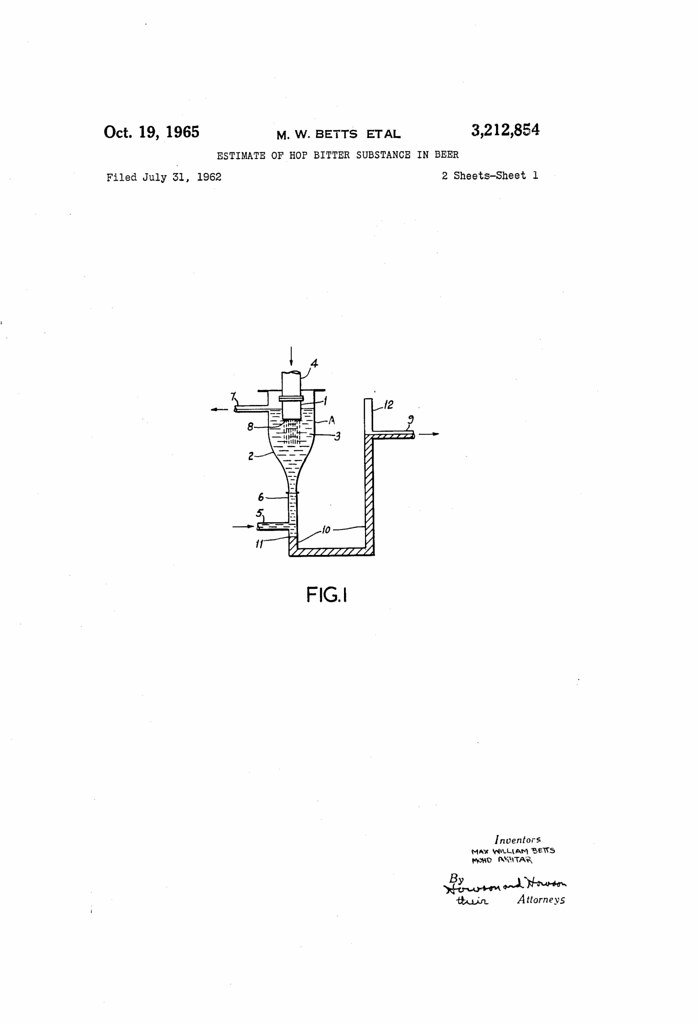
According to the present invention a process for estimating the hop bitter substances in beer comprises passing beer through a water-insoluble solvent for the hop bitter substances, in such a manner that drops of beer are formed, said drops moving at a velocity less than that at which an emulsion is formed but at a velocity sufficient “ice to cause turbulence inside the drops of beer so that more than 60 percent of the hop bitter substances passes from the beer to said water-insoluble solvent, continuously supplying and removing said water-insoluble solvent and estimating the percentage of hop bitter substances in the water-insoluble solvent removed.

The percentage of hop bitter substances in the water insoluble solvent removed may be estimated by any convenient method. We prefer to use an ultra violet spectrophotometer to measure the absorption of the solution of the hop bitter substances. The solution in the water insoluble solvent may be used direct or the hop bitter substances may be extracted into an alkali and then estimated in an ultra violet spectrophotometer.

In order to improve the partition coefficient of the hop bitter substances between the beer and the water-insoluble solvent, the beer is preferably acidified, prior to undergoing the process of the present invention. The preferred acids used are sulphuric acid or hydrochloric acid. We have found that to get the best results the pH of the beer solution should be less than about 3.5.

A large number of water-insoluble organic solvents effectively extract hop bitter substances from beer, but considerable quantities of accompanying materials may also be extracted which interfere with the subsequent spectrophotometric measurement. Hydrocarbon solvents such as light petroleum, hexane or iso-octane extract a relatively low amount of these interfering substances compared with extractions using chloroform or diethyl ether. Preferably the water-insoluble solvent used is optically suitable iso-octane.

The beer (here the term beer is used to exclude hopped wort which is already degassed) must be thoroughly degassed by any convenient method.

The peak optical density of a neutral solution of hop bitter substances and water-insoluble solvent occurs at 275 An alkaline solution of hop bitter substances and water-insoluble solvent has a peak optical density at 255 We prefer to carry out the ultra violet spectrophotometer analysis on an alkaline solution, since the interference of any background effect is reduced at this wavelength, and also because the lamps for generating this wavelength generally have a much longer life than those used for generating a wavelength of 275 ,u.

A method of making the solution of hopped bitter substances alkaline is to add aqueous alkali, for example caustic soda, to the solution followed by mixing. We prefer to pass this mixture to a separator, for example a gravity separator, whereupon pure or nearly pure water insoluble solvent is separated leaving a solution of hop bitter substances and alkali to be passed to the ultra violet spectrophotometer. If necessary further alkali may be added after the separation step.

The temperature at which the extraction takes place will of course have an effect on the partition coefficient of the hop bitter substances between beer and the water insoluble solvent, however, we have found it quite convenient to operate the process at room temperature.

Previous methods of extracting hop bitter substances from beer have involved the use of a counter-current flow column. We have found that substantially the same percentage of hop bitter substances can be extracted by using the process of our invention by using a comparatively short chamber which we call a jet chamber. A jet chamber of as short as 2 inches has been found to have an extraction efficiency of the same order as that obtained by using a counter-current flow column over 8 feet long. However, we prefer to use a jet chamber 3 inches to 4 inches long, especially when extracting from a stout.

Instead of operating on the counter-current flow principle our extraction process depends on the turbulence created in the beer droplets by the velocity with which they emerge from the orifices into the jet chamber and pass through the water-insoluble solvent. must be very carefully regulated. If, for instance, the beer droplets have a Reynolds number of above about 2,000, cavitation will occur in the water-insoluble solvent and an emulsion will be formed. This emulsion as previously stated is very difficult to break and its formation must be prevented, hence the beer droplets must initially have a Reynolds number below about 2,000. On the other hand, if the velocity of the beer drops is too low, only the beer at the surface of the beer drops will ever be in contact with the water-insoluble solvent and all the hop bitter substances in the centre of the drops will remain in the beer. The velocity of the drops must therefore be high enough to create turbulence inside the said drops. By turbulence in this context we mean that there is a continuous circulation of beer inside the drops to and from the surface of said drops. This will result in equilibrium, as defined by the partition coefficients of the hop bitter substances between beer and the water insoluble solvent, being approached very rapidly. As far as we can gather turbulence occurs inside the beer drops to a useful degree for our purposes provided that the drops have a Reynolds number of over 70.

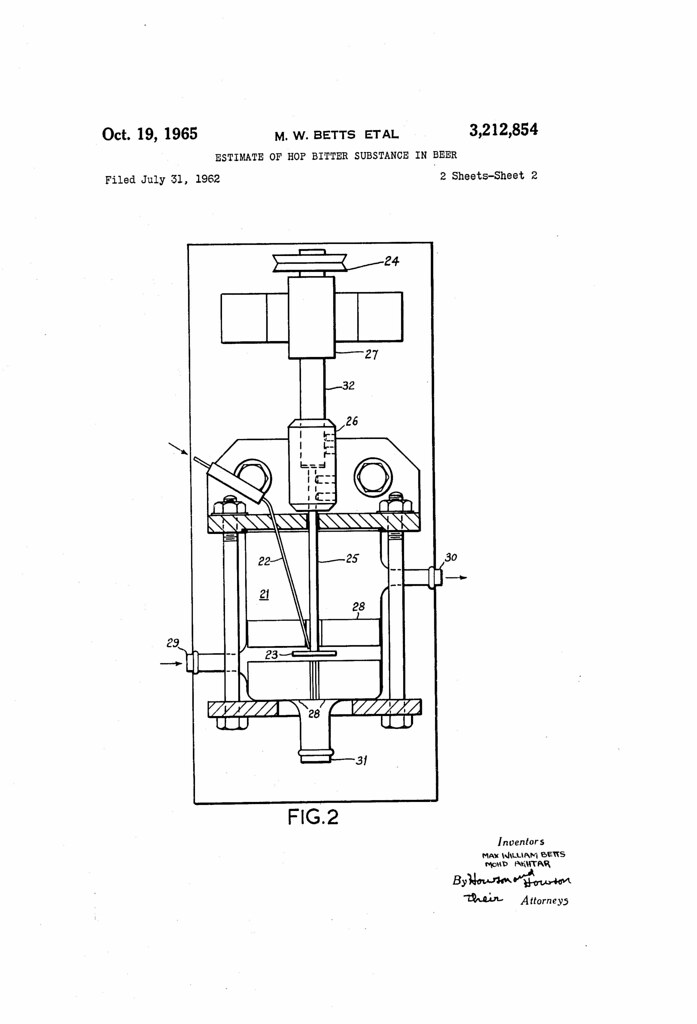
Any method of creating drops and passing them at a suitable velocity, as defined above, through a water insoluble solvent may be used in the process of this invention. For example the beer may be passed into the water-insoluble solvent through a jet head containing one or more jets. Another method which may be employed is to pass a stream of beer substantially towards the centre of a rapidly rotating plate immersed in the water-insoluble solvent which sends drops of beer outwards from its circumference.

It is not necessary to obtain 100 percent extraction of the hop bitter substances from beer in order to obtain a useful result, provided the process results in a substantially similar percentage of the hop bitter substances being extracted every time a beer containing approximately the same percentage of hop bitter substances, for example a stout, is passed through the apparatus.

If the beer is passed through a small jet it is essential that the beer does not contain any particles of solid matter having a diameter of over about half the diameter of the orifices used, otherwise the orifices are likely to become blocked easily. The particles in the beer may be removed by any convenient filtering process, for example by centrifuging or by using a mesh filter.

Untitled
Untitled

Filed Under: Beers, Breweries, Just For Fun, Politics & Law, Related Pleasures Tagged With: History, Hops, Law, Patent, Science of Brewing

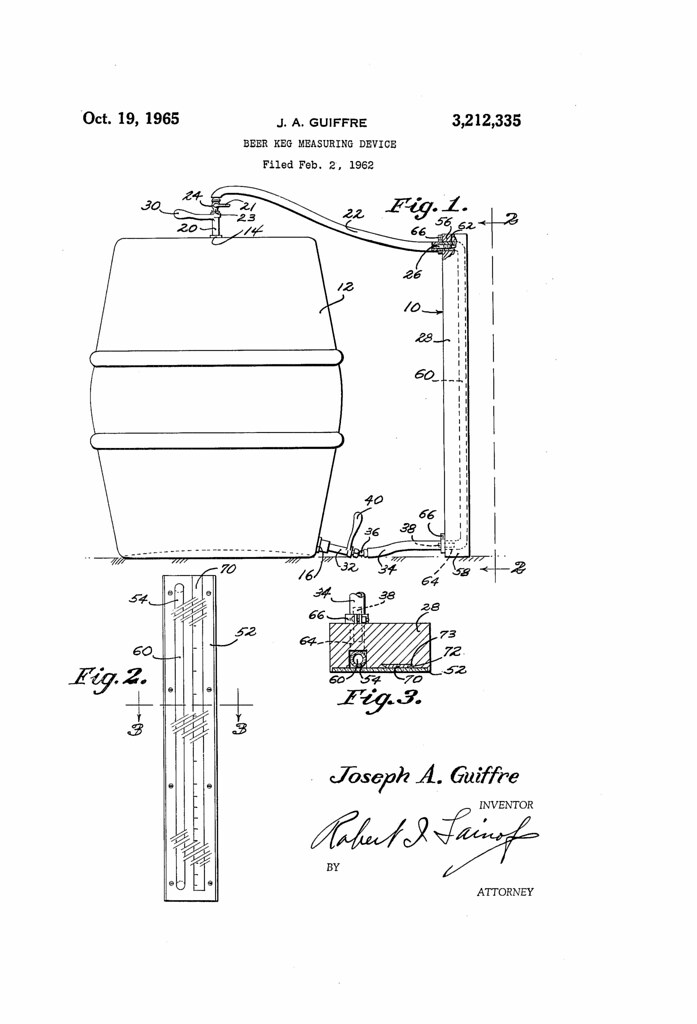
Patent No. 3212335A: Beer Keg Measuring Device

October 19, 2015 By Jay Brooks

patent-logo
Today in 1965, US Patent 3212335 A was issued, an invention of Joseph A. Guiffre, for his “Beer Keg Measuring Device.” There’s no Abstract, although in the description it includes this summary:

In the industry wherein the device of my invention is to be utilized, tap beer is sold to taverns and bars in metal kegs which are loaded in the brewery under pressure. Due to the pressure constantly maintained within a filled or partially filled keg of beer no practical device has as yet been found in the industry which will permit the operator of the business, wherein the beer is sold at tap, to determine the amount of beer sold at any interval of time, or the amount of beer which he has left in an opened or used keg. Because of his inability to determine this needed information, the shop keeper is often times inconvenienced at a rather busy hour to change from a keg which has just been emptied to another fresh keg.

Moreover, in not being able to accurately determine the amount of beer sold within a certain period of time, as for example, from the open of a business day to its close, the owner of such business is unable to determine if he is getting all the receipts which should be forthcoming from each keg of beer or ale.

An object of my invention is to provide a pressure keg measuring device which can be quickly connected to measure the amount of beer remaining in a used keg of beer or ale yet under pressure.

A further object of my invention is to provide a pressure keg measuring device which can be quickly connected to measure the remaining beer in a keg under pressure, while the keg of beer is in its usual position under the dispensing fountain in a tavern or bar.

Another and further object of my invention is to provide a beer measuring device for pressure beer kegs which is simple in construction, economical to manufacture, and which will provide the user with a device which can easily and quickly be connected to a keg for measurement of the quantity of beer or ale remaining therein.

Untitled

Filed Under: Beers, Just For Fun, Politics & Law, Related Pleasures Tagged With: Bars, History, Kegs, Law, Patent

« Previous Page
Next Page »

Find Something

Northern California Breweries

Please consider purchasing my latest book, California Breweries North, available from Amazon, or ask for it at your local bookstore.

Recent Comments

  • Bob Paolino on Beer Birthday: Grant Johnston
  • Gambrinus on Historic Beer Birthday: A.J. Houghton
  • Ernie Dewing on Historic Beer Birthday: Charles William Bergner 
  • Steve 'Pudgy' De Rose on Historic Beer Birthday: Jacob Schmidt
  • Jay Brooks on Beer Birthday: Bill Owens

Recent Posts

  • Historic Beer Birthday: William H. Gerst April 1, 2026
  • Historic Beer Birthday: Carl W. Conrad April 1, 2026
  • Beer In Ads #5198: Heim’s Bock Beer! Ready To-Day April 1, 2026
  • Historic Beer Birthday: August Koch April 1, 2026
  • Historic Beer Birthday: Thomas Fowell Buxton April 1, 2026

BBB Archives

Feedback

Head Quarter
This site is hosted and maintained by H25Q.dev. Any questions or comments for the webmaster can be directed here.