Brookston Beer Bulletin

Jay R. Brooks on Beer

  • Home
  • About
  • Editorial
  • Birthdays
  • Art & Beer

Socialize

  • Dribbble
  • Email
  • Facebook
  • Flickr
  • GitHub
  • Instagram
  • LinkedIn
  • Pinterest
  • RSS
  • Twitter
  • YouTube

Powered by Genesis

Patent No. 770271A: Liquid-Drawing Apparatus

September 20, 2015 By Jay Brooks

patent-logo
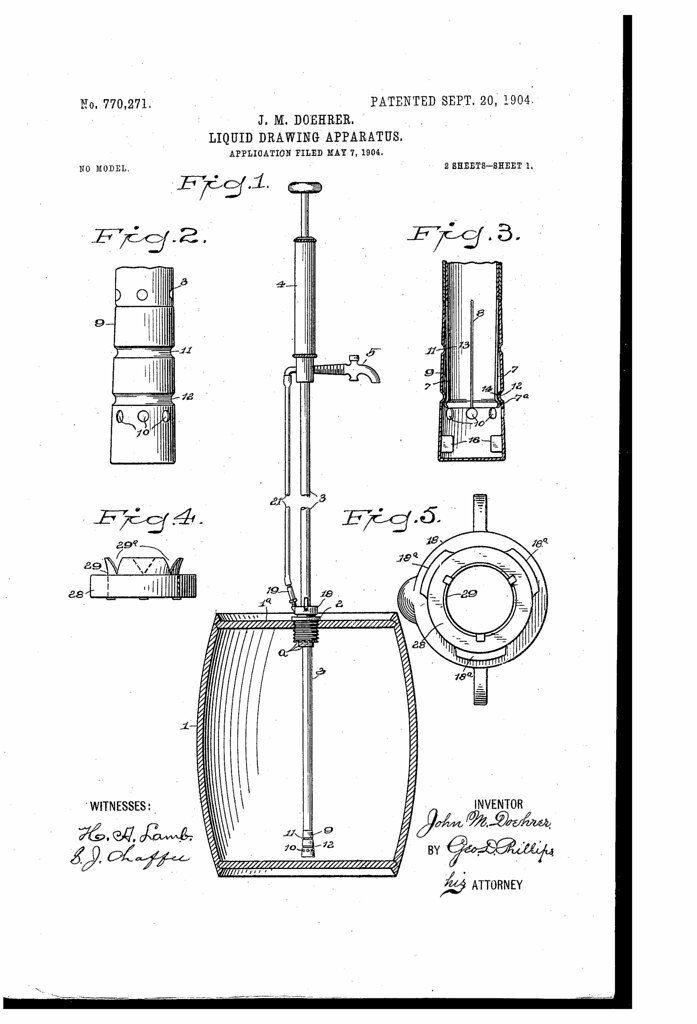
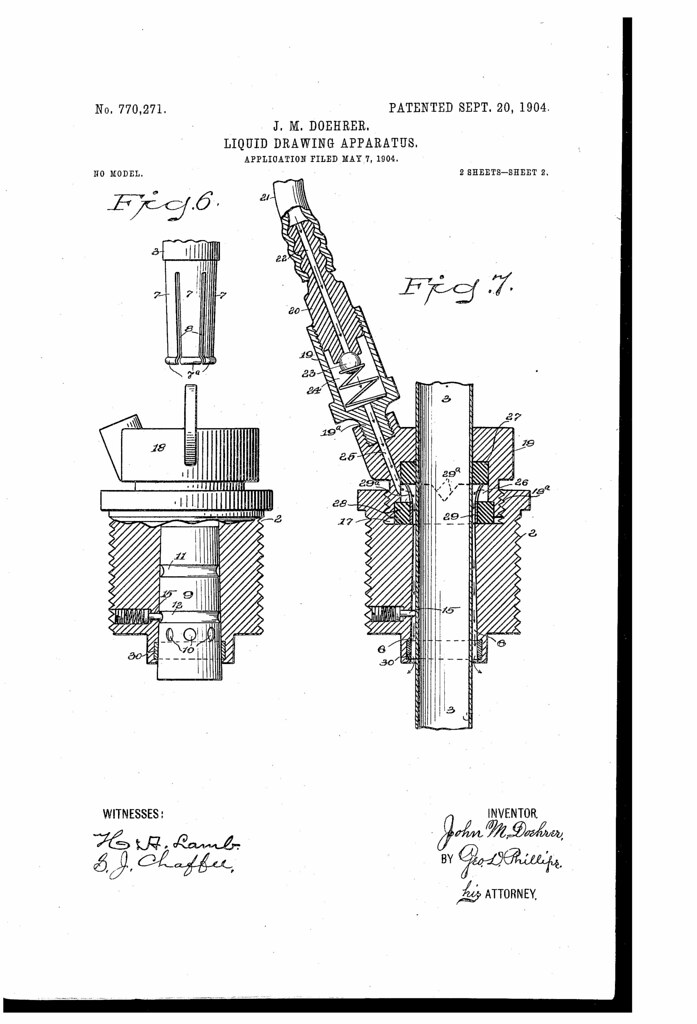
Today in 1904, US Patent 770271 A was issued, an invention of John M. Doehrer, for his “Liquid-Drawing Apparatus.” There’s no Abstract, although in the description it includes this summary:

The object of my invention is to draw beer or other like liquids from the top or bottom of the keg and automatically seal the outlet or bung when the draft-pipe is withdrawn to apply an air-pressure on the top of the beer to force it up through the draft-pipe when drawing the beer.
Untitled
Untitled

Filed Under: Beers, Just For Fun, Politics & Law, Related Pleasures Tagged With: History, Kegs, Law, Patent

Pre-Revolutionary Inns & Ale Houses Of Old Philadelphia

September 20, 2015 By Jay Brooks

independence-hall
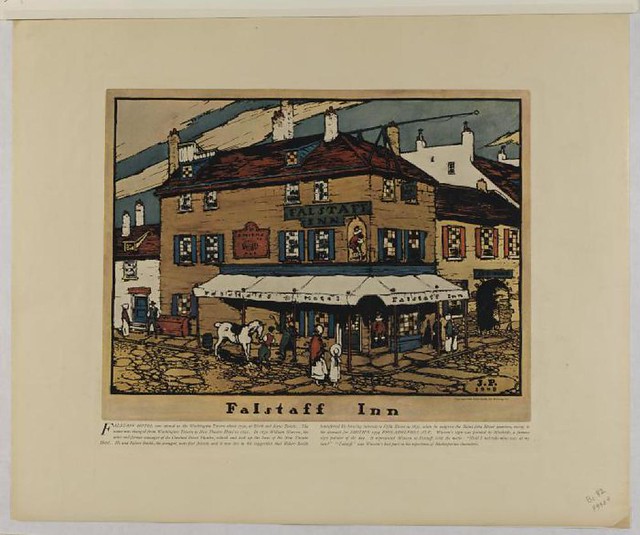
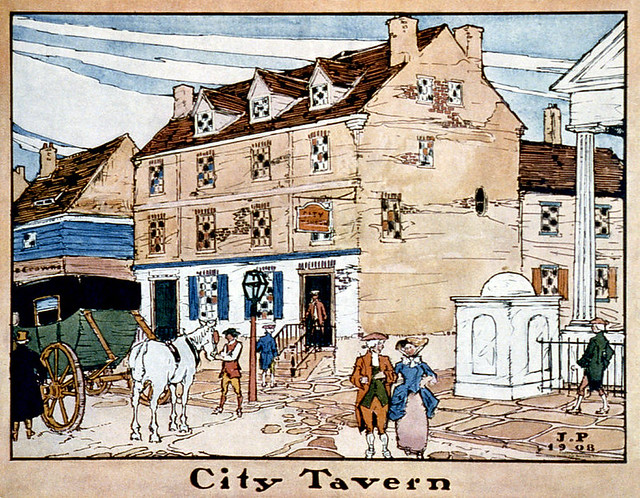
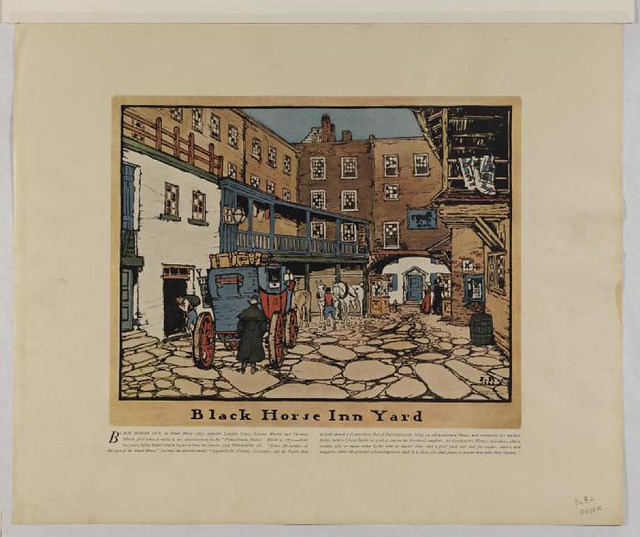
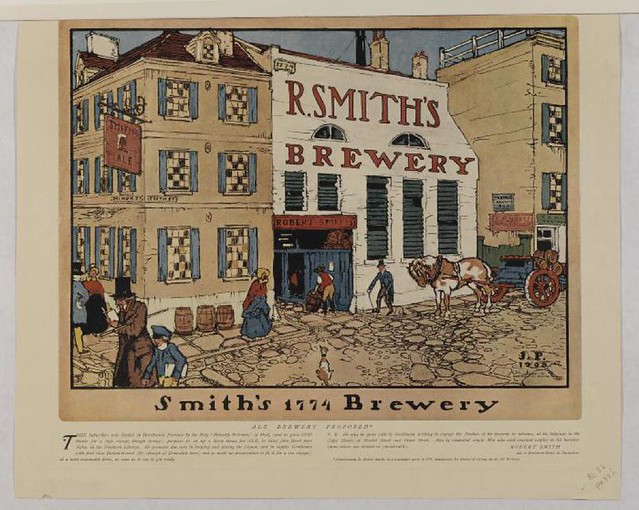
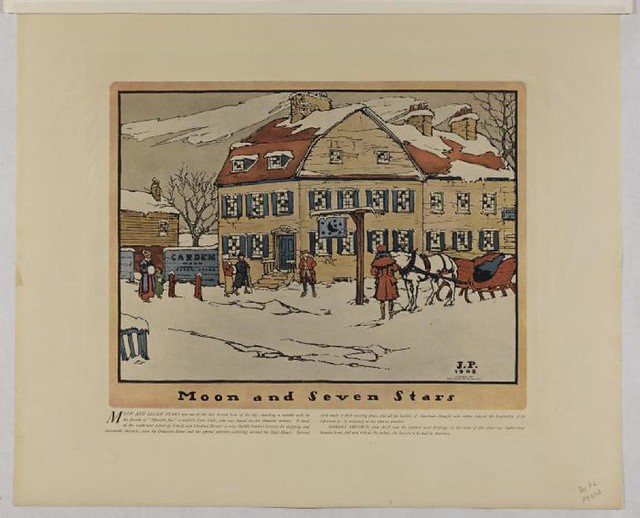
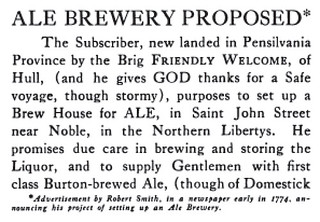
Here’s another fun historical artifact that I came across when I one of my beer ads was for the Robert Smith Ale Brewing Company, which was founded in Philadelphia in 1774, incorporated in 1887, and was apparently acquired by Schmidt’s around 1881. In 1909, Schmidt’s, through their Robert Smith Ale Brewing Company brand, commissioned a local artist, James Preston, to create a series of twelve works depicting pre-revolutionary taverns and inns in or near Philadelphia as way to promote the heritage of the Robert Smith beer brand.

James Moore Preston (1873-1962) was artist and illustrator who trained under Thomas Anshutz at the Pennsylvania Academy of Fine Arts in Philadelphia. Preston also did one cover for the “Saturday Evening Post,” in April 1905, although his most active period was during the 1920s.

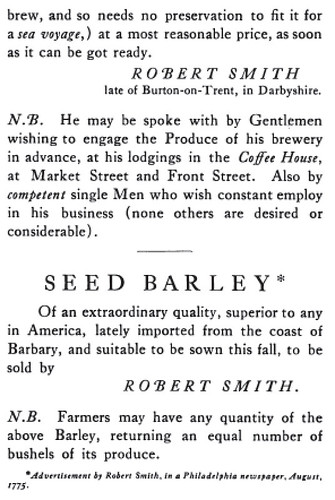
And here’s more about Robert Smith, from an article in Zymurgy magazine by Pennsylvania beer historian Rich Wagner from 1991.

Another brewer who withstood the test of time was Robert Smith. What was to become Robert Smith’s Ale Brewery had its humble beginnings in 1774 when Joseph Potts established a brewery at Fifth and Minor Streets in Philadelphia. During the British occupation of the city, the brewery was seized and used as a barracks.

In 1786 Henry Pepper purchased Potts’ brewery and operated it quite successfully. His wealth and philanthropy were demonstrated when he provided the clock and bell in the tower of Independence Hall. Upon his death in 1898 he donated large sums of money to many charitable and cultural institutions of the city. His son George headed the brewery and directed it successfully before leasing the establishment to Robert Smith.

In 1837 Smith came to America after having served an apprenticeship with the Bass Brewery in Burton-on-Trent, England. He began brewing on St. John Street near the Delaware River. He became acquainted with Pepper and Sickel and in 1845 purchased their brewery.

The Robert Smith India Pale Ale Brewing Company was incorporated in 1887 and moved to a new plant at 38th and Girard (right across the Schuylkill River from “Brewerytown”). It operated until Prohibition as the oldest brewery in continuous operation in America. In 1891 Robert Smith was described as a “hale and hearty” 84-year-old who was still running the brewery. He died two years later and the business was reorganized as the Robert Smith Ale Brewing Co. owned by Schmidt’s Brewery of Philadelphia. The Smith brewery produced mainly ales and stouts. Production figures for the turn of the century are: 1902: 53,521 bbl.; 1905: 61,910 bbl.; 1907: 64,400 bbl. Brands included Tiger Head Ale, XXX Stout, Porter, IPA, Old Mystery, Imperial Burton and English Pale.

The twelve prints show up from time to time on eBay, antiques auctions, collectibles websites and even on Amazon. They’re also in the collection of the Library of Congress.

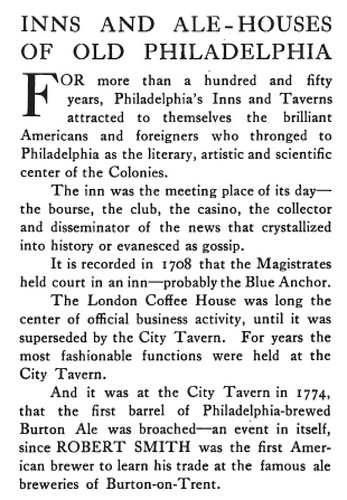
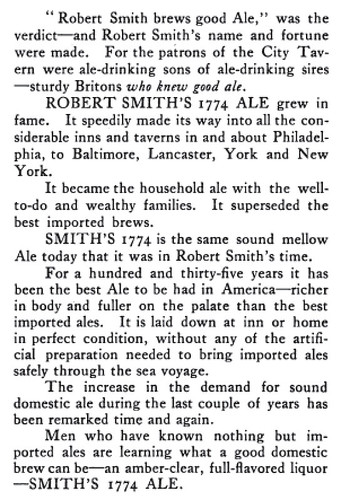
In addition to the posters, they also created a short book — more or a pamphlet at 37 pages — with information about the brewery and each of the twelve images.

Untitled
Untitled
Here’s the book’s introduction:

Untitled
Untitled
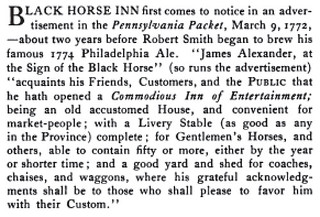
Below are all twelve illustrations. In each case, I used the biggest and best image I could find. Below each print I’ve added the text from the book, and it appears that some editions of the posters may have even included that text just below each print.

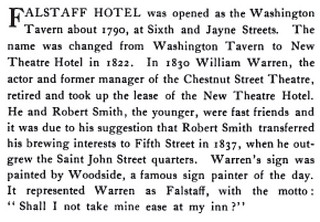
The Falstaff Inn
79242_ca_object_representations_media_121907_page

Untitled
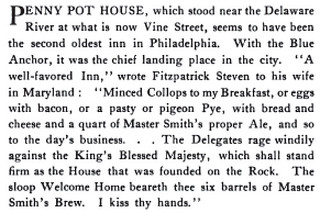
Penny Pot Tavern and Landing
Penny-Pot-Tavern

Untitled
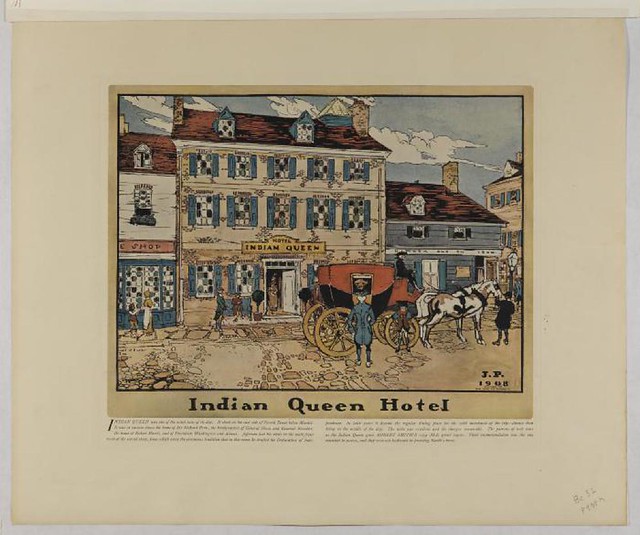
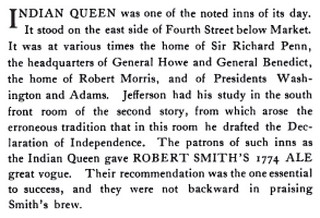
Indian Queen Hotel
25510_ca_object_representations_media_121909_page

Untitled
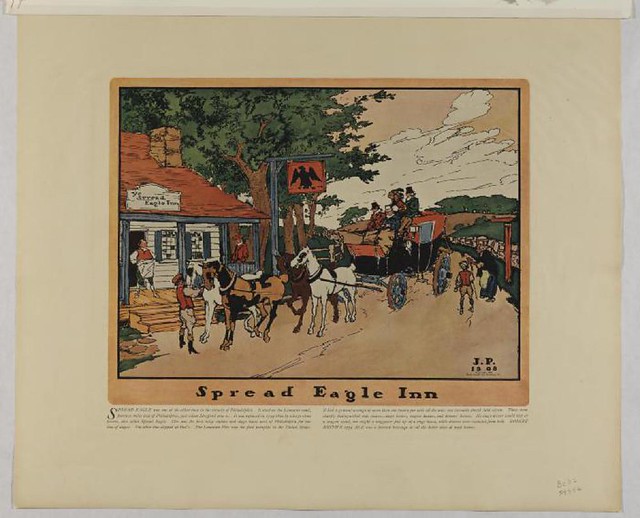
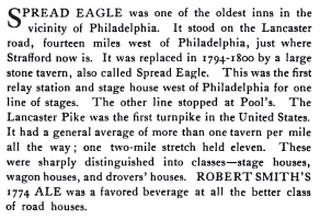
Spread Eagle Inn Inn
5219_ca_object_representations_media_121905_page

Untitled
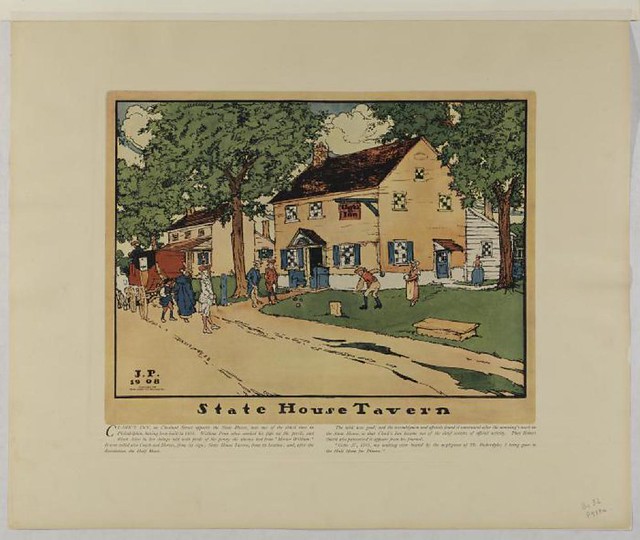
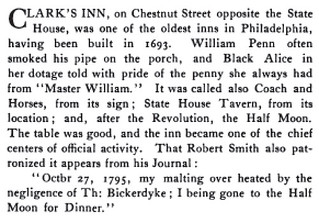
State House Tavern
17821_ca_object_representations_media_121901_page

Untitled
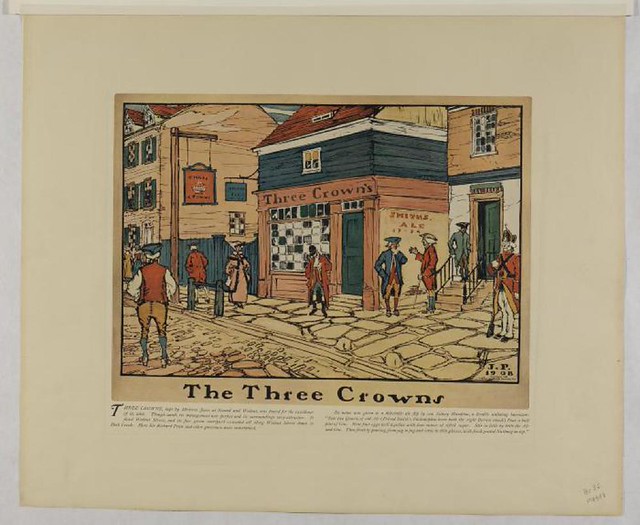
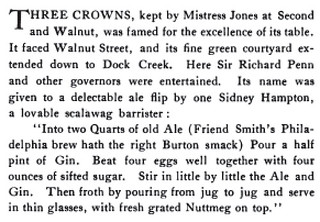
The Three Crowns
27278_ca_object_representations_media_121902_page

Untitled
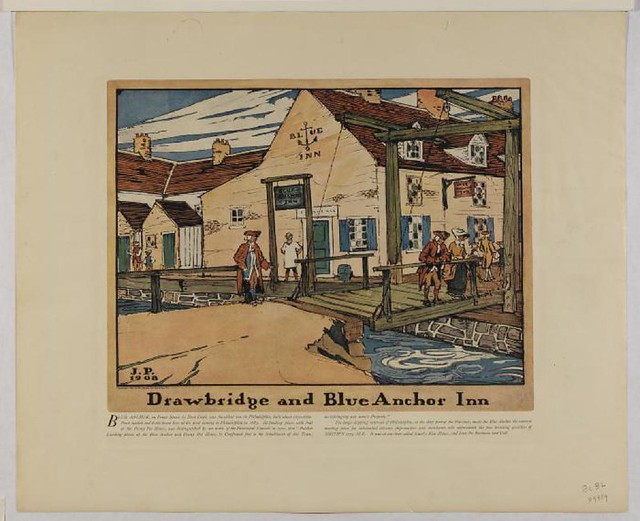
Drawbridge and Blue Anchor Inn
94167_ca_object_representations_media_121908_page

Untitled
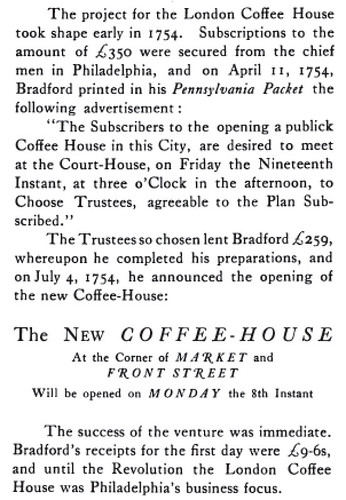
London Coffee House
philadelphia-colonial-inn-the-london

Untitled
Untitled
City Tavern
philadelphia-colonial-inn-the-city

Untitled
Black Horse Inn Yard
84833_ca_object_representations_media_121911_page

Untitled
Smith’s 1774 Brewery
67086_ca_object_representations_media_121910_page

Untitled
Untitled
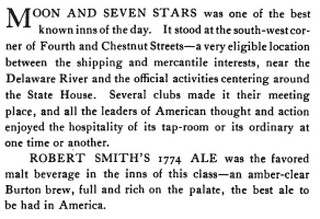
Moon and Seven Stars
56344_ca_object_representations_media_121904_page

Untitled
And here’s the final page of text from the 1909 book.

Untitled

Filed Under: Art & Beer, Just For Fun, Related Pleasures Tagged With: History, Pennsylvania, Philadelphia, Pubs

Patent No. 611003A: Keg Or Barrel

September 20, 2015 By Jay Brooks

patent-logo
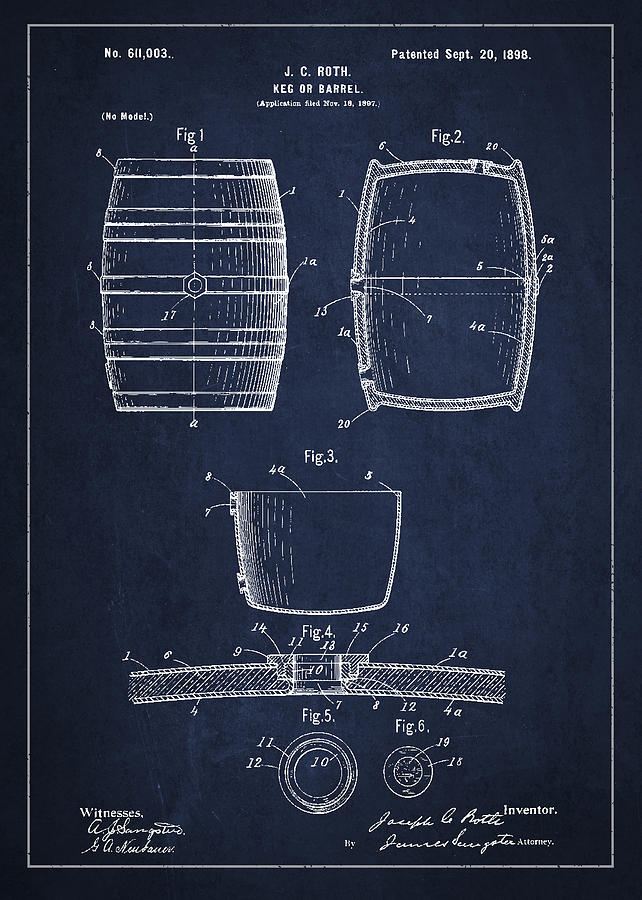
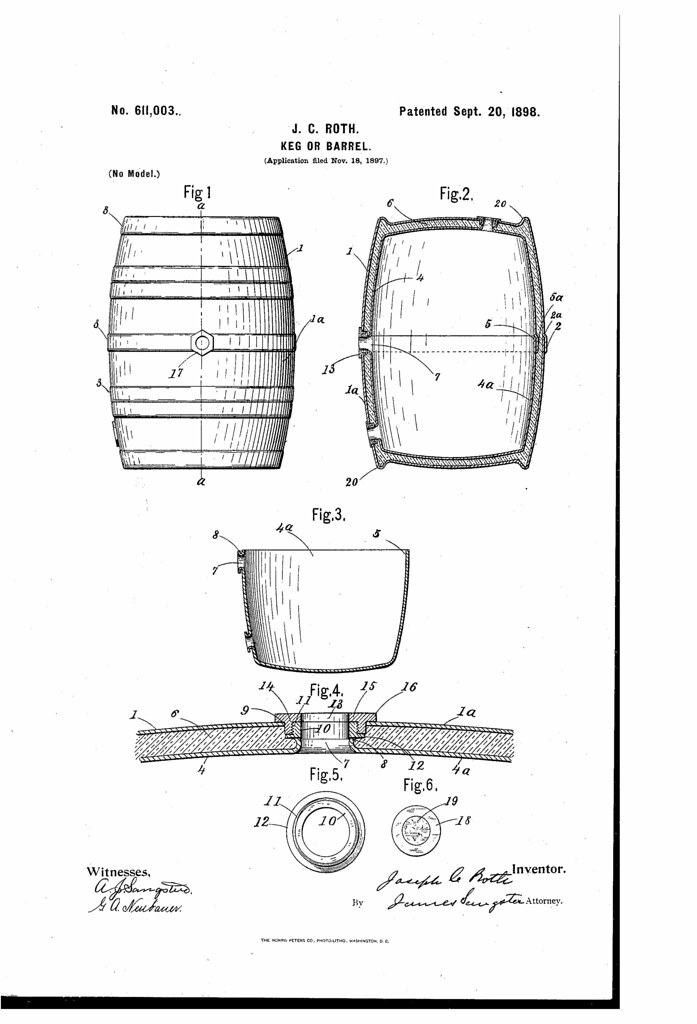
Today in 1898, US Patent 611003 A was issued, an invention of Joseph C. Roth, for his “Keg or Barrel.” There’s no Abstract, although in the description it includes this summary:

My invention relates to sheet-metal kegs or barrels, more particularly that class of barrels employed for beer, wines, or other liquors, and it will be fully and clearly hereinafter described and claimed, reference being had to the accompanying drawings, in which- Figure 1 represents a side elevation of a beer-keg made in accordance with myinvention. Fig. 2 is a vertical section on or about line a a, Fig. 1. Fig. 3 represents a vertical central section through one section of the in-V ner case of the keg or barrel. Fig. 4 represents an enlarged sectional elevation through a portion of a side of a keg, the section passing centrally through the bun g-hole and showing the construction thereof. Fig. 5 represents a detached top view of one of the outwardly-screw-threaded inner rings. Fig. 6 represents a top face View of the improved bung.

vintage-keg-or-barrel-patent-drawing-from-1898-aged-pixel

And here’s the original drawing filed with the patent application:
Untitled

Filed Under: Beers, Just For Fun, Politics & Law, Related Pleasures Tagged With: Barrels, History, Kegs, Law, Patent

Beer In Ads #1683: Great Stuff This Bass

September 19, 2015 By Jay Brooks


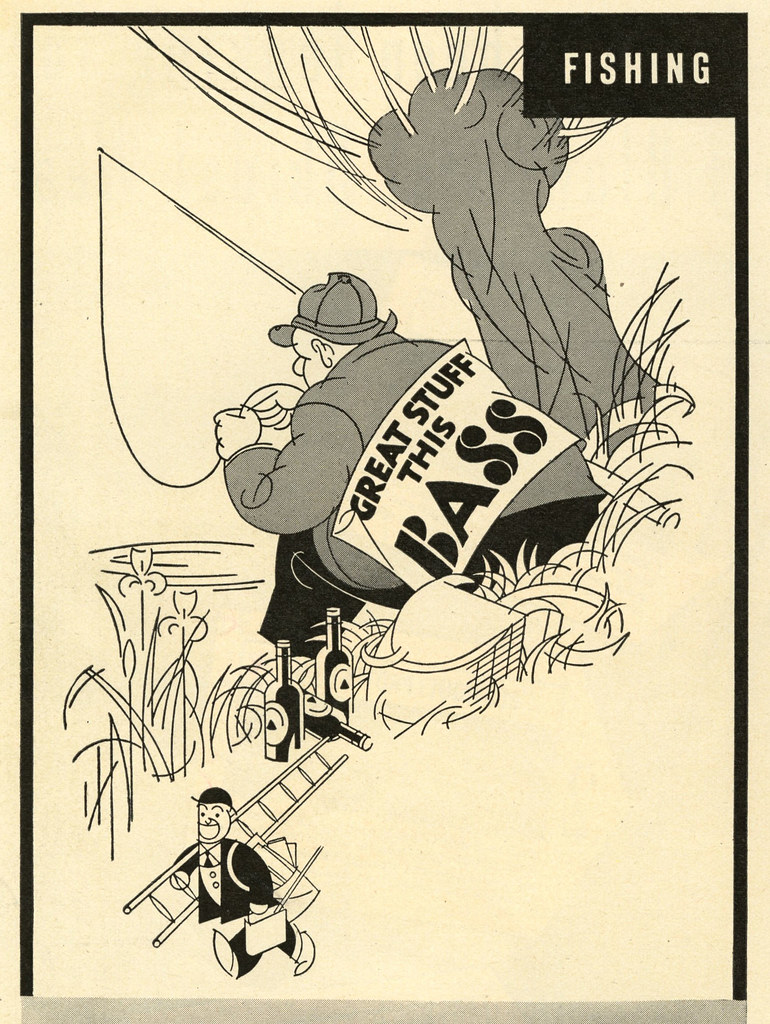
Saturday’s ad is for Bass Ale, from the 1940s. It’s a curious little ad. The block in the upper righthand corner with “Fishing” on it seems to suggest it was part of a series. I guess either he’s so engrossed in his fishing or he’s had enough Bass Ale that he didn’t even notice a tiny man put a ladder on his back, climbed up and attached a sign to his back. “Great Stuff This Bass”

Bass-1940-fishing

Filed Under: Art & Beer, Beers Tagged With: Advertising, Bass, England, History

Patent No. 3692202A: Beer Can Stein With Attached Handle

September 19, 2015 By Jay Brooks

patent-logo
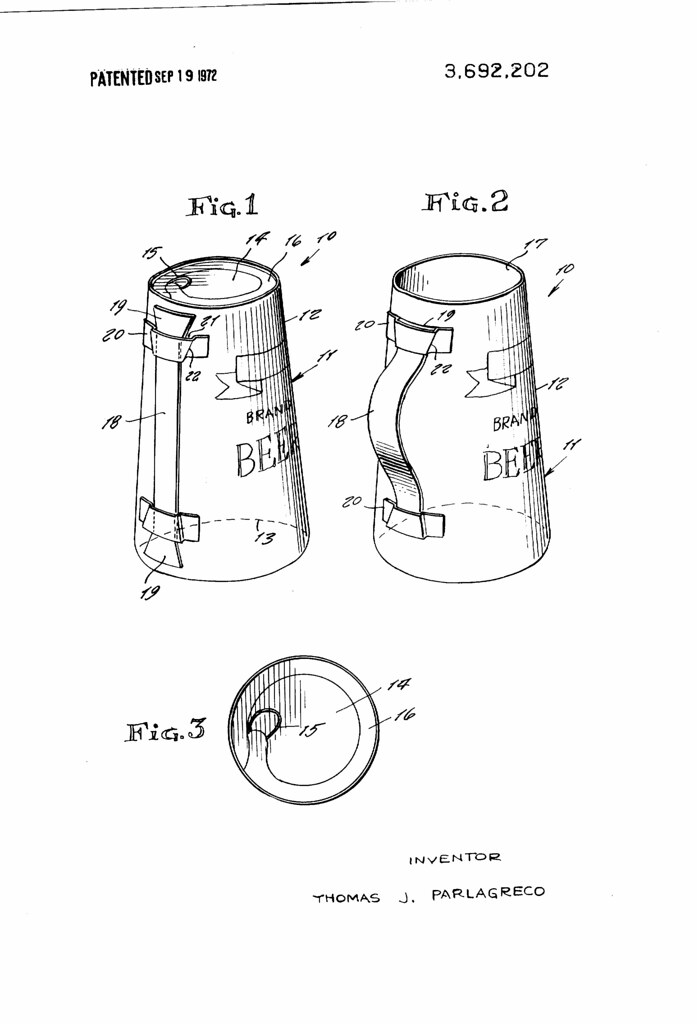
Today in 1972, US Patent 3692202 A was issued, an invention of Thomas J. Parlagreco, for his “Beer Can Stein with Attached Handle.” There’s no Abstract, although in the description it includes this summary:

A metal beer can having a pull tab opening on the upper end thereof so to permit a person to drink directly therefrom, the beer can instead of being cylindrical in shape being slightly tapered upwardly so to resemble the configuration of a beer stein, and the outer side of the can having a flat strap placed adjacent thereto, the center of the strap being able to be pulled away from the can so to form a convenient handle for being held in the hand while drinking.

Untitled

Filed Under: Beers, Just For Fun, Politics & Law, Related Pleasures Tagged With: Cans, Glassware, History, Law, Packaging, Patent

Zwanze Day 2015

September 19, 2015 By Jay Brooks

cantillon russian-river
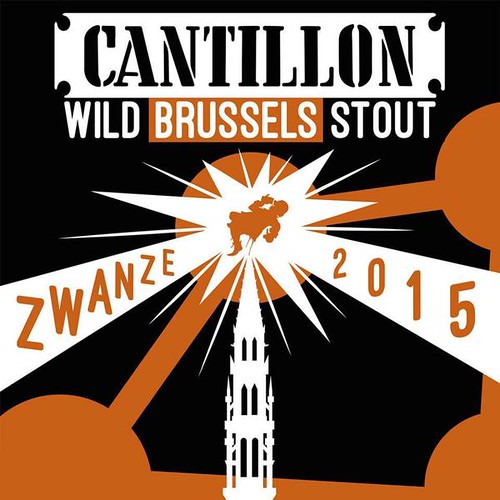
Today was Zwanze Day, an annual holiday deliciously made up by Jean Van Roy of Brasserie Cantillon. Cantillon made the first Zwanze beer in 2008, which that year was a rhubarb beer. In subsequent years they’ve made beers with elderflowers, pineau d’aunis (a red wine grape) and a sour witbier, made with the traditional coriander and orange peel, and last year they made Cuvée Florian, essentially Iris Grand Cru blended with cherries. This year, the beer was Wild Brussels Stout

zwanze-2015

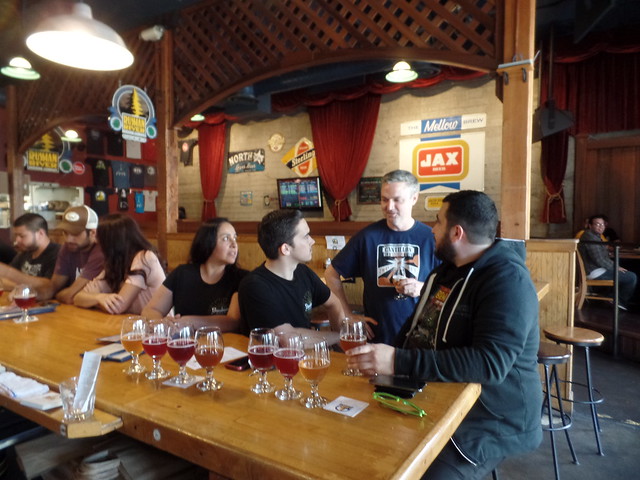
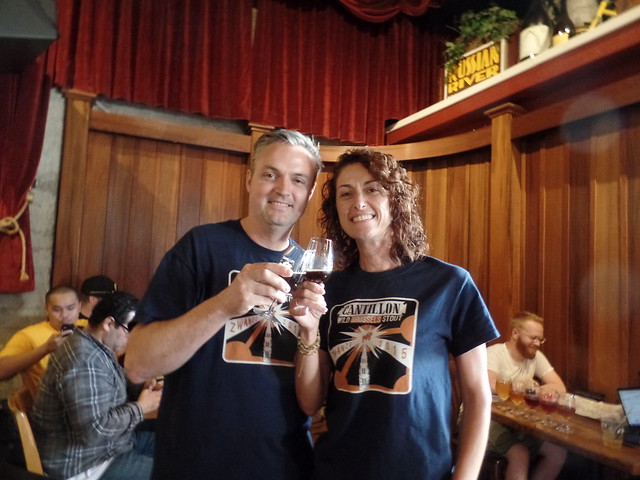
Each year, the beer is tapped at the very same time at locations around the world, regardless of times zone. Once again, this year the Zwanze Day beer was available at 56 beer bars or breweries in seventeen countries. One of those was Russian River Brewing, one of my local breweries, so I again spent the morning there with owners Vinnie and Natalie Cilurzo.

But before we get to the beer, here’s a little history of Zwanze Day. Belgium has essentially two separate regions, with the northern half known as Flanders. The language spoken there is a dialect of Dutch, known by the same name as the people of Flanders: Flemish. The word “zwanze” is unique to Flemish, has its origins in Yiddish, and essentially means a self-deprecating type of humor that’s typified by sharp-edged, playful jokes, usually good-natured. It’s said that this type of humor has become “a characteristic, defining trait” of the Flemish themselves, and for some a way of life. A “zwanze” is a joke, a “zwanzer” a joker. It was with that same playful spirit that Cantillon approached the concept of making a Zwanze beer. The goal was to create a fun beer; something a little unusual, using non-traditional ingredients.

And here’s Jean Van Roy explaining this year’s Zwanze beer:

With its Zwanze 2015, in its own way Cantillon wanted to perpetuate this typically Belgian surrealist mindset. In doing so, a few changes were made to the recipe for a traditional stout. Specifically, I fermented some raw wheat to improve mellowness and enhance storage characteristics and did not use roasted barley to avoid further accentuating the dry aspect, which was already present as a result of spontaneous fermentation.

The recipe is that of a stout, the colour is that of a stout, and spontaneous fermentation followed by 28 months of maturing in a cask has given birth to a “surreal” stout.

The dry and tart notes of a spontaneous fermentation beer combine with the roasted, slightly burnt and delicate chocolate flavours sometimes found in certain stouts.

For the 28 months of maturing we used three types of casks: 50% of the casks had already contained lambic, 25% had already been used for Côtes du Rhône wine and 25% had already been used for Cognac. Beers that have matured in old Cognac casks take up the warmth of the alcohol while those from casks having contained red wine adopt winey and fruity characteristics.

This “wild” stout’s fruitiness and “cooked” side reveal rancio flavours that are characteristic of Madeira or Banyuls wines.

Cantillon-Zwanze-Stout-2015
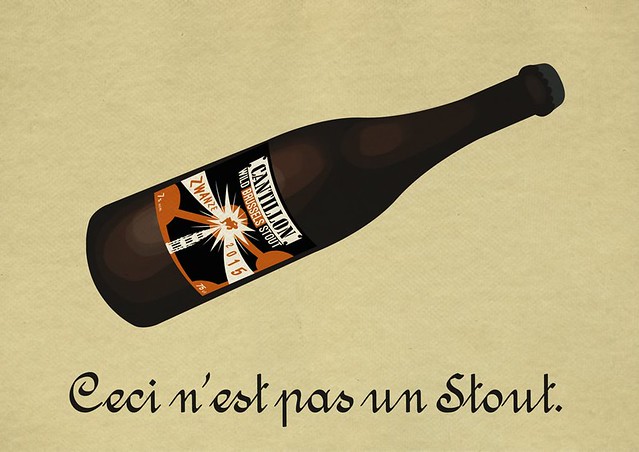
Having a little fun with one of Belgium’s best known artists, Rene Magritte, and one of his best known paintings, The treachery of images (a.k.a. Ceci n’est pas une pipe.)


Untitled
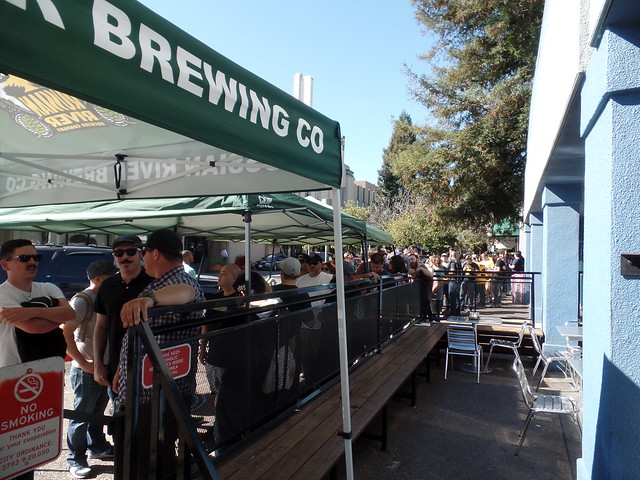
People lined up to try the very limited release Zwanze, stretching about halfway down the block. So not as crazy as for Pliny the Younger, but a respectable number of people, and enough that not everyone in line could be guaranteed a sample by around an hour before opening time.

Untitled
The doors to the brewpub opened at 11, an hour before the worldwide toast was to take place. Four other beers from Cantillon were available on draft — Gueuze, Iris, Kriek and Rose de Gambrinus — so people had something to enjoy while they waited. And Vinnie greeted people as he walked around while people were seated.

Untitled
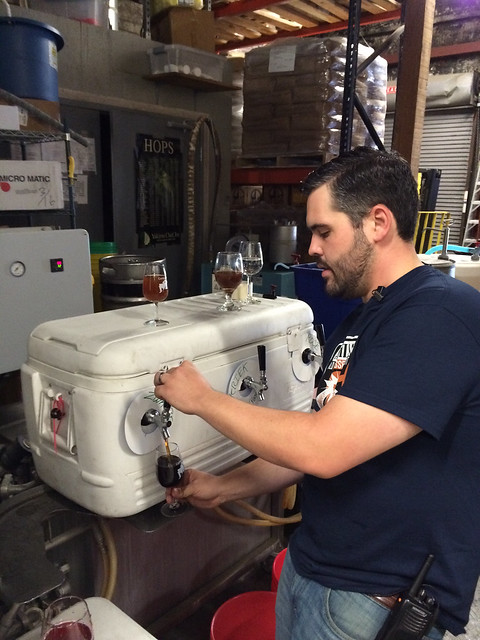
The first pour of this year’s Zwanze beer right at Noon.

Untitled
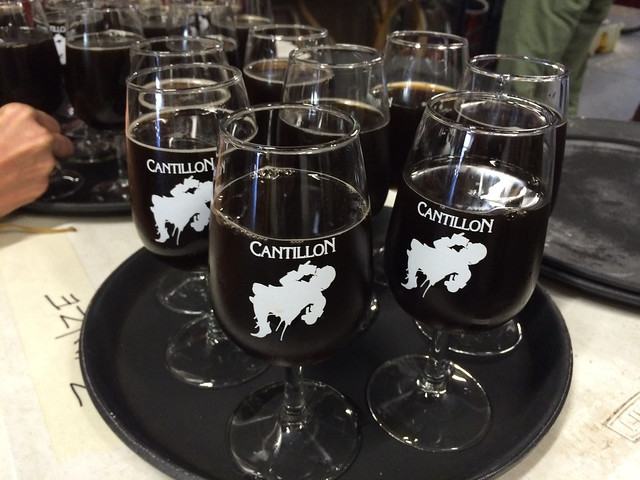
Followed by the first trays of Zwanze ready to be served.

Untitled
Vinnie and Natalie after giving the Zwanze Day toast.

Filed Under: Beers, Events, Just For Fun Tagged With: Bay Area, Belgium, California, Cantillon, Photo Gallery

Patent No. 2173529A: Barrel-Tapping Apparatus

September 19, 2015 By Jay Brooks

patent-logo
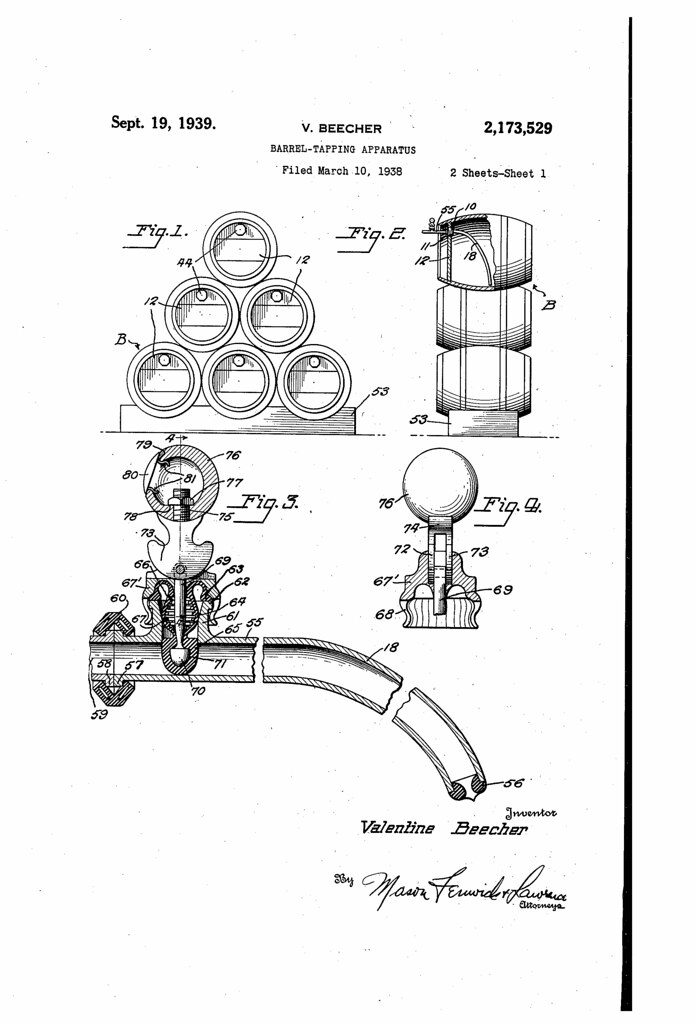
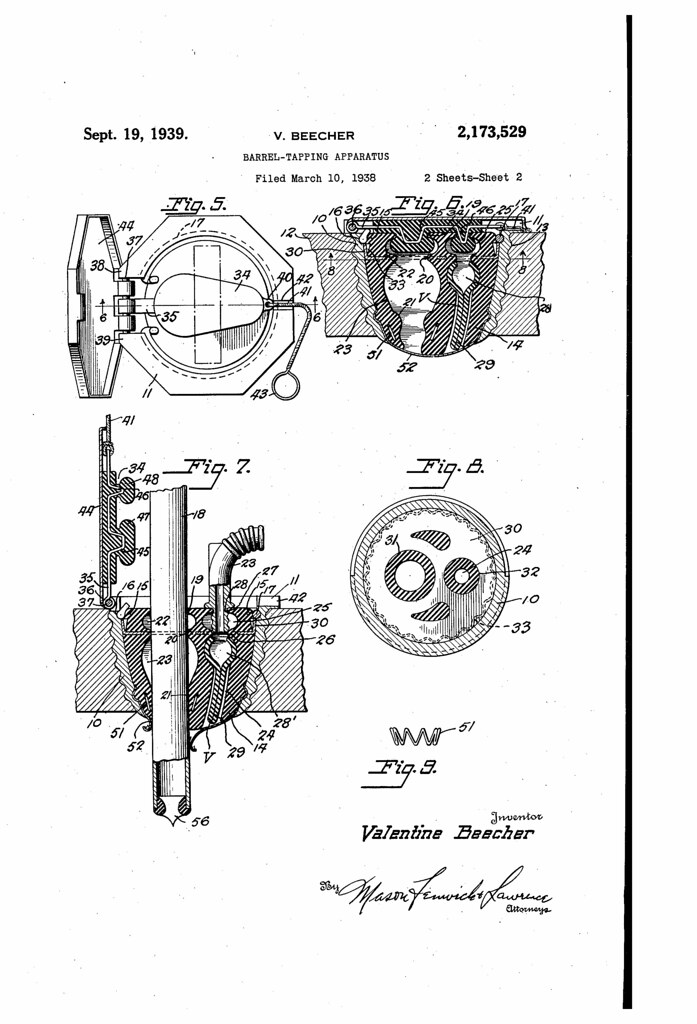
Today in 1939, US Patent 2173529 A was issued, an invention of Valentine Beecher, for his “Barrel-Tapping Apparatus.” There’s no Abstract, although in the description it includes this summary:

The invention forming the subject matter of this application relates to barrel bung and barrel tapping apparatus generally; and more particularly to such apparatus adapted for use in sealing or drawing of liquids from barrels, casks, vessels, etc., irrespective of position, or arranged in superposed rows with their axes substantially horizontal or vertical.

The main object of the invention is to provide a compact bung and tapping arrangement by means of which a straight or curved draught tube of metal or any material may be inserted through the bung and into such position within the barrel as to facilitate the removal of part, or all of the liquid contents, whenever desired.

A further object of the invention is to provide a bung that is non-rigid and extremely flexible and a tapping construction requiring less physical force or pressure than would otherwise have to be created by mechanical means, adapted for use with straight or curved glass draught tubing. to enable the liquid contents of the barrels to be dispensed; and also preventing such contents making contact with metal or other substances which might have an injurious effect upon the liquids dispensed, if so desired.

Untitled
Untitled

Filed Under: Beers, Just For Fun, Politics & Law, Related Pleasures Tagged With: History, Kegs, Law, Patent

Beer In Ads #1682: Be Light-Hearted! Stay Light-Hearted!

September 18, 2015 By Jay Brooks


Friday’s ad is for Carling’s Red Cap Ale, from 1952. “Be Light-Hearted! Stay Light-Hearted! Step up to Carling’s!” The illustration shows a couple entwined with beer mugs, but apparently disagreeing on why they like the beer. One says “Light as the smoothest drink!” The other one believes its “Hearty as only an ale can be!” My vote is for hearty.
Red-Cap-1951-light-hearted

Filed Under: Art & Beer, Beers Tagged With: Advertising, Canada, History

Patent No. 3054676A: Process For Producing A Cereal Adjunct For Use In Brewing

September 18, 2015 By Jay Brooks

patent-logo
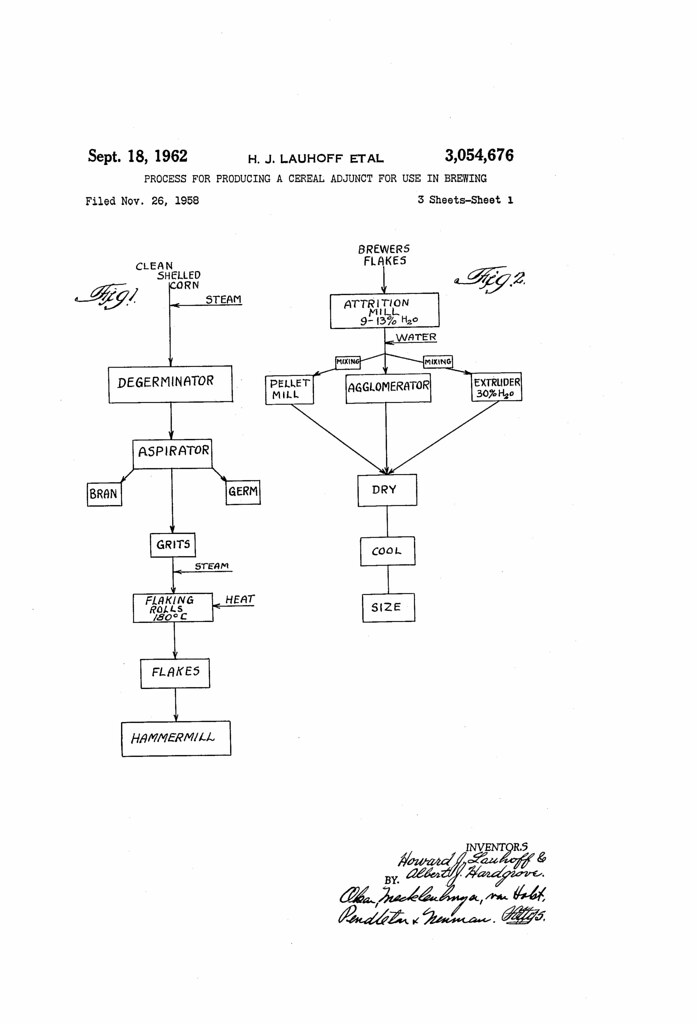
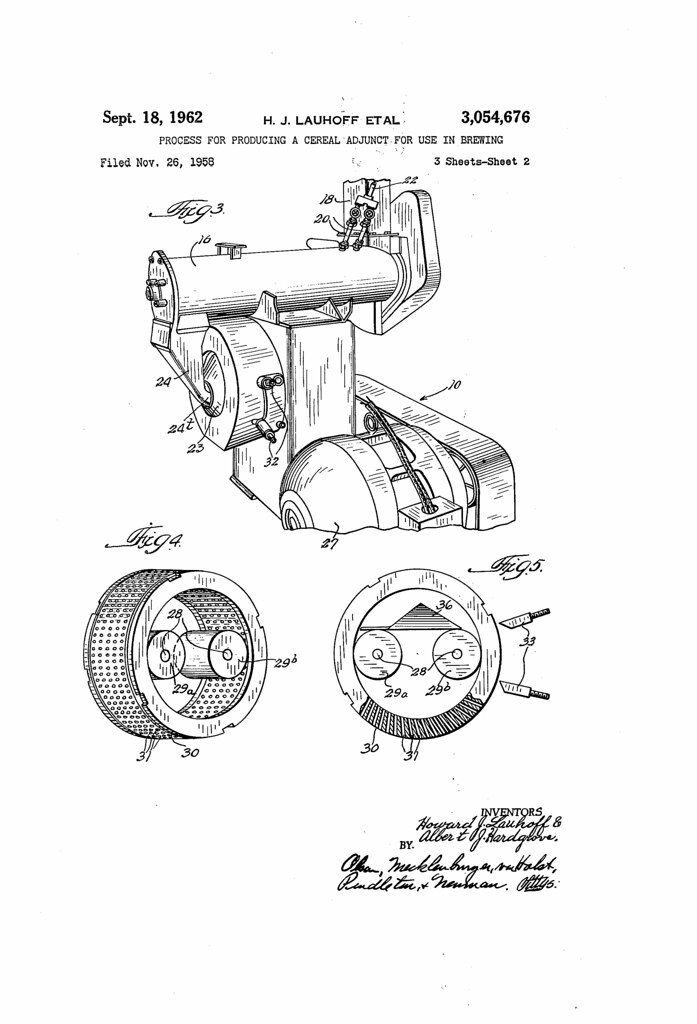
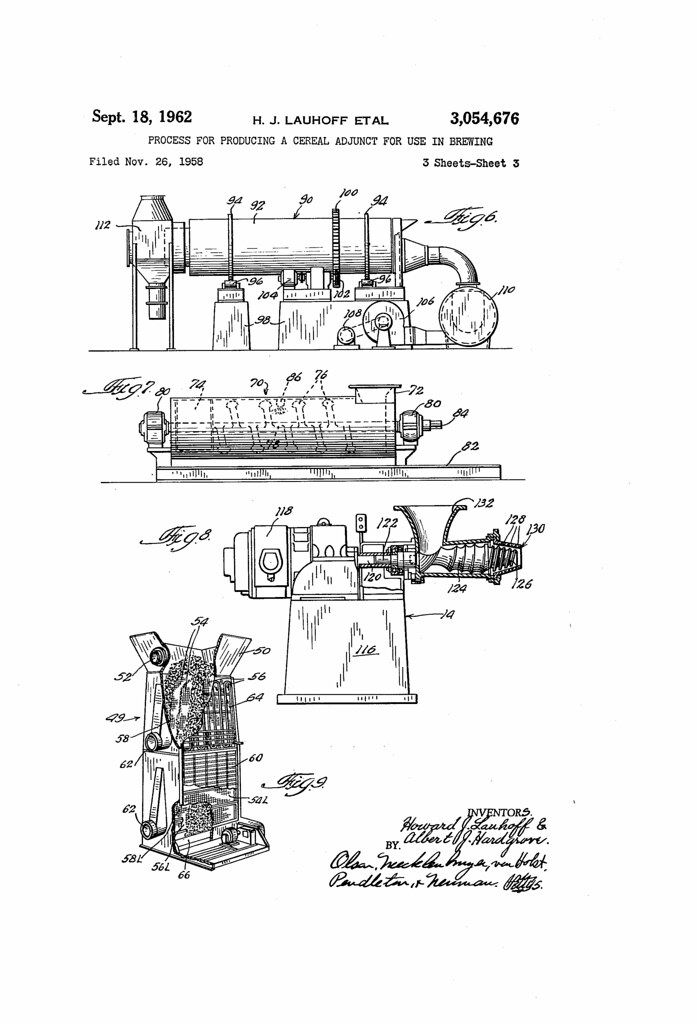
Today in 1962, US Patent 3054676 A was issued, an invention of Albert J. Hardgrove and Howard J. Lauhoff, assigned to the Lauhoff Grain Company, for their “Process For Producing A Cereal Adjunct For Use In Brewing.” There’s no Abstract, although in the description it includes this summary:

It is an object of this invention therefore to provide an improved cereal adjunct which can be efficiently handled and employed directly in the mashing step without pre-treatment. It is also an object of this invention to provide a method for producing such adjunct.

It is a further object of this invention to provide an improved cereal adjunct which will produce a higher product yield in the normal brewing operation.

It is another object of this invention to provide a cereal adjunct which can be efficiently utilized in any modern automatic brewery apparatus designed to handle materials necessary in the brewing process.

It is another object of this invention to provide an improved pre-gelatinized cereal adjunct for breweries which has less bulk than other similar type adjuncts, thereby reducing shipping costs, and requiring less storage space.

Untitled
Untitled
Untitled

Filed Under: Beers, Breweries, Just For Fun, Politics & Law, Related Pleasures Tagged With: History, Law, Patent, Science of Brewing

Scientific Proof You Can’t Get Drunk On Beer

September 18, 2015 By Jay Brooks

science
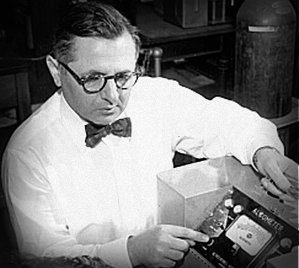
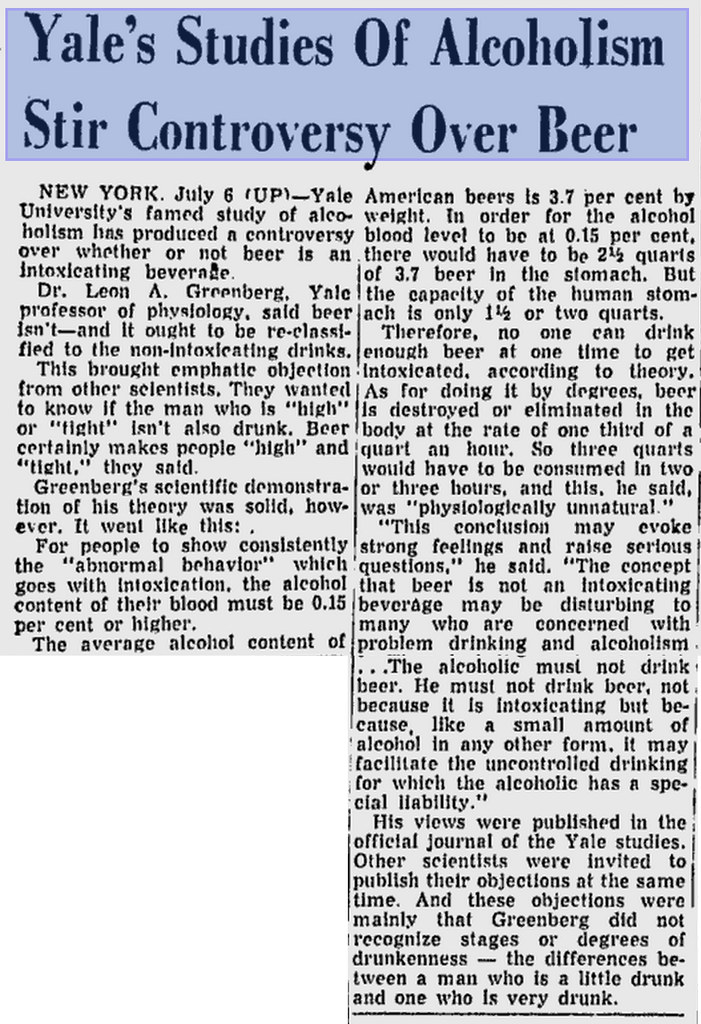
Here’s a stroll down memory lane, when in 1955 a Yale professor, Dr. Leon A. Greenberg, declared that beer isn’t an intoxicating beverage “and should be reclassified to the non-intoxicating drinks.” Greenberg was no stranger to alcohol, and in fact in the 1930s invented the Alcometer, “the first machine that analyzed the breath for alcohol,” before coming to Yale in 1933 to head what would become the Center of Alcohol Studies. Seven years after this story, the center moved to Rutgers. Maybe there’s a connection? Certainly when Dr. Greenberg passed away in 1986, his obituary didn’t mention this chapter in his life.

In the story, other scientists may have thought he’d gone crazy, but restrained themselves from saying so, and diplomatically disagreed.

This brought emphatic objection from other scientists. They wanted to know if the man who is “high” or “tight” isn’t also drunk. Beer certainly makes people “high” and “tight,” they said.

The UP story then described his theory:

For people to show consistently the “abnormal behavior” which goes with intoxication, the alcohol content of their blood must be 0.15 per cent or higher.

THE AVERAGE alcohol content of American beers is 3.7 per cent by weight. In order for the alcohol blood level to be at 0.15 per cent, there would have to be two and one-half quarts of 3.7 beer in the stomach. But the capacity of the human stomach is one and one-half to two quarts.

Therefore, no one can drink enough beer at one time to get intoxicated, according to theory. As for doing it by degrees: beer is destroyed or eliminated in the body at the rate of one-third of a quart an hour. So three quarts would have to be consumed in two or three hours, and this, he said, was “physiologically unnatural.”

“The alcoholic must not drink beer. He must not drink beer, not because it is intoxicating but because, like a small amount of alcohol in any other form, it may facilitate the uncontrolled drinking for which the alcoholic has a special liability.

His views were published in the official journal of the Yale studies. Other scientists were invited to publish their objections at the same time. And these objections were mainly that Greenberg did not recognize stages or degrees of drunkenness – the differences between a man who is a little drunk and one who is very drunk.

greenberg
See, science can’t lie.

The Minnesota Star Tribune, which in 1955 was apparently just the Minnesota Tribune, also ran the story on July 7, 1955, but they gave more space to Dr. Greenberg’s dissenters. As they note, it “demonstrates that you can be right about all the facts and still come to the wrong conclusion.”
Dr. Albion Roy King, professor of philosophy, Cornell college, Mount Vernon, Iowa, said Greenberg has performed a “feat of word manufacture and manipulation which simply makes more graphic what everybody knows, that it takes more drinking to get tight on beer than on whisky.”

Dr. Harry M. Tiebout, a psychiatrist and vice chairman of the Connecticut commission on alcoholism, said Greenberg’s view is “simple nonsense – in the eyes of most beer drinkers.”

“They may know nothing about their blood level or the percentage alcohol content of the beer drink, and they care less.

“What they do know is that they get drunk on beer, using their definition. Alcohol is alcohol, in any concentration and its regular use can lead to trouble.”

Dr. Frank J. O’Brien, associate superintendent of schools, New York city, objected to the generalizing on the grounds that alcohol affects different people differently.

It certainly seems almost silly to think he went public with such an obviously false conclusion. Beer may be the beverage of moderation, but it will still give you a buzz. And simple experience would teach anyone that much better than at least one Yale professor. Happy Friday!

yale-alcoholism-1955
Here’s how the UP story ran in the Palm Beach Post on July 7, 1955.

Filed Under: Beers, Just For Fun Tagged With: History, Humor, Science

« Previous Page
Next Page »

Find Something

Northern California Breweries

Please consider purchasing my latest book, California Breweries North, available from Amazon, or ask for it at your local bookstore.

Recent Comments

  • Bob Paolino on Beer Birthday: Grant Johnston
  • Gambrinus on Historic Beer Birthday: A.J. Houghton
  • Ernie Dewing on Historic Beer Birthday: Charles William Bergner 
  • Steve 'Pudgy' De Rose on Historic Beer Birthday: Jacob Schmidt
  • Jay Brooks on Beer Birthday: Bill Owens

Recent Posts

  • Beer In Ads #5199: Spring Is Here! April 1, 2026
  • Historic Beer Birthday: William H. Gerst April 1, 2026
  • Historic Beer Birthday: Carl W. Conrad April 1, 2026
  • Beer In Ads #5198: Heim’s Bock Beer! Ready To-Day April 1, 2026
  • Historic Beer Birthday: August Koch April 1, 2026

BBB Archives

Feedback

Head Quarter
This site is hosted and maintained by H25Q.dev. Any questions or comments for the webmaster can be directed here.